THE “MAINSTREAMING” OF
AMERICA: VIOLENCE PROFILE
          NO.11
  ~GEORGE GERBNER ET AL
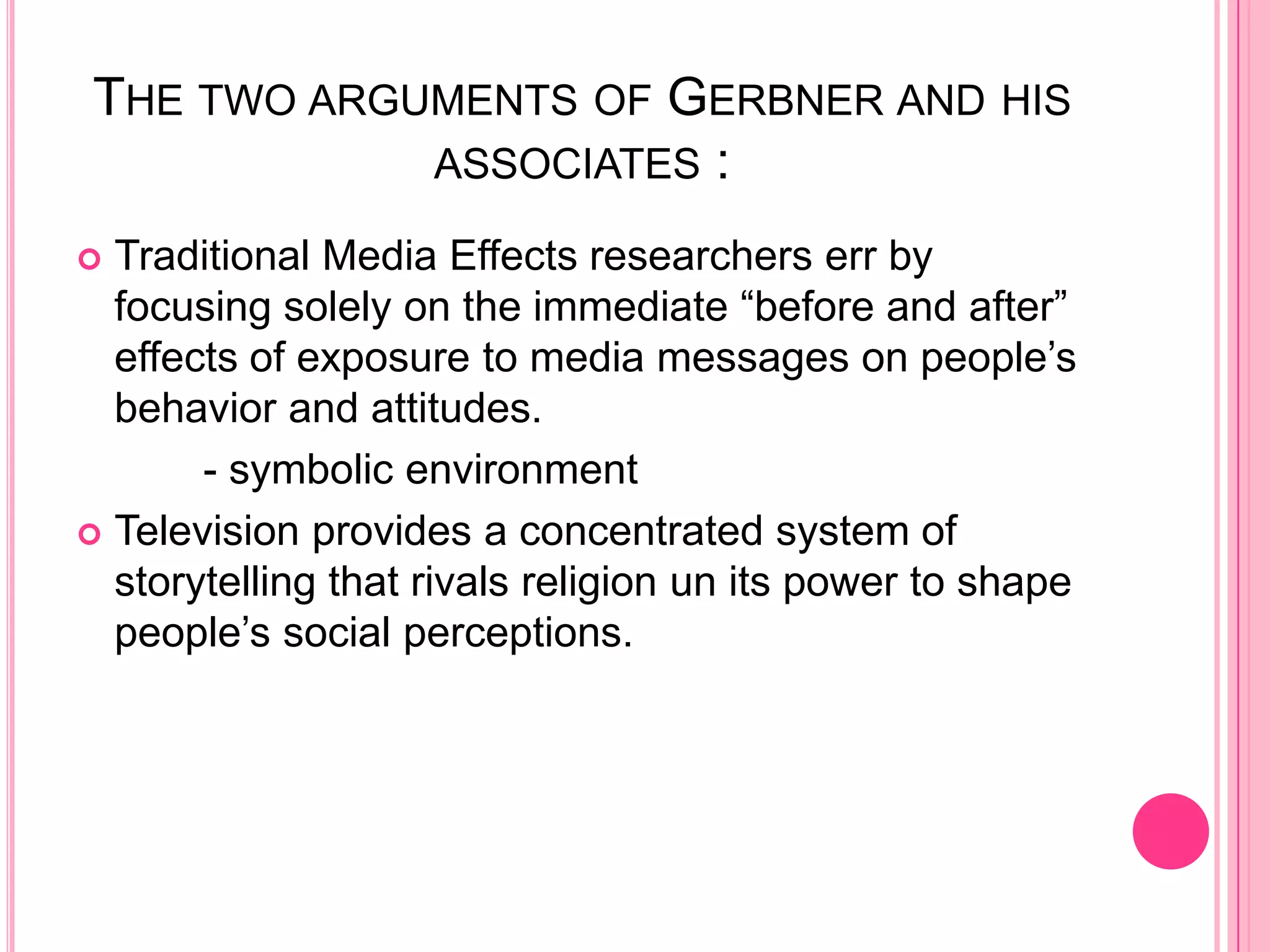
GEORGE GERBNER
   He was born in Budapest in 1919, Mr.
    Gerbner intended to study folklore at the
    University of Budapest but was forced to flee
    fascist Hungary in 1939.
   Mr. Gerbner worked as a professor and
    researcher at the Institute for
    Communications Research at the University
    of Illinois from 1956 until 1964, when he
    accepted a position at Penn. After leaving
    Penn in 1990, he founded the Cultural
    Environment Movement, an advocacy group
    working for greater diversity in media.
   He was dean emeritus of the Annenberg
    School for Communications at the University
    of Pennsylvania and studied television for
    more than three decades.
GEORGE GERBNER
   He founded the Cultural Indicators Research Project in
    1968 to track changes in television content and how
    those changes affect viewers' perceptions of the world.
    Its database has information on more than 3,000
    television programs and 35,000 characters.
   Mr. Gerbner also worked with Larry Gross, Michael
    Morgan, and Nancy Signorielli. Gross and Signorielli
    were both professors of communication.
   He coined the phrase "mean world syndrome," a
    phenomenon in which people who watch large amounts
    of television are more likely to believe that the world is
    an unforgiving and frightening place.
   He focused on the effects of mass media on everyday
    life.
THE TWO ARGUMENTS OF GERBNER AND HIS
            ASSOCIATES :

 Traditional Media Effects researchers err by
  focusing solely on the immediate “before and after”
  effects of exposure to media messages on people’s
  behavior and attitudes.
       - symbolic environment
 Television provides a concentrated system of
  storytelling that rivals religion un its power to shape
  people’s social perceptions.
OVERVIEW: CULTURAL
           INDICATORS PROJECT
   Is a “longitudinal” or long-term study of media
    effects involving a three-pronged research effort:
    - institutional analysis (structures of decision
    making that are involved in the production of media
    messages)
    - message system analysis
    - cultivation analysis
WHAT IS CULTIVATION THEORY?
 States that television brings about a shared way of
  viewing the world.
 Hypothesizes that perceptions of the social world
  on the part of heavy viewers will very closely
  resemble the structure of the “world of TV” content.
CULTURAL INDICATORS PROJECT
            (1968)
 Television makes specific and measurable
  contributions to viewers’ conceptions of reality.
  These contributions relate both to the synthetic
  world television presents and to viewers’ real life
  circumstances.
 In cultivation analysis, it is the periodic
  examinations of television programming and
  conceptions of social reality cultivated by viewing.
 The two interrelated parts of the Project are:
  message system analysis and cultivation analysis
MESSAGE SYSTEM ANALYSIS
 It is the annual monitoring of samples of prime time
  and weekend daytime network dramatic
  programming (including series, other
  plays, comedies, movies, and cartoons).
 It involves in-depth, quantitative content analysis
  aimed at discovering basic, social building blocks of
  TV content.
CULTIVATION ANALYSIS
 It is the investigation of viewer conceptions of social
  reality associated with the most recurrent features
  of the world of television.
 It focuses on TV viewers , correlating attitudes
  about the social world with the amount of TV
  viewing and content of TV.
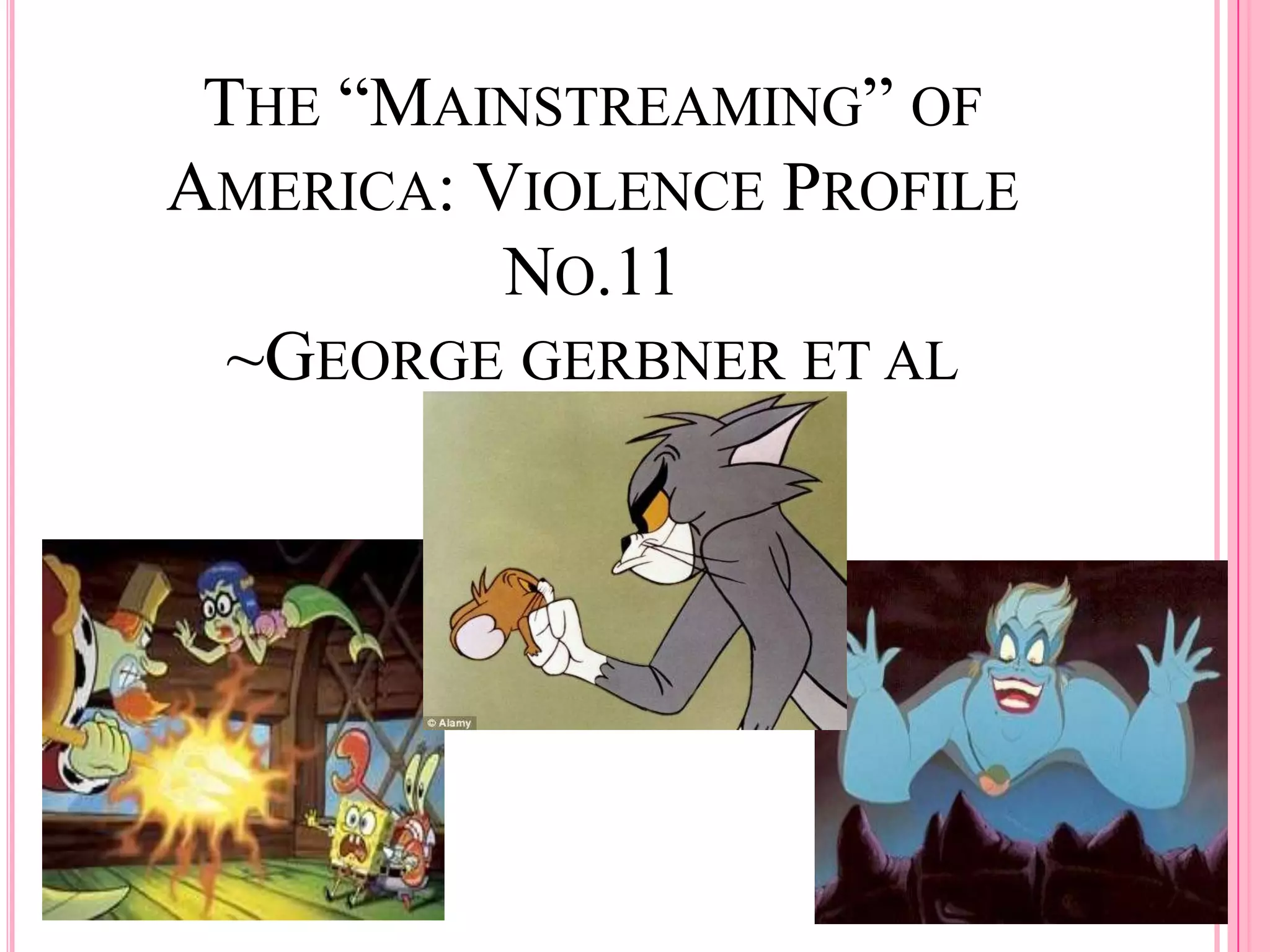
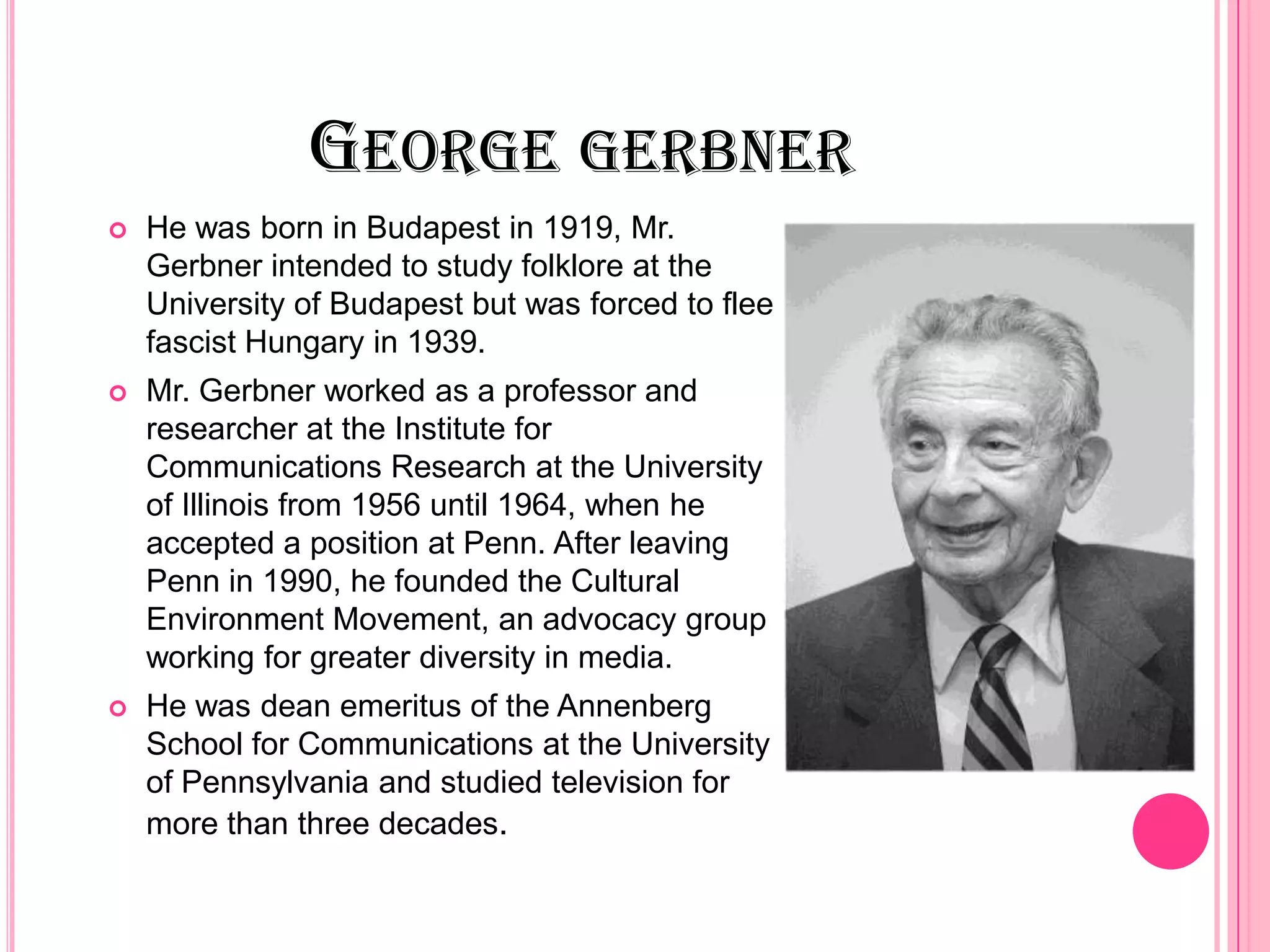
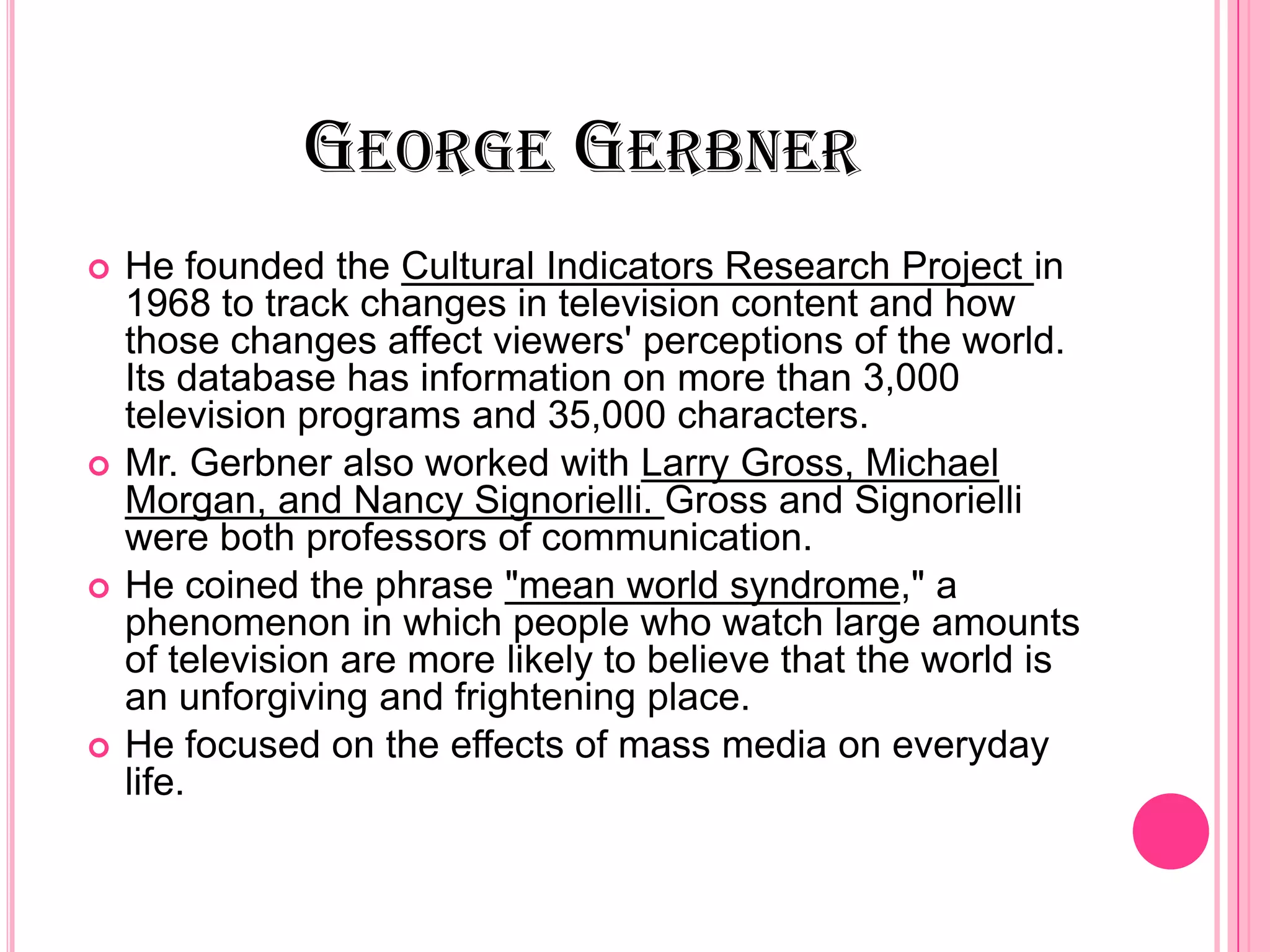
VIOLENCE
   Violence is the overt expression of physical force with or
    without a weapon, against self or others) compelling
    action against one’s will on pain of being hurt or killed or
    threatened to be so victimized as part of the plot.
   Violence Index is the annual content analysis of a
    sample week of network television prime time fare
    demonstrating how much violence is present
ICE-AGE ANALOGY
   In cultivation analysis, it is the idea that the size of
    television’s influence is less critical than the
    direction of its steady contribution.
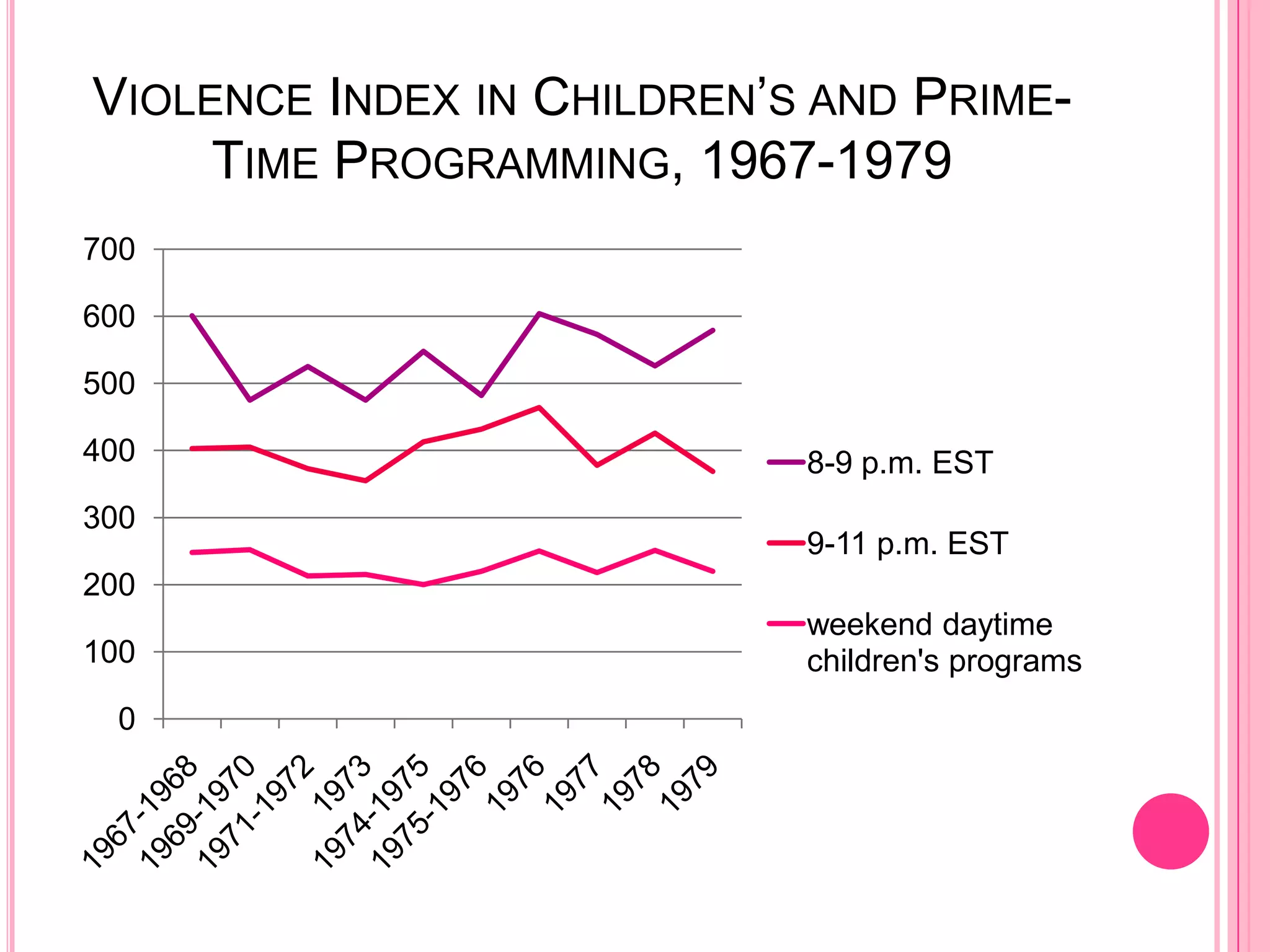
VIOLENCE INDEX IN CHILDREN’S AND PRIME-
     TIME PROGRAMMING, 1967-1979
700

600

500

400                         8-9 p.m. EST
300
                            9-11 p.m. EST
200
                            weekend daytime
100                         children's programs
  0
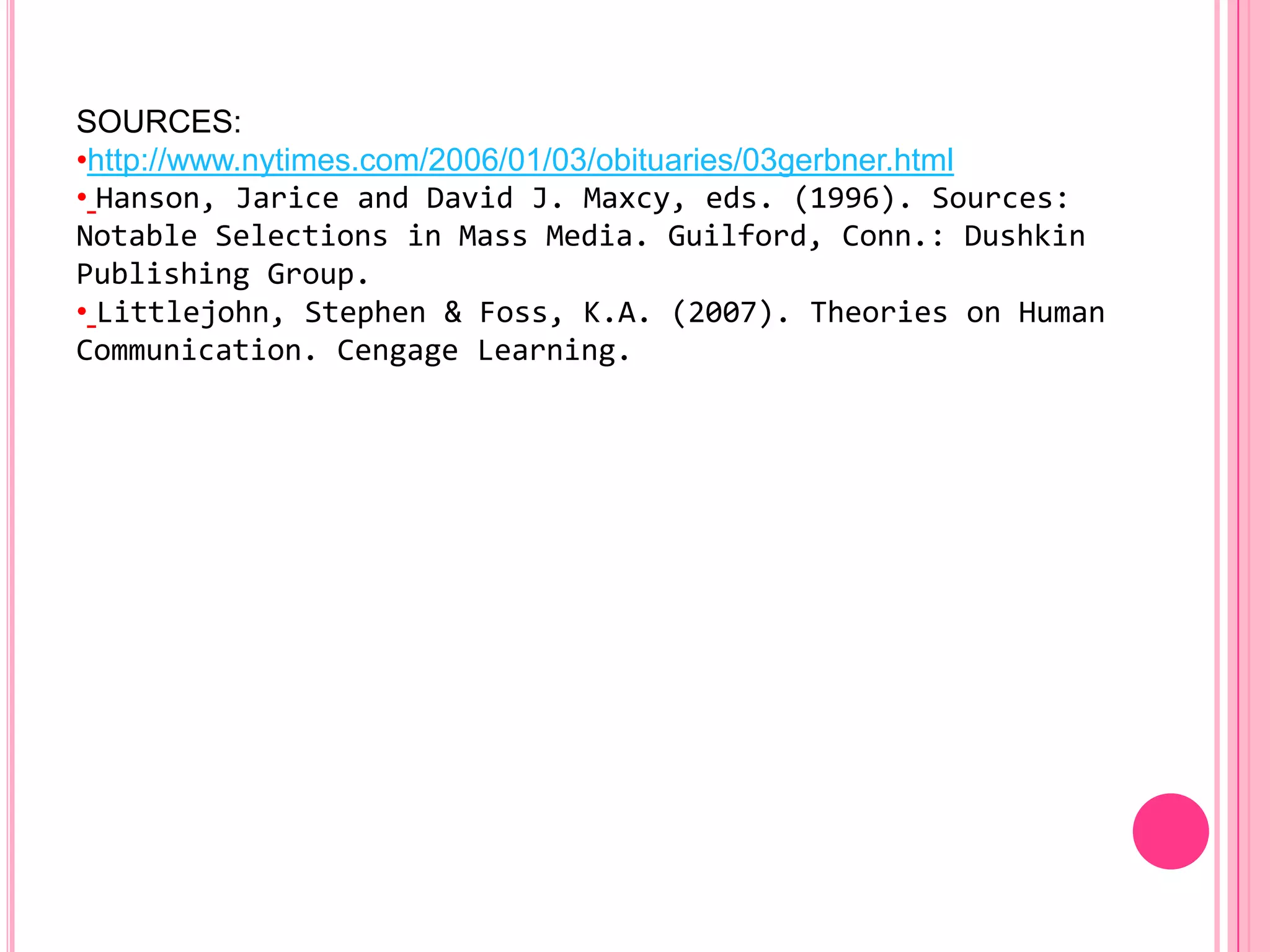
SOURCES:
•http://www.nytimes.com/2006/01/03/obituaries/03gerbner.html
• Hanson, Jarice and David J. Maxcy, eds. (1996). Sources:
Notable Selections in Mass Media. Guilford, Conn.: Dushkin
Publishing Group.
• Littlejohn, Stephen & Foss, K.A. (2007). Theories on Human
Communication. Cengage Learning.

Gerbner - Mainstreaming Violence (part 1)

  • 1.
    THE “MAINSTREAMING” OF AMERICA:VIOLENCE PROFILE NO.11 ~GEORGE GERBNER ET AL
  • 2.
    GEORGE GERBNER  He was born in Budapest in 1919, Mr. Gerbner intended to study folklore at the University of Budapest but was forced to flee fascist Hungary in 1939.  Mr. Gerbner worked as a professor and researcher at the Institute for Communications Research at the University of Illinois from 1956 until 1964, when he accepted a position at Penn. After leaving Penn in 1990, he founded the Cultural Environment Movement, an advocacy group working for greater diversity in media.  He was dean emeritus of the Annenberg School for Communications at the University of Pennsylvania and studied television for more than three decades.
  • 3.
    GEORGE GERBNER  He founded the Cultural Indicators Research Project in 1968 to track changes in television content and how those changes affect viewers' perceptions of the world. Its database has information on more than 3,000 television programs and 35,000 characters.  Mr. Gerbner also worked with Larry Gross, Michael Morgan, and Nancy Signorielli. Gross and Signorielli were both professors of communication.  He coined the phrase "mean world syndrome," a phenomenon in which people who watch large amounts of television are more likely to believe that the world is an unforgiving and frightening place.  He focused on the effects of mass media on everyday life.
  • 4.
    THE TWO ARGUMENTSOF GERBNER AND HIS ASSOCIATES :  Traditional Media Effects researchers err by focusing solely on the immediate “before and after” effects of exposure to media messages on people’s behavior and attitudes. - symbolic environment  Television provides a concentrated system of storytelling that rivals religion un its power to shape people’s social perceptions.
  • 5.
    OVERVIEW: CULTURAL INDICATORS PROJECT  Is a “longitudinal” or long-term study of media effects involving a three-pronged research effort: - institutional analysis (structures of decision making that are involved in the production of media messages) - message system analysis - cultivation analysis
  • 6.
    WHAT IS CULTIVATIONTHEORY?  States that television brings about a shared way of viewing the world.  Hypothesizes that perceptions of the social world on the part of heavy viewers will very closely resemble the structure of the “world of TV” content.
  • 7.
    CULTURAL INDICATORS PROJECT (1968)  Television makes specific and measurable contributions to viewers’ conceptions of reality. These contributions relate both to the synthetic world television presents and to viewers’ real life circumstances.  In cultivation analysis, it is the periodic examinations of television programming and conceptions of social reality cultivated by viewing.  The two interrelated parts of the Project are: message system analysis and cultivation analysis
  • 8.
    MESSAGE SYSTEM ANALYSIS It is the annual monitoring of samples of prime time and weekend daytime network dramatic programming (including series, other plays, comedies, movies, and cartoons).  It involves in-depth, quantitative content analysis aimed at discovering basic, social building blocks of TV content.
  • 9.
    CULTIVATION ANALYSIS  Itis the investigation of viewer conceptions of social reality associated with the most recurrent features of the world of television.  It focuses on TV viewers , correlating attitudes about the social world with the amount of TV viewing and content of TV.
  • 10.
    VIOLENCE  Violence is the overt expression of physical force with or without a weapon, against self or others) compelling action against one’s will on pain of being hurt or killed or threatened to be so victimized as part of the plot.  Violence Index is the annual content analysis of a sample week of network television prime time fare demonstrating how much violence is present
  • 11.
    ICE-AGE ANALOGY  In cultivation analysis, it is the idea that the size of television’s influence is less critical than the direction of its steady contribution.
  • 12.
    VIOLENCE INDEX INCHILDREN’S AND PRIME- TIME PROGRAMMING, 1967-1979 700 600 500 400 8-9 p.m. EST 300 9-11 p.m. EST 200 weekend daytime 100 children's programs 0
  • 13.
    SOURCES: •http://www.nytimes.com/2006/01/03/obituaries/03gerbner.html • Hanson, Jariceand David J. Maxcy, eds. (1996). Sources: Notable Selections in Mass Media. Guilford, Conn.: Dushkin Publishing Group. • Littlejohn, Stephen & Foss, K.A. (2007). Theories on Human Communication. Cengage Learning.