TED 406-01 Teaching Secondary Reading Fall 2010 Dr. Jill Aguilar [email_address]
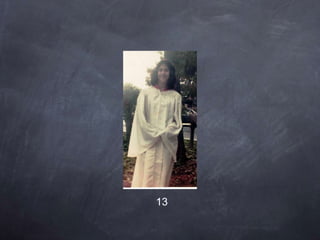
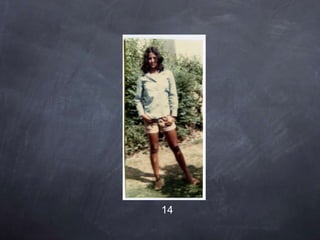
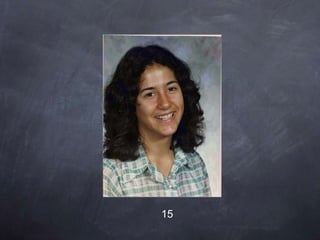
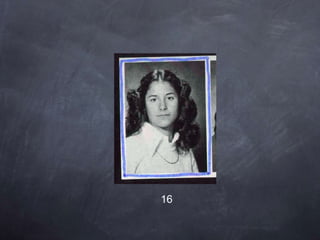
What do you remember about being a teen? What was on your mind? Who were your friends?  What were your favorite things to do? What did you worry about?  What were you entirely clueless about?
13
14
15
16
Think about where you went to middle and high school. Write a couple of sentences describing what it looked like. What was one moment in either middle or high school that was great? Briefly describe it. What was one moment in either middle or high school that was horrible? Briefly describe it. How did you like middle and high school? Why?
Who is the teacher you remember most from that time? Why? How was school for you? Knowing what you know now, what might you have done differently? If you [now] were the teacher of you [then], what would you be sure to do?  What would you be sure to NOT do?
Reading Processes
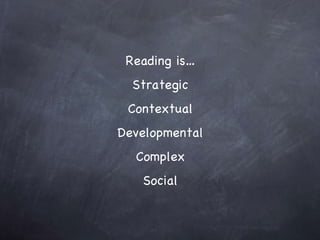
Reading is…
Reading is… Strategic
Reading is… Strategic Contextual
Reading is… Strategic Contextual Developmental
Reading is… Strategic Contextual Developmental Complex
Reading is… Strategic Contextual Developmental Complex Social
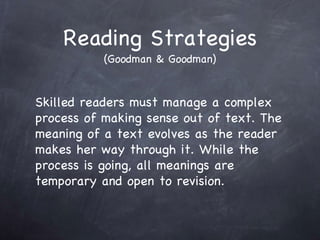
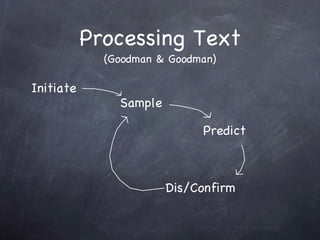
Reading Strategies (Goodman & Goodman) Skilled readers must manage a complex process of making sense out of text. The meaning of a text evolves as the reader makes her way through it. While the process is going, all meanings are temporary and open to revision.
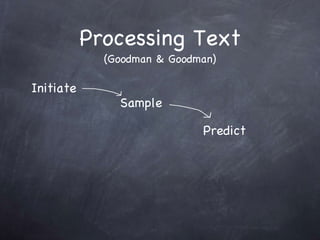
Processing Text (Goodman & Goodman) Initiate
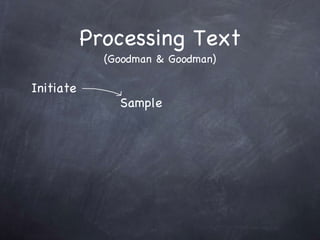
Processing Text (Goodman & Goodman) Initiate Sample
Processing Text (Goodman & Goodman) Initiate Sample Predict
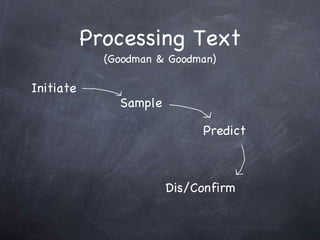
Processing Text (Goodman & Goodman) Initiate Sample Predict Dis/Confirm
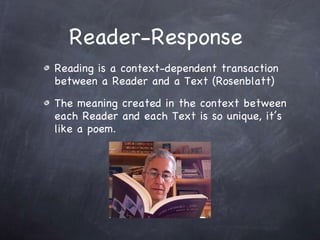
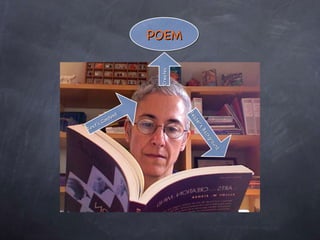
Reader-Response  Reading is a context-dependent transaction between a Reader and a Text (Rosenblatt) The meaning created in the context between each Reader and each Text is so unique, it’s like a poem.
POEM Reader’s Background Text’s Content Creates
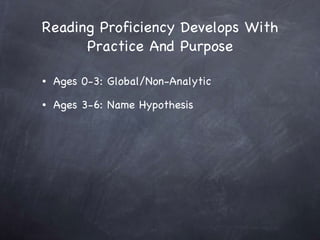
Reading Proficiency Develops With Practice And Purpose Ages 0-3:
Reading Proficiency Develops With Practice And Purpose Ages 0-3: Global/Non-Analytic
Reading Proficiency Develops With Practice And Purpose Ages 0-3: Global/Non-Analytic Ages 3-6:
Reading Proficiency Develops With Practice And Purpose Ages 0-3: Global/Non-Analytic Ages 3-6: Name Hypothesis
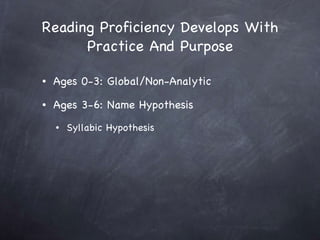
Reading Proficiency Develops With Practice And Purpose Ages 0-3: Global/Non-Analytic Ages 3-6: Name Hypothesis Syllabic Hypothesis
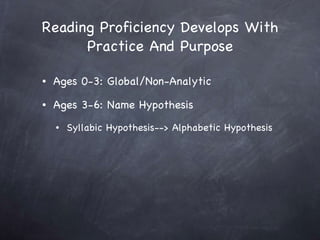
Reading Proficiency Develops With Practice And Purpose Ages 0-3: Global/Non-Analytic Ages 3-6: Name Hypothesis Syllabic Hypothesis--> Alphabetic Hypothesis
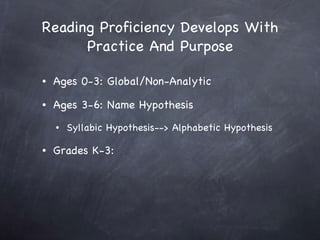
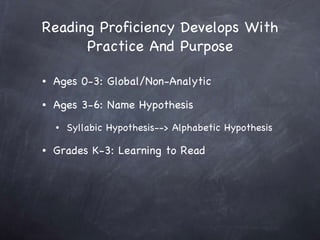
Reading Proficiency Develops With Practice And Purpose Ages 0-3: Global/Non-Analytic Ages 3-6: Name Hypothesis Syllabic Hypothesis--> Alphabetic Hypothesis Grades K-3:
Reading Proficiency Develops With Practice And Purpose Ages 0-3: Global/Non-Analytic Ages 3-6: Name Hypothesis Syllabic Hypothesis--> Alphabetic Hypothesis Grades K-3: Learning to Read
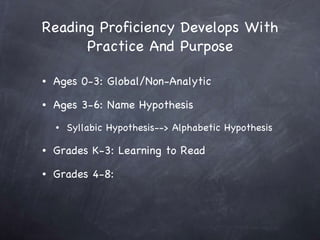
Reading Proficiency Develops With Practice And Purpose Ages 0-3: Global/Non-Analytic Ages 3-6: Name Hypothesis Syllabic Hypothesis--> Alphabetic Hypothesis Grades K-3: Learning to Read Grades 4-8:
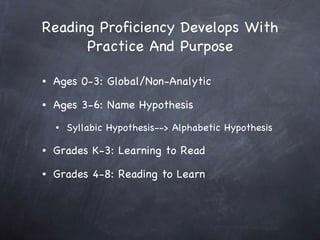
Reading Proficiency Develops With Practice And Purpose Ages 0-3: Global/Non-Analytic Ages 3-6: Name Hypothesis Syllabic Hypothesis--> Alphabetic Hypothesis Grades K-3: Learning to Read Grades 4-8: Reading to Learn
Reading Proficiency Develops With Practice And Purpose Ages 0-3: Global/Non-Analytic Ages 3-6: Name Hypothesis Syllabic Hypothesis--> Alphabetic Hypothesis Grades K-3: Learning to Read Grades 4-8: Reading to Learn Adolescence & Up:
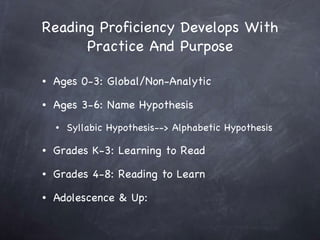
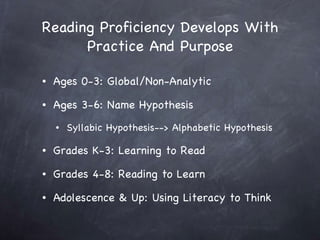
Reading Proficiency Develops With Practice And Purpose Ages 0-3: Global/Non-Analytic Ages 3-6: Name Hypothesis Syllabic Hypothesis--> Alphabetic Hypothesis Grades K-3: Learning to Read Grades 4-8: Reading to Learn Adolescence & Up: Using Literacy to Think
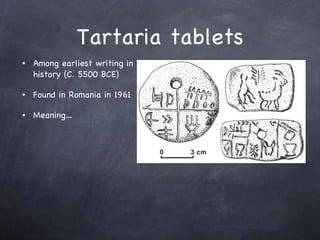
Tartaria tablets Among earliest writing in history (C. 5500 BCE) Found in Romania in 1961 Meaning…
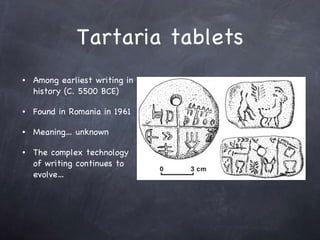
Tartaria tablets Among earliest writing in history (C. 5500 BCE) Found in Romania in 1961 Meaning… unknown The complex technology of writing continues to evolve…
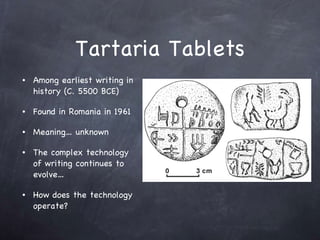
Tartaria Tablets Among earliest writing in history (C. 5500 BCE) Found in Romania in 1961 Meaning… unknown The complex technology of writing continues to evolve… How does the technology operate?
Cueing Systems (Weaver) Graphophonic Syntactic Semantic Pragmatic
Graphophonic Refers to the mapping of sounds to letters. “ Grapho-” means written, and “Phonemic” means sound. Phonetic  languages are those languages that use symbols to produce sounds (as opposed to ideographic languages like Chinese or Japanese.)  Phonics  is an approach to teaching children how to read and write.
Semantic Refers to the meanings of a written expression. Meaning can be contested, even between two English speakers at the same level of proficiency.  Readers may find different meanings, for example, between  denotation , or literal meaning, and  connotation , or figurative meanings (sometimes considered part of pragmatics).
Syntactic Refers to the principles and rules for constructing sentences.
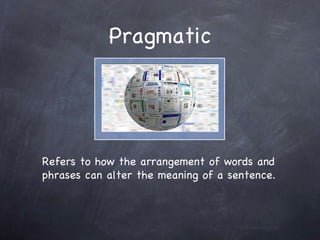
Pragmatic Refers to how the arrangement of words and phrases can alter the meaning of a sentence.
Cueing Systems (Weaver) Skilled readers must correctly use the Graphophonic, Semantic, Syntactic, and Pragmatic cueing systems in order to decode and comprehend a written text.
Making Meaning Once the decision to read has been made, skilled readers construct meaning by sampling, predicting, and confirming as they actively make use of their knowledge of the graphophonic, syntactic, semantic, and pragmatic cueing systems in a cyclical way.
Reading Is Social What is learning?
Reading Is Social What is learning? Vygotsky defines “learning” as “becoming a member of a culture”
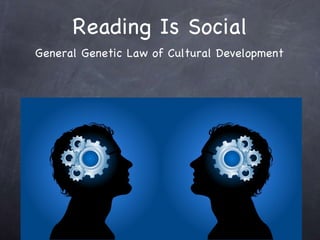
Reading Is Social General Genetic Law of Cultural Development
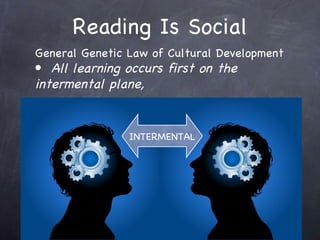
Reading Is Social General Genetic Law of Cultural Development All learning occurs first on the intermental plane,  INTERMENTAL
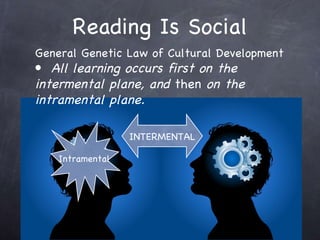
Reading Is Social General Genetic Law of Cultural Development All learning occurs first on the intermental plane, and  then  on the intramental plane. INTERMENTAL Intramental
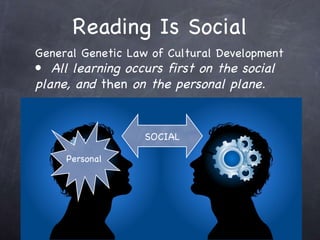
Reading Is Social General Genetic Law of Cultural Development All learning occurs first on the social plane, and  then  on the personal plane. SOCIAL Personal
Reading is… Strategic Contextual Developmental Complex Social
What is Academic Literacy?

TED 406 Session 2

  • 1.
    TED 406-01 TeachingSecondary Reading Fall 2010 Dr. Jill Aguilar [email_address]
  • 2.
    What do youremember about being a teen? What was on your mind? Who were your friends? What were your favorite things to do? What did you worry about? What were you entirely clueless about?
  • 3.
  • 4.
  • 5.
  • 6.
  • 7.
    Think about whereyou went to middle and high school. Write a couple of sentences describing what it looked like. What was one moment in either middle or high school that was great? Briefly describe it. What was one moment in either middle or high school that was horrible? Briefly describe it. How did you like middle and high school? Why?
  • 8.
    Who is theteacher you remember most from that time? Why? How was school for you? Knowing what you know now, what might you have done differently? If you [now] were the teacher of you [then], what would you be sure to do? What would you be sure to NOT do?
  • 9.
  • 10.
  • 11.
  • 12.
  • 13.
    Reading is… StrategicContextual Developmental
  • 14.
    Reading is… StrategicContextual Developmental Complex
  • 15.
    Reading is… StrategicContextual Developmental Complex Social
  • 16.
    Reading Strategies (Goodman& Goodman) Skilled readers must manage a complex process of making sense out of text. The meaning of a text evolves as the reader makes her way through it. While the process is going, all meanings are temporary and open to revision.
  • 17.
    Processing Text (Goodman& Goodman) Initiate
  • 18.
    Processing Text (Goodman& Goodman) Initiate Sample
  • 19.
    Processing Text (Goodman& Goodman) Initiate Sample Predict
  • 20.
    Processing Text (Goodman& Goodman) Initiate Sample Predict Dis/Confirm
  • 21.
    Processing Text (Goodman& Goodman) Initiate Sample Predict Dis/Confirm
  • 22.
    Reader-Response Readingis a context-dependent transaction between a Reader and a Text (Rosenblatt) The meaning created in the context between each Reader and each Text is so unique, it’s like a poem.
  • 23.
    POEM Reader’s BackgroundText’s Content Creates
  • 24.
    Reading Proficiency DevelopsWith Practice And Purpose Ages 0-3:
  • 25.
    Reading Proficiency DevelopsWith Practice And Purpose Ages 0-3: Global/Non-Analytic
  • 26.
    Reading Proficiency DevelopsWith Practice And Purpose Ages 0-3: Global/Non-Analytic Ages 3-6:
  • 27.
    Reading Proficiency DevelopsWith Practice And Purpose Ages 0-3: Global/Non-Analytic Ages 3-6: Name Hypothesis
  • 28.
    Reading Proficiency DevelopsWith Practice And Purpose Ages 0-3: Global/Non-Analytic Ages 3-6: Name Hypothesis Syllabic Hypothesis
  • 29.
    Reading Proficiency DevelopsWith Practice And Purpose Ages 0-3: Global/Non-Analytic Ages 3-6: Name Hypothesis Syllabic Hypothesis--> Alphabetic Hypothesis
  • 30.
    Reading Proficiency DevelopsWith Practice And Purpose Ages 0-3: Global/Non-Analytic Ages 3-6: Name Hypothesis Syllabic Hypothesis--> Alphabetic Hypothesis Grades K-3:
  • 31.
    Reading Proficiency DevelopsWith Practice And Purpose Ages 0-3: Global/Non-Analytic Ages 3-6: Name Hypothesis Syllabic Hypothesis--> Alphabetic Hypothesis Grades K-3: Learning to Read
  • 32.
    Reading Proficiency DevelopsWith Practice And Purpose Ages 0-3: Global/Non-Analytic Ages 3-6: Name Hypothesis Syllabic Hypothesis--> Alphabetic Hypothesis Grades K-3: Learning to Read Grades 4-8:
  • 33.
    Reading Proficiency DevelopsWith Practice And Purpose Ages 0-3: Global/Non-Analytic Ages 3-6: Name Hypothesis Syllabic Hypothesis--> Alphabetic Hypothesis Grades K-3: Learning to Read Grades 4-8: Reading to Learn
  • 34.
    Reading Proficiency DevelopsWith Practice And Purpose Ages 0-3: Global/Non-Analytic Ages 3-6: Name Hypothesis Syllabic Hypothesis--> Alphabetic Hypothesis Grades K-3: Learning to Read Grades 4-8: Reading to Learn Adolescence & Up:
  • 35.
    Reading Proficiency DevelopsWith Practice And Purpose Ages 0-3: Global/Non-Analytic Ages 3-6: Name Hypothesis Syllabic Hypothesis--> Alphabetic Hypothesis Grades K-3: Learning to Read Grades 4-8: Reading to Learn Adolescence & Up: Using Literacy to Think
  • 36.
    Tartaria tablets Amongearliest writing in history (C. 5500 BCE) Found in Romania in 1961 Meaning…
  • 37.
    Tartaria tablets Amongearliest writing in history (C. 5500 BCE) Found in Romania in 1961 Meaning… unknown The complex technology of writing continues to evolve…
  • 38.
    Tartaria Tablets Amongearliest writing in history (C. 5500 BCE) Found in Romania in 1961 Meaning… unknown The complex technology of writing continues to evolve… How does the technology operate?
  • 39.
    Cueing Systems (Weaver)Graphophonic Syntactic Semantic Pragmatic
  • 40.
    Graphophonic Refers tothe mapping of sounds to letters. “ Grapho-” means written, and “Phonemic” means sound. Phonetic languages are those languages that use symbols to produce sounds (as opposed to ideographic languages like Chinese or Japanese.) Phonics is an approach to teaching children how to read and write.
  • 41.
    Semantic Refers tothe meanings of a written expression. Meaning can be contested, even between two English speakers at the same level of proficiency. Readers may find different meanings, for example, between denotation , or literal meaning, and connotation , or figurative meanings (sometimes considered part of pragmatics).
  • 42.
    Syntactic Refers tothe principles and rules for constructing sentences.
  • 43.
    Pragmatic Refers tohow the arrangement of words and phrases can alter the meaning of a sentence.
  • 44.
    Cueing Systems (Weaver)Skilled readers must correctly use the Graphophonic, Semantic, Syntactic, and Pragmatic cueing systems in order to decode and comprehend a written text.
  • 45.
    Making Meaning Oncethe decision to read has been made, skilled readers construct meaning by sampling, predicting, and confirming as they actively make use of their knowledge of the graphophonic, syntactic, semantic, and pragmatic cueing systems in a cyclical way.
  • 46.
    Reading Is SocialWhat is learning?
  • 47.
    Reading Is SocialWhat is learning? Vygotsky defines “learning” as “becoming a member of a culture”
  • 48.
    Reading Is SocialGeneral Genetic Law of Cultural Development
  • 49.
    Reading Is SocialGeneral Genetic Law of Cultural Development All learning occurs first on the intermental plane, INTERMENTAL
  • 50.
    Reading Is SocialGeneral Genetic Law of Cultural Development All learning occurs first on the intermental plane, and then on the intramental plane. INTERMENTAL Intramental
  • 51.
    Reading Is SocialGeneral Genetic Law of Cultural Development All learning occurs first on the social plane, and then on the personal plane. SOCIAL Personal
  • 52.
    Reading is… StrategicContextual Developmental Complex Social
  • 53.