Development of
Reading
Comprehension
Four levels of reading
comprehension (Adler and Van
Doren)
First stage
 The first or elementary
level involved
understanding the literal
meaning of the word and
sentences.
Inspectual Reading
Or “systematic skimming”
When reading at this level,
one has a set amount of time
to complete an assigned
amount of reading.
Analytic Reading
It is most complete reading
that is possible given
unlimited time. It requires a
deeper more complete
understanding of the contents
of the book.
Comparative reading
Mere comparison of the text is
not enough, however, because
the comparative reader must
be able to generate a critical or
novel interpretation of the
text.
Early language
stimulation
Early language
stimulation
Spoken language has an astonishing
impact on an infant’s brain development.
 Number of words an infant hears each
day is the single most important
predictor of later intelligence.
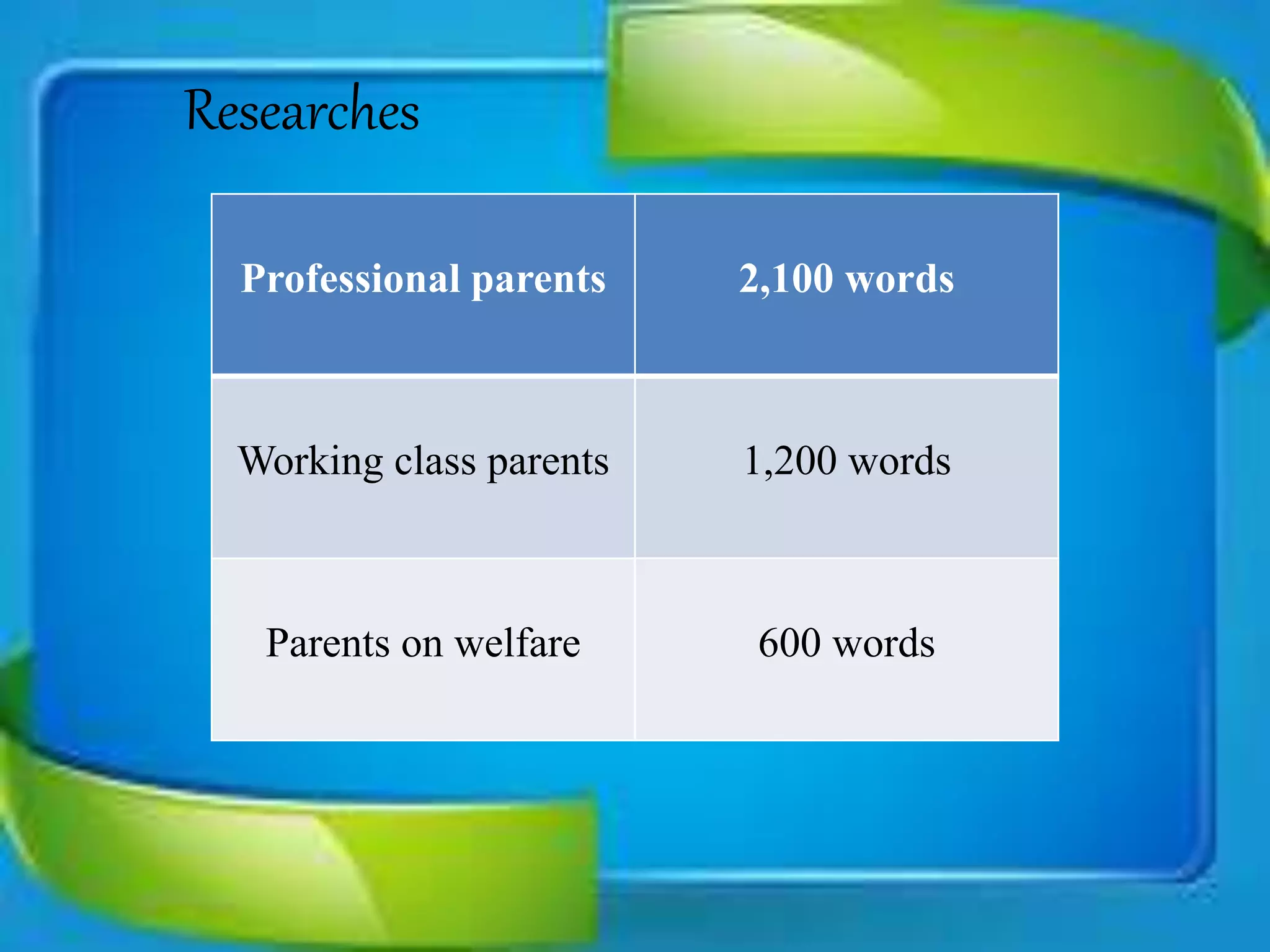
Researches
Professional parents 2,100 words
Working class parents 1,200 words
Parents on welfare 600 words
Hypothesis in Developing the
Scheme for Reading Stages
1.Stages of reading
development resemble
stages of cognitive and
language development.
Hypothesis in Developing the Scheme for
Reading Stages
Hypothesis in Developing the Scheme for
Reading Stages
2. Reading is at all stages, a
form of problem solving in
which the readers adapt to
their environment through the
processes of assimilation and
accommodation.
3. Individuals progress
through the stages by
interacting with their
environment --- the home,
school, larger community,
and culture.
Hypothesis in Developing the Scheme for
Reading Stages
Hypothesis in Developing the Scheme for
Reading Stages
4. Measures of having reached a
given reading stage will add a
further useful dimension to
standardized norm-referenced
testing, as well as to criterion-
referenced testing.
5. The fact of successive stages
means that readers do “different”
things in relation to printed matter
at each successive stage, although
the term “reading” is commonly
used for all the stages.
Hypothesis in Developing the Scheme for
Reading Stages
Hypothesis in Developing the Scheme for
Reading Stages
6.The successive stages are
characterized by growth in the
ability to read language that is
more complex, less frequently
encountered, more technical, and
more abstract, and by changes in
how reading is viewed and used.
7. The reader’s response to
the text also becomes more
general, more influential,
more critical, and more
constructive with successive
stages.
Hypothesis in Developing the Scheme for
Reading Stages
Hypothesis in Developing the Scheme for
Reading Stages
8. The stages are also
characterized by the extent
to which prior knowledge is
needed to read and
understand materials.
9. At each stage, readers may
persist in characteristic techniques
or habits that, if continued too long,
may delay or even prevent
transition to the next stage.
Hypothesis in Developing the Scheme for
Reading Stages
Hypothesis in Developing the Scheme for
Reading Stages
10. Reading has
affective as well as
cognitive components.
Reading
stages
Stage 0 – Pre-reading:
Birth to age 6
From birth until the beginning of
formal education, children living
in a literate culture with an
alphabetic writing system
accumulate a fund of knowledge
about letters, words, and books.
Stage1–Beginning
Reading Stage: (6-7)
This stage is
characterized by an
increasing ability in
reading.
Stage 2 – Confirmation, Fluency,
Ungluing from Print: Grades 2-3
Stage 2 consolidates what was learned in
Stage 1. Reading stories previously heard
increases fluency. Stage 2 is not for
gaining new information, but for
confirming what is already known to the
reader.
Stage 3 – Reading for Learning
the New: A First Step
“learn the new” – new knowledge,
information, thoughts and experiences.
within one viewpoint
in the primary grades, children learn to
read: in the higher grades, they read to
learn.
Stage 4 – Multiple
Viewpoints: High School,
(Ages 14-18)
more than one point of view.
Stage 4 is mostly acquired through
formal education – the assignments in the
various school text books, original and
other sources, and reference works in the
physical, biological, and social sciences.
Stage 5 – Construction and
Reconstruction – A World View:
College, (Age 18 and above)
What not to read, as well as
what to read.
Ability to construct knowledge on a
high level of abstraction and generality
and to create one’s own ideas from the
ideas of others.
Questions? 
Development of Reading Comprehension.pptx

Development of Reading Comprehension.pptx

  • 1.
  • 2.
    Four levels ofreading comprehension (Adler and Van Doren)
  • 3.
    First stage  Thefirst or elementary level involved understanding the literal meaning of the word and sentences.
  • 4.
    Inspectual Reading Or “systematicskimming” When reading at this level, one has a set amount of time to complete an assigned amount of reading.
  • 5.
    Analytic Reading It ismost complete reading that is possible given unlimited time. It requires a deeper more complete understanding of the contents of the book.
  • 6.
    Comparative reading Mere comparisonof the text is not enough, however, because the comparative reader must be able to generate a critical or novel interpretation of the text.
  • 7.
  • 8.
    Early language stimulation Spoken languagehas an astonishing impact on an infant’s brain development.  Number of words an infant hears each day is the single most important predictor of later intelligence.
  • 9.
    Researches Professional parents 2,100words Working class parents 1,200 words Parents on welfare 600 words
  • 10.
    Hypothesis in Developingthe Scheme for Reading Stages
  • 11.
    1.Stages of reading developmentresemble stages of cognitive and language development. Hypothesis in Developing the Scheme for Reading Stages
  • 12.
    Hypothesis in Developingthe Scheme for Reading Stages 2. Reading is at all stages, a form of problem solving in which the readers adapt to their environment through the processes of assimilation and accommodation.
  • 13.
    3. Individuals progress throughthe stages by interacting with their environment --- the home, school, larger community, and culture. Hypothesis in Developing the Scheme for Reading Stages
  • 14.
    Hypothesis in Developingthe Scheme for Reading Stages 4. Measures of having reached a given reading stage will add a further useful dimension to standardized norm-referenced testing, as well as to criterion- referenced testing.
  • 15.
    5. The factof successive stages means that readers do “different” things in relation to printed matter at each successive stage, although the term “reading” is commonly used for all the stages. Hypothesis in Developing the Scheme for Reading Stages
  • 16.
    Hypothesis in Developingthe Scheme for Reading Stages 6.The successive stages are characterized by growth in the ability to read language that is more complex, less frequently encountered, more technical, and more abstract, and by changes in how reading is viewed and used.
  • 17.
    7. The reader’sresponse to the text also becomes more general, more influential, more critical, and more constructive with successive stages. Hypothesis in Developing the Scheme for Reading Stages
  • 18.
    Hypothesis in Developingthe Scheme for Reading Stages 8. The stages are also characterized by the extent to which prior knowledge is needed to read and understand materials.
  • 19.
    9. At eachstage, readers may persist in characteristic techniques or habits that, if continued too long, may delay or even prevent transition to the next stage. Hypothesis in Developing the Scheme for Reading Stages
  • 20.
    Hypothesis in Developingthe Scheme for Reading Stages 10. Reading has affective as well as cognitive components.
  • 21.
  • 22.
    Stage 0 –Pre-reading: Birth to age 6 From birth until the beginning of formal education, children living in a literate culture with an alphabetic writing system accumulate a fund of knowledge about letters, words, and books.
  • 23.
    Stage1–Beginning Reading Stage: (6-7) Thisstage is characterized by an increasing ability in reading.
  • 24.
    Stage 2 –Confirmation, Fluency, Ungluing from Print: Grades 2-3 Stage 2 consolidates what was learned in Stage 1. Reading stories previously heard increases fluency. Stage 2 is not for gaining new information, but for confirming what is already known to the reader.
  • 25.
    Stage 3 –Reading for Learning the New: A First Step “learn the new” – new knowledge, information, thoughts and experiences. within one viewpoint in the primary grades, children learn to read: in the higher grades, they read to learn.
  • 26.
    Stage 4 –Multiple Viewpoints: High School, (Ages 14-18) more than one point of view. Stage 4 is mostly acquired through formal education – the assignments in the various school text books, original and other sources, and reference works in the physical, biological, and social sciences.
  • 27.
    Stage 5 –Construction and Reconstruction – A World View: College, (Age 18 and above) What not to read, as well as what to read. Ability to construct knowledge on a high level of abstraction and generality and to create one’s own ideas from the ideas of others.
  • 28.