Lesson 3
∞ pertains to be the first
stage in a child’s growth
toward literacy
∞ relates to the beginning
experiences or the child’s
first experiences with print
in the home and continues
through early years of
formal schooling
∞ according to Harris and
Hodges (1981) refer to this
period of acquiring the
specific skills and abilities
that allow reading to take
place as preparedness or
reading readiness
∞ significantly determined
by a complex pattern of
intellectual, motivational,
maturational and
experiential factors
Marie Clay (1991) and Fountas and Pinnell
(2001) have noted five main stages of literacy
development.
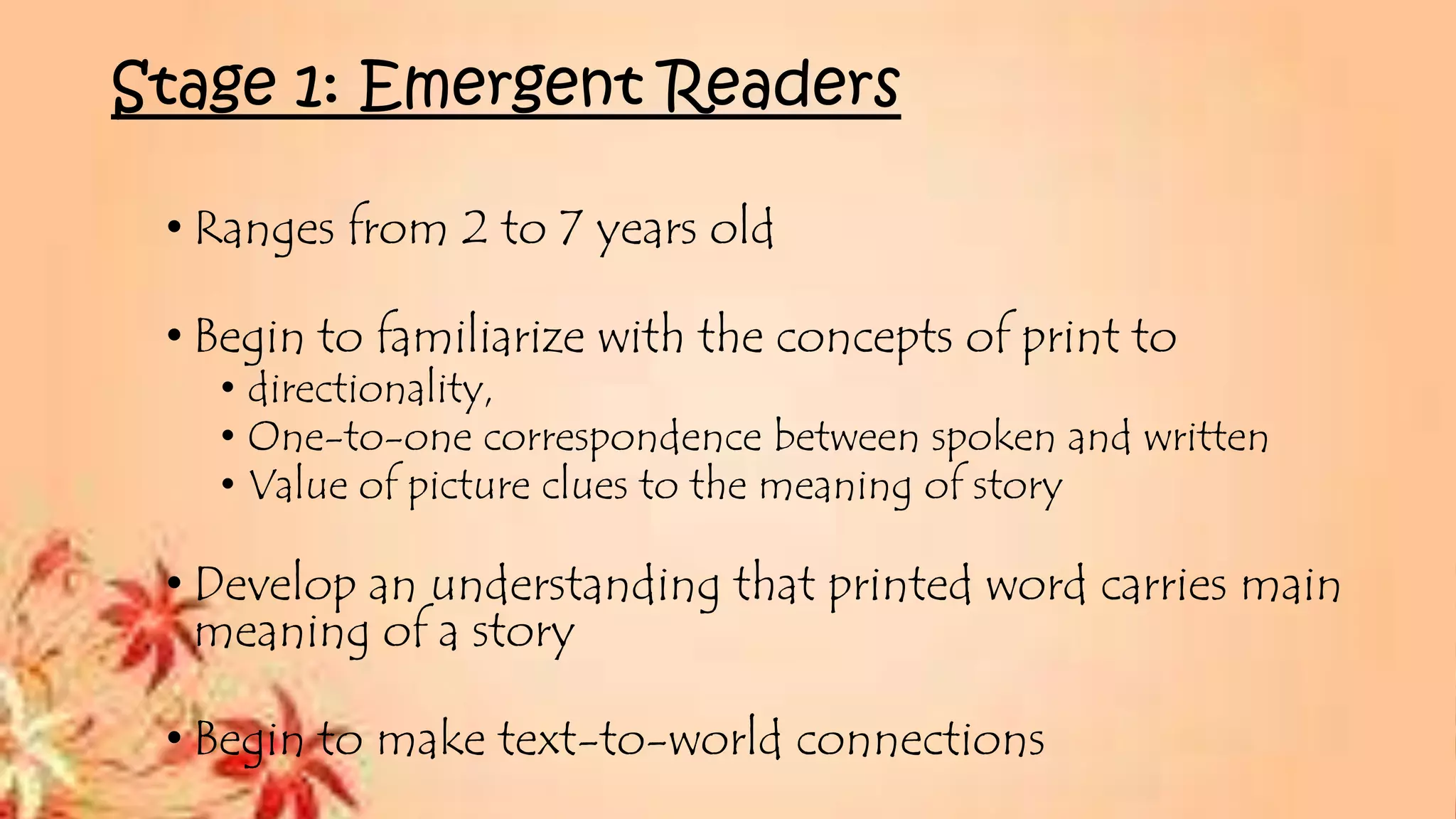
Stage 1: Emergent Readers
• Ranges from 2 to 7 years old
• Begin to familiarize with the concepts of print to
• directionality,
• One-to-one correspondence between spoken and written
• Value of picture clues to the meaning of story
• Develop an understanding that printed word carries main
meaning of a story
• Begin to make text-to-world connections
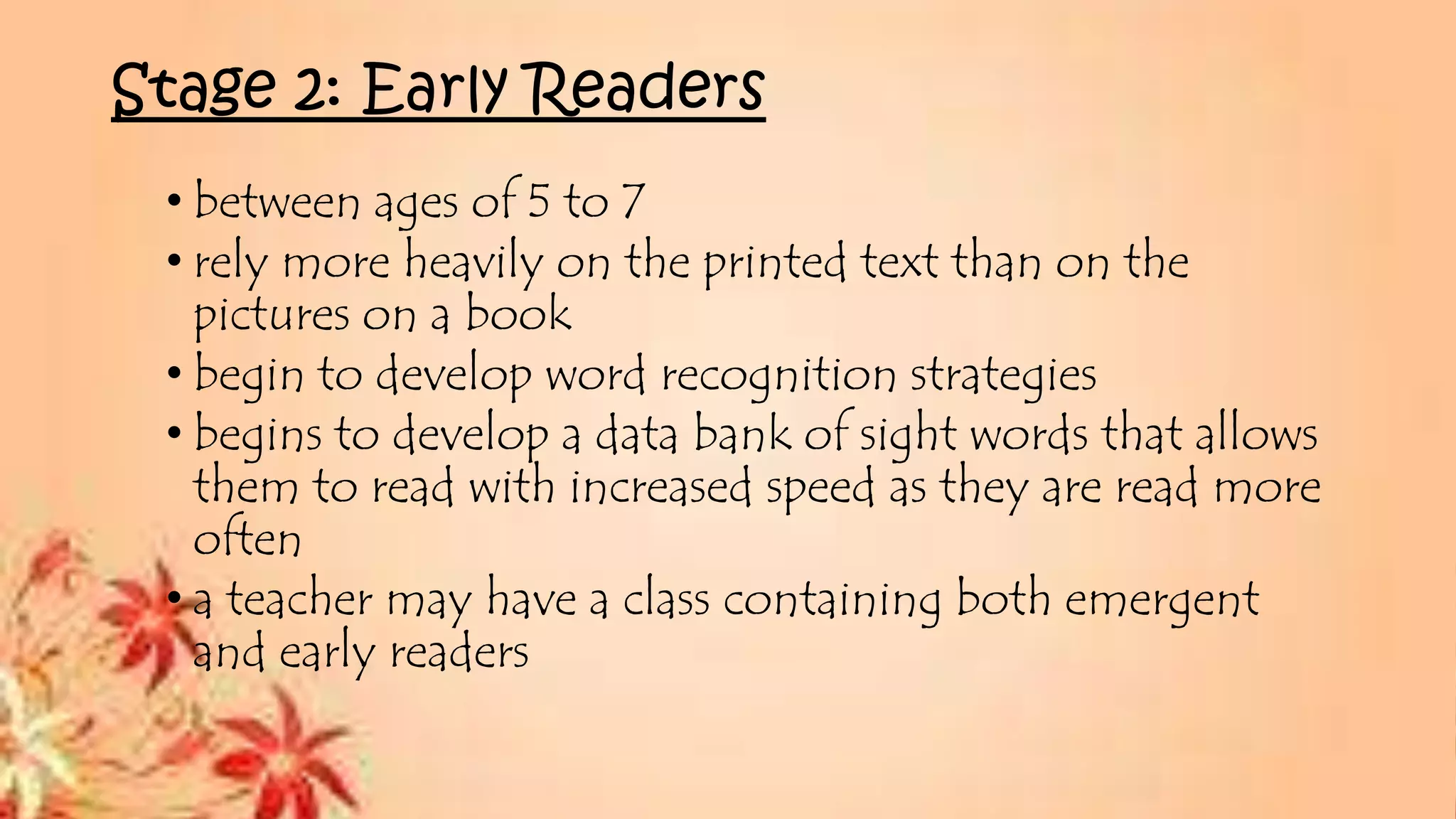
Stage 2: Early Readers
• between ages of 5 to 7
• rely more heavily on the printed text than on the
pictures on a book
• begin to develop word recognition strategies
• begins to develop a data bank of sight words that allows
them to read with increased speed as they are read more
often
• a teacher may have a class containing both emergent
and early readers
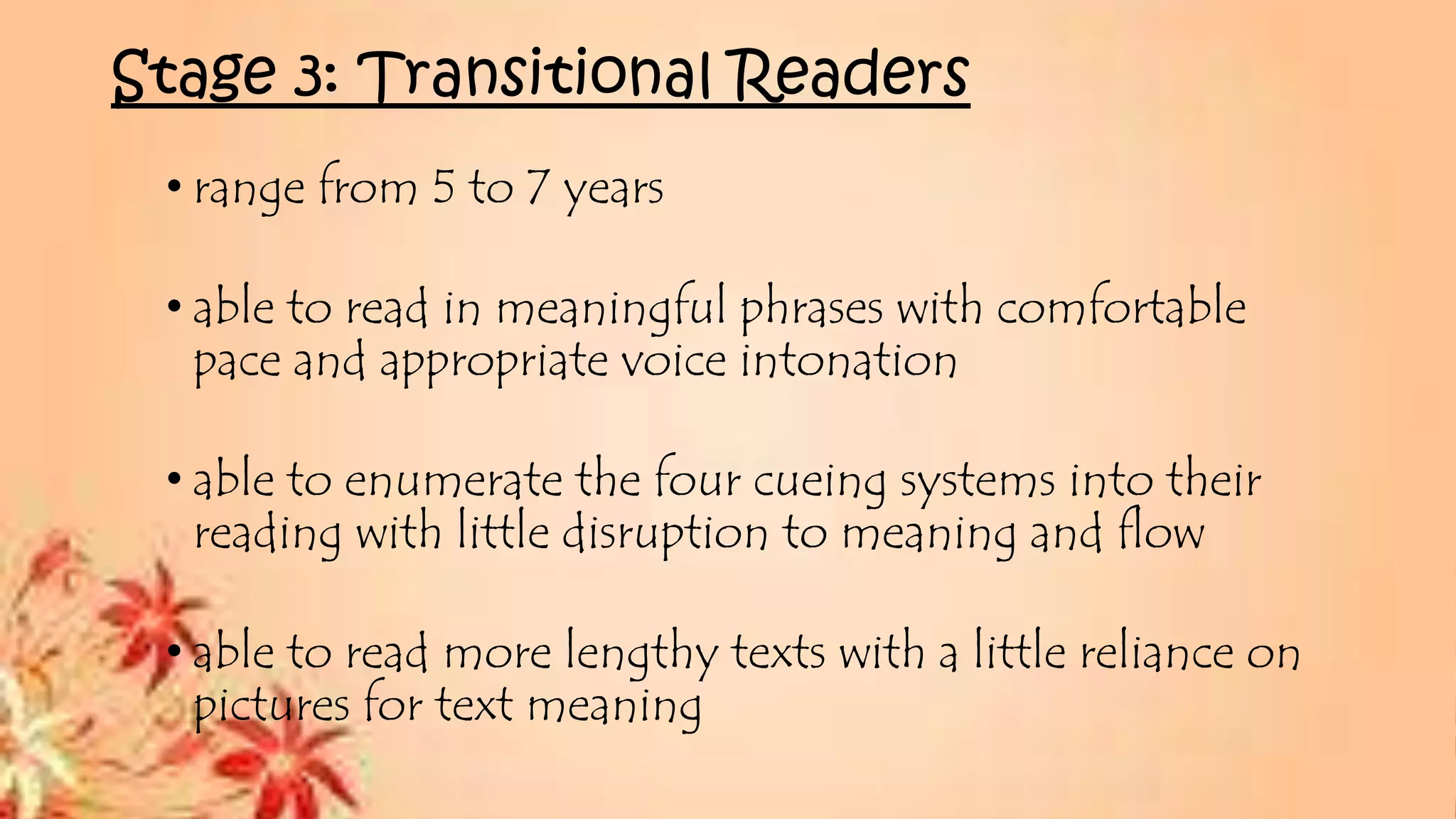
Stage 3: Transitional Readers
• range from 5 to 7 years
• able to read in meaningful phrases with comfortable
pace and appropriate voice intonation
• able to enumerate the four cueing systems into their
reading with little disruption to meaning and flow
• able to read more lengthy texts with a little reliance on
pictures for text meaning
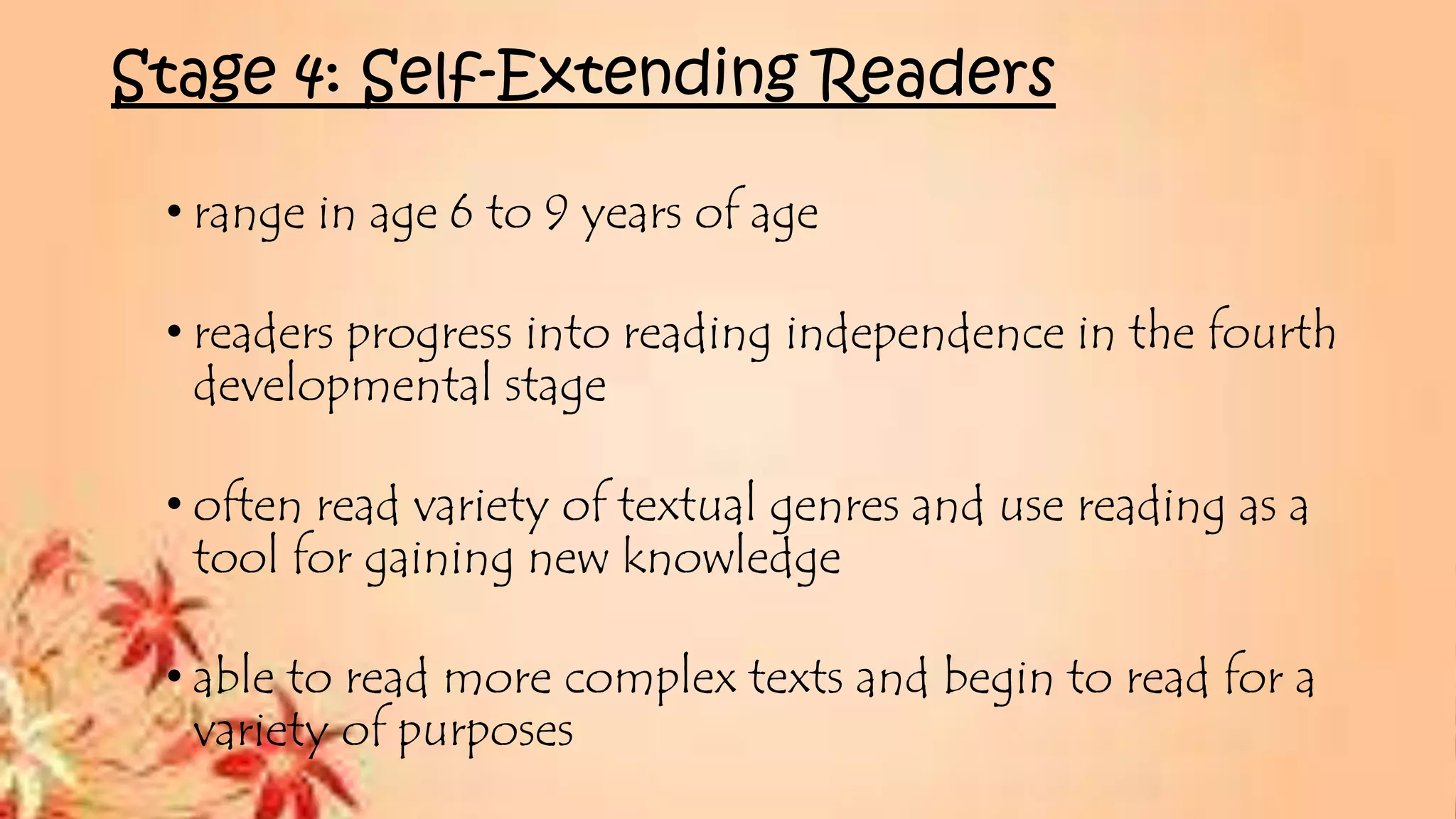
Stage 4: Self-Extending Readers
• range in age 6 to 9 years of age
• readers progress into reading independence in the fourth
developmental stage
• often read variety of textual genres and use reading as a
tool for gaining new knowledge
• able to read more complex texts and begin to read for a
variety of purposes
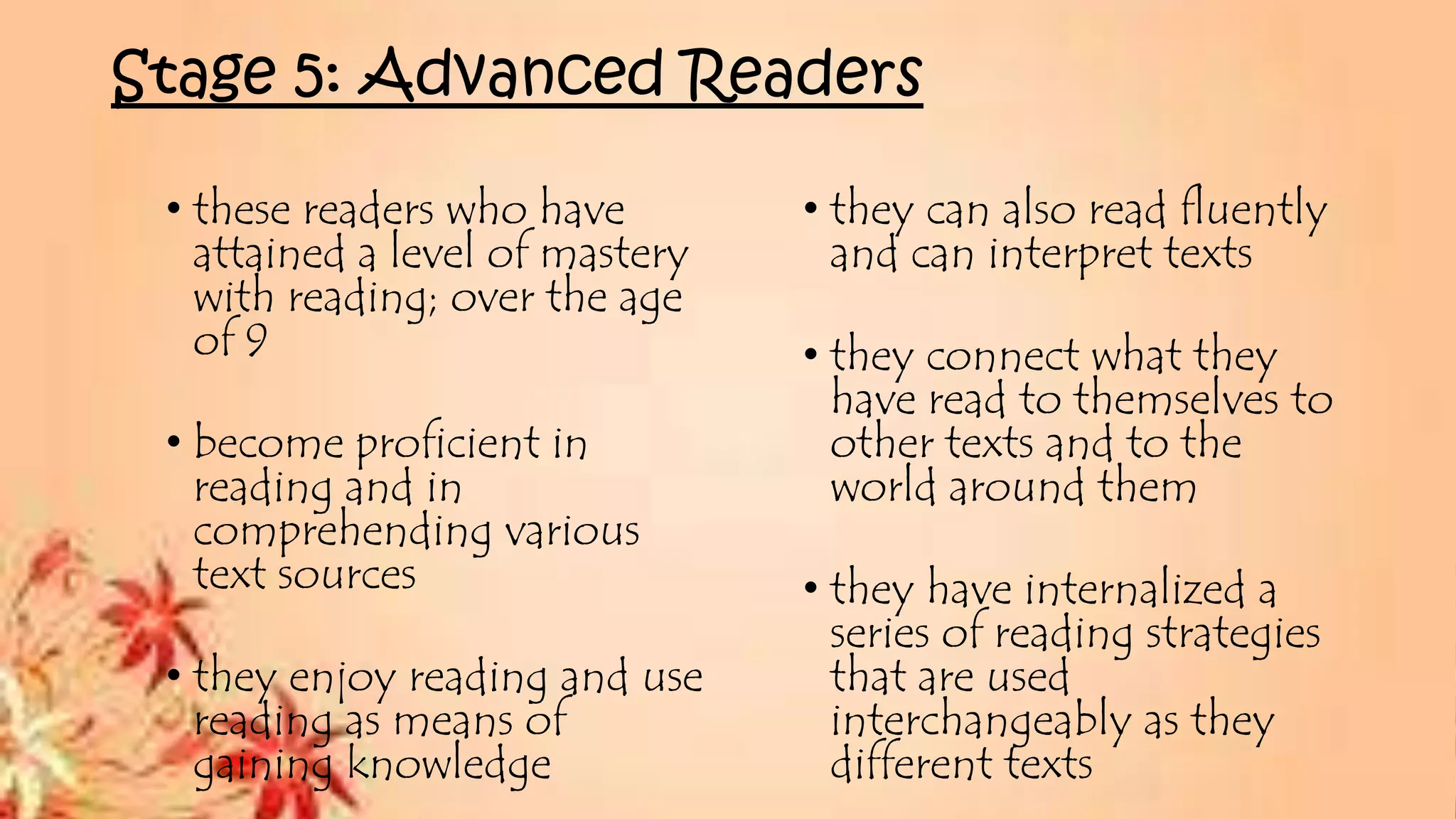
Stage 5: Advanced Readers
• these readers who have
attained a level of mastery
with reading; over the age
of 9
• become proficient in
reading and in
comprehending various
text sources
• they enjoy reading and use
reading as means of
gaining knowledge
• they can also read fluently
and can interpret texts
• they connect what they
have read to themselves to
other texts and to the
world around them
• they have internalized a
series of reading strategies
that are used
interchangeably as they
different texts
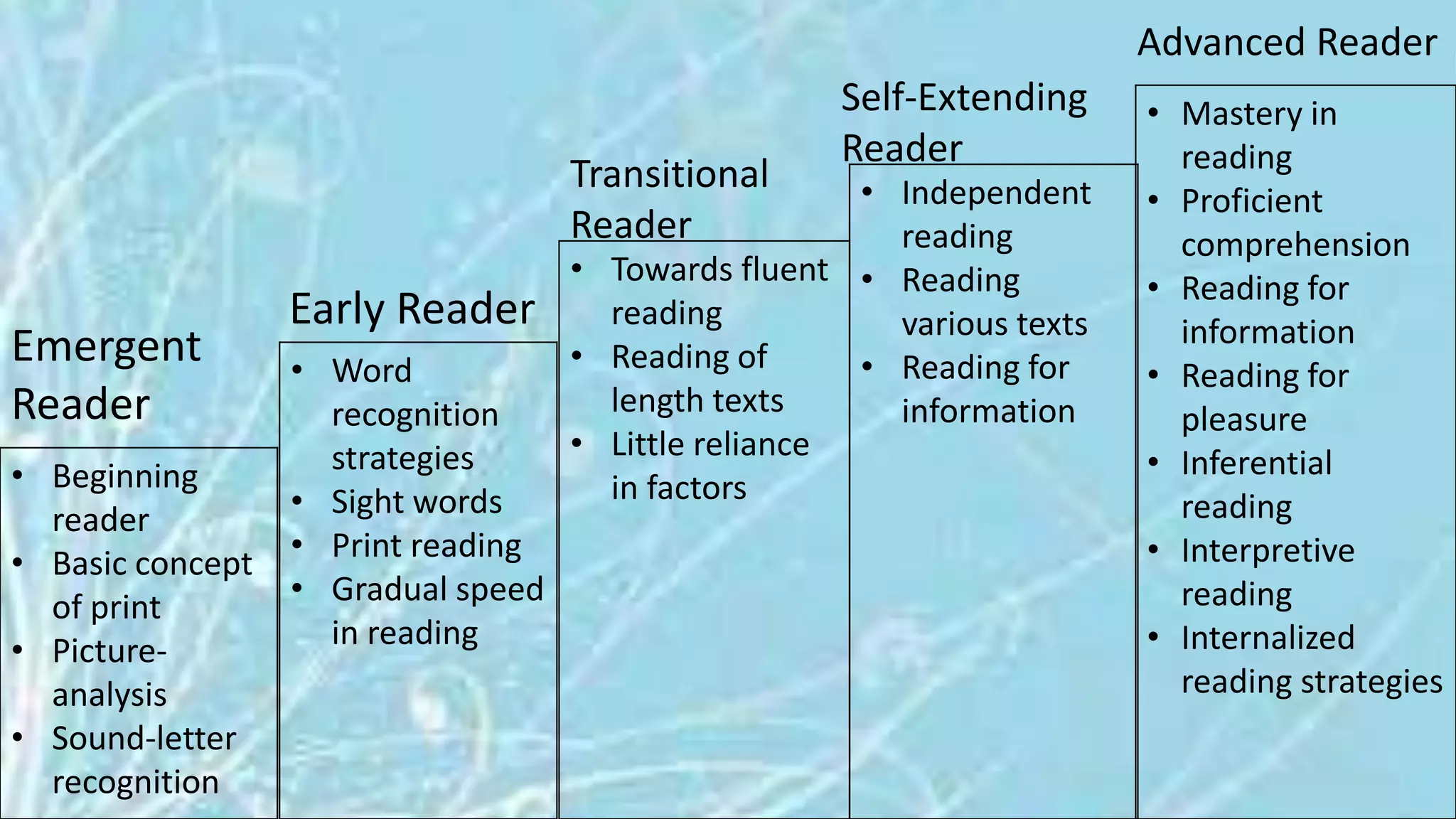
• Beginning
reader
• Basic concept
of print
• Picture-
analysis
• Sound-letter
recognition
• Word
recognition
strategies
• Sight words
• Print reading
• Gradual speed
in reading
• Mastery in
reading
• Proficient
comprehension
• Reading for
information
• Reading for
pleasure
• Inferential
reading
• Interpretive
reading
• Internalized
reading strategies
Emergent
Reader
Early Reader
Transitional
Reader
Self-Extending
Reader
Advanced Reader
• Towards fluent
reading
• Reading of
length texts
• Little reliance
in factors
• Independent
reading
• Reading
various texts
• Reading for
information
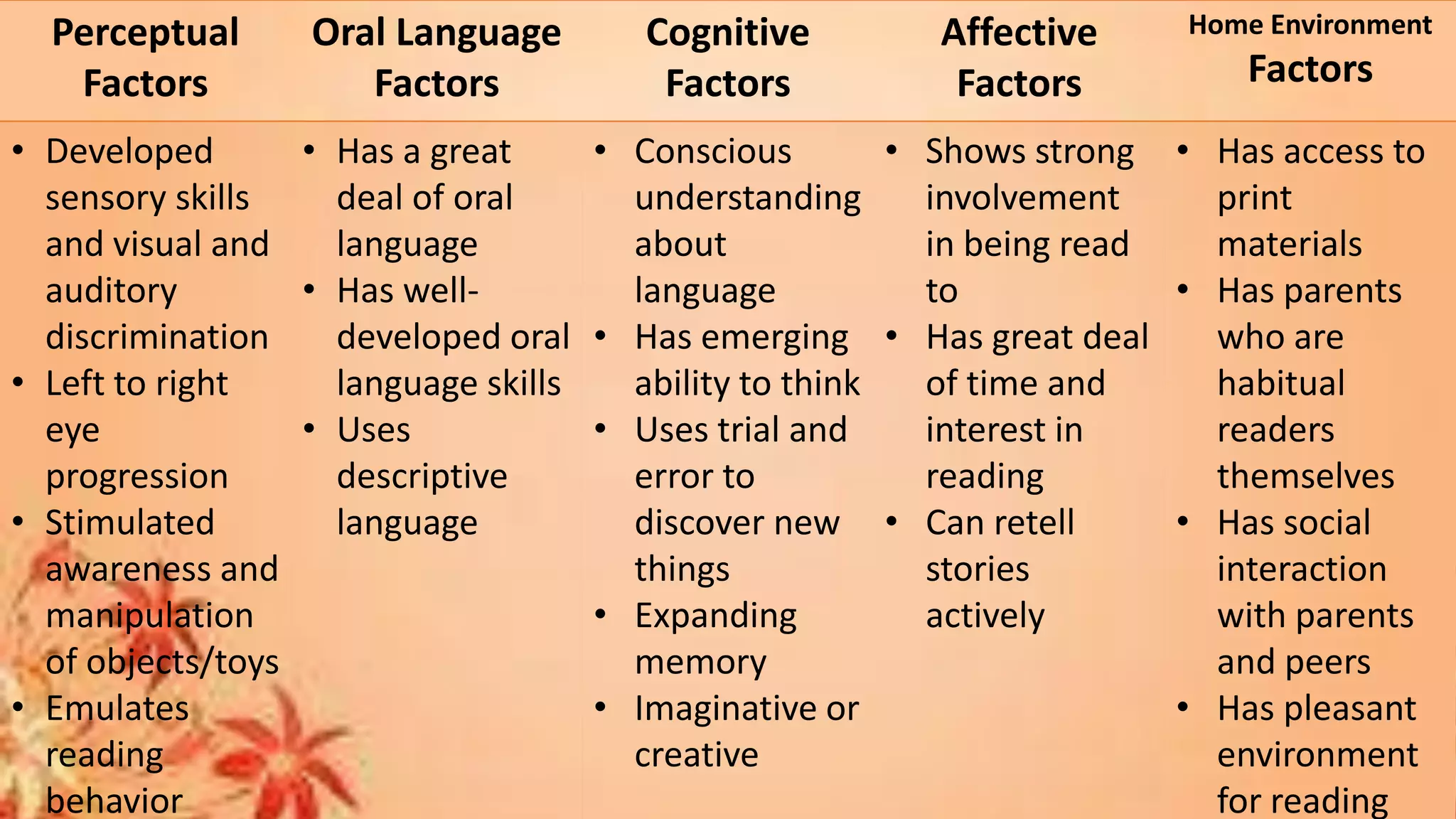
Perceptual
Factors
Oral Language
Factors
Cognitive
Factors
Affective
Factors
Home Environment
Factors
• Developed
sensory skills
and visual and
auditory
discrimination
• Left to right
eye
progression
• Stimulated
awareness and
manipulation
of objects/toys
• Emulates
reading
behavior
• Has a great
deal of oral
language
• Has well-
developed oral
language skills
• Uses
descriptive
language
• Conscious
understanding
about
language
• Has emerging
ability to think
• Uses trial and
error to
discover new
things
• Expanding
memory
• Imaginative or
creative
• Shows strong
involvement
in being read
to
• Has great deal
of time and
interest in
reading
• Can retell
stories
actively
• Has access to
print
materials
• Has parents
who are
habitual
readers
themselves
• Has social
interaction
with parents
and peers
• Has pleasant
environment
for reading
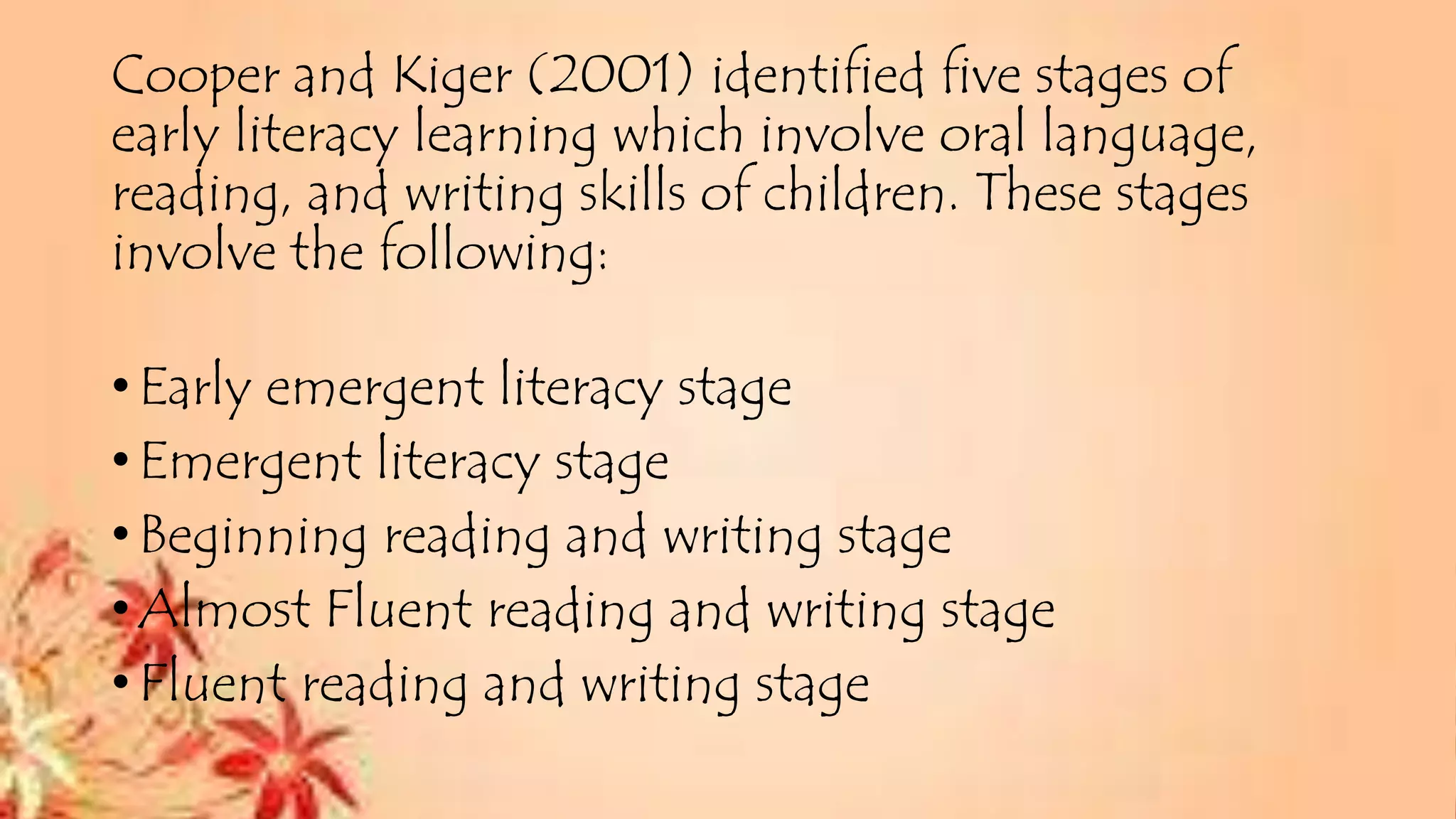
Cooper and Kiger (2001) identified five stages of
early literacy learning which involve oral language,
reading, and writing skills of children. These stages
involve the following:
•Early emergent literacy stage
•Emergent literacy stage
•Beginning reading and writing stage
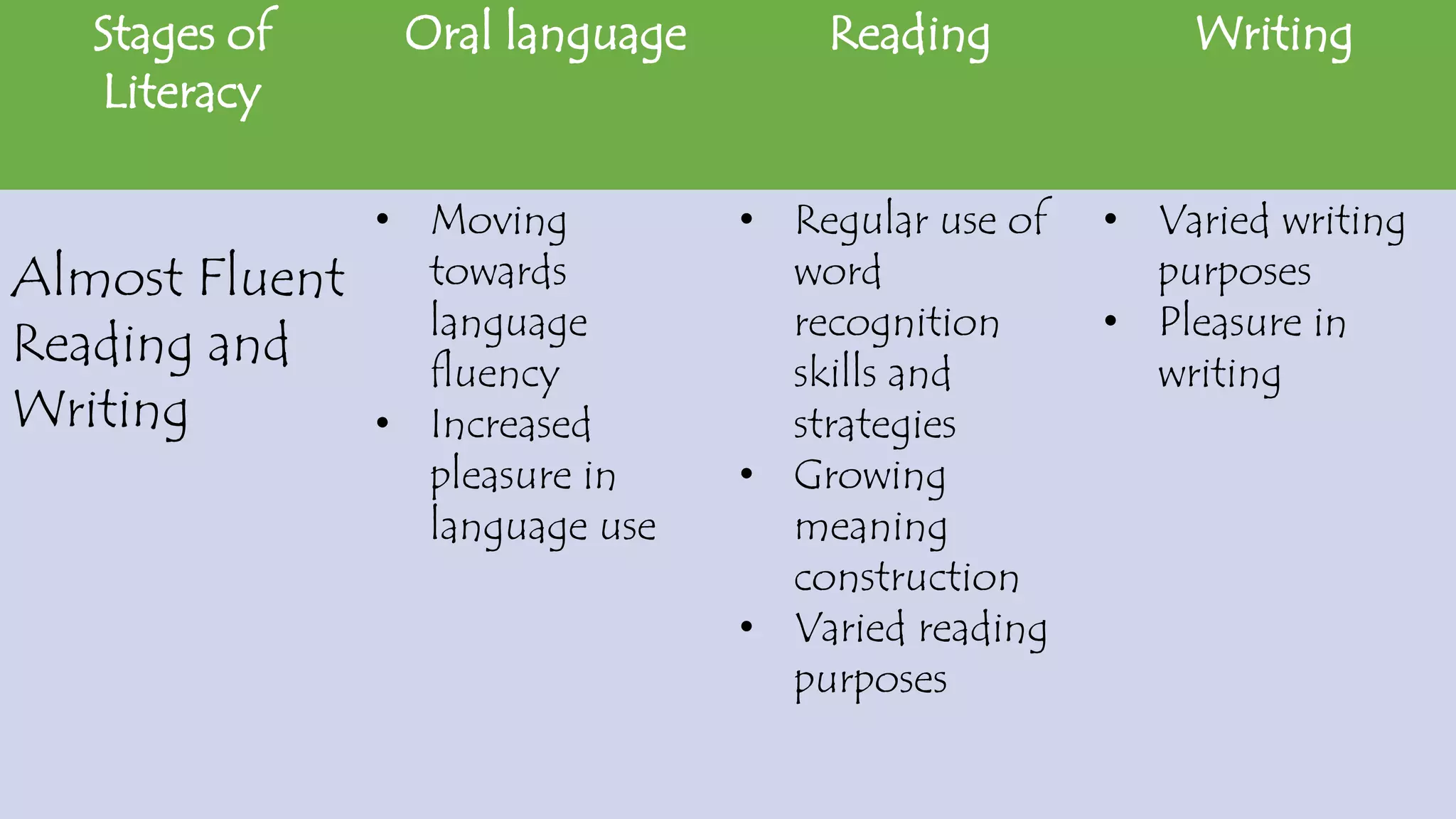
•Almost Fluent reading and writing stage
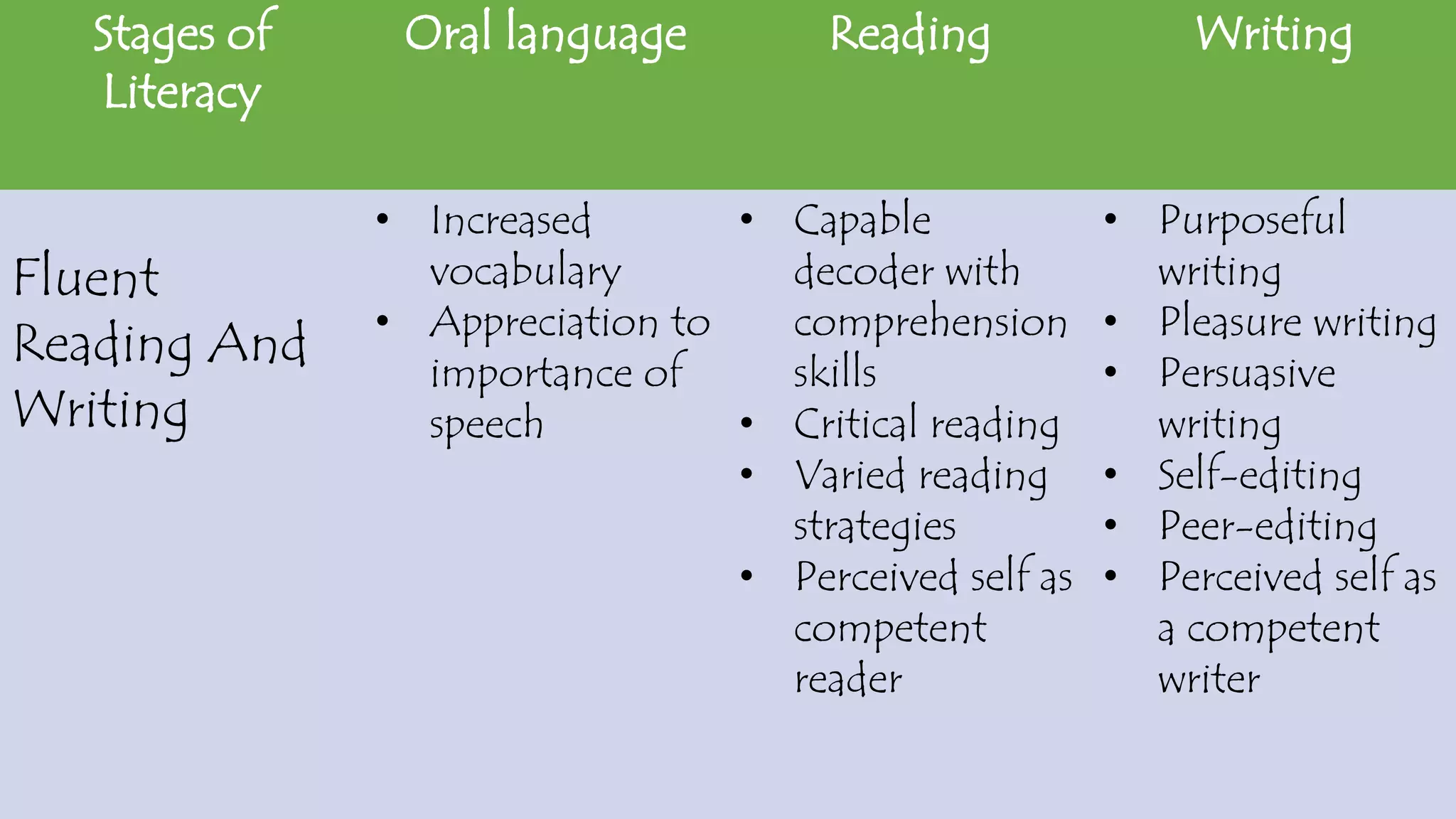
•Fluent reading and writing stage
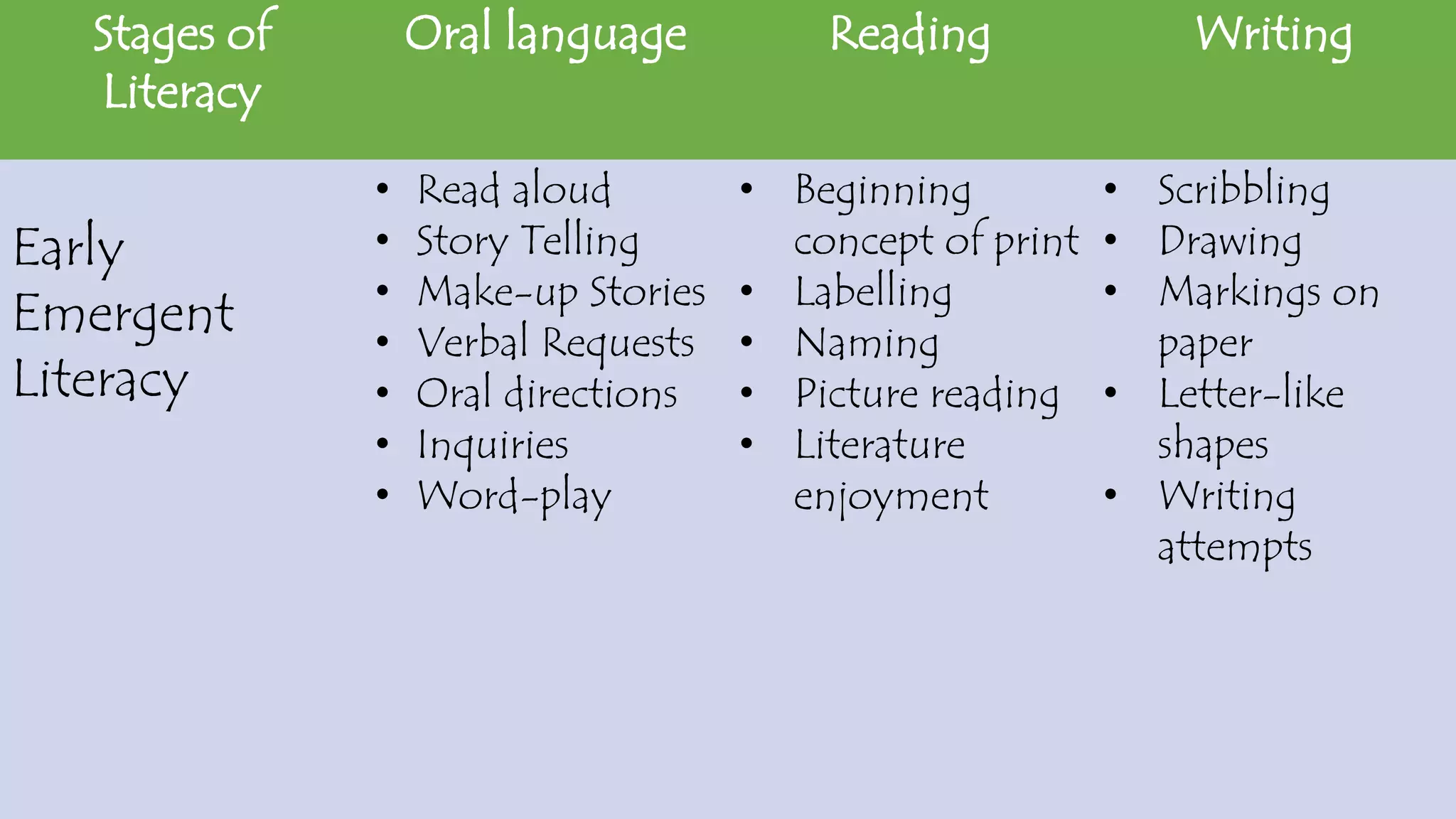
Stages of
Literacy
Oral language Reading Writing
Early
Emergent
Literacy
• Read aloud
• Story Telling
• Make-up Stories
• Verbal Requests
• Oral directions
• Inquiries
• Word-play
• Beginning
concept of print
• Labelling
• Naming
• Picture reading
• Literature
enjoyment
• Scribbling
• Drawing
• Markings on
paper
• Letter-like
shapes
• Writing
attempts
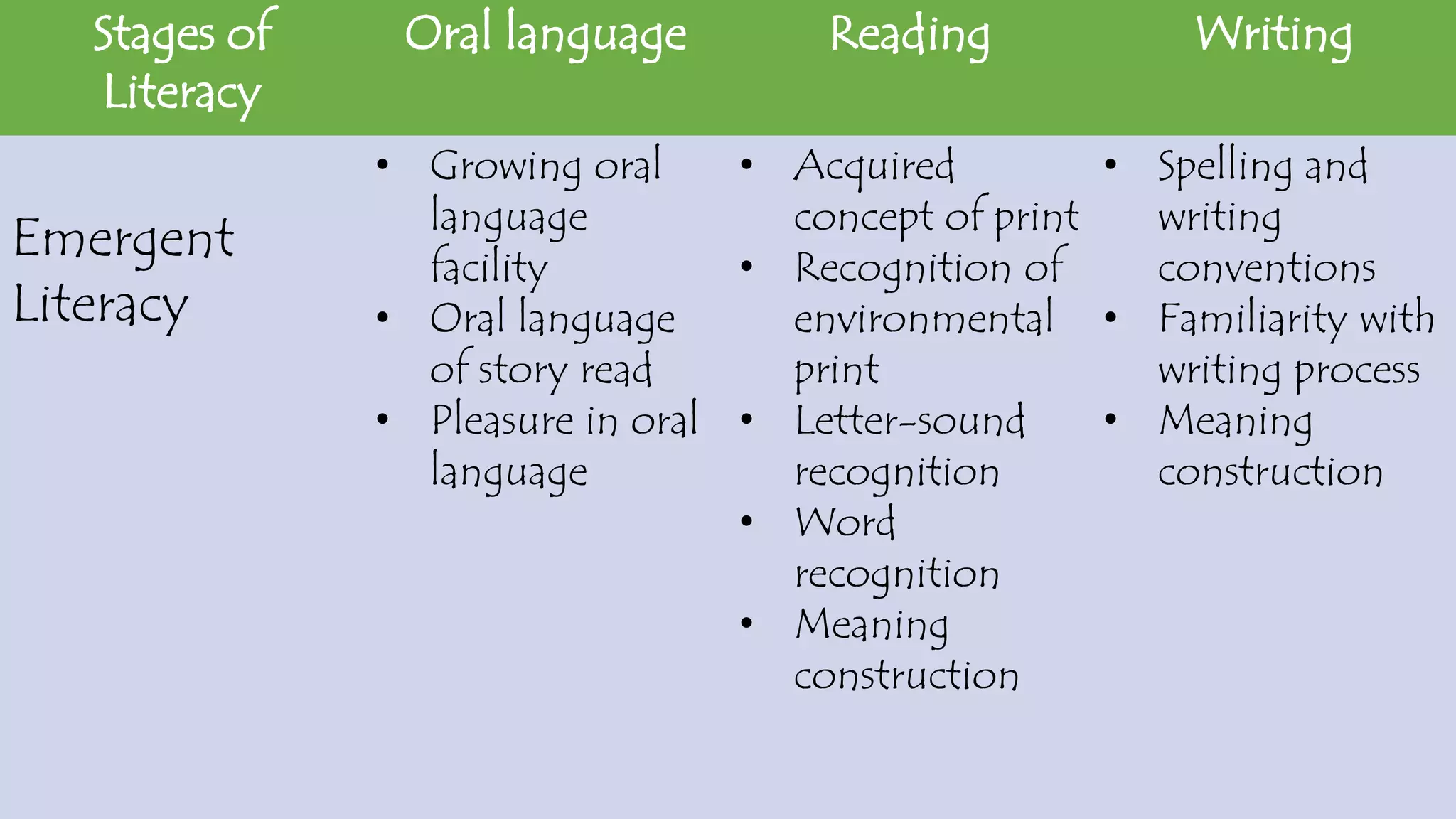
Stages of
Literacy
Oral language Reading Writing
Emergent
Literacy
• Growing oral
language
facility
• Oral language
of story read
• Pleasure in oral
language
• Acquired
concept of print
• Recognition of
environmental
print
• Letter-sound
recognition
• Word
recognition
• Meaning
construction
• Spelling and
writing
conventions
• Familiarity with
writing process
• Meaning
construction
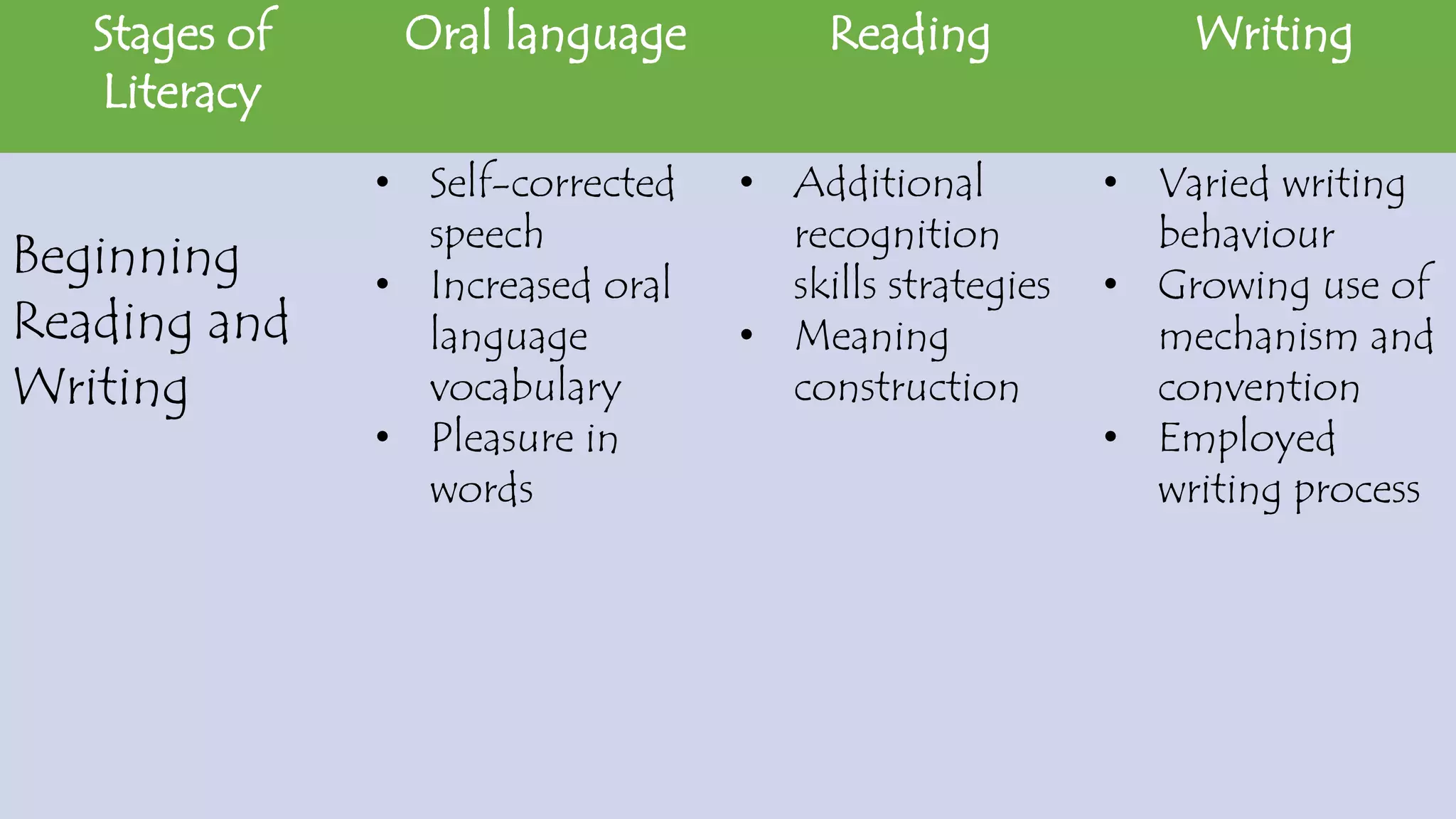
Stages of
Literacy
Oral language Reading Writing
Beginning
Reading and
Writing
• Self-corrected
speech
• Increased oral
language
vocabulary
• Pleasure in
words
• Additional
recognition
skills strategies
• Meaning
construction
• Varied writing
behaviour
• Growing use of
mechanism and
convention
• Employed
writing process
Stages of
Literacy
Oral language Reading Writing
Almost Fluent
Reading and
Writing
• Moving
towards
language
fluency
• Increased
pleasure in
language use
• Regular use of
word
recognition
skills and
strategies
• Growing
meaning
construction
• Varied reading
purposes
• Varied writing
purposes
• Pleasure in
writing
Stages of
Literacy
Oral language Reading Writing
Fluent
Reading And
Writing
• Increased
vocabulary
• Appreciation to
importance of
speech
• Capable
decoder with
comprehension
skills
• Critical reading
• Varied reading
strategies
• Perceived self as
competent
reader
• Purposeful
writing
• Pleasure writing
• Persuasive
writing
• Self-editing
• Peer-editing
• Perceived self as
a competent
writer
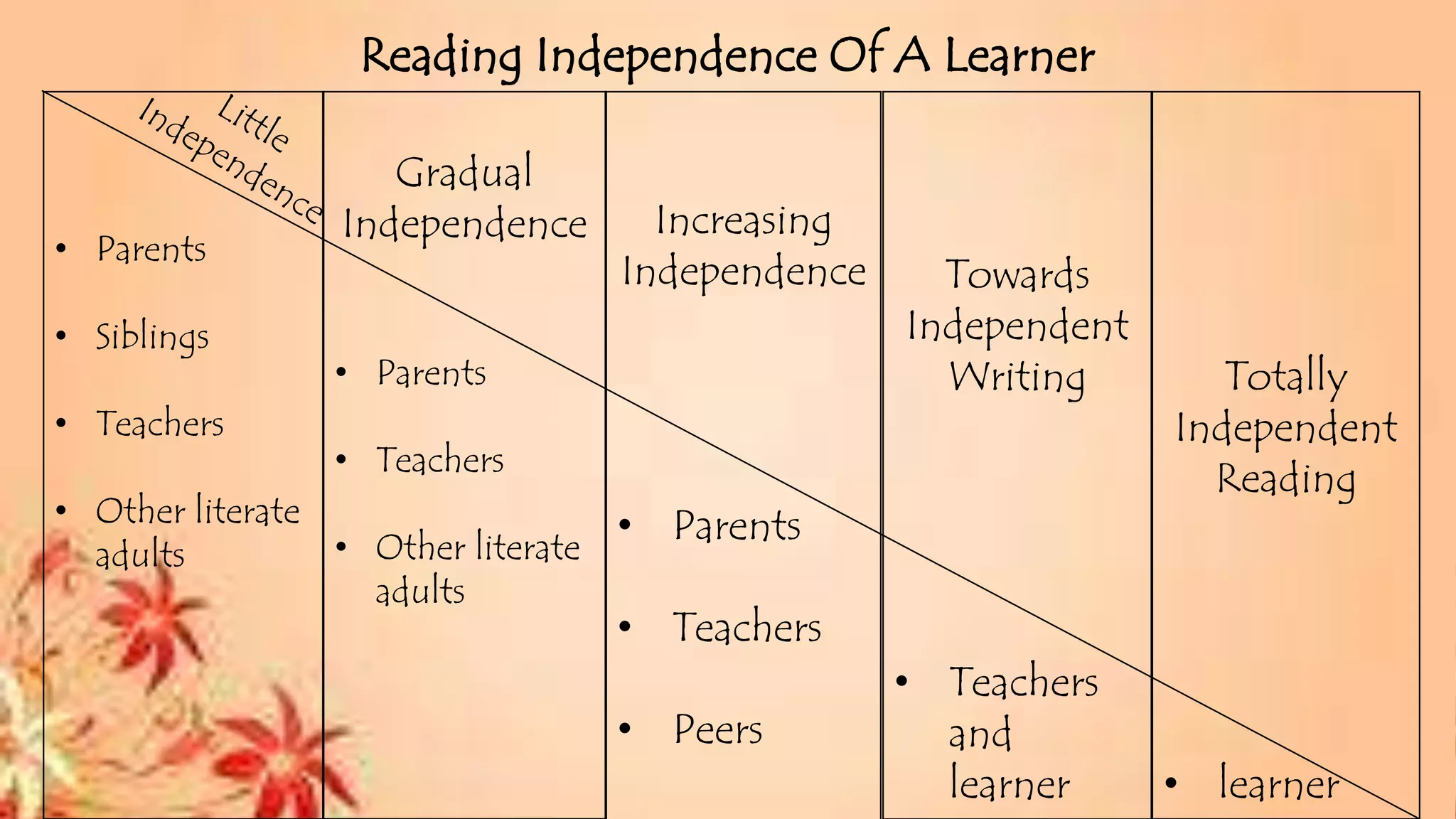
• Parents
• Siblings
• Teachers
• Other literate
adults
Gradual
Independence
• Parents
• Teachers
• Other literate
adults
Increasing
Independence
• Parents
• Teachers
• Peers
Towards
Independent
Writing
• Teachers
and
learner
Totally
Independent
Reading
• learner
Reading Independence Of A Learner
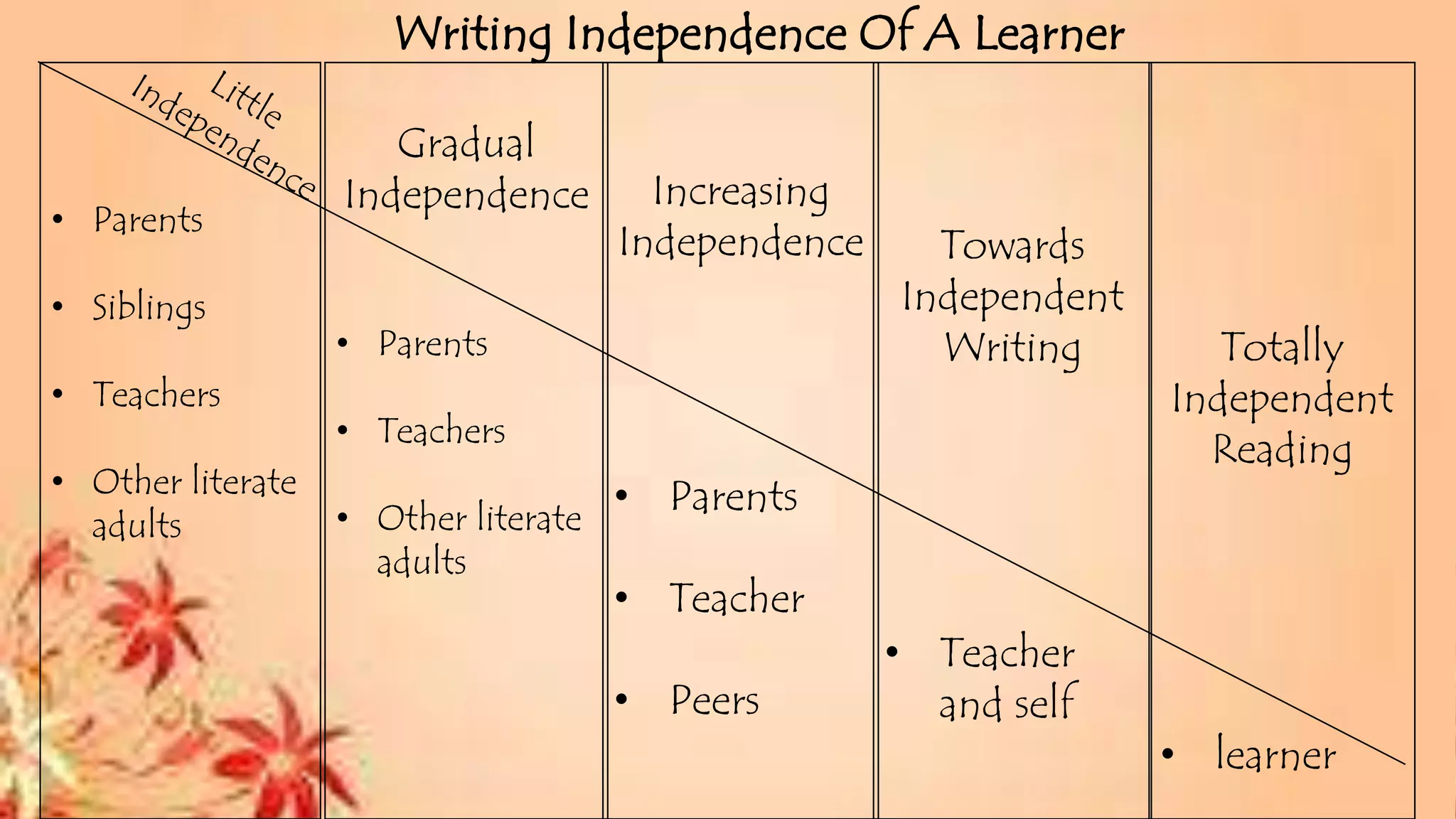
• Parents
• Siblings
• Teachers
• Other literate
adults
Gradual
Independence
• Parents
• Teachers
• Other literate
adults
Increasing
Independence
• Parents
• Teacher
• Peers
Towards
Independent
Writing
• Teacher
and self
Totally
Independent
Reading
• learner
Writing Independence Of A Learner

Emergent reader

  • 1.
  • 2.
    ∞ pertains tobe the first stage in a child’s growth toward literacy ∞ relates to the beginning experiences or the child’s first experiences with print in the home and continues through early years of formal schooling
  • 3.
    ∞ according toHarris and Hodges (1981) refer to this period of acquiring the specific skills and abilities that allow reading to take place as preparedness or reading readiness ∞ significantly determined by a complex pattern of intellectual, motivational, maturational and experiential factors
  • 4.
    Marie Clay (1991)and Fountas and Pinnell (2001) have noted five main stages of literacy development.
  • 5.
    Stage 1: EmergentReaders • Ranges from 2 to 7 years old • Begin to familiarize with the concepts of print to • directionality, • One-to-one correspondence between spoken and written • Value of picture clues to the meaning of story • Develop an understanding that printed word carries main meaning of a story • Begin to make text-to-world connections
  • 6.
    Stage 2: EarlyReaders • between ages of 5 to 7 • rely more heavily on the printed text than on the pictures on a book • begin to develop word recognition strategies • begins to develop a data bank of sight words that allows them to read with increased speed as they are read more often • a teacher may have a class containing both emergent and early readers
  • 7.
    Stage 3: TransitionalReaders • range from 5 to 7 years • able to read in meaningful phrases with comfortable pace and appropriate voice intonation • able to enumerate the four cueing systems into their reading with little disruption to meaning and flow • able to read more lengthy texts with a little reliance on pictures for text meaning
  • 8.
    Stage 4: Self-ExtendingReaders • range in age 6 to 9 years of age • readers progress into reading independence in the fourth developmental stage • often read variety of textual genres and use reading as a tool for gaining new knowledge • able to read more complex texts and begin to read for a variety of purposes
  • 9.
    Stage 5: AdvancedReaders • these readers who have attained a level of mastery with reading; over the age of 9 • become proficient in reading and in comprehending various text sources • they enjoy reading and use reading as means of gaining knowledge • they can also read fluently and can interpret texts • they connect what they have read to themselves to other texts and to the world around them • they have internalized a series of reading strategies that are used interchangeably as they different texts
  • 10.
    • Beginning reader • Basicconcept of print • Picture- analysis • Sound-letter recognition • Word recognition strategies • Sight words • Print reading • Gradual speed in reading • Mastery in reading • Proficient comprehension • Reading for information • Reading for pleasure • Inferential reading • Interpretive reading • Internalized reading strategies Emergent Reader Early Reader Transitional Reader Self-Extending Reader Advanced Reader • Towards fluent reading • Reading of length texts • Little reliance in factors • Independent reading • Reading various texts • Reading for information
  • 11.
    Perceptual Factors Oral Language Factors Cognitive Factors Affective Factors Home Environment Factors •Developed sensory skills and visual and auditory discrimination • Left to right eye progression • Stimulated awareness and manipulation of objects/toys • Emulates reading behavior • Has a great deal of oral language • Has well- developed oral language skills • Uses descriptive language • Conscious understanding about language • Has emerging ability to think • Uses trial and error to discover new things • Expanding memory • Imaginative or creative • Shows strong involvement in being read to • Has great deal of time and interest in reading • Can retell stories actively • Has access to print materials • Has parents who are habitual readers themselves • Has social interaction with parents and peers • Has pleasant environment for reading
  • 13.
    Cooper and Kiger(2001) identified five stages of early literacy learning which involve oral language, reading, and writing skills of children. These stages involve the following: •Early emergent literacy stage •Emergent literacy stage •Beginning reading and writing stage •Almost Fluent reading and writing stage •Fluent reading and writing stage
  • 14.
    Stages of Literacy Oral languageReading Writing Early Emergent Literacy • Read aloud • Story Telling • Make-up Stories • Verbal Requests • Oral directions • Inquiries • Word-play • Beginning concept of print • Labelling • Naming • Picture reading • Literature enjoyment • Scribbling • Drawing • Markings on paper • Letter-like shapes • Writing attempts
  • 15.
    Stages of Literacy Oral languageReading Writing Emergent Literacy • Growing oral language facility • Oral language of story read • Pleasure in oral language • Acquired concept of print • Recognition of environmental print • Letter-sound recognition • Word recognition • Meaning construction • Spelling and writing conventions • Familiarity with writing process • Meaning construction
  • 16.
    Stages of Literacy Oral languageReading Writing Beginning Reading and Writing • Self-corrected speech • Increased oral language vocabulary • Pleasure in words • Additional recognition skills strategies • Meaning construction • Varied writing behaviour • Growing use of mechanism and convention • Employed writing process
  • 17.
    Stages of Literacy Oral languageReading Writing Almost Fluent Reading and Writing • Moving towards language fluency • Increased pleasure in language use • Regular use of word recognition skills and strategies • Growing meaning construction • Varied reading purposes • Varied writing purposes • Pleasure in writing
  • 18.
    Stages of Literacy Oral languageReading Writing Fluent Reading And Writing • Increased vocabulary • Appreciation to importance of speech • Capable decoder with comprehension skills • Critical reading • Varied reading strategies • Perceived self as competent reader • Purposeful writing • Pleasure writing • Persuasive writing • Self-editing • Peer-editing • Perceived self as a competent writer
  • 19.
    • Parents • Siblings •Teachers • Other literate adults Gradual Independence • Parents • Teachers • Other literate adults Increasing Independence • Parents • Teachers • Peers Towards Independent Writing • Teachers and learner Totally Independent Reading • learner Reading Independence Of A Learner
  • 20.
    • Parents • Siblings •Teachers • Other literate adults Gradual Independence • Parents • Teachers • Other literate adults Increasing Independence • Parents • Teacher • Peers Towards Independent Writing • Teacher and self Totally Independent Reading • learner Writing Independence Of A Learner