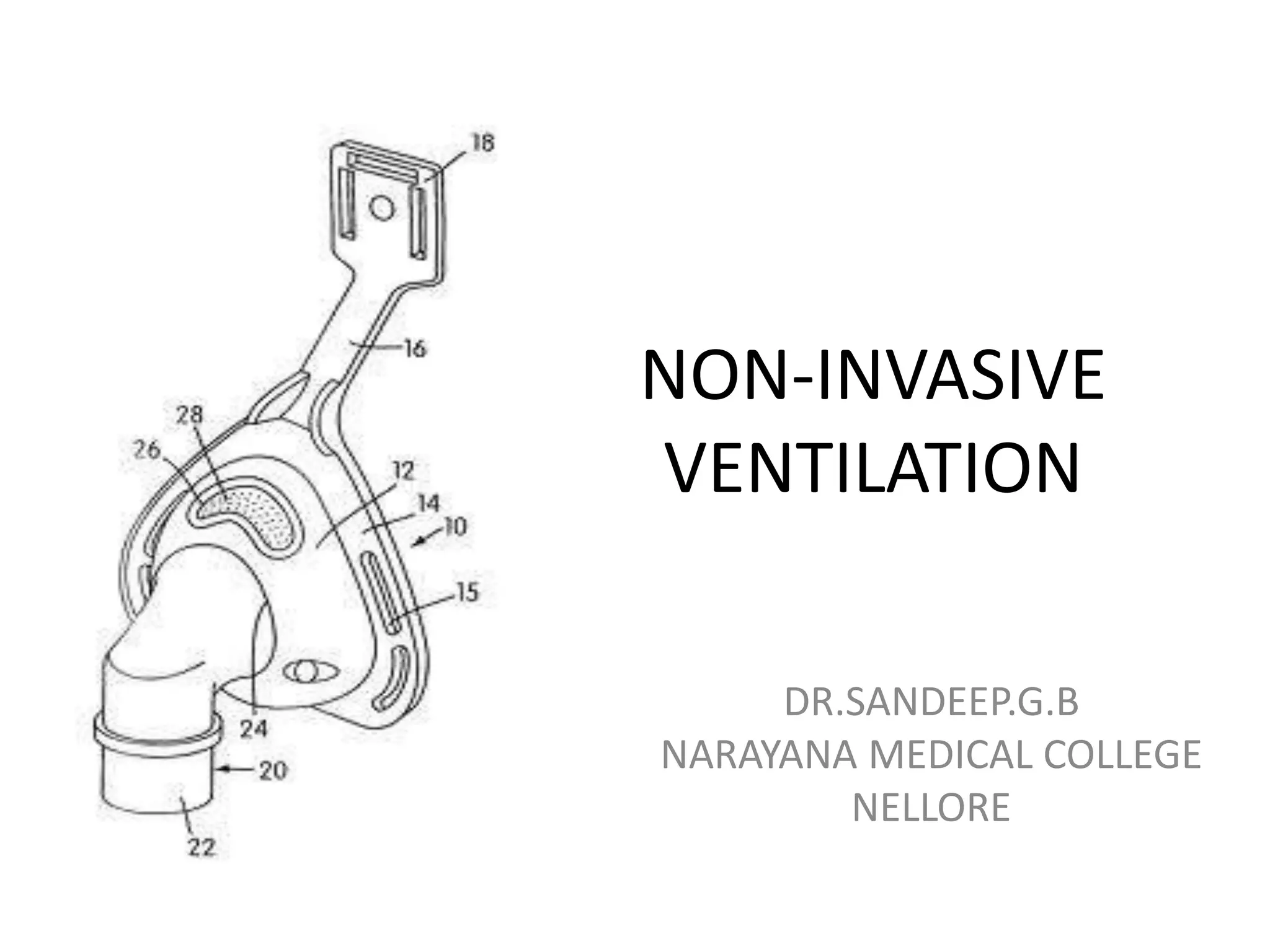
NON-INVASIVE
VENTILATION
DR.SANDEEP.G.B
NARAYANA MEDICAL COLLEGE
NELLORE
VENTILATORY FAILURE is the inability of the
Respiratory system to sustain its ventilatory function,
hence needing ventilatory support.

VENTILATORY SUPPORT
Invasive
Non Invasive
NON-INVASIVE VENTILATION (NIV)
DEFINITION:Non-invasive ventilation is the delivery of
ventilatory support without the need for an
invasive airway.
HISTORY
The concept of mechanical ventilation first evolved with
negative pressure ventilation.
• 1876 - Woillez first developed a workable iron lung.

• 1889 -Alexander Graham Bell designed & built a
prototype of iron lung.
• 1928- Drinker introduced neg-pressure ventilation &
popularized the iron lung.
Iron lung
• 1960 — use of invasive positive pressure
ventilation increased .
• 1980- use of noninvasive ventilation, fueled by
the development of PPV delivered by close
fitting nasal or face masks
INVASIVE VENTILATION

NON INVASIVE VENTILATION

ADV:1. Secures airway
2. Leak free ventilation
3. Facilitates secretion removal
DISADV:1. Trauma to airway
2. Esoph/Endobronchial intub.
3. Muscle relaxants required
4. Sedation needs
5. Greater incidence of
VAP, tracheal stenosis, etc..

• Decreased incidence of
nosocomial infections
• Improves patient comfort
• Minimal sedation
requirement
• Less painful
• Accelerates weaning
NON INVASIVE VENTILATION
• TECHNIQUES OF APPLICATION:Non Invasive Negative Pressure Ventilation
(NNPV)
Non Invasive Positive Pressure Ventilation
(NPPV)
NEGATIVE PRESSURE VENTILATION
• These devices create negative pressure around the
chest wall and augment the tidal volume.
• Devices- 1. Body ventilators
2. Iron lung
NON INVASIVE POSITIVE PRESSURE
VENTILATION
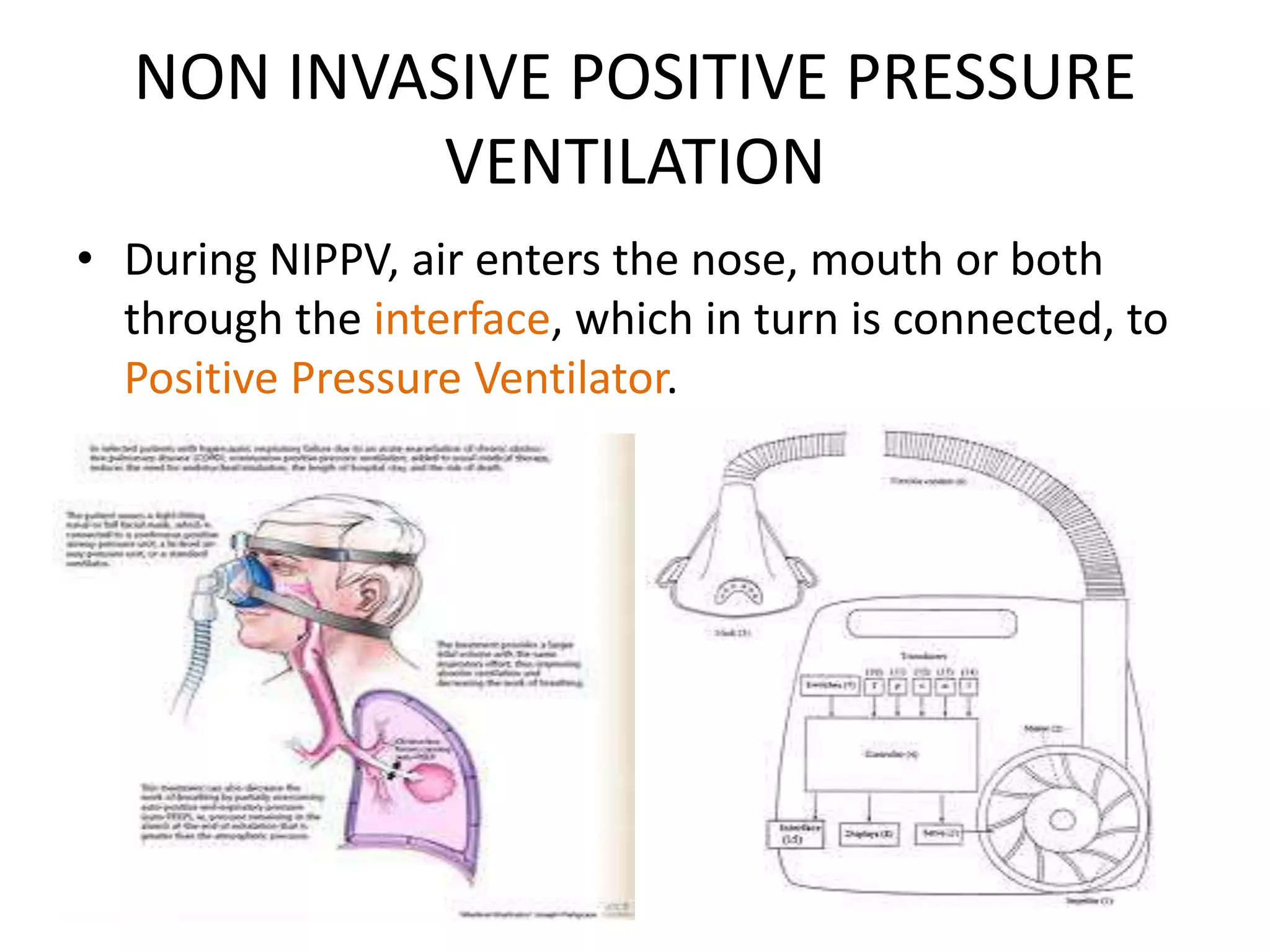
• During NIPPV, air enters the nose, mouth or both
through the interface, which in turn is connected, to
Positive Pressure Ventilator.
INTERFACES
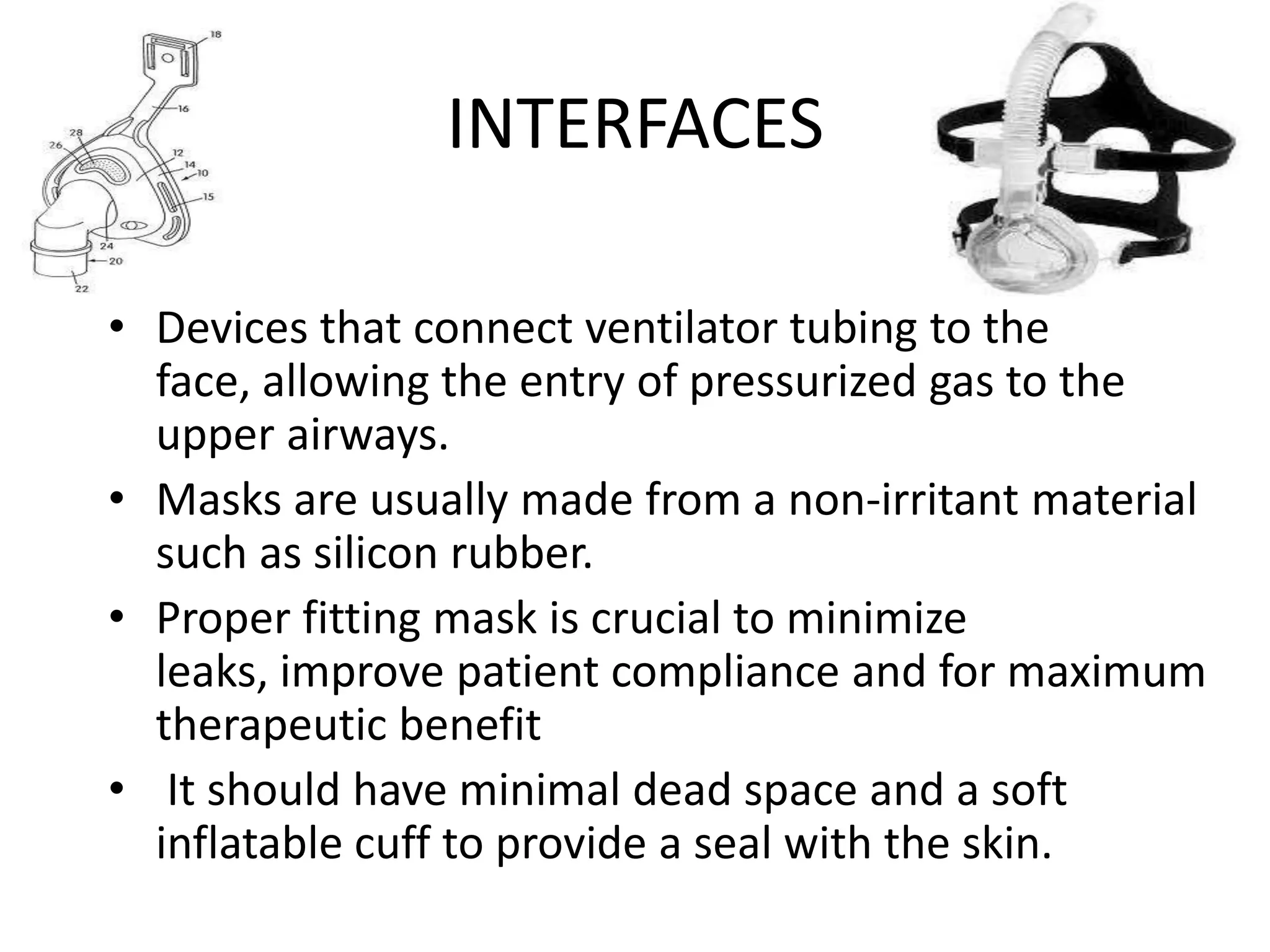
• Devices that connect ventilator tubing to the
face, allowing the entry of pressurized gas to the
upper airways.
• Masks are usually made from a non-irritant material
such as silicon rubber.
• Proper fitting mask is crucial to minimize
leaks, improve patient compliance and for maximum
therapeutic benefit
• It should have minimal dead space and a soft
inflatable cuff to provide a seal with the skin.
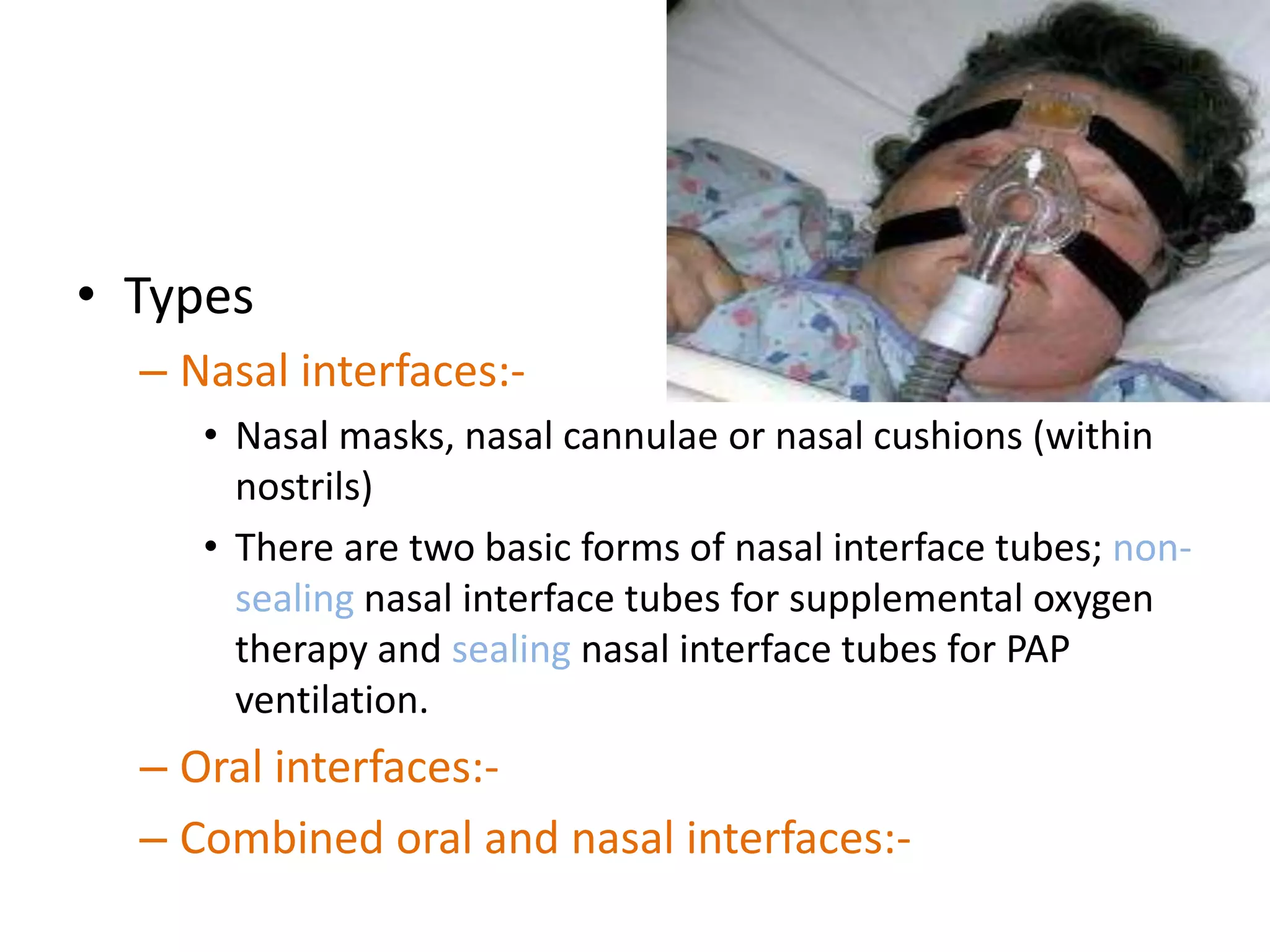
• Types
– Nasal interfaces:• Nasal masks, nasal cannulae or nasal cushions (within
nostrils)
• There are two basic forms of nasal interface tubes; nonsealing nasal interface tubes for supplemental oxygen
therapy and sealing nasal interface tubes for PAP
ventilation.

– Oral interfaces:– Combined oral and nasal interfaces:-
Variable

Nasal

Oronasal

+++

++

Claustrophobia

+

++

Rebreathing

+

++

Lower CO2

+

++

Permits expectoration

++

+

Permits speech

++

+

Permits eating

+

-

Functions if nose
obstructed

-

+

Comfort
Helmet:– Allows prolonged
continuous
application of NIV
– Lesser complications
like skin
necrosis, gastric
distension, and eye
irritation
MECHANISM OF ACTION OF NPPV
• The work of breathing equals the product of
pressure change across the lung and volume of
gas moved.
• During inspiration, most of the
work is done to overcome
elastic recoil of the thorax
and lungs, and the resistance
of the airways and non-elastic
tissues.
1. Improvement in pulmonary mechanics and
oxygenation:
– NIV augments alveolar ventilation and allows
oxygenation without raising the PaCO2

2. Partial unloading of respiratory muscles:
– NIV reduces respiratory muscle work and
diaphragmatic electromyographic activity.
– This leads to TV, RR and MV.
– Also overcomes the effect of intrinsic PEEP.
3. Resetting of respiratory centre ventilatory
responses to PaCO2:
– By maintaining lower nocturnal PaCO2 during sleep
by NIV, it is possible to reset the respiratory control
centre to become more responsive to an increased
PaCO2 by increasing the neural output to the
diaphragm and other respiratory muscles.
– These patients are then able to maintain a more
normal PaCO2 throughout the daylight hours without
the need for mechanical ventilation.
CONTRAINDICATIONS
• Inability to protect airway:– CVA, comotose patients, confused agitated
patients

• Hemodynamic instability:– Recent MI, arrhythmias, high dose inotropes

• Inability to fix the interface:– facial -abnormalities, burns, trauma, anamolies

• Severe GI symptoms:-
CONTRAINDICATIONS
• Life threatening hypoxemia
• Copious secretions
• Conditions where NIV has not been found
effective
• Non availability of trained medical personnel
Requirements for successful noninvasive support
1. A co-operative patient who can control their airway
and secretions with an adequate cough reflex. The
patient should be able to co-ordinate breathing
with the ventilator and breathe unaided for several
minutes.
2. Hemodynamically stable
3. Blood pH >7.1 and PaCO2 <92 mmHg
4. The patient should ideally show improvement in gas
exchange, H.R and R.R within first two hours.
INDICATIONS OF NPPV
A)
1.
•
•
•
•
•
•
•
•

Acute respiratory failure
Hypercapnic acute respiratory failure
Acute exacerbation of COPD
Post extubation
Weaning difficulties
Post surgical respiratory failure
Chest wall deformities/ neuromuscular disease
Cystic fibrosis
Status asthmaticus
Acute respiratory failure in obesity hypoventilation
INDICATIONS OF NPPV
2)Hypoxemic acute respiratory failure
• Cardiogenic pulmonary edema
• Community acquired pnemonia
• ARDS
• Weaning difficulties
B)Chronic respiratory failure
C)Immuno-compromised patients
D)Do not intubate patients
NIV in weaning from mechanical
ventilation
• It serves as a bridge between invasive support
and spontaneous breathing to reduce the time
on invasive mechanical ventilation.
• Used
– As a part of early weaning strategy, when SBT fails
– After conventional weaning and extubation to
prevent post extubation failure
– When signs of respiratory failure develop after
extubation
Determinants of success for NPPV
• Synchronised breathing
with ventilator
• Dentition intact
• Lower APACHE score
• Less air leaking
• Less secretions
• Good initial response to
NPPV at 1-2 hrs
• Correction of pH

• Reduction in respiratory
rate
• Reduction in PaCO2
• No pneumonia
• pH>7.10
• PaCO2 < 92mm Hg
• Better neurologic score
• Better compliance
SELECTION CRITERIA
A) ACUTE RESPIRATORY FAILURE
•
•
•
•
•

Atleast 2 of the following criteria must be present
Respiratory distress with dyspnoea
Use of accessory muscles of respiration
Abdominal paradox
Respiratory rate > 25/min
ABG shows pH< 7.35 or PaCO2 >45 mmHg or
PaO2/FiO2 <200
SELECTION CRITERIA
B) CHRONIC RESPIRATORY FAILURE( OBSTRUCTIVE LUNG
DISEASE)
Fatigue, Hypersomnalence, dyspnoea
ABG shows Ph<7.35. Paco2>55 mmHg
Oxygen saturation <88% for >10% monitoring time despite
O2 supplementation

C) THORASIC RESTRICTIVE/CEREBRAL HYPOVENTILATION
DISEASES
Fatigue, morning
headache, hypersomnalence, nightmares, enuresis, dyspn
oea
ABG shows PaCo2 >45 mmHg
Nocturnal SaO2 <90% for more than 5 minutes sustained
When to intubate during NIV???
• No improvement in gas exchange or dyspnoea
progressively increases
• Deterioration or no change in the mental condition
of the hypercapnoeic patients
• Need for airway protection
• Hemodynamic instability
• Fresh MI or arrhythmias
• Patient unable to tolerate the mask
NIV VENTILATORS
NIV
VENTILATORS

PRESSURE
PRESET
VENTILATORS

PSV

VOLUME
PRESET
VENTILATORS

PCV
• NIV ventilators also provide bilevel ventilation.
• A higher pressure is applied when patient inspires – IPAP.
• A lower pressure is applied when patient exhales – EPAP.

• The difference between IPAP and EPAP is the EFFECTIVE
PRESSURE SUPPORT.
• EPAP is equivalent to applying PEEP in a spontaneously
breathing patient
MODES
• Controlled mechanical ventilation:– No patient effort
– Referred as Timed mode
– Similar to PCV

• Assist control ventilation:– Ventilatory support in response to pt. effort and
backup safety rate if pt. does not trigger
– Referred as spontaneous/timed (S/T) mode
– Similar to PS with apnoea backup with PC breaths
• Assist mode:
– Ventilatory support to patients effort. No backup
– Referred to spont. mode
– Similar to PSV

• CPAP:
– A constant pressure is applied to airway throughout
the cycle
– Used primarily to correct hypoxemia
– Not a ventilatory mode
– Main indication- cardiogenic pulmonary edema
•Proportional Assist Ventilation (PAV)
• In this mode ventilator has capacity of responding rapidly
to the patients' ventilatory efforts rather than pressure
or volume.
• By instantaneously tracking patient inspiratory flow and
its integral (volume) using an in-line pneumotachograph,
this mode has the capability of responding rapidly to the
patient’s ventilatory effort.
• By adjusting the gain on the flow and volume signals, one
can select the proportion of breathing work that is to be
assisted.
Other Modes of Noninvasive
Ventilatory Assistance
• Diaphragm pacing.
• Glossopharyngeal breathing.
Application of NIV
1. Choose the correct interface
2. Explain therapy and its benefit to the patient in
detail . Also discuss the possibility of intubation
3. Set the NIV ventilator to Spont or S/T mode
4. Start with very low settings. Start low IPAP of 6-8
cm H2O and EPAP of 2-4 cm H2O. The difference
between IPAP and EPAP should be atleast 4 cm
H2O.
5. Administer oxygen at 2 liters per minute.
6. Hold the mask with hand over face. Do not fix it
7. Increase EPAP by 1-2 cm increments till all the
inspiratory efforts are able to trigger the ventilator

8. If the pt. is making inspiratory effort & the ventilator
is not responding, it indicates that the pt has not
generated enough respiratory effort to counter auto
PEEP and trigger the ventilator. Increase EPAP further
till it happens. Most of the pt require EPAP of about
4 to 6 cm H2O.
9. when the patients efforts are triggering the
ventilator leave EPAP at this level
10. Now start increasing IPAP in increments of 1-2 cm
H2O up to a maximum pressure, which the patient
can tolerate without discomfort

11. In some ventilators, inspiratory time (Ti) can be
set. Setting Ti at one second is reasonable
12. Now secure interface with head straps. Avoid
excessive tightness
13. After titrating pressure increase Oxygen to bring
SaO2 to around 90%.
14. As the settings may be different in wakefulness and
sleep, readjust them accordingly
FiO2 Setting:
• Initial FiO2 is to be slightly higher than that received
prior to NIV.
• Then it is adjusted to achieve desired SaO2, generally
above 92%.

• If a patient is hypoxic while breathing 100% oxygen
on a CPAP circuit, their hypoxia may not improve if
they are placed onto a BiPAP circuit (in spite of the
increased ventilatory assistance) because the FiO2
will drop significantly due to increased gas flow
through the breathing circuit.
Patient Monitoring:
• The most useful indicator is patient’s comfort. ABG is
useful to assess ventilatory parameters
• If the patient is getting increasingly tired, or ABG
deteriorates despite optimal settings, then
mechanical ventilation is necessary. It must be
recognized early.
Drug Delivery during NIV:
• Inhaled drugs can be administered during NIV by
adding a nebulizer to the circuit.
• This can be done by using a T-piece positioned as close
as possible to the patient, ideally between the exhale
valve and the patient to prevent fallout and loss of the
drug, although this does increase the dead space.

• The optimum nebulizer position during NIV is between
the leak port and the mask.
• The nebulizer dose may need to be increased if the
leak port is in the mask.
• Most nebulizers are suitable, but a nebulizer that is
able to work at varying angles is useful as often the
ventilator circuit is unsupported, leaving the
nebulizer to function on its side.
• Aerosols can also be administered into the ventilator
circuit using metered dose inhalers and spacer
devices especially when the leak port is in the mask.
ADVANTAGES OF NPPV
• Avoidance of complications
– Related to Intubation, i.e. adverse effects from induction drugs,
risk of failed intubation, risk of aspiration of gastric content and
airway trauma.
– Related to tracheal tube, i.e. need of sedation, risk of
endobronchial intubation, difficult communication, reduced
ciliary activity and more risk of ventilator associate pneumonia.
– Long term complications like tracheal stenosis, sinusitis and
vocal cord damage.

• Preservation of airway defense mechanism
• Early ventilatory support and intermittent ventilation is
possible
• Patient can eat, drink, communicate and cooperate with
physiotherapy
• Ease of application and removal with improved patient
comfort
• Pneumothorax is very rare.
• Correction of hypoxia with out worsening hypercarbia.
• It can be instituted outside the ICU because of nonrequirement of muscle paralysis
• Customized purpose-built machines available with
different NIV modes for domestic use.
• Reduction of ICU complications, hospital mortality and
lesser resource consumption in comparison with
conventional mechanical ventilation.
Disadvantages
• NIV is not appropriate for all patients and is ineffective
in those who are severely ill.
• There are problems of air leaks, skin damage and sore
from mask pressure.
• NIV may increase the risk of aspiration as airway is not
protected
• Mask uncomfortable/claustrophobic
• No direct access to bronchial tree for suction in
excessive secretions
• Patient ventilator asynchrony
• Gastric distension
Side effects
•
•
•
•
•
•
•

Air leak
Skin necrosis- particularly over bridge of nose
Retention of secretions
Gastric distension
Failure to ventilate
Sleep fragmentation
Upper airway obstruction
Problems and complications
A. PROBLEMS RELATED TO THE INTERFACE:Improperly fitting mask, excess strap tension,
claustrophobia, pressure over nasal bridge

B. PROBLEMS ASSOCIATED WITH AIRPRESSURE
AND FLOW:– Air leaks- oral dryness, eye irritation
– Air pressure – redness & congestion of nose & PNS
– Gastric distension
C. Problems associated with intolerance to NIV:
– Mask intolerance
– Patient ventilator asynchrony

D. Problems associated with failure to ventilate
adequately:
– Air leak
– Rebreathing of CO2
– Position of exhalation valve affects dynamic dead
space
E. Major complications:
– Delay in intubation and worsening of prognosis
– Major desaturation and cardiac arrest
– Aspiration pneumonia
– Hypotension
– Pneumothorax
THANK YOU

Non-invasive Ventilation

  • 1.
  • 2.
    VENTILATORY FAILURE isthe inability of the Respiratory system to sustain its ventilatory function, hence needing ventilatory support. VENTILATORY SUPPORT Invasive Non Invasive
  • 3.
    NON-INVASIVE VENTILATION (NIV) DEFINITION:Non-invasiveventilation is the delivery of ventilatory support without the need for an invasive airway.
  • 4.
    HISTORY The concept ofmechanical ventilation first evolved with negative pressure ventilation. • 1876 - Woillez first developed a workable iron lung. • 1889 -Alexander Graham Bell designed & built a prototype of iron lung. • 1928- Drinker introduced neg-pressure ventilation & popularized the iron lung.
  • 5.
  • 6.
    • 1960 —use of invasive positive pressure ventilation increased . • 1980- use of noninvasive ventilation, fueled by the development of PPV delivered by close fitting nasal or face masks
  • 7.
    INVASIVE VENTILATION NON INVASIVEVENTILATION ADV:1. Secures airway 2. Leak free ventilation 3. Facilitates secretion removal DISADV:1. Trauma to airway 2. Esoph/Endobronchial intub. 3. Muscle relaxants required 4. Sedation needs 5. Greater incidence of VAP, tracheal stenosis, etc.. • Decreased incidence of nosocomial infections • Improves patient comfort • Minimal sedation requirement • Less painful • Accelerates weaning
  • 8.
    NON INVASIVE VENTILATION •TECHNIQUES OF APPLICATION:Non Invasive Negative Pressure Ventilation (NNPV) Non Invasive Positive Pressure Ventilation (NPPV)
  • 9.
    NEGATIVE PRESSURE VENTILATION •These devices create negative pressure around the chest wall and augment the tidal volume. • Devices- 1. Body ventilators 2. Iron lung
  • 10.
    NON INVASIVE POSITIVEPRESSURE VENTILATION • During NIPPV, air enters the nose, mouth or both through the interface, which in turn is connected, to Positive Pressure Ventilator.
  • 11.
    INTERFACES • Devices thatconnect ventilator tubing to the face, allowing the entry of pressurized gas to the upper airways. • Masks are usually made from a non-irritant material such as silicon rubber. • Proper fitting mask is crucial to minimize leaks, improve patient compliance and for maximum therapeutic benefit • It should have minimal dead space and a soft inflatable cuff to provide a seal with the skin.
  • 12.
    • Types – Nasalinterfaces:• Nasal masks, nasal cannulae or nasal cushions (within nostrils) • There are two basic forms of nasal interface tubes; nonsealing nasal interface tubes for supplemental oxygen therapy and sealing nasal interface tubes for PAP ventilation. – Oral interfaces:– Combined oral and nasal interfaces:-
  • 13.
  • 16.
    Helmet:– Allows prolonged continuous applicationof NIV – Lesser complications like skin necrosis, gastric distension, and eye irritation
  • 17.
    MECHANISM OF ACTIONOF NPPV • The work of breathing equals the product of pressure change across the lung and volume of gas moved. • During inspiration, most of the work is done to overcome elastic recoil of the thorax and lungs, and the resistance of the airways and non-elastic tissues.
  • 18.
    1. Improvement inpulmonary mechanics and oxygenation: – NIV augments alveolar ventilation and allows oxygenation without raising the PaCO2 2. Partial unloading of respiratory muscles: – NIV reduces respiratory muscle work and diaphragmatic electromyographic activity. – This leads to TV, RR and MV. – Also overcomes the effect of intrinsic PEEP.
  • 19.
    3. Resetting ofrespiratory centre ventilatory responses to PaCO2: – By maintaining lower nocturnal PaCO2 during sleep by NIV, it is possible to reset the respiratory control centre to become more responsive to an increased PaCO2 by increasing the neural output to the diaphragm and other respiratory muscles. – These patients are then able to maintain a more normal PaCO2 throughout the daylight hours without the need for mechanical ventilation.
  • 20.
    CONTRAINDICATIONS • Inability toprotect airway:– CVA, comotose patients, confused agitated patients • Hemodynamic instability:– Recent MI, arrhythmias, high dose inotropes • Inability to fix the interface:– facial -abnormalities, burns, trauma, anamolies • Severe GI symptoms:-
  • 21.
    CONTRAINDICATIONS • Life threateninghypoxemia • Copious secretions • Conditions where NIV has not been found effective • Non availability of trained medical personnel
  • 22.
    Requirements for successfulnoninvasive support 1. A co-operative patient who can control their airway and secretions with an adequate cough reflex. The patient should be able to co-ordinate breathing with the ventilator and breathe unaided for several minutes. 2. Hemodynamically stable 3. Blood pH >7.1 and PaCO2 <92 mmHg 4. The patient should ideally show improvement in gas exchange, H.R and R.R within first two hours.
  • 23.
    INDICATIONS OF NPPV A) 1. • • • • • • • • Acuterespiratory failure Hypercapnic acute respiratory failure Acute exacerbation of COPD Post extubation Weaning difficulties Post surgical respiratory failure Chest wall deformities/ neuromuscular disease Cystic fibrosis Status asthmaticus Acute respiratory failure in obesity hypoventilation
  • 24.
    INDICATIONS OF NPPV 2)Hypoxemicacute respiratory failure • Cardiogenic pulmonary edema • Community acquired pnemonia • ARDS • Weaning difficulties B)Chronic respiratory failure C)Immuno-compromised patients D)Do not intubate patients
  • 25.
    NIV in weaningfrom mechanical ventilation • It serves as a bridge between invasive support and spontaneous breathing to reduce the time on invasive mechanical ventilation. • Used – As a part of early weaning strategy, when SBT fails – After conventional weaning and extubation to prevent post extubation failure – When signs of respiratory failure develop after extubation
  • 26.
    Determinants of successfor NPPV • Synchronised breathing with ventilator • Dentition intact • Lower APACHE score • Less air leaking • Less secretions • Good initial response to NPPV at 1-2 hrs • Correction of pH • Reduction in respiratory rate • Reduction in PaCO2 • No pneumonia • pH>7.10 • PaCO2 < 92mm Hg • Better neurologic score • Better compliance
  • 27.
    SELECTION CRITERIA A) ACUTERESPIRATORY FAILURE • • • • • Atleast 2 of the following criteria must be present Respiratory distress with dyspnoea Use of accessory muscles of respiration Abdominal paradox Respiratory rate > 25/min ABG shows pH< 7.35 or PaCO2 >45 mmHg or PaO2/FiO2 <200
  • 28.
    SELECTION CRITERIA B) CHRONICRESPIRATORY FAILURE( OBSTRUCTIVE LUNG DISEASE) Fatigue, Hypersomnalence, dyspnoea ABG shows Ph<7.35. Paco2>55 mmHg Oxygen saturation <88% for >10% monitoring time despite O2 supplementation C) THORASIC RESTRICTIVE/CEREBRAL HYPOVENTILATION DISEASES Fatigue, morning headache, hypersomnalence, nightmares, enuresis, dyspn oea ABG shows PaCo2 >45 mmHg Nocturnal SaO2 <90% for more than 5 minutes sustained
  • 29.
    When to intubateduring NIV??? • No improvement in gas exchange or dyspnoea progressively increases • Deterioration or no change in the mental condition of the hypercapnoeic patients • Need for airway protection • Hemodynamic instability • Fresh MI or arrhythmias • Patient unable to tolerate the mask
  • 30.
  • 31.
    • NIV ventilatorsalso provide bilevel ventilation. • A higher pressure is applied when patient inspires – IPAP. • A lower pressure is applied when patient exhales – EPAP. • The difference between IPAP and EPAP is the EFFECTIVE PRESSURE SUPPORT. • EPAP is equivalent to applying PEEP in a spontaneously breathing patient
  • 32.
    MODES • Controlled mechanicalventilation:– No patient effort – Referred as Timed mode – Similar to PCV • Assist control ventilation:– Ventilatory support in response to pt. effort and backup safety rate if pt. does not trigger – Referred as spontaneous/timed (S/T) mode – Similar to PS with apnoea backup with PC breaths
  • 33.
    • Assist mode: –Ventilatory support to patients effort. No backup – Referred to spont. mode – Similar to PSV • CPAP: – A constant pressure is applied to airway throughout the cycle – Used primarily to correct hypoxemia – Not a ventilatory mode – Main indication- cardiogenic pulmonary edema
  • 34.
    •Proportional Assist Ventilation(PAV) • In this mode ventilator has capacity of responding rapidly to the patients' ventilatory efforts rather than pressure or volume. • By instantaneously tracking patient inspiratory flow and its integral (volume) using an in-line pneumotachograph, this mode has the capability of responding rapidly to the patient’s ventilatory effort. • By adjusting the gain on the flow and volume signals, one can select the proportion of breathing work that is to be assisted.
  • 35.
    Other Modes ofNoninvasive Ventilatory Assistance • Diaphragm pacing. • Glossopharyngeal breathing.
  • 36.
    Application of NIV 1.Choose the correct interface 2. Explain therapy and its benefit to the patient in detail . Also discuss the possibility of intubation 3. Set the NIV ventilator to Spont or S/T mode 4. Start with very low settings. Start low IPAP of 6-8 cm H2O and EPAP of 2-4 cm H2O. The difference between IPAP and EPAP should be atleast 4 cm H2O.
  • 37.
    5. Administer oxygenat 2 liters per minute. 6. Hold the mask with hand over face. Do not fix it 7. Increase EPAP by 1-2 cm increments till all the inspiratory efforts are able to trigger the ventilator 8. If the pt. is making inspiratory effort & the ventilator is not responding, it indicates that the pt has not generated enough respiratory effort to counter auto PEEP and trigger the ventilator. Increase EPAP further till it happens. Most of the pt require EPAP of about 4 to 6 cm H2O.
  • 38.
    9. when thepatients efforts are triggering the ventilator leave EPAP at this level 10. Now start increasing IPAP in increments of 1-2 cm H2O up to a maximum pressure, which the patient can tolerate without discomfort 11. In some ventilators, inspiratory time (Ti) can be set. Setting Ti at one second is reasonable 12. Now secure interface with head straps. Avoid excessive tightness
  • 39.
    13. After titratingpressure increase Oxygen to bring SaO2 to around 90%. 14. As the settings may be different in wakefulness and sleep, readjust them accordingly
  • 40.
    FiO2 Setting: • InitialFiO2 is to be slightly higher than that received prior to NIV. • Then it is adjusted to achieve desired SaO2, generally above 92%. • If a patient is hypoxic while breathing 100% oxygen on a CPAP circuit, their hypoxia may not improve if they are placed onto a BiPAP circuit (in spite of the increased ventilatory assistance) because the FiO2 will drop significantly due to increased gas flow through the breathing circuit.
  • 41.
    Patient Monitoring: • Themost useful indicator is patient’s comfort. ABG is useful to assess ventilatory parameters • If the patient is getting increasingly tired, or ABG deteriorates despite optimal settings, then mechanical ventilation is necessary. It must be recognized early.
  • 42.
    Drug Delivery duringNIV: • Inhaled drugs can be administered during NIV by adding a nebulizer to the circuit. • This can be done by using a T-piece positioned as close as possible to the patient, ideally between the exhale valve and the patient to prevent fallout and loss of the drug, although this does increase the dead space. • The optimum nebulizer position during NIV is between the leak port and the mask.
  • 43.
    • The nebulizerdose may need to be increased if the leak port is in the mask. • Most nebulizers are suitable, but a nebulizer that is able to work at varying angles is useful as often the ventilator circuit is unsupported, leaving the nebulizer to function on its side. • Aerosols can also be administered into the ventilator circuit using metered dose inhalers and spacer devices especially when the leak port is in the mask.
  • 44.
    ADVANTAGES OF NPPV •Avoidance of complications – Related to Intubation, i.e. adverse effects from induction drugs, risk of failed intubation, risk of aspiration of gastric content and airway trauma. – Related to tracheal tube, i.e. need of sedation, risk of endobronchial intubation, difficult communication, reduced ciliary activity and more risk of ventilator associate pneumonia. – Long term complications like tracheal stenosis, sinusitis and vocal cord damage. • Preservation of airway defense mechanism • Early ventilatory support and intermittent ventilation is possible • Patient can eat, drink, communicate and cooperate with physiotherapy
  • 45.
    • Ease ofapplication and removal with improved patient comfort • Pneumothorax is very rare. • Correction of hypoxia with out worsening hypercarbia. • It can be instituted outside the ICU because of nonrequirement of muscle paralysis • Customized purpose-built machines available with different NIV modes for domestic use. • Reduction of ICU complications, hospital mortality and lesser resource consumption in comparison with conventional mechanical ventilation.
  • 46.
    Disadvantages • NIV isnot appropriate for all patients and is ineffective in those who are severely ill. • There are problems of air leaks, skin damage and sore from mask pressure. • NIV may increase the risk of aspiration as airway is not protected • Mask uncomfortable/claustrophobic • No direct access to bronchial tree for suction in excessive secretions • Patient ventilator asynchrony • Gastric distension
  • 47.
    Side effects • • • • • • • Air leak Skinnecrosis- particularly over bridge of nose Retention of secretions Gastric distension Failure to ventilate Sleep fragmentation Upper airway obstruction
  • 48.
    Problems and complications A.PROBLEMS RELATED TO THE INTERFACE:Improperly fitting mask, excess strap tension, claustrophobia, pressure over nasal bridge B. PROBLEMS ASSOCIATED WITH AIRPRESSURE AND FLOW:– Air leaks- oral dryness, eye irritation – Air pressure – redness & congestion of nose & PNS – Gastric distension
  • 49.
    C. Problems associatedwith intolerance to NIV: – Mask intolerance – Patient ventilator asynchrony D. Problems associated with failure to ventilate adequately: – Air leak – Rebreathing of CO2 – Position of exhalation valve affects dynamic dead space
  • 50.
    E. Major complications: –Delay in intubation and worsening of prognosis – Major desaturation and cardiac arrest – Aspiration pneumonia – Hypotension – Pneumothorax
  • 51.

Editor's Notes

  • #31 VOLUME PRESET VENTILATION: TV SET, Paw variablePRESSURE PRESET VENTILATION: Paw set, TV variablePCV- TIME TRIGGERED, PAP CYCLEDPSV- PATIENT TRIGGERES, PAP CYCLED