LIGHT VS. ELECTRON MICROSCOPE
PRESENTED BY:
GROUP 1:
REMIEL ALQUILETA
JAMICA AMBION
CELLINE ANCHETA
HUB 42
HISTORY
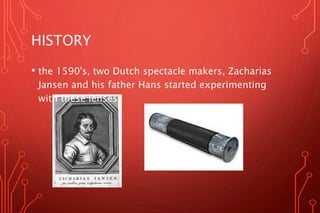
• the 1590's, two Dutch spectacle makers, Zacharias
Jansen and his father Hans started experimenting
with these lenses
HISTORY
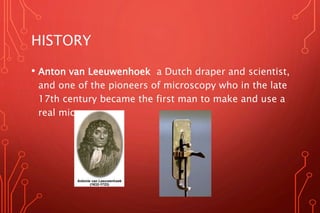
• Anton van Leeuwenhoek a Dutch draper and scientist,
and one of the pioneers of microscopy who in the late
17th century became the first man to make and use a
real microscope.
HISTORY
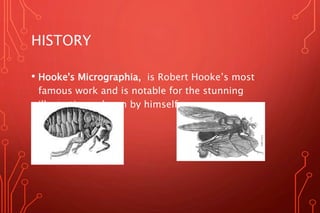
• Hooke's Micrographia, is Robert Hooke’s most
famous work and is notable for the stunning
illustrations, drawn by himself.
HISTORY
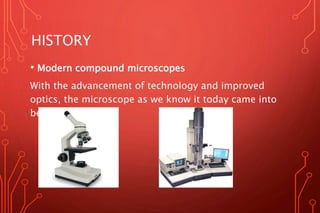
• Modern compound microscopes
With the advancement of technology and improved
optics, the microscope as we know it today came into
being.
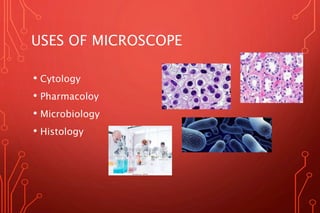
USES OF MICROSCOPE
• Cytology
• Pharmacoloy
• Microbiology
• Histology
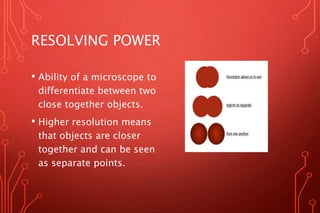
RESOLVING POWER
• Ability of a microscope to
differentiate between two
close together objects.
• Higher resolution means
that objects are closer
together and can be seen
as separate points.
LIGHT MICROSCOPE
• The term light refers to the method by which light
transmits the image to your eye.
• Microscope is the combination of two words; "micro"
meaning small and "scope" meaning view.
• Optical microscopes are the oldest design of microscope
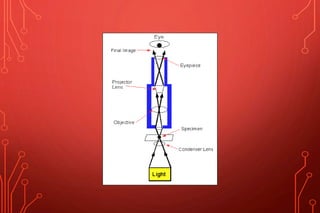
• Using a light microscope, one can view cell walls, vacuoles,
cytoplasm, chloroplasts, nucleus and cell membrane. Light
microscopes use lenses and light to magnify cell parts.
TYPES OF LIGHT MICROSCOPE
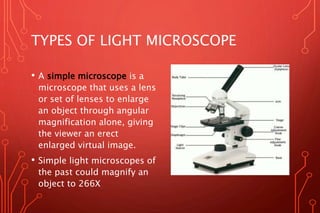
• A simple microscope is a
microscope that uses a lens
or set of lenses to enlarge
an object through angular
magnification alone, giving
the viewer an erect
enlarged virtual image.
• Simple light microscopes of
the past could magnify an
object to 266X
TYPES OF LIGHT MICROSCOPE
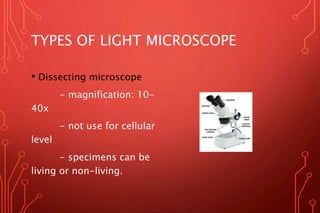
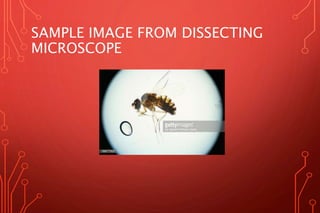
• Dissecting microscope
- magnification: 10-
40x
- not use for cellular
level
- specimens can be
living or non-living.
SAMPLE IMAGE FROM DISSECTING
MICROSCOPE
TYPES OF LIGHT MICROSCOPE
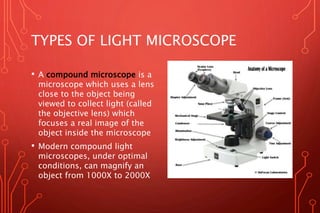
• A compound microscope is a
microscope which uses a lens
close to the object being
viewed to collect light (called
the objective lens) which
focuses a real image of the
object inside the microscope
• Modern compound light
microscopes, under optimal
conditions, can magnify an
object from 1000X to 2000X
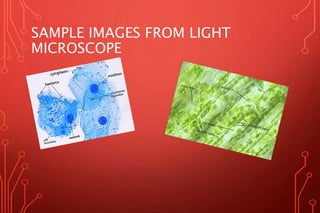
SAMPLE IMAGES FROM LIGHT
MICROSCOPE
ADVANTAGES
LIMITATION
• Easy to use
• Cheap
• True color but
sometimes require
staining
• Could use live specimens
• Low resolution due to
shorter wavelength of
light (0.2nm)
• Low magnification (max.
1250x)
• Specimen used is thin
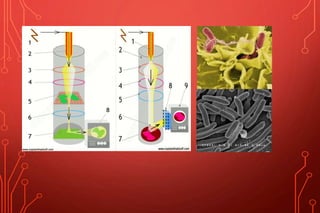
ELECTRON MICROSCOPE
• An electron microscope is a microscope that uses a beam
of accelerated electrons as a source of illumination
• A transmission electron microscope can achieve better
than 50 pm resolution and magnifications of up to about
10,000,000x
• You need to use particles that are smaller than photons to
start with: in other words, you need to use electrons
• In an electron microscope, a stream of electrons takes the
place of a beam of light and allows us to see things
smaller even than light itself.
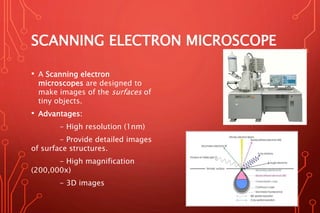
SCANNING ELECTRON MICROSCOPE
• A Scanning electron
microscopes are designed to
make images of the surfaces of
tiny objects.
• Advantages:
- High resolution (1nm)
- Provide detailed images
of surface structures.
- High magnification
(200,000x)
- 3D images
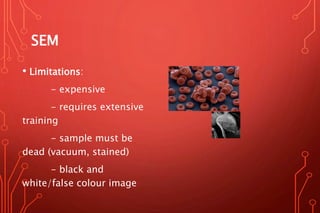
SEM
• Limitations:
- expensive
- requires extensive
training
- sample must be
dead (vacuum, stained)
- black and
white/false colour image
TRANSMISSION ELECTRON
MICROSCOPE
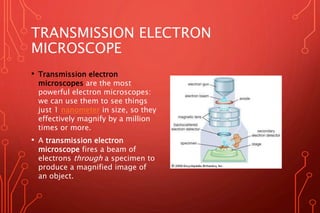
• Transmission electron
microscopes are the most
powerful electron microscopes:
we can use them to see things
just 1 nanometer in size, so they
effectively magnify by a million
times or more.
• A transmission electron
microscope fires a beam of
electrons through a specimen to
produce a magnified image of
an object.
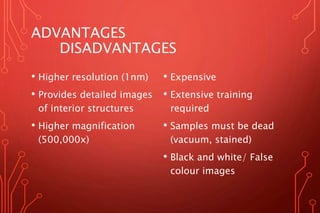
ADVANTAGES
DISADVANTAGES
• Higher resolution (1nm)
• Provides detailed images
of interior structures
• Higher magnification
(500,000x)
• Expensive
• Extensive training
required
• Samples must be dead
(vacuum, stained)
• Black and white/ False
colour images
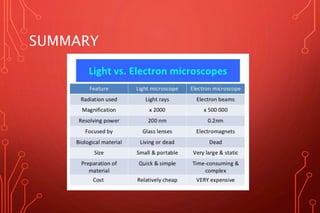
SUMMARY
REFENCES
• Comparing microscopes:
https://www.youtube.com/watch?v=b4WOsYktdn4
• Microscopes - SC.912.L.14.4
https://www.youtube.com/watch?v=6vZZeWqbmU8
• http://www.cas.miamioh.edu/mbiws/microscopes/compo
undscope.html#howit works
• http://www.history-of-the-microscope.org/history-of-
the-microscope-who-invented-the-microscope.php
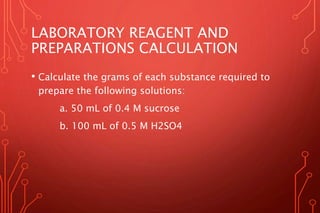
LABORATORY REAGENT AND
PREPARATIONS CALCULATION
• Calculate the grams of each substance required to
prepare the following solutions:
a. 50 mL of 0.4 M sucrose
b. 100 mL of 0.5 M H2SO4
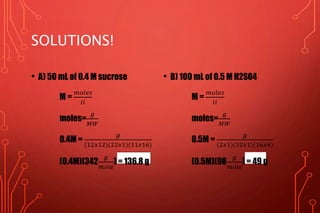
SOLUTIONS!
• A) 50 mL of 0.4 M sucrose
M =
𝑚𝑜𝑙𝑒𝑠
𝐼𝑖
moles=
𝑔
𝑀𝑊
0.4M =
𝑔
(12𝑥12)(22𝑥1)(11𝑥16)
(0.4M)(342
𝑔
𝑚𝑜𝑙𝑒
) = 136.8 g
• B) 100 mL of 0.5 M H2SO4
M =
𝑚𝑜𝑙𝑒𝑠
𝐼𝑖
moles=
𝑔
𝑀𝑊
0.5M =
𝑔
(2𝑥1)(32𝑥1)(16𝑥4)
(0.5M)(98
𝑔
𝑚𝑜𝑙𝑒
) = 49 g

Light microscope vs. Electron microscope

  • 1.
    LIGHT VS. ELECTRONMICROSCOPE PRESENTED BY: GROUP 1: REMIEL ALQUILETA JAMICA AMBION CELLINE ANCHETA HUB 42
  • 2.
    HISTORY • the 1590's,two Dutch spectacle makers, Zacharias Jansen and his father Hans started experimenting with these lenses
  • 3.
    HISTORY • Anton vanLeeuwenhoek a Dutch draper and scientist, and one of the pioneers of microscopy who in the late 17th century became the first man to make and use a real microscope.
  • 4.
    HISTORY • Hooke's Micrographia,is Robert Hooke’s most famous work and is notable for the stunning illustrations, drawn by himself.
  • 5.
    HISTORY • Modern compoundmicroscopes With the advancement of technology and improved optics, the microscope as we know it today came into being.
  • 6.
    USES OF MICROSCOPE •Cytology • Pharmacoloy • Microbiology • Histology
  • 7.
    RESOLVING POWER • Abilityof a microscope to differentiate between two close together objects. • Higher resolution means that objects are closer together and can be seen as separate points.
  • 8.
    LIGHT MICROSCOPE • Theterm light refers to the method by which light transmits the image to your eye. • Microscope is the combination of two words; "micro" meaning small and "scope" meaning view. • Optical microscopes are the oldest design of microscope • Using a light microscope, one can view cell walls, vacuoles, cytoplasm, chloroplasts, nucleus and cell membrane. Light microscopes use lenses and light to magnify cell parts.
  • 10.
    TYPES OF LIGHTMICROSCOPE • A simple microscope is a microscope that uses a lens or set of lenses to enlarge an object through angular magnification alone, giving the viewer an erect enlarged virtual image. • Simple light microscopes of the past could magnify an object to 266X
  • 11.
    TYPES OF LIGHTMICROSCOPE • Dissecting microscope - magnification: 10- 40x - not use for cellular level - specimens can be living or non-living.
  • 12.
    SAMPLE IMAGE FROMDISSECTING MICROSCOPE
  • 13.
    TYPES OF LIGHTMICROSCOPE • A compound microscope is a microscope which uses a lens close to the object being viewed to collect light (called the objective lens) which focuses a real image of the object inside the microscope • Modern compound light microscopes, under optimal conditions, can magnify an object from 1000X to 2000X
  • 14.
    SAMPLE IMAGES FROMLIGHT MICROSCOPE
  • 15.
    ADVANTAGES LIMITATION • Easy touse • Cheap • True color but sometimes require staining • Could use live specimens • Low resolution due to shorter wavelength of light (0.2nm) • Low magnification (max. 1250x) • Specimen used is thin
  • 16.
    ELECTRON MICROSCOPE • Anelectron microscope is a microscope that uses a beam of accelerated electrons as a source of illumination • A transmission electron microscope can achieve better than 50 pm resolution and magnifications of up to about 10,000,000x • You need to use particles that are smaller than photons to start with: in other words, you need to use electrons • In an electron microscope, a stream of electrons takes the place of a beam of light and allows us to see things smaller even than light itself.
  • 17.
    SCANNING ELECTRON MICROSCOPE •A Scanning electron microscopes are designed to make images of the surfaces of tiny objects. • Advantages: - High resolution (1nm) - Provide detailed images of surface structures. - High magnification (200,000x) - 3D images
  • 18.
    SEM • Limitations: - expensive -requires extensive training - sample must be dead (vacuum, stained) - black and white/false colour image
  • 19.
    TRANSMISSION ELECTRON MICROSCOPE • Transmissionelectron microscopes are the most powerful electron microscopes: we can use them to see things just 1 nanometer in size, so they effectively magnify by a million times or more. • A transmission electron microscope fires a beam of electrons through a specimen to produce a magnified image of an object.
  • 21.
    ADVANTAGES DISADVANTAGES • Higher resolution(1nm) • Provides detailed images of interior structures • Higher magnification (500,000x) • Expensive • Extensive training required • Samples must be dead (vacuum, stained) • Black and white/ False colour images
  • 22.
  • 23.
    REFENCES • Comparing microscopes: https://www.youtube.com/watch?v=b4WOsYktdn4 •Microscopes - SC.912.L.14.4 https://www.youtube.com/watch?v=6vZZeWqbmU8 • http://www.cas.miamioh.edu/mbiws/microscopes/compo undscope.html#howit works • http://www.history-of-the-microscope.org/history-of- the-microscope-who-invented-the-microscope.php
  • 24.
    LABORATORY REAGENT AND PREPARATIONSCALCULATION • Calculate the grams of each substance required to prepare the following solutions: a. 50 mL of 0.4 M sucrose b. 100 mL of 0.5 M H2SO4
  • 25.
    SOLUTIONS! • A) 50mL of 0.4 M sucrose M = 𝑚𝑜𝑙𝑒𝑠 𝐼𝑖 moles= 𝑔 𝑀𝑊 0.4M = 𝑔 (12𝑥12)(22𝑥1)(11𝑥16) (0.4M)(342 𝑔 𝑚𝑜𝑙𝑒 ) = 136.8 g • B) 100 mL of 0.5 M H2SO4 M = 𝑚𝑜𝑙𝑒𝑠 𝐼𝑖 moles= 𝑔 𝑀𝑊 0.5M = 𝑔 (2𝑥1)(32𝑥1)(16𝑥4) (0.5M)(98 𝑔 𝑚𝑜𝑙𝑒 ) = 49 g