1
INSTRUMENTALANALYSIS
LAB.
Mr Haydar A.M.S
BSc, MSc
Faculty of Science
Chemistry Department
Email: Haydar.kovly@gmail.com
University of Zakho Chemistry Department
2
TURBIDIMETRIC DETERMINATION
OF SULPHATE ION (SO4
2- ) IN THE
UNKNOWN SOLUTION
Lab 8
University of Zakho Chemistry Department
Aim of the experiment
3
To determine the concentration of SO4
2- in the unknown solution using
Nephelo-Turbidity meter.
University of Zakho Chemistry Department
4
Introduction
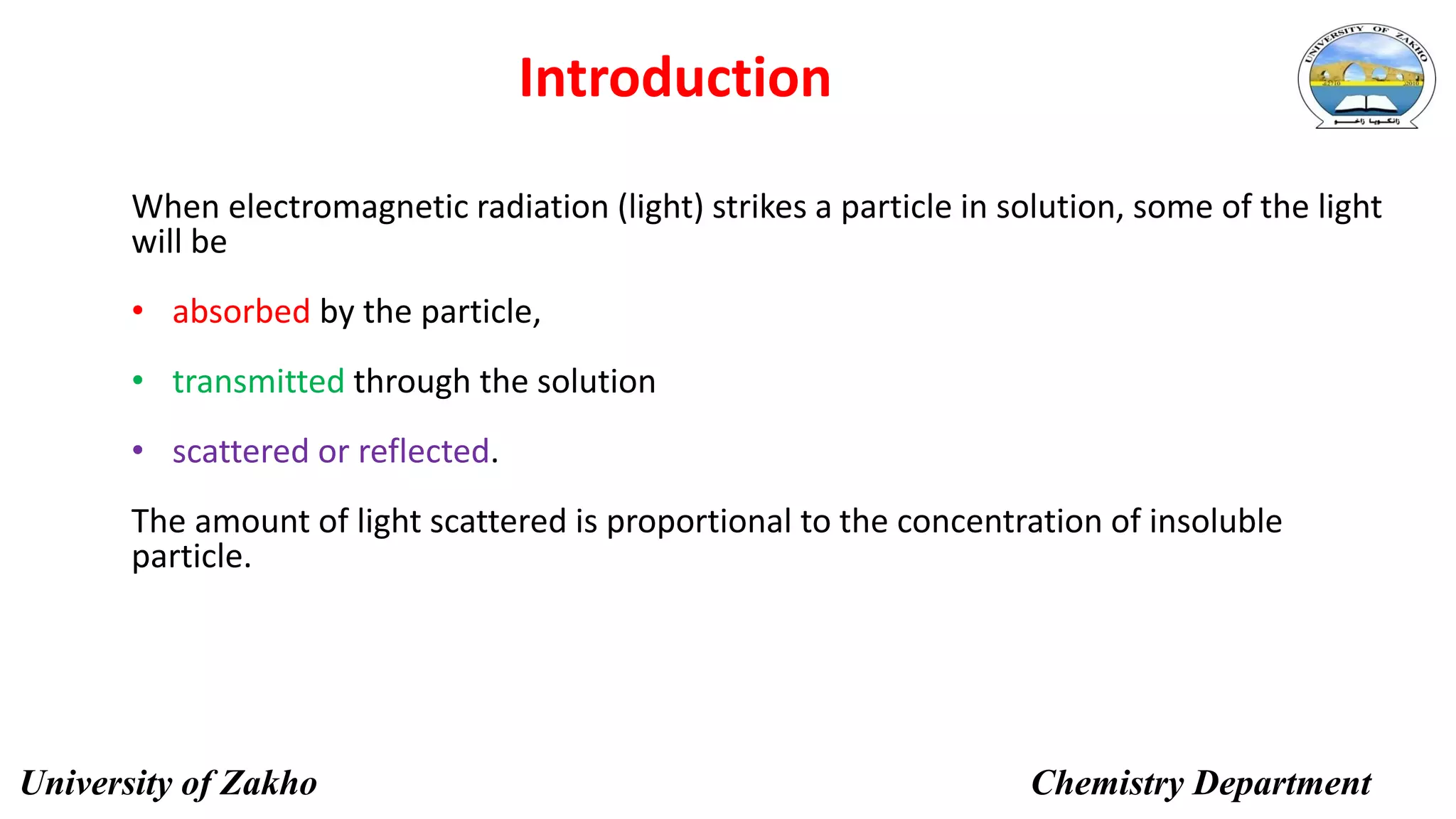
When electromagnetic radiation (light) strikes a particle in solution, some of the light
will be
• absorbed by the particle,
• transmitted through the solution
• scattered or reflected.
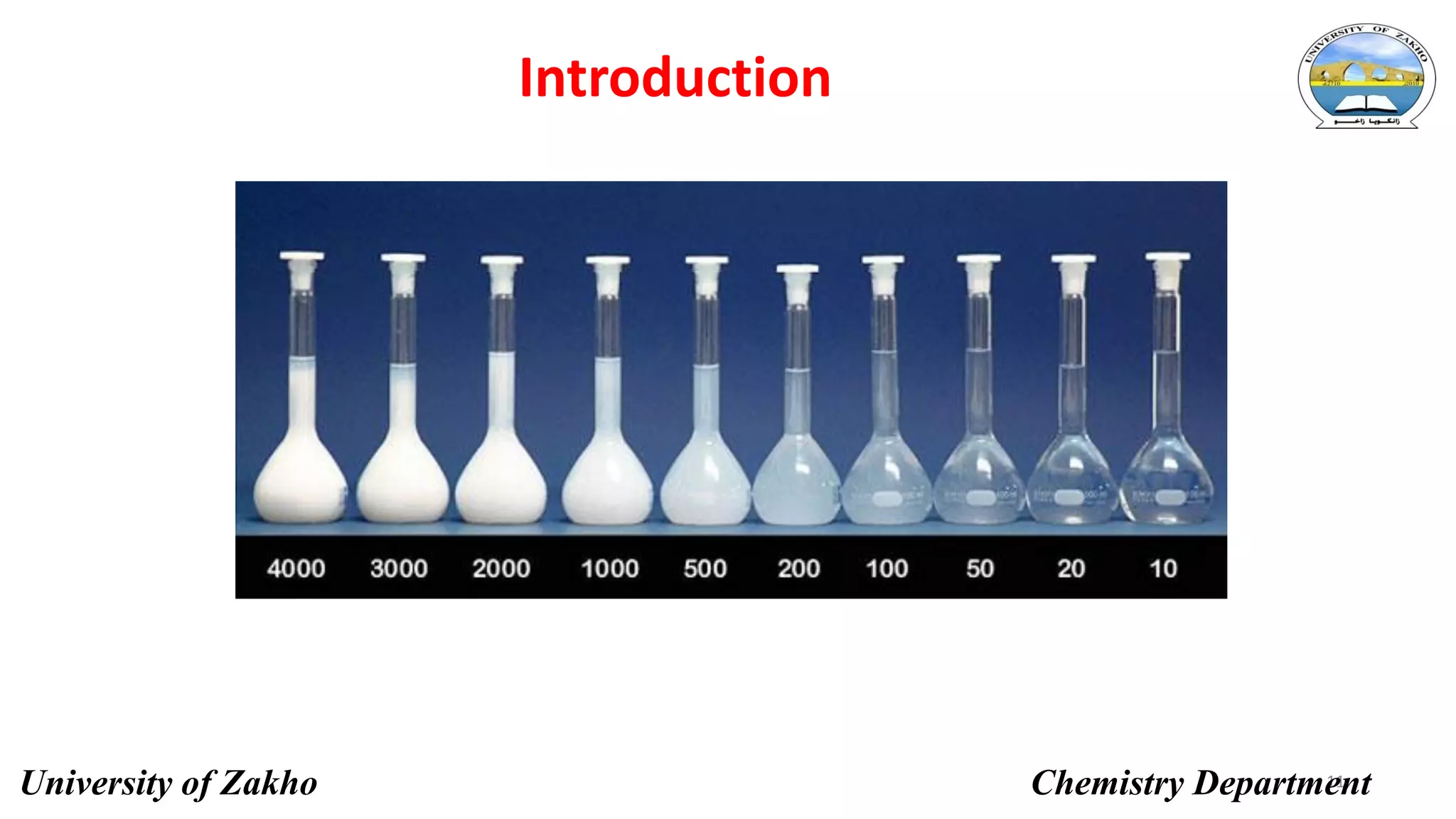
The amount of light scattered is proportional to the concentration of insoluble
particle.
University of Zakho Chemistry Department
Turbidimetry & Nephelometry
5
Introduction
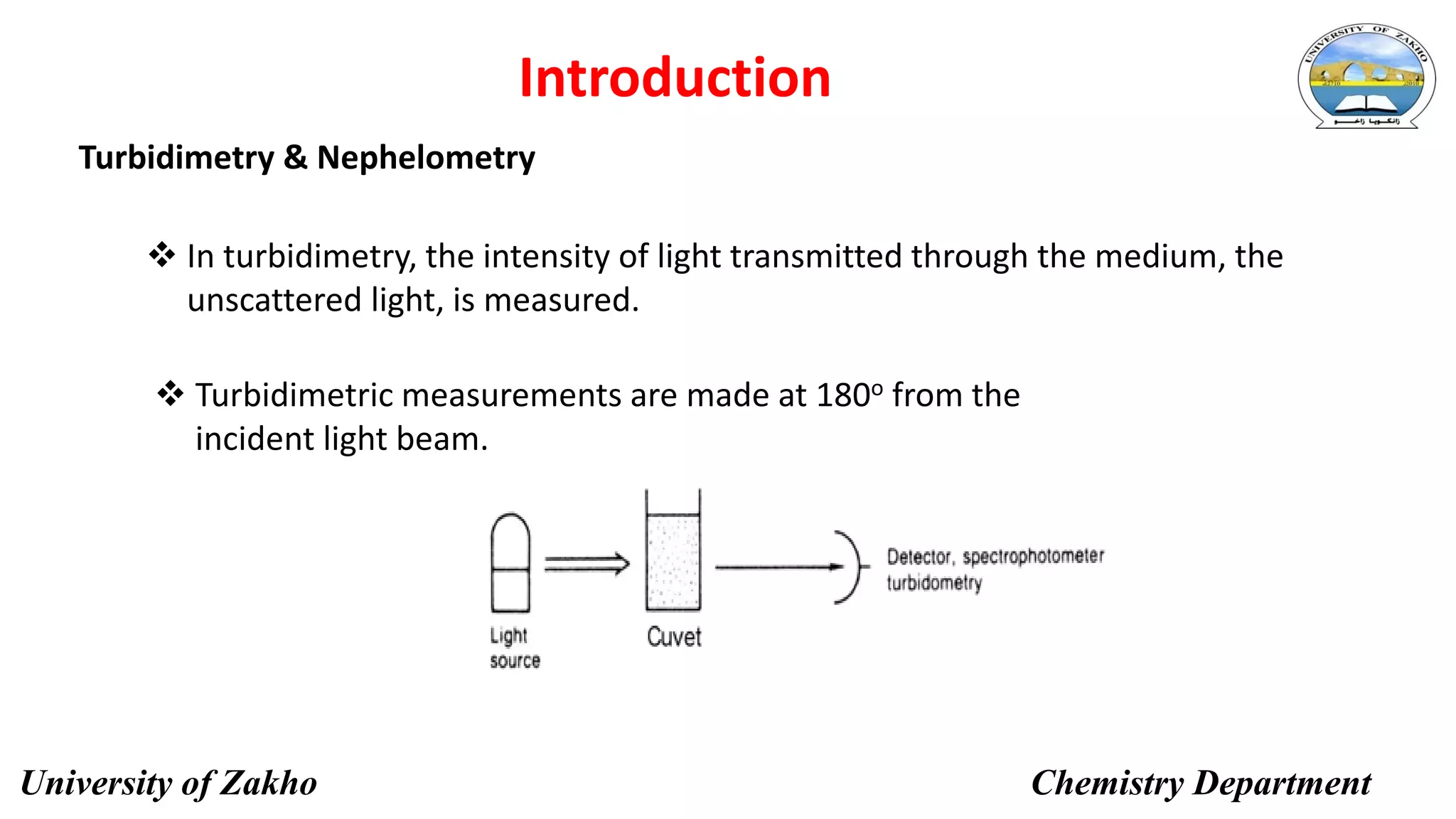
 In turbidimetry, the intensity of light transmitted through the medium, the
unscattered light, is measured.
 Turbidimetric measurements are made at 180o from the
incident light beam.
University of Zakho Chemistry Department
Turbidimetry & Nephelometry
6
Introduction
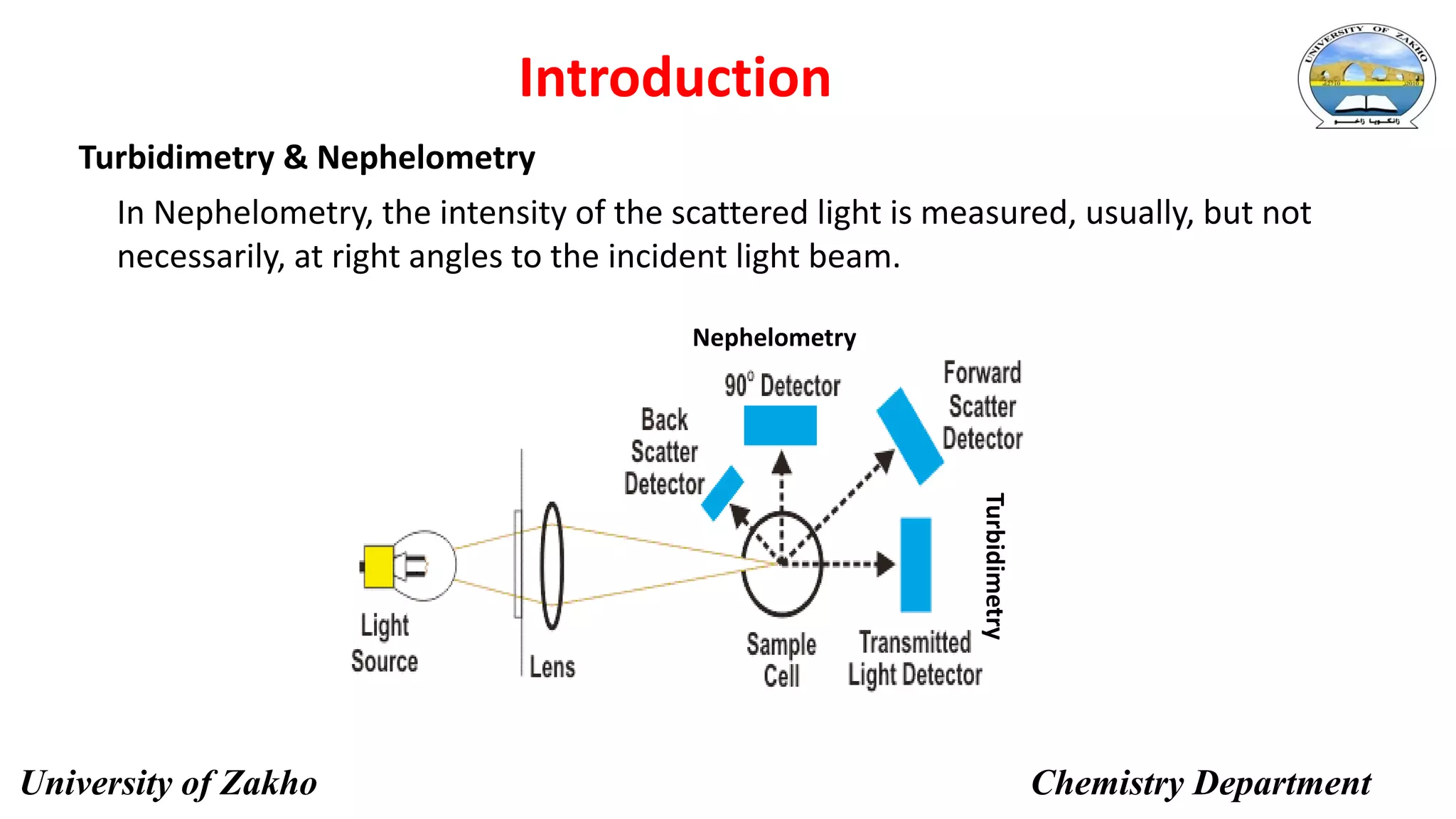
In Nephelometry, the intensity of the scattered light is measured, usually, but not
necessarily, at right angles to the incident light beam.
Nephelometry
Turbidimetry
University of Zakho Chemistry Department
Turbidimetry & Nephelometry
7
Introduction
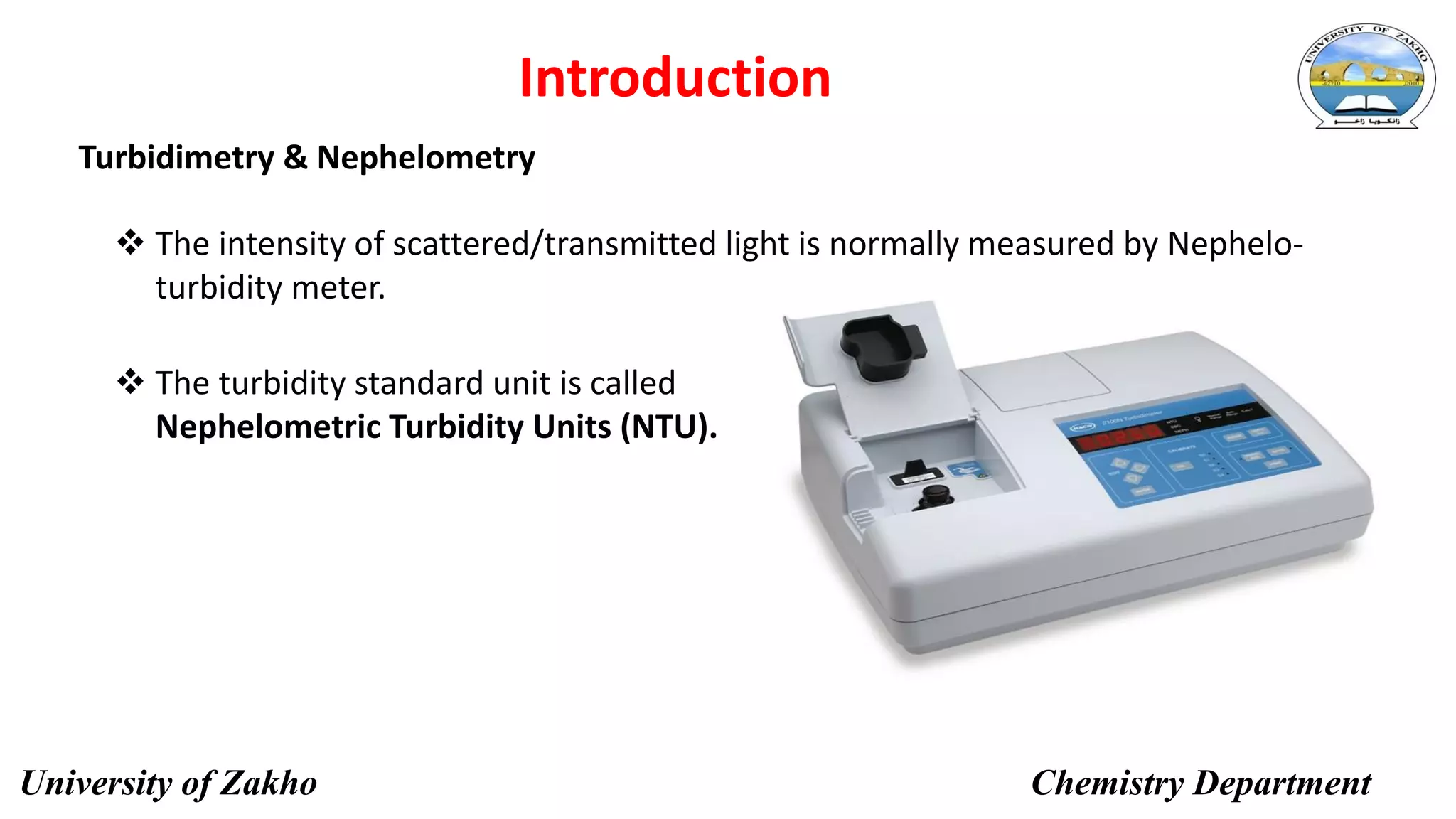
 The intensity of scattered/transmitted light is normally measured by Nephelo-
turbidity meter.
 The turbidity standard unit is called
Nephelometric Turbidity Units (NTU).
University of Zakho Chemistry Department
Turbidimetry & Nephelometry
8
Introduction
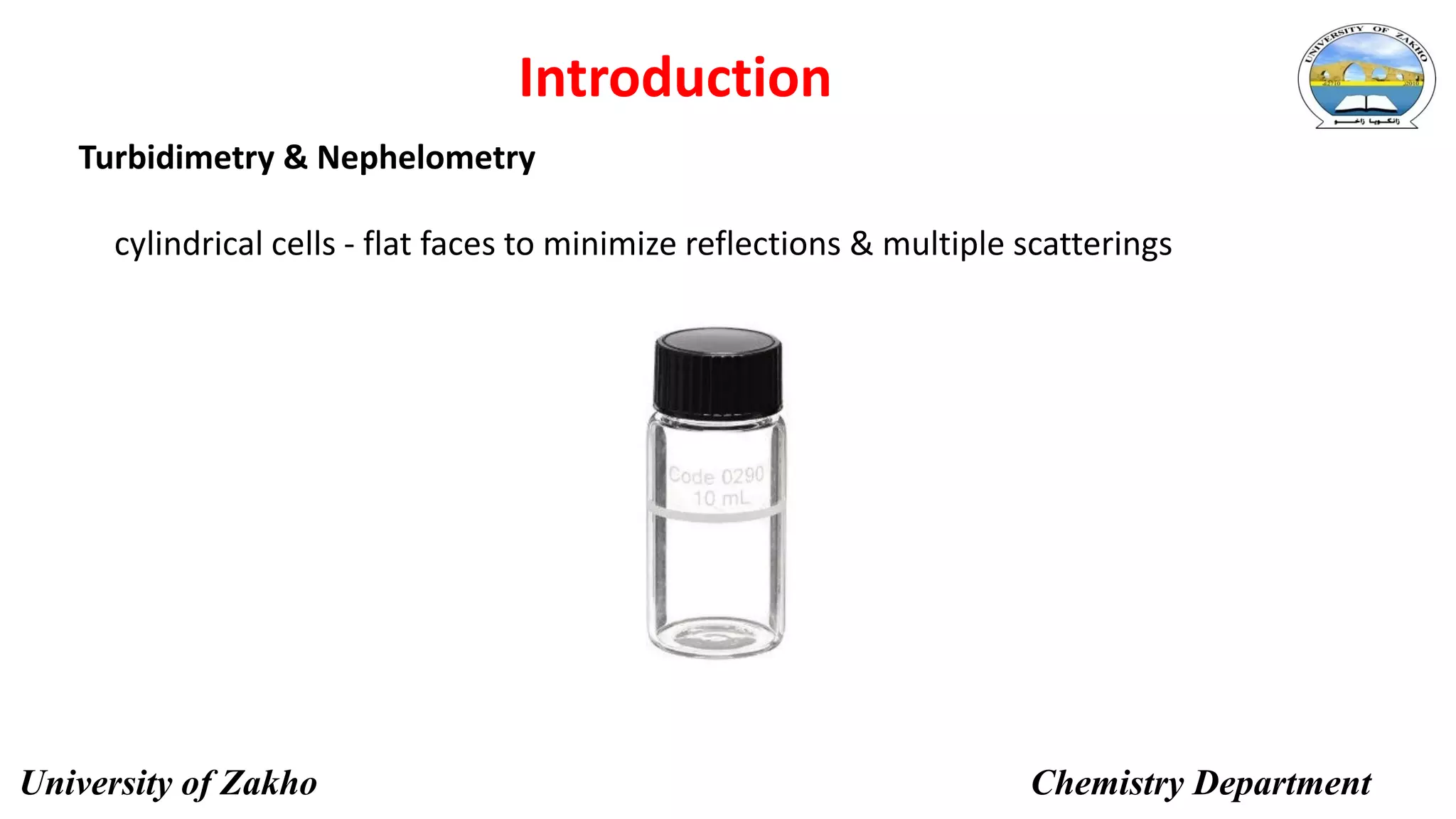
cylindrical cells - flat faces to minimize reflections & multiple scatterings
University of Zakho Chemistry Department
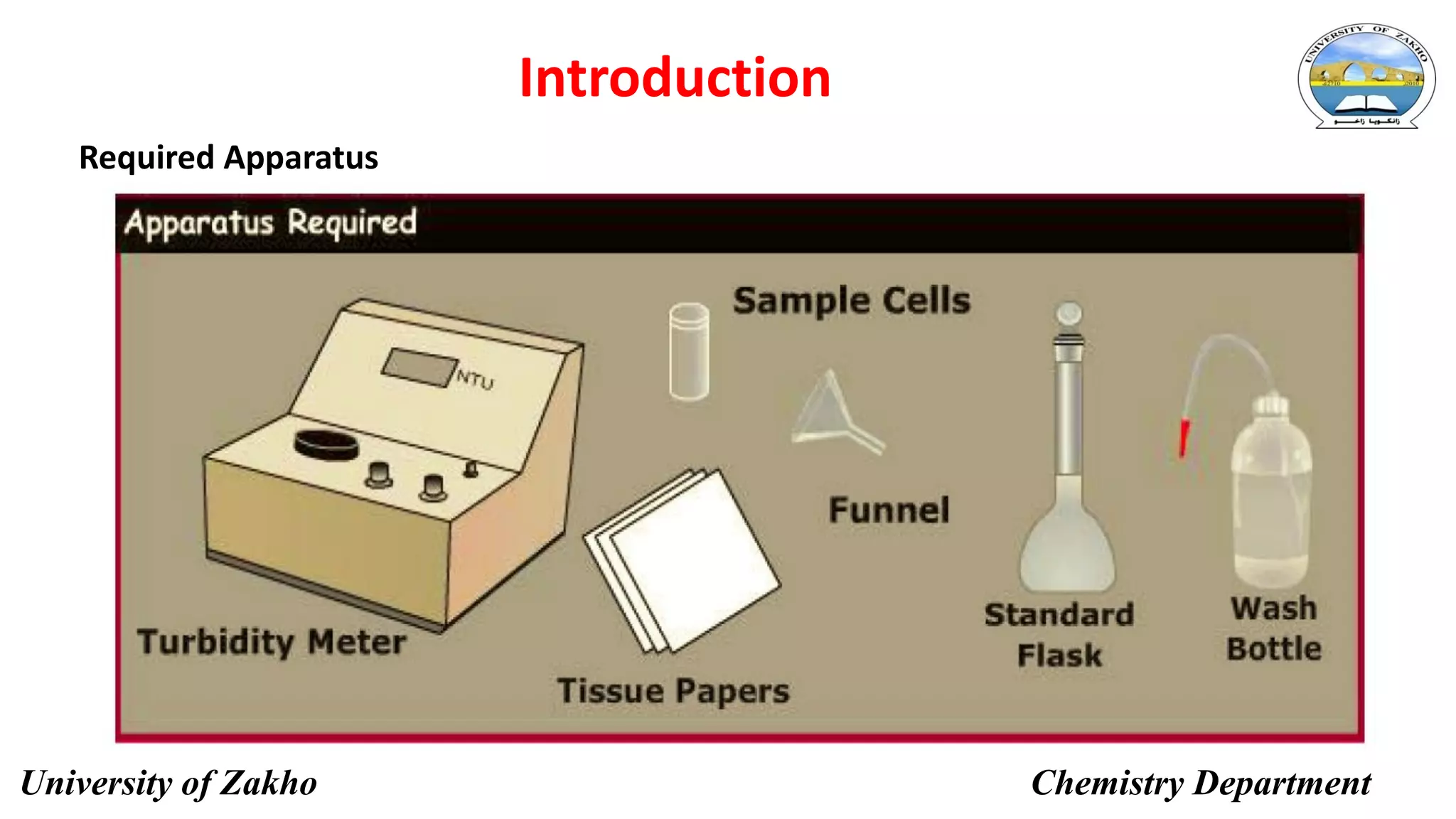
Required Apparatus
9
Introduction
University of Zakho Chemistry Department
Applications of Turbidimetry or Nephelometry
• In the analysis of water, for the determination of turbidity, measure suspended solids
in waters and for the control of treatment processes.
• The concentration of a variety of ions can be determined using suitable precipitation
reagents to form suspensions.
• To find the end point of some titrations to form a suspension.
• To measure suspended particles in gases, like smog and fog.
10
Introduction
University of Zakho Chemistry Department
11
Introduction
University of Zakho Chemistry Department
12
Determination of sulphate ion
• In this experiment an unknown sample of sulfate ion is analysed with
turbidimetry. An excess of barium chloride is added to an acidified sample.
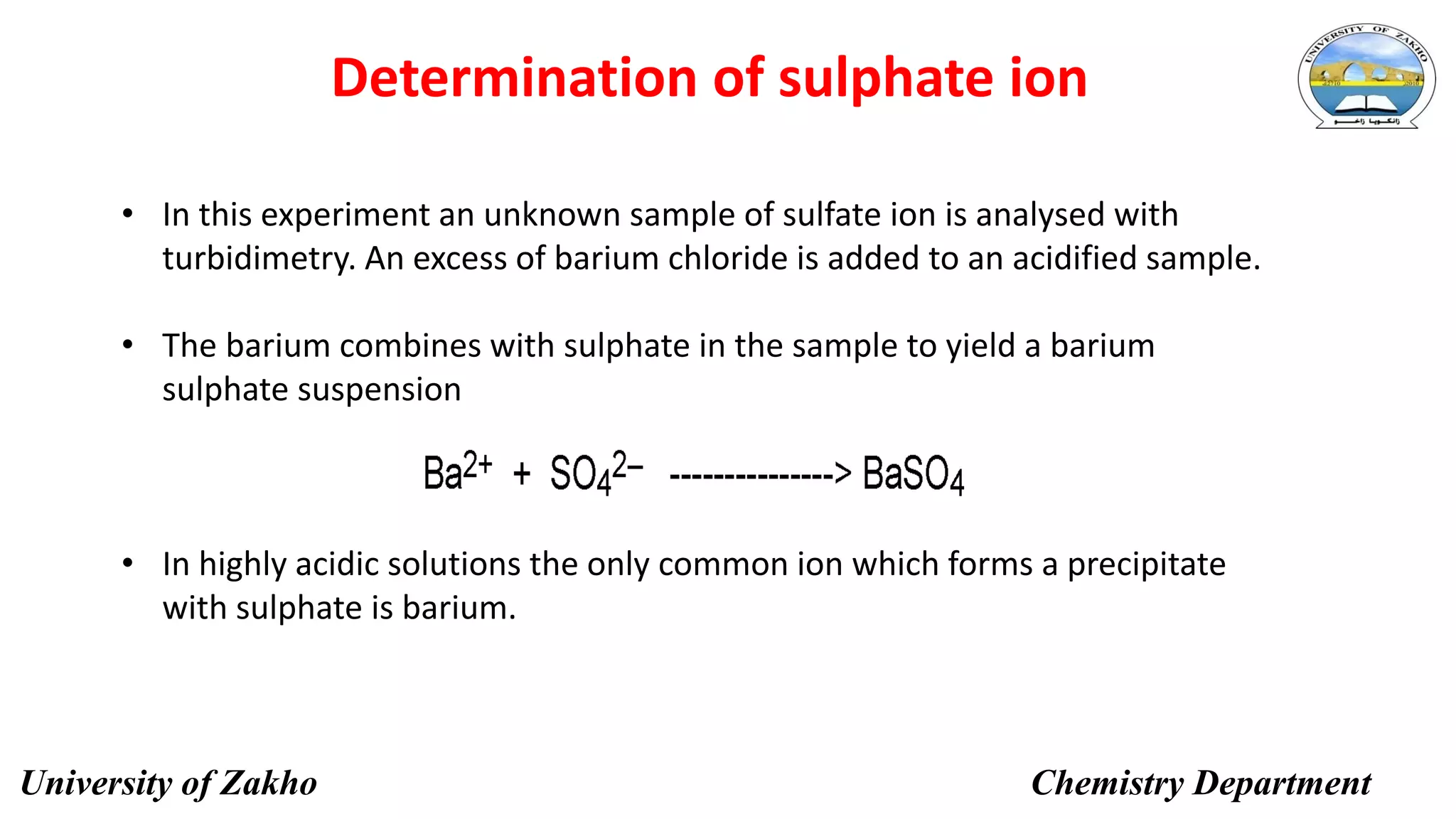
• The barium combines with sulphate in the sample to yield a barium
sulphate suspension
• In highly acidic solutions the only common ion which forms a precipitate
with sulphate is barium.
University of Zakho Chemistry Department
13
Determination of sulphate ion
Reagents & Chemicals
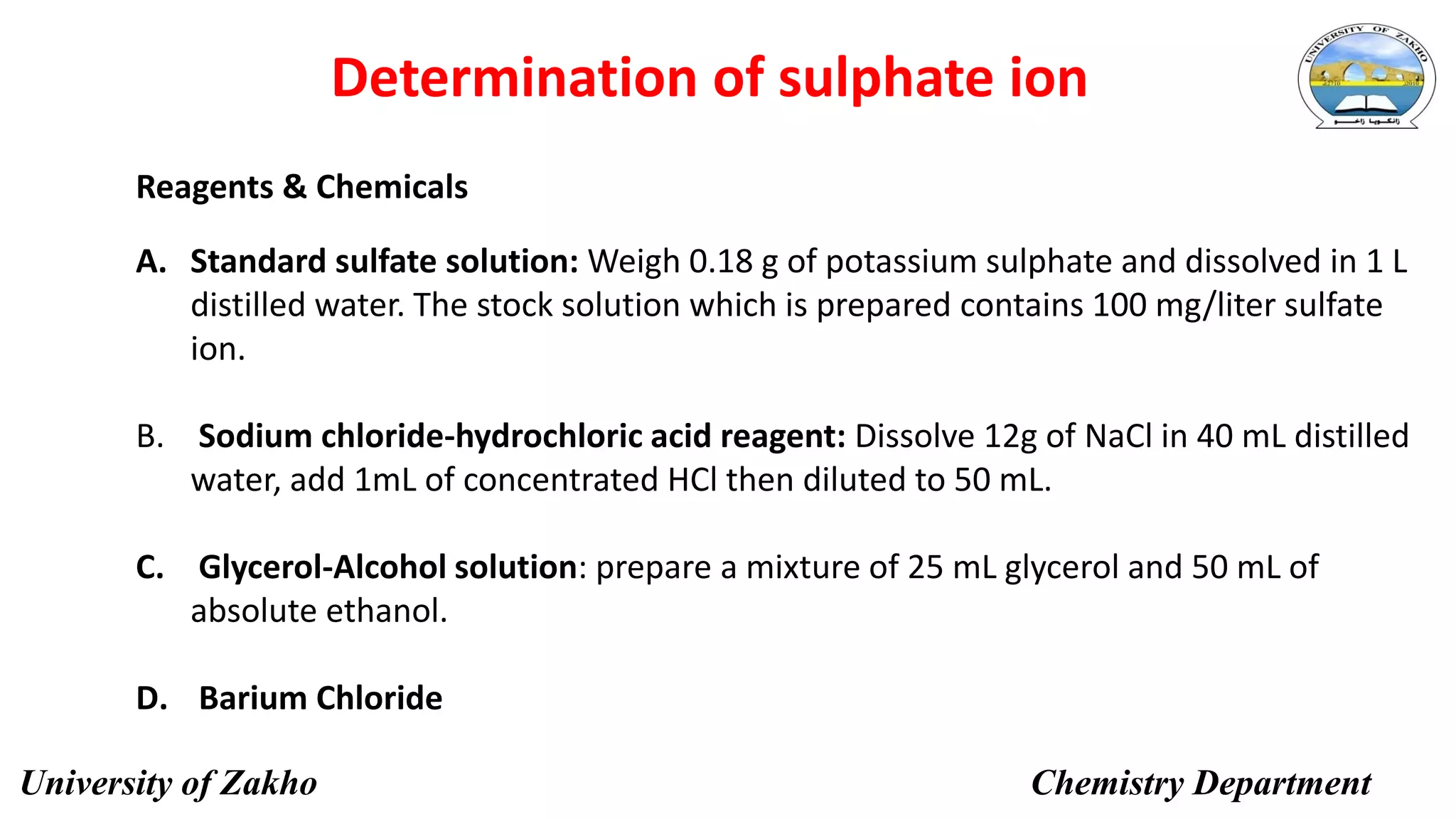
A. Standard sulfate solution: Weigh 0.18 g of potassium sulphate and dissolved in 1 L
distilled water. The stock solution which is prepared contains 100 mg/liter sulfate
ion.
B. Sodium chloride-hydrochloric acid reagent: Dissolve 12g of NaCl in 40 mL distilled
water, add 1mL of concentrated HCl then diluted to 50 mL.
C. Glycerol-Alcohol solution: prepare a mixture of 25 mL glycerol and 50 mL of
absolute ethanol.
D. Barium Chloride
University of Zakho Chemistry Department
14
Procedure
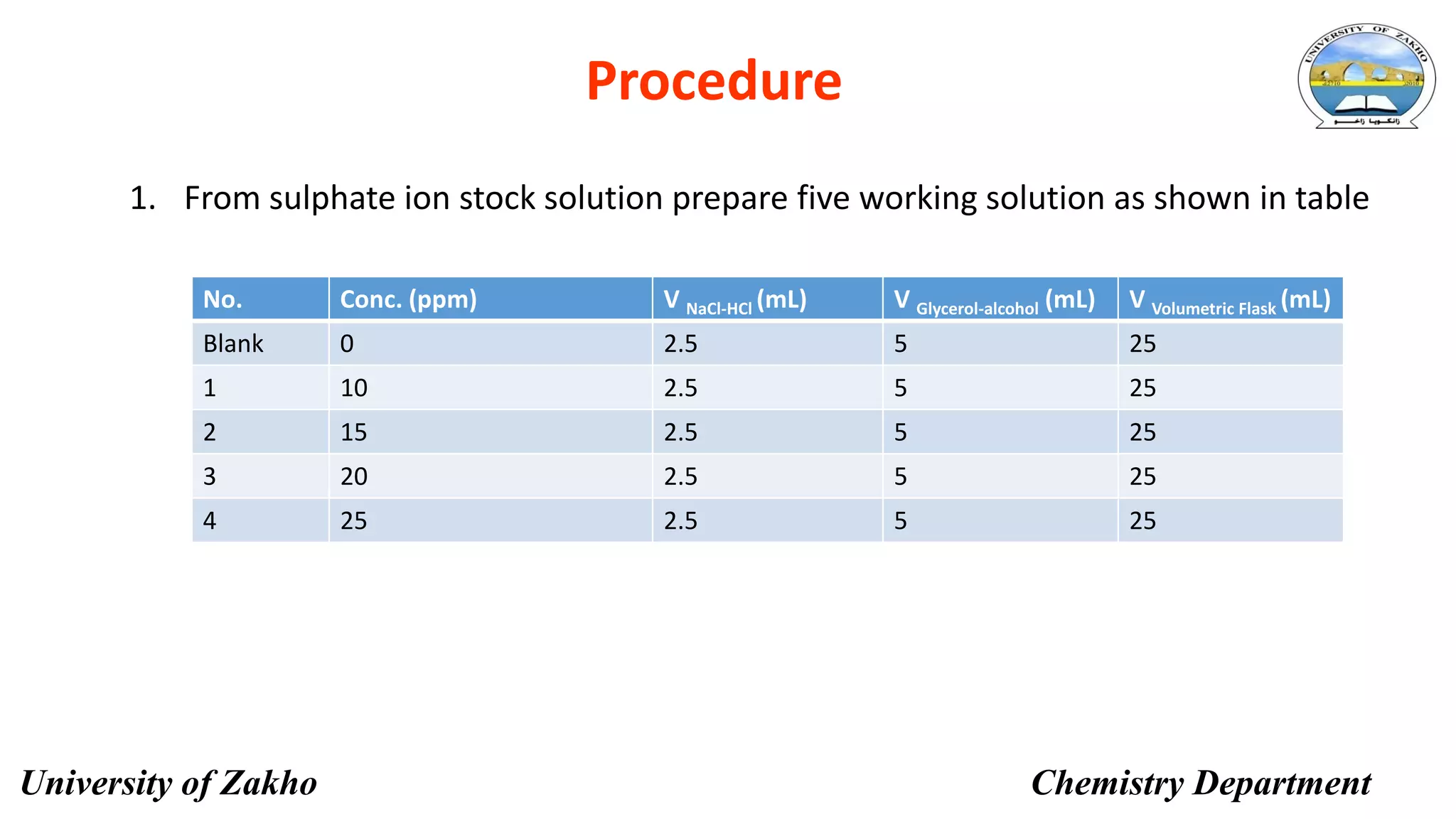
1. From sulphate ion stock solution prepare five working solution as shown in table
No. Conc. (ppm) V NaCl-HCl (mL) V Glycerol-alcohol (mL) V Volumetric Flask (mL)
Blank 0 2.5 5 25
1 10 2.5 5 25
2 15 2.5 5 25
3 20 2.5 5 25
4 25 2.5 5 25
University of Zakho Chemistry Department
15
Procedure
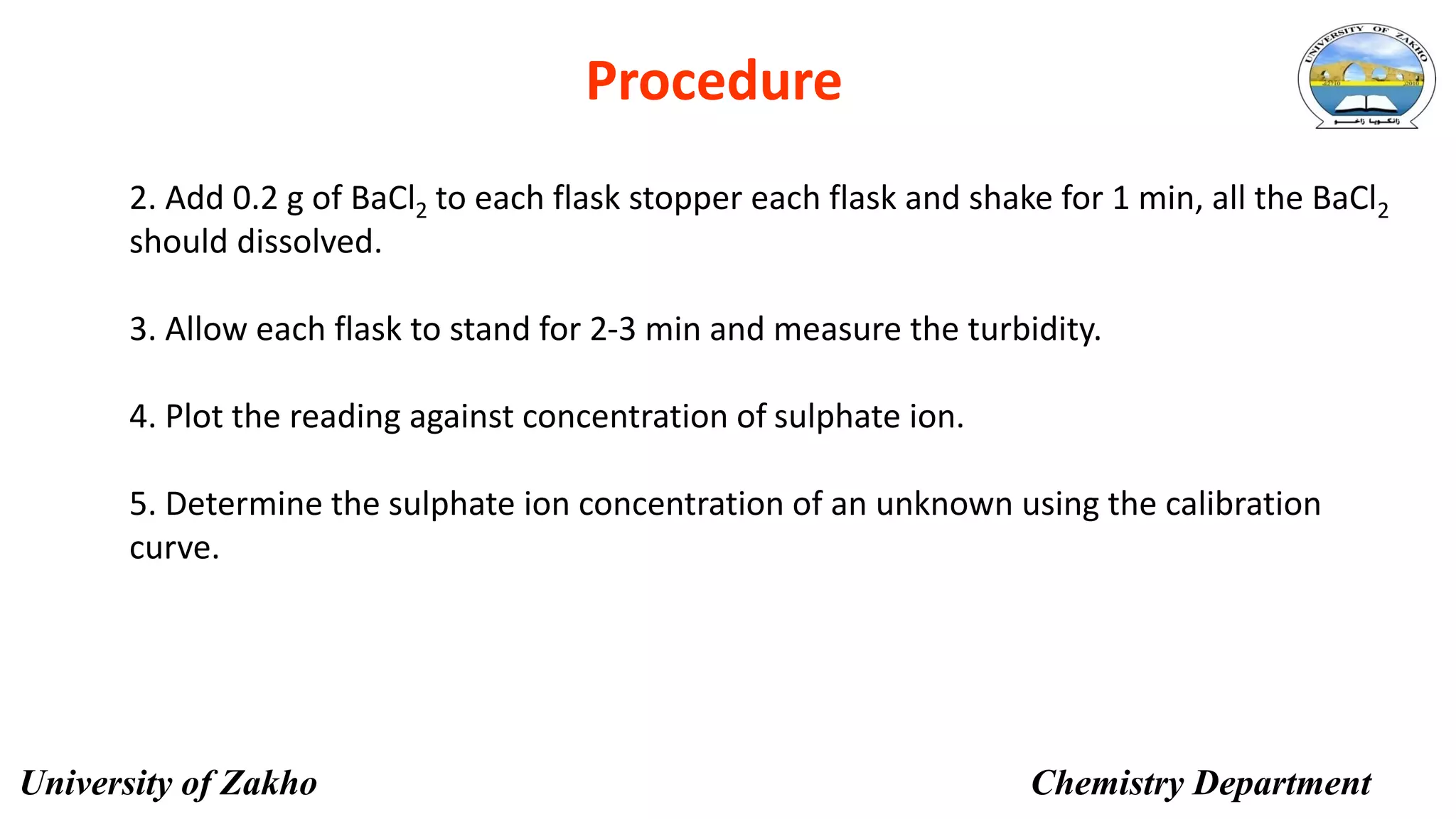
2. Add 0.2 g of BaCl2 to each flask stopper each flask and shake for 1 min, all the BaCl2
should dissolved.
3. Allow each flask to stand for 2-3 min and measure the turbidity.
4. Plot the reading against concentration of sulphate ion.
5. Determine the sulphate ion concentration of an unknown using the calibration
curve.
University of Zakho Chemistry Department

TURBIDIMETRIC DETERMINATION OF SULPHATE ION (SO42- ) IN THE UNKNOWN SOLUTION

  • 1.
    1 INSTRUMENTALANALYSIS LAB. Mr Haydar A.M.S BSc,MSc Faculty of Science Chemistry Department Email: Haydar.kovly@gmail.com University of Zakho Chemistry Department
  • 2.
    2 TURBIDIMETRIC DETERMINATION OF SULPHATEION (SO4 2- ) IN THE UNKNOWN SOLUTION Lab 8 University of Zakho Chemistry Department
  • 3.
    Aim of theexperiment 3 To determine the concentration of SO4 2- in the unknown solution using Nephelo-Turbidity meter. University of Zakho Chemistry Department
  • 4.
    4 Introduction When electromagnetic radiation(light) strikes a particle in solution, some of the light will be • absorbed by the particle, • transmitted through the solution • scattered or reflected. The amount of light scattered is proportional to the concentration of insoluble particle. University of Zakho Chemistry Department
  • 5.
    Turbidimetry & Nephelometry 5 Introduction In turbidimetry, the intensity of light transmitted through the medium, the unscattered light, is measured.  Turbidimetric measurements are made at 180o from the incident light beam. University of Zakho Chemistry Department
  • 6.
    Turbidimetry & Nephelometry 6 Introduction InNephelometry, the intensity of the scattered light is measured, usually, but not necessarily, at right angles to the incident light beam. Nephelometry Turbidimetry University of Zakho Chemistry Department
  • 7.
    Turbidimetry & Nephelometry 7 Introduction The intensity of scattered/transmitted light is normally measured by Nephelo- turbidity meter.  The turbidity standard unit is called Nephelometric Turbidity Units (NTU). University of Zakho Chemistry Department
  • 8.
    Turbidimetry & Nephelometry 8 Introduction cylindricalcells - flat faces to minimize reflections & multiple scatterings University of Zakho Chemistry Department
  • 9.
  • 10.
    Applications of Turbidimetryor Nephelometry • In the analysis of water, for the determination of turbidity, measure suspended solids in waters and for the control of treatment processes. • The concentration of a variety of ions can be determined using suitable precipitation reagents to form suspensions. • To find the end point of some titrations to form a suspension. • To measure suspended particles in gases, like smog and fog. 10 Introduction University of Zakho Chemistry Department
  • 11.
  • 12.
    12 Determination of sulphateion • In this experiment an unknown sample of sulfate ion is analysed with turbidimetry. An excess of barium chloride is added to an acidified sample. • The barium combines with sulphate in the sample to yield a barium sulphate suspension • In highly acidic solutions the only common ion which forms a precipitate with sulphate is barium. University of Zakho Chemistry Department
  • 13.
    13 Determination of sulphateion Reagents & Chemicals A. Standard sulfate solution: Weigh 0.18 g of potassium sulphate and dissolved in 1 L distilled water. The stock solution which is prepared contains 100 mg/liter sulfate ion. B. Sodium chloride-hydrochloric acid reagent: Dissolve 12g of NaCl in 40 mL distilled water, add 1mL of concentrated HCl then diluted to 50 mL. C. Glycerol-Alcohol solution: prepare a mixture of 25 mL glycerol and 50 mL of absolute ethanol. D. Barium Chloride University of Zakho Chemistry Department
  • 14.
    14 Procedure 1. From sulphateion stock solution prepare five working solution as shown in table No. Conc. (ppm) V NaCl-HCl (mL) V Glycerol-alcohol (mL) V Volumetric Flask (mL) Blank 0 2.5 5 25 1 10 2.5 5 25 2 15 2.5 5 25 3 20 2.5 5 25 4 25 2.5 5 25 University of Zakho Chemistry Department
  • 15.
    15 Procedure 2. Add 0.2g of BaCl2 to each flask stopper each flask and shake for 1 min, all the BaCl2 should dissolved. 3. Allow each flask to stand for 2-3 min and measure the turbidity. 4. Plot the reading against concentration of sulphate ion. 5. Determine the sulphate ion concentration of an unknown using the calibration curve. University of Zakho Chemistry Department