1
A Presentation On…
Macrolides
Presented by-
Gourango Kumar Biswas &
Asma Aktar,
Dept. of Pharmacy,
Jessore University of science &
Teachnology, Bangladesh.
2
Macrolides- General Consideration
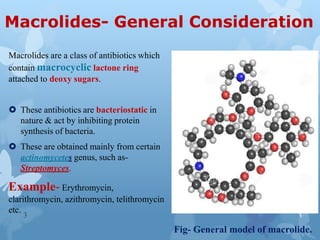
Macrolides are a class of antibiotics which
contain macrocyclic lactone ring
attached to deoxy sugars.
 These antibiotics are bacteriostatic in
nature & act by inhibiting protein
synthesis of bacteria.
 These are obtained mainly from certain
actinomycetes genus, such as-
Streptomyces.
Example- Erythromycin,
clarithromycin, azithromycin, telithromycin
etc.
Fig- General model of macrolide.
3
Chemistry of Macrolides
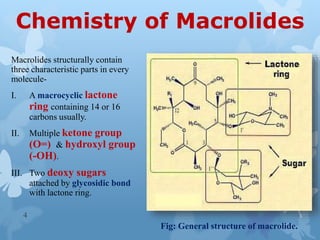
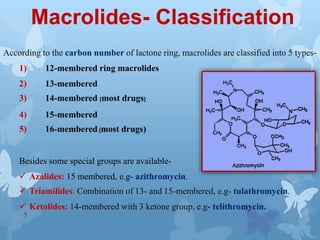
Macrolides structurally contain
three characteristic parts in every
molecule-
I. A macrocyclic lactone
ring containing 14 or 16
carbons usually.
II. Multiple ketone group
(O=) & hydroxyl group
(-OH).
III. Two deoxy sugars
attached by glycosidic bond
with lactone ring.
Fig: General structure of macrolide.
4
Macrolides- Classification
According to the carbon number of lactone ring, macrolides are classified into 5 types-
1) 12-membered ring macrolides
2) 13-membered
3) 14-membered (most drugs)
4) 15-membered
5) 16-membered (most drugs)
Besides some special groups are available-
 Azalides: 15 membered, e.g- azithromycin.
 Triamilides: Combination of 13- and 15-membered, e.g- tulathromycin.
 Ketolides: 14-membered with 3 ketone group, e.g- telithromycin.
5
Pharmacokinetics
 Route of Administration: Oral &
parenteral.
 Absorption: Erythromycin is poorly
absorbed from GIT due to acid sensitivity.
Clarithromycin & azithromycin are well
absorbed from GIT.
 Distribution: Rapidly distributed into
systemic circulation. They can cross
placenta but can’t cross BBB.
 Metabolism: Via liver.
 Excretion: Through bile mainly, but
clarithromycin is excreted through urine
too.6
Erythromycin
 1st macrolide obtained
from streptomyces
erytherus in 1952.
 Active against G(+)
bacteria.
 Plasma half life: 2hrs.
 Dose: adult(250-500mg
6-hourly).
 Unstable in stomac acid.
 Formulaed as enteric
coated tablet.
Most common market
brand of erythromycin
are-
 A-mycin
 Eromycin
 Etrocin
 Macrocin etc.
7
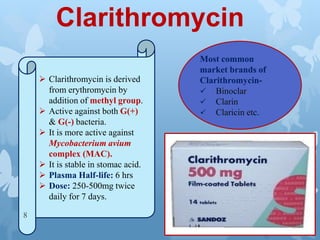
Clarithromycin
 Clarithromycin is derived
from erythromycin by
addition of methyl group.
 Active against both G(+)
& G(-) bacteria.
 It is more active against
Mycobacterium avium
complex (MAC).
 It is stable in stomac acid.
 Plasma Half-life: 6 hrs
 Dose: 250-500mg twice
daily for 7 days.
Most common
market brands of
Clarithromycin-
 Binoclar
 Clarin
 Claricin etc.
8
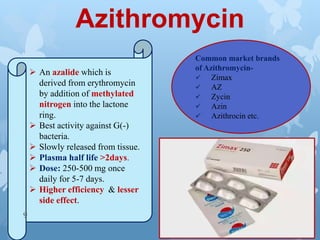
Azithromycin
 An azalide which is
derived from erythromycin
by addition of methylated
nitrogen into the lactone
ring.
 Best activity against G(-)
bacteria.
 Slowly released from tissue.
 Plasma half life >2days.
 Dose: 250-500 mg once
daily for 5-7 days.
 Higher efficiency & lesser
side effect.
Common market brands
of Azithromycin-
 Zimax
 AZ
 Zycin
 Azin
 Azithrocin etc.
9
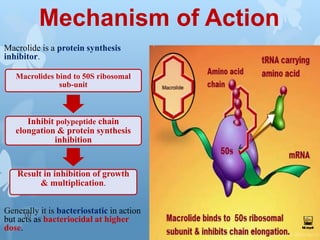
Mechanism of Action
Macrolide is a protein synthesis
inhibitor.
Generally it is bacteriostatic in action
but acts as bacteriocidal at higher
dose.
Macrolides bind to 50S ribosomal
sub-unit
Inhibit polypeptide chain
elongation & protein synthesis
inhibition
Result in inhibition of growth
& multiplication.
10
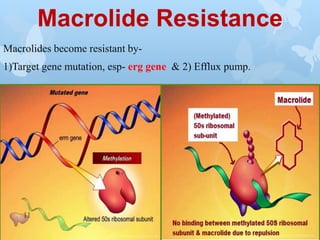
Macrolide Resistance
Macrolides become resistant by-
1)Target gene mutation, esp- erg gene & 2) Efflux pump.
11
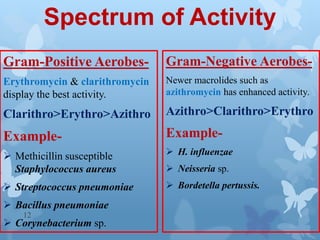
Spectrum of Activity
Gram-Positive Aerobes-
Erythromycin & clarithromycin
display the best activity.
Clarithro>Erythro>Azithro
Example-
 Methicillin susceptible
Staphylococcus aureus
 Streptococcus pneumoniae
 Bacillus pneumoniae
 Corynebacterium sp.
Gram-Negative Aerobes-
Newer macrolides such as
azithromycin has enhanced activity.
Azithro>Clarithro>Erythro
Example-
 H. influenzae
 Neisseria sp.
 Bordetella pertussis.
12
Macrolides- Indications
 Upper respiratory tract
infections- pharyngitis,
tonsillitis, sore throat,
whooping caugh etc.
 Lower respiratory tract
infection- pneumonia,
mycoplasma pneumonia,
community derived
pneumonia, anthrax etc.
 COPD
13
Macrolides- Indications
 Sinusitis
 Otitis media
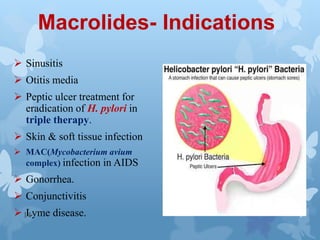
 Peptic ulcer treatment for
eradication of H. pylori in
triple therapy.
 Skin & soft tissue infection
 MAC(Mycobacterium avium
complex) infection in AIDS
 Gonorrhea.
 Conjunctivitis
 Lyme disease.14
Macrolides- Contraindications
 Hepatic dysfunction
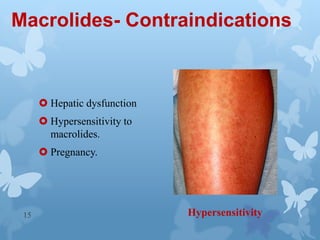
 Hypersensitivity to
macrolides.
 Pregnancy.
Hypersensitivity15
Adverse Effect of Macrolides
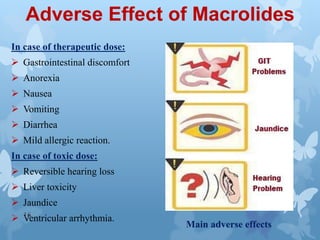
In case of therapeutic dose:
 Gastrointestinal discomfort
 Anorexia
 Nausea
 Vomiting
 Diarrhea
 Mild allergic reaction.
In case of toxic dose:
 Reversible hearing loss
 Liver toxicity
 Jaundice
 Ventricular arrhythmia.
Main adverse effects
16
Reference
1. Lippincott’s Pharmacology.
2. Essentials of MEDICINAL PHARMACOLOGY, KD
Tripathy.
3. Basic & Clinical Pharmacology; Katzung, Masters & Trevor.
4. An Introduction to Medicinal Chemistry; Graham L. Patrick.
5. Apex Medical Pharmacology; Dr Javed Yousuf.
6. Foyel’s Principle of Medicinal Chemistry.
7. Qimp Index of Medical Products & Problems.
17
18

Macrolides

  • 1.
  • 2.
    A Presentation On… Macrolides Presentedby- Gourango Kumar Biswas & Asma Aktar, Dept. of Pharmacy, Jessore University of science & Teachnology, Bangladesh. 2
  • 3.
    Macrolides- General Consideration Macrolidesare a class of antibiotics which contain macrocyclic lactone ring attached to deoxy sugars.  These antibiotics are bacteriostatic in nature & act by inhibiting protein synthesis of bacteria.  These are obtained mainly from certain actinomycetes genus, such as- Streptomyces. Example- Erythromycin, clarithromycin, azithromycin, telithromycin etc. Fig- General model of macrolide. 3
  • 4.
    Chemistry of Macrolides Macrolidesstructurally contain three characteristic parts in every molecule- I. A macrocyclic lactone ring containing 14 or 16 carbons usually. II. Multiple ketone group (O=) & hydroxyl group (-OH). III. Two deoxy sugars attached by glycosidic bond with lactone ring. Fig: General structure of macrolide. 4
  • 5.
    Macrolides- Classification According tothe carbon number of lactone ring, macrolides are classified into 5 types- 1) 12-membered ring macrolides 2) 13-membered 3) 14-membered (most drugs) 4) 15-membered 5) 16-membered (most drugs) Besides some special groups are available-  Azalides: 15 membered, e.g- azithromycin.  Triamilides: Combination of 13- and 15-membered, e.g- tulathromycin.  Ketolides: 14-membered with 3 ketone group, e.g- telithromycin. 5
  • 6.
    Pharmacokinetics  Route ofAdministration: Oral & parenteral.  Absorption: Erythromycin is poorly absorbed from GIT due to acid sensitivity. Clarithromycin & azithromycin are well absorbed from GIT.  Distribution: Rapidly distributed into systemic circulation. They can cross placenta but can’t cross BBB.  Metabolism: Via liver.  Excretion: Through bile mainly, but clarithromycin is excreted through urine too.6
  • 7.
    Erythromycin  1st macrolideobtained from streptomyces erytherus in 1952.  Active against G(+) bacteria.  Plasma half life: 2hrs.  Dose: adult(250-500mg 6-hourly).  Unstable in stomac acid.  Formulaed as enteric coated tablet. Most common market brand of erythromycin are-  A-mycin  Eromycin  Etrocin  Macrocin etc. 7
  • 8.
    Clarithromycin  Clarithromycin isderived from erythromycin by addition of methyl group.  Active against both G(+) & G(-) bacteria.  It is more active against Mycobacterium avium complex (MAC).  It is stable in stomac acid.  Plasma Half-life: 6 hrs  Dose: 250-500mg twice daily for 7 days. Most common market brands of Clarithromycin-  Binoclar  Clarin  Claricin etc. 8
  • 9.
    Azithromycin  An azalidewhich is derived from erythromycin by addition of methylated nitrogen into the lactone ring.  Best activity against G(-) bacteria.  Slowly released from tissue.  Plasma half life >2days.  Dose: 250-500 mg once daily for 5-7 days.  Higher efficiency & lesser side effect. Common market brands of Azithromycin-  Zimax  AZ  Zycin  Azin  Azithrocin etc. 9
  • 10.
    Mechanism of Action Macrolideis a protein synthesis inhibitor. Generally it is bacteriostatic in action but acts as bacteriocidal at higher dose. Macrolides bind to 50S ribosomal sub-unit Inhibit polypeptide chain elongation & protein synthesis inhibition Result in inhibition of growth & multiplication. 10
  • 11.
    Macrolide Resistance Macrolides becomeresistant by- 1)Target gene mutation, esp- erg gene & 2) Efflux pump. 11
  • 12.
    Spectrum of Activity Gram-PositiveAerobes- Erythromycin & clarithromycin display the best activity. Clarithro>Erythro>Azithro Example-  Methicillin susceptible Staphylococcus aureus  Streptococcus pneumoniae  Bacillus pneumoniae  Corynebacterium sp. Gram-Negative Aerobes- Newer macrolides such as azithromycin has enhanced activity. Azithro>Clarithro>Erythro Example-  H. influenzae  Neisseria sp.  Bordetella pertussis. 12
  • 13.
    Macrolides- Indications  Upperrespiratory tract infections- pharyngitis, tonsillitis, sore throat, whooping caugh etc.  Lower respiratory tract infection- pneumonia, mycoplasma pneumonia, community derived pneumonia, anthrax etc.  COPD 13
  • 14.
    Macrolides- Indications  Sinusitis Otitis media  Peptic ulcer treatment for eradication of H. pylori in triple therapy.  Skin & soft tissue infection  MAC(Mycobacterium avium complex) infection in AIDS  Gonorrhea.  Conjunctivitis  Lyme disease.14
  • 15.
    Macrolides- Contraindications  Hepaticdysfunction  Hypersensitivity to macrolides.  Pregnancy. Hypersensitivity15
  • 16.
    Adverse Effect ofMacrolides In case of therapeutic dose:  Gastrointestinal discomfort  Anorexia  Nausea  Vomiting  Diarrhea  Mild allergic reaction. In case of toxic dose:  Reversible hearing loss  Liver toxicity  Jaundice  Ventricular arrhythmia. Main adverse effects 16
  • 17.
    Reference 1. Lippincott’s Pharmacology. 2.Essentials of MEDICINAL PHARMACOLOGY, KD Tripathy. 3. Basic & Clinical Pharmacology; Katzung, Masters & Trevor. 4. An Introduction to Medicinal Chemistry; Graham L. Patrick. 5. Apex Medical Pharmacology; Dr Javed Yousuf. 6. Foyel’s Principle of Medicinal Chemistry. 7. Qimp Index of Medical Products & Problems. 17
  • 18.