Gerard B. Hawkins
Managing Director, CEO
• Reactions
• Equilibrium
• Catalyst Activity
• Byproducts
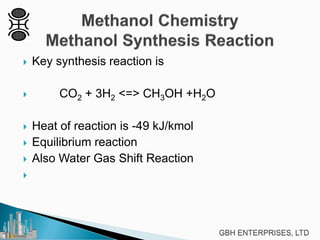
 Key synthesis reaction is
 CO2 + 3H2 <=> CH3OH +H2O
 Heat of reaction is -49 kJ/kmol
 Equilibrium reaction
 Also Water Gas Shift Reaction

 WGS reaction is
 CO + H2O <=> CO2 + H2
 Heat of reaction is -41 kJ/kmol
 Equilibrium reaction
 This combines with the methanol synthesis
reaction to convert CO to methanol
 CO +2H2 <=> CH3OH
 The reaction rate is defined by the following
equation








−=
1
3
22
3
22
3
1
KHPCOP
OHCHP
HPCOPkp
dt
OHCHd mn
.][].[
][
.][.][.
][
Where P[] is the partial pressure
Kinetic Term Equilibrium Term
 Due to water gas shift reaction can also
have this equation in terms of CO
 Powers for this equation are
◦ n is 0.5
◦ m is 1.5
◦ This is from one source
◦ Other sources have different powers
 Our belief is methanol is produced from
CO2
 The reaction rate is defined by the following
equation







−=
1
2
2
3
2
3
.][].[
][
1.][.][.
][
KHPCOP
OHCHP
HPCOPkp
dt
OHCHd mn
Where P[] is the partial pressure
Kinetic Term Equilibrium Term
Catalysis in action
High science at the atomic level
150 200 250 300 350 400 450
0.000001
0.00001
0.0001
0.001
0.01
0.1
1
Temperature (°C)
Kp-EquilibriumConstant 1 bara
100 bara
200 bara
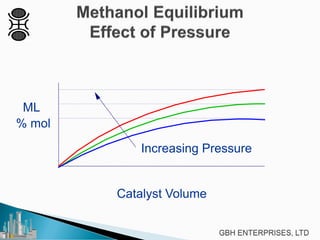
As can be seen pressure has a large effect
Note Y axis is a log scale
ML
% mol
Catalyst Volume
Increasing Pressure
Increasing
Temperature
ML
% mol
Catalyst Volume
Equilibrium Lines
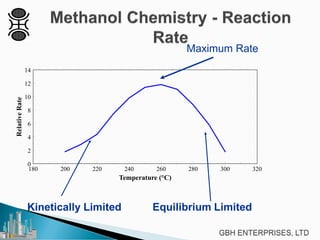
180 200 220 240 260 280 300 320
0
2
4
6
8
10
12
14
Temperature (°C)
RelativeRate
Kinetically Limited Equilibrium Limited
Maximum Rate
 Maximum rate line is where the maximum
methanol reaction rate occurs.
 By following this line, the minimum catalyst
volume will be achieved for a given duty
 Therefore should try and ensure reaction
path follows this line closely
 Each type of converter tracks this line in a
particular way
MethanolConcentration(mol-%)
Equilibrium
line
Temperature (°C)
Max Rate
Line
MethanolConcentration(mol-%)
Equilibrium
line
Temperature (°C)
Want to be here !
180 200 220 240 260 280 300 320
0
2
4
6
8
10
Temperature (°C)
MethanolConcentration(mol%)
Max Rate
Curve
Methanol
Equilibrium
180 200 220 240 260 280 300 320
0
2
4
6
8
10
Temperature (°C)
MethanolConcentration(mol%)
Max Rate
Curve
Methanol
Equilibrium
 Also some side reactions
 The following species are produced
◦ Alcohol's - Ethanol, propanol, butanol & pentanol
◦ Ketones - Acetone, Methyl Ethyl Ketone etc.
◦ Formates - Methyl Formate
◦ Ethers - Di Methyl Ether (DME)
◦ Acetates - Methyl Acetates
◦ Hydrocarbons
 Methane
 C2-C9's
 Parrafinic Waxes C10 +
 By product reactions are as follows
◦ Ethanol :
 2 CH3OH + H2 <===> CH3-CH2OH + H2O
◦ Acetone :
 CH3-CHOHCH3 <===> CH3-CO- CH3 + H2
◦ DME :
 2 CH3OH <===> CH3-O-CH3 + H2O
◦ Methane :
 CO + 3H2 <===> CH4 + H2O
 Exothermicity
◦ Methanol is thermodynamically less stable than other
possible by-products
◦ Highlighted by heats of reaction
 Free Energy of Formation
◦ Methanol is thermodynamically less likely to be formed
than other possible products
◦ Highlighted by free energy of formation
 Crude production rates
 Converter space velocity
 Converter temperatures
 Gas compositions, CO and H2 mainly
 Catalyst impurities
 Oil leaks
 Ethanol favored by
◦ high temperatures and CO partial pressures
◦ high levels of sodium ions
◦ high levels of active iron
 Higher alcohols are
◦ Limited by kinetic formation rate
◦ A function of CO/H2 ratio
Exit Bed Temp °C 280 300 315
Ethanol 0.21% 0.447% 0.62%
 Ketones dependent on temperature
◦ Acetone is a key light which must be removed in
the Topping column
◦ MEK is virtually impossible to remove by distillation
and will end up in the product
 Methyl Formate is equilibrium limited
◦ Little variation with temperature
◦ Easier to top than acetone.
 DME is equilibrium limited
◦ Very volatile and easy to remove in the topping
column
 Methane favored by high temperatures and high
levels of active iron
 Ammonia produced in the reformer will react
in the loop with methanol to form TMA
◦ As occurs in LTS on Ammonia plants
◦ Will not be removed in distillation
◦ Causes product to smell ‘fishy’
 Wax Formation
◦ Waxes are formed in synthesis converter
◦ Gaseous at converter temperatures
◦ Form solids on cooling - typically in crude coolers
◦ This leads to fouling of the crude coolers
Process Information Disclaimer
Information contained in this publication or as
otherwise supplied to Users is believed to be
accurate and correct at time of going to press, and is
given in good faith, but it is for the User to satisfy
itself of the suitability of the Product for its own
particular purpose. GBHE gives no warranty as to
the fitness of the Product for any particular purpose
and any implied warranty or condition (statutory or
otherwise) is excluded except to the extent that
exclusion is prevented by law. GBHE accepts no
liability for loss or damage resulting from reliance
on this information. Freedom under Patent,
Copyright and Designs cannot be assumed.
Methanol Synthesis Chemistry

Methanol Synthesis Chemistry

  • 1.
  • 2.
    • Reactions • Equilibrium •Catalyst Activity • Byproducts
  • 3.
     Key synthesisreaction is  CO2 + 3H2 <=> CH3OH +H2O  Heat of reaction is -49 kJ/kmol  Equilibrium reaction  Also Water Gas Shift Reaction 
  • 4.
     WGS reactionis  CO + H2O <=> CO2 + H2  Heat of reaction is -41 kJ/kmol  Equilibrium reaction  This combines with the methanol synthesis reaction to convert CO to methanol  CO +2H2 <=> CH3OH
  • 5.
     The reactionrate is defined by the following equation         −= 1 3 22 3 22 3 1 KHPCOP OHCHP HPCOPkp dt OHCHd mn .][].[ ][ .][.][. ][ Where P[] is the partial pressure Kinetic Term Equilibrium Term
  • 6.
     Due towater gas shift reaction can also have this equation in terms of CO  Powers for this equation are ◦ n is 0.5 ◦ m is 1.5 ◦ This is from one source ◦ Other sources have different powers  Our belief is methanol is produced from CO2
  • 7.
     The reactionrate is defined by the following equation        −= 1 2 2 3 2 3 .][].[ ][ 1.][.][. ][ KHPCOP OHCHP HPCOPkp dt OHCHd mn Where P[] is the partial pressure Kinetic Term Equilibrium Term
  • 8.
    Catalysis in action Highscience at the atomic level
  • 9.
    150 200 250300 350 400 450 0.000001 0.00001 0.0001 0.001 0.01 0.1 1 Temperature (°C) Kp-EquilibriumConstant 1 bara 100 bara 200 bara As can be seen pressure has a large effect Note Y axis is a log scale
  • 10.
  • 11.
  • 12.
    180 200 220240 260 280 300 320 0 2 4 6 8 10 12 14 Temperature (°C) RelativeRate Kinetically Limited Equilibrium Limited Maximum Rate
  • 13.
     Maximum rateline is where the maximum methanol reaction rate occurs.  By following this line, the minimum catalyst volume will be achieved for a given duty  Therefore should try and ensure reaction path follows this line closely  Each type of converter tracks this line in a particular way
  • 14.
  • 15.
  • 16.
    180 200 220240 260 280 300 320 0 2 4 6 8 10 Temperature (°C) MethanolConcentration(mol%) Max Rate Curve Methanol Equilibrium
  • 17.
    180 200 220240 260 280 300 320 0 2 4 6 8 10 Temperature (°C) MethanolConcentration(mol%) Max Rate Curve Methanol Equilibrium
  • 18.
     Also someside reactions  The following species are produced ◦ Alcohol's - Ethanol, propanol, butanol & pentanol ◦ Ketones - Acetone, Methyl Ethyl Ketone etc. ◦ Formates - Methyl Formate ◦ Ethers - Di Methyl Ether (DME) ◦ Acetates - Methyl Acetates ◦ Hydrocarbons  Methane  C2-C9's  Parrafinic Waxes C10 +
  • 19.
     By productreactions are as follows ◦ Ethanol :  2 CH3OH + H2 <===> CH3-CH2OH + H2O ◦ Acetone :  CH3-CHOHCH3 <===> CH3-CO- CH3 + H2 ◦ DME :  2 CH3OH <===> CH3-O-CH3 + H2O ◦ Methane :  CO + 3H2 <===> CH4 + H2O
  • 20.
     Exothermicity ◦ Methanolis thermodynamically less stable than other possible by-products ◦ Highlighted by heats of reaction  Free Energy of Formation ◦ Methanol is thermodynamically less likely to be formed than other possible products ◦ Highlighted by free energy of formation
  • 21.
     Crude productionrates  Converter space velocity  Converter temperatures  Gas compositions, CO and H2 mainly  Catalyst impurities  Oil leaks
  • 22.
     Ethanol favoredby ◦ high temperatures and CO partial pressures ◦ high levels of sodium ions ◦ high levels of active iron  Higher alcohols are ◦ Limited by kinetic formation rate ◦ A function of CO/H2 ratio Exit Bed Temp °C 280 300 315 Ethanol 0.21% 0.447% 0.62%
  • 23.
     Ketones dependenton temperature ◦ Acetone is a key light which must be removed in the Topping column ◦ MEK is virtually impossible to remove by distillation and will end up in the product  Methyl Formate is equilibrium limited ◦ Little variation with temperature ◦ Easier to top than acetone.  DME is equilibrium limited ◦ Very volatile and easy to remove in the topping column  Methane favored by high temperatures and high levels of active iron
  • 24.
     Ammonia producedin the reformer will react in the loop with methanol to form TMA ◦ As occurs in LTS on Ammonia plants ◦ Will not be removed in distillation ◦ Causes product to smell ‘fishy’  Wax Formation ◦ Waxes are formed in synthesis converter ◦ Gaseous at converter temperatures ◦ Form solids on cooling - typically in crude coolers ◦ This leads to fouling of the crude coolers
  • 25.
    Process Information Disclaimer Informationcontained in this publication or as otherwise supplied to Users is believed to be accurate and correct at time of going to press, and is given in good faith, but it is for the User to satisfy itself of the suitability of the Product for its own particular purpose. GBHE gives no warranty as to the fitness of the Product for any particular purpose and any implied warranty or condition (statutory or otherwise) is excluded except to the extent that exclusion is prevented by law. GBHE accepts no liability for loss or damage resulting from reliance on this information. Freedom under Patent, Copyright and Designs cannot be assumed.