Fischer-Tropsch
Catalysts
Preparation, Thermal Pretreatment
and Behavior during Catalytic Reaction
Gerard B. Hawkins
Managing Director
Fischer-Tropsch Process
 Reaction of carbon monoxide and hydrogen to
mainly liquid hydrocarbons
 Invented in Germany during the twenties of the
former century
 Cobalt and iron as catalysts
 Objective : Producing transport fuels out of coal
 Competitor : Bergius coal hydrogenation by I.G.
Farben
Themes
 Dissociative adsorption of methane and carbon monoxide
in competition with surface oxidation (catalytic partial
oxidation) or hydrogenation (Fischer-Tropsch synthesis)
 Reducibility of metal oxides to metal oxides of lower
valency
 Different special procedures for producing supported
catalysts
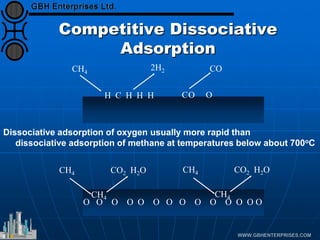
Competitive Dissociative
Adsorption
CH4
H C H H H
2H2
CO O
CO
O O O O O O O O O O O O O O
CH4
CH4
CO2 H2O CH4
CH4
CO2 H2O
Dissociative adsorption of oxygen usually more rapid than
dissociative adsorption of methane at temperatures below about 700oC
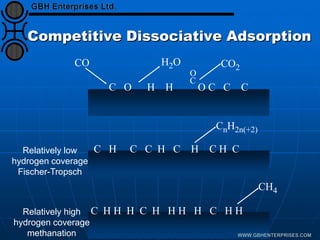
Competitive Dissociative Adsorption
CO
C O H H
H2O
O
C
O C C C
CO2
C H C C H C H C H C
CnH2n(+2)
Relatively low
hydrogen coverage
Fischer-Tropsch
Relatively high
hydrogen coverage
methanation
C H H H C H H H H C H H
CH4
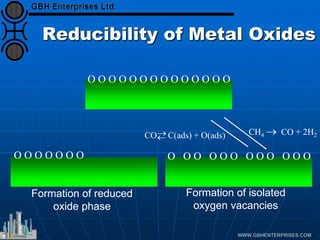
Reducibility of Metal Oxides
O O O O O O O O O O O O O O
O O O O O O O O O O O O O O O O O O O
Formation of reduced
oxide phase
Formation of isolated
oxygen vacancies
CO C(ads) + O(ads)
→
←
CH4 → CO + 2H2
Feed Stock of
the Fischer-Tropsch Process
 Feed stock : Initially coal
C + H2O = CO + H2
 Desired H2/CO ratio 2
 Carbon monoxide shift conversion
CO + H2O = CO2 + H2
 Presently : Natural gas
Steam-reforming involves
CH4 + H2O = CO + 3 H2
H2/CO ratio too elevated
 Therefore (Catalytic) Partial Oxidation
also Autothermal reforming
(Catalytic) Partial Oxidation
 Pure oxygen required to perform
2CH4 + O2 = 2CO + 4H2
Desired H2/CO ratio
 Extremely good mixing of natural gas and oxygen
required to prevent formation of soot
 Formation of explosive mixtures to be prevented
 Initial highly exothermic reaction to carbon dioxide
and water; subsequent reaction of carbon dioxide and
water with methane to carbon monoxide and hydrogen
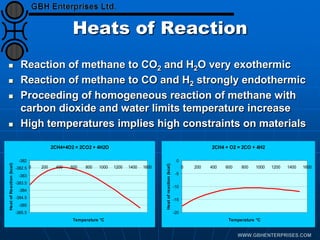
Heats of Reaction
 Reaction of methane to CO2 and H2O very exothermic
 Reaction of methane to CO and H2 strongly endothermic
 Proceeding of homogeneous reaction of methane with
carbon dioxide and water limits temperature increase
 High temperatures implies high constraints on materials
2CH4+4O2 = 2CO2 + 4H2O
-385.5
-385
-384.5
-384
-383.5
-383
-382.5
-382
0 200 400 600 800 1000 1200 1400 1600
Temperature °C
Heat
of
Reaction
(kcal)
2CH4 + O2 = 2CO + 4H2
-20
-15
-10
-5
0
0 200 400 600 800 1000 1200 1400 1600
Temperature °C
Heat
of
reaction
(kcal)
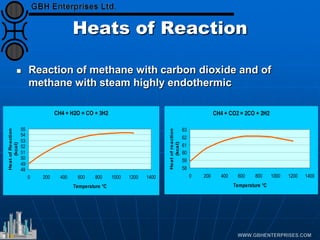
Heats of Reaction
 Reaction of methane with carbon dioxide and of
methane with steam highly endothermic
CH4 + H2O = CO + 3H2
48
49
50
51
52
53
54
55
0 200 400 600 800 1000 1200 1400
Temperature °C
Heat
of
Reaction
(kcal)
CH4 + CO2 = 2CO + 2H2
58
59
60
61
62
63
0 200 400 600 800 1000 1200 1400
Temperature °C
Heat
of
reaction
(kcal)
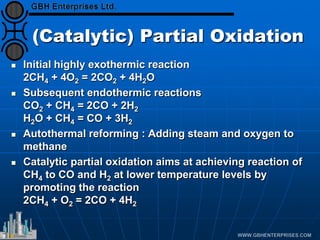
(Catalytic) Partial Oxidation
 Initial highly exothermic reaction
2CH4 + 4O2 = 2CO2 + 4H2O
 Subsequent endothermic reactions
CO2 + CH4 = 2CO + 2H2
H2O + CH4 = CO + 3H2
 Autothermal reforming : Adding steam and oxygen to
methane
 Catalytic partial oxidation aims at achieving reaction of
CH4 to CO and H2 at lower temperature levels by
promoting the reaction
2CH4 + O2 = 2CO + 4H2
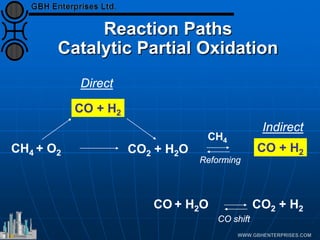
CO + H2O CO2 + H2
Reaction Paths
Catalytic Partial Oxidation
CH4 + O2 CO2 + H2O
CO + H2
CH4
CO + H2
Direct
Indirect
CO shift
Reforming
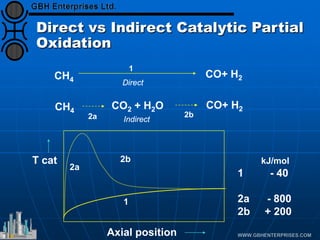
Direct vs Indirect Catalytic Partial
Oxidation
CH4
CO+ H2
CO2 + H2O
Direct
Indirect
T cat
Axial position
2a
2b
1
1
2b
2a
kJ/mol
1 - 40
2a - 800
2b + 200
CH4
CO+ H2
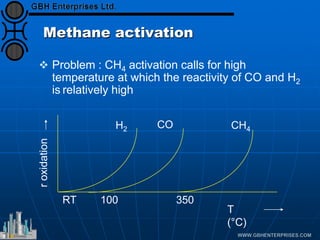
Methane activation
 Problem : CH4 activation calls for high
temperature at which the reactivity of CO and H2
is relatively high
RT 100 350
r
oxidation
H2 CO CH4
T
(°C)
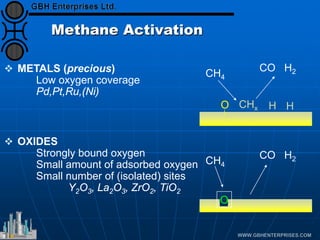
Methane Activation
 METALS (precious)
Low oxygen coverage
Pd,Pt,Ru,(Ni)
 OXIDES
Strongly bound oxygen
Small amount of adsorbed oxygen
Small number of (isolated) sites
Y2O3, La2O3, ZrO2, TiO2
CH4
O
CO H2
CHx H
CH4
CO H2
O
H
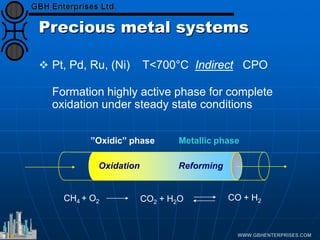
Precious metal systems
 Pt, Pd, Ru, (Ni) T<700°C Indirect CPO
Formation highly active phase for complete
oxidation under steady state conditions
CH4 + O2 CO2 + H2O CO + H2
Oxidation Reforming
”Oxidic” phase Metallic phase
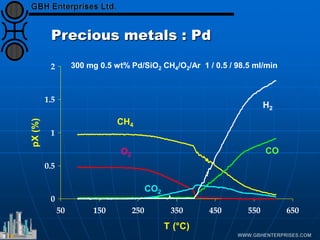
Precious metals : Pd
0
0.5
1
1.5
2
50 150 250 350 450 550 650
T (°C)
pX
(%)
CO
H2
CH4
O2
CO2
300 mg 0.5 wt% Pd/SiO2 CH4/O2/Ar 1 / 0.5 / 98.5 ml/min
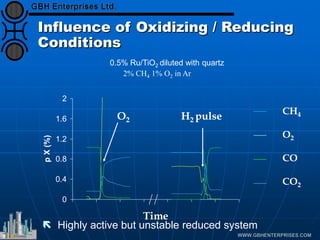
Influence of Oxidizing / Reducing
Conditions
 Highly active but unstable reduced system
0
0.4
0.8
1.2
1.6
2
Time
p
X
(%)
CH4
O2
CO
CO2
O2 H2 pulse
0.5% Ru/TiO2 diluted with quartz
2% CH4 1% O2 in Ar
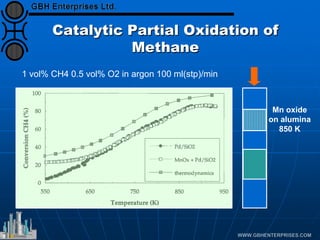
Catalytic Partial Oxidation of
Methane
1 vol% CH4 0.5 vol% O2 in argon 100 ml(stp)/min
Mn oxide
on alumina
850 K
Catalytic Partial Oxidation on
Precious Metals (Nickel)
 Oxidation to carbon dioxide and water
 Subsequent reaction of remaining methane
with carbon dioxide and water to carbon
monoxide and hydrogen
 Catalyst bed not uniform being oxidized at
entrance and reduced at exit
 Catalyst system not stable against deactivation
by oxidation
Trade Time for Temperature
 Catalytic partial oxidation at temperatures
above 1100oC
 High rate of reaction; no problem in keeping
the surface of the precious metal reduced
 Also reaction of methane with carbon dioxide
and water proceeding rapidly
 Problem to prevent deposition of carbon on
precious metal particles
 Demands on materials at such elevated
temperatures
Catalytic Partial Oxidation on
Oxides
 OXIDES
Strongly bound oxygen
Small amount of adsorbed oxygen
Small number of (isolated) sites
TiO2, ZrO2, Y2O3, La2O3
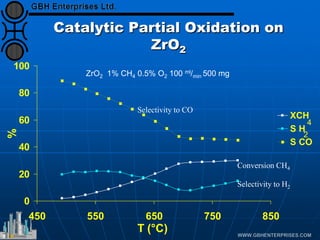
Catalytic Partial Oxidation on
ZrO2
0
20
40
60
80
100
450 550 650 750 850
T (°C)
%
XCH
S H
S CO
ZrO2 1% CH4 0.5% O2 100 ml/min 500 mg
4
2
Conversion CH4
Selectivity to H2
Selectivity to CO
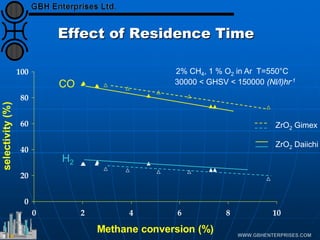
Effect of Residence Time
0
20
40
60
80
100
0 2 4 6 8 10
Methane conversion (%)
selectivity
(%)
2% CH4, 1 % O2 in Ar T=550°C
30000 < GHSV < 150000 (Nl/l)hr-1
ZrO2 Gimex
ZrO2 Daiichi
CO
H2
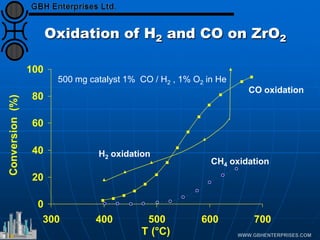
Oxidation of H2 and CO on ZrO2
0
20
40
60
80
100
300 400 500 600 700
T (°C)
Conversion
(%)
500 mg catalyst 1% CO / H2 , 1% O2 in He
CO oxidation
CH4 oxidation
H2 oxidation
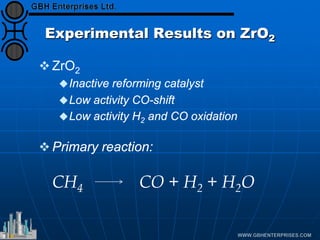
Experimental Results on ZrO2
 ZrO2
Inactive reforming catalyst
Low activity CO-shift
Low activity H2 and CO oxidation
 Primary reaction:
CH4 CO + H2 + H2O
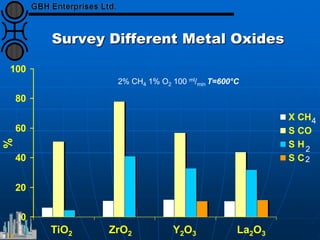
Survey Different Metal Oxides
0
20
40
60
80
100
%
X CH
S CO
S H
S C
2% CH4 1% O2 100 ml/min T=600°C
TiO2 ZrO2 Y2O3 La2O3
4
2
2
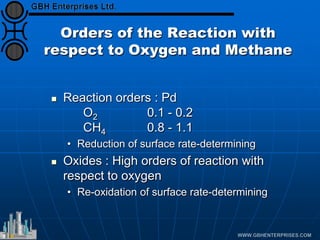
Orders of the Reaction with
respect to Oxygen and Methane
 Reaction orders : Pd
O2 0.1 - 0.2
CH4 0.8 - 1.1
• Reduction of surface rate-determining
 Oxides : High orders of reaction with
respect to oxygen
• Re-oxidation of surface rate-determining
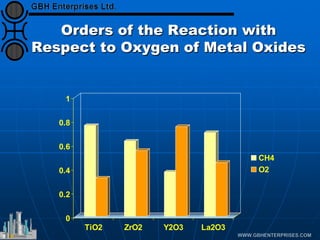
Orders of the Reaction with
Respect to Oxygen of Metal Oxides
0
0.2
0.4
0.6
0.8
1
TiO2 ZrO2 Y2O3 La2O3
CH4
O2
Discussion Oxides
TiO2, ZrO2,Y2O3,La2O3
 Low activity
 High selectivity
 High reaction order O2
Low number of (isolated) sites
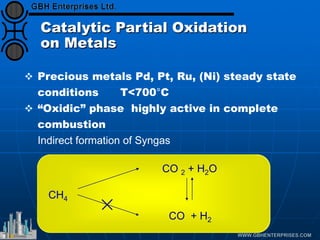
Catalytic Partial Oxidation
on Metals
 Precious metals Pd, Pt, Ru, (Ni) steady state
conditions T<700°C
 “Oxidic” phase highly active in complete
combustion
Indirect formation of Syngas
CH4
CO 2 + H2O
CO + H2
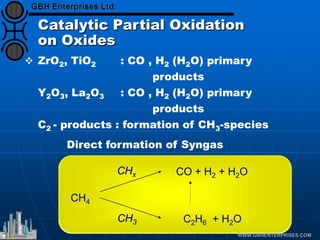
Catalytic Partial Oxidation
on Oxides
 ZrO2, TiO2 : CO , H2 (H2O) primary
products
Y2O3, La2O3 : CO , H2 (H2O) primary
products
C2 - products : formation of CH3-species
CH4
CO + H2 + H2O
C2H6 + H2O
CHx
CH3
Direct formation of Syngas
Fischer-Tropsch Synthesis
 Reaction : CO + 2H2 → ‘CH2’ + H2O
 Undesired reactions CO + 3H2 → CH4 + H2O, carbon
deposition on supported metal particles, and carbon
monoxide shift conversion
• Higher hydrogen pressure promotes formation of
methane
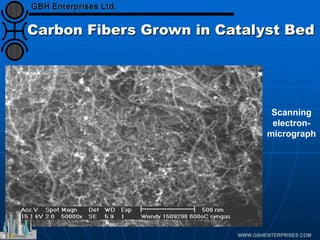
 Highly undesired : Growth of carbon nanofibers
• Mechanically very strong carbon fibers plug reactor
and can even pierce reactor wall
• With bubble column reactor and suspended catalyst
bodies growth of carbon nanofibers less disastrous
Carbon Fibers Grown in Catalyst Bed
Scanning
electron-
micrograph
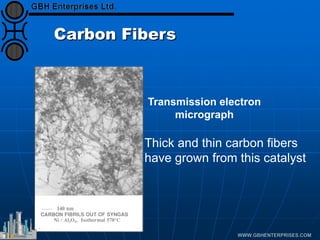
Carbon Fibers
Transmission electron
micrograph
Thick and thin carbon fibers
have grown from this catalyst
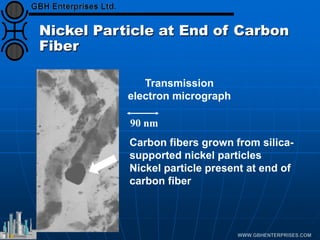
Nickel Particle at End of Carbon
Fiber
Transmission
electron micrograph
Carbon fibers grown from silica-
supported nickel particles
Nickel particle present at end of
carbon fiber
90 nm
Catalysts for
Fischer-Tropsch Synthesis
 Required :
• Dissociation of carbon monoxide
 Ability to react to metal carbide(s)
• Removal of adsorbed oxygen by reaction to either carbon
dioxide or water
• Limited availability of adsorbed hydrogen
 Considerable extent of reduction of supported precursor to
metal particles
 Oxidation by water resulting from the Fischer-Tropsch reaction
to be considered
Catalysts for
Fischer-Tropsch Synthesis
 Iron, cobalt and nickel able to react to metal carbides
 Dissociation of carbon monoxide on iron and cobalt not
strongly surface-sensitive
 Dissociation of carbon monoxide on nickel surface-
sensitive
 Selectivity to methane therefore on iron and cobalt lower
than on nickel
 Supported iron and cobalt precursor difficult to reduce
Catalysts for
Fischer-Tropsch Synthesis
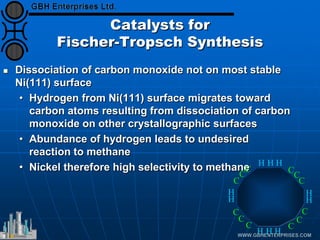
 Dissociation of carbon monoxide not on most stable
Ni(111) surface
• Hydrogen from Ni(111) surface migrates toward
carbon atoms resulting from dissociation of carbon
monoxide on other crystallographic surfaces
• Abundance of hydrogen leads to undesired
reaction to methane
• Nickel therefore high selectivity to methane H H H
H H H
H
H
H
H
C
C C
C
C
C
C
C
C
C C
C
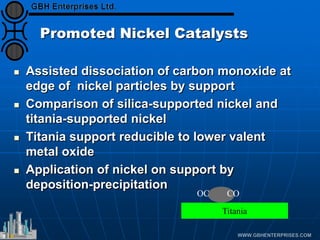
Promoted Nickel Catalysts
 Assisted dissociation of carbon monoxide at
edge of nickel particles by support
 Comparison of silica-supported nickel and
titania-supported nickel
 Titania support reducible to lower valent
metal oxide
 Application of nickel on support by
deposition-precipitation
Titania
CO
OC
Preparation of Supported
Nickel Catalysts
 Injection of nickel nitrate into suspension of
silica or titania support
 Maintaining pH at constant level of 9 by
simultaneous injection of ammonia
 Suspension of finely divided supports in
water
 After separation from the liquid, washed and
dried in vacuum at room temperature
 Shaped and subsequently calcined at 573 K
for 3 hours
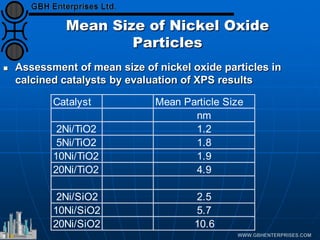
Mean Size of Nickel Oxide
Particles
 Assessment of mean size of nickel oxide particles in
calcined catalysts by evaluation of XPS results
Catalyst Mean Particle Size
nm
2Ni/TiO2 1.2
5Ni/TiO2 1.8
10Ni/TiO2 1.9
20Ni/TiO2 4.9
2Ni/SiO2 2.5
10Ni/SiO2 5.7
20Ni/SiO2 10.6
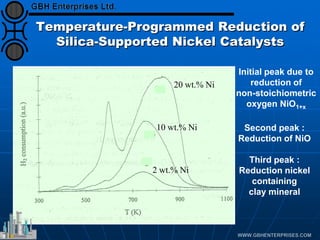
Temperature-Programmed Reduction of
Silica-Supported Nickel Catalysts
Initial peak due to
reduction of
non-stoichiometric
oxygen NiO1+x
20 wt.% Ni
10 wt.% Ni
2 wt.% Ni
Second peak :
Reduction of NiO
Third peak :
Reduction nickel
containing
clay mineral
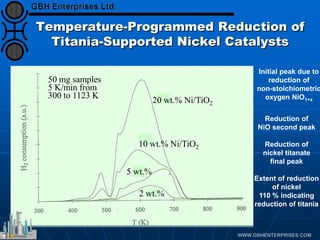
Temperature-Programmed Reduction of
Titania-Supported Nickel Catalysts
Initial peak due to
reduction of
non-stoichiometric
oxygen NiO1+x
Reduction of
NiO second peak
Reduction of
nickel titanate
final peak
Extent of reduction
of nickel
110 % indicating
reduction of titania
5 wt.%
20 wt.% Ni/TiO2
10 wt.% Ni/TiO2
2 wt.%
50 mg samples
5 K/min from
300 to 1123 K
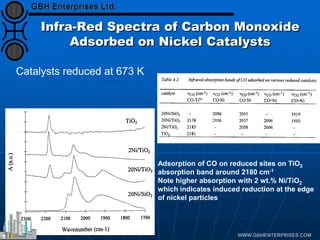
Infra-Red Spectra of Carbon Monoxide
Adsorbed on Nickel Catalysts
Catalysts reduced at 673 K
Adsorption of CO on reduced sites on TiO2
absorption band around 2180 cm-1
Note higher absorption with 2 wt.% Ni/TiO2
which indicates induced reduction at the edge
of nickel particles
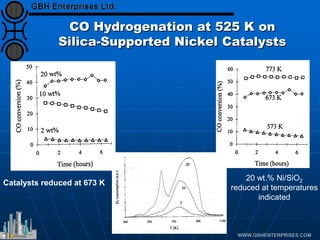
CO Hydrogenation at 525 K on
Silica-Supported Nickel Catalysts
Catalysts reduced at 673 K
20 wt.% Ni/SiO2
reduced at temperatures
indicated
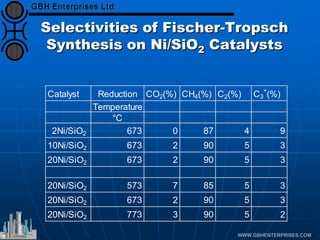
Selectivities of Fischer-Tropsch
Synthesis on Ni/SiO2 Catalysts
Catalyst Reduction CO2(%) CH4(%) C2(%) C3
+
(%)
Temperature
°C
2Ni/SiO2 673 0 87 4 9
10Ni/SiO2 673 2 90 5 3
20Ni/SiO2 673 2 90 5 3
20Ni/SiO2 573 7 85 5 3
20Ni/SiO2 673 2 90 5 3
20Ni/SiO2 773 3 90 5 2
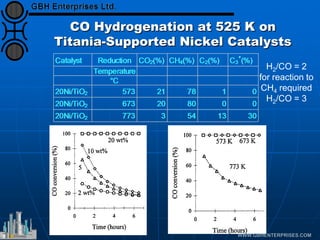
CO Hydrogenation at 525 K on
Titania-Supported Nickel Catalysts
H2/CO = 2
for reaction to
CH4 required
H2/CO = 3
Comparison T.P.R. and Activity at 525
K of Ni/TiO2 Catalysts
20 wt.% Ni/SiO2
reduced at temperatures
indicated
Temperature-Programmed Reduction (T.P.R.) of
Ni/SiO2 catalysts. Ni content (wt.%) indicated at
T.P.R. curves
50 mg samples
5 K/min from
300 to 1123 K
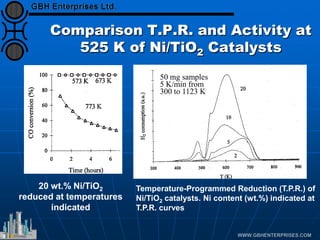
Comparison T.P.R. and Activity at
525 K of Ni/TiO2 Catalysts
20 wt.% Ni/TiO2
reduced at temperatures
indicated
Temperature-Programmed Reduction (T.P.R.) of
Ni/TiO2 catalysts. Ni content (wt.%) indicated at
T.P.R. curves
50 mg samples
5 K/min from
300 to 1123 K
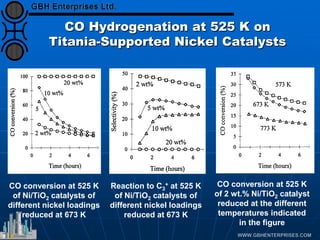
CO Hydrogenation at 525 K on
Titania-Supported Nickel Catalysts
CO conversion at 525 K
of Ni/TiO2 catalysts of
different nickel loadings
reduced at 673 K
Reaction to C3
+ at 525 K
of Ni/TiO2 catalysts of
different nickel loadings
reduced at 673 K
CO conversion at 525 K
of 2 wt.% Ni/TiO2 catalyst
reduced at the different
temperatures indicated
in the figure
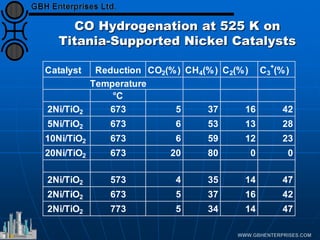
CO Hydrogenation at 525 K on
Titania-Supported Nickel Catalysts
Catalyst Reduction CO2(%) CH4(%) C2(%) C3
+
(%)
Temperature
°C
2Ni/TiO2 673 5 37 16 42
5Ni/TiO2 673 6 53 13 28
10Ni/TiO2 673 6 59 12 23
20Ni/TiO2 673 20 80 0 0
2Ni/TiO2 573 4 35 14 47
2Ni/TiO2 673 5 37 16 42
2Ni/TiO2 773 5 34 14 47
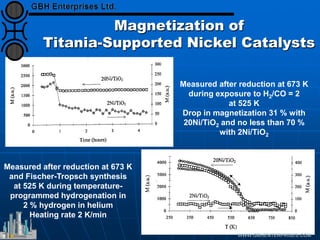
Magnetization of
Titania-Supported Nickel Catalysts
Measured after reduction at 673 K
during exposure to H2/CO = 2
at 525 K
Drop in magnetization 31 % with
20Ni/TiO2 and no less than 70 %
with 2Ni/TiO2
Measured after reduction at 673 K
and Fischer-Tropsch synthesis
at 525 K during temperature-
programmed hydrogenation in
2 % hydrogen in helium
Heating rate 2 K/min
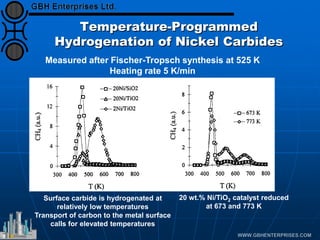
Temperature-Programmed
Hydrogenation of Nickel Carbides
20 wt.% Ni/TiO2 catalyst reduced
at 673 and 773 K
Measured after Fischer-Tropsch synthesis at 525 K
Heating rate 5 K/min
Surface carbide is hydrogenated at
relatively low temperatures
Transport of carbon to the metal surface
calls for elevated temperatures
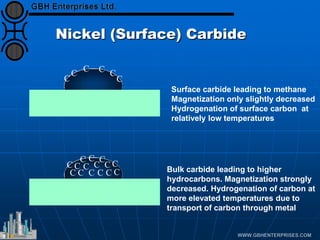
Nickel (Surface) Carbide
C
C C C C
C
C
C
C
C C
C
C
C C
C C
C C C
C
Surface carbide leading to methane
Magnetization only slightly decreased
Hydrogenation of surface carbon at
relatively low temperatures
Bulk carbide leading to higher
hydrocarbons. Magnetization strongly
decreased. Hydrogenation of carbon at
more elevated temperatures due to
transport of carbon through metal
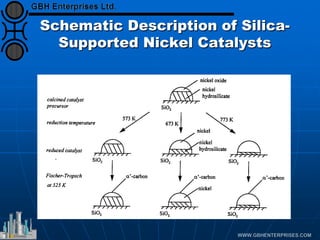
Schematic Description of Silica-
Supported Nickel Catalysts
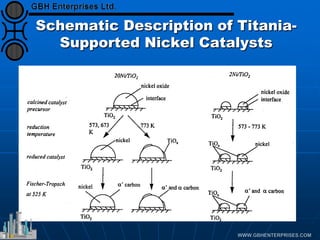
Schematic Description of Titania-
Supported Nickel Catalysts
Conclusions about Fischer-
Tropsch on Nickel
 Promotion of dissociative adsorption of
carbon monoxide required for synthesis of
higher hydrocarbons
 Promotion by reducible support, which is not
reduced to metal, but to oxygen acceptor
 Reaction to bulk carbide goes together with
Fischer-Tropsch synthesis to higher
hydrocarbons
Preparation of Supported Cobalt
Catalysts by Impregnation and Drying
 Alumina A2ST g-alumina
pore volume 0.48 ml/g, surface area 110 m2/g
employed as support
 Impregnation with
• Solution of cobalt nitrate
• Solution of cobalt EDTA complex
• Solution of cobalt ammonium citrate
 Catalyst according to Exxon patent as reference
catalyst 10Co1Ce/TiO2
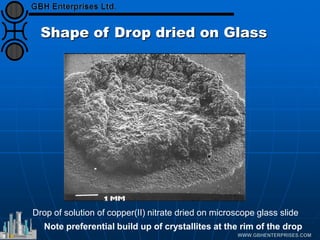
Shape of Drop dried on Glass
Drop of solution of copper(II) nitrate dried on microscope glass slide
Note preferential build up of crystallites at the rim of the drop
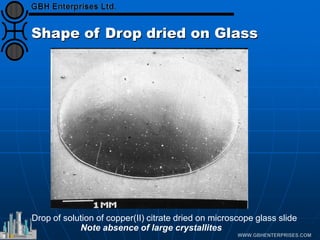
Shape of Drop dried on Glass
Drop of solution of copper(II) citrate dried on microscope glass slide
Note absence of large crystallites
Mean Particle Size of Supported
Cobalt Oxide by XPS
 Catalyst Mean particle size (nm)
2.5Co/Al2O3 nitrate 7.3
2.5Co/Al2O3 citrate 1.7
2.5 Co/Al2O3 EDTA 0.7
5 Co/Al2O3 nitrate 15.5
5 Co/Al2O3 citrate 3.9
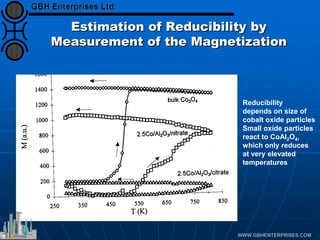
Estimation of Reducibility by
Measurement of the Magnetization
Reducibility
depends on size of
cobalt oxide particles
Small oxide particles
react to CoAl2O4,
which only reduces
at very elevated
temperatures
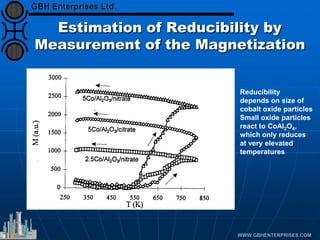
Estimation of Reducibility by
Measurement of the Magnetization
Reducibility
depends on size of
cobalt oxide particles
Small oxide particles
react to CoAl2O4,
which only reduces
at very elevated
temperatures
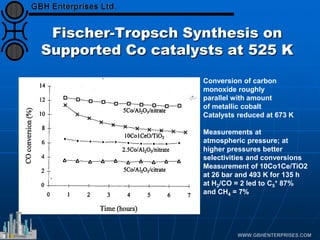
Fischer-Tropsch Synthesis on
Supported Co catalysts at 525 K
Conversion of carbon
monoxide roughly
parallel with amount
of metallic cobalt
Catalysts reduced at 673 K
Measurements at
atmospheric pressure; at
higher pressures better
selectivities and conversions
Measurement of 10Co1Ce/TiO2
at 26 bar and 493 K for 135 h
at H2/CO = 2 led to C5
+ 87%
and CH4 = 7%
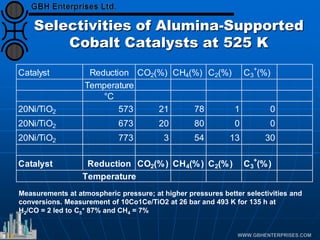
Selectivities of Alumina-Supported
Cobalt Catalysts at 525 K
Catalyst Reduction CO2(%) CH4(%) C2(%) C3
+
(%)
Temperature
°C
20Ni/TiO2 573 21 78 1 0
20Ni/TiO2 673 20 80 0 0
20Ni/TiO2 773 3 54 13 30
Catalyst Reduction CO2(%) CH4(%) C2(%) C3
+
(%)
Temperature
Measurements at atmospheric pressure; at higher pressures better selectivities and
conversions. Measurement of 10Co1Ce/TiO2 at 26 bar and 493 K for 135 h at
H2/CO = 2 led to C5
+ 87% and CH4 = 7%
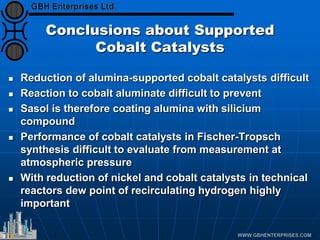
Conclusions about Supported
Cobalt Catalysts
 Reduction of alumina-supported cobalt catalysts difficult
 Reaction to cobalt aluminate difficult to prevent
 Sasol is therefore coating alumina with silicium
compound
 Performance of cobalt catalysts in Fischer-Tropsch
synthesis difficult to evaluate from measurement at
atmospheric pressure
 With reduction of nickel and cobalt catalysts in technical
reactors dew point of recirculating hydrogen highly
important
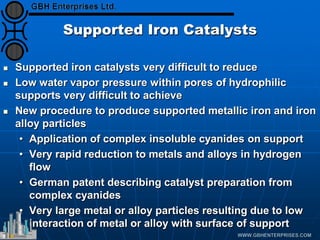
Supported Iron Catalysts
 Supported iron catalysts very difficult to reduce
 Low water vapor pressure within pores of hydrophilic
supports very difficult to achieve
 New procedure to produce supported metallic iron and iron
alloy particles
• Application of complex insoluble cyanides on support
• Very rapid reduction to metals and alloys in hydrogen
flow
• German patent describing catalyst preparation from
complex cyanides
• Very large metal or alloy particles resulting due to low
interaction of metal or alloy with surface of support
Supported Iron Catalysts
 Our invention : Initial calcination of supported complex
cyanide precursor to oxide
 Subsequent reduction leads to oxidic layer at interface
between metal or alloy particles and support
 Oxidic layer anchors metal or alloy particles to surface
of support and provides stable catalysts
Supported Iron Alloy Catalysts
 Precipitation of complex cyanides with metal ions to
be present in alloy
 Atomic mixing of components of alloy
 Examples for iron-nickel alloy catalysts
• Fe2+ + K4Fe(CN)6 ® Fe2Fe(CN)6 + K2FeFe(CN)6
• Fe2+ + K3Fe(CN)6 ® Fe3Fe(CN)6 + K2FeFe(CN)6
• Fe2+ + Na2Fe(CN)5NO ® FeFe(CN)5 NO
• Ni2+ + K4Fe(CN)6 ® Ni2Fe(CN)6 + K2NiFe(CN)6
• Ni2+ + K3Fe(CN)6 ® Ni2Fe(CN)6 + K2NiFe(CN)6
• Ni2+ + Na2Fe(CN)5NO® NiFe(CN)5NO
Supported Iron Alloy Catalysts
 Reaction with potassium iron cyanide complexes leads
to catalysts containing potassium
 Since potassium is very well and homogeneously
distributed within the iron containing moieties,
catalysts very well suited to investigate effect of
potassium on Fischer-Tropsch activity
 For preparation of potassium-free catalysts starting
from H4Fe(CN)6 attractive
Supported Iron Alloy Catalysts
 Preparation of potassium-free iron and nickel-iron
catalysts
• Ni2+ + H4Fe(CN)6 ® Ni2Fe(CN)6
• 0.4Ni2+ + 0.6Fe2+ + NaFe(CN)5NO ®
® (Ni0.4Fe0.6)Fe(CN)5NO
 Comparison potassium-free and potassium
containing catalysts
 Titania as the support; Degussa P 25 50 m2/g
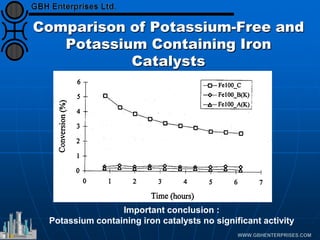
Comparison of Potassium-Free and
Potassium Containing Iron
Catalysts
Important conclusion :
Potassium containing iron catalysts no significant activity
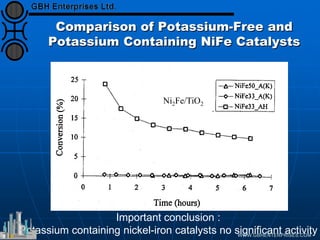
Comparison of Potassium-Free and
Potassium Containing NiFe Catalysts
Important conclusion :
Potassium containing nickel-iron catalysts no significant activity
Ni2Fe/TiO2
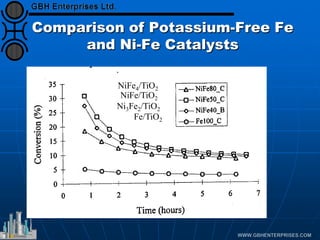
Comparison of Potassium-Free Fe
and Ni-Fe Catalysts
NiFe4/TiO2
NiFe/TiO2
Ni3Fe2/TiO2
Fe/TiO2
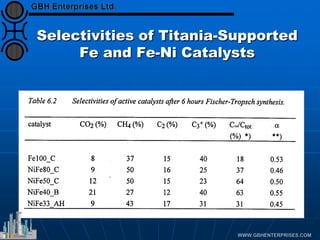
Selectivities of Titania-Supported
Fe and Fe-Ni Catalysts
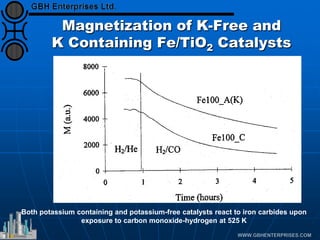
Magnetization of K-Free and
K Containing Fe/TiO2 Catalysts
Both potassium containing and potassium-free catalysts react to iron carbides upon
exposure to carbon monoxide-hydrogen at 525 K
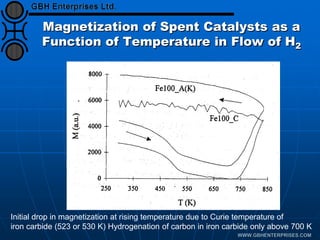
Magnetization of Spent Catalysts as a
Function of Temperature in Flow of H2
Initial drop in magnetization at rising temperature due to Curie temperature of
iron carbide (523 or 530 K) Hydrogenation of carbon in iron carbide only above 700 K
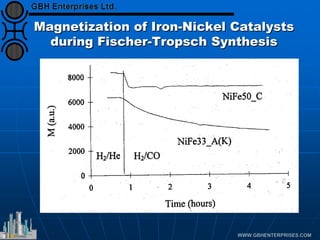
Magnetization of Iron-Nickel Catalysts
during Fischer-Tropsch Synthesis
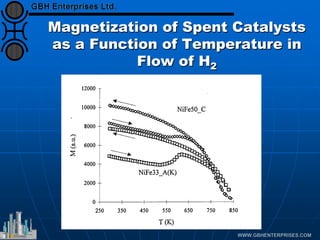
Magnetization of Spent Catalysts
as a Function of Temperature in
Flow of H2
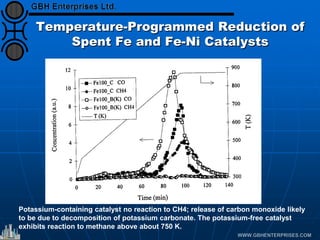
Temperature-Programmed Reduction of
Spent Fe and Fe-Ni Catalysts
Potassium-containing catalyst no reaction to CH4; release of carbon monoxide likely
to be due to decomposition of potassium carbonate. The potassium-free catalyst
exhibits reaction to methane above about 750 K.
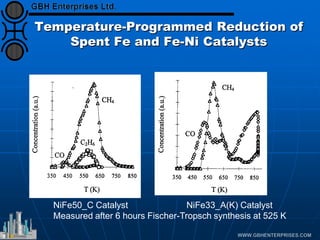
Temperature-Programmed Reduction of
Spent Fe and Fe-Ni Catalysts
NiFe50_C Catalyst NiFe33_A(K) Catalyst
Measured after 6 hours Fischer-Tropsch synthesis at 525 K
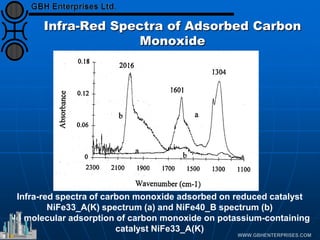
Infra-Red Spectra of Adsorbed Carbon
Monoxide
Infra-red spectra of carbon monoxide adsorbed on reduced catalyst
NiFe33_A(K) spectrum (a) and NiFe40_B spectrum (b)
No molecular adsorption of carbon monoxide on potassium-containing
catalyst NiFe33_A(K)
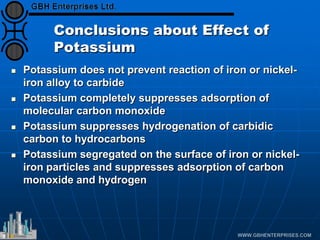
Conclusions about Effect of
Potassium
 Potassium does not prevent reaction of iron or nickel-
iron alloy to carbide
 Potassium completely suppresses adsorption of
molecular carbon monoxide
 Potassium suppresses hydrogenation of carbidic
carbon to hydrocarbons
 Potassium segregated on the surface of iron or nickel-
iron particles and suppresses adsorption of carbon
monoxide and hydrogen
Zirconia-Supported Iron Catalysts
 Zirconia as a support to limit reaction of iron(II) with
the support, which impedes reduction to metallic iron
 Zirconia of A2ST, surface area 49 m2/g; pore volume
0.28 ml/g
 Impregnation with ammonium iron citrate
 Loading only 2.5 wt.% iron; small iron particles to
suppress encapsulation by graphite layers and
growth of nanofibers
 Activity measurements at elevated pressures
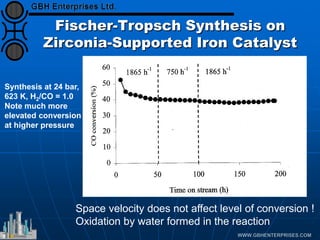
Fischer-Tropsch Synthesis on
Zirconia-Supported Iron Catalyst
Space velocity does not affect level of conversion !
Oxidation by water formed in the reaction
Synthesis at 24 bar,
623 K, H2/CO = 1.0
Note much more
elevated conversion
at higher pressure
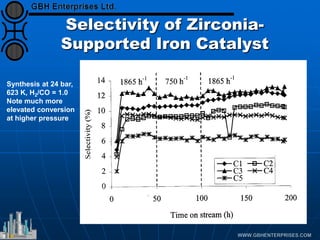
Selectivity of Zirconia-
Supported Iron Catalyst
Synthesis at 24 bar,
623 K, H2/CO = 1.0
Note much more
elevated conversion
at higher pressure
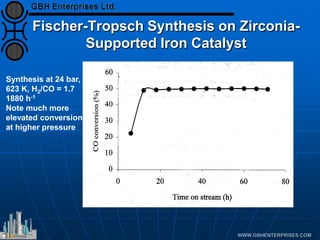
Fischer-Tropsch Synthesis on Zirconia-
Supported Iron Catalyst
Synthesis at 24 bar,
623 K, H2/CO = 1.7
1880 h-1
Note much more
elevated conversion
at higher pressure
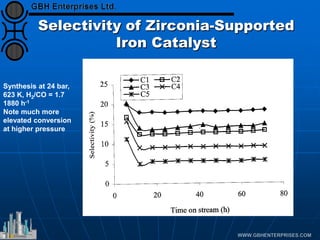
Selectivity of Zirconia-Supported
Iron Catalyst
Synthesis at 24 bar,
623 K, H2/CO = 1.7
1880 h-1
Note much more
elevated conversion
at higher pressure
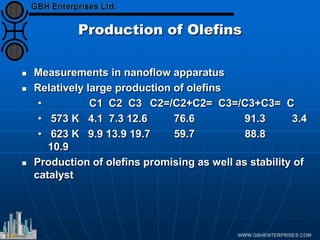
Production of Olefins
 Measurements in nanoflow apparatus
 Relatively large production of olefins
• C1 C2 C3 C2=/C2+C2= C3=/C3+C3= C
• 573 K 4.1 7.3 12.6 76.6 91.3 3.4
• 623 K 9.9 13.9 19.7 59.7 88.8
10.9
 Production of olefins promising as well as stability of
catalyst
Conclusions (1)
 Preparation of supported iron, cobalt, nickel, and iron-
nickel catalysts well developed
 Complementing range of analytical techniques for
characterizing catalysts before, during and after Fischer-
Tropsch synthesis
• Mossbauer experiments and results not dealt with
 Earlier mentioned items, competitive dissociative
adsorption and effect not completely reducible metal
oxides well identified
 Reduction of cobalt catalysts prepared by impregnation
extensively investigated
Conclusions (2)
 Deposition-precipitation, impregnation with
badly crystallizing compounds (citrates, EDTA
complexes) successfully applied
 Complex cyanides very interesting precursors
for metals and alloys difficult to reduce or to
prepare with uniform chemical composition
 Reliable and significant investigation of activity
and selectivity of Fischer-Tropsch catalysts can
only be performed at elevated pressures
Fischer_Tropsch_Catalysts.pdf

Fischer_Tropsch_Catalysts.pdf

  • 1.
    Fischer-Tropsch Catalysts Preparation, Thermal Pretreatment andBehavior during Catalytic Reaction Gerard B. Hawkins Managing Director
  • 2.
    Fischer-Tropsch Process  Reactionof carbon monoxide and hydrogen to mainly liquid hydrocarbons  Invented in Germany during the twenties of the former century  Cobalt and iron as catalysts  Objective : Producing transport fuels out of coal  Competitor : Bergius coal hydrogenation by I.G. Farben
  • 3.
    Themes  Dissociative adsorptionof methane and carbon monoxide in competition with surface oxidation (catalytic partial oxidation) or hydrogenation (Fischer-Tropsch synthesis)  Reducibility of metal oxides to metal oxides of lower valency  Different special procedures for producing supported catalysts
  • 4.
    Competitive Dissociative Adsorption CH4 H CH H H 2H2 CO O CO O O O O O O O O O O O O O O CH4 CH4 CO2 H2O CH4 CH4 CO2 H2O Dissociative adsorption of oxygen usually more rapid than dissociative adsorption of methane at temperatures below about 700oC
  • 5.
    Competitive Dissociative Adsorption CO CO H H H2O O C O C C C CO2 C H C C H C H C H C CnH2n(+2) Relatively low hydrogen coverage Fischer-Tropsch Relatively high hydrogen coverage methanation C H H H C H H H H C H H CH4
  • 6.
    Reducibility of MetalOxides O O O O O O O O O O O O O O O O O O O O O O O O O O O O O O O O O Formation of reduced oxide phase Formation of isolated oxygen vacancies CO C(ads) + O(ads) → ← CH4 → CO + 2H2
  • 7.
    Feed Stock of theFischer-Tropsch Process  Feed stock : Initially coal C + H2O = CO + H2  Desired H2/CO ratio 2  Carbon monoxide shift conversion CO + H2O = CO2 + H2  Presently : Natural gas Steam-reforming involves CH4 + H2O = CO + 3 H2 H2/CO ratio too elevated  Therefore (Catalytic) Partial Oxidation also Autothermal reforming
  • 8.
    (Catalytic) Partial Oxidation Pure oxygen required to perform 2CH4 + O2 = 2CO + 4H2 Desired H2/CO ratio  Extremely good mixing of natural gas and oxygen required to prevent formation of soot  Formation of explosive mixtures to be prevented  Initial highly exothermic reaction to carbon dioxide and water; subsequent reaction of carbon dioxide and water with methane to carbon monoxide and hydrogen
  • 9.
    Heats of Reaction Reaction of methane to CO2 and H2O very exothermic  Reaction of methane to CO and H2 strongly endothermic  Proceeding of homogeneous reaction of methane with carbon dioxide and water limits temperature increase  High temperatures implies high constraints on materials 2CH4+4O2 = 2CO2 + 4H2O -385.5 -385 -384.5 -384 -383.5 -383 -382.5 -382 0 200 400 600 800 1000 1200 1400 1600 Temperature °C Heat of Reaction (kcal) 2CH4 + O2 = 2CO + 4H2 -20 -15 -10 -5 0 0 200 400 600 800 1000 1200 1400 1600 Temperature °C Heat of reaction (kcal)
  • 10.
    Heats of Reaction Reaction of methane with carbon dioxide and of methane with steam highly endothermic CH4 + H2O = CO + 3H2 48 49 50 51 52 53 54 55 0 200 400 600 800 1000 1200 1400 Temperature °C Heat of Reaction (kcal) CH4 + CO2 = 2CO + 2H2 58 59 60 61 62 63 0 200 400 600 800 1000 1200 1400 Temperature °C Heat of reaction (kcal)
  • 11.
    (Catalytic) Partial Oxidation Initial highly exothermic reaction 2CH4 + 4O2 = 2CO2 + 4H2O  Subsequent endothermic reactions CO2 + CH4 = 2CO + 2H2 H2O + CH4 = CO + 3H2  Autothermal reforming : Adding steam and oxygen to methane  Catalytic partial oxidation aims at achieving reaction of CH4 to CO and H2 at lower temperature levels by promoting the reaction 2CH4 + O2 = 2CO + 4H2
  • 12.
    CO + H2OCO2 + H2 Reaction Paths Catalytic Partial Oxidation CH4 + O2 CO2 + H2O CO + H2 CH4 CO + H2 Direct Indirect CO shift Reforming
  • 13.
    Direct vs IndirectCatalytic Partial Oxidation CH4 CO+ H2 CO2 + H2O Direct Indirect T cat Axial position 2a 2b 1 1 2b 2a kJ/mol 1 - 40 2a - 800 2b + 200 CH4 CO+ H2
  • 14.
    Methane activation  Problem: CH4 activation calls for high temperature at which the reactivity of CO and H2 is relatively high RT 100 350 r oxidation H2 CO CH4 T (°C)
  • 15.
    Methane Activation  METALS(precious) Low oxygen coverage Pd,Pt,Ru,(Ni)  OXIDES Strongly bound oxygen Small amount of adsorbed oxygen Small number of (isolated) sites Y2O3, La2O3, ZrO2, TiO2 CH4 O CO H2 CHx H CH4 CO H2 O H
  • 16.
    Precious metal systems Pt, Pd, Ru, (Ni) T<700°C Indirect CPO Formation highly active phase for complete oxidation under steady state conditions CH4 + O2 CO2 + H2O CO + H2 Oxidation Reforming ”Oxidic” phase Metallic phase
  • 17.
    Precious metals :Pd 0 0.5 1 1.5 2 50 150 250 350 450 550 650 T (°C) pX (%) CO H2 CH4 O2 CO2 300 mg 0.5 wt% Pd/SiO2 CH4/O2/Ar 1 / 0.5 / 98.5 ml/min
  • 18.
    Influence of Oxidizing/ Reducing Conditions  Highly active but unstable reduced system 0 0.4 0.8 1.2 1.6 2 Time p X (%) CH4 O2 CO CO2 O2 H2 pulse 0.5% Ru/TiO2 diluted with quartz 2% CH4 1% O2 in Ar
  • 19.
    Catalytic Partial Oxidationof Methane 1 vol% CH4 0.5 vol% O2 in argon 100 ml(stp)/min Mn oxide on alumina 850 K
  • 20.
    Catalytic Partial Oxidationon Precious Metals (Nickel)  Oxidation to carbon dioxide and water  Subsequent reaction of remaining methane with carbon dioxide and water to carbon monoxide and hydrogen  Catalyst bed not uniform being oxidized at entrance and reduced at exit  Catalyst system not stable against deactivation by oxidation
  • 21.
    Trade Time forTemperature  Catalytic partial oxidation at temperatures above 1100oC  High rate of reaction; no problem in keeping the surface of the precious metal reduced  Also reaction of methane with carbon dioxide and water proceeding rapidly  Problem to prevent deposition of carbon on precious metal particles  Demands on materials at such elevated temperatures
  • 22.
    Catalytic Partial Oxidationon Oxides  OXIDES Strongly bound oxygen Small amount of adsorbed oxygen Small number of (isolated) sites TiO2, ZrO2, Y2O3, La2O3
  • 23.
    Catalytic Partial Oxidationon ZrO2 0 20 40 60 80 100 450 550 650 750 850 T (°C) % XCH S H S CO ZrO2 1% CH4 0.5% O2 100 ml/min 500 mg 4 2 Conversion CH4 Selectivity to H2 Selectivity to CO
  • 24.
    Effect of ResidenceTime 0 20 40 60 80 100 0 2 4 6 8 10 Methane conversion (%) selectivity (%) 2% CH4, 1 % O2 in Ar T=550°C 30000 < GHSV < 150000 (Nl/l)hr-1 ZrO2 Gimex ZrO2 Daiichi CO H2
  • 25.
    Oxidation of H2and CO on ZrO2 0 20 40 60 80 100 300 400 500 600 700 T (°C) Conversion (%) 500 mg catalyst 1% CO / H2 , 1% O2 in He CO oxidation CH4 oxidation H2 oxidation
  • 26.
    Experimental Results onZrO2  ZrO2 Inactive reforming catalyst Low activity CO-shift Low activity H2 and CO oxidation  Primary reaction: CH4 CO + H2 + H2O
  • 27.
    Survey Different MetalOxides 0 20 40 60 80 100 % X CH S CO S H S C 2% CH4 1% O2 100 ml/min T=600°C TiO2 ZrO2 Y2O3 La2O3 4 2 2
  • 28.
    Orders of theReaction with respect to Oxygen and Methane  Reaction orders : Pd O2 0.1 - 0.2 CH4 0.8 - 1.1 • Reduction of surface rate-determining  Oxides : High orders of reaction with respect to oxygen • Re-oxidation of surface rate-determining
  • 29.
    Orders of theReaction with Respect to Oxygen of Metal Oxides 0 0.2 0.4 0.6 0.8 1 TiO2 ZrO2 Y2O3 La2O3 CH4 O2
  • 30.
    Discussion Oxides TiO2, ZrO2,Y2O3,La2O3 Low activity  High selectivity  High reaction order O2 Low number of (isolated) sites
  • 31.
    Catalytic Partial Oxidation onMetals  Precious metals Pd, Pt, Ru, (Ni) steady state conditions T<700°C  “Oxidic” phase highly active in complete combustion Indirect formation of Syngas CH4 CO 2 + H2O CO + H2
  • 32.
    Catalytic Partial Oxidation onOxides  ZrO2, TiO2 : CO , H2 (H2O) primary products Y2O3, La2O3 : CO , H2 (H2O) primary products C2 - products : formation of CH3-species CH4 CO + H2 + H2O C2H6 + H2O CHx CH3 Direct formation of Syngas
  • 33.
    Fischer-Tropsch Synthesis  Reaction: CO + 2H2 → ‘CH2’ + H2O  Undesired reactions CO + 3H2 → CH4 + H2O, carbon deposition on supported metal particles, and carbon monoxide shift conversion • Higher hydrogen pressure promotes formation of methane  Highly undesired : Growth of carbon nanofibers • Mechanically very strong carbon fibers plug reactor and can even pierce reactor wall • With bubble column reactor and suspended catalyst bodies growth of carbon nanofibers less disastrous
  • 34.
    Carbon Fibers Grownin Catalyst Bed Scanning electron- micrograph
  • 35.
    Carbon Fibers Transmission electron micrograph Thickand thin carbon fibers have grown from this catalyst
  • 36.
    Nickel Particle atEnd of Carbon Fiber Transmission electron micrograph Carbon fibers grown from silica- supported nickel particles Nickel particle present at end of carbon fiber 90 nm
  • 37.
    Catalysts for Fischer-Tropsch Synthesis Required : • Dissociation of carbon monoxide  Ability to react to metal carbide(s) • Removal of adsorbed oxygen by reaction to either carbon dioxide or water • Limited availability of adsorbed hydrogen  Considerable extent of reduction of supported precursor to metal particles  Oxidation by water resulting from the Fischer-Tropsch reaction to be considered
  • 38.
    Catalysts for Fischer-Tropsch Synthesis Iron, cobalt and nickel able to react to metal carbides  Dissociation of carbon monoxide on iron and cobalt not strongly surface-sensitive  Dissociation of carbon monoxide on nickel surface- sensitive  Selectivity to methane therefore on iron and cobalt lower than on nickel  Supported iron and cobalt precursor difficult to reduce
  • 39.
    Catalysts for Fischer-Tropsch Synthesis Dissociation of carbon monoxide not on most stable Ni(111) surface • Hydrogen from Ni(111) surface migrates toward carbon atoms resulting from dissociation of carbon monoxide on other crystallographic surfaces • Abundance of hydrogen leads to undesired reaction to methane • Nickel therefore high selectivity to methane H H H H H H H H H H C C C C C C C C C C C C
  • 40.
    Promoted Nickel Catalysts Assisted dissociation of carbon monoxide at edge of nickel particles by support  Comparison of silica-supported nickel and titania-supported nickel  Titania support reducible to lower valent metal oxide  Application of nickel on support by deposition-precipitation Titania CO OC
  • 41.
    Preparation of Supported NickelCatalysts  Injection of nickel nitrate into suspension of silica or titania support  Maintaining pH at constant level of 9 by simultaneous injection of ammonia  Suspension of finely divided supports in water  After separation from the liquid, washed and dried in vacuum at room temperature  Shaped and subsequently calcined at 573 K for 3 hours
  • 42.
    Mean Size ofNickel Oxide Particles  Assessment of mean size of nickel oxide particles in calcined catalysts by evaluation of XPS results Catalyst Mean Particle Size nm 2Ni/TiO2 1.2 5Ni/TiO2 1.8 10Ni/TiO2 1.9 20Ni/TiO2 4.9 2Ni/SiO2 2.5 10Ni/SiO2 5.7 20Ni/SiO2 10.6
  • 43.
    Temperature-Programmed Reduction of Silica-SupportedNickel Catalysts Initial peak due to reduction of non-stoichiometric oxygen NiO1+x 20 wt.% Ni 10 wt.% Ni 2 wt.% Ni Second peak : Reduction of NiO Third peak : Reduction nickel containing clay mineral
  • 44.
    Temperature-Programmed Reduction of Titania-SupportedNickel Catalysts Initial peak due to reduction of non-stoichiometric oxygen NiO1+x Reduction of NiO second peak Reduction of nickel titanate final peak Extent of reduction of nickel 110 % indicating reduction of titania 5 wt.% 20 wt.% Ni/TiO2 10 wt.% Ni/TiO2 2 wt.% 50 mg samples 5 K/min from 300 to 1123 K
  • 45.
    Infra-Red Spectra ofCarbon Monoxide Adsorbed on Nickel Catalysts Catalysts reduced at 673 K Adsorption of CO on reduced sites on TiO2 absorption band around 2180 cm-1 Note higher absorption with 2 wt.% Ni/TiO2 which indicates induced reduction at the edge of nickel particles
  • 46.
    CO Hydrogenation at525 K on Silica-Supported Nickel Catalysts Catalysts reduced at 673 K 20 wt.% Ni/SiO2 reduced at temperatures indicated
  • 47.
    Selectivities of Fischer-Tropsch Synthesison Ni/SiO2 Catalysts Catalyst Reduction CO2(%) CH4(%) C2(%) C3 + (%) Temperature °C 2Ni/SiO2 673 0 87 4 9 10Ni/SiO2 673 2 90 5 3 20Ni/SiO2 673 2 90 5 3 20Ni/SiO2 573 7 85 5 3 20Ni/SiO2 673 2 90 5 3 20Ni/SiO2 773 3 90 5 2
  • 48.
    CO Hydrogenation at525 K on Titania-Supported Nickel Catalysts H2/CO = 2 for reaction to CH4 required H2/CO = 3
  • 49.
    Comparison T.P.R. andActivity at 525 K of Ni/TiO2 Catalysts 20 wt.% Ni/SiO2 reduced at temperatures indicated Temperature-Programmed Reduction (T.P.R.) of Ni/SiO2 catalysts. Ni content (wt.%) indicated at T.P.R. curves 50 mg samples 5 K/min from 300 to 1123 K
  • 50.
    Comparison T.P.R. andActivity at 525 K of Ni/TiO2 Catalysts 20 wt.% Ni/TiO2 reduced at temperatures indicated Temperature-Programmed Reduction (T.P.R.) of Ni/TiO2 catalysts. Ni content (wt.%) indicated at T.P.R. curves 50 mg samples 5 K/min from 300 to 1123 K
  • 51.
    CO Hydrogenation at525 K on Titania-Supported Nickel Catalysts CO conversion at 525 K of Ni/TiO2 catalysts of different nickel loadings reduced at 673 K Reaction to C3 + at 525 K of Ni/TiO2 catalysts of different nickel loadings reduced at 673 K CO conversion at 525 K of 2 wt.% Ni/TiO2 catalyst reduced at the different temperatures indicated in the figure
  • 52.
    CO Hydrogenation at525 K on Titania-Supported Nickel Catalysts Catalyst Reduction CO2(%) CH4(%) C2(%) C3 + (%) Temperature °C 2Ni/TiO2 673 5 37 16 42 5Ni/TiO2 673 6 53 13 28 10Ni/TiO2 673 6 59 12 23 20Ni/TiO2 673 20 80 0 0 2Ni/TiO2 573 4 35 14 47 2Ni/TiO2 673 5 37 16 42 2Ni/TiO2 773 5 34 14 47
  • 53.
    Magnetization of Titania-Supported NickelCatalysts Measured after reduction at 673 K during exposure to H2/CO = 2 at 525 K Drop in magnetization 31 % with 20Ni/TiO2 and no less than 70 % with 2Ni/TiO2 Measured after reduction at 673 K and Fischer-Tropsch synthesis at 525 K during temperature- programmed hydrogenation in 2 % hydrogen in helium Heating rate 2 K/min
  • 54.
    Temperature-Programmed Hydrogenation of NickelCarbides 20 wt.% Ni/TiO2 catalyst reduced at 673 and 773 K Measured after Fischer-Tropsch synthesis at 525 K Heating rate 5 K/min Surface carbide is hydrogenated at relatively low temperatures Transport of carbon to the metal surface calls for elevated temperatures
  • 55.
    Nickel (Surface) Carbide C CC C C C C C C C C C C C C C C C C C C Surface carbide leading to methane Magnetization only slightly decreased Hydrogenation of surface carbon at relatively low temperatures Bulk carbide leading to higher hydrocarbons. Magnetization strongly decreased. Hydrogenation of carbon at more elevated temperatures due to transport of carbon through metal
  • 56.
    Schematic Description ofSilica- Supported Nickel Catalysts
  • 57.
    Schematic Description ofTitania- Supported Nickel Catalysts
  • 58.
    Conclusions about Fischer- Tropschon Nickel  Promotion of dissociative adsorption of carbon monoxide required for synthesis of higher hydrocarbons  Promotion by reducible support, which is not reduced to metal, but to oxygen acceptor  Reaction to bulk carbide goes together with Fischer-Tropsch synthesis to higher hydrocarbons
  • 59.
    Preparation of SupportedCobalt Catalysts by Impregnation and Drying  Alumina A2ST g-alumina pore volume 0.48 ml/g, surface area 110 m2/g employed as support  Impregnation with • Solution of cobalt nitrate • Solution of cobalt EDTA complex • Solution of cobalt ammonium citrate  Catalyst according to Exxon patent as reference catalyst 10Co1Ce/TiO2
  • 60.
    Shape of Dropdried on Glass Drop of solution of copper(II) nitrate dried on microscope glass slide Note preferential build up of crystallites at the rim of the drop
  • 61.
    Shape of Dropdried on Glass Drop of solution of copper(II) citrate dried on microscope glass slide Note absence of large crystallites
  • 62.
    Mean Particle Sizeof Supported Cobalt Oxide by XPS  Catalyst Mean particle size (nm) 2.5Co/Al2O3 nitrate 7.3 2.5Co/Al2O3 citrate 1.7 2.5 Co/Al2O3 EDTA 0.7 5 Co/Al2O3 nitrate 15.5 5 Co/Al2O3 citrate 3.9
  • 63.
    Estimation of Reducibilityby Measurement of the Magnetization Reducibility depends on size of cobalt oxide particles Small oxide particles react to CoAl2O4, which only reduces at very elevated temperatures
  • 64.
    Estimation of Reducibilityby Measurement of the Magnetization Reducibility depends on size of cobalt oxide particles Small oxide particles react to CoAl2O4, which only reduces at very elevated temperatures
  • 65.
    Fischer-Tropsch Synthesis on SupportedCo catalysts at 525 K Conversion of carbon monoxide roughly parallel with amount of metallic cobalt Catalysts reduced at 673 K Measurements at atmospheric pressure; at higher pressures better selectivities and conversions Measurement of 10Co1Ce/TiO2 at 26 bar and 493 K for 135 h at H2/CO = 2 led to C5 + 87% and CH4 = 7%
  • 66.
    Selectivities of Alumina-Supported CobaltCatalysts at 525 K Catalyst Reduction CO2(%) CH4(%) C2(%) C3 + (%) Temperature °C 20Ni/TiO2 573 21 78 1 0 20Ni/TiO2 673 20 80 0 0 20Ni/TiO2 773 3 54 13 30 Catalyst Reduction CO2(%) CH4(%) C2(%) C3 + (%) Temperature Measurements at atmospheric pressure; at higher pressures better selectivities and conversions. Measurement of 10Co1Ce/TiO2 at 26 bar and 493 K for 135 h at H2/CO = 2 led to C5 + 87% and CH4 = 7%
  • 67.
    Conclusions about Supported CobaltCatalysts  Reduction of alumina-supported cobalt catalysts difficult  Reaction to cobalt aluminate difficult to prevent  Sasol is therefore coating alumina with silicium compound  Performance of cobalt catalysts in Fischer-Tropsch synthesis difficult to evaluate from measurement at atmospheric pressure  With reduction of nickel and cobalt catalysts in technical reactors dew point of recirculating hydrogen highly important
  • 68.
    Supported Iron Catalysts Supported iron catalysts very difficult to reduce  Low water vapor pressure within pores of hydrophilic supports very difficult to achieve  New procedure to produce supported metallic iron and iron alloy particles • Application of complex insoluble cyanides on support • Very rapid reduction to metals and alloys in hydrogen flow • German patent describing catalyst preparation from complex cyanides • Very large metal or alloy particles resulting due to low interaction of metal or alloy with surface of support
  • 69.
    Supported Iron Catalysts Our invention : Initial calcination of supported complex cyanide precursor to oxide  Subsequent reduction leads to oxidic layer at interface between metal or alloy particles and support  Oxidic layer anchors metal or alloy particles to surface of support and provides stable catalysts
  • 70.
    Supported Iron AlloyCatalysts  Precipitation of complex cyanides with metal ions to be present in alloy  Atomic mixing of components of alloy  Examples for iron-nickel alloy catalysts • Fe2+ + K4Fe(CN)6 ® Fe2Fe(CN)6 + K2FeFe(CN)6 • Fe2+ + K3Fe(CN)6 ® Fe3Fe(CN)6 + K2FeFe(CN)6 • Fe2+ + Na2Fe(CN)5NO ® FeFe(CN)5 NO • Ni2+ + K4Fe(CN)6 ® Ni2Fe(CN)6 + K2NiFe(CN)6 • Ni2+ + K3Fe(CN)6 ® Ni2Fe(CN)6 + K2NiFe(CN)6 • Ni2+ + Na2Fe(CN)5NO® NiFe(CN)5NO
  • 71.
    Supported Iron AlloyCatalysts  Reaction with potassium iron cyanide complexes leads to catalysts containing potassium  Since potassium is very well and homogeneously distributed within the iron containing moieties, catalysts very well suited to investigate effect of potassium on Fischer-Tropsch activity  For preparation of potassium-free catalysts starting from H4Fe(CN)6 attractive
  • 72.
    Supported Iron AlloyCatalysts  Preparation of potassium-free iron and nickel-iron catalysts • Ni2+ + H4Fe(CN)6 ® Ni2Fe(CN)6 • 0.4Ni2+ + 0.6Fe2+ + NaFe(CN)5NO ® ® (Ni0.4Fe0.6)Fe(CN)5NO  Comparison potassium-free and potassium containing catalysts  Titania as the support; Degussa P 25 50 m2/g
  • 73.
    Comparison of Potassium-Freeand Potassium Containing Iron Catalysts Important conclusion : Potassium containing iron catalysts no significant activity
  • 74.
    Comparison of Potassium-Freeand Potassium Containing NiFe Catalysts Important conclusion : Potassium containing nickel-iron catalysts no significant activity Ni2Fe/TiO2
  • 75.
    Comparison of Potassium-FreeFe and Ni-Fe Catalysts NiFe4/TiO2 NiFe/TiO2 Ni3Fe2/TiO2 Fe/TiO2
  • 76.
  • 77.
    Magnetization of K-Freeand K Containing Fe/TiO2 Catalysts Both potassium containing and potassium-free catalysts react to iron carbides upon exposure to carbon monoxide-hydrogen at 525 K
  • 78.
    Magnetization of SpentCatalysts as a Function of Temperature in Flow of H2 Initial drop in magnetization at rising temperature due to Curie temperature of iron carbide (523 or 530 K) Hydrogenation of carbon in iron carbide only above 700 K
  • 79.
    Magnetization of Iron-NickelCatalysts during Fischer-Tropsch Synthesis
  • 80.
    Magnetization of SpentCatalysts as a Function of Temperature in Flow of H2
  • 81.
    Temperature-Programmed Reduction of SpentFe and Fe-Ni Catalysts Potassium-containing catalyst no reaction to CH4; release of carbon monoxide likely to be due to decomposition of potassium carbonate. The potassium-free catalyst exhibits reaction to methane above about 750 K.
  • 82.
    Temperature-Programmed Reduction of SpentFe and Fe-Ni Catalysts NiFe50_C Catalyst NiFe33_A(K) Catalyst Measured after 6 hours Fischer-Tropsch synthesis at 525 K
  • 83.
    Infra-Red Spectra ofAdsorbed Carbon Monoxide Infra-red spectra of carbon monoxide adsorbed on reduced catalyst NiFe33_A(K) spectrum (a) and NiFe40_B spectrum (b) No molecular adsorption of carbon monoxide on potassium-containing catalyst NiFe33_A(K)
  • 84.
    Conclusions about Effectof Potassium  Potassium does not prevent reaction of iron or nickel- iron alloy to carbide  Potassium completely suppresses adsorption of molecular carbon monoxide  Potassium suppresses hydrogenation of carbidic carbon to hydrocarbons  Potassium segregated on the surface of iron or nickel- iron particles and suppresses adsorption of carbon monoxide and hydrogen
  • 85.
    Zirconia-Supported Iron Catalysts Zirconia as a support to limit reaction of iron(II) with the support, which impedes reduction to metallic iron  Zirconia of A2ST, surface area 49 m2/g; pore volume 0.28 ml/g  Impregnation with ammonium iron citrate  Loading only 2.5 wt.% iron; small iron particles to suppress encapsulation by graphite layers and growth of nanofibers  Activity measurements at elevated pressures
  • 86.
    Fischer-Tropsch Synthesis on Zirconia-SupportedIron Catalyst Space velocity does not affect level of conversion ! Oxidation by water formed in the reaction Synthesis at 24 bar, 623 K, H2/CO = 1.0 Note much more elevated conversion at higher pressure
  • 87.
    Selectivity of Zirconia- SupportedIron Catalyst Synthesis at 24 bar, 623 K, H2/CO = 1.0 Note much more elevated conversion at higher pressure
  • 88.
    Fischer-Tropsch Synthesis onZirconia- Supported Iron Catalyst Synthesis at 24 bar, 623 K, H2/CO = 1.7 1880 h-1 Note much more elevated conversion at higher pressure
  • 89.
    Selectivity of Zirconia-Supported IronCatalyst Synthesis at 24 bar, 623 K, H2/CO = 1.7 1880 h-1 Note much more elevated conversion at higher pressure
  • 90.
    Production of Olefins Measurements in nanoflow apparatus  Relatively large production of olefins • C1 C2 C3 C2=/C2+C2= C3=/C3+C3= C • 573 K 4.1 7.3 12.6 76.6 91.3 3.4 • 623 K 9.9 13.9 19.7 59.7 88.8 10.9  Production of olefins promising as well as stability of catalyst
  • 91.
    Conclusions (1)  Preparationof supported iron, cobalt, nickel, and iron- nickel catalysts well developed  Complementing range of analytical techniques for characterizing catalysts before, during and after Fischer- Tropsch synthesis • Mossbauer experiments and results not dealt with  Earlier mentioned items, competitive dissociative adsorption and effect not completely reducible metal oxides well identified  Reduction of cobalt catalysts prepared by impregnation extensively investigated
  • 92.
    Conclusions (2)  Deposition-precipitation,impregnation with badly crystallizing compounds (citrates, EDTA complexes) successfully applied  Complex cyanides very interesting precursors for metals and alloys difficult to reduce or to prepare with uniform chemical composition  Reliable and significant investigation of activity and selectivity of Fischer-Tropsch catalysts can only be performed at elevated pressures