MEMS SENSOR
Presented by
MD. FAIZAN AHMAD
Outline
MEMS Introduction
Sensor and its type
Applications
References
What is MEMS?
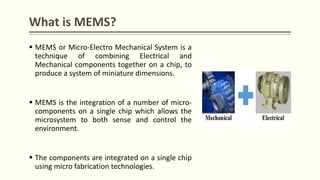
 MEMS or Micro-Electro Mechanical System is a
technique of combining Electrical and
Mechanical components together on a chip, to
produce a system of miniature dimensions.
 MEMS is the integration of a number of micro-
components on a single chip which allows the
microsystem to both sense and control the
environment.
 The components are integrated on a single chip
using micro fabrication technologies.
What is a Sensor?
 A device used to measure a physical
quantity(such as temperature) and convert it
into an electronic signal of some kind(e.g. a
voltage), without modifying the environment.
 What can be sensed?
Almost Everything!!!
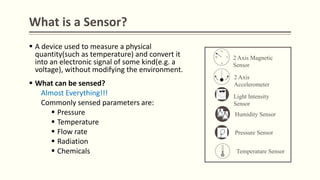
Commonly sensed parameters are:
 Pressure
 Temperature
 Flow rate
 Radiation
 Chemicals
N
S
EW
2 Axis Magnetic
Sensor
2 Axis
Accelerometer
Light Intensity
Sensor
Humidity Sensor
Pressure Sensor
Temperature Sensor
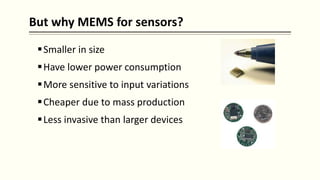
But why MEMS for sensors?
Smaller in size
Have lower power consumption
More sensitive to input variations
Cheaper due to mass production
Less invasive than larger devices
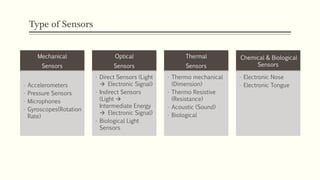
Type of Sensors
Mechanical
Sensors
• Accelerometers
• Pressure Sensors
• Microphones
• Gyroscopes(Rotation
Rate)
Optical
Sensors
• Direct Sensors (Light
 Electronic Signal)
• Indirect Sensors
(Light 
Intermediate Energy
 Electronic Signal)
• Biological Light
Sensors
Thermal
Sensors
• Thermo mechanical
(Dimension)
• Thermo Resistive
(Resistance)
• Acoustic (Sound)
• Biological
Chemical & Biological
Sensors
• Electronic Nose
• Electronic Tongue
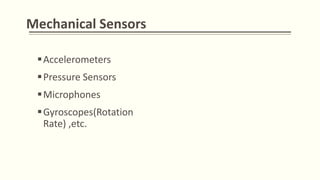
Mechanical Sensors
Accelerometers
Pressure Sensors
Microphones
Gyroscopes(Rotation
Rate) ,etc.
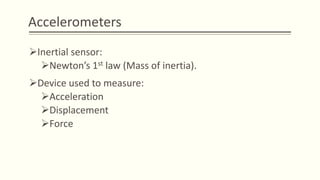
Accelerometers
Inertial sensor:
Newton’s 1st law (Mass of inertia).
Device used to measure:
Acceleration
Displacement
Force
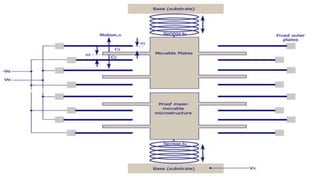
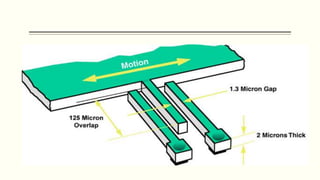
MEMS-based accelerometer with capacitors is typically a structure that uses
two capacitors formed by a moveable plate held between two fixed plates.
Under zero net force the two capacitors are equal but a change in force will
cause the moveable plate to shift closer to one of the fixed plates, increasing
the capacitance, and further away from the other fixed reducing that
capacitance.
This difference in capacitance is detected and amplified to produce a voltage
proportional to the acceleration
Pressure Sensors
 Pressure sensors are required in all walks of life, irrespective of civilian,
defence, aerospace, biomedical, automobile, Oceanography or domestic
applications.
 Among the various devices, pressure sensors using MEMS technology have
received great attention because the pressure sensors find applications in
everyday life involving sensing, monitoring and controlling pressure.
 Pressure sensors are categorized as
a) Absolute Pressure Sensors
b) Gauge Pressure sensors
c) Differential Pressure Sensors
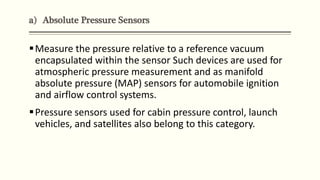
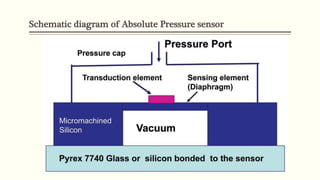
a) Absolute Pressure Sensors
Measure the pressure relative to a reference vacuum
encapsulated within the sensor Such devices are used for
atmospheric pressure measurement and as manifold
absolute pressure (MAP) sensors for automobile ignition
and airflow control systems.
Pressure sensors used for cabin pressure control, launch
vehicles, and satellites also belong to this category.
Schematic diagram of Absolute Pressure sensor
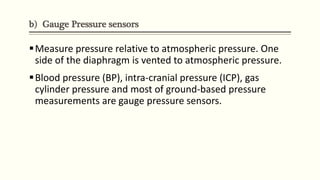
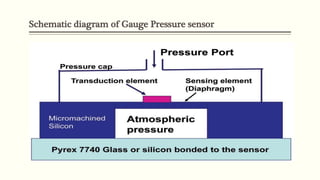
b) Gauge Pressure sensors
Measure pressure relative to atmospheric pressure. One
side of the diaphragm is vented to atmospheric pressure.
Blood pressure (BP), intra-cranial pressure (ICP), gas
cylinder pressure and most of ground-based pressure
measurements are gauge pressure sensors.
Schematic diagram of Gauge Pressure sensor
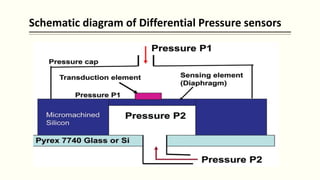
c) Differential Pressure Sensors
Measure accurately the difference ΔP between two
pressures P1 and P2 across the diaphragm (with ΔP << P1
or P2 ), and hence need two pressure ports.
They find applications in airplanes used in warfare. They
are also used in high pressure oxidation systems.
Schematic diagram of Differential Pressure sensors
 In almost all types of pressure sensors, the basic sensing element is the
diaphragm, which deflects in response to the pressure.
 As the deflections in diaphragm-based sensors are small they cannot be
directly measured. This mechanical deflection or the resulting strain in the
diaphragm is converted ultimately into electrical signals using suitable
transduction mechanisms, namely,
1) Capacitive
2) Piezoresistive or piezo-electric
Capacitive Pressure Sensor
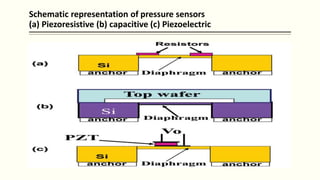
 This approach uses the diaphragm as one electrode of a parallel
plate capacitor structure and diaphragm displacement causes a
change in capacitance with respect to a fixed electrode.
 The merits of capacitive pressure sensors are their high sensitivity,
which is practically invariant with temperature.
 An electronic circuit is used to convert the capacitance change into
an electrical output.
Schematic representation of pressure sensors
(a) Piezoresistive (b) capacitive (c) Piezoelectric
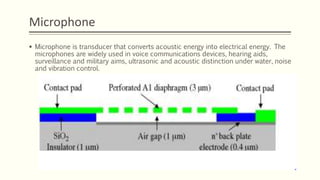
Microphone
 Microphone is transducer that converts acoustic energy into electrical energy. The
microphones are widely used in voice communications devices, hearing aids,
surveillance and military aims, ultrasonic and acoustic distinction under water, noise
and vibration control.
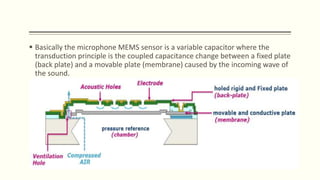
 Basically the microphone MEMS sensor is a variable capacitor where the
transduction principle is the coupled capacitance change between a fixed plate
(back plate) and a movable plate (membrane) caused by the incoming wave of
the sound.
Gyroscopes
A gyroscope is a device for measuring or maintaining the
orientation, based on the principles of the conservation of
momentum.
It uses vibrating mechanical element to sense the rotation.
Transfer of energy between two vibrating resonator is by
coriolis acceleration.
Types of Gyroscope
Spinning Gyroscope
Optical Gyroscope
Vibrating Gyroscope
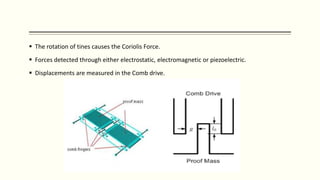
 The rotation of tines causes the Coriolis Force.
 Forces detected through either electrostatic, electromagnetic or piezoelectric.
 Displacements are measured in the Comb drive.
Applications of Gyroscope
 Yaw rate sensor for skid control in antilock braking applications for
automobiles.
 Inertial navigation systems.
 Smart cruise control.
 Guiding gun launched munitions.
 Detection of roll over detections.
Applications in Medical Science
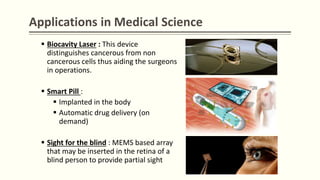
 Biocavity Laser : This device
distinguishes cancerous from non
cancerous cells thus aiding the surgeons
in operations.
 Smart Pill :
 Implanted in the body
 Automatic drug delivery (on
demand)
 Sight for the blind : MEMS based array
that may be inserted in the retina of a
blind person to provide partial sight
Applications in Marine Science
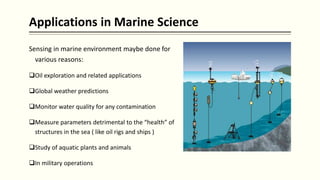
Sensing in marine environment maybe done for
various reasons:
Oil exploration and related applications
Global weather predictions
Monitor water quality for any contamination
Measure parameters detrimental to the “health” of
structures in the sea ( like oil rigs and ships )
Study of aquatic plants and animals
In military operations
Applications in Marine Military Operations
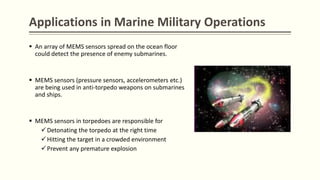
 An array of MEMS sensors spread on the ocean floor
could detect the presence of enemy submarines.
 MEMS sensors (pressure sensors, accelerometers etc.)
are being used in anti-torpedo weapons on submarines
and ships.
 MEMS sensors in torpedoes are responsible for
Detonating the torpedo at the right time
Hitting the target in a crowded environment
Prevent any premature explosion
References
 X. Wang, J. Engel, C. Liu, J. Micromech. Microeng. 2003, 13, 628.
 Christian A. Zorman, Mehran Mehregany, MEMS Design and Fabrication, 2nd Ed. 2,16.
 Ms. Santoshi Gupta, MEMS and Nanotechnology IJSER, Vol 3, Issue 5,2012
 Stephen Beeby, MEMS Mechanical Sensor, PP. 7
 Lenz, J., Edelstein, A.S., "Magnetic sensors and their applications." IEEE Sensors J. 2006, 6, 631-
649.
 Sinclair M J 2000 A high force low area MEMS thermal actuator Proc. 7th Intersociety Conf. on
Thermal and Thermomechanical Phenomena (Las Vegas, NV) pp 127–32
 R. Ghodssi, P. Lin (2011). MEMS Materials and Processes Handbook. Berlin: Springer.
 Chang, Floy I. (1995).Gas-phase silicon micromachining with xenon difluoride. 2641. pp. 117.
Mems sensor

Mems sensor

  • 1.
  • 2.
    Outline MEMS Introduction Sensor andits type Applications References
  • 3.
    What is MEMS? MEMS or Micro-Electro Mechanical System is a technique of combining Electrical and Mechanical components together on a chip, to produce a system of miniature dimensions.  MEMS is the integration of a number of micro- components on a single chip which allows the microsystem to both sense and control the environment.  The components are integrated on a single chip using micro fabrication technologies.
  • 4.
    What is aSensor?  A device used to measure a physical quantity(such as temperature) and convert it into an electronic signal of some kind(e.g. a voltage), without modifying the environment.  What can be sensed? Almost Everything!!! Commonly sensed parameters are:  Pressure  Temperature  Flow rate  Radiation  Chemicals N S EW 2 Axis Magnetic Sensor 2 Axis Accelerometer Light Intensity Sensor Humidity Sensor Pressure Sensor Temperature Sensor
  • 5.
    But why MEMSfor sensors? Smaller in size Have lower power consumption More sensitive to input variations Cheaper due to mass production Less invasive than larger devices
  • 6.
    Type of Sensors Mechanical Sensors •Accelerometers • Pressure Sensors • Microphones • Gyroscopes(Rotation Rate) Optical Sensors • Direct Sensors (Light  Electronic Signal) • Indirect Sensors (Light  Intermediate Energy  Electronic Signal) • Biological Light Sensors Thermal Sensors • Thermo mechanical (Dimension) • Thermo Resistive (Resistance) • Acoustic (Sound) • Biological Chemical & Biological Sensors • Electronic Nose • Electronic Tongue
  • 7.
  • 8.
    Accelerometers Inertial sensor: Newton’s 1stlaw (Mass of inertia). Device used to measure: Acceleration Displacement Force
  • 10.
    MEMS-based accelerometer withcapacitors is typically a structure that uses two capacitors formed by a moveable plate held between two fixed plates. Under zero net force the two capacitors are equal but a change in force will cause the moveable plate to shift closer to one of the fixed plates, increasing the capacitance, and further away from the other fixed reducing that capacitance. This difference in capacitance is detected and amplified to produce a voltage proportional to the acceleration
  • 12.
    Pressure Sensors  Pressuresensors are required in all walks of life, irrespective of civilian, defence, aerospace, biomedical, automobile, Oceanography or domestic applications.  Among the various devices, pressure sensors using MEMS technology have received great attention because the pressure sensors find applications in everyday life involving sensing, monitoring and controlling pressure.  Pressure sensors are categorized as a) Absolute Pressure Sensors b) Gauge Pressure sensors c) Differential Pressure Sensors
  • 13.
    a) Absolute PressureSensors Measure the pressure relative to a reference vacuum encapsulated within the sensor Such devices are used for atmospheric pressure measurement and as manifold absolute pressure (MAP) sensors for automobile ignition and airflow control systems. Pressure sensors used for cabin pressure control, launch vehicles, and satellites also belong to this category.
  • 14.
    Schematic diagram ofAbsolute Pressure sensor
  • 15.
    b) Gauge Pressuresensors Measure pressure relative to atmospheric pressure. One side of the diaphragm is vented to atmospheric pressure. Blood pressure (BP), intra-cranial pressure (ICP), gas cylinder pressure and most of ground-based pressure measurements are gauge pressure sensors.
  • 16.
    Schematic diagram ofGauge Pressure sensor
  • 17.
    c) Differential PressureSensors Measure accurately the difference ΔP between two pressures P1 and P2 across the diaphragm (with ΔP << P1 or P2 ), and hence need two pressure ports. They find applications in airplanes used in warfare. They are also used in high pressure oxidation systems.
  • 18.
    Schematic diagram ofDifferential Pressure sensors
  • 19.
     In almostall types of pressure sensors, the basic sensing element is the diaphragm, which deflects in response to the pressure.  As the deflections in diaphragm-based sensors are small they cannot be directly measured. This mechanical deflection or the resulting strain in the diaphragm is converted ultimately into electrical signals using suitable transduction mechanisms, namely, 1) Capacitive 2) Piezoresistive or piezo-electric
  • 20.
    Capacitive Pressure Sensor This approach uses the diaphragm as one electrode of a parallel plate capacitor structure and diaphragm displacement causes a change in capacitance with respect to a fixed electrode.  The merits of capacitive pressure sensors are their high sensitivity, which is practically invariant with temperature.  An electronic circuit is used to convert the capacitance change into an electrical output.
  • 21.
    Schematic representation ofpressure sensors (a) Piezoresistive (b) capacitive (c) Piezoelectric
  • 22.
    Microphone  Microphone istransducer that converts acoustic energy into electrical energy. The microphones are widely used in voice communications devices, hearing aids, surveillance and military aims, ultrasonic and acoustic distinction under water, noise and vibration control.
  • 23.
     Basically themicrophone MEMS sensor is a variable capacitor where the transduction principle is the coupled capacitance change between a fixed plate (back plate) and a movable plate (membrane) caused by the incoming wave of the sound.
  • 24.
    Gyroscopes A gyroscope isa device for measuring or maintaining the orientation, based on the principles of the conservation of momentum. It uses vibrating mechanical element to sense the rotation. Transfer of energy between two vibrating resonator is by coriolis acceleration.
  • 25.
    Types of Gyroscope SpinningGyroscope Optical Gyroscope Vibrating Gyroscope
  • 26.
     The rotationof tines causes the Coriolis Force.  Forces detected through either electrostatic, electromagnetic or piezoelectric.  Displacements are measured in the Comb drive.
  • 27.
    Applications of Gyroscope Yaw rate sensor for skid control in antilock braking applications for automobiles.  Inertial navigation systems.  Smart cruise control.  Guiding gun launched munitions.  Detection of roll over detections.
  • 28.
    Applications in MedicalScience  Biocavity Laser : This device distinguishes cancerous from non cancerous cells thus aiding the surgeons in operations.  Smart Pill :  Implanted in the body  Automatic drug delivery (on demand)  Sight for the blind : MEMS based array that may be inserted in the retina of a blind person to provide partial sight
  • 29.
    Applications in MarineScience Sensing in marine environment maybe done for various reasons: Oil exploration and related applications Global weather predictions Monitor water quality for any contamination Measure parameters detrimental to the “health” of structures in the sea ( like oil rigs and ships ) Study of aquatic plants and animals In military operations
  • 30.
    Applications in MarineMilitary Operations  An array of MEMS sensors spread on the ocean floor could detect the presence of enemy submarines.  MEMS sensors (pressure sensors, accelerometers etc.) are being used in anti-torpedo weapons on submarines and ships.  MEMS sensors in torpedoes are responsible for Detonating the torpedo at the right time Hitting the target in a crowded environment Prevent any premature explosion
  • 31.
    References  X. Wang,J. Engel, C. Liu, J. Micromech. Microeng. 2003, 13, 628.  Christian A. Zorman, Mehran Mehregany, MEMS Design and Fabrication, 2nd Ed. 2,16.  Ms. Santoshi Gupta, MEMS and Nanotechnology IJSER, Vol 3, Issue 5,2012  Stephen Beeby, MEMS Mechanical Sensor, PP. 7  Lenz, J., Edelstein, A.S., "Magnetic sensors and their applications." IEEE Sensors J. 2006, 6, 631- 649.  Sinclair M J 2000 A high force low area MEMS thermal actuator Proc. 7th Intersociety Conf. on Thermal and Thermomechanical Phenomena (Las Vegas, NV) pp 127–32  R. Ghodssi, P. Lin (2011). MEMS Materials and Processes Handbook. Berlin: Springer.  Chang, Floy I. (1995).Gas-phase silicon micromachining with xenon difluoride. 2641. pp. 117.

Editor's Notes

  • #31 The MEMS devices, in marine sensing maybe attached to:  Ships  Floating devices (buoys) in the sea  Fixed sea structures (like oil rigs)  Sea bed using links  AUVs(Autonomous Underwater Vehicle)