©Dr. Anwar Siddiqui
Physiology Seminar
08/08/2013
What is urine analysis?
• Urine analysis, also called
Urinalysis – one of the
oldest laboratory
procedures in the practice
of medicine.
• Also knows as Urine-
R&M (routine &
microscopy)
• Is an array of tests
performed on urine, and
one of the most common
Courtesy of the National Library of Medicine
Why urinalysis?
• General evaluation of health
• Diagnosis of disease or disorders of the
kidneys or urinary tract
• Diagnosis of other systemic disease that
affect kidney function
• Monitoring of patients with diabetes
• Screening for drug abuse (eg.
Sulfonamide or aminoglycosides)
Collection of urine specimens
• Improper collection---- may
invalidate the results
• Containers for collection of urine
should be wide mouthed, clean and
dry.
• Analysed within 2 hours of
collection else requires
refrigeration.
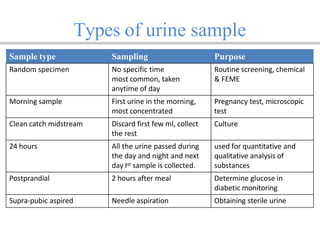
Types of urine sample
Sample type Sampling Purpose
Random specimen No specific time
most common, taken
anytime of day
Routine screening, chemical
& FEME
Morning sample First urine in the morning,
most concentrated
Pregnancy test, microscopic
test
Clean catch midstream Discard first few ml, collect
the rest
Culture
24 hours All the urine passed during
the day and night and next
day Ist sample is collected.
used for quantitative and
qualitative analysis of
substances
Postprandial 2 hours after meal Determine glucose in
diabetic monitoring
Supra-pubic aspired Needle aspiration Obtaining sterile urine
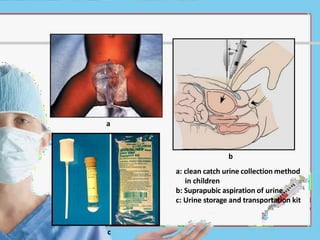
a
c
b
a: clean catch urine collection method
in children
b: Suprapubic aspiration of urine.
c: Urine storage and transportation kit
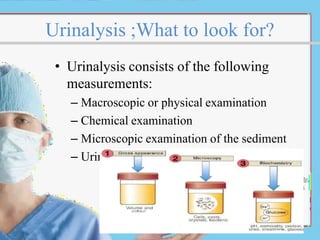
Urinalysis ;What to look for?
• Urinalysis consists of the following
measurements:
– Macroscopic or physical examination
– Chemical examination
– Microscopic examination of the sediment
– Urine culture
Physical examination of urine
Examination of physical
characteristics:
• Volume
• Color
• Odor
• pH and
• Specific gravity
 The refractometer or a reagent strip is used to
measure specific gravity
Physical examination continued…
 Normal- 1-2.5 L/day
 Oliguria- Urine Output < 400ml/day
Seen in
– Dehydration
– Shock
– Acute glomerulonephritis
– Renal Failure
 Polyuria- Urine Output > 2.5 L/day
Seen in
– Increased water ingestion
– Diabetes mellitus and insipidus.
 Anuria- Urine output < 100ml/day
Seen in renal shut down
V
olume
Physical examination continued…
 Normal- pale yellow in color due to pigments
urochrome, urobilin and uroerythrin.
 Cloudiness may be caused by excessive
cellular material or protein, crystallization or
precipitation of non pathological salts upon
standing at room temperature or in the
refrigerator.
 Colour of urine depending upon it’s
constituents.

Color
Physical examination continued…
Color• Abnormal colors:
• Colorless – diabetes, diuretics.
• Deep Yellow – concentrated urine,
excess bile pigments, jaundice
Physical examination continued…
Odour• Normal - aromatic due to the volatile fatty
acids
• On long standing – ammonical
(decomposition of urea forming ammonia
which gives a strong ammonical smell)
• Foul, offensive - pus or inflammation
• Sweet - Diabetes
• Fruity - Ketonuria
• Maple syrup-like - Maple Syrup Urine
Disease
• Rancid - Tyrosinaemia
Physical examination continued…
• Reflects ability of kidney to maintain
normal hydrogen ion concentration in
plasma & ECF
• Urine pH ranges from 4.5 to 8
• Normally it is slightly acidic lying between
6 – 6.5.
• Tested by:
– litmus paper
– pH paper
– dipsticks
• Acidic Urine –Ketosis (diabetes, starvation,
fever),systemic acidosis, UTI- E.coli,
acidification therapy
pH
Physical examination continued…
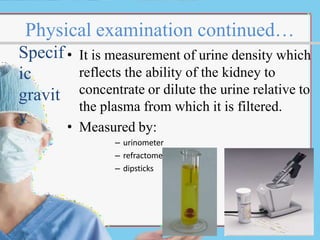
reflects the ability of the kidney to
concentrate or dilute the urine relative to
the plasma from which it is filtered.
• Measured by:
– urinometer
– refractometer
– dipsticks
Specif • It is measurement of urine density which
ic
gravit
y
Physical examination continued…
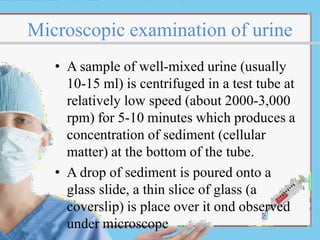
Specif • Normal :- 1.001- 1.040.
ic
gravit
y
 Increase in Specific Gravity - Low water intake,
Diabetes mellitus,Albuminuruia,Acute nephritis.
 Decrease in Specific Gravity - Absence ofADH,
Renal Tubular damage.
 Fixed specific gravity (isosthenuria)=1.010
Microscopic examination of urine
• A sample of well-mixed urine (usually
10-15 ml) is centrifuged in a test tube at
relatively low speed (about 2000-3,000
rpm) for 5-10 minutes which produces a
concentration of sediment (cellular
matter) at the bottom of the tube.
• A drop of sediment is poured onto a
glass slide, a thin slice of glass (a
coverslip) is place over it ond observed
under microscope
Microscopic examination of urine
• A variety of normal and abnormal
cellular elements may be seen in urine
sediment such as:
• Red blood cells
• White blood cells
• Mucus
• Various epithelial cells
• Various crystals
• Bacteria
• Casts
Microscopic examination of urine
– > 5 leukocytes
– > 2 renal tubular cells
– > 10 bacteria
• Per Low Power Field (LPF) (200x)
– > 3 hyaline casts or > 1 granular cast
– > 10 squamous cells (indicative of contaminate
specimen)
– Any other cast (RBCs, WBCs)
• Presence of:
– Fungal hyphae or yeast, parasite, viral inclusion
– Pathological crystals (cystine, leucine, tyrosine)
– Large number of uric acid or calcium oxalate cr
Abnorma• Per High Power Field (HPF) (400x)
– > 3 erythrocytes
l
findings
Microscopic examination of urine
• Hematuria is the presence of abnormal numbers
of red cells in urine due to any of several
possible causes.
– glomerular damage,
– tumors which erode the urinary tract anywhere along
its length,
– kidney trauma,
– urinary tract stones,
– acute tubular necrosis,
– upper and lower urinary tract infections,
– nephrotoxins
• WBC in high numbers indicate inflammation
or infection somewhere along the urinary or
Microscopic examination of urine
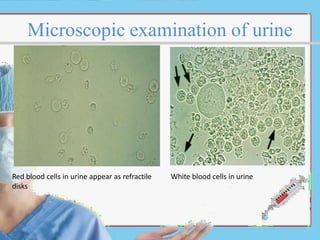
Red blood cells in urine appear as refractile
disks
White blood cells in urine
Microscopic examination of urine
Casts
• Urinary casts are cylindrical
aggregations of particles that form in the
distal nephron, dislodge, and pass into
the urine. In urinalysis they indicate
kidney disease.
• They form via precipitation of Tamm-
Horsfall mucoprotein which is secreted
by renal tubule cells.
Microscopic examination of urine
Types of cast seen :
– Acellular cast: Hyaline casts, Granular casts, Waxy
casts, Fatty casts, Pigment casts, Crystal casts.
– Cellular cast: Red cell casts, White cell casts,
Epithelial cell cast
• The most common type of cast- hyaline casts
are solidified Tamm-Horsfall mucoprotein
secreted from the tubular epithelial cells and
seen in fever, strenuous exercise, damage to the
glomerular capillary.
• Red blood cells may stick together and form red
blood cell casts. Such casts are indicative of
glomerulonephritis, with leakage of RBC's from
glomeruli, or severe tubular damage
• White blood cell casts are most typical for acute
pyelonephritis, but they may also be present
Microscopic examination of urine
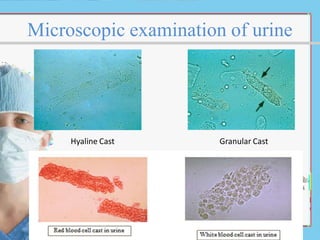
Granular Cast
Hyaline Cast
Microscopic examination of urine
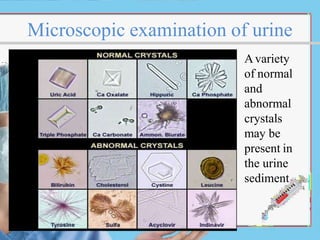
Avariety
of normal
and
abnormal
crystals
may be
present in
the urine
sediment
Chemical analysis of urine
• The chemical analysis of urine us
undertaken to evaluate the levels of the
following componen:
– Protein
– Glucose
– Ketones
– Occult blood
– Bilirubin
– Urobilinogen
– Bile salts
Chemical analysis of urine
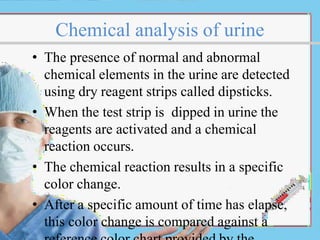
• The presence of normal and abnormal
chemical elements in the urine are detected
using dry reagent strips called dipsticks.
• When the test strip is dipped in urine the
reagents are activated and a chemical
reaction occurs.
• The chemical reaction results in a specific
color change.
• After a specific amount of time has elapse,
this color change is compared against a
Chemical analysis of urine
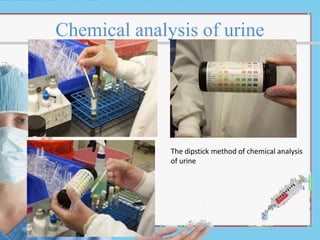
The dipstick method of chemical analysis
of urine
Chemical analysis of urine
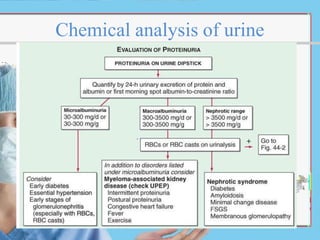
Proteins in urine:
• Detected by heat coagulation or dipstick
method
• Urine proteins come from plasma protein
and Tomm-Horsfall (T-H) glycoprotein
• healthy individuals excrete <150 mg/d of
total protein and <30 mg/d of albumin.
• Plasma cell dyscrasias (multiple myeloma)
can be associated with large amounts of
excreted light chains in the urine, which
may not be detected by dipstick. The light
chains produced from these disorders are
Chemical analysis of urine
That’s all ……..
Thank you!!!!

urineanalysis-130812011724-phpapp02.pptx

  • 1.
  • 2.
    What is urineanalysis? • Urine analysis, also called Urinalysis – one of the oldest laboratory procedures in the practice of medicine. • Also knows as Urine- R&M (routine & microscopy) • Is an array of tests performed on urine, and one of the most common Courtesy of the National Library of Medicine
  • 3.
    Why urinalysis? • Generalevaluation of health • Diagnosis of disease or disorders of the kidneys or urinary tract • Diagnosis of other systemic disease that affect kidney function • Monitoring of patients with diabetes • Screening for drug abuse (eg. Sulfonamide or aminoglycosides)
  • 4.
    Collection of urinespecimens • Improper collection---- may invalidate the results • Containers for collection of urine should be wide mouthed, clean and dry. • Analysed within 2 hours of collection else requires refrigeration.
  • 5.
    Types of urinesample Sample type Sampling Purpose Random specimen No specific time most common, taken anytime of day Routine screening, chemical & FEME Morning sample First urine in the morning, most concentrated Pregnancy test, microscopic test Clean catch midstream Discard first few ml, collect the rest Culture 24 hours All the urine passed during the day and night and next day Ist sample is collected. used for quantitative and qualitative analysis of substances Postprandial 2 hours after meal Determine glucose in diabetic monitoring Supra-pubic aspired Needle aspiration Obtaining sterile urine
  • 6.
    a c b a: clean catchurine collection method in children b: Suprapubic aspiration of urine. c: Urine storage and transportation kit
  • 7.
    Urinalysis ;What tolook for? • Urinalysis consists of the following measurements: – Macroscopic or physical examination – Chemical examination – Microscopic examination of the sediment – Urine culture
  • 8.
    Physical examination ofurine Examination of physical characteristics: • Volume • Color • Odor • pH and • Specific gravity  The refractometer or a reagent strip is used to measure specific gravity
  • 9.
    Physical examination continued… Normal- 1-2.5 L/day  Oliguria- Urine Output < 400ml/day Seen in – Dehydration – Shock – Acute glomerulonephritis – Renal Failure  Polyuria- Urine Output > 2.5 L/day Seen in – Increased water ingestion – Diabetes mellitus and insipidus.  Anuria- Urine output < 100ml/day Seen in renal shut down V olume
  • 10.
    Physical examination continued… Normal- pale yellow in color due to pigments urochrome, urobilin and uroerythrin.  Cloudiness may be caused by excessive cellular material or protein, crystallization or precipitation of non pathological salts upon standing at room temperature or in the refrigerator.  Colour of urine depending upon it’s constituents.  Color
  • 11.
    Physical examination continued… Color•Abnormal colors: • Colorless – diabetes, diuretics. • Deep Yellow – concentrated urine, excess bile pigments, jaundice
  • 12.
    Physical examination continued… Odour•Normal - aromatic due to the volatile fatty acids • On long standing – ammonical (decomposition of urea forming ammonia which gives a strong ammonical smell) • Foul, offensive - pus or inflammation • Sweet - Diabetes • Fruity - Ketonuria • Maple syrup-like - Maple Syrup Urine Disease • Rancid - Tyrosinaemia
  • 13.
    Physical examination continued… •Reflects ability of kidney to maintain normal hydrogen ion concentration in plasma & ECF • Urine pH ranges from 4.5 to 8 • Normally it is slightly acidic lying between 6 – 6.5. • Tested by: – litmus paper – pH paper – dipsticks • Acidic Urine –Ketosis (diabetes, starvation, fever),systemic acidosis, UTI- E.coli, acidification therapy pH
  • 14.
    Physical examination continued… reflectsthe ability of the kidney to concentrate or dilute the urine relative to the plasma from which it is filtered. • Measured by: – urinometer – refractometer – dipsticks Specif • It is measurement of urine density which ic gravit y
  • 15.
    Physical examination continued… Specif• Normal :- 1.001- 1.040. ic gravit y  Increase in Specific Gravity - Low water intake, Diabetes mellitus,Albuminuruia,Acute nephritis.  Decrease in Specific Gravity - Absence ofADH, Renal Tubular damage.  Fixed specific gravity (isosthenuria)=1.010
  • 16.
    Microscopic examination ofurine • A sample of well-mixed urine (usually 10-15 ml) is centrifuged in a test tube at relatively low speed (about 2000-3,000 rpm) for 5-10 minutes which produces a concentration of sediment (cellular matter) at the bottom of the tube. • A drop of sediment is poured onto a glass slide, a thin slice of glass (a coverslip) is place over it ond observed under microscope
  • 17.
    Microscopic examination ofurine • A variety of normal and abnormal cellular elements may be seen in urine sediment such as: • Red blood cells • White blood cells • Mucus • Various epithelial cells • Various crystals • Bacteria • Casts
  • 18.
    Microscopic examination ofurine – > 5 leukocytes – > 2 renal tubular cells – > 10 bacteria • Per Low Power Field (LPF) (200x) – > 3 hyaline casts or > 1 granular cast – > 10 squamous cells (indicative of contaminate specimen) – Any other cast (RBCs, WBCs) • Presence of: – Fungal hyphae or yeast, parasite, viral inclusion – Pathological crystals (cystine, leucine, tyrosine) – Large number of uric acid or calcium oxalate cr Abnorma• Per High Power Field (HPF) (400x) – > 3 erythrocytes l findings
  • 19.
    Microscopic examination ofurine • Hematuria is the presence of abnormal numbers of red cells in urine due to any of several possible causes. – glomerular damage, – tumors which erode the urinary tract anywhere along its length, – kidney trauma, – urinary tract stones, – acute tubular necrosis, – upper and lower urinary tract infections, – nephrotoxins • WBC in high numbers indicate inflammation or infection somewhere along the urinary or
  • 20.
    Microscopic examination ofurine Red blood cells in urine appear as refractile disks White blood cells in urine
  • 21.
    Microscopic examination ofurine Casts • Urinary casts are cylindrical aggregations of particles that form in the distal nephron, dislodge, and pass into the urine. In urinalysis they indicate kidney disease. • They form via precipitation of Tamm- Horsfall mucoprotein which is secreted by renal tubule cells.
  • 22.
    Microscopic examination ofurine Types of cast seen : – Acellular cast: Hyaline casts, Granular casts, Waxy casts, Fatty casts, Pigment casts, Crystal casts. – Cellular cast: Red cell casts, White cell casts, Epithelial cell cast • The most common type of cast- hyaline casts are solidified Tamm-Horsfall mucoprotein secreted from the tubular epithelial cells and seen in fever, strenuous exercise, damage to the glomerular capillary. • Red blood cells may stick together and form red blood cell casts. Such casts are indicative of glomerulonephritis, with leakage of RBC's from glomeruli, or severe tubular damage • White blood cell casts are most typical for acute pyelonephritis, but they may also be present
  • 23.
    Microscopic examination ofurine Granular Cast Hyaline Cast
  • 24.
    Microscopic examination ofurine Avariety of normal and abnormal crystals may be present in the urine sediment
  • 25.
    Chemical analysis ofurine • The chemical analysis of urine us undertaken to evaluate the levels of the following componen: – Protein – Glucose – Ketones – Occult blood – Bilirubin – Urobilinogen – Bile salts
  • 26.
    Chemical analysis ofurine • The presence of normal and abnormal chemical elements in the urine are detected using dry reagent strips called dipsticks. • When the test strip is dipped in urine the reagents are activated and a chemical reaction occurs. • The chemical reaction results in a specific color change. • After a specific amount of time has elapse, this color change is compared against a
  • 27.
    Chemical analysis ofurine The dipstick method of chemical analysis of urine
  • 29.
    Chemical analysis ofurine Proteins in urine: • Detected by heat coagulation or dipstick method • Urine proteins come from plasma protein and Tomm-Horsfall (T-H) glycoprotein • healthy individuals excrete <150 mg/d of total protein and <30 mg/d of albumin. • Plasma cell dyscrasias (multiple myeloma) can be associated with large amounts of excreted light chains in the urine, which may not be detected by dipstick. The light chains produced from these disorders are
  • 31.
  • 32.