ANTICOAGULANTS
Presented By:
Kazi Ornob
MD.Salman Haque
Anticoagulant
 When Blood is collected, it clots after sometime. The a
nticoagulants are the chemical agents which prevent t
he clotting of Blood when mixed with Blood in proper
proportion.
 Purpose of using anticoagulants:
- For study of various constituents of Blood component
s.
- Study of coagulation(clotting of Blood).
- Preservation of Blood in Blood Bank.
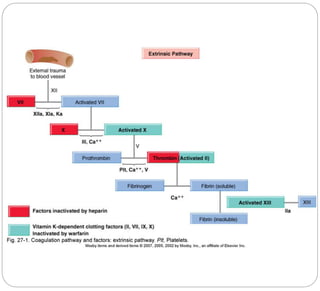
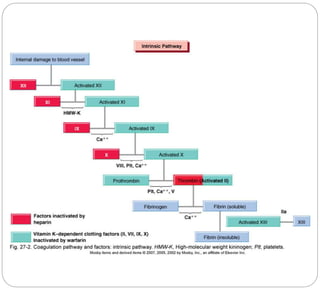
Coagulation Phase
 Two major pathways
 Intrinsic pathway
 Extrinsic pathway
 Both converge at a common point
 13 soluble factors are involved in clotting
 Biosynthesis of these factors are dependent on
Vitamin K1 and K2
 Normally inactive and sequentially activated
 Hereditary lack of clotting factors lead to
hemophilia -A
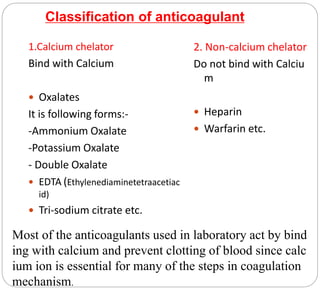
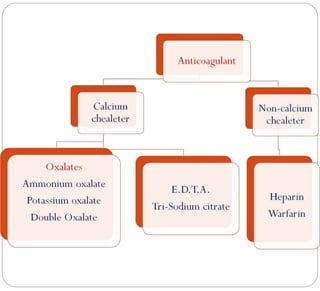
Classification of anticoagulant
1.Calcium chelator
Bind with Calcium
 Oxalates
It is following forms:-
-Ammonium Oxalate
-Potassium Oxalate
- Double Oxalate
 EDTA (Ethylenediaminetetraacetiac
id)
 Tri-sodium citrate etc.
2. Non-calcium chelator
Do not bind with Calciu
m
 Heparin
 Warfarin etc.
Most of the anticoagulants used in laboratory act by bind
ing with calcium and prevent clotting of blood since calc
ium ion is essential for many of the steps in coagulation
mechanism.
Classification according to Route o
f administration:
Parenteral Anticoagulants:
1.Heparin
2.Hirudin
3.Lepirudin
Oral Anticoagulants:
1.Warfarin
2.Dicoumarol
3.Acenocoumarol
E.D.T.A.(Ethylenediamine tetra-acetic a
cid)
 It is the most commonly used anticoagulant in Haematology lab becau
se E.D.T.A. is the most powerful calcium chelating (binding) agent we h
ave. It gives the best preservation to the cell morphology therefore E.
D.T.A. is the preferred anticoagulant for all cell count and blood smear
preparation.
E.D.T.A. is used in two different forms:-
 Di-sodium E.D.T.A. salt (Versene)
 Di-potassium E.D.T.A. salt (Sequestrene)
Excess of EDTA
 Excess of EDTA affects both red blood cells
and leukocytes causing shrinkage and deg
enerative changes.
 Excess of EDTA ( in case of 2 mg/ml) may c
ause significant decrease in packed cell vol
ume(PCV) and increase in mean cell haem
oglobin concentration (MCHC).
 Platelets swell and disintegrate due to the
excess of EDTA and artificially high platelet
s count may be obtained due to disintegra
ted platelets.
Heparin
It is a natural anticoagulant and is nor
mally present in the blood in small a
mount and highly acidic. This is the b
est anticoagulant for open heart surg
ery and it causes minimum haemolysi
s.
It is very expensive.
It produce black back ground in the s
mear so it is not use for smear prepar
ation.
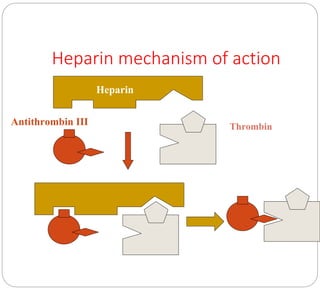
Heparin mechanism of action
Heparin
Antithrombin III Thrombin
Warfarin
 It is an oral medication
 It rapidly and completely absorbed from the intes
tine and is 99% plasma protein bound.
 It crosses placenta and is secreted in milk.
 The commercial preparation of warfarin is a mixtu
re of both dextrorotatory and levorotatory enanti
omers.
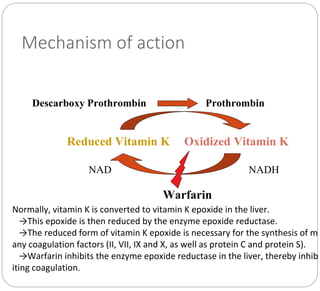
Mechanism of action
Descarboxy Prothrombin Prothrombin
Reduced Vitamin K Oxidized Vitamin K
NADHNAD
Warfarin
Normally, vitamin K is converted to vitamin K epoxide in the liver.
→This epoxide is then reduced by the enzyme epoxide reductase.
→The reduced form of vitamin K epoxide is necessary for the synthesis of m
any coagulation factors (II, VII, IX and X, as well as protein C and protein S).
→Warfarin inhibits the enzyme epoxide reductase in the liver, thereby inhib
iting coagulation.
Warfarin Side Effect
Severe Side effects:
• Severe bleeding
• Bleeding from the rectum or black stool
• Skin conditions such as hives, a rash or itching
• Swelling of the face, throat, mouth, legs, feet or hands
• Bruising that comes about without an injury you remember
• Chest pain or pressure
• Nausea or vomiting
• Fever or flu-like symptoms
• Joint or muscle aches
• Diarrhea
• Difficulty moving
• Numbness of tingling in any part of your body
• Painful erection lasting four hours or longer
Anticoagulant used in Blood Bank
 ACD (Acid Citrate Dextrose)
 CPD ( Citrate Phosphate Dextrose )
 CPDA (Citrate Phosphate Dextrose Adeni
ne)
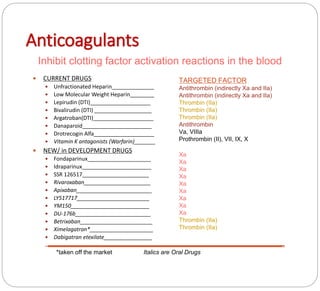
Anticoagulants
 CURRENT DRUGS
 Unfractionated Heparin______________
 Low Molecular Weight Heparin________
 Lepirudin (DTI)____________________
 Bivalirudin (DTI) ___________________
 Argatroban(DTI)____________________
 Danaparoid_______________________
 Drotrecogin Alfa____________________
 Vitamin K antagonists (Warfarin)_______
 NEW/ in DEVELOPMENT DRUGS
 Fondaparinux_____________________
 Idraparinux_______________________
 SSR 126517______________________
 Rivaroxaban______________________
 Apixaban_________________________
 LY517717________________________
 YM150__________________________
 DU-176b_________________________
 Betrixaban________________________
 Ximelagatran*_____________________
 Dabigatran etexilate________________
*taken off the market Italics are Oral Drugs
Inhibit clotting factor activation reactions in the blood
TARGETED FACTOR
Antithrombin (indirectly Xa and IIa)
Thrombin (IIa)
Thrombin (IIa)
Thrombin (IIa)
Antithrombin
Va, VIIIa
Prothrombin (II), VII, IX, X
Xa
Xa
Xa
Xa
Xa
Xa
Xa
Xa
Xa
Thrombin (IIa)
Thrombin (IIa)
The End
THANK YOU

Anticoagulants

  • 1.
  • 2.
    Anticoagulant  When Bloodis collected, it clots after sometime. The a nticoagulants are the chemical agents which prevent t he clotting of Blood when mixed with Blood in proper proportion.  Purpose of using anticoagulants: - For study of various constituents of Blood component s. - Study of coagulation(clotting of Blood). - Preservation of Blood in Blood Bank.
  • 4.
    Coagulation Phase  Twomajor pathways  Intrinsic pathway  Extrinsic pathway  Both converge at a common point  13 soluble factors are involved in clotting  Biosynthesis of these factors are dependent on Vitamin K1 and K2  Normally inactive and sequentially activated  Hereditary lack of clotting factors lead to hemophilia -A
  • 7.
    Classification of anticoagulant 1.Calciumchelator Bind with Calcium  Oxalates It is following forms:- -Ammonium Oxalate -Potassium Oxalate - Double Oxalate  EDTA (Ethylenediaminetetraacetiac id)  Tri-sodium citrate etc. 2. Non-calcium chelator Do not bind with Calciu m  Heparin  Warfarin etc. Most of the anticoagulants used in laboratory act by bind ing with calcium and prevent clotting of blood since calc ium ion is essential for many of the steps in coagulation mechanism.
  • 9.
    Classification according toRoute o f administration: Parenteral Anticoagulants: 1.Heparin 2.Hirudin 3.Lepirudin Oral Anticoagulants: 1.Warfarin 2.Dicoumarol 3.Acenocoumarol
  • 10.
    E.D.T.A.(Ethylenediamine tetra-acetic a cid) It is the most commonly used anticoagulant in Haematology lab becau se E.D.T.A. is the most powerful calcium chelating (binding) agent we h ave. It gives the best preservation to the cell morphology therefore E. D.T.A. is the preferred anticoagulant for all cell count and blood smear preparation. E.D.T.A. is used in two different forms:-  Di-sodium E.D.T.A. salt (Versene)  Di-potassium E.D.T.A. salt (Sequestrene)
  • 11.
    Excess of EDTA Excess of EDTA affects both red blood cells and leukocytes causing shrinkage and deg enerative changes.  Excess of EDTA ( in case of 2 mg/ml) may c ause significant decrease in packed cell vol ume(PCV) and increase in mean cell haem oglobin concentration (MCHC).  Platelets swell and disintegrate due to the excess of EDTA and artificially high platelet s count may be obtained due to disintegra ted platelets.
  • 12.
    Heparin It is anatural anticoagulant and is nor mally present in the blood in small a mount and highly acidic. This is the b est anticoagulant for open heart surg ery and it causes minimum haemolysi s. It is very expensive. It produce black back ground in the s mear so it is not use for smear prepar ation.
  • 13.
    Heparin mechanism ofaction Heparin Antithrombin III Thrombin
  • 14.
    Warfarin  It isan oral medication  It rapidly and completely absorbed from the intes tine and is 99% plasma protein bound.  It crosses placenta and is secreted in milk.  The commercial preparation of warfarin is a mixtu re of both dextrorotatory and levorotatory enanti omers.
  • 15.
    Mechanism of action DescarboxyProthrombin Prothrombin Reduced Vitamin K Oxidized Vitamin K NADHNAD Warfarin Normally, vitamin K is converted to vitamin K epoxide in the liver. →This epoxide is then reduced by the enzyme epoxide reductase. →The reduced form of vitamin K epoxide is necessary for the synthesis of m any coagulation factors (II, VII, IX and X, as well as protein C and protein S). →Warfarin inhibits the enzyme epoxide reductase in the liver, thereby inhib iting coagulation.
  • 16.
    Warfarin Side Effect SevereSide effects: • Severe bleeding • Bleeding from the rectum or black stool • Skin conditions such as hives, a rash or itching • Swelling of the face, throat, mouth, legs, feet or hands • Bruising that comes about without an injury you remember • Chest pain or pressure • Nausea or vomiting • Fever or flu-like symptoms • Joint or muscle aches • Diarrhea • Difficulty moving • Numbness of tingling in any part of your body • Painful erection lasting four hours or longer
  • 17.
    Anticoagulant used inBlood Bank  ACD (Acid Citrate Dextrose)  CPD ( Citrate Phosphate Dextrose )  CPDA (Citrate Phosphate Dextrose Adeni ne)
  • 18.
    Anticoagulants  CURRENT DRUGS Unfractionated Heparin______________  Low Molecular Weight Heparin________  Lepirudin (DTI)____________________  Bivalirudin (DTI) ___________________  Argatroban(DTI)____________________  Danaparoid_______________________  Drotrecogin Alfa____________________  Vitamin K antagonists (Warfarin)_______  NEW/ in DEVELOPMENT DRUGS  Fondaparinux_____________________  Idraparinux_______________________  SSR 126517______________________  Rivaroxaban______________________  Apixaban_________________________  LY517717________________________  YM150__________________________  DU-176b_________________________  Betrixaban________________________  Ximelagatran*_____________________  Dabigatran etexilate________________ *taken off the market Italics are Oral Drugs Inhibit clotting factor activation reactions in the blood TARGETED FACTOR Antithrombin (indirectly Xa and IIa) Antithrombin (indirectly Xa and IIa) Thrombin (IIa) Thrombin (IIa) Thrombin (IIa) Antithrombin Va, VIIIa Prothrombin (II), VII, IX, X Xa Xa Xa Xa Xa Xa Xa Xa Xa Thrombin (IIa) Thrombin (IIa)
  • 19.