Unit 8:
Topic will be discussed in this lecture
Physical examination of Abdomen
Prepared by: Miss Rabia Hanif
Nursing Lecturer
Sharif College of Nursing
Anatomy & Physiology
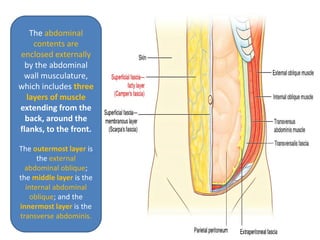
The abdominal
contents are
enclosed externally
by the abdominal
wall musculature,
which includes three
layers of muscle
extending from the
back, around the
flanks, to the front.
The outermost layer is
the external
abdominal oblique;
the middle layer is the
internal abdominal
oblique; and the
innermost layer is the
transverse abdominis.
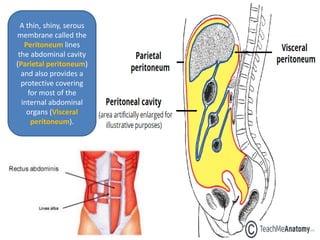
A thin, shiny, serous
membrane called the
Peritoneum lines
the abdominal cavity
(Parietal peritoneum)
and also provides a
protective covering
for most of the
internal abdominal
organs (Visceral
peritoneum).
Within the abdominal cavity are
structures of several different
body systems. These structures
are typically referred to as the
Abdominal viscera and can be
divided into two types: solid
viscera and hollow viscera.
Solid viscera are those organs
that maintain their shape
consistently: liver, pancreas,
spleen, adrenal glands, kidneys,
ovaries, and uterus.
The Hollow viscera consist of
structures that change shape
depending on their contents.
These include the stomach,
gallbladder, small intestine,
colon,
and bladder.
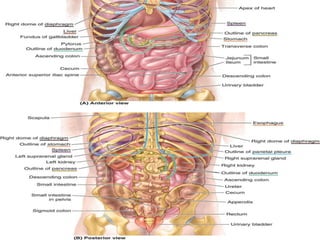
Solid Viscera
• The Liver is the largest solid organ in the body. It is located
below the diaphragm in the RUQ of the abdomen. It is
composed of four lobes that fill most of the RUQ and
extend to the left midclavicular line. In many people, the
liver extends just below the right costal margin, where it
may be palpated.
• The Pancreas, located mostly behind the stomach deep in
the upper abdomen, is normally not palpable. It is a long
gland extending across the abdomen from the RUQ to the
LUQ.
• The Spleen is approximately 7 cm wide and is located
above the left kidney just below the diaphragm at the level
of the ninth, tenth, and eleventh ribs. This soft, flat
structure is normally not palpable. In some healthy clients,
the lower tip can be felt below the left costal margin.
Conti…..
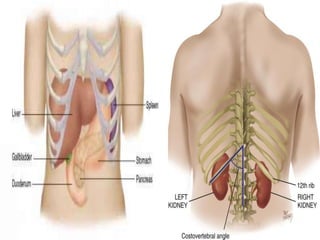
• The Kidneys are located high and deep under the
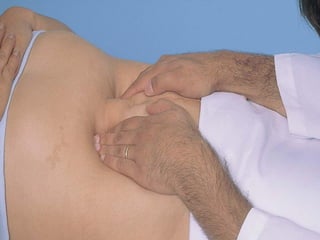
diaphragm. Considered posterior organs and
approximate with the level of the T12 to L3 vertebrae.
The tops of both kidneys are protected by the posterior
rib cage.
• Kidney tenderness is best assessed at the
costovertebral angle. The right kidney is positioned
slightly lower because of the position of the liver.
Therefore, in some thin clients, the bottom portion of
the right kidney may be palpated anteriorly.
• The pregnant uterus may be palpated above the level
of the symphysis pubis in the midline. The ovaries are
located in the RLQ and LLQ and are normally palpated
only during a bimanual examination of the internal
genitalia.
Hollow Viscera
• The abdominal cavity begins with the Stomach. It is a
distensible, flask-like organ located in the LUQ just below
the diaphragm and between the liver and spleen. The
stomach is not usually palpable.
• The Gallbladder, a muscular sac approximately 10 cm Long.
It is located near the posterior surface of the liver lateral to
the midclavicular line. It is not normally palpated because it
is difficult to distinguish between the gallbladder and the
liver.
• The Small intestine is actually the longest portion of the
digestive tract (approximately 7.0 m long) but is named for
its small diameter (approximately 2.5 cm). The small
intestine, which lies coiled in all four quadrants of the
abdomen, is not normally palpated.
Conti….
• The Colon, or large intestine, has a wider diameter
than the small intestine (approximately 6.0 cm) and is
approximately 1.4 m long. It originates in the RLQ.
• The colon is composed of three major sections:
ascending, transverse, and descending. The sigmoid
colon is often felt as a firm structure on palpation,
whereas the cecum and ascending colon may feel
softer. The transverse and descending colon may also
be felt on palpation.
• The Urinary bladder, a distensible muscular sac
located behind the pubic bone in the midline of the
abdomen, functions as a temporary receptacle for
urine. A bladder filled with urine may be palpated in
the abdomen above the Symphysis pubis.
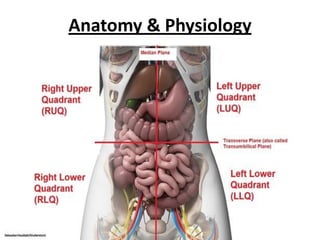
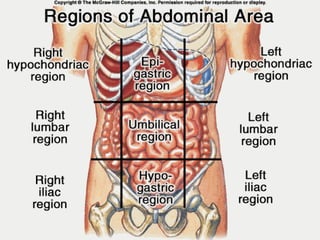
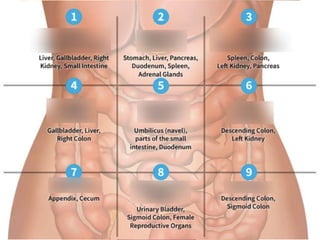
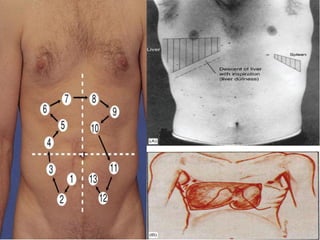
ABDOMINAL QUADRANT
 RIGHT UPPER QUADRANT
(RUQ)
• Ascending and transverse
colon
• Duodenum
• Gallbladder
• Hepatic flexure of colon
• Liver
• Pancreas (head)
• Pylorus (the small bowel—
or ileum—traverses
• all quadrants)
• Right adrenal gland
• Right kidney (upper pole)
• Right ureter
 RIGHT LOWER QUADRANT
(RLQ)
• Appendix
• Ascending colon
• Cecum
• Right kidney (lower pole)
• Right ovary and tube
• Right ureter
• Right spermatic cord
Conti….
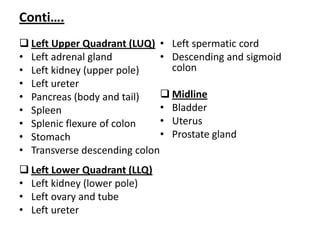
 Left Upper Quadrant (LUQ)
• Left adrenal gland
• Left kidney (upper pole)
• Left ureter
• Pancreas (body and tail)
• Spleen
• Splenic flexure of colon
• Stomach
• Transverse descending colon
 Left Lower Quadrant (LLQ)
• Left kidney (lower pole)
• Left ovary and tube
• Left ureter
• Left spermatic cord
• Descending and sigmoid
colon
 Midline
• Bladder
• Uterus
• Prostate gland
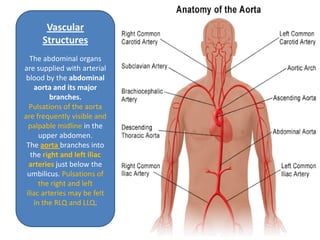
Vascular
Structures
The abdominal organs
are supplied with arterial
blood by the abdominal
aorta and its major
branches.
Pulsations of the aorta
are frequently visible and
palpable midline in the
upper abdomen.
The aorta branches into
the right and left iliac
arteries just below the
umbilicus. Pulsations of
the right and left
iliac arteries may be felt
in the RLQ and LLQ.
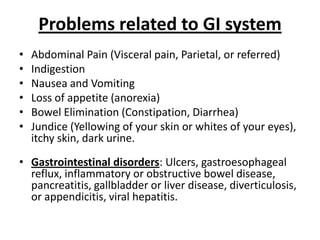
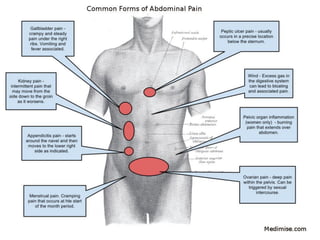
Problems related to GI system
• Abdominal Pain (Visceral pain, Parietal, or referred)
• Indigestion
• Nausea and Vomiting
• Loss of appetite (anorexia)
• Bowel Elimination (Constipation, Diarrhea)
• Jundice (Yellowing of your skin or whites of your eyes),
itchy skin, dark urine.
• Gastrointestinal disorders: Ulcers, gastroesophageal
reflux, inflammatory or obstructive bowel disease,
pancreatitis, gallbladder or liver disease, diverticulosis,
or appendicitis, viral hepatitis.
Preparing the Client
• Ask the client to empty the bladder before beginning the examination to
eliminate bladder distention and interference with an accurate
examination. Instruct the client to remove clothes and to put on a gown.
Help the client to lie supine with the arms folded across the chest or
resting by the sides.
• A flat pillow may be placed under the client’s head for comfort. Slightly
flex the client’s legs by placing a pillow or rolled blanket under the client’s
knees to help relax the abdominal muscles. Drape the client with sheets so
the abdomen is visible from the lower rib cage to the pubic area.
• Instruct the client to breathe through the mouth and to take slow, deep
breaths; this promotes relaxation. Before touching the abdomen, ask the
client about painful or tender areas. These areas should always be
assessed at the end of the examination.
Equipment
• Small pillow or rolled blanket
• Centimeter ruler
• Stethoscope (warm the diaphragm and bell)
• Marking pen
Inspection
Observe the coloration of the skin.
 Normal Findings: Abdominal skin may be paler than the
general skin tone because this skin is so seldom exposed
to the natural elements.
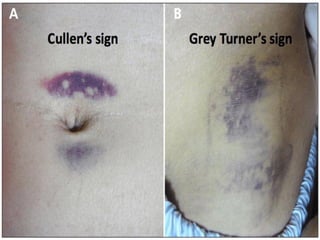
 Abnormal Findings: Purple discoloration at the flanks
(Grey Turner sign) indicates bleeding within the
abdominal wall, possibly from trauma to the kidneys,
pancreas, or duodenum or from pancreatitis.
 The yellow hue of jaundice may be more apparent on the
abdomen. Pale, taut skin may be seen with ascites.
 Redness may indicate inflammation. Bruises or areas of
local discoloration are also abnormal.
Conti….
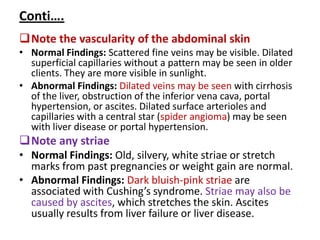
Note the vascularity of the abdominal skin
• Normal Findings: Scattered fine veins may be visible. Dilated
superficial capillaries without a pattern may be seen in older
clients. They are more visible in sunlight.
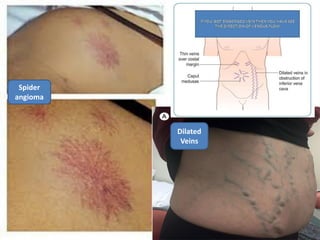
• Abnormal Findings: Dilated veins may be seen with cirrhosis
of the liver, obstruction of the inferior vena cava, portal
hypertension, or ascites. Dilated surface arterioles and
capillaries with a central star (spider angioma) may be seen
with liver disease or portal hypertension.
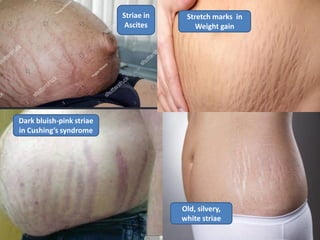
Note any striae
• Normal Findings: Old, silvery, white striae or stretch
marks from past pregnancies or weight gain are normal.
• Abnormal Findings: Dark bluish-pink striae are
associated with Cushing’s syndrome. Striae may also be
caused by ascites, which stretches the skin. Ascites
usually results from liver failure or liver disease.
Dilated
Veins
Spider
angioma
Dark bluish-pink striae
in Cushing’s syndrome
Striae in
Ascites
Old, silvery,
white striae
Stretch marks in
Weight gain
Conti….
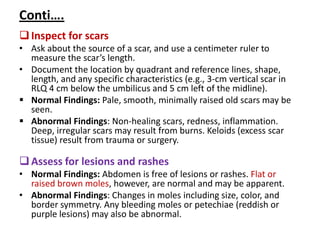
Inspect for scars
• Ask about the source of a scar, and use a centimeter ruler to
measure the scar’s length.
• Document the location by quadrant and reference lines, shape,
length, and any specific characteristics (e.g., 3-cm vertical scar in
RLQ 4 cm below the umbilicus and 5 cm left of the midline).
 Normal Findings: Pale, smooth, minimally raised old scars may be
seen.
 Abnormal Findings: Non-healing scars, redness, inflammation.
Deep, irregular scars may result from burns. Keloids (excess scar
tissue) result from trauma or surgery.
Assess for lesions and rashes
• Normal Findings: Abdomen is free of lesions or rashes. Flat or
raised brown moles, however, are normal and may be apparent.
• Abnormal Findings: Changes in moles including size, color, and
border symmetry. Any bleeding moles or petechiae (reddish or
purple lesions) may also be abnormal.
Keloids
Deep, irregular
scars from burn
Non-healing
wound
Conti….
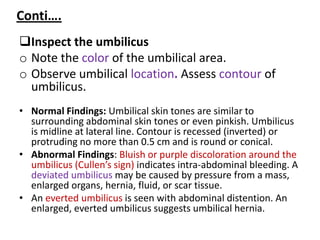
Inspect the umbilicus
o Note the color of the umbilical area.
o Observe umbilical location. Assess contour of
umbilicus.
• Normal Findings: Umbilical skin tones are similar to
surrounding abdominal skin tones or even pinkish. Umbilicus
is midline at lateral line. Contour is recessed (inverted) or
protruding no more than 0.5 cm and is round or conical.
• Abnormal Findings: Bluish or purple discoloration around the
umbilicus (Cullen’s sign) indicates intra-abdominal bleeding. A
deviated umbilicus may be caused by pressure from a mass,
enlarged organs, hernia, fluid, or scar tissue.
• An everted umbilicus is seen with abdominal distention. An
enlarged, everted umbilicus suggests umbilical hernia.
Deviated
umbilicus
Cullen’s
sign
Conti….
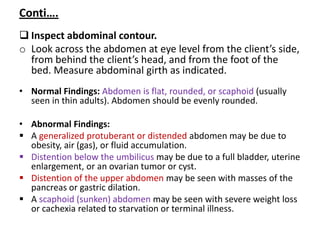
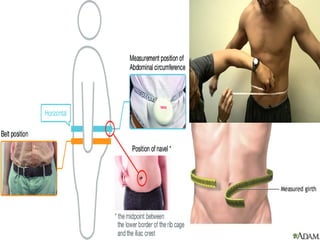
 Inspect abdominal contour.
o Look across the abdomen at eye level from the client’s side,
from behind the client’s head, and from the foot of the
bed. Measure abdominal girth as indicated.
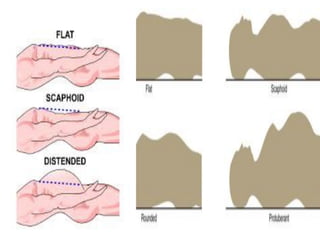
• Normal Findings: Abdomen is flat, rounded, or scaphoid (usually
seen in thin adults). Abdomen should be evenly rounded.
• Abnormal Findings:
 A generalized protuberant or distended abdomen may be due to
obesity, air (gas), or fluid accumulation.
 Distention below the umbilicus may be due to a full bladder, uterine
enlargement, or an ovarian tumor or cyst.
 Distention of the upper abdomen may be seen with masses of the
pancreas or gastric dilation.
 A scaphoid (sunken) abdomen may be seen with severe weight loss
or cachexia related to starvation or terminal illness.
Conti…..
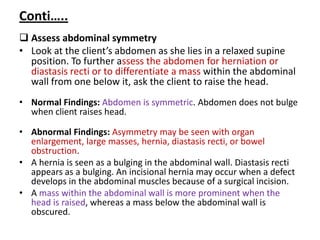
 Assess abdominal symmetry
• Look at the client’s abdomen as she lies in a relaxed supine
position. To further assess the abdomen for herniation or
diastasis recti or to differentiate a mass within the abdominal
wall from one below it, ask the client to raise the head.
• Normal Findings: Abdomen is symmetric. Abdomen does not bulge
when client raises head.
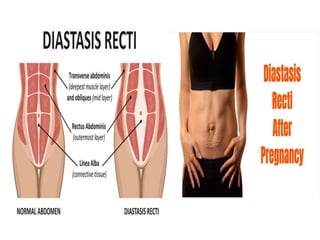
• Abnormal Findings: Asymmetry may be seen with organ
enlargement, large masses, hernia, diastasis recti, or bowel
obstruction.
• A hernia is seen as a bulging in the abdominal wall. Diastasis recti
appears as a bulging. An incisional hernia may occur when a defect
develops in the abdominal muscles because of a surgical incision.
• A mass within the abdominal wall is more prominent when the
head is raised, whereas a mass below the abdominal wall is
obscured.
Conti…..
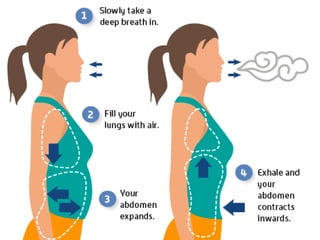
 Inspect abdominal movement when the client breathes (respiratory
movements).
• Normal Findings: Abdominal respiratory movement may be seen,
especially in male clients.
• Abnormal Findings: Diminished abdominal respiration or change to
thoracic breathing in male clients may reflect peritoneal irritation.
 Observe aortic pulsations
• Normal Findings: A slight pulsation of the abdominal aorta, which is visible
in the epigastrium, extends full length in thin people.
• Abnormal Findings: Vigorous, wide, exaggerated pulsations may be seen
with abdominal aortic aneurysm.
 Observe for peristaltic waves
• Normal Findings: Normally peristaltic waves are not seen although they
may be visible in very thin people as slight ripples on the abdominal wall.
• Abnormal Findings: Peristaltic waves are increased and progress in a
ripple-like fashion from the LUQ to the RLQ with intestinal obstruction
(especially small intestine). In addition, abdominal distention typically is
present with intestinal wall obstruction.
Auscultation
Auscultate for bowel sounds
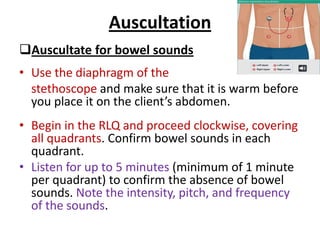
• Use the diaphragm of the
stethoscope and make sure that it is warm before
you place it on the client’s abdomen.
• Begin in the RLQ and proceed clockwise, covering
all quadrants. Confirm bowel sounds in each
quadrant.
• Listen for up to 5 minutes (minimum of 1 minute
per quadrant) to confirm the absence of bowel
sounds. Note the intensity, pitch, and frequency
of the sounds.
Conti….
 Normal Findings: A series of intermittent, soft clicks and
gurgles are heard at a rate of 5 to 30 per minute.
 Abnormal Findings:
 Hypoactive bowel sounds indicate diminished bowel
motility. Common causes include abdominal surgery or
late bowel obstruction.
 Hyperactive bowel sounds indicate increased bowel
motility. Common causes include diarrhea,
gastroenteritis, or early bowel obstruction.
 Decreased or absent bowel sounds signify the absence of
bowel motility, which constitutes an emergency requiring
immediate referral.
 Absent bowel sounds may be associated with peritonitis
or paralytic ileus..
Conti…..
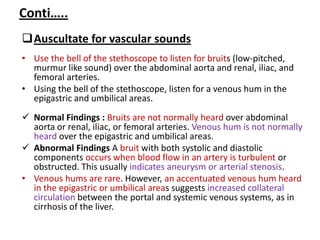
Auscultate for vascular sounds
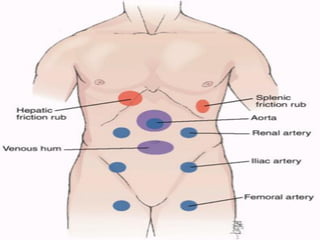
• Use the bell of the stethoscope to listen for bruits (low-pitched,
murmur like sound) over the abdominal aorta and renal, iliac, and
femoral arteries.
• Using the bell of the stethoscope, listen for a venous hum in the
epigastric and umbilical areas.
 Normal Findings : Bruits are not normally heard over abdominal
aorta or renal, iliac, or femoral arteries. Venous hum is not normally
heard over the epigastric and umbilical areas.
 Abnormal Findings A bruit with both systolic and diastolic
components occurs when blood flow in an artery is turbulent or
obstructed. This usually indicates aneurysm or arterial stenosis.
• Venous hums are rare. However, an accentuated venous hum heard
in the epigastric or umbilical areas suggests increased collateral
circulation between the portal and systemic venous systems, as in
cirrhosis of the liver.
Conti…..
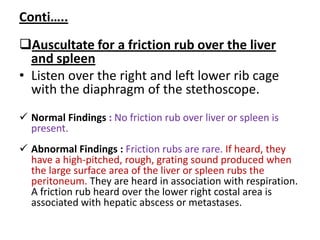
Auscultate for a friction rub over the liver
and spleen
• Listen over the right and left lower rib cage
with the diaphragm of the stethoscope.
 Normal Findings : No friction rub over liver or spleen is
present.
 Abnormal Findings : Friction rubs are rare. If heard, they
have a high-pitched, rough, grating sound produced when
the large surface area of the liver or spleen rubs the
peritoneum. They are heard in association with respiration.
A friction rub heard over the lower right costal area is
associated with hepatic abscess or metastases.
Percussion
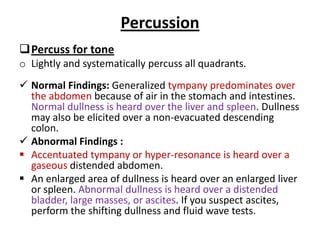
Percuss for tone
o Lightly and systematically percuss all quadrants.
 Normal Findings: Generalized tympany predominates over
the abdomen because of air in the stomach and intestines.
Normal dullness is heard over the liver and spleen. Dullness
may also be elicited over a non-evacuated descending
colon.
 Abnormal Findings :
 Accentuated tympany or hyper-resonance is heard over a
gaseous distended abdomen.
 An enlarged area of dullness is heard over an enlarged liver
or spleen. Abnormal dullness is heard over a distended
bladder, large masses, or ascites. If you suspect ascites,
perform the shifting dullness and fluid wave tests.
Conti….
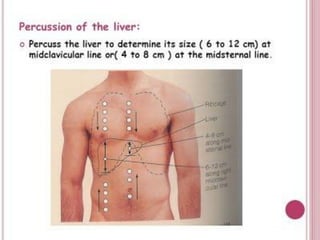
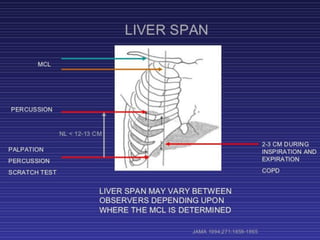
Percuss the span or height of the liver by
determining its lower and upper borders.
 Normal Findings: The lower border of liver dullness is located
at the costal margin to 1 to 2 cm below.
• To assess the lower border, begin in the RLQ at the
mid-clavicular line (MCL) and percuss upward. Note the
change from tympany to dullness. Mark this point: It is
the lower border of liver dullness.
• To assess the descent of the liver, ask the client to take
a deep breath and hold; then repeat the procedure.
Remind the client to exhale after percussing.
 Normal Findings: On deep inspiration, the lower border of
liver dullness may descend from 1 to 4 cm below the costal
margin.
Conti….
• To assess the upper border, percuss over the
upper right chest at the MCL and percuss
downward, noting the change from lung
resonance to liver dullness. Mark this point: It
is the upper border of liver dullness.
 Normal Findings: The upper border of liver dullness is
located between the left fifth and seventh intercostal
spaces.
 Abnormal Findings: The upper border of liver dullness
may be difficult to estimate if obscured by pleural fluid of
lung consolidation.
Conti…..
Measure the distance between the two marks: this is
the span of the liver.
 Normal Findings: The normal liver span at the MCL is 6 to 12
cm (greater in men and taller clients, less in shorter clients).
Normally liver size decreases after age 50.
 Abnormal Findings:
• Hepatomegaly, a liver span that exceeds normal limits
(enlarged), is characteristic of liver tumors, cirrhosis, abscess,
and vascular engorgement.
• Atrophy of the liver is indicated by a decreased span.
• A liver in a lower position than normal may be caused by
emphysema, whereas a liver in a higher position than normal
may be caused by an abdominal mass, ascites, or a paralyzed
diaphragm. A liver in a lower or higher position should have a
normal span.
Conti….
Repeat percussion of the liver at the midsternal line
(MSL).
 Normal Findings: The normal liver span at the MSL is 4 to 8
cm.
 Abnormal Findings: An enlarged liver may be roughly
estimated (not accurately) when more intense sounds outline
a liver span or borders outside the normal range.
If you cannot accurately percuss the liver borders,
Perform the scratch test.
Auscultate over the liver and, starting in the RLQ, scratch
lightly over the abdomen, progressing upward toward
the liver.
 Normal Findings: The sound produced by scratching becomes
more intense over the liver.
Tests for Ascites
Test for shifting dullness
• If you suspect that the client has ascites because
of a distended abdomen or bulging flanks,
perform this special percussion technique. The
client should remain supine.
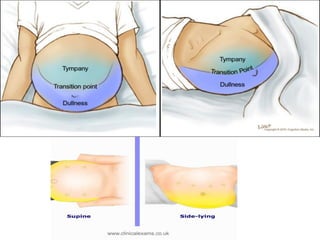
• Percuss the flanks from the bed upward toward
the umbilicus. Note the change from dullness to
tympany and mark this point. Now help the client
turn onto his or her side. Percuss the abdomen
from the bed upward. Mark the level where
dullness changes to tympany.
Conti….
• The borders between tympany and dullness remain
relatively constant throughout position changes.
• When ascites is present and the client is supine, the
fluid assumes a dependent position and produces a
dull percussion tone around the flanks. Air rises to the
top and tympany is percussed around the umbilicus.
• When the client turns onto one side and ascites is
present, the fluid assumes a dependent position and
air rises to the top. There is a marked increase in the
height of the dullness.
• This test is not always reliable and definitive testing by
ultrasound is necessary.
Perform the fluid wave test
• A second special technique to detect ascites is the
fluid wave test. The client should remain supine.
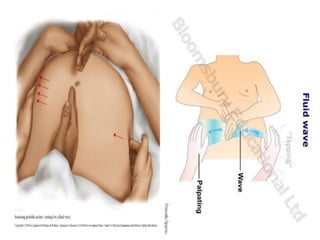
• Ask the patient or an assistant to press the edges of
both hands firmly down the midline of the abdomen.
This pressure helps to stop the transmission wave
through fat. While you tap one flank sharply with
your fingertips, feel on the opposite flank for an
impulse transmitted through the fluid.
 Normal Findings: No fluid wave is transmitted.
 Abnormal Findings: Movement of a fluid wave against the
resting hand suggests large amounts of fluid are present
(ascites).
Conti….
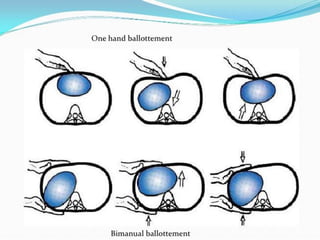
Use ballottement technique
• Ballottement is a palpation technique performed to identify
a mass or enlarged organ within an ascitic abdomen.
Ballottement can be performed two different ways: single-
handed or bimanually.
• Single-Hand Method: Using a tapping or bouncing motion
of the fingerpads over the abdominal wall, feel for a
floating mass.
• Bimanual Method: Place one hand under the flank
(receiving/feeling hand) and push the anterior abdominal
wall with the other hand.
 Normal Findings: No palpable mass or masses are present.
 Abnormal Findings: In the client with ascites, you can feel a
freely movable mass moving upward (floats). It can be felt at
the fingertips. A floating mass can be palpated for size.
Conti….
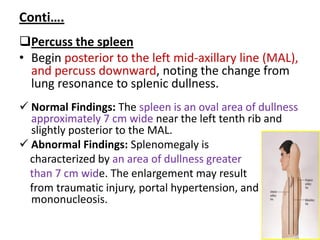
Percuss the spleen
• Begin posterior to the left mid-axillary line (MAL),
and percuss downward, noting the change from
lung resonance to splenic dullness.
 Normal Findings: The spleen is an oval area of dullness
approximately 7 cm wide near the left tenth rib and
slightly posterior to the MAL.
 Abnormal Findings: Splenomegaly is
characterized by an area of dullness greater
than 7 cm wide. The enlargement may result
from traumatic injury, portal hypertension, and
mononucleosis.
Conti….
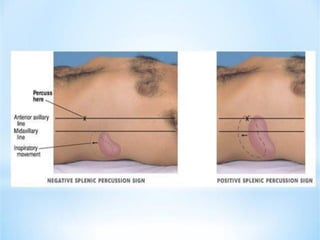
• A second method for detecting splenic
enlargement is to percuss the last left
interspace at the anterior axillary line (AAL)
while the client takes a deep breath.
• Normal Findings: Normally tympany (or
resonance) is heard at the last left interspace.
• Abnormal Findings: On inspiration, dullness at
the last left interspace at the AAL suggests an
enlarged spleen.
Conti….
Perform blunt percussion on the liver and the
kidneys
• This is to assess for tenderness in difficult-to-palpate structures.
Percuss the liver by placing your left hand flat against the lower
right anterior rib cage. Use the ulnar side of your right fist to strike
your left hand.
• Normal Findings: Normally no tenderness is elicited.
• Abnormal Findings: Tenderness elicited over the liver may be
associated with inflammation or infection (e.g., hepatitis or
cholecystitis).
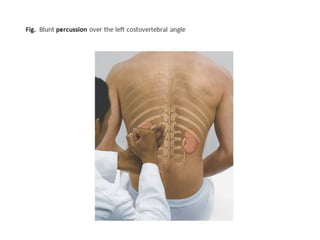
Perform blunt percussion on the kidneys at the
costovertebral angles (CVA) over the twelfth rib.
• Normal Findings: Normally no tenderness or pain is elicited or
reported by the client. The examiner senses only a dull thud.
• Abnormal Findings: Tenderness or sharp pain elicited over the CVA
suggests kidney infection (pyelonephritis), renal calculi, or
hydronephrosis.
Palpation
Perform light palpation
• Light palpation is used to identify areas of
tenderness and muscular resistance. Using the
fingertips, begin palpation in a non-tender quadrant,
and compress to a depth of 1 cm in a dipping
motion. Then gently lift the fingers and move to the
next area. Keep in mind that the rectus abdominis
muscle relaxes on expiration.
 Normal Findings: Abdomen is non-tender and soft. There is no
guarding.
 Abnormal Findings: Involuntary reflex guarding is serious and
reflects peritoneal irritation. The abdomen is rigid and the rectus
muscle fails to relax with palpation when the client exhales. Right-
sided guarding may be due to cholecystitis.
Conti….
Deeply palpate all quadrants to delineate
abdominal organs and detect subtle masses.
Using the palmar surface of the fingers, compress
to a maximum depth (5 to 6 cm). Perform
bimanual palpation if you encounter resistance or
to assess deeper structures.
 Normal Findings: Normal (mild) tenderness is
possible over the xiphoid, aorta, cecum, sigmoid
colon, and ovaries with deep palpation.
 Abnormal Findings Severe tenderness or pain may
be related to trauma, peritonitis, infection, tumors,
or enlarged or diseased organs.
Conti….
Palpate for masses
o Note their location, size (cm), shape, consistency,
demarcation, pulsatility, tenderness, and
mobility. Do not confuse a mass with a normally
palpated organ or structure.
 Normal Findings: No palpable masses are present.
 Abnormal Findings: A mass detected in any quadrant
may be due to a tumor, cyst, abscess, enlarged organ,
aneurysm, or adhesions.
Conti…..
Palpate the umbilicus and surrounding area
for swellings, bulges, or masses.
 Normal Findings: Umbilicus and surrounding area
are free of swellings, bulges, or masses.
 Abnormal Findings: A soft center of the umbilicus
can be a potential for herniation. Palpation of a hard
nodule in or around the umbilicus may indicate
metastatic nodes from an occult gastrointestinal
cancer.
Conti…
Palpate the aorta
• Use your thumb and first finger or use two hands and
palpate deeply in the epigastrium, slightly to the left of
midline. Assess the pulsation of the abdominal aorta. If
the client is older than age 50 or has hypertension,
assess the width of the aorta.
 Normal Findings: The normal aorta is approximately 2.5 to 3.0
cm wide with a moderately strong and regular pulse. Possibly
mild tenderness may be elicited.
 Abnormal Findings: A wide, bounding pulse may be felt with
an abdominal aortic aneurysm. A prominent, laterally
pulsating mass above the umbilicus with an accompanying
audible bruit strongly suggests an aortic aneurysm.
Conti….
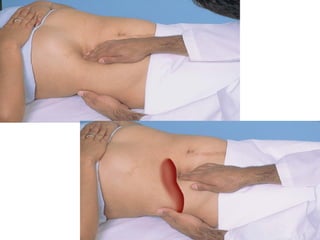
Palpate the liver
Note consistency and tenderness
• To palpate bimanually, stand at the client’s right side
and place your left hand under the client’s back at
the level of the eleventh to twelfth ribs. Lay your
right hand parallel to the right costal margin (your
fingertips should point toward the client’s head). Ask
the client to inhale then compress upward and
inward with your fingers.
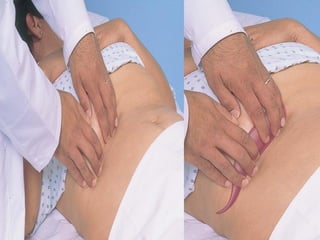
• To palpate by hooking, stand to the right of the
client’s chest. Curl (hook) the fingers of both hands
over the edge of the right costal margin. Ask the
client to take a deep breath and gently but firmly pull
inward and upward with your fingers.
Conti….
 Normal Findings: The liver is usually not palpable,
although it may be felt in some thin clients. If the lower
edge is felt, it should be firm, smooth, and even. Mild
tenderness may be normal.
 Abnormal Findings: A hard, firm liver may indicate
cancer. Nodularity may occur with tumors, metastatic
cancer, late cirrhosis, or syphilis. Tenderness may be
from vascular engorgement (e.g., congestive heart
failure), acute hepatitis, or abscess.
 A liver more than 1 to 3 cm below the costal margin is
considered enlarged (unless pressed down by the
diaphragm). Enlargement may be due to hepatitis, liver
tumors, cirrhosis, and vascular engorgement.
Conti….
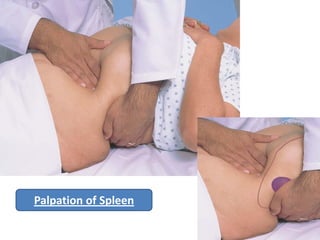
Palpate the spleen
• Stand at the client’s right side, reach over the abdomen
with your left arm, and place your hand under the
posterior lower ribs. Pull up gently.
• Place your right hand below the left costal margin with
the fingers pointing toward the client’s head. Ask the
client to inhale and press inward and upward as you
provide support with your other hand.
• Alternatively asking the client to turn onto the right
side may facilitate splenic palpation by moving the
spleen downward and forward. Document the size of
the spleen in centimeters below the left costal margin.
Also note consistency and tenderness.
Palpation of Spleen
Conti…
 Normal Findings: The spleen is seldom palpable at the left
costal margin; rarely, the tip is palpable in the presence of a
low, flat diaphragm (e.g., chronic obstructive lung disease)
or with deep diaphragmatic descent on inspiration. If the
edge of the spleen can be palpated, it should be soft and
non-tender.
 Abnormal Findings: A palpable spleen suggests
enlargement (up to three times the normal size), which
may result from trauma, mononucleosis, chronic blood
disorders, and cancers. The splenic notch may be felt,
which is an indication of splenic enlargement.
 The spleen feels soft with a rounded edge when it is
enlarged from infection. It feels firm with a sharp edge
when it is enlarged from chronic disease.
Conti….
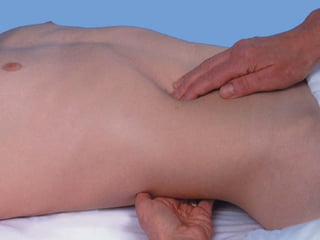
Palpate the kidneys
• To palpate the right kidney, support the right
posterior flank with your left hand and place your
right hand in the RUQ just below the costal
margin at the MCL.
• To capture the kidney, ask the client to inhale.
Then compress your fingers deeply during peak
inspiration. Ask the client to exhale and hold the
breath briefly. Gradually release the pressure of
your right hand. If you have captured the kidney,
you will feel it slip beneath your fingers. To
palpate the left kidney, reverse the procedure.
Conti…
Normal Findings: The kidneys are normally
not palpable. Sometimes the lower pole of the
right kidney may be palpable by the capture
method because of its lower position.
If palpated, it should feel firm, smooth, and
rounded. The kidney may or may not be
slightly tender.
Abnormal Findings: An enlarged kidney may
be due to a cyst, tumor, or hydronephrosis.
Conti….
Palpate the urinary bladder
• Palpate for a distended bladder when the client’s
history or other findings warrant (e.g., dull
percussion noted over the symphysis pubis).
Begin at the symphysis pubis and move upward
and outward to estimate bladder borders.
• Normal Findings: Normally the bladder is not
palpable.
• Abnormal Findings: A distended bladder is palpated
as a smooth, round, and somewhat firm mass
extending as far as the umbilicus. It may be further
validated by dull percussion tones.
Tests for Appendicitis
• Assess for rebound tenderness and Rovsing’s Sign.
Abdominal pain and tenderness may indicate peritoneal
irritation.
• To assess this possibility, Test for rebound tenderness.
Palpate deeply in the abdomen where the client has pain
then suddenly release pressure. Listen and watch for the
client’s expression of pain. Ask the client to describe which
hurt more—the pressing in or the releasing—and where on
the abdomen the pain occurred.
 Normal Findings: No rebound tenderness is present.
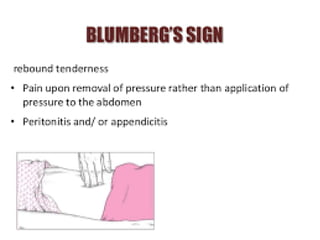
 Abnormal Findings: The client has rebound tenderness when he or
she perceives sharp, stabbing pain as the examiner releases
pressure from the abdomen (Blumberg’s sign). It suggests
peritoneal irritation (as from appendicitis). If the client feels pain at
an area other than where you were assessing for rebound
tenderness, consider that area as the source of the pain.
Conti….
Test for referred rebound tenderness
• Palpate deeply in the LLQ and, quickly release
pressure.
 Normal Findings: No rebound pain is elicited.
 Abnormal Findings: Pain in the RLQ during pressure
in the LLQ is a positive Rovsing’s sign. It suggests
acute appendicitis.
Conti…
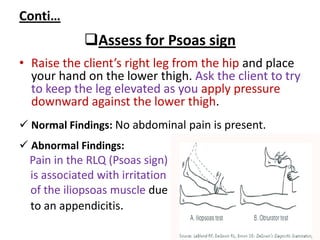
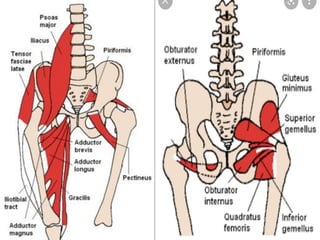
Assess for Psoas sign
• Raise the client’s right leg from the hip and place
your hand on the lower thigh. Ask the client to try
to keep the leg elevated as you apply pressure
downward against the lower thigh.
 Normal Findings: No abdominal pain is present.
 Abnormal Findings:
Pain in the RLQ (Psoas sign)
is associated with irritation
of the iliopsoas muscle due
to an appendicitis.
Conti…
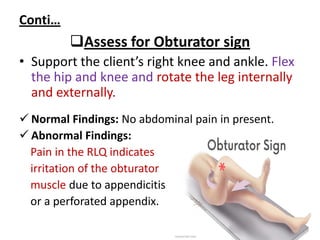
Assess for Obturator sign
• Support the client’s right knee and ankle. Flex
the hip and knee and rotate the leg internally
and externally.
 Normal Findings: No abdominal pain in present.
 Abnormal Findings:
Pain in the RLQ indicates
irritation of the obturator
muscle due to appendicitis
or a perforated appendix.
Conti….
Perform hypersensitivity test
• Stroke the abdomen with a sharp object (e.g.,
broken cotton tipped applicator or tongue blade)
or grasp a fold of skin with your thumb and index
finger and quickly let go. Do this several times
along the abdominal wall.
 Normal Findings: The client feels no pain and no
exaggerated sensation.
 Abnormal Findings: Pain or an exaggerated sensation
felt in the RLQ is a positive skin hypersensitivity test
and may indicate appendicitis.
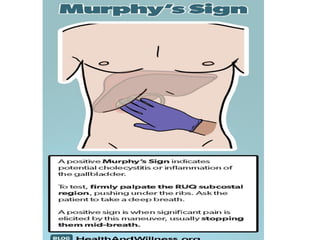
Test for Cholecystitis
• Assess RUQ pain or tenderness, which may signal
cholecystitis.
• Press your fingertips under the liver border at the
right costal margin and ask the client to inhale
deeply.
 Normal Findings: No increase in pain is present.
 Abnormal Findings: Accentuated sharp pain that
causes the client to hold his or her breath
(inspiratory arrest) is a positive Murphy’s sign and is
associated with acute cholecystitis.
Abdominal assessment.pdf

Abdominal assessment.pdf

  • 2.
    Unit 8: Topic willbe discussed in this lecture Physical examination of Abdomen Prepared by: Miss Rabia Hanif Nursing Lecturer Sharif College of Nursing
  • 3.
  • 5.
    The abdominal contents are enclosedexternally by the abdominal wall musculature, which includes three layers of muscle extending from the back, around the flanks, to the front. The outermost layer is the external abdominal oblique; the middle layer is the internal abdominal oblique; and the innermost layer is the transverse abdominis.
  • 6.
    A thin, shiny,serous membrane called the Peritoneum lines the abdominal cavity (Parietal peritoneum) and also provides a protective covering for most of the internal abdominal organs (Visceral peritoneum).
  • 7.
    Within the abdominalcavity are structures of several different body systems. These structures are typically referred to as the Abdominal viscera and can be divided into two types: solid viscera and hollow viscera. Solid viscera are those organs that maintain their shape consistently: liver, pancreas, spleen, adrenal glands, kidneys, ovaries, and uterus. The Hollow viscera consist of structures that change shape depending on their contents. These include the stomach, gallbladder, small intestine, colon, and bladder.
  • 8.
    Solid Viscera • TheLiver is the largest solid organ in the body. It is located below the diaphragm in the RUQ of the abdomen. It is composed of four lobes that fill most of the RUQ and extend to the left midclavicular line. In many people, the liver extends just below the right costal margin, where it may be palpated. • The Pancreas, located mostly behind the stomach deep in the upper abdomen, is normally not palpable. It is a long gland extending across the abdomen from the RUQ to the LUQ. • The Spleen is approximately 7 cm wide and is located above the left kidney just below the diaphragm at the level of the ninth, tenth, and eleventh ribs. This soft, flat structure is normally not palpable. In some healthy clients, the lower tip can be felt below the left costal margin.
  • 10.
    Conti….. • The Kidneysare located high and deep under the diaphragm. Considered posterior organs and approximate with the level of the T12 to L3 vertebrae. The tops of both kidneys are protected by the posterior rib cage. • Kidney tenderness is best assessed at the costovertebral angle. The right kidney is positioned slightly lower because of the position of the liver. Therefore, in some thin clients, the bottom portion of the right kidney may be palpated anteriorly. • The pregnant uterus may be palpated above the level of the symphysis pubis in the midline. The ovaries are located in the RLQ and LLQ and are normally palpated only during a bimanual examination of the internal genitalia.
  • 11.
    Hollow Viscera • Theabdominal cavity begins with the Stomach. It is a distensible, flask-like organ located in the LUQ just below the diaphragm and between the liver and spleen. The stomach is not usually palpable. • The Gallbladder, a muscular sac approximately 10 cm Long. It is located near the posterior surface of the liver lateral to the midclavicular line. It is not normally palpated because it is difficult to distinguish between the gallbladder and the liver. • The Small intestine is actually the longest portion of the digestive tract (approximately 7.0 m long) but is named for its small diameter (approximately 2.5 cm). The small intestine, which lies coiled in all four quadrants of the abdomen, is not normally palpated.
  • 12.
    Conti…. • The Colon,or large intestine, has a wider diameter than the small intestine (approximately 6.0 cm) and is approximately 1.4 m long. It originates in the RLQ. • The colon is composed of three major sections: ascending, transverse, and descending. The sigmoid colon is often felt as a firm structure on palpation, whereas the cecum and ascending colon may feel softer. The transverse and descending colon may also be felt on palpation. • The Urinary bladder, a distensible muscular sac located behind the pubic bone in the midline of the abdomen, functions as a temporary receptacle for urine. A bladder filled with urine may be palpated in the abdomen above the Symphysis pubis.
  • 14.
    ABDOMINAL QUADRANT  RIGHTUPPER QUADRANT (RUQ) • Ascending and transverse colon • Duodenum • Gallbladder • Hepatic flexure of colon • Liver • Pancreas (head) • Pylorus (the small bowel— or ileum—traverses • all quadrants) • Right adrenal gland • Right kidney (upper pole) • Right ureter  RIGHT LOWER QUADRANT (RLQ) • Appendix • Ascending colon • Cecum • Right kidney (lower pole) • Right ovary and tube • Right ureter • Right spermatic cord
  • 15.
    Conti….  Left UpperQuadrant (LUQ) • Left adrenal gland • Left kidney (upper pole) • Left ureter • Pancreas (body and tail) • Spleen • Splenic flexure of colon • Stomach • Transverse descending colon  Left Lower Quadrant (LLQ) • Left kidney (lower pole) • Left ovary and tube • Left ureter • Left spermatic cord • Descending and sigmoid colon  Midline • Bladder • Uterus • Prostate gland
  • 17.
    Vascular Structures The abdominal organs aresupplied with arterial blood by the abdominal aorta and its major branches. Pulsations of the aorta are frequently visible and palpable midline in the upper abdomen. The aorta branches into the right and left iliac arteries just below the umbilicus. Pulsations of the right and left iliac arteries may be felt in the RLQ and LLQ.
  • 18.
    Problems related toGI system • Abdominal Pain (Visceral pain, Parietal, or referred) • Indigestion • Nausea and Vomiting • Loss of appetite (anorexia) • Bowel Elimination (Constipation, Diarrhea) • Jundice (Yellowing of your skin or whites of your eyes), itchy skin, dark urine. • Gastrointestinal disorders: Ulcers, gastroesophageal reflux, inflammatory or obstructive bowel disease, pancreatitis, gallbladder or liver disease, diverticulosis, or appendicitis, viral hepatitis.
  • 20.
    Preparing the Client •Ask the client to empty the bladder before beginning the examination to eliminate bladder distention and interference with an accurate examination. Instruct the client to remove clothes and to put on a gown. Help the client to lie supine with the arms folded across the chest or resting by the sides. • A flat pillow may be placed under the client’s head for comfort. Slightly flex the client’s legs by placing a pillow or rolled blanket under the client’s knees to help relax the abdominal muscles. Drape the client with sheets so the abdomen is visible from the lower rib cage to the pubic area. • Instruct the client to breathe through the mouth and to take slow, deep breaths; this promotes relaxation. Before touching the abdomen, ask the client about painful or tender areas. These areas should always be assessed at the end of the examination. Equipment • Small pillow or rolled blanket • Centimeter ruler • Stethoscope (warm the diaphragm and bell) • Marking pen
  • 21.
    Inspection Observe the colorationof the skin.  Normal Findings: Abdominal skin may be paler than the general skin tone because this skin is so seldom exposed to the natural elements.  Abnormal Findings: Purple discoloration at the flanks (Grey Turner sign) indicates bleeding within the abdominal wall, possibly from trauma to the kidneys, pancreas, or duodenum or from pancreatitis.  The yellow hue of jaundice may be more apparent on the abdomen. Pale, taut skin may be seen with ascites.  Redness may indicate inflammation. Bruises or areas of local discoloration are also abnormal.
  • 23.
    Conti…. Note the vascularityof the abdominal skin • Normal Findings: Scattered fine veins may be visible. Dilated superficial capillaries without a pattern may be seen in older clients. They are more visible in sunlight. • Abnormal Findings: Dilated veins may be seen with cirrhosis of the liver, obstruction of the inferior vena cava, portal hypertension, or ascites. Dilated surface arterioles and capillaries with a central star (spider angioma) may be seen with liver disease or portal hypertension. Note any striae • Normal Findings: Old, silvery, white striae or stretch marks from past pregnancies or weight gain are normal. • Abnormal Findings: Dark bluish-pink striae are associated with Cushing’s syndrome. Striae may also be caused by ascites, which stretches the skin. Ascites usually results from liver failure or liver disease.
  • 24.
  • 25.
    Dark bluish-pink striae inCushing’s syndrome Striae in Ascites Old, silvery, white striae Stretch marks in Weight gain
  • 26.
    Conti…. Inspect for scars •Ask about the source of a scar, and use a centimeter ruler to measure the scar’s length. • Document the location by quadrant and reference lines, shape, length, and any specific characteristics (e.g., 3-cm vertical scar in RLQ 4 cm below the umbilicus and 5 cm left of the midline).  Normal Findings: Pale, smooth, minimally raised old scars may be seen.  Abnormal Findings: Non-healing scars, redness, inflammation. Deep, irregular scars may result from burns. Keloids (excess scar tissue) result from trauma or surgery. Assess for lesions and rashes • Normal Findings: Abdomen is free of lesions or rashes. Flat or raised brown moles, however, are normal and may be apparent. • Abnormal Findings: Changes in moles including size, color, and border symmetry. Any bleeding moles or petechiae (reddish or purple lesions) may also be abnormal.
  • 27.
    Keloids Deep, irregular scars fromburn Non-healing wound
  • 28.
    Conti…. Inspect the umbilicus oNote the color of the umbilical area. o Observe umbilical location. Assess contour of umbilicus. • Normal Findings: Umbilical skin tones are similar to surrounding abdominal skin tones or even pinkish. Umbilicus is midline at lateral line. Contour is recessed (inverted) or protruding no more than 0.5 cm and is round or conical. • Abnormal Findings: Bluish or purple discoloration around the umbilicus (Cullen’s sign) indicates intra-abdominal bleeding. A deviated umbilicus may be caused by pressure from a mass, enlarged organs, hernia, fluid, or scar tissue. • An everted umbilicus is seen with abdominal distention. An enlarged, everted umbilicus suggests umbilical hernia.
  • 29.
  • 30.
    Conti….  Inspect abdominalcontour. o Look across the abdomen at eye level from the client’s side, from behind the client’s head, and from the foot of the bed. Measure abdominal girth as indicated. • Normal Findings: Abdomen is flat, rounded, or scaphoid (usually seen in thin adults). Abdomen should be evenly rounded. • Abnormal Findings:  A generalized protuberant or distended abdomen may be due to obesity, air (gas), or fluid accumulation.  Distention below the umbilicus may be due to a full bladder, uterine enlargement, or an ovarian tumor or cyst.  Distention of the upper abdomen may be seen with masses of the pancreas or gastric dilation.  A scaphoid (sunken) abdomen may be seen with severe weight loss or cachexia related to starvation or terminal illness.
  • 33.
    Conti…..  Assess abdominalsymmetry • Look at the client’s abdomen as she lies in a relaxed supine position. To further assess the abdomen for herniation or diastasis recti or to differentiate a mass within the abdominal wall from one below it, ask the client to raise the head. • Normal Findings: Abdomen is symmetric. Abdomen does not bulge when client raises head. • Abnormal Findings: Asymmetry may be seen with organ enlargement, large masses, hernia, diastasis recti, or bowel obstruction. • A hernia is seen as a bulging in the abdominal wall. Diastasis recti appears as a bulging. An incisional hernia may occur when a defect develops in the abdominal muscles because of a surgical incision. • A mass within the abdominal wall is more prominent when the head is raised, whereas a mass below the abdominal wall is obscured.
  • 35.
    Conti…..  Inspect abdominalmovement when the client breathes (respiratory movements). • Normal Findings: Abdominal respiratory movement may be seen, especially in male clients. • Abnormal Findings: Diminished abdominal respiration or change to thoracic breathing in male clients may reflect peritoneal irritation.  Observe aortic pulsations • Normal Findings: A slight pulsation of the abdominal aorta, which is visible in the epigastrium, extends full length in thin people. • Abnormal Findings: Vigorous, wide, exaggerated pulsations may be seen with abdominal aortic aneurysm.  Observe for peristaltic waves • Normal Findings: Normally peristaltic waves are not seen although they may be visible in very thin people as slight ripples on the abdominal wall. • Abnormal Findings: Peristaltic waves are increased and progress in a ripple-like fashion from the LUQ to the RLQ with intestinal obstruction (especially small intestine). In addition, abdominal distention typically is present with intestinal wall obstruction.
  • 37.
    Auscultation Auscultate for bowelsounds • Use the diaphragm of the stethoscope and make sure that it is warm before you place it on the client’s abdomen. • Begin in the RLQ and proceed clockwise, covering all quadrants. Confirm bowel sounds in each quadrant. • Listen for up to 5 minutes (minimum of 1 minute per quadrant) to confirm the absence of bowel sounds. Note the intensity, pitch, and frequency of the sounds.
  • 38.
    Conti….  Normal Findings:A series of intermittent, soft clicks and gurgles are heard at a rate of 5 to 30 per minute.  Abnormal Findings:  Hypoactive bowel sounds indicate diminished bowel motility. Common causes include abdominal surgery or late bowel obstruction.  Hyperactive bowel sounds indicate increased bowel motility. Common causes include diarrhea, gastroenteritis, or early bowel obstruction.  Decreased or absent bowel sounds signify the absence of bowel motility, which constitutes an emergency requiring immediate referral.  Absent bowel sounds may be associated with peritonitis or paralytic ileus..
  • 39.
    Conti….. Auscultate for vascularsounds • Use the bell of the stethoscope to listen for bruits (low-pitched, murmur like sound) over the abdominal aorta and renal, iliac, and femoral arteries. • Using the bell of the stethoscope, listen for a venous hum in the epigastric and umbilical areas.  Normal Findings : Bruits are not normally heard over abdominal aorta or renal, iliac, or femoral arteries. Venous hum is not normally heard over the epigastric and umbilical areas.  Abnormal Findings A bruit with both systolic and diastolic components occurs when blood flow in an artery is turbulent or obstructed. This usually indicates aneurysm or arterial stenosis. • Venous hums are rare. However, an accentuated venous hum heard in the epigastric or umbilical areas suggests increased collateral circulation between the portal and systemic venous systems, as in cirrhosis of the liver.
  • 41.
    Conti….. Auscultate for afriction rub over the liver and spleen • Listen over the right and left lower rib cage with the diaphragm of the stethoscope.  Normal Findings : No friction rub over liver or spleen is present.  Abnormal Findings : Friction rubs are rare. If heard, they have a high-pitched, rough, grating sound produced when the large surface area of the liver or spleen rubs the peritoneum. They are heard in association with respiration. A friction rub heard over the lower right costal area is associated with hepatic abscess or metastases.
  • 42.
    Percussion Percuss for tone oLightly and systematically percuss all quadrants.  Normal Findings: Generalized tympany predominates over the abdomen because of air in the stomach and intestines. Normal dullness is heard over the liver and spleen. Dullness may also be elicited over a non-evacuated descending colon.  Abnormal Findings :  Accentuated tympany or hyper-resonance is heard over a gaseous distended abdomen.  An enlarged area of dullness is heard over an enlarged liver or spleen. Abnormal dullness is heard over a distended bladder, large masses, or ascites. If you suspect ascites, perform the shifting dullness and fluid wave tests.
  • 44.
    Conti…. Percuss the spanor height of the liver by determining its lower and upper borders.  Normal Findings: The lower border of liver dullness is located at the costal margin to 1 to 2 cm below. • To assess the lower border, begin in the RLQ at the mid-clavicular line (MCL) and percuss upward. Note the change from tympany to dullness. Mark this point: It is the lower border of liver dullness. • To assess the descent of the liver, ask the client to take a deep breath and hold; then repeat the procedure. Remind the client to exhale after percussing.  Normal Findings: On deep inspiration, the lower border of liver dullness may descend from 1 to 4 cm below the costal margin.
  • 45.
    Conti…. • To assessthe upper border, percuss over the upper right chest at the MCL and percuss downward, noting the change from lung resonance to liver dullness. Mark this point: It is the upper border of liver dullness.  Normal Findings: The upper border of liver dullness is located between the left fifth and seventh intercostal spaces.  Abnormal Findings: The upper border of liver dullness may be difficult to estimate if obscured by pleural fluid of lung consolidation.
  • 48.
    Conti….. Measure the distancebetween the two marks: this is the span of the liver.  Normal Findings: The normal liver span at the MCL is 6 to 12 cm (greater in men and taller clients, less in shorter clients). Normally liver size decreases after age 50.  Abnormal Findings: • Hepatomegaly, a liver span that exceeds normal limits (enlarged), is characteristic of liver tumors, cirrhosis, abscess, and vascular engorgement. • Atrophy of the liver is indicated by a decreased span. • A liver in a lower position than normal may be caused by emphysema, whereas a liver in a higher position than normal may be caused by an abdominal mass, ascites, or a paralyzed diaphragm. A liver in a lower or higher position should have a normal span.
  • 49.
    Conti…. Repeat percussion ofthe liver at the midsternal line (MSL).  Normal Findings: The normal liver span at the MSL is 4 to 8 cm.  Abnormal Findings: An enlarged liver may be roughly estimated (not accurately) when more intense sounds outline a liver span or borders outside the normal range. If you cannot accurately percuss the liver borders, Perform the scratch test. Auscultate over the liver and, starting in the RLQ, scratch lightly over the abdomen, progressing upward toward the liver.  Normal Findings: The sound produced by scratching becomes more intense over the liver.
  • 51.
    Tests for Ascites Testfor shifting dullness • If you suspect that the client has ascites because of a distended abdomen or bulging flanks, perform this special percussion technique. The client should remain supine. • Percuss the flanks from the bed upward toward the umbilicus. Note the change from dullness to tympany and mark this point. Now help the client turn onto his or her side. Percuss the abdomen from the bed upward. Mark the level where dullness changes to tympany.
  • 53.
    Conti…. • The bordersbetween tympany and dullness remain relatively constant throughout position changes. • When ascites is present and the client is supine, the fluid assumes a dependent position and produces a dull percussion tone around the flanks. Air rises to the top and tympany is percussed around the umbilicus. • When the client turns onto one side and ascites is present, the fluid assumes a dependent position and air rises to the top. There is a marked increase in the height of the dullness. • This test is not always reliable and definitive testing by ultrasound is necessary.
  • 54.
    Perform the fluidwave test • A second special technique to detect ascites is the fluid wave test. The client should remain supine. • Ask the patient or an assistant to press the edges of both hands firmly down the midline of the abdomen. This pressure helps to stop the transmission wave through fat. While you tap one flank sharply with your fingertips, feel on the opposite flank for an impulse transmitted through the fluid.  Normal Findings: No fluid wave is transmitted.  Abnormal Findings: Movement of a fluid wave against the resting hand suggests large amounts of fluid are present (ascites).
  • 56.
    Conti…. Use ballottement technique •Ballottement is a palpation technique performed to identify a mass or enlarged organ within an ascitic abdomen. Ballottement can be performed two different ways: single- handed or bimanually. • Single-Hand Method: Using a tapping or bouncing motion of the fingerpads over the abdominal wall, feel for a floating mass. • Bimanual Method: Place one hand under the flank (receiving/feeling hand) and push the anterior abdominal wall with the other hand.  Normal Findings: No palpable mass or masses are present.  Abnormal Findings: In the client with ascites, you can feel a freely movable mass moving upward (floats). It can be felt at the fingertips. A floating mass can be palpated for size.
  • 58.
    Conti…. Percuss the spleen •Begin posterior to the left mid-axillary line (MAL), and percuss downward, noting the change from lung resonance to splenic dullness.  Normal Findings: The spleen is an oval area of dullness approximately 7 cm wide near the left tenth rib and slightly posterior to the MAL.  Abnormal Findings: Splenomegaly is characterized by an area of dullness greater than 7 cm wide. The enlargement may result from traumatic injury, portal hypertension, and mononucleosis.
  • 59.
    Conti…. • A secondmethod for detecting splenic enlargement is to percuss the last left interspace at the anterior axillary line (AAL) while the client takes a deep breath. • Normal Findings: Normally tympany (or resonance) is heard at the last left interspace. • Abnormal Findings: On inspiration, dullness at the last left interspace at the AAL suggests an enlarged spleen.
  • 61.
    Conti…. Perform blunt percussionon the liver and the kidneys • This is to assess for tenderness in difficult-to-palpate structures. Percuss the liver by placing your left hand flat against the lower right anterior rib cage. Use the ulnar side of your right fist to strike your left hand. • Normal Findings: Normally no tenderness is elicited. • Abnormal Findings: Tenderness elicited over the liver may be associated with inflammation or infection (e.g., hepatitis or cholecystitis). Perform blunt percussion on the kidneys at the costovertebral angles (CVA) over the twelfth rib. • Normal Findings: Normally no tenderness or pain is elicited or reported by the client. The examiner senses only a dull thud. • Abnormal Findings: Tenderness or sharp pain elicited over the CVA suggests kidney infection (pyelonephritis), renal calculi, or hydronephrosis.
  • 63.
    Palpation Perform light palpation •Light palpation is used to identify areas of tenderness and muscular resistance. Using the fingertips, begin palpation in a non-tender quadrant, and compress to a depth of 1 cm in a dipping motion. Then gently lift the fingers and move to the next area. Keep in mind that the rectus abdominis muscle relaxes on expiration.  Normal Findings: Abdomen is non-tender and soft. There is no guarding.  Abnormal Findings: Involuntary reflex guarding is serious and reflects peritoneal irritation. The abdomen is rigid and the rectus muscle fails to relax with palpation when the client exhales. Right- sided guarding may be due to cholecystitis.
  • 64.
    Conti…. Deeply palpate allquadrants to delineate abdominal organs and detect subtle masses. Using the palmar surface of the fingers, compress to a maximum depth (5 to 6 cm). Perform bimanual palpation if you encounter resistance or to assess deeper structures.  Normal Findings: Normal (mild) tenderness is possible over the xiphoid, aorta, cecum, sigmoid colon, and ovaries with deep palpation.  Abnormal Findings Severe tenderness or pain may be related to trauma, peritonitis, infection, tumors, or enlarged or diseased organs.
  • 65.
    Conti…. Palpate for masses oNote their location, size (cm), shape, consistency, demarcation, pulsatility, tenderness, and mobility. Do not confuse a mass with a normally palpated organ or structure.  Normal Findings: No palpable masses are present.  Abnormal Findings: A mass detected in any quadrant may be due to a tumor, cyst, abscess, enlarged organ, aneurysm, or adhesions.
  • 66.
    Conti….. Palpate the umbilicusand surrounding area for swellings, bulges, or masses.  Normal Findings: Umbilicus and surrounding area are free of swellings, bulges, or masses.  Abnormal Findings: A soft center of the umbilicus can be a potential for herniation. Palpation of a hard nodule in or around the umbilicus may indicate metastatic nodes from an occult gastrointestinal cancer.
  • 67.
    Conti… Palpate the aorta •Use your thumb and first finger or use two hands and palpate deeply in the epigastrium, slightly to the left of midline. Assess the pulsation of the abdominal aorta. If the client is older than age 50 or has hypertension, assess the width of the aorta.  Normal Findings: The normal aorta is approximately 2.5 to 3.0 cm wide with a moderately strong and regular pulse. Possibly mild tenderness may be elicited.  Abnormal Findings: A wide, bounding pulse may be felt with an abdominal aortic aneurysm. A prominent, laterally pulsating mass above the umbilicus with an accompanying audible bruit strongly suggests an aortic aneurysm.
  • 69.
    Conti…. Palpate the liver Noteconsistency and tenderness • To palpate bimanually, stand at the client’s right side and place your left hand under the client’s back at the level of the eleventh to twelfth ribs. Lay your right hand parallel to the right costal margin (your fingertips should point toward the client’s head). Ask the client to inhale then compress upward and inward with your fingers. • To palpate by hooking, stand to the right of the client’s chest. Curl (hook) the fingers of both hands over the edge of the right costal margin. Ask the client to take a deep breath and gently but firmly pull inward and upward with your fingers.
  • 72.
    Conti….  Normal Findings:The liver is usually not palpable, although it may be felt in some thin clients. If the lower edge is felt, it should be firm, smooth, and even. Mild tenderness may be normal.  Abnormal Findings: A hard, firm liver may indicate cancer. Nodularity may occur with tumors, metastatic cancer, late cirrhosis, or syphilis. Tenderness may be from vascular engorgement (e.g., congestive heart failure), acute hepatitis, or abscess.  A liver more than 1 to 3 cm below the costal margin is considered enlarged (unless pressed down by the diaphragm). Enlargement may be due to hepatitis, liver tumors, cirrhosis, and vascular engorgement.
  • 73.
    Conti…. Palpate the spleen •Stand at the client’s right side, reach over the abdomen with your left arm, and place your hand under the posterior lower ribs. Pull up gently. • Place your right hand below the left costal margin with the fingers pointing toward the client’s head. Ask the client to inhale and press inward and upward as you provide support with your other hand. • Alternatively asking the client to turn onto the right side may facilitate splenic palpation by moving the spleen downward and forward. Document the size of the spleen in centimeters below the left costal margin. Also note consistency and tenderness.
  • 74.
  • 75.
    Conti…  Normal Findings:The spleen is seldom palpable at the left costal margin; rarely, the tip is palpable in the presence of a low, flat diaphragm (e.g., chronic obstructive lung disease) or with deep diaphragmatic descent on inspiration. If the edge of the spleen can be palpated, it should be soft and non-tender.  Abnormal Findings: A palpable spleen suggests enlargement (up to three times the normal size), which may result from trauma, mononucleosis, chronic blood disorders, and cancers. The splenic notch may be felt, which is an indication of splenic enlargement.  The spleen feels soft with a rounded edge when it is enlarged from infection. It feels firm with a sharp edge when it is enlarged from chronic disease.
  • 76.
    Conti…. Palpate the kidneys •To palpate the right kidney, support the right posterior flank with your left hand and place your right hand in the RUQ just below the costal margin at the MCL. • To capture the kidney, ask the client to inhale. Then compress your fingers deeply during peak inspiration. Ask the client to exhale and hold the breath briefly. Gradually release the pressure of your right hand. If you have captured the kidney, you will feel it slip beneath your fingers. To palpate the left kidney, reverse the procedure.
  • 78.
    Conti… Normal Findings: Thekidneys are normally not palpable. Sometimes the lower pole of the right kidney may be palpable by the capture method because of its lower position. If palpated, it should feel firm, smooth, and rounded. The kidney may or may not be slightly tender. Abnormal Findings: An enlarged kidney may be due to a cyst, tumor, or hydronephrosis.
  • 79.
    Conti…. Palpate the urinarybladder • Palpate for a distended bladder when the client’s history or other findings warrant (e.g., dull percussion noted over the symphysis pubis). Begin at the symphysis pubis and move upward and outward to estimate bladder borders. • Normal Findings: Normally the bladder is not palpable. • Abnormal Findings: A distended bladder is palpated as a smooth, round, and somewhat firm mass extending as far as the umbilicus. It may be further validated by dull percussion tones.
  • 80.
    Tests for Appendicitis •Assess for rebound tenderness and Rovsing’s Sign. Abdominal pain and tenderness may indicate peritoneal irritation. • To assess this possibility, Test for rebound tenderness. Palpate deeply in the abdomen where the client has pain then suddenly release pressure. Listen and watch for the client’s expression of pain. Ask the client to describe which hurt more—the pressing in or the releasing—and where on the abdomen the pain occurred.  Normal Findings: No rebound tenderness is present.  Abnormal Findings: The client has rebound tenderness when he or she perceives sharp, stabbing pain as the examiner releases pressure from the abdomen (Blumberg’s sign). It suggests peritoneal irritation (as from appendicitis). If the client feels pain at an area other than where you were assessing for rebound tenderness, consider that area as the source of the pain.
  • 82.
    Conti…. Test for referredrebound tenderness • Palpate deeply in the LLQ and, quickly release pressure.  Normal Findings: No rebound pain is elicited.  Abnormal Findings: Pain in the RLQ during pressure in the LLQ is a positive Rovsing’s sign. It suggests acute appendicitis.
  • 83.
    Conti… Assess for Psoassign • Raise the client’s right leg from the hip and place your hand on the lower thigh. Ask the client to try to keep the leg elevated as you apply pressure downward against the lower thigh.  Normal Findings: No abdominal pain is present.  Abnormal Findings: Pain in the RLQ (Psoas sign) is associated with irritation of the iliopsoas muscle due to an appendicitis.
  • 85.
    Conti… Assess for Obturatorsign • Support the client’s right knee and ankle. Flex the hip and knee and rotate the leg internally and externally.  Normal Findings: No abdominal pain in present.  Abnormal Findings: Pain in the RLQ indicates irritation of the obturator muscle due to appendicitis or a perforated appendix.
  • 86.
    Conti…. Perform hypersensitivity test •Stroke the abdomen with a sharp object (e.g., broken cotton tipped applicator or tongue blade) or grasp a fold of skin with your thumb and index finger and quickly let go. Do this several times along the abdominal wall.  Normal Findings: The client feels no pain and no exaggerated sensation.  Abnormal Findings: Pain or an exaggerated sensation felt in the RLQ is a positive skin hypersensitivity test and may indicate appendicitis.
  • 87.
    Test for Cholecystitis •Assess RUQ pain or tenderness, which may signal cholecystitis. • Press your fingertips under the liver border at the right costal margin and ask the client to inhale deeply.  Normal Findings: No increase in pain is present.  Abnormal Findings: Accentuated sharp pain that causes the client to hold his or her breath (inspiratory arrest) is a positive Murphy’s sign and is associated with acute cholecystitis.