Statistics - Basic concepts
BY
Ibrahim Abdelmonaem
ZMRS TEAM
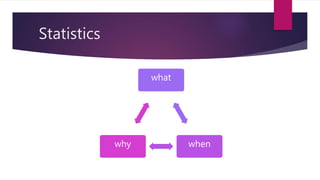
Statistics
what
when
why
What … ?
 Statistics is the science concerned with collection, organization, analysis,
interpretation and presentation of data.
 Why … ??
 When … ??
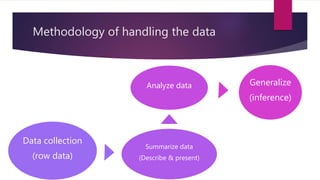
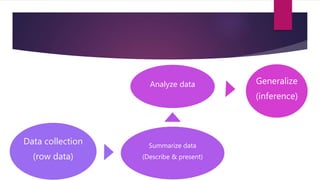
Methodology of handling the data
Data collection
(row data)
Summarize data
(Describe & present)
Analyze data Generalize
(inference)
Data Vs Information
 Data: row materials (individual values)
 Information: processed data – management of data
 Variable !!!
Variable …
 Any thing can change and can be measured and observed
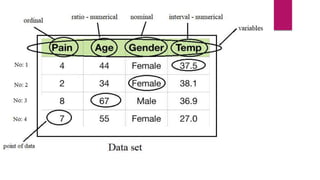
Types of variables – four types:
 Nominal variables (dichotomous / multi nominal)
 Ordinal variables
 Interval variables
 Ratio variables
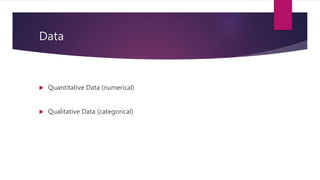
Data
 Quantitative Data (numerical)
 Qualitative Data (categorical)
Data collection
(row data)
Summarize data
(Describe & present)
Analyze data Generalize
(inference)
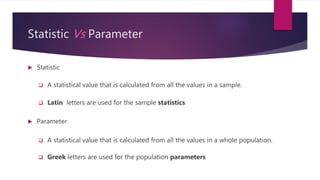
Statistic Vs Parameter
 Statistic
 A statistical value that is calculated from all the values in a sample.
 Latin letters are used for the sample statistics
 Parameter
 A statistical value that is calculated from all the values in a whole population.
 Greek letters are used for the population parameters
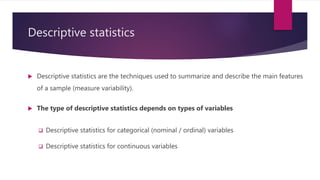
Descriptive statistics
 Descriptive statistics are the techniques used to summarize and describe the main features
of a sample (measure variability).
 The type of descriptive statistics depends on types of variables
 Descriptive statistics for categorical (nominal / ordinal) variables
 Descriptive statistics for continuous variables
Describing categorical (nominal / ordinal) variables
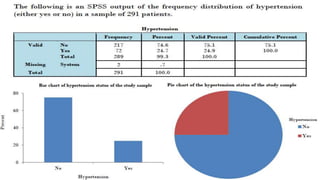
 Frequency distribution table
 Graph presentation
 Bar chart
 Pie chart
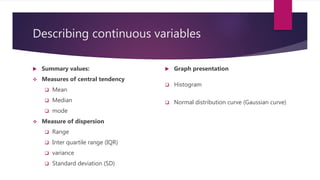
Describing continuous variables
 Summary values:
 Measures of central tendency
 Mean
 Median
 mode
 Measure of dispersion
 Range
 Inter quartile range (IQR)
 variance
 Standard deviation (SD)
 Graph presentation
 Histogram
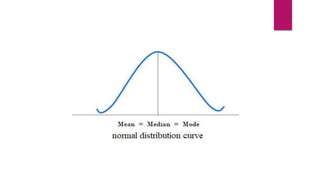
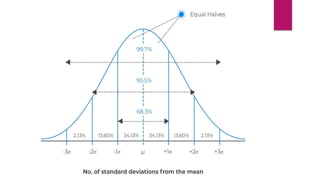
 Normal distribution curve (Gaussian curve)
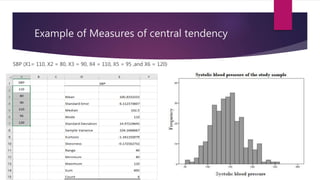
Example of Measures of central tendency
SBP (X1= 110, X2 = 80, X3 = 90, X4 = 110, X5 = 95 ,and X6 = 120)
Inferential statistics
 Inferential statistics is a type of statistics that is used to draw conclusions on a population used
data that was collected on a sample.
 A statistical step performed to generalize the results found in the study to the population under
consideration.
 There are two main types of inferential statistics:
 Confidence interval.
 Hypothesis testing (p-value).
Probability and Hypothesis
 Inferential statistics is highly related to probability distributions.
 Probability distribution is a statistical function describing the probability of all possible values
of a continuous variable.
 The most frequently used distribution is the normal distribution.
Examining the associations between two variables
 Absolute risk
 A measure to indicate the probability of an event to occur.
 Relative risk / Risk ratio
 A measure to assess the association between two different groups.
 Risk difference / Attributable risk
 A measure to indicate the difference in the risks between the exposure groups.
 Difference in means
THANK YOU

Introduction to Statistics - Basic concepts

  • 1.
    Statistics - Basicconcepts BY Ibrahim Abdelmonaem ZMRS TEAM
  • 2.
  • 3.
    What … ? Statistics is the science concerned with collection, organization, analysis, interpretation and presentation of data.  Why … ??  When … ??
  • 4.
    Methodology of handlingthe data Data collection (row data) Summarize data (Describe & present) Analyze data Generalize (inference)
  • 5.
    Data Vs Information Data: row materials (individual values)  Information: processed data – management of data  Variable !!!
  • 6.
    Variable …  Anything can change and can be measured and observed Types of variables – four types:  Nominal variables (dichotomous / multi nominal)  Ordinal variables  Interval variables  Ratio variables
  • 8.
    Data  Quantitative Data(numerical)  Qualitative Data (categorical)
  • 9.
    Data collection (row data) Summarizedata (Describe & present) Analyze data Generalize (inference)
  • 10.
    Statistic Vs Parameter Statistic  A statistical value that is calculated from all the values in a sample.  Latin letters are used for the sample statistics  Parameter  A statistical value that is calculated from all the values in a whole population.  Greek letters are used for the population parameters
  • 12.
    Descriptive statistics  Descriptivestatistics are the techniques used to summarize and describe the main features of a sample (measure variability).  The type of descriptive statistics depends on types of variables  Descriptive statistics for categorical (nominal / ordinal) variables  Descriptive statistics for continuous variables
  • 13.
    Describing categorical (nominal/ ordinal) variables  Frequency distribution table  Graph presentation  Bar chart  Pie chart
  • 15.
    Describing continuous variables Summary values:  Measures of central tendency  Mean  Median  mode  Measure of dispersion  Range  Inter quartile range (IQR)  variance  Standard deviation (SD)  Graph presentation  Histogram  Normal distribution curve (Gaussian curve)
  • 16.
    Example of Measuresof central tendency SBP (X1= 110, X2 = 80, X3 = 90, X4 = 110, X5 = 95 ,and X6 = 120)
  • 17.
    Inferential statistics  Inferentialstatistics is a type of statistics that is used to draw conclusions on a population used data that was collected on a sample.  A statistical step performed to generalize the results found in the study to the population under consideration.  There are two main types of inferential statistics:  Confidence interval.  Hypothesis testing (p-value).
  • 18.
    Probability and Hypothesis Inferential statistics is highly related to probability distributions.  Probability distribution is a statistical function describing the probability of all possible values of a continuous variable.  The most frequently used distribution is the normal distribution.
  • 21.
    Examining the associationsbetween two variables  Absolute risk  A measure to indicate the probability of an event to occur.  Relative risk / Risk ratio  A measure to assess the association between two different groups.  Risk difference / Attributable risk  A measure to indicate the difference in the risks between the exposure groups.  Difference in means
  • 22.