Discrete MathematicsDiscrete Mathematics
What are propositional equivalences?
Tautology?Tautology?
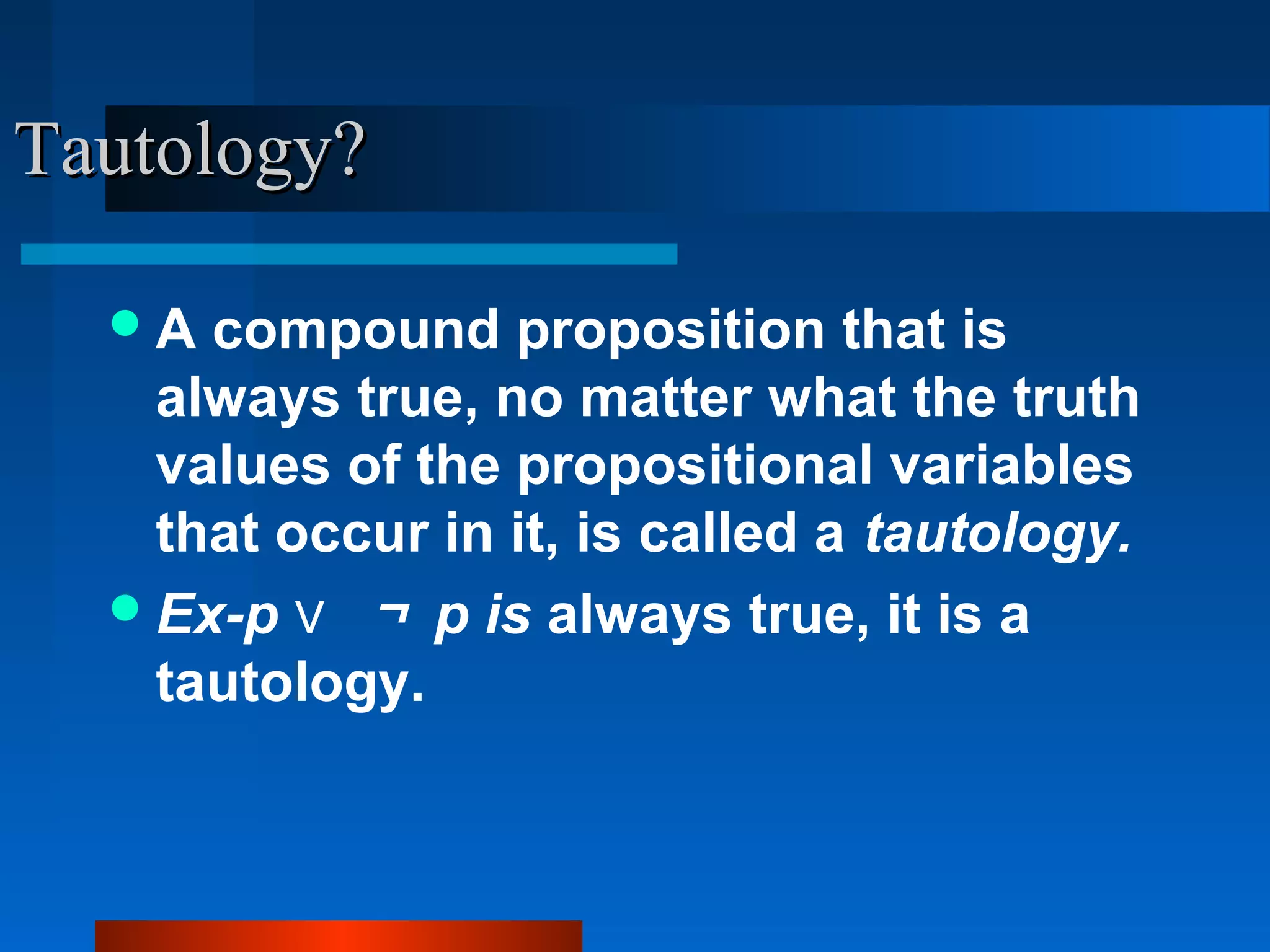
A compound proposition that is
always true, no matter what the truth
values of the propositional variables
that occur in it, is called a tautology.
Ex-p ∨ ¬ p is always true, it is a
tautology.
Contradiction?Contradiction?
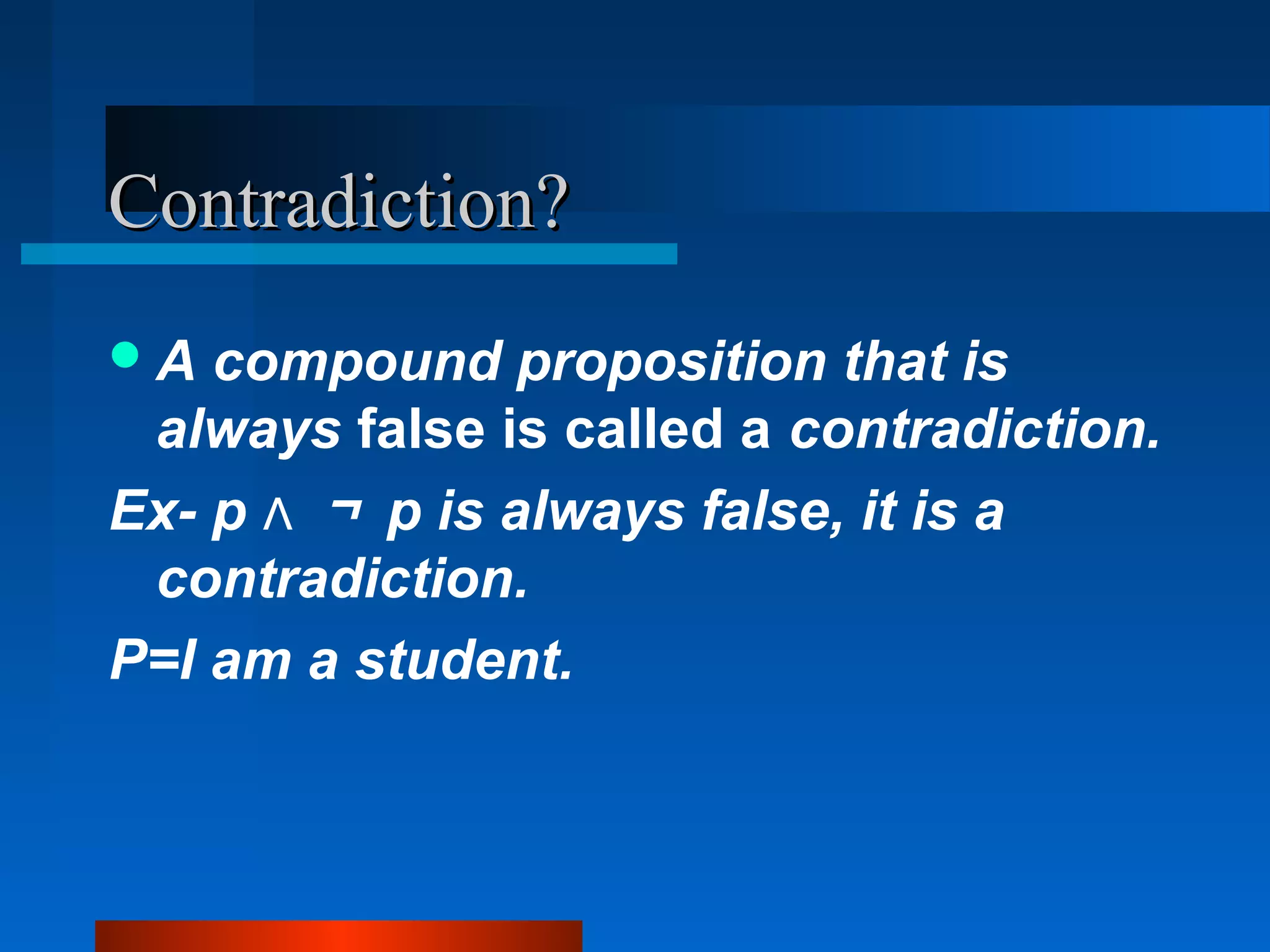
A compound proposition that is
always false is called a contradiction.
Ex- p ∧ ¬ p is always false, it is a
contradiction.
P=I am a student.
Logical EquivalencesLogical Equivalences
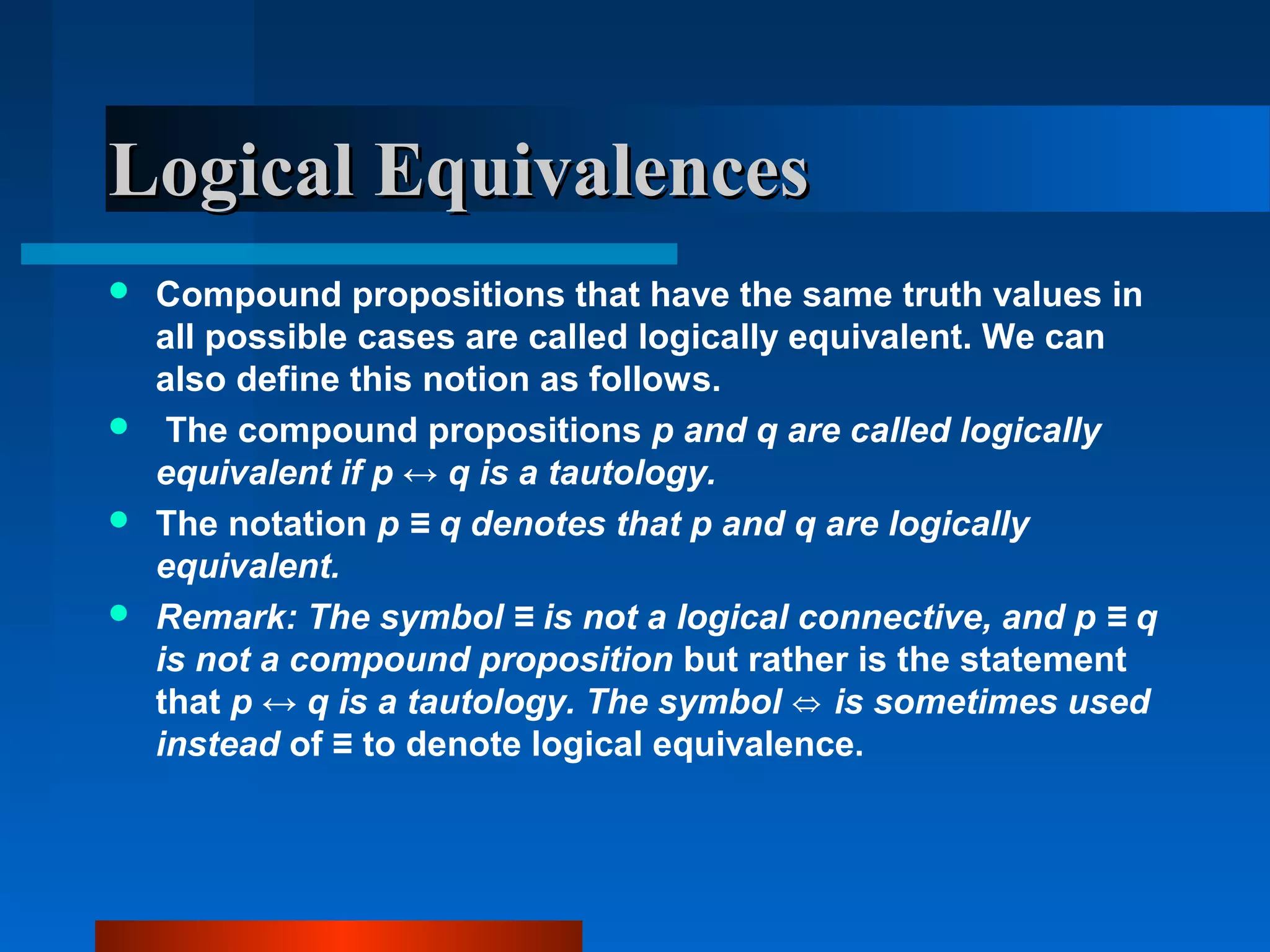
 Compound propositions that have the same truth values in
all possible cases are called logically equivalent. We can
also define this notion as follows.
 The compound propositions p and q are called logically
equivalent if p ↔ q is a tautology.
 The notation p ≡ q denotes that p and q are logically
equivalent.
 Remark: The symbol ≡ is not a logical connective, and p ≡ q
is not a compound proposition but rather is the statement
that p ↔ q is a tautology. The symbol is sometimes used⇔
instead of ≡ to denote logical equivalence.
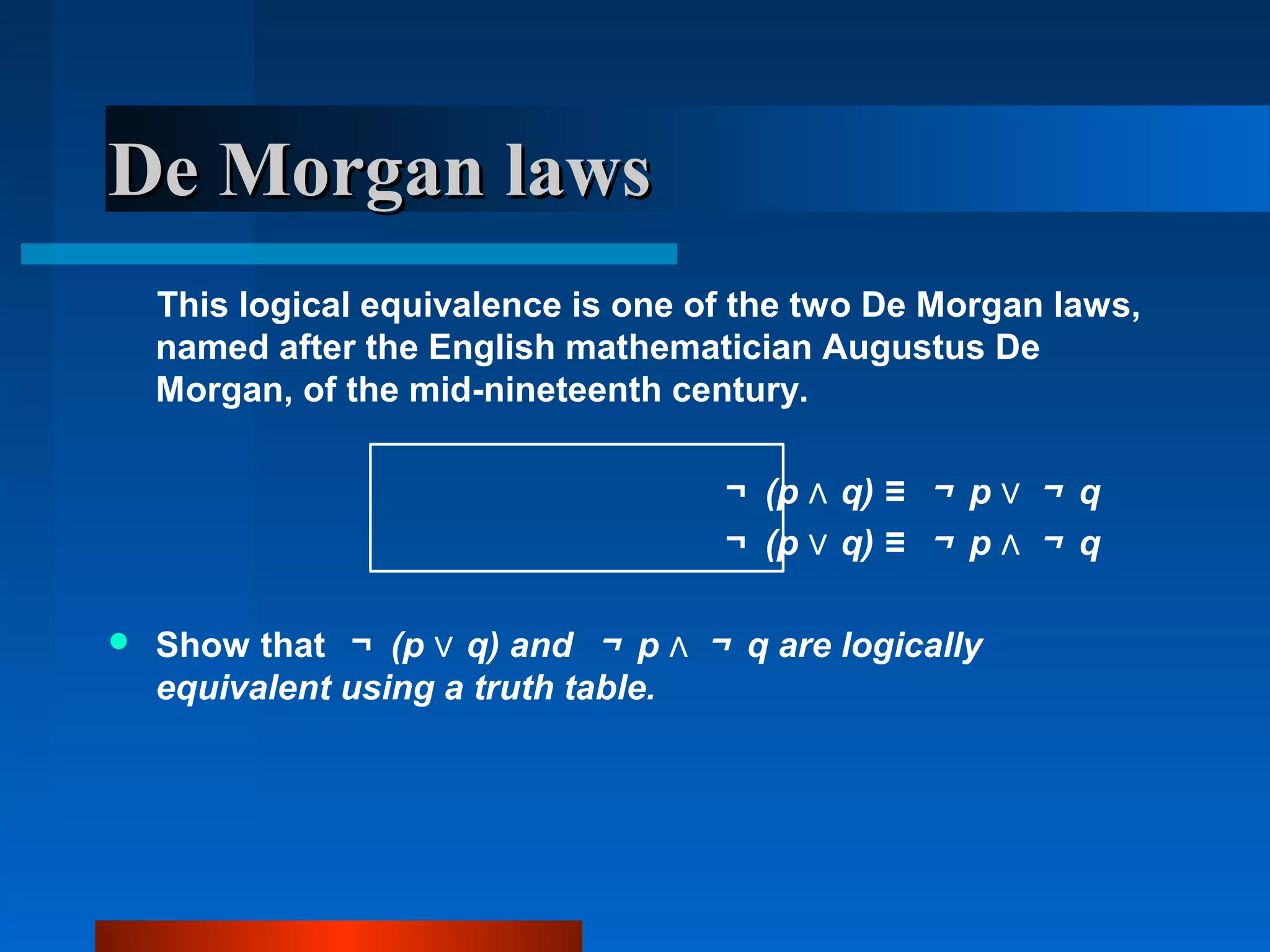
De Morgan lawsDe Morgan laws
This logical equivalence is one of the two De Morgan laws,
named after the English mathematician Augustus De
Morgan, of the mid-nineteenth century.
¬ (p q) ≡∧ ¬ p ∨ ¬ q
¬ (p q) ≡∨ ¬ p ∧ ¬ q
 Show that ¬ (p q) and∨ ¬ p ∧ ¬ q are logically
equivalent using a truth table.
Compare it with your answerCompare it with your answer
The same truth values in all possible cases
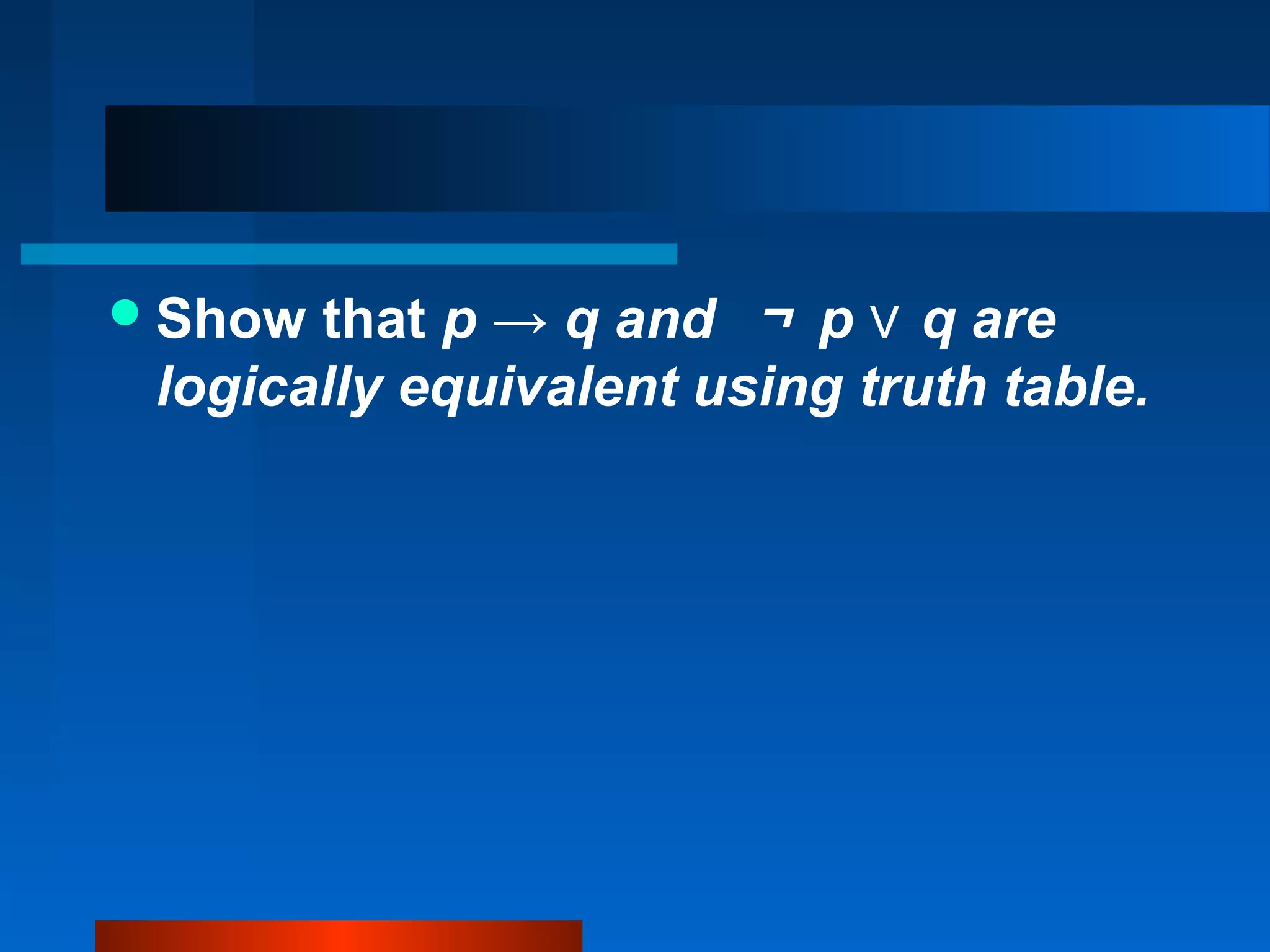
Show that p → q and ¬ p q are∨
logically equivalent using truth table.
Compare it with your answerCompare it with your answer
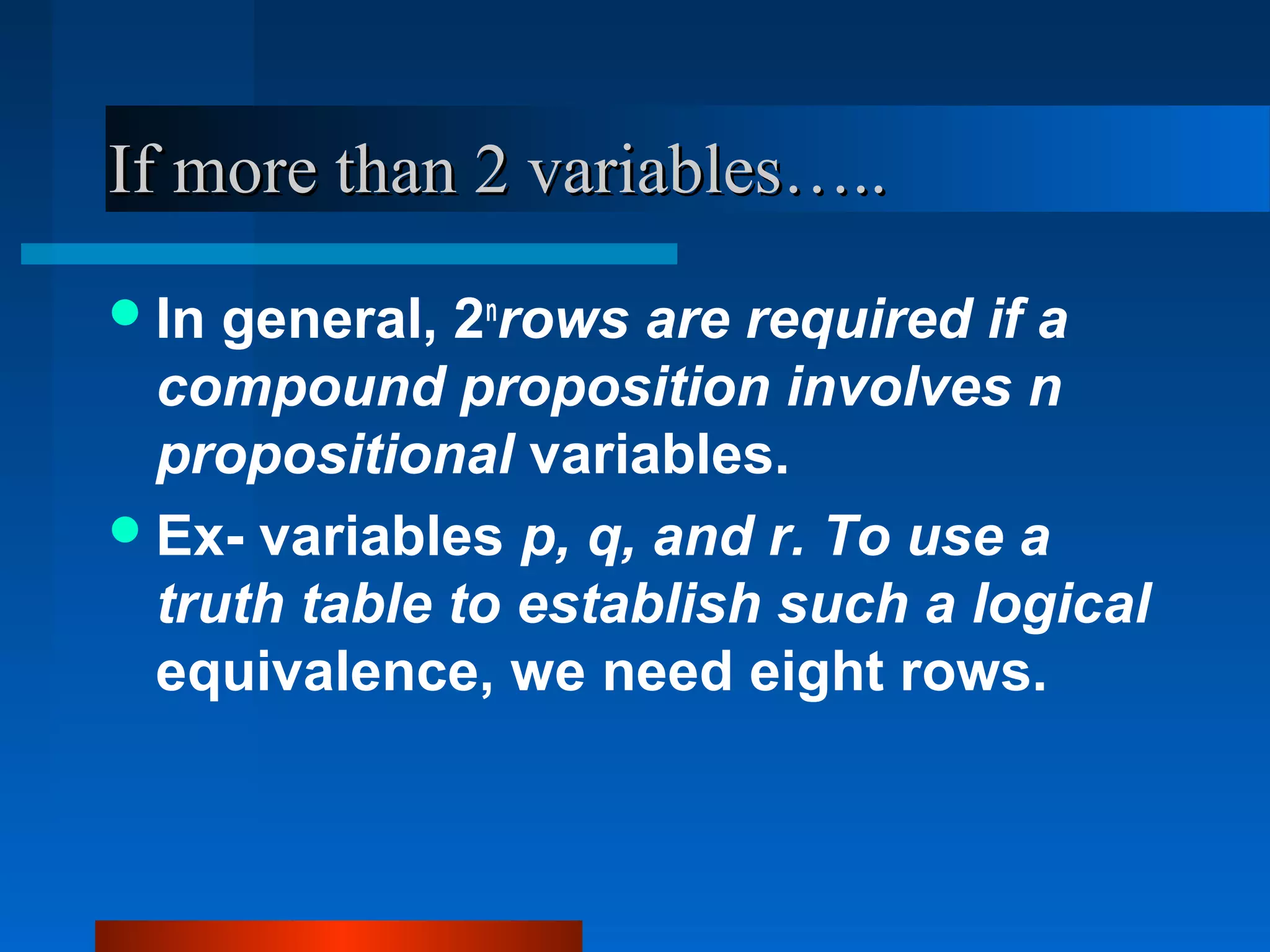
If more than 2 variables…..If more than 2 variables…..
In general, 2n
rows are required if a
compound proposition involves n
propositional variables.
Ex- variables p, q, and r. To use a
truth table to establish such a logical
equivalence, we need eight rows.
Show thatShow that p (q r) and (p q) (p r) are∨ ∧ ∨ ∧ ∨p (q r) and (p q) (p r) are∨ ∧ ∨ ∧ ∨
logically equivalent. This is the distributivelogically equivalent. This is the distributive
law of disjunction over conjunction.law of disjunction over conjunction.
Table 6 contains someTable 6 contains some
important equivalences. Inimportant equivalences. In
these equivalences,these equivalences, TT
denotes the compounddenotes the compound
proposition that is alwaysproposition that is always
true andtrue and F denotes theF denotes the
compound proposition thatcompound proposition that
is always false.is always false.
Some more equivalences:Some more equivalences:
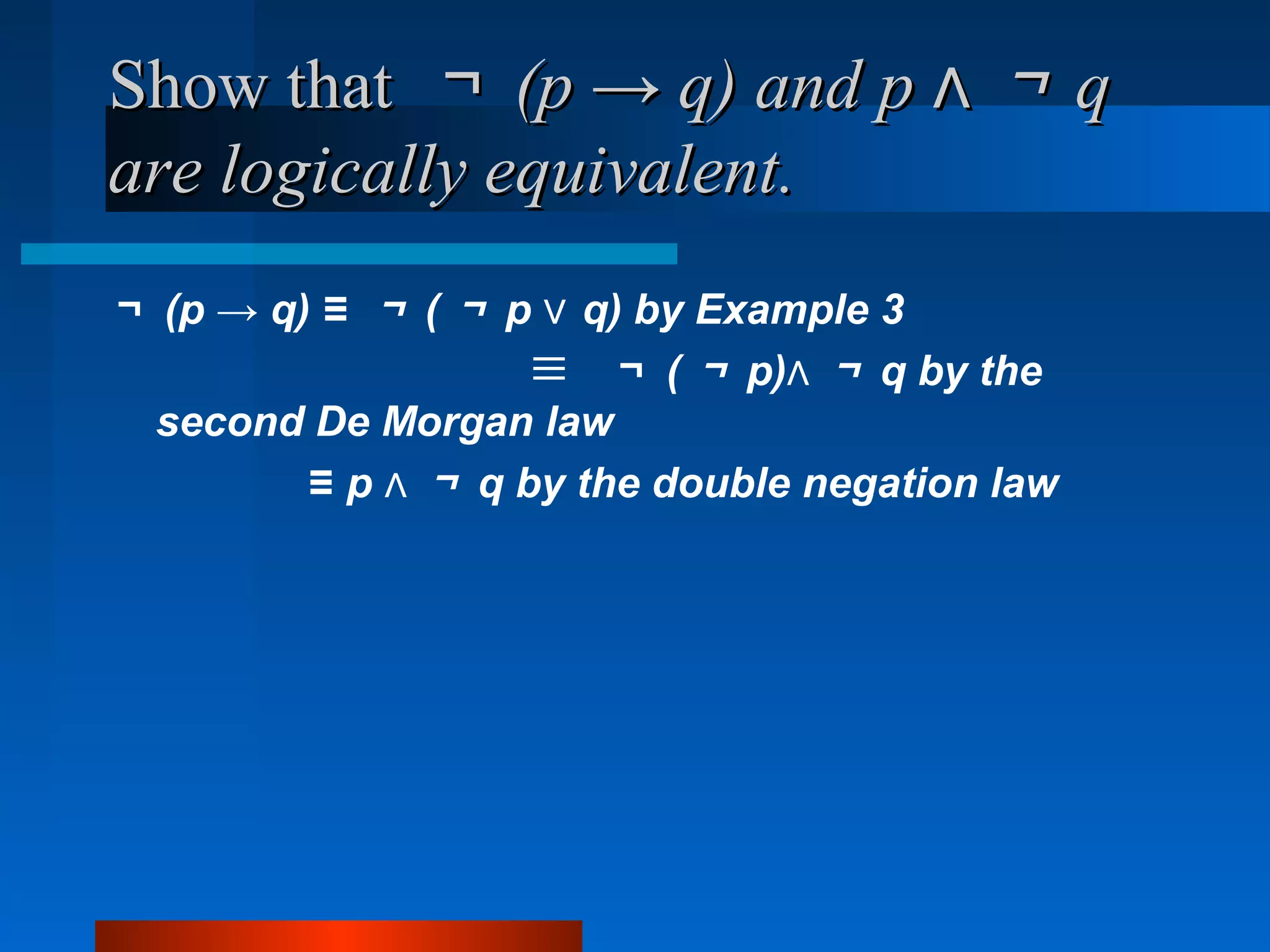
Show thatShow that ¬¬ (p → q) and p ∧(p → q) and p ∧ ¬¬ qq
are logically equivalent.are logically equivalent.
¬ (p → q) ≡ ¬ ( ¬ p q) by Example 3∨
≡ ¬ ( ¬ p)∧ ¬ q by the
second De Morgan law
≡ p ∧ ¬ q by the double negation law
Show thatShow that ¬¬ (p (∨(p (∨ ¬¬ p q)) and∧p q)) and∧ ¬¬ p ∧p ∧ ¬¬ q areq are
logically equivalent by developing a series oflogically equivalent by developing a series of
logical equivalences.logical equivalences.
 ¬ (p (∨ ¬ p q)) ≡∧ ¬ p ∧ ¬ ( ¬ p q) by the second De∧
Morgan law
≡ ¬ p [∧ ¬ ( ¬ p)∨ ¬ q] by the first De Morgan law
≡ ¬ p (p∧ ∨ ¬ q) by the double negation law
≡ ( ¬ p p) (∧ ∨ ¬ p ∧ ¬ q) by the second distributive law
≡ F ∨ ( ¬ p ∧ ¬ q) because ¬ p p ≡ F∧
≡ ( ¬ p ∧ ¬ q) F by the commutative law for disjunction∨
≡ ¬ p ∧ ¬ q by the identity law for F
Show thatShow that (p q) → (p q) is a∧ ∨(p q) → (p q) is a∧ ∨
tautology.tautology.
(p q) → (p q) ≡∧ ∨ ¬ (p q) (p q) by Example 3∧ ∨ ∨
≡ ( ¬ p ∨ ¬ q) (p q) by the first De Morgan law∨ ∨
≡ ( ¬ p p) (∨ ∨ ¬ q q) by the associative and∨
commutative
laws for disjunction
≡ T T by Example 1 and the commutative∨
law for disjunction
≡ T by the domination law
HomeworkHomework
 9. Show that each of these conditional statements is a
tautology without using truth tables.
 a) (p q) → p∧
 b) p → (p q)∨
 c) ¬ p → (p → q) d) (p q) → (p → q)∧
 e) ¬ (p → q) → p f ) ¬ (p → q)→ ¬ q
 10. Show that each of these conditional statements is a
tautology without using truth tables.
 a) [ ¬ p (p q)] → q∧ ∨
 b) [(p → q) (q → r)] → (p → r)∧
 c) [p (p → q)] → q∧
 d) [(p q) (p → r) (q → r)] → r∨ ∧ ∧

Discrete mathematics

  • 1.
    Discrete MathematicsDiscrete Mathematics Whatare propositional equivalences?
  • 2.
    Tautology?Tautology? A compound propositionthat is always true, no matter what the truth values of the propositional variables that occur in it, is called a tautology. Ex-p ∨ ¬ p is always true, it is a tautology.
  • 3.
    Contradiction?Contradiction? A compound propositionthat is always false is called a contradiction. Ex- p ∧ ¬ p is always false, it is a contradiction. P=I am a student.
  • 4.
    Logical EquivalencesLogical Equivalences Compound propositions that have the same truth values in all possible cases are called logically equivalent. We can also define this notion as follows.  The compound propositions p and q are called logically equivalent if p ↔ q is a tautology.  The notation p ≡ q denotes that p and q are logically equivalent.  Remark: The symbol ≡ is not a logical connective, and p ≡ q is not a compound proposition but rather is the statement that p ↔ q is a tautology. The symbol is sometimes used⇔ instead of ≡ to denote logical equivalence.
  • 5.
    De Morgan lawsDeMorgan laws This logical equivalence is one of the two De Morgan laws, named after the English mathematician Augustus De Morgan, of the mid-nineteenth century. ¬ (p q) ≡∧ ¬ p ∨ ¬ q ¬ (p q) ≡∨ ¬ p ∧ ¬ q  Show that ¬ (p q) and∨ ¬ p ∧ ¬ q are logically equivalent using a truth table.
  • 6.
    Compare it withyour answerCompare it with your answer The same truth values in all possible cases
  • 7.
    Show that p→ q and ¬ p q are∨ logically equivalent using truth table.
  • 8.
    Compare it withyour answerCompare it with your answer
  • 9.
    If more than2 variables…..If more than 2 variables….. In general, 2n rows are required if a compound proposition involves n propositional variables. Ex- variables p, q, and r. To use a truth table to establish such a logical equivalence, we need eight rows.
  • 10.
    Show thatShow thatp (q r) and (p q) (p r) are∨ ∧ ∨ ∧ ∨p (q r) and (p q) (p r) are∨ ∧ ∨ ∧ ∨ logically equivalent. This is the distributivelogically equivalent. This is the distributive law of disjunction over conjunction.law of disjunction over conjunction.
  • 11.
    Table 6 containssomeTable 6 contains some important equivalences. Inimportant equivalences. In these equivalences,these equivalences, TT denotes the compounddenotes the compound proposition that is alwaysproposition that is always true andtrue and F denotes theF denotes the compound proposition thatcompound proposition that is always false.is always false.
  • 12.
    Some more equivalences:Somemore equivalences:
  • 13.
    Show thatShow that¬¬ (p → q) and p ∧(p → q) and p ∧ ¬¬ qq are logically equivalent.are logically equivalent. ¬ (p → q) ≡ ¬ ( ¬ p q) by Example 3∨ ≡ ¬ ( ¬ p)∧ ¬ q by the second De Morgan law ≡ p ∧ ¬ q by the double negation law
  • 14.
    Show thatShow that¬¬ (p (∨(p (∨ ¬¬ p q)) and∧p q)) and∧ ¬¬ p ∧p ∧ ¬¬ q areq are logically equivalent by developing a series oflogically equivalent by developing a series of logical equivalences.logical equivalences.  ¬ (p (∨ ¬ p q)) ≡∧ ¬ p ∧ ¬ ( ¬ p q) by the second De∧ Morgan law ≡ ¬ p [∧ ¬ ( ¬ p)∨ ¬ q] by the first De Morgan law ≡ ¬ p (p∧ ∨ ¬ q) by the double negation law ≡ ( ¬ p p) (∧ ∨ ¬ p ∧ ¬ q) by the second distributive law ≡ F ∨ ( ¬ p ∧ ¬ q) because ¬ p p ≡ F∧ ≡ ( ¬ p ∧ ¬ q) F by the commutative law for disjunction∨ ≡ ¬ p ∧ ¬ q by the identity law for F
  • 15.
    Show thatShow that(p q) → (p q) is a∧ ∨(p q) → (p q) is a∧ ∨ tautology.tautology. (p q) → (p q) ≡∧ ∨ ¬ (p q) (p q) by Example 3∧ ∨ ∨ ≡ ( ¬ p ∨ ¬ q) (p q) by the first De Morgan law∨ ∨ ≡ ( ¬ p p) (∨ ∨ ¬ q q) by the associative and∨ commutative laws for disjunction ≡ T T by Example 1 and the commutative∨ law for disjunction ≡ T by the domination law
  • 16.
    HomeworkHomework  9. Showthat each of these conditional statements is a tautology without using truth tables.  a) (p q) → p∧  b) p → (p q)∨  c) ¬ p → (p → q) d) (p q) → (p → q)∧  e) ¬ (p → q) → p f ) ¬ (p → q)→ ¬ q  10. Show that each of these conditional statements is a tautology without using truth tables.  a) [ ¬ p (p q)] → q∧ ∨  b) [(p → q) (q → r)] → (p → r)∧  c) [p (p → q)] → q∧  d) [(p q) (p → r) (q → r)] → r∨ ∧ ∧