MAT-1014 Discrete Mathematics and Graph Theory
Faculty: Dr.D.Ezhilmaran
Teaching Research Associate: M.Adhiyaman
Department of Mathematics, School of Advanced Sciences, VIT-University,
Tamil Nadu, India
ezhilmaran.d@vit.ac.in
January 31, 2017
Faculty: Dr.D.Ezhilmaran Teaching Research Associate: M.Adhiyaman (VIT)Discrete Mathematics January 31, 2017 1 / 43
Overview
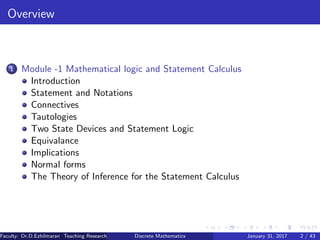
1 Module -1 Mathematical logic and Statement Calculus
Introduction
Statement and Notations
Connectives
Tautologies
Two State Devices and Statement Logic
Equivalance
Implications
Normal forms
The Theory of Inference for the Statement Calculus
Faculty: Dr.D.Ezhilmaran Teaching Research Associate: M.Adhiyaman (VIT)Discrete Mathematics January 31, 2017 2 / 43
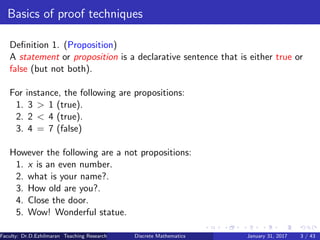
Basics of proof techniques
Definition 1. (Proposition)
A statement or proposition is a declarative sentence that is either true or
false (but not both).
For instance, the following are propositions:
1. 3 > 1 (true).
2. 2 < 4 (true).
3. 4 = 7 (false)
However the following are a not propositions:
1. x is an even number.
2. what is your name?.
3. How old are you?.
4. Close the door.
5. Wow! Wonderful statue.
Faculty: Dr.D.Ezhilmaran Teaching Research Associate: M.Adhiyaman (VIT)Discrete Mathematics January 31, 2017 3 / 43
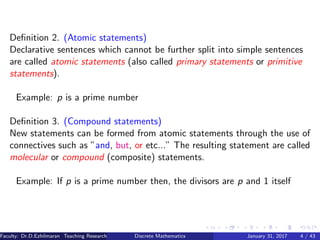
Definition 2. (Atomic statements)
Declarative sentences which cannot be further split into simple sentences
are called atomic statements (also called primary statements or primitive
statements).
Example: p is a prime number
Definition 3. (Compound statements)
New statements can be formed from atomic statements through the use of
connectives such as ”and, but, or etc...” The resulting statement are called
molecular or compound (composite) statements.
Example: If p is a prime number then, the divisors are p and 1 itself
Faculty: Dr.D.Ezhilmaran Teaching Research Associate: M.Adhiyaman (VIT)Discrete Mathematics January 31, 2017 4 / 43
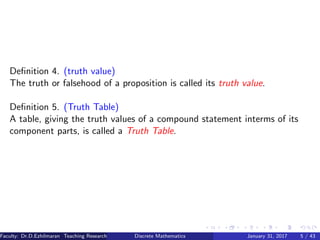
Definition 4. (truth value)
The truth or falsehood of a proposition is called its truth value.
Definition 5. (Truth Table)
A table, giving the truth values of a compound statement interms of its
component parts, is called a Truth Table.
Faculty: Dr.D.Ezhilmaran Teaching Research Associate: M.Adhiyaman (VIT)Discrete Mathematics January 31, 2017 5 / 43
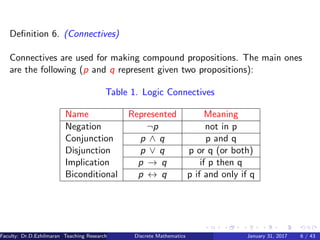
Definition 6. (Connectives)
Connectives are used for making compound propositions. The main ones
are the following (p and q represent given two propositions):
Table 1. Logic Connectives
Name Represented Meaning
Negation ¬p not in p
Conjunction p ∧ q p and q
Disjunction p ∨ q p or q (or both)
Implication p → q if p then q
Biconditional p ↔ q p if and only if q
Faculty: Dr.D.Ezhilmaran Teaching Research Associate: M.Adhiyaman (VIT)Discrete Mathematics January 31, 2017 6 / 43
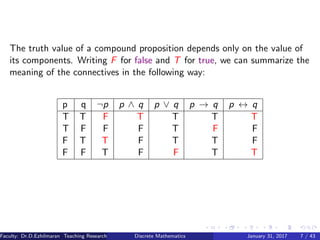
The truth value of a compound proposition depends only on the value of
its components. Writing F for false and T for true, we can summarize the
meaning of the connectives in the following way:
p q ¬p p ∧ q p ∨ q p → q p ↔ q
T T F T T T T
T F F F T F F
F T T F T T F
F F T F F T T
Faculty: Dr.D.Ezhilmaran Teaching Research Associate: M.Adhiyaman (VIT)Discrete Mathematics January 31, 2017 7 / 43
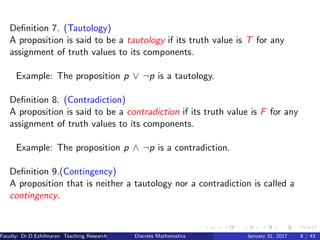
Definition 7. (Tautology)
A proposition is said to be a tautology if its truth value is T for any
assignment of truth values to its components.
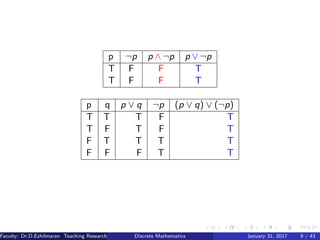
Example: The proposition p ∨ ¬p is a tautology.
Definition 8. (Contradiction)
A proposition is said to be a contradiction if its truth value is F for any
assignment of truth values to its components.
Example: The proposition p ∧ ¬p is a contradiction.
Definition 9.(Contingency)
A proposition that is neither a tautology nor a contradiction is called a
contingency.
Faculty: Dr.D.Ezhilmaran Teaching Research Associate: M.Adhiyaman (VIT)Discrete Mathematics January 31, 2017 8 / 43
p ¬p p ∧ ¬p p ∨ ¬p
T F F T
T F F T
p q p ∨ q ¬p (p ∨ q) ∨ (¬p)
T T T F T
T F T F T
F T T T T
F F F T T
Faculty: Dr.D.Ezhilmaran Teaching Research Associate: M.Adhiyaman (VIT)Discrete Mathematics January 31, 2017 9 / 43
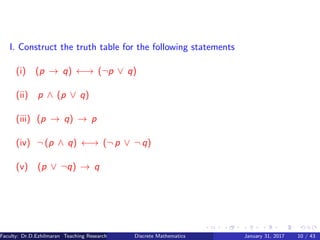
I. Construct the truth table for the following statements
(i) (p → q) ←→ (¬p ∨ q)
(ii) p ∧ (p ∨ q)
(iii) (p → q) → p
(iv) ¬ (p ∧ q) ←→ (¬ p ∨ ¬ q)
(v) (p ∨ ¬q) → q
Faculty: Dr.D.Ezhilmaran Teaching Research Associate: M.Adhiyaman (VIT)Discrete Mathematics January 31, 2017 10 / 43
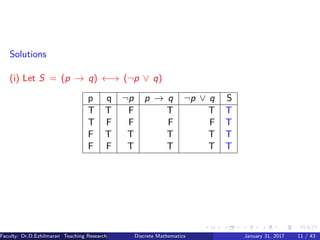
Solutions
(i) Let S = (p → q) ←→ (¬p ∨ q)
p q ¬p p → q ¬p ∨ q S
T T F T T T
T F F F F T
F T T T T T
F F T T T T
Faculty: Dr.D.Ezhilmaran Teaching Research Associate: M.Adhiyaman (VIT)Discrete Mathematics January 31, 2017 11 / 43
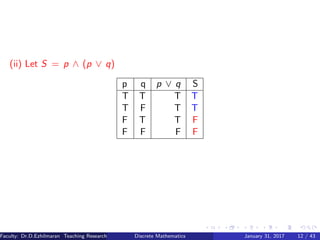
(ii) Let S = p ∧ (p ∨ q)
p q p ∨ q S
T T T T
T F T T
F T T F
F F F F
Faculty: Dr.D.Ezhilmaran Teaching Research Associate: M.Adhiyaman (VIT)Discrete Mathematics January 31, 2017 12 / 43
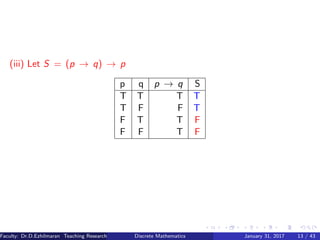
(iii) Let S = (p → q) → p
p q p → q S
T T T T
T F F T
F T T F
F F T F
Faculty: Dr.D.Ezhilmaran Teaching Research Associate: M.Adhiyaman (VIT)Discrete Mathematics January 31, 2017 13 / 43
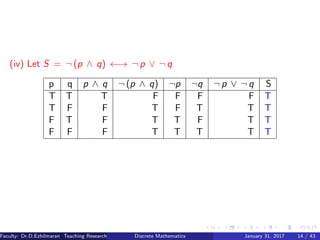
(iv) Let S = ¬ (p ∧ q) ←→ ¬ p ∨ ¬ q
p q p ∧ q ¬ (p ∧ q) ¬p ¬q ¬ p ∨ ¬ q S
T T T F F F F T
T F F T F T T T
F T F T T F T T
F F F T T T T T
Faculty: Dr.D.Ezhilmaran Teaching Research Associate: M.Adhiyaman (VIT)Discrete Mathematics January 31, 2017 14 / 43
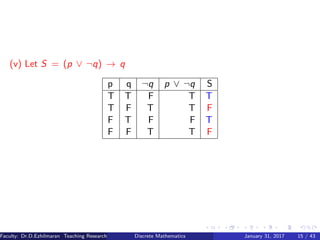
(v) Let S = (p ∨ ¬q) → q
p q ¬q p ∨ ¬q S
T T F T T
T F T T F
F T F F T
F F T T F
Faculty: Dr.D.Ezhilmaran Teaching Research Associate: M.Adhiyaman (VIT)Discrete Mathematics January 31, 2017 15 / 43
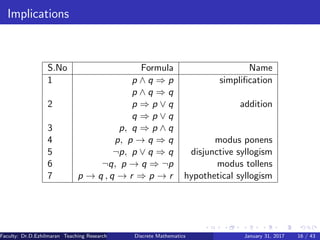
Implications
S.No Formula Name
1 p ∧ q ⇒ p simplification
p ∧ q ⇒ q
2 p ⇒ p ∨ q addition
q ⇒ p ∨ q
3 p, q ⇒ p ∧ q
4 p, p → q ⇒ q modus ponens
5 ¬p, p ∨ q ⇒ q disjunctive syllogism
6 ¬q, p → q ⇒ ¬p modus tollens
7 p → q , q → r ⇒ p → r hypothetical syllogism
Faculty: Dr.D.Ezhilmaran Teaching Research Associate: M.Adhiyaman (VIT)Discrete Mathematics January 31, 2017 16 / 43
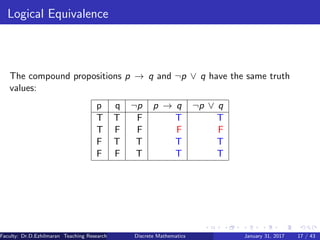
Logical Equivalence
The compound propositions p → q and ¬p ∨ q have the same truth
values:
p q ¬p p → q ¬p ∨ q
T T F T T
T F F F F
F T T T T
F F T T T
Faculty: Dr.D.Ezhilmaran Teaching Research Associate: M.Adhiyaman (VIT)Discrete Mathematics January 31, 2017 17 / 43
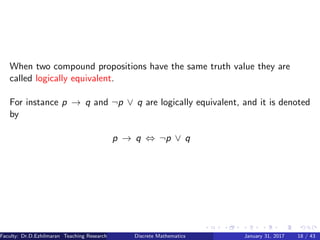
When two compound propositions have the same truth value they are
called logically equivalent.
For instance p → q and ¬p ∨ q are logically equivalent, and it is denoted
by
p → q ⇔ ¬p ∨ q
Faculty: Dr.D.Ezhilmaran Teaching Research Associate: M.Adhiyaman (VIT)Discrete Mathematics January 31, 2017 18 / 43
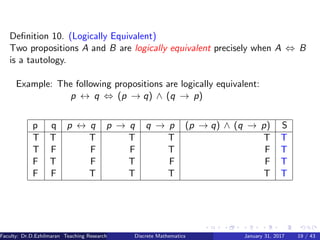
Definition 10. (Logically Equivalent)
Two propositions A and B are logically equivalent precisely when A ⇔ B
is a tautology.
Example: The following propositions are logically equivalent:
p ↔ q ⇔ (p → q) ∧ (q → p)
p q p ↔ q p → q q → p (p → q) ∧ (q → p) S
T T T T T T T
T F F F T F T
F T F T F F T
F F T T T T T
Faculty: Dr.D.Ezhilmaran Teaching Research Associate: M.Adhiyaman (VIT)Discrete Mathematics January 31, 2017 19 / 43
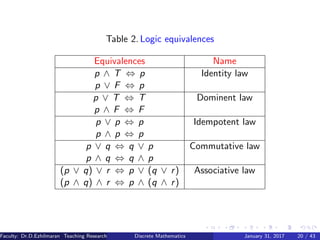
Table 2. Logic equivalences
Equivalences Name
p ∧ T ⇔ p Identity law
p ∨ F ⇔ p
p ∨ T ⇔ T Dominent law
p ∧ F ⇔ F
p ∨ p ⇔ p Idempotent law
p ∧ p ⇔ p
p ∨ q ⇔ q ∨ p Commutative law
p ∧ q ⇔ q ∧ p
(p ∨ q) ∨ r ⇔ p ∨ (q ∨ r) Associative law
(p ∧ q) ∧ r ⇔ p ∧ (q ∧ r)
Faculty: Dr.D.Ezhilmaran Teaching Research Associate: M.Adhiyaman (VIT)Discrete Mathematics January 31, 2017 20 / 43
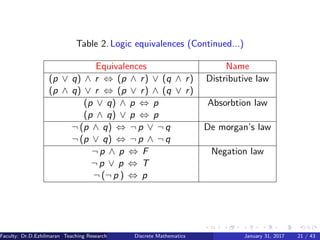
Table 2. Logic equivalences (Continued...)
Equivalences Name
(p ∨ q) ∧ r ⇔ (p ∧ r) ∨ (q ∧ r) Distributive law
(p ∧ q) ∨ r ⇔ (p ∨ r) ∧ (q ∨ r)
(p ∨ q) ∧ p ⇔ p Absorbtion law
(p ∧ q) ∨ p ⇔ p
¬ (p ∧ q) ⇔ ¬ p ∨ ¬ q De morgan’s law
¬ (p ∨ q) ⇔ ¬ p ∧ ¬ q
¬ p ∧ p ⇔ F Negation law
¬ p ∨ p ⇔ T
¬ (¬ p ) ⇔ p
Faculty: Dr.D.Ezhilmaran Teaching Research Associate: M.Adhiyaman (VIT)Discrete Mathematics January 31, 2017 21 / 43
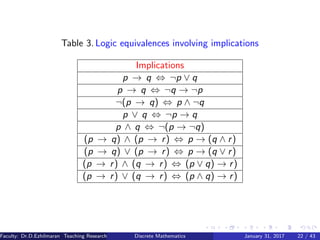
Table 3. Logic equivalences involving implications
Implications
p → q ⇔ ¬p ∨ q
p → q ⇔ ¬q → ¬p
¬(p → q) ⇔ p ∧ ¬q
p ∨ q ⇔ ¬p → q
p ∧ q ⇔ ¬(p → ¬q)
(p → q) ∧ (p → r) ⇔ p → (q ∧ r)
(p → q) ∨ (p → r) ⇔ p → (q ∨ r)
(p → r) ∧ (q → r) ⇔ (p ∨ q) → r)
(p → r) ∨ (q → r) ⇔ (p ∧ q) → r)
Faculty: Dr.D.Ezhilmaran Teaching Research Associate: M.Adhiyaman (VIT)Discrete Mathematics January 31, 2017 22 / 43
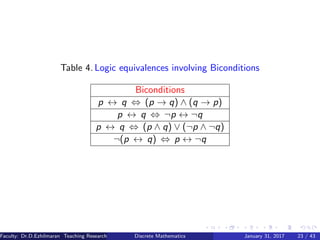
Table 4. Logic equivalences involving Biconditions
Biconditions
p ↔ q ⇔ (p → q) ∧ (q → p)
p ↔ q ⇔ ¬p ↔ ¬q
p ↔ q ⇔ (p ∧ q) ∨ (¬p ∧ ¬q)
¬(p ↔ q) ⇔ p ↔ ¬q
Faculty: Dr.D.Ezhilmaran Teaching Research Associate: M.Adhiyaman (VIT)Discrete Mathematics January 31, 2017 23 / 43
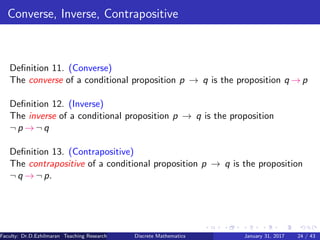
Converse, Inverse, Contrapositive
Definition 11. (Converse)
The converse of a conditional proposition p → q is the proposition q → p
Definition 12. (Inverse)
The inverse of a conditional proposition p → q is the proposition
¬ p → ¬ q
Definition 13. (Contrapositive)
The contrapositive of a conditional proposition p → q is the proposition
¬ q → ¬ p.
Faculty: Dr.D.Ezhilmaran Teaching Research Associate: M.Adhiyaman (VIT)Discrete Mathematics January 31, 2017 24 / 43
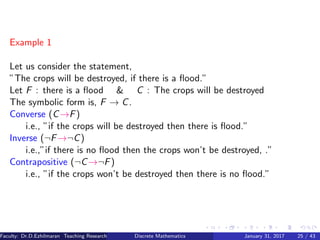
Example 1
Let us consider the statement,
”The crops will be destroyed, if there is a flood.”
Let F : there is a flood & C : The crops will be destroyed
The symbolic form is, F → C.
Converse (C→F)
i.e., ”if the crops will be destroyed then there is flood.”
Inverse (¬F→¬C)
i.e.,”if there is no flood then the crops won’t be destroyed, .”
Contrapositive (¬C→¬F)
i.e., ”if the crops won’t be destroyed then there is no flood.”
Faculty: Dr.D.Ezhilmaran Teaching Research Associate: M.Adhiyaman (VIT)Discrete Mathematics January 31, 2017 25 / 43
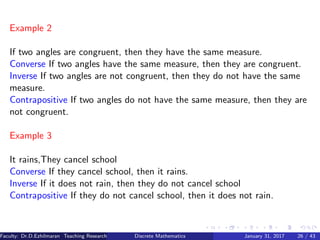
Example 2
If two angles are congruent, then they have the same measure.
Converse If two angles have the same measure, then they are congruent.
Inverse If two angles are not congruent, then they do not have the same
measure.
Contrapositive If two angles do not have the same measure, then they are
not congruent.
Example 3
It rains,They cancel school
Converse If they cancel school, then it rains.
Inverse If it does not rain, then they do not cancel school
Contrapositive If they do not cancel school, then it does not rain.
Faculty: Dr.D.Ezhilmaran Teaching Research Associate: M.Adhiyaman (VIT)Discrete Mathematics January 31, 2017 26 / 43
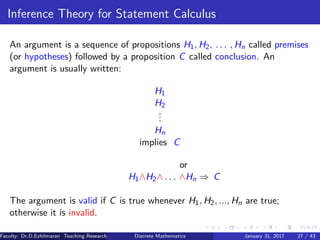
Inference Theory for Statement Calculus
An argument is a sequence of propositions H1, H2, . . . , Hn called premises
(or hypotheses) followed by a proposition C called conclusion. An
argument is usually written:
H1
H2
...
Hn
implies C
or
H1∧H2∧ . . . ∧Hn ⇒ C
The argument is valid if C is true whenever H1, H2, ..., Hn are true;
otherwise it is invalid.
Faculty: Dr.D.Ezhilmaran Teaching Research Associate: M.Adhiyaman (VIT)Discrete Mathematics January 31, 2017 27 / 43
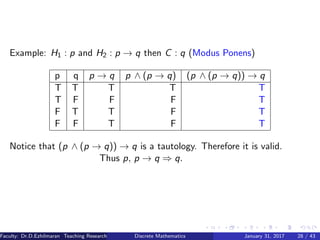
Example: H1 : p and H2 : p → q then C : q (Modus Ponens)
p q p → q p ∧ (p → q) (p ∧ (p → q)) → q
T T T T T
T F F F T
F T T F T
F F T F T
Notice that (p ∧ (p → q)) → q is a tautology. Therefore it is valid.
Thus p, p → q ⇒ q.
Faculty: Dr.D.Ezhilmaran Teaching Research Associate: M.Adhiyaman (VIT)Discrete Mathematics January 31, 2017 28 / 43
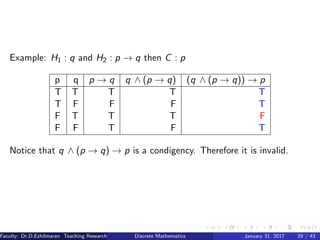
Example: H1 : q and H2 : p → q then C : p
p q p → q q ∧ (p → q) (q ∧ (p → q)) → p
T T T T T
T F F F T
F T T T F
F F T F T
Notice that q ∧ (p → q) → p is a condigency. Therefore it is invalid.
Faculty: Dr.D.Ezhilmaran Teaching Research Associate: M.Adhiyaman (VIT)Discrete Mathematics January 31, 2017 29 / 43
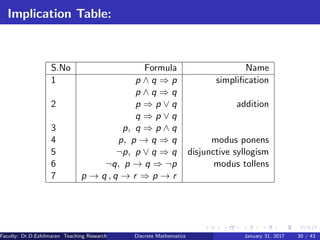
Implication Table:
S.No Formula Name
1 p ∧ q ⇒ p simplification
p ∧ q ⇒ q
2 p ⇒ p ∨ q addition
q ⇒ p ∨ q
3 p, q ⇒ p ∧ q
4 p, p → q ⇒ q modus ponens
5 ¬p, p ∨ q ⇒ q disjunctive syllogism
6 ¬q, p → q ⇒ ¬p modus tollens
7 p → q , q → r ⇒ p → r
Faculty: Dr.D.Ezhilmaran Teaching Research Associate: M.Adhiyaman (VIT)Discrete Mathematics January 31, 2017 30 / 43
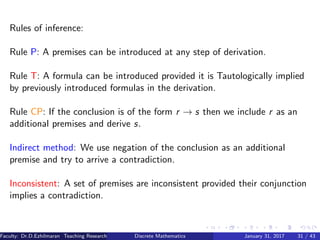
Rules of inference:
Rule P: A premises can be introduced at any step of derivation.
Rule T: A formula can be introduced provided it is Tautologically implied
by previously introduced formulas in the derivation.
Rule CP: If the conclusion is of the form r → s then we include r as an
additional premises and derive s.
Indirect method: We use negation of the conclusion as an additional
premise and try to arrive a contradiction.
Inconsistent: A set of premises are inconsistent provided their conjunction
implies a contradiction.
Faculty: Dr.D.Ezhilmaran Teaching Research Associate: M.Adhiyaman (VIT)Discrete Mathematics January 31, 2017 31 / 43
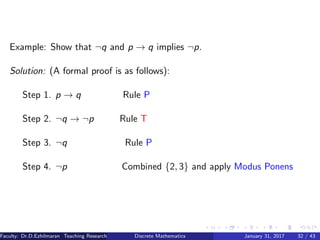
Example: Show that ¬q and p → q implies ¬p.
Solution: (A formal proof is as follows):
Step 1. p → q Rule P
Step 2. ¬q → ¬p Rule T
Step 3. ¬q Rule P
Step 4. ¬p Combined {2, 3} and apply Modus Ponens
Faculty: Dr.D.Ezhilmaran Teaching Research Associate: M.Adhiyaman (VIT)Discrete Mathematics January 31, 2017 32 / 43
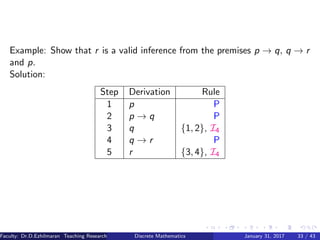
Example: Show that r is a valid inference from the premises p → q, q → r
and p.
Solution:
Step Derivation Rule
1 p P
2 p → q P
3 q {1, 2}, I4
4 q → r P
5 r {3, 4}, I4
Faculty: Dr.D.Ezhilmaran Teaching Research Associate: M.Adhiyaman (VIT)Discrete Mathematics January 31, 2017 33 / 43
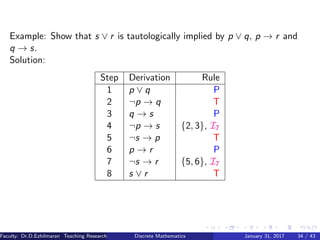
Example: Show that s ∨ r is tautologically implied by p ∨ q, p → r and
q → s.
Solution:
Step Derivation Rule
1 p ∨ q P
2 ¬p → q T
3 q → s P
4 ¬p → s {2, 3}, I7
5 ¬s → p T
6 p → r P
7 ¬s → r {5, 6}, I7
8 s ∨ r T
Faculty: Dr.D.Ezhilmaran Teaching Research Associate: M.Adhiyaman (VIT)Discrete Mathematics January 31, 2017 34 / 43
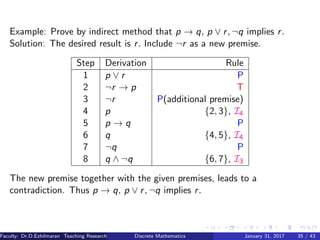
Example: Prove by indirect method that p → q, p ∨ r, ¬q implies r.
Solution: The desired result is r. Include ¬r as a new premise.
Step Derivation Rule
1 p ∨ r P
2 ¬r → p T
3 ¬r P(additional premise)
4 p {2, 3}, I4
5 p → q P
6 q {4, 5}, I4
7 ¬q P
8 q ∧ ¬q {6, 7}, I3
The new premise together with the given premises, leads to a
contradiction. Thus p → q, p ∨ r, ¬q implies r.
Faculty: Dr.D.Ezhilmaran Teaching Research Associate: M.Adhiyaman (VIT)Discrete Mathematics January 31, 2017 35 / 43
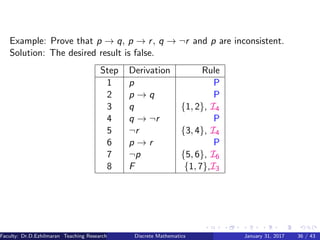
Example: Prove that p → q, p → r, q → ¬r and p are inconsistent.
Solution: The desired result is false.
Step Derivation Rule
1 p P
2 p → q P
3 q {1, 2}, I4
4 q → ¬r P
5 ¬r {3, 4}, I4
6 p → r P
7 ¬p {5, 6}, I6
8 F {1, 7},I3
Faculty: Dr.D.Ezhilmaran Teaching Research Associate: M.Adhiyaman (VIT)Discrete Mathematics January 31, 2017 36 / 43
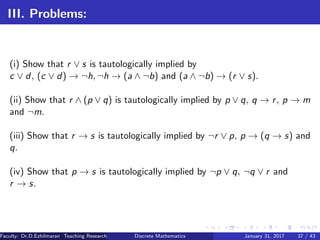
III. Problems:
(i) Show that r ∨ s is tautologically implied by
c ∨ d, (c ∨ d) → ¬h, ¬h → (a ∧ ¬b) and (a ∧ ¬b) → (r ∨ s).
(ii) Show that r ∧ (p ∨ q) is tautologically implied by p ∨ q, q → r, p → m
and ¬m.
(iii) Show that r → s is tautologically implied by ¬r ∨ p, p → (q → s) and
q.
(iv) Show that p → s is tautologically implied by ¬p ∨ q, ¬q ∨ r and
r → s.
Faculty: Dr.D.Ezhilmaran Teaching Research Associate: M.Adhiyaman (VIT)Discrete Mathematics January 31, 2017 37 / 43
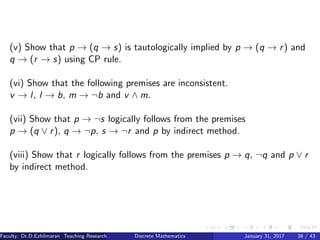
(v) Show that p → (q → s) is tautologically implied by p → (q → r) and
q → (r → s) using CP rule.
(vi) Show that the following premises are inconsistent.
v → l, l → b, m → ¬b and v ∧ m.
(vii) Show that p → ¬s logically follows from the premises
p → (q ∨ r), q → ¬p, s → ¬r and p by indirect method.
(viii) Show that r logically follows from the premises p → q, ¬q and p ∨ r
by indirect method.
Faculty: Dr.D.Ezhilmaran Teaching Research Associate: M.Adhiyaman (VIT)Discrete Mathematics January 31, 2017 38 / 43
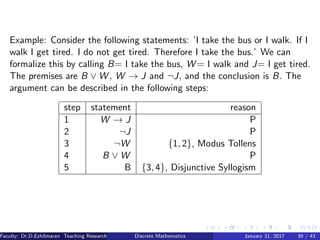
Example: Consider the following statements: ’I take the bus or I walk. If I
walk I get tired. I do not get tired. Therefore I take the bus.’ We can
formalize this by calling B= I take the bus, W = I walk and J= I get tired.
The premises are B ∨ W , W → J and ¬J, and the conclusion is B. The
argument can be described in the following steps:
step statement reason
1 W → J P
2 ¬J P
3 ¬W {1, 2}, Modus Tollens
4 B ∨ W P
5 B {3, 4}, Disjunctive Syllogism
Faculty: Dr.D.Ezhilmaran Teaching Research Associate: M.Adhiyaman (VIT)Discrete Mathematics January 31, 2017 39 / 43
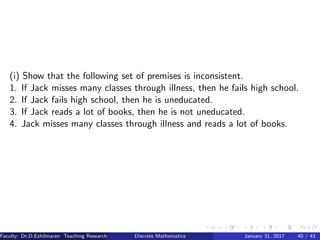
(i) Show that the following set of premises is inconsistent.
1. If Jack misses many classes through illness, then he fails high school.
2. If Jack fails high school, then he is uneducated.
3. If Jack reads a lot of books, then he is not uneducated.
4. Jack misses many classes through illness and reads a lot of books.
Faculty: Dr.D.Ezhilmaran Teaching Research Associate: M.Adhiyaman (VIT)Discrete Mathematics January 31, 2017 40 / 43
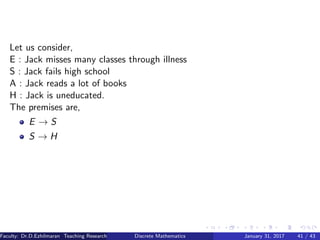
Let us consider,
E : Jack misses many classes through illness
S : Jack fails high school
A : Jack reads a lot of books
H : Jack is uneducated.
The premises are,
Faculty: Dr.D.Ezhilmaran Teaching Research Associate: M.Adhiyaman (VIT)Discrete Mathematics January 31, 2017 41 / 43
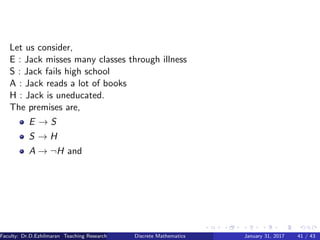
Let us consider,
E : Jack misses many classes through illness
S : Jack fails high school
A : Jack reads a lot of books
H : Jack is uneducated.
The premises are,
E → S
Faculty: Dr.D.Ezhilmaran Teaching Research Associate: M.Adhiyaman (VIT)Discrete Mathematics January 31, 2017 41 / 43
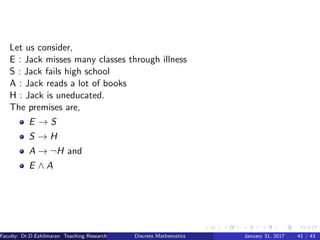
Let us consider,
E : Jack misses many classes through illness
S : Jack fails high school
A : Jack reads a lot of books
H : Jack is uneducated.
The premises are,
E → S
S → H
Faculty: Dr.D.Ezhilmaran Teaching Research Associate: M.Adhiyaman (VIT)Discrete Mathematics January 31, 2017 41 / 43
Let us consider,
E : Jack misses many classes through illness
S : Jack fails high school
A : Jack reads a lot of books
H : Jack is uneducated.
The premises are,
E → S
S → H
A → ¬H and
Faculty: Dr.D.Ezhilmaran Teaching Research Associate: M.Adhiyaman (VIT)Discrete Mathematics January 31, 2017 41 / 43
Let us consider,
E : Jack misses many classes through illness
S : Jack fails high school
A : Jack reads a lot of books
H : Jack is uneducated.
The premises are,
E → S
S → H
A → ¬H and
E ∧ A
Faculty: Dr.D.Ezhilmaran Teaching Research Associate: M.Adhiyaman (VIT)Discrete Mathematics January 31, 2017 41 / 43
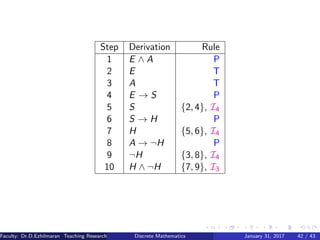
Step Derivation Rule
1 E ∧ A P
2 E T
3 A T
4 E → S P
5 S {2, 4}, I4
6 S → H P
7 H {5, 6}, I4
8 A → ¬H P
9 ¬H {3, 8}, I4
10 H ∧ ¬H {7, 9}, I3
Faculty: Dr.D.Ezhilmaran Teaching Research Associate: M.Adhiyaman (VIT)Discrete Mathematics January 31, 2017 42 / 43
For further queries
Prof.Dr.D.Ezhilmaran, Ph.D.,
Assistant Professor (Senior),
Department of Mathematics,
Vellore Institute of Technology, Tamilnadu, India.
E-mail.ID : ezhilmaran.d@vit.ac.in
Faculty: Dr.D.Ezhilmaran Teaching Research Associate: M.Adhiyaman (VIT)Discrete Mathematics January 31, 2017 43 / 43

Module - 1 Discrete Mathematics and Graph Theory

  • 1.
    MAT-1014 Discrete Mathematicsand Graph Theory Faculty: Dr.D.Ezhilmaran Teaching Research Associate: M.Adhiyaman Department of Mathematics, School of Advanced Sciences, VIT-University, Tamil Nadu, India ezhilmaran.d@vit.ac.in January 31, 2017 Faculty: Dr.D.Ezhilmaran Teaching Research Associate: M.Adhiyaman (VIT)Discrete Mathematics January 31, 2017 1 / 43
  • 2.
    Overview 1 Module -1Mathematical logic and Statement Calculus Introduction Statement and Notations Connectives Tautologies Two State Devices and Statement Logic Equivalance Implications Normal forms The Theory of Inference for the Statement Calculus Faculty: Dr.D.Ezhilmaran Teaching Research Associate: M.Adhiyaman (VIT)Discrete Mathematics January 31, 2017 2 / 43
  • 3.
    Basics of prooftechniques Definition 1. (Proposition) A statement or proposition is a declarative sentence that is either true or false (but not both). For instance, the following are propositions: 1. 3 > 1 (true). 2. 2 < 4 (true). 3. 4 = 7 (false) However the following are a not propositions: 1. x is an even number. 2. what is your name?. 3. How old are you?. 4. Close the door. 5. Wow! Wonderful statue. Faculty: Dr.D.Ezhilmaran Teaching Research Associate: M.Adhiyaman (VIT)Discrete Mathematics January 31, 2017 3 / 43
  • 4.
    Definition 2. (Atomicstatements) Declarative sentences which cannot be further split into simple sentences are called atomic statements (also called primary statements or primitive statements). Example: p is a prime number Definition 3. (Compound statements) New statements can be formed from atomic statements through the use of connectives such as ”and, but, or etc...” The resulting statement are called molecular or compound (composite) statements. Example: If p is a prime number then, the divisors are p and 1 itself Faculty: Dr.D.Ezhilmaran Teaching Research Associate: M.Adhiyaman (VIT)Discrete Mathematics January 31, 2017 4 / 43
  • 5.
    Definition 4. (truthvalue) The truth or falsehood of a proposition is called its truth value. Definition 5. (Truth Table) A table, giving the truth values of a compound statement interms of its component parts, is called a Truth Table. Faculty: Dr.D.Ezhilmaran Teaching Research Associate: M.Adhiyaman (VIT)Discrete Mathematics January 31, 2017 5 / 43
  • 6.
    Definition 6. (Connectives) Connectivesare used for making compound propositions. The main ones are the following (p and q represent given two propositions): Table 1. Logic Connectives Name Represented Meaning Negation ¬p not in p Conjunction p ∧ q p and q Disjunction p ∨ q p or q (or both) Implication p → q if p then q Biconditional p ↔ q p if and only if q Faculty: Dr.D.Ezhilmaran Teaching Research Associate: M.Adhiyaman (VIT)Discrete Mathematics January 31, 2017 6 / 43
  • 7.
    The truth valueof a compound proposition depends only on the value of its components. Writing F for false and T for true, we can summarize the meaning of the connectives in the following way: p q ¬p p ∧ q p ∨ q p → q p ↔ q T T F T T T T T F F F T F F F T T F T T F F F T F F T T Faculty: Dr.D.Ezhilmaran Teaching Research Associate: M.Adhiyaman (VIT)Discrete Mathematics January 31, 2017 7 / 43
  • 8.
    Definition 7. (Tautology) Aproposition is said to be a tautology if its truth value is T for any assignment of truth values to its components. Example: The proposition p ∨ ¬p is a tautology. Definition 8. (Contradiction) A proposition is said to be a contradiction if its truth value is F for any assignment of truth values to its components. Example: The proposition p ∧ ¬p is a contradiction. Definition 9.(Contingency) A proposition that is neither a tautology nor a contradiction is called a contingency. Faculty: Dr.D.Ezhilmaran Teaching Research Associate: M.Adhiyaman (VIT)Discrete Mathematics January 31, 2017 8 / 43
  • 9.
    p ¬p p∧ ¬p p ∨ ¬p T F F T T F F T p q p ∨ q ¬p (p ∨ q) ∨ (¬p) T T T F T T F T F T F T T T T F F F T T Faculty: Dr.D.Ezhilmaran Teaching Research Associate: M.Adhiyaman (VIT)Discrete Mathematics January 31, 2017 9 / 43
  • 10.
    I. Construct thetruth table for the following statements (i) (p → q) ←→ (¬p ∨ q) (ii) p ∧ (p ∨ q) (iii) (p → q) → p (iv) ¬ (p ∧ q) ←→ (¬ p ∨ ¬ q) (v) (p ∨ ¬q) → q Faculty: Dr.D.Ezhilmaran Teaching Research Associate: M.Adhiyaman (VIT)Discrete Mathematics January 31, 2017 10 / 43
  • 11.
    Solutions (i) Let S= (p → q) ←→ (¬p ∨ q) p q ¬p p → q ¬p ∨ q S T T F T T T T F F F F T F T T T T T F F T T T T Faculty: Dr.D.Ezhilmaran Teaching Research Associate: M.Adhiyaman (VIT)Discrete Mathematics January 31, 2017 11 / 43
  • 12.
    (ii) Let S= p ∧ (p ∨ q) p q p ∨ q S T T T T T F T T F T T F F F F F Faculty: Dr.D.Ezhilmaran Teaching Research Associate: M.Adhiyaman (VIT)Discrete Mathematics January 31, 2017 12 / 43
  • 13.
    (iii) Let S= (p → q) → p p q p → q S T T T T T F F T F T T F F F T F Faculty: Dr.D.Ezhilmaran Teaching Research Associate: M.Adhiyaman (VIT)Discrete Mathematics January 31, 2017 13 / 43
  • 14.
    (iv) Let S= ¬ (p ∧ q) ←→ ¬ p ∨ ¬ q p q p ∧ q ¬ (p ∧ q) ¬p ¬q ¬ p ∨ ¬ q S T T T F F F F T T F F T F T T T F T F T T F T T F F F T T T T T Faculty: Dr.D.Ezhilmaran Teaching Research Associate: M.Adhiyaman (VIT)Discrete Mathematics January 31, 2017 14 / 43
  • 15.
    (v) Let S= (p ∨ ¬q) → q p q ¬q p ∨ ¬q S T T F T T T F T T F F T F F T F F T T F Faculty: Dr.D.Ezhilmaran Teaching Research Associate: M.Adhiyaman (VIT)Discrete Mathematics January 31, 2017 15 / 43
  • 16.
    Implications S.No Formula Name 1p ∧ q ⇒ p simplification p ∧ q ⇒ q 2 p ⇒ p ∨ q addition q ⇒ p ∨ q 3 p, q ⇒ p ∧ q 4 p, p → q ⇒ q modus ponens 5 ¬p, p ∨ q ⇒ q disjunctive syllogism 6 ¬q, p → q ⇒ ¬p modus tollens 7 p → q , q → r ⇒ p → r hypothetical syllogism Faculty: Dr.D.Ezhilmaran Teaching Research Associate: M.Adhiyaman (VIT)Discrete Mathematics January 31, 2017 16 / 43
  • 17.
    Logical Equivalence The compoundpropositions p → q and ¬p ∨ q have the same truth values: p q ¬p p → q ¬p ∨ q T T F T T T F F F F F T T T T F F T T T Faculty: Dr.D.Ezhilmaran Teaching Research Associate: M.Adhiyaman (VIT)Discrete Mathematics January 31, 2017 17 / 43
  • 18.
    When two compoundpropositions have the same truth value they are called logically equivalent. For instance p → q and ¬p ∨ q are logically equivalent, and it is denoted by p → q ⇔ ¬p ∨ q Faculty: Dr.D.Ezhilmaran Teaching Research Associate: M.Adhiyaman (VIT)Discrete Mathematics January 31, 2017 18 / 43
  • 19.
    Definition 10. (LogicallyEquivalent) Two propositions A and B are logically equivalent precisely when A ⇔ B is a tautology. Example: The following propositions are logically equivalent: p ↔ q ⇔ (p → q) ∧ (q → p) p q p ↔ q p → q q → p (p → q) ∧ (q → p) S T T T T T T T T F F F T F T F T F T F F T F F T T T T T Faculty: Dr.D.Ezhilmaran Teaching Research Associate: M.Adhiyaman (VIT)Discrete Mathematics January 31, 2017 19 / 43
  • 20.
    Table 2. Logicequivalences Equivalences Name p ∧ T ⇔ p Identity law p ∨ F ⇔ p p ∨ T ⇔ T Dominent law p ∧ F ⇔ F p ∨ p ⇔ p Idempotent law p ∧ p ⇔ p p ∨ q ⇔ q ∨ p Commutative law p ∧ q ⇔ q ∧ p (p ∨ q) ∨ r ⇔ p ∨ (q ∨ r) Associative law (p ∧ q) ∧ r ⇔ p ∧ (q ∧ r) Faculty: Dr.D.Ezhilmaran Teaching Research Associate: M.Adhiyaman (VIT)Discrete Mathematics January 31, 2017 20 / 43
  • 21.
    Table 2. Logicequivalences (Continued...) Equivalences Name (p ∨ q) ∧ r ⇔ (p ∧ r) ∨ (q ∧ r) Distributive law (p ∧ q) ∨ r ⇔ (p ∨ r) ∧ (q ∨ r) (p ∨ q) ∧ p ⇔ p Absorbtion law (p ∧ q) ∨ p ⇔ p ¬ (p ∧ q) ⇔ ¬ p ∨ ¬ q De morgan’s law ¬ (p ∨ q) ⇔ ¬ p ∧ ¬ q ¬ p ∧ p ⇔ F Negation law ¬ p ∨ p ⇔ T ¬ (¬ p ) ⇔ p Faculty: Dr.D.Ezhilmaran Teaching Research Associate: M.Adhiyaman (VIT)Discrete Mathematics January 31, 2017 21 / 43
  • 22.
    Table 3. Logicequivalences involving implications Implications p → q ⇔ ¬p ∨ q p → q ⇔ ¬q → ¬p ¬(p → q) ⇔ p ∧ ¬q p ∨ q ⇔ ¬p → q p ∧ q ⇔ ¬(p → ¬q) (p → q) ∧ (p → r) ⇔ p → (q ∧ r) (p → q) ∨ (p → r) ⇔ p → (q ∨ r) (p → r) ∧ (q → r) ⇔ (p ∨ q) → r) (p → r) ∨ (q → r) ⇔ (p ∧ q) → r) Faculty: Dr.D.Ezhilmaran Teaching Research Associate: M.Adhiyaman (VIT)Discrete Mathematics January 31, 2017 22 / 43
  • 23.
    Table 4. Logicequivalences involving Biconditions Biconditions p ↔ q ⇔ (p → q) ∧ (q → p) p ↔ q ⇔ ¬p ↔ ¬q p ↔ q ⇔ (p ∧ q) ∨ (¬p ∧ ¬q) ¬(p ↔ q) ⇔ p ↔ ¬q Faculty: Dr.D.Ezhilmaran Teaching Research Associate: M.Adhiyaman (VIT)Discrete Mathematics January 31, 2017 23 / 43
  • 24.
    Converse, Inverse, Contrapositive Definition11. (Converse) The converse of a conditional proposition p → q is the proposition q → p Definition 12. (Inverse) The inverse of a conditional proposition p → q is the proposition ¬ p → ¬ q Definition 13. (Contrapositive) The contrapositive of a conditional proposition p → q is the proposition ¬ q → ¬ p. Faculty: Dr.D.Ezhilmaran Teaching Research Associate: M.Adhiyaman (VIT)Discrete Mathematics January 31, 2017 24 / 43
  • 25.
    Example 1 Let usconsider the statement, ”The crops will be destroyed, if there is a flood.” Let F : there is a flood & C : The crops will be destroyed The symbolic form is, F → C. Converse (C→F) i.e., ”if the crops will be destroyed then there is flood.” Inverse (¬F→¬C) i.e.,”if there is no flood then the crops won’t be destroyed, .” Contrapositive (¬C→¬F) i.e., ”if the crops won’t be destroyed then there is no flood.” Faculty: Dr.D.Ezhilmaran Teaching Research Associate: M.Adhiyaman (VIT)Discrete Mathematics January 31, 2017 25 / 43
  • 26.
    Example 2 If twoangles are congruent, then they have the same measure. Converse If two angles have the same measure, then they are congruent. Inverse If two angles are not congruent, then they do not have the same measure. Contrapositive If two angles do not have the same measure, then they are not congruent. Example 3 It rains,They cancel school Converse If they cancel school, then it rains. Inverse If it does not rain, then they do not cancel school Contrapositive If they do not cancel school, then it does not rain. Faculty: Dr.D.Ezhilmaran Teaching Research Associate: M.Adhiyaman (VIT)Discrete Mathematics January 31, 2017 26 / 43
  • 27.
    Inference Theory forStatement Calculus An argument is a sequence of propositions H1, H2, . . . , Hn called premises (or hypotheses) followed by a proposition C called conclusion. An argument is usually written: H1 H2 ... Hn implies C or H1∧H2∧ . . . ∧Hn ⇒ C The argument is valid if C is true whenever H1, H2, ..., Hn are true; otherwise it is invalid. Faculty: Dr.D.Ezhilmaran Teaching Research Associate: M.Adhiyaman (VIT)Discrete Mathematics January 31, 2017 27 / 43
  • 28.
    Example: H1 :p and H2 : p → q then C : q (Modus Ponens) p q p → q p ∧ (p → q) (p ∧ (p → q)) → q T T T T T T F F F T F T T F T F F T F T Notice that (p ∧ (p → q)) → q is a tautology. Therefore it is valid. Thus p, p → q ⇒ q. Faculty: Dr.D.Ezhilmaran Teaching Research Associate: M.Adhiyaman (VIT)Discrete Mathematics January 31, 2017 28 / 43
  • 29.
    Example: H1 :q and H2 : p → q then C : p p q p → q q ∧ (p → q) (q ∧ (p → q)) → p T T T T T T F F F T F T T T F F F T F T Notice that q ∧ (p → q) → p is a condigency. Therefore it is invalid. Faculty: Dr.D.Ezhilmaran Teaching Research Associate: M.Adhiyaman (VIT)Discrete Mathematics January 31, 2017 29 / 43
  • 30.
    Implication Table: S.No FormulaName 1 p ∧ q ⇒ p simplification p ∧ q ⇒ q 2 p ⇒ p ∨ q addition q ⇒ p ∨ q 3 p, q ⇒ p ∧ q 4 p, p → q ⇒ q modus ponens 5 ¬p, p ∨ q ⇒ q disjunctive syllogism 6 ¬q, p → q ⇒ ¬p modus tollens 7 p → q , q → r ⇒ p → r Faculty: Dr.D.Ezhilmaran Teaching Research Associate: M.Adhiyaman (VIT)Discrete Mathematics January 31, 2017 30 / 43
  • 31.
    Rules of inference: RuleP: A premises can be introduced at any step of derivation. Rule T: A formula can be introduced provided it is Tautologically implied by previously introduced formulas in the derivation. Rule CP: If the conclusion is of the form r → s then we include r as an additional premises and derive s. Indirect method: We use negation of the conclusion as an additional premise and try to arrive a contradiction. Inconsistent: A set of premises are inconsistent provided their conjunction implies a contradiction. Faculty: Dr.D.Ezhilmaran Teaching Research Associate: M.Adhiyaman (VIT)Discrete Mathematics January 31, 2017 31 / 43
  • 32.
    Example: Show that¬q and p → q implies ¬p. Solution: (A formal proof is as follows): Step 1. p → q Rule P Step 2. ¬q → ¬p Rule T Step 3. ¬q Rule P Step 4. ¬p Combined {2, 3} and apply Modus Ponens Faculty: Dr.D.Ezhilmaran Teaching Research Associate: M.Adhiyaman (VIT)Discrete Mathematics January 31, 2017 32 / 43
  • 33.
    Example: Show thatr is a valid inference from the premises p → q, q → r and p. Solution: Step Derivation Rule 1 p P 2 p → q P 3 q {1, 2}, I4 4 q → r P 5 r {3, 4}, I4 Faculty: Dr.D.Ezhilmaran Teaching Research Associate: M.Adhiyaman (VIT)Discrete Mathematics January 31, 2017 33 / 43
  • 34.
    Example: Show thats ∨ r is tautologically implied by p ∨ q, p → r and q → s. Solution: Step Derivation Rule 1 p ∨ q P 2 ¬p → q T 3 q → s P 4 ¬p → s {2, 3}, I7 5 ¬s → p T 6 p → r P 7 ¬s → r {5, 6}, I7 8 s ∨ r T Faculty: Dr.D.Ezhilmaran Teaching Research Associate: M.Adhiyaman (VIT)Discrete Mathematics January 31, 2017 34 / 43
  • 35.
    Example: Prove byindirect method that p → q, p ∨ r, ¬q implies r. Solution: The desired result is r. Include ¬r as a new premise. Step Derivation Rule 1 p ∨ r P 2 ¬r → p T 3 ¬r P(additional premise) 4 p {2, 3}, I4 5 p → q P 6 q {4, 5}, I4 7 ¬q P 8 q ∧ ¬q {6, 7}, I3 The new premise together with the given premises, leads to a contradiction. Thus p → q, p ∨ r, ¬q implies r. Faculty: Dr.D.Ezhilmaran Teaching Research Associate: M.Adhiyaman (VIT)Discrete Mathematics January 31, 2017 35 / 43
  • 36.
    Example: Prove thatp → q, p → r, q → ¬r and p are inconsistent. Solution: The desired result is false. Step Derivation Rule 1 p P 2 p → q P 3 q {1, 2}, I4 4 q → ¬r P 5 ¬r {3, 4}, I4 6 p → r P 7 ¬p {5, 6}, I6 8 F {1, 7},I3 Faculty: Dr.D.Ezhilmaran Teaching Research Associate: M.Adhiyaman (VIT)Discrete Mathematics January 31, 2017 36 / 43
  • 37.
    III. Problems: (i) Showthat r ∨ s is tautologically implied by c ∨ d, (c ∨ d) → ¬h, ¬h → (a ∧ ¬b) and (a ∧ ¬b) → (r ∨ s). (ii) Show that r ∧ (p ∨ q) is tautologically implied by p ∨ q, q → r, p → m and ¬m. (iii) Show that r → s is tautologically implied by ¬r ∨ p, p → (q → s) and q. (iv) Show that p → s is tautologically implied by ¬p ∨ q, ¬q ∨ r and r → s. Faculty: Dr.D.Ezhilmaran Teaching Research Associate: M.Adhiyaman (VIT)Discrete Mathematics January 31, 2017 37 / 43
  • 38.
    (v) Show thatp → (q → s) is tautologically implied by p → (q → r) and q → (r → s) using CP rule. (vi) Show that the following premises are inconsistent. v → l, l → b, m → ¬b and v ∧ m. (vii) Show that p → ¬s logically follows from the premises p → (q ∨ r), q → ¬p, s → ¬r and p by indirect method. (viii) Show that r logically follows from the premises p → q, ¬q and p ∨ r by indirect method. Faculty: Dr.D.Ezhilmaran Teaching Research Associate: M.Adhiyaman (VIT)Discrete Mathematics January 31, 2017 38 / 43
  • 39.
    Example: Consider thefollowing statements: ’I take the bus or I walk. If I walk I get tired. I do not get tired. Therefore I take the bus.’ We can formalize this by calling B= I take the bus, W = I walk and J= I get tired. The premises are B ∨ W , W → J and ¬J, and the conclusion is B. The argument can be described in the following steps: step statement reason 1 W → J P 2 ¬J P 3 ¬W {1, 2}, Modus Tollens 4 B ∨ W P 5 B {3, 4}, Disjunctive Syllogism Faculty: Dr.D.Ezhilmaran Teaching Research Associate: M.Adhiyaman (VIT)Discrete Mathematics January 31, 2017 39 / 43
  • 40.
    (i) Show thatthe following set of premises is inconsistent. 1. If Jack misses many classes through illness, then he fails high school. 2. If Jack fails high school, then he is uneducated. 3. If Jack reads a lot of books, then he is not uneducated. 4. Jack misses many classes through illness and reads a lot of books. Faculty: Dr.D.Ezhilmaran Teaching Research Associate: M.Adhiyaman (VIT)Discrete Mathematics January 31, 2017 40 / 43
  • 41.
    Let us consider, E: Jack misses many classes through illness S : Jack fails high school A : Jack reads a lot of books H : Jack is uneducated. The premises are, Faculty: Dr.D.Ezhilmaran Teaching Research Associate: M.Adhiyaman (VIT)Discrete Mathematics January 31, 2017 41 / 43
  • 42.
    Let us consider, E: Jack misses many classes through illness S : Jack fails high school A : Jack reads a lot of books H : Jack is uneducated. The premises are, E → S Faculty: Dr.D.Ezhilmaran Teaching Research Associate: M.Adhiyaman (VIT)Discrete Mathematics January 31, 2017 41 / 43
  • 43.
    Let us consider, E: Jack misses many classes through illness S : Jack fails high school A : Jack reads a lot of books H : Jack is uneducated. The premises are, E → S S → H Faculty: Dr.D.Ezhilmaran Teaching Research Associate: M.Adhiyaman (VIT)Discrete Mathematics January 31, 2017 41 / 43
  • 44.
    Let us consider, E: Jack misses many classes through illness S : Jack fails high school A : Jack reads a lot of books H : Jack is uneducated. The premises are, E → S S → H A → ¬H and Faculty: Dr.D.Ezhilmaran Teaching Research Associate: M.Adhiyaman (VIT)Discrete Mathematics January 31, 2017 41 / 43
  • 45.
    Let us consider, E: Jack misses many classes through illness S : Jack fails high school A : Jack reads a lot of books H : Jack is uneducated. The premises are, E → S S → H A → ¬H and E ∧ A Faculty: Dr.D.Ezhilmaran Teaching Research Associate: M.Adhiyaman (VIT)Discrete Mathematics January 31, 2017 41 / 43
  • 46.
    Step Derivation Rule 1E ∧ A P 2 E T 3 A T 4 E → S P 5 S {2, 4}, I4 6 S → H P 7 H {5, 6}, I4 8 A → ¬H P 9 ¬H {3, 8}, I4 10 H ∧ ¬H {7, 9}, I3 Faculty: Dr.D.Ezhilmaran Teaching Research Associate: M.Adhiyaman (VIT)Discrete Mathematics January 31, 2017 42 / 43
  • 47.
    For further queries Prof.Dr.D.Ezhilmaran,Ph.D., Assistant Professor (Senior), Department of Mathematics, Vellore Institute of Technology, Tamilnadu, India. E-mail.ID : ezhilmaran.d@vit.ac.in Faculty: Dr.D.Ezhilmaran Teaching Research Associate: M.Adhiyaman (VIT)Discrete Mathematics January 31, 2017 43 / 43