Propositional Logic Phil 57 section 3 San Jose State University Fall 2010
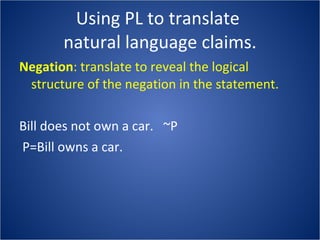
Using PL to translate  natural language claims. Negation : translate to reveal the logical structure of the negation in the statement. Bill does not own a car.
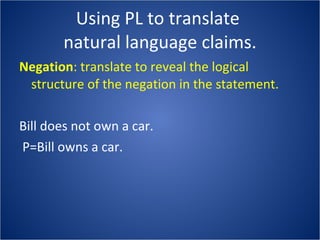
Using PL to translate  natural language claims. Negation : translate to reveal the logical structure of the negation in the statement. Bill does not own a car. P=Bill owns a car.
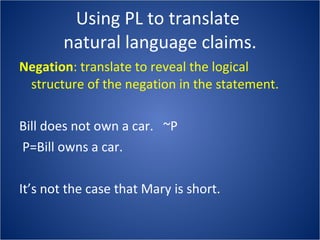
Using PL to translate  natural language claims. Negation : translate to reveal the logical structure of the negation in the statement. Bill does not own a car. ~P P=Bill owns a car.
Using PL to translate  natural language claims. Negation : translate to reveal the logical structure of the negation in the statement. Bill does not own a car. ~P P=Bill owns a car. It’s not the case that Mary is short.
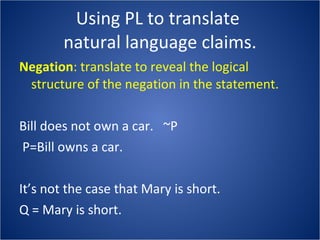
Using PL to translate  natural language claims. Negation : translate to reveal the logical structure of the negation in the statement. Bill does not own a car. ~P P=Bill owns a car. It’s not the case that Mary is short. Q = Mary is short.
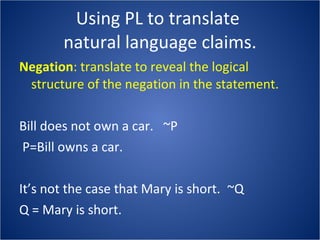
Using PL to translate  natural language claims. Negation : translate to reveal the logical structure of the negation in the statement. Bill does not own a car. ~P P=Bill owns a car. It’s not the case that Mary is short. ~Q Q = Mary is short.
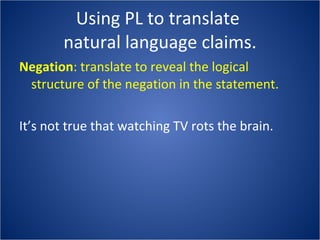
Using PL to translate  natural language claims. Negation : translate to reveal the logical structure of the negation in the statement. It’s not true that watching TV rots the brain.
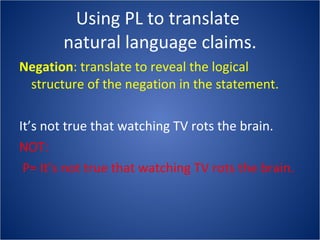
Using PL to translate  natural language claims. Negation : translate to reveal the logical structure of the negation in the statement. It’s not true that watching TV rots the brain.  NOT: P= It’s not true that watching TV rots the brain.
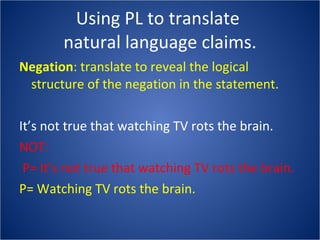
Using PL to translate  natural language claims. Negation : translate to reveal the logical structure of the negation in the statement. It’s not true that watching TV rots the brain.  NOT: P= It’s not true that watching TV rots the brain. P= Watching TV rots the brain.
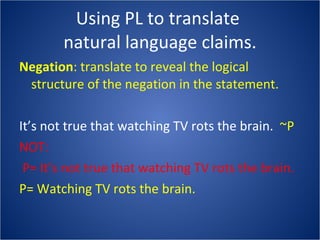
Using PL to translate  natural language claims. Negation : translate to reveal the logical structure of the negation in the statement. It’s not true that watching TV rots the brain.  ~P NOT: P= It’s not true that watching TV rots the brain. P= Watching TV rots the brain.
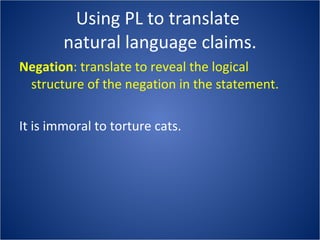
Using PL to translate  natural language claims. Negation : translate to reveal the logical structure of the negation in the statement. It is immoral to torture cats.
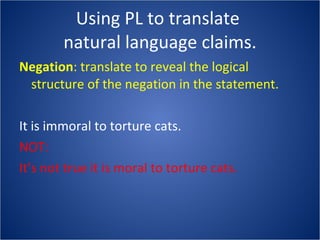
Using PL to translate  natural language claims. Negation : translate to reveal the logical structure of the negation in the statement. It is immoral to torture cats.  NOT: It’s not true it is moral to torture cats.
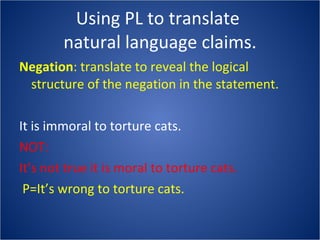
Using PL to translate  natural language claims. Negation : translate to reveal the logical structure of the negation in the statement. It is immoral to torture cats.  NOT: It’s not true it is moral to torture cats. P=It’s wrong to torture cats.
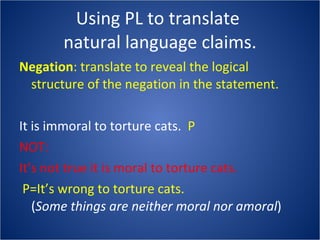
Using PL to translate  natural language claims. Negation : translate to reveal the logical structure of the negation in the statement. It is immoral to torture cats.  P NOT: It’s not true it is moral to torture cats. P=It’s wrong to torture cats. ( Some things are neither moral nor amoral )
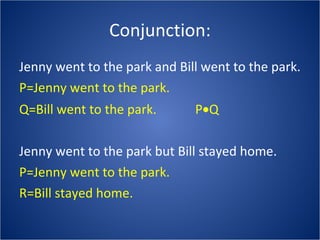
Conjunction: Jenny went to the park and Bill went to the park.
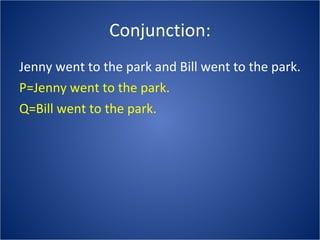
Conjunction: Jenny went to the park and Bill went to the park. P=Jenny went to the park. Q=Bill went to the park.
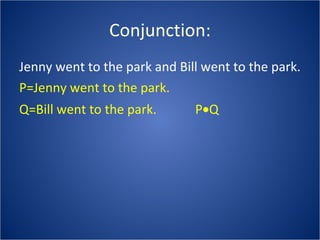
Conjunction: Jenny went to the park and Bill went to the park. P=Jenny went to the park. Q=Bill went to the park. P  Q
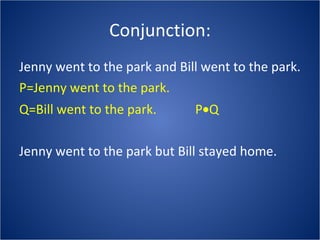
Conjunction: Jenny went to the park and Bill went to the park. P=Jenny went to the park. Q=Bill went to the park. P  Q Jenny went to the park but Bill stayed home.
Conjunction: Jenny went to the park and Bill went to the park. P=Jenny went to the park. Q=Bill went to the park. P  Q Jenny went to the park but Bill stayed home. P=Jenny went to the park. R=Bill stayed home.
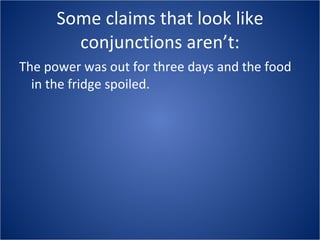
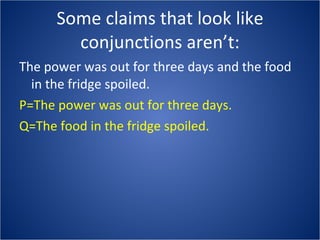
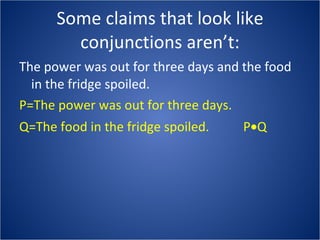
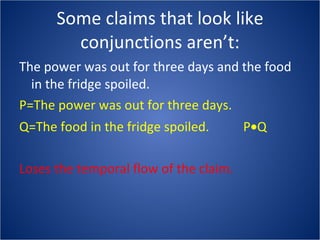
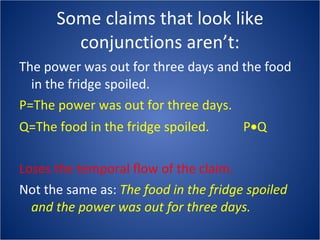
Some claims that look like conjunctions aren’t: The power was out for three days and the food in the fridge spoiled.
Some claims that look like conjunctions aren’t: The power was out for three days and the food in the fridge spoiled. P=The power was out for three days.  Q=The food in the fridge spoiled.
Some claims that look like conjunctions aren’t: The power was out for three days and the food in the fridge spoiled. P=The power was out for three days.  Q=The food in the fridge spoiled. P  Q
Some claims that look like conjunctions aren’t: The power was out for three days and the food in the fridge spoiled. P=The power was out for three days.  Q=The food in the fridge spoiled. P  Q Loses the temporal flow of the claim.
Some claims that look like conjunctions aren’t: The power was out for three days and the food in the fridge spoiled. P=The power was out for three days.  Q=The food in the fridge spoiled. P  Q Loses the temporal flow of the claim. Not the same as:  The food in the fridge spoiled and the power was out for three days.
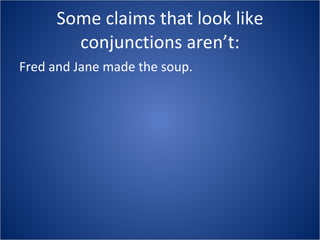
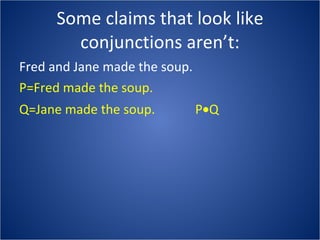
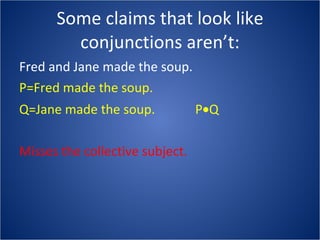
Some claims that look like conjunctions aren’t: Fred and Jane made the soup.
Some claims that look like conjunctions aren’t: Fred and Jane made the soup. P=Fred made the soup.  Q=Jane made the soup. P  Q
Some claims that look like conjunctions aren’t: Fred and Jane made the soup. P=Fred made the soup.  Q=Jane made the soup. P  Q Misses the collective subject.
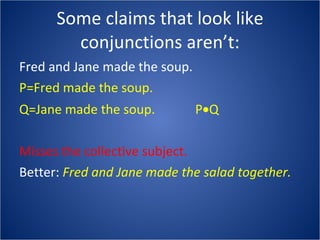
Some claims that look like conjunctions aren’t: Fred and Jane made the soup. P=Fred made the soup.  Q=Jane made the soup. P  Q Misses the collective subject. Better:  Fred and Jane made the salad together.
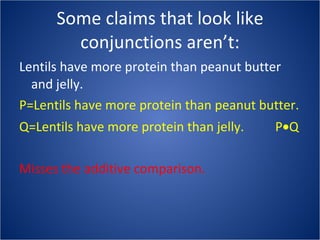
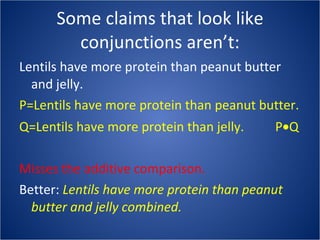
Some claims that look like conjunctions aren’t: Lentils have more protein than peanut butter and jelly.
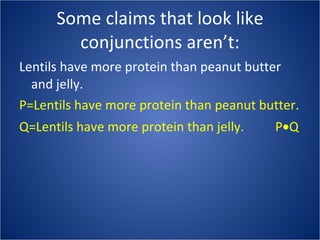
Some claims that look like conjunctions aren’t: Lentils have more protein than peanut butter and jelly. P=Lentils have more protein than peanut butter.  Q=Lentils have more protein than jelly.  P  Q
Some claims that look like conjunctions aren’t: Lentils have more protein than peanut butter and jelly. P=Lentils have more protein than peanut butter.  Q=Lentils have more protein than jelly.  P  Q Misses the additive comparison.
Some claims that look like conjunctions aren’t: Lentils have more protein than peanut butter and jelly. P=Lentils have more protein than peanut butter.  Q=Lentils have more protein than jelly.  P  Q Misses the additive comparison. Better:  Lentils have more protein than peanut butter and jelly combined.
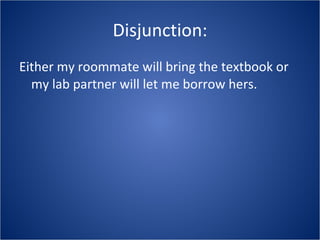
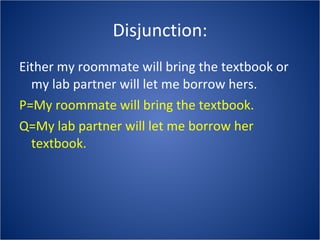
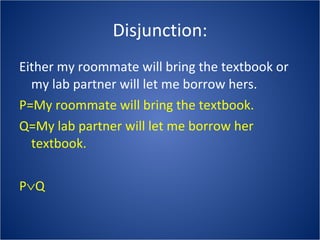
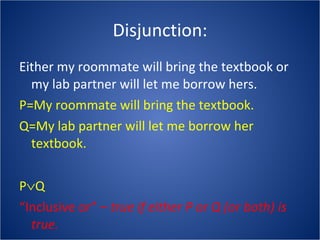
Disjunction: Either my roommate will bring the textbook or my lab partner will let me borrow hers.
Disjunction: Either my roommate will bring the textbook or my lab partner will let me borrow hers. P=My roommate will bring the textbook.  Q=My lab partner will let me borrow her textbook.
Disjunction: Either my roommate will bring the textbook or my lab partner will let me borrow hers. P=My roommate will bring the textbook.  Q=My lab partner will let me borrow her textbook.  P  Q
Disjunction: Either my roommate will bring the textbook or my lab partner will let me borrow hers. P=My roommate will bring the textbook.  Q=My lab partner will let me borrow her textbook.  P  Q  “ Inclusive or” –  true if either P or Q (or both) is true.
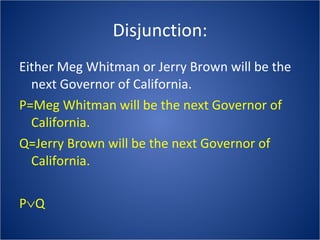
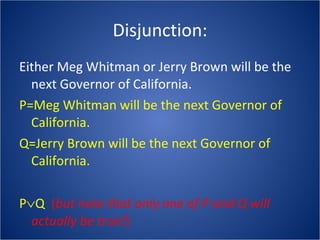
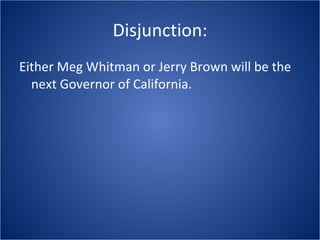
Disjunction: Either Meg Whitman or Jerry Brown will be the next Governor of California.
Disjunction: Either Meg Whitman or Jerry Brown will be the next Governor of California. P=Meg Whitman will be the next Governor of California.  Q=Jerry Brown will be the next Governor of California.
Disjunction: Either Meg Whitman or Jerry Brown will be the next Governor of California. P=Meg Whitman will be the next Governor of California.  Q=Jerry Brown will be the next Governor of California.  P  Q
Disjunction: Either Meg Whitman or Jerry Brown will be the next Governor of California. P=Meg Whitman will be the next Governor of California.  Q=Jerry Brown will be the next Governor of California.  P  Q  ( but note that only one of P and Q will actually be true! )
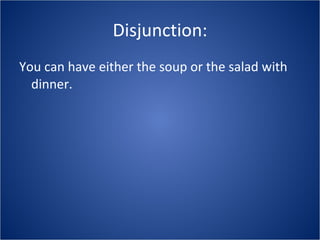
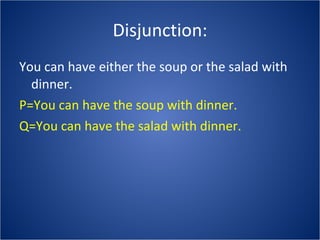
Disjunction: You can have either the soup or the salad with dinner.
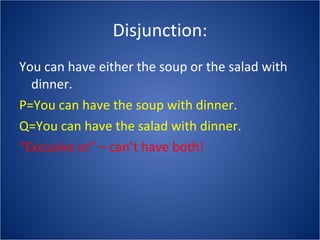
Disjunction: You can have either the soup or the salad with dinner. P=You can have the soup with dinner.  Q=You can have the salad with dinner.
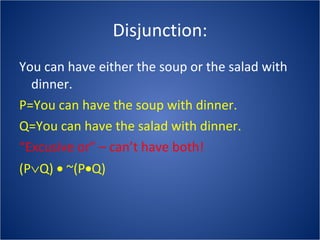
Disjunction: You can have either the soup or the salad with dinner. P=You can have the soup with dinner.  Q=You can have the salad with dinner.  “ Excusive or” – can’t have both!
Disjunction: You can have either the soup or the salad with dinner. P=You can have the soup with dinner.  Q=You can have the salad with dinner.  “ Excusive or” – can’t have both!  (P  Q)    ~(P  Q)
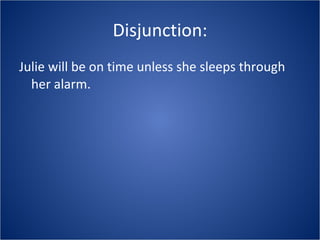
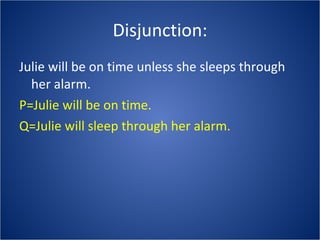
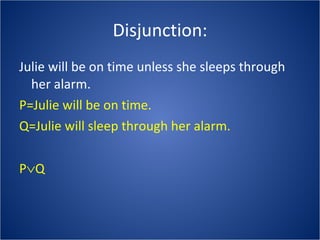
Disjunction: Julie will be on time unless she sleeps through her alarm.
Disjunction: Julie will be on time unless she sleeps through her alarm. P=Julie will be on time.  Q=Julie will sleep through her alarm.
Disjunction: Julie will be on time unless she sleeps through her alarm. P=Julie will be on time.  Q=Julie will sleep through her alarm.  P  Q
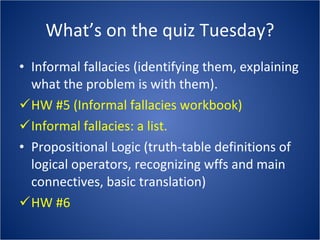
What’s on the quiz Tuesday? Informal fallacies (identifying them, explaining what the problem is with them). HW #5 (Informal fallacies workbook) Informal fallacies: a list. Propositional Logic (truth-table definitions of logical operators, recognizing wffs and main connectives, basic translation) HW #6

Propositional logic

  • 1.
    Propositional Logic Phil57 section 3 San Jose State University Fall 2010
  • 2.
    Using PL totranslate natural language claims. Negation : translate to reveal the logical structure of the negation in the statement. Bill does not own a car.
  • 3.
    Using PL totranslate natural language claims. Negation : translate to reveal the logical structure of the negation in the statement. Bill does not own a car. P=Bill owns a car.
  • 4.
    Using PL totranslate natural language claims. Negation : translate to reveal the logical structure of the negation in the statement. Bill does not own a car. ~P P=Bill owns a car.
  • 5.
    Using PL totranslate natural language claims. Negation : translate to reveal the logical structure of the negation in the statement. Bill does not own a car. ~P P=Bill owns a car. It’s not the case that Mary is short.
  • 6.
    Using PL totranslate natural language claims. Negation : translate to reveal the logical structure of the negation in the statement. Bill does not own a car. ~P P=Bill owns a car. It’s not the case that Mary is short. Q = Mary is short.
  • 7.
    Using PL totranslate natural language claims. Negation : translate to reveal the logical structure of the negation in the statement. Bill does not own a car. ~P P=Bill owns a car. It’s not the case that Mary is short. ~Q Q = Mary is short.
  • 8.
    Using PL totranslate natural language claims. Negation : translate to reveal the logical structure of the negation in the statement. It’s not true that watching TV rots the brain.
  • 9.
    Using PL totranslate natural language claims. Negation : translate to reveal the logical structure of the negation in the statement. It’s not true that watching TV rots the brain. NOT: P= It’s not true that watching TV rots the brain.
  • 10.
    Using PL totranslate natural language claims. Negation : translate to reveal the logical structure of the negation in the statement. It’s not true that watching TV rots the brain. NOT: P= It’s not true that watching TV rots the brain. P= Watching TV rots the brain.
  • 11.
    Using PL totranslate natural language claims. Negation : translate to reveal the logical structure of the negation in the statement. It’s not true that watching TV rots the brain. ~P NOT: P= It’s not true that watching TV rots the brain. P= Watching TV rots the brain.
  • 12.
    Using PL totranslate natural language claims. Negation : translate to reveal the logical structure of the negation in the statement. It is immoral to torture cats.
  • 13.
    Using PL totranslate natural language claims. Negation : translate to reveal the logical structure of the negation in the statement. It is immoral to torture cats. NOT: It’s not true it is moral to torture cats.
  • 14.
    Using PL totranslate natural language claims. Negation : translate to reveal the logical structure of the negation in the statement. It is immoral to torture cats. NOT: It’s not true it is moral to torture cats. P=It’s wrong to torture cats.
  • 15.
    Using PL totranslate natural language claims. Negation : translate to reveal the logical structure of the negation in the statement. It is immoral to torture cats. P NOT: It’s not true it is moral to torture cats. P=It’s wrong to torture cats. ( Some things are neither moral nor amoral )
  • 16.
    Conjunction: Jenny wentto the park and Bill went to the park.
  • 17.
    Conjunction: Jenny wentto the park and Bill went to the park. P=Jenny went to the park. Q=Bill went to the park.
  • 18.
    Conjunction: Jenny wentto the park and Bill went to the park. P=Jenny went to the park. Q=Bill went to the park. P  Q
  • 19.
    Conjunction: Jenny wentto the park and Bill went to the park. P=Jenny went to the park. Q=Bill went to the park. P  Q Jenny went to the park but Bill stayed home.
  • 20.
    Conjunction: Jenny wentto the park and Bill went to the park. P=Jenny went to the park. Q=Bill went to the park. P  Q Jenny went to the park but Bill stayed home. P=Jenny went to the park. R=Bill stayed home.
  • 21.
    Some claims thatlook like conjunctions aren’t: The power was out for three days and the food in the fridge spoiled.
  • 22.
    Some claims thatlook like conjunctions aren’t: The power was out for three days and the food in the fridge spoiled. P=The power was out for three days. Q=The food in the fridge spoiled.
  • 23.
    Some claims thatlook like conjunctions aren’t: The power was out for three days and the food in the fridge spoiled. P=The power was out for three days. Q=The food in the fridge spoiled. P  Q
  • 24.
    Some claims thatlook like conjunctions aren’t: The power was out for three days and the food in the fridge spoiled. P=The power was out for three days. Q=The food in the fridge spoiled. P  Q Loses the temporal flow of the claim.
  • 25.
    Some claims thatlook like conjunctions aren’t: The power was out for three days and the food in the fridge spoiled. P=The power was out for three days. Q=The food in the fridge spoiled. P  Q Loses the temporal flow of the claim. Not the same as: The food in the fridge spoiled and the power was out for three days.
  • 26.
    Some claims thatlook like conjunctions aren’t: Fred and Jane made the soup.
  • 27.
    Some claims thatlook like conjunctions aren’t: Fred and Jane made the soup. P=Fred made the soup. Q=Jane made the soup. P  Q
  • 28.
    Some claims thatlook like conjunctions aren’t: Fred and Jane made the soup. P=Fred made the soup. Q=Jane made the soup. P  Q Misses the collective subject.
  • 29.
    Some claims thatlook like conjunctions aren’t: Fred and Jane made the soup. P=Fred made the soup. Q=Jane made the soup. P  Q Misses the collective subject. Better: Fred and Jane made the salad together.
  • 30.
    Some claims thatlook like conjunctions aren’t: Lentils have more protein than peanut butter and jelly.
  • 31.
    Some claims thatlook like conjunctions aren’t: Lentils have more protein than peanut butter and jelly. P=Lentils have more protein than peanut butter. Q=Lentils have more protein than jelly. P  Q
  • 32.
    Some claims thatlook like conjunctions aren’t: Lentils have more protein than peanut butter and jelly. P=Lentils have more protein than peanut butter. Q=Lentils have more protein than jelly. P  Q Misses the additive comparison.
  • 33.
    Some claims thatlook like conjunctions aren’t: Lentils have more protein than peanut butter and jelly. P=Lentils have more protein than peanut butter. Q=Lentils have more protein than jelly. P  Q Misses the additive comparison. Better: Lentils have more protein than peanut butter and jelly combined.
  • 34.
    Disjunction: Either myroommate will bring the textbook or my lab partner will let me borrow hers.
  • 35.
    Disjunction: Either myroommate will bring the textbook or my lab partner will let me borrow hers. P=My roommate will bring the textbook. Q=My lab partner will let me borrow her textbook.
  • 36.
    Disjunction: Either myroommate will bring the textbook or my lab partner will let me borrow hers. P=My roommate will bring the textbook. Q=My lab partner will let me borrow her textbook. P  Q
  • 37.
    Disjunction: Either myroommate will bring the textbook or my lab partner will let me borrow hers. P=My roommate will bring the textbook. Q=My lab partner will let me borrow her textbook. P  Q “ Inclusive or” – true if either P or Q (or both) is true.
  • 38.
    Disjunction: Either MegWhitman or Jerry Brown will be the next Governor of California.
  • 39.
    Disjunction: Either MegWhitman or Jerry Brown will be the next Governor of California. P=Meg Whitman will be the next Governor of California. Q=Jerry Brown will be the next Governor of California.
  • 40.
    Disjunction: Either MegWhitman or Jerry Brown will be the next Governor of California. P=Meg Whitman will be the next Governor of California. Q=Jerry Brown will be the next Governor of California. P  Q
  • 41.
    Disjunction: Either MegWhitman or Jerry Brown will be the next Governor of California. P=Meg Whitman will be the next Governor of California. Q=Jerry Brown will be the next Governor of California. P  Q ( but note that only one of P and Q will actually be true! )
  • 42.
    Disjunction: You canhave either the soup or the salad with dinner.
  • 43.
    Disjunction: You canhave either the soup or the salad with dinner. P=You can have the soup with dinner. Q=You can have the salad with dinner.
  • 44.
    Disjunction: You canhave either the soup or the salad with dinner. P=You can have the soup with dinner. Q=You can have the salad with dinner. “ Excusive or” – can’t have both!
  • 45.
    Disjunction: You canhave either the soup or the salad with dinner. P=You can have the soup with dinner. Q=You can have the salad with dinner. “ Excusive or” – can’t have both! (P  Q)  ~(P  Q)
  • 46.
    Disjunction: Julie willbe on time unless she sleeps through her alarm.
  • 47.
    Disjunction: Julie willbe on time unless she sleeps through her alarm. P=Julie will be on time. Q=Julie will sleep through her alarm.
  • 48.
    Disjunction: Julie willbe on time unless she sleeps through her alarm. P=Julie will be on time. Q=Julie will sleep through her alarm. P  Q
  • 49.
    What’s on thequiz Tuesday? Informal fallacies (identifying them, explaining what the problem is with them). HW #5 (Informal fallacies workbook) Informal fallacies: a list. Propositional Logic (truth-table definitions of logical operators, recognizing wffs and main connectives, basic translation) HW #6