DISCRETE MATHEMATICS
LOGIC
All Mathematicians wear sandals Anyone who wears sandals is an algebraist Therefore, all mathematicians are algebraist
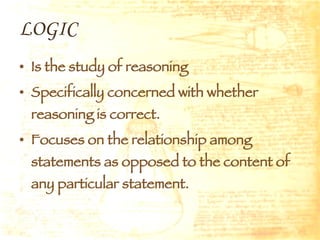
LOGIC Is the study of reasoning Specifically concerned with whether reasoning is correct. Focuses on the relationship among statements as opposed to the content of any particular statement.
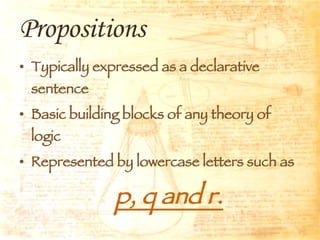
Propositions Typically expressed as a declarative sentence Basic building blocks of any theory of logic Represented by lowercase letters such as  p, q and r.
Connectives Used to combine propositions
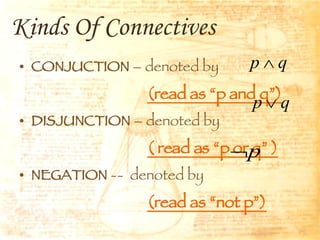
Kinds Of Connectives CONJUCTION  – denoted by  (read as “p and q”) DISJUNCTION  – denoted by  ( read as “p or q” ) NEGATION  --  denoted by  (read as “not p”)
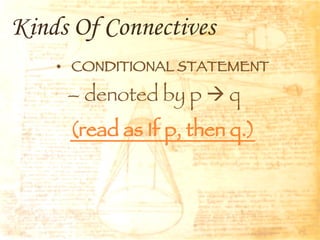
Kinds Of Connectives CONDITIONAL STATEMENT denoted by p    q   (read as If p, then q.)
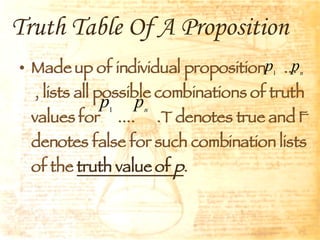
Truth Table Of A Proposition   Made up of individual proposition  ...  , lists all possible combinations of truth values for  ....  .T denotes true and F denotes false for such combination lists of the  truth value of  p .
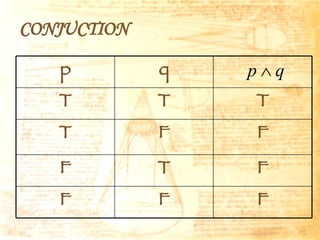
CONJUCTION p q T T T T F F F T F F F F
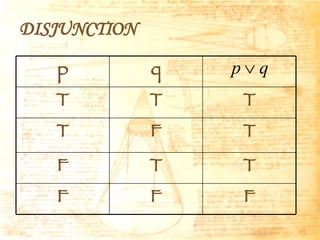
DISJUNCTION p q T T T T F T F T T F F F
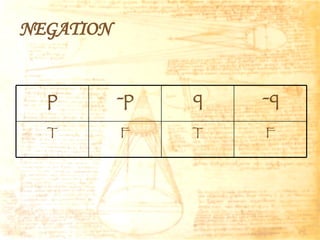
NEGATION p -p q -q T F T F
IF-THEN STATEMENTS The most commonly used connectives. It also known as conditional statements or implications.
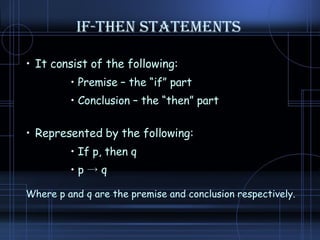
IF-THEN STATEMENTS It consist of the following: Premise – the “if” part Conclusion – the “then” part Represented by the following: If p, then q p  -> q Where p and q are the premise and conclusion respectively.
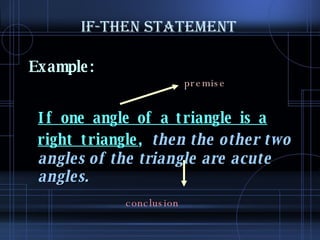
IF-THEN STATEMENT Example: If one angle of a triangle is a right triangle ,  then the other two angles of the triangle are acute angles.  premise conclusion
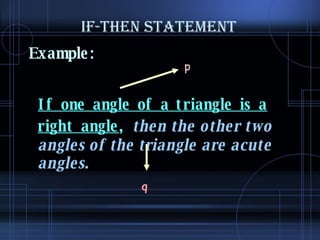
IF-THEN STATEMENT Example: If one angle of a triangle is a right angle ,  then the other two angles of the triangle are acute angles.  p q
IF-THEN STATEMENTS it can only be false when the premise is true but the conclusion is false.
If
If If a picture paints a thousand words  Then why can't I paint you?  The words will never show  For you I've come to know.  If a face could launch a thousand ships  Then where am I to go?  There's no one home but you  And now you've left me too.
And when my love for life is running dry  You come and pour yourself on me  If a man could be two places at one time  I'd be with you.  Tomorrow and today  Beside you all the way  If the world should stop revolving  Spinning slowly down to die.
I'd spend the end with you And when the world was through...  Then one by one, the stars would all go out.  Then you and I, would simply fly away.
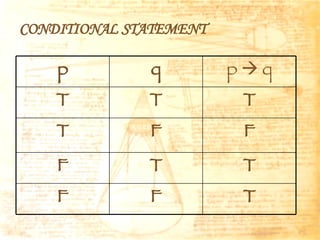
CONDITIONAL STATEMENT p q p    q T T T T F F F T T F F T
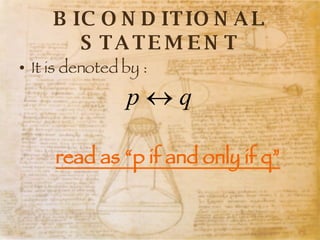
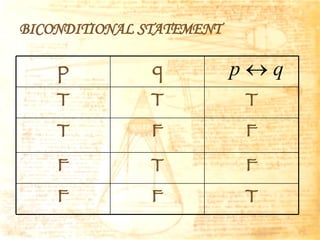
BICONDITIONAL STATEMENT It is denoted by : read as “p if and only if q”
BICONDITIONAL STATEMENT p q T T T T F F F T F F F T
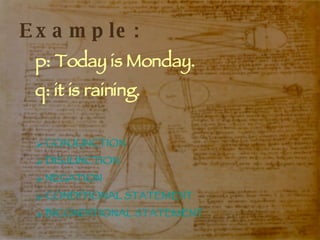
Example: p: Today is Monday. q: it is raining. CONJUNCTION DISJUNCTION NEGATION CONDITIONAL STATEMENT BICONDITIONAL STATEMENT
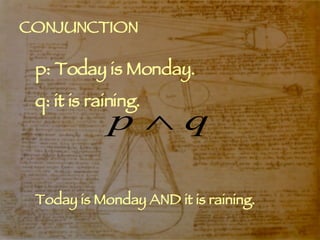
CONJUNCTION p: Today is Monday. q: it is raining. Today is Monday AND it is raining.
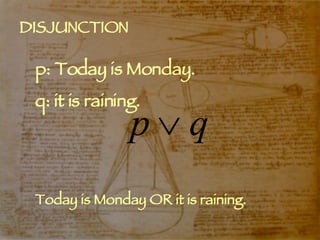
DISJUNCTION p: Today is Monday. q: it is raining. Today is Monday OR it is raining.
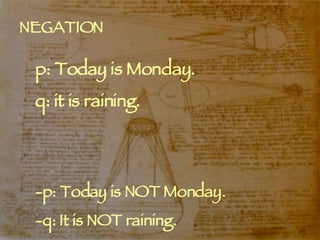
NEGATION p: Today is Monday. q: it is raining. -p: Today is NOT Monday. -q: It is NOT raining.
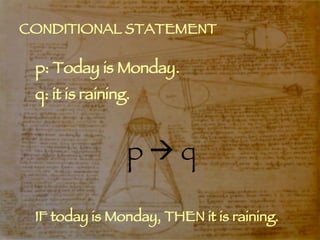
CONDITIONAL STATEMENT p: Today is Monday. q: it is raining. p    q IF today is Monday, THEN it is raining.
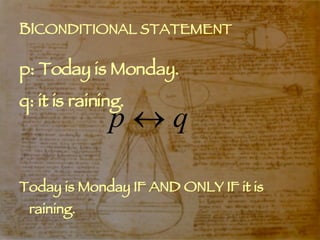
BI CONDITIONAL STATEMENT p: Today is Monday. q: it is raining. Today is Monday IF AND ONLY IF it is raining.

Discrete Mathematics Lecture

  • 1.
  • 2.
  • 3.
    All Mathematicians wearsandals Anyone who wears sandals is an algebraist Therefore, all mathematicians are algebraist
  • 4.
    LOGIC Is thestudy of reasoning Specifically concerned with whether reasoning is correct. Focuses on the relationship among statements as opposed to the content of any particular statement.
  • 5.
    Propositions Typically expressedas a declarative sentence Basic building blocks of any theory of logic Represented by lowercase letters such as p, q and r.
  • 6.
    Connectives Used tocombine propositions
  • 7.
    Kinds Of ConnectivesCONJUCTION – denoted by (read as “p and q”) DISJUNCTION – denoted by ( read as “p or q” ) NEGATION -- denoted by (read as “not p”)
  • 8.
    Kinds Of ConnectivesCONDITIONAL STATEMENT denoted by p  q (read as If p, then q.)
  • 9.
    Truth Table OfA Proposition Made up of individual proposition ... , lists all possible combinations of truth values for .... .T denotes true and F denotes false for such combination lists of the truth value of p .
  • 10.
    CONJUCTION p qT T T T F F F T F F F F
  • 11.
    DISJUNCTION p qT T T T F T F T T F F F
  • 12.
    NEGATION p -pq -q T F T F
  • 13.
    IF-THEN STATEMENTS Themost commonly used connectives. It also known as conditional statements or implications.
  • 14.
    IF-THEN STATEMENTS Itconsist of the following: Premise – the “if” part Conclusion – the “then” part Represented by the following: If p, then q p -> q Where p and q are the premise and conclusion respectively.
  • 15.
    IF-THEN STATEMENT Example:If one angle of a triangle is a right triangle , then the other two angles of the triangle are acute angles. premise conclusion
  • 16.
    IF-THEN STATEMENT Example:If one angle of a triangle is a right angle , then the other two angles of the triangle are acute angles. p q
  • 17.
    IF-THEN STATEMENTS itcan only be false when the premise is true but the conclusion is false.
  • 18.
  • 19.
    If If apicture paints a thousand words Then why can't I paint you? The words will never show For you I've come to know. If a face could launch a thousand ships Then where am I to go? There's no one home but you And now you've left me too.
  • 20.
    And when mylove for life is running dry You come and pour yourself on me If a man could be two places at one time I'd be with you. Tomorrow and today Beside you all the way If the world should stop revolving Spinning slowly down to die.
  • 21.
    I'd spend theend with you And when the world was through... Then one by one, the stars would all go out. Then you and I, would simply fly away.
  • 22.
    CONDITIONAL STATEMENT pq p  q T T T T F F F T T F F T
  • 23.
    BICONDITIONAL STATEMENT Itis denoted by : read as “p if and only if q”
  • 24.
    BICONDITIONAL STATEMENT pq T T T T F F F T F F F T
  • 25.
    Example: p: Todayis Monday. q: it is raining. CONJUNCTION DISJUNCTION NEGATION CONDITIONAL STATEMENT BICONDITIONAL STATEMENT
  • 26.
    CONJUNCTION p: Todayis Monday. q: it is raining. Today is Monday AND it is raining.
  • 27.
    DISJUNCTION p: Todayis Monday. q: it is raining. Today is Monday OR it is raining.
  • 28.
    NEGATION p: Todayis Monday. q: it is raining. -p: Today is NOT Monday. -q: It is NOT raining.
  • 29.
    CONDITIONAL STATEMENT p:Today is Monday. q: it is raining. p  q IF today is Monday, THEN it is raining.
  • 30.
    BI CONDITIONAL STATEMENTp: Today is Monday. q: it is raining. Today is Monday IF AND ONLY IF it is raining.