Downloaded 11 times
![DEEP LEARNING JP
[DL Papers]
http://deeplearning.jp/](https://image.slidesharecdn.com/20200619akuzawa-200630053016/85/DL-Weakly-Supervised-Disentanglement-Without-Compromises-1-320.jpg)
![DEEP LEARNING JP
[DL Papers]
http://deeplearning.jp/](https://image.slidesharecdn.com/20200619akuzawa-200630053016/75/DL-Weakly-Supervised-Disentanglement-Without-Compromises-1-2048.jpg)
![z = [z1, . . . , zd]T
̂z = [ ̂z1, . . . , ̂zd]T
̂z
f π i zi = fi( ̂zπ(i))
z](https://image.slidesharecdn.com/20200619akuzawa-200630053016/85/DL-Weakly-Supervised-Disentanglement-Without-Compromises-3-320.jpg)
![(x1, x2) ∼ p(x1, x2) =
∫ ∫ ∫
p(x1, x2, z, ˜z, S)dzd˜zdS
|S| = k
S, S′ ∼ p(S) P(S ∩ S′ = {i}) > 0,∀i ∈ [d]
p( ̂zi) q(x1 | ̂z) p( ̂S)
q( ̂z) =
∫
q( ̂z|x1)p(x1)dx](https://image.slidesharecdn.com/20200619akuzawa-200630053016/85/DL-Weakly-Supervised-Disentanglement-Without-Compromises-12-320.jpg)

![[DL輪読会]Weakly-Supervised Disentanglement Without Compromises](https://image.slidesharecdn.com/20200619akuzawa-200630053016/85/DL-Weakly-Supervised-Disentanglement-Without-Compromises-23-320.jpg)

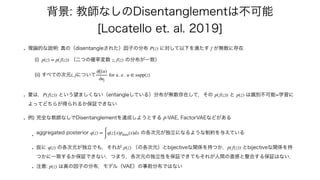
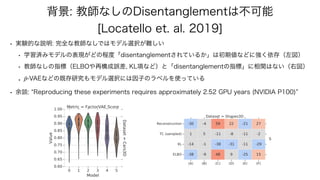
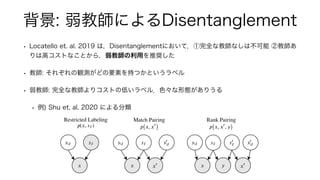
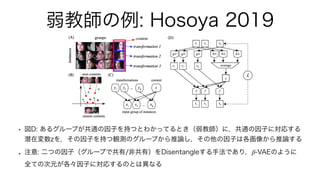
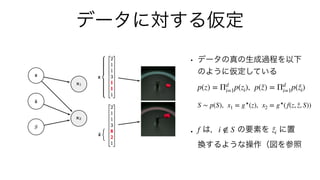
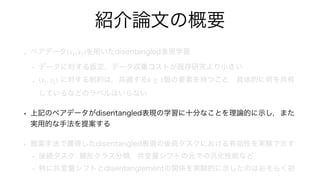
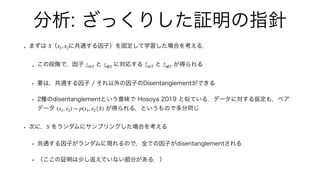
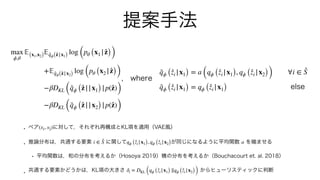
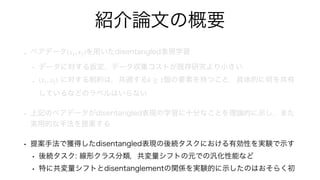
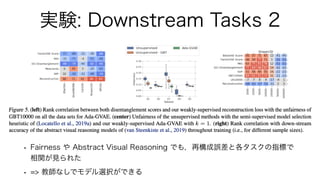
1. The document presents a method for deep learning using variational autoencoders that model the relationship between pairs of data points (x1, x2). 2. It introduces variables to represent latent vectors z and z~ that are used to generate x1 and x2, as well as a subset S of dimensions that relate x1 and x2. 3. The method works by training an encoder qφ(z|x) to approximate a prior p(z) and maximize the likelihood of generating x1 and x2 from their respective latent representations, while minimizing the KL divergence between the encoder and prior.


![[DL輪読会]Learning Transferable Visual Models From Natural Language Supervision](https://cdn.slidesharecdn.com/ss_thumbnails/dlkobayashi0115-210115012308-thumbnail.jpg?width=640&height=640&fit=bounds)


![[DL輪読会]Life-Long Disentangled Representation Learning with Cross-Domain Laten...](https://cdn.slidesharecdn.com/ss_thumbnails/20180914iwasawa-180919025635-thumbnail.jpg?width=640&height=640&fit=bounds)

![[DL輪読会]Flow-based Deep Generative Models](https://cdn.slidesharecdn.com/ss_thumbnails/20190307-190328024744-thumbnail.jpg?width=640&height=640&fit=bounds)


![[DL輪読会]Dream to Control: Learning Behaviors by Latent Imagination](https://cdn.slidesharecdn.com/ss_thumbnails/20200313furutav2-200313025657-thumbnail.jpg?width=640&height=640&fit=bounds)
![[DL輪読会]NVAE: A Deep Hierarchical Variational Autoencoder](https://cdn.slidesharecdn.com/ss_thumbnails/nvaeadeephierarchicalvariationalautoencoder-201113004930-thumbnail.jpg?width=640&height=640&fit=bounds)


![SSII2022 [TS1] Transformerの最前線〜 畳込みニューラルネットワークの先へ 〜](https://cdn.slidesharecdn.com/ss_thumbnails/ts120220608ssiitransformerr2-220607054025-3adacf07-thumbnail.jpg?width=640&height=640&fit=bounds)

![[DL輪読会]Learning Latent Dynamics for Planning from Pixels](https://cdn.slidesharecdn.com/ss_thumbnails/taniguchi20181221-190104064850-thumbnail.jpg?width=640&height=640&fit=bounds)
![SSII2021 [OS2-01] 転移学習の基礎:異なるタスクの知識を利用するための機械学習の方法](https://cdn.slidesharecdn.com/ss_thumbnails/os2-02final-210610091211-thumbnail.jpg?width=640&height=640&fit=bounds)
![[DL輪読会]Quantization and Training of Neural Networks for Efficient Integer-Ari...](https://cdn.slidesharecdn.com/ss_thumbnails/20180209misono-180209000316-thumbnail.jpg?width=640&height=640&fit=bounds)


![[Paper Reading] Causal Bandits: Learning Good Interventions via Causal Inference](https://cdn.slidesharecdn.com/ss_thumbnails/reading201912-191206052456-thumbnail.jpg?width=640&height=640&fit=bounds)
![[DL輪読会]Recent Advances in Autoencoder-Based Representation Learning](https://cdn.slidesharecdn.com/ss_thumbnails/20190119dljournalclubweb-190401063633-thumbnail.jpg?width=640&height=640&fit=bounds)


