FLUIDS &
ELECTROLYTE
S IN SURGERY
*** ***
DR. MUGENYA
Fluid And Electrolytes
Therapy
 Though fluid and electrolyte therapy can
be a lifesaver, it can also be very harmful.
 Fluid and electrolyte balance is an
extremely complicated thing.
 It requires the understanding of its
composition and distribution in the body.
Fluids & Electrolytes
Total body water:
 60% of total body weight in males.
 55% of total body weight in females.
 75% of total body weight in infants.
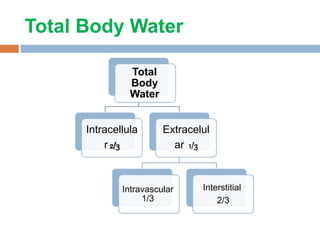
Total Body Water
Total
Body
Water
Intracellula
r 2/3
Extracelul
ar 1/3
Intravascular
1/3
Interstitial
2/3
Total Body Water
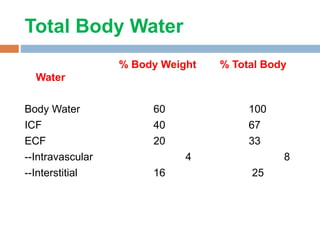
% Body Weight % Total Body
Water
Body Water 60 100
ICF 40 67
ECF 20 33
--Intravascular 4 8
--Interstitial 16 25
Water Sources & Losses
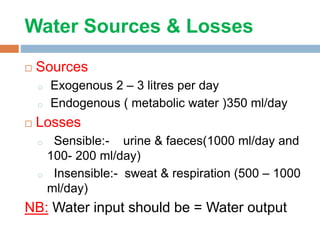
 Sources
o Exogenous 2 – 3 litres per day
o Endogenous ( metabolic water )350 ml/day
 Losses
o Sensible:- urine & faeces(1000 ml/day and
100- 200 ml/day)
o Insensible:- sweat & respiration (500 – 1000
ml/day)
NB: Water input should be = Water output
Electrolytes Metabolism
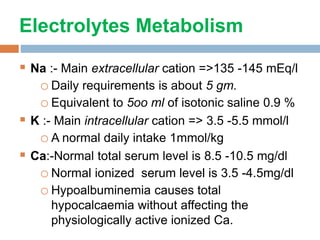
 Na :- Main extracellular cation =>135 -145 mEq/l
oDaily requirements is about 5 gm.
oEquivalent to 5oo ml of isotonic saline 0.9 %
 K :- Main intracellular cation => 3.5 -5.5 mmol/l
oA normal daily intake 1mmol/kg
 Ca:-Normal total serum level is 8.5 -10.5 mg/dl
oNormal ionized serum level is 3.5 -4.5mg/dl
oHypoalbuminemia causes total
hypocalcaemia without affecting the
physiologically active ionized Ca.
Perioperative Fluid Therapy
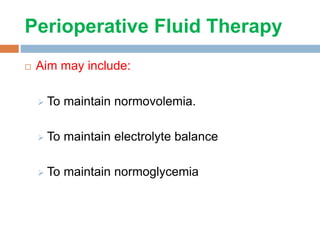
 Aim may include:
 To maintain normovolemia.
 To maintain electrolyte balance
 To maintain normoglycemia
Types of Fluids
 Fluids are generally classified as:
1. Crystalloids.
2. Colloids.
 They are jointly referred to as plasma
expanders or volume expanders.
 Fluids can also be classified as:
1. Hypertonic
2. Isotonic
3. Hypotonic
Crystalloids
 Aqueous solutions of low molecular weight
ions(salts)
 With or without glucose.
 Sodium is the major osmotically active
particle.
 Crystalloid replacement should be 3 to 6 times
the volume of lost blood.
Some Crystalloids
Normal saline(NS).
Lactated Ringer’s solution(LR).
5% dextrose in water (D5W).
Ringer’s acetate.
D5LR.
D5 NS.
D5 ½ NS.
Hypertonic saline(HS)3%.
Normal Saline
 Na 154 mEq/L.; Cl 154 mEq/L.; PH 5.7
 Uses: Hyponatreamia.
Brain oedema.
 0.9% NaCl (isotonic) 308 mOsm/L.
 Large quantity may lead to hyperchloremic
metabolic acidosis.
 The predominant effect of volume resuscitation
with crystalloid fluids is to expand the interstitial
fluid volume rather than the plasma volume
Lactated Ringer’s (LR)
 Osmolarity 273 mOsm/L
 Na —130 mEq/L
 Cl —109 mEq/L
 K — 4 mEq/L
 Ca — 3 mEq/L
 Lactate —28 mEq/L
 The most physiological solution.
 Lactate is converted into HCO3 in the liver
Ringer’s Acetate
 Acetate —28 mEq/L
 Metabolism 2.5-4 times faster than lactate (in
muscles).
Glucose 5% (5% Dextrose)
 It functions as free water.
 50 gm/L isotonic (253 mOsm/L).
 Uses:
 To maintain normoglycemia.
 To correct Hypernatraemia.
 To keep an IV line open for medication.
 Not used for volume expansion => predominant effect is
to expand the intracellular volume (cellular oedema).
 During surgery only given for patients at risk of
hypoglycemia(infants, insulin therapy).
 Avoided in critically ill (increases CO2 production and
aggravates ischemic brain injury).
Hypertonic Saline HS 3%
 Osmolarity of1026 mOsm/L.
 Na — 513 mEq/L.
 Cl — 513 mEq/L.
 It expands plasma volume by the
increasing IV oncotic pressure(fluids move
from IC space).
 More effective than crystalloids.
 Uses: -Severe hyponatreamia.
-Early treatment of hypovolaemic
shock.
 Side effects:
Colloids
 Solutions containing high-molecular
weight substances such as proteins or
large glucose polymers.
 Plasma is expanded by:
 Volume of colloid.
 Increasing plasma oncotic pressure
which moves fluids from interstitial
space to intravenous spaces.
Colloids –vs— Crystalloids
 Colloids stays longer in IV space (3-6 hrs.)
compared to crystalloids (20-30 min.).
 Colloids 3 times potent than crystalloids.
 Severe IV fluid deficits can be more
rapidly corrected using colloids.
 Colloid resuscitation is more expensive.
 Rapid administration of large amounts of
crystalloids (>4-5L) is more frequently
associated with significant tissue edema.
Types of Colloids
Sources:
 Blood derived
*Human albumin.
 Synthetic
* Starches.
* Gelatins.
*Dextrans.
Human Albumin
 Formulations:
 5% (isotonic) in NS.
 25% (hypertonic) in NS.
 Uses:
 Abnormal protein loss: e.g peritonitis.
 Severe burns.
 Expensive.
 No risk of viral infection.
 Rare allergic reactions.
 No effect on coagulation.
Starches
 Examples:
 Hetastarch 6%(Hydroxyethyl Starch ; HES)
 Pentastarch 10% in NS.
More effective than 5% albumin, gelatins
and dextrans.
Non-antigenic => No effect on cross-
matching.
Lower cost than albumin.
Cleared by the kidneys.
 Disadvantages:
 Coagulation abnormalities if >1.5L. is given.
 Rare anaphylactic reactions.
 Elevated serum amylase.
Gelatins
 Degraded gelatin polypeptides:
 Examples:
 Haemagel
Relatively cheap.
No effect on coagulation or on cross-
matching.
High incidence of allergic reactions.
Dextrans
 Long-chain glucose polysaccharides.
 Dextran 40 and 70 in NS or 5% dextrose.
 Anti-thrombotic effects.
 Dextran 70 is preferred (12hrs.).
 Dextran 40 improves blood flow in
microcirculation.
 Uses:
*Plasma expander.
*To prevent thromboembolism
(postoperative.).
…Dextrans
 Disadvantages:
1. Bleeding tendency.
2. Interfere with blood grouping and
cross-matching.
3. Rare anaphylactic reactions.
4. Dextran 40 can precipitate in renal
tubules leading to renal failure.
Peri-operative Fluid Therapy
May be required to address the following:
 Compensatory IV volume expansion.
 Normal maintenance requirements.
 Pre-existing deficits.
 Surgical fluid losses:
*Blood.
*Other fluids.
Peri-operative Situations
 Factors that need to be considered in the
peri-operative period:
 Patient (age, physiological reserve, pre-op
status)
 Clinical context (magnitude of surgery, blood
loss, etc.)
 Existing deficit
 Stress response - causes salt and water
retention.
 Anticipated losses( Fever, Respiratory rate
Compensatory Volume
Expansion
 5-7 ml/kg of crystalloid before anaesthesia.
 This is to compensate for vasodilatation and
cardiac depression by anaesthetic drugs.
 For spinal anaesthesia pre-loading is
mandatory (1 litre in adults)
Normal Maintenance
Requirements
The 4 / 2 / 1 rule:
 For the first 10 kg: 4 ml/kg/h.
 For the next 10-20 kg: 2 ml/kg/h.
 For each kg above 20 kg: add 1 ml/kg/h.
Example:
Maintenance fluid needs for a 25 kg child:
40+20+5= 65ml/hour.
Postoperative
Requirements to consider:
 Water: as maintenance.
 Potassium: 1 mmol/kg/day.
 Sodium: 1-1.5 mmol/kg/day
 For 70 kg adult:
 2640 ml water
 70-100 mmol Na
 70 mmol K (remember rule of 40)
(Urine output at least40ml/h; Not more than 40 mmol added
to1L drip; Not faster than 40 mmol/hr.)
 Choice of fluids for 70 kg adult:
 2L dextrose 5% => 100gm glucose
 500 ml NS => 75 mmol sodium
Preexisting Deficits
 The deficit can be estimated by multiplying
the normal maintenance rate by the length
of the fast.
 70 kg person fasting 8 hr:
 40+20+50 ml/h x 8h =880 ml.
 Consider abnormal losses.
Patients Who Are Eating
 Patients who are eating require
“supplemental” fluids (due to inadequate
oral intake):
May require only small amounts of IV
fluid.
 Intravenous potassium replacement is not
usually required (even if hypokalaemic):
Can usually use oral supplementation.
…Patients Who Are Eating
 Calculate the amount of water actually
required:
If needs one litre in addition to oral
intake, then give only one litre in a day
(as NS or dextrose solution).
If no other intravenous drug access is
required and intravenous access is
difficult:
o Consider a subcutaneous line (maximum
rate 80 ml/h).
Surgical Fluid Losses
Blood loss:
 Continuous monitoring and accurate
estimation of blood loss is very important:
 For each 1 ml loss replace with 3 mls
crystalloids or 1 ml colloids.
Other losses:
 Evaporation from large exposed wounds.
 Third space losses.
Guidelines For Fluid Therapy
 Use a short large-bore I.V. cannula.
 The consequences of hypovolemia carry
high mortality and must be treated
promptly.
 Do not give inotropes to hypovolaemic
patient.
 For old, cardiac, hepatic or renal patients,
replace gradually.
Only half calculated deficit is given
initially.
…Guidelines For Fluid
Therapy
 Crystalloids, when given in sufficient
amounts are just as effective as colloids:
ie. 3-6 times the volume.
 Severe deficits correct by colloids.
 Rapid large amounts of crystalloids(>5L)
is frequently associated with tissue
edema.
 Monitor clinical markers of perfusion:
Capillary refill time
Urine output
…Guidelines For Fluid
Therapy
 Observations (Pulse-BP-CVP)
 CVP if central venous access present (5-12cmH2O)
 Patient thirst
 Response to fluid challenge
 Investigations:
 Electrolytes (Na & K)
 Heamoglobin
 Urine out put more than 0.5ml/kg/h.
 ABG—Arterial blood gas
 CXR
Water Depletion
Causes:
 Lack of intake
 Diabetes insipidus
 Increased out put (fever; osmotic diuresis)
C/P:
 Intense thirst & weakness, decreased skin
turgor, oliguria with increased specific gravity.
 Initially increase in serum Na: 3mmol=1L water
deficit
Mx:
Water Excess
Causes
 Over infusion of IV 5% glucose in post operative
patients.
 Colorectal washout with plain water before colonic
surgery.
 Excessive uptake of water during TURP.
Findings:
 Moderate:- Asymptomatic; increased urine volume;
increase in body weight; decrease in Na &
haematocrit.
 Marked:- Na <120 meq/L; cerebral oedema, nausea &
vomiting of clear fluid
Mx:
 Mild water excess require fluid restriction
 Severe:- induction of diuresis by Mannitol+careful infusion of 5%
Electrolyte Imbalance
HYPONATREAMIA
CAUSES:
 Abnormal GIT losses(suction, vomiting, diarrhea)as in
obstruction of small bowel
 Loss of ECF externally (burns, marked sweating)
 Loss of ECF internally into a third space.
 Excessive urine Na wastage( diuretics, salt wasting
nephritis, adrenal failure)
 Blood loss.
 Decrease intake.
 Addison’s disease.
…Electrolyte Imbalance
…HYPONATREAMIA
C/P:
 Eyes sunken & face drawn & skin dry & wrinkled
& tongue dry
 Peripheral veins contracted hypovolaemia
(tachycardia & orthostatic hypotension & shock)
 Low CVP
 Decreased urine output.
Mx :
 NaCl 0.9% infusion.
 Blood loss replaced by blood
Hypernatraemia
CAUSES:
 Administration of excessive amount of 0.9%
NaCl post-operatively (Na retention tend to
occur).
 Hyperaldosteronism (Conn’s disease, liver
cirrhosis).
 Cushing syndrome.
C/P: Puffiness of the face is the only early sign:
 Reliable signs are oedema, weight gain,
hypertension.
 Serum Na is usually normal.
Hypokalaemia
CAUSES:-
 Excessive vomiting: eg. pyloric stenosis; intestinal
obstruction; paralytic ileus;
 Prolonged GIT aspiration with fluid replacement by IV
NaCl
 External alimentary fistulae
 Diarrhoea & Diuretics as furosemide
 Alkalosis (shift of K intra cellular) & Hyperaldosteronism
C/P:-Mostly asymptomatic; early signs are malaise &
weakness:
:-Paralytic ileus & distention; muscular paresis.
:-ECG prolonged QT; Tachycardia; ST segment
Hyperkalaemia
CAUSES
 Life-threatening K excess usually with renal
failure
 Acidosis lead to shift of K out side the cells
C/P:- Arrhythmia, bradycardia, hypotension,
cardiac arrest.
:-ECG wide QRS & peaked T wave.
Mx:- IV Ca gluconate & IV NaHCO3 & glucose,
insulin & if previous fail ion exchange resins
& the end dialysis
Calcium Imbalance
HYPOCALCAEMIA
 Latent: As in hypoparathyriodism following thyroid
surgery
 C/P:- Circum-oral tingling, numbness & +ve chvosteks
sign.
 Symptomatic hypocalcaemia: As in permanent
hypoparathyriodism, acute pancreatitis & acute alkalosis
 C/P:- Hyperactive deep tendon reflexes, muscle &
abdominal cramps, carpo-pedal
spasm.
:-ECG prolonged QT interval.
 Mx:- IV Ca gluconate or CaCl2
:- Chronic hypocalcaemia: vit D, oral Ca &
AL(OH)3 bind phosphate in the intestine
Metabolic Acidosis
CAUSES
 Over production of organic acid DKA; Lactic
acidosis of sepsis and shock.
 Renal failure(acute-chronic)
 Excessive loss of HCO3(diarrhea; pancreatic or
small intestinal fistula; ureterosigmoidostomy.
C/P:- Increased rate & depth of breathing
Mx:- Mild to moderate treat the cause.
:- Severe: IV HCO3 and treat the cause.
Metabolic Alkalosis
PH more than 7.45
CAUSES
 GIT losses of H due to vomiting, suction (pyloric
stenosis)
 Hypokalemia lead to H movement into the
cells(extracellular alkalosis & paradoxical intracellular
acidosis)
 HCO3 retention(NaHCO3 administration, milk alkali
syndrome)
C/P:- Chyne-Stoke respiration & apnea; Tetany.
Mx:- Replacement of Cl:
:-In mild cases saline NaCl is sufficient; associated
SURG-I FLUIDS & ELECTROLYTES.ppt

SURG-I FLUIDS & ELECTROLYTES.ppt

  • 1.
    FLUIDS & ELECTROLYTE S INSURGERY *** *** DR. MUGENYA
  • 2.
    Fluid And Electrolytes Therapy Though fluid and electrolyte therapy can be a lifesaver, it can also be very harmful.  Fluid and electrolyte balance is an extremely complicated thing.  It requires the understanding of its composition and distribution in the body.
  • 3.
    Fluids & Electrolytes Totalbody water:  60% of total body weight in males.  55% of total body weight in females.  75% of total body weight in infants.
  • 4.
    Total Body Water Total Body Water Intracellula r2/3 Extracelul ar 1/3 Intravascular 1/3 Interstitial 2/3
  • 5.
    Total Body Water %Body Weight % Total Body Water Body Water 60 100 ICF 40 67 ECF 20 33 --Intravascular 4 8 --Interstitial 16 25
  • 6.
    Water Sources &Losses  Sources o Exogenous 2 – 3 litres per day o Endogenous ( metabolic water )350 ml/day  Losses o Sensible:- urine & faeces(1000 ml/day and 100- 200 ml/day) o Insensible:- sweat & respiration (500 – 1000 ml/day) NB: Water input should be = Water output
  • 7.
    Electrolytes Metabolism  Na:- Main extracellular cation =>135 -145 mEq/l oDaily requirements is about 5 gm. oEquivalent to 5oo ml of isotonic saline 0.9 %  K :- Main intracellular cation => 3.5 -5.5 mmol/l oA normal daily intake 1mmol/kg  Ca:-Normal total serum level is 8.5 -10.5 mg/dl oNormal ionized serum level is 3.5 -4.5mg/dl oHypoalbuminemia causes total hypocalcaemia without affecting the physiologically active ionized Ca.
  • 8.
    Perioperative Fluid Therapy Aim may include:  To maintain normovolemia.  To maintain electrolyte balance  To maintain normoglycemia
  • 9.
    Types of Fluids Fluids are generally classified as: 1. Crystalloids. 2. Colloids.  They are jointly referred to as plasma expanders or volume expanders.  Fluids can also be classified as: 1. Hypertonic 2. Isotonic 3. Hypotonic
  • 10.
    Crystalloids  Aqueous solutionsof low molecular weight ions(salts)  With or without glucose.  Sodium is the major osmotically active particle.  Crystalloid replacement should be 3 to 6 times the volume of lost blood.
  • 11.
    Some Crystalloids Normal saline(NS). LactatedRinger’s solution(LR). 5% dextrose in water (D5W). Ringer’s acetate. D5LR. D5 NS. D5 ½ NS. Hypertonic saline(HS)3%.
  • 12.
    Normal Saline  Na154 mEq/L.; Cl 154 mEq/L.; PH 5.7  Uses: Hyponatreamia. Brain oedema.  0.9% NaCl (isotonic) 308 mOsm/L.  Large quantity may lead to hyperchloremic metabolic acidosis.  The predominant effect of volume resuscitation with crystalloid fluids is to expand the interstitial fluid volume rather than the plasma volume
  • 13.
    Lactated Ringer’s (LR) Osmolarity 273 mOsm/L  Na —130 mEq/L  Cl —109 mEq/L  K — 4 mEq/L  Ca — 3 mEq/L  Lactate —28 mEq/L  The most physiological solution.  Lactate is converted into HCO3 in the liver Ringer’s Acetate  Acetate —28 mEq/L  Metabolism 2.5-4 times faster than lactate (in muscles).
  • 14.
    Glucose 5% (5%Dextrose)  It functions as free water.  50 gm/L isotonic (253 mOsm/L).  Uses:  To maintain normoglycemia.  To correct Hypernatraemia.  To keep an IV line open for medication.  Not used for volume expansion => predominant effect is to expand the intracellular volume (cellular oedema).  During surgery only given for patients at risk of hypoglycemia(infants, insulin therapy).  Avoided in critically ill (increases CO2 production and aggravates ischemic brain injury).
  • 15.
    Hypertonic Saline HS3%  Osmolarity of1026 mOsm/L.  Na — 513 mEq/L.  Cl — 513 mEq/L.  It expands plasma volume by the increasing IV oncotic pressure(fluids move from IC space).  More effective than crystalloids.  Uses: -Severe hyponatreamia. -Early treatment of hypovolaemic shock.  Side effects:
  • 16.
    Colloids  Solutions containinghigh-molecular weight substances such as proteins or large glucose polymers.  Plasma is expanded by:  Volume of colloid.  Increasing plasma oncotic pressure which moves fluids from interstitial space to intravenous spaces.
  • 17.
    Colloids –vs— Crystalloids Colloids stays longer in IV space (3-6 hrs.) compared to crystalloids (20-30 min.).  Colloids 3 times potent than crystalloids.  Severe IV fluid deficits can be more rapidly corrected using colloids.  Colloid resuscitation is more expensive.  Rapid administration of large amounts of crystalloids (>4-5L) is more frequently associated with significant tissue edema.
  • 18.
    Types of Colloids Sources: Blood derived *Human albumin.  Synthetic * Starches. * Gelatins. *Dextrans.
  • 19.
    Human Albumin  Formulations: 5% (isotonic) in NS.  25% (hypertonic) in NS.  Uses:  Abnormal protein loss: e.g peritonitis.  Severe burns.  Expensive.  No risk of viral infection.  Rare allergic reactions.  No effect on coagulation.
  • 20.
    Starches  Examples:  Hetastarch6%(Hydroxyethyl Starch ; HES)  Pentastarch 10% in NS. More effective than 5% albumin, gelatins and dextrans. Non-antigenic => No effect on cross- matching. Lower cost than albumin. Cleared by the kidneys.  Disadvantages:  Coagulation abnormalities if >1.5L. is given.  Rare anaphylactic reactions.  Elevated serum amylase.
  • 21.
    Gelatins  Degraded gelatinpolypeptides:  Examples:  Haemagel Relatively cheap. No effect on coagulation or on cross- matching. High incidence of allergic reactions.
  • 22.
    Dextrans  Long-chain glucosepolysaccharides.  Dextran 40 and 70 in NS or 5% dextrose.  Anti-thrombotic effects.  Dextran 70 is preferred (12hrs.).  Dextran 40 improves blood flow in microcirculation.  Uses: *Plasma expander. *To prevent thromboembolism (postoperative.).
  • 23.
    …Dextrans  Disadvantages: 1. Bleedingtendency. 2. Interfere with blood grouping and cross-matching. 3. Rare anaphylactic reactions. 4. Dextran 40 can precipitate in renal tubules leading to renal failure.
  • 24.
    Peri-operative Fluid Therapy Maybe required to address the following:  Compensatory IV volume expansion.  Normal maintenance requirements.  Pre-existing deficits.  Surgical fluid losses: *Blood. *Other fluids.
  • 25.
    Peri-operative Situations  Factorsthat need to be considered in the peri-operative period:  Patient (age, physiological reserve, pre-op status)  Clinical context (magnitude of surgery, blood loss, etc.)  Existing deficit  Stress response - causes salt and water retention.  Anticipated losses( Fever, Respiratory rate
  • 26.
    Compensatory Volume Expansion  5-7ml/kg of crystalloid before anaesthesia.  This is to compensate for vasodilatation and cardiac depression by anaesthetic drugs.  For spinal anaesthesia pre-loading is mandatory (1 litre in adults)
  • 27.
    Normal Maintenance Requirements The 4/ 2 / 1 rule:  For the first 10 kg: 4 ml/kg/h.  For the next 10-20 kg: 2 ml/kg/h.  For each kg above 20 kg: add 1 ml/kg/h. Example: Maintenance fluid needs for a 25 kg child: 40+20+5= 65ml/hour.
  • 28.
    Postoperative Requirements to consider: Water: as maintenance.  Potassium: 1 mmol/kg/day.  Sodium: 1-1.5 mmol/kg/day  For 70 kg adult:  2640 ml water  70-100 mmol Na  70 mmol K (remember rule of 40) (Urine output at least40ml/h; Not more than 40 mmol added to1L drip; Not faster than 40 mmol/hr.)  Choice of fluids for 70 kg adult:  2L dextrose 5% => 100gm glucose  500 ml NS => 75 mmol sodium
  • 29.
    Preexisting Deficits  Thedeficit can be estimated by multiplying the normal maintenance rate by the length of the fast.  70 kg person fasting 8 hr:  40+20+50 ml/h x 8h =880 ml.  Consider abnormal losses.
  • 30.
    Patients Who AreEating  Patients who are eating require “supplemental” fluids (due to inadequate oral intake): May require only small amounts of IV fluid.  Intravenous potassium replacement is not usually required (even if hypokalaemic): Can usually use oral supplementation.
  • 31.
    …Patients Who AreEating  Calculate the amount of water actually required: If needs one litre in addition to oral intake, then give only one litre in a day (as NS or dextrose solution). If no other intravenous drug access is required and intravenous access is difficult: o Consider a subcutaneous line (maximum rate 80 ml/h).
  • 32.
    Surgical Fluid Losses Bloodloss:  Continuous monitoring and accurate estimation of blood loss is very important:  For each 1 ml loss replace with 3 mls crystalloids or 1 ml colloids. Other losses:  Evaporation from large exposed wounds.  Third space losses.
  • 33.
    Guidelines For FluidTherapy  Use a short large-bore I.V. cannula.  The consequences of hypovolemia carry high mortality and must be treated promptly.  Do not give inotropes to hypovolaemic patient.  For old, cardiac, hepatic or renal patients, replace gradually. Only half calculated deficit is given initially.
  • 34.
    …Guidelines For Fluid Therapy Crystalloids, when given in sufficient amounts are just as effective as colloids: ie. 3-6 times the volume.  Severe deficits correct by colloids.  Rapid large amounts of crystalloids(>5L) is frequently associated with tissue edema.  Monitor clinical markers of perfusion: Capillary refill time Urine output
  • 35.
    …Guidelines For Fluid Therapy Observations (Pulse-BP-CVP)  CVP if central venous access present (5-12cmH2O)  Patient thirst  Response to fluid challenge  Investigations:  Electrolytes (Na & K)  Heamoglobin  Urine out put more than 0.5ml/kg/h.  ABG—Arterial blood gas  CXR
  • 36.
    Water Depletion Causes:  Lackof intake  Diabetes insipidus  Increased out put (fever; osmotic diuresis) C/P:  Intense thirst & weakness, decreased skin turgor, oliguria with increased specific gravity.  Initially increase in serum Na: 3mmol=1L water deficit Mx:
  • 37.
    Water Excess Causes  Overinfusion of IV 5% glucose in post operative patients.  Colorectal washout with plain water before colonic surgery.  Excessive uptake of water during TURP. Findings:  Moderate:- Asymptomatic; increased urine volume; increase in body weight; decrease in Na & haematocrit.  Marked:- Na <120 meq/L; cerebral oedema, nausea & vomiting of clear fluid Mx:  Mild water excess require fluid restriction  Severe:- induction of diuresis by Mannitol+careful infusion of 5%
  • 38.
    Electrolyte Imbalance HYPONATREAMIA CAUSES:  AbnormalGIT losses(suction, vomiting, diarrhea)as in obstruction of small bowel  Loss of ECF externally (burns, marked sweating)  Loss of ECF internally into a third space.  Excessive urine Na wastage( diuretics, salt wasting nephritis, adrenal failure)  Blood loss.  Decrease intake.  Addison’s disease.
  • 39.
    …Electrolyte Imbalance …HYPONATREAMIA C/P:  Eyessunken & face drawn & skin dry & wrinkled & tongue dry  Peripheral veins contracted hypovolaemia (tachycardia & orthostatic hypotension & shock)  Low CVP  Decreased urine output. Mx :  NaCl 0.9% infusion.  Blood loss replaced by blood
  • 40.
    Hypernatraemia CAUSES:  Administration ofexcessive amount of 0.9% NaCl post-operatively (Na retention tend to occur).  Hyperaldosteronism (Conn’s disease, liver cirrhosis).  Cushing syndrome. C/P: Puffiness of the face is the only early sign:  Reliable signs are oedema, weight gain, hypertension.  Serum Na is usually normal.
  • 41.
    Hypokalaemia CAUSES:-  Excessive vomiting:eg. pyloric stenosis; intestinal obstruction; paralytic ileus;  Prolonged GIT aspiration with fluid replacement by IV NaCl  External alimentary fistulae  Diarrhoea & Diuretics as furosemide  Alkalosis (shift of K intra cellular) & Hyperaldosteronism C/P:-Mostly asymptomatic; early signs are malaise & weakness: :-Paralytic ileus & distention; muscular paresis. :-ECG prolonged QT; Tachycardia; ST segment
  • 42.
    Hyperkalaemia CAUSES  Life-threatening Kexcess usually with renal failure  Acidosis lead to shift of K out side the cells C/P:- Arrhythmia, bradycardia, hypotension, cardiac arrest. :-ECG wide QRS & peaked T wave. Mx:- IV Ca gluconate & IV NaHCO3 & glucose, insulin & if previous fail ion exchange resins & the end dialysis
  • 43.
    Calcium Imbalance HYPOCALCAEMIA  Latent:As in hypoparathyriodism following thyroid surgery  C/P:- Circum-oral tingling, numbness & +ve chvosteks sign.  Symptomatic hypocalcaemia: As in permanent hypoparathyriodism, acute pancreatitis & acute alkalosis  C/P:- Hyperactive deep tendon reflexes, muscle & abdominal cramps, carpo-pedal spasm. :-ECG prolonged QT interval.  Mx:- IV Ca gluconate or CaCl2 :- Chronic hypocalcaemia: vit D, oral Ca & AL(OH)3 bind phosphate in the intestine
  • 44.
    Metabolic Acidosis CAUSES  Overproduction of organic acid DKA; Lactic acidosis of sepsis and shock.  Renal failure(acute-chronic)  Excessive loss of HCO3(diarrhea; pancreatic or small intestinal fistula; ureterosigmoidostomy. C/P:- Increased rate & depth of breathing Mx:- Mild to moderate treat the cause. :- Severe: IV HCO3 and treat the cause.
  • 45.
    Metabolic Alkalosis PH morethan 7.45 CAUSES  GIT losses of H due to vomiting, suction (pyloric stenosis)  Hypokalemia lead to H movement into the cells(extracellular alkalosis & paradoxical intracellular acidosis)  HCO3 retention(NaHCO3 administration, milk alkali syndrome) C/P:- Chyne-Stoke respiration & apnea; Tetany. Mx:- Replacement of Cl: :-In mild cases saline NaCl is sufficient; associated