Essential Clinical
Symptoms & Signs
Objectives
• Define key symptoms of common, serious
diseases
• Define and demonstrate key clinical signs of
common, serious diseases
• Improve communication between professionals
The most useful symptoms & signs
• Observed commonly in common illnesses
• Help assessment of nature and severity of illness
• Indicate risk of death
• Useful for monitoring progress
• Differentiate diseases
• Easy for everyone to observe and learn
Choosing the ‘best’ symptoms & signs
• WHO and others investigating this for 30 years
• Sound evidence base for most common disorders
of children
• Included in the IMNCI approach
• Best signs are the foundation of the whole week
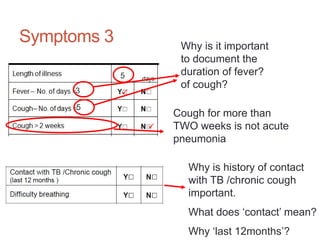
Symptoms 3
Cough for more than
TWO weeks is not acute
pneumonia
5
5
3 


Why is it important
to document the
duration of fever?
of cough?
Why is history of contact
with TB /chronic cough
important.
What does ‘contact’ mean?
Why ‘last 12months’?
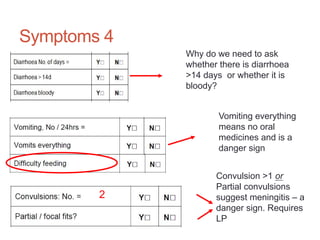
Symptoms 4
Vomiting everything
means no oral
medicines and is a
danger sign
Convulsion >1 or
Partial convulsions
suggest meningitis – a
danger sign. Requires
LP
2
Why do we need to ask
whether there is diarrhoea
>14 days or whether it is
bloody?
Airway / Breathing
• Airway
• Stridor (inspiratory)
• Breathing adequacy
• Respiratory Rate – Counted for 1 minute in a calm child!
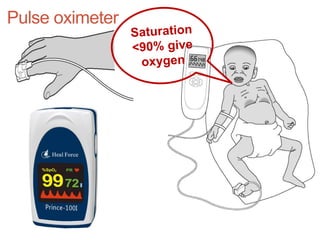
• Oxygen saturation (pulse oximetry)
• Central cyanosis
• Head nodding
• Grunting
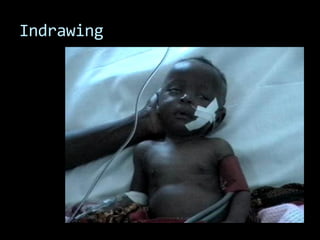
• Indrawing
• Acidotic / deep breathing
• Wheeze / crackles
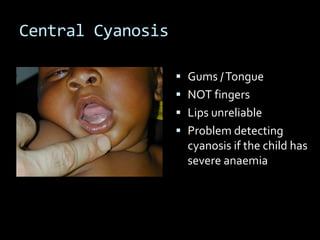
Central Cyanosis
 Gums /Tongue
 NOT fingers
 Lips unreliable
 Problem detecting
cyanosis if the child has
severe anaemia
Indrawing
Deep/Acidotic Breathing
Respiratory distress
 Signs
 Grunting:
 abnormal, short, deep, hoarse sounds on exhalation
 Grunting is the body's way of trying to keep air in the
lungs so they will stay open
Pulse oximeter
Saturation
<90% give
oxygen
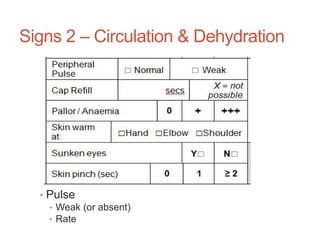
Signs 2 – Circulation & Dehydration
• Pulse
• Weak (or absent)
• Rate
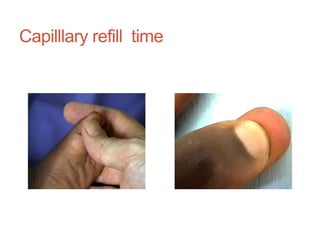
Capilllary refill time
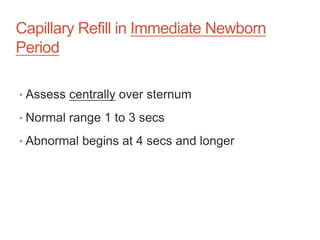
Capillary Refill in Immediate Newborn
Period
• Assess centrally over sternum
• Normal range 1 to 3 secs
• Abnormal begins at 4 secs and longer
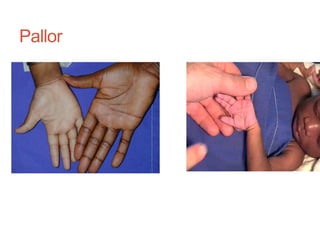
Pallor
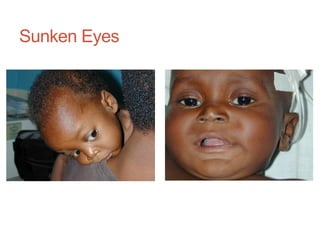
Sunken Eyes
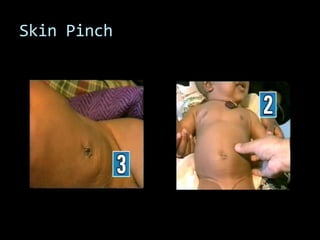
Skin Pinch
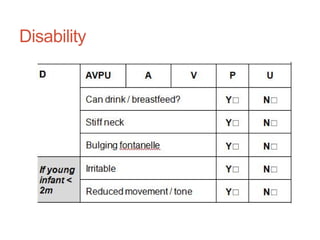
Disability
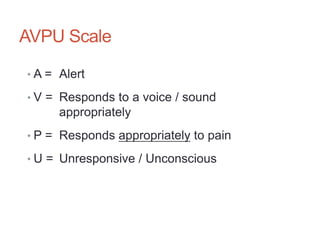
AVPU Scale
• A = Alert
• V = Responds to a voice / sound
appropriately
• P = Responds appropriately to pain
• U = Unresponsive / Unconscious
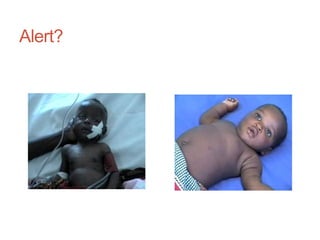
Alert?
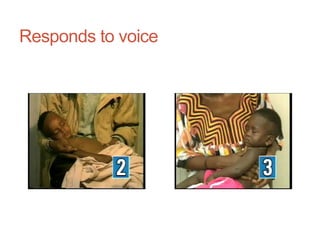
Responds to voice
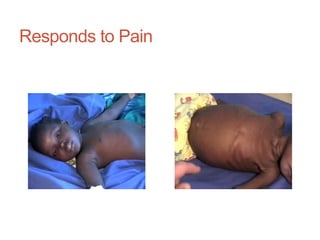
Responds to Pain
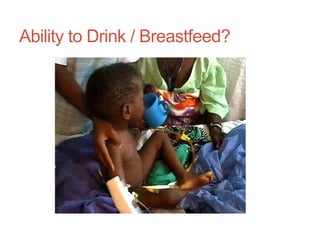
Ability to Drink / Breastfeed?
Bulging fontanelle and stiff neck
• Fontanelle should be examined with the infant lying down
at rest (i.e. not crying)
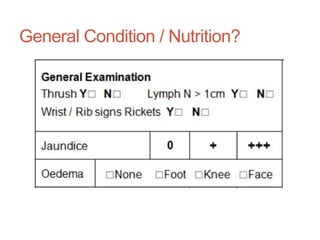
General Condition / Nutrition?
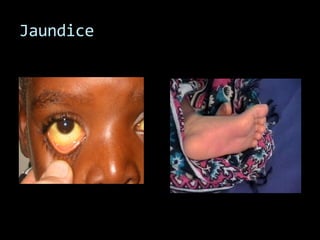
Jaundice
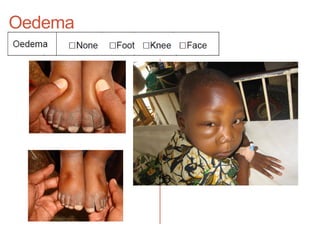
Oedema
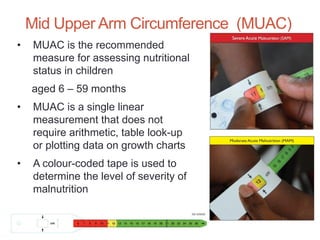
Mid Upper Arm Circumference (MUAC)
• MUAC is the recommended
measure for assessing nutritional
status in children
aged 6 – 59 months
• MUAC is a single linear
measurement that does not
require arithmetic, table look-up
or plotting data on growth charts
• A colour-coded tape is used to
determine the level of severity of
malnutrition
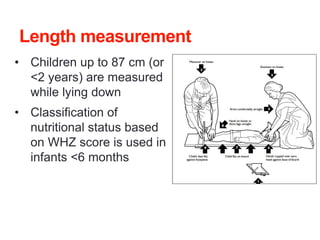
Length measurement
• Children up to 87 cm (or
<2 years) are measured
while lying down
• Classification of
nutritional status based
on WHZ score is used in
infants <6 months
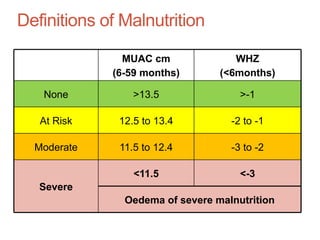
Definitions of Malnutrition
MUAC cm
(6-59 months)
WHZ
(<6months)
None >13.5 >-1
At Risk 12.5 to 13.4 -2 to -1
Moderate 11.5 to 12.4 -3 to -2
Severe
<11.5 <-3
Oedema of severe malnutrition
QUESTIONS?
Summary
• Simple symptoms and signs will help guide basic
treatment in 80-90% of children admitted.
• A common approach to interpreting clinical signs
helps clinical communication.
• Always be on the look out for additional important
signs

2-Essential-Symptoms-Signs-_-May-2017.pdf

  • 1.
  • 2.
    Objectives • Define keysymptoms of common, serious diseases • Define and demonstrate key clinical signs of common, serious diseases • Improve communication between professionals
  • 3.
    The most usefulsymptoms & signs • Observed commonly in common illnesses • Help assessment of nature and severity of illness • Indicate risk of death • Useful for monitoring progress • Differentiate diseases • Easy for everyone to observe and learn
  • 4.
    Choosing the ‘best’symptoms & signs • WHO and others investigating this for 30 years • Sound evidence base for most common disorders of children • Included in the IMNCI approach • Best signs are the foundation of the whole week
  • 5.
    Symptoms 3 Cough formore than TWO weeks is not acute pneumonia 5 5 3    Why is it important to document the duration of fever? of cough? Why is history of contact with TB /chronic cough important. What does ‘contact’ mean? Why ‘last 12months’?
  • 6.
    Symptoms 4 Vomiting everything meansno oral medicines and is a danger sign Convulsion >1 or Partial convulsions suggest meningitis – a danger sign. Requires LP 2 Why do we need to ask whether there is diarrhoea >14 days or whether it is bloody?
  • 7.
    Airway / Breathing •Airway • Stridor (inspiratory) • Breathing adequacy • Respiratory Rate – Counted for 1 minute in a calm child! • Oxygen saturation (pulse oximetry) • Central cyanosis • Head nodding • Grunting • Indrawing • Acidotic / deep breathing • Wheeze / crackles
  • 8.
    Central Cyanosis  Gums/Tongue  NOT fingers  Lips unreliable  Problem detecting cyanosis if the child has severe anaemia
  • 9.
  • 10.
  • 11.
    Respiratory distress  Signs Grunting:  abnormal, short, deep, hoarse sounds on exhalation  Grunting is the body's way of trying to keep air in the lungs so they will stay open
  • 12.
  • 13.
    Signs 2 –Circulation & Dehydration • Pulse • Weak (or absent) • Rate
  • 14.
  • 15.
    Capillary Refill inImmediate Newborn Period • Assess centrally over sternum • Normal range 1 to 3 secs • Abnormal begins at 4 secs and longer
  • 16.
  • 17.
  • 18.
  • 19.
  • 20.
    AVPU Scale • A= Alert • V = Responds to a voice / sound appropriately • P = Responds appropriately to pain • U = Unresponsive / Unconscious
  • 21.
  • 22.
  • 23.
  • 24.
    Ability to Drink/ Breastfeed?
  • 25.
    Bulging fontanelle andstiff neck • Fontanelle should be examined with the infant lying down at rest (i.e. not crying)
  • 26.
  • 27.
  • 28.
  • 29.
    Mid Upper ArmCircumference (MUAC) • MUAC is the recommended measure for assessing nutritional status in children aged 6 – 59 months • MUAC is a single linear measurement that does not require arithmetic, table look-up or plotting data on growth charts • A colour-coded tape is used to determine the level of severity of malnutrition
  • 30.
    Length measurement • Childrenup to 87 cm (or <2 years) are measured while lying down • Classification of nutritional status based on WHZ score is used in infants <6 months
  • 31.
    Definitions of Malnutrition MUACcm (6-59 months) WHZ (<6months) None >13.5 >-1 At Risk 12.5 to 13.4 -2 to -1 Moderate 11.5 to 12.4 -3 to -2 Severe <11.5 <-3 Oedema of severe malnutrition
  • 32.
  • 33.
    Summary • Simple symptomsand signs will help guide basic treatment in 80-90% of children admitted. • A common approach to interpreting clinical signs helps clinical communication. • Always be on the look out for additional important signs