CH10: Catalysis and Catalyst
RE10
Chemical Engineering Guy
www. Chemical Engineering Guy .com
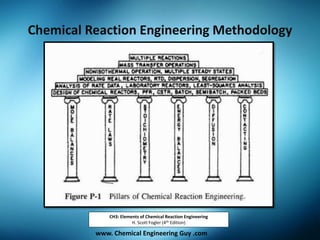
Chemical Reaction Engineering Methodology
www. Chemical Engineering Guy .com
CH3: Elements of Chemical Reaction Engineering
H. Scott Fogler (4th Edition)
Chemical Reaction Engineering Methodology
www. Chemical Engineering Guy .com
CH3: Elements of Chemical Reaction Engineering
H. Scott Fogler (4th Edition)
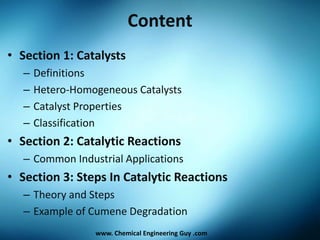
Content
• Section 1: Catalysts
– Definitions
– Hetero-Homogeneous Catalysts
– Catalyst Properties
– Classification
• Section 2: Catalytic Reactions
– Common Industrial Applications
• Section 3: Steps In Catalytic Reactions
– Theory and Steps
– Example of Cumene Degradation
www. Chemical Engineering Guy .com
Section 1
Catalysis Basic Concepts
www. Chemical Engineering Guy .com
Catalysis Use and Importance
• Wine, cheese and bread  Previous batch was needed for
the next one
• Major users
– Petroleum refining
– Chemical Processes
– Automotive
• 1/3 of chemical processes will need eventually the use of a
catalyst
• The global demand on catalysts in 2010 was estimated at
approximately 29.5 billions USD.
• Automotive and Chemical industry overall
– the global catalyst market is expected to experience fast growth
in the next years.
Catalysis Use and Importance
Definition of Catalyst
• A substance that affects the rate of a reaction but
emerges from the process unchanged
• A catalyst usually changes a reaction rate by
promoting a different molecular path ("mechanism")
for the reaction
www. Chemical Engineering Guy .com
Definition of Catalyst
• A catalyst changes only the rate of a reaction;
it does nor affect the equilibrium.
– That is, no higher conversion is achieved
www. Chemical Engineering Guy .com
Catalysts
• Usually for “Faster” reaction design
• Less Activation Energy/Less free energy is required to reach
the transition state
• but the total free energy from reactants to products does not
change
– That is, the change in enthalpy or enthalpy of reaction
www. Chemical Engineering Guy .com
Catalysts Free Energy Diagram
www. Chemical Engineering Guy .com
Catalysts
• As a catalyst is regenerated in a reaction, often
only small amounts are needed to increase
the rate of the reaction.
• In practice, however, catalysts are sometimes
consumed in secondary processes.
• There are many type of catalyst recovery due
to the high prices of catalysts
www. Chemical Engineering Guy .com
Inhibitor
• The opposite of a catalyst, a substance that
reduces the rate of a reaction, is an inhibitor.
• This is typical for enzymes as well
www. Chemical Engineering Guy .com
Typical Mechanism
• Typical mechanism
X + C → XC (1)
Y + XC → XYC (2)
XYC → CZ (3)
CZ → C + Z (4)
• Overall reaction:
X + Y → Z
www. Chemical Engineering Guy .com
Typical Mechanism
www. Chemical Engineering Guy .com
Types of Catalysts
• Homogeneous
• Heterogeneous
• Enzymes and biocatalysts
www. Chemical Engineering Guy .com
Homogeneous Reaction
• The processes use the catalyst is in solution
• Types
– Acid Catalysis
– Oraganometallic Catalysis
– Enzymatic reactions
www. Chemical Engineering Guy .com
Enzymes
• Enzymes possess properties of both:
– Homogeneous
– heterogeneous catalysts.
• As such, they are usually regarded as a third, separate
category of catalyst.
• Typical for Biotechnological Processes
www. Chemical Engineering Guy .com
Heterogeneous Reaction
• Heterogeneous: involves more than one
phase: usually the catalyst is a solid and the
reactants and products are in liquid or
gaseous form
• A heterogeneous catalytic reaction occurs at
or very near the fluid-solid interface
• Reactions between gases-Iiquids are usually
mass-transfer limited
www. Chemical Engineering Guy .com
Heterogenous Reaction Examples
• From mighty Wikipedia
www. Chemical Engineering Guy .com
Catalyst Properties
• A large interaction area is almost always
essential in attaining a significant reaction rate
• This is provided by an inner porous structure
– i.e., i solid contains many tine pores, and the
surface of these pores supports the a needed for
the high rate of reaction
• These Cat. Are called poro-catalyst
www. Chemical Engineering Guy .com
Porous Catalysts
www. Chemical Engineering Guy .com
Chemisorption
• Chemisorption results in the sharing of
electrons between the adsorbate and the
adsorbent.
www. Chemical Engineering Guy .com
Chemisorption
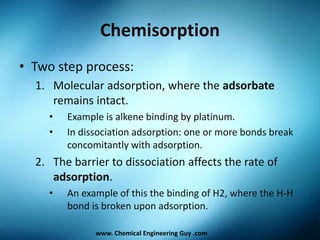
• Two step process:
1. Molecular adsorption, where the adsorbate
remains intact.
• Example is alkene binding by platinum.
• In dissociation adsorption: one or more bonds break
concomitantly with adsorption.
2. The barrier to dissociation affects the rate of
adsorption.
• An example of this the binding of H2, where the H-H
bond is broken upon adsorption.
www. Chemical Engineering Guy .com
Surface Reactions
• Langmuir-Hinshelwood mechanism.
• Rideal-Eley mechanism.
• Precursor mechanism.
www. Chemical Engineering Guy .com
Langmuir-Hinshelwood mechanism.
• The two molecules A and B both adsorb to the
surface.
• While adsorbed to the surface, the A and B "meet,”
and bond
• The new molecule A-B desorbs.
www. Chemical Engineering Guy .com
Rideal-Eley mechanism.
• One of the two molecules, A, adsorbs to the surface.
• The second molecule, B, meets A on the surface,
having never adsorbed to the surface, and they react
and bind.
• Then the newly formed A-B desorbs.
www. Chemical Engineering Guy .com
Langmui vs. Rideal Models
www. Chemical Engineering Guy .com
Catalyst Examples
• Naturals:
– Clays
– Zeolite
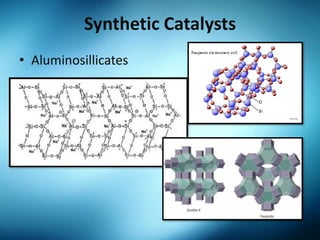
• Synthetics
– Crystalline aluminosillicates
www. Chemical Engineering Guy .com
Clays and Zeolites
www. Chemical Engineering Guy .com
Zeolite use in Para-Xylene
• Benzene and Toluene enter the zeolite
• They both react to form a mix of ortho, para
metha xylene
• The size of the mouth only accepts p-xylene
going out
Zeolite use in Para-Xylene
• Many interior sites isomerize ortho and metha
xylene to para-xylene
• High selectivity of para-xylene
Synthetic Catalysts
• Aluminosillicates
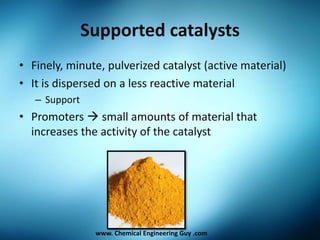
Supported catalysts
• Finely, minute, pulverized catalyst (active material)
• It is dispersed on a less reactive material
– Support
• Promoters  small amounts of material that
increases the activity of the catalyst
www. Chemical Engineering Guy .com
Carbon-Supported Pt Catalyst
www. Chemical Engineering Guy .com
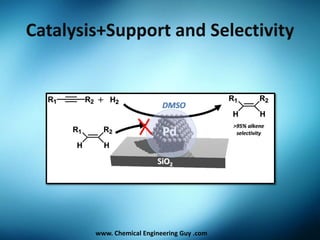
Catalysis+Support and Selectivity
www. Chemical Engineering Guy .com
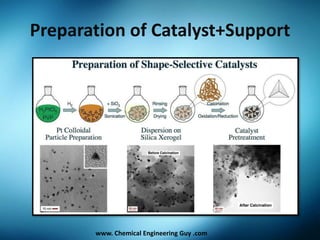
Preparation of Catalyst+Support
www. Chemical Engineering Guy .com
Supported Catalysts: Examples
• Packed-Bed Catalytic converter of the auto
• Platinum-alumina for petroleum reformation
• Vanadium Pentoxide on silica for sulfuric acid
production
www. Chemical Engineering Guy .com
Deactivation
• Decline on catalyst’s
activity with time
– Aging phenomena
• gradual change in structure
– Poisoning
• irreversible deposition of
substances on the active sites
– Fouling/coking
• carbonous deposition on all
the entire surface
www. Chemical Engineering Guy .com
Deactivation by Sintering (Aging)
• Loss of catalytic activity due to a loss of active
surface area (due to high gas-phase
temperatures)
– Crystal agglomeration and growth of the metals
deposited on the support
– Loss of activity by narrowing or closing of the
pores inside the catalyst pellet.
www. Chemical Engineering Guy .com
Deactivation by Sintering (Aging)
• A change in the surface structure
– Recrystallization
– Formation or elimination of surface defects
• Sintering is usually negligible at temperatures below 40% of
the melting temperature of the solid
www. Chemical Engineering Guy .com
Deactivation by Coking or Fouling
• This mechanism of decay is common to
reactions involving hydrocarbon.
• It results from a carbonaceous (coke) material
being deposited on the surface of a catalyst.
www. Chemical Engineering Guy .com
Deactivation by Coking or Fouling
• When the catalyst is already Fouled or coked,
the material is normally called “spent catalyst”
www. Chemical Engineering Guy .com
Deactivation by Poisoning
• Poisoning molecules become irreversibly
chemisorbed to active sites
• This reduce the number of sites available for
the main reaction.
• Normally is done by impurities
www. Chemical Engineering Guy .com
Deactivation by Poisoning
• Petroleum feed stocks contain trace
impurities such as:
– sulfur, lead, and other components which are too
costly to remove.
www. Chemical Engineering Guy .com
Deactivation by Poisoning
www. Chemical Engineering Guy .com
Section 2
Catalytic Reactions
www. Chemical Engineering Guy .com
Basic Industrial Classification
• Alkylation and Dealkylation Reactions
• Isomerization Reactions
• Hydrogenation and Dehydrogenation
Reactions
• Oxidation Reactions
• Hydration and Dehydration Reactions.
• Halogenation and DehaIogenation Reactions.
Alkylation and Dealkylation Reactions
• Alkylation  addition of an alkyl group to an
organic compound
• Common catalyst: Friedel-Crafts AlCl3 + HCl
Alkylation and Dealkylation Reactions
• Dealkylation  Cracking of petrochemicals
• Common catalyst: silica-alumina; silica-
magnesia and even clays (montmorilonite)
Cracking Units
Cracking Units
Isomerization Reactions
• Change of Structure
• Hydrocarbon molecules are rearranged into a
more useful isomer
• The process is particularly useful in enhancing
the octane rating of petrol, as branched
alkanes burn more efficiently in a car engine
than straight-chain alkanes.
Isomerization Units
Isomerization Units
Hydrogenation and Dehydrogenation
Reactions
• Some metals used in Hydrogenation are:
– Co, Ni, Rh, Ru, Os, Pd, Ir, and Pt.
• Non-used metals:
– V, Cr, Nb, Mo, Ta, and W
– each of which has a large number of vacant d-
orbitals
– These are inactive as a result of the strong
adsorption for the reactants or the products or
both
Hydrogenation and Dehydrogenation
Reactions
• Hydrogenation reactions are favored at lower
temperatures (<200ºC)
• Dehydrogenation reactions are favored at high
temperatures (at least 200ºC)
• Example:
– Industrial butadiene (synthetic rubber production)
can be obtained by the dehydrogenation of
butenes
Hydrogenation and Dehydrogenation Reactions
Oxidation Reactions
• The transition group elements
(group VIII) and subgroup are used
extensively in oxidation reactions:
– Ag, Cu, Pt, Fe, Ni
• In addition, V2O5 and MnO2 are
frequently used for oxidation
reactions
Oxidation Reactions Types
• Oxygen Addition
• Oxygenolysis of carbon-hydrogen bonds
Oxidation Reactions Types
• Oxygenation of nitrogen-hydrogen bonds:
• Complete combustion
Burner/Furnace Units
Thermal Oxidizers
Incineration Unit
Hydration and Dehydration Reactions.
• Used to get rid of H2O molecules
• Hydration and dehydration catalysts have a strong
affinity for water
• One such catalyst is AI2O3, which is used in the
dehydration of alcohols to form olefins
Hydration and Dehydration Reactions.
• Other examples:
– Clays
– Phosphoric acid
– Phosphoric acid salts on inert carriers
Dehydration Units
HaIogenation and DehaIogenation
Reactions.
• Addition of Halogens Elements (group 7)
• Cl, F, Br, I, etc…
• Typical catalysts: CuCI2, AgCI. Pd, AlBr3, CCl4
HaIogenation and DehaIogenation
Reactions.
Catalyst Classification Summary
Section 3
Steps in a Catalytic Reaction
www. Chemical Engineering Guy .com
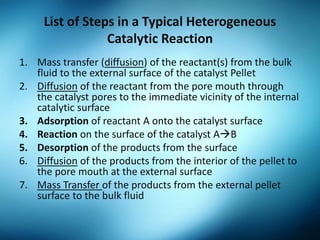
List of Steps in a Typical Heterogeneous
Catalytic Reaction
1. Mass transfer (diffusion) of the reactant(s) from the bulk
fluid to the external surface of the catalyst Pellet
2. Diffusion of the reactant from the pore mouth through
the catalyst pores to the immediate vicinity of the internal
catalytic surface
3. Adsorption of reactant A onto the catalyst surface
4. Reaction on the surface of the catalyst AB
5. Desorption of the products from the surface
6. Diffusion of the products from the interior of the pellet to
the pore mouth at the external surface
7. Mass Transfer of the products from the external pellet
surface to the bulk fluid
List of Steps in a Typical
Heterogeneous Catalytic Reaction
1. External diffusion of reactant
2. Internal Diffusion of reactant
3. Adsorption of reactant A
4. Reaction on the surface of the catalyst AB
5. Desorption of the products from the surface
6. Internal diffusion of products
7. External diffusion of products
Visual SummaryAB
Visual Summary
Visual Summary
Visual Summary
Visual Summary
Visual Summary
Overall Rate of Reaction
• Typically, is related to the rate of the slowest step in the
mechanism
• Classification of steps
– Mass Transfer related steps (1,2,6 and 7)
– Reaction Kinetic related steps (3,4 and 5)
Overall Rate of Reaction
• Then there are two cases
– Mass Transfer limitations
– Reaction Kinetic/Chemisorption limitations
• When the diffusion steps:
• If (1,2,6 and 7) are very fast vs. with the steps (3, 4
and 5)
– Transport or diffusion steps do not affect the overall rate
of the reaction.
Overall Rate of Reaction
Focus on Reactor Engineering
• We will focus in the actual Reaction
– Steps 3,4 and 5
– Adsorption, Surface Reaction, Desorption
• Mass Transfer phenomena limitations are more
commonly studied in other courses
Visual Aid
Step 1: External Diffusion
• The reactant will diffuse to the “bulk” material
• The surface of the boundary layer is the one
with most resistance
• Lets call CAb to the concentration of reactant
A in the bulk
Step 1: External Diffusion
• Let Kc be the mass transfer coefficient
• Kc is function of Diffusion of A in B and the film length
• If diffusion of A in B is low and distance is large… you
have a slow coefficient and therefore a slow reaction
• At fast velocities  low length
• At low velocities  high length
Visual Aid
Step 2: Internal diffusion
• Once the particle is “inside”, it must achieve
the activation site
• Suppose it diffuses to a Concentration of CAs
• Kr is dependent only of the particle diameter
Kr = 1/ Dp
Step 2: Internal diffusion
• The bigger the particle, the larger the path needed!
Visual Aid
Step 3: Adsorption
• S  Active Site
• Two models of Adsorption
– Molecular/non-dissociated adsorption
– Dissociative adsorption
Step 3: Adsorption
• Rate of Attachment vs. Detachment
• Combining Both Rates:
Step 3: Adsorption
• If we apply the KA ratio (adsorption equilibrium)
• We will get:
Step 3: Adsorption
• Applying an Active site Balance:
• In equilibrium, the rate should be equal to 0
• Solving for CCO·S
• And rearranging…
Step 3: Adsorption
• This expression is generally called Langmuir
Isotherm
Visual Aid
Step 4: Surface Reaction
• Recall that:
• After the reactant is absorbed, it may react in
the next ways:
– Single Site
– Dual Site
– Eley-Rideal
Step 4: Surface Reaction
• Single Site
• Each step is elementary reaction
• The reaction occurs directly on-site
• The model is left as:
• Where Ks is the surface reaction constant
Ks = ks/k-s
Step 4: Surface Reaction
• Dual-Site
• A reacts with B in the adjacent site
• This type of reactions are the so called
Langmuir-Hinshelwood kinetic model
Step 4: Surface Reaction
• Eley-Rideal Mechanism Reaction
• Similar to Langmuir but only requires 1 site
Visual Aid
Step 5: Desorption
• Let C be the product and S the Active Site
• Desorption to the gas phase… The rate of
reaction can be modeled with
• Let KDC be the equilibrium constant
Step 5: Desorption
• It is just the opposite (negative sign)
• For the Equilibrium Constant then:
• Therefore:
Visual Aid
Step 6: Internal Diffusion of Products
• Similar to step 2
• The length of the particle is still a factor
Visual Aid
Step 7: External Diffusion of Products
• Similar to step 1
• The diffusion factor of C in B is now the factor
– That is, now we are concerned with the product
rather than with the reactant
Summary of Rates
• Step 1
• Step 2
• Step 3
• Step 4
• Step 5
• Step 6
• Step 7
Mass Transfer Rates
Mass Transfer Phenomena
Adsorption Rates
 Chemisorption relevant
Rate of Reaction
 kinetic relevant
Application to Cummene Decomposition
• Not diffusion-limited
• Product: Benzene and Propylene
• Catalyst: Platinum bed
• Application of Langmuir Mechanism
www. Chemical Engineering Guy .com
Application to Cummene Decomposition
• Each step is treated as an elementary reaction
• Due to gas-phase
– We will use Partial Pressures
– Remember Concentration may be related to
Partial pressure: Pc = = Cc RT
www. Chemical Engineering Guy .com
Application to Cummene
Decomposition
www. Chemical Engineering Guy .com
Application to Cummene Decomposition:
Adsorption
• Adsorption of cummene in the Pt-bed
www. Chemical Engineering Guy .com
Visual Aid
www. Chemical Engineering Guy .com
Application to Cummene Decomposition:
Surface-Reaction
• The rate Law for the surface reaction step
producing adsorbed benzene and propylene in
the gas phase.
• Using the surface criterion equilibrium
• Propylene is not adsorbed on the surface.
Consequently, its concentration on the surface
is zero being
www. Chemical Engineering Guy .com
Application to Cummene Decomposition:
Surface-Reaction
www. Chemical Engineering Guy .com
Visual Aid
www. Chemical Engineering Guy .com
Application to Cummene Decomposition:
Desorption
www. Chemical Engineering Guy .com
Visual Aid
www. Chemical Engineering Guy .com
Application to Cummene Decomposition:
Rate-Limiting Step
• Typically, you would search for the rate-limiting step:
– Rate of Absorption
– Rate of Surface-Reaction
– Rate of Desorption
www. Chemical Engineering Guy .com
End of Block RE10
• By now you should know:
– Definition of a catalysis and a catalyst
– Importance of the Catalyst Industry
– What is an inhibitor
– Type of Catalytic Reactions (homo and
heterogeneous)
– The importance of chemisorption
– Basic Reaction Mechanisms such as: Langmuir
Models and Eley-Rideal Models
www. Chemical Engineering Guy .com
End of Block RE10
• You now know:
– The Importance of the Supported Catalysts
– Why deactivation occurs and its types (aging,
coking, poisoning)
– Common Industrial Processes and the type of
catalysts they use
– The basic steps of the Catalytic Reaction (7)
– What a limiting step is
– How to model a basic catalytic reaction
mechanism
www. Chemical Engineering Guy .com
Questions and Problems
• I included some extra problems and exercises
• All problems are solved in the next webpage
– www.ChemicalEngineeringGuy.com
• Courses
–Reactor Engineering
»Solved Problems Section
• CH10 – Catalysis and Catalytic Reactors
www. Chemical Engineering Guy .com
More Information…
• Get extra information here!
– Directly on the WebPage:
• www.ChemicalEngineeringGuy.com/courses
– FB page:
• www.facebook.com/Chemical.Engineering.Guy
– Contact me by e-mail:
• Contact@ChemicalEngineeringGuy.com
www. Chemical Engineering Guy .com
Text Book & Reference
Essentials of Chemical
Reaction Engineering
H. Scott Fogler (1st Edition)
Chemical Reactor
Analysis and Design
Fundamentals
J.B. Rawlings and J.G.
Ekerdt (1st Edition)
Elements of Chemical
Reaction Engineering
H. Scott Fogler (4th Edition)
www. Chemical Engineering Guy .com
Bibliography
Elements of Chemical Reaction Engineering
H. Scott Fogler (4th Edition)
www. Chemical Engineering Guy .com
We’ve seen  CH10

Catalysis and Catalytic reactors RE10

  • 1.
    CH10: Catalysis andCatalyst RE10 Chemical Engineering Guy www. Chemical Engineering Guy .com
  • 2.
    Chemical Reaction EngineeringMethodology www. Chemical Engineering Guy .com CH3: Elements of Chemical Reaction Engineering H. Scott Fogler (4th Edition)
  • 3.
    Chemical Reaction EngineeringMethodology www. Chemical Engineering Guy .com CH3: Elements of Chemical Reaction Engineering H. Scott Fogler (4th Edition)
  • 4.
    Content • Section 1:Catalysts – Definitions – Hetero-Homogeneous Catalysts – Catalyst Properties – Classification • Section 2: Catalytic Reactions – Common Industrial Applications • Section 3: Steps In Catalytic Reactions – Theory and Steps – Example of Cumene Degradation www. Chemical Engineering Guy .com
  • 5.
    Section 1 Catalysis BasicConcepts www. Chemical Engineering Guy .com
  • 6.
    Catalysis Use andImportance • Wine, cheese and bread  Previous batch was needed for the next one • Major users – Petroleum refining – Chemical Processes – Automotive • 1/3 of chemical processes will need eventually the use of a catalyst • The global demand on catalysts in 2010 was estimated at approximately 29.5 billions USD. • Automotive and Chemical industry overall – the global catalyst market is expected to experience fast growth in the next years.
  • 7.
  • 8.
  • 9.
    Definition of Catalyst •A substance that affects the rate of a reaction but emerges from the process unchanged • A catalyst usually changes a reaction rate by promoting a different molecular path ("mechanism") for the reaction www. Chemical Engineering Guy .com
  • 10.
    Definition of Catalyst •A catalyst changes only the rate of a reaction; it does nor affect the equilibrium. – That is, no higher conversion is achieved www. Chemical Engineering Guy .com
  • 11.
    Catalysts • Usually for“Faster” reaction design • Less Activation Energy/Less free energy is required to reach the transition state • but the total free energy from reactants to products does not change – That is, the change in enthalpy or enthalpy of reaction www. Chemical Engineering Guy .com
  • 12.
    Catalysts Free EnergyDiagram www. Chemical Engineering Guy .com
  • 13.
    Catalysts • As acatalyst is regenerated in a reaction, often only small amounts are needed to increase the rate of the reaction. • In practice, however, catalysts are sometimes consumed in secondary processes. • There are many type of catalyst recovery due to the high prices of catalysts www. Chemical Engineering Guy .com
  • 14.
    Inhibitor • The oppositeof a catalyst, a substance that reduces the rate of a reaction, is an inhibitor. • This is typical for enzymes as well www. Chemical Engineering Guy .com
  • 15.
    Typical Mechanism • Typicalmechanism X + C → XC (1) Y + XC → XYC (2) XYC → CZ (3) CZ → C + Z (4) • Overall reaction: X + Y → Z www. Chemical Engineering Guy .com
  • 16.
    Typical Mechanism www. ChemicalEngineering Guy .com
  • 17.
    Types of Catalysts •Homogeneous • Heterogeneous • Enzymes and biocatalysts www. Chemical Engineering Guy .com
  • 18.
    Homogeneous Reaction • Theprocesses use the catalyst is in solution • Types – Acid Catalysis – Oraganometallic Catalysis – Enzymatic reactions www. Chemical Engineering Guy .com
  • 19.
    Enzymes • Enzymes possessproperties of both: – Homogeneous – heterogeneous catalysts. • As such, they are usually regarded as a third, separate category of catalyst. • Typical for Biotechnological Processes www. Chemical Engineering Guy .com
  • 20.
    Heterogeneous Reaction • Heterogeneous:involves more than one phase: usually the catalyst is a solid and the reactants and products are in liquid or gaseous form • A heterogeneous catalytic reaction occurs at or very near the fluid-solid interface • Reactions between gases-Iiquids are usually mass-transfer limited www. Chemical Engineering Guy .com
  • 21.
    Heterogenous Reaction Examples •From mighty Wikipedia www. Chemical Engineering Guy .com
  • 22.
    Catalyst Properties • Alarge interaction area is almost always essential in attaining a significant reaction rate • This is provided by an inner porous structure – i.e., i solid contains many tine pores, and the surface of these pores supports the a needed for the high rate of reaction • These Cat. Are called poro-catalyst www. Chemical Engineering Guy .com
  • 23.
    Porous Catalysts www. ChemicalEngineering Guy .com
  • 24.
    Chemisorption • Chemisorption resultsin the sharing of electrons between the adsorbate and the adsorbent. www. Chemical Engineering Guy .com
  • 25.
    Chemisorption • Two stepprocess: 1. Molecular adsorption, where the adsorbate remains intact. • Example is alkene binding by platinum. • In dissociation adsorption: one or more bonds break concomitantly with adsorption. 2. The barrier to dissociation affects the rate of adsorption. • An example of this the binding of H2, where the H-H bond is broken upon adsorption. www. Chemical Engineering Guy .com
  • 26.
    Surface Reactions • Langmuir-Hinshelwoodmechanism. • Rideal-Eley mechanism. • Precursor mechanism. www. Chemical Engineering Guy .com
  • 27.
    Langmuir-Hinshelwood mechanism. • Thetwo molecules A and B both adsorb to the surface. • While adsorbed to the surface, the A and B "meet,” and bond • The new molecule A-B desorbs. www. Chemical Engineering Guy .com
  • 28.
    Rideal-Eley mechanism. • Oneof the two molecules, A, adsorbs to the surface. • The second molecule, B, meets A on the surface, having never adsorbed to the surface, and they react and bind. • Then the newly formed A-B desorbs. www. Chemical Engineering Guy .com
  • 29.
    Langmui vs. RidealModels www. Chemical Engineering Guy .com
  • 30.
    Catalyst Examples • Naturals: –Clays – Zeolite • Synthetics – Crystalline aluminosillicates www. Chemical Engineering Guy .com
  • 31.
    Clays and Zeolites www.Chemical Engineering Guy .com
  • 32.
    Zeolite use inPara-Xylene • Benzene and Toluene enter the zeolite • They both react to form a mix of ortho, para metha xylene • The size of the mouth only accepts p-xylene going out
  • 33.
    Zeolite use inPara-Xylene • Many interior sites isomerize ortho and metha xylene to para-xylene • High selectivity of para-xylene
  • 34.
  • 35.
    Supported catalysts • Finely,minute, pulverized catalyst (active material) • It is dispersed on a less reactive material – Support • Promoters  small amounts of material that increases the activity of the catalyst www. Chemical Engineering Guy .com
  • 36.
    Carbon-Supported Pt Catalyst www.Chemical Engineering Guy .com
  • 37.
    Catalysis+Support and Selectivity www.Chemical Engineering Guy .com
  • 38.
    Preparation of Catalyst+Support www.Chemical Engineering Guy .com
  • 39.
    Supported Catalysts: Examples •Packed-Bed Catalytic converter of the auto • Platinum-alumina for petroleum reformation • Vanadium Pentoxide on silica for sulfuric acid production www. Chemical Engineering Guy .com
  • 40.
    Deactivation • Decline oncatalyst’s activity with time – Aging phenomena • gradual change in structure – Poisoning • irreversible deposition of substances on the active sites – Fouling/coking • carbonous deposition on all the entire surface www. Chemical Engineering Guy .com
  • 41.
    Deactivation by Sintering(Aging) • Loss of catalytic activity due to a loss of active surface area (due to high gas-phase temperatures) – Crystal agglomeration and growth of the metals deposited on the support – Loss of activity by narrowing or closing of the pores inside the catalyst pellet. www. Chemical Engineering Guy .com
  • 42.
    Deactivation by Sintering(Aging) • A change in the surface structure – Recrystallization – Formation or elimination of surface defects • Sintering is usually negligible at temperatures below 40% of the melting temperature of the solid www. Chemical Engineering Guy .com
  • 43.
    Deactivation by Cokingor Fouling • This mechanism of decay is common to reactions involving hydrocarbon. • It results from a carbonaceous (coke) material being deposited on the surface of a catalyst. www. Chemical Engineering Guy .com
  • 44.
    Deactivation by Cokingor Fouling • When the catalyst is already Fouled or coked, the material is normally called “spent catalyst” www. Chemical Engineering Guy .com
  • 45.
    Deactivation by Poisoning •Poisoning molecules become irreversibly chemisorbed to active sites • This reduce the number of sites available for the main reaction. • Normally is done by impurities www. Chemical Engineering Guy .com
  • 46.
    Deactivation by Poisoning •Petroleum feed stocks contain trace impurities such as: – sulfur, lead, and other components which are too costly to remove. www. Chemical Engineering Guy .com
  • 47.
    Deactivation by Poisoning www.Chemical Engineering Guy .com
  • 48.
    Section 2 Catalytic Reactions www.Chemical Engineering Guy .com
  • 49.
    Basic Industrial Classification •Alkylation and Dealkylation Reactions • Isomerization Reactions • Hydrogenation and Dehydrogenation Reactions • Oxidation Reactions • Hydration and Dehydration Reactions. • Halogenation and DehaIogenation Reactions.
  • 50.
    Alkylation and DealkylationReactions • Alkylation  addition of an alkyl group to an organic compound • Common catalyst: Friedel-Crafts AlCl3 + HCl
  • 51.
    Alkylation and DealkylationReactions • Dealkylation  Cracking of petrochemicals • Common catalyst: silica-alumina; silica- magnesia and even clays (montmorilonite)
  • 52.
  • 53.
  • 54.
    Isomerization Reactions • Changeof Structure • Hydrocarbon molecules are rearranged into a more useful isomer • The process is particularly useful in enhancing the octane rating of petrol, as branched alkanes burn more efficiently in a car engine than straight-chain alkanes.
  • 55.
  • 56.
  • 57.
    Hydrogenation and Dehydrogenation Reactions •Some metals used in Hydrogenation are: – Co, Ni, Rh, Ru, Os, Pd, Ir, and Pt. • Non-used metals: – V, Cr, Nb, Mo, Ta, and W – each of which has a large number of vacant d- orbitals – These are inactive as a result of the strong adsorption for the reactants or the products or both
  • 58.
    Hydrogenation and Dehydrogenation Reactions •Hydrogenation reactions are favored at lower temperatures (<200ºC) • Dehydrogenation reactions are favored at high temperatures (at least 200ºC) • Example: – Industrial butadiene (synthetic rubber production) can be obtained by the dehydrogenation of butenes
  • 59.
  • 60.
  • 61.
    Oxidation Reactions • Thetransition group elements (group VIII) and subgroup are used extensively in oxidation reactions: – Ag, Cu, Pt, Fe, Ni • In addition, V2O5 and MnO2 are frequently used for oxidation reactions
  • 62.
    Oxidation Reactions Types •Oxygen Addition • Oxygenolysis of carbon-hydrogen bonds
  • 63.
    Oxidation Reactions Types •Oxygenation of nitrogen-hydrogen bonds: • Complete combustion
  • 64.
  • 65.
  • 66.
  • 67.
    Hydration and DehydrationReactions. • Used to get rid of H2O molecules • Hydration and dehydration catalysts have a strong affinity for water • One such catalyst is AI2O3, which is used in the dehydration of alcohols to form olefins
  • 68.
    Hydration and DehydrationReactions. • Other examples: – Clays – Phosphoric acid – Phosphoric acid salts on inert carriers
  • 69.
  • 70.
    HaIogenation and DehaIogenation Reactions. •Addition of Halogens Elements (group 7) • Cl, F, Br, I, etc… • Typical catalysts: CuCI2, AgCI. Pd, AlBr3, CCl4
  • 71.
  • 72.
  • 73.
    Section 3 Steps ina Catalytic Reaction www. Chemical Engineering Guy .com
  • 74.
    List of Stepsin a Typical Heterogeneous Catalytic Reaction 1. Mass transfer (diffusion) of the reactant(s) from the bulk fluid to the external surface of the catalyst Pellet 2. Diffusion of the reactant from the pore mouth through the catalyst pores to the immediate vicinity of the internal catalytic surface 3. Adsorption of reactant A onto the catalyst surface 4. Reaction on the surface of the catalyst AB 5. Desorption of the products from the surface 6. Diffusion of the products from the interior of the pellet to the pore mouth at the external surface 7. Mass Transfer of the products from the external pellet surface to the bulk fluid
  • 75.
    List of Stepsin a Typical Heterogeneous Catalytic Reaction 1. External diffusion of reactant 2. Internal Diffusion of reactant 3. Adsorption of reactant A 4. Reaction on the surface of the catalyst AB 5. Desorption of the products from the surface 6. Internal diffusion of products 7. External diffusion of products
  • 76.
  • 77.
  • 78.
  • 79.
  • 80.
  • 81.
  • 82.
    Overall Rate ofReaction • Typically, is related to the rate of the slowest step in the mechanism • Classification of steps – Mass Transfer related steps (1,2,6 and 7) – Reaction Kinetic related steps (3,4 and 5)
  • 83.
    Overall Rate ofReaction • Then there are two cases – Mass Transfer limitations – Reaction Kinetic/Chemisorption limitations • When the diffusion steps: • If (1,2,6 and 7) are very fast vs. with the steps (3, 4 and 5) – Transport or diffusion steps do not affect the overall rate of the reaction.
  • 84.
  • 85.
    Focus on ReactorEngineering • We will focus in the actual Reaction – Steps 3,4 and 5 – Adsorption, Surface Reaction, Desorption • Mass Transfer phenomena limitations are more commonly studied in other courses
  • 86.
  • 87.
    Step 1: ExternalDiffusion • The reactant will diffuse to the “bulk” material • The surface of the boundary layer is the one with most resistance • Lets call CAb to the concentration of reactant A in the bulk
  • 88.
    Step 1: ExternalDiffusion • Let Kc be the mass transfer coefficient • Kc is function of Diffusion of A in B and the film length • If diffusion of A in B is low and distance is large… you have a slow coefficient and therefore a slow reaction • At fast velocities  low length • At low velocities  high length
  • 89.
  • 90.
    Step 2: Internaldiffusion • Once the particle is “inside”, it must achieve the activation site • Suppose it diffuses to a Concentration of CAs • Kr is dependent only of the particle diameter Kr = 1/ Dp
  • 91.
    Step 2: Internaldiffusion • The bigger the particle, the larger the path needed!
  • 92.
  • 93.
    Step 3: Adsorption •S  Active Site • Two models of Adsorption – Molecular/non-dissociated adsorption – Dissociative adsorption
  • 94.
    Step 3: Adsorption •Rate of Attachment vs. Detachment • Combining Both Rates:
  • 95.
    Step 3: Adsorption •If we apply the KA ratio (adsorption equilibrium) • We will get:
  • 96.
    Step 3: Adsorption •Applying an Active site Balance: • In equilibrium, the rate should be equal to 0 • Solving for CCO·S • And rearranging…
  • 97.
    Step 3: Adsorption •This expression is generally called Langmuir Isotherm
  • 98.
  • 99.
    Step 4: SurfaceReaction • Recall that: • After the reactant is absorbed, it may react in the next ways: – Single Site – Dual Site – Eley-Rideal
  • 100.
    Step 4: SurfaceReaction • Single Site • Each step is elementary reaction • The reaction occurs directly on-site • The model is left as: • Where Ks is the surface reaction constant Ks = ks/k-s
  • 101.
    Step 4: SurfaceReaction • Dual-Site • A reacts with B in the adjacent site • This type of reactions are the so called Langmuir-Hinshelwood kinetic model
  • 102.
    Step 4: SurfaceReaction • Eley-Rideal Mechanism Reaction • Similar to Langmuir but only requires 1 site
  • 103.
  • 104.
    Step 5: Desorption •Let C be the product and S the Active Site • Desorption to the gas phase… The rate of reaction can be modeled with • Let KDC be the equilibrium constant
  • 105.
    Step 5: Desorption •It is just the opposite (negative sign) • For the Equilibrium Constant then: • Therefore:
  • 106.
  • 107.
    Step 6: InternalDiffusion of Products • Similar to step 2 • The length of the particle is still a factor
  • 108.
  • 109.
    Step 7: ExternalDiffusion of Products • Similar to step 1 • The diffusion factor of C in B is now the factor – That is, now we are concerned with the product rather than with the reactant
  • 110.
    Summary of Rates •Step 1 • Step 2 • Step 3 • Step 4 • Step 5 • Step 6 • Step 7 Mass Transfer Rates Mass Transfer Phenomena Adsorption Rates  Chemisorption relevant Rate of Reaction  kinetic relevant
  • 111.
    Application to CummeneDecomposition • Not diffusion-limited • Product: Benzene and Propylene • Catalyst: Platinum bed • Application of Langmuir Mechanism www. Chemical Engineering Guy .com
  • 112.
    Application to CummeneDecomposition • Each step is treated as an elementary reaction • Due to gas-phase – We will use Partial Pressures – Remember Concentration may be related to Partial pressure: Pc = = Cc RT www. Chemical Engineering Guy .com
  • 113.
    Application to Cummene Decomposition www.Chemical Engineering Guy .com
  • 114.
    Application to CummeneDecomposition: Adsorption • Adsorption of cummene in the Pt-bed www. Chemical Engineering Guy .com
  • 115.
    Visual Aid www. ChemicalEngineering Guy .com
  • 116.
    Application to CummeneDecomposition: Surface-Reaction • The rate Law for the surface reaction step producing adsorbed benzene and propylene in the gas phase. • Using the surface criterion equilibrium • Propylene is not adsorbed on the surface. Consequently, its concentration on the surface is zero being www. Chemical Engineering Guy .com
  • 117.
    Application to CummeneDecomposition: Surface-Reaction www. Chemical Engineering Guy .com
  • 118.
    Visual Aid www. ChemicalEngineering Guy .com
  • 119.
    Application to CummeneDecomposition: Desorption www. Chemical Engineering Guy .com
  • 120.
    Visual Aid www. ChemicalEngineering Guy .com
  • 121.
    Application to CummeneDecomposition: Rate-Limiting Step • Typically, you would search for the rate-limiting step: – Rate of Absorption – Rate of Surface-Reaction – Rate of Desorption www. Chemical Engineering Guy .com
  • 122.
    End of BlockRE10 • By now you should know: – Definition of a catalysis and a catalyst – Importance of the Catalyst Industry – What is an inhibitor – Type of Catalytic Reactions (homo and heterogeneous) – The importance of chemisorption – Basic Reaction Mechanisms such as: Langmuir Models and Eley-Rideal Models www. Chemical Engineering Guy .com
  • 123.
    End of BlockRE10 • You now know: – The Importance of the Supported Catalysts – Why deactivation occurs and its types (aging, coking, poisoning) – Common Industrial Processes and the type of catalysts they use – The basic steps of the Catalytic Reaction (7) – What a limiting step is – How to model a basic catalytic reaction mechanism www. Chemical Engineering Guy .com
  • 124.
    Questions and Problems •I included some extra problems and exercises • All problems are solved in the next webpage – www.ChemicalEngineeringGuy.com • Courses –Reactor Engineering »Solved Problems Section • CH10 – Catalysis and Catalytic Reactors www. Chemical Engineering Guy .com
  • 125.
    More Information… • Getextra information here! – Directly on the WebPage: • www.ChemicalEngineeringGuy.com/courses – FB page: • www.facebook.com/Chemical.Engineering.Guy – Contact me by e-mail: • Contact@ChemicalEngineeringGuy.com www. Chemical Engineering Guy .com
  • 126.
    Text Book &Reference Essentials of Chemical Reaction Engineering H. Scott Fogler (1st Edition) Chemical Reactor Analysis and Design Fundamentals J.B. Rawlings and J.G. Ekerdt (1st Edition) Elements of Chemical Reaction Engineering H. Scott Fogler (4th Edition) www. Chemical Engineering Guy .com
  • 127.
    Bibliography Elements of ChemicalReaction Engineering H. Scott Fogler (4th Edition) www. Chemical Engineering Guy .com We’ve seen  CH10