Promoters
Promoters
A substance which, though itself not a catalyst, promotes the activity of
a catalyst is called a promoter.
Example
Molybdenum (Mo) or aluminium oxide (Al2O3) promotes the activity of
iron catalyst in the Haber process for the manufacture of ammonia.
Fe
N2 + 3H2 2NH3
+Mo
In some reactions, mixtures of catalysts are used to obtain the maximum
catalyst efficiency.
Example
In the synthesis of methanol (CH3OH) from carbon monoxide and
hydrogen, a mixture of zinc and chromium oxide is used as a catalyst.
ZnO
CO + 2H2 CH3OH
Promoters
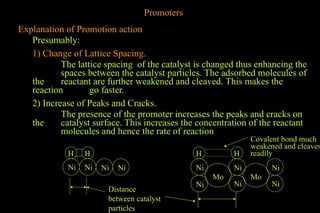
Explanation of Promotion action
Presumably:
1) Change of Lattice Spacing.
The lattice spacing of the catalyst is changed thus enhancing the
spaces between the catalyst particles. The adsorbed molecules of
the reactant are further weakened and cleaved. This makes the
reaction go faster.
2) Increase of Peaks and Cracks.
The presence of the promoter increases the peaks and cracks on
the catalyst surface. This increases the concentration of the reactant
molecules and hence the rate of reaction
H H
Ni Ni Ni Ni Ni
Ni
Ni
Ni
Ni
Ni
H H
Mo Mo
Distance
between catalyst
particles
Covalent bond much
weakened and cleaves
readily
Catalytic poisoning
Catalytic poisoning
A substance which, destroys the activity of a catalyst is called a poison
and the process is called catalytic poisoning.
Examples
1) The platinum catalyst used in the oxidation of sulphur dioxide
(Contact process), is poisoned by arsenic oxide (As2O3).
Pt
SO2 + O2 2SO3
As2O3
2) The platinum catalyst used in the oxidation of hydrogen is poisoned
by carbon monoxide.
Pt
2H2 +O2 2H2O
CO
Catalytic poisoning
Explanation of Catalytic Poisoning
• The poison is adsorbed on the catalyst surface in preference to the
reactants.
Strong adsorption at the active centers prevent the access of the
reacting substances. Even a monomolecular layer renders the surface
unavailable for further adsorption of the reactants.
The poisoning by As2O3 or CO are of this kind
O O O
C C C
• The catalyst may combine chemically with the impurity.
The poisoning of iron catalyst by H2S falls in this class.
Pt Pt Pt Pt Pt Pt
Autocatalysis
Autocatalysis
When one of the products of a reaction itself acts as a catalyst for that
reaction, the phenomenon is called autocatalysis.
In an autocatalytic reaction, plotting the concentration of a product is
against time generate a sigmoid curve.
these chemical reactions proceed
slowly at the start because there
is little catalyst present,
the rate of reaction increases
progressively as the reaction
proceeds as the amount of catalyst
increases and then it again slows
down as the reactant concentration
decreases.
If the concentration of a reactant or product in an experiment follows a
sigmoid curve, the reaction is likely to be autocatalytic.
Sigmoid curve
Completion of reaction
Time
Percentage
reaction
Autocatalysis
Examples of Autocatalysis
1) Hydrolysis of an Ester.
The hydrolysis of ethyl acetate forms acetic acid and ethanol. Acetic
acid acts as a catalyst for the reaction.
CH3COOC2H5 + H2O CH3COOH + C2H5OH
2) The unsaturated fatty acids present in the lipids of many foods are
susceptible to chemical breakdown when exposed to oxygen. The
oxidation of unsaturated fatty acids is autocatalytic.
3) Binding of oxygen by hemoglobin.
When oxygen enters the lungs, it binds to hemoglobin in red blood cells. This first oxygen molecule
that binds causes a change in the hemoglobin molecule, making it easier for more oxygen molecules
to bind. This means that each subsequent oxygen molecule binds more tightly and easily than the one
before it. As more and more oxygen binds, the hemoglobin molecule becomes saturated, allowing it
to transport oxygen efficiently to the body tissues that need it. This cooperative binding ensures that
oxygen is efficiently transported throughout the body.
Autocatalysis
The reaction of oxygen binding to hemoglobin in a cooperative manner is given by the
schematic diagram:
The oxygen-hemoglobin dissociation curve provides a graphical
representation of the relationship between hemoglobin saturation and
partial pressure of oxygen, which exhibits cooperative binding behavior.
The equation for this curve can be represented as follows:
Y-axis: % Hemoglobin saturation
X-axis: Partial pressure of oxygen (PO2)
The curve can be described by the equation:
Y = [HbO2]
[HbO2] + [Hb]
Negative Catalysis
Negative Catalysis
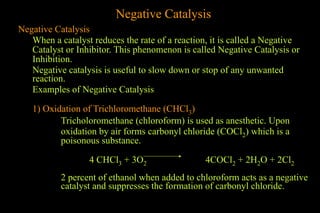
When a catalyst reduces the rate of a reaction, it is called a Negative
Catalyst or Inhibitor. This phenomenon is called Negative Catalysis or
Inhibition.
Negative catalysis is useful to slow down or stop of any unwanted
reaction.
Examples of Negative Catalysis
1) Oxidation of Trichloromethane (CHCl3)
Tricholoromethane (chloroform) is used as anesthetic. Upon
oxidation by air forms carbonyl chloride (COCl2) which is a
poisonous substance.
4 CHCl3 + 3O2 4COCl2 + 2H2O + 2Cl2
2 percent of ethanol when added to chloroform acts as a negative
catalyst and suppresses the formation of carbonyl chloride.
Negative Catalysis
Explanation of Negative Catalysis
The mechanism could be different for different reactions.
1) By poisoning a catalyst.
A negative catalyst may function by poisoning a catalyst which
already present in the reaction mixture. The traces of alkali
dissolved from the glass of the container, catalyze the decomposition
of hydrogen peroxide. However, the addition of an acid would
destroy the alkali catalyst and thus prevent decomposition.
2) By breaking a chain reaction.
In some cases, negative catalyst act by breaking the chain of
reactions.
the combination of H2 and Cl2 (which is a chain reaction) is
negatively catalyzed by nitrogen trichloride (NCl3).
Cl2 Cl●
+ Cl●
H2 + Cl●
HCl + H●
H●
+ Cl2 HCl + Cl●
NCl3 breaks the chain of reactions by absorbing the propagating
●
Activation Energy and Catalysis
The minimum amount of energy required to cause a chemical reaction is
known as the Activation Energy.
The activated molecules on collision first form an Activated Complex.
As a result of breaking and forming of new bonds, the activated complex
dissociates to yield product molecules.
Molecules approach
Activated Complex;
Transition State
Product molecules
Activation Energy and Catalysis
A catalyst lowers the activation energy of the reaction by providing the a
new pathway.
The larger number of effective collisions occur in the presence of catalyst
than would occur at the same temperature without the presence of the
catalyst.
Thus, the presence of the catalyst makes the reaction go faster.
Ea
Ea
Products
Reactants
Catalyzed
complex
Uncatalyzed
complex
Reaction progress
Potential
energy
Theories of Catalysis
Two main theories
1) Intermediate Compound Formation theory.
applies to homogeneous catalytic reactions.
2) The Adsorption theory
applies to heterogeneous catalytic reactions.
1) Intermediate Compound Formation theory.
• A catalyst functions by lowering the activation energy.
• In homogeneous catalysis, it does so by forming an intermediate
compound with one of the reactants.
• The highly reactive intermediate compound then reacts with the
second reactant to yield the product, releasing the catalyst.
A + B AB …….(1)
C is the catalyst. The reaction proceeds as follows:
A + C AC ……(2)
AC + B AB + C ……(3)
• The activation energies of the reactions (2) and (3) are lower than that of
the reaction (1).
Theories of Catalysis
Example
Preparation of diethyl ether from ethanol using sulphuric acid as
catalyst.
Mechanism:
C2H5OH + H2SO4 C2H5HSO4 + H2O
Ethyl hydrogen sulphate
(Intermediate compound)
C2H5HSO4 + C2H5OH(C2H5)2O + H2SO4
(Second molecule)
Theories of Catalysis
2) The Adsorption Theory
This theory explains the mechanism of a reaction between two
gases catalyzed by a solid (Heterogeneous or Contact Catalysis).
The catalyst functions by adsorption of the reacting molecules on its
surface.
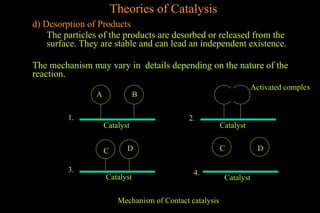
Four steps are involved for heterogeneous catalysis. For the reaction
A (g) + B (g) C (g) + D (g)
a) Adsorption of Reactant molecules
The reactant molecules A and B strike the catalyst surface. They are
held up at the surface by weak van der Waal’s forces (physical
adsorption) or by partial chemical bonds (chemisorptions).
b) Formation of Activated complex
The particles of the reactants adjacent to one another join to form an
intermediate complex (A – B ). The activated complex is unstable.
c) Decomposition of Activated complex
The activated complex breaks to form the products C and D. The
separated particles of the products hold to the catalyst surface by
partial chemical bonds.
Theories of Catalysis
d) Desorption of Products
The particles of the products are desorbed or released from the
surface. They are stable and can lead an independent existence.
The mechanism may vary in details depending on the nature of the
reaction.
A B
C D C D
Activated complex
Catalyst Catalyst
Catalyst Catalyst
1. 2.
3. 4.
Mechanism of Contact catalysis
Theories of Catalysis
Active centers on catalyst surface
• The catalyst surface has unbalanced chemical bonds on it. The
reactant gaseous molecules are adsorbed on the surface by these free
bonds.
• The distribution of free bonds on the catalyst surface is not uniform.
• These are crowded at the ‘peaks’, ‘cracks’ or ‘corners’ of the
catalyst.
• The catalytic activity due to adsorption of reacting molecules is
maximum at these points.
• These are referred to as the active centers or active sites.
Acid-Base Catalysis
Acid-Base Catalysis
• Homogeneous catalytic reactions catalyzed by acids or bases or both
acids and bases are known as acid-base catalysts and the process is
known as acid-base catalysis.
• Arrhenius suggested that acid catalysis is brought about by H+
ions
supplied by strong acids while base catalysis is caused by OH –
ions
supplied by strong base.
Example of Acid-Base catalysis
Inversion of Cane sugar:
H+
C12H22O11 C6H12O6 + C6H12O6
cane sugar
General Acid-Base catalysis
It has been found that
a) Not only H+
ions but all Bronsted acids (proton donors) cause acid
catalysis. Thus, general acid catalyst are:
H+
, undissociated acids (CH3COOH), cations of weak bases
+ +
Acid-Base Catalysis
General Acid-Base catalysis
b) Not only OH–
ions but all Bronsted bases (proton acceptors) acts as
base catalyst. Thus, general base catalyst are:
OH–
, undissociated bases, anions of weak acids (CH3COO –
)
and
H2O.
The catalysis brought about by general acids and bases is termed
General Acid-Base catalysis.
Mechanism of Acid –Base catalysis
a) In acid –catalysis, the H+ ion ( or proton donor) forms an
intermediate complex with the reactant, which then reacts to give
back the proton.
Example: the mechanism of keto-enol tautomerism of acetone.
H+
CH3 C CH3 CH3 C CH3 CH3 C CH2 +
H+
Acetone Intermediate complex Enol form
Acid-Base Catalysis
Mechanism of Acid –Base catalysis
b) In base catalysis, the OH–
ion ( or any Bronsted base) accepts a
proton from the reactant to form an intermediate complex which
then reacts or decomposes to regenerate the OH–
( or Bronsted
base).
Example: the decomposition of nitramide by OH–
ions and CH3COO –
i) by OH–
ions:
NH2NO2 + OH–
H2O + NHNO2
–
NHNO2
–
N2O + OH–
ii) by CH3COO –
ions:
NH2NO2 + CH3COO –
CH3COOH + NHNO2
–
Enzyme Catalysis
Enzymes are specialized proteins which act as catalyst to speed up
numerous organic reactions taking place in the body of animals and plants
to maintain the life process.
The catalysis brought about by enzymes is known as Enzyme Catalysis.
Examples of Enzyme catalysis
a) Inversion of cane sugar by invertase
invertase
C12H22O11 C6H12O6 + C6H12O6
b) Trypsin is found in the digestive system, where it breaks down
proteins into smaller peptides.
trypsin
Proteins in food smaller peptides or amino
acids
Enzymes show extraordinary specificity and catalytic power, far greater
Enzyme Catalysis
Mechanism of Enzyme Catalysis
• The enzyme molecules are coiled on each other to make particle
with cavities.
• These cavities which are of characteristic shape and contain active
groups (NH2, COOH, SH, OH), are termed Active centers.
• Substrate molecules which have complementary shape, fit into these
cavities just as key fits into a lock (Lock-and-Key theory).
• The enzyme forms an activated complex with the substrate through
the active groups, which at once decomposes to yield the products.
Thus, the substrate molecules enters the cavities, forms complex and
reacts, and at once the products get out of the cavities.
Substrate entering
active site of
enzyme
Substrate
Active site
Enzyme /
Substrate
complex
Enzyme /
product
complex
Products leaving active
site of enzymes
Enzyme changes shape
slightly as substrate
binds Products
Enzyme Catalysis
Lock-and Key model of enzyme catalysis was first proposed by Michales
and Menten in 1913.
E + S ES P + E
complex
E = enzyme; S = substrate; ES = activated complex; P = products.
Enzyme Catalysis
Characteristics of Enzyme Catalysis
1) Enzymes are the most efficient catalysts known.
2) Enzyme catalysis is marked by absolute specificity.
3) The rate of enzyme catalyzed reactions is maximum at the optimum
temperature.
4) Rate of enzyme catalyzed reactions is maximum at the optimum PH
.
5) Enzymes are markedly inhibited or poisoned.
6) Catalytic activity of enzymes is greatly enhanced by the presence of
Activators or Coenzymes.

Lecture 12_NROgyfftftftdtydtytyttdtydttt

  • 1.
    Promoters Promoters A substance which,though itself not a catalyst, promotes the activity of a catalyst is called a promoter. Example Molybdenum (Mo) or aluminium oxide (Al2O3) promotes the activity of iron catalyst in the Haber process for the manufacture of ammonia. Fe N2 + 3H2 2NH3 +Mo In some reactions, mixtures of catalysts are used to obtain the maximum catalyst efficiency. Example In the synthesis of methanol (CH3OH) from carbon monoxide and hydrogen, a mixture of zinc and chromium oxide is used as a catalyst. ZnO CO + 2H2 CH3OH
  • 2.
    Promoters Explanation of Promotionaction Presumably: 1) Change of Lattice Spacing. The lattice spacing of the catalyst is changed thus enhancing the spaces between the catalyst particles. The adsorbed molecules of the reactant are further weakened and cleaved. This makes the reaction go faster. 2) Increase of Peaks and Cracks. The presence of the promoter increases the peaks and cracks on the catalyst surface. This increases the concentration of the reactant molecules and hence the rate of reaction H H Ni Ni Ni Ni Ni Ni Ni Ni Ni Ni H H Mo Mo Distance between catalyst particles Covalent bond much weakened and cleaves readily
  • 3.
    Catalytic poisoning Catalytic poisoning Asubstance which, destroys the activity of a catalyst is called a poison and the process is called catalytic poisoning. Examples 1) The platinum catalyst used in the oxidation of sulphur dioxide (Contact process), is poisoned by arsenic oxide (As2O3). Pt SO2 + O2 2SO3 As2O3 2) The platinum catalyst used in the oxidation of hydrogen is poisoned by carbon monoxide. Pt 2H2 +O2 2H2O CO
  • 4.
    Catalytic poisoning Explanation ofCatalytic Poisoning • The poison is adsorbed on the catalyst surface in preference to the reactants. Strong adsorption at the active centers prevent the access of the reacting substances. Even a monomolecular layer renders the surface unavailable for further adsorption of the reactants. The poisoning by As2O3 or CO are of this kind O O O C C C • The catalyst may combine chemically with the impurity. The poisoning of iron catalyst by H2S falls in this class. Pt Pt Pt Pt Pt Pt
  • 5.
    Autocatalysis Autocatalysis When one ofthe products of a reaction itself acts as a catalyst for that reaction, the phenomenon is called autocatalysis. In an autocatalytic reaction, plotting the concentration of a product is against time generate a sigmoid curve. these chemical reactions proceed slowly at the start because there is little catalyst present, the rate of reaction increases progressively as the reaction proceeds as the amount of catalyst increases and then it again slows down as the reactant concentration decreases. If the concentration of a reactant or product in an experiment follows a sigmoid curve, the reaction is likely to be autocatalytic. Sigmoid curve Completion of reaction Time Percentage reaction
  • 6.
    Autocatalysis Examples of Autocatalysis 1)Hydrolysis of an Ester. The hydrolysis of ethyl acetate forms acetic acid and ethanol. Acetic acid acts as a catalyst for the reaction. CH3COOC2H5 + H2O CH3COOH + C2H5OH 2) The unsaturated fatty acids present in the lipids of many foods are susceptible to chemical breakdown when exposed to oxygen. The oxidation of unsaturated fatty acids is autocatalytic. 3) Binding of oxygen by hemoglobin. When oxygen enters the lungs, it binds to hemoglobin in red blood cells. This first oxygen molecule that binds causes a change in the hemoglobin molecule, making it easier for more oxygen molecules to bind. This means that each subsequent oxygen molecule binds more tightly and easily than the one before it. As more and more oxygen binds, the hemoglobin molecule becomes saturated, allowing it to transport oxygen efficiently to the body tissues that need it. This cooperative binding ensures that oxygen is efficiently transported throughout the body.
  • 7.
    Autocatalysis The reaction ofoxygen binding to hemoglobin in a cooperative manner is given by the schematic diagram: The oxygen-hemoglobin dissociation curve provides a graphical representation of the relationship between hemoglobin saturation and partial pressure of oxygen, which exhibits cooperative binding behavior. The equation for this curve can be represented as follows: Y-axis: % Hemoglobin saturation X-axis: Partial pressure of oxygen (PO2) The curve can be described by the equation: Y = [HbO2] [HbO2] + [Hb]
  • 8.
    Negative Catalysis Negative Catalysis Whena catalyst reduces the rate of a reaction, it is called a Negative Catalyst or Inhibitor. This phenomenon is called Negative Catalysis or Inhibition. Negative catalysis is useful to slow down or stop of any unwanted reaction. Examples of Negative Catalysis 1) Oxidation of Trichloromethane (CHCl3) Tricholoromethane (chloroform) is used as anesthetic. Upon oxidation by air forms carbonyl chloride (COCl2) which is a poisonous substance. 4 CHCl3 + 3O2 4COCl2 + 2H2O + 2Cl2 2 percent of ethanol when added to chloroform acts as a negative catalyst and suppresses the formation of carbonyl chloride.
  • 9.
    Negative Catalysis Explanation ofNegative Catalysis The mechanism could be different for different reactions. 1) By poisoning a catalyst. A negative catalyst may function by poisoning a catalyst which already present in the reaction mixture. The traces of alkali dissolved from the glass of the container, catalyze the decomposition of hydrogen peroxide. However, the addition of an acid would destroy the alkali catalyst and thus prevent decomposition. 2) By breaking a chain reaction. In some cases, negative catalyst act by breaking the chain of reactions. the combination of H2 and Cl2 (which is a chain reaction) is negatively catalyzed by nitrogen trichloride (NCl3). Cl2 Cl● + Cl● H2 + Cl● HCl + H● H● + Cl2 HCl + Cl● NCl3 breaks the chain of reactions by absorbing the propagating ●
  • 10.
    Activation Energy andCatalysis The minimum amount of energy required to cause a chemical reaction is known as the Activation Energy. The activated molecules on collision first form an Activated Complex. As a result of breaking and forming of new bonds, the activated complex dissociates to yield product molecules. Molecules approach Activated Complex; Transition State Product molecules
  • 11.
    Activation Energy andCatalysis A catalyst lowers the activation energy of the reaction by providing the a new pathway. The larger number of effective collisions occur in the presence of catalyst than would occur at the same temperature without the presence of the catalyst. Thus, the presence of the catalyst makes the reaction go faster. Ea Ea Products Reactants Catalyzed complex Uncatalyzed complex Reaction progress Potential energy
  • 12.
    Theories of Catalysis Twomain theories 1) Intermediate Compound Formation theory. applies to homogeneous catalytic reactions. 2) The Adsorption theory applies to heterogeneous catalytic reactions. 1) Intermediate Compound Formation theory. • A catalyst functions by lowering the activation energy. • In homogeneous catalysis, it does so by forming an intermediate compound with one of the reactants. • The highly reactive intermediate compound then reacts with the second reactant to yield the product, releasing the catalyst. A + B AB …….(1) C is the catalyst. The reaction proceeds as follows: A + C AC ……(2) AC + B AB + C ……(3) • The activation energies of the reactions (2) and (3) are lower than that of the reaction (1).
  • 13.
    Theories of Catalysis Example Preparationof diethyl ether from ethanol using sulphuric acid as catalyst. Mechanism: C2H5OH + H2SO4 C2H5HSO4 + H2O Ethyl hydrogen sulphate (Intermediate compound) C2H5HSO4 + C2H5OH(C2H5)2O + H2SO4 (Second molecule)
  • 14.
    Theories of Catalysis 2)The Adsorption Theory This theory explains the mechanism of a reaction between two gases catalyzed by a solid (Heterogeneous or Contact Catalysis). The catalyst functions by adsorption of the reacting molecules on its surface. Four steps are involved for heterogeneous catalysis. For the reaction A (g) + B (g) C (g) + D (g) a) Adsorption of Reactant molecules The reactant molecules A and B strike the catalyst surface. They are held up at the surface by weak van der Waal’s forces (physical adsorption) or by partial chemical bonds (chemisorptions). b) Formation of Activated complex The particles of the reactants adjacent to one another join to form an intermediate complex (A – B ). The activated complex is unstable. c) Decomposition of Activated complex The activated complex breaks to form the products C and D. The separated particles of the products hold to the catalyst surface by partial chemical bonds.
  • 15.
    Theories of Catalysis d)Desorption of Products The particles of the products are desorbed or released from the surface. They are stable and can lead an independent existence. The mechanism may vary in details depending on the nature of the reaction. A B C D C D Activated complex Catalyst Catalyst Catalyst Catalyst 1. 2. 3. 4. Mechanism of Contact catalysis
  • 16.
    Theories of Catalysis Activecenters on catalyst surface • The catalyst surface has unbalanced chemical bonds on it. The reactant gaseous molecules are adsorbed on the surface by these free bonds. • The distribution of free bonds on the catalyst surface is not uniform. • These are crowded at the ‘peaks’, ‘cracks’ or ‘corners’ of the catalyst. • The catalytic activity due to adsorption of reacting molecules is maximum at these points. • These are referred to as the active centers or active sites.
  • 17.
    Acid-Base Catalysis Acid-Base Catalysis •Homogeneous catalytic reactions catalyzed by acids or bases or both acids and bases are known as acid-base catalysts and the process is known as acid-base catalysis. • Arrhenius suggested that acid catalysis is brought about by H+ ions supplied by strong acids while base catalysis is caused by OH – ions supplied by strong base. Example of Acid-Base catalysis Inversion of Cane sugar: H+ C12H22O11 C6H12O6 + C6H12O6 cane sugar General Acid-Base catalysis It has been found that a) Not only H+ ions but all Bronsted acids (proton donors) cause acid catalysis. Thus, general acid catalyst are: H+ , undissociated acids (CH3COOH), cations of weak bases + +
  • 18.
    Acid-Base Catalysis General Acid-Basecatalysis b) Not only OH– ions but all Bronsted bases (proton acceptors) acts as base catalyst. Thus, general base catalyst are: OH– , undissociated bases, anions of weak acids (CH3COO – ) and H2O. The catalysis brought about by general acids and bases is termed General Acid-Base catalysis. Mechanism of Acid –Base catalysis a) In acid –catalysis, the H+ ion ( or proton donor) forms an intermediate complex with the reactant, which then reacts to give back the proton. Example: the mechanism of keto-enol tautomerism of acetone. H+ CH3 C CH3 CH3 C CH3 CH3 C CH2 + H+ Acetone Intermediate complex Enol form
  • 19.
    Acid-Base Catalysis Mechanism ofAcid –Base catalysis b) In base catalysis, the OH– ion ( or any Bronsted base) accepts a proton from the reactant to form an intermediate complex which then reacts or decomposes to regenerate the OH– ( or Bronsted base). Example: the decomposition of nitramide by OH– ions and CH3COO – i) by OH– ions: NH2NO2 + OH– H2O + NHNO2 – NHNO2 – N2O + OH– ii) by CH3COO – ions: NH2NO2 + CH3COO – CH3COOH + NHNO2 –
  • 20.
    Enzyme Catalysis Enzymes arespecialized proteins which act as catalyst to speed up numerous organic reactions taking place in the body of animals and plants to maintain the life process. The catalysis brought about by enzymes is known as Enzyme Catalysis. Examples of Enzyme catalysis a) Inversion of cane sugar by invertase invertase C12H22O11 C6H12O6 + C6H12O6 b) Trypsin is found in the digestive system, where it breaks down proteins into smaller peptides. trypsin Proteins in food smaller peptides or amino acids Enzymes show extraordinary specificity and catalytic power, far greater
  • 21.
    Enzyme Catalysis Mechanism ofEnzyme Catalysis • The enzyme molecules are coiled on each other to make particle with cavities. • These cavities which are of characteristic shape and contain active groups (NH2, COOH, SH, OH), are termed Active centers. • Substrate molecules which have complementary shape, fit into these cavities just as key fits into a lock (Lock-and-Key theory). • The enzyme forms an activated complex with the substrate through the active groups, which at once decomposes to yield the products. Thus, the substrate molecules enters the cavities, forms complex and reacts, and at once the products get out of the cavities. Substrate entering active site of enzyme Substrate Active site Enzyme / Substrate complex Enzyme / product complex Products leaving active site of enzymes Enzyme changes shape slightly as substrate binds Products
  • 22.
    Enzyme Catalysis Lock-and Keymodel of enzyme catalysis was first proposed by Michales and Menten in 1913. E + S ES P + E complex E = enzyme; S = substrate; ES = activated complex; P = products.
  • 23.
    Enzyme Catalysis Characteristics ofEnzyme Catalysis 1) Enzymes are the most efficient catalysts known. 2) Enzyme catalysis is marked by absolute specificity. 3) The rate of enzyme catalyzed reactions is maximum at the optimum temperature. 4) Rate of enzyme catalyzed reactions is maximum at the optimum PH . 5) Enzymes are markedly inhibited or poisoned. 6) Catalytic activity of enzymes is greatly enhanced by the presence of Activators or Coenzymes.