www.ChemicalEngineeringGuy.com
1. Drum Design
 Vertical vs. Horizontal
 Hold-up times
 Equipment & Auxiliary Pieces
2. Control Systems
www.ChemicalEngineeringGuy.com
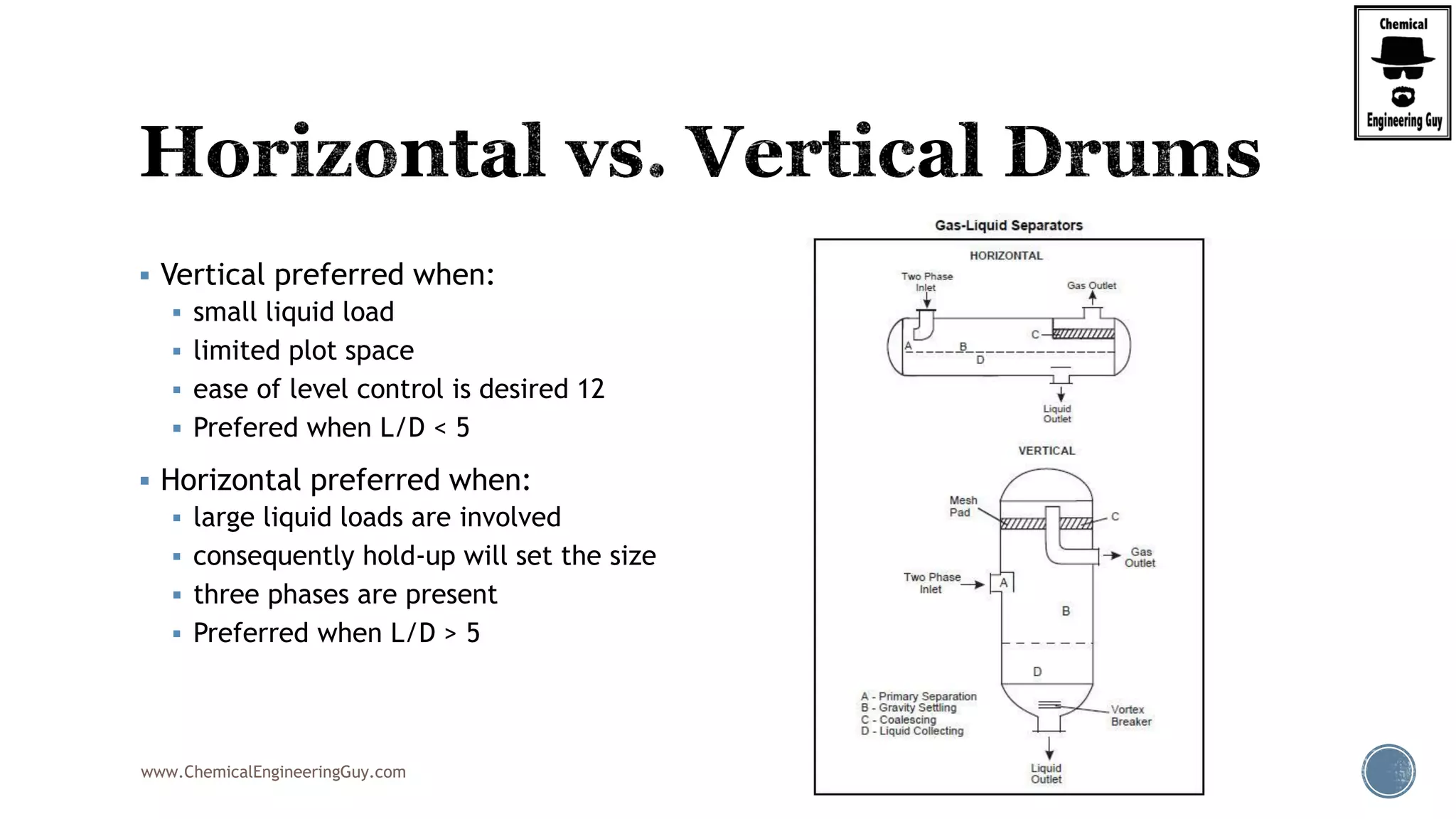
 Vertical preferred when:
 small liquid load
 limited plot space
 ease of level control is desired 12
 Prefered when L/D < 5
 Horizontal preferred when:
 large liquid loads are involved
 consequently hold-up will set the size
 three phases are present
 Preferred when L/D > 5
www.ChemicalEngineeringGuy.com
Do you need the Full Version?
Contact me if needed!
Contact@ChemicalEngineeringGuy.com
https://courses.chemicalengineeringguy.com/courses
You can also check out more content here:
My Youtube Channel 
My Fan Page 
The LinkedIn
My website:
www.ChemicalEngineeringGuy.com
Do you need the Full Version?
Contact me if needed!
Contact@ChemicalEngineeringGuy.com
https://courses.chemicalengineeringguy.com/courses
You can also check out more content here:
My Youtube Channel 
My Fan Page 
The LinkedIn
My website:
www.ChemicalEngineeringGuy.com
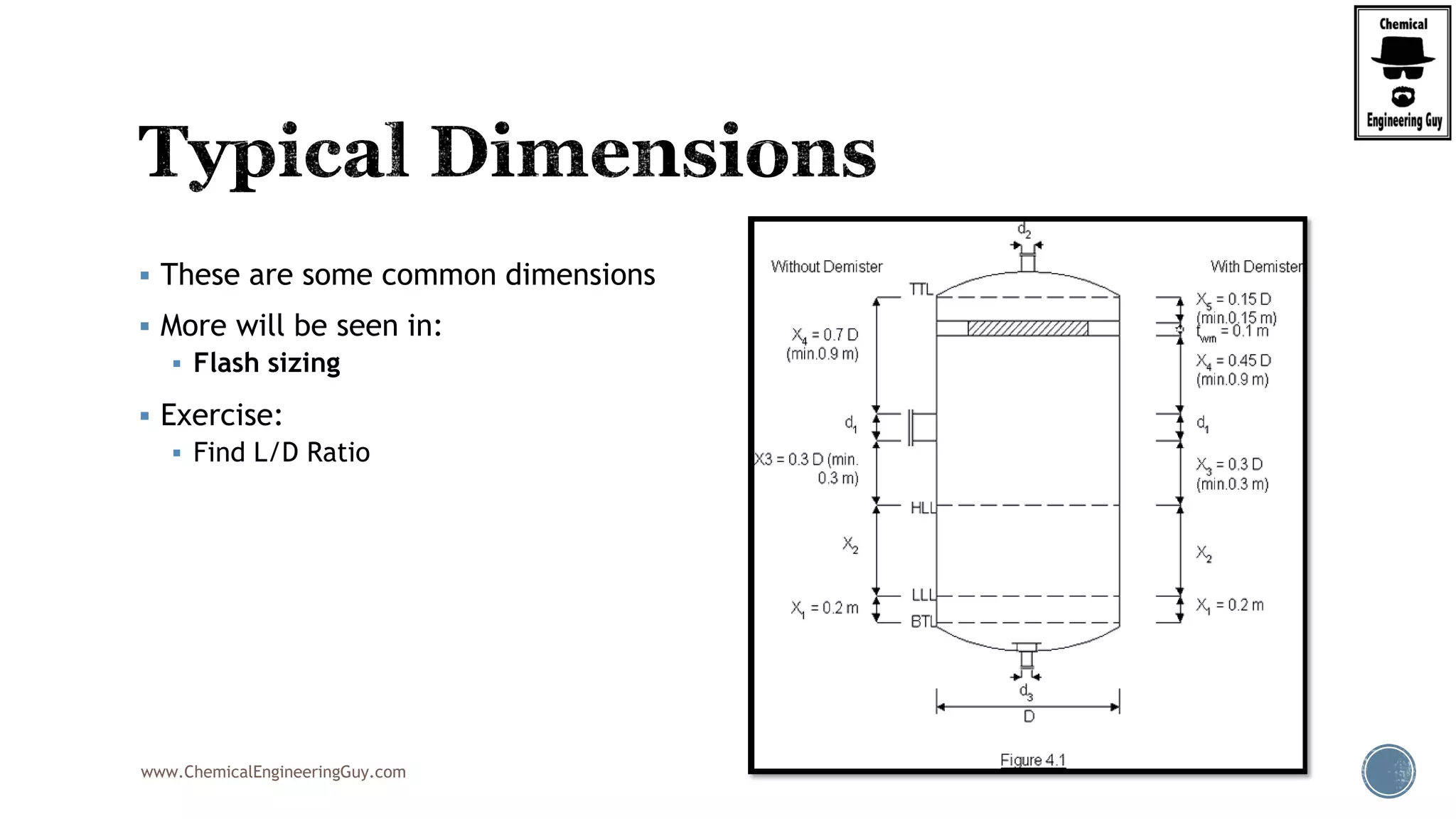
 These are some common dimensions
 More will be seen in:
 Flash sizing
 Exercise:
 Find L/D Ratio
www.ChemicalEngineeringGuy.com
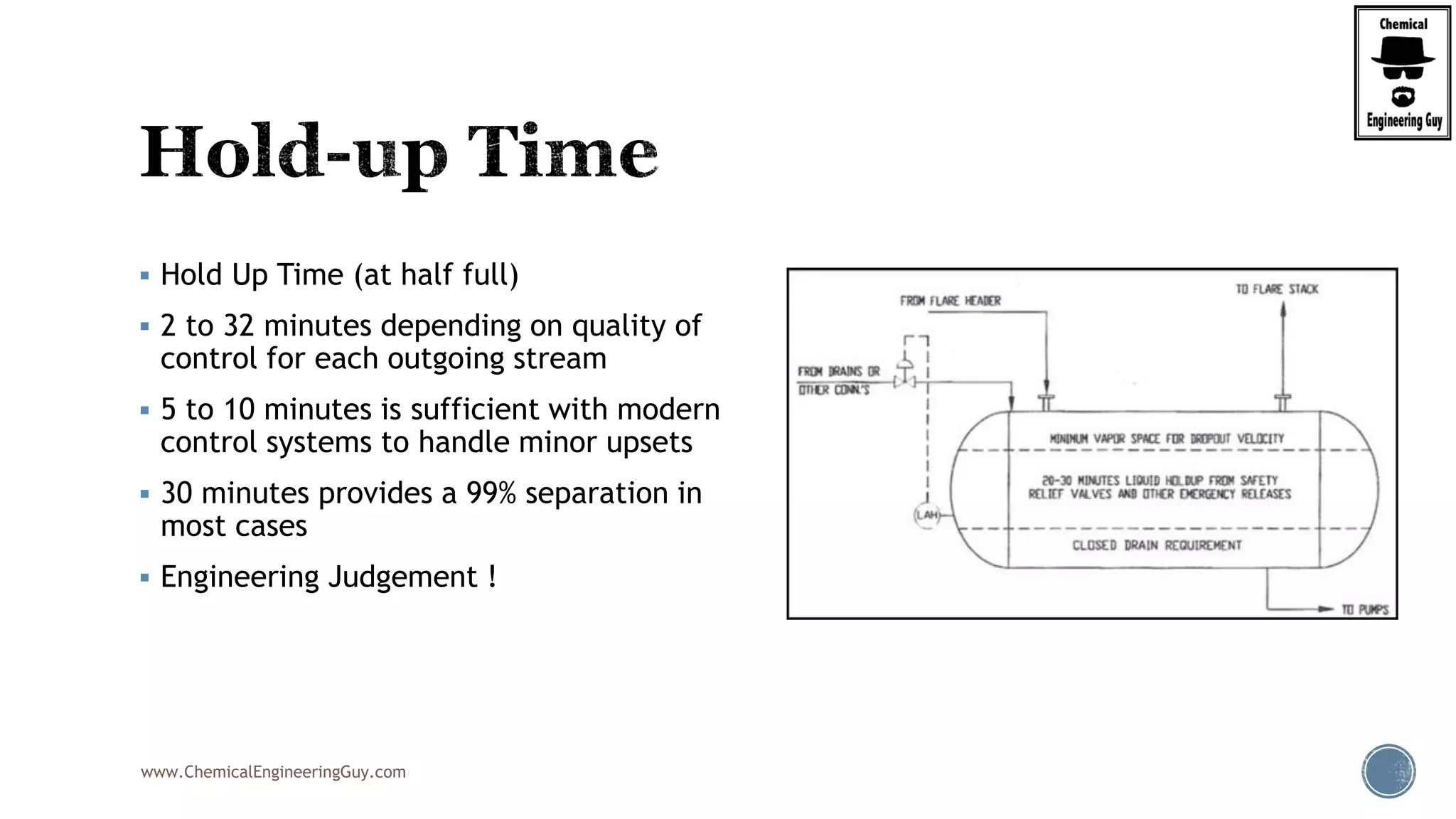
 Hold Up Time (at half full)
 2 to 32 minutes depending on quality of
control for each outgoing stream
 5 to 10 minutes is sufficient with modern
control systems to handle minor upsets
 30 minutes provides a 99% separation in
most cases
 Engineering Judgement !
www.ChemicalEngineeringGuy.com
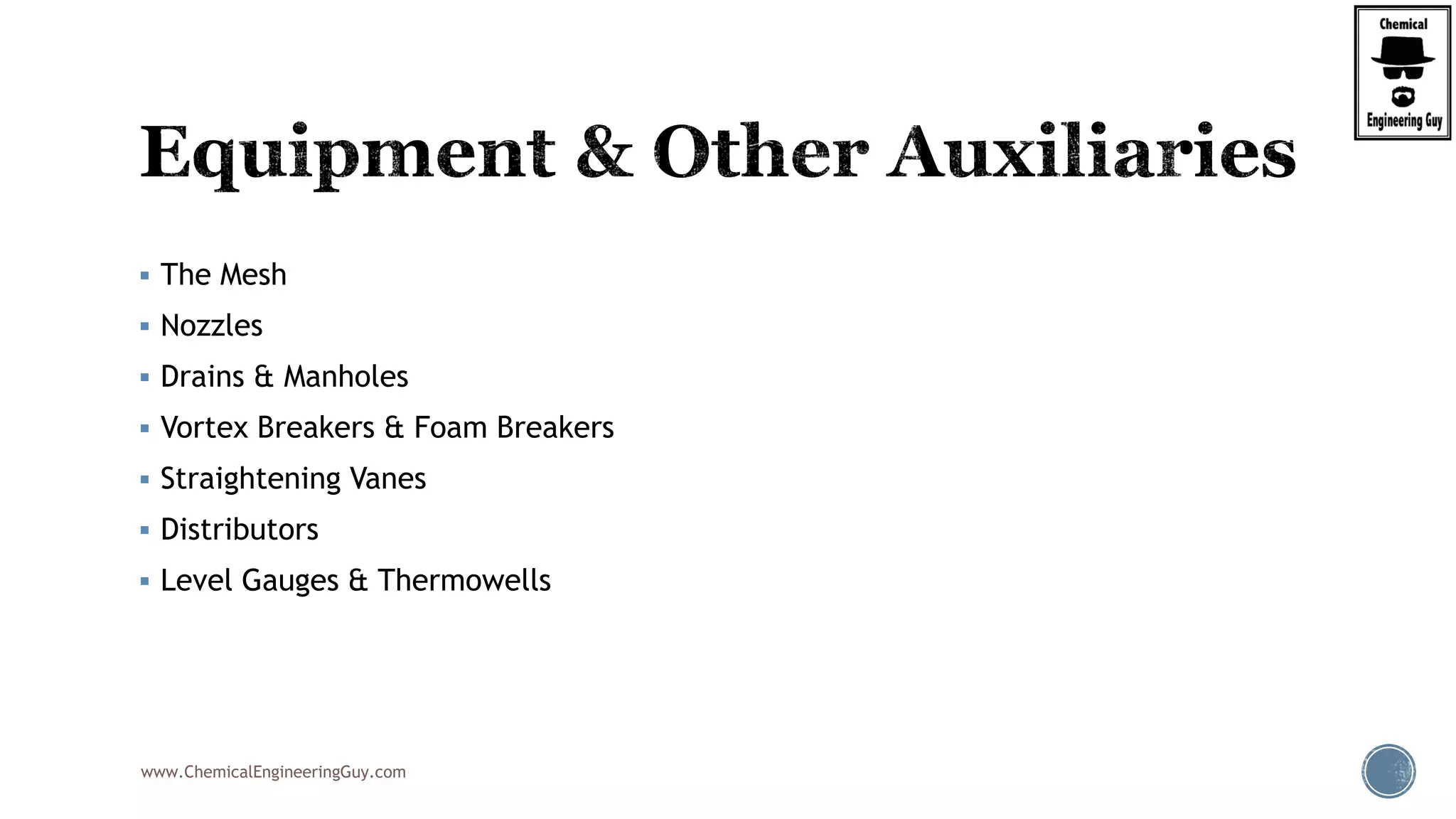
 The Mesh
 Nozzles
 Drains & Manholes
 Vortex Breakers & Foam Breakers
 Straightening Vanes
 Distributors
 Level Gauges & Thermowells
www.ChemicalEngineeringGuy.com
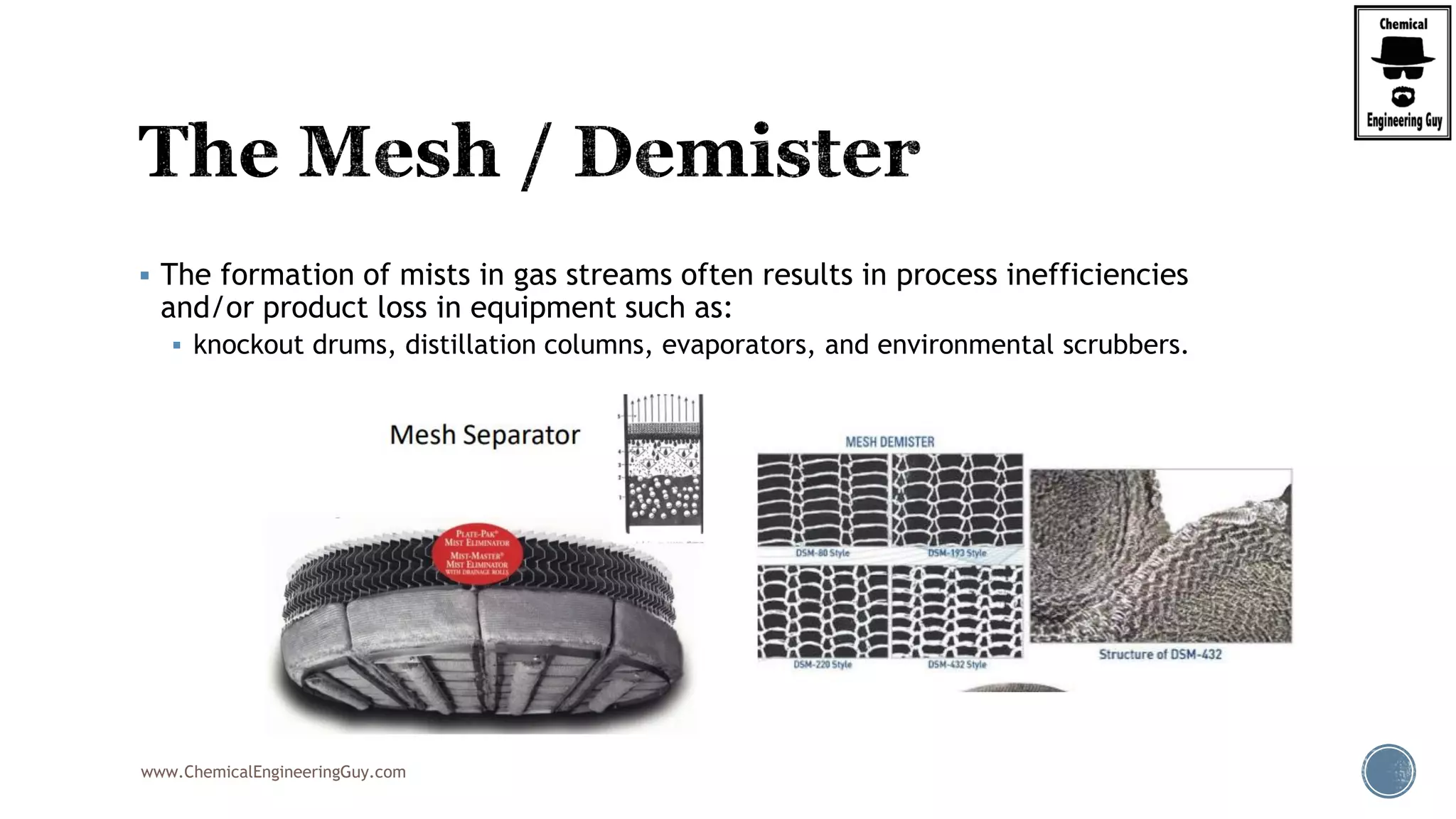
 The mist extractor is the final gas cleaning device in a conventional separator.
 The selection, and design to a large degree, determine the amount of liquid
carryover remaining in the gas phase.
 The most common types include:
 Wire mesh pads (“mesh pads”)
 Vane-type (vane “packs”)
 Axial flow demisting cyclones.
Do you need the Full Version?
Contact me if needed!
Contact@ChemicalEngineeringGuy.com
https://courses.chemicalengineeringguy.com/courses
You can also check out more content here:
My Youtube Channel 
My Fan Page 
The LinkedIn
My website:
www.ChemicalEngineeringGuy.com
 The formation of mists in gas streams often results in process inefficiencies
and/or product loss in equipment such as:
 knockout drums, distillation columns, evaporators, and environmental scrubbers.
www.ChemicalEngineeringGuy.com
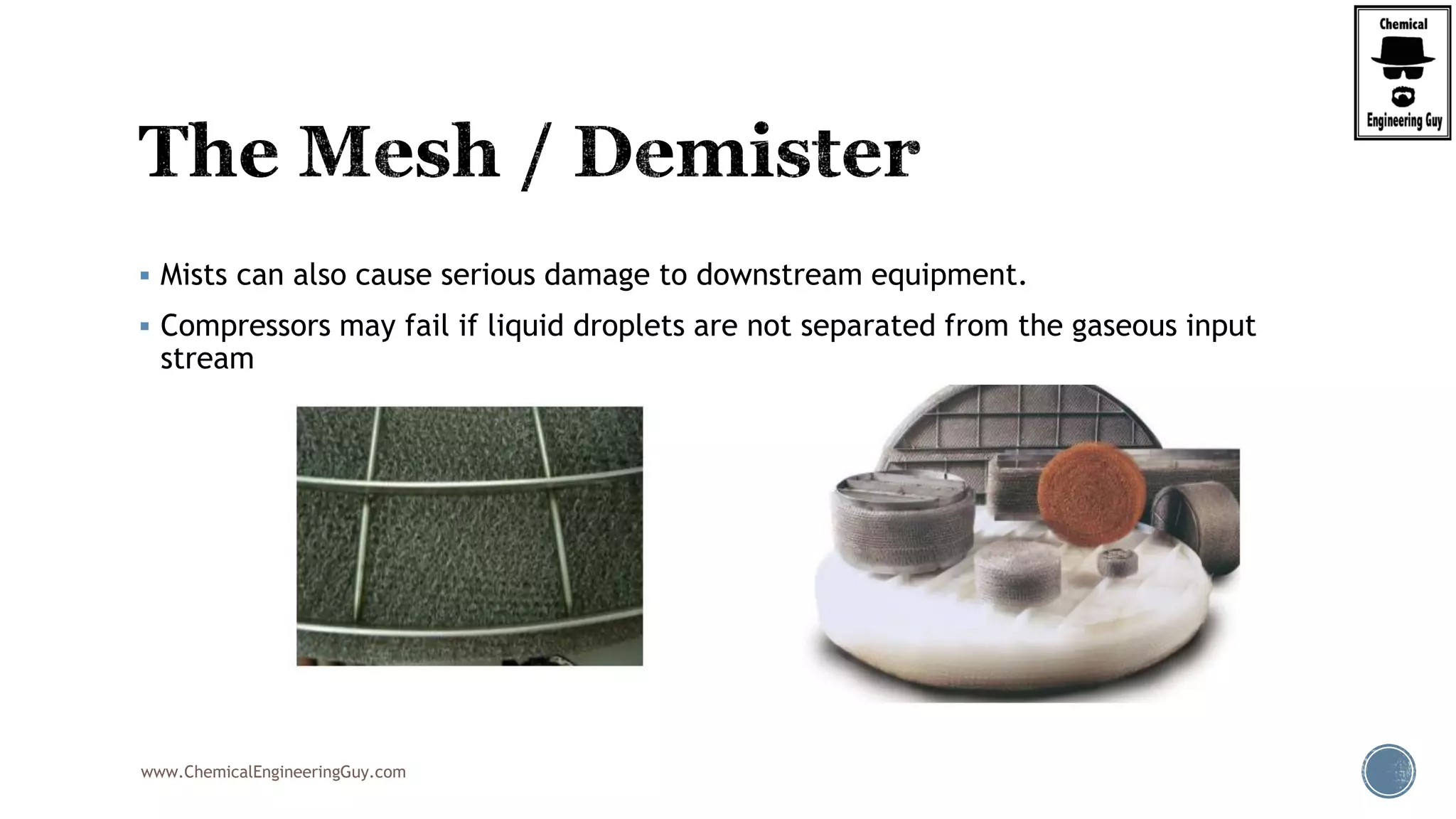
 Mists can also cause serious damage to downstream equipment.
 Compressors may fail if liquid droplets are not separated from the gaseous input
stream
www.ChemicalEngineeringGuy.com
Do you need the Full Version?
Contact me if needed!
Contact@ChemicalEngineeringGuy.com
https://courses.chemicalengineeringguy.com/courses
You can also check out more content here:
My Youtube Channel 
My Fan Page 
The LinkedIn
My website:
www.ChemicalEngineeringGuy.com
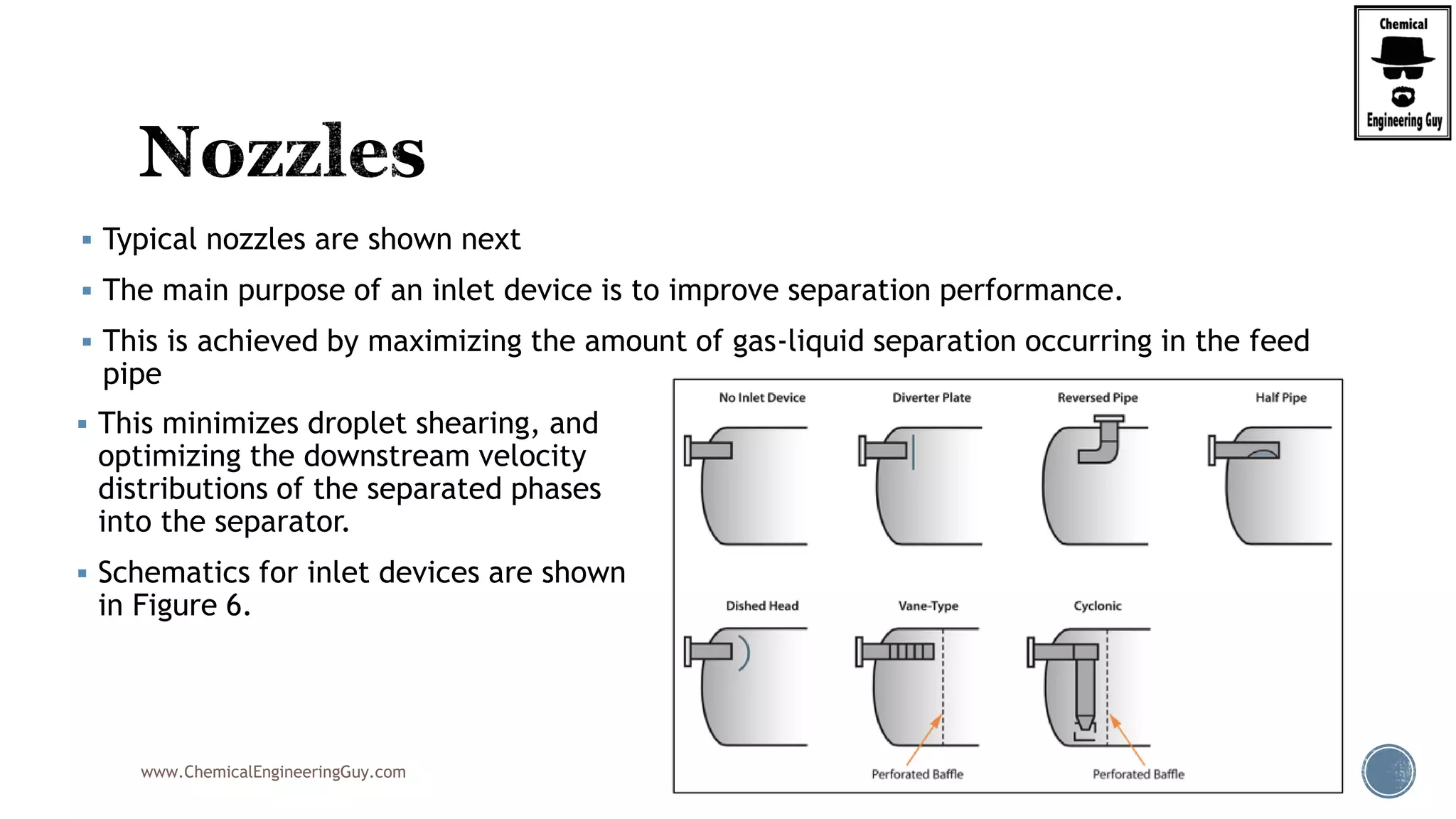
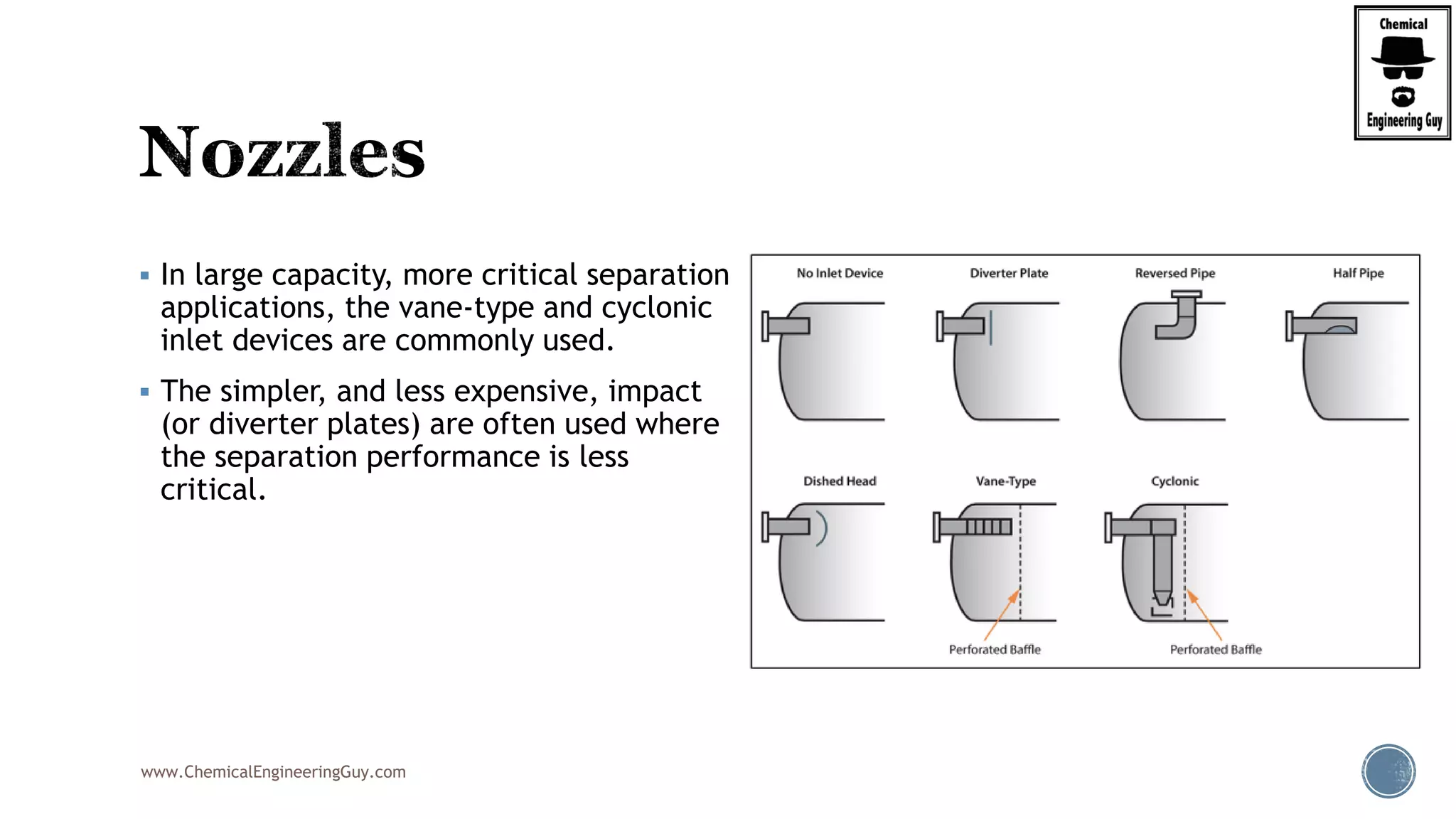
 Typical nozzles are shown next
 The main purpose of an inlet device is to improve separation performance.
 This is achieved by maximizing the amount of gas-liquid separation occurring in the feed
pipe
 This minimizes droplet shearing, and
optimizing the downstream velocity
distributions of the separated phases
into the separator.
 Schematics for inlet devices are shown
in Figure 6.
www.ChemicalEngineeringGuy.com
 In large capacity, more critical separation
applications, the vane-type and cyclonic
inlet devices are commonly used.
 The simpler, and less expensive, impact
(or diverter plates) are often used where
the separation performance is less
critical.
www.ChemicalEngineeringGuy.com
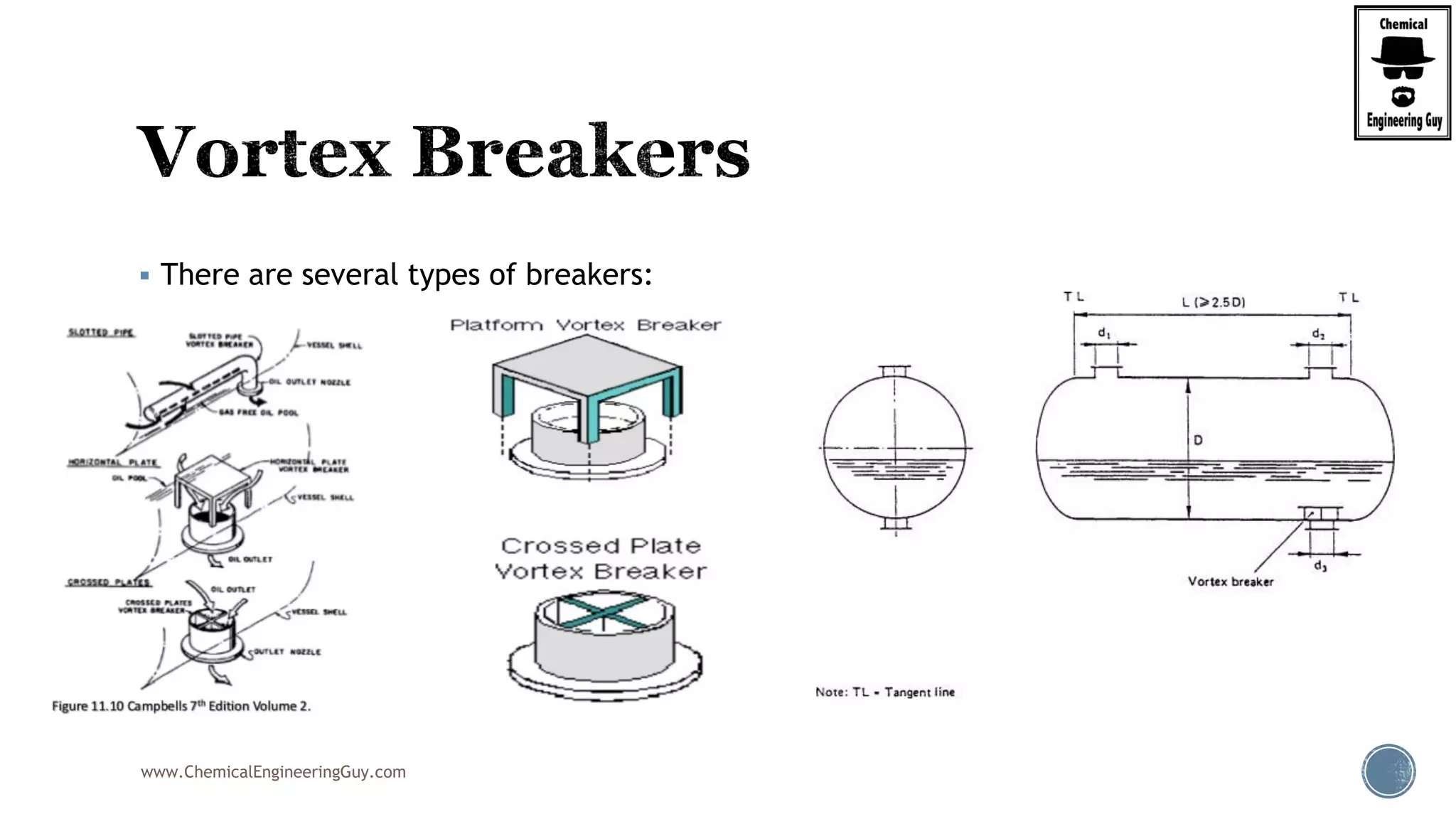
 Ideal vs Vortex Formation due to Drain / outlets
 Excessive Pressure Drops
 Erosion of nozzle
 Poor Separation Steps
Do you need the Full Version?
Contact me if needed!
Contact@ChemicalEngineeringGuy.com
https://courses.chemicalengineeringguy.com/courses
You can also check out more content here:
My Youtube Channel 
My Fan Page 
The LinkedIn
My website:
www.ChemicalEngineeringGuy.com
 There are several types of breakers:
www.ChemicalEngineeringGuy.com
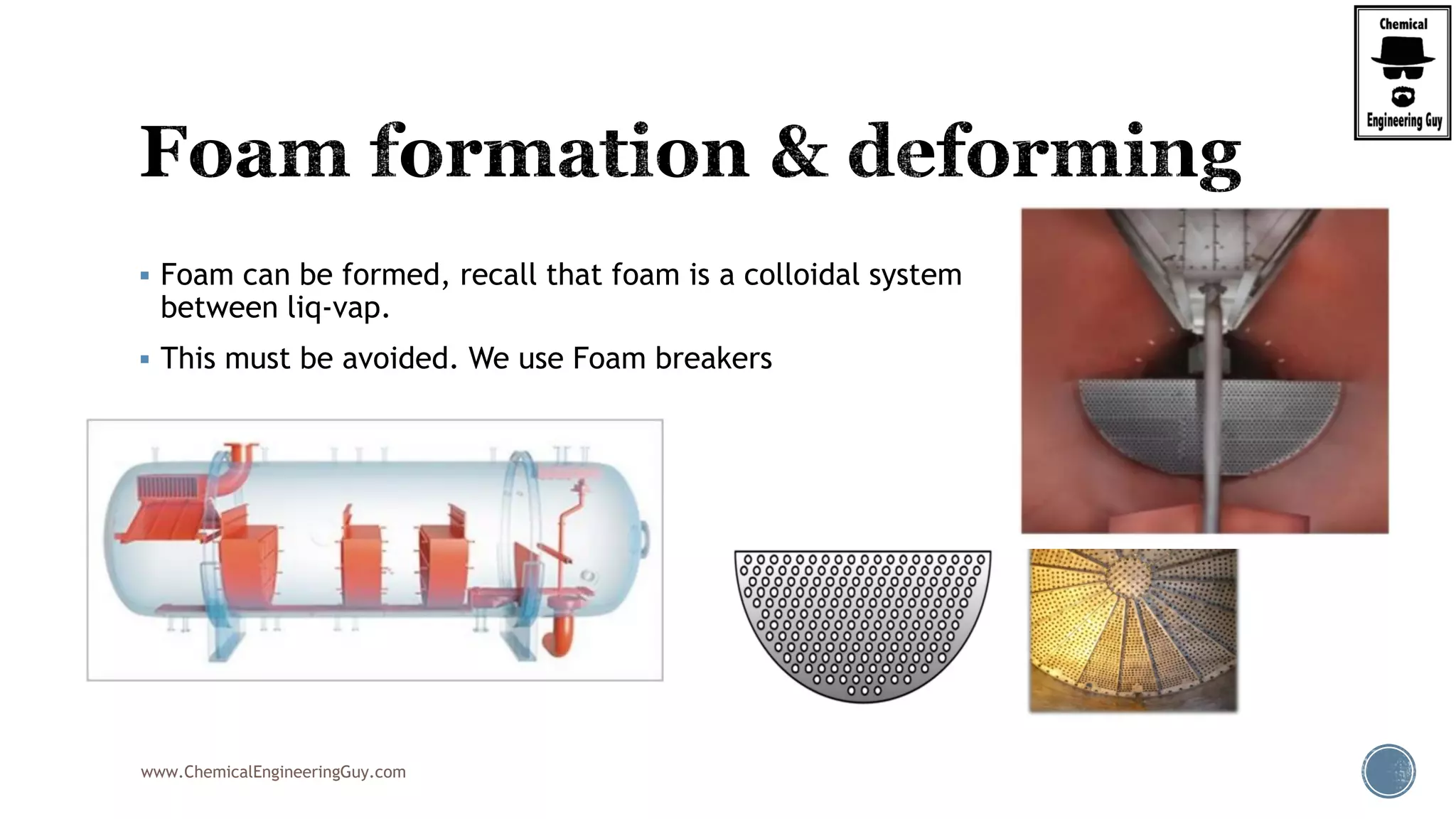
 Foam can be formed, recall that foam is a colloidal system
between liq-vap.
 This must be avoided. We use Foam breakers
www.ChemicalEngineeringGuy.com
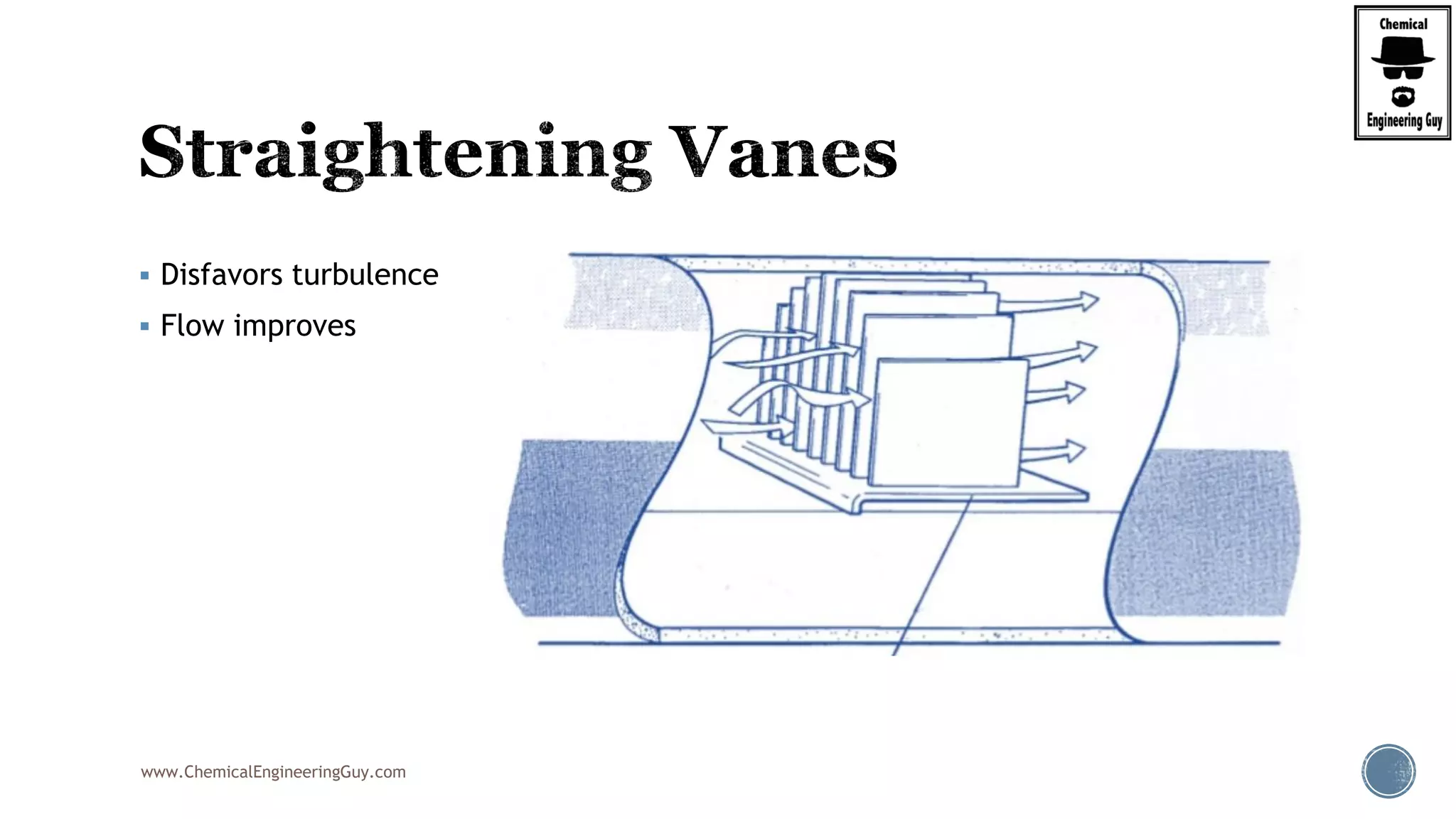
 Disfavors turbulence
 Flow improves
www.ChemicalEngineeringGuy.com
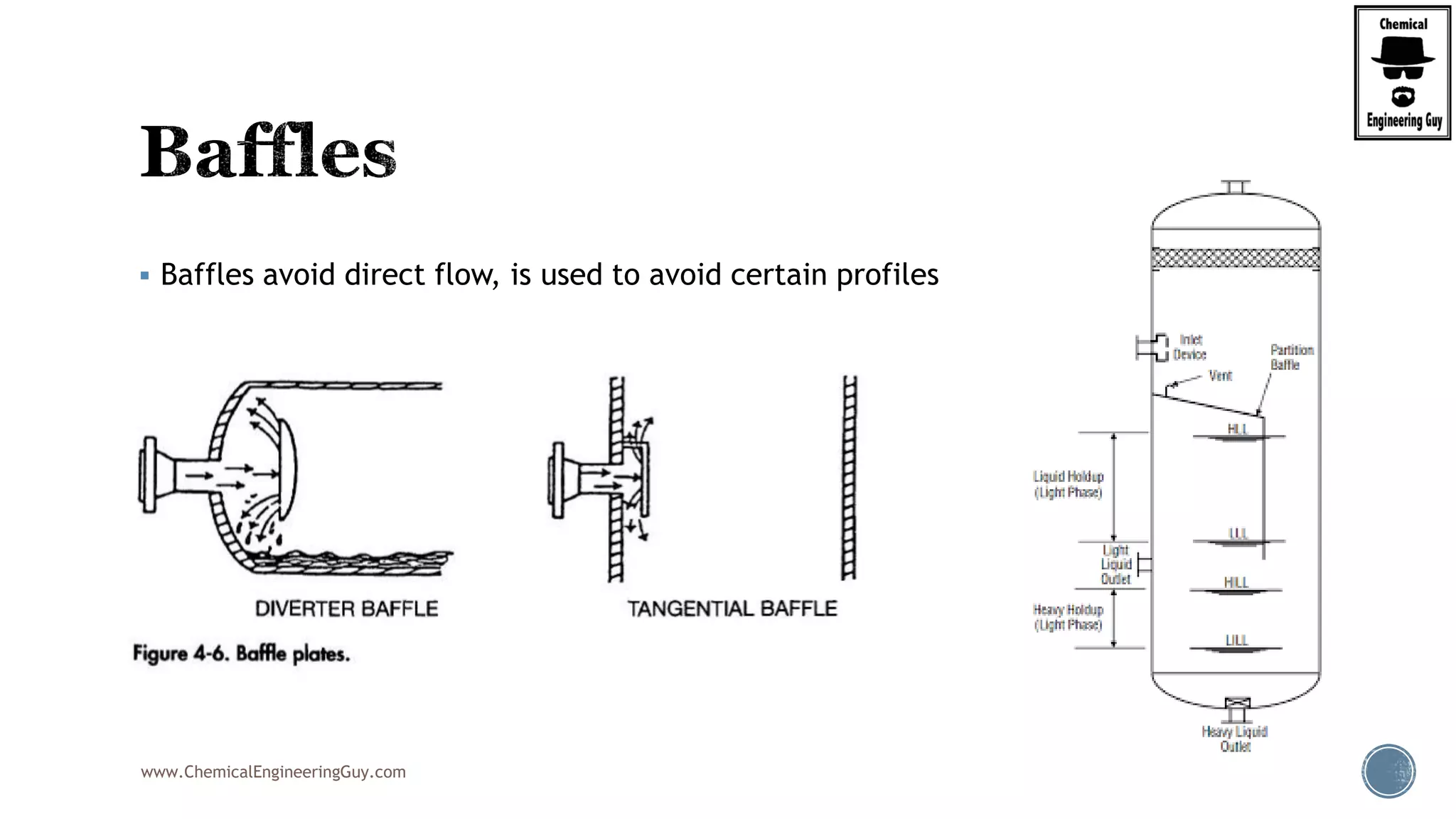
 Baffles avoid direct flow, is used to avoid certain profiles
www.ChemicalEngineeringGuy.com
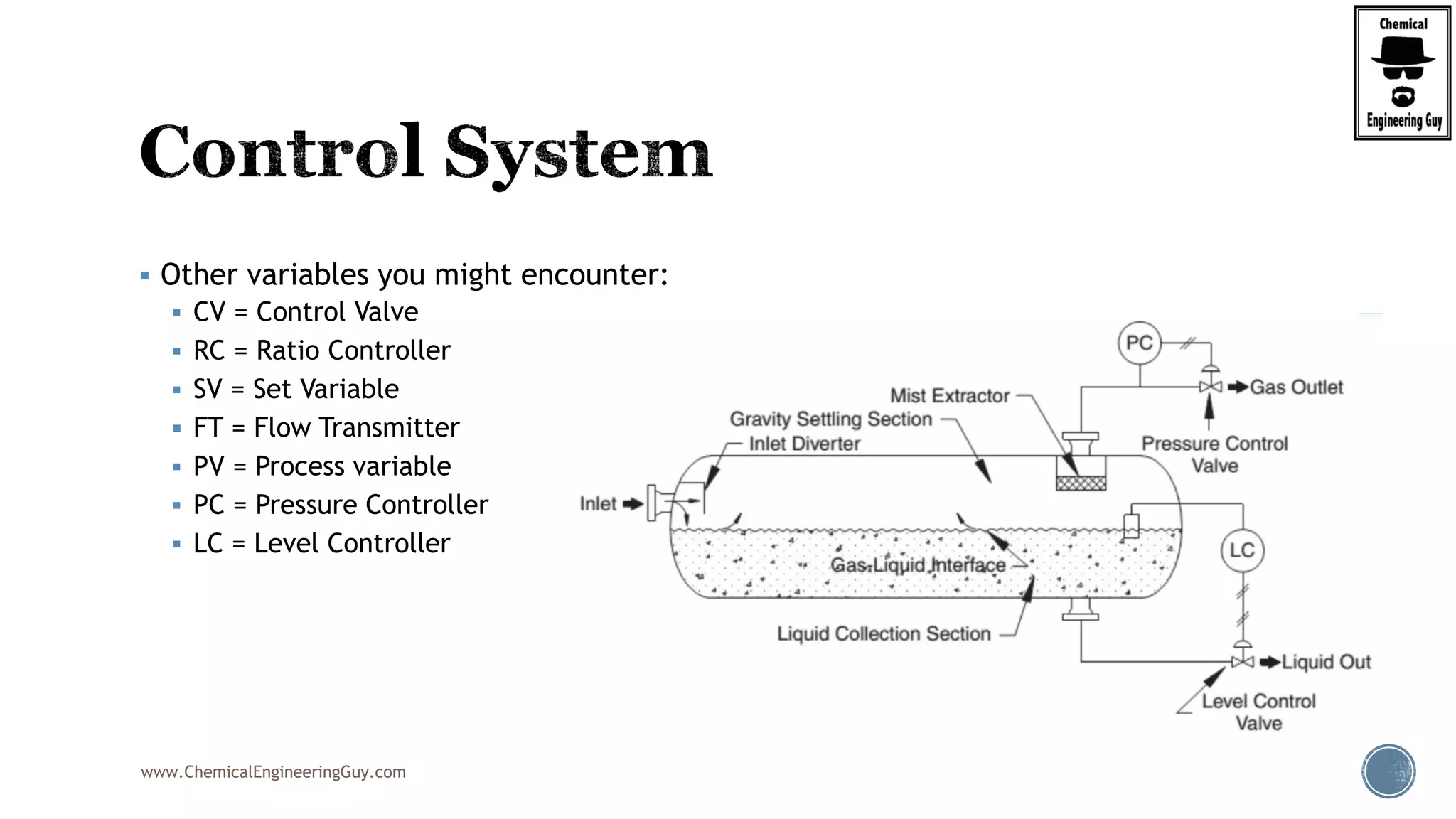
 Typically you will find:
 Level Controllers
 Pressure Controllers
 Temperature Controllers
 Flow Rate controllers
 Most of the variables can be controlled with
valves
 Pressure  open Gas Vent
 Liquid Level  Open Liquid Outlet
 Flow Rate  Open valve on inlet
 Temperature  Heating Jacket & Flow Rate
Do you need the Full Version?
Contact me if needed!
Contact@ChemicalEngineeringGuy.com
https://courses.chemicalengineeringguy.com/courses
You can also check out more content here:
My Youtube Channel 
My Fan Page 
The LinkedIn
My website:
www.ChemicalEngineeringGuy.com
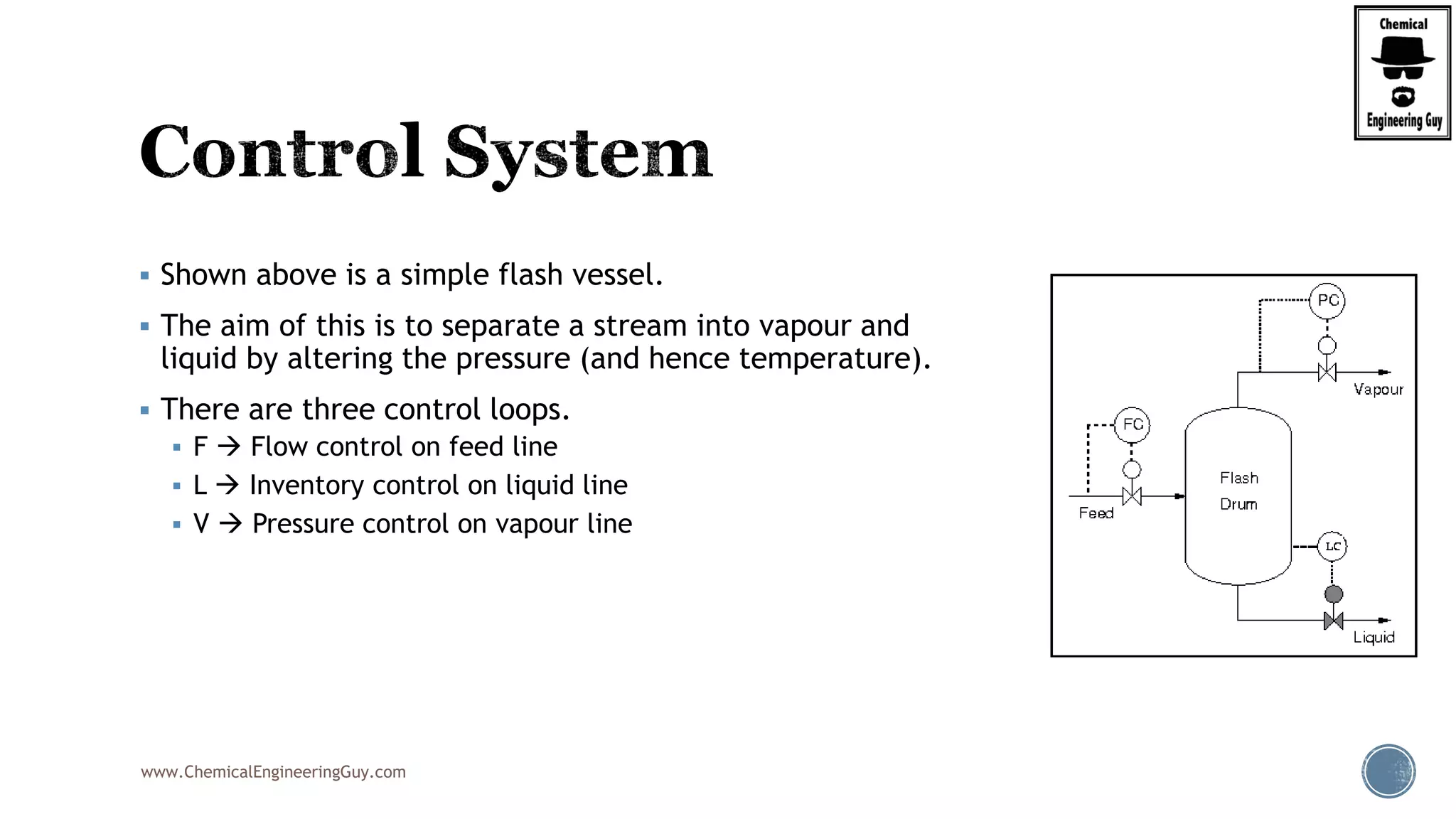
 Shown above is a simple flash vessel.
 The aim of this is to separate a stream into vapour and
liquid by altering the pressure (and hence temperature).
 There are three control loops.
 F  Flow control on feed line
 L  Inventory control on liquid line
 V  Pressure control on vapour line
www.ChemicalEngineeringGuy.com
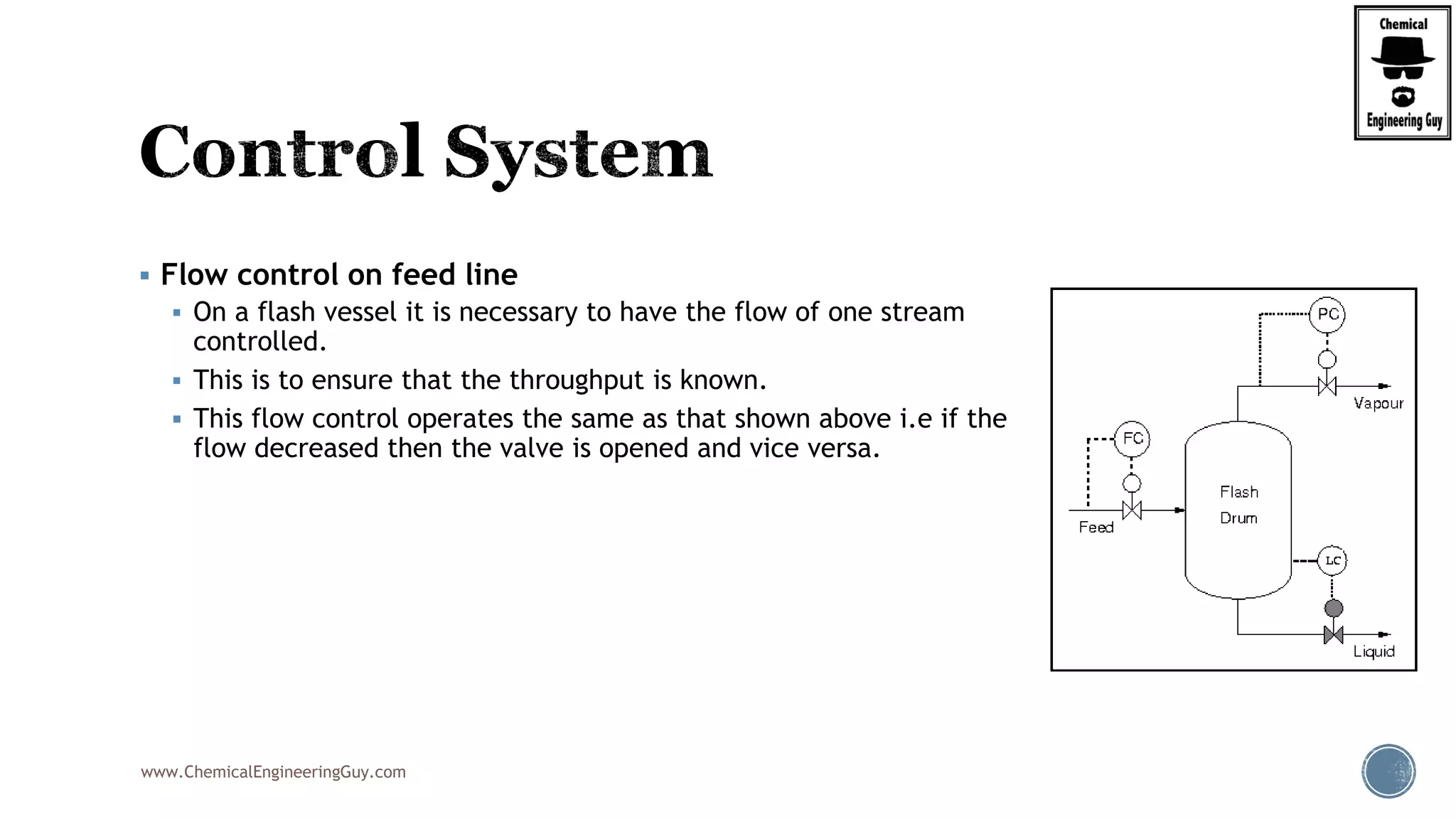
 Flow control on feed line
 On a flash vessel it is necessary to have the flow of one stream
controlled.
 This is to ensure that the throughput is known.
 This flow control operates the same as that shown above i.e if the
flow decreased then the valve is opened and vice versa.
www.ChemicalEngineeringGuy.com
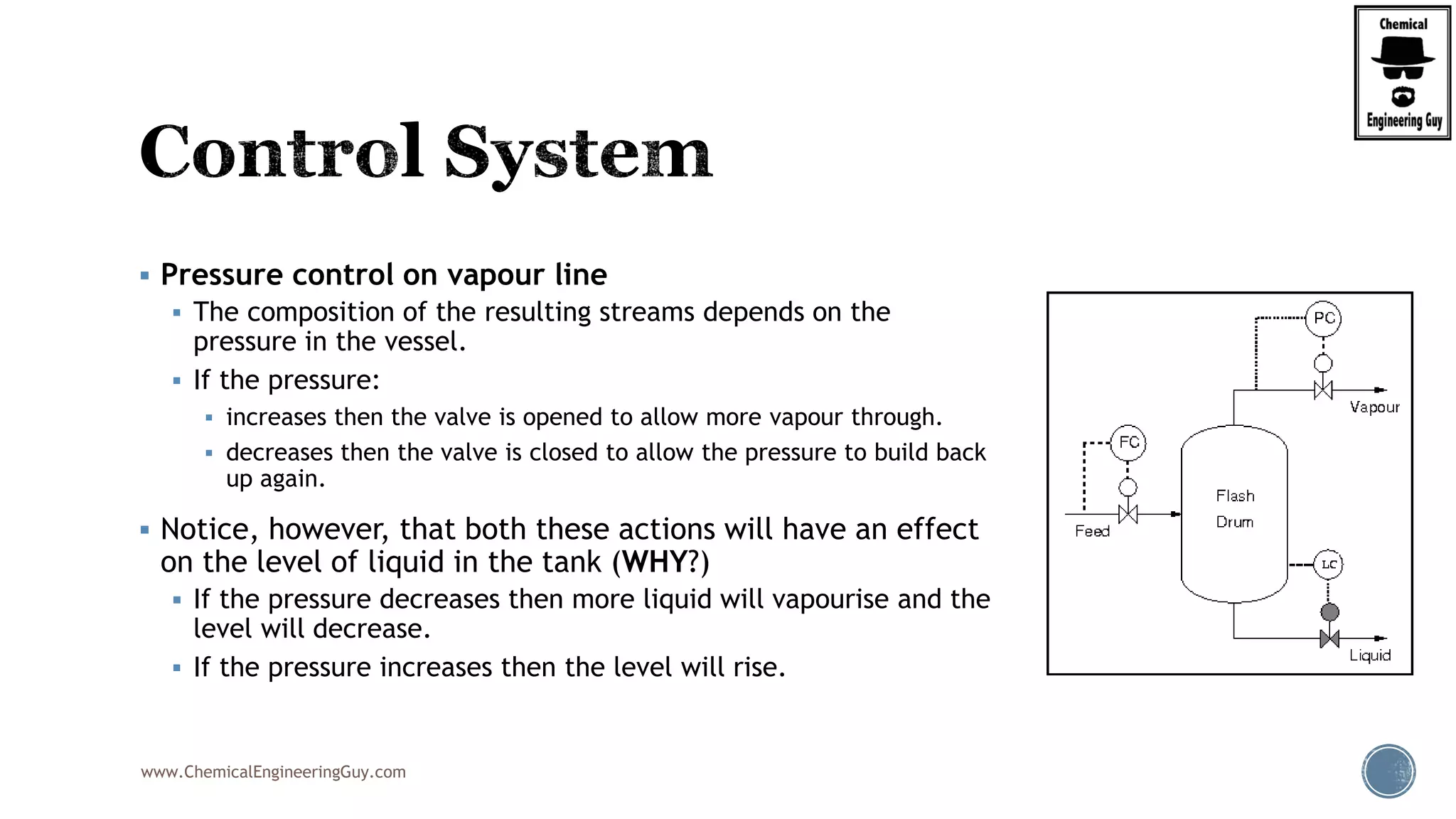
 Pressure control on vapour line
 The composition of the resulting streams depends on the
pressure in the vessel.
 If the pressure:
 increases then the valve is opened to allow more vapour through.
 decreases then the valve is closed to allow the pressure to build back
up again.
 Notice, however, that both these actions will have an effect
on the level of liquid in the tank (WHY?)
 If the pressure decreases then more liquid will vapourise and the
level will decrease.
 If the pressure increases then the level will rise.
www.ChemicalEngineeringGuy.com
 Inventory control on liquid line
 The shaded valve denotes an inventory loop.
 This is to ensure that the mass balance around the vessel balances
i.e. what goes in must come out.
 In this case it is simply a feedback liquid level control loop.
 If the level increases then the valve is opened and if the level
decreases then the valve is closed.
 Thus the vessel should not overflow or run dry.
Do you need the Full Version?
Contact me if needed!
Contact@ChemicalEngineeringGuy.com
https://courses.chemicalengineeringguy.com/courses
You can also check out more content here:
My Youtube Channel 
My Fan Page 
The LinkedIn
My website:
www.ChemicalEngineeringGuy.com
 Other variables you might encounter:
 CV = Control Valve
 RC = Ratio Controller
 SV = Set Variable
 FT = Flow Transmitter
 PV = Process variable
 PC = Pressure Controller
 LC = Level Controller
www.ChemicalEngineeringGuy.com
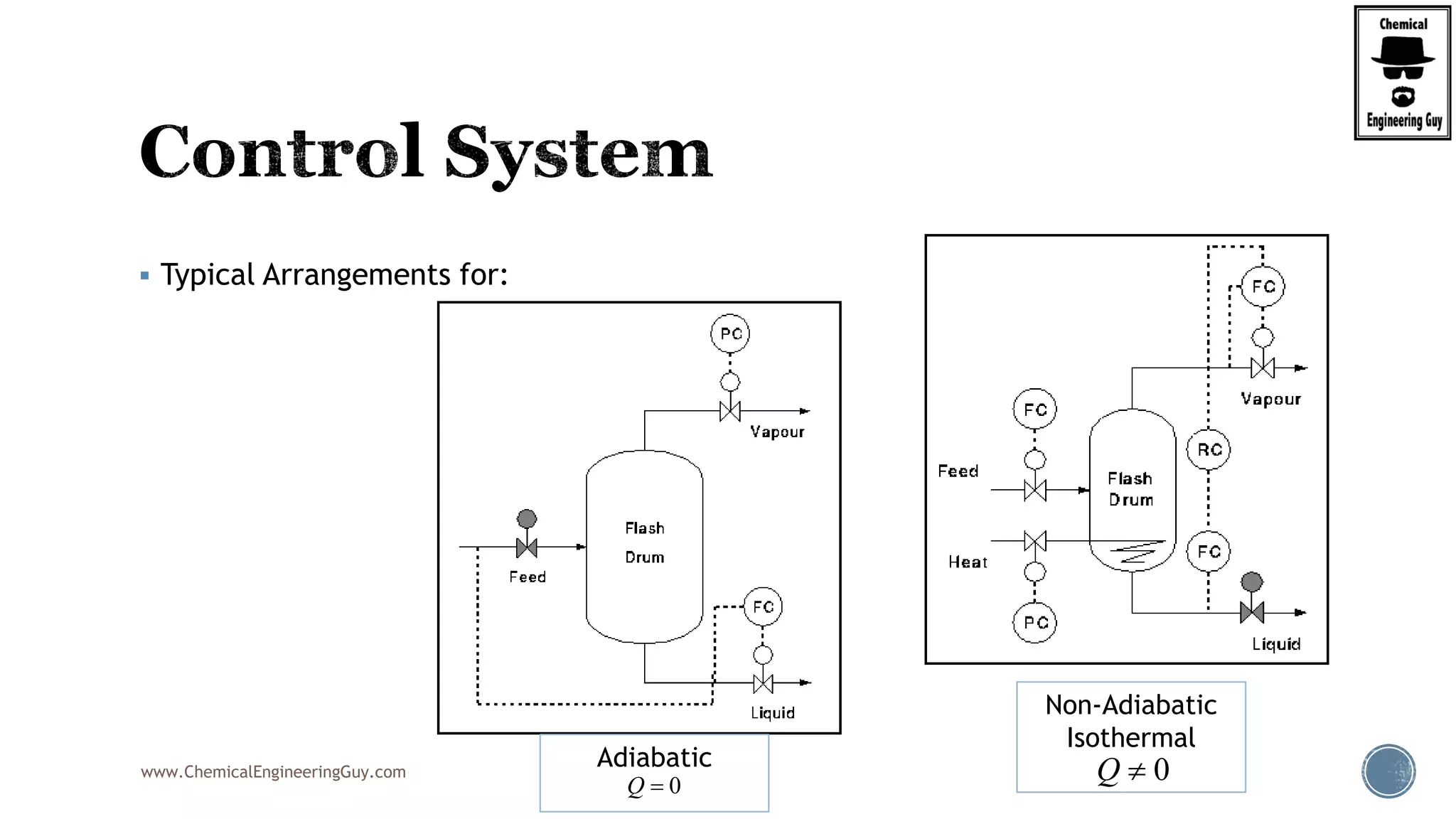
 Typical Arrangements for:
Non-Adiabatic
Isothermal
Adiabatic 0Q 0Q 
www.ChemicalEngineeringGuy.com
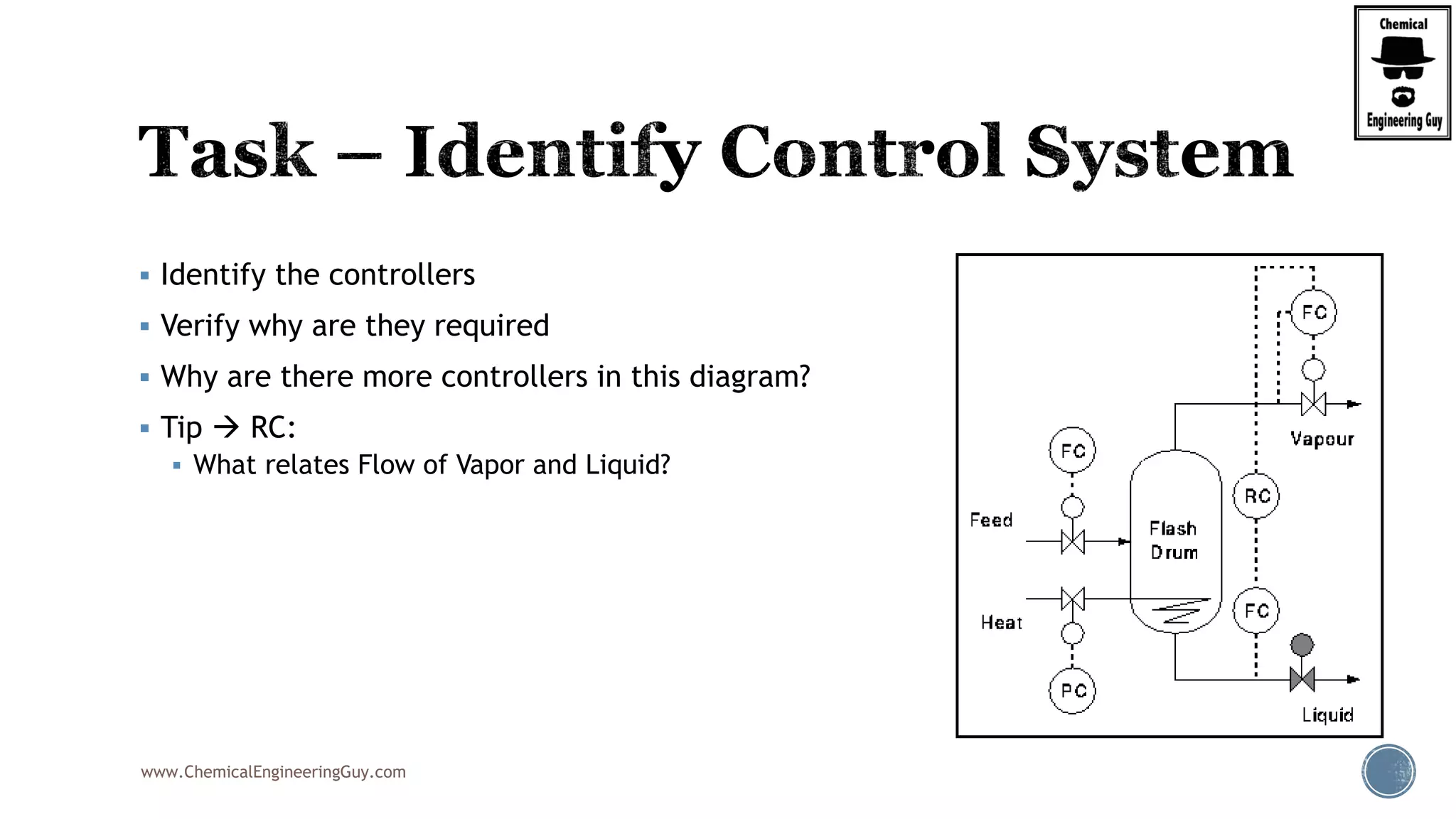
 Identify the controllers
 Verify why are they required
 Why are there more controllers in this diagram?
 Tip  RC:
 What relates Flow of Vapor and Liquid?
www.ChemicalEngineeringGuy.com
 Sequential Method:
 Flash Distillation  Operation Line (FOL)
 Analysis of Operating Line  Changes in Fraction Vapourised
 Exercises!
www.ChemicalEngineeringGuy.com
 Degrees of Freedom  6
 Variables 
 Feed Flow Rate, F
 Feed Composition, xF
 Temperature, T1
 Pressure, p1
 Remaining:
 Drum Pressure, Pdrum
 X  this is the interesting part!
 Vapor mole fraction, y
 Liquid mole fraction, x
 Fraction feed vaporized, f = V/F
 Fraction of feed remaining in liquid, q = L/F
 Temperature of the flash drum Tdrum
Do you need the Full Version?
Contact me if needed!
Contact@ChemicalEngineeringGuy.com
https://courses.chemicalengineeringguy.com/courses
You can also check out more content here:
My Youtube Channel 
My Fan Page 
The LinkedIn
My website:
www.ChemicalEngineeringGuy.com
 There are several ways we can solve a Flash System:
 Sequential
 Equation by equation, variable by variable
 More intuitive
 Simultaneous
 All equations are solved at the same time
 Convergence Methods
 Note that in both cases, we calculate:
 Flow rates (F, V, L)
 Ccompositions of vapor, liquid and feed in A and B
 Temperatures, Pressures, etc..
www.ChemicalEngineeringGuy.com
 We will first solve the mass balance and equilibrium relationships
 Then we will solve the energy balance & enthalpy equations (if required)
 We can do this in a binary system if at least one of these is given:
 Vapor mole fraction, y
 Liquid mole fraction, x
 Fraction feed vaporized, f = V/F
 Fraction of feed remaining in liquid, q = L/F
 Temperature of the flash drum Tdrum
 Recall that due to equilibrium we just need a single variable to “fix” the system
 We will need an Operation Line
www.ChemicalEngineeringGuy.com
 Operation Lines are very commonly used in Separation Processed & Mass Trnasfer
Operations
 This is a line in which the operation will take place
 Initial spot
 Final spot
 Typically, there will be a change regarding the position in the EQUILIBRIUM
 The Driving Force of the process ( change in concentrations) is given by this
“change”
 The Operating Line is also based on a material balance
Do you need the Full Version?
Contact me if needed!
Contact@ChemicalEngineeringGuy.com
https://courses.chemicalengineeringguy.com/courses
You can also check out more content here:
My Youtube Channel 
My Fan Page 
The LinkedIn
My website:
www.ChemicalEngineeringGuy.com
 Example of Operation Lines
 Gas Absorption
 Flash
 Distillation (stripping, enriching sections)
 Batch Distillation
 Liquid-Liquid
www.ChemicalEngineeringGuy.com
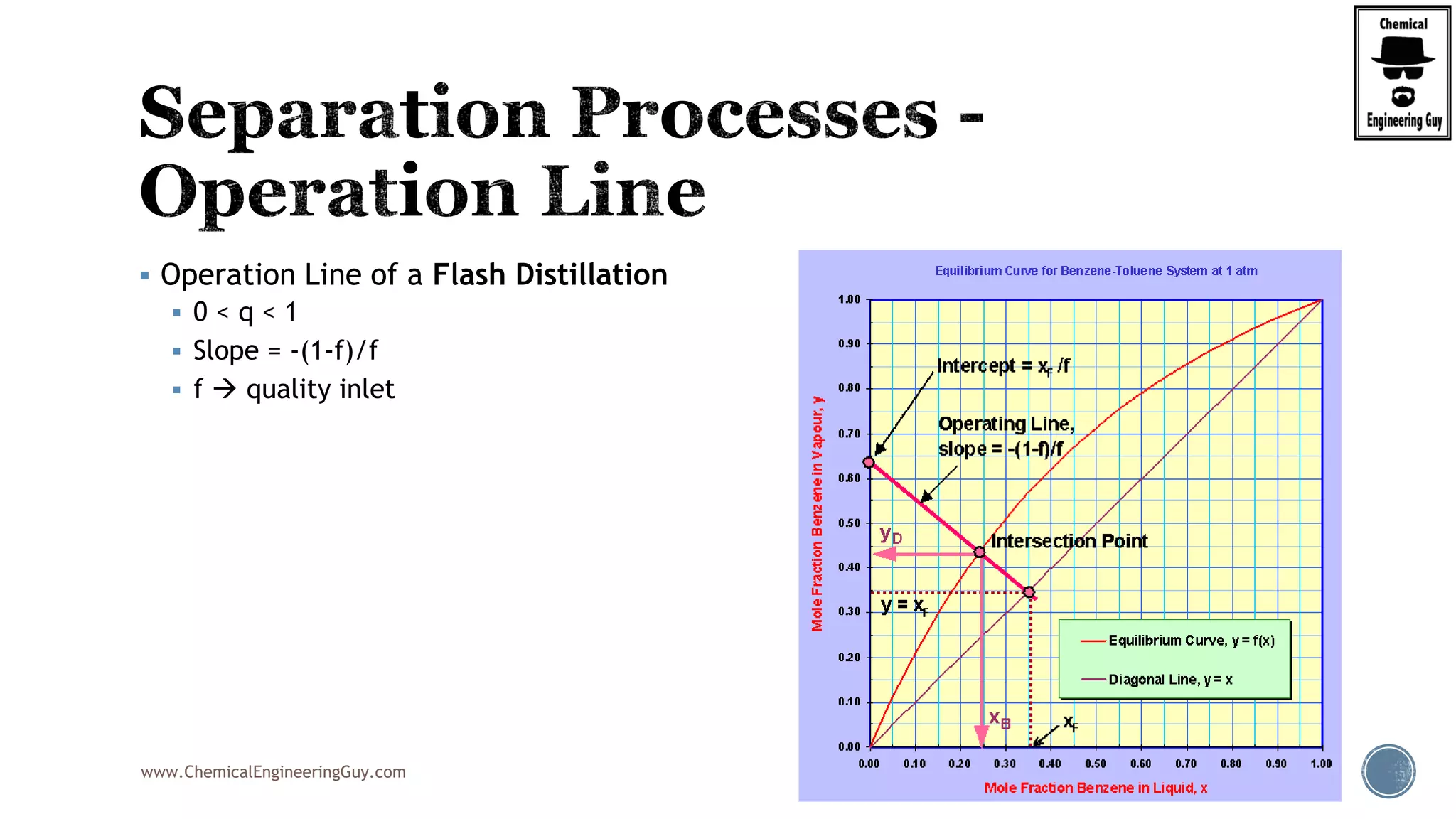
 Operation Line of a Flash Distillation
 0 < q < 1
 Slope = -(1-f)/f
 f  quality inlet
www.ChemicalEngineeringGuy.com
 Operation Line of a Batch Rectifier Distillation
 Line varies with time
 Depends:
 Constant Reflux
 Constant Distillate Composition
Do you need the Full Version?
Contact me if needed!
Contact@ChemicalEngineeringGuy.com
https://courses.chemicalengineeringguy.com/courses
You can also check out more content here:
My Youtube Channel 
My Fan Page 
The LinkedIn
My website:
www.ChemicalEngineeringGuy.com
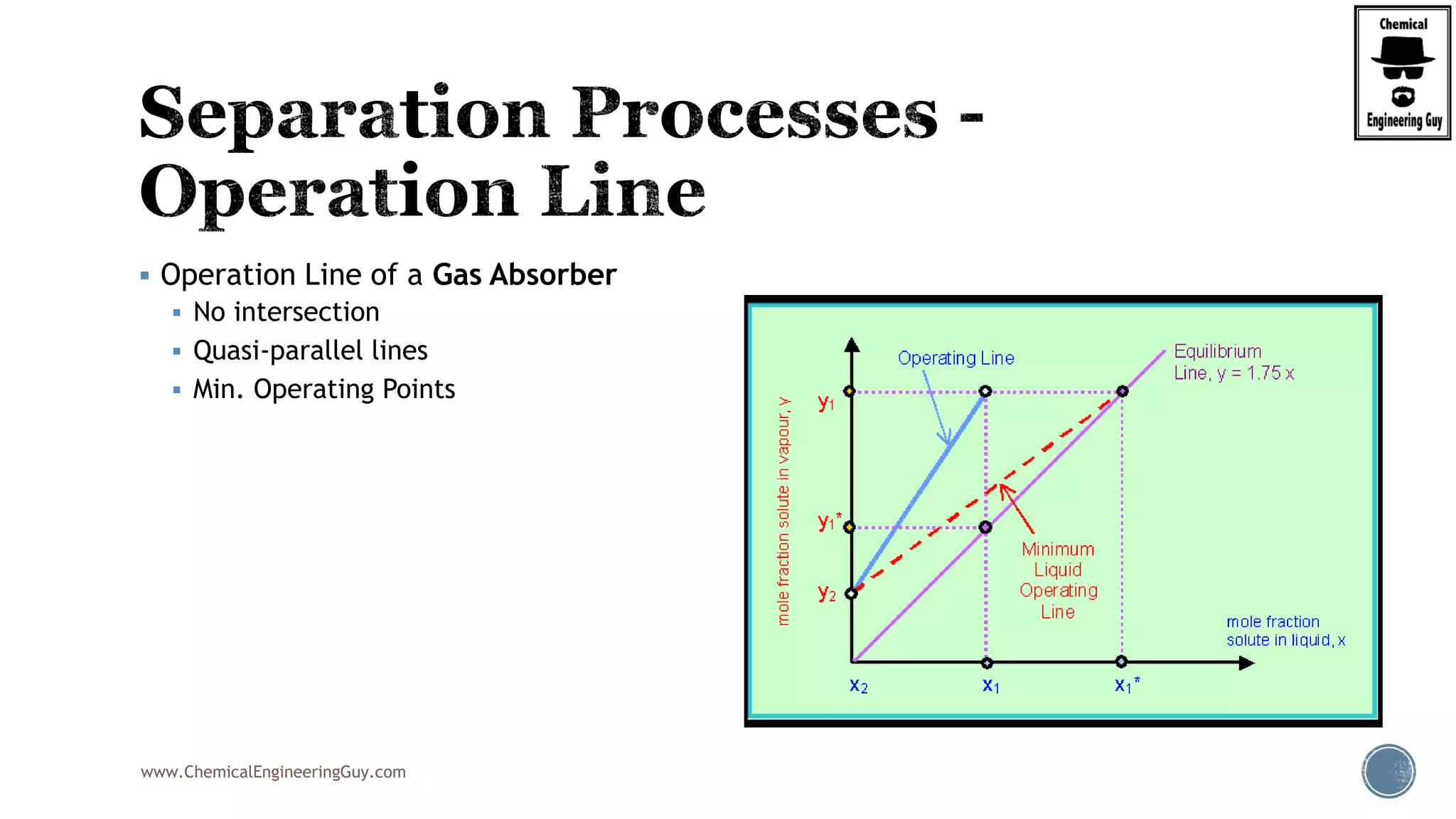
 Operation Line of a Gas Absorber
 No intersection
 Quasi-parallel lines
 Min. Operating Points
www.ChemicalEngineeringGuy.com
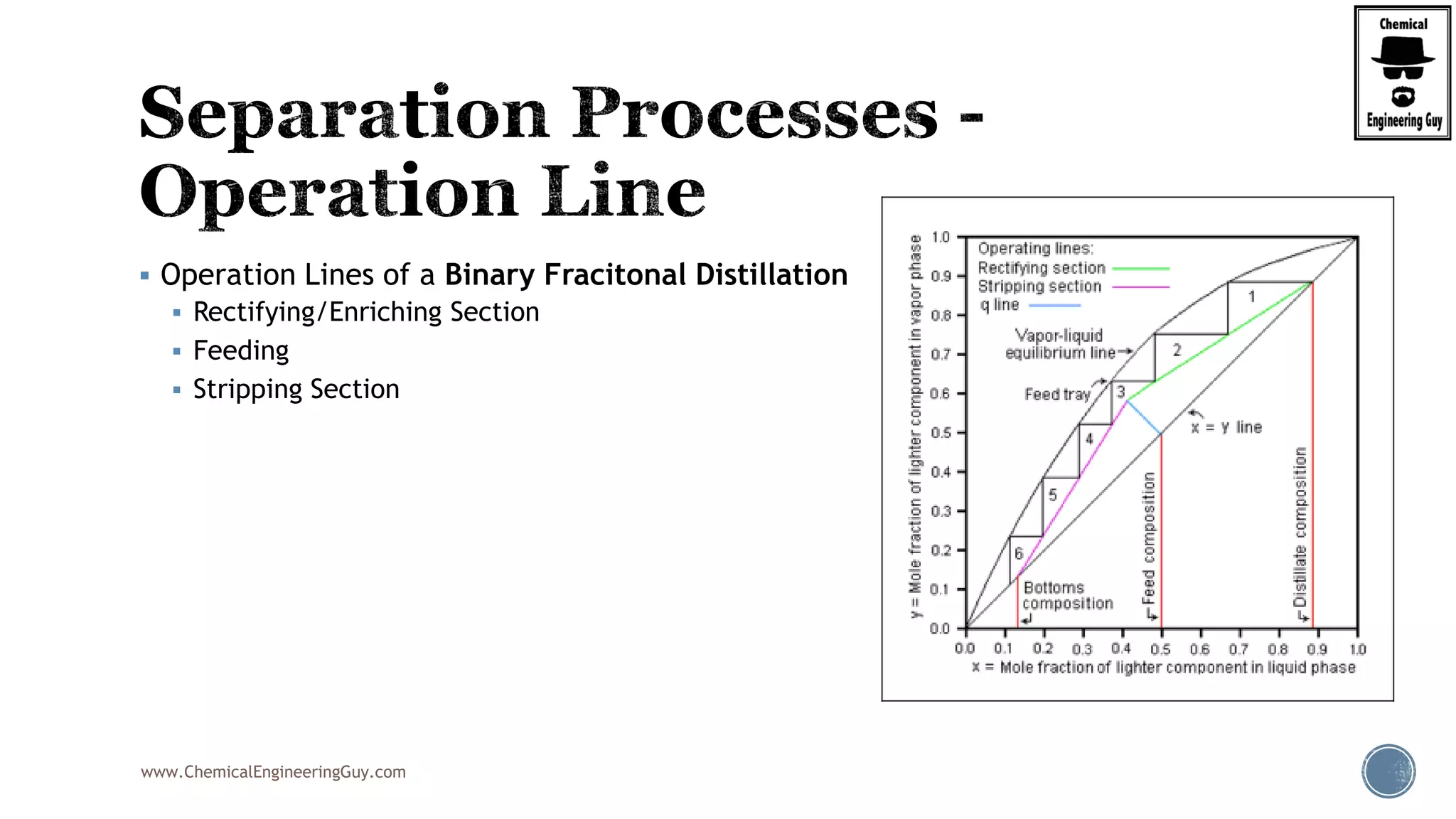
 Operation Lines of a Binary Fracitonal Distillation
 Rectifying/Enriching Section
 Feeding
 Stripping Section
www.ChemicalEngineeringGuy.com
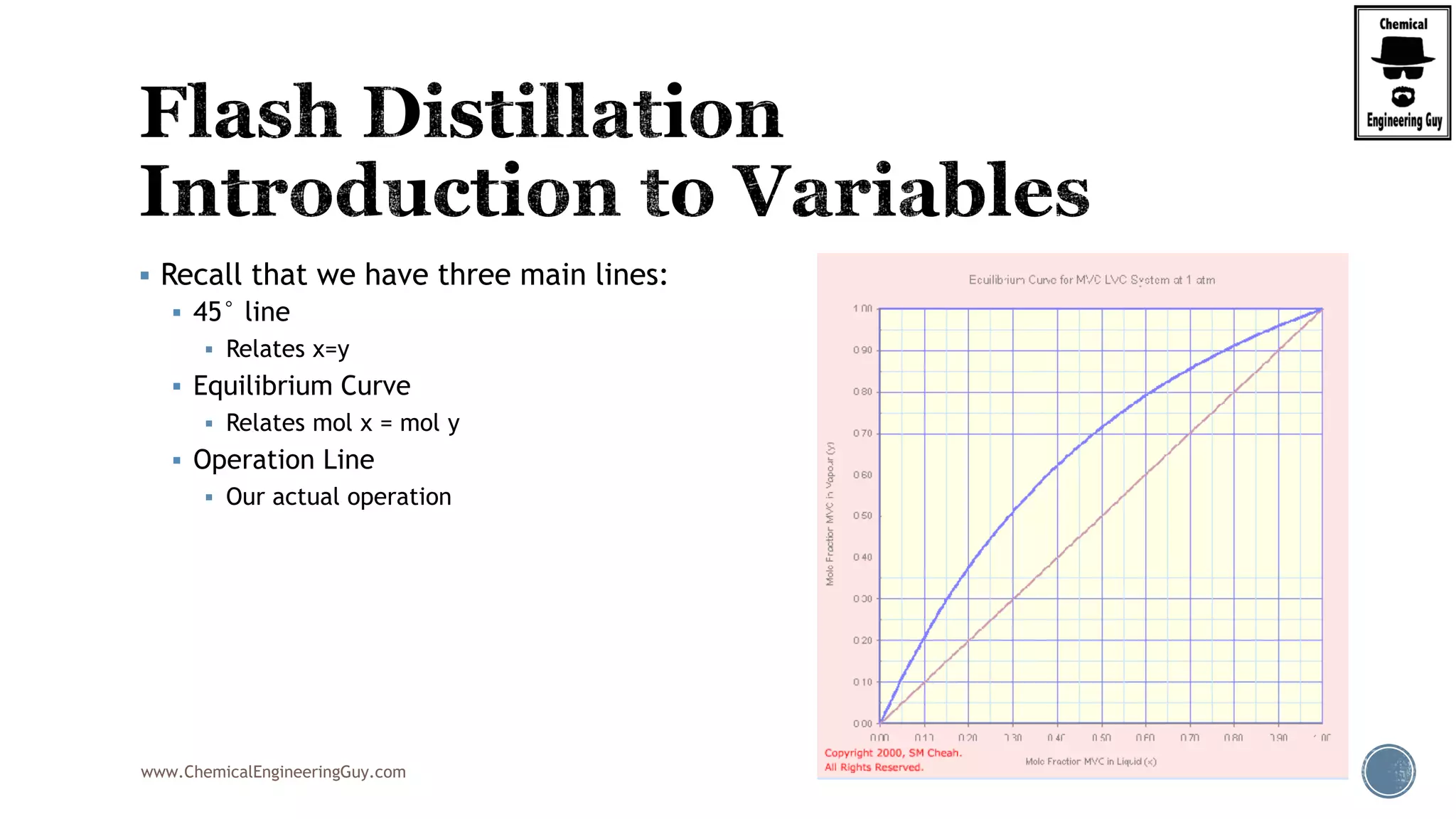
 Recall that we have three main lines:
 45° line
 Relates x=y
 Equilibrium Curve
 Relates mol x = mol y
 Operation Line
 Our actual operation
www.ChemicalEngineeringGuy.com
 If no vapourization takes place:
 the liquid leaving the separator will have the same
composition as the feed
 If total vapourization occurs:
 the vapour will also have the same composition as the feed.
Do you need the Full Version?
Contact me if needed!
Contact@ChemicalEngineeringGuy.com
https://courses.chemicalengineeringguy.com/courses
You can also check out more content here:
My Youtube Channel 
My Fan Page 
The LinkedIn
My website:
www.ChemicalEngineeringGuy.com
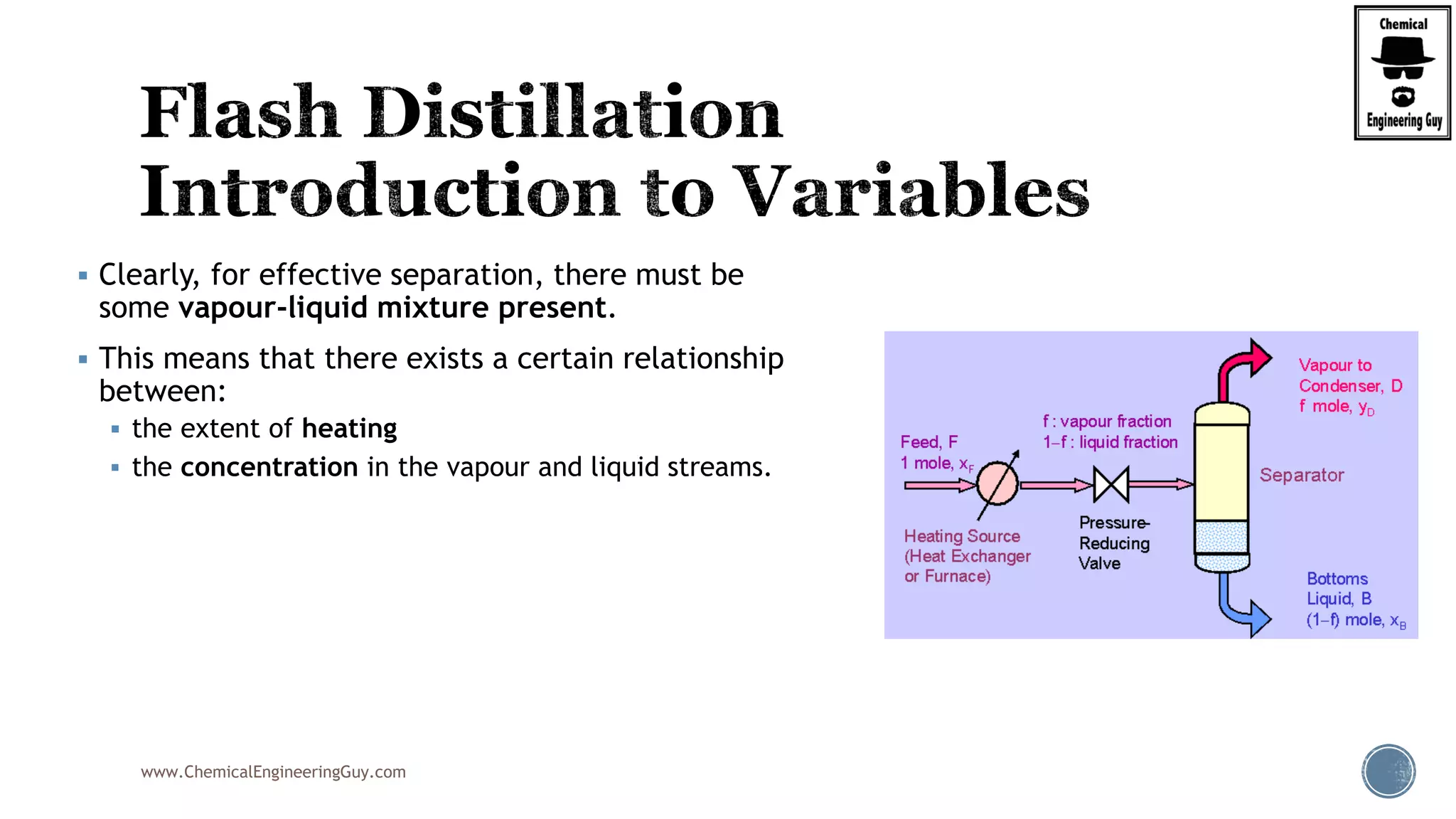
 Clearly, for effective separation, there must be
some vapour-liquid mixture present.
 This means that there exists a certain relationship
between:
 the extent of heating
 the concentration in the vapour and liquid streams.
www.ChemicalEngineeringGuy.com
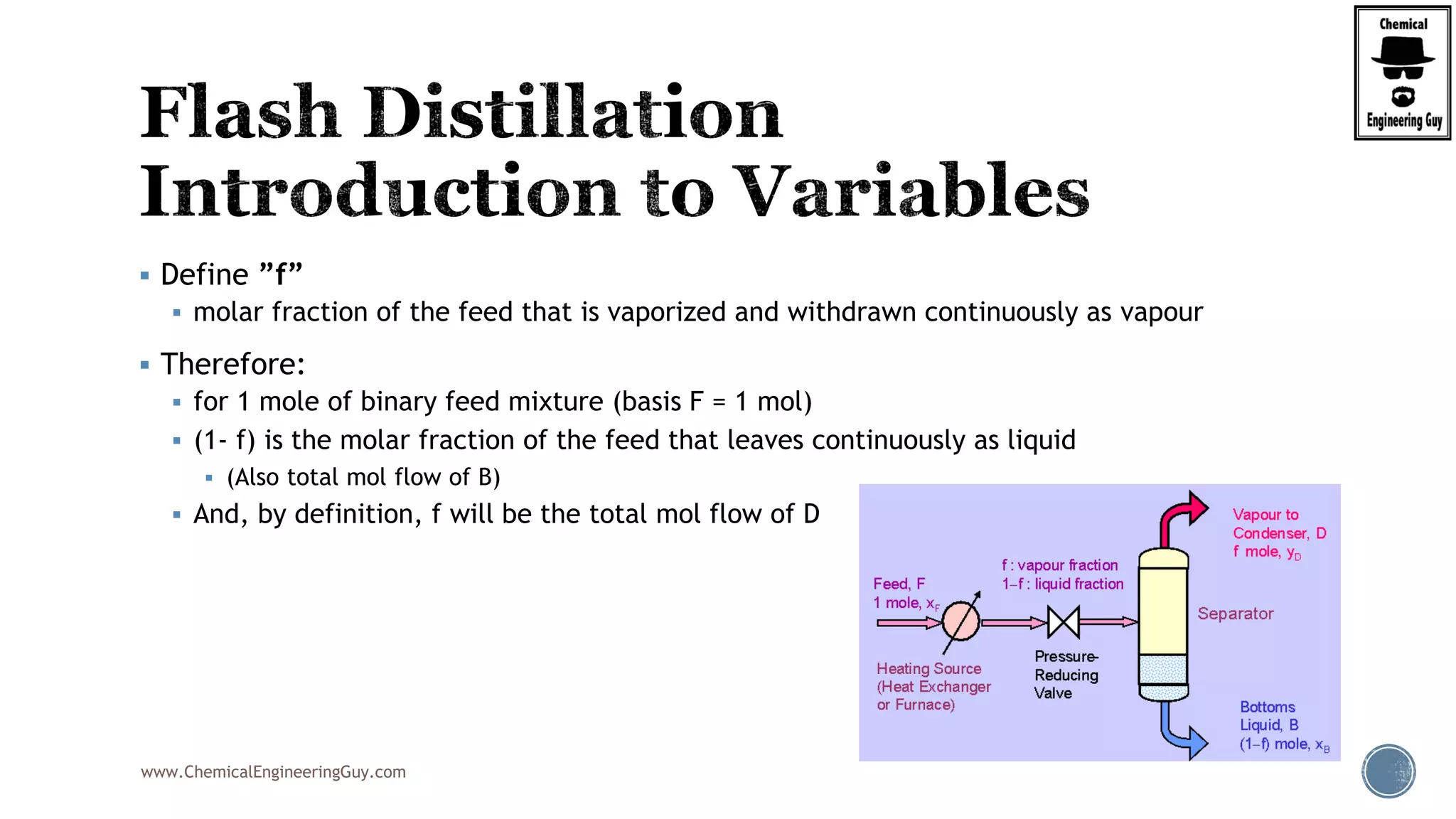
 Define ”f”
 molar fraction of the feed that is vaporized and withdrawn continuously as vapour
 Therefore:
 for 1 mole of binary feed mixture (basis F = 1 mol)
 (1- f) is the molar fraction of the feed that leaves continuously as liquid
 (Also total mol flow of B)
 And, by definition, f will be the total mol flow of D
www.ChemicalEngineeringGuy.com
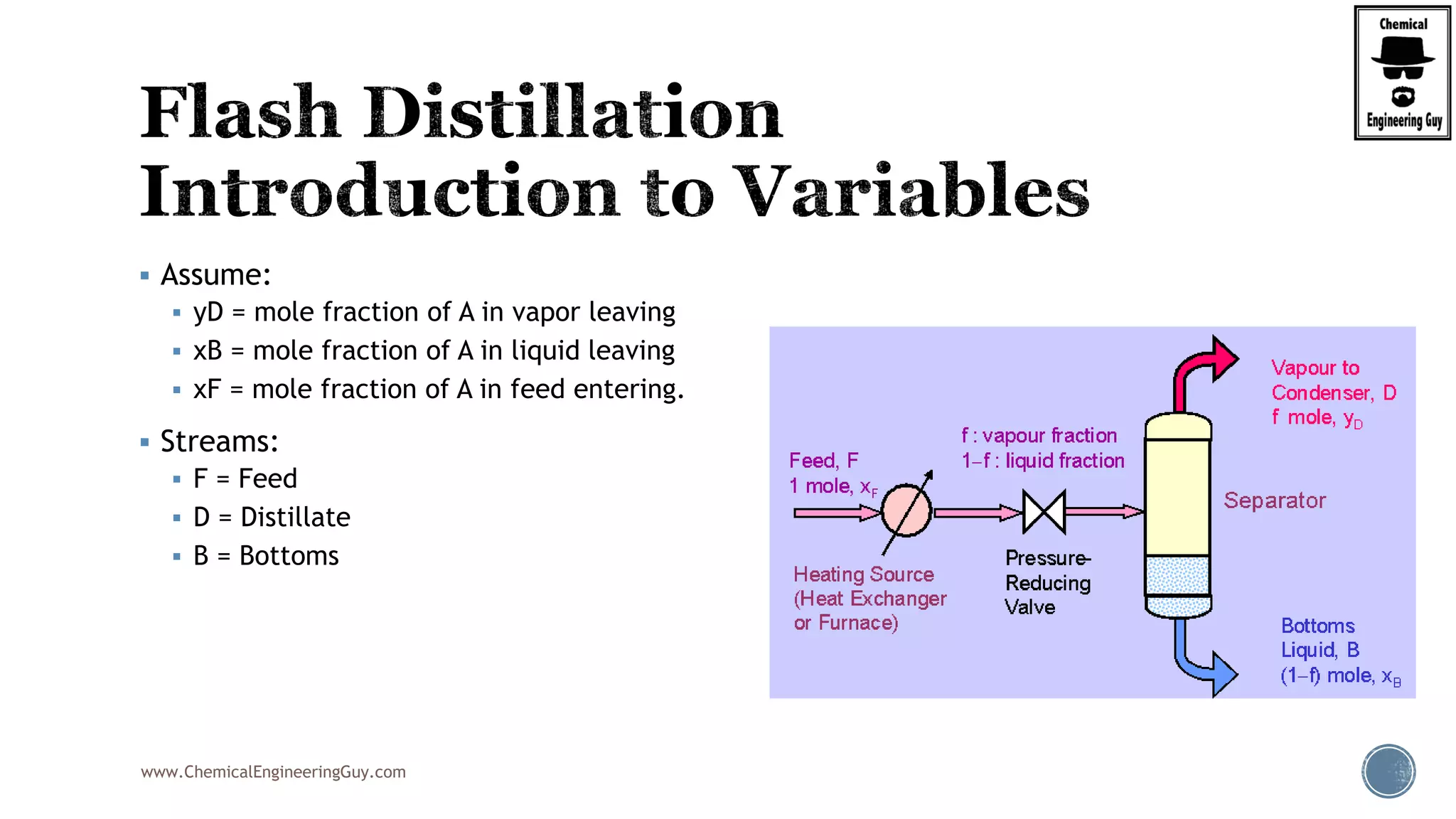
 Assume:
 yD = mole fraction of A in vapor leaving
 xB = mole fraction of A in liquid leaving
 xF = mole fraction of A in feed entering.
 Streams:
 F = Feed
 D = Distillate
 B = Bottoms
www.ChemicalEngineeringGuy.com
 Based on the definition for “f”:
 the greater the heating is:
 the larger the value of “f”
 If the feed is completely vaporized
 then f = 1.0
 Thus, the value of f can vary:
 From 0 (no vaporization) to 1 (total vaporization).
Do you need the Full Version?
Contact me if needed!
Contact@ChemicalEngineeringGuy.com
https://courses.chemicalengineeringguy.com/courses
You can also check out more content here:
My Youtube Channel 
My Fan Page 
The LinkedIn
My website:
www.ChemicalEngineeringGuy.com
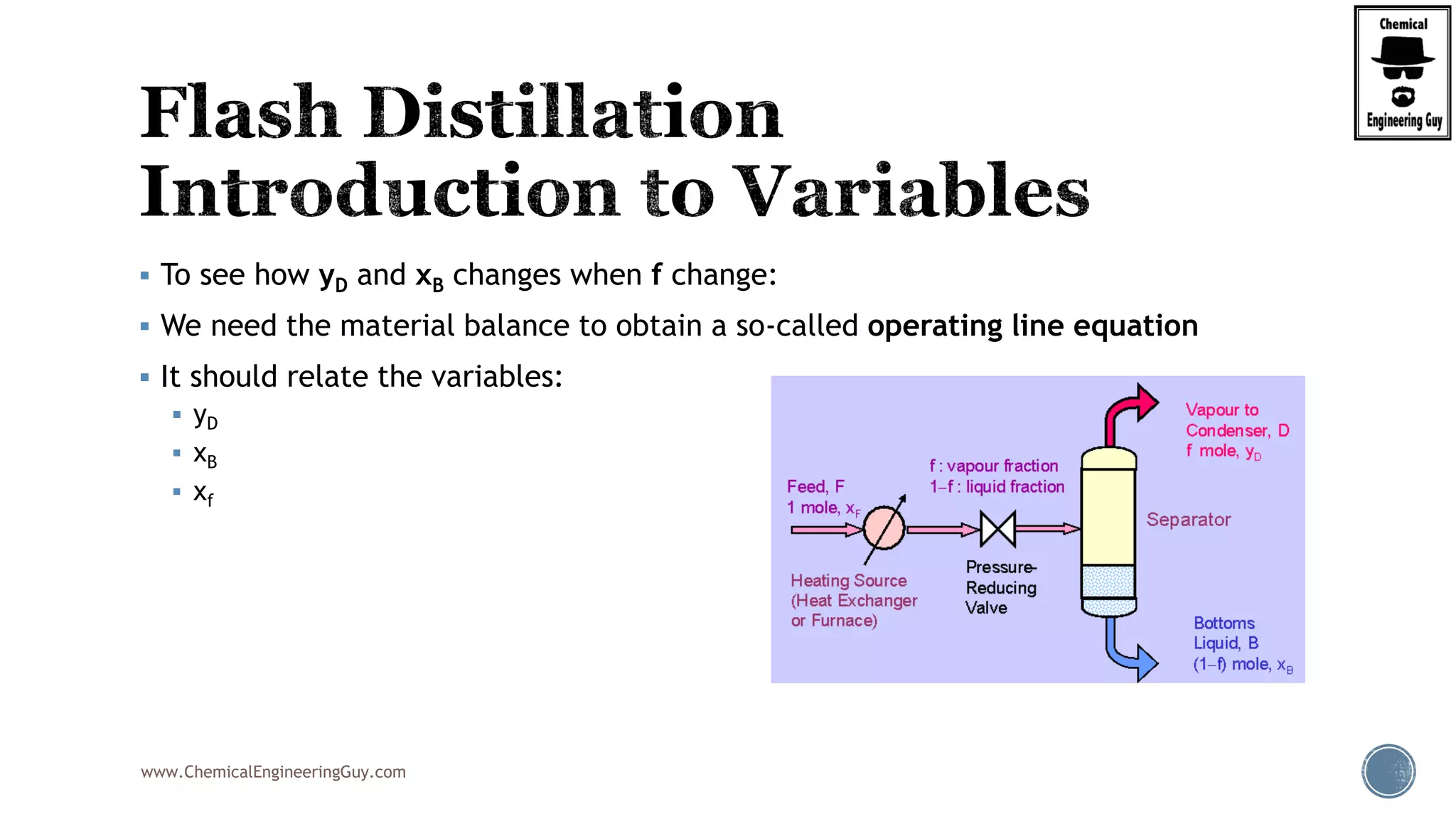
 To see how yD and xB changes when f change:
 We need the material balance to obtain a so-called operating line equation
 It should relate the variables:
 yD
 xB
 xf
www.ChemicalEngineeringGuy.com
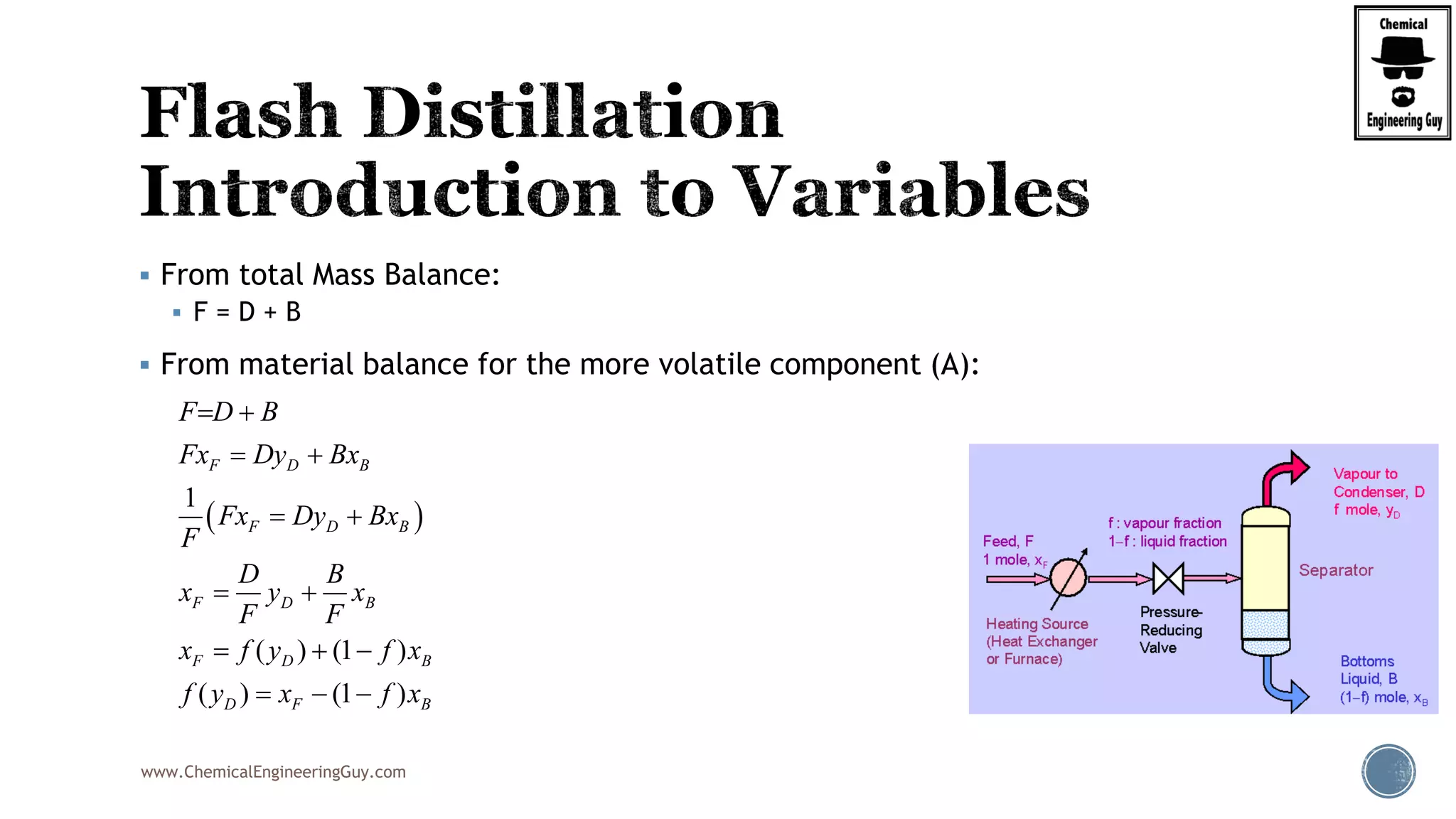
 From total Mass Balance:
 F = D + B
 From material balance for the more volatile component (A):
 
1
( ) (1 )
( ) (1 )
F D B
F D B
F D B
F D B
D F B
F D B
Fx Dy Bx
Fx Dy Bx
F
D B
x y x
F F
x f y f x
f y x f x
 
 
 
 
  
  
www.ChemicalEngineeringGuy.com
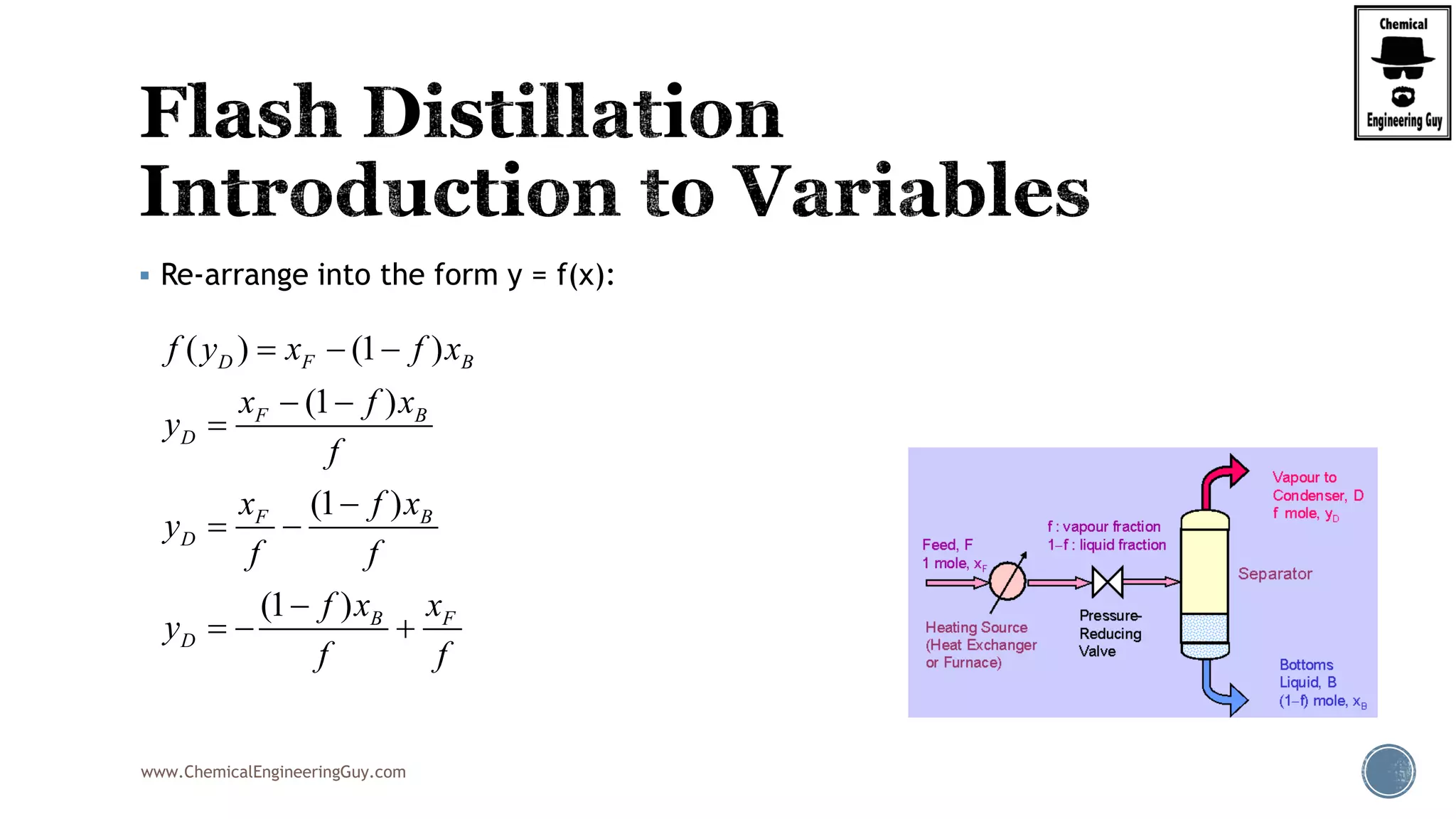
 Re-arrange into the form y = f(x):
( ) (1 )
(1 )
(1 )
(1 )
D F B
F B
D
F B
D
B F
D
f y x f x
x f x
y
f
x f x
y
f f
f x x
y
f f
  
 


 

  
www.ChemicalEngineeringGuy.com
 We see that for a given value of “f”, we will obtain certain values for yD and
xB respectively.
 The fraction “f” depends on:
 Enthalpies going “in”
 Enthalpies going “out” (Vapor and Liquid)
(1 ) B F
D
f x x
y
f f

  
Do you need the Full Version?
Contact me if needed!
Contact@ChemicalEngineeringGuy.com
https://courses.chemicalengineeringguy.com/courses
You can also check out more content here:
My Youtube Channel 
My Fan Page 
The LinkedIn
My website:
www.ChemicalEngineeringGuy.com
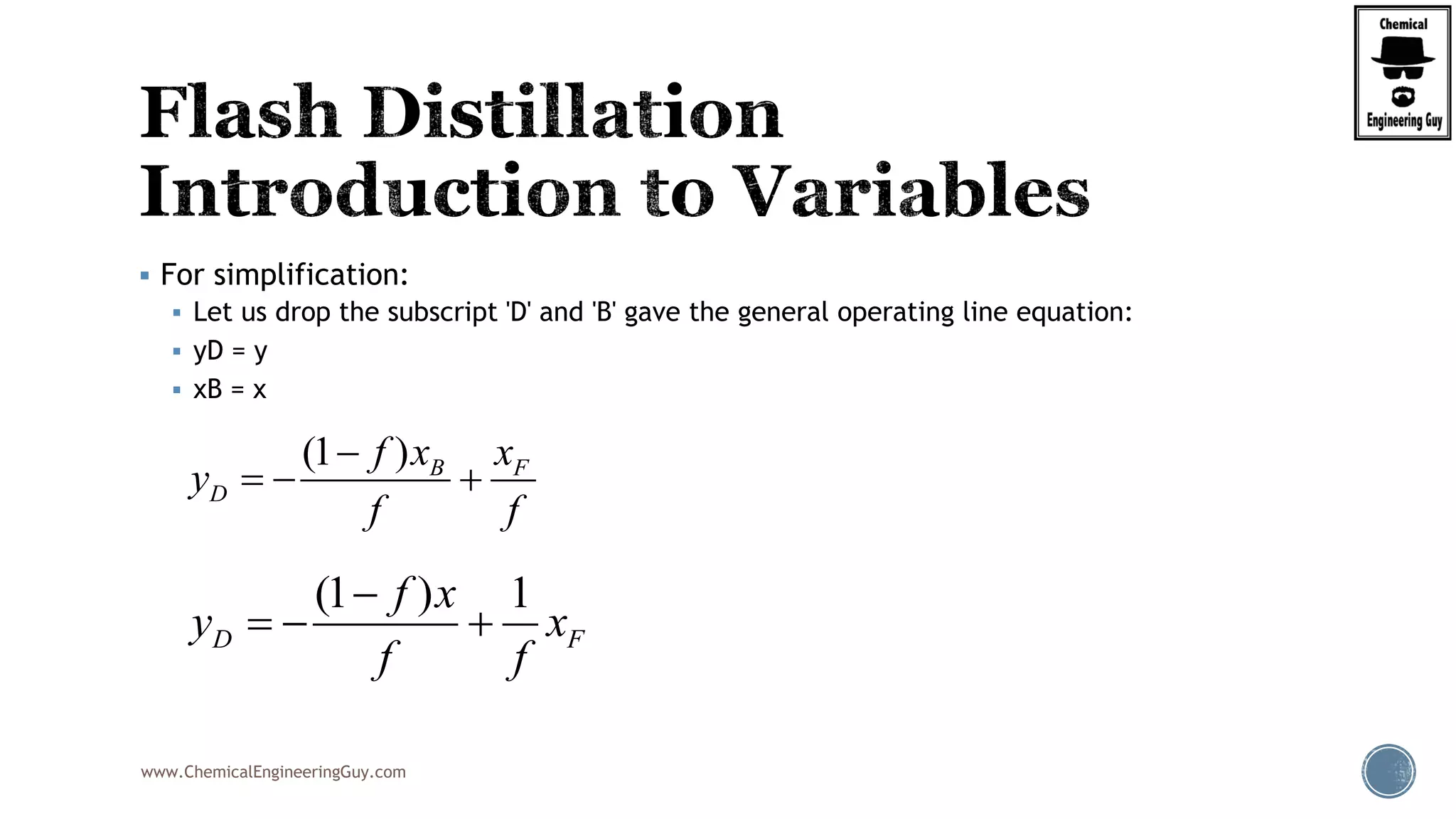
 For simplification:
 Let us drop the subscript 'D' and 'B' gave the general operating line equation:
 yD = y
 xB = x
(1 ) B F
D
f x x
y
f f

  
(1 ) 1
D F
f x
y x
f f

  
www.ChemicalEngineeringGuy.com
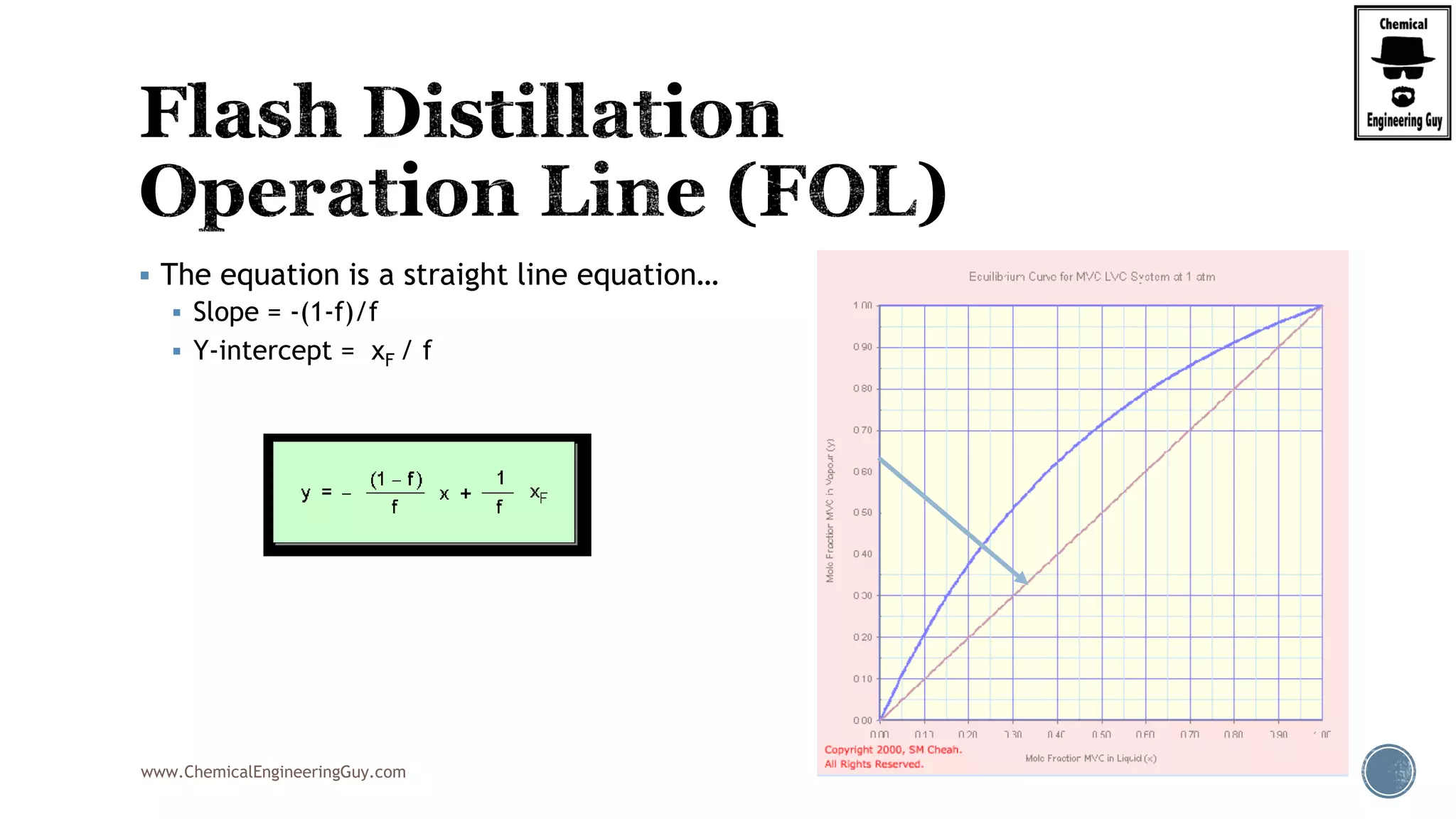
 The equation is a straight line equation…
 Slope = -(1-f)/f
 Y-intercept = xF / f
www.ChemicalEngineeringGuy.com
 The equation is a straight line equation…
 Slope = -(1-f)/f
 Y-intercept = xF / f
Do you need the Full Version?
Contact me if needed!
Contact@ChemicalEngineeringGuy.com
https://courses.chemicalengineeringguy.com/courses
You can also check out more content here:
My Youtube Channel 
My Fan Page 
The LinkedIn
My website:
www.ChemicalEngineeringGuy.com
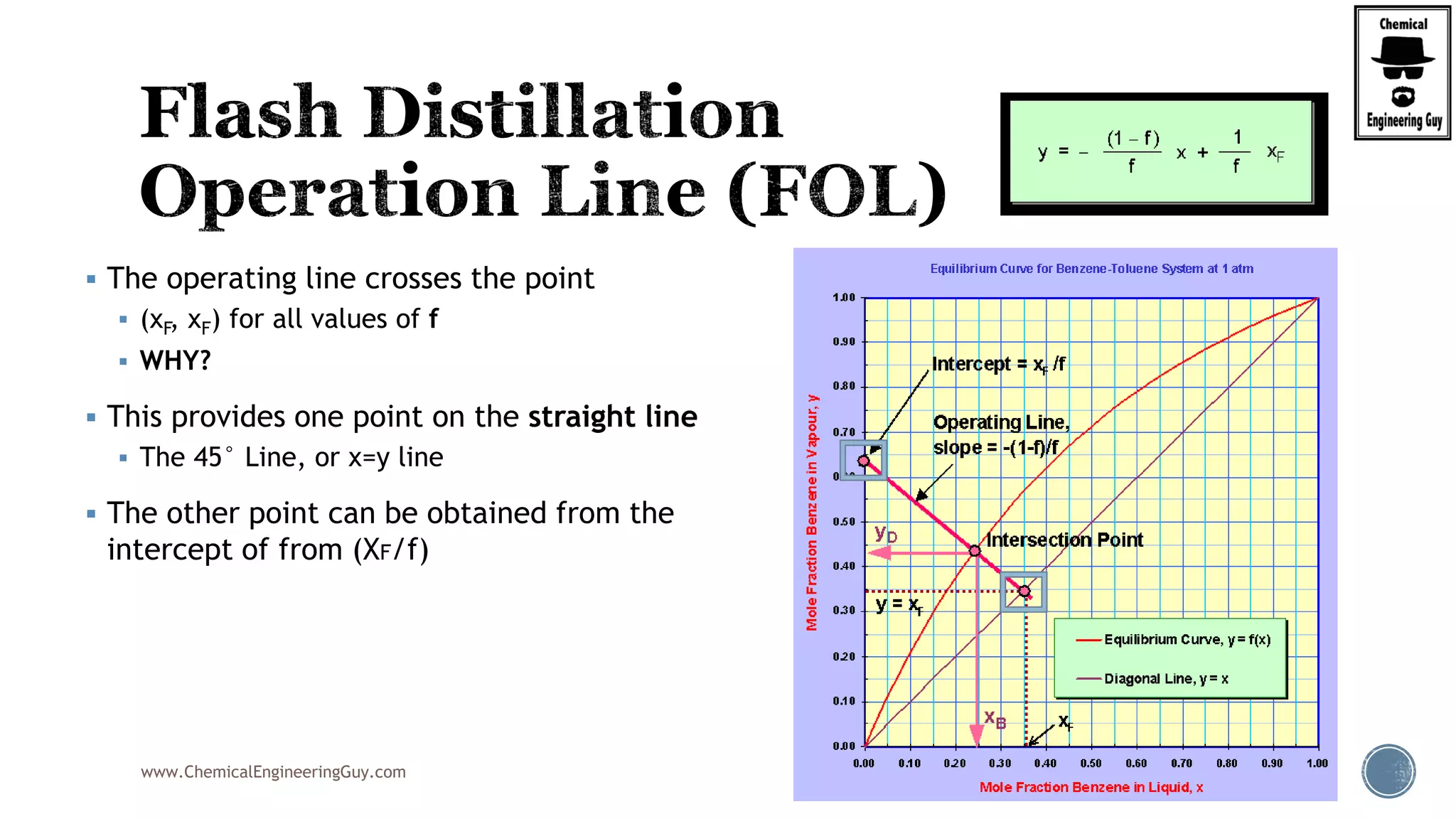
 The operating line crosses the point
 (xF, xF) for all values of f
 WHY?
 This provides one point on the straight line
 The 45° Line, or x=y line
 The other point can be obtained from the
intercept of from (XF/f)
www.ChemicalEngineeringGuy.com
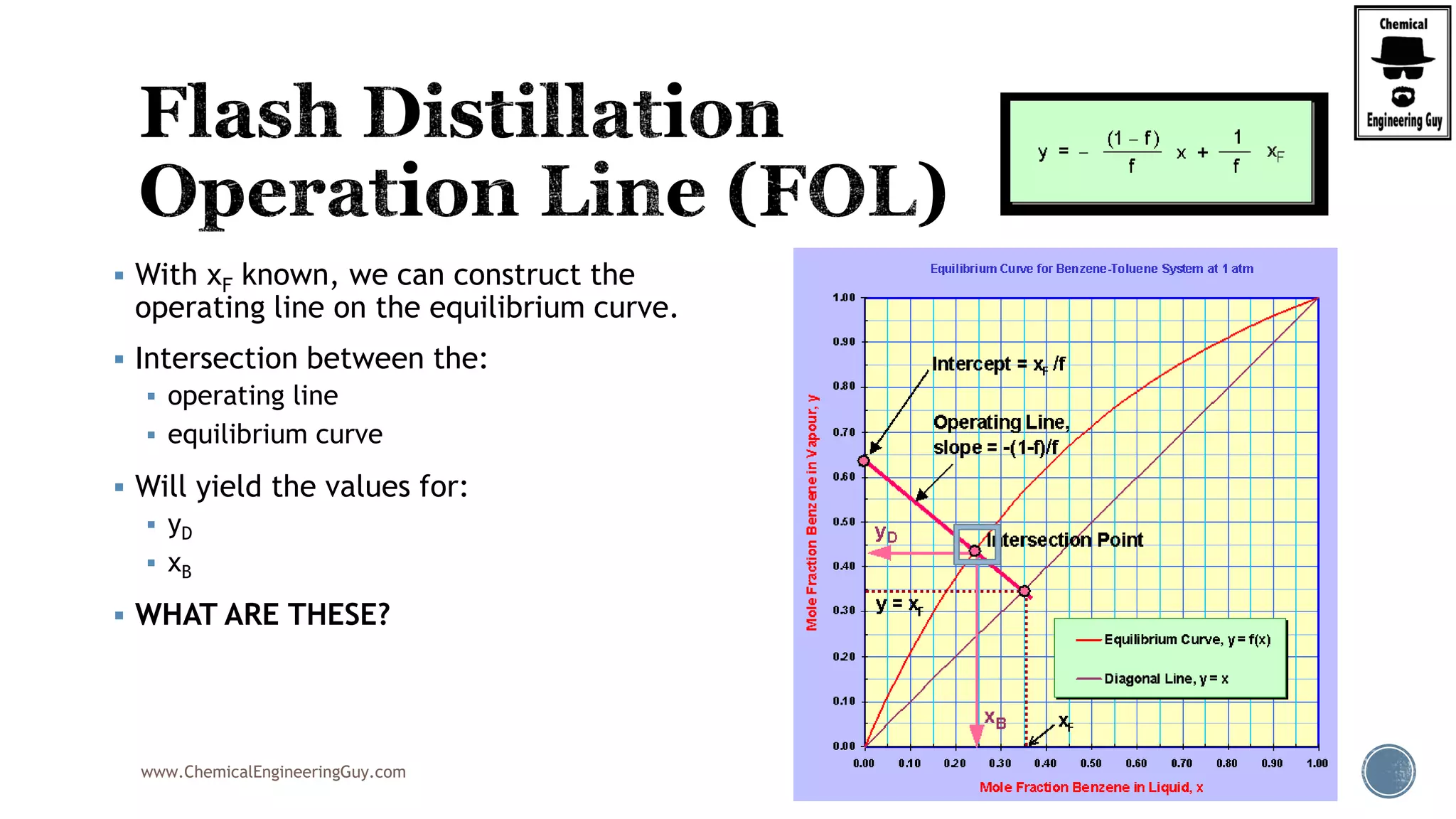
 With xF known, we can construct the
operating line on the equilibrium curve.
 Intersection between the:
 operating line
 equilibrium curve
 Will yield the values for:
 yD
 xB
 WHAT ARE THESE?
www.ChemicalEngineeringGuy.com
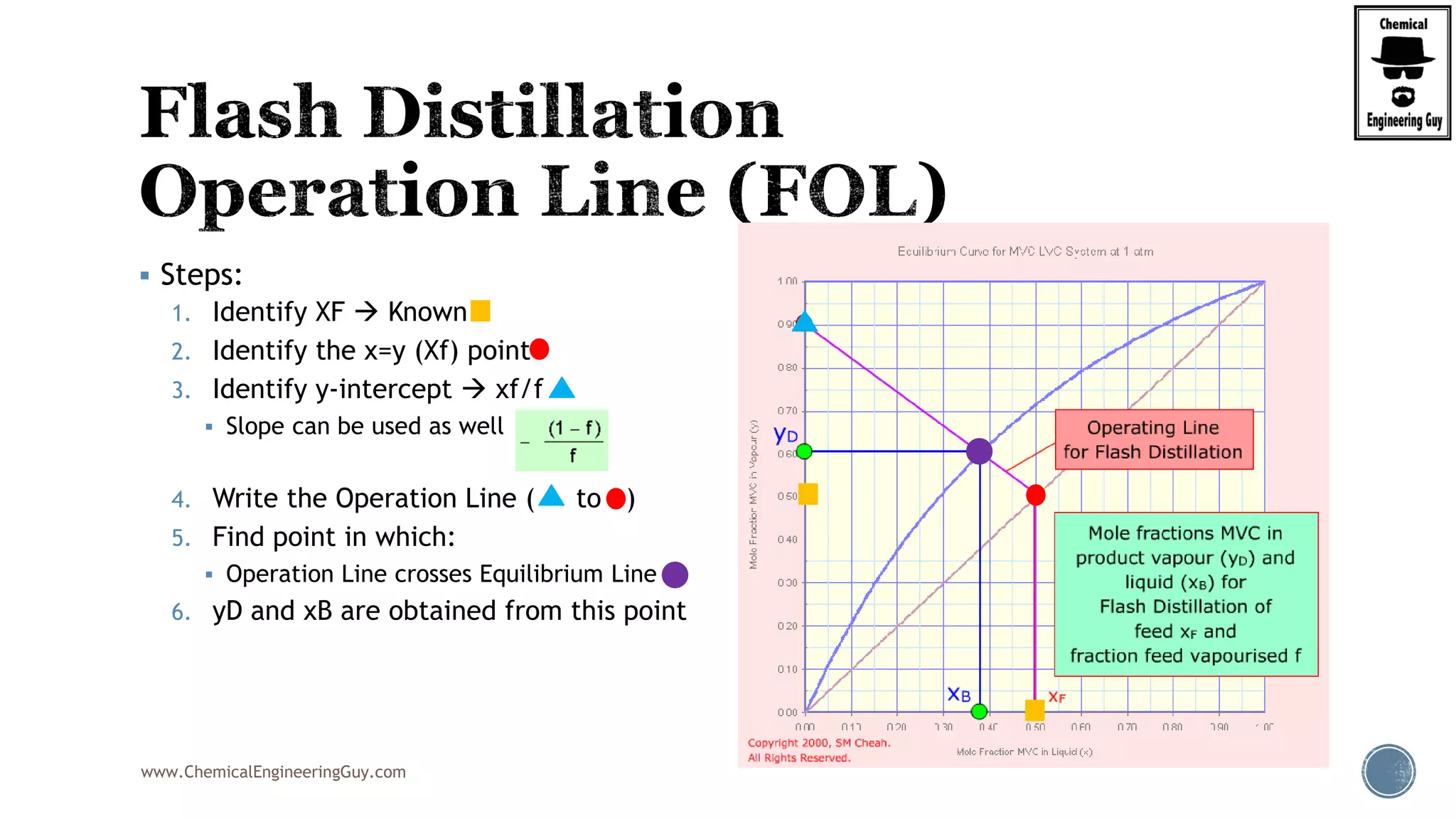
 Steps:
1. Identify XF  Known
2. Identify the x=y (Xf) point
3. Identify y-intercept  xf/f
 Slope can be used as well
4. Write the Operation Line ( to )
5. Find point in which:
 Operation Line crosses Equilibrium Line
6. yD and xB are obtained from this point
www.ChemicalEngineeringGuy.com
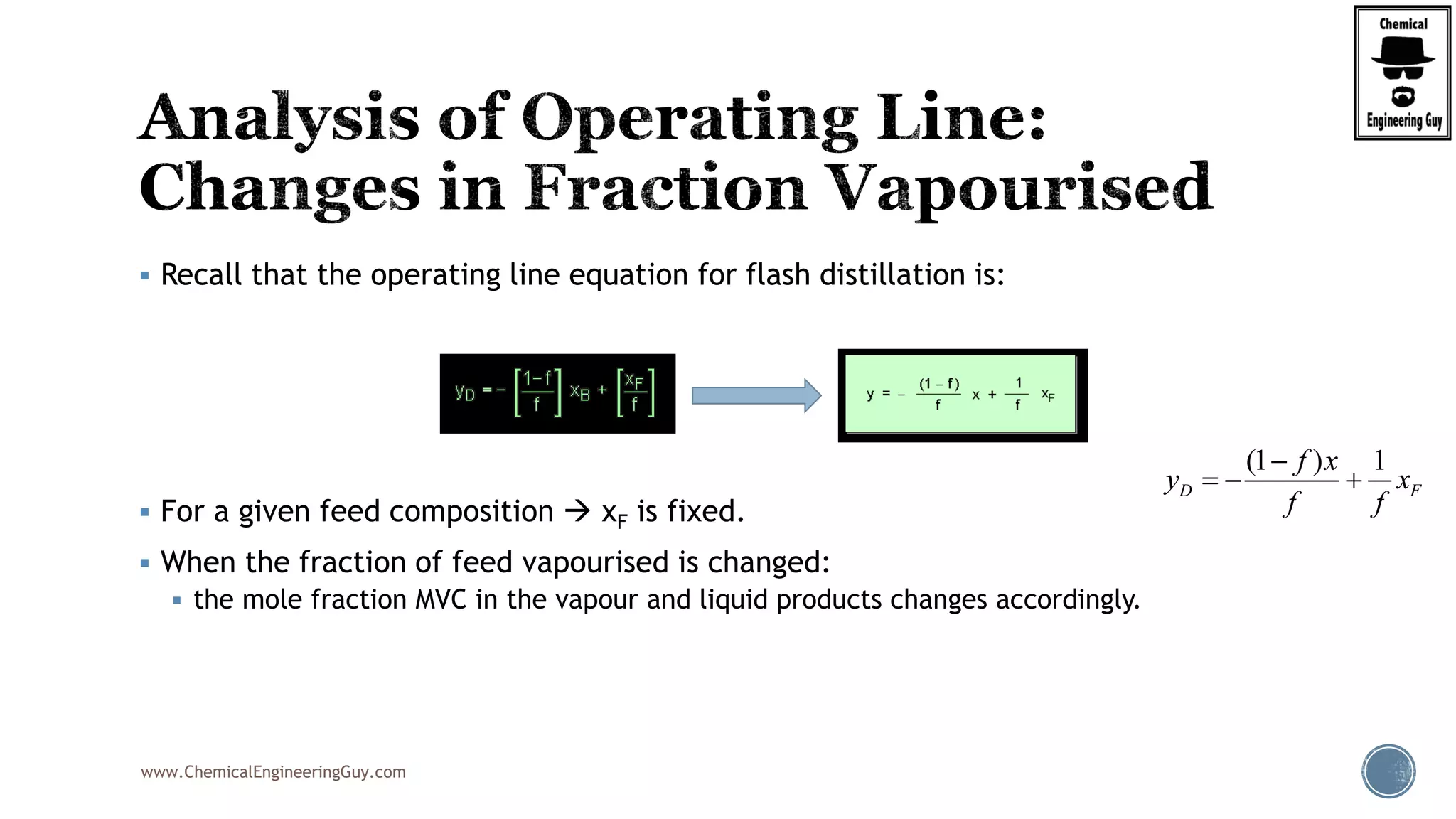
 Recall that the operating line equation for flash distillation is:
 For a given feed composition  xF is fixed.
 When the fraction of feed vapourised is changed:
 the mole fraction MVC in the vapour and liquid products changes accordingly.
(1 ) 1
D F
f x
y x
f f

  
www.ChemicalEngineeringGuy.com
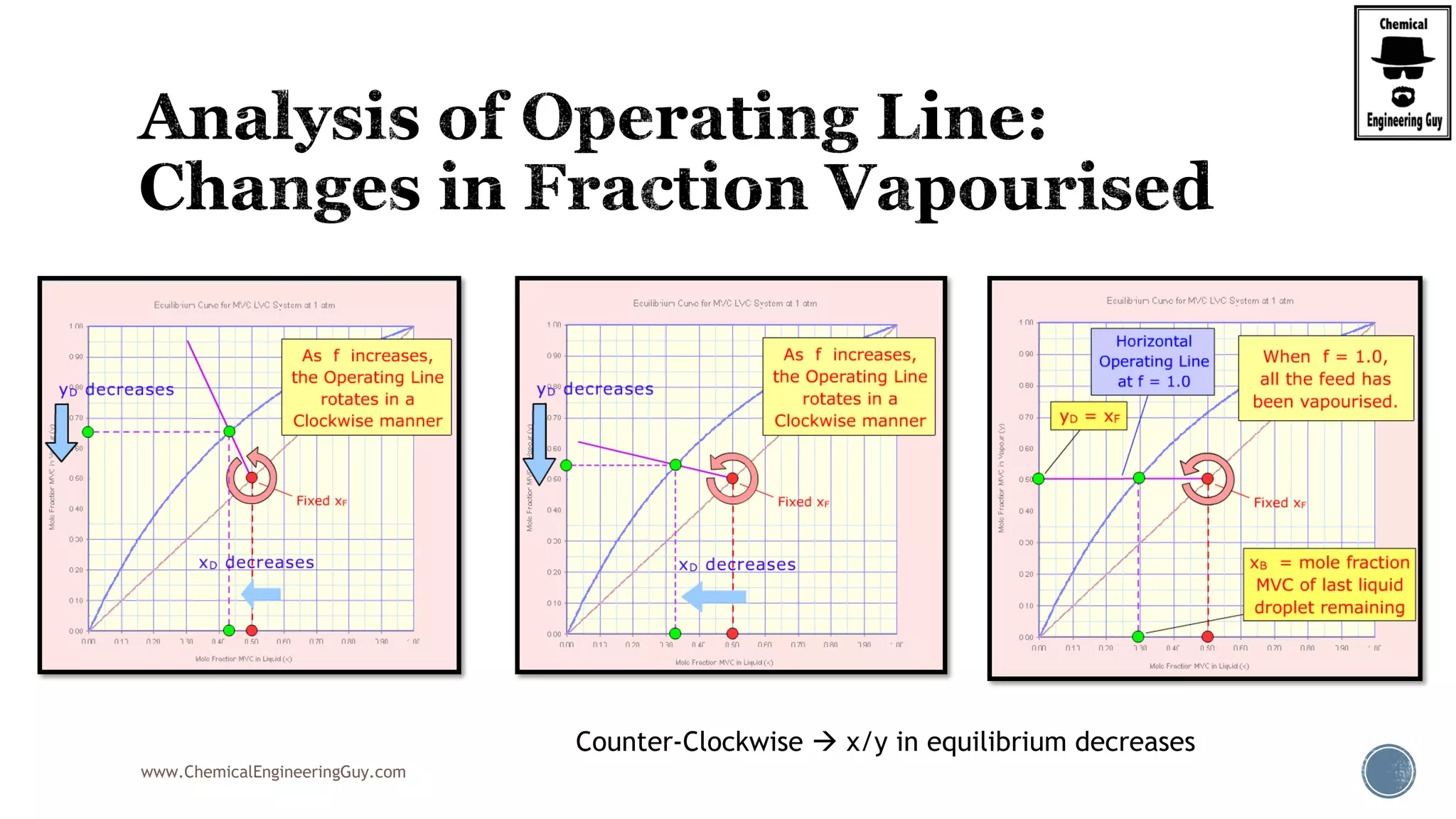
 If f = 0
 no vaporization; vertical
 If f = 1
 total vaporization; horizontal
 If 0< f <1
 90° < angle < 180°
Do you need the Full Version?
Contact me if needed!
Contact@ChemicalEngineeringGuy.com
https://courses.chemicalengineeringguy.com/courses
You can also check out more content here:
My Youtube Channel 
My Fan Page 
The LinkedIn
My website:
www.ChemicalEngineeringGuy.com
Counter-Clockwise  x/y in equilibrium decreases
www.ChemicalEngineeringGuy.com
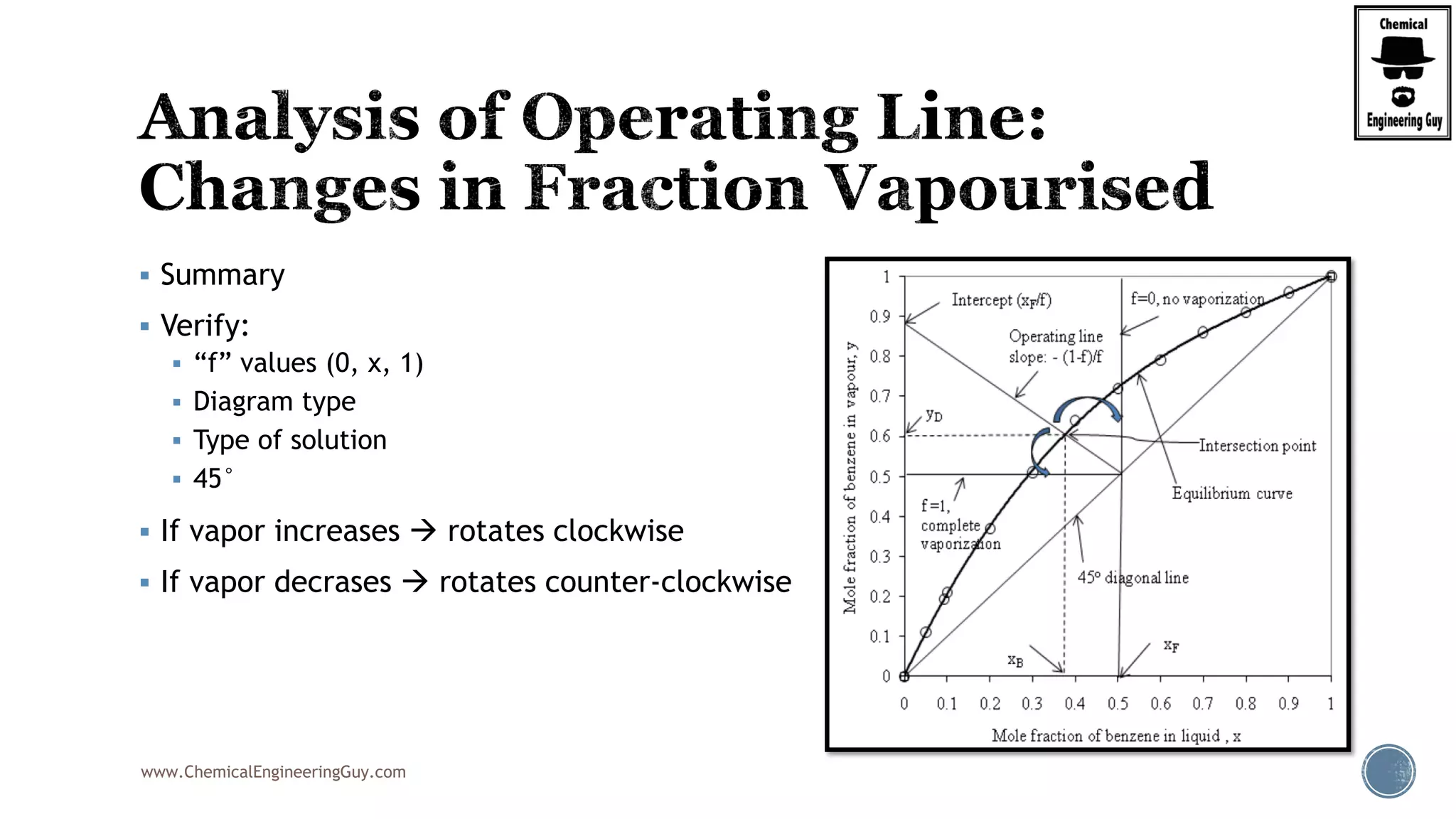
 Summary
 Verify:
 “f” values (0, x, 1)
 Diagram type
 Type of solution
 45°
 If vapor increases  rotates clockwise
 If vapor decrases  rotates counter-clockwise
www.ChemicalEngineeringGuy.com
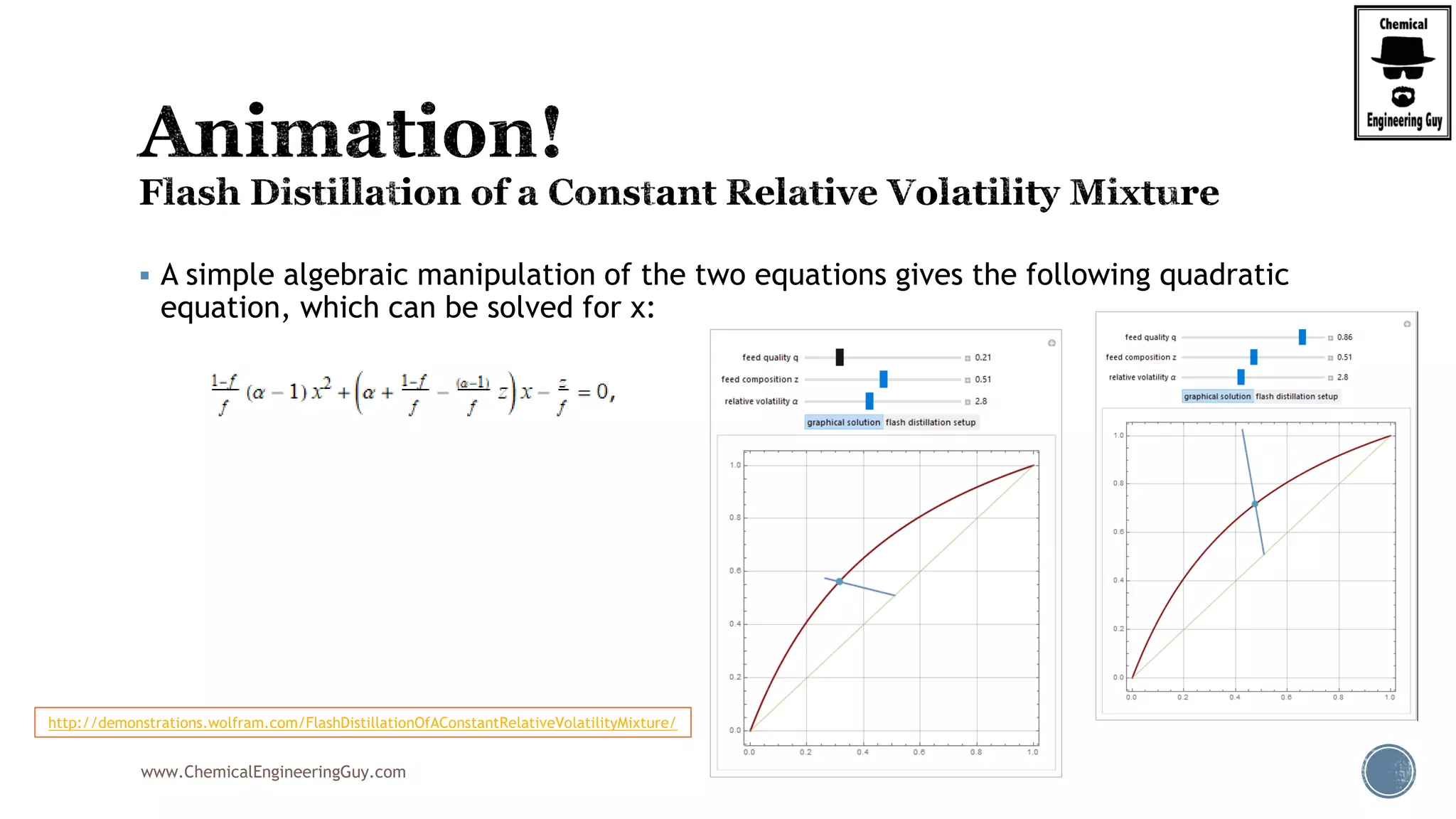
 A simple algebraic manipulation of the two equations gives the following quadratic
equation, which can be solved for x:
http://demonstrations.wolfram.com/FlashDistillationOfAConstantRelativeVolatilityMixture/
www.ChemicalEngineeringGuy.com
 Use the Sequential Method:
 From Wankat Ex 3-1
 A flash distillation chamber operating at 1 atm is going to separate ethanol-water
mix.
 The feed mix is 40% ethanol.
 A) What is the max. vapor composition
 B) What is the min. liquid composition
 C) if V/F = f = 0.4, find L and V compositions
 D) Repeat c) given that F = 1000 kmol/h
www.ChemicalEngineeringGuy.com
 Step 1 - Define Requirements
 Step 2 – Draw the x-y diagram
 Step 3 – Get Equilibrium data for ethanol-water system at P = 1 atm
 Step 4 – Solve for the given cases
Do you need the Full Version?
Contact me if needed!
Contact@ChemicalEngineeringGuy.com
https://courses.chemicalengineeringguy.com/courses
You can also check out more content here:
My Youtube Channel 
My Fan Page 
The LinkedIn
My website:
www.ChemicalEngineeringGuy.com
 Step 1. Define Requirements
 For a) find the highest y (vapor composition) possible
 This is only possible at V/F = (WHY)
 For b) find the lowest x (liquid composition) possible
 This is at V/ = 1.0, why?
 For c) given V/F = 0.4
 use operation line for x and y
 For d) given F = 1000, re-solve c
 The answer should be the same, since equilibrium is based on composition, not mass amount
 Sizing will change
 Energy requirements will change
www.ChemicalEngineeringGuy.com
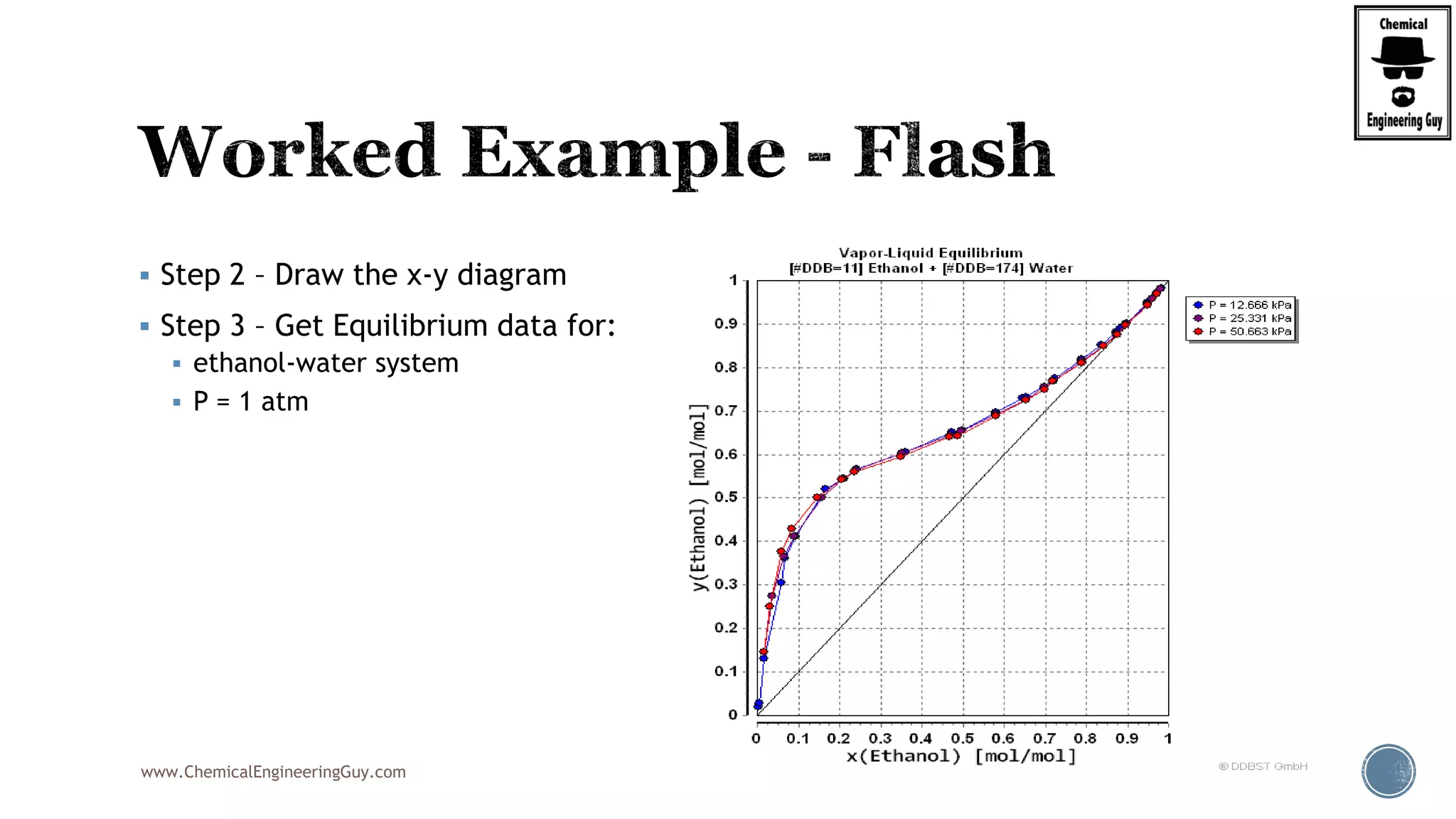
 Step 2 – Draw the x-y diagram
 Step 3 – Get Equilibrium data for:
 ethanol-water system
 P = 1 atm
www.ChemicalEngineeringGuy.com
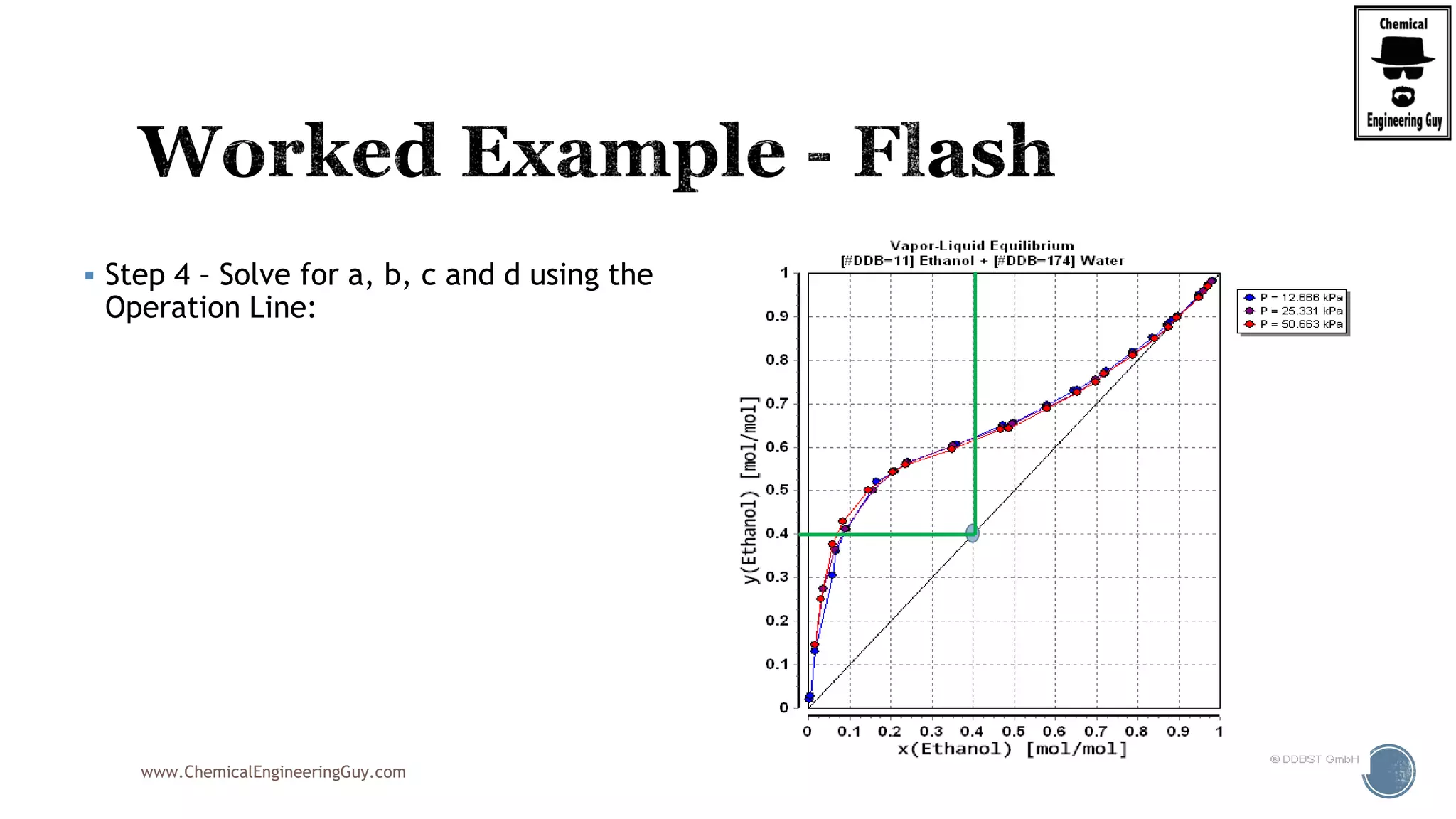
 Step 4 – Solve for a, b, c and d using the
Operation Line:
www.ChemicalEngineeringGuy.com
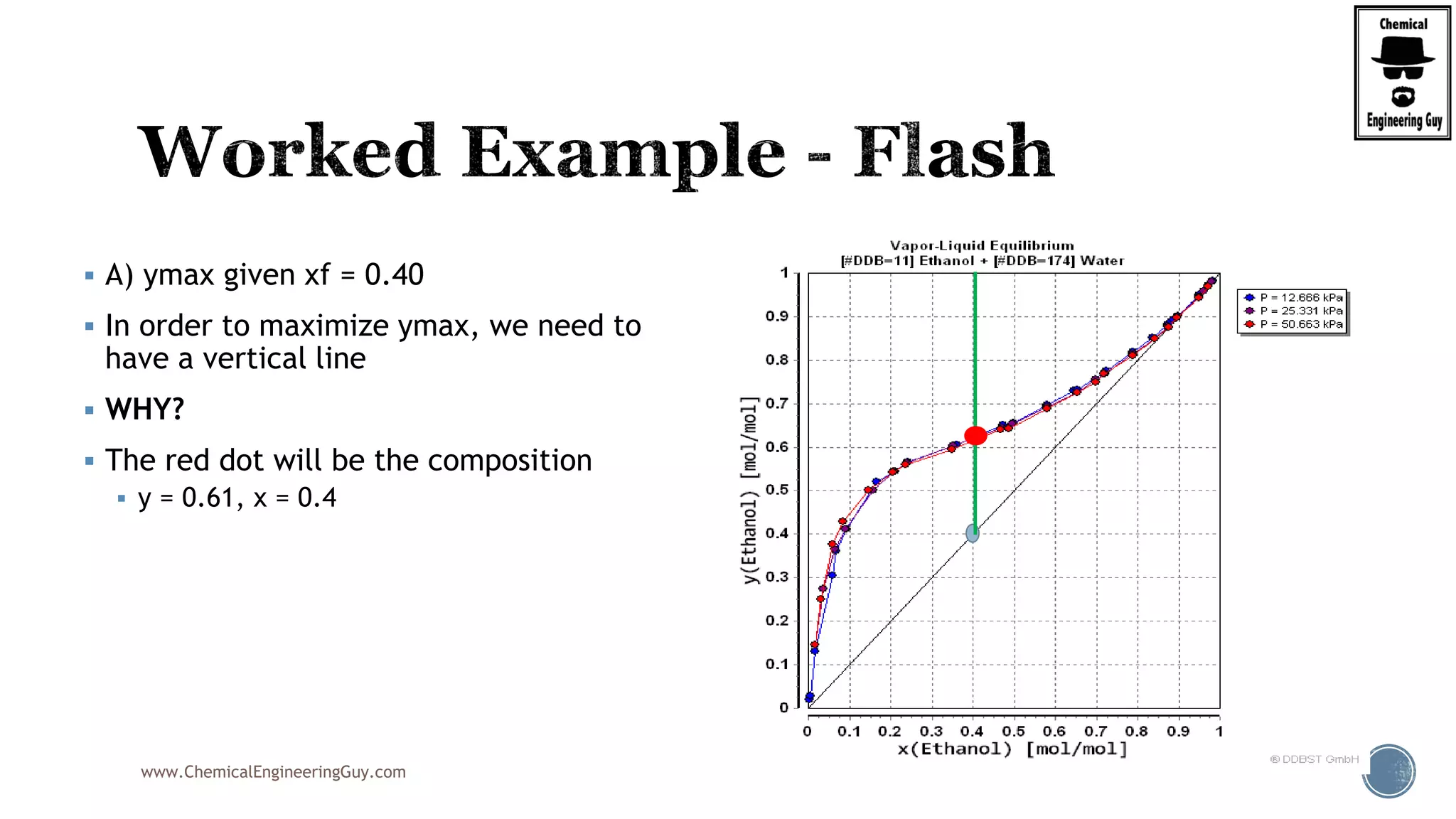
 A) ymax given xf = 0.40
 In order to maximize ymax, we need to
have a vertical line
 WHY?
 The red dot will be the composition
 y = 0.61, x = 0.4
www.ChemicalEngineeringGuy.com
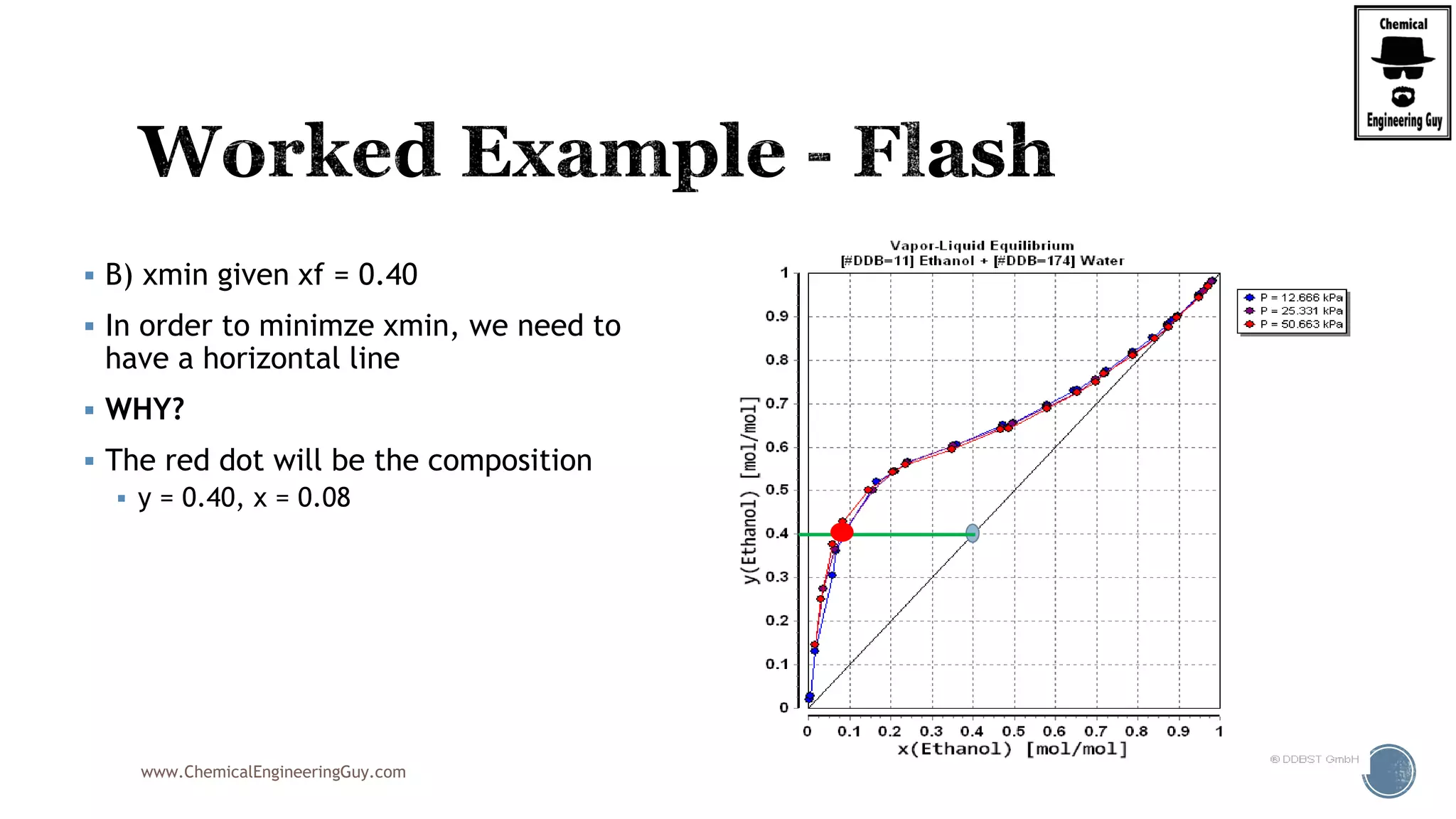
 B) xmin given xf = 0.40
 In order to minimze xmin, we need to
have a horizontal line
 WHY?
 The red dot will be the composition
 y = 0.40, x = 0.08
www.ChemicalEngineeringGuy.com
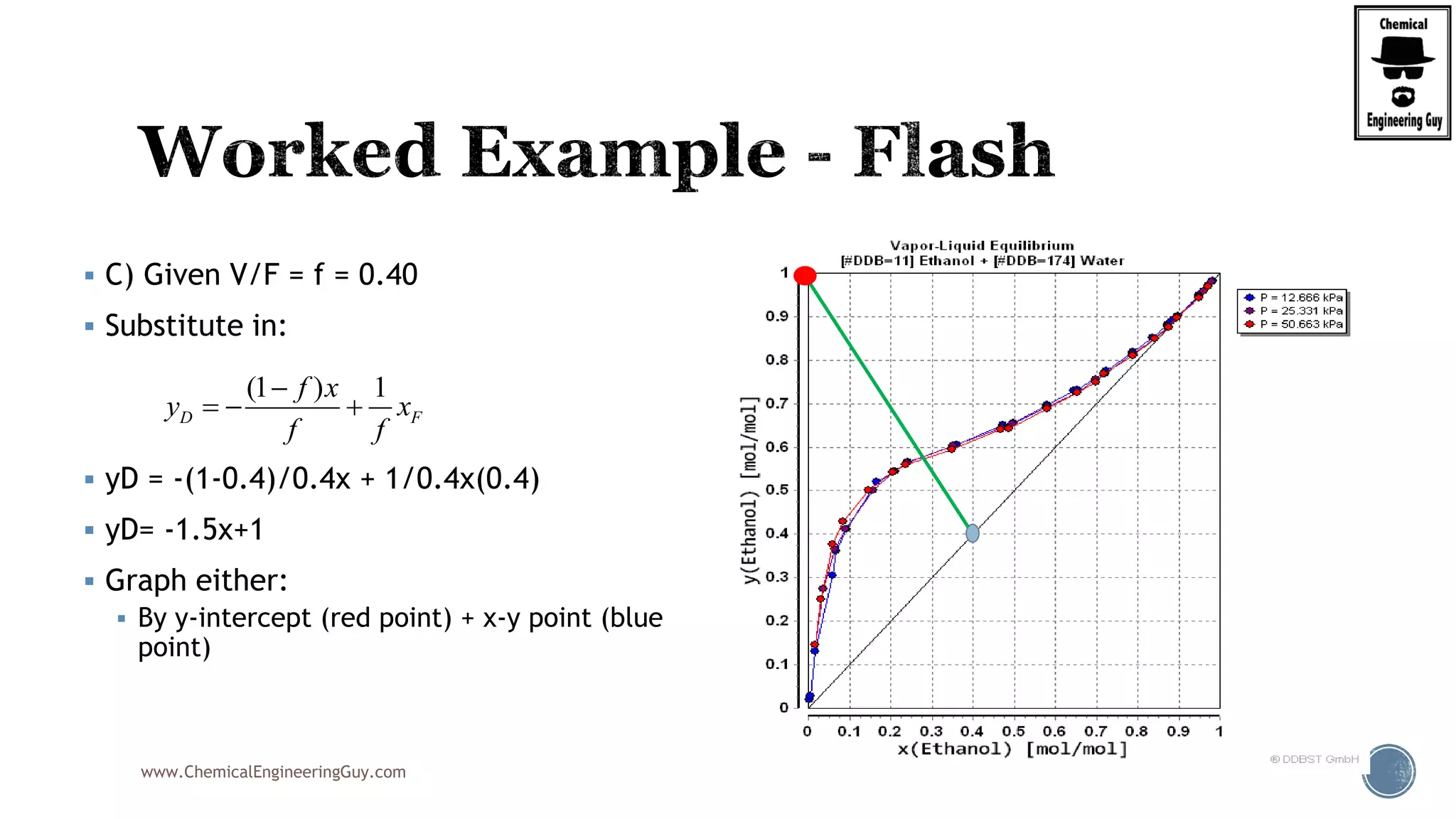
 C) Given V/F = f = 0.40
 Substitute in:
 yD = -(1-0.4)/0.4x + 1/0.4x(0.4)
 yD= -1.5x+1
 Graph either:
 By slope + x-y point (blue point)
(1 ) 1
D F
f x
y x
f f

  
Slope = for every 0.5 dx there is -0.75 of dy
Do you need the Full Version?
Contact me if needed!
Contact@ChemicalEngineeringGuy.com
https://courses.chemicalengineeringguy.com/courses
You can also check out more content here:
My Youtube Channel 
My Fan Page 
The LinkedIn
My website:
www.ChemicalEngineeringGuy.com
 C) Given V/F = f = 0.40
 Substitute in:
 yD = -(1-0.4)/0.4x + 1/0.4x(0.4)
 yD= -1.5x+1
 Graph either:
 By y-intercept (red point) + x-y point (blue
point)
(1 ) 1
D F
f x
y x
f f

  
www.ChemicalEngineeringGuy.com
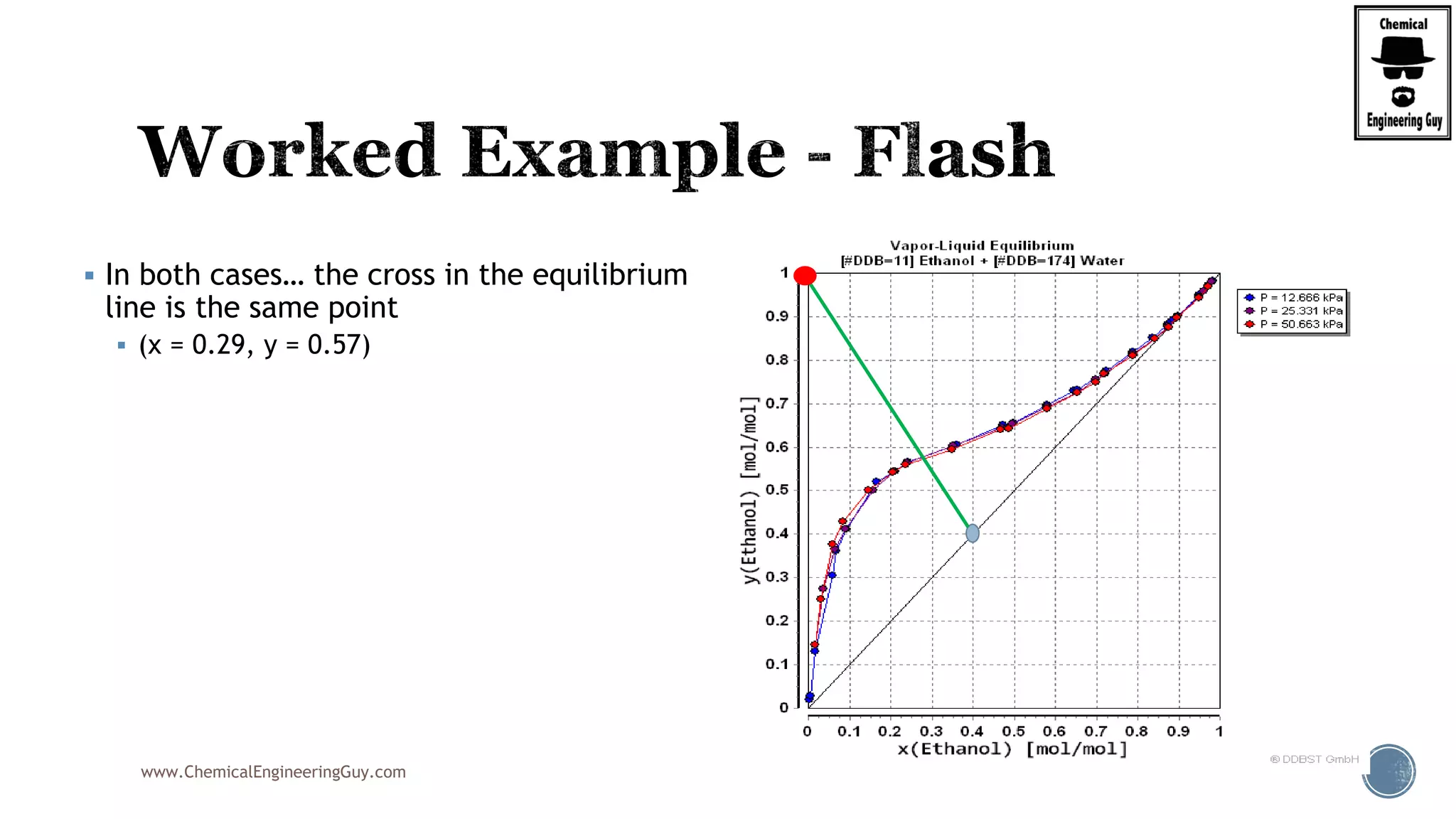
 In both cases… the cross in the equilibrium
line is the same point
 (x = 0.29, y = 0.57)
www.ChemicalEngineeringGuy.com
 D) Given F = 1000 kmol/h
 No effect… since slope and intercepts do not
depend on the value…
 Given V/F = f = 0.40
 Substitute in:
 Note that V/F = 0.4
 V = 0.4xF = 0.4x1000 = 400
 F = L+V  L = F-V = 1000-400 = 600
 The line remains the same, as well as the
slope and y-intercept
(1 ) 1
D F
f x
y x
f f

  
Do you need the Full Version?
Contact me if needed!
Contact@ChemicalEngineeringGuy.com
https://courses.chemicalengineeringguy.com/courses
You can also check out more content here:
My Youtube Channel 
My Fan Page 
The LinkedIn
My website:
www.ChemicalEngineeringGuy.com
 Typically we will continue with an Energy balance to determine enthalpies and Heat
exchange
 Finally, we continue with Flash Drum Design & Sizing…
www.ChemicalEngineeringGuy.com
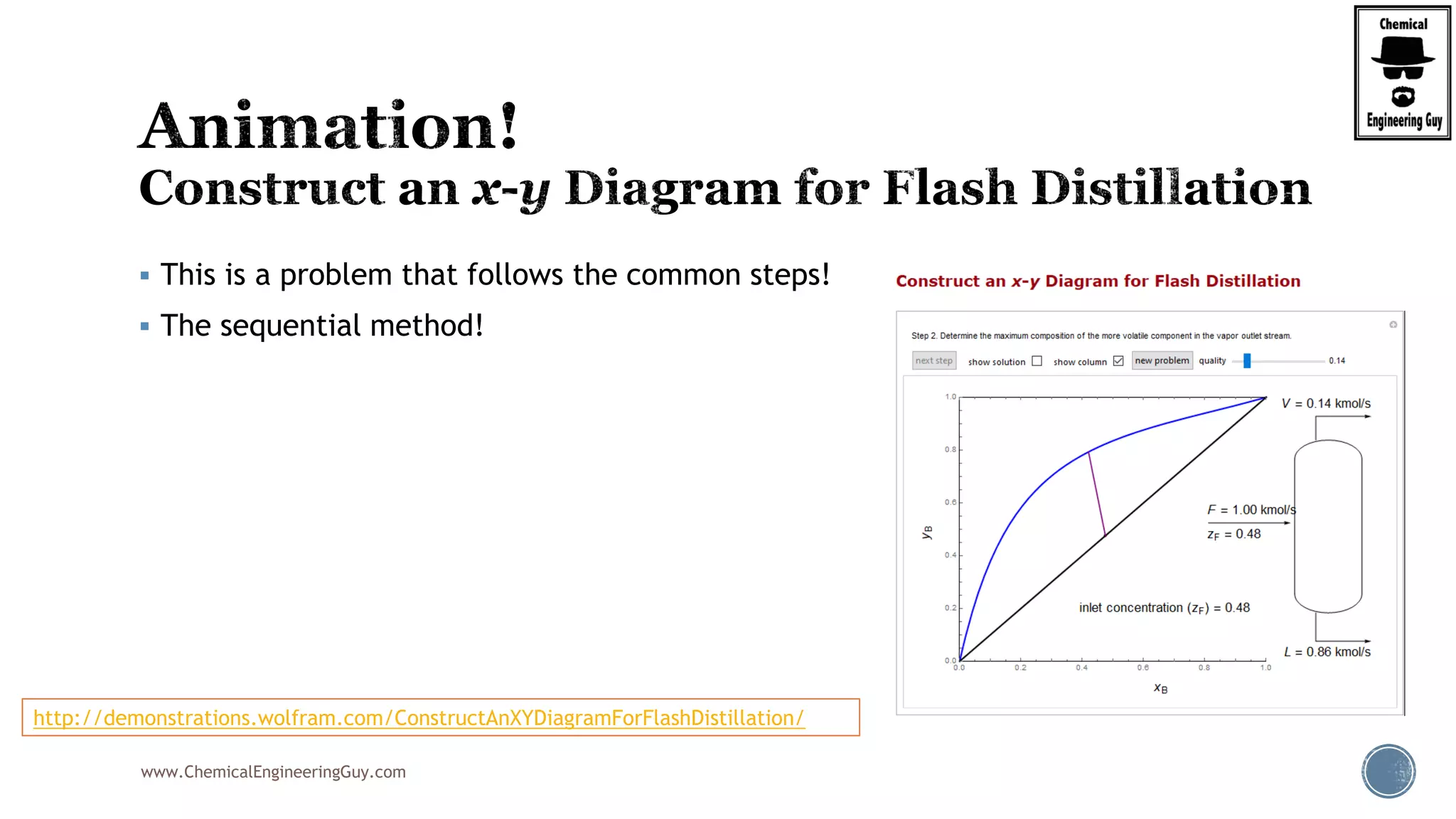
 This is a problem that follows the common steps!
 The sequential method!
http://demonstrations.wolfram.com/ConstructAnXYDiagramForFlashDistillation/
www.ChemicalEngineeringGuy.com
 An equimolar mixture of benzene and toluene is subjected to flash distillation at a
pressure of 1 bar in the separator.
 Determine the compositions (in mole fraction benzene) of the liquid and vapour
leaving the separator when the feed is X% vaporized.
 A) Estimate the temperature in the separator for 25%
 B) Calculate the composition
 Proposed Homework:
 Bi) Rpeat (A) for cases (0%, 50%, 75%, 100%)
Do you need the Full Version?
Contact me if needed!
Contact@ChemicalEngineeringGuy.com
https://courses.chemicalengineeringguy.com/courses
You can also check out more content here:
My Youtube Channel 
My Fan Page 
The LinkedIn
My website:
www.ChemicalEngineeringGuy.com
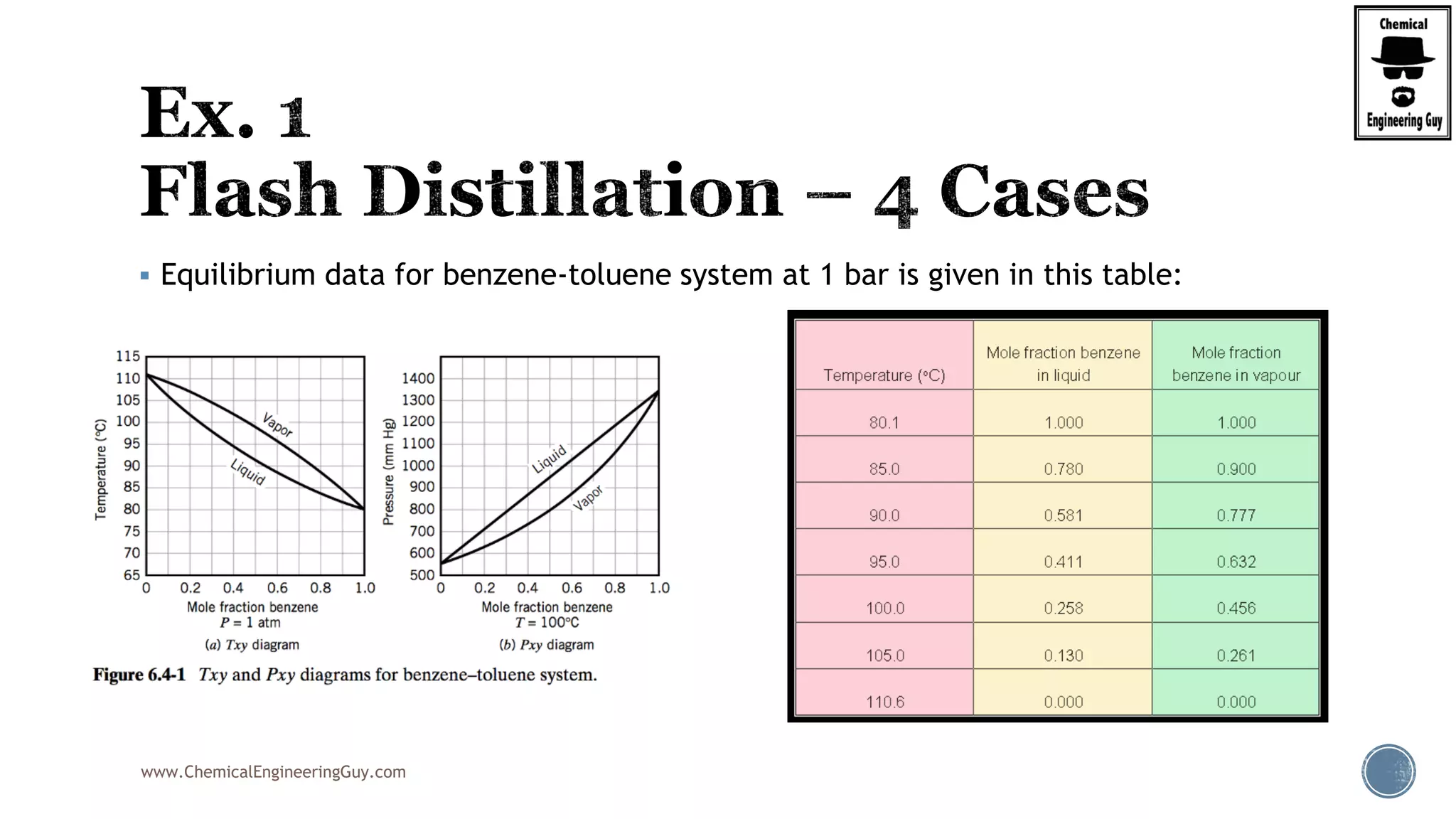
 Equilibrium data for benzene-toluene system at 1 bar is given in this table:
www.ChemicalEngineeringGuy.com
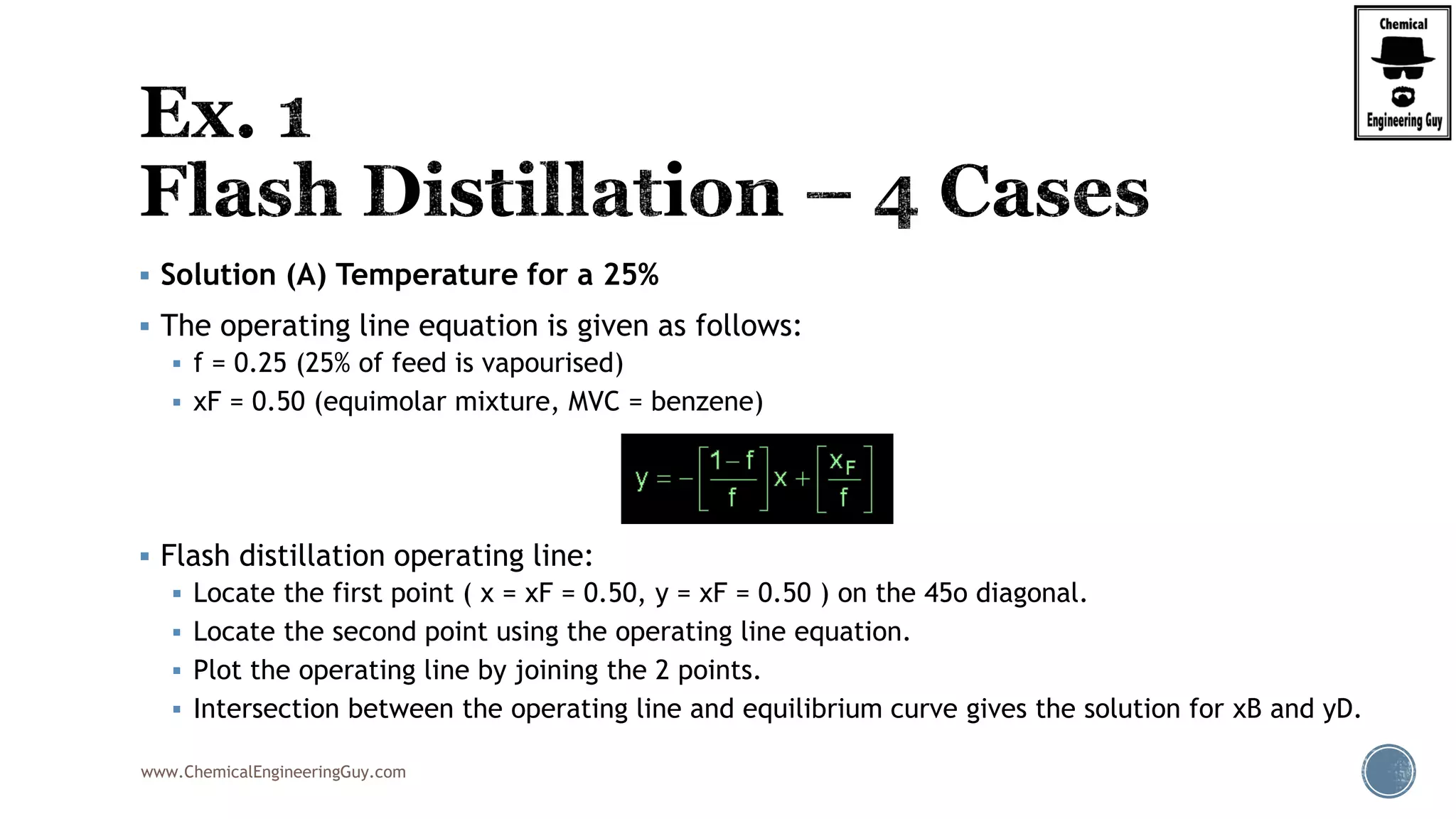
 Solution (A) Temperature for a 25%
 The operating line equation is given as follows:
 f = 0.25 (25% of feed is vapourised)
 xF = 0.50 (equimolar mixture, MVC = benzene)
 Flash distillation operating line:
 Locate the first point ( x = xF = 0.50, y = xF = 0.50 ) on the 45o diagonal.
 Locate the second point using the operating line equation.
 Plot the operating line by joining the 2 points.
 Intersection between the operating line and equilibrium curve gives the solution for xB and yD.
www.ChemicalEngineeringGuy.com
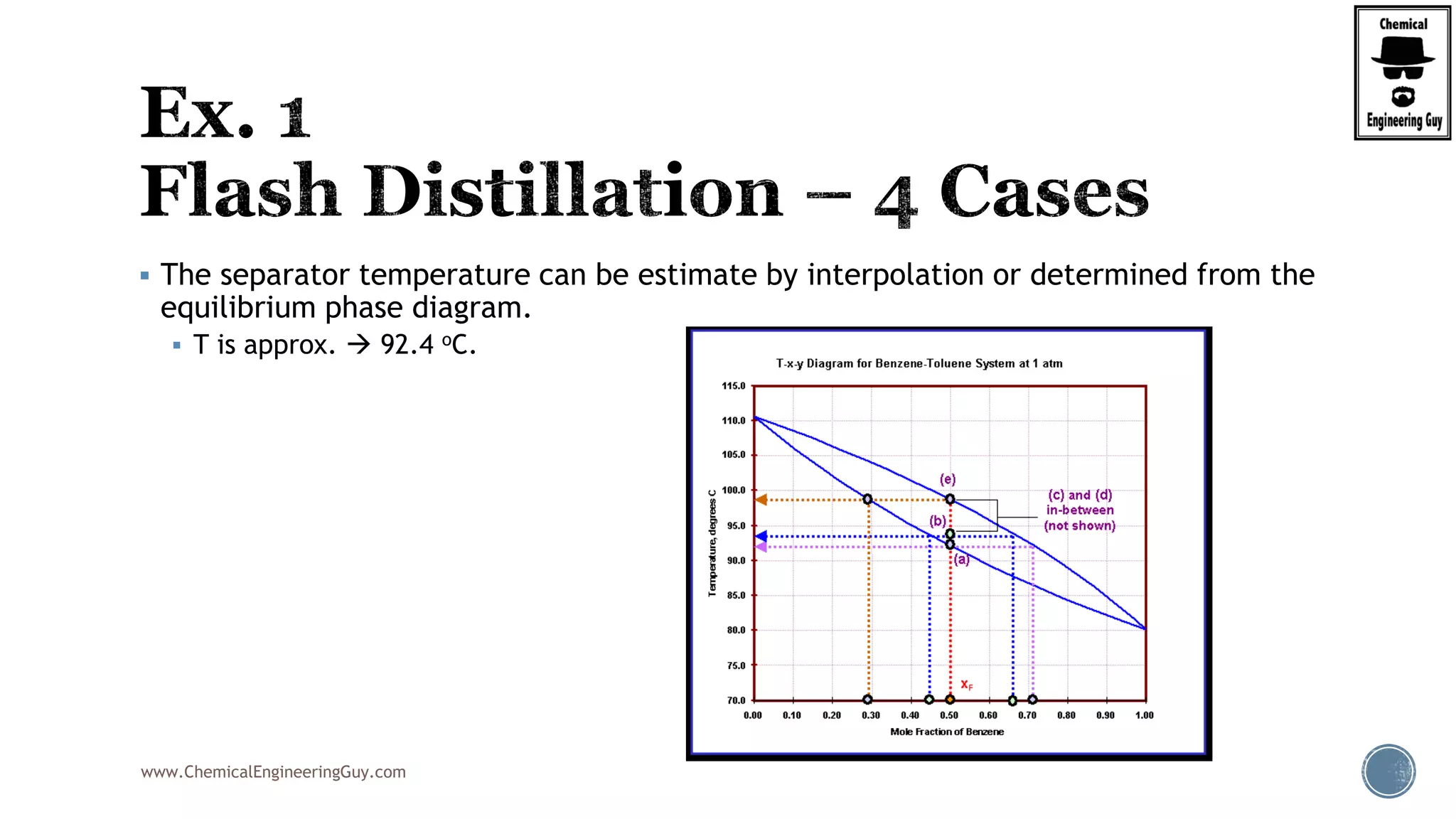
 From graph: xB = 0.44, yD = 0.66
Do you need the Full Version?
Contact me if needed!
Contact@ChemicalEngineeringGuy.com
https://courses.chemicalengineeringguy.com/courses
You can also check out more content here:
My Youtube Channel 
My Fan Page 
The LinkedIn
My website:
www.ChemicalEngineeringGuy.com
 The separator temperature can be estimate by interpolation or determined from the
equilibrium phase diagram.
 T is approx.  92.4 oC.
www.ChemicalEngineeringGuy.com
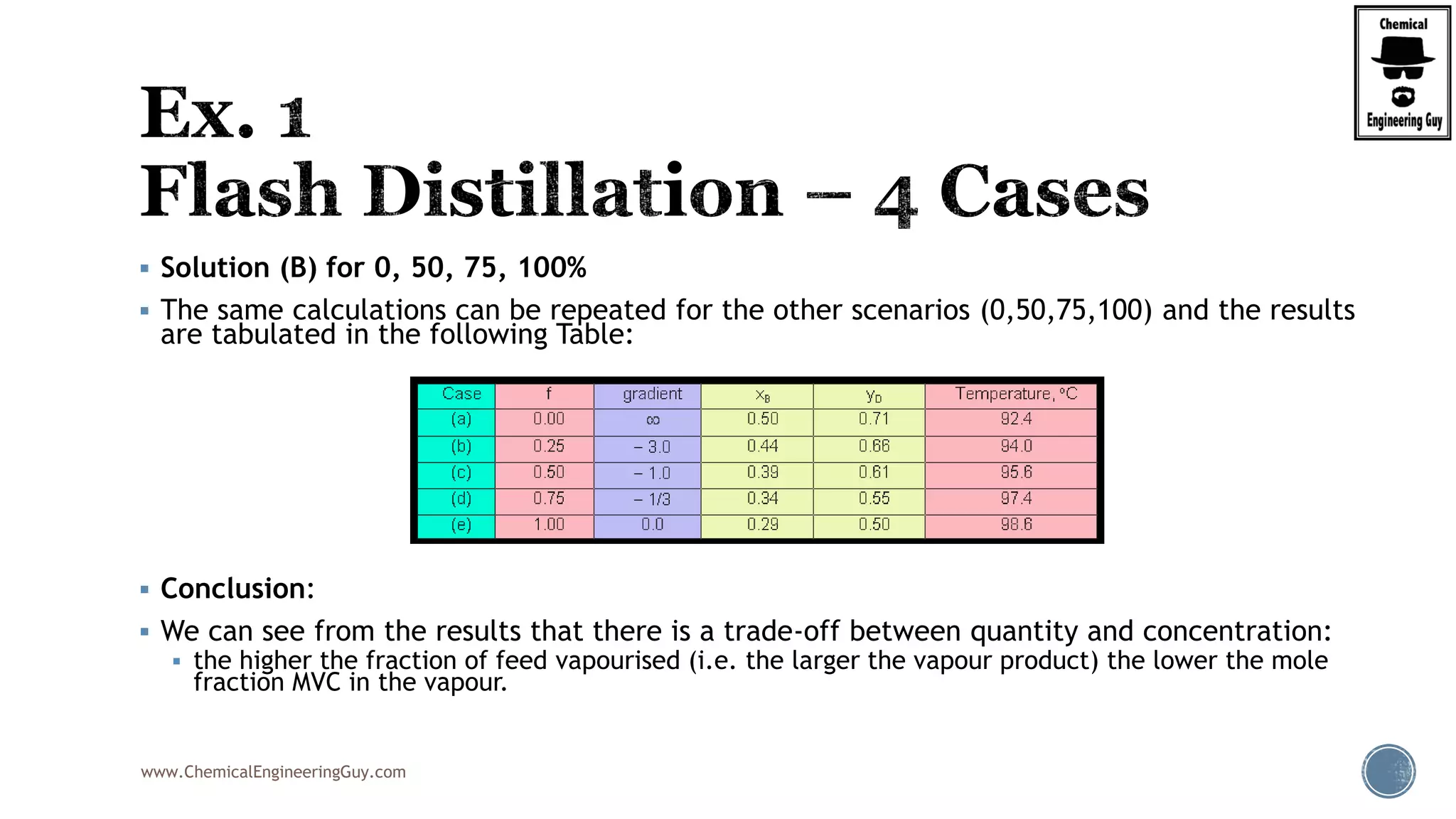
 Solution (B) for 0, 50, 75, 100%
 The same calculations can be repeated for the other scenarios (0,50,75,100) and the results
are tabulated in the following Table:
 Conclusion:
 We can see from the results that there is a trade-off between quantity and concentration:
 the higher the fraction of feed vapourised (i.e. the larger the vapour product) the lower the mole
fraction MVC in the vapour.
www.ChemicalEngineeringGuy.com
 Conclusion:
 We can see from the results that there is a trade-off between quantity and
concentration:
 the higher the fraction of feed vapourised (i.e. the larger the vapour product) the lower the
mole fraction MVC in the vapour.
Do you need the Full Version?
Contact me if needed!
Contact@ChemicalEngineeringGuy.com
https://courses.chemicalengineeringguy.com/courses
You can also check out more content here:
My Youtube Channel 
My Fan Page 
The LinkedIn
My website:
www.ChemicalEngineeringGuy.com
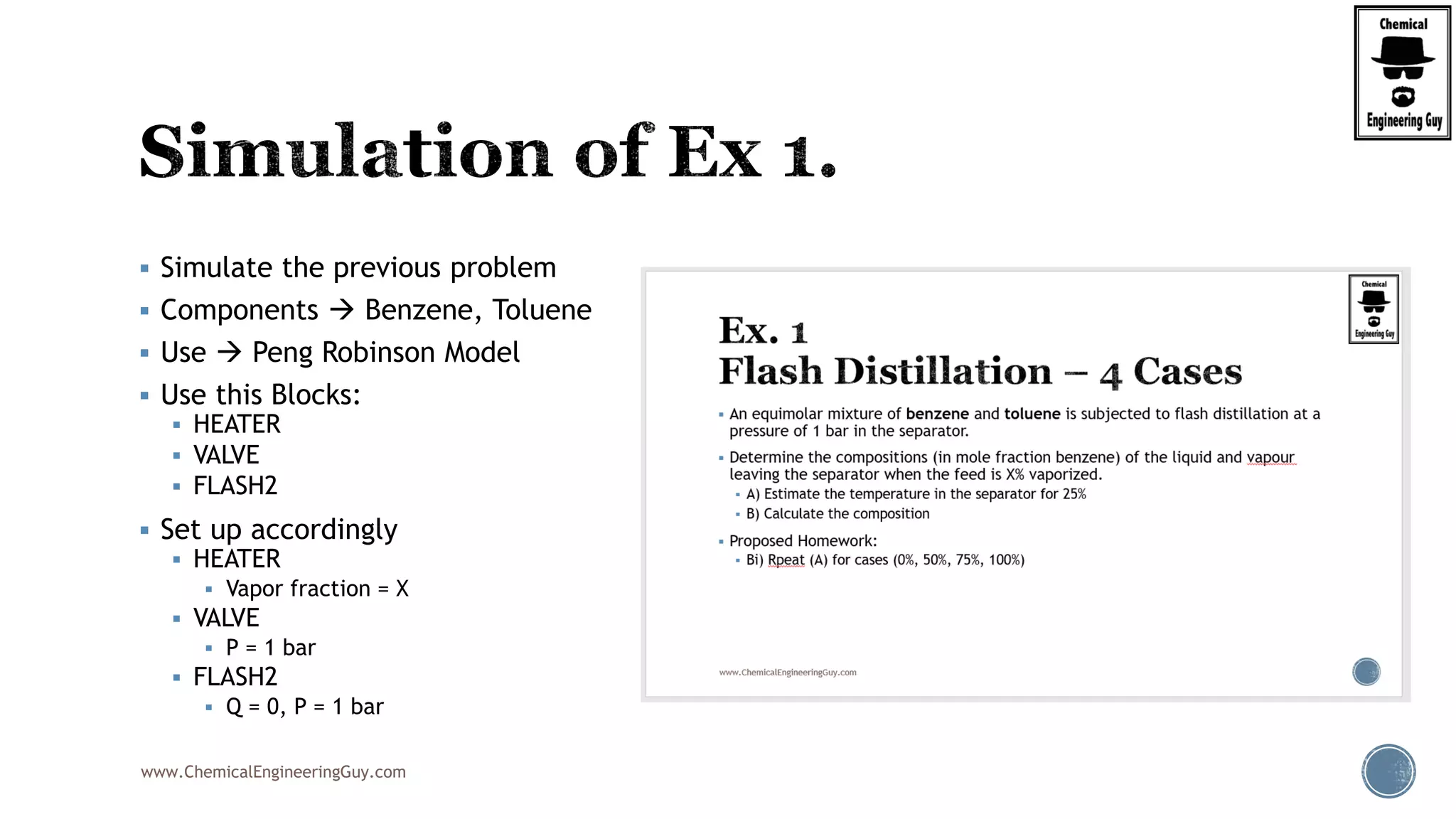
 Simulate the previous problem
 Components  Benzene, Toluene
 Use  Peng Robinson Model
 Use this Blocks:
 HEATER
 VALVE
 FLASH2
 Set up accordingly
 HEATER
 Vapor fraction = X
 VALVE
 P = 1 bar
 FLASH2
 Q = 0, P = 1 bar
www.ChemicalEngineeringGuy.com
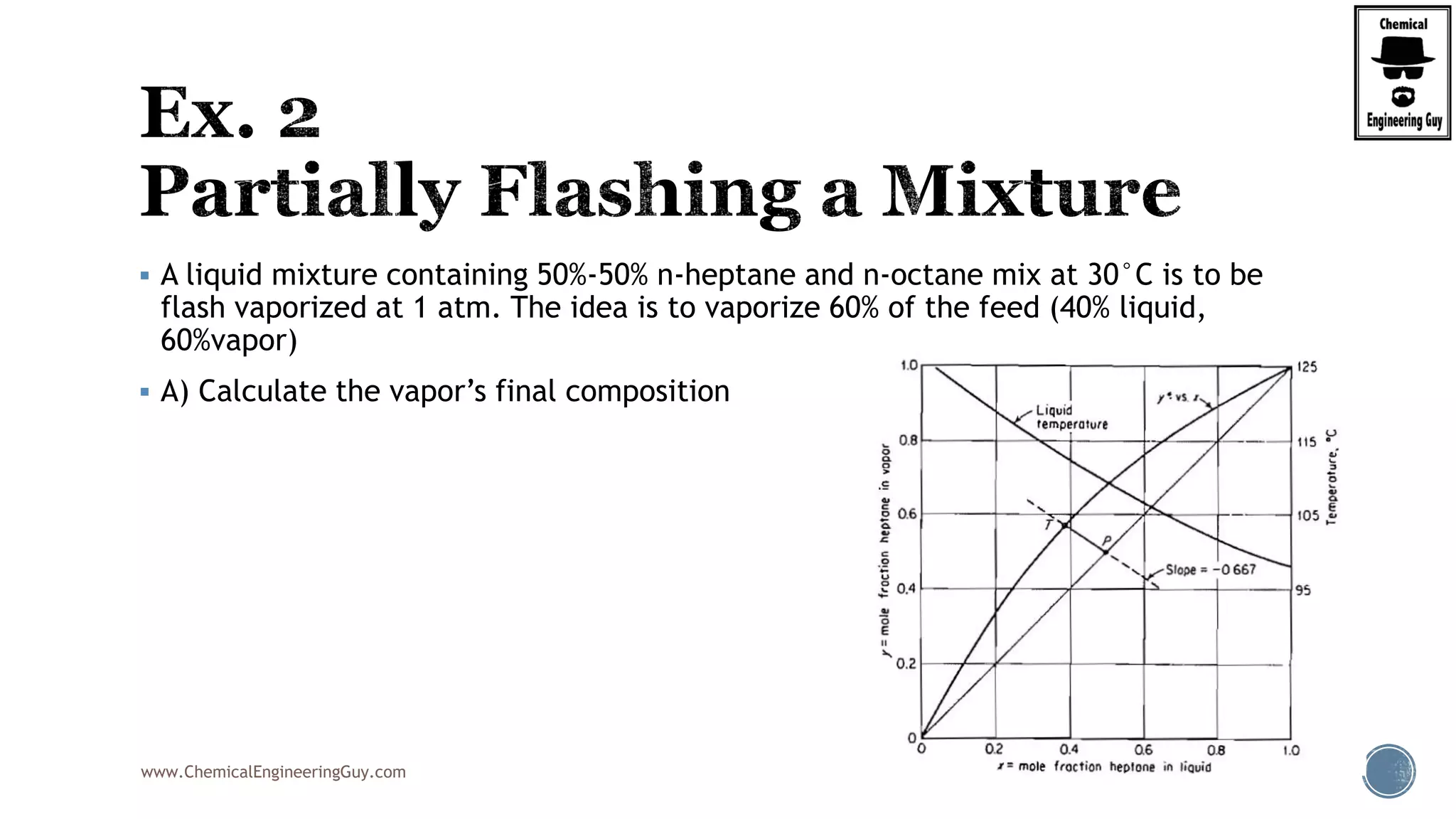
 A liquid mixture containing 50%-50% n-heptane and n-octane mix at 30°C is to be
flash vaporized at 1 atm. The idea is to vaporize 60% of the feed (40% liquid,
60%vapor)
 A) Calculate the vapor’s final composition
www.ChemicalEngineeringGuy.com
 Solution
 Assume 
 F = 100 mol
 zF = 0.50 (equimolar)
 B = 40, D = 60  -W/D = -40/60 = -0.667
 From the plot:
 Identify FEED (point P, in x=y line)
 Draw Operation line:
 With the slope  -0.667
 Intersect in equilibrium curve (Point “T”)
Do you need the Full Version?
Contact me if needed!
Contact@ChemicalEngineeringGuy.com
https://courses.chemicalengineeringguy.com/courses
You can also check out more content here:
My Youtube Channel 
My Fan Page 
The LinkedIn
My website:
www.ChemicalEngineeringGuy.com
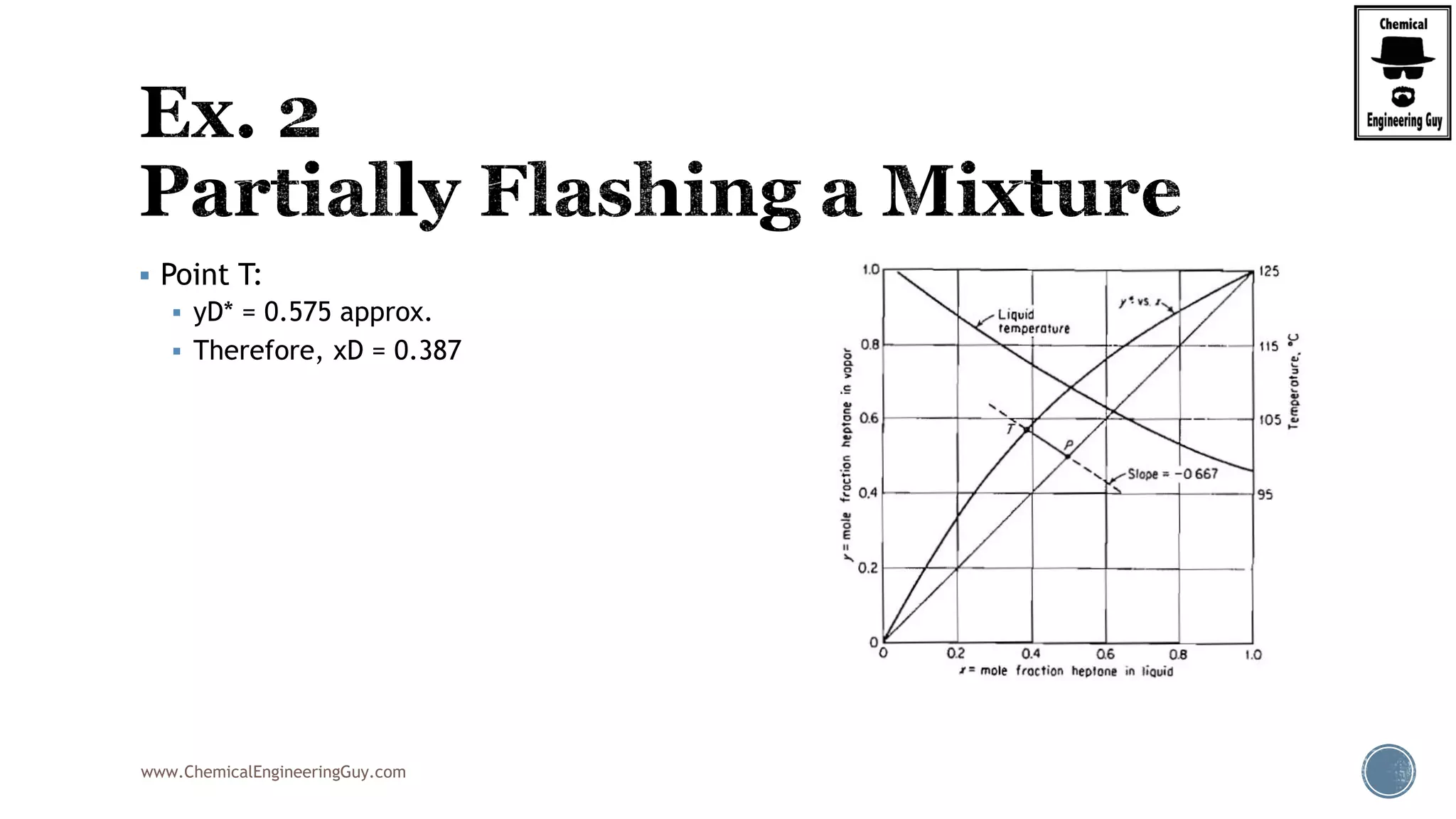
 Point T:
 yD* = 0.575 approx.
 Therefore, xD = 0.387
www.ChemicalEngineeringGuy.com
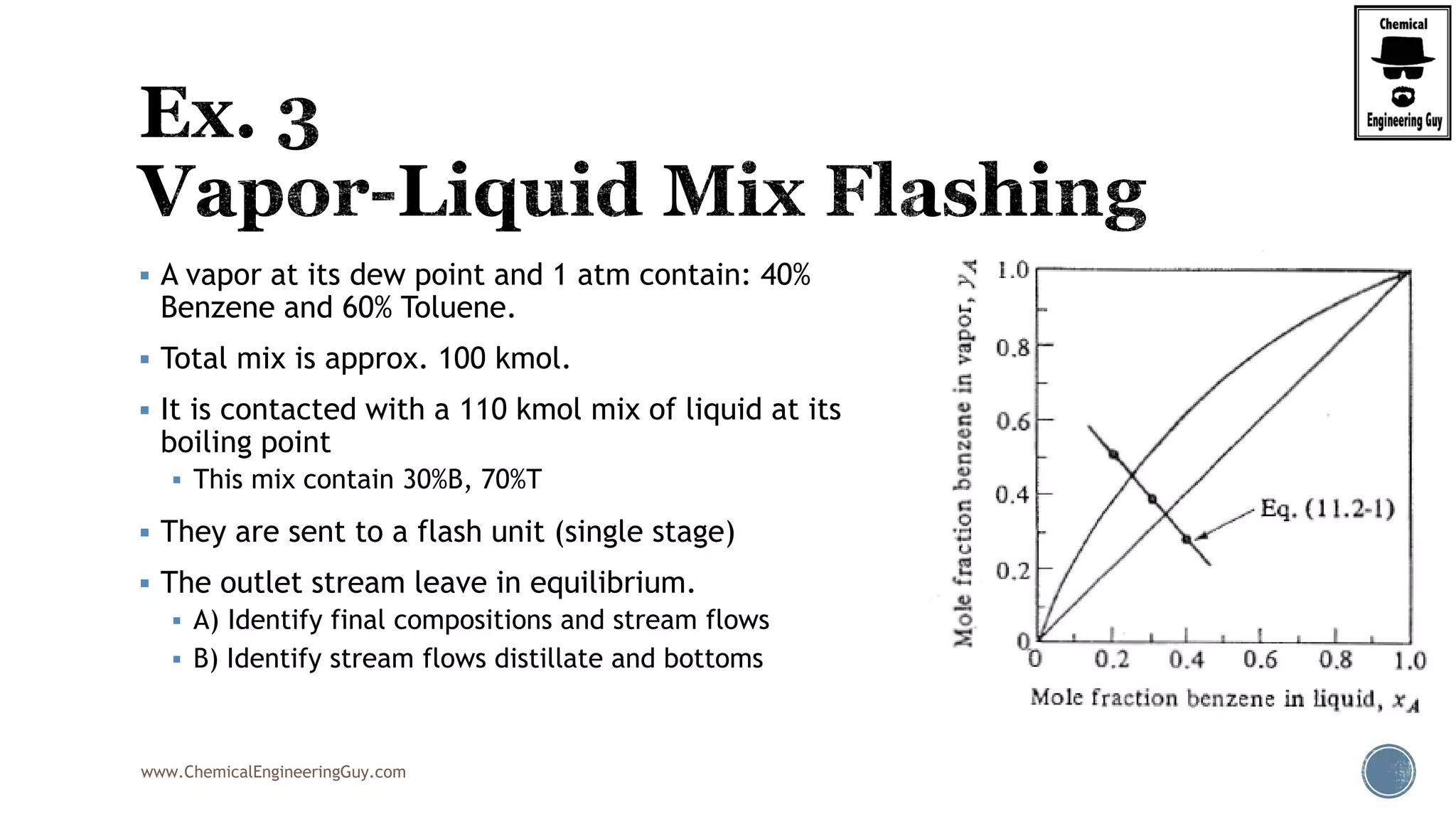
 A vapor at its dew point and 1 atm contain: 40%
Benzene and 60% Toluene.
 Total mix is approx. 100 kmol.
 It is contacted with a 110 kmol mix of liquid at its
boiling point
 This mix contain 30%B, 70%T
 They are sent to a flash unit (single stage)
 The outlet stream leave in equilibrium.
 A) Identify final compositions and stream flows
 B) Identify stream flows distillate and bottoms
www.ChemicalEngineeringGuy.com
 Solution:
 Mass balance:
 Total:
 F = L+D = 100+110 = 210 kmol
 On Benzene:
 Lxb + Dyb = Fxb
 (110)(0.3) + (100)(40) = Fxb
 Benzene flow = 73 kmol B (in both, liquid & vapor)
 In equilibrium:
 (110)(0.3) + (100)(40) = (Bvap + Bliq)
 (110)(0.3) + (100)(40) = 110x + 100y*
Do you need the Full Version?
Contact me if needed!
Contact@ChemicalEngineeringGuy.com
https://courses.chemicalengineeringguy.com/courses
You can also check out more content here:
My Youtube Channel 
My Fan Page 
The LinkedIn
My website:
www.ChemicalEngineeringGuy.com
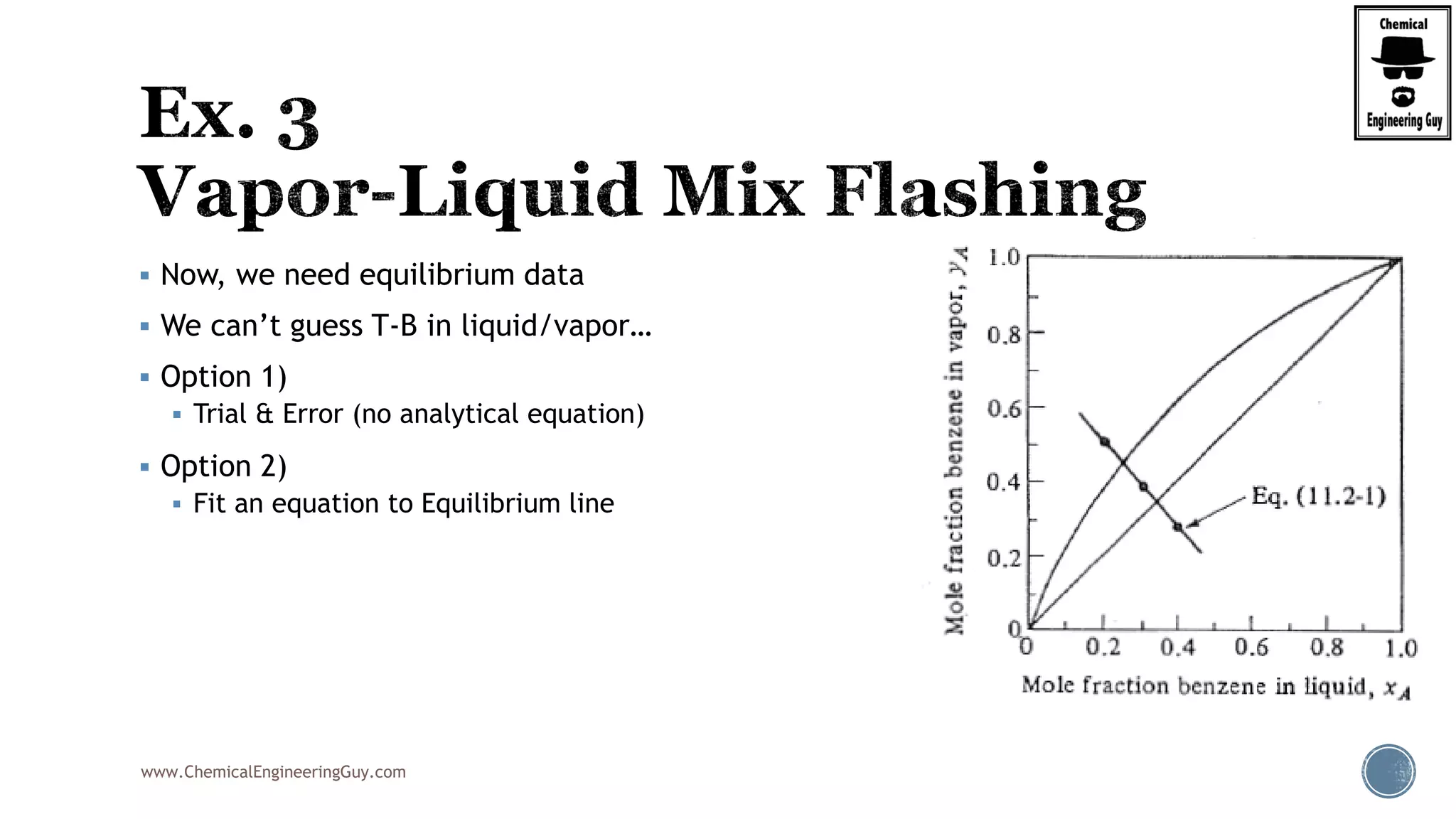
 Now, we need equilibrium data
 We can’t guess T-B in liquid/vapor…
 Option 1)
 Trial & Error (no analytical equation)
 Option 2)
 Fit an equation to Equilibrium line
www.ChemicalEngineeringGuy.com
 Option 1)
 Iteration 1
 Balance on Benzene (before equilibrium  after equilibrium)
 (110)(0.3) + (100)(40) = 110x + 100y*
 Assume x = 0.20
 (110)(0.3) + (100)(40) = 110(0.20) + 100y*
 y = (73-22)/(100) = 0.51
 Verify if true…
 x = 0.2, y = 0.51  NOT TRUE
Do you need the Full Version?
Contact me if needed!
Contact@ChemicalEngineeringGuy.com
https://courses.chemicalengineeringguy.com/courses
You can also check out more content here:
My Youtube Channel 
My Fan Page 
The LinkedIn
My website:
www.ChemicalEngineeringGuy.com
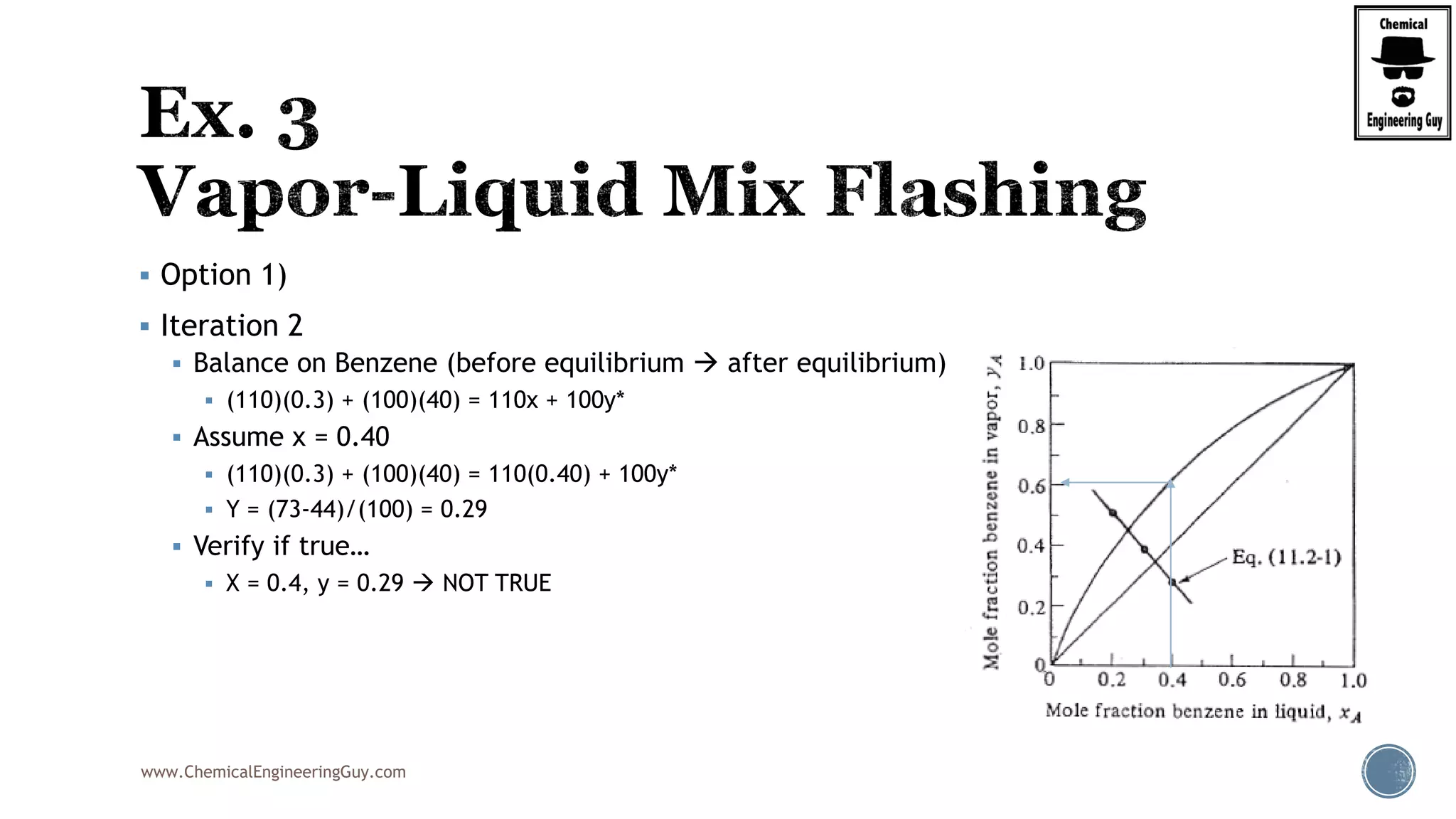
 Option 1)
 Iteration 2
 Balance on Benzene (before equilibrium  after equilibrium)
 (110)(0.3) + (100)(40) = 110x + 100y*
 Assume x = 0.40
 (110)(0.3) + (100)(40) = 110(0.40) + 100y*
 Y = (73-44)/(100) = 0.29
 Verify if true…
 X = 0.4, y = 0.29  NOT TRUE
www.ChemicalEngineeringGuy.com
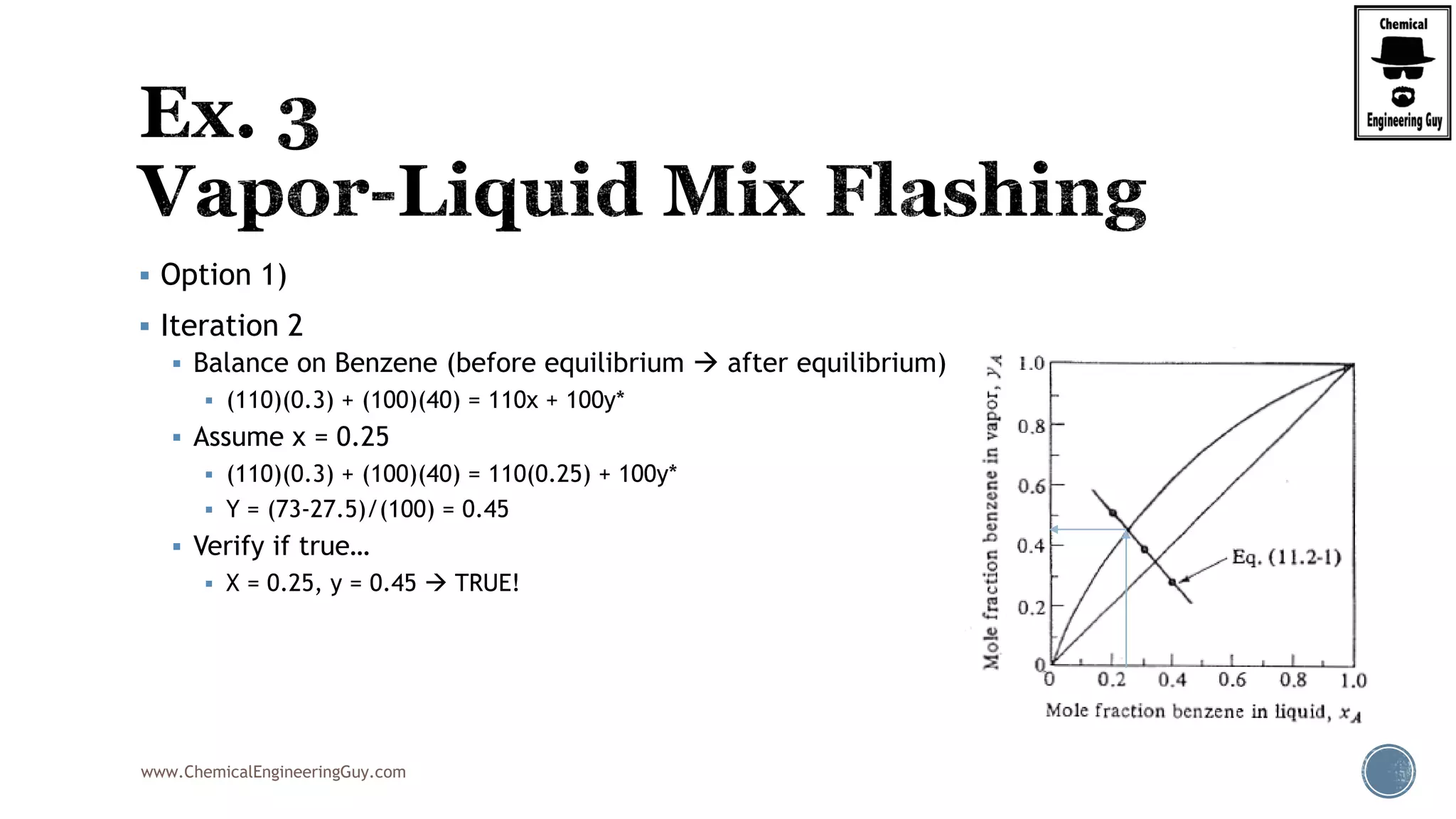
 Option 1)
 Iteration 2
 Balance on Benzene (before equilibrium  after equilibrium)
 (110)(0.3) + (100)(40) = 110x + 100y*
 Assume x = 0.25
 (110)(0.3) + (100)(40) = 110(0.25) + 100y*
 Y = (73-27.5)/(100) = 0.45
 Verify if true…
 X = 0.25, y = 0.45  TRUE!
www.ChemicalEngineeringGuy.com
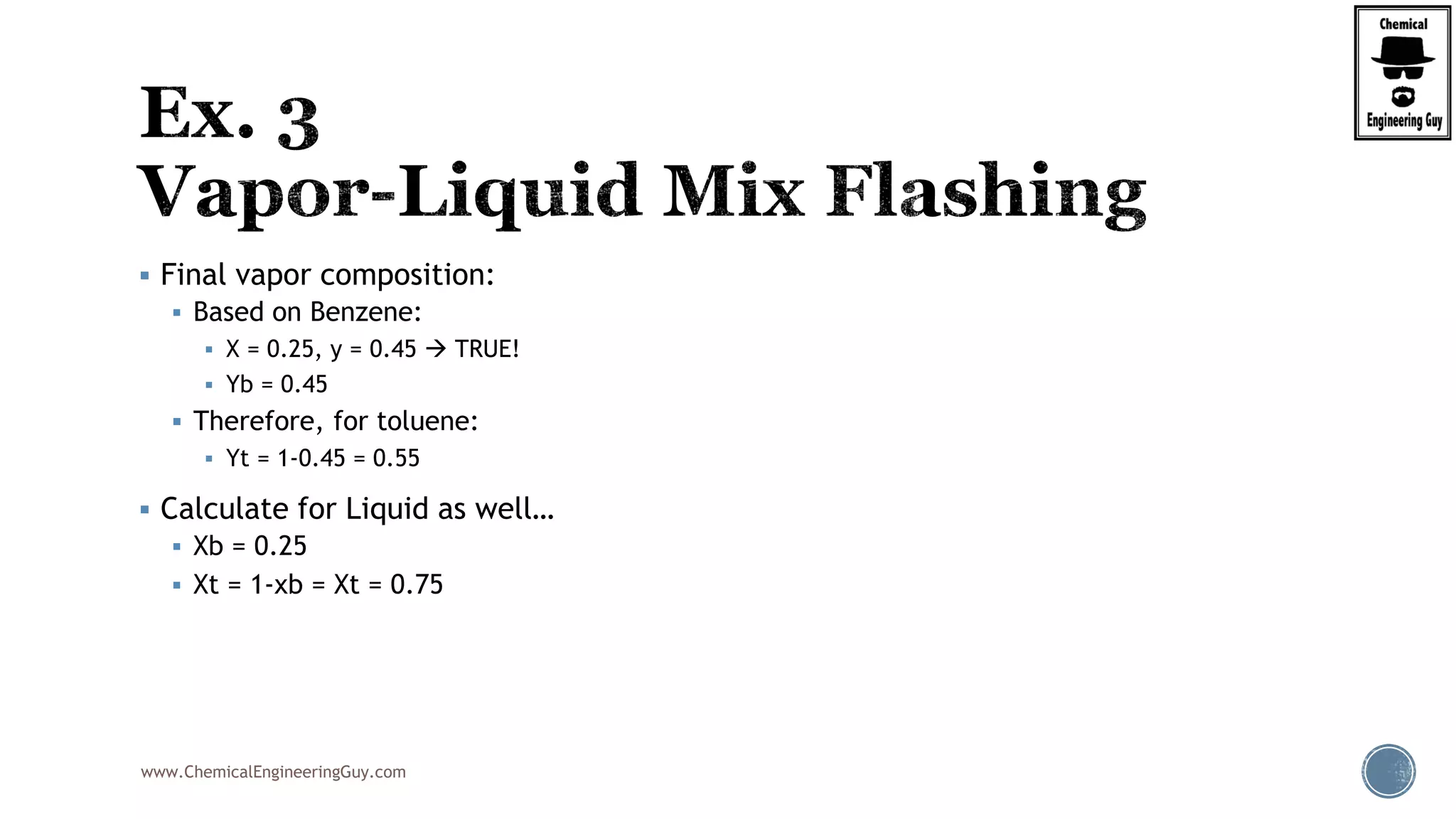
 Final vapor composition:
 Based on Benzene:
 X = 0.25, y = 0.45  TRUE!
 Yb = 0.45
 Therefore, for toluene:
 Yt = 1-0.45 = 0.55
 Calculate for Liquid as well…
 Xb = 0.25
 Xt = 1-xb = Xt = 0.75
www.ChemicalEngineeringGuy.com
 For the system methanol-water; we have an azeotrope..
 Try to obtain the best separation!
http://demonstrations.wolfram.com/AdiabaticFlashDrumWithBinaryLiquidFeed/
Do you need the Full Version?
Contact me if needed!
Contact@ChemicalEngineeringGuy.com
https://courses.chemicalengineeringguy.com/courses
You can also check out more content here:
My Youtube Channel 
My Fan Page 
The LinkedIn
My website:
www.ChemicalEngineeringGuy.com
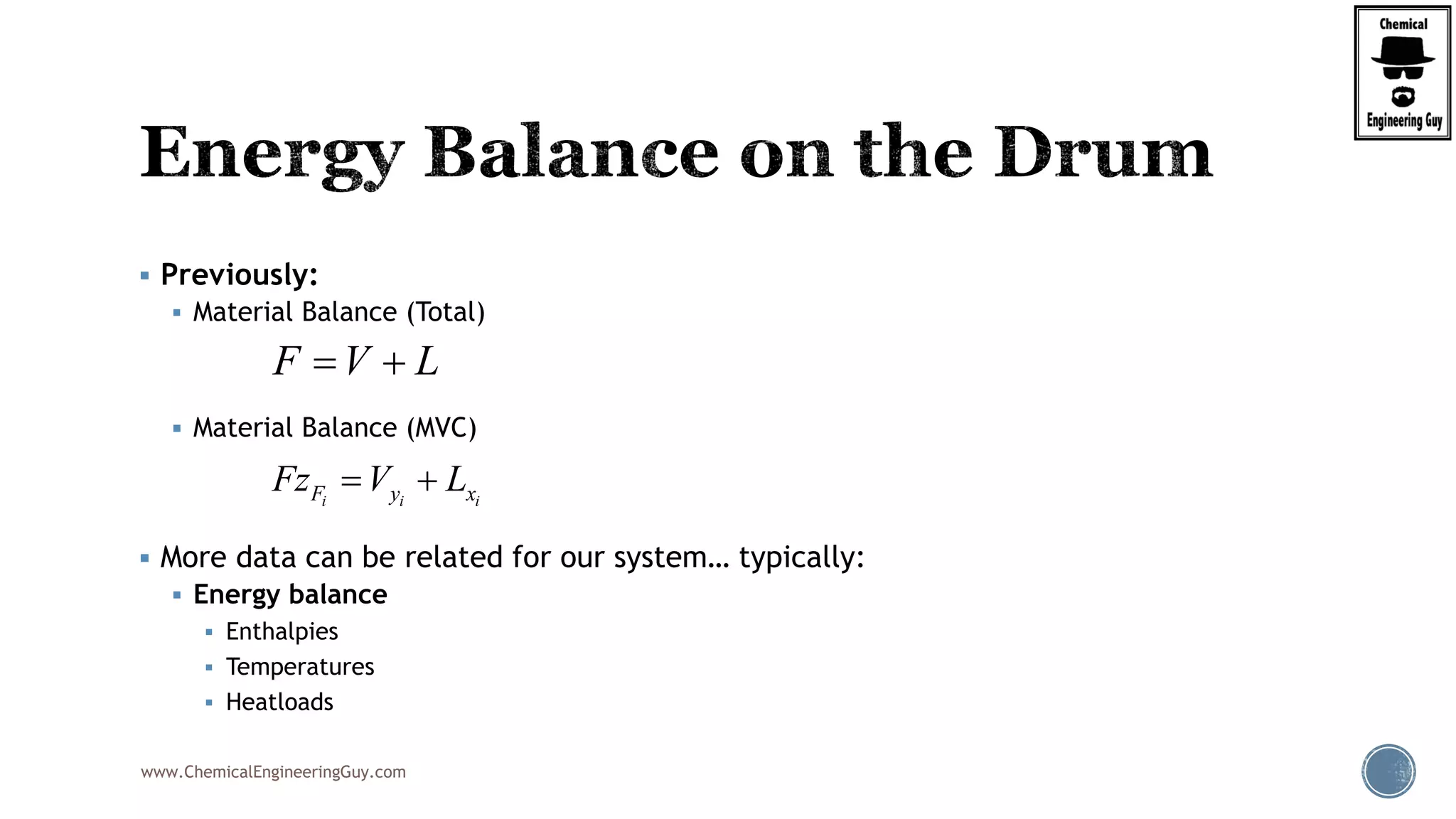
 Previously:
 Material Balance (Total)
 Material Balance (MVC)
 More data can be related for our system… typically:
 Energy balance
 Enthalpies
 Temperatures
 Heatloads
F V L 
i i iF y xFz V L 
www.ChemicalEngineeringGuy.com
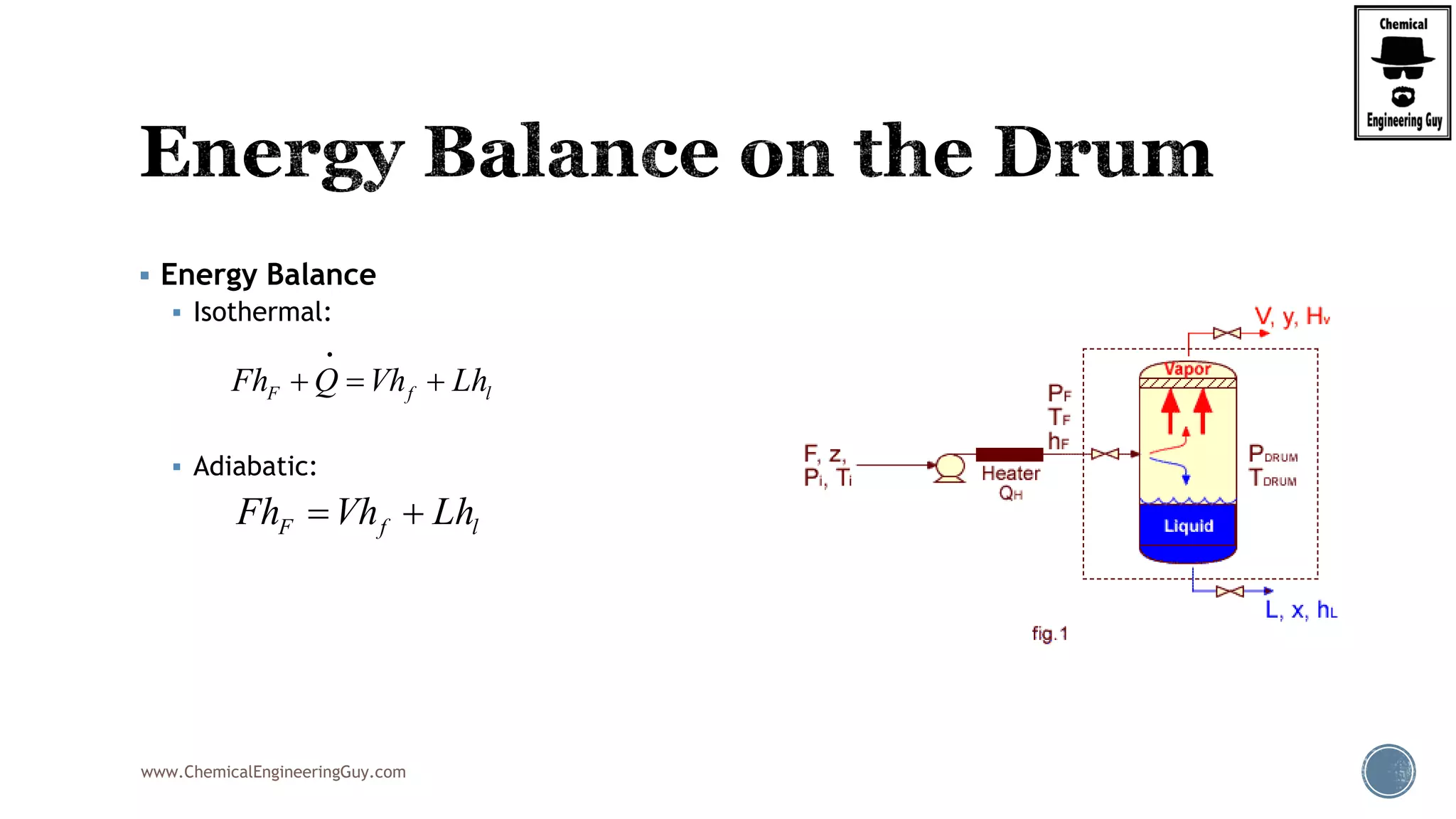
 Energy Balance
 Isothermal:
 Adiabatic:
F f lFh Q Vh Lh  
F f lFh Vh Lh 
www.ChemicalEngineeringGuy.com
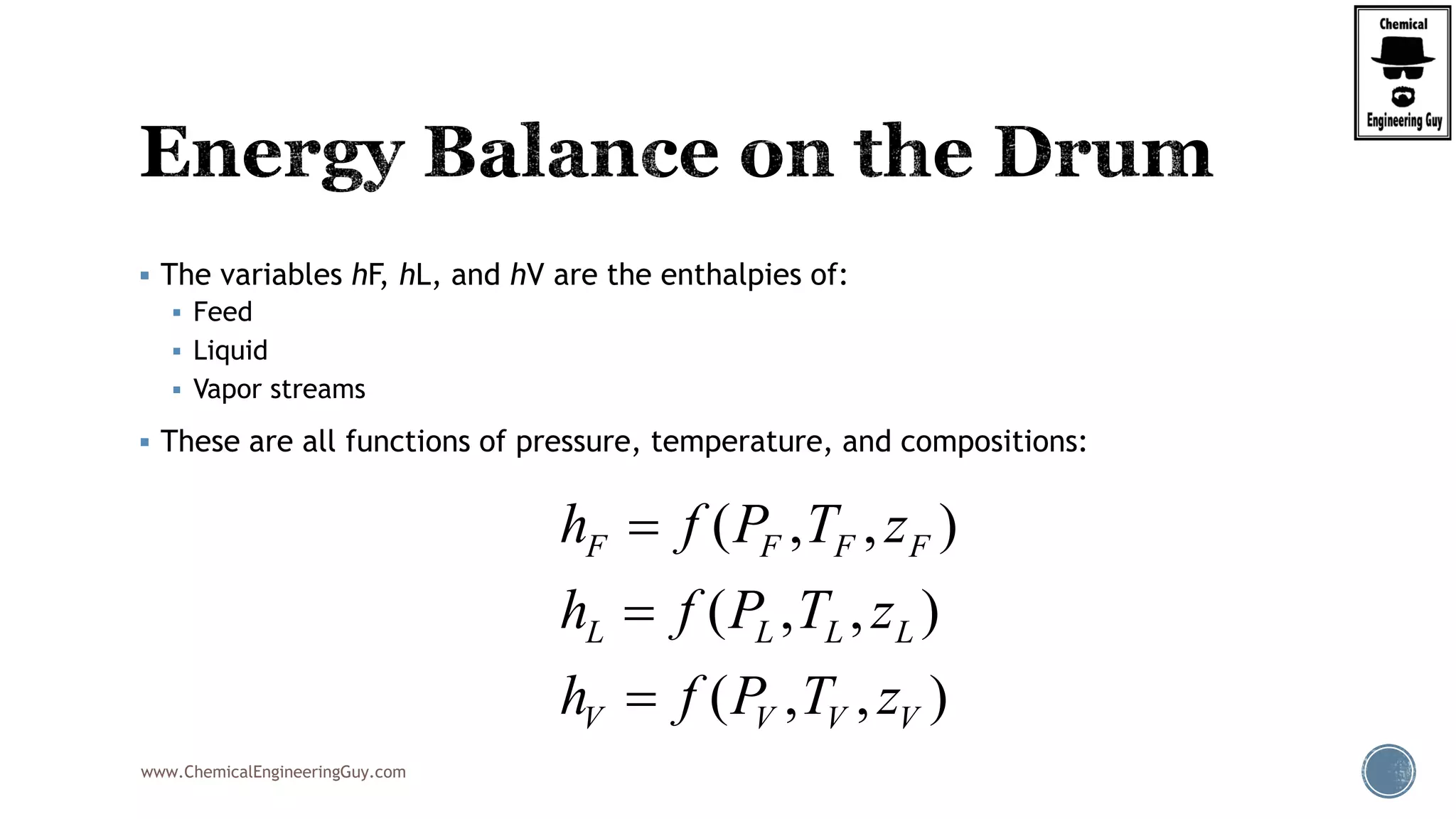
 The variables hF, hL, and hV are the enthalpies of:
 Feed
 Liquid
 Vapor streams
 These are all functions of pressure, temperature, and compositions:
( , , )
( , , )
( , , )
F F F F
L L L L
V V V V
h f P T z
h f P T z
h f P T z



www.ChemicalEngineeringGuy.com
 The unit is generally assumed to be under:
 Mechanical equilibrium 
 Thermal equilibrium
 Phase equilibrium 
 Ki is generally a function of (P,T)
F L VP P P 
F L VT T T T  
i i iy K x
Do you need the Full Version?
Contact me if needed!
Contact@ChemicalEngineeringGuy.com
https://courses.chemicalengineeringguy.com/courses
You can also check out more content here:
My Youtube Channel 
My Fan Page 
The LinkedIn
My website:
www.ChemicalEngineeringGuy.com
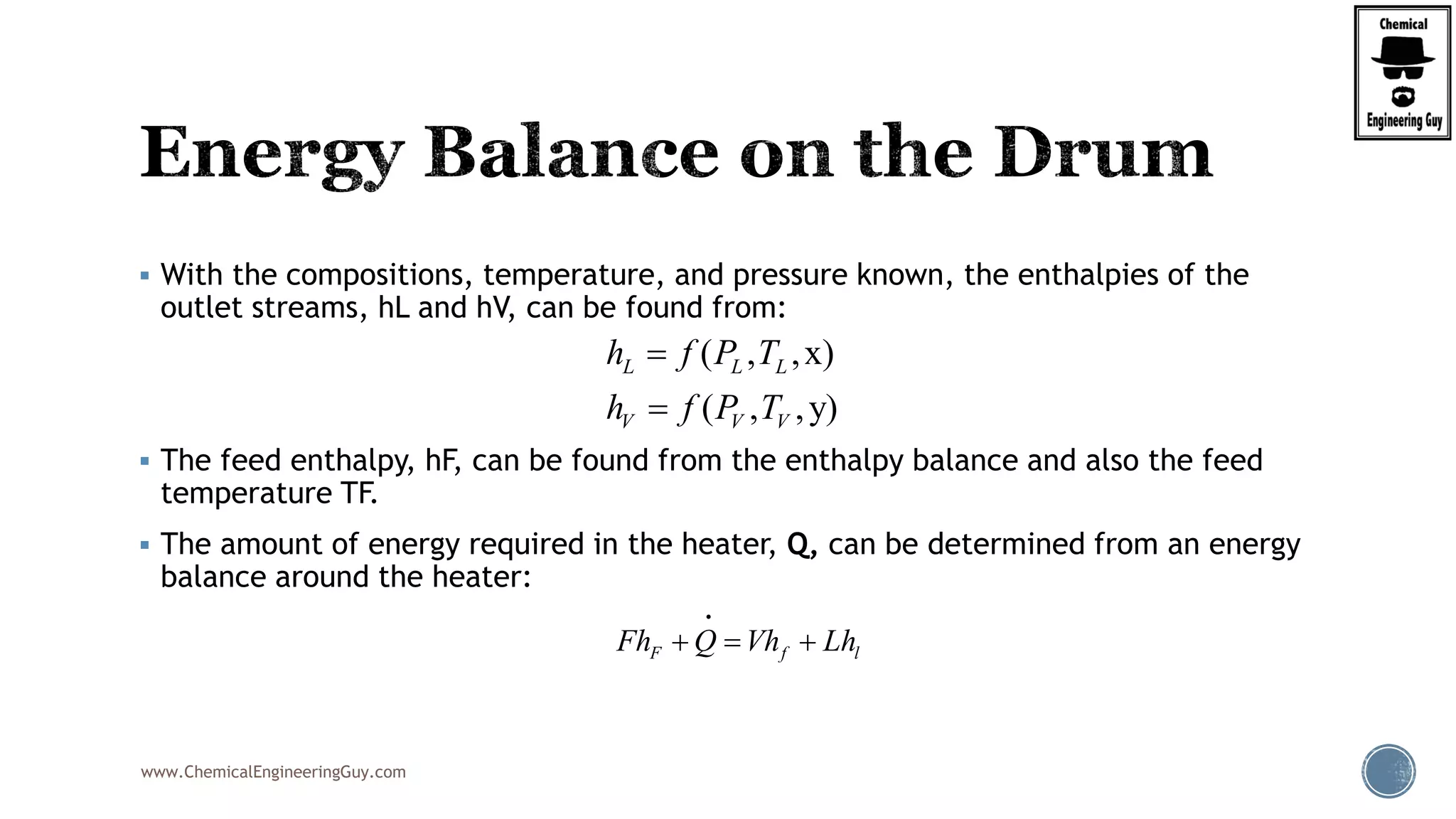
 With the compositions, temperature, and pressure known, the enthalpies of the
outlet streams, hL and hV, can be found from:
 The feed enthalpy, hF, can be found from the enthalpy balance and also the feed
temperature TF.
 The amount of energy required in the heater, Q, can be determined from an energy
balance around the heater:
F f lFh Q Vh Lh  
( , ,x)
( , ,y)
L L L
V V V
h f P T
h f P T


www.ChemicalEngineeringGuy.com
 Finally, the heat balance:
( , , ) ( , , )
( , , ) ( , , )
[ ( , , ) ( , , )]
hx in in F F F F
hx F F F in in F
hx F F F in in F
Q Fh P T z Fh P T z
Q Fh P T z Fh P T z
Q F h P T z h P T z
 
 
 
www.ChemicalEngineeringGuy.com
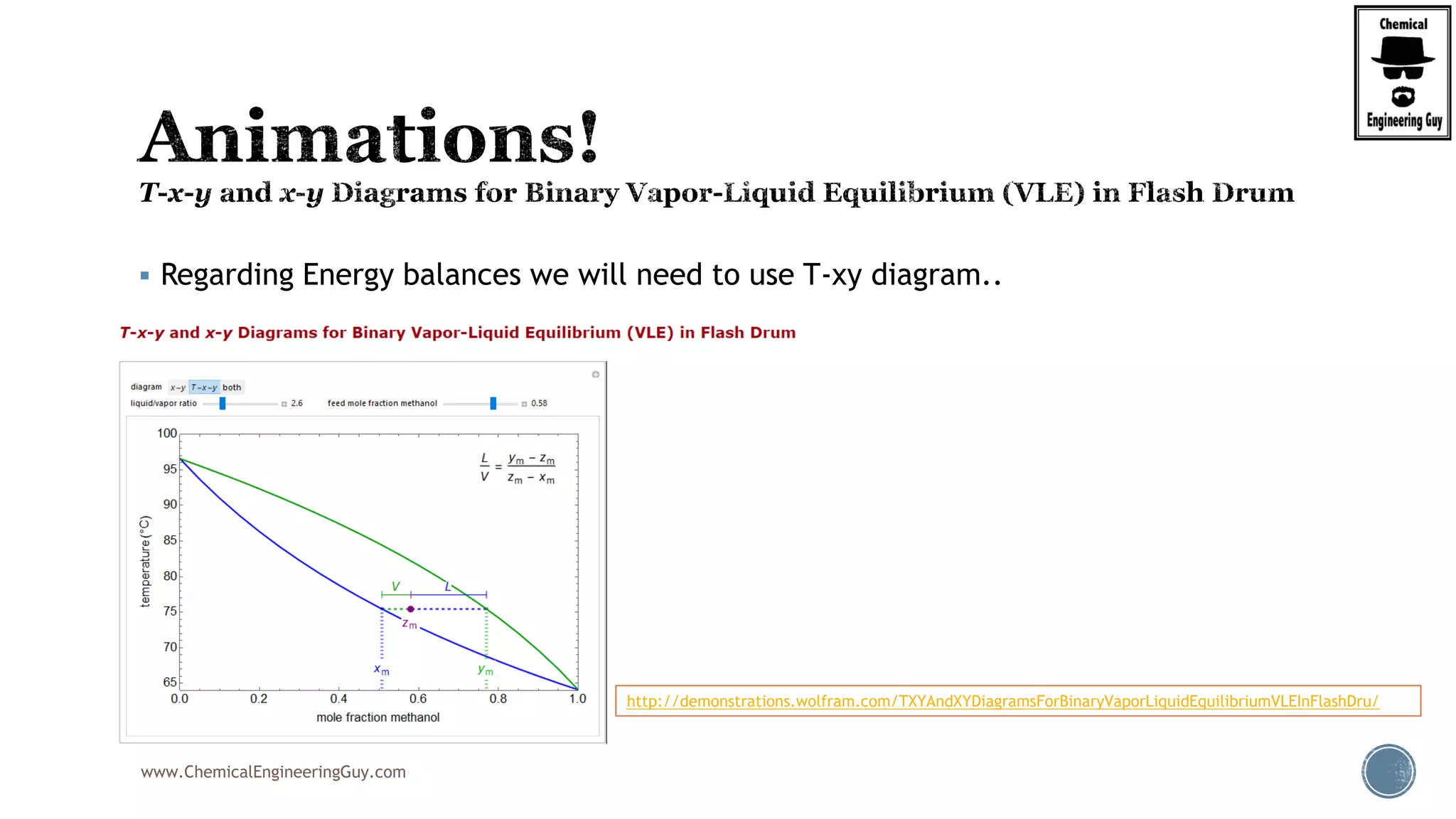
 Regarding Energy balances we will need to use T-xy diagram..
http://demonstrations.wolfram.com/TXYAndXYDiagramsForBinaryVaporLiquidEquilibriumVLEInFlashDru/
www.ChemicalEngineeringGuy.com
 A vertical Flash Drum is used to separate 100 kmol/h of (40-60%) water-ethylene
glycol mix.
 Feed conditions: P = 300 kPA, T = 150°C
 Flash Drum Conditions: P = 30.4 kPa, 0.33 V/F ratio
 Get the required equilibrium data from Aspen Plus or HYSYS
 A) Find the compositions in the outlet
 If Adiabatic:
 Bi) Temperature of the drum
 Ci) Temperature at the outlet (vapor/liquid)
 Di) Is the Heat-load (added or removed)
www.ChemicalEngineeringGuy.com
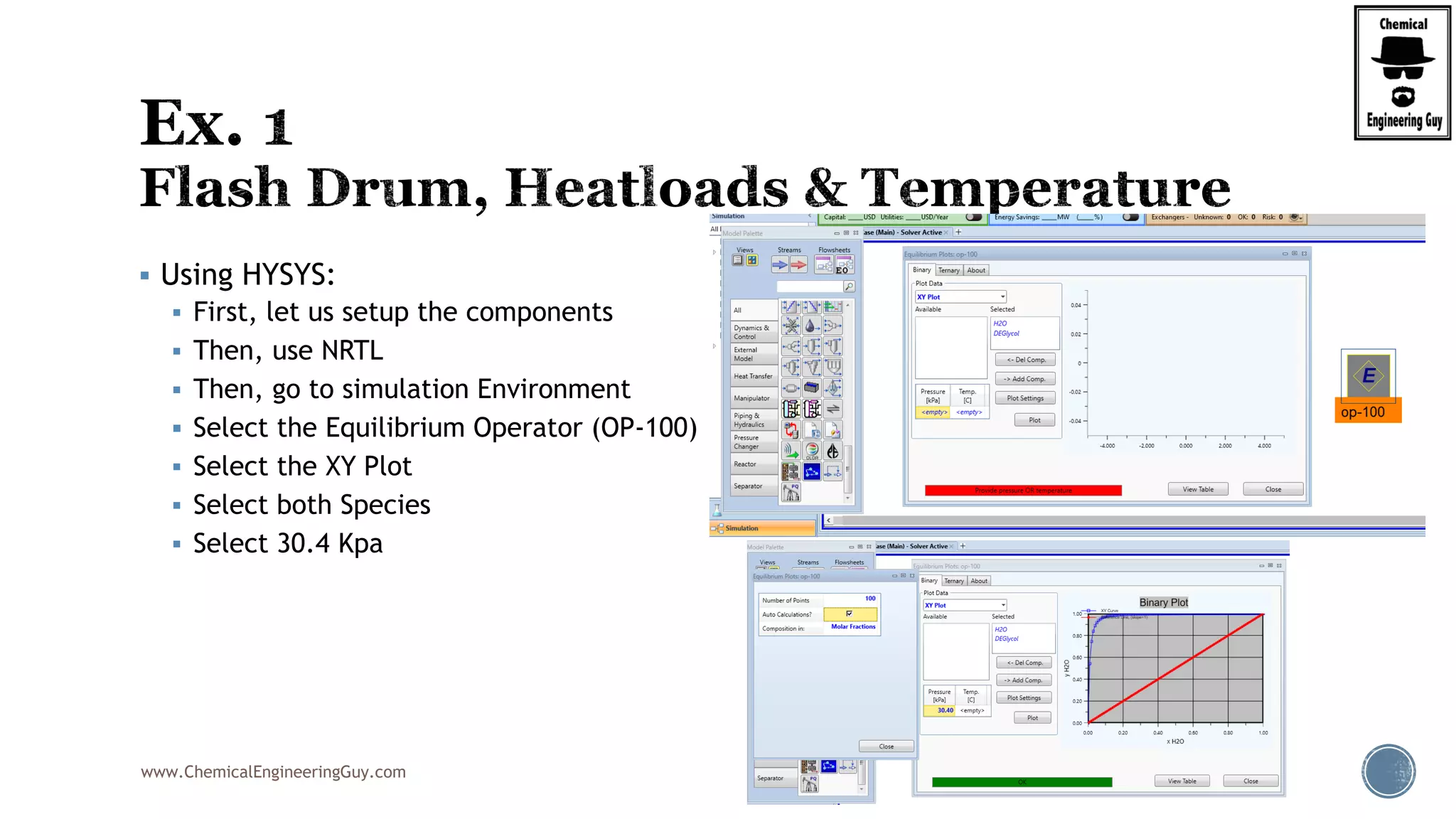
 Using HYSYS:
 First, let us setup the components
 Then, use NRTL
 Then, go to simulation Environment
 Select the Equilibrium Operator (OP-100)
 Select the XY Plot
 Select both Species
 Select 30.4 Kpa
www.ChemicalEngineeringGuy.com
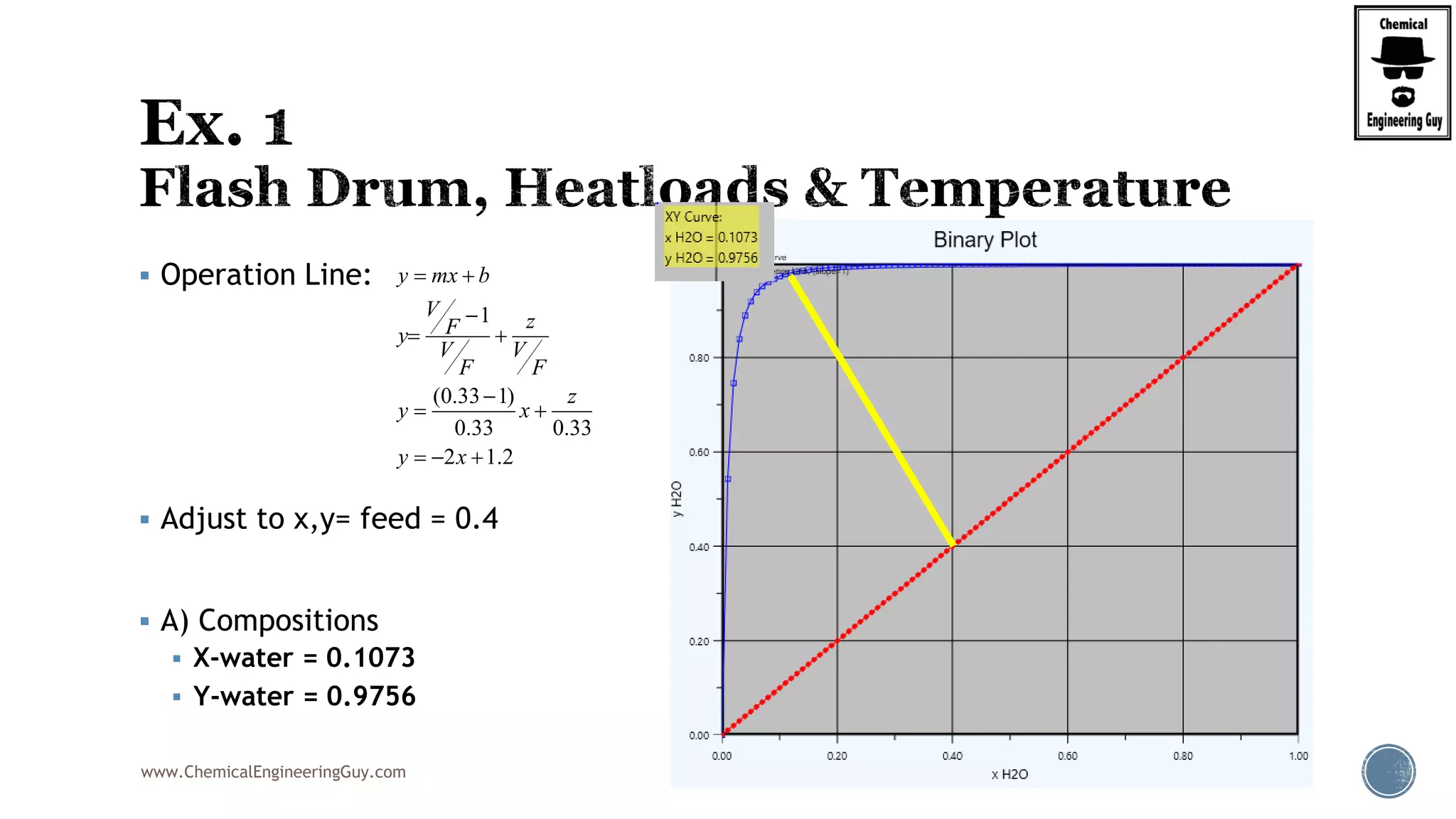
 From the diagram…
 The Operation Line
1
(0.33 1)
0.33 0.33
2 1.2
y mx b
V
zFy
V V
F F
z
y x
y x
 

 

 
  
Do you need the Full Version?
Contact me if needed!
Contact@ChemicalEngineeringGuy.com
https://courses.chemicalengineeringguy.com/courses
You can also check out more content here:
My Youtube Channel 
My Fan Page 
The LinkedIn
My website:
www.ChemicalEngineeringGuy.com
 Operation Line:
 Adjust to x,y= feed = 0.4
 A) Compositions
 X-water = 0.1073
 Y-water = 0.9756
1
(0.33 1)
0.33 0.33
2 1.2
y mx b
V
zFy
V V
F F
z
y x
y x
 

 

 
  
www.ChemicalEngineeringGuy.com
 If Adiabatic…
 Using the same Block E, then change XY to TXY
 For:
 X = 0.1073
 Y = 0.9756
Do you need the Full Version?
Contact me if needed!
Contact@ChemicalEngineeringGuy.com
https://courses.chemicalengineeringguy.com/courses
You can also check out more content here:
My Youtube Channel 
My Fan Page 
The LinkedIn
My website:
www.ChemicalEngineeringGuy.com
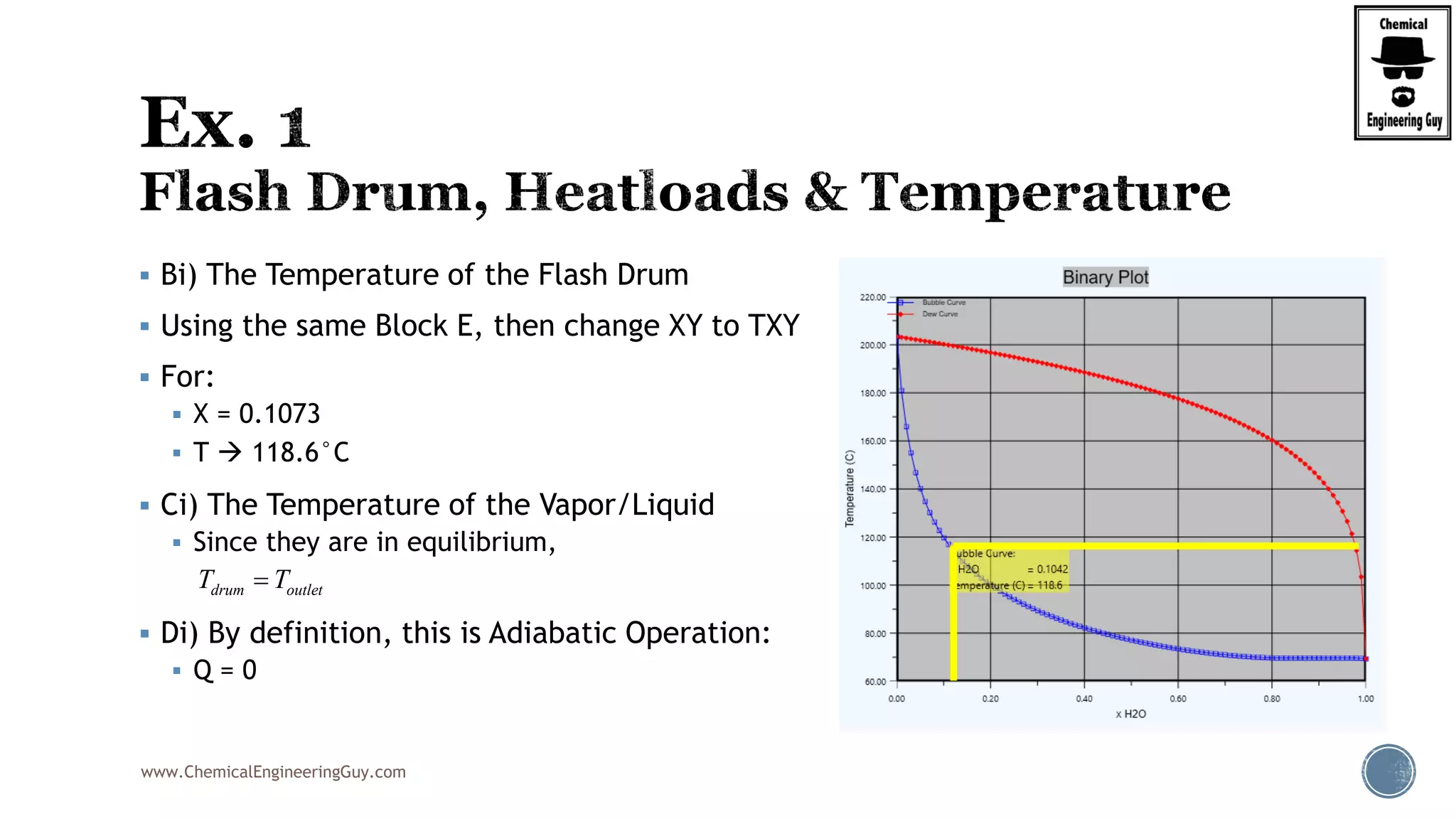
 Bi) The Temperature of the Flash Drum
 Using the same Block E, then change XY to TXY
 For:
 X = 0.1073
 T  118.6°C
 Ci) The Temperature of the Vapor/Liquid
 Since they are in equilibrium,
 Di) By definition, this is Adiabatic Operation:
 Q = 0
drum outletT T
www.ChemicalEngineeringGuy.com
 Conclusion…
 A good follow up question…
 If the system is to be Isothermal, calculate Q required
www.ChemicalEngineeringGuy.com
 A binary system of Ethanol-Water is to be flashed
 Conditions:
 P = 98kPa, T = 180°F
 q = 1 (saturated vapor)
 L:V ratio is  3V = L
 Basis may be assumed 100 kg/h (L = 75, V = 25)
 A) Determine composition of exiting streams (V/L)
 B) Determine composition of INLET (feed)
 C) Find the Energy required to add/remove
Do you need the Full Version?
Contact me if needed!
Contact@ChemicalEngineeringGuy.com
https://courses.chemicalengineeringguy.com/courses
You can also check out more content here:
My Youtube Channel 
My Fan Page 
The LinkedIn
My website:
www.ChemicalEngineeringGuy.com
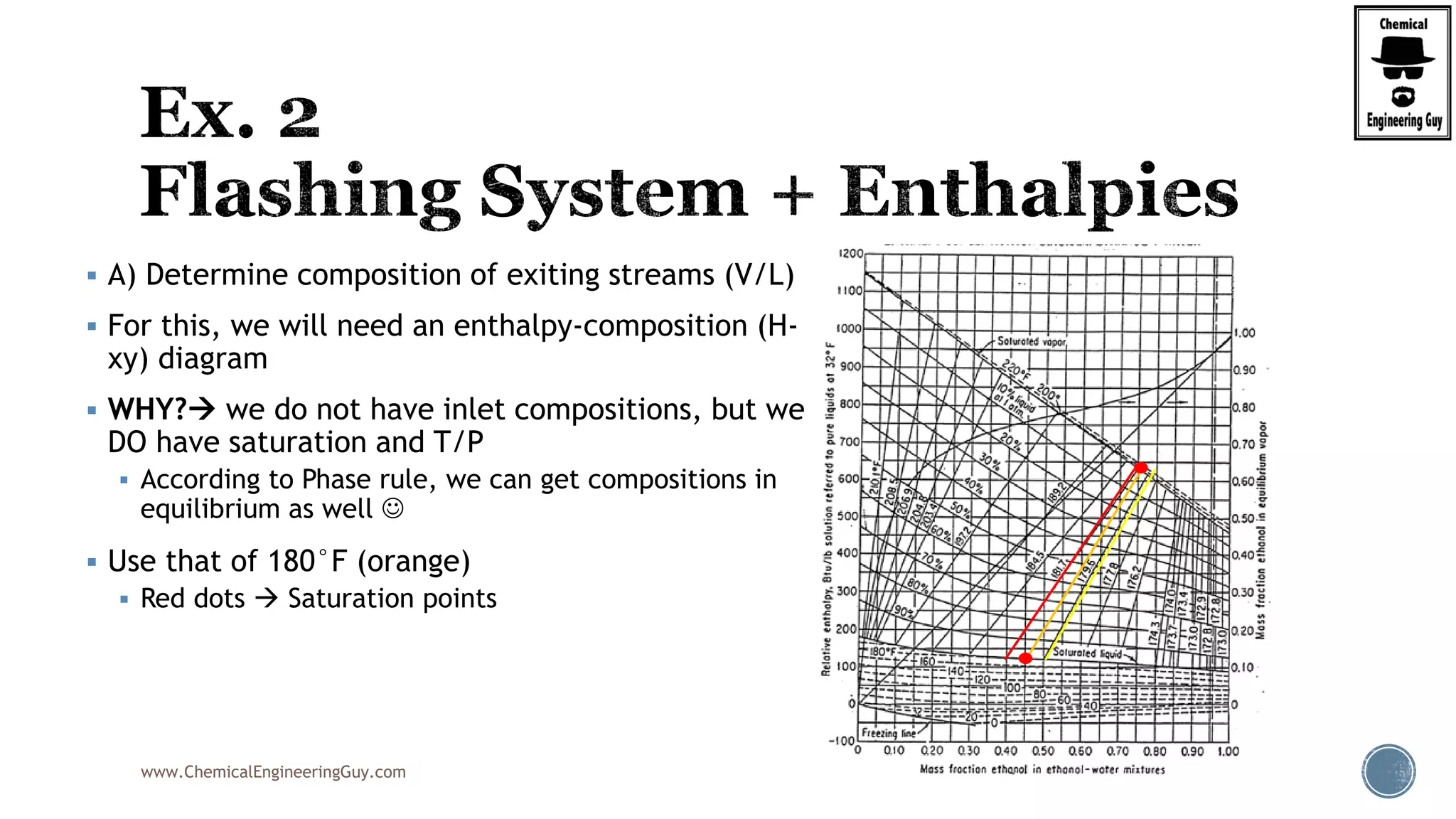
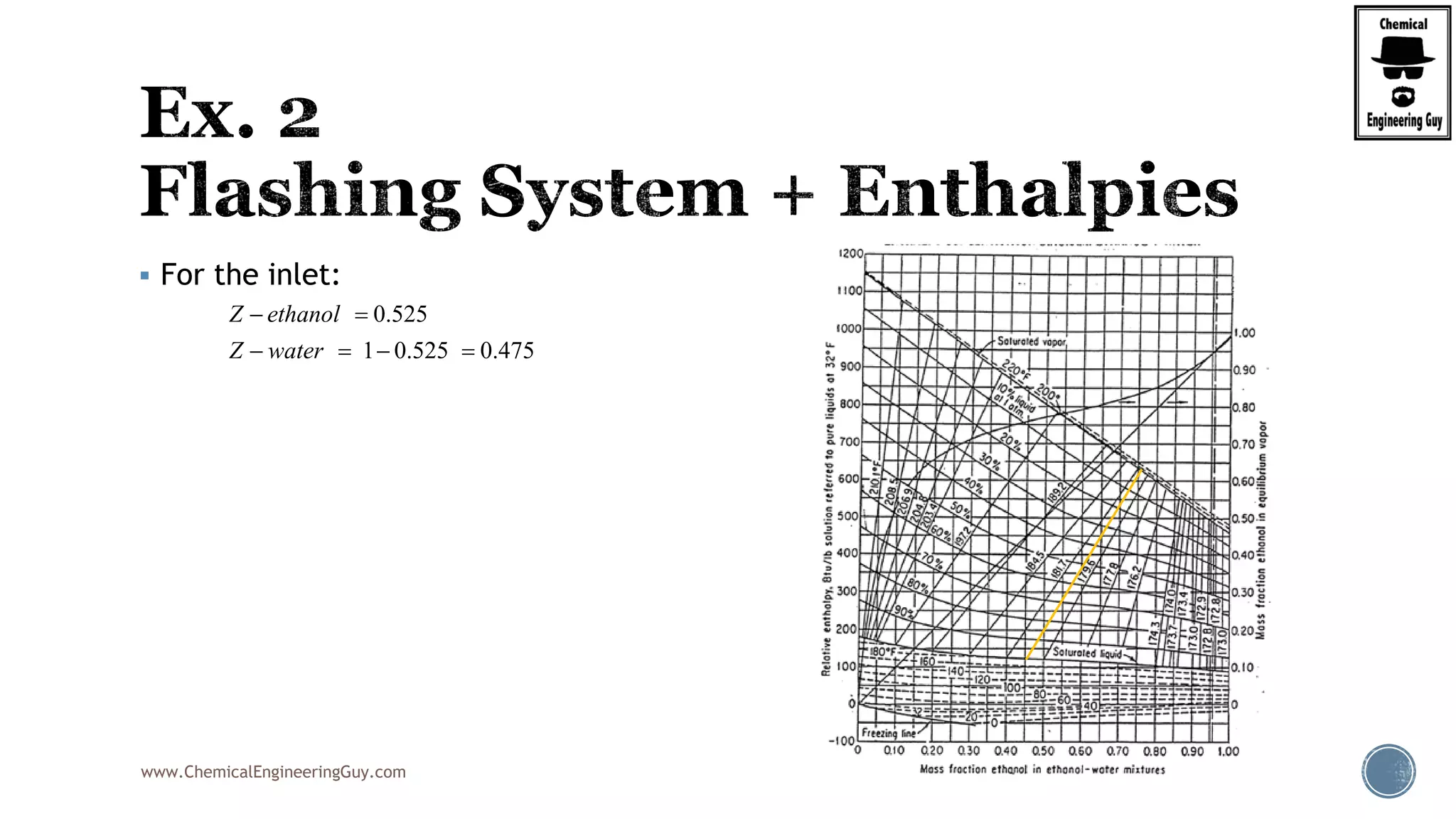
 A) Determine composition of exiting streams (V/L)
 For this, we will need an enthalpy-composition (H-
xy) diagram
 WHY? we do not have inlet compositions, but we
DO have saturation and T/P
 According to Phase rule, we can get compositions in
equilibrium as well 
 Use that of 180°F (orange)
 Red dots  Saturation points
www.ChemicalEngineeringGuy.com
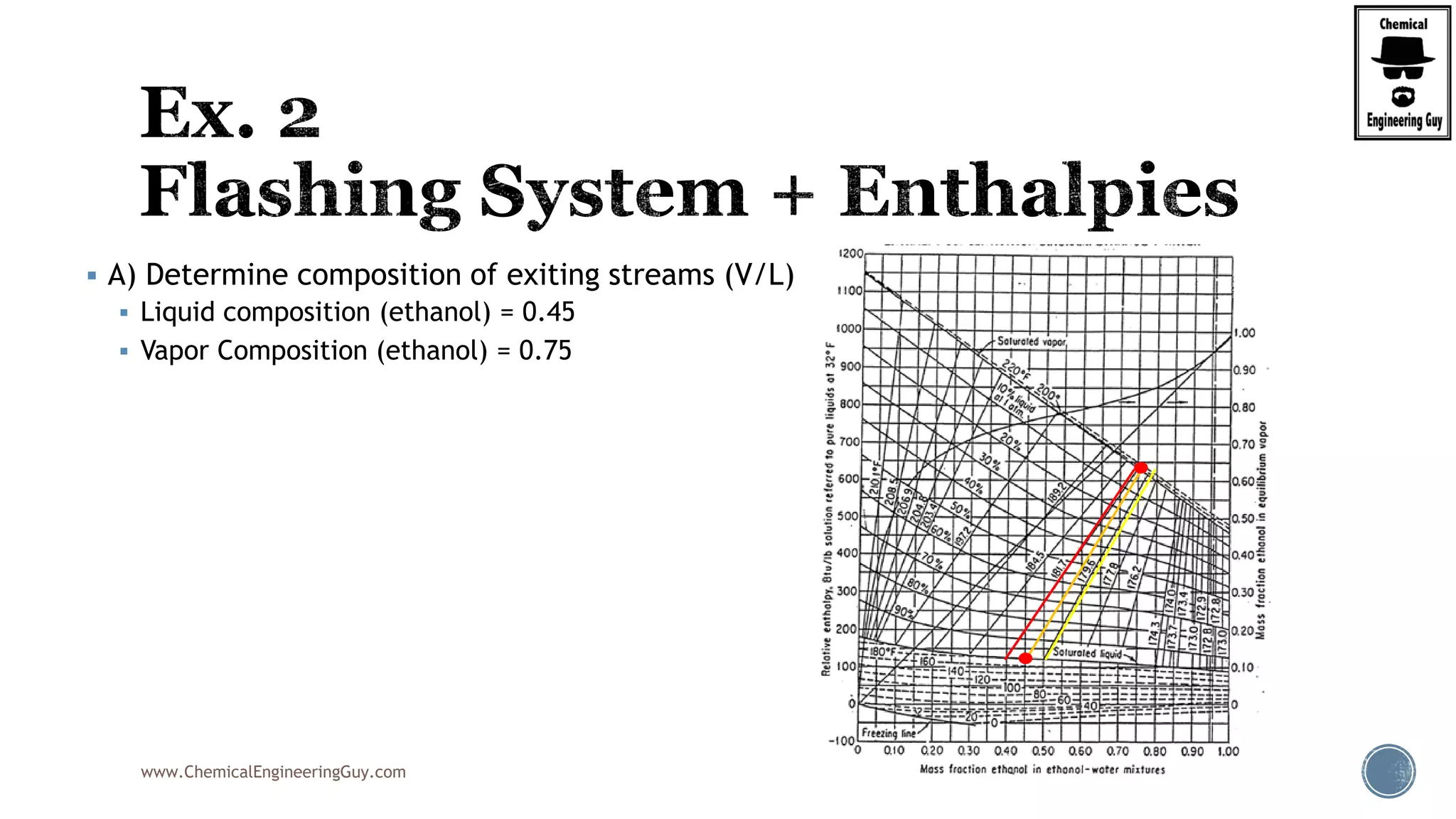
 A) Determine composition of exiting streams (V/L)
 Liquid composition (ethanol) = 0.45
 Vapor Composition (ethanol) = 0.75
www.ChemicalEngineeringGuy.com
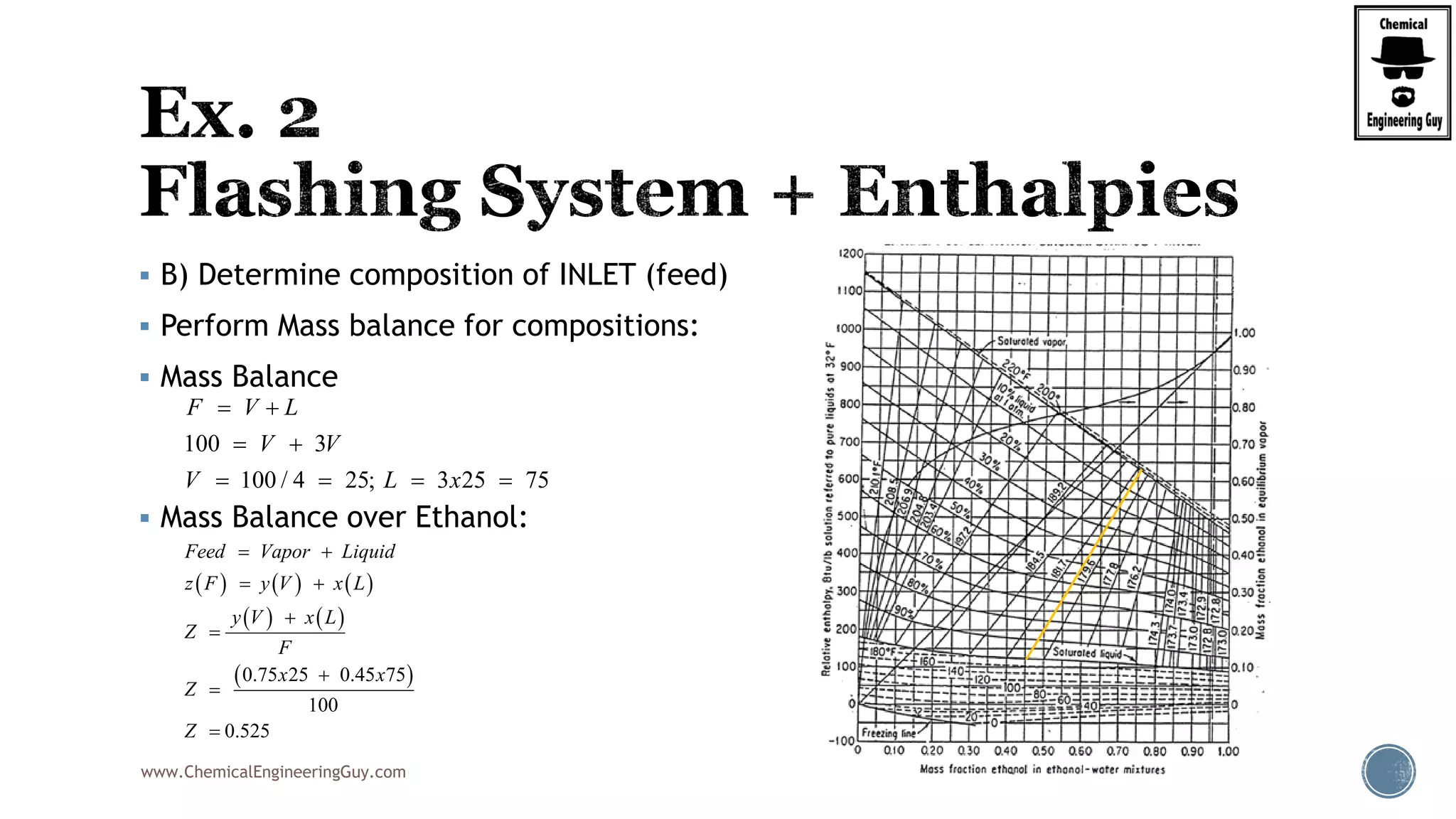
 B) Determine composition of INLET (feed)
 Perform Mass balance for compositions:
 Mass Balance
 Mass Balance over Ethanol:
100 3
100 / 4 25; 3 25 75
F V L
V V
V L x
 
 
   
     
   
 0.75 25 0.45 75
100
0.525
Feed Vapor Liquid
z F y V x L
y V x L
Z
F
x x
Z
Z
 
 





www.ChemicalEngineeringGuy.com
 For the inlet:
0.525
1 0.525 0.475
Z ethanol
Z water
 
   
www.ChemicalEngineeringGuy.com
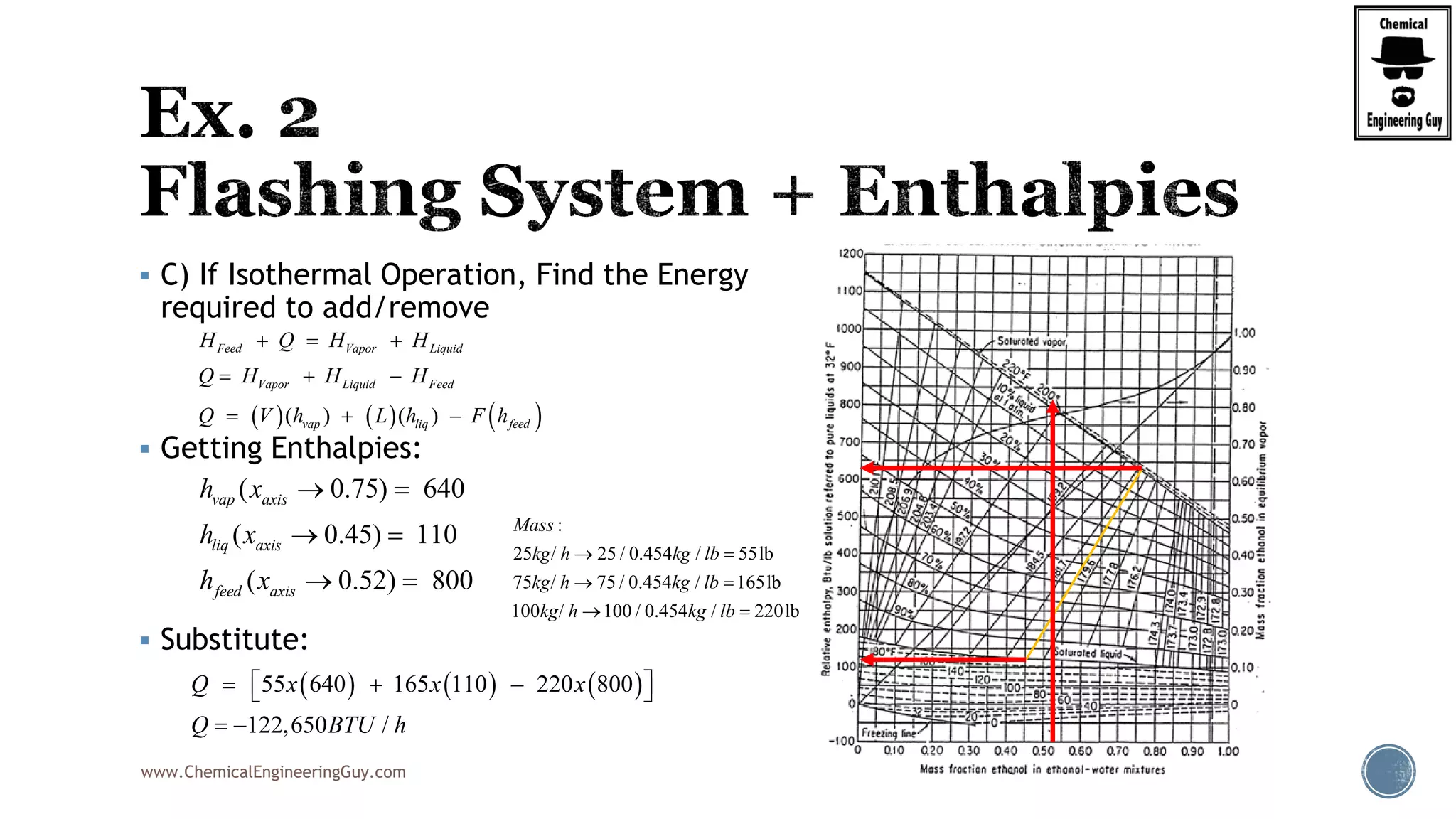
 C) If Isothermal Operation, Find the Energy
required to add/remove
 Getting Enthalpies:
 Substitute:
     ( ) –( )
Feed Vapor Liquid
Vapor Liquid Feed
vap liq feed
H Q H H
Q H H H
Q V h L h F h
  
  
 
0.75 640
0
( )
( ).45 110
( 0.52 800)
vap axis
liq axis
feed axis
h x
h x
h x
 
 
 
     55 640 165 110 – 220 800
122,650 /Q
Q x x x
BTU h
  



:
25 / 25 / 0.454 / 55lb
75 / 75 / 0.454 / 165lb
100 / 100 / 0.454 / 220lb
Mass
kg h kg lb
kg h kg lb
kg h kg lb
 
 
 
www.ChemicalEngineeringGuy.com
 Final notes…
 What will be the inlet temperature? Is it the
same as the outlet?
 NO  WHY?
 This is not adiabatic, i.e. Q=/0, therefore there
was a temperature change…
 Between:
 200°F
 Let it be approx. 200F  92°C
Do you need the Full Version?
Contact me if needed!
Contact@ChemicalEngineeringGuy.com
https://courses.chemicalengineeringguy.com/courses
You can also check out more content here:
My Youtube Channel 
My Fan Page 
The LinkedIn
My website:
www.ChemicalEngineeringGuy.com
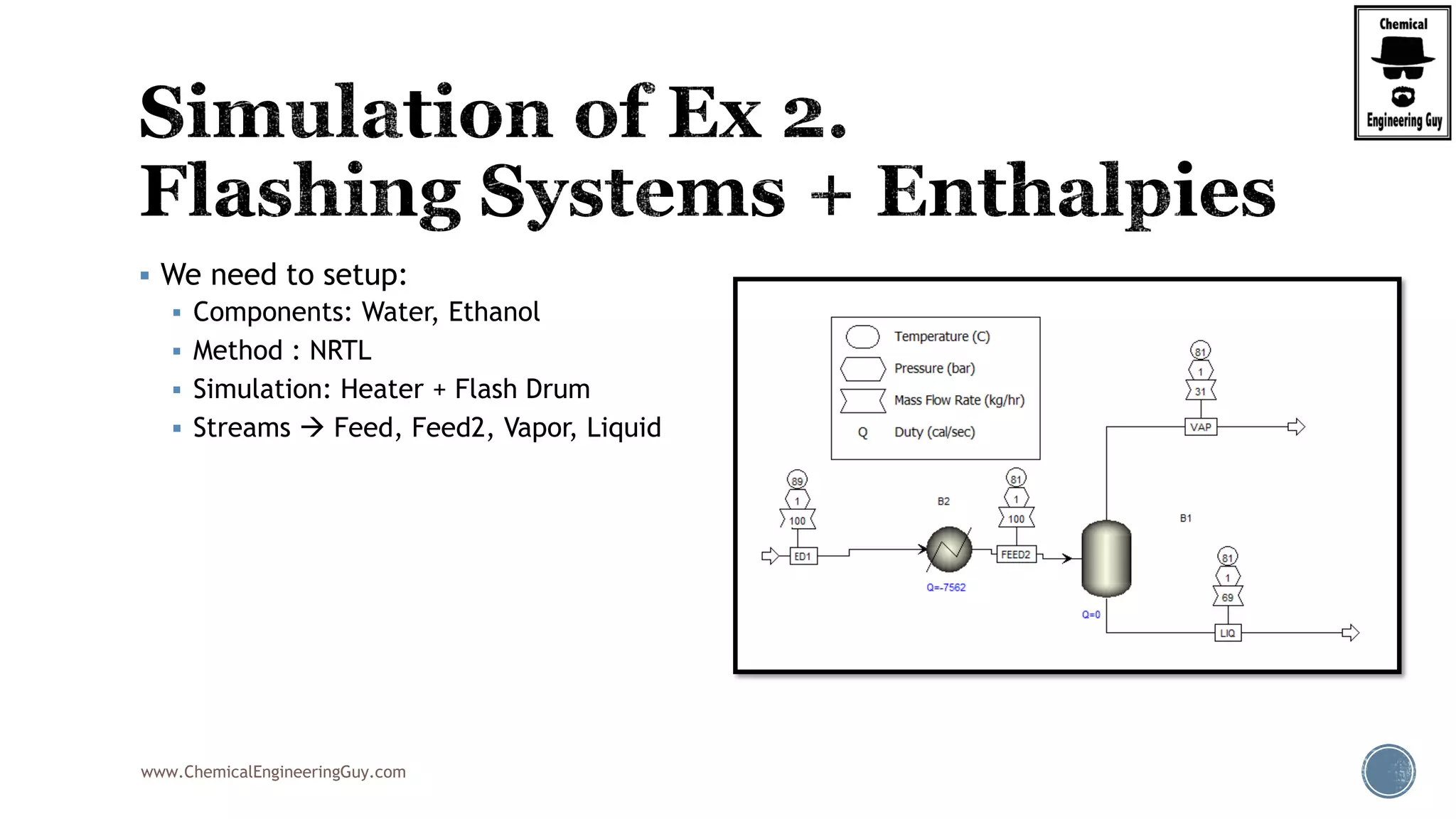
 We need to setup:
 Components: Water, Ethanol
 Method : NRTL
 Simulation: Heater + Flash Drum
 Streams  Feed, Feed2, Vapor, Liquid
www.ChemicalEngineeringGuy.com
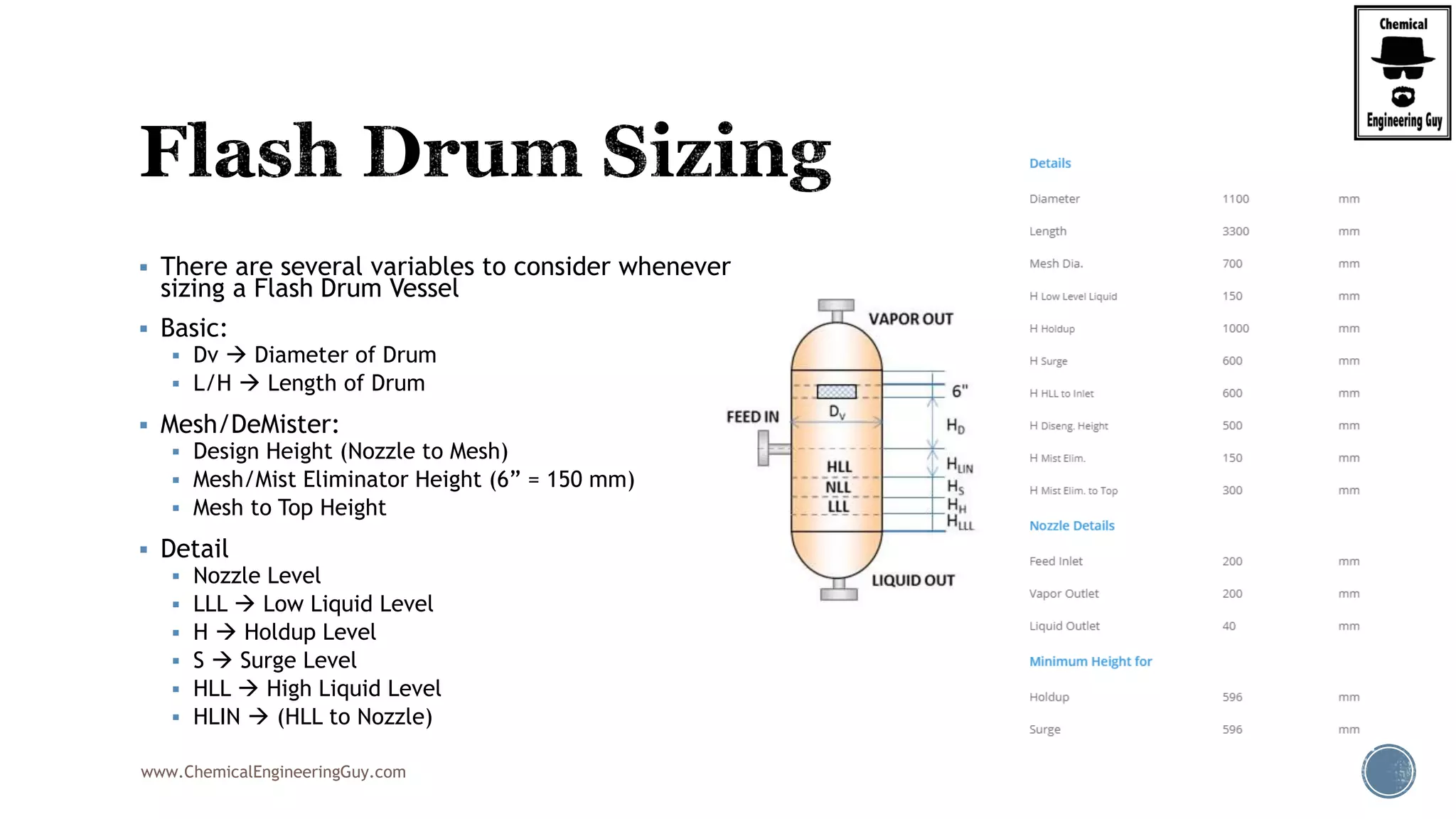
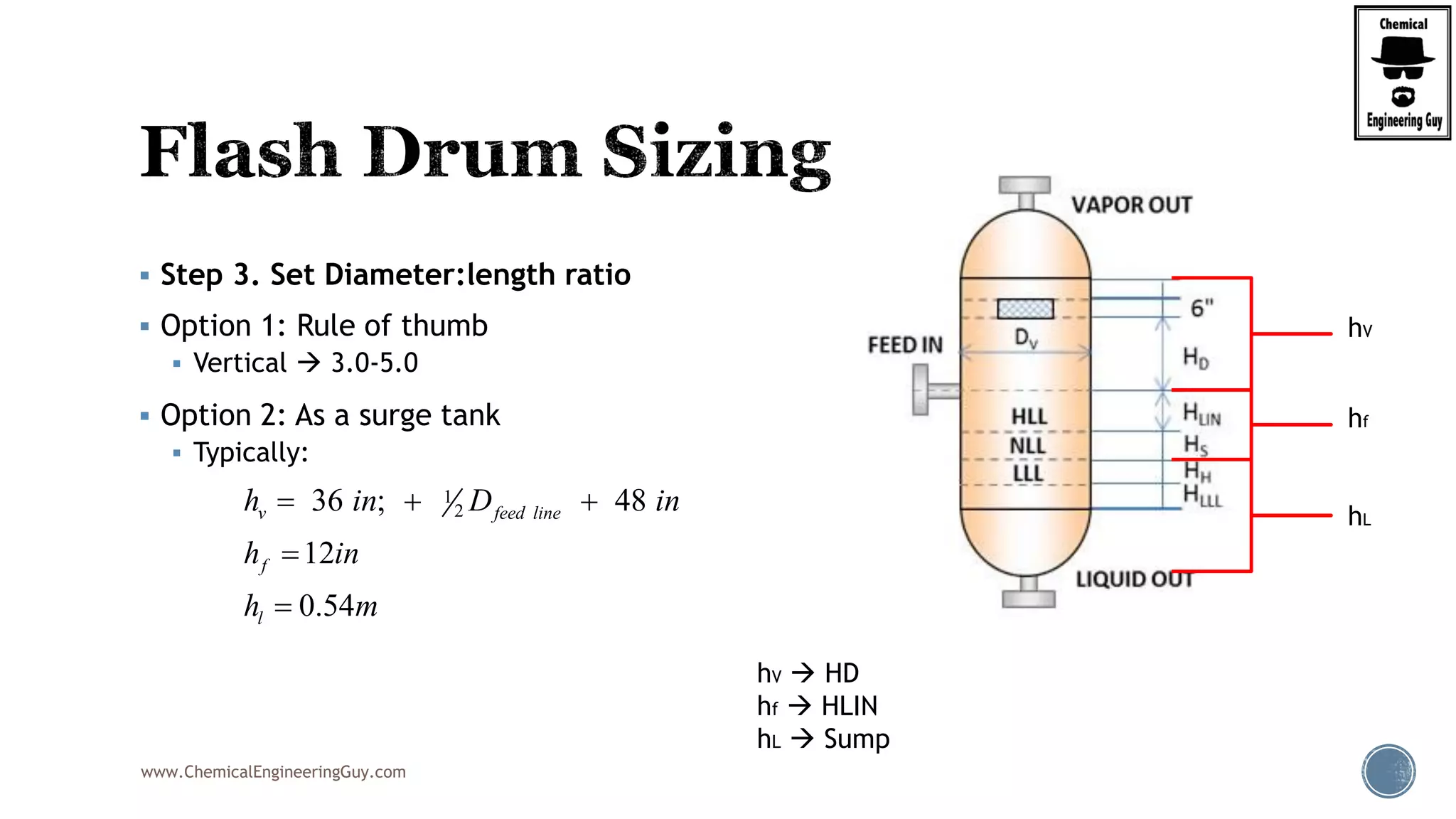
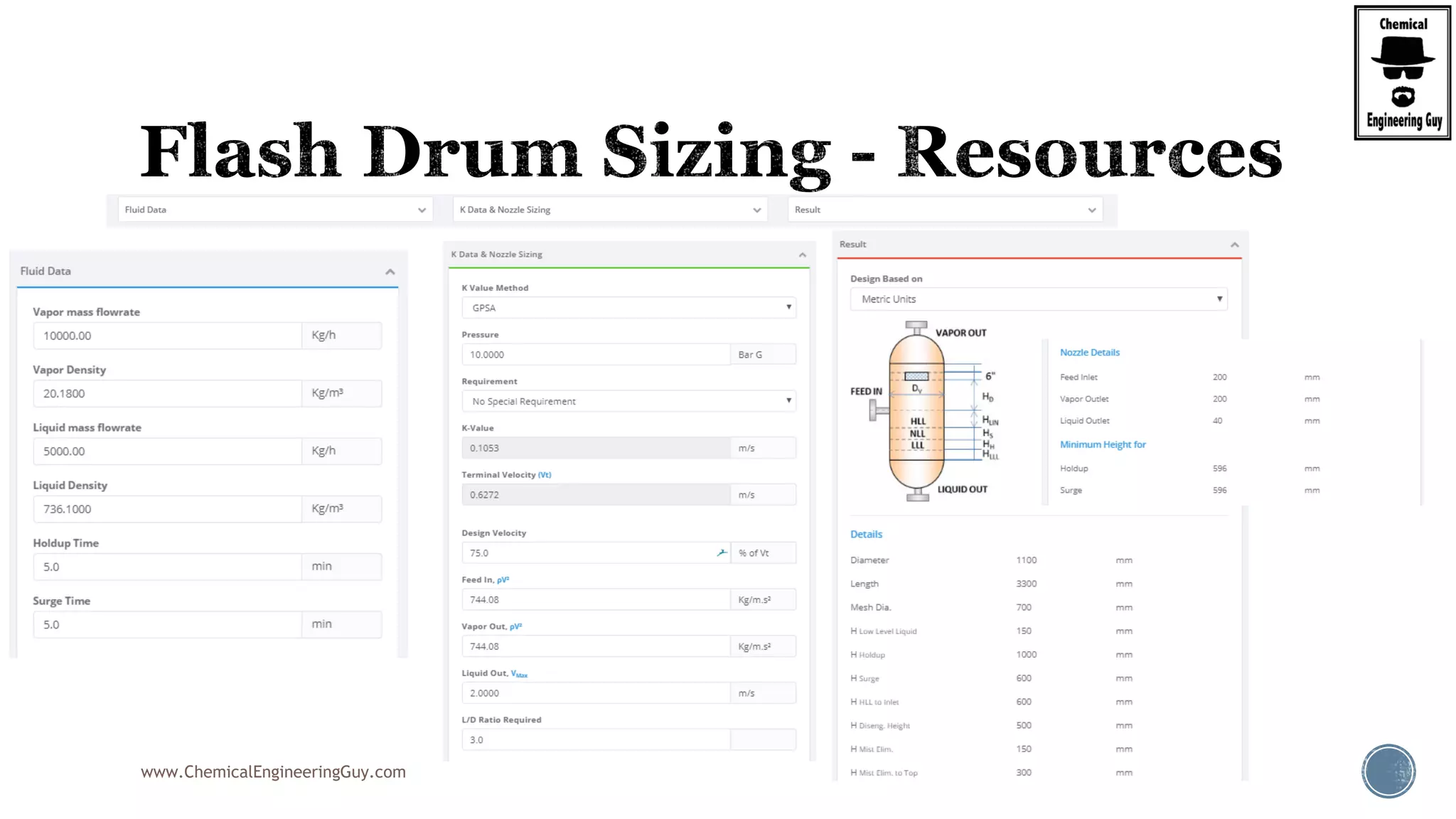
 There are several variables to consider whenever
sizing a Flash Drum Vessel
 Basic:
 Dv  Diameter of Drum
 L/H  Length of Drum
 Mesh/DeMister:
 Design Height (Nozzle to Mesh)
 Mesh/Mist Eliminator Height (6” = 150 mm)
 Mesh to Top Height
 Detail
 Nozzle Level
 LLL  Low Liquid Level
 H  Holdup Level
 S  Surge Level
 HLL  High Liquid Level
 HLIN  (HLL to Nozzle)
www.ChemicalEngineeringGuy.com
 There are several variables to consider whenever
sizing a Flash Drum Vessel
 Basic:
 ID  Diameter of Drum
 L  Length of Drum
 Mesh/DeMister:
 Hv
 Detail
 LLL  Low Liquid Level
 NLL  Normal Liquid Level
 HLL  High Liquid Level
Do you need the Full Version?
Contact me if needed!
Contact@ChemicalEngineeringGuy.com
https://courses.chemicalengineeringguy.com/courses
You can also check out more content here:
My Youtube Channel 
My Fan Page 
The LinkedIn
My website:
www.ChemicalEngineeringGuy.com
 Once vapor, liquid composition and flow rates have been determined…
 We can set the Size now!
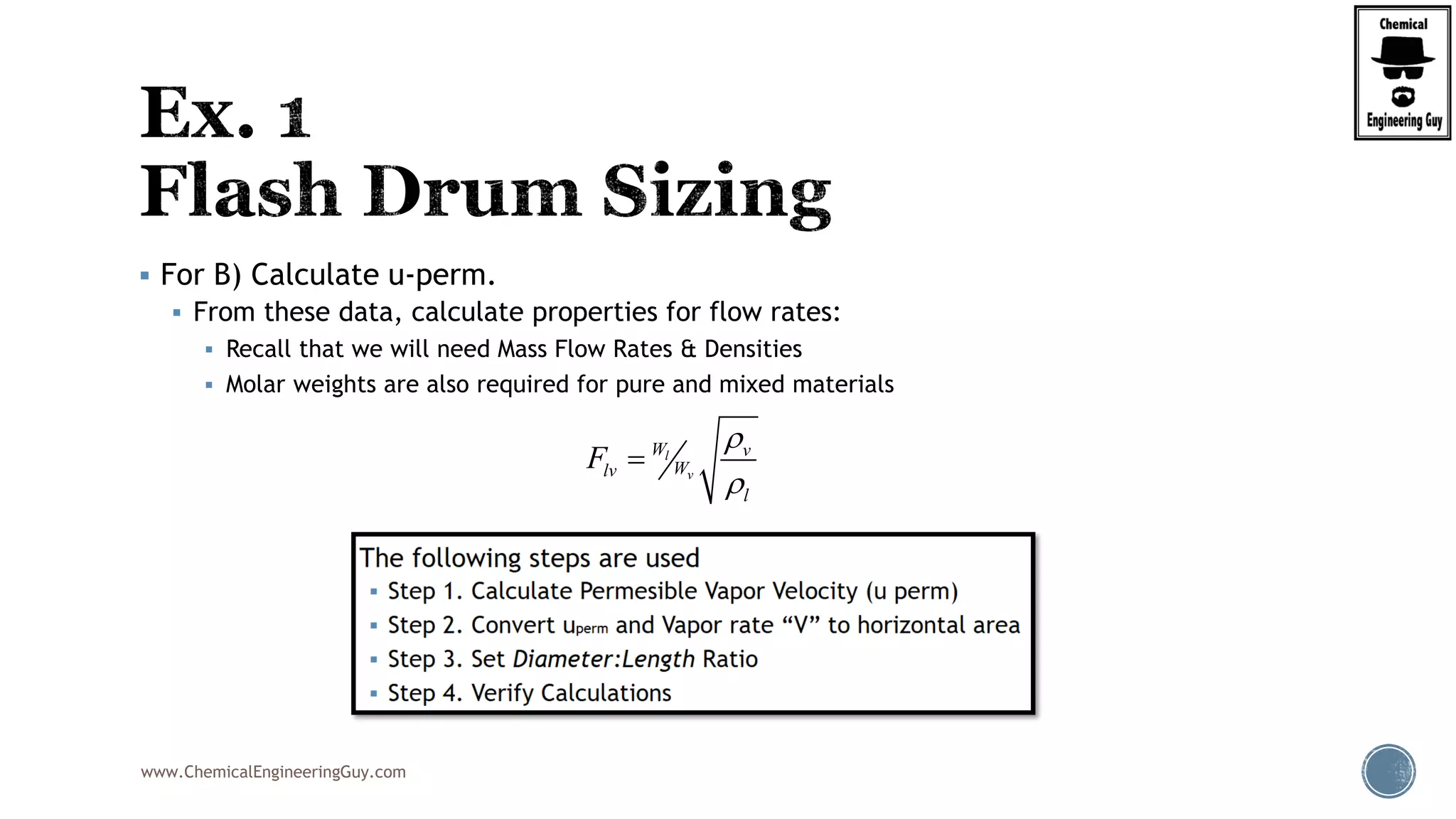
 The following steps are used
 Step 1. Calculate Permesible Vapor Velocity (u perm)
 Step 2. Convert uperm and Vapor rate “V” to horizontal area
 Step 3. Set Diameter:Length Ratio
 Step 4. Verify Calculations
www.ChemicalEngineeringGuy.com
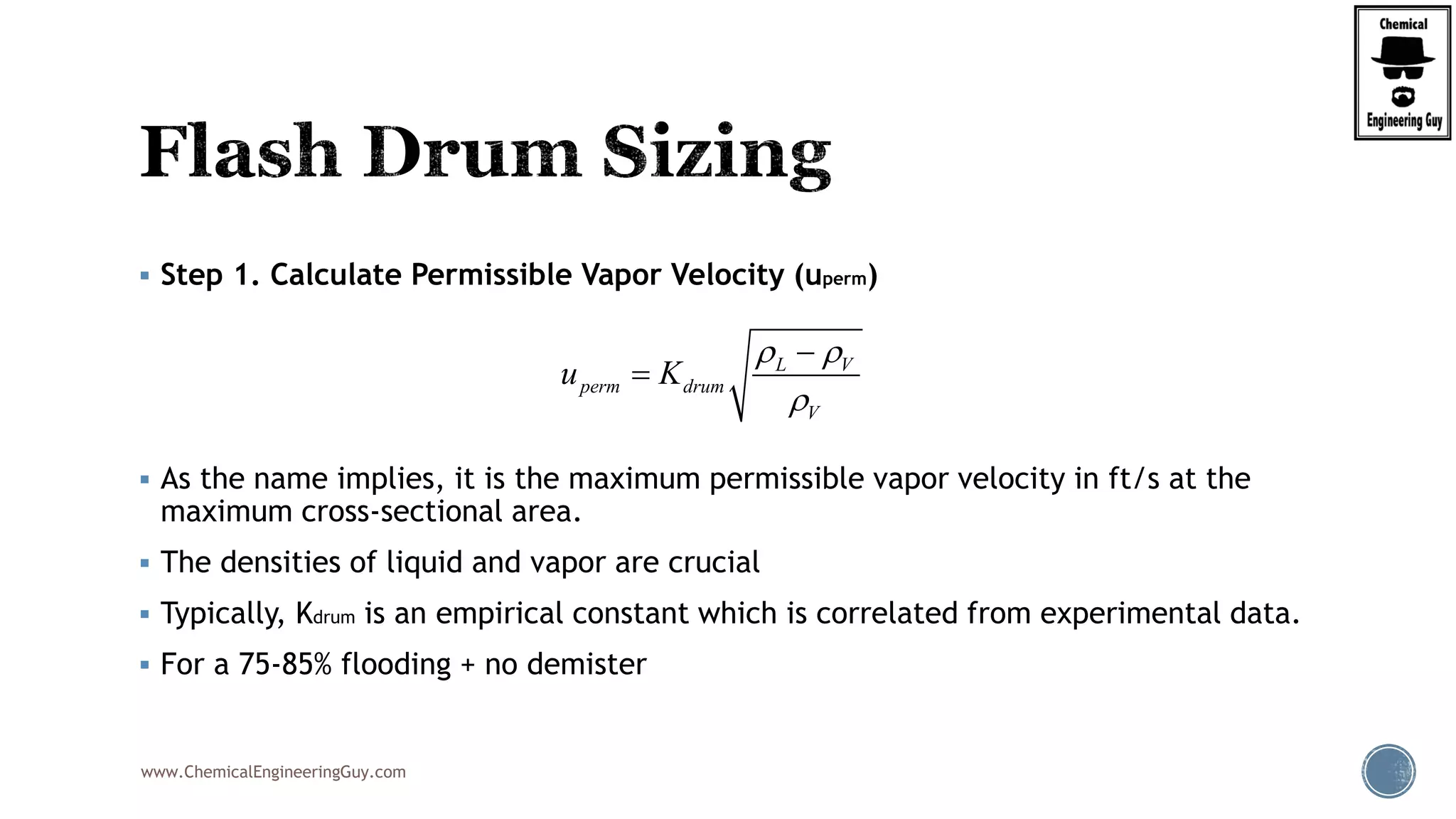
 Step 1. Calculate Permissible Vapor Velocity (uperm)
 As the name implies, it is the maximum permissible vapor velocity in ft/s at the
maximum cross-sectional area.
 The densities of liquid and vapor are crucial
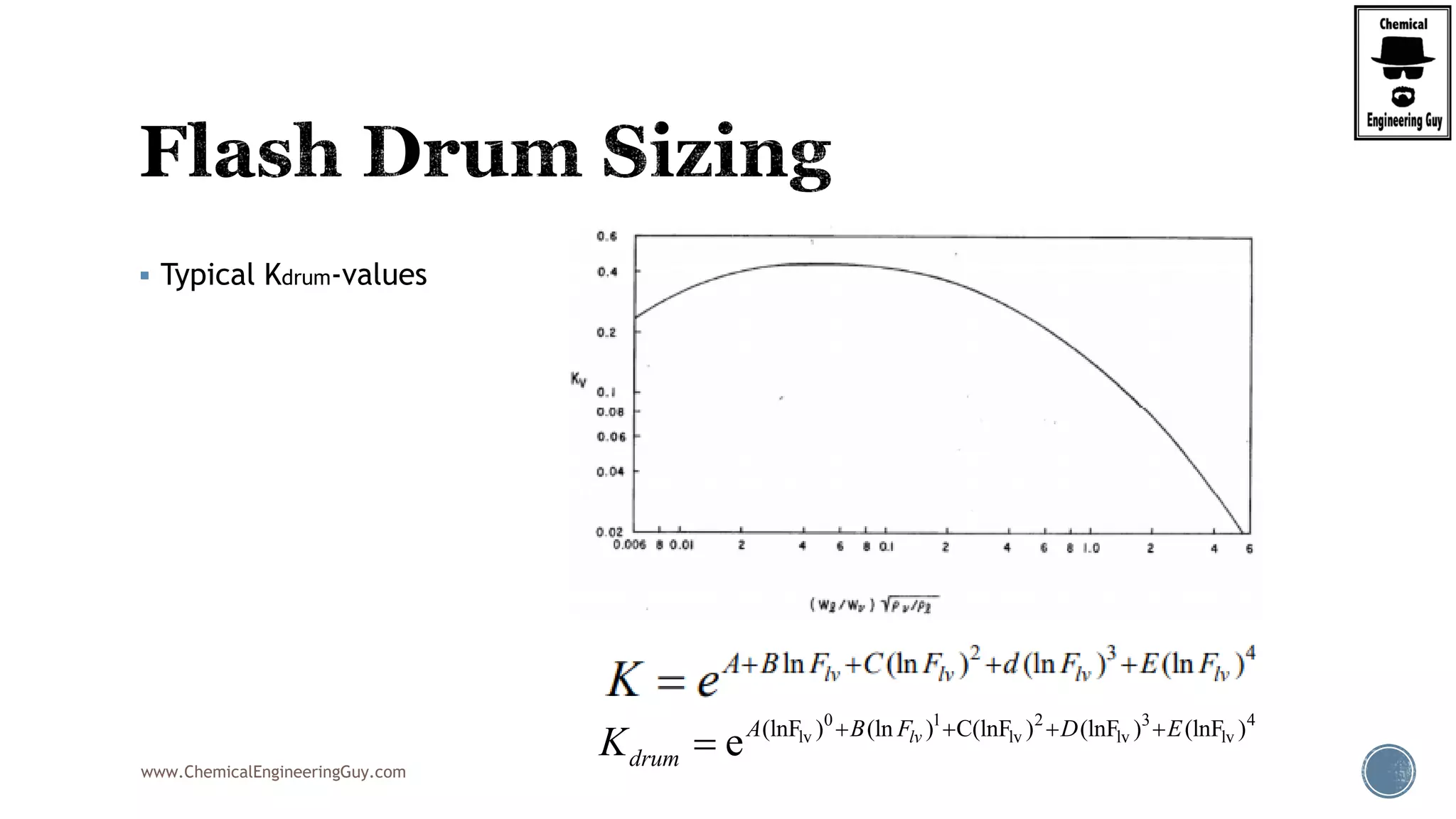
 Typically, Kdrum is an empirical constant which is correlated from experimental data.
 For a 75-85% flooding + no demister
L V
perm drum
V
u K
 



www.ChemicalEngineeringGuy.com
 Demister Notes:
 No use of demister
 Approx. 5% of liquid will be entrained in the vapor
 Use of demister
 Approx- 1% of liquid
 Typical sizing depens on manufacturer
 Generally, assume 6 in or 150 mm
Do you need the Full Version?
Contact me if needed!
Contact@ChemicalEngineeringGuy.com
https://courses.chemicalengineeringguy.com/courses
You can also check out more content here:
My Youtube Channel 
My Fan Page 
The LinkedIn
My website:
www.ChemicalEngineeringGuy.com
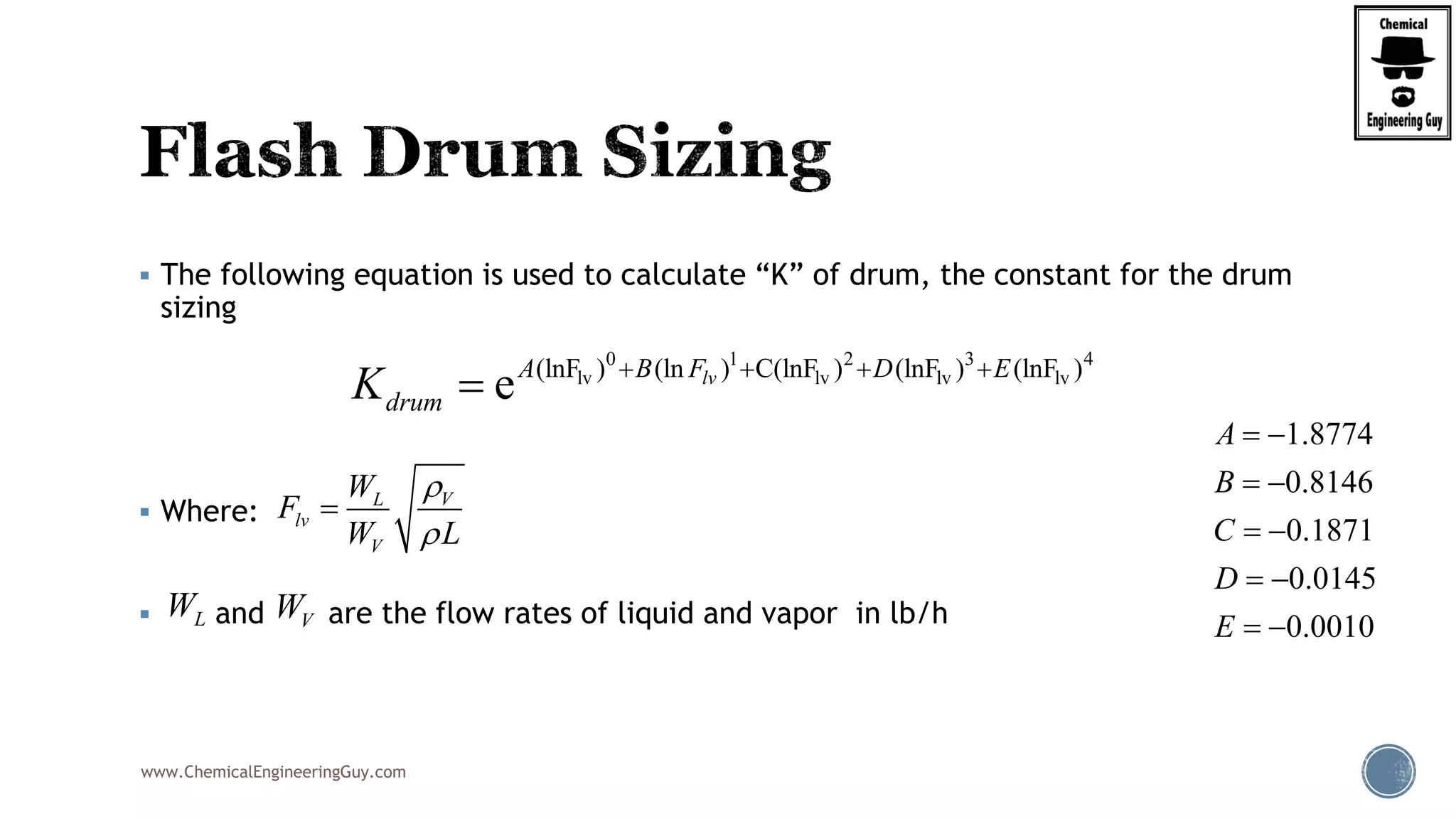
 The following equation is used to calculate “K” of drum, the constant for the drum
sizing
 Where:
 and are the flow rates of liquid and vapor in lb/h
0 1 2 3 4
lv lv lv lv(lnF ) (ln ) C(lnF ) (lnF ) (lnF )
e lvA B F D E
drumK    

VL
lv
V
W
F
W L



1.8774
0.8146
0.1871
0.0145
0.0010
A
B
C
D
E
 
 
 
 
 LW VW
www.ChemicalEngineeringGuy.com
 Typical Kdrum-values
0 1 2 3 4
lv lv lv lv(lnF ) (ln ) C(lnF ) (lnF ) (lnF )
e lvA B F D E
drumK    

www.ChemicalEngineeringGuy.com
 Step 2. Convert uperm and Vapor Rate V to horizontal area:
 Solving for Cross-Sectional Area (Ac)
   2
3
3600
1
( / )
perm c V
vapor
s lbmftu A ft
s h ft
V lbmol h
lbm
MW
lbmol

  
   
   
( )
3600
v
c
perm V
V MW
A
u 

Do you need the Full Version?
Contact me if needed!
Contact@ChemicalEngineeringGuy.com
https://courses.chemicalengineeringguy.com/courses
You can also check out more content here:
My Youtube Channel 
My Fan Page 
The LinkedIn
My website:
www.ChemicalEngineeringGuy.com
 Step 3. Set Diameter:length ratio
 Option 1: Rule of thumb
 Vertical  3.0-5.0
 Option 2: As a surge tank
 Typically:
1
236 ; 48
12
0.54
v feed line
f
l
h in D in
h in
h m
  


hV  HD
hf  HLIN
hL  Sump
hV
hf
hL
www.ChemicalEngineeringGuy.com
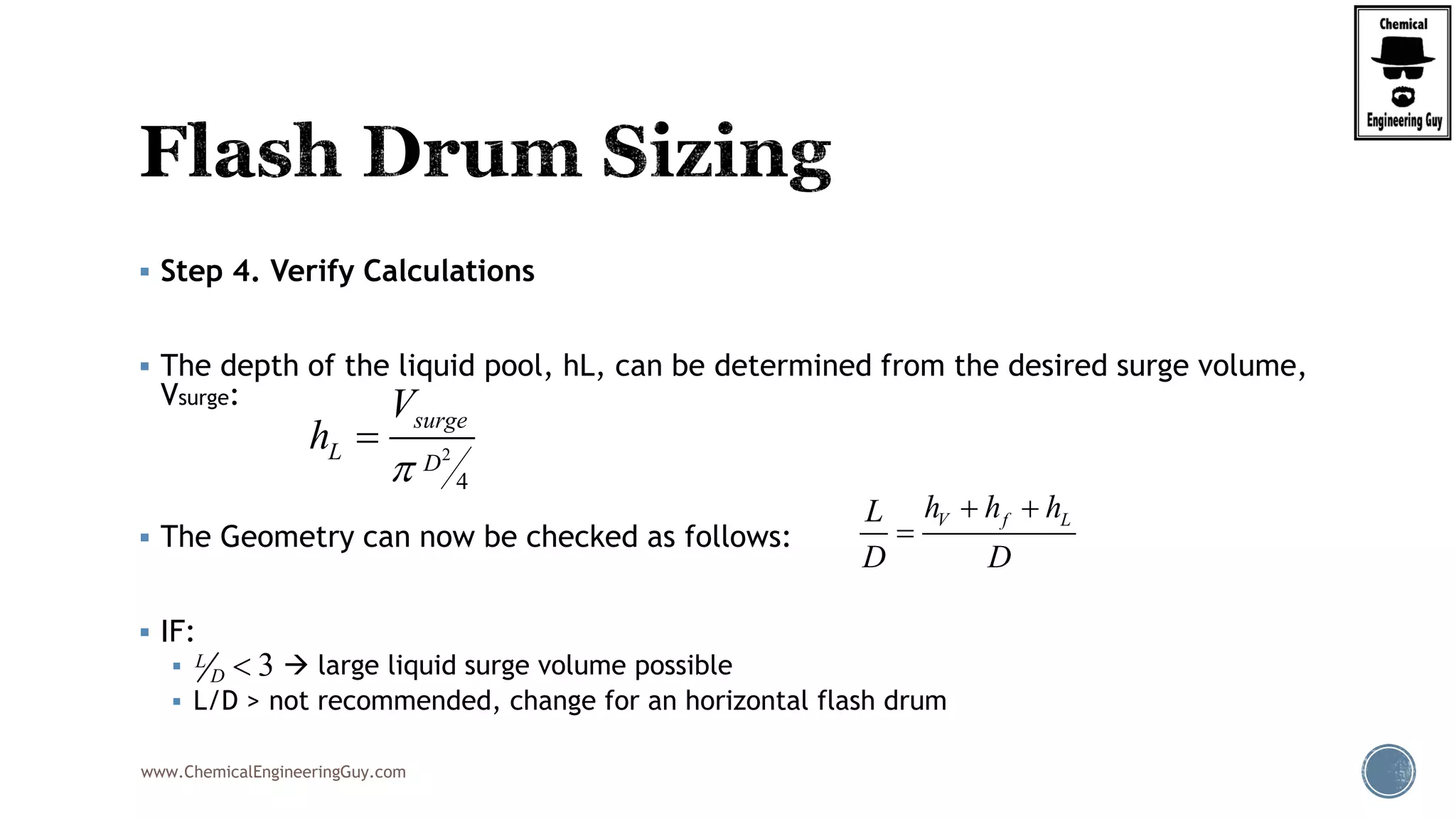
 Step 4. Verify Calculations
 The depth of the liquid pool, hL, can be determined from the desired surge volume,
Vsurge:
 The Geometry can now be checked as follows:
 IF:
  large liquid surge volume possible
 L/D > not recommended, change for an horizontal flash drum
2
4
surge
L D
V
h


V f Lh h hL
D D
 

3L
D 
www.ChemicalEngineeringGuy.com
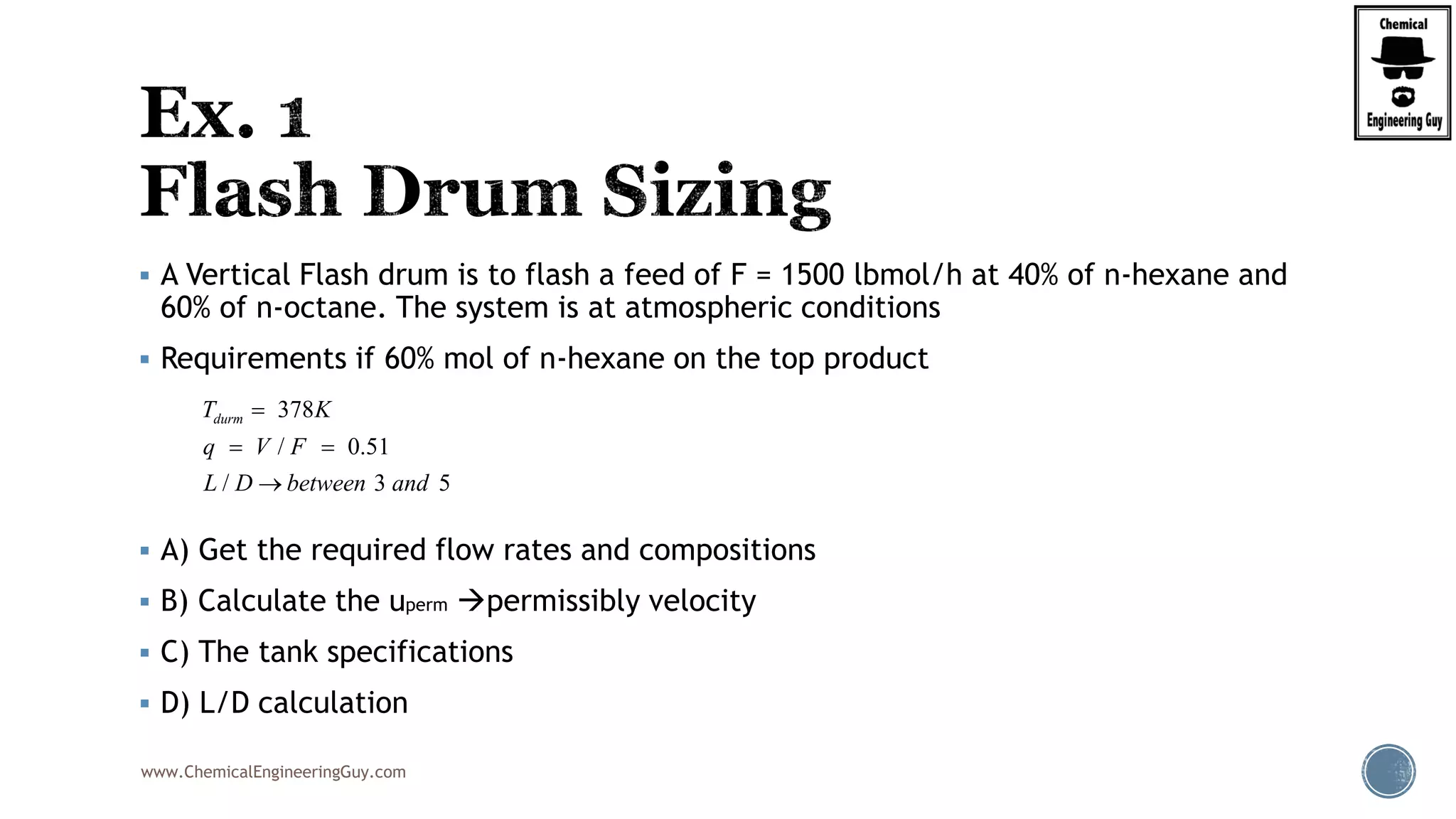
 A Vertical Flash drum is to flash a feed of F = 1500 lbmol/h at 40% of n-hexane and
60% of n-octane. The system is at atmospheric conditions
 Requirements if 60% mol of n-hexane on the top product
 A) Get the required flow rates and compositions
 B) Calculate the uperm permissibly velocity
 C) The tank specifications
 D) L/D calculation
378
/ 0.51
/ 3 5
durmT K
q V F
L D between and

 

www.ChemicalEngineeringGuy.com
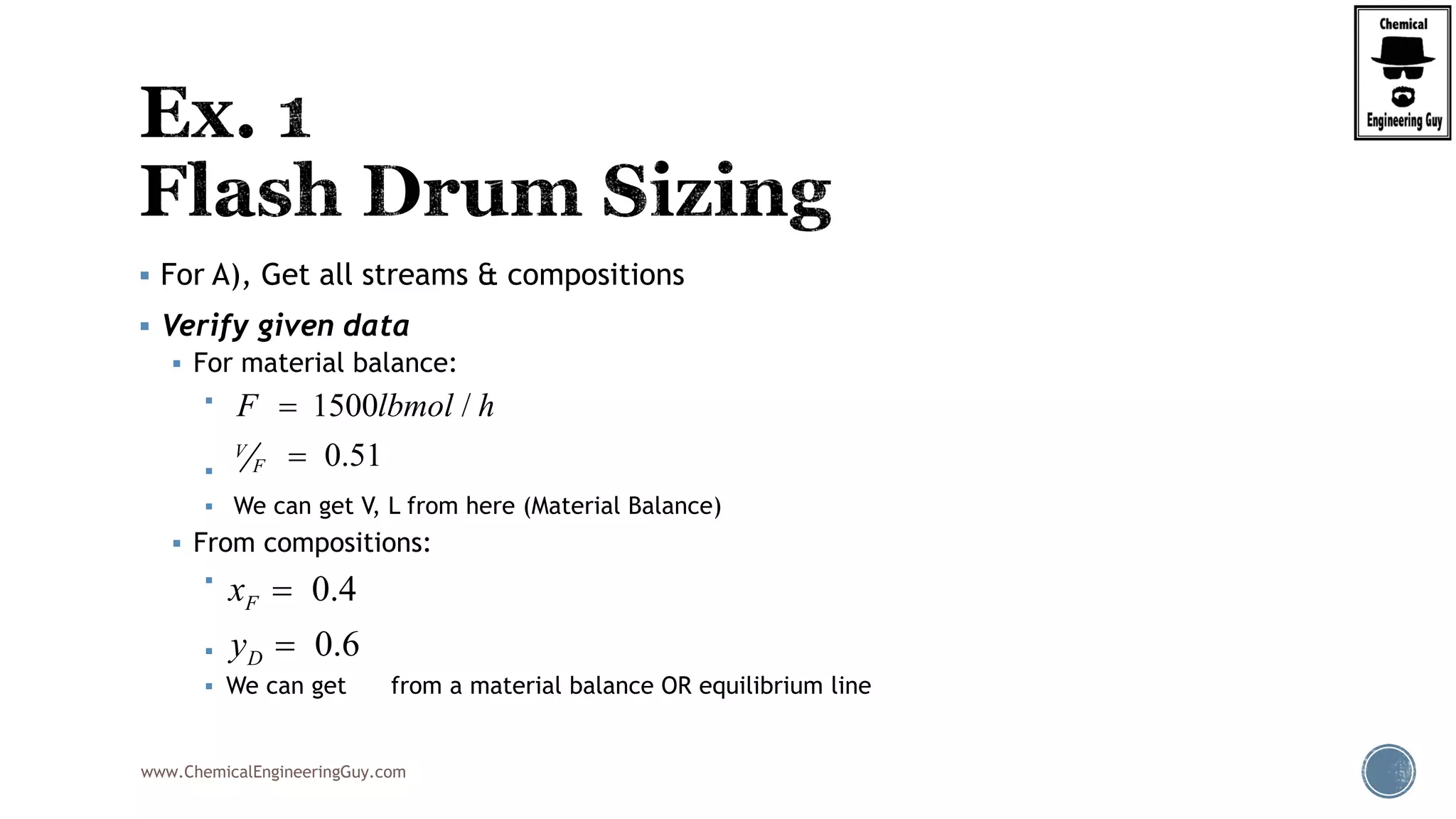
 For A), Get all streams & compositions
 Verify given data
 For material balance:


 We can get V, L from here (Material Balance)
 From compositions:


 We can get from a material balance OR equilibrium line
1500 /
0.51V
F
F lbmol h

0.4
0.6
F
D
x
y


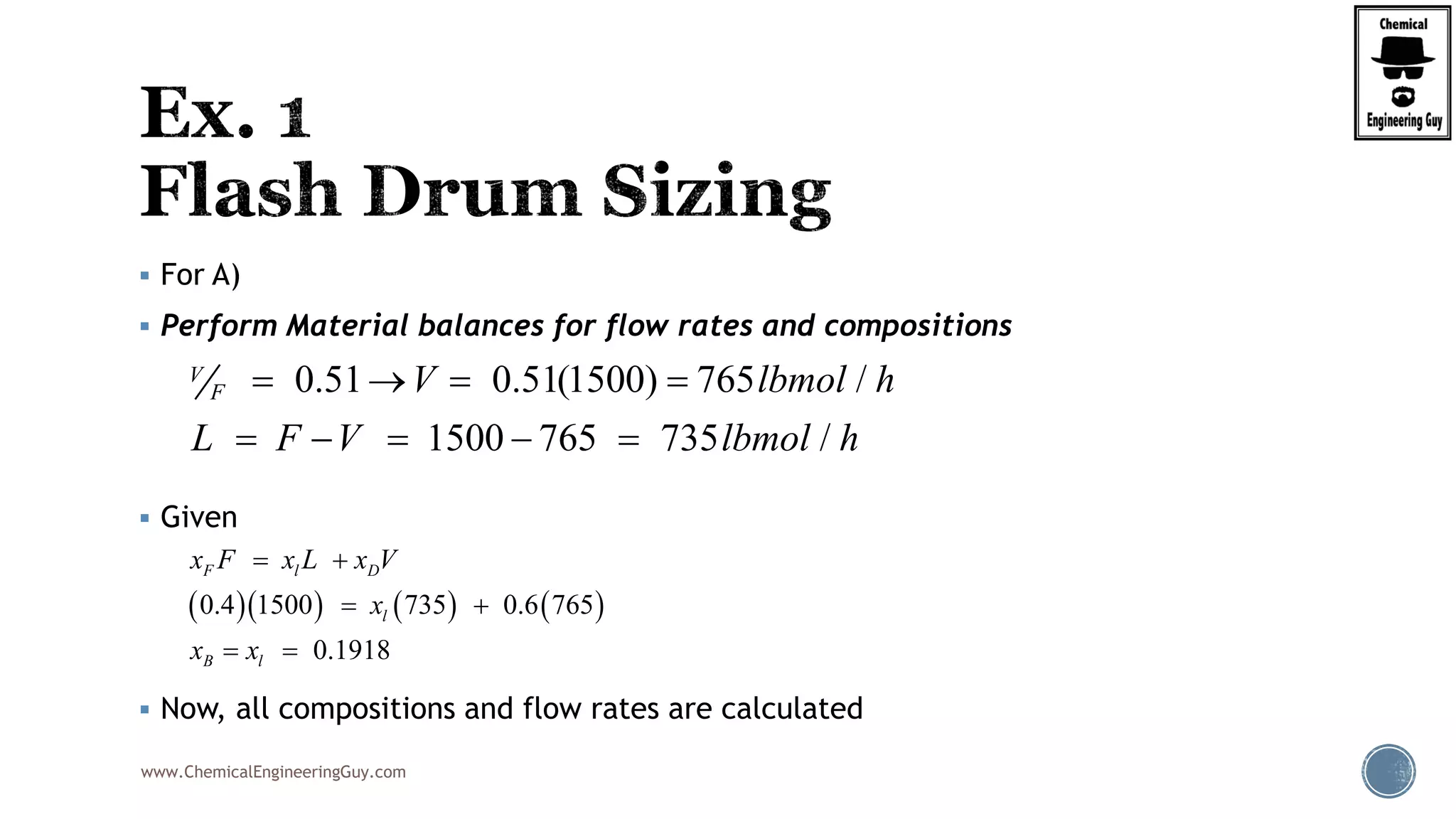
www.ChemicalEngineeringGuy.com
 For A)
 Perform Material balances for flow rates and compositions
 Given
 Now, all compositions and flow rates are calculated
0.51 0.51(1500) 765 /
1500 765 735 /
V
F V lbmol h
L F V lbmol h
   
    
      0.4 1500 735 0.6 765
0.1918
F l D
l
B l
x F x L x V
x
x x
 
 
 
www.ChemicalEngineeringGuy.com
 For B) Calculate u-perm.
 From these data, calculate properties for flow rates:
 Recall that we will need Mass Flow Rates & Densities
 Molar weights are also required for pure and mixed materials
l
v
W v
Wlv
l
F



www.ChemicalEngineeringGuy.com
 For the LIQUID:
 Molar Weight for Liquid:
 Density of the liquid
     
6 6 8 8
0.19 86 0.81 114
108.9
liq c c c c
liq
liq
MW x MW x MW
MW
MW
 
 

6 6 8 8
(0.19)(0.659) (0.81)(0.703) /
0.696
mix C C C C
mix
g
mLmix
x x
g mL
  


 
 

Do you need the Full Version?
Contact me if needed!
Contact@ChemicalEngineeringGuy.com
https://courses.chemicalengineeringguy.com/courses
You can also check out more content here:
My Youtube Channel 
My Fan Page 
The LinkedIn
My website:
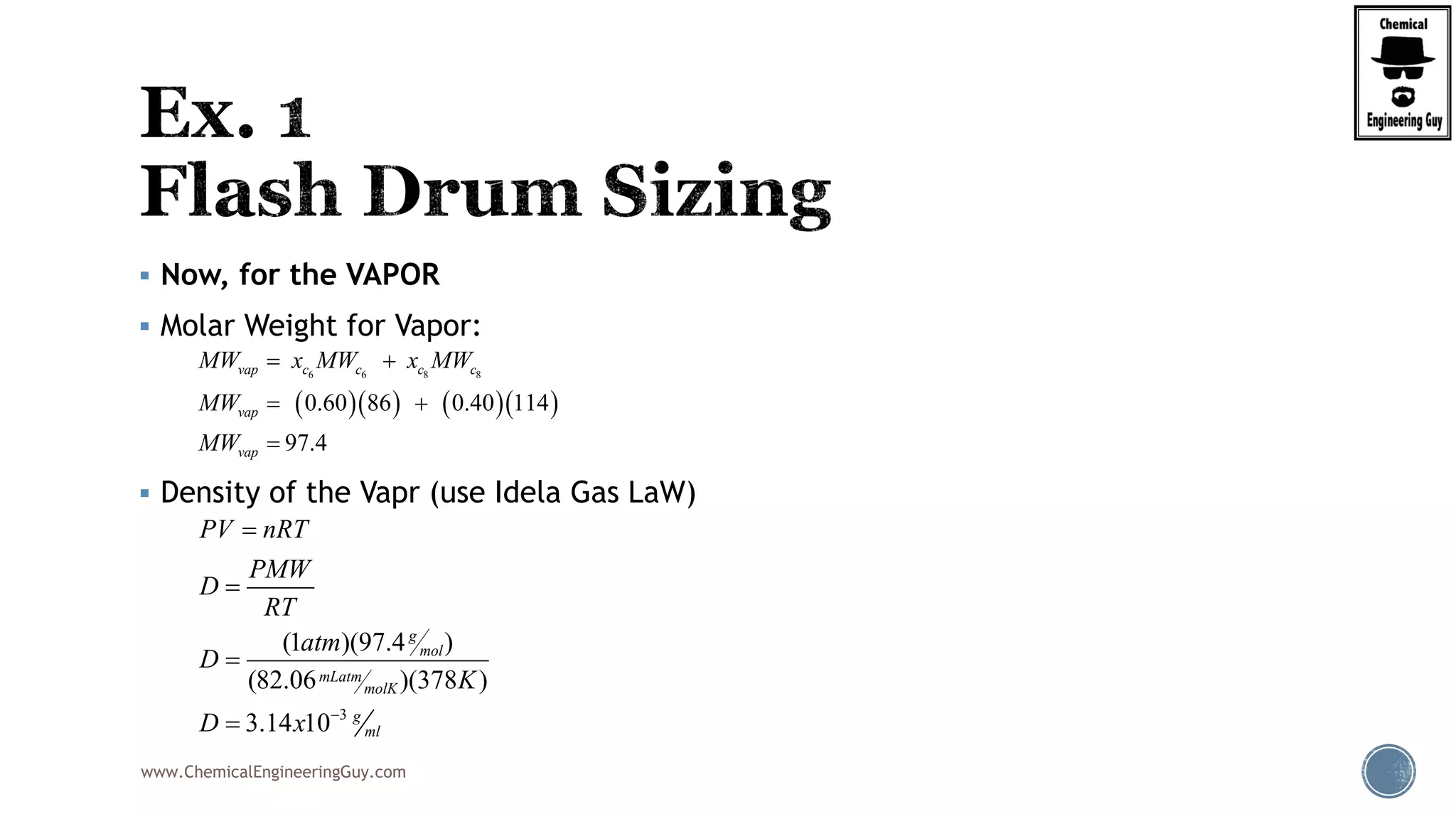
www.ChemicalEngineeringGuy.com
 Now, for the VAPOR
 Molar Weight for Vapor:
 Density of the Vapr (use Idela Gas LaW)
     
6 6 8 8
0.60 86 0.40 114
97.4
vap c c c c
vap
vap
MW x MW x MW
MW
MW
 
 

3
(1 )(97.4 )
(82.06 )(378 )
3.14 10
g
mol
mLatm
molK
g
ml
PV nRT
PMW
D
RT
atm
D
K
D x 




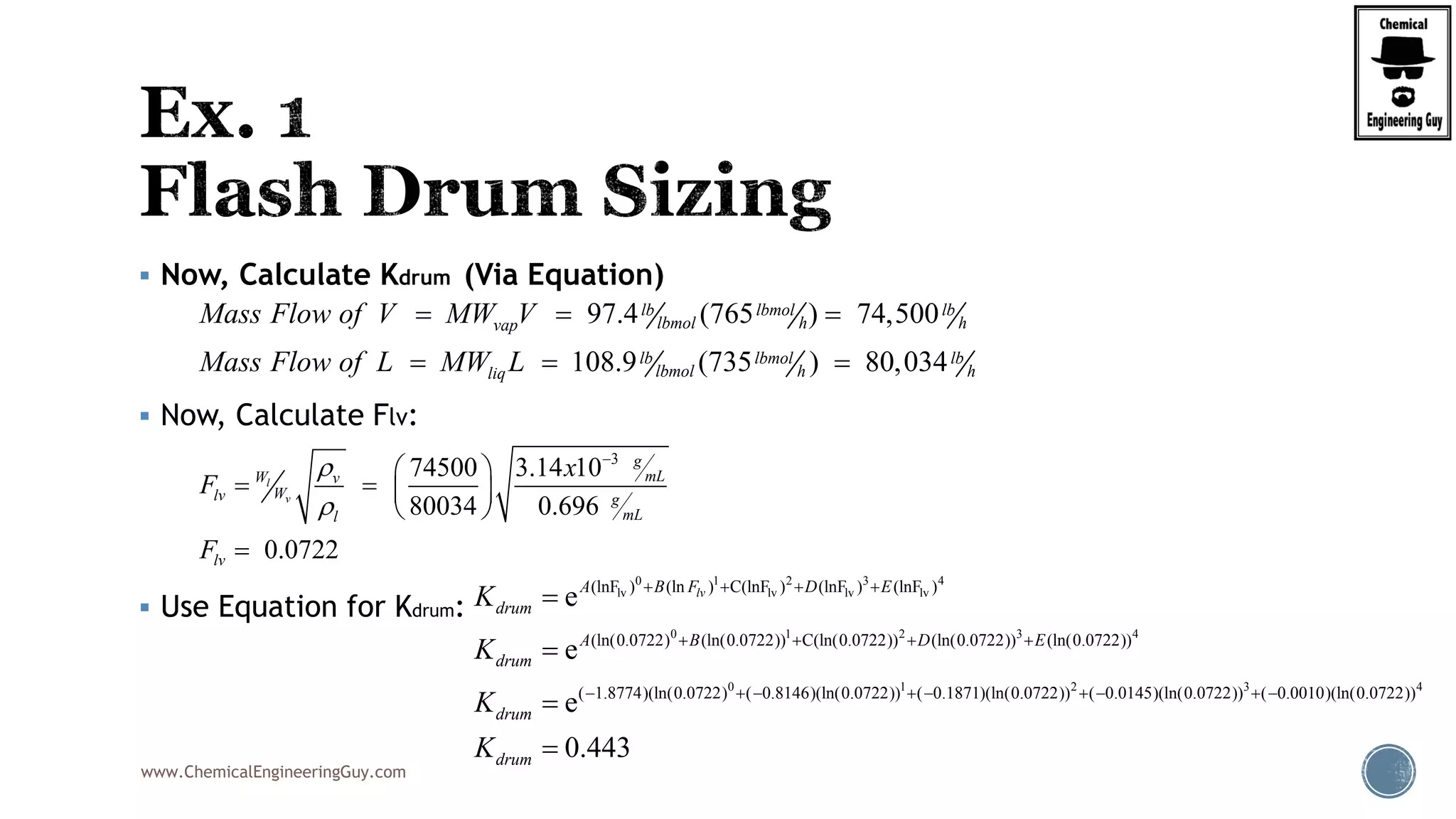
www.ChemicalEngineeringGuy.com
 Now, Calculate Kdrum (Via Equation)
 Now, Calculate Flv:
 Use Equation for Kdrum:
97.4 (765 ) 74,500
108.9 (735 ) 80,034
lb lbmol lb
lbmol h hvap
lb lbmol lb
lbmol h hliq
Mass Flow of V MW V
Mass Flow of L MW L
  
  
3
74500 3.14 10
80034 0.696
0.0722
l
v
g
mLW v
Wlv g
mLl
lv
x
F
F



 
 
 
 

0 1 2 3 4
lv lv lv lv
0 1 2 3 4
0 1
0.0722 0.0722) 0.0722) 0.0722)
(lnF ) (ln ) C(lnF ) (lnF ) (lnF )
(ln( ) (ln( ) C(ln( ) (ln( ) (ln( )
( 1.8774)(ln
0.0722)
0.0722 0.07( ) ( 0.8146)(ln( ) ( 0.1871)(ln22)
e
e
e
lvA B F D E
drum
A B D E
drum
drum
K
K
K
   
   
    



2 3 4
( ) ( 0.0145)(ln( ) ( 0.0010)(ln(0.0722) 0.0722) 0 ).0722)
0.443drumK
   

www.ChemicalEngineeringGuy.com
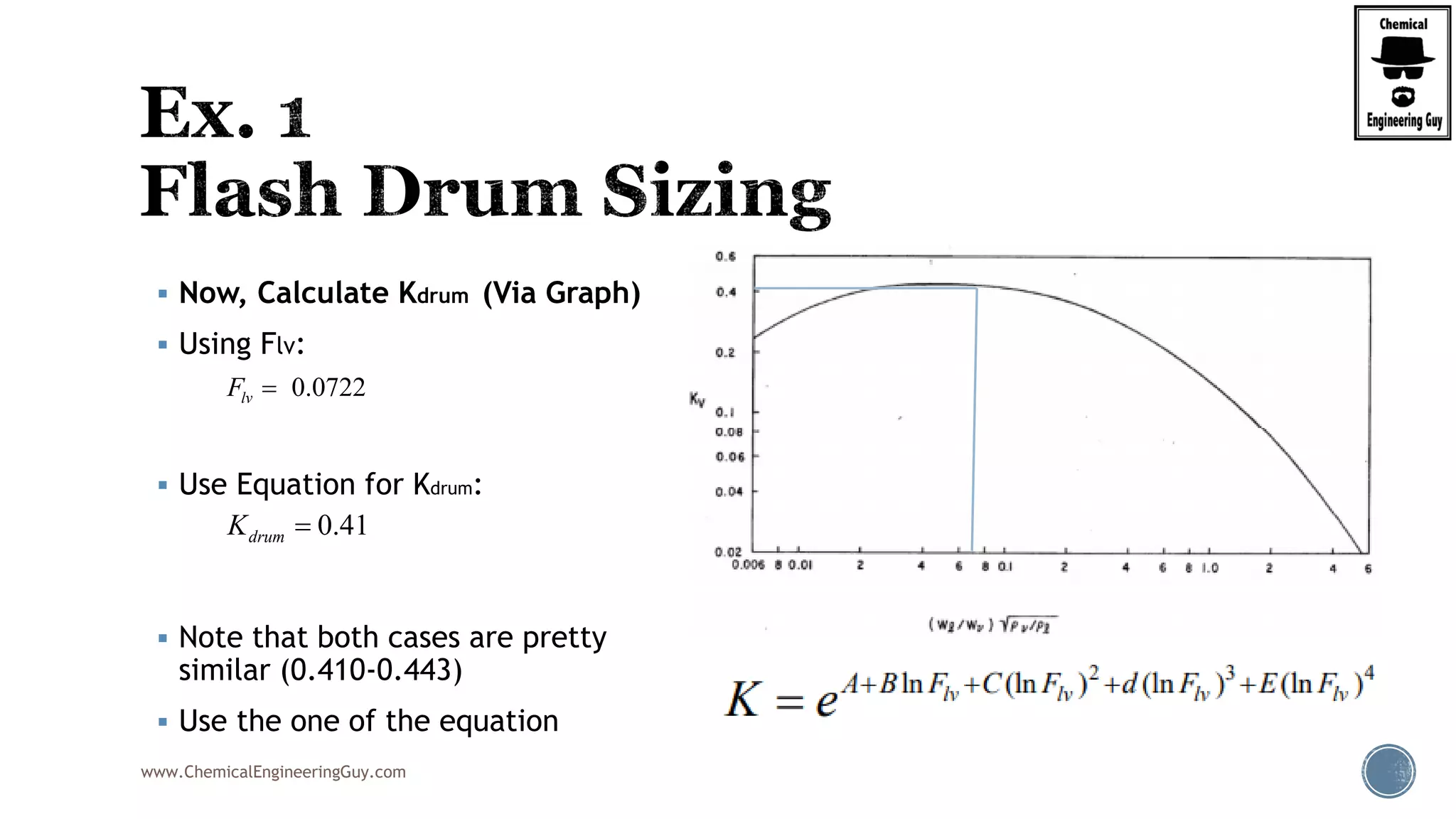
 Now, Calculate Kdrum (Via Graph)
 Using Flv:
 Use Equation for Kdrum:
 Note that both cases are pretty
similar (0.410-0.443)
 Use the one of the equation
0.0722lvF 
0.41drumK 
www.ChemicalEngineeringGuy.com
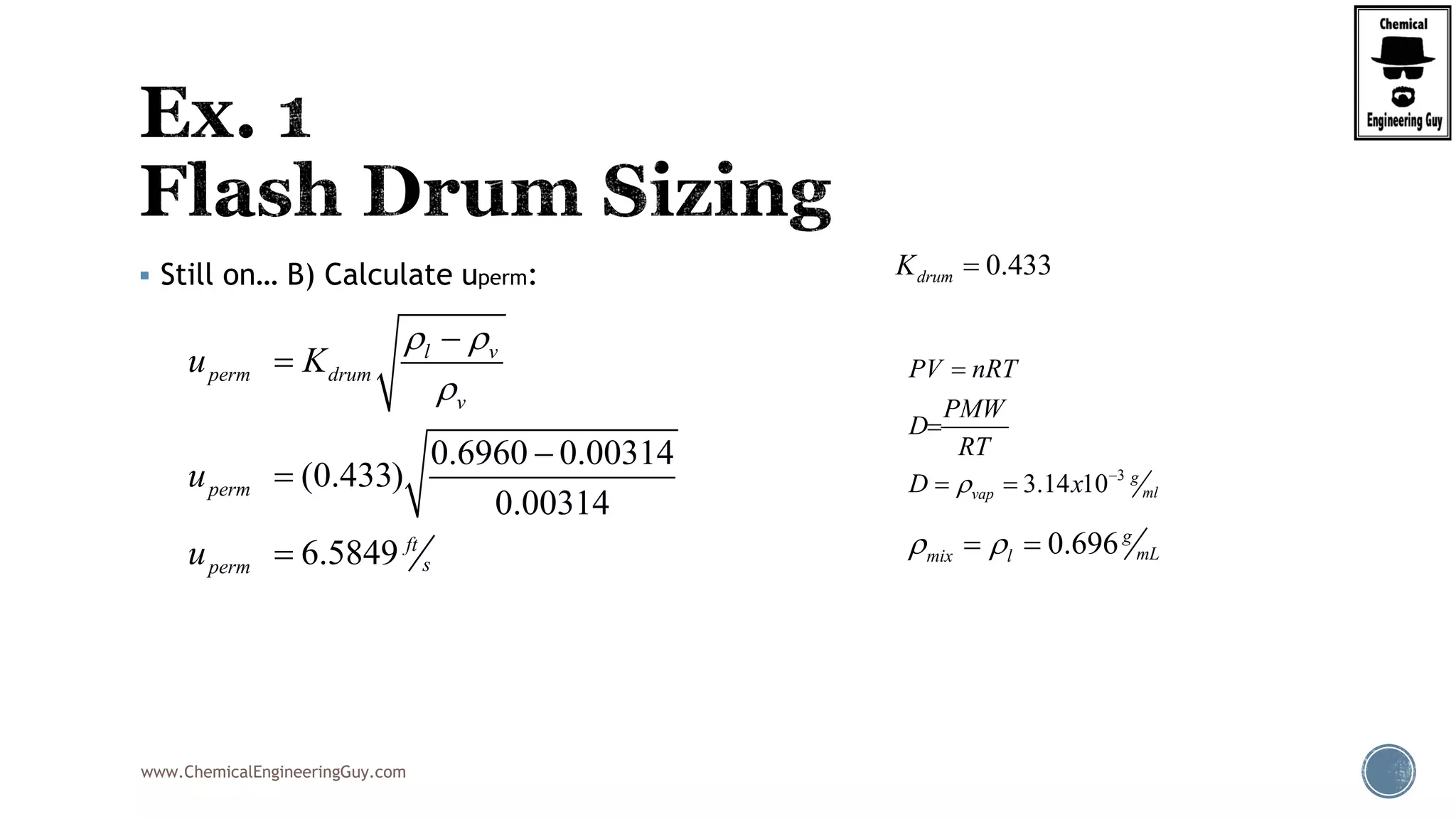
 Still on… B) Calculate uperm:
0.6960 0.00314
(0.433)
0.00314
6.5849
l v
perm drum
v
perm
ft
sperm
u K
u
u
 






3
3.14 10 g
mlvap
PV nRT
PMW
D
RT
D x 


 
0.696g
mLmix l  
0.433drumK 
www.ChemicalEngineeringGuy.com
 Now, for C) get the Tank specifications…
 Get D:
3
g
2
(3600 )
(765 / )(97.39)(454 )
(6.5849 / )(3600 / )(0.00314 )(28316.85 )
16.05
( )v
e
perm v
g
lb
e mL
mL ft
e
V MW
A
u
lbmol h
A
ft s s h
A ft




4
4(16.05)
4
eA
D
D
D ft





97.4vapMW 
3
3.14 10 g
mlvap
PV nRT
PMW
D
RT
D x 


 
0.51 (1500 / )(0.51)
V 765 /
0.696g
mLmix l
V F lb h
lb h
 
 

 
Do you need the Full Version?
Contact me if needed!
Contact@ChemicalEngineeringGuy.com
https://courses.chemicalengineeringguy.com/courses
You can also check out more content here:
My Youtube Channel 
My Fan Page 
The LinkedIn
My website:
www.ChemicalEngineeringGuy.com
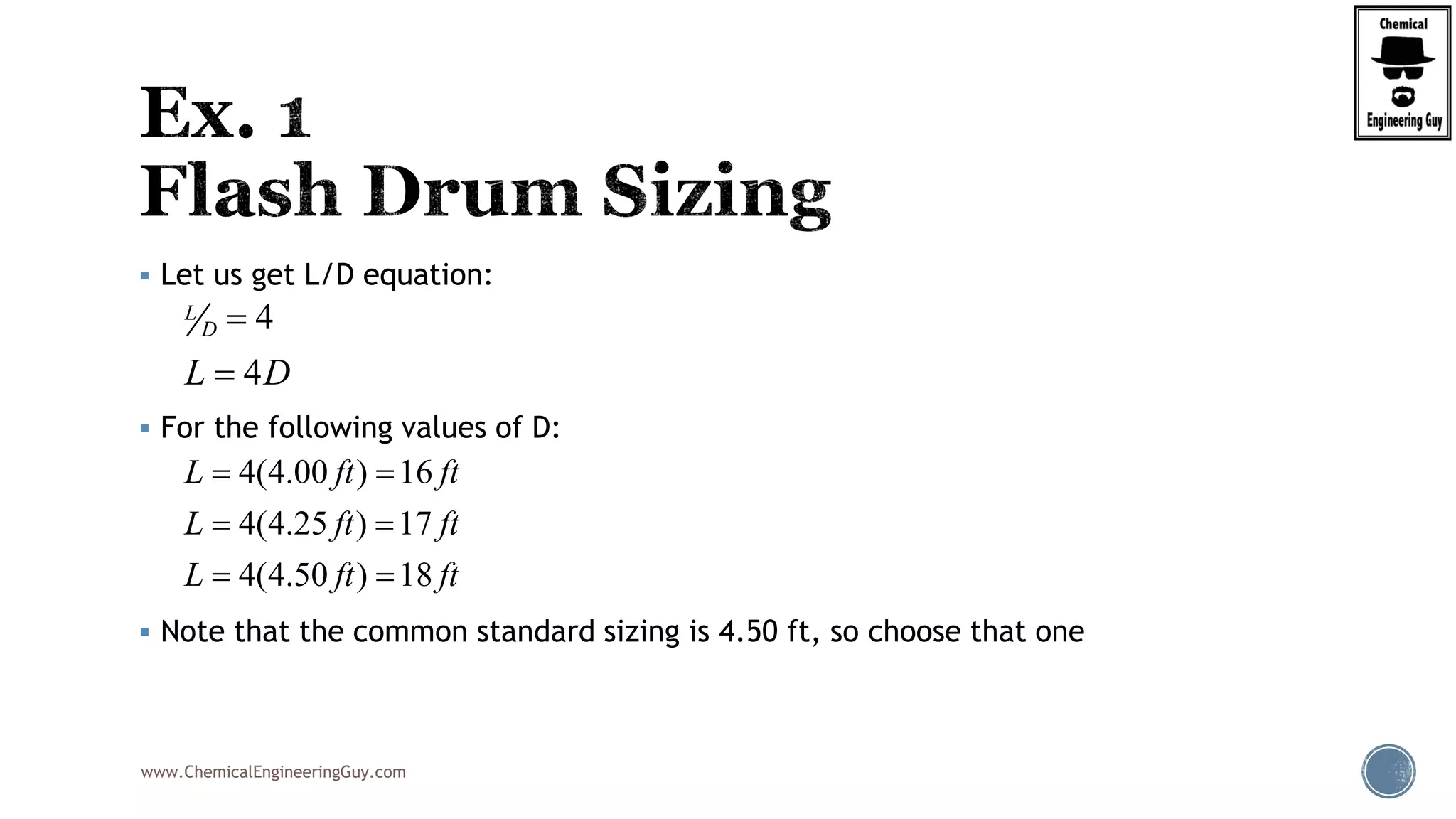
 Let us get L/D equation:
 For the following values of D:
 Note that the common standard sizing is 4.50 ft, so choose that one
4
4
L
D
L D


4(4.00 ) 16
4(4.25 ) 17
4(4.50 ) 18
L ft ft
L ft ft
L ft ft
 
 
 
www.ChemicalEngineeringGuy.com
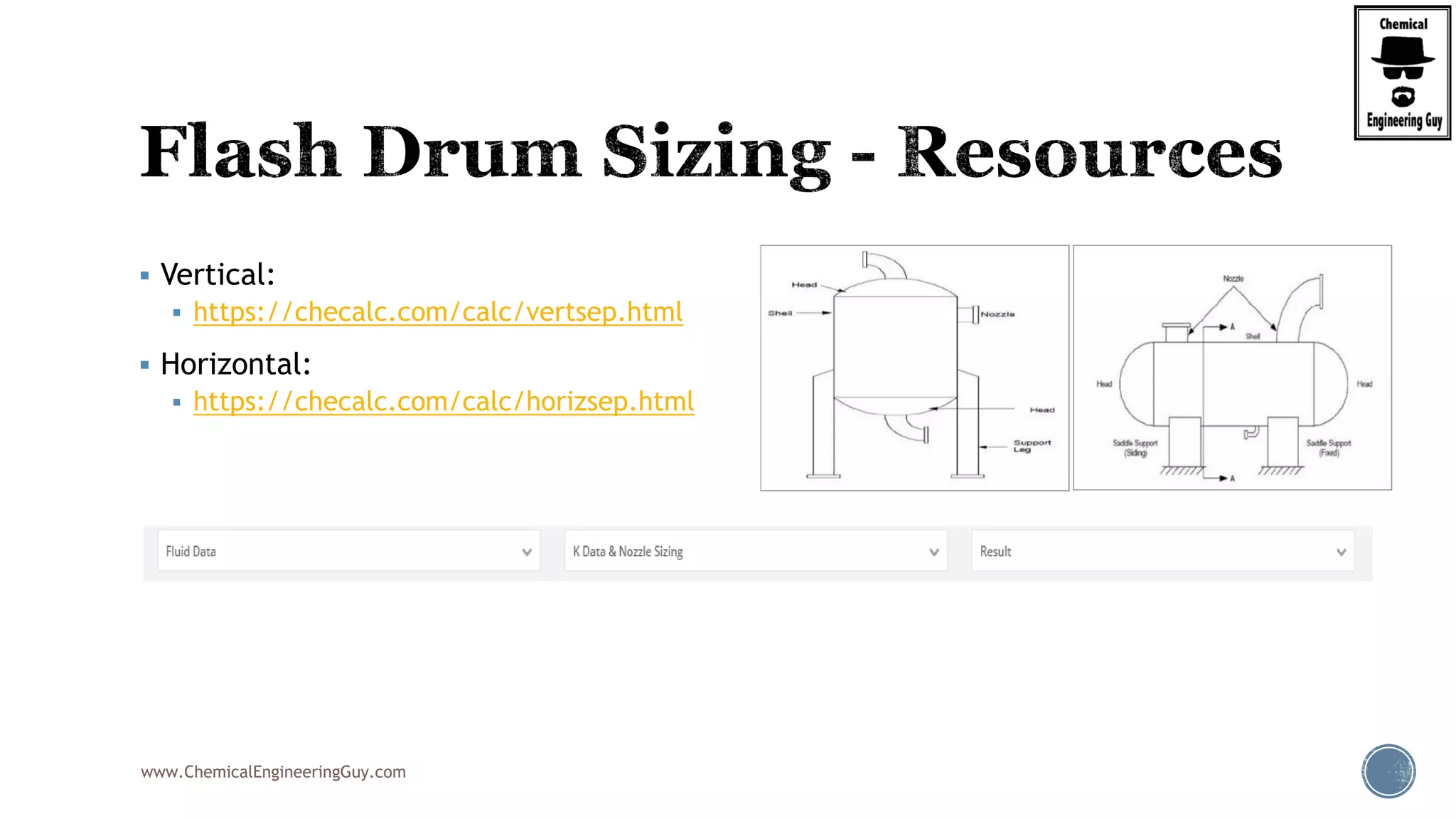
 Vertical:
 https://checalc.com/calc/vertsep.html
 Horizontal:
 https://checalc.com/calc/horizsep.html
www.ChemicalEngineeringGuy.com
 Size the Drum from Ex 1.
 https://checalc.com/calc/horizsep.html
Do you need the Full Version?
Contact me if needed!
Contact@ChemicalEngineeringGuy.com
https://courses.chemicalengineeringguy.com/courses
You can also check out more content here:
My Youtube Channel 
My Fan Page 
The LinkedIn
My website:
www.ChemicalEngineeringGuy.com
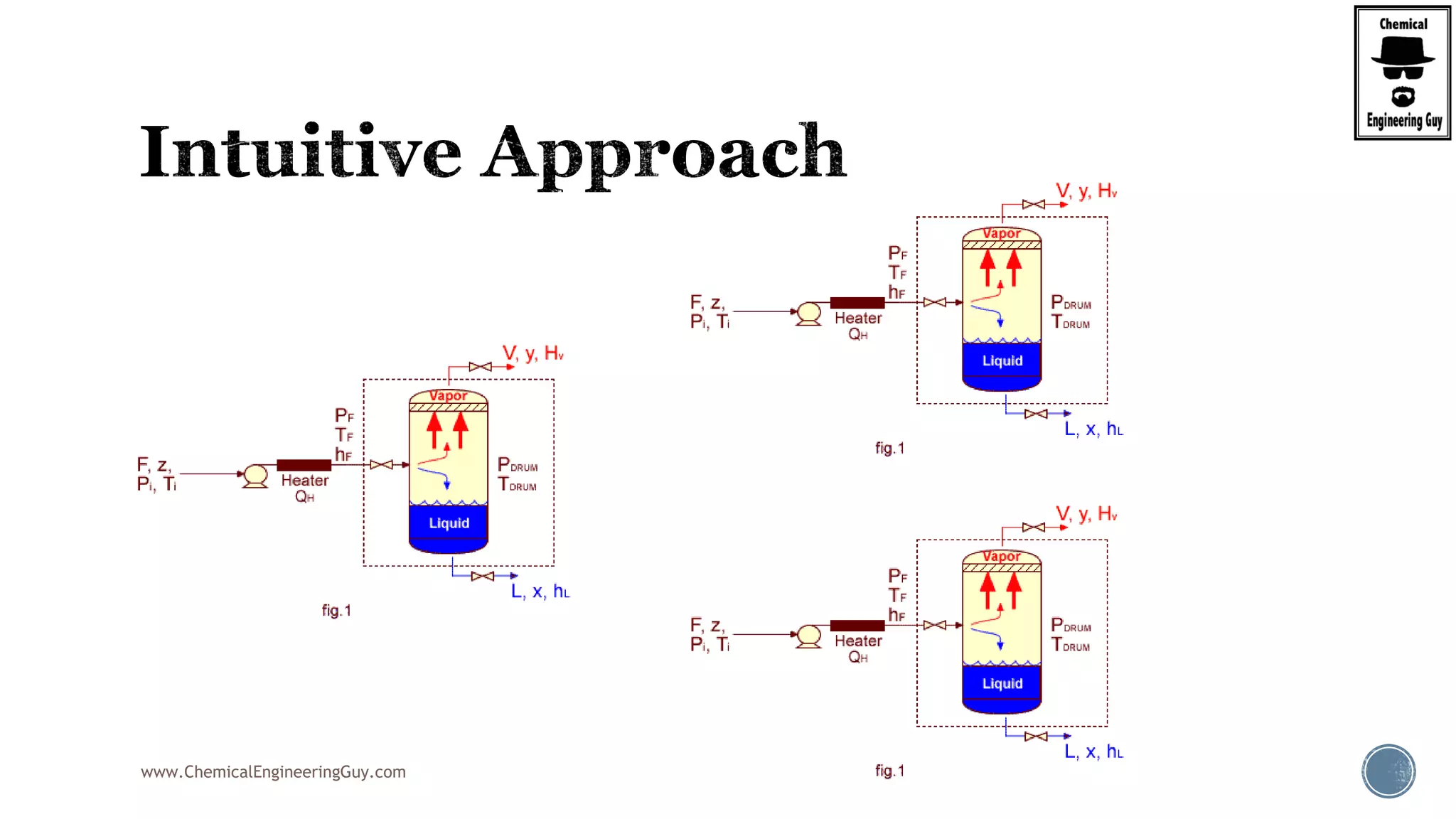
 Intuitive Approach
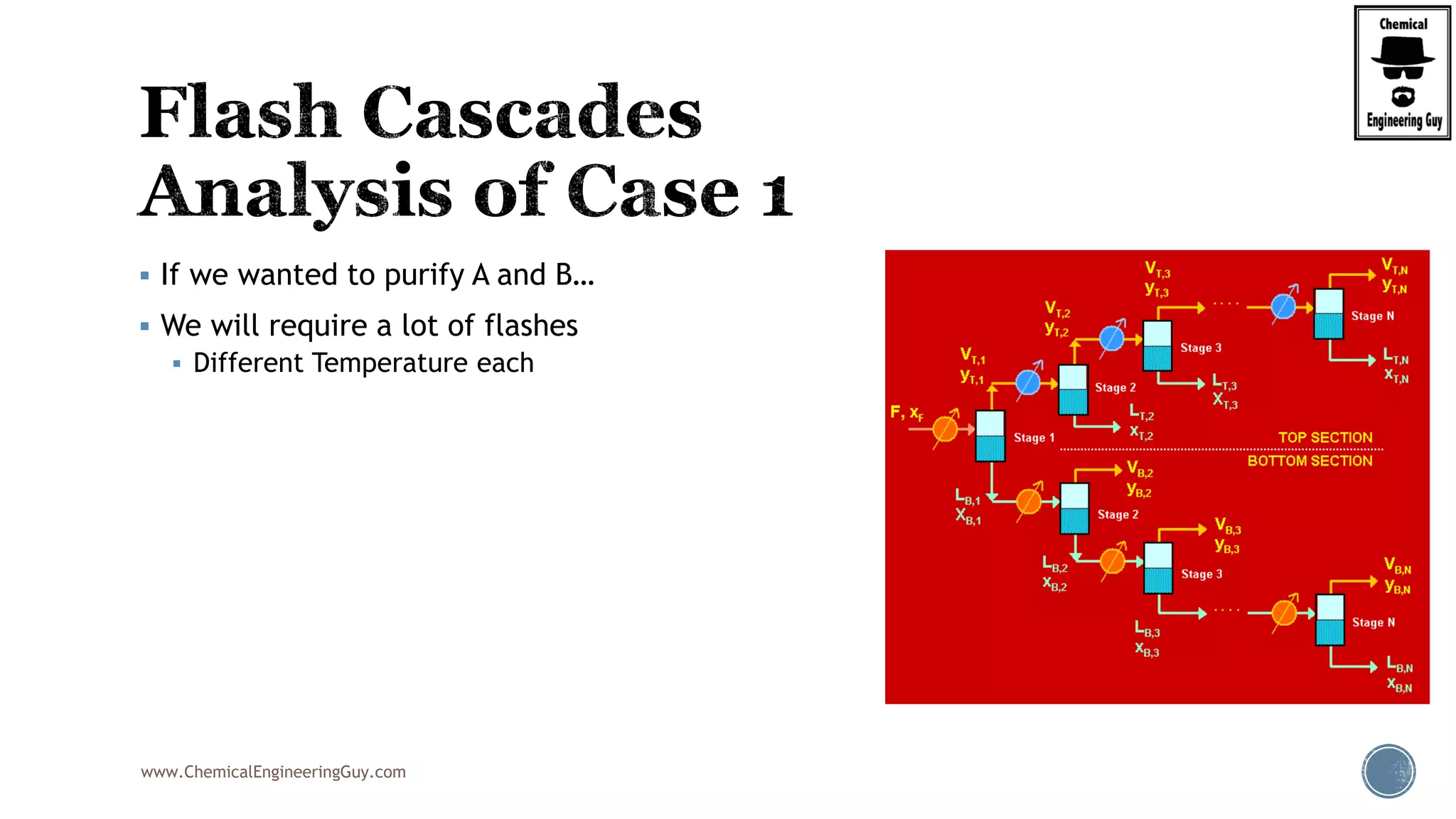
 Flash Cascades Analysis of Case 1
 Task – Flash Cascades - Simulation of Case 1
 Animation! Flash Distillation Cascade for an Acetone-Chloroform Mixture
 Task – Flash Cascades - Simulation of Case 2
 Animation! Flash Distillation Cascade in a Constant Relative Volatility Mixture
 Task – Flash Cascades - Simulation of Case 3
www.ChemicalEngineeringGuy.com
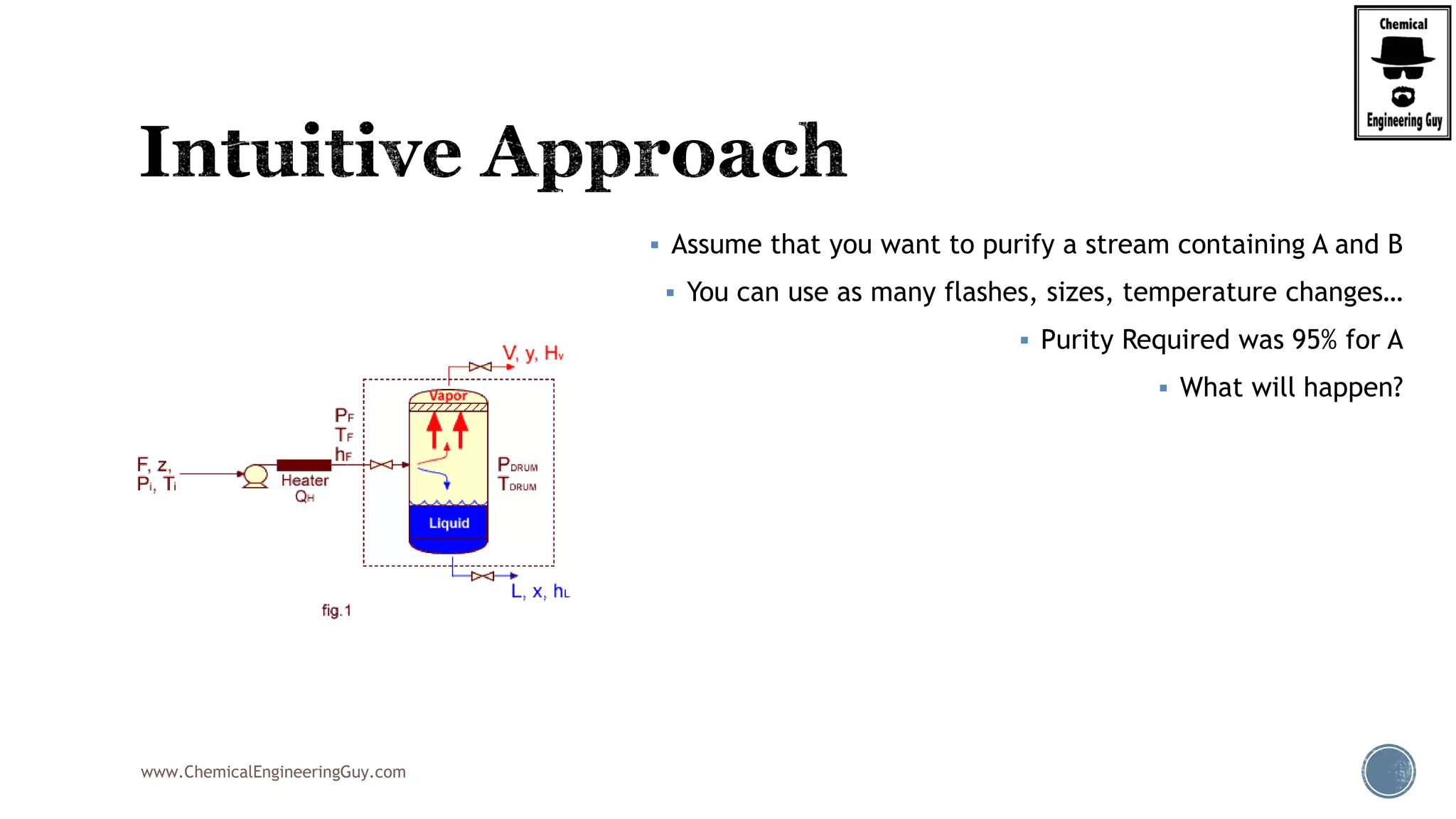
 Assume that you want to purify a stream containing A and B
 You can use as many flashes, sizes, temperature changes…
 Purity Required was 95% for A
 What will happen?
www.ChemicalEngineeringGuy.com
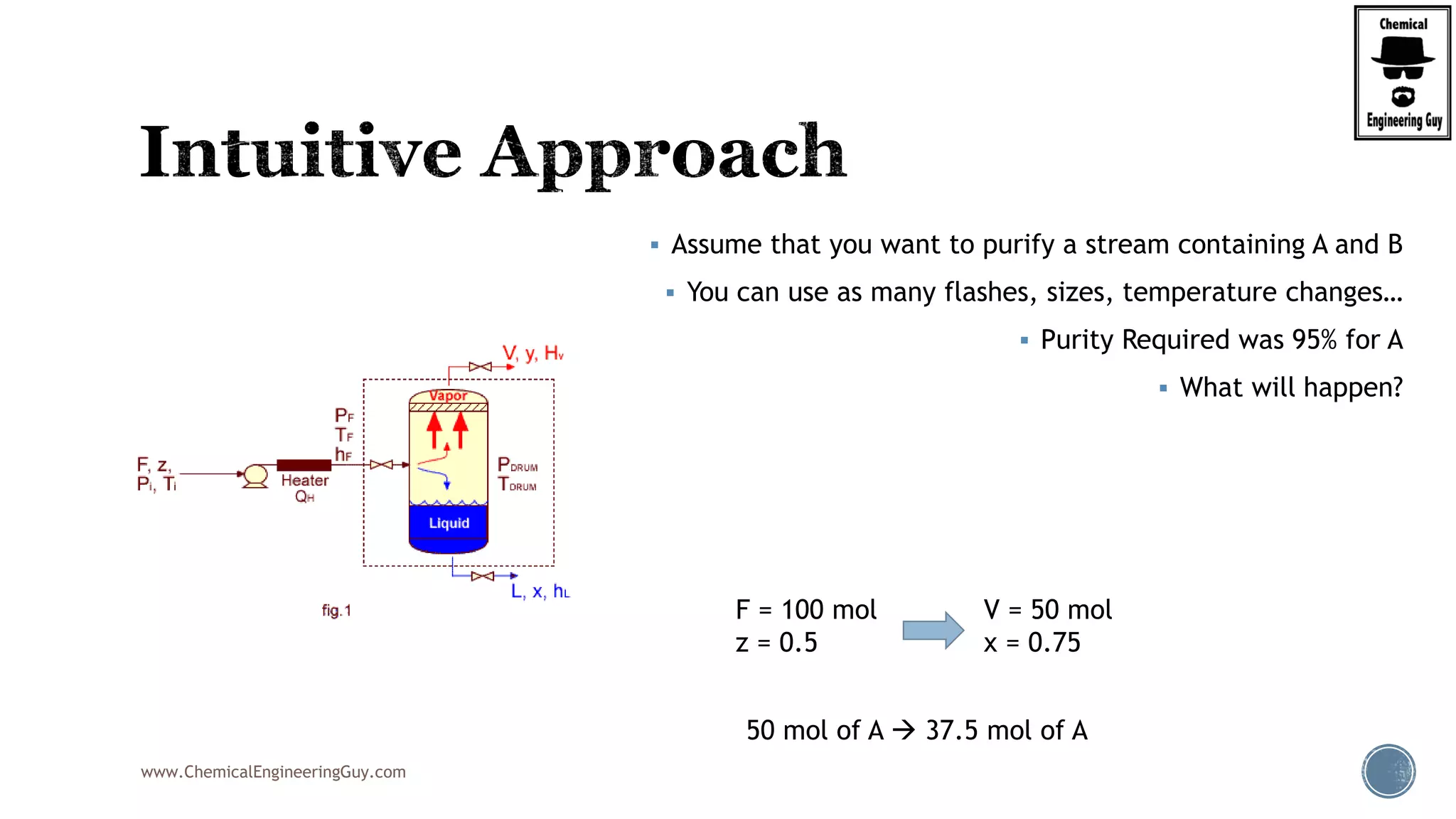
 Assume that you want to purify a stream containing A and B
 You can use as many flashes, sizes, temperature changes…
 Purity Required was 95% for A
 What will happen?
F = 100 mol
z = 0.5
V = 50 mol
x = 0.75
50 mol of A  37.5 mol of A
www.ChemicalEngineeringGuy.com
Do you need the Full Version?
Contact me if needed!
Contact@ChemicalEngineeringGuy.com
https://courses.chemicalengineeringguy.com/courses
You can also check out more content here:
My Youtube Channel 
My Fan Page 
The LinkedIn
My website:
www.ChemicalEngineeringGuy.com
Do you need the Full Version?
Contact me if needed!
Contact@ChemicalEngineeringGuy.com
https://courses.chemicalengineeringguy.com/courses
You can also check out more content here:
My Youtube Channel 
My Fan Page 
The LinkedIn
My website:
www.ChemicalEngineeringGuy.com
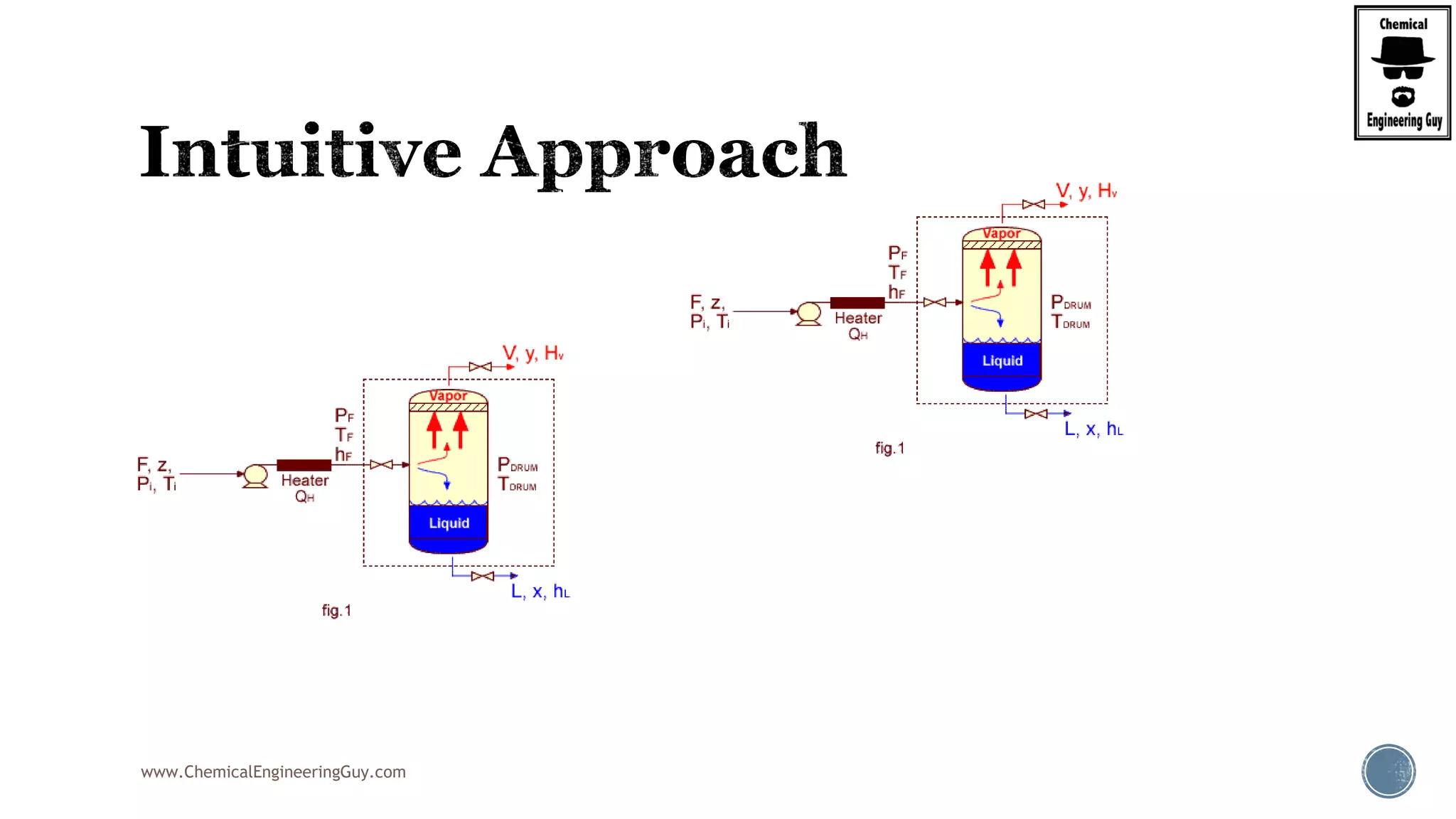
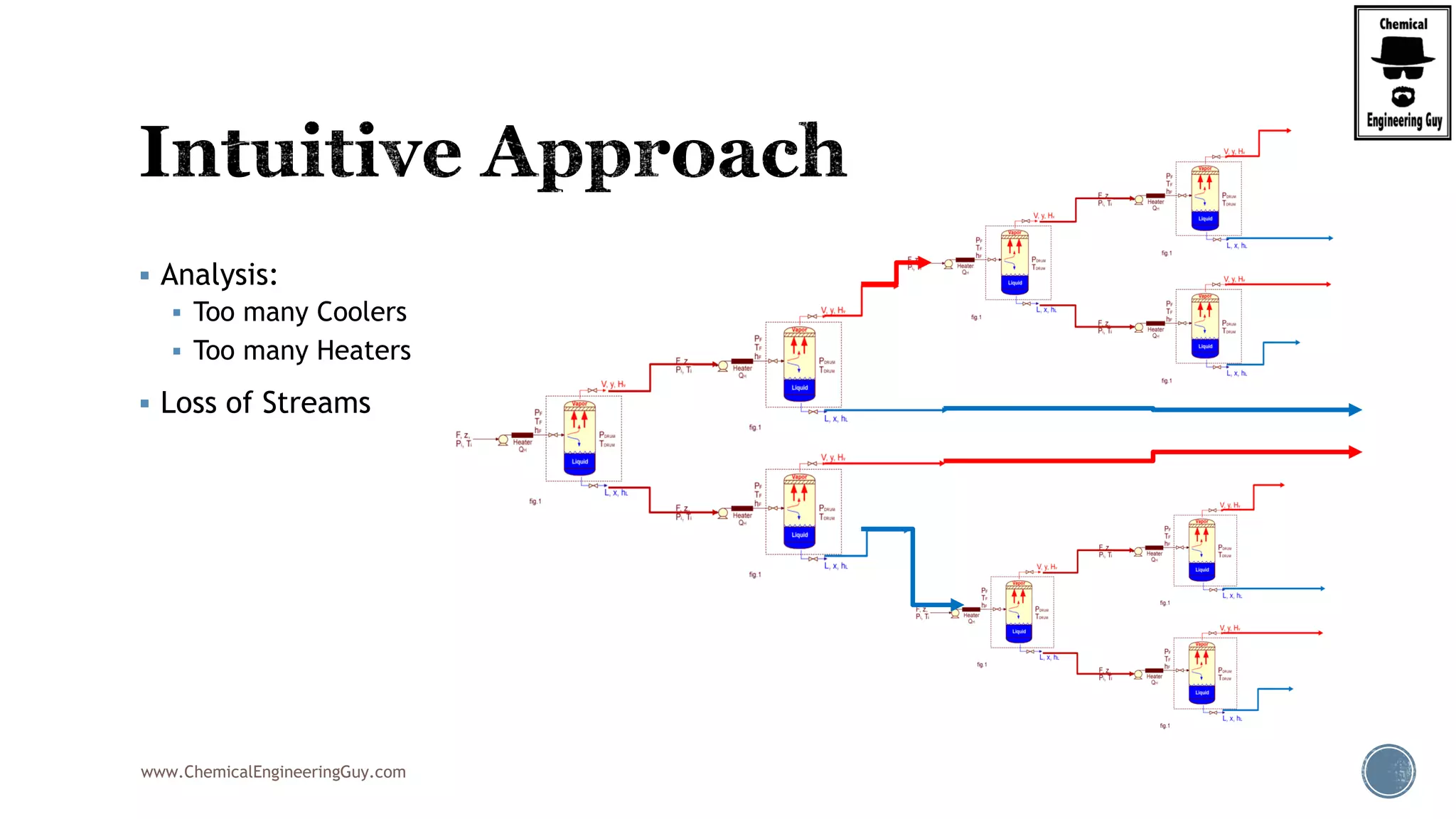
 Analysis:
 Too many Coolers
 Too many Heaters
 Loss of Streams
www.ChemicalEngineeringGuy.com
 If we wanted to purify A and B…
 We will require a lot of flashes
 Different Temperature each
www.ChemicalEngineeringGuy.com
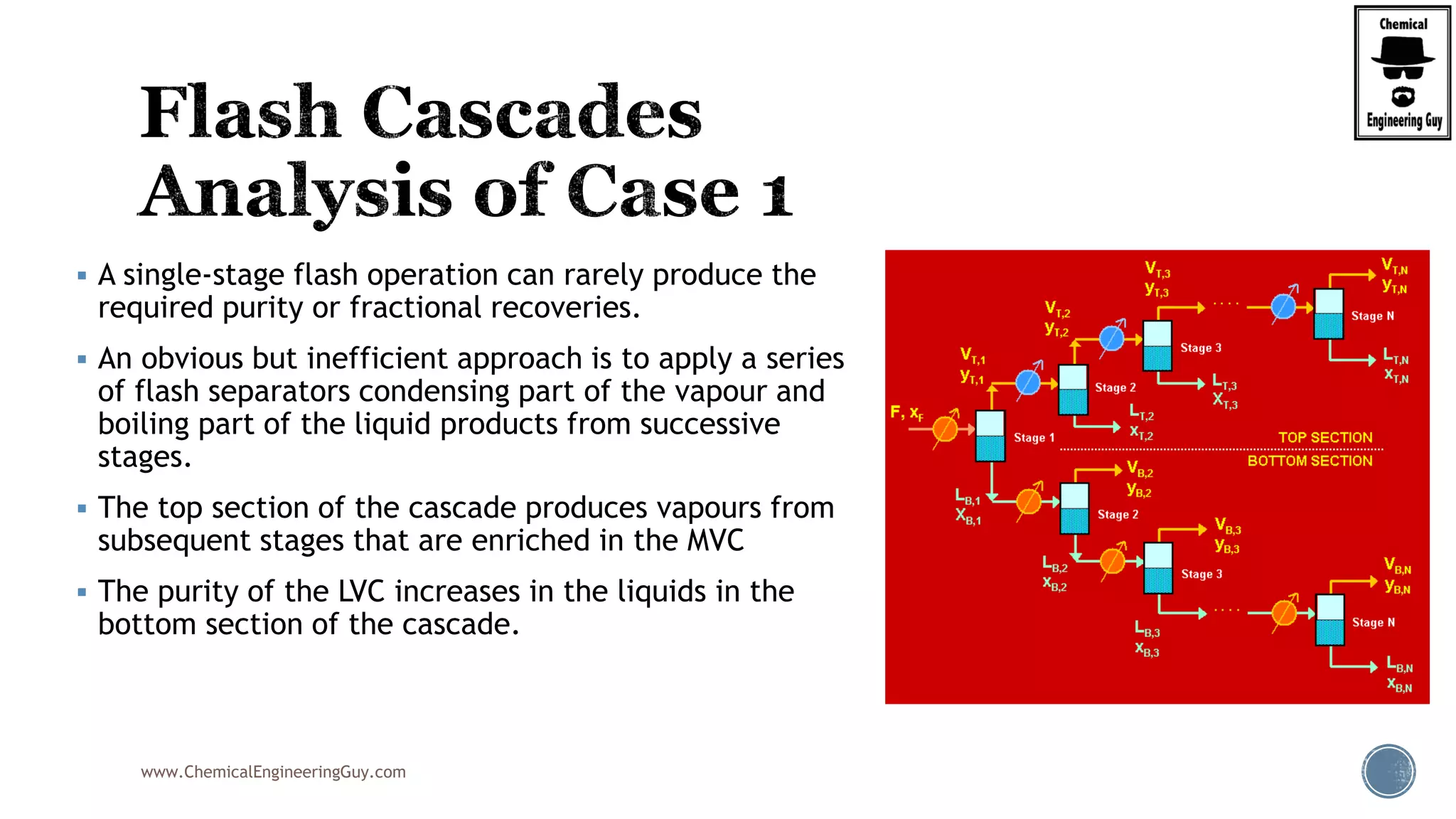
 A single-stage flash operation can rarely produce the
required purity or fractional recoveries.
 An obvious but inefficient approach is to apply a series
of flash separators condensing part of the vapour and
boiling part of the liquid products from successive
stages.
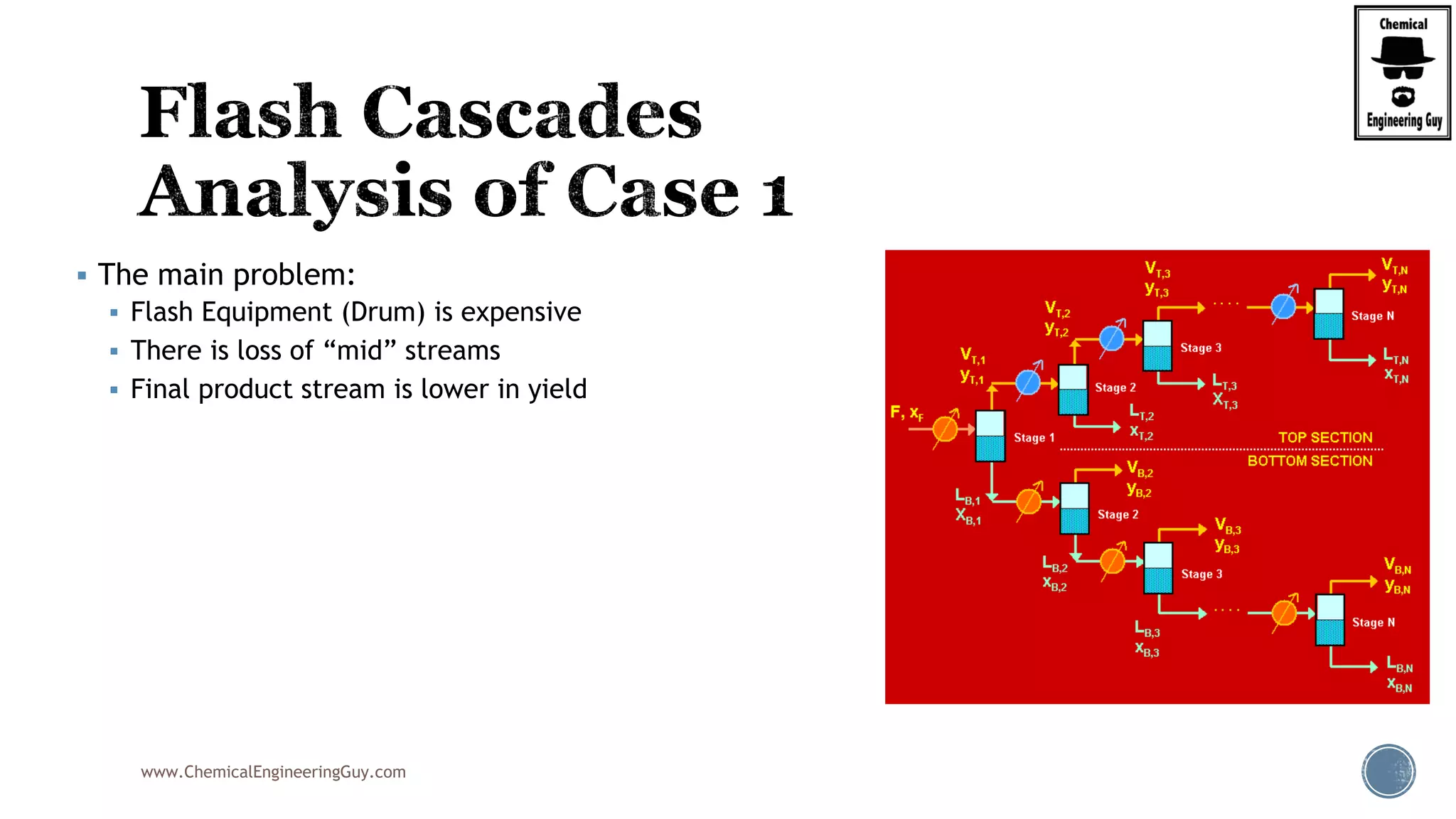
 The top section of the cascade produces vapours from
subsequent stages that are enriched in the MVC
 The purity of the LVC increases in the liquids in the
bottom section of the cascade.
www.ChemicalEngineeringGuy.com
 The main problem:
 Flash Equipment (Drum) is expensive
 There is loss of “mid” streams
 Final product stream is lower in yield
www.ChemicalEngineeringGuy.com
 ASPEN PLUS SIMULATION
 Case 1  Different temperatures
 Components:
 Toluene (50%)
 Benzene (50%)
 Package:
 Peng Robinson
 Unit: Flash2
 Adiabatic operation
Do you need the Full Version?
Contact me if needed!
Contact@ChemicalEngineeringGuy.com
https://courses.chemicalengineeringguy.com/courses
You can also check out more content here:
My Youtube Channel 
My Fan Page 
The LinkedIn
My website:
www.ChemicalEngineeringGuy.com
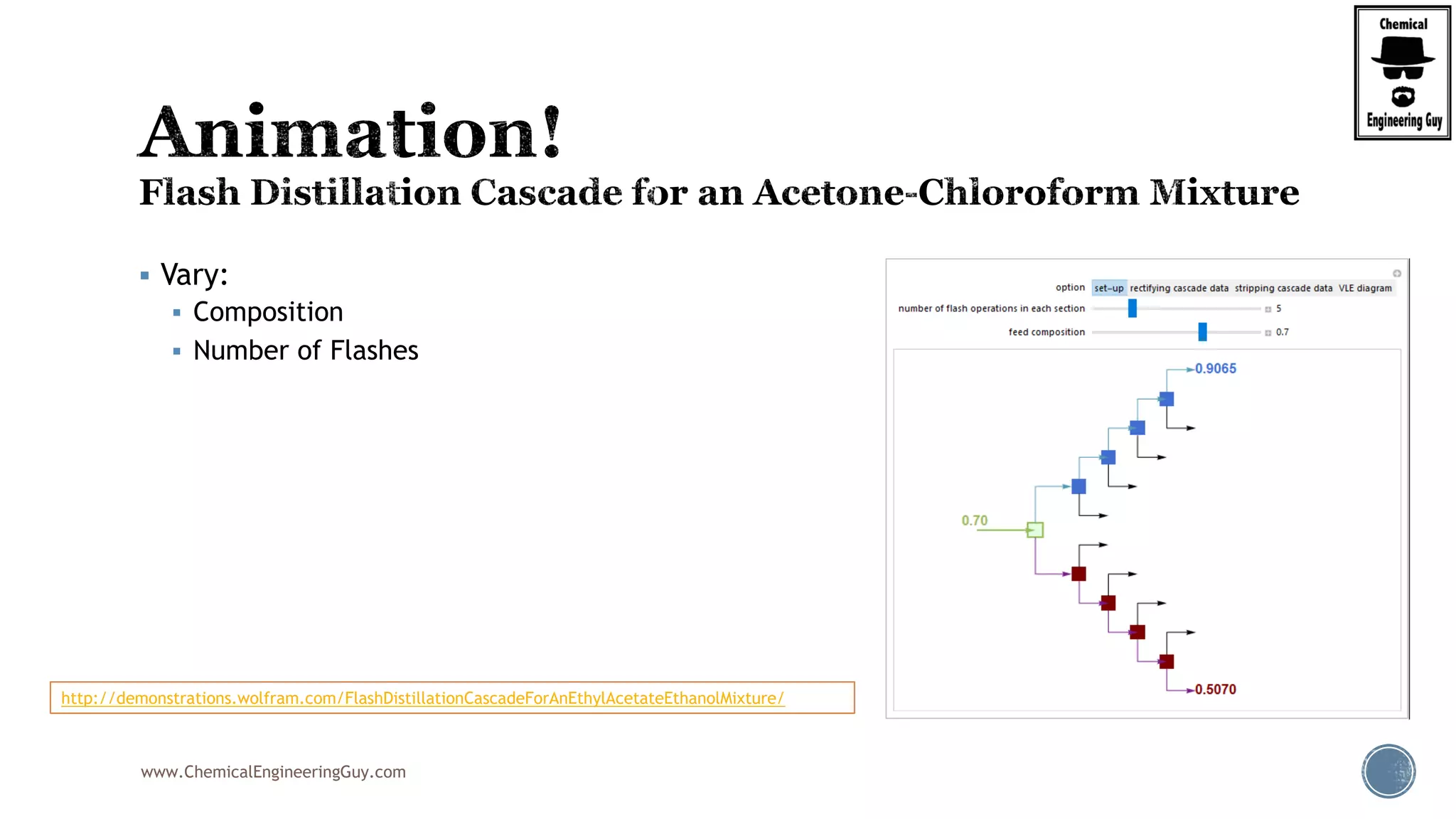
 Vary:
 Composition
 Number of Flashes
http://demonstrations.wolfram.com/FlashDistillationCascadeForAnEthylAcetateEthanolMixture/
www.ChemicalEngineeringGuy.com
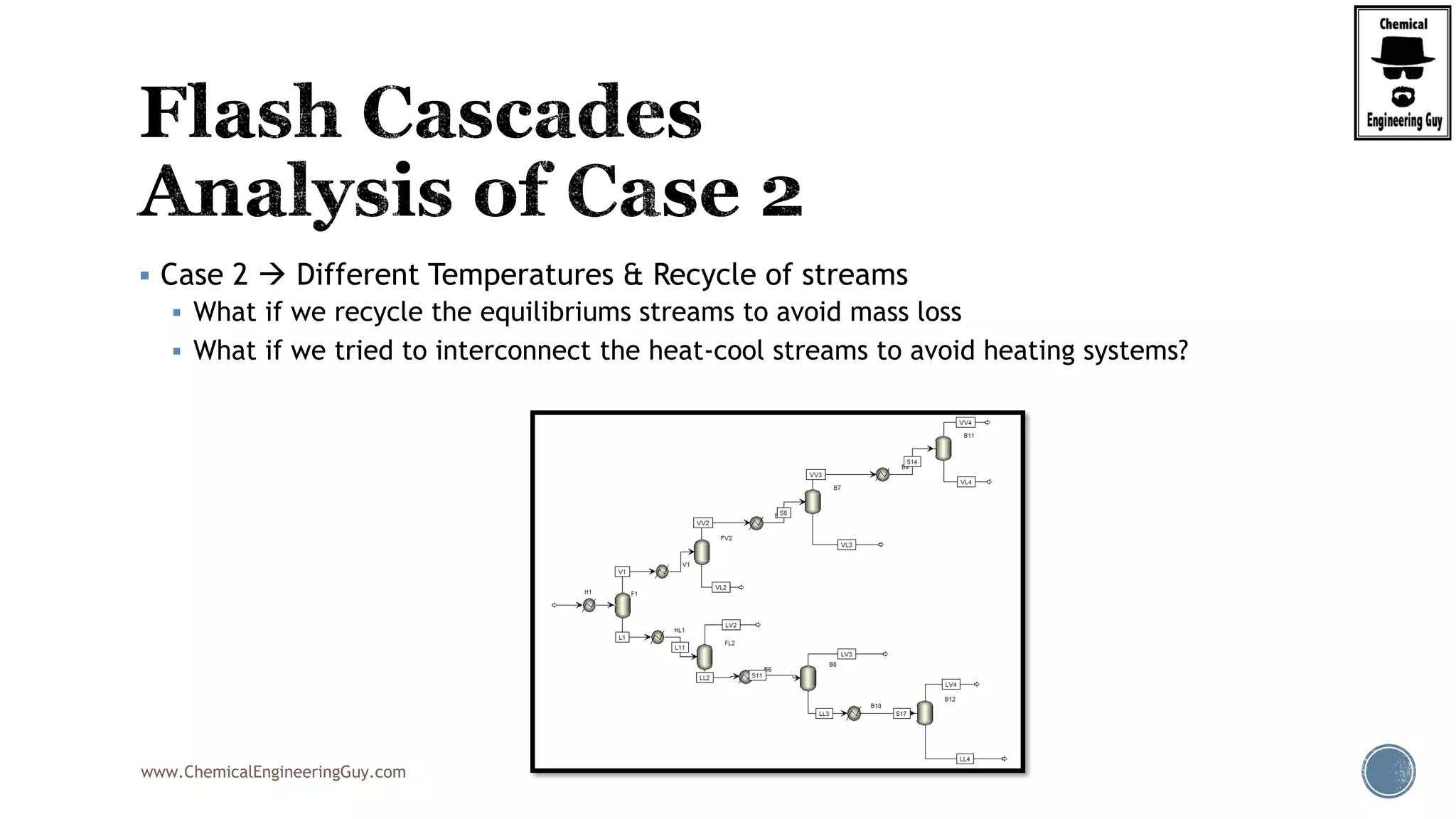
 Case 2  Different Temperatures & Recycle of streams
 What if we recycle the equilibriums streams to avoid mass loss
 What if we tried to interconnect the heat-cool streams to avoid heating systems?
www.ChemicalEngineeringGuy.com
Do you need the Full Version?
Contact me if needed!
Contact@ChemicalEngineeringGuy.com
https://courses.chemicalengineeringguy.com/courses
You can also check out more content here:
My Youtube Channel 
My Fan Page 
The LinkedIn
My website:
www.ChemicalEngineeringGuy.com
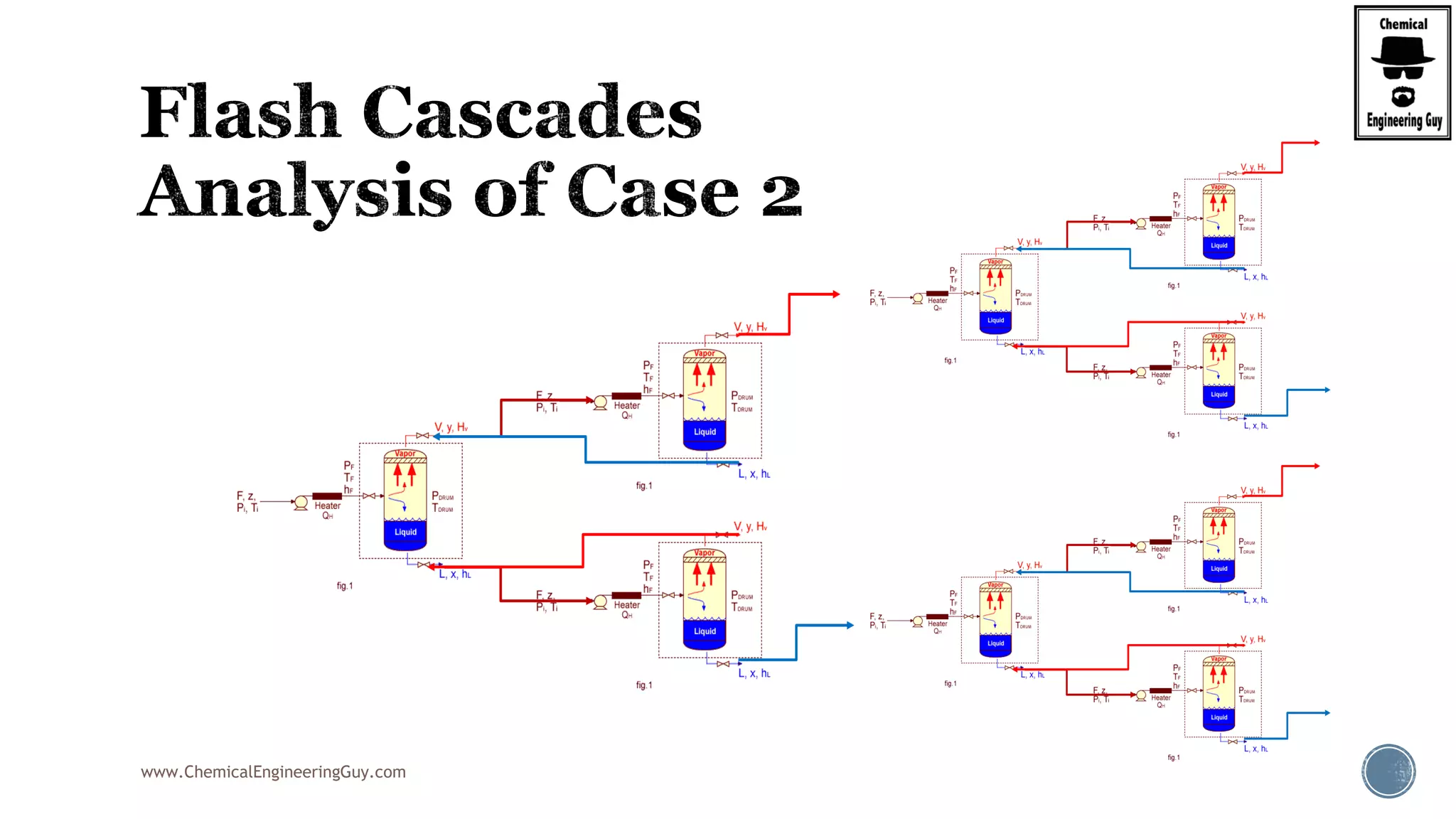
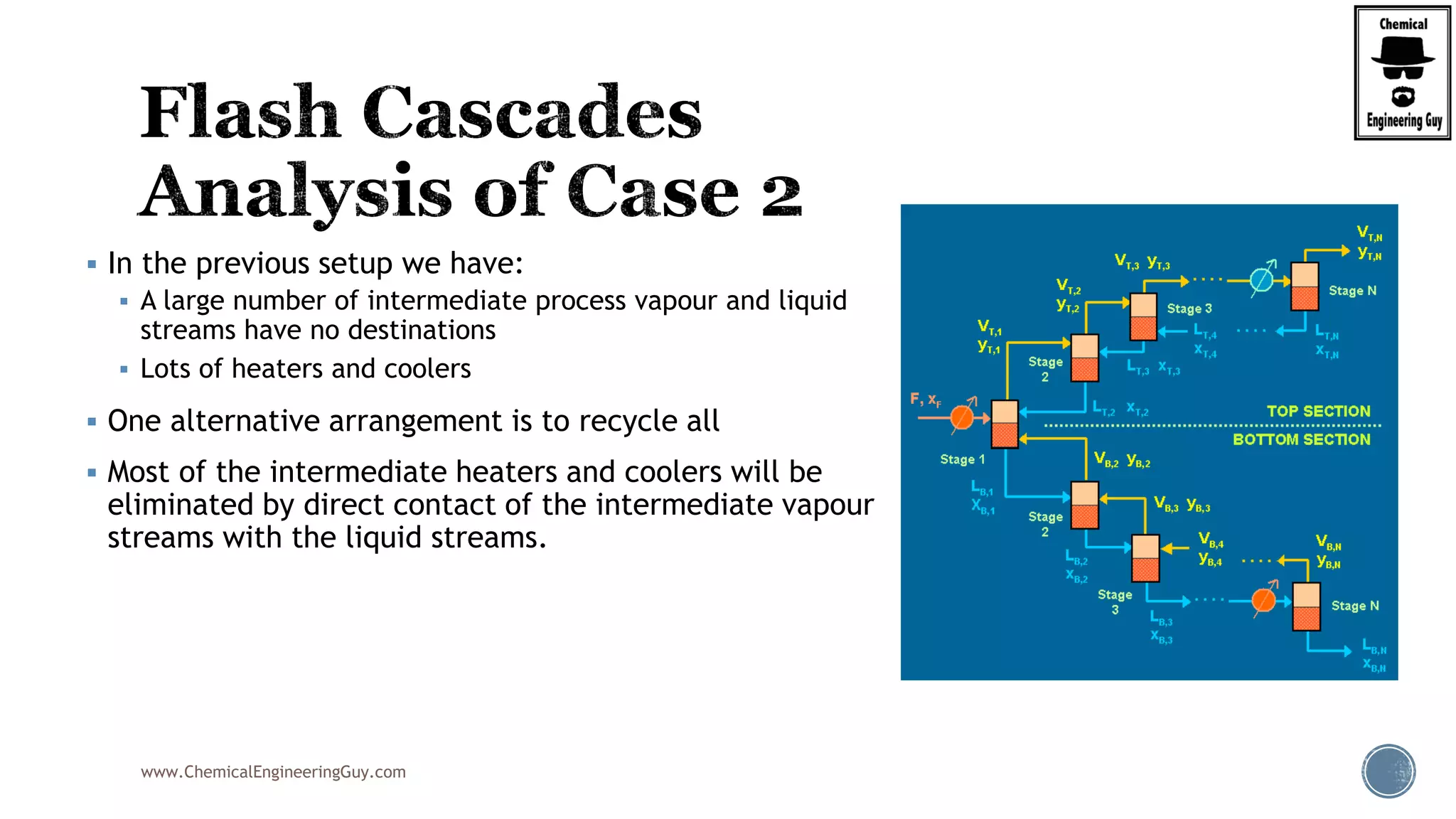
 In the previous setup we have:
 A large number of intermediate process vapour and liquid
streams have no destinations
 Lots of heaters and coolers
 One alternative arrangement is to recycle all
 Most of the intermediate heaters and coolers will be
eliminated by direct contact of the intermediate vapour
streams with the liquid streams.
www.ChemicalEngineeringGuy.com
 In the top section of the cascade, the intermediate
vapour streams are contacted with the recycled liquid
streams.
 Some of the vapour will condense while some of the
liquid will boil.
Do you need the Full Version?
Contact me if needed!
Contact@ChemicalEngineeringGuy.com
https://courses.chemicalengineeringguy.com/courses
You can also check out more content here:
My Youtube Channel 
My Fan Page 
The LinkedIn
My website:
www.ChemicalEngineeringGuy.com
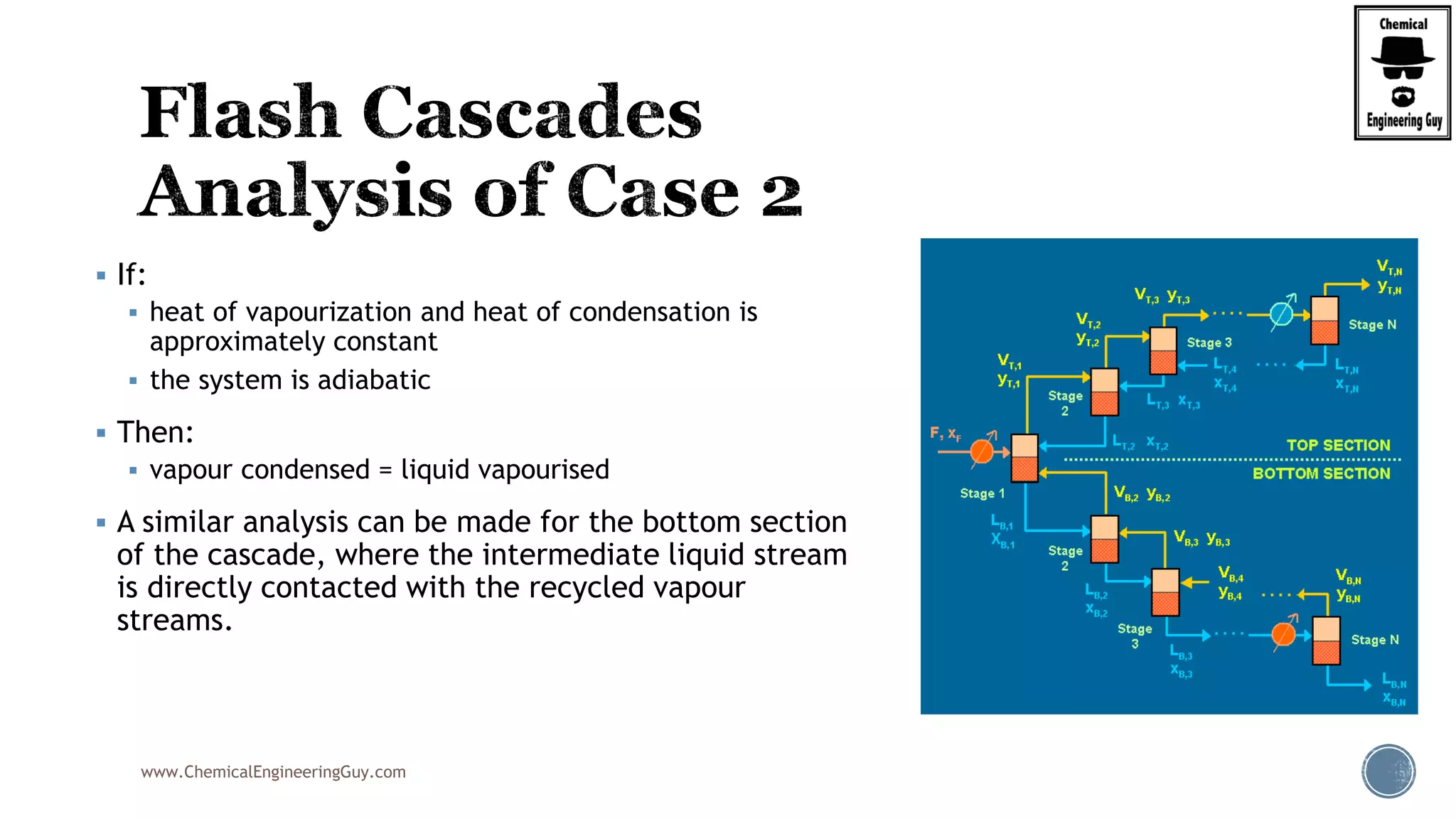
 If:
 heat of vapourization and heat of condensation is
approximately constant
 the system is adiabatic
 Then:
 vapour condensed = liquid vapourised
 A similar analysis can be made for the bottom section
of the cascade, where the intermediate liquid stream
is directly contacted with the recycled vapour
streams.
www.ChemicalEngineeringGuy.com
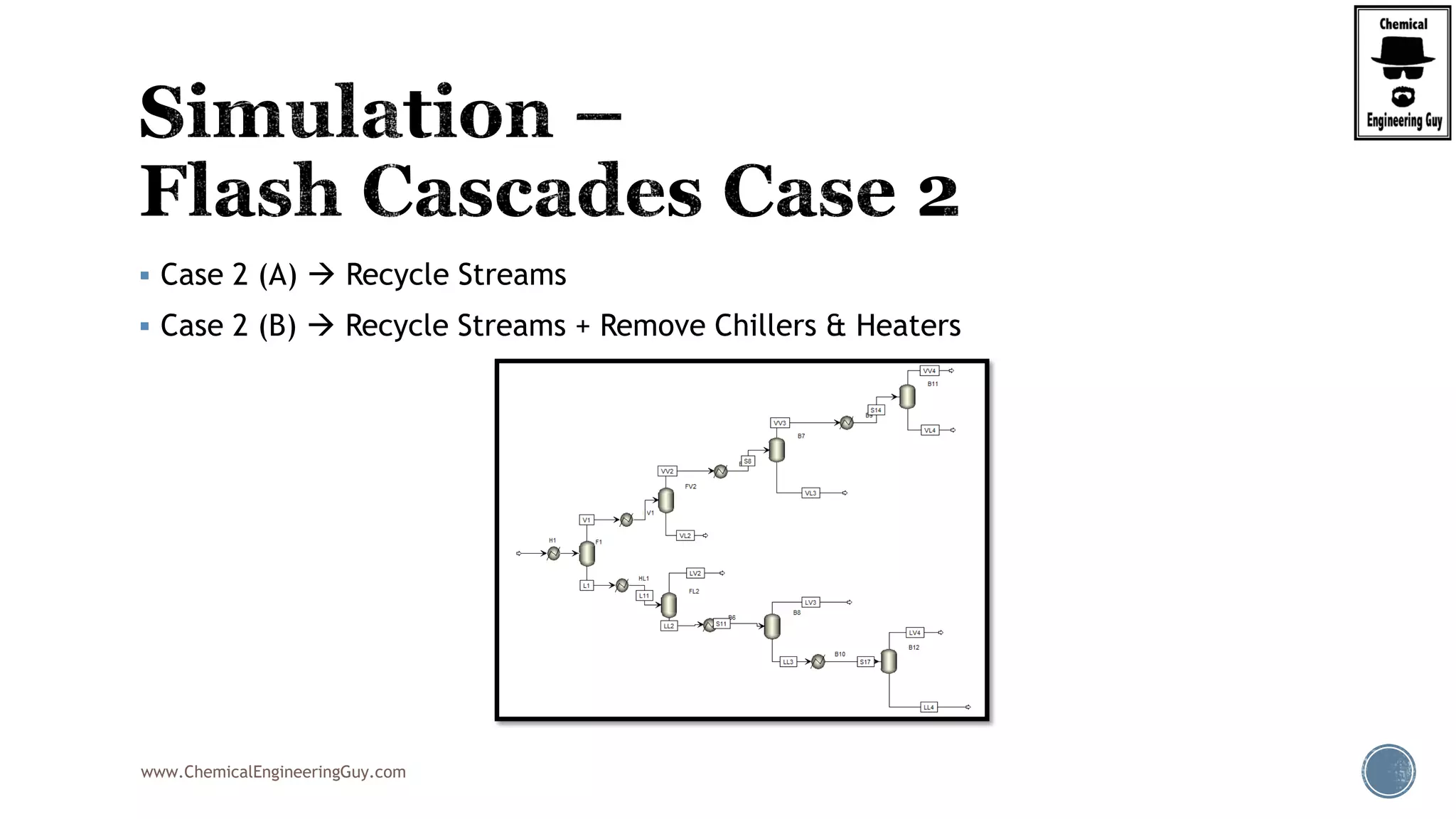
 Case 2 (A)  Recycle Streams
 Case 2 (B)  Recycle Streams + Remove Chillers & Heaters
www.ChemicalEngineeringGuy.com
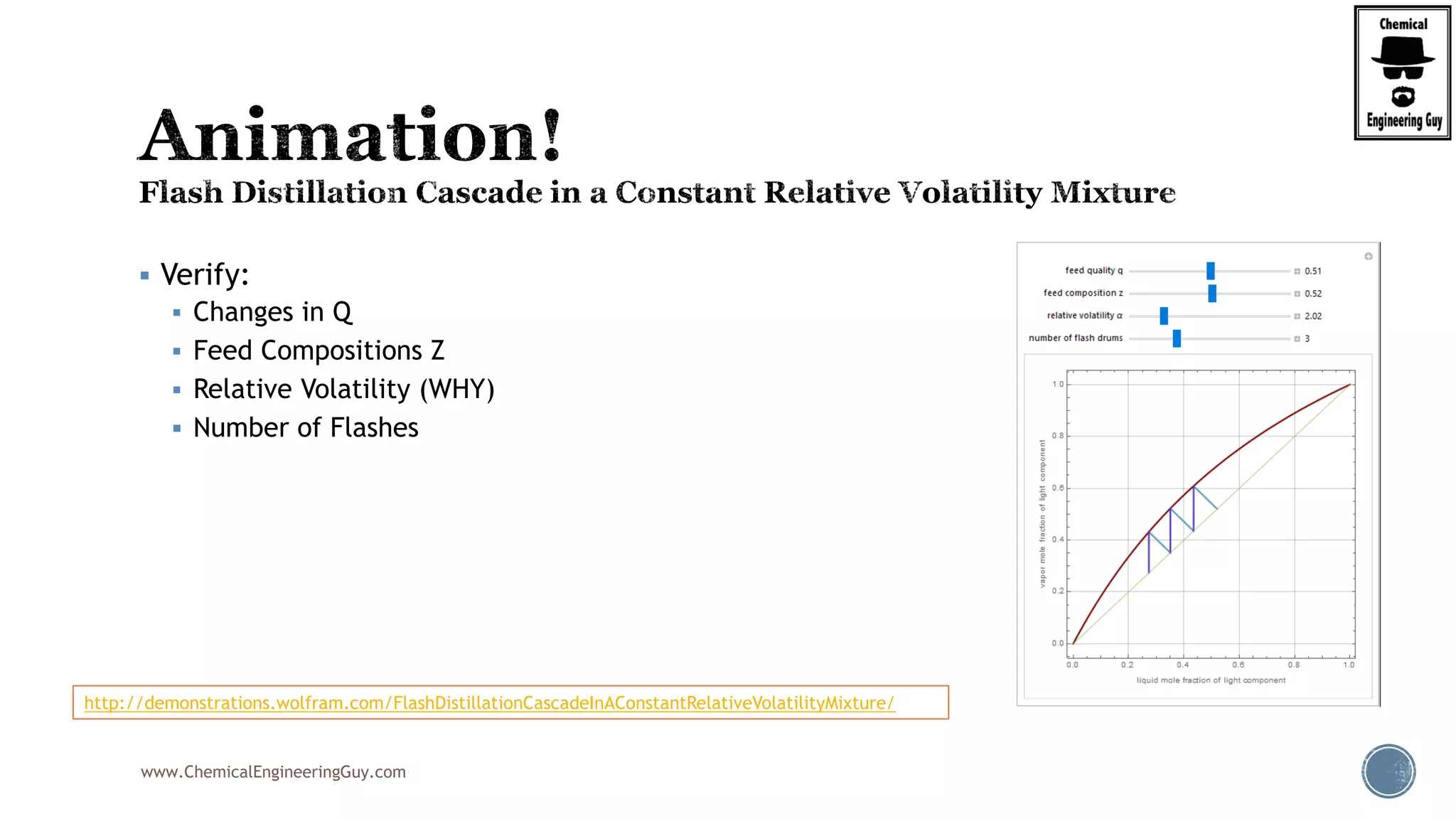
 Verify:
 Changes in Q
 Feed Compositions Z
 Relative Volatility (WHY)
 Number of Flashes
http://demonstrations.wolfram.com/FlashDistillationCascadeInAConstantRelativeVolatilityMixture/

Flash Distillation in Chemical and Process Engineering (Part 2 of 3)

  • 1.
    www.ChemicalEngineeringGuy.com 1. Drum Design Vertical vs. Horizontal  Hold-up times  Equipment & Auxiliary Pieces 2. Control Systems
  • 2.
    www.ChemicalEngineeringGuy.com  Vertical preferredwhen:  small liquid load  limited plot space  ease of level control is desired 12  Prefered when L/D < 5  Horizontal preferred when:  large liquid loads are involved  consequently hold-up will set the size  three phases are present  Preferred when L/D > 5
  • 3.
    www.ChemicalEngineeringGuy.com Do you needthe Full Version? Contact me if needed! Contact@ChemicalEngineeringGuy.com https://courses.chemicalengineeringguy.com/courses You can also check out more content here: My Youtube Channel  My Fan Page  The LinkedIn My website:
  • 4.
    www.ChemicalEngineeringGuy.com Do you needthe Full Version? Contact me if needed! Contact@ChemicalEngineeringGuy.com https://courses.chemicalengineeringguy.com/courses You can also check out more content here: My Youtube Channel  My Fan Page  The LinkedIn My website:
  • 5.
    www.ChemicalEngineeringGuy.com  These aresome common dimensions  More will be seen in:  Flash sizing  Exercise:  Find L/D Ratio
  • 6.
    www.ChemicalEngineeringGuy.com  Hold UpTime (at half full)  2 to 32 minutes depending on quality of control for each outgoing stream  5 to 10 minutes is sufficient with modern control systems to handle minor upsets  30 minutes provides a 99% separation in most cases  Engineering Judgement !
  • 7.
    www.ChemicalEngineeringGuy.com  The Mesh Nozzles  Drains & Manholes  Vortex Breakers & Foam Breakers  Straightening Vanes  Distributors  Level Gauges & Thermowells
  • 8.
    www.ChemicalEngineeringGuy.com  The mistextractor is the final gas cleaning device in a conventional separator.  The selection, and design to a large degree, determine the amount of liquid carryover remaining in the gas phase.  The most common types include:  Wire mesh pads (“mesh pads”)  Vane-type (vane “packs”)  Axial flow demisting cyclones. Do you need the Full Version? Contact me if needed! Contact@ChemicalEngineeringGuy.com https://courses.chemicalengineeringguy.com/courses You can also check out more content here: My Youtube Channel  My Fan Page  The LinkedIn My website:
  • 9.
    www.ChemicalEngineeringGuy.com  The formationof mists in gas streams often results in process inefficiencies and/or product loss in equipment such as:  knockout drums, distillation columns, evaporators, and environmental scrubbers.
  • 10.
    www.ChemicalEngineeringGuy.com  Mists canalso cause serious damage to downstream equipment.  Compressors may fail if liquid droplets are not separated from the gaseous input stream
  • 11.
    www.ChemicalEngineeringGuy.com Do you needthe Full Version? Contact me if needed! Contact@ChemicalEngineeringGuy.com https://courses.chemicalengineeringguy.com/courses You can also check out more content here: My Youtube Channel  My Fan Page  The LinkedIn My website:
  • 12.
    www.ChemicalEngineeringGuy.com  Typical nozzlesare shown next  The main purpose of an inlet device is to improve separation performance.  This is achieved by maximizing the amount of gas-liquid separation occurring in the feed pipe  This minimizes droplet shearing, and optimizing the downstream velocity distributions of the separated phases into the separator.  Schematics for inlet devices are shown in Figure 6.
  • 13.
    www.ChemicalEngineeringGuy.com  In largecapacity, more critical separation applications, the vane-type and cyclonic inlet devices are commonly used.  The simpler, and less expensive, impact (or diverter plates) are often used where the separation performance is less critical.
  • 14.
    www.ChemicalEngineeringGuy.com  Ideal vsVortex Formation due to Drain / outlets  Excessive Pressure Drops  Erosion of nozzle  Poor Separation Steps Do you need the Full Version? Contact me if needed! Contact@ChemicalEngineeringGuy.com https://courses.chemicalengineeringguy.com/courses You can also check out more content here: My Youtube Channel  My Fan Page  The LinkedIn My website:
  • 15.
  • 16.
    www.ChemicalEngineeringGuy.com  Foam canbe formed, recall that foam is a colloidal system between liq-vap.  This must be avoided. We use Foam breakers
  • 17.
  • 18.
    www.ChemicalEngineeringGuy.com  Baffles avoiddirect flow, is used to avoid certain profiles
  • 19.
    www.ChemicalEngineeringGuy.com  Typically youwill find:  Level Controllers  Pressure Controllers  Temperature Controllers  Flow Rate controllers  Most of the variables can be controlled with valves  Pressure  open Gas Vent  Liquid Level  Open Liquid Outlet  Flow Rate  Open valve on inlet  Temperature  Heating Jacket & Flow Rate Do you need the Full Version? Contact me if needed! Contact@ChemicalEngineeringGuy.com https://courses.chemicalengineeringguy.com/courses You can also check out more content here: My Youtube Channel  My Fan Page  The LinkedIn My website:
  • 20.
    www.ChemicalEngineeringGuy.com  Shown aboveis a simple flash vessel.  The aim of this is to separate a stream into vapour and liquid by altering the pressure (and hence temperature).  There are three control loops.  F  Flow control on feed line  L  Inventory control on liquid line  V  Pressure control on vapour line
  • 21.
    www.ChemicalEngineeringGuy.com  Flow controlon feed line  On a flash vessel it is necessary to have the flow of one stream controlled.  This is to ensure that the throughput is known.  This flow control operates the same as that shown above i.e if the flow decreased then the valve is opened and vice versa.
  • 22.
    www.ChemicalEngineeringGuy.com  Pressure controlon vapour line  The composition of the resulting streams depends on the pressure in the vessel.  If the pressure:  increases then the valve is opened to allow more vapour through.  decreases then the valve is closed to allow the pressure to build back up again.  Notice, however, that both these actions will have an effect on the level of liquid in the tank (WHY?)  If the pressure decreases then more liquid will vapourise and the level will decrease.  If the pressure increases then the level will rise.
  • 23.
    www.ChemicalEngineeringGuy.com  Inventory controlon liquid line  The shaded valve denotes an inventory loop.  This is to ensure that the mass balance around the vessel balances i.e. what goes in must come out.  In this case it is simply a feedback liquid level control loop.  If the level increases then the valve is opened and if the level decreases then the valve is closed.  Thus the vessel should not overflow or run dry. Do you need the Full Version? Contact me if needed! Contact@ChemicalEngineeringGuy.com https://courses.chemicalengineeringguy.com/courses You can also check out more content here: My Youtube Channel  My Fan Page  The LinkedIn My website:
  • 24.
    www.ChemicalEngineeringGuy.com  Other variablesyou might encounter:  CV = Control Valve  RC = Ratio Controller  SV = Set Variable  FT = Flow Transmitter  PV = Process variable  PC = Pressure Controller  LC = Level Controller
  • 25.
    www.ChemicalEngineeringGuy.com  Typical Arrangementsfor: Non-Adiabatic Isothermal Adiabatic 0Q 0Q 
  • 26.
    www.ChemicalEngineeringGuy.com  Identify thecontrollers  Verify why are they required  Why are there more controllers in this diagram?  Tip  RC:  What relates Flow of Vapor and Liquid?
  • 27.
    www.ChemicalEngineeringGuy.com  Sequential Method: Flash Distillation  Operation Line (FOL)  Analysis of Operating Line  Changes in Fraction Vapourised  Exercises!
  • 28.
    www.ChemicalEngineeringGuy.com  Degrees ofFreedom  6  Variables   Feed Flow Rate, F  Feed Composition, xF  Temperature, T1  Pressure, p1  Remaining:  Drum Pressure, Pdrum  X  this is the interesting part!  Vapor mole fraction, y  Liquid mole fraction, x  Fraction feed vaporized, f = V/F  Fraction of feed remaining in liquid, q = L/F  Temperature of the flash drum Tdrum Do you need the Full Version? Contact me if needed! Contact@ChemicalEngineeringGuy.com https://courses.chemicalengineeringguy.com/courses You can also check out more content here: My Youtube Channel  My Fan Page  The LinkedIn My website:
  • 29.
    www.ChemicalEngineeringGuy.com  There areseveral ways we can solve a Flash System:  Sequential  Equation by equation, variable by variable  More intuitive  Simultaneous  All equations are solved at the same time  Convergence Methods  Note that in both cases, we calculate:  Flow rates (F, V, L)  Ccompositions of vapor, liquid and feed in A and B  Temperatures, Pressures, etc..
  • 30.
    www.ChemicalEngineeringGuy.com  We willfirst solve the mass balance and equilibrium relationships  Then we will solve the energy balance & enthalpy equations (if required)  We can do this in a binary system if at least one of these is given:  Vapor mole fraction, y  Liquid mole fraction, x  Fraction feed vaporized, f = V/F  Fraction of feed remaining in liquid, q = L/F  Temperature of the flash drum Tdrum  Recall that due to equilibrium we just need a single variable to “fix” the system  We will need an Operation Line
  • 31.
    www.ChemicalEngineeringGuy.com  Operation Linesare very commonly used in Separation Processed & Mass Trnasfer Operations  This is a line in which the operation will take place  Initial spot  Final spot  Typically, there will be a change regarding the position in the EQUILIBRIUM  The Driving Force of the process ( change in concentrations) is given by this “change”  The Operating Line is also based on a material balance Do you need the Full Version? Contact me if needed! Contact@ChemicalEngineeringGuy.com https://courses.chemicalengineeringguy.com/courses You can also check out more content here: My Youtube Channel  My Fan Page  The LinkedIn My website:
  • 32.
    www.ChemicalEngineeringGuy.com  Example ofOperation Lines  Gas Absorption  Flash  Distillation (stripping, enriching sections)  Batch Distillation  Liquid-Liquid
  • 33.
    www.ChemicalEngineeringGuy.com  Operation Lineof a Flash Distillation  0 < q < 1  Slope = -(1-f)/f  f  quality inlet
  • 34.
    www.ChemicalEngineeringGuy.com  Operation Lineof a Batch Rectifier Distillation  Line varies with time  Depends:  Constant Reflux  Constant Distillate Composition Do you need the Full Version? Contact me if needed! Contact@ChemicalEngineeringGuy.com https://courses.chemicalengineeringguy.com/courses You can also check out more content here: My Youtube Channel  My Fan Page  The LinkedIn My website:
  • 35.
    www.ChemicalEngineeringGuy.com  Operation Lineof a Gas Absorber  No intersection  Quasi-parallel lines  Min. Operating Points
  • 36.
    www.ChemicalEngineeringGuy.com  Operation Linesof a Binary Fracitonal Distillation  Rectifying/Enriching Section  Feeding  Stripping Section
  • 37.
    www.ChemicalEngineeringGuy.com  Recall thatwe have three main lines:  45° line  Relates x=y  Equilibrium Curve  Relates mol x = mol y  Operation Line  Our actual operation
  • 38.
    www.ChemicalEngineeringGuy.com  If novapourization takes place:  the liquid leaving the separator will have the same composition as the feed  If total vapourization occurs:  the vapour will also have the same composition as the feed. Do you need the Full Version? Contact me if needed! Contact@ChemicalEngineeringGuy.com https://courses.chemicalengineeringguy.com/courses You can also check out more content here: My Youtube Channel  My Fan Page  The LinkedIn My website:
  • 39.
    www.ChemicalEngineeringGuy.com  Clearly, foreffective separation, there must be some vapour-liquid mixture present.  This means that there exists a certain relationship between:  the extent of heating  the concentration in the vapour and liquid streams.
  • 40.
    www.ChemicalEngineeringGuy.com  Define ”f” molar fraction of the feed that is vaporized and withdrawn continuously as vapour  Therefore:  for 1 mole of binary feed mixture (basis F = 1 mol)  (1- f) is the molar fraction of the feed that leaves continuously as liquid  (Also total mol flow of B)  And, by definition, f will be the total mol flow of D
  • 41.
    www.ChemicalEngineeringGuy.com  Assume:  yD= mole fraction of A in vapor leaving  xB = mole fraction of A in liquid leaving  xF = mole fraction of A in feed entering.  Streams:  F = Feed  D = Distillate  B = Bottoms
  • 42.
    www.ChemicalEngineeringGuy.com  Based onthe definition for “f”:  the greater the heating is:  the larger the value of “f”  If the feed is completely vaporized  then f = 1.0  Thus, the value of f can vary:  From 0 (no vaporization) to 1 (total vaporization). Do you need the Full Version? Contact me if needed! Contact@ChemicalEngineeringGuy.com https://courses.chemicalengineeringguy.com/courses You can also check out more content here: My Youtube Channel  My Fan Page  The LinkedIn My website:
  • 43.
    www.ChemicalEngineeringGuy.com  To seehow yD and xB changes when f change:  We need the material balance to obtain a so-called operating line equation  It should relate the variables:  yD  xB  xf
  • 44.
    www.ChemicalEngineeringGuy.com  From totalMass Balance:  F = D + B  From material balance for the more volatile component (A):   1 ( ) (1 ) ( ) (1 ) F D B F D B F D B F D B D F B F D B Fx Dy Bx Fx Dy Bx F D B x y x F F x f y f x f y x f x              
  • 45.
    www.ChemicalEngineeringGuy.com  Re-arrange intothe form y = f(x): ( ) (1 ) (1 ) (1 ) (1 ) D F B F B D F B D B F D f y x f x x f x y f x f x y f f f x x y f f             
  • 46.
    www.ChemicalEngineeringGuy.com  We seethat for a given value of “f”, we will obtain certain values for yD and xB respectively.  The fraction “f” depends on:  Enthalpies going “in”  Enthalpies going “out” (Vapor and Liquid) (1 ) B F D f x x y f f     Do you need the Full Version? Contact me if needed! Contact@ChemicalEngineeringGuy.com https://courses.chemicalengineeringguy.com/courses You can also check out more content here: My Youtube Channel  My Fan Page  The LinkedIn My website:
  • 47.
    www.ChemicalEngineeringGuy.com  For simplification: Let us drop the subscript 'D' and 'B' gave the general operating line equation:  yD = y  xB = x (1 ) B F D f x x y f f     (1 ) 1 D F f x y x f f    
  • 48.
    www.ChemicalEngineeringGuy.com  The equationis a straight line equation…  Slope = -(1-f)/f  Y-intercept = xF / f
  • 49.
    www.ChemicalEngineeringGuy.com  The equationis a straight line equation…  Slope = -(1-f)/f  Y-intercept = xF / f Do you need the Full Version? Contact me if needed! Contact@ChemicalEngineeringGuy.com https://courses.chemicalengineeringguy.com/courses You can also check out more content here: My Youtube Channel  My Fan Page  The LinkedIn My website:
  • 50.
    www.ChemicalEngineeringGuy.com  The operatingline crosses the point  (xF, xF) for all values of f  WHY?  This provides one point on the straight line  The 45° Line, or x=y line  The other point can be obtained from the intercept of from (XF/f)
  • 51.
    www.ChemicalEngineeringGuy.com  With xFknown, we can construct the operating line on the equilibrium curve.  Intersection between the:  operating line  equilibrium curve  Will yield the values for:  yD  xB  WHAT ARE THESE?
  • 52.
    www.ChemicalEngineeringGuy.com  Steps: 1. IdentifyXF  Known 2. Identify the x=y (Xf) point 3. Identify y-intercept  xf/f  Slope can be used as well 4. Write the Operation Line ( to ) 5. Find point in which:  Operation Line crosses Equilibrium Line 6. yD and xB are obtained from this point
  • 53.
    www.ChemicalEngineeringGuy.com  Recall thatthe operating line equation for flash distillation is:  For a given feed composition  xF is fixed.  When the fraction of feed vapourised is changed:  the mole fraction MVC in the vapour and liquid products changes accordingly. (1 ) 1 D F f x y x f f    
  • 54.
    www.ChemicalEngineeringGuy.com  If f= 0  no vaporization; vertical  If f = 1  total vaporization; horizontal  If 0< f <1  90° < angle < 180° Do you need the Full Version? Contact me if needed! Contact@ChemicalEngineeringGuy.com https://courses.chemicalengineeringguy.com/courses You can also check out more content here: My Youtube Channel  My Fan Page  The LinkedIn My website:
  • 55.
  • 56.
    www.ChemicalEngineeringGuy.com  Summary  Verify: “f” values (0, x, 1)  Diagram type  Type of solution  45°  If vapor increases  rotates clockwise  If vapor decrases  rotates counter-clockwise
  • 57.
    www.ChemicalEngineeringGuy.com  A simplealgebraic manipulation of the two equations gives the following quadratic equation, which can be solved for x: http://demonstrations.wolfram.com/FlashDistillationOfAConstantRelativeVolatilityMixture/
  • 58.
    www.ChemicalEngineeringGuy.com  Use theSequential Method:  From Wankat Ex 3-1  A flash distillation chamber operating at 1 atm is going to separate ethanol-water mix.  The feed mix is 40% ethanol.  A) What is the max. vapor composition  B) What is the min. liquid composition  C) if V/F = f = 0.4, find L and V compositions  D) Repeat c) given that F = 1000 kmol/h
  • 59.
    www.ChemicalEngineeringGuy.com  Step 1- Define Requirements  Step 2 – Draw the x-y diagram  Step 3 – Get Equilibrium data for ethanol-water system at P = 1 atm  Step 4 – Solve for the given cases Do you need the Full Version? Contact me if needed! Contact@ChemicalEngineeringGuy.com https://courses.chemicalengineeringguy.com/courses You can also check out more content here: My Youtube Channel  My Fan Page  The LinkedIn My website:
  • 60.
    www.ChemicalEngineeringGuy.com  Step 1.Define Requirements  For a) find the highest y (vapor composition) possible  This is only possible at V/F = (WHY)  For b) find the lowest x (liquid composition) possible  This is at V/ = 1.0, why?  For c) given V/F = 0.4  use operation line for x and y  For d) given F = 1000, re-solve c  The answer should be the same, since equilibrium is based on composition, not mass amount  Sizing will change  Energy requirements will change
  • 61.
    www.ChemicalEngineeringGuy.com  Step 2– Draw the x-y diagram  Step 3 – Get Equilibrium data for:  ethanol-water system  P = 1 atm
  • 62.
    www.ChemicalEngineeringGuy.com  Step 4– Solve for a, b, c and d using the Operation Line:
  • 63.
    www.ChemicalEngineeringGuy.com  A) ymaxgiven xf = 0.40  In order to maximize ymax, we need to have a vertical line  WHY?  The red dot will be the composition  y = 0.61, x = 0.4
  • 64.
    www.ChemicalEngineeringGuy.com  B) xmingiven xf = 0.40  In order to minimze xmin, we need to have a horizontal line  WHY?  The red dot will be the composition  y = 0.40, x = 0.08
  • 65.
    www.ChemicalEngineeringGuy.com  C) GivenV/F = f = 0.40  Substitute in:  yD = -(1-0.4)/0.4x + 1/0.4x(0.4)  yD= -1.5x+1  Graph either:  By slope + x-y point (blue point) (1 ) 1 D F f x y x f f     Slope = for every 0.5 dx there is -0.75 of dy Do you need the Full Version? Contact me if needed! Contact@ChemicalEngineeringGuy.com https://courses.chemicalengineeringguy.com/courses You can also check out more content here: My Youtube Channel  My Fan Page  The LinkedIn My website:
  • 66.
    www.ChemicalEngineeringGuy.com  C) GivenV/F = f = 0.40  Substitute in:  yD = -(1-0.4)/0.4x + 1/0.4x(0.4)  yD= -1.5x+1  Graph either:  By y-intercept (red point) + x-y point (blue point) (1 ) 1 D F f x y x f f    
  • 67.
    www.ChemicalEngineeringGuy.com  In bothcases… the cross in the equilibrium line is the same point  (x = 0.29, y = 0.57)
  • 68.
    www.ChemicalEngineeringGuy.com  D) GivenF = 1000 kmol/h  No effect… since slope and intercepts do not depend on the value…  Given V/F = f = 0.40  Substitute in:  Note that V/F = 0.4  V = 0.4xF = 0.4x1000 = 400  F = L+V  L = F-V = 1000-400 = 600  The line remains the same, as well as the slope and y-intercept (1 ) 1 D F f x y x f f     Do you need the Full Version? Contact me if needed! Contact@ChemicalEngineeringGuy.com https://courses.chemicalengineeringguy.com/courses You can also check out more content here: My Youtube Channel  My Fan Page  The LinkedIn My website:
  • 69.
    www.ChemicalEngineeringGuy.com  Typically wewill continue with an Energy balance to determine enthalpies and Heat exchange  Finally, we continue with Flash Drum Design & Sizing…
  • 70.
    www.ChemicalEngineeringGuy.com  This isa problem that follows the common steps!  The sequential method! http://demonstrations.wolfram.com/ConstructAnXYDiagramForFlashDistillation/
  • 71.
    www.ChemicalEngineeringGuy.com  An equimolarmixture of benzene and toluene is subjected to flash distillation at a pressure of 1 bar in the separator.  Determine the compositions (in mole fraction benzene) of the liquid and vapour leaving the separator when the feed is X% vaporized.  A) Estimate the temperature in the separator for 25%  B) Calculate the composition  Proposed Homework:  Bi) Rpeat (A) for cases (0%, 50%, 75%, 100%) Do you need the Full Version? Contact me if needed! Contact@ChemicalEngineeringGuy.com https://courses.chemicalengineeringguy.com/courses You can also check out more content here: My Youtube Channel  My Fan Page  The LinkedIn My website:
  • 72.
    www.ChemicalEngineeringGuy.com  Equilibrium datafor benzene-toluene system at 1 bar is given in this table:
  • 73.
    www.ChemicalEngineeringGuy.com  Solution (A)Temperature for a 25%  The operating line equation is given as follows:  f = 0.25 (25% of feed is vapourised)  xF = 0.50 (equimolar mixture, MVC = benzene)  Flash distillation operating line:  Locate the first point ( x = xF = 0.50, y = xF = 0.50 ) on the 45o diagonal.  Locate the second point using the operating line equation.  Plot the operating line by joining the 2 points.  Intersection between the operating line and equilibrium curve gives the solution for xB and yD.
  • 74.
    www.ChemicalEngineeringGuy.com  From graph:xB = 0.44, yD = 0.66 Do you need the Full Version? Contact me if needed! Contact@ChemicalEngineeringGuy.com https://courses.chemicalengineeringguy.com/courses You can also check out more content here: My Youtube Channel  My Fan Page  The LinkedIn My website:
  • 75.
    www.ChemicalEngineeringGuy.com  The separatortemperature can be estimate by interpolation or determined from the equilibrium phase diagram.  T is approx.  92.4 oC.
  • 76.
    www.ChemicalEngineeringGuy.com  Solution (B)for 0, 50, 75, 100%  The same calculations can be repeated for the other scenarios (0,50,75,100) and the results are tabulated in the following Table:  Conclusion:  We can see from the results that there is a trade-off between quantity and concentration:  the higher the fraction of feed vapourised (i.e. the larger the vapour product) the lower the mole fraction MVC in the vapour.
  • 77.
    www.ChemicalEngineeringGuy.com  Conclusion:  Wecan see from the results that there is a trade-off between quantity and concentration:  the higher the fraction of feed vapourised (i.e. the larger the vapour product) the lower the mole fraction MVC in the vapour. Do you need the Full Version? Contact me if needed! Contact@ChemicalEngineeringGuy.com https://courses.chemicalengineeringguy.com/courses You can also check out more content here: My Youtube Channel  My Fan Page  The LinkedIn My website:
  • 78.
    www.ChemicalEngineeringGuy.com  Simulate theprevious problem  Components  Benzene, Toluene  Use  Peng Robinson Model  Use this Blocks:  HEATER  VALVE  FLASH2  Set up accordingly  HEATER  Vapor fraction = X  VALVE  P = 1 bar  FLASH2  Q = 0, P = 1 bar
  • 79.
    www.ChemicalEngineeringGuy.com  A liquidmixture containing 50%-50% n-heptane and n-octane mix at 30°C is to be flash vaporized at 1 atm. The idea is to vaporize 60% of the feed (40% liquid, 60%vapor)  A) Calculate the vapor’s final composition
  • 80.
    www.ChemicalEngineeringGuy.com  Solution  Assume  F = 100 mol  zF = 0.50 (equimolar)  B = 40, D = 60  -W/D = -40/60 = -0.667  From the plot:  Identify FEED (point P, in x=y line)  Draw Operation line:  With the slope  -0.667  Intersect in equilibrium curve (Point “T”) Do you need the Full Version? Contact me if needed! Contact@ChemicalEngineeringGuy.com https://courses.chemicalengineeringguy.com/courses You can also check out more content here: My Youtube Channel  My Fan Page  The LinkedIn My website:
  • 81.
    www.ChemicalEngineeringGuy.com  Point T: yD* = 0.575 approx.  Therefore, xD = 0.387
  • 82.
    www.ChemicalEngineeringGuy.com  A vaporat its dew point and 1 atm contain: 40% Benzene and 60% Toluene.  Total mix is approx. 100 kmol.  It is contacted with a 110 kmol mix of liquid at its boiling point  This mix contain 30%B, 70%T  They are sent to a flash unit (single stage)  The outlet stream leave in equilibrium.  A) Identify final compositions and stream flows  B) Identify stream flows distillate and bottoms
  • 83.
    www.ChemicalEngineeringGuy.com  Solution:  Massbalance:  Total:  F = L+D = 100+110 = 210 kmol  On Benzene:  Lxb + Dyb = Fxb  (110)(0.3) + (100)(40) = Fxb  Benzene flow = 73 kmol B (in both, liquid & vapor)  In equilibrium:  (110)(0.3) + (100)(40) = (Bvap + Bliq)  (110)(0.3) + (100)(40) = 110x + 100y* Do you need the Full Version? Contact me if needed! Contact@ChemicalEngineeringGuy.com https://courses.chemicalengineeringguy.com/courses You can also check out more content here: My Youtube Channel  My Fan Page  The LinkedIn My website:
  • 84.
    www.ChemicalEngineeringGuy.com  Now, weneed equilibrium data  We can’t guess T-B in liquid/vapor…  Option 1)  Trial & Error (no analytical equation)  Option 2)  Fit an equation to Equilibrium line
  • 85.
    www.ChemicalEngineeringGuy.com  Option 1) Iteration 1  Balance on Benzene (before equilibrium  after equilibrium)  (110)(0.3) + (100)(40) = 110x + 100y*  Assume x = 0.20  (110)(0.3) + (100)(40) = 110(0.20) + 100y*  y = (73-22)/(100) = 0.51  Verify if true…  x = 0.2, y = 0.51  NOT TRUE Do you need the Full Version? Contact me if needed! Contact@ChemicalEngineeringGuy.com https://courses.chemicalengineeringguy.com/courses You can also check out more content here: My Youtube Channel  My Fan Page  The LinkedIn My website:
  • 86.
    www.ChemicalEngineeringGuy.com  Option 1) Iteration 2  Balance on Benzene (before equilibrium  after equilibrium)  (110)(0.3) + (100)(40) = 110x + 100y*  Assume x = 0.40  (110)(0.3) + (100)(40) = 110(0.40) + 100y*  Y = (73-44)/(100) = 0.29  Verify if true…  X = 0.4, y = 0.29  NOT TRUE
  • 87.
    www.ChemicalEngineeringGuy.com  Option 1) Iteration 2  Balance on Benzene (before equilibrium  after equilibrium)  (110)(0.3) + (100)(40) = 110x + 100y*  Assume x = 0.25  (110)(0.3) + (100)(40) = 110(0.25) + 100y*  Y = (73-27.5)/(100) = 0.45  Verify if true…  X = 0.25, y = 0.45  TRUE!
  • 88.
    www.ChemicalEngineeringGuy.com  Final vaporcomposition:  Based on Benzene:  X = 0.25, y = 0.45  TRUE!  Yb = 0.45  Therefore, for toluene:  Yt = 1-0.45 = 0.55  Calculate for Liquid as well…  Xb = 0.25  Xt = 1-xb = Xt = 0.75
  • 89.
    www.ChemicalEngineeringGuy.com  For thesystem methanol-water; we have an azeotrope..  Try to obtain the best separation! http://demonstrations.wolfram.com/AdiabaticFlashDrumWithBinaryLiquidFeed/ Do you need the Full Version? Contact me if needed! Contact@ChemicalEngineeringGuy.com https://courses.chemicalengineeringguy.com/courses You can also check out more content here: My Youtube Channel  My Fan Page  The LinkedIn My website:
  • 90.
    www.ChemicalEngineeringGuy.com  Previously:  MaterialBalance (Total)  Material Balance (MVC)  More data can be related for our system… typically:  Energy balance  Enthalpies  Temperatures  Heatloads F V L  i i iF y xFz V L 
  • 91.
    www.ChemicalEngineeringGuy.com  Energy Balance Isothermal:  Adiabatic: F f lFh Q Vh Lh   F f lFh Vh Lh 
  • 92.
    www.ChemicalEngineeringGuy.com  The variableshF, hL, and hV are the enthalpies of:  Feed  Liquid  Vapor streams  These are all functions of pressure, temperature, and compositions: ( , , ) ( , , ) ( , , ) F F F F L L L L V V V V h f P T z h f P T z h f P T z   
  • 93.
    www.ChemicalEngineeringGuy.com  The unitis generally assumed to be under:  Mechanical equilibrium   Thermal equilibrium  Phase equilibrium   Ki is generally a function of (P,T) F L VP P P  F L VT T T T   i i iy K x Do you need the Full Version? Contact me if needed! Contact@ChemicalEngineeringGuy.com https://courses.chemicalengineeringguy.com/courses You can also check out more content here: My Youtube Channel  My Fan Page  The LinkedIn My website:
  • 94.
    www.ChemicalEngineeringGuy.com  With thecompositions, temperature, and pressure known, the enthalpies of the outlet streams, hL and hV, can be found from:  The feed enthalpy, hF, can be found from the enthalpy balance and also the feed temperature TF.  The amount of energy required in the heater, Q, can be determined from an energy balance around the heater: F f lFh Q Vh Lh   ( , ,x) ( , ,y) L L L V V V h f P T h f P T  
  • 95.
    www.ChemicalEngineeringGuy.com  Finally, theheat balance: ( , , ) ( , , ) ( , , ) ( , , ) [ ( , , ) ( , , )] hx in in F F F F hx F F F in in F hx F F F in in F Q Fh P T z Fh P T z Q Fh P T z Fh P T z Q F h P T z h P T z      
  • 96.
    www.ChemicalEngineeringGuy.com  Regarding Energybalances we will need to use T-xy diagram.. http://demonstrations.wolfram.com/TXYAndXYDiagramsForBinaryVaporLiquidEquilibriumVLEInFlashDru/
  • 97.
    www.ChemicalEngineeringGuy.com  A verticalFlash Drum is used to separate 100 kmol/h of (40-60%) water-ethylene glycol mix.  Feed conditions: P = 300 kPA, T = 150°C  Flash Drum Conditions: P = 30.4 kPa, 0.33 V/F ratio  Get the required equilibrium data from Aspen Plus or HYSYS  A) Find the compositions in the outlet  If Adiabatic:  Bi) Temperature of the drum  Ci) Temperature at the outlet (vapor/liquid)  Di) Is the Heat-load (added or removed)
  • 98.
    www.ChemicalEngineeringGuy.com  Using HYSYS: First, let us setup the components  Then, use NRTL  Then, go to simulation Environment  Select the Equilibrium Operator (OP-100)  Select the XY Plot  Select both Species  Select 30.4 Kpa
  • 99.
    www.ChemicalEngineeringGuy.com  From thediagram…  The Operation Line 1 (0.33 1) 0.33 0.33 2 1.2 y mx b V zFy V V F F z y x y x            Do you need the Full Version? Contact me if needed! Contact@ChemicalEngineeringGuy.com https://courses.chemicalengineeringguy.com/courses You can also check out more content here: My Youtube Channel  My Fan Page  The LinkedIn My website:
  • 100.
    www.ChemicalEngineeringGuy.com  Operation Line: Adjust to x,y= feed = 0.4  A) Compositions  X-water = 0.1073  Y-water = 0.9756 1 (0.33 1) 0.33 0.33 2 1.2 y mx b V zFy V V F F z y x y x           
  • 101.
    www.ChemicalEngineeringGuy.com  If Adiabatic… Using the same Block E, then change XY to TXY  For:  X = 0.1073  Y = 0.9756 Do you need the Full Version? Contact me if needed! Contact@ChemicalEngineeringGuy.com https://courses.chemicalengineeringguy.com/courses You can also check out more content here: My Youtube Channel  My Fan Page  The LinkedIn My website:
  • 102.
    www.ChemicalEngineeringGuy.com  Bi) TheTemperature of the Flash Drum  Using the same Block E, then change XY to TXY  For:  X = 0.1073  T  118.6°C  Ci) The Temperature of the Vapor/Liquid  Since they are in equilibrium,  Di) By definition, this is Adiabatic Operation:  Q = 0 drum outletT T
  • 103.
    www.ChemicalEngineeringGuy.com  Conclusion…  Agood follow up question…  If the system is to be Isothermal, calculate Q required
  • 104.
    www.ChemicalEngineeringGuy.com  A binarysystem of Ethanol-Water is to be flashed  Conditions:  P = 98kPa, T = 180°F  q = 1 (saturated vapor)  L:V ratio is  3V = L  Basis may be assumed 100 kg/h (L = 75, V = 25)  A) Determine composition of exiting streams (V/L)  B) Determine composition of INLET (feed)  C) Find the Energy required to add/remove Do you need the Full Version? Contact me if needed! Contact@ChemicalEngineeringGuy.com https://courses.chemicalengineeringguy.com/courses You can also check out more content here: My Youtube Channel  My Fan Page  The LinkedIn My website:
  • 105.
    www.ChemicalEngineeringGuy.com  A) Determinecomposition of exiting streams (V/L)  For this, we will need an enthalpy-composition (H- xy) diagram  WHY? we do not have inlet compositions, but we DO have saturation and T/P  According to Phase rule, we can get compositions in equilibrium as well   Use that of 180°F (orange)  Red dots  Saturation points
  • 106.
    www.ChemicalEngineeringGuy.com  A) Determinecomposition of exiting streams (V/L)  Liquid composition (ethanol) = 0.45  Vapor Composition (ethanol) = 0.75
  • 107.
    www.ChemicalEngineeringGuy.com  B) Determinecomposition of INLET (feed)  Perform Mass balance for compositions:  Mass Balance  Mass Balance over Ethanol: 100 3 100 / 4 25; 3 25 75 F V L V V V L x                    0.75 25 0.45 75 100 0.525 Feed Vapor Liquid z F y V x L y V x L Z F x x Z Z         
  • 108.
    www.ChemicalEngineeringGuy.com  For theinlet: 0.525 1 0.525 0.475 Z ethanol Z water      
  • 109.
    www.ChemicalEngineeringGuy.com  C) IfIsothermal Operation, Find the Energy required to add/remove  Getting Enthalpies:  Substitute:      ( ) –( ) Feed Vapor Liquid Vapor Liquid Feed vap liq feed H Q H H Q H H H Q V h L h F h         0.75 640 0 ( ) ( ).45 110 ( 0.52 800) vap axis liq axis feed axis h x h x h x            55 640 165 110 – 220 800 122,650 /Q Q x x x BTU h       : 25 / 25 / 0.454 / 55lb 75 / 75 / 0.454 / 165lb 100 / 100 / 0.454 / 220lb Mass kg h kg lb kg h kg lb kg h kg lb      
  • 110.
    www.ChemicalEngineeringGuy.com  Final notes… What will be the inlet temperature? Is it the same as the outlet?  NO  WHY?  This is not adiabatic, i.e. Q=/0, therefore there was a temperature change…  Between:  200°F  Let it be approx. 200F  92°C Do you need the Full Version? Contact me if needed! Contact@ChemicalEngineeringGuy.com https://courses.chemicalengineeringguy.com/courses You can also check out more content here: My Youtube Channel  My Fan Page  The LinkedIn My website:
  • 111.
    www.ChemicalEngineeringGuy.com  We needto setup:  Components: Water, Ethanol  Method : NRTL  Simulation: Heater + Flash Drum  Streams  Feed, Feed2, Vapor, Liquid
  • 112.
    www.ChemicalEngineeringGuy.com  There areseveral variables to consider whenever sizing a Flash Drum Vessel  Basic:  Dv  Diameter of Drum  L/H  Length of Drum  Mesh/DeMister:  Design Height (Nozzle to Mesh)  Mesh/Mist Eliminator Height (6” = 150 mm)  Mesh to Top Height  Detail  Nozzle Level  LLL  Low Liquid Level  H  Holdup Level  S  Surge Level  HLL  High Liquid Level  HLIN  (HLL to Nozzle)
  • 113.
    www.ChemicalEngineeringGuy.com  There areseveral variables to consider whenever sizing a Flash Drum Vessel  Basic:  ID  Diameter of Drum  L  Length of Drum  Mesh/DeMister:  Hv  Detail  LLL  Low Liquid Level  NLL  Normal Liquid Level  HLL  High Liquid Level Do you need the Full Version? Contact me if needed! Contact@ChemicalEngineeringGuy.com https://courses.chemicalengineeringguy.com/courses You can also check out more content here: My Youtube Channel  My Fan Page  The LinkedIn My website:
  • 114.
    www.ChemicalEngineeringGuy.com  Once vapor,liquid composition and flow rates have been determined…  We can set the Size now!  The following steps are used  Step 1. Calculate Permesible Vapor Velocity (u perm)  Step 2. Convert uperm and Vapor rate “V” to horizontal area  Step 3. Set Diameter:Length Ratio  Step 4. Verify Calculations
  • 115.
    www.ChemicalEngineeringGuy.com  Step 1.Calculate Permissible Vapor Velocity (uperm)  As the name implies, it is the maximum permissible vapor velocity in ft/s at the maximum cross-sectional area.  The densities of liquid and vapor are crucial  Typically, Kdrum is an empirical constant which is correlated from experimental data.  For a 75-85% flooding + no demister L V perm drum V u K     
  • 116.
    www.ChemicalEngineeringGuy.com  Demister Notes: No use of demister  Approx. 5% of liquid will be entrained in the vapor  Use of demister  Approx- 1% of liquid  Typical sizing depens on manufacturer  Generally, assume 6 in or 150 mm Do you need the Full Version? Contact me if needed! Contact@ChemicalEngineeringGuy.com https://courses.chemicalengineeringguy.com/courses You can also check out more content here: My Youtube Channel  My Fan Page  The LinkedIn My website:
  • 117.
    www.ChemicalEngineeringGuy.com  The followingequation is used to calculate “K” of drum, the constant for the drum sizing  Where:  and are the flow rates of liquid and vapor in lb/h 0 1 2 3 4 lv lv lv lv(lnF ) (ln ) C(lnF ) (lnF ) (lnF ) e lvA B F D E drumK      VL lv V W F W L    1.8774 0.8146 0.1871 0.0145 0.0010 A B C D E          LW VW
  • 118.
    www.ChemicalEngineeringGuy.com  Typical Kdrum-values 01 2 3 4 lv lv lv lv(lnF ) (ln ) C(lnF ) (lnF ) (lnF ) e lvA B F D E drumK     
  • 119.
    www.ChemicalEngineeringGuy.com  Step 2.Convert uperm and Vapor Rate V to horizontal area:  Solving for Cross-Sectional Area (Ac)    2 3 3600 1 ( / ) perm c V vapor s lbmftu A ft s h ft V lbmol h lbm MW lbmol             ( ) 3600 v c perm V V MW A u   Do you need the Full Version? Contact me if needed! Contact@ChemicalEngineeringGuy.com https://courses.chemicalengineeringguy.com/courses You can also check out more content here: My Youtube Channel  My Fan Page  The LinkedIn My website:
  • 120.
    www.ChemicalEngineeringGuy.com  Step 3.Set Diameter:length ratio  Option 1: Rule of thumb  Vertical  3.0-5.0  Option 2: As a surge tank  Typically: 1 236 ; 48 12 0.54 v feed line f l h in D in h in h m      hV  HD hf  HLIN hL  Sump hV hf hL
  • 121.
    www.ChemicalEngineeringGuy.com  Step 4.Verify Calculations  The depth of the liquid pool, hL, can be determined from the desired surge volume, Vsurge:  The Geometry can now be checked as follows:  IF:   large liquid surge volume possible  L/D > not recommended, change for an horizontal flash drum 2 4 surge L D V h   V f Lh h hL D D    3L D 
  • 122.
    www.ChemicalEngineeringGuy.com  A VerticalFlash drum is to flash a feed of F = 1500 lbmol/h at 40% of n-hexane and 60% of n-octane. The system is at atmospheric conditions  Requirements if 60% mol of n-hexane on the top product  A) Get the required flow rates and compositions  B) Calculate the uperm permissibly velocity  C) The tank specifications  D) L/D calculation 378 / 0.51 / 3 5 durmT K q V F L D between and    
  • 123.
    www.ChemicalEngineeringGuy.com  For A),Get all streams & compositions  Verify given data  For material balance:    We can get V, L from here (Material Balance)  From compositions:    We can get from a material balance OR equilibrium line 1500 / 0.51V F F lbmol h  0.4 0.6 F D x y  
  • 124.
    www.ChemicalEngineeringGuy.com  For A) Perform Material balances for flow rates and compositions  Given  Now, all compositions and flow rates are calculated 0.51 0.51(1500) 765 / 1500 765 735 / V F V lbmol h L F V lbmol h                0.4 1500 735 0.6 765 0.1918 F l D l B l x F x L x V x x x      
  • 125.
    www.ChemicalEngineeringGuy.com  For B)Calculate u-perm.  From these data, calculate properties for flow rates:  Recall that we will need Mass Flow Rates & Densities  Molar weights are also required for pure and mixed materials l v W v Wlv l F   
  • 126.
    www.ChemicalEngineeringGuy.com  For theLIQUID:  Molar Weight for Liquid:  Density of the liquid       6 6 8 8 0.19 86 0.81 114 108.9 liq c c c c liq liq MW x MW x MW MW MW      6 6 8 8 (0.19)(0.659) (0.81)(0.703) / 0.696 mix C C C C mix g mLmix x x g mL           Do you need the Full Version? Contact me if needed! Contact@ChemicalEngineeringGuy.com https://courses.chemicalengineeringguy.com/courses You can also check out more content here: My Youtube Channel  My Fan Page  The LinkedIn My website:
  • 127.
    www.ChemicalEngineeringGuy.com  Now, forthe VAPOR  Molar Weight for Vapor:  Density of the Vapr (use Idela Gas LaW)       6 6 8 8 0.60 86 0.40 114 97.4 vap c c c c vap vap MW x MW x MW MW MW      3 (1 )(97.4 ) (82.06 )(378 ) 3.14 10 g mol mLatm molK g ml PV nRT PMW D RT atm D K D x     
  • 128.
    www.ChemicalEngineeringGuy.com  Now, CalculateKdrum (Via Equation)  Now, Calculate Flv:  Use Equation for Kdrum: 97.4 (765 ) 74,500 108.9 (735 ) 80,034 lb lbmol lb lbmol h hvap lb lbmol lb lbmol h hliq Mass Flow of V MW V Mass Flow of L MW L       3 74500 3.14 10 80034 0.696 0.0722 l v g mLW v Wlv g mLl lv x F F             0 1 2 3 4 lv lv lv lv 0 1 2 3 4 0 1 0.0722 0.0722) 0.0722) 0.0722) (lnF ) (ln ) C(lnF ) (lnF ) (lnF ) (ln( ) (ln( ) C(ln( ) (ln( ) (ln( ) ( 1.8774)(ln 0.0722) 0.0722 0.07( ) ( 0.8146)(ln( ) ( 0.1871)(ln22) e e e lvA B F D E drum A B D E drum drum K K K                 2 3 4 ( ) ( 0.0145)(ln( ) ( 0.0010)(ln(0.0722) 0.0722) 0 ).0722) 0.443drumK     
  • 129.
    www.ChemicalEngineeringGuy.com  Now, CalculateKdrum (Via Graph)  Using Flv:  Use Equation for Kdrum:  Note that both cases are pretty similar (0.410-0.443)  Use the one of the equation 0.0722lvF  0.41drumK 
  • 130.
    www.ChemicalEngineeringGuy.com  Still on…B) Calculate uperm: 0.6960 0.00314 (0.433) 0.00314 6.5849 l v perm drum v perm ft sperm u K u u         3 3.14 10 g mlvap PV nRT PMW D RT D x      0.696g mLmix l   0.433drumK 
  • 131.
    www.ChemicalEngineeringGuy.com  Now, forC) get the Tank specifications…  Get D: 3 g 2 (3600 ) (765 / )(97.39)(454 ) (6.5849 / )(3600 / )(0.00314 )(28316.85 ) 16.05 ( )v e perm v g lb e mL mL ft e V MW A u lbmol h A ft s s h A ft     4 4(16.05) 4 eA D D D ft      97.4vapMW  3 3.14 10 g mlvap PV nRT PMW D RT D x      0.51 (1500 / )(0.51) V 765 / 0.696g mLmix l V F lb h lb h        Do you need the Full Version? Contact me if needed! Contact@ChemicalEngineeringGuy.com https://courses.chemicalengineeringguy.com/courses You can also check out more content here: My Youtube Channel  My Fan Page  The LinkedIn My website:
  • 132.
    www.ChemicalEngineeringGuy.com  Let usget L/D equation:  For the following values of D:  Note that the common standard sizing is 4.50 ft, so choose that one 4 4 L D L D   4(4.00 ) 16 4(4.25 ) 17 4(4.50 ) 18 L ft ft L ft ft L ft ft      
  • 133.
  • 134.
  • 135.
    www.ChemicalEngineeringGuy.com  Size theDrum from Ex 1.  https://checalc.com/calc/horizsep.html Do you need the Full Version? Contact me if needed! Contact@ChemicalEngineeringGuy.com https://courses.chemicalengineeringguy.com/courses You can also check out more content here: My Youtube Channel  My Fan Page  The LinkedIn My website:
  • 136.
    www.ChemicalEngineeringGuy.com  Intuitive Approach Flash Cascades Analysis of Case 1  Task – Flash Cascades - Simulation of Case 1  Animation! Flash Distillation Cascade for an Acetone-Chloroform Mixture  Task – Flash Cascades - Simulation of Case 2  Animation! Flash Distillation Cascade in a Constant Relative Volatility Mixture  Task – Flash Cascades - Simulation of Case 3
  • 137.
    www.ChemicalEngineeringGuy.com  Assume thatyou want to purify a stream containing A and B  You can use as many flashes, sizes, temperature changes…  Purity Required was 95% for A  What will happen?
  • 138.
    www.ChemicalEngineeringGuy.com  Assume thatyou want to purify a stream containing A and B  You can use as many flashes, sizes, temperature changes…  Purity Required was 95% for A  What will happen? F = 100 mol z = 0.5 V = 50 mol x = 0.75 50 mol of A  37.5 mol of A
  • 139.
    www.ChemicalEngineeringGuy.com Do you needthe Full Version? Contact me if needed! Contact@ChemicalEngineeringGuy.com https://courses.chemicalengineeringguy.com/courses You can also check out more content here: My Youtube Channel  My Fan Page  The LinkedIn My website:
  • 140.
  • 141.
  • 142.
    www.ChemicalEngineeringGuy.com Do you needthe Full Version? Contact me if needed! Contact@ChemicalEngineeringGuy.com https://courses.chemicalengineeringguy.com/courses You can also check out more content here: My Youtube Channel  My Fan Page  The LinkedIn My website:
  • 143.
    www.ChemicalEngineeringGuy.com  Analysis:  Toomany Coolers  Too many Heaters  Loss of Streams
  • 144.
    www.ChemicalEngineeringGuy.com  If wewanted to purify A and B…  We will require a lot of flashes  Different Temperature each
  • 145.
    www.ChemicalEngineeringGuy.com  A single-stageflash operation can rarely produce the required purity or fractional recoveries.  An obvious but inefficient approach is to apply a series of flash separators condensing part of the vapour and boiling part of the liquid products from successive stages.  The top section of the cascade produces vapours from subsequent stages that are enriched in the MVC  The purity of the LVC increases in the liquids in the bottom section of the cascade.
  • 146.
    www.ChemicalEngineeringGuy.com  The mainproblem:  Flash Equipment (Drum) is expensive  There is loss of “mid” streams  Final product stream is lower in yield
  • 147.
    www.ChemicalEngineeringGuy.com  ASPEN PLUSSIMULATION  Case 1  Different temperatures  Components:  Toluene (50%)  Benzene (50%)  Package:  Peng Robinson  Unit: Flash2  Adiabatic operation Do you need the Full Version? Contact me if needed! Contact@ChemicalEngineeringGuy.com https://courses.chemicalengineeringguy.com/courses You can also check out more content here: My Youtube Channel  My Fan Page  The LinkedIn My website:
  • 148.
    www.ChemicalEngineeringGuy.com  Vary:  Composition Number of Flashes http://demonstrations.wolfram.com/FlashDistillationCascadeForAnEthylAcetateEthanolMixture/
  • 149.
    www.ChemicalEngineeringGuy.com  Case 2 Different Temperatures & Recycle of streams  What if we recycle the equilibriums streams to avoid mass loss  What if we tried to interconnect the heat-cool streams to avoid heating systems?
  • 150.
    www.ChemicalEngineeringGuy.com Do you needthe Full Version? Contact me if needed! Contact@ChemicalEngineeringGuy.com https://courses.chemicalengineeringguy.com/courses You can also check out more content here: My Youtube Channel  My Fan Page  The LinkedIn My website:
  • 151.
  • 152.
    www.ChemicalEngineeringGuy.com  In theprevious setup we have:  A large number of intermediate process vapour and liquid streams have no destinations  Lots of heaters and coolers  One alternative arrangement is to recycle all  Most of the intermediate heaters and coolers will be eliminated by direct contact of the intermediate vapour streams with the liquid streams.
  • 153.
    www.ChemicalEngineeringGuy.com  In thetop section of the cascade, the intermediate vapour streams are contacted with the recycled liquid streams.  Some of the vapour will condense while some of the liquid will boil. Do you need the Full Version? Contact me if needed! Contact@ChemicalEngineeringGuy.com https://courses.chemicalengineeringguy.com/courses You can also check out more content here: My Youtube Channel  My Fan Page  The LinkedIn My website:
  • 154.
    www.ChemicalEngineeringGuy.com  If:  heatof vapourization and heat of condensation is approximately constant  the system is adiabatic  Then:  vapour condensed = liquid vapourised  A similar analysis can be made for the bottom section of the cascade, where the intermediate liquid stream is directly contacted with the recycled vapour streams.
  • 155.
    www.ChemicalEngineeringGuy.com  Case 2(A)  Recycle Streams  Case 2 (B)  Recycle Streams + Remove Chillers & Heaters
  • 156.
    www.ChemicalEngineeringGuy.com  Verify:  Changesin Q  Feed Compositions Z  Relative Volatility (WHY)  Number of Flashes http://demonstrations.wolfram.com/FlashDistillationCascadeInAConstantRelativeVolatilityMixture/