Spatial Data
 Prepared By
 Md. Akram Ullah
Lecturer
FIMS,NSTU
Spatial data
The data or information that identifies the
geographic location of features and
boundaries.
On earth, such as natural and constructed
features like Ocean, lake, pond etc.
Spatial data is usually stored as coordinate
and topology, and is data that can be mapped.
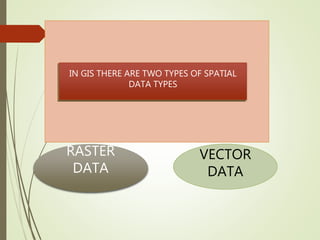
IN GIS THEARE ARE TWO BASIC
SPATIAL DATA TYPES
RASTER
DATA
VECTOR
DATA
IN GIS THERE ARE TWO TYPES OF SPATIAL
DATA TYPES
Vector Data
Vector data provide a way to represent real world features within
the GIS environment. A vector feature has its shape represented
using geometry. The geometry is made up of one or more
interconnected vertices. A vertex describe a position in space
using an x, y and optionally z axis. In the vector data model,
features on the earth are represented as:
• points
• lines / routes
• polygons / regions
• TINs (triangulated irregular networks)
Vector Data
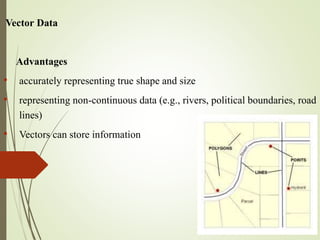
This system of recording features is based on the interaction
between arcs and nodes, represented by points, lines and
polygons. A point is a single node, a line is two nodes with an arc
between them, and a polygon is a closed group of three or more
arcs. With these three elements , it is possible to record most all
necessary information.
Points
Polygons
Lines
Vector Data
Advantages
• accurately representing true shape and size
• representing non-continuous data (e.g., rivers, political boundaries, road
lines)
• Vectors can store information
About topology
• A vector data model uses points stored by their
real (earth) coordinates and so requires a precise
coordinate system. Geographic Coordinate
System Latitude/Longitude Cartesian Coordinate
Systems X,Y Coordinate system
Vector Data
Disadvantages:
• The location of each vertex needs to be stored explicitly.
• Vector data must be converted into a topological structure.
• This is often processing intensive and usually requires
extensive data cleaning.
• Updating or editing of the vector data requires re-building of
the topology.
Vector Data
Vector Data
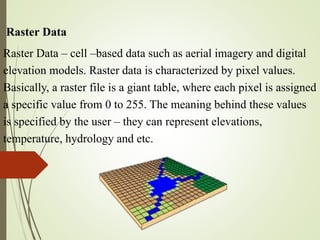
Raster Data
Raster Data – cell –based data such as aerial imagery and digital
elevation models. Raster data is characterized by pixel values.
Basically, a raster file is a giant table, where each pixel is assigned
a specific value from 0 to 255. The meaning behind these values
is specified by the user – they can represent elevations,
temperature, hydrology and etc.
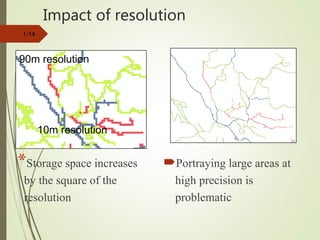
Impact of resolution
Portraying large areas at
high precision is
problematic
1-14
90m resolution
10m resolution
*Storage space increases
by the square of the
resolution
Advantages:
• Raster is the best way to store continuously changing values
such as elevation, slope.
• Analysis faster and more flexible then vector for many
application.
• Rapid computations ("map algebra") in which raster layers are
treated as elements in mathematical expressions
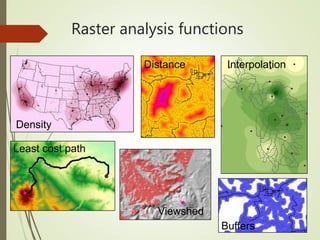
Raster analysis functions
Density
Least cost path
Distance Interpolation
Viewshed
Buffers
Raster Data
Disadvantages:
• It is especially difficult to adequately represent linear features
depending on the cell resolution.
• Network linkages are difficult to establish.
• Processing of associated attribute data may be cumbersome if
large amounts of data exists.
• Raster maps inherently reflect only one attribute or
characteristic for an area.
• Most output maps from grid-cell systems do not conform to
high-quality cartographic needs.
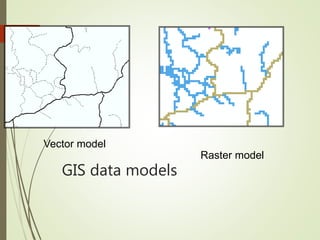
GIS data models
1-18
Vector model
Raster model
Sources for GIS data
 Analog maps
 Aerial photographs
 Satellite image
 Ground survey with GPS
 Reports and publications
Remote Sensing and GIS in Water Management © Dr. Saiful Islam, IWFM, BUET

Spatial data for GIS

  • 1.
    Spatial Data  PreparedBy  Md. Akram Ullah Lecturer FIMS,NSTU
  • 2.
    Spatial data The dataor information that identifies the geographic location of features and boundaries. On earth, such as natural and constructed features like Ocean, lake, pond etc. Spatial data is usually stored as coordinate and topology, and is data that can be mapped.
  • 3.
    IN GIS THEAREARE TWO BASIC SPATIAL DATA TYPES RASTER DATA VECTOR DATA IN GIS THERE ARE TWO TYPES OF SPATIAL DATA TYPES
  • 4.
    Vector Data Vector dataprovide a way to represent real world features within the GIS environment. A vector feature has its shape represented using geometry. The geometry is made up of one or more interconnected vertices. A vertex describe a position in space using an x, y and optionally z axis. In the vector data model, features on the earth are represented as:
  • 5.
    • points • lines/ routes • polygons / regions • TINs (triangulated irregular networks)
  • 6.
    Vector Data This systemof recording features is based on the interaction between arcs and nodes, represented by points, lines and polygons. A point is a single node, a line is two nodes with an arc between them, and a polygon is a closed group of three or more arcs. With these three elements , it is possible to record most all necessary information.
  • 7.
  • 8.
    Vector Data Advantages • accuratelyrepresenting true shape and size • representing non-continuous data (e.g., rivers, political boundaries, road lines) • Vectors can store information
  • 9.
    About topology • Avector data model uses points stored by their real (earth) coordinates and so requires a precise coordinate system. Geographic Coordinate System Latitude/Longitude Cartesian Coordinate Systems X,Y Coordinate system
  • 10.
    Vector Data Disadvantages: • Thelocation of each vertex needs to be stored explicitly. • Vector data must be converted into a topological structure. • This is often processing intensive and usually requires extensive data cleaning. • Updating or editing of the vector data requires re-building of the topology.
  • 11.
  • 12.
  • 13.
    Raster Data Raster Data– cell –based data such as aerial imagery and digital elevation models. Raster data is characterized by pixel values. Basically, a raster file is a giant table, where each pixel is assigned a specific value from 0 to 255. The meaning behind these values is specified by the user – they can represent elevations, temperature, hydrology and etc.
  • 14.
    Impact of resolution Portrayinglarge areas at high precision is problematic 1-14 90m resolution 10m resolution *Storage space increases by the square of the resolution
  • 15.
    Advantages: • Raster isthe best way to store continuously changing values such as elevation, slope. • Analysis faster and more flexible then vector for many application. • Rapid computations ("map algebra") in which raster layers are treated as elements in mathematical expressions
  • 16.
    Raster analysis functions Density Leastcost path Distance Interpolation Viewshed Buffers
  • 17.
    Raster Data Disadvantages: • Itis especially difficult to adequately represent linear features depending on the cell resolution. • Network linkages are difficult to establish. • Processing of associated attribute data may be cumbersome if large amounts of data exists. • Raster maps inherently reflect only one attribute or characteristic for an area. • Most output maps from grid-cell systems do not conform to high-quality cartographic needs.
  • 18.
    GIS data models 1-18 Vectormodel Raster model
  • 19.
    Sources for GISdata  Analog maps  Aerial photographs  Satellite image  Ground survey with GPS  Reports and publications Remote Sensing and GIS in Water Management © Dr. Saiful Islam, IWFM, BUET