Preparation and Presentation of Geospatial
Data in Maps
AFM Tariqul Islam
Scientific Officer, BARI,Gazipur
E-mail: afmtareq@gmail.com
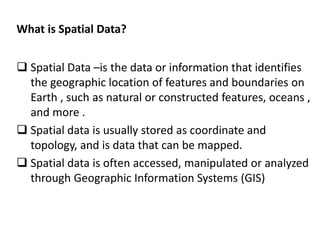
What is Spatial Data?
 Spatial Data –is the data or information that identifies
the geographic location of features and boundaries on
Earth , such as natural or constructed features, oceans ,
and more .
 Spatial data is usually stored as coordinate and
topology, and is data that can be mapped.
 Spatial data is often accessed, manipulated or analyzed
through Geographic Information Systems (GIS)
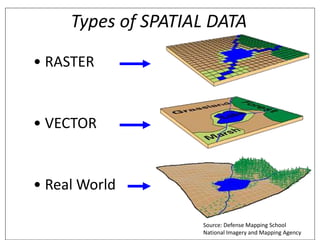
Types of SPATIAL DATA
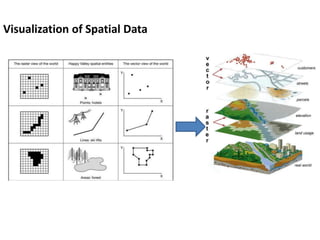
• RASTER
• VECTOR
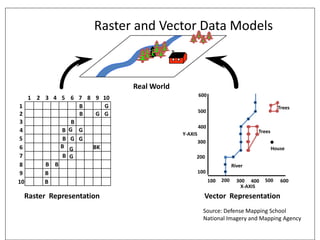
• Real World
Source: Defense Mapping School
National Imagery and Mapping Agency
Raster and Vector Data Models
Vector Representation
X-AXIS
500
400
300
200
100
600
500
400
300
200
100
Y-AXIS
River
House
600
Trees
Trees
B
B
B B
B
B
B
B G
G
BK
B
B
B
G
G
G G
G
Raster Representation
1 2 3 4 5 6 7 8 9 10
1
2
3
4
5
6
7
8
9
10
Real World
G
G
Source: Defense Mapping School
National Imagery and Mapping Agency
Vector Data
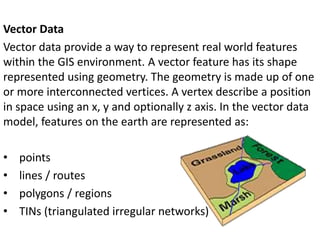
Vector data provide a way to represent real world features
within the GIS environment. A vector feature has its shape
represented using geometry. The geometry is made up of one
or more interconnected vertices. A vertex describe a position
in space using an x, y and optionally z axis. In the vector data
model, features on the earth are represented as:
• points
• lines / routes
• polygons / regions
• TINs (triangulated irregular networks)
Vector Data
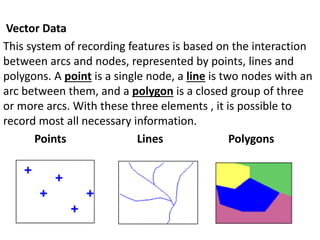
This system of recording features is based on the interaction
between arcs and nodes, represented by points, lines and
polygons. A point is a single node, a line is two nodes with an
arc between them, and a polygon is a closed group of three
or more arcs. With these three elements , it is possible to
record most all necessary information.
Points Lines Polygons
Raster Data
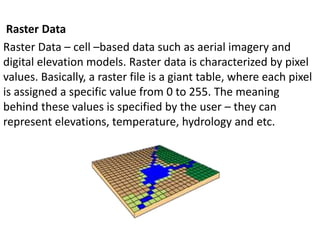
Raster Data – cell –based data such as aerial imagery and
digital elevation models. Raster data is characterized by pixel
values. Basically, a raster file is a giant table, where each pixel
is assigned a specific value from 0 to 255. The meaning
behind these values is specified by the user – they can
represent elevations, temperature, hydrology and etc.
Visualization of Spatial Data
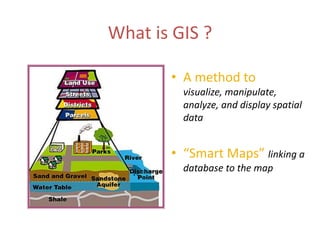
What is GIS ?
• A method to
visualize, manipulate,
analyze, and display spatial
data
• “Smart Maps” linking a
database to the map
GIS data formats (files)
• Shapefiles
• Coverages
• TIN (e.g. elevation can be stored as TIN)
– Triangulated Irregular Network
• Grid (e.g. elevation can be stored as Grid)
• Image (e.g. elevation can be stored as image)
Vector data
Raster data
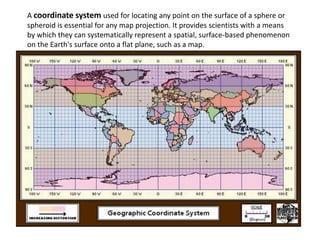
A coordinate system used for locating any point on the surface of a sphere or
spheroid is essential for any map projection. It provides scientists with a means
by which they can systematically represent a spatial, surface-based phenomenon
on the Earth's surface onto a flat plane, such as a map.
Introducing QGIS
Hands-on-Training
Geospatial Data Presentation
for Mapping
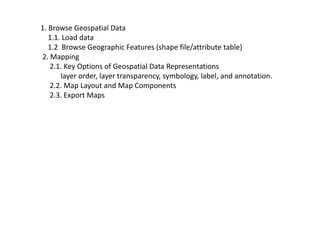
1. Browse Geospatial Data
1.1. Load data
1.2 Browse Geographic Features (shape file/attribute table)
2. Mapping
2.1. Key Options of Geospatial Data Representations
layer order, layer transparency, symbology, label, and annotation.
2.2. Map Layout and Map Components
2.3. Export Maps

Presentation spatial data nata final

  • 1.
    Preparation and Presentationof Geospatial Data in Maps AFM Tariqul Islam Scientific Officer, BARI,Gazipur E-mail: afmtareq@gmail.com
  • 2.
    What is SpatialData?  Spatial Data –is the data or information that identifies the geographic location of features and boundaries on Earth , such as natural or constructed features, oceans , and more .  Spatial data is usually stored as coordinate and topology, and is data that can be mapped.  Spatial data is often accessed, manipulated or analyzed through Geographic Information Systems (GIS)
  • 3.
    Types of SPATIALDATA • RASTER • VECTOR • Real World Source: Defense Mapping School National Imagery and Mapping Agency
  • 4.
    Raster and VectorData Models Vector Representation X-AXIS 500 400 300 200 100 600 500 400 300 200 100 Y-AXIS River House 600 Trees Trees B B B B B B B B G G BK B B B G G G G G Raster Representation 1 2 3 4 5 6 7 8 9 10 1 2 3 4 5 6 7 8 9 10 Real World G G Source: Defense Mapping School National Imagery and Mapping Agency
  • 5.
    Vector Data Vector dataprovide a way to represent real world features within the GIS environment. A vector feature has its shape represented using geometry. The geometry is made up of one or more interconnected vertices. A vertex describe a position in space using an x, y and optionally z axis. In the vector data model, features on the earth are represented as: • points • lines / routes • polygons / regions • TINs (triangulated irregular networks)
  • 6.
    Vector Data This systemof recording features is based on the interaction between arcs and nodes, represented by points, lines and polygons. A point is a single node, a line is two nodes with an arc between them, and a polygon is a closed group of three or more arcs. With these three elements , it is possible to record most all necessary information. Points Lines Polygons
  • 7.
    Raster Data Raster Data– cell –based data such as aerial imagery and digital elevation models. Raster data is characterized by pixel values. Basically, a raster file is a giant table, where each pixel is assigned a specific value from 0 to 255. The meaning behind these values is specified by the user – they can represent elevations, temperature, hydrology and etc.
  • 8.
  • 9.
    What is GIS? • A method to visualize, manipulate, analyze, and display spatial data • “Smart Maps” linking a database to the map
  • 12.
    GIS data formats(files) • Shapefiles • Coverages • TIN (e.g. elevation can be stored as TIN) – Triangulated Irregular Network • Grid (e.g. elevation can be stored as Grid) • Image (e.g. elevation can be stored as image) Vector data Raster data
  • 13.
    A coordinate systemused for locating any point on the surface of a sphere or spheroid is essential for any map projection. It provides scientists with a means by which they can systematically represent a spatial, surface-based phenomenon on the Earth's surface onto a flat plane, such as a map.
  • 14.
  • 15.
    1. Browse GeospatialData 1.1. Load data 1.2 Browse Geographic Features (shape file/attribute table) 2. Mapping 2.1. Key Options of Geospatial Data Representations layer order, layer transparency, symbology, label, and annotation. 2.2. Map Layout and Map Components 2.3. Export Maps