Bibin bhaskaran
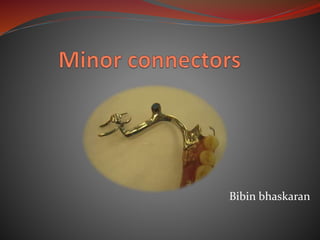
Minor connectors
Definition-
 Components that serve as the connecting link between
major connector or base of a removable partial denture and
other components of the prosthesis,such as the clasp
assembly,indirect retainers,occlusal rests,or cingulum rests.
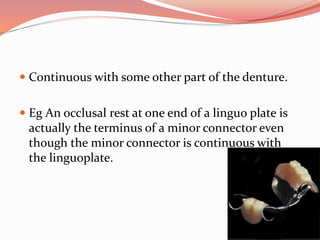
 Continuous with some other part of the denture.
 Eg An occlusal rest at one end of a linguo plate is
actually the terminus of a minor connector even
though the minor connector is continuous with
the linguoplate.
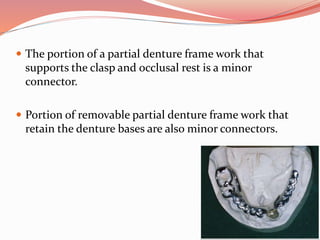
 The portion of a partial denture frame work that
supports the clasp and occlusal rest is a minor
connector.
 Portion of removable partial denture frame work that
retain the denture bases are also minor connectors.
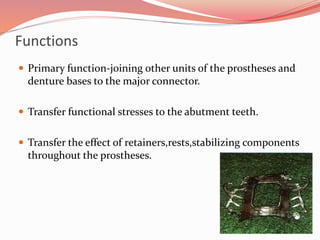
Functions

 Primary function-joining other units of the prostheses and
denture bases to the major connector.
 Transfer functional stresses to the abutment teeth.
 Transfer the effect of retainers,rests,stabilizing components
throughout the prostheses.
 Distributes the stresses that occur against certain
components of partial denture to other components.
 Distributes forces on the edentulous ridge to the ridge and
the remaining teeth.
This broad distribution of force prevents any one tooth or one portion of
the edentulous ridge from bearing a destructive amount of stress.
Form and location
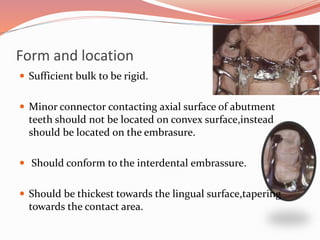
 Sufficient bulk to be rigid.
 Minor connector contacting axial surface of abutment
teeth should not be located on convex surface,instead
should be located on the embrasure.
 Should conform to the interdental embrassure.
 Should be thickest towards the lingual surface,tapering
towards the contact area.
 Deepest part of interdental embrassure should have been
blocked out to avoid interference during placement and
removal.
 When a minor connector contacts tooth surfaces on either
side of the embrassure in which it lies,it should be tapered to
the teeth.
 Minor connector should be wide enough to use the guiding
plane to the fullest advantage.
 When it gives rise to clasp arm it should be tapered.
 Whenever possible, the minor connector of a removable
partial denture is located in the interdental embrasure.
 Recent evidence suggests that gingival attachment loss is
more probable on the proximal aspect, thus minor
connectors located in embrasures cover susceptible sites.
“A variation in minor connector design for partial dentures,Radford DR, Walter JD
Int J Prosthodont. 1993 Jan-Feb;6(1):50-4.”
 The framework designs offering strong retention for
acrylic resin bases allowed the use of a greater bulk of
acrylic resin projecting through openings in the metal
retention design.
“Dunny J A, King G E, Minor connector designs for anterior acrylic resin bases: a
preliminary study. J Prosthet Dent 1975,34:496-502.”
Types
4 types –
 Join the clasp assembly to the major connector.
 Join direct retainers or auxillary rests to the major
connector.
 Join the denture base to the major connector.
 Serve as an approach arm for a vertical projection or bar
type.
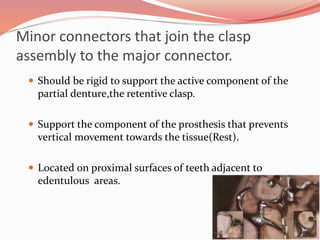
Minor connectors that join the clasp
assembly to the major connector.
 Should be rigid to support the active component of the
partial denture,the retentive clasp.
 Support the component of the prosthesis that prevents
vertical movement towards the tissue(Rest).
 Located on proximal surfaces of teeth adjacent to
edentulous areas.
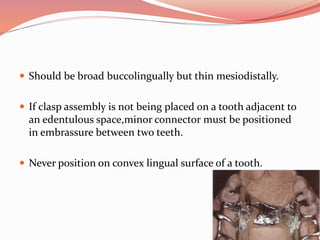
 Should be broad buccolingually but thin mesiodistally.
 If clasp assembly is not being placed on a tooth adjacent to
an edentulous space,minor connector must be positioned
in embrassure between two teeth.
 Never position on convex lingual surface of a tooth.
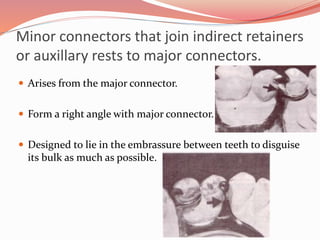
Minor connectors that join indirect retainers
or auxillary rests to major connectors.
 Arises from the major connector.
 Form a right angle with major connector.
 Designed to lie in the embrassure between teeth to disguise
its bulk as much as possible.
Minor connector that join denture base to
major connector
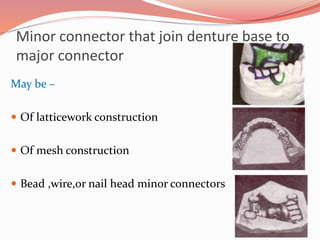
May be –
 Of latticework construction
 Of mesh construction
 Bead ,wire,or nail head minor connectors
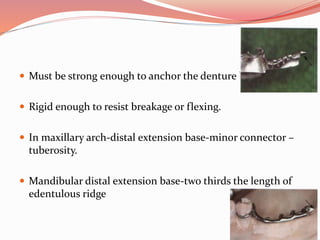
 Must be strong enough to anchor the denture base.
 Rigid enough to resist breakage or flexing.
 In maxillary arch-distal extension base-minor connector –
tuberosity.
 Mandibular distal extension base-two thirds the length of
edentulous ridge
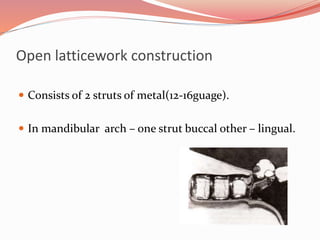
Open latticework construction
 Consists of 2 struts of metal(12-16guage).
 In mandibular arch – one strut buccal other – lingual.
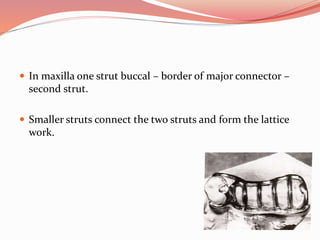
 In maxilla one strut buccal – border of major connector –
second strut.
 Smaller struts connect the two struts and form the lattice
work.
 Longitudinal struts avoided– artificial teeth arrangement.
 Relief space given for both lattice work and mesh work
minor connectors.
 Acrylic denture base will be formed in this space.
 Locking of acrylic resin provides retention of denture base.
 Used – multiple teeth replacements.
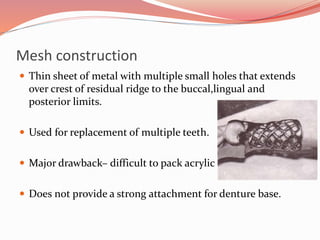
Mesh construction
 Thin sheet of metal with multiple small holes that extends
over crest of residual ridge to the buccal,lingual and
posterior limits.
 Used for replacement of multiple teeth.
 Major drawback– difficult to pack acrylic resin.
 Does not provide a strong attachment for denture base.
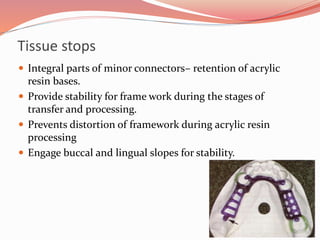
Tissue stops
 Integral parts of minor connectors– retention of acrylic
resin bases.
 Provide stability for frame work during the stages of
transfer and processing.
 Prevents distortion of framework during acrylic resin
processing
 Engage buccal and lingual slopes for stability.
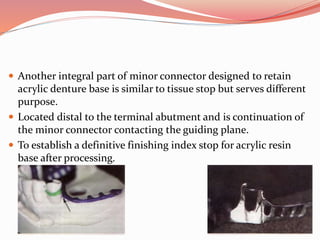
 Another integral part of minor connector designed to retain
acrylic denture base is similar to tissue stop but serves different
purpose.
 Located distal to the terminal abutment and is continuation of
the minor connector contacting the guiding plane.
 To establish a definitive finishing index stop for acrylic resin
base after processing.
Fabrication
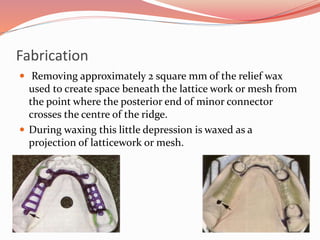
 Removing approximately 2 square mm of the relief wax
used to create space beneath the lattice work or mesh from
the point where the posterior end of minor connector
crosses the centre of the ridge.
 During waxing this little depression is waxed as a
projection of latticework or mesh.
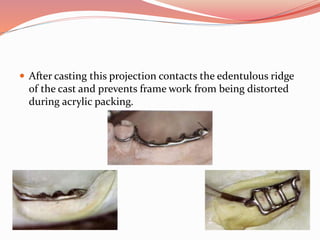
 After casting this projection contacts the edentulous ridge
of the cast and prevents frame work from being distorted
during acrylic packing.
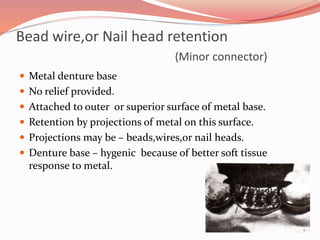
Bead wire,or Nail head retention
(Minor connector)
 Metal denture base
 No relief provided.
 Attached to outer or superior surface of metal base.
 Retention by projections of metal on this surface.
 Projections may be – beads,wires,or nail heads.
 Denture base – hygenic because of better soft tissue
response to metal.
Shortcomings –
 Difficult to adjust metal base.
 Cannot be adequately relined.
 Weakest attachment of 3 types.
“Should be used on tooth-supported,well healed ridges when interarch space is
limited.”
Attachment to major connector
 Acrylic resin minor connector must be joined to major
connector with sufficient bulk to avoid fracture.
 Must join in a smooth,event joint.
 Irregularity b/w surface irritates tongue or mucosa of the
ridge.
 Acrylic resin– butt joint must be made on both internal
and external surfaces of the major connector.
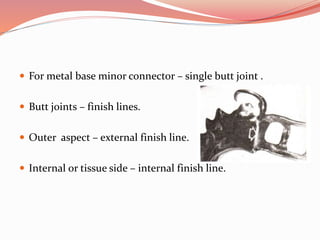
 For metal base minor connector – single butt joint .
 Butt joints – finish lines.
 Outer aspect – external finish line.
 Internal or tissue side – internal finish line.
Finish lines
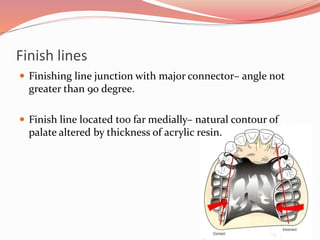
 Finishing line junction with major connector– angle not
greater than 90 degree.
 Finish line located too far medially– natural contour of
palate altered by thickness of acrylic resin.
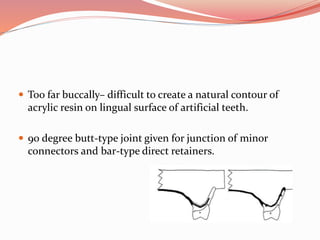
 Too far buccally– difficult to create a natural contour of
acrylic resin on lingual surface of artificial teeth.
 90 degree butt-type joint given for junction of minor
connectors and bar-type direct retainers.
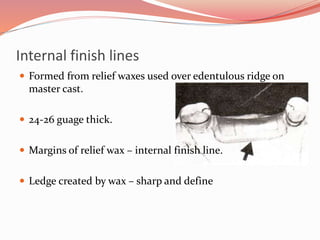
Internal finish lines
 Formed from relief waxes used over edentulous ridge on
master cast.
 24-26 guage thick.
 Margins of relief wax – internal finish line.
 Ledge created by wax – sharp and define
External finish lines
 Sharp and definite and should be slightly undercut to help
lock acrylic resin securely to major connector.
 Angle the finish line forms with major connector – less
than 90 degree.
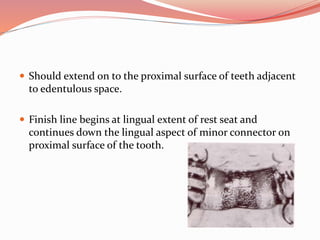
 Should extend on to the proximal surface of teeth adjacent
to edentulous space.
 Finish line begins at lingual extent of rest seat and
continues down the lingual aspect of minor connector on
proximal surface of the tooth.
Minor connector that serve as approach
arm for vertical projection or bar-type clasp.
 Only non rigid minor connector.
 Supports a direct retainer that engages an undercut on a
tooth from below.
 Approaches tooth from gingival margin.
 Should be smooth,even and taper from its origin to its
terminus.
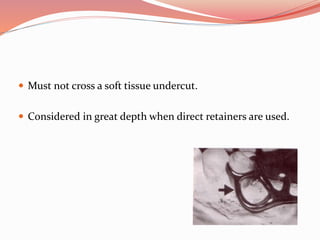
 Must not cross a soft tissue undercut.
 Considered in great depth when direct retainers are used.
References
 Carr A B, Mc Givney G P, Brown D T, Minor connector in
McCraken’s Removable partial Prothodontics. 11th ed, st
louis: Mosby; 2008, 35-53.
 Stewart K L, Rudd K D, Kuebker W A, Minor connector in
Stewart’s Clinical Removable Partial Prosthodontics. 2nd ed,
2004, 22-42.
 Miller E L, Grasso J E, Major connector in Removable Partial
Prosthodontics. 2nd ed, Baltimore: Williams & Wilkins;
1979, 175-94.
 Dunny J A, King G E, Minor connector designs for anterior
acrylic resin bases: a preliminary study. J Prosthet Dent
1975,34:496-502.
 Brown D T, Desjardins R P, Chao EY.Fatigue failure in
acrylic resin retaining minor connections. J Prosthet Dent
1987;58:329-35.
 A variation in minor connector design for partial
dentures,Radford DR, Walter JD Int J Prosthodont. 1993
Jan-Feb;6(1):50-4.
 Davenport JC, Basker RM, Heath JR, Ralph JP, Glantz P-O,
Hammond P. Connectors. British Dental Journal 2001; 190:
184–191.
Minor connectors

Minor connectors

  • 1.
  • 2.
    Minor connectors Definition-  Componentsthat serve as the connecting link between major connector or base of a removable partial denture and other components of the prosthesis,such as the clasp assembly,indirect retainers,occlusal rests,or cingulum rests.
  • 3.
     Continuous withsome other part of the denture.  Eg An occlusal rest at one end of a linguo plate is actually the terminus of a minor connector even though the minor connector is continuous with the linguoplate.
  • 4.
     The portionof a partial denture frame work that supports the clasp and occlusal rest is a minor connector.  Portion of removable partial denture frame work that retain the denture bases are also minor connectors.
  • 5.
    Functions  Primary function-joiningother units of the prostheses and denture bases to the major connector.  Transfer functional stresses to the abutment teeth.  Transfer the effect of retainers,rests,stabilizing components throughout the prostheses.
  • 6.
     Distributes thestresses that occur against certain components of partial denture to other components.  Distributes forces on the edentulous ridge to the ridge and the remaining teeth. This broad distribution of force prevents any one tooth or one portion of the edentulous ridge from bearing a destructive amount of stress.
  • 7.
    Form and location Sufficient bulk to be rigid.  Minor connector contacting axial surface of abutment teeth should not be located on convex surface,instead should be located on the embrasure.  Should conform to the interdental embrassure.  Should be thickest towards the lingual surface,tapering towards the contact area.
  • 8.
     Deepest partof interdental embrassure should have been blocked out to avoid interference during placement and removal.  When a minor connector contacts tooth surfaces on either side of the embrassure in which it lies,it should be tapered to the teeth.  Minor connector should be wide enough to use the guiding plane to the fullest advantage.  When it gives rise to clasp arm it should be tapered.
  • 9.
     Whenever possible,the minor connector of a removable partial denture is located in the interdental embrasure.  Recent evidence suggests that gingival attachment loss is more probable on the proximal aspect, thus minor connectors located in embrasures cover susceptible sites. “A variation in minor connector design for partial dentures,Radford DR, Walter JD Int J Prosthodont. 1993 Jan-Feb;6(1):50-4.”
  • 10.
     The frameworkdesigns offering strong retention for acrylic resin bases allowed the use of a greater bulk of acrylic resin projecting through openings in the metal retention design. “Dunny J A, King G E, Minor connector designs for anterior acrylic resin bases: a preliminary study. J Prosthet Dent 1975,34:496-502.”
  • 11.
    Types 4 types – Join the clasp assembly to the major connector.  Join direct retainers or auxillary rests to the major connector.  Join the denture base to the major connector.  Serve as an approach arm for a vertical projection or bar type.
  • 12.
    Minor connectors thatjoin the clasp assembly to the major connector.  Should be rigid to support the active component of the partial denture,the retentive clasp.  Support the component of the prosthesis that prevents vertical movement towards the tissue(Rest).  Located on proximal surfaces of teeth adjacent to edentulous areas.
  • 13.
     Should bebroad buccolingually but thin mesiodistally.  If clasp assembly is not being placed on a tooth adjacent to an edentulous space,minor connector must be positioned in embrassure between two teeth.  Never position on convex lingual surface of a tooth.
  • 14.
    Minor connectors thatjoin indirect retainers or auxillary rests to major connectors.  Arises from the major connector.  Form a right angle with major connector.  Designed to lie in the embrassure between teeth to disguise its bulk as much as possible.
  • 15.
    Minor connector thatjoin denture base to major connector May be –  Of latticework construction  Of mesh construction  Bead ,wire,or nail head minor connectors
  • 16.
     Must bestrong enough to anchor the denture base.  Rigid enough to resist breakage or flexing.  In maxillary arch-distal extension base-minor connector – tuberosity.  Mandibular distal extension base-two thirds the length of edentulous ridge
  • 17.
    Open latticework construction Consists of 2 struts of metal(12-16guage).  In mandibular arch – one strut buccal other – lingual.
  • 18.
     In maxillaone strut buccal – border of major connector – second strut.  Smaller struts connect the two struts and form the lattice work.
  • 19.
     Longitudinal strutsavoided– artificial teeth arrangement.  Relief space given for both lattice work and mesh work minor connectors.  Acrylic denture base will be formed in this space.  Locking of acrylic resin provides retention of denture base.  Used – multiple teeth replacements.
  • 20.
    Mesh construction  Thinsheet of metal with multiple small holes that extends over crest of residual ridge to the buccal,lingual and posterior limits.  Used for replacement of multiple teeth.  Major drawback– difficult to pack acrylic resin.  Does not provide a strong attachment for denture base.
  • 21.
    Tissue stops  Integralparts of minor connectors– retention of acrylic resin bases.  Provide stability for frame work during the stages of transfer and processing.  Prevents distortion of framework during acrylic resin processing  Engage buccal and lingual slopes for stability.
  • 22.
     Another integralpart of minor connector designed to retain acrylic denture base is similar to tissue stop but serves different purpose.  Located distal to the terminal abutment and is continuation of the minor connector contacting the guiding plane.  To establish a definitive finishing index stop for acrylic resin base after processing.
  • 23.
    Fabrication  Removing approximately2 square mm of the relief wax used to create space beneath the lattice work or mesh from the point where the posterior end of minor connector crosses the centre of the ridge.  During waxing this little depression is waxed as a projection of latticework or mesh.
  • 24.
     After castingthis projection contacts the edentulous ridge of the cast and prevents frame work from being distorted during acrylic packing.
  • 25.
    Bead wire,or Nailhead retention (Minor connector)  Metal denture base  No relief provided.  Attached to outer or superior surface of metal base.  Retention by projections of metal on this surface.  Projections may be – beads,wires,or nail heads.  Denture base – hygenic because of better soft tissue response to metal.
  • 26.
    Shortcomings –  Difficultto adjust metal base.  Cannot be adequately relined.  Weakest attachment of 3 types. “Should be used on tooth-supported,well healed ridges when interarch space is limited.”
  • 27.
    Attachment to majorconnector  Acrylic resin minor connector must be joined to major connector with sufficient bulk to avoid fracture.  Must join in a smooth,event joint.  Irregularity b/w surface irritates tongue or mucosa of the ridge.  Acrylic resin– butt joint must be made on both internal and external surfaces of the major connector.
  • 28.
     For metalbase minor connector – single butt joint .  Butt joints – finish lines.  Outer aspect – external finish line.  Internal or tissue side – internal finish line.
  • 29.
    Finish lines  Finishingline junction with major connector– angle not greater than 90 degree.  Finish line located too far medially– natural contour of palate altered by thickness of acrylic resin.
  • 30.
     Too farbuccally– difficult to create a natural contour of acrylic resin on lingual surface of artificial teeth.  90 degree butt-type joint given for junction of minor connectors and bar-type direct retainers.
  • 31.
    Internal finish lines Formed from relief waxes used over edentulous ridge on master cast.  24-26 guage thick.  Margins of relief wax – internal finish line.  Ledge created by wax – sharp and define
  • 32.
    External finish lines Sharp and definite and should be slightly undercut to help lock acrylic resin securely to major connector.  Angle the finish line forms with major connector – less than 90 degree.
  • 33.
     Should extendon to the proximal surface of teeth adjacent to edentulous space.  Finish line begins at lingual extent of rest seat and continues down the lingual aspect of minor connector on proximal surface of the tooth.
  • 34.
    Minor connector thatserve as approach arm for vertical projection or bar-type clasp.  Only non rigid minor connector.  Supports a direct retainer that engages an undercut on a tooth from below.  Approaches tooth from gingival margin.  Should be smooth,even and taper from its origin to its terminus.
  • 35.
     Must notcross a soft tissue undercut.  Considered in great depth when direct retainers are used.
  • 36.
    References  Carr AB, Mc Givney G P, Brown D T, Minor connector in McCraken’s Removable partial Prothodontics. 11th ed, st louis: Mosby; 2008, 35-53.  Stewart K L, Rudd K D, Kuebker W A, Minor connector in Stewart’s Clinical Removable Partial Prosthodontics. 2nd ed, 2004, 22-42.  Miller E L, Grasso J E, Major connector in Removable Partial Prosthodontics. 2nd ed, Baltimore: Williams & Wilkins; 1979, 175-94.
  • 37.
     Dunny JA, King G E, Minor connector designs for anterior acrylic resin bases: a preliminary study. J Prosthet Dent 1975,34:496-502.  Brown D T, Desjardins R P, Chao EY.Fatigue failure in acrylic resin retaining minor connections. J Prosthet Dent 1987;58:329-35.
  • 38.
     A variationin minor connector design for partial dentures,Radford DR, Walter JD Int J Prosthodont. 1993 Jan-Feb;6(1):50-4.  Davenport JC, Basker RM, Heath JR, Ralph JP, Glantz P-O, Hammond P. Connectors. British Dental Journal 2001; 190: 184–191.