ANILA SHAH
BDS FINAL YEAR
MINOR CONNECTOR
 The connecting link between the major connector or
base of the partial removable dental prosthesis and
other units of prosthesis , such as the clasp assembly
,indirect retainers , occlusal rests ,or cingulum rests
TYPES
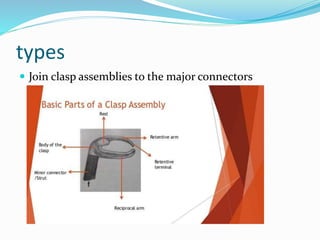
 Join clasp assemblies to the major connectors
 Join denture bases to the major connectors
 Join indirect retainers or auxillary rests to the major
connectors
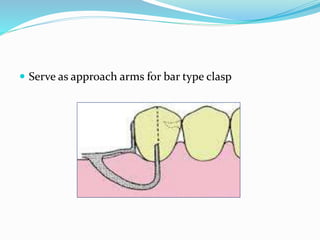
 Serve as approach arms for bar type clasp
types
 Join clasp assemblies to the major connectors
 Join denture bases to the major connectors
 Join indirect retainers or auxillary rests to the major
connectors
 Serve as approach arms for bar type clasp
Functions
 Joining other units of prosthesis and dentures bases to
the major connector.
 Prosthesis to abutment function . Transfer functional
stress to the abutment teeth .
 Abutment to prosthesis function of minor connector .
Transfers the effects of retainers , rests , and stabilizing
components throughout the prosthesis.
Forms and location
 Sufficient bulk to be rigid
 Minor connector contacting axial surface of abutment
teeth should not be located on convex surface , instead
should be located on the embrasure.
 Should conform to the interdental embrasures.

 Should be thickest towards the lingual
surface , tapering towards the contact
area
 Deepest part of interdental
embrassure should have been blocked
out to avoid interference during
placement and removal.

 Minor connector should be wide
enough to use the guiding plane to the
fullest advantage.
 When it gives rise to clasp arm it
should be tapered.
 Bar clasp –tapered to the knife edge
modification
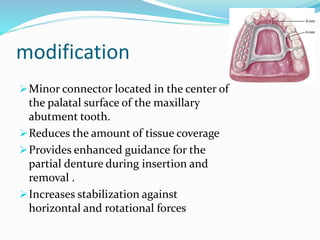
Minor connector located in the center of
the palatal surface of the maxillary
abutment tooth.
Reduces the amount of tissue coverage
Provides enhanced guidance for the
partial denture during insertion and
removal .
Increases stabilization against
horizontal and rotational forces
drawback
 Greater potential space for food entrapment
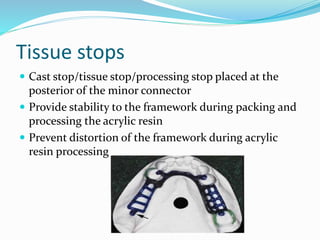
Tissue stops
 Cast stop/tissue stop/processing stop placed at the
posterior of the minor connector
 Provide stability to the framework during packing and
processing the acrylic resin
 Prevent distortion of the framework during acrylic
resin processing
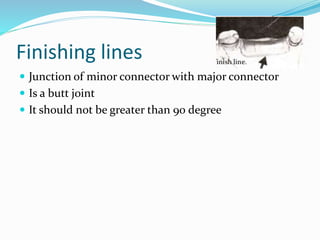
Finishing lines
 Junction of minor connector with major connector
 Is a butt joint
 It should not be greater than 90 degree
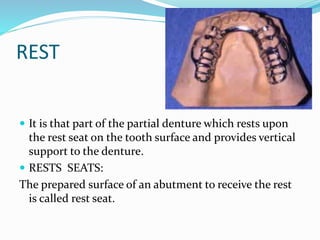
REST
 It is that part of the partial denture which rests upon
the rest seat on the tooth surface and provides vertical
support to the denture.
 RESTS SEATS:
The prepared surface of an abutment to receive the rest
is called rest seat.
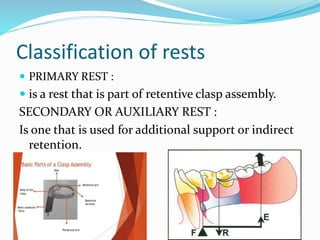
Classification of rests
 PRIMARY REST :
 is a rest that is part of retentive clasp assembly.
SECONDARY OR AUXILIARY REST :
Is one that is used for additional support or indirect
retention.
types
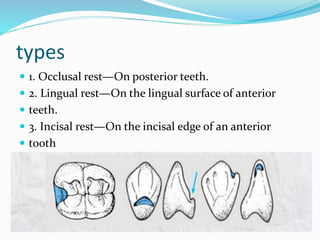
 1. Occlusal rest—On posterior teeth.
 2. Lingual rest—On the lingual surface of anterior
 teeth.
 3. Incisal rest—On the incisal edge of an anterior
 tooth
FUNCTIONS
 1. Prevent vertical displacement of the denture
 towards the soft tissues.
 2. Transfer the load of the mastication to the natural
 teeth.
 3. Prevent occlusal imbalance.
 4. Retain clasps in their correct position.
 5. Prevent food packing between denture and natural
 teeth.
OCCLUSAL REST
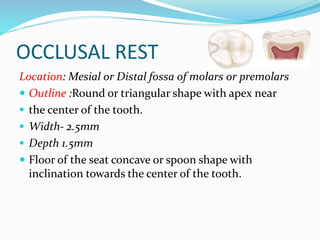
Location: Mesial or Distal fossa of molars or premolars
 Outline :Round or triangular shape with apex near
 the center of the tooth.
 Width- 2.5mm
 Depth 1.5mm
 Floor of the seat concave or spoon shape with
inclination towards the center of the tooth.
requirements
 Rest must fit tooth rest seat accurately to prevent food
collection.
 Should be strong to take-up load of mastication.

 The angle formed by occlusal rest and vertical minor
connector should be <90 degree
Extended occlusal rest
 Kennedy’s class II and class III situations .
 An extended occlusal rest should be designed &
prepared to minimize further tipping of the abutment.

 Rest should extends more >1/2 of mesiodistal width
 = one thirds the buccolingual width of the tooth
 & should allow for a minimum of 1mm thickness of the
metal,
 the preparation should be rounded with no undercuts or
sharp angles.
 If abutment is severely tilted the extended occlusal rest
may be in form of onlays .
Interproximal occlusal rest
 They are prepared as an individual occlusal rest seats
except that the preparation must be extended further
lingually than an ordinarily accomplished .
 Used to avoid interproximal wedging
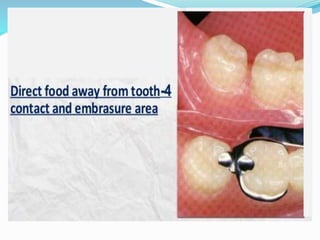
 Additionally the joint rests are designed to shunt food
away from contact points. .
Lingual rests
 Cingulum rest
 Ball rest
 Location: On canines and Incisors.
 Indications
 a. Where anterior tooth is the only abutment available
 for occlusal support.
 b. To support indirect retainer.
 c. As an extra rest.
 A rounded inverted V shape preparation ( the apex of
V is directed incisally
 The most satisfactory lingual rest is one that is placed
on a prepared rest seat in a cast restoration .
 This is done most effectively by planning and
executing a rest seat in the wax pattern rather than by
attempting to cut a rest in a caste restoration in the
mouth .
Incisal rest
 A rigid extension of RPD placed at
the incisal angles of anterior teeth
on prepared rest seats.
 Commonly used as an auxillary or
indirect retainer
 More applicable on the mandibular
teeth , due to lack of inadequate
thickness of enamel on the lingual
surface .
Preparation of rest seat
 In the form of rounded notch at the incisal angle
 Deepest preparation apical to the incisal edge
 The notch should be beveled on both facial and
lingual surfaces.
 2.5mm wide 1.5mm deep
Minor connectors and rests

Minor connectors and rests

  • 1.
  • 2.
    MINOR CONNECTOR  Theconnecting link between the major connector or base of the partial removable dental prosthesis and other units of prosthesis , such as the clasp assembly ,indirect retainers , occlusal rests ,or cingulum rests
  • 3.
    TYPES  Join claspassemblies to the major connectors  Join denture bases to the major connectors  Join indirect retainers or auxillary rests to the major connectors  Serve as approach arms for bar type clasp
  • 4.
    types  Join claspassemblies to the major connectors
  • 5.
     Join denturebases to the major connectors
  • 6.
     Join indirectretainers or auxillary rests to the major connectors
  • 7.
     Serve asapproach arms for bar type clasp
  • 8.
    Functions  Joining otherunits of prosthesis and dentures bases to the major connector.  Prosthesis to abutment function . Transfer functional stress to the abutment teeth .  Abutment to prosthesis function of minor connector . Transfers the effects of retainers , rests , and stabilizing components throughout the prosthesis.
  • 9.
    Forms and location Sufficient bulk to be rigid  Minor connector contacting axial surface of abutment teeth should not be located on convex surface , instead should be located on the embrasure.  Should conform to the interdental embrasures. 
  • 10.
     Should bethickest towards the lingual surface , tapering towards the contact area  Deepest part of interdental embrassure should have been blocked out to avoid interference during placement and removal.
  • 11.
      Minor connectorshould be wide enough to use the guiding plane to the fullest advantage.  When it gives rise to clasp arm it should be tapered.  Bar clasp –tapered to the knife edge
  • 12.
    modification Minor connector locatedin the center of the palatal surface of the maxillary abutment tooth. Reduces the amount of tissue coverage Provides enhanced guidance for the partial denture during insertion and removal . Increases stabilization against horizontal and rotational forces
  • 13.
    drawback  Greater potentialspace for food entrapment
  • 14.
    Tissue stops  Caststop/tissue stop/processing stop placed at the posterior of the minor connector  Provide stability to the framework during packing and processing the acrylic resin  Prevent distortion of the framework during acrylic resin processing
  • 15.
    Finishing lines  Junctionof minor connector with major connector  Is a butt joint  It should not be greater than 90 degree
  • 16.
    REST  It isthat part of the partial denture which rests upon the rest seat on the tooth surface and provides vertical support to the denture.  RESTS SEATS: The prepared surface of an abutment to receive the rest is called rest seat.
  • 17.
    Classification of rests PRIMARY REST :  is a rest that is part of retentive clasp assembly. SECONDARY OR AUXILIARY REST : Is one that is used for additional support or indirect retention.
  • 18.
    types  1. Occlusalrest—On posterior teeth.  2. Lingual rest—On the lingual surface of anterior  teeth.  3. Incisal rest—On the incisal edge of an anterior  tooth
  • 21.
    FUNCTIONS  1. Preventvertical displacement of the denture  towards the soft tissues.  2. Transfer the load of the mastication to the natural  teeth.  3. Prevent occlusal imbalance.  4. Retain clasps in their correct position.  5. Prevent food packing between denture and natural  teeth.
  • 23.
    OCCLUSAL REST Location: Mesialor Distal fossa of molars or premolars  Outline :Round or triangular shape with apex near  the center of the tooth.  Width- 2.5mm  Depth 1.5mm  Floor of the seat concave or spoon shape with inclination towards the center of the tooth.
  • 24.
    requirements  Rest mustfit tooth rest seat accurately to prevent food collection.  Should be strong to take-up load of mastication. 
  • 25.
     The angleformed by occlusal rest and vertical minor connector should be <90 degree
  • 26.
    Extended occlusal rest Kennedy’s class II and class III situations .  An extended occlusal rest should be designed & prepared to minimize further tipping of the abutment. 
  • 27.
     Rest shouldextends more >1/2 of mesiodistal width  = one thirds the buccolingual width of the tooth  & should allow for a minimum of 1mm thickness of the metal,  the preparation should be rounded with no undercuts or sharp angles.  If abutment is severely tilted the extended occlusal rest may be in form of onlays .
  • 28.
    Interproximal occlusal rest They are prepared as an individual occlusal rest seats except that the preparation must be extended further lingually than an ordinarily accomplished .  Used to avoid interproximal wedging  Additionally the joint rests are designed to shunt food away from contact points. .
  • 29.
    Lingual rests  Cingulumrest  Ball rest
  • 30.
     Location: Oncanines and Incisors.  Indications  a. Where anterior tooth is the only abutment available  for occlusal support.  b. To support indirect retainer.  c. As an extra rest.
  • 31.
     A roundedinverted V shape preparation ( the apex of V is directed incisally  The most satisfactory lingual rest is one that is placed on a prepared rest seat in a cast restoration .  This is done most effectively by planning and executing a rest seat in the wax pattern rather than by attempting to cut a rest in a caste restoration in the mouth .
  • 32.
    Incisal rest  Arigid extension of RPD placed at the incisal angles of anterior teeth on prepared rest seats.  Commonly used as an auxillary or indirect retainer  More applicable on the mandibular teeth , due to lack of inadequate thickness of enamel on the lingual surface .
  • 33.
    Preparation of restseat  In the form of rounded notch at the incisal angle  Deepest preparation apical to the incisal edge  The notch should be beveled on both facial and lingual surfaces.  2.5mm wide 1.5mm deep