Removal partial denture considerations in maxillofacial prosthetics. (Part -1)
Index 1.  Maxilofacial prosthetics    Definition      Classification 2.  Timing of dental and maxillofacial prosthetic care for acquired defects     Post operative and intraoperative care     Interim care     Potential complications     Defect and oral hygiene     Definitive care
Index Intraoral prostheses design considerations.4. Surgical preservation for prostheses benefit    Maxillary defects    Mandibular defects    Mandibular reconstruction-bone grafts
Maxillofacial Prosthetics“the art and science of anatomic, functional, or cosmetic reconstruction by means of nonliving substitutes of those regions in the maxilla, mandible, and face that are missing or defective because of surgical intervention, trauma, pathology, or developmental or congenital malformations”
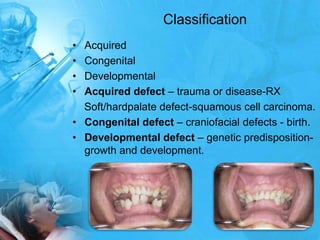
Classification Acquired CongenitalDevelopmentalAcquired defect – trauma or disease-RX    Soft/hardpalate defect-squamous cell carcinoma.Congenital defect – craniofacial defects - birth.Developmental defect – genetic predisposition-growth and development.
Classification Type of prostheisis under consideration-Extra-oral (cranial or facial replacement)Intra-oral (oral cavity)Interim (short periods)Definitive (more permanent)Treatment prosthesis (splint or stent)
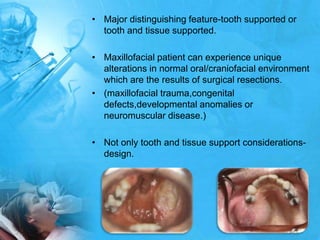
Major distinguishing feature-tooth supported or tooth and tissue supported.Maxillofacial patient can experience unique alterations in normal oral/craniofacial environment which are the results of surgical resections.(maxillofacial trauma,congenitaldefects,developmental anomalies or neuromuscular disease.)Not only tooth and tissue support considerations-design.
Timing of dental and maxillofacial prosthetic care for acquired defectsPreoperative and intrao-perative careInterim careDefinitive care
Preoperative and intraoperative carePlanning of prosthetic treatment for acquired oral defects-before surgery.Pt-head and neck surgery-dental needs.Dental objectives-preoperative and intraoperative care stage-potential dental postoperative complications-subsequent prosthetic Rx.
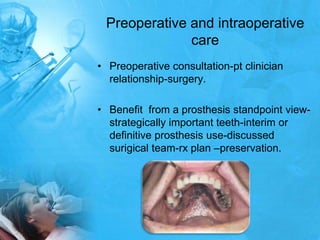
Preoperative and intraoperative carePreoperative consultation-pt clinician relationship-surgery.Benefit  from a prosthesis standpoint view-strategically important teeth-interim or definitive prosthesis use-discussed surigical team-rx plan –preservation.
Preoperative and intraoperative careImmediate postoperative period-challenging.Large carious lesion-endodontic therapy.Acute periodontal disease – treated-post pain.Nonrestorable tooth-interim care-removed-before/at time of surgical resection.
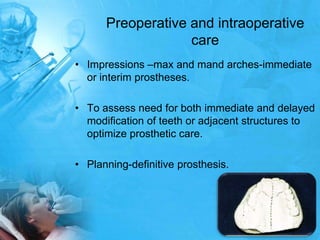
Preoperative and intraoperative careImpressions –max and mand arches-immediate or interim prostheses.To assess need for both immediate and delayed modification of teeth or adjacent structures to optimize prosthetic care.Planning-definitive prosthesis.
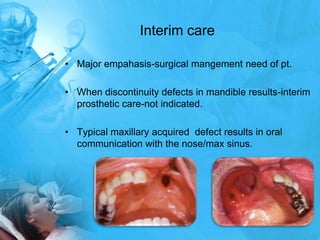
Interim careMajor empahasis-surgical mangementneed of pt.When discontinuity defects in mandible results-interim prosthetic care-not indicated.Typical maxillary acquired  defect results in oral communication with the nose/max sinus.
Interim careCreates physiological and functional deficiencies in mastication,degluttition and speech.Such defects-psychological.Major deficiency addressed by prosthetic management-interim care time-degluttition and speech.
Interim careAn initial focus on improvement in swallowing and speech with the interim prosthesis can help boost the rehabilitation process significantly.Objective of interim obturator prosthesis-separate-oral and nasal cavities-obturating communication.Such obturatorprostheis commonly refers – obturation of hard palatal defects-same for soft palate.
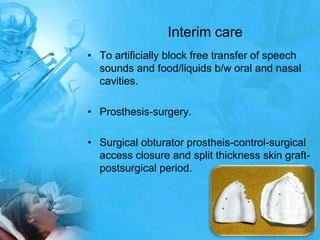
Interim careTo artificially block free transfer of speech sounds and food/liquids b/w oral and nasal cavities.Prosthesis-surgery.Surgical obturatorprostheis-control-surgical access closure and split thickness skin graft-postsurgical period.
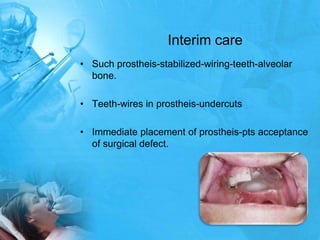
Interim careSuch prostheis-stabilized-wiring-teeth-alveolar bone.Teeth-wires in prostheis-undercutsImmediate placement of prostheis-pts acceptance of surgical defect.
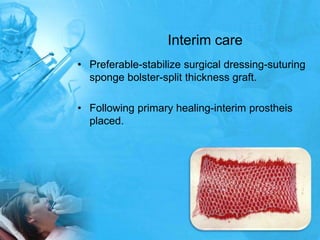
Interim carePreferable-stabilize surgical dressing-suturing sponge bolster-split thickness graft.Following primary healing-interim prostheis placed.
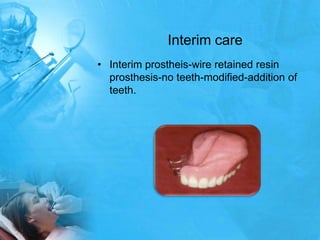
Interim careInterim prostheis-wire retained resin prosthesis-no teeth-modified-addition of teeth.
Interim careTotal maxillectomy-prosthesis support stability and retention –not satisfactory-extension of defect.Teeth present-impact of defect lessened.Few unilateral teeth-stability-prosthesis is less.
Potential complicationsDuration for interim phase-3-4 months.Primary objective-surgical-observation phase.Common interim prosthetic complications :-Tissue trauma and associated discomfort.Inadequate retention of max prostheisis.Incomleteobturation with leakage of air,food and liquid around obturator portion-prostheis.Tissue effects of chemotherapy and radiation therapy.
Potential complicationsCommon interim prosthetic complications :-Tissue trauma and associated discomfort.Inadequate retention.Incomplete obturation (leakage of air,food and liquid).Tissue effects of chemotherapy&radiation therapy.
Discomfort related to use of interim prosthesis-Surgical wound healing dynamics.Defect conditions.Mucosal effects of adjunctive Rx/prosthetic fit.Common areas of surgical wound pain include junctions of lip/cheek mucosa-maxillectomy pts.Lateral scar band-skin grafts heals-discomfort.Alveolar bone cuts not rounded-perforate-oral mucosa-discomfort.Most common in mandibular resection-lower and labial contour.
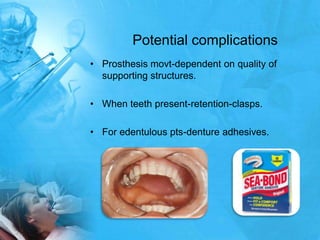
Potential complicationsProsthesis movt-dependent on quality of supporting structures.When teeth present-retention-clasps.For edentulous pts-denture adhesives.
Potential complicationsWhen max resection leaves cheek unsupported by bone-prosthesis-support-wound maturation.During immediate postoperative healing stage-surgical defect-change in dimension-fit and seal.Adjustments-temporary resilient denture lining materials.Pts instructed not to swallow large quantities-head horizontal-swallowing-water tight seal.
Potential complicationsMidline soft palate resection-difficult-retain prostheis-water tight seal.When combination Rx (chemotherapy,physiotherapy) – post surgical phase.Major intraoral complication-mucositis.Long term effects of radiation therapy-radiation induced xerostomia and capillary bed changes-within mandible-dentition-osteoradionecrosis.During interim prosthesis stage-xerostomic effects.
Defect and oral hygieneSurgical pack removal-defect site mature with time.Initial loss of incompletely consolidated skin graft,mucous secretions mixed with blood and residual food debris –common.Pts instructed to clean defect of food debris and mucous secretions routinely.
Defect and oral hygieneDefect hygiene-timelier healing-improve-fit of prosthesis.Common defect hygiene practices-rinsing of defect-bulb syringe,sponge handled cleaning aid.Teeth-oral hygiene.Xerostomia-fluoride.
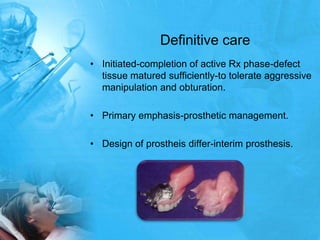
Definitive careInitiated-completion of active Rx phase-defect tissue matured sufficiently-to tolerate aggressive manipulation and obturation.Primary emphasis-prosthetic management.Design of prostheis differ-interim prosthesis.
Definitive careFor some pts definitive prostheis delayed-general health concerns,questionable tumor prognosis and improper hygiene.For control of maxillofacial prostheses-large skilled performance of pt required.(oral and defect structures important for success.)
Definitive careUnderstanding of impact of post surgical characteristics and soft tissue reconstruction on MFPmanagement :-Opportunity for max prosthetic benefit-necessitates surgical site characteresticsthat are separate from classic tumor approaches.Ability of pt to biomechanically control large removable prostheis following surgery-hindered-surgical closure/reconstruction options.
Intraoral prostheses design considerationsFor maxilofacialreconstruction with RPD-well supported stable,retentive prosthesis-min movt-preserving-max amt-supporting tissue.Max coverage-edentulous ridge-remaining teeth.Normal resistance-functional load-P.attachment-natural dentition.Partial edentulous-support,stability-teeth.
Intraoral prostheses design considerationsSeveral post teeth-support-teeth and mucosa.No teeth-support-mucosa-residual ridges.Tumor-loss-tooth & supporting structures-support-combination-teeth/ridge.For both partial & complete tissue supported-functional load support-mucosa-unsuited.
Surgical preservation for prosthesis benefitMaxillary defects –Surgical outcomes that impact prosthetic success-amt of max structures removed/that impacts the surgical integrity and quality of the defect.For hard/soft palate-restoration of physical separation of oral and nasal cavities-mastication ,deglutition,speech & facial contour.
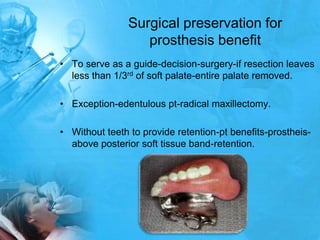
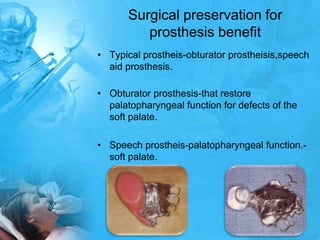
Surgical preservation for prosthesis benefitTypical prostheis-obturatorprostheisis,speech aid prosthesis.Obturator prosthesis-that restore palatopharyngeal function for defects of the soft palate.Speech prostheis-palatopharyngeal function.-soft palate.
Surgical preservation for prosthesis benefitTooth preservation-greatest impact-stabilizing effect.Classical midline max defect-preservation of premax accomplished-inclusion of ant premaxilla-individual decision-tumor control and resection technique.Resection of pt with teeth-tooth adjacent to defect-force-prostheismovt.Surgical alveolar osteotomy cut-resection-xn site –adjacent tooth-prognosis-supportive tooth.
Surgical preservation for prosthesis benefitMidline of hard palate-common-prosthesis pressure.To provide best surgical resection-hard palate resected.Vertical surface of bone cut-advancement flap-palatal mucosa-resilient mucosal covering-prostheis-fulcrum.
Surgical preservation for prosthesis benefitTo serve as a guide-decision-surgery-if resection leaves less than 1/3rd of soft palate-entire palate removed.Exception-edentulous pt-radical maxillectomy.Without teeth to provide retention-pt benefits-prostheis-above posterior soft tissue band-retention.
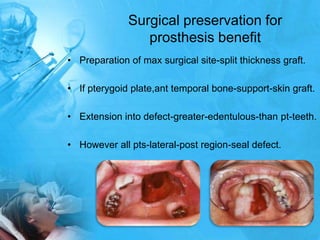
Surgical preservation for prosthesis benefitPreparation of max surgical site-split thickness graft.If pterygoidplate,ant temporal bone-support-skin graft.Extension into defect-greater-edentulous-than pt-teeth.However all pts-lateral-post region-seal defect.
Surgical preservation for prosthesis benefitSurgical defects 3cm or less-reconstructed to normal contours-tissue function-surgical management-appropriate.Larger defects-difficult-incapable-prostheis.Soft palate reconstructions-difficult-functional tissue replacement-compromising-palatal function.In light of this unpredicability,the predictable prosthetic management of such defects is most often the Rx of choice.
Mandibular defects    Functions of mastication,deglutition,speech and saliva control are possible through coordinated efforts of separate anatomic regions which include:-Oral sphincter.Alveolingual and buccalsulci.Alveolar ridges,floor of mouth.Tongue,tonsillar pillars.Soft palate,hard palate.Buccal mucosa.More regions involved-surgical procedure-greater demand –surgical reconstruction.
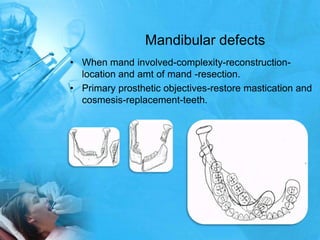
Mandibular defectsWhen mand involved-complexity-reconstruction-location and amt of mand -resection.Primary prosthetic objectives-restore mastication and cosmesis-replacement-teeth.
Regardless of prostheis support-prosthetic success-surgical management-soft tissue,bone.Diseases-soft tissue structures-resection-control.Soft tissue-bone removal-no prosthetic management.Exception-tongue resection-augmentation-palatal contours-speech production.Primary tumors-ameloblastoma-resection of segments-tumor control.
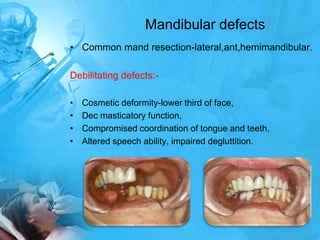
Mandibular defectsCommon mandresection-lateral,ant,hemimandibular.Debilitating defects:-Cosmetic deformity-lower third of face,Dec masticatory function,Compromised coordination of tongue and teeth,Altered speech ability, impaired degluttition.
Mandibular defectsMasticatory rehabilitation-resection-with mand discontinuity-unpredictable.For pts with teeth-altered mand position-functional and cosmetic handicap.Reconstruction plate failure.Cosmetic deformity improved-reconstruction plates.Preserves bilateral nature of mandmovt.Prosthetic replacement of teeth-cannot-regions superior-recontruction bar-mucosal perforation,bar exposure.
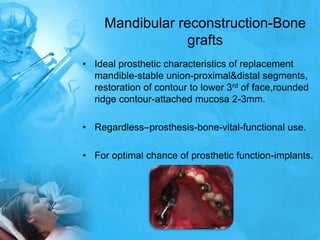
Mandibular reconstruction-Bone graftsIdeal prosthetic characteristics of replacement mandible-stable union-proximal&distal segments, restoration of contour to lower 3rd of face,rounded ridge contour-attached mucosa 2-3mm.Regardless–prosthesis-bone-vital-functional use.For optimal chance of prosthetic function-implants.
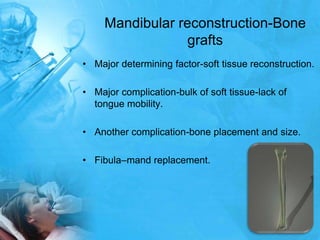
Mandibular reconstruction-Bone graftsMajor determining factor-soft tissue reconstruction.Major complication-bulk of soft tissue-lack of tongue mobility.Another complication-bone placement and size.Fibula–mand replacement.
Mandibular reconstruction-Bone graftsBcos of straight nature of bone it is easy to err in both the horizontal and vertical positioning-midline.Post inability to recreate natural ascending curve posteriorly-teeth-restoring occlusion-resected side.Mismatch-height-ant junction of graft.Implant supported prosthesis-implant hygiene.For removable prostheses-irritation-fulcrum like action-movt.
References Carr A B, Mc Givney G P, Brown D T, McCraken’s Removable partial Prothodontics. 11thed, stlouis: Mosby; 2008.Stewart K L, Rudd K D, Kuebker W A, Stewart’s Clinical Removable Partial Prosthodontics. 2nd edition 2004.Miller E L, Grasso J E, Removable Partial Prosthodontics. 2nd ed, Baltimore: Williams & Wilkins.
Removal partial denture considerations in maxillofacial prosthetics

Removal partial denture considerations in maxillofacial prosthetics

  • 1.
    Removal partial dentureconsiderations in maxillofacial prosthetics. (Part -1)
  • 2.
    Index 1. Maxilofacial prosthetics Definition Classification 2. Timing of dental and maxillofacial prosthetic care for acquired defects Post operative and intraoperative care Interim care Potential complications Defect and oral hygiene Definitive care
  • 3.
    Index Intraoral prosthesesdesign considerations.4. Surgical preservation for prostheses benefit Maxillary defects Mandibular defects Mandibular reconstruction-bone grafts
  • 4.
    Maxillofacial Prosthetics“the artand science of anatomic, functional, or cosmetic reconstruction by means of nonliving substitutes of those regions in the maxilla, mandible, and face that are missing or defective because of surgical intervention, trauma, pathology, or developmental or congenital malformations”
  • 5.
    Classification Acquired CongenitalDevelopmentalAcquireddefect – trauma or disease-RX Soft/hardpalate defect-squamous cell carcinoma.Congenital defect – craniofacial defects - birth.Developmental defect – genetic predisposition-growth and development.
  • 6.
    Classification Type ofprostheisis under consideration-Extra-oral (cranial or facial replacement)Intra-oral (oral cavity)Interim (short periods)Definitive (more permanent)Treatment prosthesis (splint or stent)
  • 7.
    Major distinguishing feature-toothsupported or tooth and tissue supported.Maxillofacial patient can experience unique alterations in normal oral/craniofacial environment which are the results of surgical resections.(maxillofacial trauma,congenitaldefects,developmental anomalies or neuromuscular disease.)Not only tooth and tissue support considerations-design.
  • 8.
    Timing of dentaland maxillofacial prosthetic care for acquired defectsPreoperative and intrao-perative careInterim careDefinitive care
  • 9.
    Preoperative and intraoperativecarePlanning of prosthetic treatment for acquired oral defects-before surgery.Pt-head and neck surgery-dental needs.Dental objectives-preoperative and intraoperative care stage-potential dental postoperative complications-subsequent prosthetic Rx.
  • 10.
    Preoperative and intraoperativecarePreoperative consultation-pt clinician relationship-surgery.Benefit from a prosthesis standpoint view-strategically important teeth-interim or definitive prosthesis use-discussed surigical team-rx plan –preservation.
  • 11.
    Preoperative and intraoperativecareImmediate postoperative period-challenging.Large carious lesion-endodontic therapy.Acute periodontal disease – treated-post pain.Nonrestorable tooth-interim care-removed-before/at time of surgical resection.
  • 12.
    Preoperative and intraoperativecareImpressions –max and mand arches-immediate or interim prostheses.To assess need for both immediate and delayed modification of teeth or adjacent structures to optimize prosthetic care.Planning-definitive prosthesis.
  • 13.
    Interim careMajor empahasis-surgicalmangementneed of pt.When discontinuity defects in mandible results-interim prosthetic care-not indicated.Typical maxillary acquired defect results in oral communication with the nose/max sinus.
  • 14.
    Interim careCreates physiologicaland functional deficiencies in mastication,degluttition and speech.Such defects-psychological.Major deficiency addressed by prosthetic management-interim care time-degluttition and speech.
  • 15.
    Interim careAn initialfocus on improvement in swallowing and speech with the interim prosthesis can help boost the rehabilitation process significantly.Objective of interim obturator prosthesis-separate-oral and nasal cavities-obturating communication.Such obturatorprostheis commonly refers – obturation of hard palatal defects-same for soft palate.
  • 16.
    Interim careTo artificiallyblock free transfer of speech sounds and food/liquids b/w oral and nasal cavities.Prosthesis-surgery.Surgical obturatorprostheis-control-surgical access closure and split thickness skin graft-postsurgical period.
  • 17.
    Interim careSuch prostheis-stabilized-wiring-teeth-alveolarbone.Teeth-wires in prostheis-undercutsImmediate placement of prostheis-pts acceptance of surgical defect.
  • 18.
    Interim carePreferable-stabilize surgicaldressing-suturing sponge bolster-split thickness graft.Following primary healing-interim prostheis placed.
  • 19.
    Interim careInterim prostheis-wireretained resin prosthesis-no teeth-modified-addition of teeth.
  • 20.
    Interim careTotal maxillectomy-prosthesissupport stability and retention –not satisfactory-extension of defect.Teeth present-impact of defect lessened.Few unilateral teeth-stability-prosthesis is less.
  • 21.
    Potential complicationsDuration forinterim phase-3-4 months.Primary objective-surgical-observation phase.Common interim prosthetic complications :-Tissue trauma and associated discomfort.Inadequate retention of max prostheisis.Incomleteobturation with leakage of air,food and liquid around obturator portion-prostheis.Tissue effects of chemotherapy and radiation therapy.
  • 22.
    Potential complicationsCommon interimprosthetic complications :-Tissue trauma and associated discomfort.Inadequate retention.Incomplete obturation (leakage of air,food and liquid).Tissue effects of chemotherapy&radiation therapy.
  • 23.
    Discomfort related touse of interim prosthesis-Surgical wound healing dynamics.Defect conditions.Mucosal effects of adjunctive Rx/prosthetic fit.Common areas of surgical wound pain include junctions of lip/cheek mucosa-maxillectomy pts.Lateral scar band-skin grafts heals-discomfort.Alveolar bone cuts not rounded-perforate-oral mucosa-discomfort.Most common in mandibular resection-lower and labial contour.
  • 24.
    Potential complicationsProsthesis movt-dependenton quality of supporting structures.When teeth present-retention-clasps.For edentulous pts-denture adhesives.
  • 25.
    Potential complicationsWhen maxresection leaves cheek unsupported by bone-prosthesis-support-wound maturation.During immediate postoperative healing stage-surgical defect-change in dimension-fit and seal.Adjustments-temporary resilient denture lining materials.Pts instructed not to swallow large quantities-head horizontal-swallowing-water tight seal.
  • 26.
    Potential complicationsMidline softpalate resection-difficult-retain prostheis-water tight seal.When combination Rx (chemotherapy,physiotherapy) – post surgical phase.Major intraoral complication-mucositis.Long term effects of radiation therapy-radiation induced xerostomia and capillary bed changes-within mandible-dentition-osteoradionecrosis.During interim prosthesis stage-xerostomic effects.
  • 27.
    Defect and oralhygieneSurgical pack removal-defect site mature with time.Initial loss of incompletely consolidated skin graft,mucous secretions mixed with blood and residual food debris –common.Pts instructed to clean defect of food debris and mucous secretions routinely.
  • 28.
    Defect and oralhygieneDefect hygiene-timelier healing-improve-fit of prosthesis.Common defect hygiene practices-rinsing of defect-bulb syringe,sponge handled cleaning aid.Teeth-oral hygiene.Xerostomia-fluoride.
  • 29.
    Definitive careInitiated-completion ofactive Rx phase-defect tissue matured sufficiently-to tolerate aggressive manipulation and obturation.Primary emphasis-prosthetic management.Design of prostheis differ-interim prosthesis.
  • 30.
    Definitive careFor somepts definitive prostheis delayed-general health concerns,questionable tumor prognosis and improper hygiene.For control of maxillofacial prostheses-large skilled performance of pt required.(oral and defect structures important for success.)
  • 31.
    Definitive careUnderstanding ofimpact of post surgical characteristics and soft tissue reconstruction on MFPmanagement :-Opportunity for max prosthetic benefit-necessitates surgical site characteresticsthat are separate from classic tumor approaches.Ability of pt to biomechanically control large removable prostheis following surgery-hindered-surgical closure/reconstruction options.
  • 32.
    Intraoral prostheses designconsiderationsFor maxilofacialreconstruction with RPD-well supported stable,retentive prosthesis-min movt-preserving-max amt-supporting tissue.Max coverage-edentulous ridge-remaining teeth.Normal resistance-functional load-P.attachment-natural dentition.Partial edentulous-support,stability-teeth.
  • 33.
    Intraoral prostheses designconsiderationsSeveral post teeth-support-teeth and mucosa.No teeth-support-mucosa-residual ridges.Tumor-loss-tooth & supporting structures-support-combination-teeth/ridge.For both partial & complete tissue supported-functional load support-mucosa-unsuited.
  • 34.
    Surgical preservation forprosthesis benefitMaxillary defects –Surgical outcomes that impact prosthetic success-amt of max structures removed/that impacts the surgical integrity and quality of the defect.For hard/soft palate-restoration of physical separation of oral and nasal cavities-mastication ,deglutition,speech & facial contour.
  • 35.
    Surgical preservation forprosthesis benefitTypical prostheis-obturatorprostheisis,speech aid prosthesis.Obturator prosthesis-that restore palatopharyngeal function for defects of the soft palate.Speech prostheis-palatopharyngeal function.-soft palate.
  • 36.
    Surgical preservation forprosthesis benefitTooth preservation-greatest impact-stabilizing effect.Classical midline max defect-preservation of premax accomplished-inclusion of ant premaxilla-individual decision-tumor control and resection technique.Resection of pt with teeth-tooth adjacent to defect-force-prostheismovt.Surgical alveolar osteotomy cut-resection-xn site –adjacent tooth-prognosis-supportive tooth.
  • 37.
    Surgical preservation forprosthesis benefitMidline of hard palate-common-prosthesis pressure.To provide best surgical resection-hard palate resected.Vertical surface of bone cut-advancement flap-palatal mucosa-resilient mucosal covering-prostheis-fulcrum.
  • 38.
    Surgical preservation forprosthesis benefitTo serve as a guide-decision-surgery-if resection leaves less than 1/3rd of soft palate-entire palate removed.Exception-edentulous pt-radical maxillectomy.Without teeth to provide retention-pt benefits-prostheis-above posterior soft tissue band-retention.
  • 39.
    Surgical preservation forprosthesis benefitPreparation of max surgical site-split thickness graft.If pterygoidplate,ant temporal bone-support-skin graft.Extension into defect-greater-edentulous-than pt-teeth.However all pts-lateral-post region-seal defect.
  • 40.
    Surgical preservation forprosthesis benefitSurgical defects 3cm or less-reconstructed to normal contours-tissue function-surgical management-appropriate.Larger defects-difficult-incapable-prostheis.Soft palate reconstructions-difficult-functional tissue replacement-compromising-palatal function.In light of this unpredicability,the predictable prosthetic management of such defects is most often the Rx of choice.
  • 41.
    Mandibular defects Functions of mastication,deglutition,speech and saliva control are possible through coordinated efforts of separate anatomic regions which include:-Oral sphincter.Alveolingual and buccalsulci.Alveolar ridges,floor of mouth.Tongue,tonsillar pillars.Soft palate,hard palate.Buccal mucosa.More regions involved-surgical procedure-greater demand –surgical reconstruction.
  • 42.
    Mandibular defectsWhen mandinvolved-complexity-reconstruction-location and amt of mand -resection.Primary prosthetic objectives-restore mastication and cosmesis-replacement-teeth.
  • 43.
    Regardless of prostheissupport-prosthetic success-surgical management-soft tissue,bone.Diseases-soft tissue structures-resection-control.Soft tissue-bone removal-no prosthetic management.Exception-tongue resection-augmentation-palatal contours-speech production.Primary tumors-ameloblastoma-resection of segments-tumor control.
  • 44.
    Mandibular defectsCommon mandresection-lateral,ant,hemimandibular.Debilitatingdefects:-Cosmetic deformity-lower third of face,Dec masticatory function,Compromised coordination of tongue and teeth,Altered speech ability, impaired degluttition.
  • 45.
    Mandibular defectsMasticatory rehabilitation-resection-withmand discontinuity-unpredictable.For pts with teeth-altered mand position-functional and cosmetic handicap.Reconstruction plate failure.Cosmetic deformity improved-reconstruction plates.Preserves bilateral nature of mandmovt.Prosthetic replacement of teeth-cannot-regions superior-recontruction bar-mucosal perforation,bar exposure.
  • 46.
    Mandibular reconstruction-Bone graftsIdealprosthetic characteristics of replacement mandible-stable union-proximal&distal segments, restoration of contour to lower 3rd of face,rounded ridge contour-attached mucosa 2-3mm.Regardless–prosthesis-bone-vital-functional use.For optimal chance of prosthetic function-implants.
  • 47.
    Mandibular reconstruction-Bone graftsMajordetermining factor-soft tissue reconstruction.Major complication-bulk of soft tissue-lack of tongue mobility.Another complication-bone placement and size.Fibula–mand replacement.
  • 48.
    Mandibular reconstruction-Bone graftsBcosof straight nature of bone it is easy to err in both the horizontal and vertical positioning-midline.Post inability to recreate natural ascending curve posteriorly-teeth-restoring occlusion-resected side.Mismatch-height-ant junction of graft.Implant supported prosthesis-implant hygiene.For removable prostheses-irritation-fulcrum like action-movt.
  • 49.
    References Carr AB, Mc Givney G P, Brown D T, McCraken’s Removable partial Prothodontics. 11thed, stlouis: Mosby; 2008.Stewart K L, Rudd K D, Kuebker W A, Stewart’s Clinical Removable Partial Prosthodontics. 2nd edition 2004.Miller E L, Grasso J E, Removable Partial Prosthodontics. 2nd ed, Baltimore: Williams & Wilkins.