

1
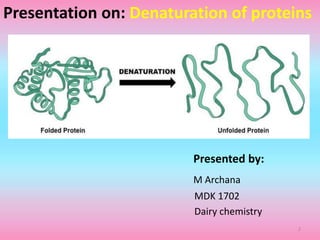
Presentation on: Denaturation of proteins
Presented by:
M Archana
MDK 1702
Dairy chemistry
2
Contents:
• Introduction
• Reversibility and irreversibility of protein denaturation
• Mechanism of protein denaturation
• Agents causing denaturation
1) physical agents
2) chemical agents
• Measurements of protein denaturation
• Denaturation at interfaces
• Advantages and disadvantages
• References
• Conclusion
3
Introduction:
• Denaturation is a process in which a protein loses its native shape
due to the disruption of weak chemical bonds and interactions,
thereby becoming biologically inactive.
In case of proteins :
• A loss of three-dimensional structure, sufficient to cause loss of
function
• Loss of secondary, tertiary and quaternary structure of proteins.
• Change in physical, chemical and biological properties of protein
molecules.
Definition:
• Denaturation involves transformation of a well-defined folded
structure of a proteins formed under physiological conditions, to an
unfolded state under non-physiological conditions is called protein
denaturation
4
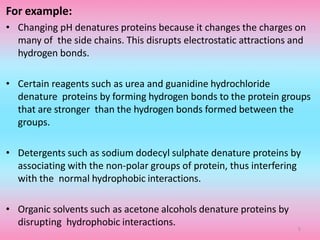
For example:
• Changing pH denatures proteins because it changes the charges on
many of the side chains. This disrupts electrostatic attractions and
hydrogen bonds.
• Certain reagents such as urea and guanidine hydrochloride
denature proteins by forming hydrogen bonds to the protein groups
that are stronger than the hydrogen bonds formed between the
groups.
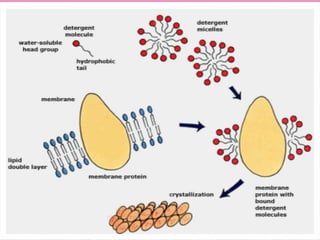
• Detergents such as sodium dodecyl sulphate denature proteins by
associating with the non-polar groups of protein, thus interfering
with the normal hydrophobic interactions.
• Organic solvents such as acetone alcohols denature proteins by
disrupting hydrophobic interactions.
5
Cont..
• Proteins can also be denatured by heat. Heat increase molecular
motion which can disrupt the attractive forces.
• None of these agents breaks the peptide bonds, so the primary
structure of proteins remains intact when it is denatured.
When protein is denatured it losses its function examples are:
• A denatured enzyme ceases/stops its function.
• A denatured antibody no longer binds to its antigen.
• A denatured milk proteins losses its biological activity
6
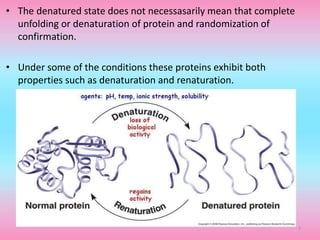
• The denatured state does not necessasarily mean that complete
unfolding or denaturation of protein and randomization of
confirmation.
• Under some of the conditions these proteins exhibit both
properties such as denaturation and renaturation.
7
Mechanism of protein denaturation:
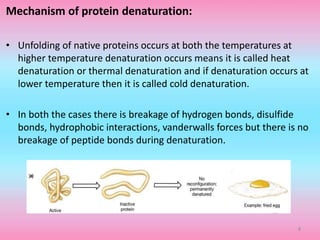
• Unfolding of native proteins occurs at both the temperatures at
higher temperature denaturation occurs means it is called heat
denaturation or thermal denaturation and if denaturation occurs at
lower temperature then it is called cold denaturation.
• In both the cases there is breakage of hydrogen bonds, disulfide
bonds, hydrophobic interactions, vanderwalls forces but there is no
breakage of peptide bonds during denaturation.
8
Causes of protein denaturation:
• Denaturation occurs when proteins are exposed to an extreme
environment conditions such as high level of salt, higher level of
acidity, higher temperature etc.
• Because of these extreme conditions the function of the proteins
alters due to deformities along their bonds and can be temporarily
or permanently denatured.
9
• Agents causing denaturation: There are various agents which
causes denaturation of proteins, some of them are as follows:
Physical agents:
• Heat
• Violent shaking or agitation
• Hydrostatic pressure
• UV radiation
Chemical agents:
• Acids and alkalis
• Organic solvents
• Salts of heavy metals
• Chaotropic agents
• Detergents
• Altered pH
10
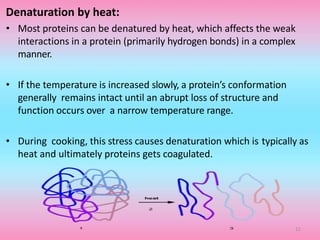
Denaturation by heat:
• Most proteins can be denatured by heat, which affects the weak
interactions in a protein (primarily hydrogen bonds) in a complex
manner.
• If the temperature is increased slowly, a protein’s conformation
generally remains intact until an abrupt loss of structure and
function occurs over a narrow temperature range.
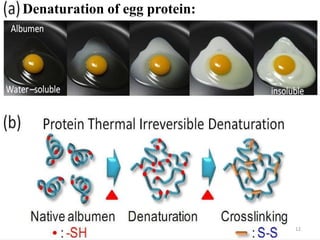
• During cooking, this stress causes denaturation which is typically as
heat and ultimately proteins gets coagulated.
11
Denaturation of egg protein:
12
• As higher temperatures can cause irreversible denaturation of
proteins, and when a cell is exposed to high temperatures, several
types of molecular chaperones swing into action for this reason,
these chaperones are also called heat-shock proteins (HSPs).
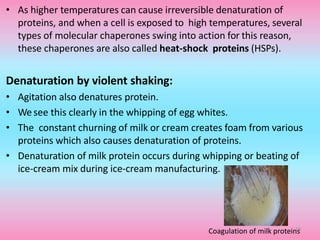
Denaturation by violent shaking:
• Agitation also denatures protein.
• We see this clearly in the whipping of egg whites.
• The constant churning of milk or cream creates foam from various
proteins which also causes denaturation of proteins.
• Denaturation of milk protein occurs during whipping or beating of
ice-cream mix during ice-cream manufacturing.
Coagulation of milk proteins13
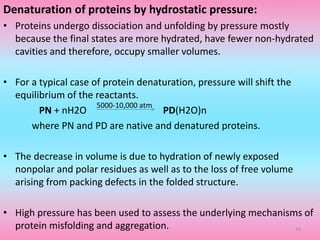
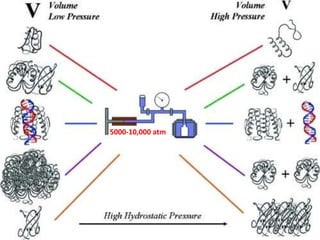
Denaturation of proteins by hydrostatic pressure:
• Proteins undergo dissociation and unfolding by pressure mostly
because the final states are more hydrated, have fewer non-hydrated
cavities and therefore, occupy smaller volumes.
• For a typical case of protein denaturation, pressure will shift the
equilibrium of the reactants.
PN + nH2O PD(H2O)n
where PN and PD are native and denatured proteins.
• The decrease in volume is due to hydration of newly exposed
nonpolar and polar residues as well as to the loss of free volume
arising from packing defects in the folded structure.
• High pressure has been used to assess the underlying mechanisms of
protein misfolding and aggregation.
5000-10,000 atm
14
5000-10,000 atm
15
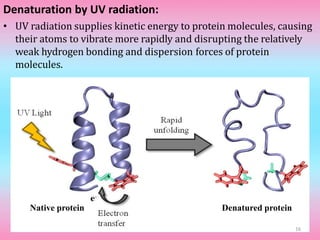
Denaturation by UV radiation:
• UV radiation supplies kinetic energy to protein molecules, causing
their atoms to vibrate more rapidly and disrupting the relatively
weak hydrogen bonding and dispersion forces of protein
molecules.
Native protein Denatured protein
16
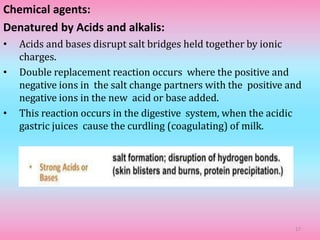
Chemical agents:
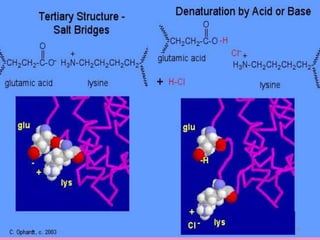
Denatured by Acids and alkalis:
• Acids and bases disrupt salt bridges held together by ionic
charges.
• Double replacement reaction occurs where the positive and
negative ions in the salt change partners with the positive and
negative ions in the new acid or base added.
• This reaction occurs in the digestive system, when the acidic
gastric juices cause the curdling (coagulating) of milk.
17
18
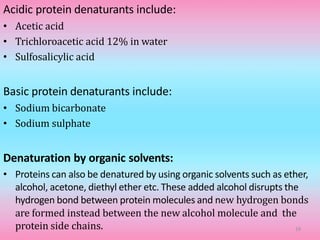
Acidic protein denaturants include:
• Acetic acid
• Trichloroacetic acid 12% in water
• Sulfosalicylic acid
Basic protein denaturants include:
• Sodium bicarbonate
• Sodium sulphate
Denaturation by organic solvents:
• Proteins can also be denatured by using organic solvents such as ether,
alcohol, acetone, diethyl ether etc. These added alcohol disrupts the
hydrogen bond between protein molecules and new hydrogen bonds
are formed instead between the new alcohol molecule and the
protein side chains. 19
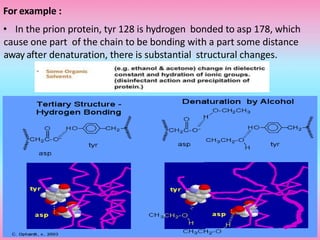
For example :
• In the prion protein, tyr 128 is hydrogen bonded to asp 178, which
cause one part of the chain to be bonding with a part some distance
away after denaturation, there is substantial structural changes.
20
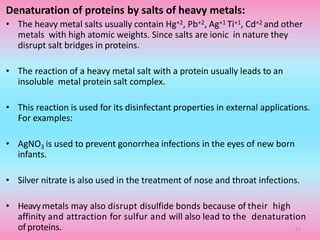
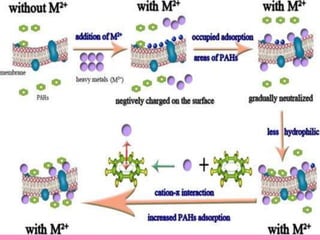
Denaturation of proteins by salts of heavy metals:
• The heavy metal salts usually contain Hg+2, Pb+2, Ag+1 Ti+1, Cd+2 and other
metals with high atomic weights. Since salts are ionic in nature they
disrupt salt bridges in proteins.
• The reaction of a heavy metal salt with a protein usually leads to an
insoluble metal protein salt complex.
• This reaction is used for its disinfectant properties in external applications.
For examples:
• AgNO3 is used to prevent gonorrhea infections in the eyes of new born
infants.
• Silver nitrate is also used in the treatment of nose and throat infections.
• Heavymetals may also disrupt disulfide bonds because of their high
affinity and attraction for sulfur and will also lead to the denaturation
of proteins. 21
22
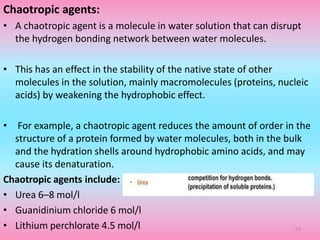
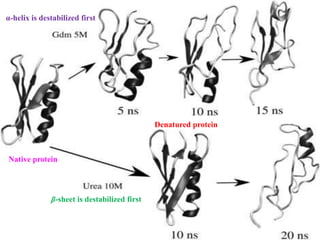
Chaotropic agents:
• A chaotropic agent is a molecule in water solution that can disrupt
the hydrogen bonding network between water molecules.
• This has an effect in the stability of the native state of other
molecules in the solution, mainly macromolecules (proteins, nucleic
acids) by weakening the hydrophobic effect.
• For example, a chaotropic agent reduces the amount of order in the
structure of a protein formed by water molecules, both in the bulk
and the hydration shells around hydrophobic amino acids, and may
cause its denaturation.
Chaotropic agents include:
• Urea 6–8 mol/l
• Guanidinium chloride 6 mol/l
• Lithium perchlorate 4.5 mol/l 23
24
β-sheet is destabilized first
α-helix is destabilized first
Native protein
Denatured protein
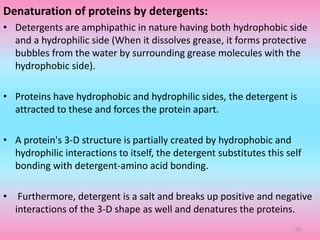
Denaturation of proteins by detergents:
• Detergents are amphipathic in nature having both hydrophobic side
and a hydrophilic side (When it dissolves grease, it forms protective
bubbles from the water by surrounding grease molecules with the
hydrophobic side).
• Proteins have hydrophobic and hydrophilic sides, the detergent is
attracted to these and forces the protein apart.
• A protein's 3-D structure is partially created by hydrophobic and
hydrophilic interactions to itself, the detergent substitutes this self
bonding with detergent-amino acid bonding.
• Furthermore, detergent is a salt and breaks up positive and negative
interactions of the 3-D shape as well and denatures the proteins.
25
26
Denaturation of proteins by altered pH:
• There are ionizable groups in the individual amino acids.
• The rate at which they ionize depends on the group and the pH.
• A high concentration of hydrogen ions (low pH) will result in more
groups being protonated.
• Carboxyl groups (aspartic acid, glutamic acid, the carboxy terminus)
and phenolic groups are uncharged when protonated. The nitrogen
groups (amines on lysine, guanidine of arginine, and imidazole in
histidine, etc.) are charged when protonated.
• Charged groups will tend to move towards the surface of the proteins
and uncharged groups tend to move inwards.
27
• How denaturation occurs at the level of protein structures:
• Denaturation occurs when that shape is compromised and
the molecule can no longer function in its desired capacity.
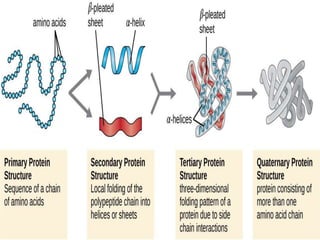
• Proteins may be denatured at the secondary, tertiary and
quaternary structural levels but not at the primary
structural level.
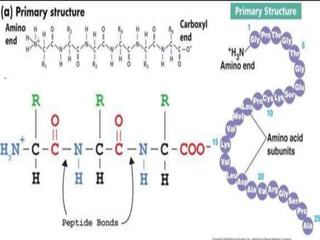
Primary structure:
• In primary structure the sequence of amino acids held
together by covalent peptide bonds which are not disrupted
by the process of denaturation.
28
29
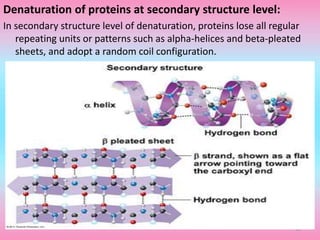
Denaturation of proteins at secondary structure level:
In secondary structure level of denaturation, proteins lose all regular
repeating units or patterns such as alpha-helices and beta-pleated
sheets, and adopt a random coil configuration.
30
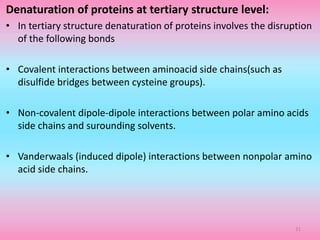
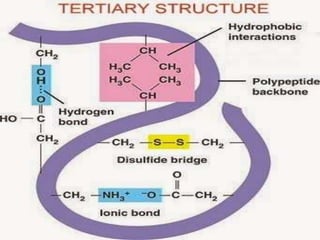
Denaturation of proteins at tertiary structure level:
• In tertiary structure denaturation of proteins involves the disruption
of the following bonds
• Covalent interactions between aminoacid side chains(such as
disulfide bridges between cysteine groups).
• Non-covalent dipole-dipole interactions between polar amino acids
side chains and surounding solvents.
• Vanderwaals (induced dipole) interactions between nonpolar amino
acid side chains.
31
32
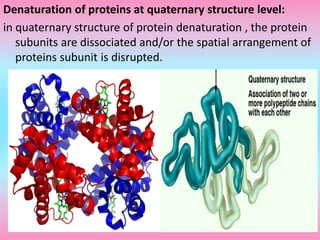
Denaturation of proteins at quaternary structure level:
in quaternary structure of protein denaturation , the protein
subunits are dissociated and/or the spatial arrangement of
proteins subunit is disrupted.
33
34
Measurements of protein denaturation:
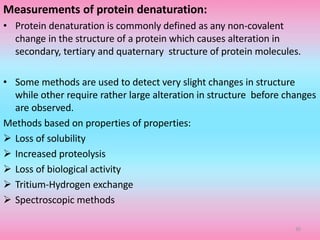
• Protein denaturation is commonly defined as any non-covalent
change in the structure of a protein which causes alteration in
secondary, tertiary and quaternary structure of protein molecules.
• Some methods are used to detect very slight changes in structure
while other require rather large alteration in structure before changes
are observed.
Methods based on properties of properties:
 Loss of solubility
 Increased proteolysis
 Loss of biological activity
 Tritium-Hydrogen exchange
 Spectroscopic methods
35
Other methods for determining protein content:
• Kjeldahl method
• Enhanced dumas method
• UV Spectroscopy method
• Biuret method
• Lowry method
• Dye binding method
• Turbimetric method
• Isoelectric precipitation
• Isoelectric focusing
• Chromatographic techniques
• Electrophoresis
• Dual polarization interferometry
• CD(circular dichorism)
36
Denaturation at interfaces:
when proteins are exposed to either liquid-air or liquid-liquid interfaces
it undergoes denaturation.
As a liquid-liquid interfaces the protein comes in contact with a
hydrophobic enviraonment , if alowed to remain at this interface for a
period of time proteins will tend to unfold this is because the tertiary
structure of proteins are not rigid.
The amount of unfolding that occurs at such an interface will depend on
how rigid the three dimensional structure is an on the number and
location of htdrophobic groups in the molecule.
The shear can cause the protein to unfold, thus exposing its hydrophobic
groups to non-polar phase, thus increases the interfacial area
between the two phases. 37
Characteristics of denaturation:
• The native helical structure of protein is lost.
• The primary structure of protein with peptide linkages are intact and
not hydrolysed during denaturation.
• Denatured protein losses its biological activity.
• Denatured protein becomes insoluble in the solvent in which it
was originally soluble.
• The viscosity of denatured protein solution increases while its
surface tension decreases.
38
• Denaturation is associated with increase in ionizable and sulfhydryl
groups of protein. This is due to loss of hydrogen and disulfide
bonds.
• Denatured protein is more easily digested. This is due to increased
exposure of peptide bonds to enzymes. Cooking causes protein
denaturation and therefore, cooked food (protein) is more easily
digested.
Advantages of protein denaturation:
• The study of denaturation of proteins helps in the field of
proteomics.
• To determine the concentration of protein in any given food
samples.
39
• Desired proteolysis is useful in manufacturing many of dairy
products such as cheese, paneer, khoa etc.
• Knowledge of protein concentration will help in analysis of
interaction between sugar and amino groups in millard browning.
• Denatured proteins are easily digested in the stomach as compare
to undenatured proteins.
Disdavantages of protein denaturation:
• Denatured protein losses its biological activity.
• Most of enzymes gets inactivated due to danaturation of proteins.
40
References:
Textbook of dairy chemistry and biochemistry
- By P F Fox
Mc Sweeney
http://elmhurst.edu/~chm/vchembook/568denaturation.html
http://en.wikipedia.org/wiki/Denaturation_(biochemistry)#Loss
of_function
http://elmhurst.edu/~chm/vchembook/567tertprotein.html
41
42
THANK YOU

PROTEIN DENATURATION

  • 1.
  • 2.
    Presentation on: Denaturationof proteins Presented by: M Archana MDK 1702 Dairy chemistry 2
  • 3.
    Contents: • Introduction • Reversibilityand irreversibility of protein denaturation • Mechanism of protein denaturation • Agents causing denaturation 1) physical agents 2) chemical agents • Measurements of protein denaturation • Denaturation at interfaces • Advantages and disadvantages • References • Conclusion 3
  • 4.
    Introduction: • Denaturation isa process in which a protein loses its native shape due to the disruption of weak chemical bonds and interactions, thereby becoming biologically inactive. In case of proteins : • A loss of three-dimensional structure, sufficient to cause loss of function • Loss of secondary, tertiary and quaternary structure of proteins. • Change in physical, chemical and biological properties of protein molecules. Definition: • Denaturation involves transformation of a well-defined folded structure of a proteins formed under physiological conditions, to an unfolded state under non-physiological conditions is called protein denaturation 4
  • 5.
    For example: • ChangingpH denatures proteins because it changes the charges on many of the side chains. This disrupts electrostatic attractions and hydrogen bonds. • Certain reagents such as urea and guanidine hydrochloride denature proteins by forming hydrogen bonds to the protein groups that are stronger than the hydrogen bonds formed between the groups. • Detergents such as sodium dodecyl sulphate denature proteins by associating with the non-polar groups of protein, thus interfering with the normal hydrophobic interactions. • Organic solvents such as acetone alcohols denature proteins by disrupting hydrophobic interactions. 5
  • 6.
    Cont.. • Proteins canalso be denatured by heat. Heat increase molecular motion which can disrupt the attractive forces. • None of these agents breaks the peptide bonds, so the primary structure of proteins remains intact when it is denatured. When protein is denatured it losses its function examples are: • A denatured enzyme ceases/stops its function. • A denatured antibody no longer binds to its antigen. • A denatured milk proteins losses its biological activity 6
  • 7.
    • The denaturedstate does not necessasarily mean that complete unfolding or denaturation of protein and randomization of confirmation. • Under some of the conditions these proteins exhibit both properties such as denaturation and renaturation. 7
  • 8.
    Mechanism of proteindenaturation: • Unfolding of native proteins occurs at both the temperatures at higher temperature denaturation occurs means it is called heat denaturation or thermal denaturation and if denaturation occurs at lower temperature then it is called cold denaturation. • In both the cases there is breakage of hydrogen bonds, disulfide bonds, hydrophobic interactions, vanderwalls forces but there is no breakage of peptide bonds during denaturation. 8
  • 9.
    Causes of proteindenaturation: • Denaturation occurs when proteins are exposed to an extreme environment conditions such as high level of salt, higher level of acidity, higher temperature etc. • Because of these extreme conditions the function of the proteins alters due to deformities along their bonds and can be temporarily or permanently denatured. 9
  • 10.
    • Agents causingdenaturation: There are various agents which causes denaturation of proteins, some of them are as follows: Physical agents: • Heat • Violent shaking or agitation • Hydrostatic pressure • UV radiation Chemical agents: • Acids and alkalis • Organic solvents • Salts of heavy metals • Chaotropic agents • Detergents • Altered pH 10
  • 11.
    Denaturation by heat: •Most proteins can be denatured by heat, which affects the weak interactions in a protein (primarily hydrogen bonds) in a complex manner. • If the temperature is increased slowly, a protein’s conformation generally remains intact until an abrupt loss of structure and function occurs over a narrow temperature range. • During cooking, this stress causes denaturation which is typically as heat and ultimately proteins gets coagulated. 11
  • 12.
  • 13.
    • As highertemperatures can cause irreversible denaturation of proteins, and when a cell is exposed to high temperatures, several types of molecular chaperones swing into action for this reason, these chaperones are also called heat-shock proteins (HSPs). Denaturation by violent shaking: • Agitation also denatures protein. • We see this clearly in the whipping of egg whites. • The constant churning of milk or cream creates foam from various proteins which also causes denaturation of proteins. • Denaturation of milk protein occurs during whipping or beating of ice-cream mix during ice-cream manufacturing. Coagulation of milk proteins13
  • 14.
    Denaturation of proteinsby hydrostatic pressure: • Proteins undergo dissociation and unfolding by pressure mostly because the final states are more hydrated, have fewer non-hydrated cavities and therefore, occupy smaller volumes. • For a typical case of protein denaturation, pressure will shift the equilibrium of the reactants. PN + nH2O PD(H2O)n where PN and PD are native and denatured proteins. • The decrease in volume is due to hydration of newly exposed nonpolar and polar residues as well as to the loss of free volume arising from packing defects in the folded structure. • High pressure has been used to assess the underlying mechanisms of protein misfolding and aggregation. 5000-10,000 atm 14
  • 15.
  • 16.
    Denaturation by UVradiation: • UV radiation supplies kinetic energy to protein molecules, causing their atoms to vibrate more rapidly and disrupting the relatively weak hydrogen bonding and dispersion forces of protein molecules. Native protein Denatured protein 16
  • 17.
    Chemical agents: Denatured byAcids and alkalis: • Acids and bases disrupt salt bridges held together by ionic charges. • Double replacement reaction occurs where the positive and negative ions in the salt change partners with the positive and negative ions in the new acid or base added. • This reaction occurs in the digestive system, when the acidic gastric juices cause the curdling (coagulating) of milk. 17
  • 18.
  • 19.
    Acidic protein denaturantsinclude: • Acetic acid • Trichloroacetic acid 12% in water • Sulfosalicylic acid Basic protein denaturants include: • Sodium bicarbonate • Sodium sulphate Denaturation by organic solvents: • Proteins can also be denatured by using organic solvents such as ether, alcohol, acetone, diethyl ether etc. These added alcohol disrupts the hydrogen bond between protein molecules and new hydrogen bonds are formed instead between the new alcohol molecule and the protein side chains. 19
  • 20.
    For example : •In the prion protein, tyr 128 is hydrogen bonded to asp 178, which cause one part of the chain to be bonding with a part some distance away after denaturation, there is substantial structural changes. 20
  • 21.
    Denaturation of proteinsby salts of heavy metals: • The heavy metal salts usually contain Hg+2, Pb+2, Ag+1 Ti+1, Cd+2 and other metals with high atomic weights. Since salts are ionic in nature they disrupt salt bridges in proteins. • The reaction of a heavy metal salt with a protein usually leads to an insoluble metal protein salt complex. • This reaction is used for its disinfectant properties in external applications. For examples: • AgNO3 is used to prevent gonorrhea infections in the eyes of new born infants. • Silver nitrate is also used in the treatment of nose and throat infections. • Heavymetals may also disrupt disulfide bonds because of their high affinity and attraction for sulfur and will also lead to the denaturation of proteins. 21
  • 22.
  • 23.
    Chaotropic agents: • Achaotropic agent is a molecule in water solution that can disrupt the hydrogen bonding network between water molecules. • This has an effect in the stability of the native state of other molecules in the solution, mainly macromolecules (proteins, nucleic acids) by weakening the hydrophobic effect. • For example, a chaotropic agent reduces the amount of order in the structure of a protein formed by water molecules, both in the bulk and the hydration shells around hydrophobic amino acids, and may cause its denaturation. Chaotropic agents include: • Urea 6–8 mol/l • Guanidinium chloride 6 mol/l • Lithium perchlorate 4.5 mol/l 23
  • 24.
    24 β-sheet is destabilizedfirst α-helix is destabilized first Native protein Denatured protein
  • 25.
    Denaturation of proteinsby detergents: • Detergents are amphipathic in nature having both hydrophobic side and a hydrophilic side (When it dissolves grease, it forms protective bubbles from the water by surrounding grease molecules with the hydrophobic side). • Proteins have hydrophobic and hydrophilic sides, the detergent is attracted to these and forces the protein apart. • A protein's 3-D structure is partially created by hydrophobic and hydrophilic interactions to itself, the detergent substitutes this self bonding with detergent-amino acid bonding. • Furthermore, detergent is a salt and breaks up positive and negative interactions of the 3-D shape as well and denatures the proteins. 25
  • 26.
  • 27.
    Denaturation of proteinsby altered pH: • There are ionizable groups in the individual amino acids. • The rate at which they ionize depends on the group and the pH. • A high concentration of hydrogen ions (low pH) will result in more groups being protonated. • Carboxyl groups (aspartic acid, glutamic acid, the carboxy terminus) and phenolic groups are uncharged when protonated. The nitrogen groups (amines on lysine, guanidine of arginine, and imidazole in histidine, etc.) are charged when protonated. • Charged groups will tend to move towards the surface of the proteins and uncharged groups tend to move inwards. 27
  • 28.
    • How denaturationoccurs at the level of protein structures: • Denaturation occurs when that shape is compromised and the molecule can no longer function in its desired capacity. • Proteins may be denatured at the secondary, tertiary and quaternary structural levels but not at the primary structural level. Primary structure: • In primary structure the sequence of amino acids held together by covalent peptide bonds which are not disrupted by the process of denaturation. 28
  • 29.
  • 30.
    Denaturation of proteinsat secondary structure level: In secondary structure level of denaturation, proteins lose all regular repeating units or patterns such as alpha-helices and beta-pleated sheets, and adopt a random coil configuration. 30
  • 31.
    Denaturation of proteinsat tertiary structure level: • In tertiary structure denaturation of proteins involves the disruption of the following bonds • Covalent interactions between aminoacid side chains(such as disulfide bridges between cysteine groups). • Non-covalent dipole-dipole interactions between polar amino acids side chains and surounding solvents. • Vanderwaals (induced dipole) interactions between nonpolar amino acid side chains. 31
  • 32.
  • 33.
    Denaturation of proteinsat quaternary structure level: in quaternary structure of protein denaturation , the protein subunits are dissociated and/or the spatial arrangement of proteins subunit is disrupted. 33
  • 34.
  • 35.
    Measurements of proteindenaturation: • Protein denaturation is commonly defined as any non-covalent change in the structure of a protein which causes alteration in secondary, tertiary and quaternary structure of protein molecules. • Some methods are used to detect very slight changes in structure while other require rather large alteration in structure before changes are observed. Methods based on properties of properties:  Loss of solubility  Increased proteolysis  Loss of biological activity  Tritium-Hydrogen exchange  Spectroscopic methods 35
  • 36.
    Other methods fordetermining protein content: • Kjeldahl method • Enhanced dumas method • UV Spectroscopy method • Biuret method • Lowry method • Dye binding method • Turbimetric method • Isoelectric precipitation • Isoelectric focusing • Chromatographic techniques • Electrophoresis • Dual polarization interferometry • CD(circular dichorism) 36
  • 37.
    Denaturation at interfaces: whenproteins are exposed to either liquid-air or liquid-liquid interfaces it undergoes denaturation. As a liquid-liquid interfaces the protein comes in contact with a hydrophobic enviraonment , if alowed to remain at this interface for a period of time proteins will tend to unfold this is because the tertiary structure of proteins are not rigid. The amount of unfolding that occurs at such an interface will depend on how rigid the three dimensional structure is an on the number and location of htdrophobic groups in the molecule. The shear can cause the protein to unfold, thus exposing its hydrophobic groups to non-polar phase, thus increases the interfacial area between the two phases. 37
  • 38.
    Characteristics of denaturation: •The native helical structure of protein is lost. • The primary structure of protein with peptide linkages are intact and not hydrolysed during denaturation. • Denatured protein losses its biological activity. • Denatured protein becomes insoluble in the solvent in which it was originally soluble. • The viscosity of denatured protein solution increases while its surface tension decreases. 38
  • 39.
    • Denaturation isassociated with increase in ionizable and sulfhydryl groups of protein. This is due to loss of hydrogen and disulfide bonds. • Denatured protein is more easily digested. This is due to increased exposure of peptide bonds to enzymes. Cooking causes protein denaturation and therefore, cooked food (protein) is more easily digested. Advantages of protein denaturation: • The study of denaturation of proteins helps in the field of proteomics. • To determine the concentration of protein in any given food samples. 39
  • 40.
    • Desired proteolysisis useful in manufacturing many of dairy products such as cheese, paneer, khoa etc. • Knowledge of protein concentration will help in analysis of interaction between sugar and amino groups in millard browning. • Denatured proteins are easily digested in the stomach as compare to undenatured proteins. Disdavantages of protein denaturation: • Denatured protein losses its biological activity. • Most of enzymes gets inactivated due to danaturation of proteins. 40
  • 41.
    References: Textbook of dairychemistry and biochemistry - By P F Fox Mc Sweeney http://elmhurst.edu/~chm/vchembook/568denaturation.html http://en.wikipedia.org/wiki/Denaturation_(biochemistry)#Loss of_function http://elmhurst.edu/~chm/vchembook/567tertprotein.html 41
  • 42.