CHEMISTRY PROJECT FILE
ON
DENATURATION OF MILK AND EGG PROTEIN
PROJECT PREPARED BY: UNDER THE GUIDANCE OF:
T.DHIVYALAKSHMI Mr.K.SARAVANA KUMAR M.Sc., B.Ed.,
XII STANDARD CHEMISTRY TEACHER
ROLL NO: 12203
SESSION: 2019-2020
SRI NACHAMMAL VIDYAVANI SENIOR SECONDARY SCHOOL
(Affiliation No: 1930499)
Devarayampalayam bypass road, Avinashi,
Tirupur - 641 654.
1
CERTIFICATE
This is to certify that DHIVYALAKSHMI.T of class XII
standard, SRI NACHAMMAL VIDYAVANI SENIOR
SECONDARY SCHOOL, Avinashi, Tirupur has successfully
completed her Project Report in Chemistry on topic
“DENATURATION OF MILK AND EGG PROTEIN” for
the partial fulfillment of AISSCE as prescribed by CBSE in the
year 2019-2020.
Date:
Registration Number:
Signature of Teacher Signature of Principal
2
Signature of the External Examiner
ACKNOWLEDGEMENT
I would like to express my very great gratitude to my
Correspondent for providing me an opportunity to do the project work
in our school.
I respect and thank Executive director sir for giving me
support and guidance.I would not forget to remember Executive
directoress ma’am for her timely support.
I would like to offer my special thanks to my principal
Mrs.V.Sharmila Sunitha, M.Sc., M.Phil., B.Ed., for her
encouragement till the completion of my project work.
I would also like to express my special thanks of gratitude
to my Chemistry teacher Mr.K.Saravana Kumar, M.Sc., B.Ed., for
his advice and assistance in keeping my project in progress on schedule.
I wish to thank my parents for their support and
encouragement throughout my project. Finally,I am thankful to all my
3
friends who have directly and indirectly guided me and made valuable
suggestions on my project work.
INDEX
4
S.N
o
CONTENTS PAGE
NUMBER
1 INTRODUCTION 06
2 DENATURATION OF
PROTEIN
07
3 DETERIORATION OF
MILK PROTEIN
10
4 DETERIORATION OF
EGG PROTEIN
11
5 GRAPHS 12
6 EXPERIMENT 14
7 PHOTOGRAPH 16
8 RESULT AND
BIBLIOGRAPHY
20
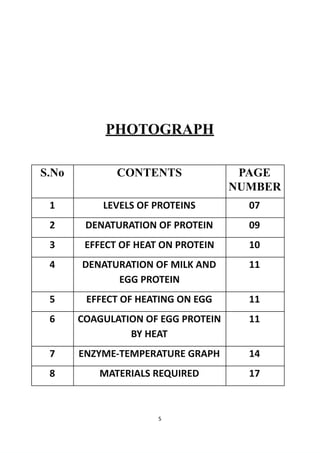
PHOTOGRAPH
5
S.No CONTENTS PAGE
NUMBER
1 LEVELS OF PROTEINS 07
2 DENATURATION OF PROTEIN 09
3 EFFECT OF HEAT ON PROTEIN 10
4 DENATURATION OF MILK AND
EGG PROTEIN
11
5 EFFECT OF HEATING ON EGG 11
6 COAGULATION OF EGG PROTEIN
BY HEAT
11
7 ENZYME-TEMPERATURE GRAPH 14
8 MATERIALS REQUIRED 17
DENATURATION OF MILK AND
EGG PROTEIN
INTRODUCTION
Protein denaturation:
Denaturation is a process in which proteins or nucleic acids lose the
quaternary structure, tertiary structure, and secondary structure which is
present in their native state, by application of some external stress or
compound such as a
● Heat,
● Strong acid or base,
● A concentrated inorganic salt,
● An organic solvent (e.g., alcohol or chloroform),
● Radiation.
If proteins in a living cell are denatured, this results in disruption of
cell activity and possibly cell death. Protein denaturation is also a
consequence of cell death.
Denatured proteins can exhibit a wide range of characteristics, from
conformational change and loss of solubility to aggregation due to the
6
9 DENATURATION OF MILK AND
EGG PROTEIN
18
exposure of hydrophobic groups. Denatured proteins lose their 3D
structure and therefore cannot function.
Protein folding is key to whether a globular or membrane protein
can do its job correctly; it must be folded into the right shape to
function. However, hydrogen bonds, which play a big part in folding,
are rather weak and thus easily affected which can denature the protein.
Denaturation at levels of protein structure:
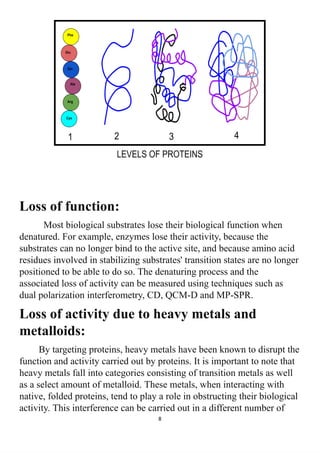
1. In quaternary structure denaturation, protein sub-units are
dissociated and/or the spatial arrangement of protein subunits is
disrupted.
2. Tertiary structure denaturation involves the disruption of:
● Covalent interactions between amino acid side-chains (such as
disulfide bridges between cysteine groups)
● Non-covalent dipole-dipole interactions between polar amino
acid side-chains (and the surrounding solvent)
● Van der Waals (induced dipole) interactions between nonpolar
amino acid side-chains.
3. In secondary structure denaturation, proteins lose all regular
repeating patterns such as alpha-helices and beta-pleated sheets,
and adopt a random coil configuration.
4. Primary structure, such as the sequence of amino acids held
together by covalent peptide bonds, is not disrupted by
denaturation.
7
LEVELS OF PROTEINS
Loss of function:
Most biological substrates lose their biological function when
denatured. For example, enzymes lose their activity, because the
substrates can no longer bind to the active site, and because amino acid
residues involved in stabilizing substrates' transition states are no longer
positioned to be able to do so. The denaturing process and the
associated loss of activity can be measured using techniques such as
dual polarization interferometry, CD, QCM-D and MP-SPR.
Loss of activity due to heavy metals and
metalloids:
By targeting proteins, heavy metals have been known to disrupt the
function and activity carried out by proteins. It is important to note that
heavy metals fall into categories consisting of transition metals as well
as a select amount of metalloid. These metals, when interacting with
native, folded proteins, tend to play a role in obstructing their biological
activity. This interference can be carried out in a different number of
8
ways. These heavy metals can form a complex with the functional side
chain groups present in a protein or form bonds to free thiols. Heavy
metals also play a role in oxidizing amino acid side chains present in
protein. Along with this, when interacting with metalloproteins, heavy
metals can dislocate and replace key metal ions. As a result, heavy
metals can interfere with folded proteins, which can strongly deter
protein stability and activity.
Reversibility and irreversibility:
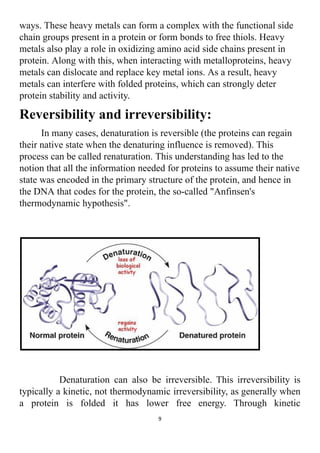
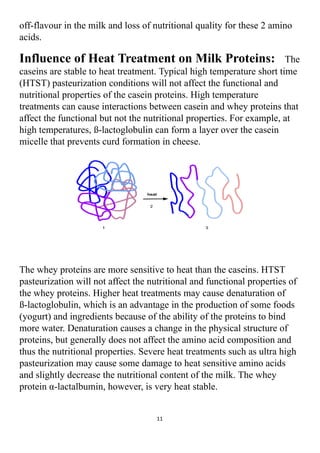
In many cases, denaturation is reversible (the proteins can regain
their native state when the denaturing influence is removed). This
process can be called renaturation. This understanding has led to the
notion that all the information needed for proteins to assume their native
state was encoded in the primary structure of the protein, and hence in
the DNA that codes for the protein, the so-called "Anfinsen's
thermodynamic hypothesis".
Denaturation can also be irreversible. This irreversibility is
typically a kinetic, not thermodynamic irreversibility, as generally when
a protein is folded it has lower free energy. Through kinetic
9
irreversibility, the fact that the protein is stuck in a local minimum can
stop it from ever refolding after it has been irreversibly denatured.
Protein denaturation due to pH:
Denaturation can also be caused by changes in the pH which can
affect the chemistry of the amino acids and their residues. The ionizable
groups in amino acids are able to become ionized when changes in pH
occur. A pH change to more acidic or more basic conditions can induce
unfolding. Acid-induced unfolding often occurs between pH 2 and 5,
base-induced unfolding usually requires pH 10 or higher.
Deterioration of Milk Protein:
Proteins can be degraded by enzyme action or by exposure to light. The
predominant cause of protein degradation is through enzymes called
proteases. Milk proteases come from several sources: the native milk,
airborne bacterial contamination, bacteria that are added intentionally
for fermentation, or somatic cells present in milk. The action of
proteases can be desirable, as in the case of yogurt and cheese
manufacture, so, for these processes, bacteria with desirable proteolytic
properties are added to the milk. Undesirable degradation (proteolysis)
results in milk with off-flavours and poor quality. The most important
protease in milk for cheese manufacturing is plasmin because it causes
proteolysis during ripening which leads to desirable flavours and texture
in cheese.
Two amino acids in milk, methionine and cysteine are sensitive to light
and may be degraded with exposure to light. This results in an
10
off-flavour in the milk and loss of nutritional quality for these 2 amino
acids.
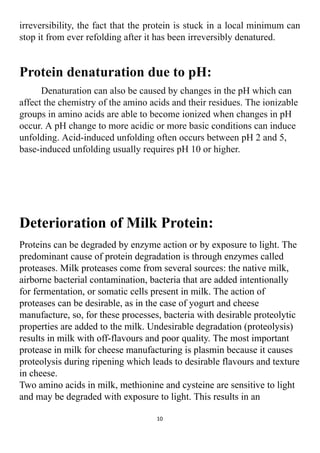
Influence of Heat Treatment on Milk Proteins: The
caseins are stable to heat treatment. Typical high temperature short time
(HTST) pasteurization conditions will not affect the functional and
nutritional properties of the casein proteins. High temperature
treatments can cause interactions between casein and whey proteins that
affect the functional but not the nutritional properties. For example, at
high temperatures, ß-lactoglobulin can form a layer over the casein
micelle that prevents curd formation in cheese.
The whey proteins are more sensitive to heat than the caseins. HTST
pasteurization will not affect the nutritional and functional properties of
the whey proteins. Higher heat treatments may cause denaturation of
ß-lactoglobulin, which is an advantage in the production of some foods
(yogurt) and ingredients because of the ability of the proteins to bind
more water. Denaturation causes a change in the physical structure of
proteins, but generally does not affect the amino acid composition and
thus the nutritional properties. Severe heat treatments such as ultra high
pasteurization may cause some damage to heat sensitive amino acids
and slightly decrease the nutritional content of the milk. The whey
protein α-lactalbumin, however, is very heat stable.
11
DENATURATION OF MILK AND EGG PROTEIN
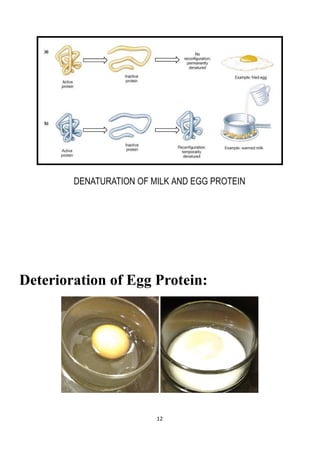
Deterioration of Egg Protein:
12
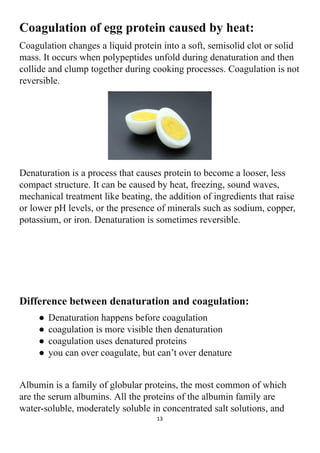
Coagulation of egg protein caused by heat:
Coagulation changes a liquid protein into a soft, semisolid clot or solid
mass. It occurs when polypeptides unfold during denaturation and then
collide and clump together during cooking processes. Coagulation is not
reversible.
Denaturation is a process that causes protein to become a looser, less
compact structure. It can be caused by heat, freezing, sound waves,
mechanical treatment like beating, the addition of ingredients that raise
or lower pH levels, or the presence of minerals such as sodium, copper,
potassium, or iron. Denaturation is sometimes reversible.
Difference between denaturation and coagulation:
● Denaturation happens before coagulation
● coagulation is more visible then denaturation
● coagulation uses denatured proteins
● you can over coagulate, but can’t over denature
Albumin is a family of globular proteins, the most common of which
are the serum albumins. All the proteins of the albumin family are
water-soluble, moderately soluble in concentrated salt solutions, and
13
experience heat denaturation. Albumins are commonly found in blood
plasma and differ from other blood proteins in that they are not
glycosylated. Substances containing albumins, such as egg white, are
called albuminoids.
A number of blood transport proteins are evolutionarily related,
including serum albumin, alpha-fetoprotein, vitamin D-binding protein
and afamin. Albumin binds to the cell surface receptor albondin.
Ovalbumin (abbreviated OVA) is the main protein found in egg white,
making up approximately 55% of the total protein. Ovalbumin displays
sequence and three-dimensional homology to the serpin superfamily, but
unlike most serpins it is not a serine protease inhibitor. The function of
ovalbumin is unknown, although it is presumed to be a storage protein.
Change upon heating:
When heated, ovalbumin undergoes a conformational change from its
soluble, serpin structure into an insoluble all-β-sheet structure with
exposed hydrophobic regions. This causes the protein to aggregate and
cause the solidification associated with cooked egg white.
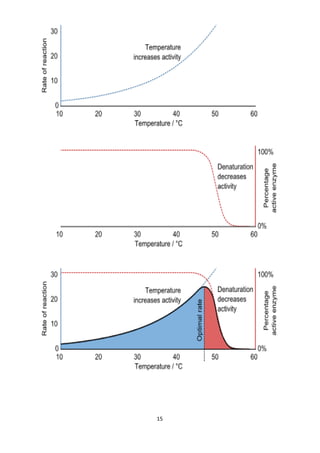
PROTEIN DENATURATION DUE TO pH
14
15
DENATURATION OF MILK AND EGG
PROTEIN
AIM:
To study about the denaturation of milk and egg protein
TO FIND:
● What happens when a protein denatures?
● Do all protein denature at the same temperature?
● What temperature does albumin denature at?
● What temperature does casein denature at?
● Why might protein denature at different temperature?
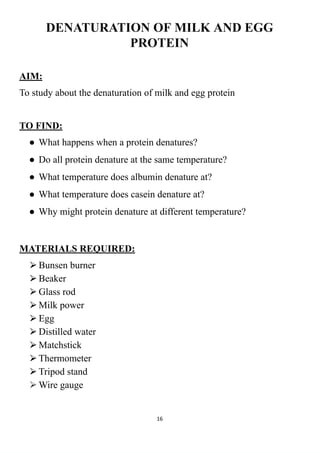
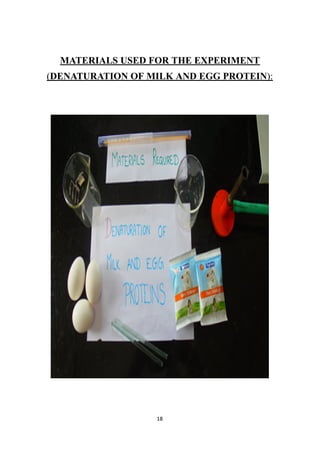
MATERIALS REQUIRED:
⮚Bunsen burner
⮚Beaker
⮚Glass rod
⮚Milk power
⮚Egg
⮚Distilled water
⮚Matchstick
⮚Thermometer
⮚Tripod stand
⮚Wire gauge
16
PROCEDURE:
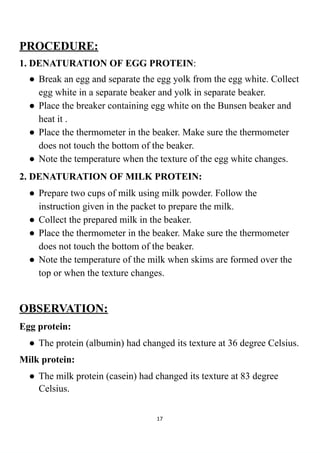
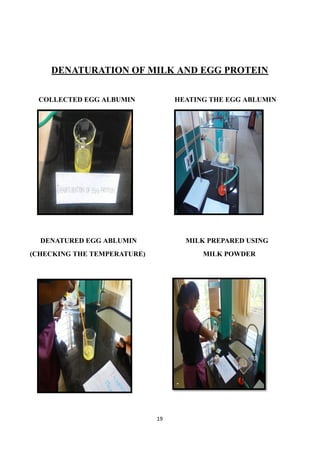
1. DENATURATION OF EGG PROTEIN:
● Break an egg and separate the egg yolk from the egg white. Collect
egg white in a separate beaker and yolk in separate beaker.
● Place the breaker containing egg white on the Bunsen beaker and
heat it .
● Place the thermometer in the beaker. Make sure the thermometer
does not touch the bottom of the beaker.
● Note the temperature when the texture of the egg white changes.
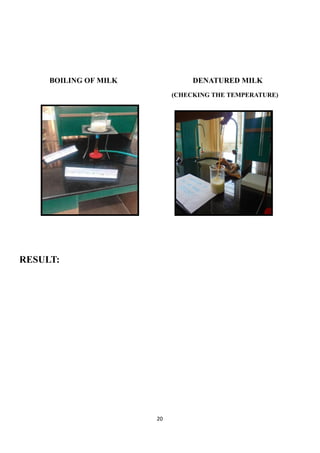
2. DENATURATION OF MILK PROTEIN:
● Prepare two cups of milk using milk powder. Follow the
instruction given in the packet to prepare the milk.
● Collect the prepared milk in the beaker.
● Place the thermometer in the beaker. Make sure the thermometer
does not touch the bottom of the beaker.
● Note the temperature of the milk when skims are formed over the
top or when the texture changes.
OBSERVATION:
Egg protein:
● The protein (albumin) had changed its texture at 36 degree Celsius.
Milk protein:
● The milk protein (casein) had changed its texture at 83 degree
Celsius.
17
MATERIALS USED FOR THE EXPERIMENT
(DENATURATION OF MILK AND EGG PROTEIN):
18
DENATURATION OF MILK AND EGG PROTEIN
COLLECTED EGG ALBUMIN HEATING THE EGG ABLUMIN
DENATURED EGG ABLUMIN MILK PREPARED USING
(CHECKING THE TEMPERATURE) MILK POWDER
19
BOILING OF MILK DENATURED MILK
(CHECKING THE TEMPERATURE)
RESULT:
20
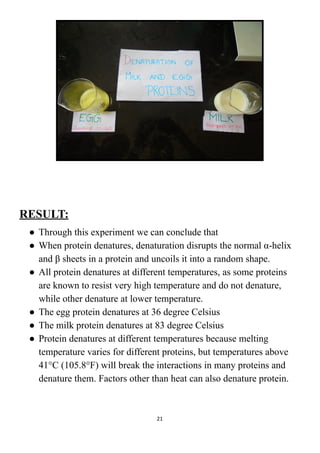
RESULT:
● Through this experiment we can conclude that
● When protein denatures, denaturation disrupts the normal α-helix
and β sheets in a protein and uncoils it into a random shape.
● All protein denatures at different temperatures, as some proteins
are known to resist very high temperature and do not denature,
while other denature at lower temperature.
● The egg protein denatures at 36 degree Celsius
● The milk protein denatures at 83 degree Celsius
● Protein denatures at different temperatures because melting
temperature varies for different proteins, but temperatures above
41°C (105.8°F) will break the interactions in many proteins and
denature them. Factors other than heat can also denature protein.
21
Changes in pH affect the chemistry of amino acid residues and can
lead to denaturation.
BIBLIOGRAPHY:
⮚
⮚https://en.wikipedia.org › wiki › Denaturation_(biochemistry)
⮚https://www.education.ne.gov › wp-content › uploads › 2017/07 ›
64-Eggs
⮚
⮚www.milkfacts.info › Milk Composition › Protein
⮚
⮚https://www.livescience.com ›
28575-science-of-cooking-perfect-egg
22

Chemistry project -12TH STD CBSE

  • 1.
    CHEMISTRY PROJECT FILE ON DENATURATIONOF MILK AND EGG PROTEIN PROJECT PREPARED BY: UNDER THE GUIDANCE OF: T.DHIVYALAKSHMI Mr.K.SARAVANA KUMAR M.Sc., B.Ed., XII STANDARD CHEMISTRY TEACHER ROLL NO: 12203 SESSION: 2019-2020 SRI NACHAMMAL VIDYAVANI SENIOR SECONDARY SCHOOL (Affiliation No: 1930499) Devarayampalayam bypass road, Avinashi, Tirupur - 641 654. 1
  • 2.
    CERTIFICATE This is tocertify that DHIVYALAKSHMI.T of class XII standard, SRI NACHAMMAL VIDYAVANI SENIOR SECONDARY SCHOOL, Avinashi, Tirupur has successfully completed her Project Report in Chemistry on topic “DENATURATION OF MILK AND EGG PROTEIN” for the partial fulfillment of AISSCE as prescribed by CBSE in the year 2019-2020. Date: Registration Number: Signature of Teacher Signature of Principal 2
  • 3.
    Signature of theExternal Examiner ACKNOWLEDGEMENT I would like to express my very great gratitude to my Correspondent for providing me an opportunity to do the project work in our school. I respect and thank Executive director sir for giving me support and guidance.I would not forget to remember Executive directoress ma’am for her timely support. I would like to offer my special thanks to my principal Mrs.V.Sharmila Sunitha, M.Sc., M.Phil., B.Ed., for her encouragement till the completion of my project work. I would also like to express my special thanks of gratitude to my Chemistry teacher Mr.K.Saravana Kumar, M.Sc., B.Ed., for his advice and assistance in keeping my project in progress on schedule. I wish to thank my parents for their support and encouragement throughout my project. Finally,I am thankful to all my 3
  • 4.
    friends who havedirectly and indirectly guided me and made valuable suggestions on my project work. INDEX 4 S.N o CONTENTS PAGE NUMBER 1 INTRODUCTION 06 2 DENATURATION OF PROTEIN 07 3 DETERIORATION OF MILK PROTEIN 10 4 DETERIORATION OF EGG PROTEIN 11 5 GRAPHS 12 6 EXPERIMENT 14 7 PHOTOGRAPH 16 8 RESULT AND BIBLIOGRAPHY 20
  • 5.
    PHOTOGRAPH 5 S.No CONTENTS PAGE NUMBER 1LEVELS OF PROTEINS 07 2 DENATURATION OF PROTEIN 09 3 EFFECT OF HEAT ON PROTEIN 10 4 DENATURATION OF MILK AND EGG PROTEIN 11 5 EFFECT OF HEATING ON EGG 11 6 COAGULATION OF EGG PROTEIN BY HEAT 11 7 ENZYME-TEMPERATURE GRAPH 14 8 MATERIALS REQUIRED 17
  • 6.
    DENATURATION OF MILKAND EGG PROTEIN INTRODUCTION Protein denaturation: Denaturation is a process in which proteins or nucleic acids lose the quaternary structure, tertiary structure, and secondary structure which is present in their native state, by application of some external stress or compound such as a ● Heat, ● Strong acid or base, ● A concentrated inorganic salt, ● An organic solvent (e.g., alcohol or chloroform), ● Radiation. If proteins in a living cell are denatured, this results in disruption of cell activity and possibly cell death. Protein denaturation is also a consequence of cell death. Denatured proteins can exhibit a wide range of characteristics, from conformational change and loss of solubility to aggregation due to the 6 9 DENATURATION OF MILK AND EGG PROTEIN 18
  • 7.
    exposure of hydrophobicgroups. Denatured proteins lose their 3D structure and therefore cannot function. Protein folding is key to whether a globular or membrane protein can do its job correctly; it must be folded into the right shape to function. However, hydrogen bonds, which play a big part in folding, are rather weak and thus easily affected which can denature the protein. Denaturation at levels of protein structure: 1. In quaternary structure denaturation, protein sub-units are dissociated and/or the spatial arrangement of protein subunits is disrupted. 2. Tertiary structure denaturation involves the disruption of: ● Covalent interactions between amino acid side-chains (such as disulfide bridges between cysteine groups) ● Non-covalent dipole-dipole interactions between polar amino acid side-chains (and the surrounding solvent) ● Van der Waals (induced dipole) interactions between nonpolar amino acid side-chains. 3. In secondary structure denaturation, proteins lose all regular repeating patterns such as alpha-helices and beta-pleated sheets, and adopt a random coil configuration. 4. Primary structure, such as the sequence of amino acids held together by covalent peptide bonds, is not disrupted by denaturation. 7
  • 8.
    LEVELS OF PROTEINS Lossof function: Most biological substrates lose their biological function when denatured. For example, enzymes lose their activity, because the substrates can no longer bind to the active site, and because amino acid residues involved in stabilizing substrates' transition states are no longer positioned to be able to do so. The denaturing process and the associated loss of activity can be measured using techniques such as dual polarization interferometry, CD, QCM-D and MP-SPR. Loss of activity due to heavy metals and metalloids: By targeting proteins, heavy metals have been known to disrupt the function and activity carried out by proteins. It is important to note that heavy metals fall into categories consisting of transition metals as well as a select amount of metalloid. These metals, when interacting with native, folded proteins, tend to play a role in obstructing their biological activity. This interference can be carried out in a different number of 8
  • 9.
    ways. These heavymetals can form a complex with the functional side chain groups present in a protein or form bonds to free thiols. Heavy metals also play a role in oxidizing amino acid side chains present in protein. Along with this, when interacting with metalloproteins, heavy metals can dislocate and replace key metal ions. As a result, heavy metals can interfere with folded proteins, which can strongly deter protein stability and activity. Reversibility and irreversibility: In many cases, denaturation is reversible (the proteins can regain their native state when the denaturing influence is removed). This process can be called renaturation. This understanding has led to the notion that all the information needed for proteins to assume their native state was encoded in the primary structure of the protein, and hence in the DNA that codes for the protein, the so-called "Anfinsen's thermodynamic hypothesis". Denaturation can also be irreversible. This irreversibility is typically a kinetic, not thermodynamic irreversibility, as generally when a protein is folded it has lower free energy. Through kinetic 9
  • 10.
    irreversibility, the factthat the protein is stuck in a local minimum can stop it from ever refolding after it has been irreversibly denatured. Protein denaturation due to pH: Denaturation can also be caused by changes in the pH which can affect the chemistry of the amino acids and their residues. The ionizable groups in amino acids are able to become ionized when changes in pH occur. A pH change to more acidic or more basic conditions can induce unfolding. Acid-induced unfolding often occurs between pH 2 and 5, base-induced unfolding usually requires pH 10 or higher. Deterioration of Milk Protein: Proteins can be degraded by enzyme action or by exposure to light. The predominant cause of protein degradation is through enzymes called proteases. Milk proteases come from several sources: the native milk, airborne bacterial contamination, bacteria that are added intentionally for fermentation, or somatic cells present in milk. The action of proteases can be desirable, as in the case of yogurt and cheese manufacture, so, for these processes, bacteria with desirable proteolytic properties are added to the milk. Undesirable degradation (proteolysis) results in milk with off-flavours and poor quality. The most important protease in milk for cheese manufacturing is plasmin because it causes proteolysis during ripening which leads to desirable flavours and texture in cheese. Two amino acids in milk, methionine and cysteine are sensitive to light and may be degraded with exposure to light. This results in an 10
  • 11.
    off-flavour in themilk and loss of nutritional quality for these 2 amino acids. Influence of Heat Treatment on Milk Proteins: The caseins are stable to heat treatment. Typical high temperature short time (HTST) pasteurization conditions will not affect the functional and nutritional properties of the casein proteins. High temperature treatments can cause interactions between casein and whey proteins that affect the functional but not the nutritional properties. For example, at high temperatures, ß-lactoglobulin can form a layer over the casein micelle that prevents curd formation in cheese. The whey proteins are more sensitive to heat than the caseins. HTST pasteurization will not affect the nutritional and functional properties of the whey proteins. Higher heat treatments may cause denaturation of ß-lactoglobulin, which is an advantage in the production of some foods (yogurt) and ingredients because of the ability of the proteins to bind more water. Denaturation causes a change in the physical structure of proteins, but generally does not affect the amino acid composition and thus the nutritional properties. Severe heat treatments such as ultra high pasteurization may cause some damage to heat sensitive amino acids and slightly decrease the nutritional content of the milk. The whey protein α-lactalbumin, however, is very heat stable. 11
  • 12.
    DENATURATION OF MILKAND EGG PROTEIN Deterioration of Egg Protein: 12
  • 13.
    Coagulation of eggprotein caused by heat: Coagulation changes a liquid protein into a soft, semisolid clot or solid mass. It occurs when polypeptides unfold during denaturation and then collide and clump together during cooking processes. Coagulation is not reversible. Denaturation is a process that causes protein to become a looser, less compact structure. It can be caused by heat, freezing, sound waves, mechanical treatment like beating, the addition of ingredients that raise or lower pH levels, or the presence of minerals such as sodium, copper, potassium, or iron. Denaturation is sometimes reversible. Difference between denaturation and coagulation: ● Denaturation happens before coagulation ● coagulation is more visible then denaturation ● coagulation uses denatured proteins ● you can over coagulate, but can’t over denature Albumin is a family of globular proteins, the most common of which are the serum albumins. All the proteins of the albumin family are water-soluble, moderately soluble in concentrated salt solutions, and 13
  • 14.
    experience heat denaturation.Albumins are commonly found in blood plasma and differ from other blood proteins in that they are not glycosylated. Substances containing albumins, such as egg white, are called albuminoids. A number of blood transport proteins are evolutionarily related, including serum albumin, alpha-fetoprotein, vitamin D-binding protein and afamin. Albumin binds to the cell surface receptor albondin. Ovalbumin (abbreviated OVA) is the main protein found in egg white, making up approximately 55% of the total protein. Ovalbumin displays sequence and three-dimensional homology to the serpin superfamily, but unlike most serpins it is not a serine protease inhibitor. The function of ovalbumin is unknown, although it is presumed to be a storage protein. Change upon heating: When heated, ovalbumin undergoes a conformational change from its soluble, serpin structure into an insoluble all-β-sheet structure with exposed hydrophobic regions. This causes the protein to aggregate and cause the solidification associated with cooked egg white. PROTEIN DENATURATION DUE TO pH 14
  • 15.
  • 16.
    DENATURATION OF MILKAND EGG PROTEIN AIM: To study about the denaturation of milk and egg protein TO FIND: ● What happens when a protein denatures? ● Do all protein denature at the same temperature? ● What temperature does albumin denature at? ● What temperature does casein denature at? ● Why might protein denature at different temperature? MATERIALS REQUIRED: ⮚Bunsen burner ⮚Beaker ⮚Glass rod ⮚Milk power ⮚Egg ⮚Distilled water ⮚Matchstick ⮚Thermometer ⮚Tripod stand ⮚Wire gauge 16
  • 17.
    PROCEDURE: 1. DENATURATION OFEGG PROTEIN: ● Break an egg and separate the egg yolk from the egg white. Collect egg white in a separate beaker and yolk in separate beaker. ● Place the breaker containing egg white on the Bunsen beaker and heat it . ● Place the thermometer in the beaker. Make sure the thermometer does not touch the bottom of the beaker. ● Note the temperature when the texture of the egg white changes. 2. DENATURATION OF MILK PROTEIN: ● Prepare two cups of milk using milk powder. Follow the instruction given in the packet to prepare the milk. ● Collect the prepared milk in the beaker. ● Place the thermometer in the beaker. Make sure the thermometer does not touch the bottom of the beaker. ● Note the temperature of the milk when skims are formed over the top or when the texture changes. OBSERVATION: Egg protein: ● The protein (albumin) had changed its texture at 36 degree Celsius. Milk protein: ● The milk protein (casein) had changed its texture at 83 degree Celsius. 17
  • 18.
    MATERIALS USED FORTHE EXPERIMENT (DENATURATION OF MILK AND EGG PROTEIN): 18
  • 19.
    DENATURATION OF MILKAND EGG PROTEIN COLLECTED EGG ALBUMIN HEATING THE EGG ABLUMIN DENATURED EGG ABLUMIN MILK PREPARED USING (CHECKING THE TEMPERATURE) MILK POWDER 19
  • 20.
    BOILING OF MILKDENATURED MILK (CHECKING THE TEMPERATURE) RESULT: 20
  • 21.
    RESULT: ● Through thisexperiment we can conclude that ● When protein denatures, denaturation disrupts the normal α-helix and β sheets in a protein and uncoils it into a random shape. ● All protein denatures at different temperatures, as some proteins are known to resist very high temperature and do not denature, while other denature at lower temperature. ● The egg protein denatures at 36 degree Celsius ● The milk protein denatures at 83 degree Celsius ● Protein denatures at different temperatures because melting temperature varies for different proteins, but temperatures above 41°C (105.8°F) will break the interactions in many proteins and denature them. Factors other than heat can also denature protein. 21
  • 22.
    Changes in pHaffect the chemistry of amino acid residues and can lead to denaturation. BIBLIOGRAPHY: ⮚ ⮚https://en.wikipedia.org › wiki › Denaturation_(biochemistry) ⮚https://www.education.ne.gov › wp-content › uploads › 2017/07 › 64-Eggs ⮚ ⮚www.milkfacts.info › Milk Composition › Protein ⮚ ⮚https://www.livescience.com › 28575-science-of-cooking-perfect-egg 22