SOCIOLINGUISTICS
By
Alvy Mayrina Pribadi
S200160071
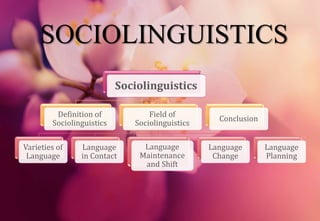
SOCIOLINGUISTICS
Sociolinguistics
Definition of
Sociolinguistics
Field of
Sociolinguistics
Varieties of
Language
Language
in Contact
Language
Maintenance
and Shift
Language
Change
Language
Planning
Conclusion
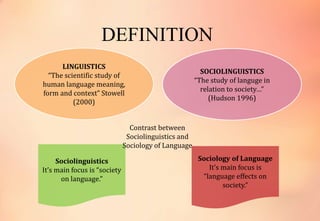
DEFINITION
LINGUISTICS
“The scientific study of
human language meaning,
form and context” Stowell
(2000)
SOCIOLINGUISTICS
“The study of languge in
relation to society…”
(Hudson 1996)
Sociolinguistics
It’s main focus is “society
on language.”
Sociology of Language
It’s main focus is
“language effects on
society.”
Contrast between
Sociolinguistics and
Sociology of Language
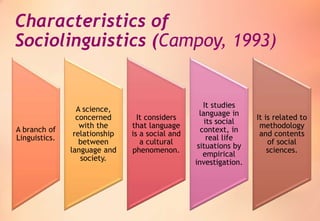
Characteristics of
Sociolinguistics (Campoy, 1993)
A branch of
Linguistics.
A science,
concerned
with the
relationship
between
language and
society.
It considers
that language
is a social and
a cultural
phenomenon.
It studies
language in
its social
context, in
real life
situations by
empirical
investigation.
It is related to
methodology
and contents
of social
sciences.
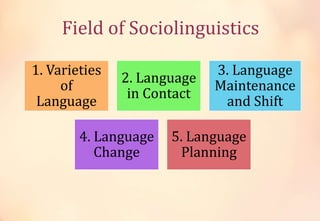
Field of Sociolinguistics
1. Varieties
of
Language
2. Language
in Contact
3. Language
Maintenance
and Shift
4. Language
Change
5. Language
Planning
1. Varieties of Language
• used by government, media
communication, and taught in
schools or universities
the standard variety
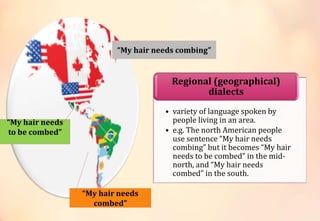
• variety of language spoken by
people living in an area.
• e.g. The north American people
use sentence “My hair needs
combing” but it becomes “My hair
needs to be combed” in the mid-
north, and “My hair needs
combed” in the south.
Regional (geographical)
dialects
“My hair needs combing”
“My hair needs
to be combed”
“My hair needs
combed”
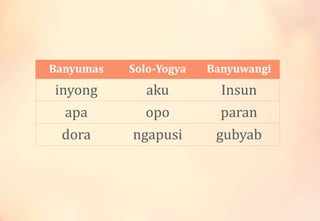
Banyumas Solo-Yogya Banyuwangi
inyong aku Insun
apa opo paran
dora ngapusi gubyab
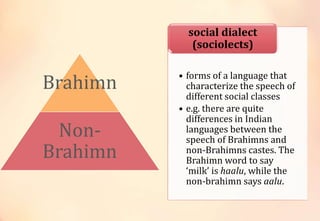
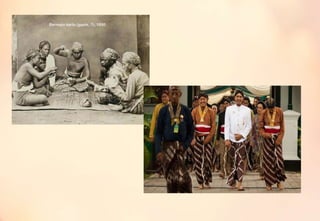
• forms of a language that
characterize the speech of
different social classes
• e.g. there are quite
differences in Indian
languages between the
speech of Brahimns and
non-Brahimns castes. The
Brahimn word to say
‘milk’ is haalu, while the
non-brahimn says aalu.
social dialect
(sociolects)
Brahimn
Non-
Brahimn
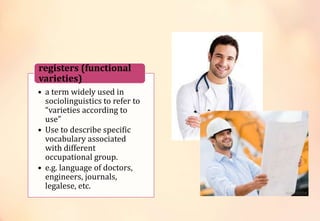
• a term widely used in
sociolinguistics to refer to
“varieties according to
use”
• Use to describe specific
vocabulary associated
with different
occupational group.
• e.g. language of doctors,
engineers, journals,
legalese, etc.
registers (functional
varieties)
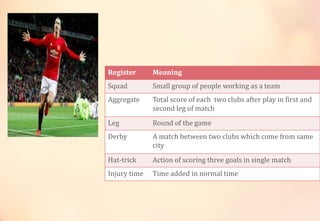
Register Meaning
Squad Small group of people working as a team
Aggregate Total score of each two clubs after play in first and
second leg of match
Leg Round of the game
Derby A match between two clubs which come from same
city
Hat-trick Action of scoring three goals in single match
Injury time Time added in normal time
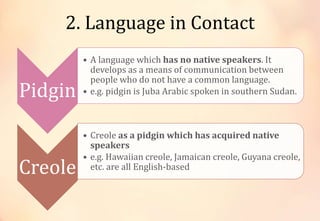
2. Language in Contact
Pidgin
• A language which has no native speakers. It
develops as a means of communication between
people who do not have a common language.
• e.g. pidgin is Juba Arabic spoken in southern Sudan.
Creole
• Creole as a pidgin which has acquired native
speakers
• e.g. Hawaiian creole, Jamaican creole, Guyana creole,
etc. are all English-based
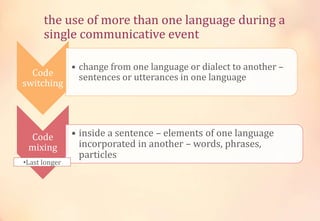
the use of more than one language during a
single communicative event
Code
switching
• change from one language or dialect to another –
sentences or utterances in one language
Code
mixing
• inside a sentence – elements of one language
incorporated in another – words, phrases,
particles
•Last longer
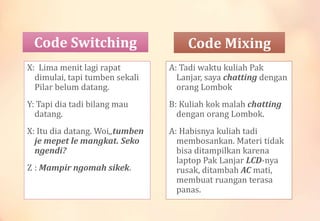
Code Switching
X: Lima menit lagi rapat
dimulai, tapi tumben sekali
Pilar belum datang.
Y: Tapi dia tadi bilang mau
datang.
X: Itu dia datang. Woi,,tumben
je mepet le mangkat. Seko
ngendi?
Z : Mampir ngomah sikek.
A: Tadi waktu kuliah Pak
Lanjar, saya chatting dengan
orang Lombok
B: Kuliah kok malah chatting
dengan orang Lombok.
A: Habisnya kuliah tadi
membosankan. Materi tidak
bisa ditampilkan karena
laptop Pak Lanjar LCD-nya
rusak, ditambah AC mati,
membuat ruangan terasa
panas.
Code Mixing
3. Language Maintenance and
Shift
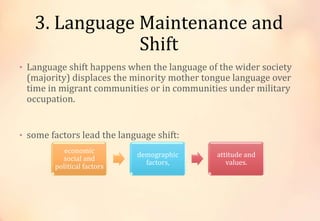
• Language shift happens when the language of the wider society
(majority) displaces the minority mother tongue language over
time in migrant communities or in communities under military
occupation.
• some factors lead the language shift:
economic
social and
political factors
demographic
factors,
attitude and
values.
How to maintain a minority language?
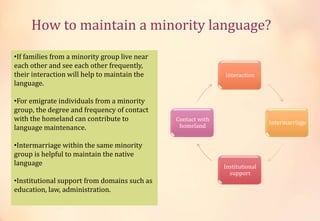
•If families from a minority group live near
each other and see each other frequently,
their interaction will help to maintain the
language.
•For emigrate individuals from a minority
group, the degree and frequency of contact
with the homeland can contribute to
language maintenance.
•Intermarriage within the same minority
group is helpful to maintain the native
language
•Institutional support from domains such as
education, law, administration.
Interaction
Intermarriage
Institutional
support
Contact with
homeland
4. Language change
•According to Holmes (2001: 195) the cause behind the language change is the variation
of use in the areas of pronunciation and vocabulary.
Post-vocal [r] its spread and its
status
• In many part of England and
Wales, Standard English has lost
the pronunciation post-vocal r.
• Accents with post-vocal [r] are
called rhotict, and these accents
are regarded as rural and
uneducated.
• On the other hand, in cities like
New York, pronouncing the letter
[r] is regarded as prestigious.
The spread of vernacular form.
• The example of the spread of
vernacular form is like what
happen in Martha’s Vineyard
Island.
• When the island was invaded by summer
tourists, the island community of
fisherman changed their pronunciation of
some word vowels from the past as a
reaction to the language of the tourists.
• Light was pronounced [ləit] (it sounds a bit
like layeet) and house was pronounced
[həus] (a bit like heyoose)
Holmes (2001:102)
Selection
Codification
Elaboration
Securing its
acceptance
choosing the variety or code to
be developed
standardizing its structural or
linguistic features
extending its functions for use in
new domains
the status of the new
variety is important,
and so people’s
attitudes to the
variety being
developed must be
considered
5.
Language
Planning
Conclusion
Basically Sociolinguistics deals with language-
society relationships and its study is based on
empirical analysis from real life social context.
Sociolinguistics is different with sociology of
language. Sociolinguistics focuses on society
on language while sociology of language
focuses on language effects on society.
Field of sociolinguistics studies consists of
varieties of language, language in contact,
language maintenance and language shift,
language change, language planning, and etc.
References
Holmes, Janet. 2001. An Introduction to Sociolinguistics. England:
Longman.
Hudson, R.A. 1996. Sociolinguistics. England: Cambridge University
Press.
Mesthrie, et.al,. 2000. Introducing Sociolinguistics. Edinburgh: University
Press
Wardhaugh, Roland. 1998. An Introduction to Sociolinguistics.
Massachusetts: Blackwell.
_________. 2006. An Introduction to Sociolinguistics. Massachusetts:
Blackwell.
Thank you

Sociolinguistics

  • 1.
  • 3.
    SOCIOLINGUISTICS Sociolinguistics Definition of Sociolinguistics Field of Sociolinguistics Varietiesof Language Language in Contact Language Maintenance and Shift Language Change Language Planning Conclusion
  • 4.
    DEFINITION LINGUISTICS “The scientific studyof human language meaning, form and context” Stowell (2000) SOCIOLINGUISTICS “The study of languge in relation to society…” (Hudson 1996) Sociolinguistics It’s main focus is “society on language.” Sociology of Language It’s main focus is “language effects on society.” Contrast between Sociolinguistics and Sociology of Language
  • 5.
    Characteristics of Sociolinguistics (Campoy,1993) A branch of Linguistics. A science, concerned with the relationship between language and society. It considers that language is a social and a cultural phenomenon. It studies language in its social context, in real life situations by empirical investigation. It is related to methodology and contents of social sciences.
  • 6.
    Field of Sociolinguistics 1.Varieties of Language 2. Language in Contact 3. Language Maintenance and Shift 4. Language Change 5. Language Planning
  • 7.
    1. Varieties ofLanguage • used by government, media communication, and taught in schools or universities the standard variety
  • 8.
    • variety oflanguage spoken by people living in an area. • e.g. The north American people use sentence “My hair needs combing” but it becomes “My hair needs to be combed” in the mid- north, and “My hair needs combed” in the south. Regional (geographical) dialects “My hair needs combing” “My hair needs to be combed” “My hair needs combed”
  • 9.
    Banyumas Solo-Yogya Banyuwangi inyongaku Insun apa opo paran dora ngapusi gubyab
  • 10.
    • forms ofa language that characterize the speech of different social classes • e.g. there are quite differences in Indian languages between the speech of Brahimns and non-Brahimns castes. The Brahimn word to say ‘milk’ is haalu, while the non-brahimn says aalu. social dialect (sociolects) Brahimn Non- Brahimn
  • 12.
    • a termwidely used in sociolinguistics to refer to “varieties according to use” • Use to describe specific vocabulary associated with different occupational group. • e.g. language of doctors, engineers, journals, legalese, etc. registers (functional varieties)
  • 13.
    Register Meaning Squad Smallgroup of people working as a team Aggregate Total score of each two clubs after play in first and second leg of match Leg Round of the game Derby A match between two clubs which come from same city Hat-trick Action of scoring three goals in single match Injury time Time added in normal time
  • 14.
    2. Language inContact Pidgin • A language which has no native speakers. It develops as a means of communication between people who do not have a common language. • e.g. pidgin is Juba Arabic spoken in southern Sudan. Creole • Creole as a pidgin which has acquired native speakers • e.g. Hawaiian creole, Jamaican creole, Guyana creole, etc. are all English-based
  • 15.
    the use ofmore than one language during a single communicative event Code switching • change from one language or dialect to another – sentences or utterances in one language Code mixing • inside a sentence – elements of one language incorporated in another – words, phrases, particles •Last longer
  • 16.
    Code Switching X: Limamenit lagi rapat dimulai, tapi tumben sekali Pilar belum datang. Y: Tapi dia tadi bilang mau datang. X: Itu dia datang. Woi,,tumben je mepet le mangkat. Seko ngendi? Z : Mampir ngomah sikek. A: Tadi waktu kuliah Pak Lanjar, saya chatting dengan orang Lombok B: Kuliah kok malah chatting dengan orang Lombok. A: Habisnya kuliah tadi membosankan. Materi tidak bisa ditampilkan karena laptop Pak Lanjar LCD-nya rusak, ditambah AC mati, membuat ruangan terasa panas. Code Mixing
  • 17.
    3. Language Maintenanceand Shift • Language shift happens when the language of the wider society (majority) displaces the minority mother tongue language over time in migrant communities or in communities under military occupation. • some factors lead the language shift: economic social and political factors demographic factors, attitude and values.
  • 18.
    How to maintaina minority language? •If families from a minority group live near each other and see each other frequently, their interaction will help to maintain the language. •For emigrate individuals from a minority group, the degree and frequency of contact with the homeland can contribute to language maintenance. •Intermarriage within the same minority group is helpful to maintain the native language •Institutional support from domains such as education, law, administration. Interaction Intermarriage Institutional support Contact with homeland
  • 19.
    4. Language change •Accordingto Holmes (2001: 195) the cause behind the language change is the variation of use in the areas of pronunciation and vocabulary. Post-vocal [r] its spread and its status • In many part of England and Wales, Standard English has lost the pronunciation post-vocal r. • Accents with post-vocal [r] are called rhotict, and these accents are regarded as rural and uneducated. • On the other hand, in cities like New York, pronouncing the letter [r] is regarded as prestigious. The spread of vernacular form. • The example of the spread of vernacular form is like what happen in Martha’s Vineyard Island. • When the island was invaded by summer tourists, the island community of fisherman changed their pronunciation of some word vowels from the past as a reaction to the language of the tourists. • Light was pronounced [ləit] (it sounds a bit like layeet) and house was pronounced [həus] (a bit like heyoose)
  • 20.
    Holmes (2001:102) Selection Codification Elaboration Securing its acceptance choosingthe variety or code to be developed standardizing its structural or linguistic features extending its functions for use in new domains the status of the new variety is important, and so people’s attitudes to the variety being developed must be considered 5. Language Planning
  • 21.
    Conclusion Basically Sociolinguistics dealswith language- society relationships and its study is based on empirical analysis from real life social context. Sociolinguistics is different with sociology of language. Sociolinguistics focuses on society on language while sociology of language focuses on language effects on society. Field of sociolinguistics studies consists of varieties of language, language in contact, language maintenance and language shift, language change, language planning, and etc.
  • 22.
    References Holmes, Janet. 2001.An Introduction to Sociolinguistics. England: Longman. Hudson, R.A. 1996. Sociolinguistics. England: Cambridge University Press. Mesthrie, et.al,. 2000. Introducing Sociolinguistics. Edinburgh: University Press Wardhaugh, Roland. 1998. An Introduction to Sociolinguistics. Massachusetts: Blackwell. _________. 2006. An Introduction to Sociolinguistics. Massachusetts: Blackwell.
  • 23.