Types of studies in
  epidemiology
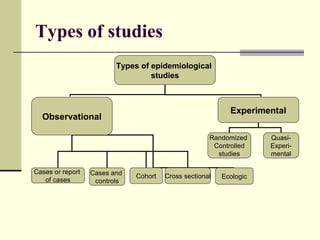
Types of studies
                         Types of epidemiological
                                  studies


                                                           Experimental
  Observational

                                                     Randomized     Quasi-
                                                      Controlled    Experi-
                                                       studies      mental

Cases or report   Cases and   Cohort   Cross sectional   Ecologic
   of cases        controls
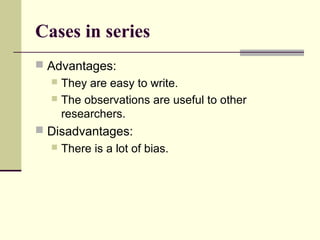
Cases in series
 Advantages:
   They are easy to write.
   The observations are useful to other
    researchers.
 Disadvantages:
     There is a lot of bias.
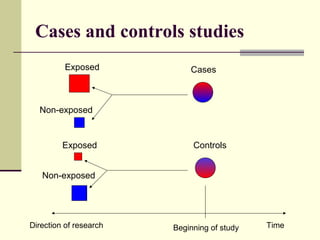
Cases and controls studies
          Exposed           Cases


  Non-exposed


         Exposed             Controls


   Non-exposed


Direction of research   Beginning of study   Time
Cases and controls studies
 Advantages:
    They are adequate to study rare outcomes.
    They are adequate to outcomes with long latency
     period.
    They are cheap and easy to apply.
    It is not necessary to wait to present outcome.
 Disadvantages:
    A lot of bias.
    They depend on the quality of registries.
    Control group should be adequately selected,
     because they represent the population without the
     outcome.
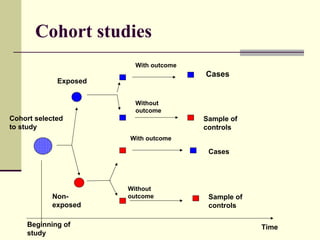
Cohort studies
                         With outcome
                                        Cases
             Exposed


                         Without
                         outcome
Cohort selected                         Sample of
to study                                controls
                       With outcome

                                         Cases


                       Without
            Non-       outcome           Sample of
            exposed                      controls

    Beginning of                                     Time
    study
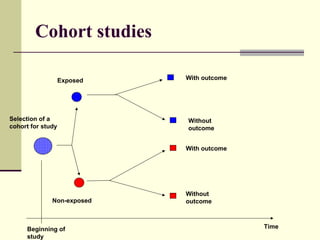
Cohort studies

                   Exposed   With outcome


Selection of a               Without
cohort for study             outcome


                             With outcome


                             Without
              Non-exposed    outcome


     Beginning of                           Time
     study
Cohort studies
 Subjects are selected because do not have
  the outcome and they are classified if have or
  not have the risk factor (exposure).
 We follow up to prove if they develop the
  outcome.
 The cohort study can be prospective if the
  follow up is forward in the time or it can be
  retrospective (historic), if it go back in the
  time.
Cohort studies
 Advantages:
   They are adequate to know the causes of an
    outcome.
   To know the natural history of disease.
   They adequate when the exposure is rare.
   They are useful when we study two or more
    outcome at the same time.
 Disadvantages:
   They take a long time.
   They are expensive.
   Subjects can be lost in the follow up.
   They are not adequate for study rare
    outcomes.
Cross sectional studies

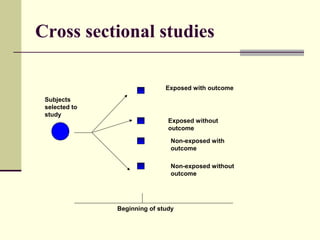
                              Exposed with outcome
 Subjects
 selected to
 study
                               Exposed without
                               outcome

                                Non-exposed with
                                outcome

                                Non-exposed without
                                outcome


               Beginning of study
Cross sectional studies
 Analyze data of a subjects group in a point of
  time.
 Describe a disease and its importance for the
  population.
 Define the needed on health.
 They can be classified in:
   Descriptive
   Analytic
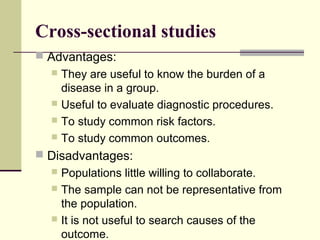
Cross-sectional studies
 Advantages:
   They are useful to know the burden of a
    disease in a group.
   Useful to evaluate diagnostic procedures.
   To study common risk factors.
   To study common outcomes.

 Disadvantages:
   Populations little willing to collaborate.
   The sample can not be representative from
    the population.
   It is not useful to search causes of the
    outcome.
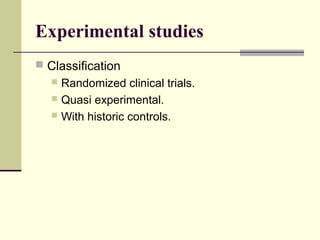
Experimental studies
 Classification
    Randomized clinical trials.
    Quasi experimental.
    With historic controls.
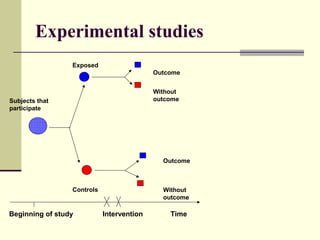
Experimental studies
                 Exposed
                                           Outcome


                                           Without
Subjects that                              outcome
participate


                                             Outcome


                 Controls                    Without
                                             outcome

Beginning of study          Intervention       Time
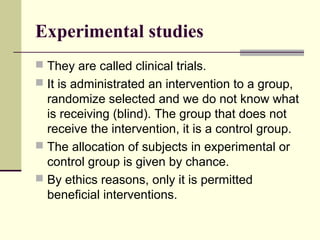
Experimental studies
 They are called clinical trials.
 It is administrated an intervention to a group,
  randomize selected and we do not know what
  is receiving (blind). The group that does not
  receive the intervention, it is a control group.
 The allocation of subjects in experimental or
  control group is given by chance.
 By ethics reasons, only it is permitted
  beneficial interventions.
Experimental studies
 Blind single is when the subjects do not know
  what intervention are receiving.
 Double blind is when neither subjects nor
  researcher know what intervention are
  receiving each subject.
Experimental studies
 There are clinical trials with auto controls.
 The same group work as control group.
Experimental studies
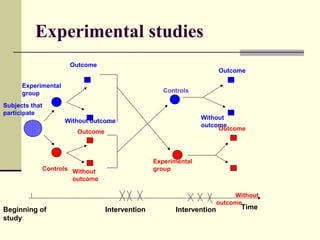
 There are cross design where it is
  administrated an intervention (1) to
  experimental group and another (2) in a
  control group.
 After, interventions are suspended, and left a
  space (wash out period) without it, then the
  intervention 1 is administrated to control
  group and intervention 2 is administrated to
  experimental group.
Experimental studies
                      Outcome
                                                                      Outcome

      Experimental
      group                                         Controls

Subjects that
participate
                                                                Without
                     Without outcome
                                                                outcome
                        Outcome                                      Outcome


                                                 Experimental
            Controls Without                     group
                     outcome

                                                                         Without
                                                                    outcome
Beginning of                      Intervention         Intervention        Time
study
Experimental studies
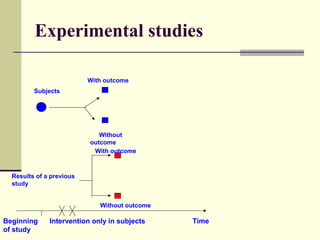
 There are clinical trials with external controls.
 We compare the results with the results of
  another researcher or with the results of a
  previous study.
 Also, they are called historic controls.
Experimental studies

                          With outcome
         Subjects


                             Without
                          outcome
                           With outcome


  Results of a previous
  study


                             Without outcome

Beginning     Intervention only in subjects    Time
of study
Experimental studies
 Advantages:
   Give evidence strong of causality.
   There are less bias.
   Historic controls are used in preliminary
    studies.
 Disadvantages:
    Inappropriate use of historic controls lead a
     severe mistakes.
    Expensive.
    They need time.
Ecologic studies
 Compare exposure and the outcome between
  groups.
 Measure the exposure and outcome, in the
  group as all.
 They are only studies that offer to study
  differences between groups.
Ecologic studies
 Advantages:
   Fast
   Cheap
   Use routinely data

 Disadvantages:
   They did not take into account to the
    individual.
   They depend on the quality of routinely data
   They are difficult to interpret.
Bibliography
 1.- Gordis L. Epidemiology. Phialdelphia,
  W.B. Saunders Company, 1996.
 2.- Songer T. Study designs in epidemiologic
  research. Supercourse, 2005 (
  http://www.pitt.edu/~super1/lecture/lec19101/index
  ) (Accesed October 2008).
 3.- Hennekens CH, Buring J, Mayrent SL.
  Epidemiology in Medicine. Boston, Little
  Brown and Company, 1987.

Types of studies

  • 1.
    Types of studiesin epidemiology
  • 2.
    Types of studies Types of epidemiological studies Experimental Observational Randomized Quasi- Controlled Experi- studies mental Cases or report Cases and Cohort Cross sectional Ecologic of cases controls
  • 3.
    Cases in series Advantages:  They are easy to write.  The observations are useful to other researchers.  Disadvantages:  There is a lot of bias.
  • 4.
    Cases and controlsstudies Exposed Cases Non-exposed Exposed Controls Non-exposed Direction of research Beginning of study Time
  • 5.
    Cases and controlsstudies  Advantages:  They are adequate to study rare outcomes.  They are adequate to outcomes with long latency period.  They are cheap and easy to apply.  It is not necessary to wait to present outcome.  Disadvantages:  A lot of bias.  They depend on the quality of registries.  Control group should be adequately selected, because they represent the population without the outcome.
  • 6.
    Cohort studies With outcome Cases Exposed Without outcome Cohort selected Sample of to study controls With outcome Cases Without Non- outcome Sample of exposed controls Beginning of Time study
  • 7.
    Cohort studies Exposed With outcome Selection of a Without cohort for study outcome With outcome Without Non-exposed outcome Beginning of Time study
  • 8.
    Cohort studies  Subjectsare selected because do not have the outcome and they are classified if have or not have the risk factor (exposure).  We follow up to prove if they develop the outcome.  The cohort study can be prospective if the follow up is forward in the time or it can be retrospective (historic), if it go back in the time.
  • 9.
    Cohort studies  Advantages:  They are adequate to know the causes of an outcome.  To know the natural history of disease.  They adequate when the exposure is rare.  They are useful when we study two or more outcome at the same time.  Disadvantages:  They take a long time.  They are expensive.  Subjects can be lost in the follow up.  They are not adequate for study rare outcomes.
  • 10.
    Cross sectional studies Exposed with outcome Subjects selected to study Exposed without outcome Non-exposed with outcome Non-exposed without outcome Beginning of study
  • 11.
    Cross sectional studies Analyze data of a subjects group in a point of time.  Describe a disease and its importance for the population.  Define the needed on health.  They can be classified in:  Descriptive  Analytic
  • 12.
    Cross-sectional studies  Advantages:  They are useful to know the burden of a disease in a group.  Useful to evaluate diagnostic procedures.  To study common risk factors.  To study common outcomes.  Disadvantages:  Populations little willing to collaborate.  The sample can not be representative from the population.  It is not useful to search causes of the outcome.
  • 13.
    Experimental studies  Classification  Randomized clinical trials.  Quasi experimental.  With historic controls.
  • 14.
    Experimental studies Exposed Outcome Without Subjects that outcome participate Outcome Controls Without outcome Beginning of study Intervention Time
  • 15.
    Experimental studies  Theyare called clinical trials.  It is administrated an intervention to a group, randomize selected and we do not know what is receiving (blind). The group that does not receive the intervention, it is a control group.  The allocation of subjects in experimental or control group is given by chance.  By ethics reasons, only it is permitted beneficial interventions.
  • 16.
    Experimental studies  Blindsingle is when the subjects do not know what intervention are receiving.  Double blind is when neither subjects nor researcher know what intervention are receiving each subject.
  • 17.
    Experimental studies  Thereare clinical trials with auto controls.  The same group work as control group.
  • 18.
    Experimental studies  Thereare cross design where it is administrated an intervention (1) to experimental group and another (2) in a control group.  After, interventions are suspended, and left a space (wash out period) without it, then the intervention 1 is administrated to control group and intervention 2 is administrated to experimental group.
  • 19.
    Experimental studies Outcome Outcome Experimental group Controls Subjects that participate Without Without outcome outcome Outcome Outcome Experimental Controls Without group outcome Without outcome Beginning of Intervention Intervention Time study
  • 20.
    Experimental studies  Thereare clinical trials with external controls.  We compare the results with the results of another researcher or with the results of a previous study.  Also, they are called historic controls.
  • 21.
    Experimental studies With outcome Subjects Without outcome With outcome Results of a previous study Without outcome Beginning Intervention only in subjects Time of study
  • 22.
    Experimental studies  Advantages:  Give evidence strong of causality.  There are less bias.  Historic controls are used in preliminary studies.  Disadvantages:  Inappropriate use of historic controls lead a severe mistakes.  Expensive.  They need time.
  • 23.
    Ecologic studies  Compareexposure and the outcome between groups.  Measure the exposure and outcome, in the group as all.  They are only studies that offer to study differences between groups.
  • 24.
    Ecologic studies  Advantages:  Fast  Cheap  Use routinely data  Disadvantages:  They did not take into account to the individual.  They depend on the quality of routinely data  They are difficult to interpret.
  • 25.
    Bibliography  1.- GordisL. Epidemiology. Phialdelphia, W.B. Saunders Company, 1996.  2.- Songer T. Study designs in epidemiologic research. Supercourse, 2005 ( http://www.pitt.edu/~super1/lecture/lec19101/index ) (Accesed October 2008).  3.- Hennekens CH, Buring J, Mayrent SL. Epidemiology in Medicine. Boston, Little Brown and Company, 1987.

Editor's Notes

  • #3 Observational studies. We observe one or more groups of subjects and their characteristics are described and/or analyzed. Experimental. We can manipulate variables. Series of cases. To describe characteristics of a patients group. Leads to the generation of hypothesis; use a short time period and there is not a control group. Cases and controls. The beginning is with the presence or absence of outcome y review before in the time to detect risk factors. Cohort. The beginning is with a subjects group with outcome; then, we classified them in exposed or non-exposed, and follow in the time to see if they develop the outcome. Cross-sectional. We measure the exposure and the outcome in a subjects group simultaneously, in a point of the time. Experimental. The beginning is with a cohort and randomize it to receive the intervention (experimental group) or not receive it (control group); then we follow to the subjects in the time to see if develop the outcome of interest. Ecologic. The main characteristic is that study groups not individuals.
  • #5 They are called retrospective because of their direction in the time. Sometimes are matched cases with controls to make them more similar.
  • #7 It begin as cohort study, classify the subjects as exposed or non-exposed; in the follow up, some participants develop the outcome, and they are the cases and a sample of subjects without outcome are controls and with them analyzed the cases-controls study. An important advantage is that cases and controls are members of the same population, because the probability of selection bias is minimized. Another advantage is that the information about the exposure is collected before of the develop of outcome, and the probability of information bias is minimized.
  • #9 A cohort is a subjects group or things that they have some in common and do not have the outcome of interest.
  • #12 They are called prevalence studies. They help us to know the economic, social burden of a disease in a population in a point of time. They can be: descriptive or analytic. The descriptive only show the frequency of exposure and of outcome in population in a point of time; in analytic studies we search to show the exposure and outcome in a point of time, searching associations with Prevalence Ratio or Odds Ratio.
  • #14 También se les llama pruebas clínica o estudios intervencionales.
  • #26 http://www.pitt.edu/~super1/lecture/lec19101/index.htm