OFFSHORE PLATFORMS
BY
ABHISHEK KUMAR
Indian Maritime University
Visakhapatnam Campus
WHAT IS AN OFFSHORE
PLATFORM?
A large structure at sea used to house crew and mechinery for
exploration and/ or production of natural resouces such as fossil fuels
from under the ocean bed.
Normally located in the continental shelf, but could be in deeper waters.
Could be fixed to sea bed or floating.
Could be dumb or mobile.
WHERE ARE OFFSHORE
PLATFORMS?
Around 6,500 offshore oil and gas installations distributed in
some 53 countries
US Gulf of Mexico: 4,000; Asia: 950; Middle East: 700; Europe,
North Sea and North East Atlantic: 490; West Africa coast:
380; and South America: 340
TYPES OF OFFSHORE
PLATFORMS
 Fixed Platforms
 Compliant towers
 Jack-up Platforms
 Semi-submersible Platforms
 Drillships
 Tension-leg platforms
 SPAR Platforms
 Normally unmanned installations
 Floating production systems
FIXED OFFSHORE
PLATFORMS
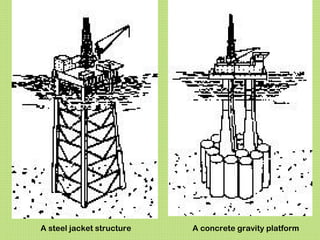
Superstructure: 'topsides' supported on a
deck mounted on jacket structure. Has
modules which house drilling equipment,
production equipment, power generating
sets, pumps, compressors, a gas flare stack,
revolving cranes, survival craft, helicopter
pad and living quarters with hotel and
catering facilities. Weight - up to 40,000
tonnes.
Substructure: (a) steel tubular jacket or
(b)pre-stressed concrete structure.
FIXED OFFSHORE
PLATFORMS(CONTD.)
Long term use production platform
Shallow depth installations (from 5m to 500 feet)
Load on platform depends on jacket length and can be very
severe
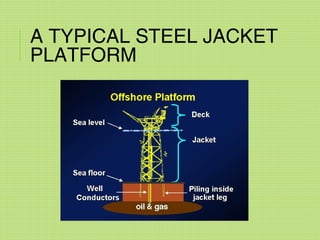
A TYPICAL STEEL JACKET
PLATFORM
A steel jacket structure A concrete gravity platform
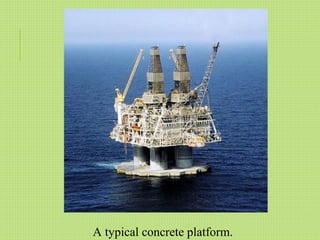
A typical concrete platform.
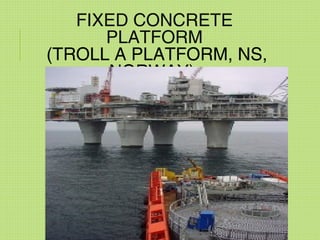
FIXED CONCRETE
PLATFORM
(TROLL A PLATFORM, NS,
NORWAY)
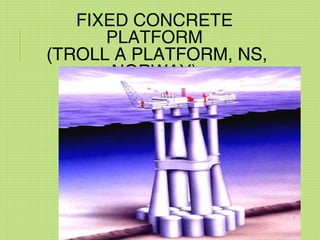
FIXED CONCRETE
PLATFORM
(TROLL A PLATFORM, NS,
NORWAY)
OFFSHORE STRUCTURES
– COMPLIANT TOWERS
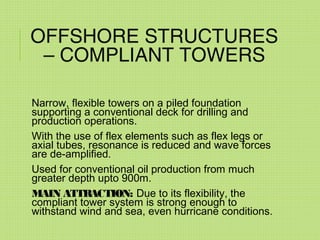
Narrow, flexible towers on a piled foundation
supporting a conventional deck for drilling and
production operations.
With the use of flex elements such as flex legs or
axial tubes, resonance is reduced and wave forces
are de-amplified.
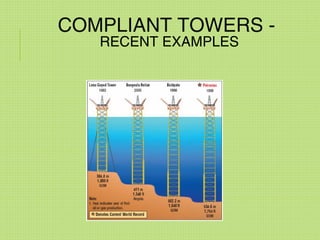
Used for conventional oil production from much
greater depth upto 900m.
MAIN ATTRACTION: Due to its flexibility, the
compliant tower system is strong enough to
withstand wind and sea, even hurricane conditions.
COMPLIANT TOWERS -
RECENT EXAMPLES
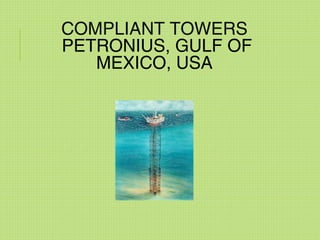
COMPLIANT TOWERS
PETRONIUS, GULF OF
MEXICO, USA
OFFSHORE STRUCTURES
– JACK-UP RIGS
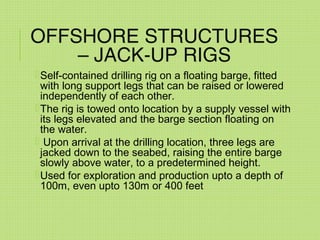
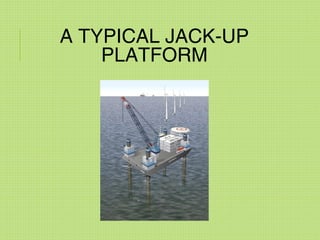
Self-contained drilling rig on a floating barge, fitted
with long support legs that can be raised or lowered
independently of each other.
The rig is towed onto location by a supply vessel with
its legs elevated and the barge section floating on
the water.
 Upon arrival at the drilling location, three legs are
jacked down to the seabed, raising the entire barge
slowly above water, to a predetermined height.
Used for exploration and production upto a depth of
100m, even upto 130m or 400 feet
A TYPICAL JACK-UP
PLATFORM
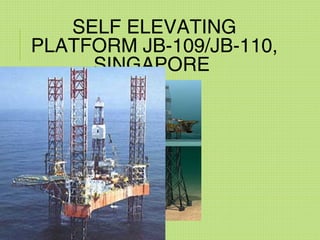
SELF ELEVATING
PLATFORM JB-109/JB-110,
SINGAPORE
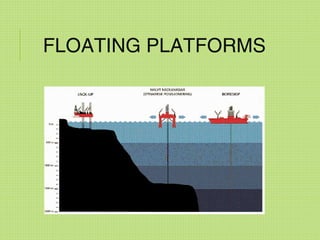
FLOATING PLATFORMS
SEMI-SUBMERSIBLE
PLATFORMS
Two or more submerged Hulls
Four or six pillars or legs
Platform about 100 feet above water
Remains afloat by weight and buoyancy balance
Height above water can be varied by buoyancy adjustment in
tanks
SEMI-SUBMERSIBLE
PLATFORMS (CONTD.)
Can be moved from place to place
Remains in position by multi-point anchoring to sea bed and
Dynamic positioning system
Can be operated inshallow as well as deep waters upto 5000
feet depth
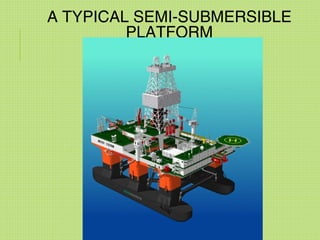
A TYPICAL SEMI-SUBMERSIBLE
PLATFORM
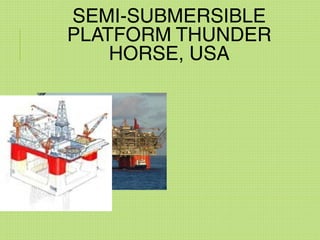
SEMI-SUBMERSIBLE
PLATFORM THUNDER
HORSE, USA
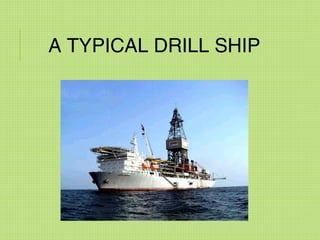
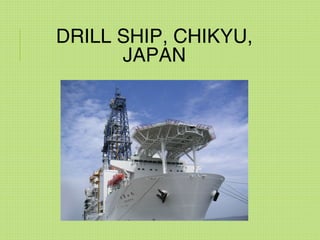
DRILL SHIPS
 It is a ship equipped with a drilling rig and station-keeping equipment such as
anchor chains and/ or a DP system
 They carry larger payloads than semi-submersible rigs and due to their
mobility and ability to carry large amounts of drilling equipment, drill-ships are
well suited to operate in remote and deep oceans
A TYPICAL DRILL SHIP
DRILL SHIP, CHIKYU,
JAPAN
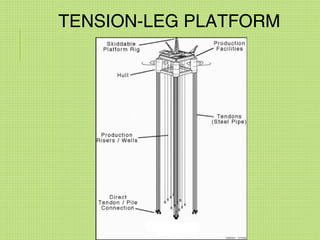
TENSION LEG PLATFORM
Semi-submersible construction with submerged hulls, four or
six pillars and a platform
Vertical tethers hold the TLP to the sea floor and these are in
tension always
Tension in tethers =
buoyancy - weight
TENSION LEG
PLATFORM(CONTD.)
Vertical motion of structure restricted
Can be used in very deep waters upto 2000m
depth
TENSION-LEG PLATFORM
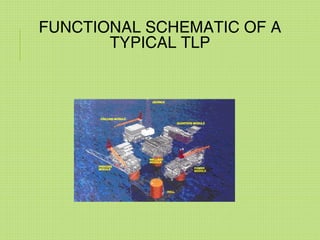
FUNCTIONAL SCHEMATIC OF A
TYPICAL TLP
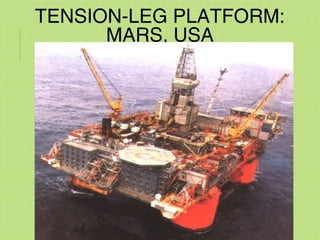
TENSION-LEG PLATFORM:
MARS, USA
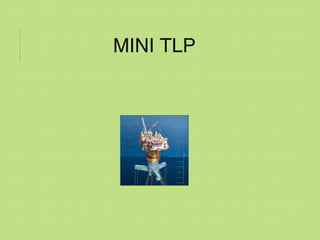
MINI TLP
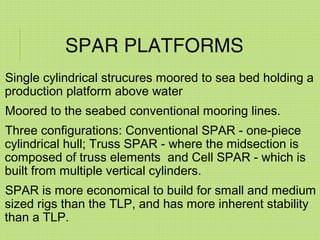
SPAR PLATFORMS
Single cylindrical strucures moored to sea bed holding a
production platform above water
Moored to the seabed conventional mooring lines.
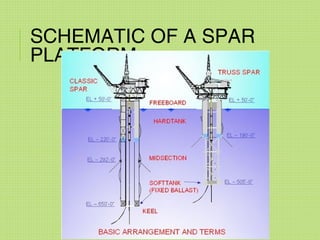
Three configurations: Conventional SPAR - one-piece
cylindrical hull; Truss SPAR - where the midsection is
composed of truss elements and Cell SPAR - which is
built from multiple vertical cylinders.
SPAR is more economical to build for small and medium
sized rigs than the TLP, and has more inherent stability
than a TLP.
SCHEMATIC OF A SPAR
PLATFORM
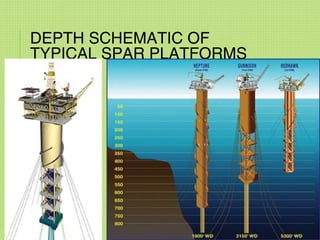
DEPTH SCHEMATIC OF
TYPICAL SPAR PLATFORMS
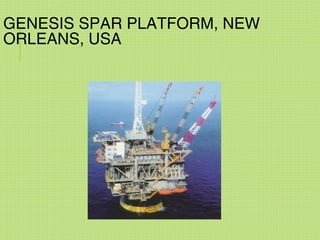
GENESIS SPAR PLATFORM, NEW
ORLEANS, USA
OFFSHORE PLATFORMS –
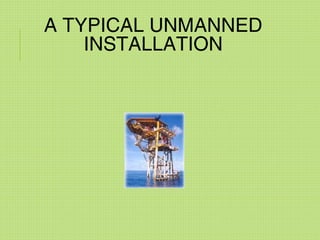
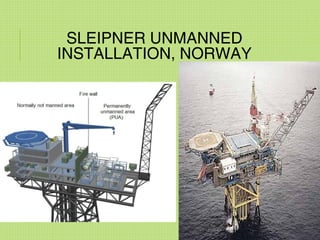
UNMANNED INSTALLATION (UI)
Offshore facility designed to be operated
remotely without the constant presence of
personnel.
Small size with a helipad on top. These are
easy to build and maintain, while avoiding
the high operating costs of a full production
platform.
Used only in shallower water, where
constructing many small UIs is a relatively
easy and cheap option as compared to the
cost of using subsea wells.
A TYPICAL UNMANNED
INSTALLATION
SLEIPNER UNMANNED
INSTALLATION, NORWAY
FLOATING PRODUCTION
SYSTEMS
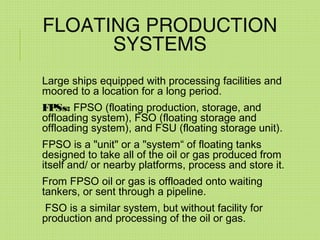
Large ships equipped with processing facilities and
moored to a location for a long period.
FPSs: FPSO (floating production, storage, and
offloading system), FSO (floating storage and
offloading system), and FSU (floating storage unit).
FPSO is a "unit" or a "system“ of floating tanks
designed to take all of the oil or gas produced from
itself and/ or nearby platforms, process and store it.
From FPSO oil or gas is offloaded onto waiting
tankers, or sent through a pipeline.
FSO is a similar system, but without facility for
production and processing of the oil or gas.
FLOATING PRODUCTION
SYSTEMS
(CONTD.)
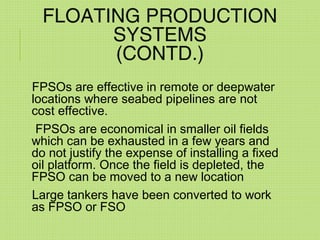
FPSOs are effective in remote or deepwater
locations where seabed pipelines are not
cost effective.
FPSOs are economical in smaller oil fields
which can be exhausted in a few years and
do not justify the expense of installing a fixed
oil platform. Once the field is depleted, the
FPSO can be moved to a new location
Large tankers have been converted to work
as FPSO or FSO
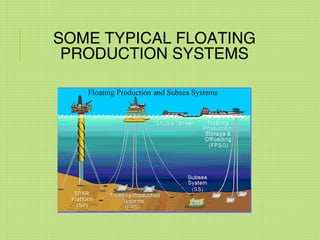
SOME TYPICAL FLOATING
PRODUCTION SYSTEMS
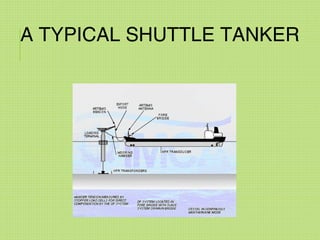
A TYPICAL SHUTTLE TANKER
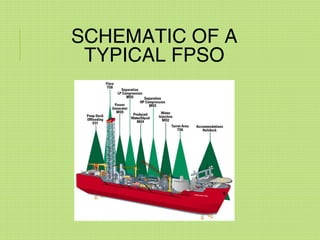
SCHEMATIC OF A
TYPICAL FPSO
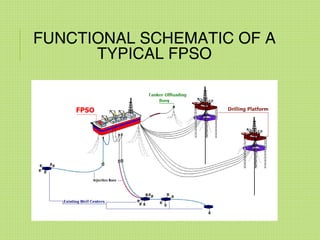
FUNCTIONAL SCHEMATIC OF A
TYPICAL FPSO
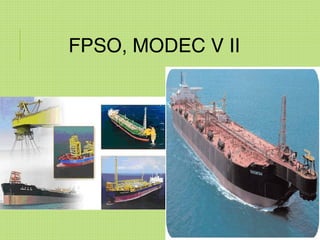
FPSO, MODEC V II
THANK YOU

Offshore Platforms

  • 1.
    OFFSHORE PLATFORMS BY ABHISHEK KUMAR IndianMaritime University Visakhapatnam Campus
  • 2.
    WHAT IS ANOFFSHORE PLATFORM? A large structure at sea used to house crew and mechinery for exploration and/ or production of natural resouces such as fossil fuels from under the ocean bed. Normally located in the continental shelf, but could be in deeper waters. Could be fixed to sea bed or floating. Could be dumb or mobile.
  • 3.
    WHERE ARE OFFSHORE PLATFORMS? Around6,500 offshore oil and gas installations distributed in some 53 countries US Gulf of Mexico: 4,000; Asia: 950; Middle East: 700; Europe, North Sea and North East Atlantic: 490; West Africa coast: 380; and South America: 340
  • 4.
    TYPES OF OFFSHORE PLATFORMS Fixed Platforms  Compliant towers  Jack-up Platforms  Semi-submersible Platforms  Drillships  Tension-leg platforms  SPAR Platforms  Normally unmanned installations  Floating production systems
  • 5.
    FIXED OFFSHORE PLATFORMS Superstructure: 'topsides'supported on a deck mounted on jacket structure. Has modules which house drilling equipment, production equipment, power generating sets, pumps, compressors, a gas flare stack, revolving cranes, survival craft, helicopter pad and living quarters with hotel and catering facilities. Weight - up to 40,000 tonnes. Substructure: (a) steel tubular jacket or (b)pre-stressed concrete structure.
  • 6.
    FIXED OFFSHORE PLATFORMS(CONTD.) Long termuse production platform Shallow depth installations (from 5m to 500 feet) Load on platform depends on jacket length and can be very severe
  • 7.
    A TYPICAL STEELJACKET PLATFORM
  • 8.
    A steel jacketstructure A concrete gravity platform
  • 9.
  • 10.
    FIXED CONCRETE PLATFORM (TROLL APLATFORM, NS, NORWAY)
  • 11.
    FIXED CONCRETE PLATFORM (TROLL APLATFORM, NS, NORWAY)
  • 12.
    OFFSHORE STRUCTURES – COMPLIANTTOWERS Narrow, flexible towers on a piled foundation supporting a conventional deck for drilling and production operations. With the use of flex elements such as flex legs or axial tubes, resonance is reduced and wave forces are de-amplified. Used for conventional oil production from much greater depth upto 900m. MAIN ATTRACTION: Due to its flexibility, the compliant tower system is strong enough to withstand wind and sea, even hurricane conditions.
  • 13.
  • 14.
  • 15.
    OFFSHORE STRUCTURES – JACK-UPRIGS Self-contained drilling rig on a floating barge, fitted with long support legs that can be raised or lowered independently of each other. The rig is towed onto location by a supply vessel with its legs elevated and the barge section floating on the water.  Upon arrival at the drilling location, three legs are jacked down to the seabed, raising the entire barge slowly above water, to a predetermined height. Used for exploration and production upto a depth of 100m, even upto 130m or 400 feet
  • 16.
  • 17.
  • 18.
  • 19.
    SEMI-SUBMERSIBLE PLATFORMS Two or moresubmerged Hulls Four or six pillars or legs Platform about 100 feet above water Remains afloat by weight and buoyancy balance Height above water can be varied by buoyancy adjustment in tanks
  • 20.
    SEMI-SUBMERSIBLE PLATFORMS (CONTD.) Can bemoved from place to place Remains in position by multi-point anchoring to sea bed and Dynamic positioning system Can be operated inshallow as well as deep waters upto 5000 feet depth
  • 21.
  • 22.
  • 23.
    DRILL SHIPS  Itis a ship equipped with a drilling rig and station-keeping equipment such as anchor chains and/ or a DP system  They carry larger payloads than semi-submersible rigs and due to their mobility and ability to carry large amounts of drilling equipment, drill-ships are well suited to operate in remote and deep oceans
  • 24.
  • 25.
  • 26.
    TENSION LEG PLATFORM Semi-submersibleconstruction with submerged hulls, four or six pillars and a platform Vertical tethers hold the TLP to the sea floor and these are in tension always Tension in tethers = buoyancy - weight
  • 27.
    TENSION LEG PLATFORM(CONTD.) Vertical motionof structure restricted Can be used in very deep waters upto 2000m depth
  • 28.
  • 29.
  • 30.
  • 31.
  • 32.
    SPAR PLATFORMS Single cylindricalstrucures moored to sea bed holding a production platform above water Moored to the seabed conventional mooring lines. Three configurations: Conventional SPAR - one-piece cylindrical hull; Truss SPAR - where the midsection is composed of truss elements and Cell SPAR - which is built from multiple vertical cylinders. SPAR is more economical to build for small and medium sized rigs than the TLP, and has more inherent stability than a TLP.
  • 33.
    SCHEMATIC OF ASPAR PLATFORM
  • 34.
  • 35.
    GENESIS SPAR PLATFORM,NEW ORLEANS, USA
  • 36.
    OFFSHORE PLATFORMS – UNMANNEDINSTALLATION (UI) Offshore facility designed to be operated remotely without the constant presence of personnel. Small size with a helipad on top. These are easy to build and maintain, while avoiding the high operating costs of a full production platform. Used only in shallower water, where constructing many small UIs is a relatively easy and cheap option as compared to the cost of using subsea wells.
  • 37.
  • 38.
  • 39.
    FLOATING PRODUCTION SYSTEMS Large shipsequipped with processing facilities and moored to a location for a long period. FPSs: FPSO (floating production, storage, and offloading system), FSO (floating storage and offloading system), and FSU (floating storage unit). FPSO is a "unit" or a "system“ of floating tanks designed to take all of the oil or gas produced from itself and/ or nearby platforms, process and store it. From FPSO oil or gas is offloaded onto waiting tankers, or sent through a pipeline. FSO is a similar system, but without facility for production and processing of the oil or gas.
  • 40.
    FLOATING PRODUCTION SYSTEMS (CONTD.) FPSOs areeffective in remote or deepwater locations where seabed pipelines are not cost effective. FPSOs are economical in smaller oil fields which can be exhausted in a few years and do not justify the expense of installing a fixed oil platform. Once the field is depleted, the FPSO can be moved to a new location Large tankers have been converted to work as FPSO or FSO
  • 41.
  • 42.
  • 43.
  • 44.
  • 45.
  • 46.