OFFSHORE
PLATFORMS/STRUCTURES
INTRODUCTION
Offshore structures may be used for a
variety of reasons:
• Oil and gas exploration
• Navigation aid towers
• Bridges and causeways
• Ship loading and unloading facilities
OFFSHORE
PLATFORMS/STRUCTURES
TYPES OF OFFSHORE OIL/GAS EXPLORATION
STRUCTURES
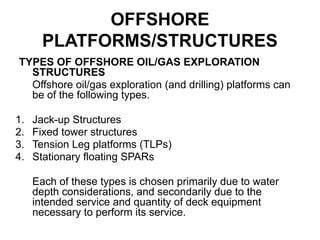
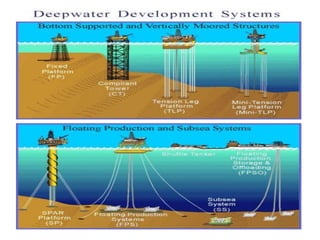
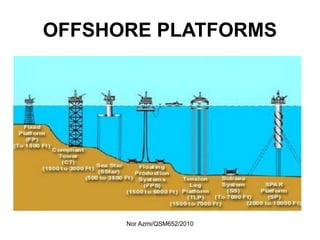
Offshore oil/gas exploration (and drilling) platforms can
be of the following types.
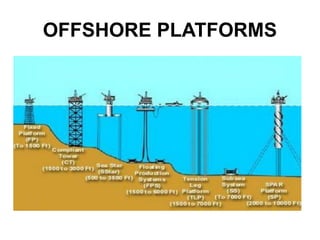
1. Jack-up Structures
2. Fixed tower structures
3. Tension Leg platforms (TLPs)
4. Stationary floating SPARs
Each of these types is chosen primarily due to water
depth considerations, and secondarily due to the
intended service and quantity of deck equipment
necessary to perform its service.
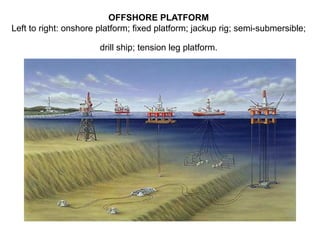
OFFSHORE PLATFORM
Left to right: onshore platform; fixed platform; jackup rig; semi-submersible;
drill ship; tension leg platform.
OFFSHORE PLATFORMS
Offshore platform
The design and analysis of offshore platforms must be
done taking into consideration many factors, including
the following important parameters:
• Environmental (initial transportation, and in-place
100-year storm conditions)
• Soil characteristics
• American Institute of Steel Construction (AISC) codes,
and recommendations
• Intensity level of consequences of failure
Offshore platform:
Fixed Tower
• The Fixed Steel Structures are restricted
to shallow water developments with water
deep about 1500 ft.
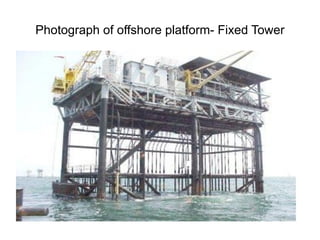
• The traditional offshore structure consists
of weld steel, tubular framework or jacket
to support the topside facilities. Piles
driven into the seafloor secure the jacket.
Photograph of offshore platform- Fixed Tower
OFFSHORE PLATFORM:
JACK-UP PLATFORM
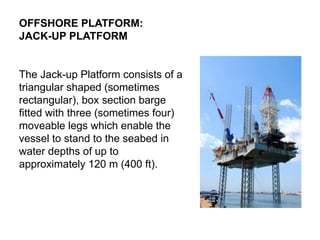
The Jack-up Platform consists of a
triangular shaped (sometimes
rectangular), box section barge
fitted with three (sometimes four)
moveable legs which enable the
vessel to stand to the seabed in
water depths of up to
approximately 120 m (400 ft).
OFFSHORE PLATFORM:
TENSION LEG PLATFORM (TLP)
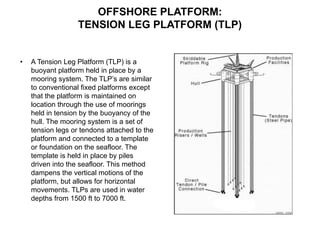
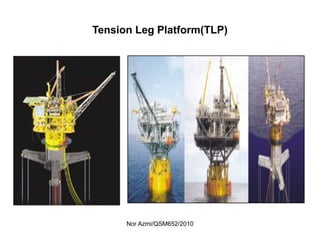
• A Tension Leg Platform (TLP) is a
buoyant platform held in place by a
mooring system. The TLP’s are similar
to conventional fixed platforms except
that the platform is maintained on
location through the use of moorings
held in tension by the buoyancy of the
hull. The mooring system is a set of
tension legs or tendons attached to the
platform and connected to a template
or foundation on the seafloor. The
template is held in place by piles
driven into the seafloor. This method
dampens the vertical motions of the
platform, but allows for horizontal
movements. TLPs are used in water
depths from 1500 ft to 7000 ft.
OFFSHORE PLATFORM:
TENSION LEG PLATFORM (TLP)
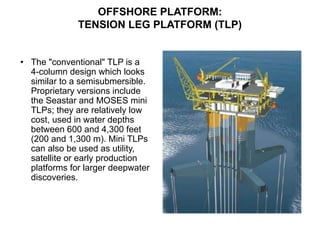
• The "conventional" TLP is a
4-column design which looks
similar to a semisubmersible.
Proprietary versions include
the Seastar and MOSES mini
TLPs; they are relatively low
cost, used in water depths
between 600 and 4,300 feet
(200 and 1,300 m). Mini TLPs
can also be used as utility,
satellite or early production
platforms for larger deepwater
discoveries.
OFFSHORE PLATFORM:
SPAR PLATFORM
OFFSHORE PLATFORM:
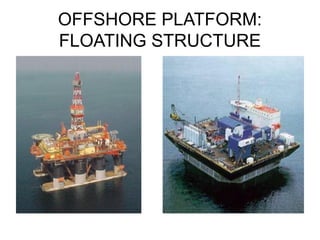
FLOATING STRUCTURE
Nor Azmi/QSM652/2010
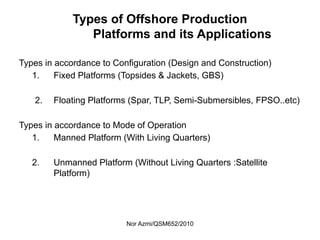
Types of Offshore Production
Platforms and its Applications
Types in accordance to Configuration (Design and Construction)
1. Fixed Platforms (Topsides & Jackets, GBS)
2. Floating Platforms (Spar, TLP, Semi-Submersibles, FPSO..etc)
Types in accordance to Mode of Operation
1. Manned Platform (With Living Quarters)
2. Unmanned Platform (Without Living Quarters :Satellite
Platform)
Nor Azmi/QSM652/2010
OFFSHORE PLATFORMS
Nor Azmi/QSM652/2010
Types of Offshore Production
Platforms in Accordance to Configuration,
Design and Construction
1. Fixed Platforms
Fixed Platforms are none-floating, none-mobile marine structures
that consists mainly of a Topside and a Jacket.
a. Topside and Jacket
A Topside is a dry structure totally above water which contains all
the facilities necessary for production, processing of hydrocarbon
fluids (oil and gas) as well as facilities for artificial lifting of
hydrocarbons (gaslift, water injecton, gas injection..etc).
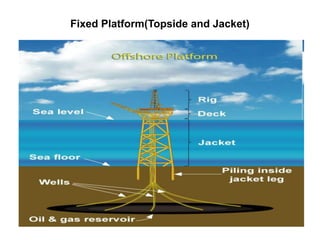
A Jacket is a free-standing substructure that stands on the sea bed
and supports the Topside keeping it above water. The Jacket is
secured onto the seabed by piles which runs through its main
tubular legs or through skirt rings attached to its legs.
Nor Azmi/QSM652/2010
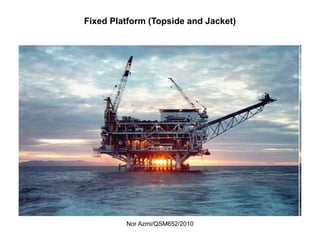
Fixed Platform (Topside and Jacket)
Nor Azmi/QSM652/2010
Fixed Platform(Topside and Jacket)
Nor Azmi/QSM652/2010
Types of Offshore Production
Platforms in Accordance to Configuration
(Design and Construction)
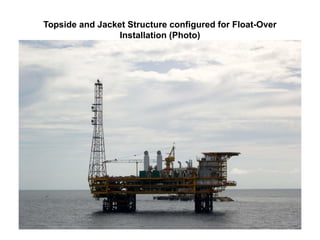
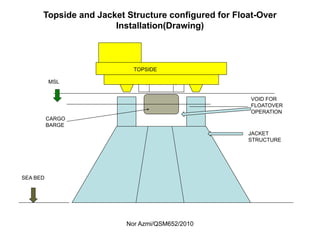
Topside and Jacket Structure configured for Float-Over Installation
The same as a normal Topside and Jacket, except that upper middle
portion of Jacket Structure is configured to allow access or through
passage (float-over) of a cargo barge carrying the topside. By careful
positioning of the carrier barge, the topside is set in-place over the jacket
structure.
One or two method are used to make the topside sit in proper alignment
over the jacket structure : 1) By barge ballasting, and/or 2) By retracting
of pre-extended hydraulic cylinders
Nor Azmi/QSM652/2010
Topside and Jacket Structure configured for Float-Over
Installation (Photo)
Nor Azmi/QSM652/2010
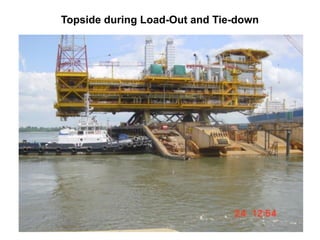
Topside during Load-Out and Tie-down
Nor Azmi/QSM652/2010
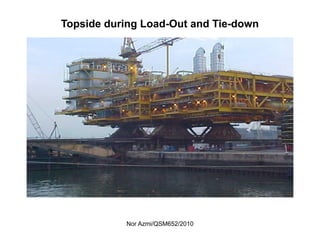
Topside during Load-Out and Tie-down
Nor Azmi/QSM652/2010
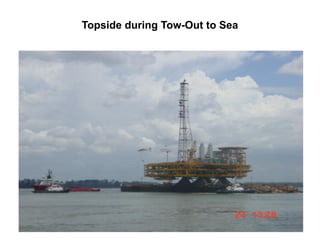
Topside during Tow-Out to Sea
Nor Azmi/QSM652/2010
Topside and Jacket Structure configured for Float-Over
Installation(Drawing)
MSL
SEA BED
JACKET
STRUCTURE
VOID FOR
FLOATOVER
OPERATION
CARGO
BARGE
TOPSIDE
Nor Azmi/QSM652/2010
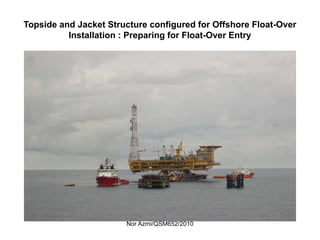
Topside and Jacket Structure configured for Offshore Float-Over
Installation : Preparing for Float-Over Entry
Nor Azmi/QSM652/2010
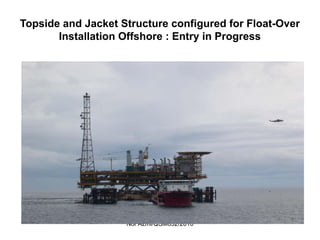
Topside and Jacket Structure configured for Float-Over
Installation Offshore : Entry in Progress
Nor Azmi/QSM652/2010
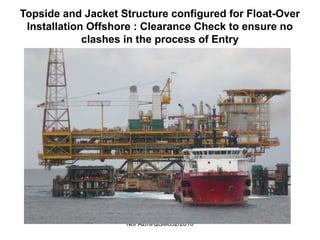
Topside and Jacket Structure configured for Float-Over
Installation Offshore : Clearance Check to ensure no
clashes in the process of Entry
Nor Azmi/QSM652/2010
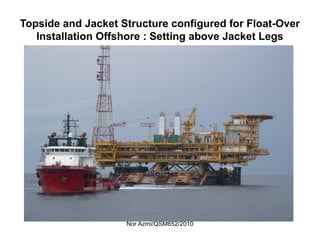
Topside and Jacket Structure configured for Float-Over
Installation Offshore : Setting above Jacket Legs
Nor Azmi/QSM652/2010
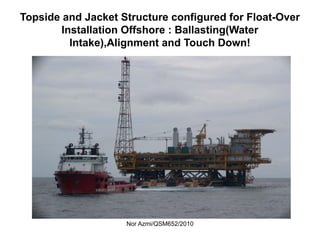
Topside and Jacket Structure configured for Float-Over
Installation Offshore : Ballasting(Water
Intake),Alignment and Touch Down!
Nor Azmi/QSM652/2010
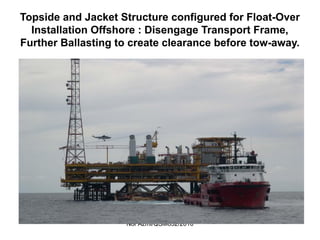
Topside and Jacket Structure configured for Float-Over
Installation Offshore : Disengage Transport Frame,
Further Ballasting to create clearance before tow-away.
Nor Azmi/QSM652/2010
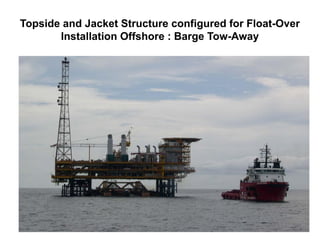
Topside and Jacket Structure configured for Float-Over
Installation Offshore : Barge Tow-Away
Nor Azmi/QSM652/2010
Fixed Platform / Gravity Base Structure (GBS)
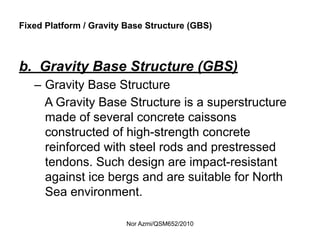
b. Gravity Base Structure (GBS)
– Gravity Base Structure
A Gravity Base Structure is a superstructure
made of several concrete caissons
constructed of high-strength concrete
reinforced with steel rods and prestressed
tendons. Such design are impact-resistant
against ice bergs and are suitable for North
Sea environment.
Nor Azmi/QSM652/2010
Fixed Platform / Gravity Base Structure (GBS)
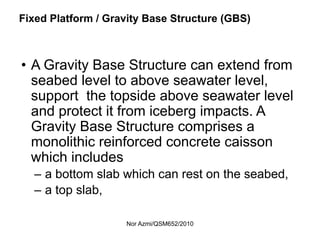
• A Gravity Base Structure can extend from
seabed level to above seawater level,
support the topside above seawater level
and protect it from iceberg impacts. A
Gravity Base Structure comprises a
monolithic reinforced concrete caisson
which includes
– a bottom slab which can rest on the seabed,
– a top slab,
Nor Azmi/QSM652/2010
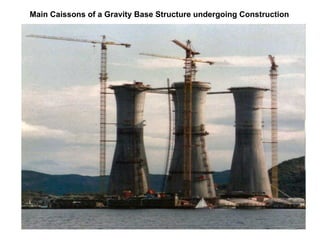
Main Caissons of a Gravity Base Structure undergoing Construction
Nor Azmi/QSM652/2010
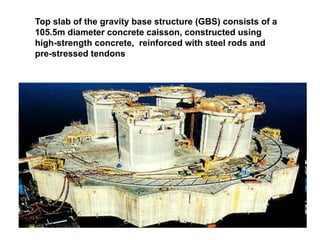
Top slab of the gravity base structure (GBS) consists of a
105.5m diameter concrete caisson, constructed using
high-strength concrete, reinforced with steel rods and
pre-stressed tendons
Nor Azmi/QSM652/2010
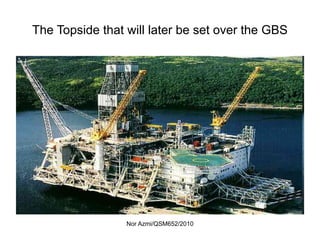
The Topside that will later be set over the GBS
Nor Azmi/QSM652/2010
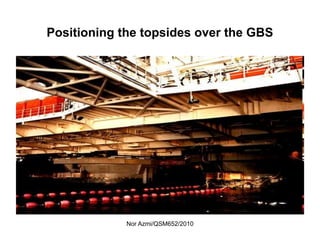
Positioning the topsides over the GBS
Nor Azmi/QSM652/2010
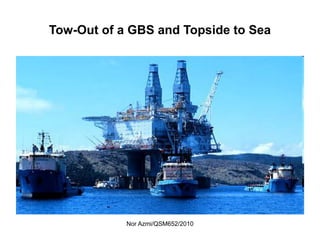
Tow-Out of a GBS and Topside to Sea
Nor Azmi/QSM652/2010
Types of Offshore Production
Platforms in accordance to Design and
Construction
2. Floating Platforms/Installation
Floating Platforms are either mobile or semi-mobile.
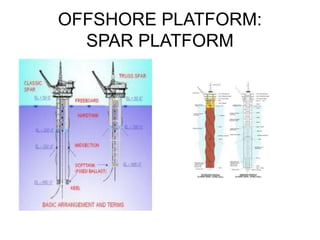
– SPAR
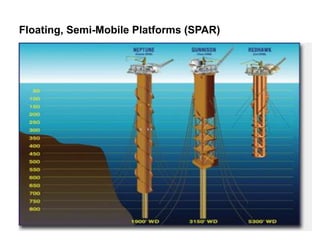
A SPAR is a single large-diameter semi-submerged Cylinder or
Caisson moored by some 6-20 taut catenary lines that are
anchored to the sea bed. The Spar supports a Topside and is
equipped with void tanks and ballasting chambers fitted with
pumps, piping and control instrumentation that works to keep the
SPAR stable and floating on water.
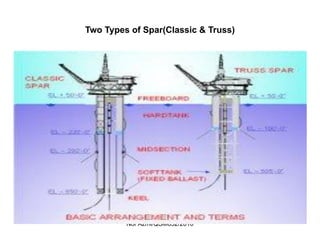
a. Truss Spar
b. Classic Spar
Nor Azmi/QSM652/2010
Floating, Semi-Mobile Platforms (SPAR)
Nor Azmi/QSM652/2010
Two Types of Spar(Classic & Truss)
Nor Azmi/QSM652/2010
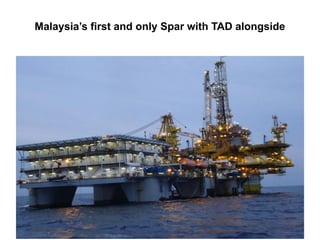
Malaysia’s first and only Spar with TAD alongside
Nor Azmi/QSM652/2010
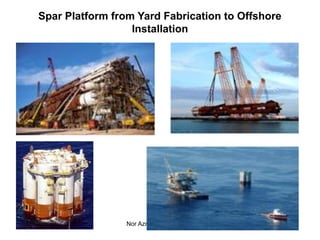
Spar Platform from Yard Fabrication to Offshore
Installation
Nor Azmi/QSM652/2010
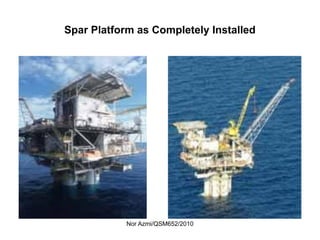
Spar Platform as Completely Installed
Nor Azmi/QSM652/2010
Types of Offshore Production
Platforms in accordance to Design and
Construction
• Floating Platforms/Installation
– Tension Leg Platform(TLP)
A floating structure held in place by vertical, tensioned
tendons connected to the sea floor. These tensioned
tendons provide limited vertical motion. Suitable for
deepwater depths up to 4,000ft (~ 9,000ft)
Nor Azmi/QSM652/2010
Tension Leg Platform(TLP)
Nor Azmi/QSM652/2010
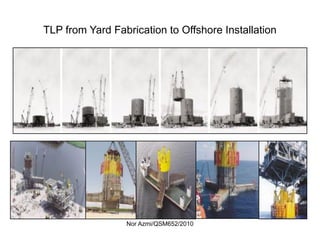
TLP from Yard Fabrication to Offshore Installation
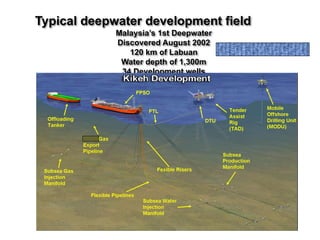
Typical deepwater development field
Malaysia’s 1st Deepwater
Discovered August 2002
120 km of Labuan
Water depth of 1,300m
34 Development wells
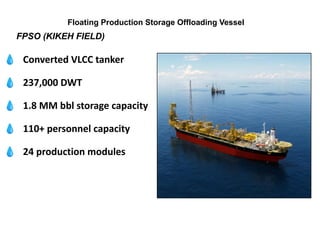
💧 Converted VLCC tanker
💧 237,000 DWT
💧 1.8 MM bbl storage capacity
💧 110+ personnel capacity
💧 24 production modules
Floating Production Storage Offloading Vessel
FPSO (KIKEH FIELD)
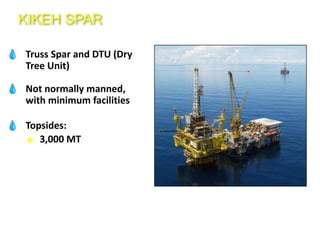
💧 Truss Spar and DTU (Dry
Tree Unit)
💧 Not normally manned,
with minimum facilities
💧 Topsides:
❖ 3,000 MT
KIKEH SPAR
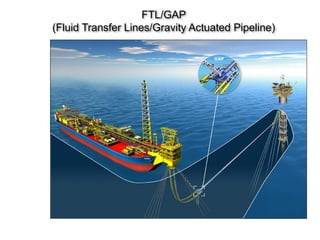
FTL/GAP
(Fluid Transfer Lines/Gravity Actuated Pipeline)
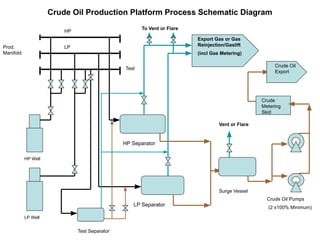
Crude Oil Production Platform Process Schematic Diagram
To Vent or Flare
Export Gas or Gas
Reinjection/Gaslift
(incl Gas Metering)
HP Separator
LP Separator
Surge Vessel
Crude
Metering
Skid
Crude Oil Pumps
(2 x100% Minimum)
Crude Oil
Export
HP Well
LP Well
HP
LP
Test
Prod.
Manifold
Test Separator
Vent or Flare
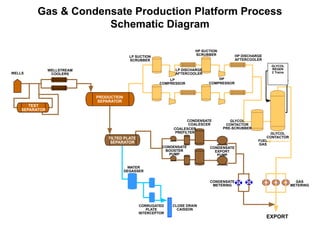
Gas & Condensate Production Platform Process
Schematic Diagram
EXPORT
CLOSE DRAIN
CAISSON
TEST
SEPARATOR
WELLS
PRODUCTION
SEPARATOR
TILTED PLATE
SEPARATOR
LP SUCTION
SCRUBBER
LP
COMPRESSOR
LP DISCHARGE
AFTERCOOLER
HP SUCTION
SCRUBBER
HP
COMPRESSOR
HP DISCHARGE
AFTERCOOLER
GLYCOL
CONTACTOR
PRE-SCRUBBER
GLYCOL
CONTACTOR
GAS
METERING
CONDENSATE
EXPORT
PUMP
CONDENSATE
BOOSTER
PUMP
COALESCER
PREFILTER
CONDENSATE
COALESCER
WATER
DEGASSER
CORRUGATED
PLATE
INTERCEPTOR
FUEL
GAS
CONDENSATE
METERING
WELLSTREAM
COOLERS
GLYCOL
REGEN
2 Trains
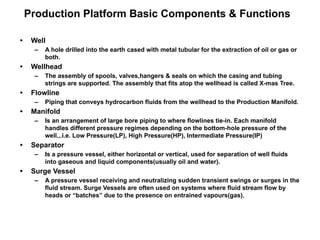
Production Platform Basic Components & Functions
• Well
– A hole drilled into the earth cased with metal tubular for the extraction of oil or gas or
both.
• Wellhead
– The assembly of spools, valves,hangers & seals on which the casing and tubing
strings are supported. The assembly that fits atop the wellhead is called X-mas Tree.
• Flowline
– Piping that conveys hydrocarbon fluids from the wellhead to the Production Manifold.
• Manifold
– Is an arrangement of large bore piping to where flowlines tie-in. Each manifold
handles different pressure regimes depending on the bottom-hole pressure of the
well.,.i.e. Low Pressure(LP), High Pressure(HP), Intermediate Pressure(IP)
• Separator
– Is a pressure vessel, either horizontal or vertical, used for separation of well fluids
into gaseous and liquid components(usually oil and water).
• Surge Vessel
– A pressure vessel receiving and neutralizing sudden transient swings or surges in the
fluid stream. Surge Vessels are often used on systems where fluid stream flow by
heads or “batches” due to the presence on entrained vapours(gas).
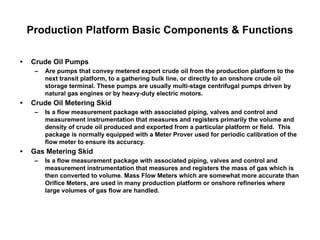
Production Platform Basic Components & Functions
• Crude Oil Pumps
– Are pumps that convey metered export crude oil from the production platform to the
next transit platform, to a gathering bulk line, or directly to an onshore crude oil
storage terminal. These pumps are usually multi-stage centrifugal pumps driven by
natural gas engines or by heavy-duty electric motors.
• Crude Oil Metering Skid
– Is a flow measurement package with associated piping, valves and control and
measurement instrumentation that measures and registers primarily the volume and
density of crude oil produced and exported from a particular platform or field. This
package is normally equipped with a Meter Prover used for periodic calibration of the
flow meter to ensure its accuracy.
• Gas Metering Skid
– Is a flow measurement package with associated piping, valves and control and
measurement instrumentation that measures and registers the mass of gas which is
then converted to volume. Mass Flow Meters which are somewhat more accurate than
Orifice Meters, are used in many production platform or onshore refineries where
large volumes of gas flow are handled.
Production Platform Basic Components & Functions
• Hydrocarbon
– Organic chemical compounds of hydrogen and carbon atoms. There are
vast amounts of these compounds and they form the basis of all petroleum
products. Hydrocarbons may exist as gases, liquids or solids. E.g. –
Methane, Hexane & Asphalt.
• Types of Crude Oil (Generic)
– Paraffin-base
• Crude oil containing little or no asphalt materials, a good source of
paraffin, quality lubricating oil and high-grade kerosene. It usually has
lower none-hydrocarbon content than Asphalt-base crude.
– Asphaltic-base
• Crude oil containing very little paraffin wax and a residue primarily
asphaltic. Sulfur, Oxygen and Nitrogen often occurs relatively high.
This type of crude is particularly suitable for making high-quality
gasoline, lubrication oil and asphalt.
– Mixed-base
• Crude oil which contains both paraffin wax and asphaltic matter.
Maintenance of Offshore Production Facilities
Taking an example of a maintenance
strategy of KIKEH offshore production
facilities
• Preventive Maintenance
– Dynamic Equipment
• Time-Based
• Condition-Based
– Static Equipment
• Time-Based
• Risk-Based Inspection(RBI)
– Reliability-Centered Maintenance(RCM)
Maintenance of Offshore Production Facilities
• Preventive Maintenance
– Dynamic Equipment (Rotating, Reciprocating, etc)
• Time-Based
– Is a maintenance intervention approach wholly based on
OEM-recommended task or set of tasks that shall be
performed at specific intervals.
• Condition-Based
– Is a maintenance intervention approach that must
address findings about the prevailing condition of the
equipment following a pre-implementation survey or
inspection. Examples of such pre-implementation survey
or inspection are : Lube Oil Sampling & Analysis,
Compression Test on Recip Engines, Thermal trending).
Scope of work and implementation frequency does not
depend on time but depends on equipment condition.
– Static Equipment(Pressure Vessels, Tanks, Piping)
• Time-Based
– Is a maintenance intervention approach wholly based on
pre-established scopes & frequencies defined by
appropriate authorities or by statutory regulation, and is
widely accepted and practiced in any specific industry.
(Pressure Vessel, Tank Inspection)
• Risk-Based Inspection(RBI)
– Is inspection where all numerical data gathered during
inspection and prevailing operating conditions are
assimilated and factored together using applicable
risk-assessment methods to determine remaining life of
component inspected.
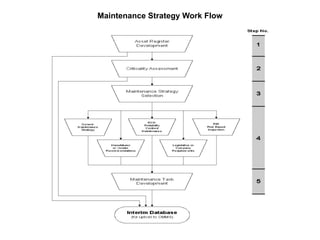
Maintenance Strategy Work Flow
RCM
• A reliability-centered approach will be used to determine
maintenance and inspection programs for individual
components and systems. The approach has the
following steps:
• Establish equipment criticality
• Determine component subject to failure
• Identify failure modes and consequences
• Determine appropriate style of maintenance
• Condition monitoring
• Planned based on calendar or running hours
• Breakdown maintenance
RCM
• Identify possible condition monitoring variables and methods
• On-line/Off-line
• Continuous/Intermittent
• Install monitoring equipment
• Set limits on variables
• Trend and interpret monitoring data
• Collect and trend data
RCM
• Alarm when data is outside limits
• Optimize unit equipment within constraints
• Convert breakdown and time-based maintenance to condition
monitoring
• Understand component condition
• Adjust operating conditions to extend life
• Predict impending failures
• Use condition monitoring to set scope of maintenance activity
• Tailor to condition
• Challenge need for major overhauls

OFFSHORE PLATFORM_1.ppt (1).pdf

  • 1.
    OFFSHORE PLATFORMS/STRUCTURES INTRODUCTION Offshore structures maybe used for a variety of reasons: • Oil and gas exploration • Navigation aid towers • Bridges and causeways • Ship loading and unloading facilities
  • 2.
    OFFSHORE PLATFORMS/STRUCTURES TYPES OF OFFSHOREOIL/GAS EXPLORATION STRUCTURES Offshore oil/gas exploration (and drilling) platforms can be of the following types. 1. Jack-up Structures 2. Fixed tower structures 3. Tension Leg platforms (TLPs) 4. Stationary floating SPARs Each of these types is chosen primarily due to water depth considerations, and secondarily due to the intended service and quantity of deck equipment necessary to perform its service.
  • 3.
    OFFSHORE PLATFORM Left toright: onshore platform; fixed platform; jackup rig; semi-submersible; drill ship; tension leg platform.
  • 4.
  • 5.
    Offshore platform The designand analysis of offshore platforms must be done taking into consideration many factors, including the following important parameters: • Environmental (initial transportation, and in-place 100-year storm conditions) • Soil characteristics • American Institute of Steel Construction (AISC) codes, and recommendations • Intensity level of consequences of failure
  • 6.
    Offshore platform: Fixed Tower •The Fixed Steel Structures are restricted to shallow water developments with water deep about 1500 ft. • The traditional offshore structure consists of weld steel, tubular framework or jacket to support the topside facilities. Piles driven into the seafloor secure the jacket.
  • 7.
    Photograph of offshoreplatform- Fixed Tower
  • 8.
    OFFSHORE PLATFORM: JACK-UP PLATFORM TheJack-up Platform consists of a triangular shaped (sometimes rectangular), box section barge fitted with three (sometimes four) moveable legs which enable the vessel to stand to the seabed in water depths of up to approximately 120 m (400 ft).
  • 9.
    OFFSHORE PLATFORM: TENSION LEGPLATFORM (TLP) • A Tension Leg Platform (TLP) is a buoyant platform held in place by a mooring system. The TLP’s are similar to conventional fixed platforms except that the platform is maintained on location through the use of moorings held in tension by the buoyancy of the hull. The mooring system is a set of tension legs or tendons attached to the platform and connected to a template or foundation on the seafloor. The template is held in place by piles driven into the seafloor. This method dampens the vertical motions of the platform, but allows for horizontal movements. TLPs are used in water depths from 1500 ft to 7000 ft.
  • 10.
    OFFSHORE PLATFORM: TENSION LEGPLATFORM (TLP) • The "conventional" TLP is a 4-column design which looks similar to a semisubmersible. Proprietary versions include the Seastar and MOSES mini TLPs; they are relatively low cost, used in water depths between 600 and 4,300 feet (200 and 1,300 m). Mini TLPs can also be used as utility, satellite or early production platforms for larger deepwater discoveries.
  • 11.
  • 12.
  • 14.
    Nor Azmi/QSM652/2010 Types ofOffshore Production Platforms and its Applications Types in accordance to Configuration (Design and Construction) 1. Fixed Platforms (Topsides & Jackets, GBS) 2. Floating Platforms (Spar, TLP, Semi-Submersibles, FPSO..etc) Types in accordance to Mode of Operation 1. Manned Platform (With Living Quarters) 2. Unmanned Platform (Without Living Quarters :Satellite Platform)
  • 15.
  • 16.
    Nor Azmi/QSM652/2010 Types ofOffshore Production Platforms in Accordance to Configuration, Design and Construction 1. Fixed Platforms Fixed Platforms are none-floating, none-mobile marine structures that consists mainly of a Topside and a Jacket. a. Topside and Jacket A Topside is a dry structure totally above water which contains all the facilities necessary for production, processing of hydrocarbon fluids (oil and gas) as well as facilities for artificial lifting of hydrocarbons (gaslift, water injecton, gas injection..etc). A Jacket is a free-standing substructure that stands on the sea bed and supports the Topside keeping it above water. The Jacket is secured onto the seabed by piles which runs through its main tubular legs or through skirt rings attached to its legs.
  • 17.
  • 18.
  • 19.
    Nor Azmi/QSM652/2010 Types ofOffshore Production Platforms in Accordance to Configuration (Design and Construction) Topside and Jacket Structure configured for Float-Over Installation The same as a normal Topside and Jacket, except that upper middle portion of Jacket Structure is configured to allow access or through passage (float-over) of a cargo barge carrying the topside. By careful positioning of the carrier barge, the topside is set in-place over the jacket structure. One or two method are used to make the topside sit in proper alignment over the jacket structure : 1) By barge ballasting, and/or 2) By retracting of pre-extended hydraulic cylinders
  • 20.
    Nor Azmi/QSM652/2010 Topside andJacket Structure configured for Float-Over Installation (Photo)
  • 21.
  • 22.
  • 23.
  • 24.
    Nor Azmi/QSM652/2010 Topside andJacket Structure configured for Float-Over Installation(Drawing) MSL SEA BED JACKET STRUCTURE VOID FOR FLOATOVER OPERATION CARGO BARGE TOPSIDE
  • 25.
    Nor Azmi/QSM652/2010 Topside andJacket Structure configured for Offshore Float-Over Installation : Preparing for Float-Over Entry
  • 26.
    Nor Azmi/QSM652/2010 Topside andJacket Structure configured for Float-Over Installation Offshore : Entry in Progress
  • 27.
    Nor Azmi/QSM652/2010 Topside andJacket Structure configured for Float-Over Installation Offshore : Clearance Check to ensure no clashes in the process of Entry
  • 28.
    Nor Azmi/QSM652/2010 Topside andJacket Structure configured for Float-Over Installation Offshore : Setting above Jacket Legs
  • 29.
    Nor Azmi/QSM652/2010 Topside andJacket Structure configured for Float-Over Installation Offshore : Ballasting(Water Intake),Alignment and Touch Down!
  • 30.
    Nor Azmi/QSM652/2010 Topside andJacket Structure configured for Float-Over Installation Offshore : Disengage Transport Frame, Further Ballasting to create clearance before tow-away.
  • 31.
    Nor Azmi/QSM652/2010 Topside andJacket Structure configured for Float-Over Installation Offshore : Barge Tow-Away
  • 32.
    Nor Azmi/QSM652/2010 Fixed Platform/ Gravity Base Structure (GBS) b. Gravity Base Structure (GBS) – Gravity Base Structure A Gravity Base Structure is a superstructure made of several concrete caissons constructed of high-strength concrete reinforced with steel rods and prestressed tendons. Such design are impact-resistant against ice bergs and are suitable for North Sea environment.
  • 33.
    Nor Azmi/QSM652/2010 Fixed Platform/ Gravity Base Structure (GBS) • A Gravity Base Structure can extend from seabed level to above seawater level, support the topside above seawater level and protect it from iceberg impacts. A Gravity Base Structure comprises a monolithic reinforced concrete caisson which includes – a bottom slab which can rest on the seabed, – a top slab,
  • 34.
    Nor Azmi/QSM652/2010 Main Caissonsof a Gravity Base Structure undergoing Construction
  • 35.
    Nor Azmi/QSM652/2010 Top slabof the gravity base structure (GBS) consists of a 105.5m diameter concrete caisson, constructed using high-strength concrete, reinforced with steel rods and pre-stressed tendons
  • 36.
    Nor Azmi/QSM652/2010 The Topsidethat will later be set over the GBS
  • 37.
  • 38.
    Nor Azmi/QSM652/2010 Tow-Out ofa GBS and Topside to Sea
  • 39.
    Nor Azmi/QSM652/2010 Types ofOffshore Production Platforms in accordance to Design and Construction 2. Floating Platforms/Installation Floating Platforms are either mobile or semi-mobile. – SPAR A SPAR is a single large-diameter semi-submerged Cylinder or Caisson moored by some 6-20 taut catenary lines that are anchored to the sea bed. The Spar supports a Topside and is equipped with void tanks and ballasting chambers fitted with pumps, piping and control instrumentation that works to keep the SPAR stable and floating on water. a. Truss Spar b. Classic Spar
  • 40.
  • 41.
    Nor Azmi/QSM652/2010 Two Typesof Spar(Classic & Truss)
  • 42.
    Nor Azmi/QSM652/2010 Malaysia’s firstand only Spar with TAD alongside
  • 43.
    Nor Azmi/QSM652/2010 Spar Platformfrom Yard Fabrication to Offshore Installation
  • 44.
    Nor Azmi/QSM652/2010 Spar Platformas Completely Installed
  • 45.
    Nor Azmi/QSM652/2010 Types ofOffshore Production Platforms in accordance to Design and Construction • Floating Platforms/Installation – Tension Leg Platform(TLP) A floating structure held in place by vertical, tensioned tendons connected to the sea floor. These tensioned tendons provide limited vertical motion. Suitable for deepwater depths up to 4,000ft (~ 9,000ft)
  • 46.
  • 47.
    Nor Azmi/QSM652/2010 TLP fromYard Fabrication to Offshore Installation
  • 48.
    Typical deepwater developmentfield Malaysia’s 1st Deepwater Discovered August 2002 120 km of Labuan Water depth of 1,300m 34 Development wells
  • 49.
    💧 Converted VLCCtanker 💧 237,000 DWT 💧 1.8 MM bbl storage capacity 💧 110+ personnel capacity 💧 24 production modules Floating Production Storage Offloading Vessel FPSO (KIKEH FIELD)
  • 50.
    💧 Truss Sparand DTU (Dry Tree Unit) 💧 Not normally manned, with minimum facilities 💧 Topsides: ❖ 3,000 MT KIKEH SPAR
  • 51.
  • 52.
    Crude Oil ProductionPlatform Process Schematic Diagram To Vent or Flare Export Gas or Gas Reinjection/Gaslift (incl Gas Metering) HP Separator LP Separator Surge Vessel Crude Metering Skid Crude Oil Pumps (2 x100% Minimum) Crude Oil Export HP Well LP Well HP LP Test Prod. Manifold Test Separator Vent or Flare
  • 53.
    Gas & CondensateProduction Platform Process Schematic Diagram EXPORT CLOSE DRAIN CAISSON TEST SEPARATOR WELLS PRODUCTION SEPARATOR TILTED PLATE SEPARATOR LP SUCTION SCRUBBER LP COMPRESSOR LP DISCHARGE AFTERCOOLER HP SUCTION SCRUBBER HP COMPRESSOR HP DISCHARGE AFTERCOOLER GLYCOL CONTACTOR PRE-SCRUBBER GLYCOL CONTACTOR GAS METERING CONDENSATE EXPORT PUMP CONDENSATE BOOSTER PUMP COALESCER PREFILTER CONDENSATE COALESCER WATER DEGASSER CORRUGATED PLATE INTERCEPTOR FUEL GAS CONDENSATE METERING WELLSTREAM COOLERS GLYCOL REGEN 2 Trains
  • 54.
    Production Platform BasicComponents & Functions • Well – A hole drilled into the earth cased with metal tubular for the extraction of oil or gas or both. • Wellhead – The assembly of spools, valves,hangers & seals on which the casing and tubing strings are supported. The assembly that fits atop the wellhead is called X-mas Tree. • Flowline – Piping that conveys hydrocarbon fluids from the wellhead to the Production Manifold. • Manifold – Is an arrangement of large bore piping to where flowlines tie-in. Each manifold handles different pressure regimes depending on the bottom-hole pressure of the well.,.i.e. Low Pressure(LP), High Pressure(HP), Intermediate Pressure(IP) • Separator – Is a pressure vessel, either horizontal or vertical, used for separation of well fluids into gaseous and liquid components(usually oil and water). • Surge Vessel – A pressure vessel receiving and neutralizing sudden transient swings or surges in the fluid stream. Surge Vessels are often used on systems where fluid stream flow by heads or “batches” due to the presence on entrained vapours(gas).
  • 55.
    Production Platform BasicComponents & Functions • Crude Oil Pumps – Are pumps that convey metered export crude oil from the production platform to the next transit platform, to a gathering bulk line, or directly to an onshore crude oil storage terminal. These pumps are usually multi-stage centrifugal pumps driven by natural gas engines or by heavy-duty electric motors. • Crude Oil Metering Skid – Is a flow measurement package with associated piping, valves and control and measurement instrumentation that measures and registers primarily the volume and density of crude oil produced and exported from a particular platform or field. This package is normally equipped with a Meter Prover used for periodic calibration of the flow meter to ensure its accuracy. • Gas Metering Skid – Is a flow measurement package with associated piping, valves and control and measurement instrumentation that measures and registers the mass of gas which is then converted to volume. Mass Flow Meters which are somewhat more accurate than Orifice Meters, are used in many production platform or onshore refineries where large volumes of gas flow are handled.
  • 56.
    Production Platform BasicComponents & Functions • Hydrocarbon – Organic chemical compounds of hydrogen and carbon atoms. There are vast amounts of these compounds and they form the basis of all petroleum products. Hydrocarbons may exist as gases, liquids or solids. E.g. – Methane, Hexane & Asphalt. • Types of Crude Oil (Generic) – Paraffin-base • Crude oil containing little or no asphalt materials, a good source of paraffin, quality lubricating oil and high-grade kerosene. It usually has lower none-hydrocarbon content than Asphalt-base crude. – Asphaltic-base • Crude oil containing very little paraffin wax and a residue primarily asphaltic. Sulfur, Oxygen and Nitrogen often occurs relatively high. This type of crude is particularly suitable for making high-quality gasoline, lubrication oil and asphalt. – Mixed-base • Crude oil which contains both paraffin wax and asphaltic matter.
  • 57.
    Maintenance of OffshoreProduction Facilities Taking an example of a maintenance strategy of KIKEH offshore production facilities • Preventive Maintenance – Dynamic Equipment • Time-Based • Condition-Based – Static Equipment • Time-Based • Risk-Based Inspection(RBI) – Reliability-Centered Maintenance(RCM)
  • 58.
    Maintenance of OffshoreProduction Facilities • Preventive Maintenance – Dynamic Equipment (Rotating, Reciprocating, etc) • Time-Based – Is a maintenance intervention approach wholly based on OEM-recommended task or set of tasks that shall be performed at specific intervals. • Condition-Based – Is a maintenance intervention approach that must address findings about the prevailing condition of the equipment following a pre-implementation survey or inspection. Examples of such pre-implementation survey or inspection are : Lube Oil Sampling & Analysis, Compression Test on Recip Engines, Thermal trending). Scope of work and implementation frequency does not depend on time but depends on equipment condition.
  • 59.
    – Static Equipment(PressureVessels, Tanks, Piping) • Time-Based – Is a maintenance intervention approach wholly based on pre-established scopes & frequencies defined by appropriate authorities or by statutory regulation, and is widely accepted and practiced in any specific industry. (Pressure Vessel, Tank Inspection) • Risk-Based Inspection(RBI) – Is inspection where all numerical data gathered during inspection and prevailing operating conditions are assimilated and factored together using applicable risk-assessment methods to determine remaining life of component inspected.
  • 60.
  • 61.
    RCM • A reliability-centeredapproach will be used to determine maintenance and inspection programs for individual components and systems. The approach has the following steps: • Establish equipment criticality • Determine component subject to failure • Identify failure modes and consequences • Determine appropriate style of maintenance • Condition monitoring • Planned based on calendar or running hours • Breakdown maintenance
  • 62.
    RCM • Identify possiblecondition monitoring variables and methods • On-line/Off-line • Continuous/Intermittent • Install monitoring equipment • Set limits on variables • Trend and interpret monitoring data • Collect and trend data
  • 63.
    RCM • Alarm whendata is outside limits • Optimize unit equipment within constraints • Convert breakdown and time-based maintenance to condition monitoring • Understand component condition • Adjust operating conditions to extend life • Predict impending failures • Use condition monitoring to set scope of maintenance activity • Tailor to condition • Challenge need for major overhauls