Offshore pile design:
International practice

    Dr David Cathie
   Cathie Associates
Outline
             Oil and gas industry has a lot of experience in developing both small and large
                                            offshore projects.
               Practical solutions are available today for safe design of tripod structures


                    Pile design in the offshore industry
                    International standards and methods
                    Pile resistance (capacity) methods – API, CPT
                    Pile driveability
                    Pile driving monitoring
                    Piled tripods for wind converters – key issues
                    Conclusions


Offshore pile design : International practice
Tallest offshore piled structure
                                        Bullwinkle, GOM


            Bullwinkle platform:                         Bullwinkle piles:
            529m high                                    28 x 84”OD, 165m long
            412m water depth

Offshore pile design : International practice
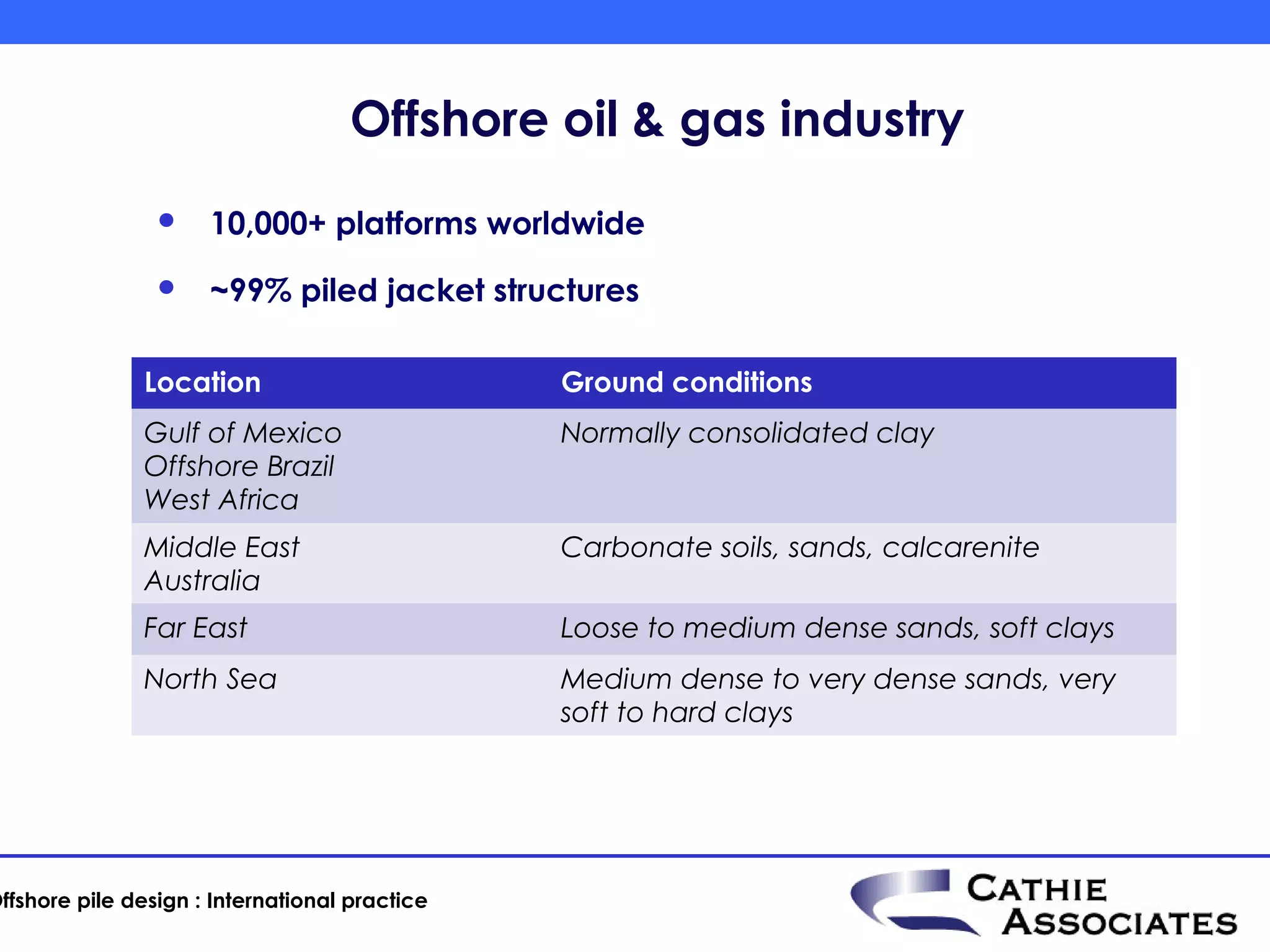
Offshore oil & gas industry
                     10,000+ platforms worldwide
                     ~99% piled jacket structures

                Location                        Ground conditions
                Gulf of Mexico                  Normally consolidated clay
                Offshore Brazil
                West Africa
                Middle East                     Carbonate soils, sands, calcarenite
                Australia
                Far East                        Loose to medium dense sands, soft clays
                North Sea                       Medium dense to very dense sands, very
                                                soft to hard clays


Offshore pile design : International practice
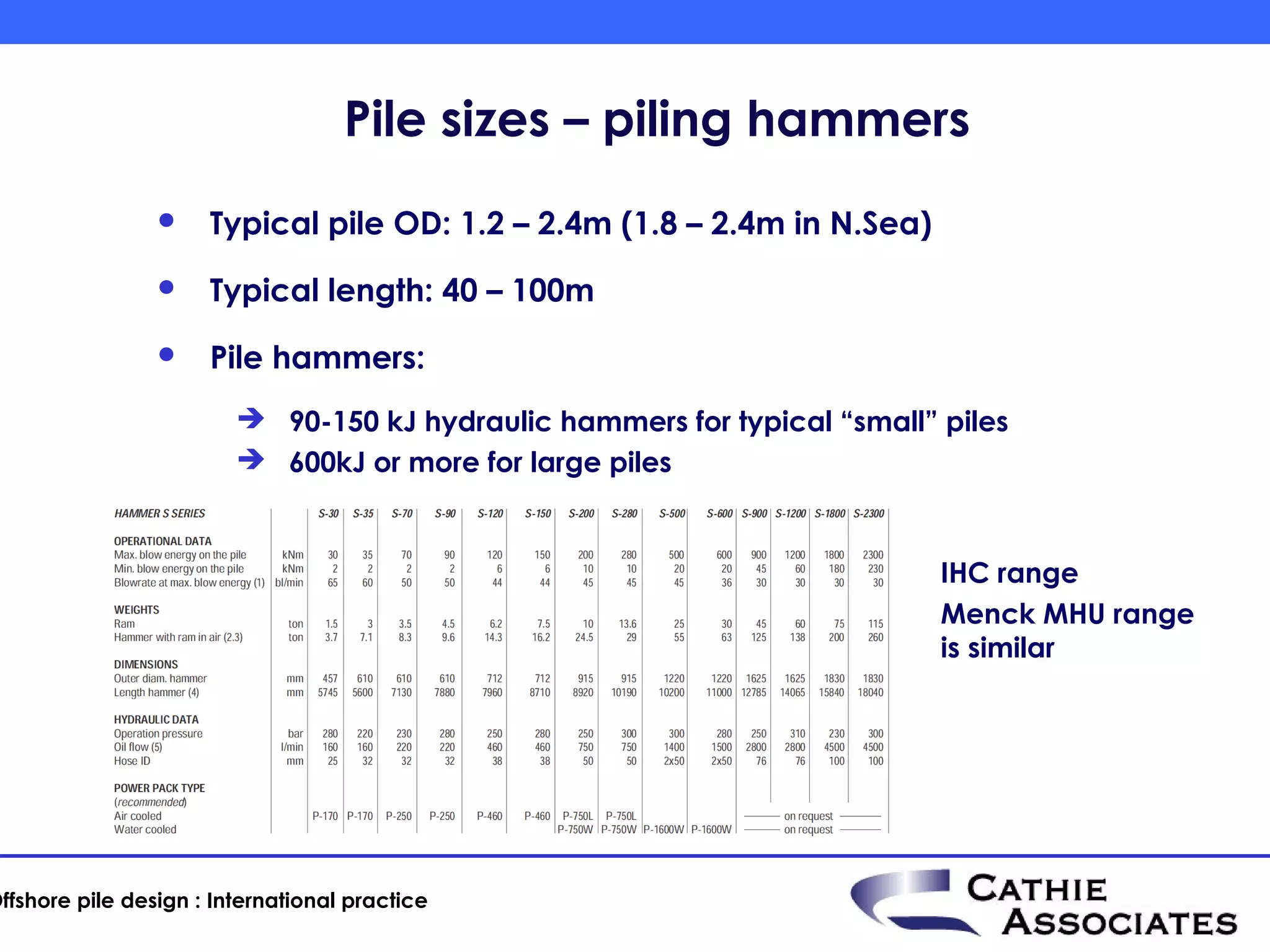
Pile sizes – piling hammers
                     Typical pile OD: 1.2 – 2.4m (1.8 – 2.4m in N.Sea)
                     Typical length: 40 – 100m
                     Pile hammers:
                          90-150 kJ hydraulic hammers for typical “small” piles
                          600kJ or more for large piles


                          Put in table with rated energy
                                                                           IHC range
                                                                           Menck MHU range
                                                                           is similar


Offshore pile design : International practice
Pile design in the offshore industry
                     Industry is risk adverse, and highly cost conscious
                     Consequences of structural failure leading to shutdown are
                      very high, and unacceptable
                     Consequences of installation delays are very high, and
                      unacceptable (production delayed, cost overrun)
                     Innovation is seen as risky and must have very high cost-
                      benefit
                     Reliability of pile design is very high (no failures reported).
                      Belief that methods are conservative to very conservative. No
                      account taken of ageing effects.


Offshore pile design : International practice
International Standards
                  API RP2A – WSD 29th edition, 2000
                  API RP2A – LRFD, 1st edition 1993
                  DNV classification notes No. 30.4, 1992
                   (based on API 1987)
                  ISO 19902:2007 Fixed steel offshore
                   structures (based on API)


                  API RP2A – WSD 29th edition, 2000, errata
                   and supplement 3, 2007, provides the
                   Commentary on CPT-based methods for
                   pile capacity (C6.4.3c)


Offshore pile design : International practice
API pile design approach
                     Pile capacity/resistance methods

                          Main text API 93 method
                          CPT methods in commentary in 2007 edition

                     Axial/lateral response
                     Cyclic loads


Offshore pile design : International practice
API Main text method


Shaft resistance

f = K σv’ tanδ


f <= flim


Offshore pile design : International practice
API 2007 - CPT methods
                     Motivation
                     Research programs
                     Key features
                     Database
                     Industry acceptance


Offshore pile design : International practice
API 2007 CPT-based pile resistance

                      Motivation
                              Improve reliability and reduce conservatism
                              Based on more fundamental understanding of pile behaviour
                              Practical method capturing basic mechanics of driven pile
                              Direct use of CPT results in silica sand


                      Research Programs
                          Euripides (started 1995) in Eemshaven, Netherlands: dense to
                           very dense sands
                          Pile load tests in Dunkirk (dense to very dense marine sands) –
                           CLAROM site
                          Pile load test in Labenne (loose to medium dense sand), LCPC
                           site.


Offshore pile design : International practice
Key features of CPT methods
                     Direct use of cone resistance (qc) to
                      determine radial stress (σ’rc)


                     Effect of distance from pile tip
                          “friction fatigue” or degradation
                           during driving as pile progresses

                     Unit shaft resistance based on
                      residual soil-pile friction angle


Offshore pile design : International practice
CPT methods – database


                      ICP database: 20 open-ended tubular piles in sand
                          Length: 2m to 47m
                          Diameter: 0.07m to 2.0m (average 0.65m)
                          Range of Dr at tip: 57-96%


                      UWA database: 32 open-ended tubular piles in sand
                              Length: 5.3m to 79.1m
                              Diameter: 0.36m to 2.0m (average 0.73m)
                              Range of Dr at tip: 15-100% (average 68%)
                              Range of Dr along shaft: 23-100% (average 74%)


Offshore pile design : International practice
CPT method – application by Shell
                                                             Dynamic SRD [MN]                           Dynamic SRD [MN]
                                                         0   4   8    12   16         20            0    4     8     12    16
                                                    0                                          0


                                                    5                           ICP
                                                                                API
                                                                                               20
                                                    10


                                                    15
                                                                                               40
                                                    20


                                                    25                                                   ICP
                                                                                               60        API


                                                                                           m
                                                m


                                                                                           w
                                                w


                                                                                           a
                                                a


                                                                                           o
                                                                                           e
                                                o
                                                e


                                                                                           n
                                                n


                                                                                           B
                                                B


                                                                                           P
                                                P


                                                                                           S
                                                S


                                                                                           ]
                                                                                           [
                                                                                           r
                                                ]
                                                [
                                                r


                                                                                           t
                                                t


                                                                                           f
                                                f


                                                                                           l
                                                                                           i
                                                l
                                                i


                                                    30


                                                    35                                         80


                                                Overy (2007) The Use of ICP Design Methods for the
                                                Foundations of Nine Platforms installed in the UK North Sea, Int.
                                                Offshore Site Investigation and Geotechnics Conference


Offshore pile design : International practice
CPT Method – industry acceptance
                     Adopted by Shell UK in 1996 for requalification of a number of
                      North Sea platforms (Overy, 2007)
                          Pile length: 26m to 87m
                          Diameter: 0.66m to 2.13m
                          Variable soil conditions


                     Adopted by API, 2007 as a “recent and more reliable method
                      ...considered fundamentally better..”
                          But qualified by offering 4 alternative methods
                          Should be used only by qualified engineers


Offshore pile design : International practice
API pile design approach
                     Axial/lateral response
                          T-Z/Q-Z and P-Y standardised approach
                          Mainly based on research in 1980’s

                     Cyclic loading
                          Axial
                              Axial and lateral effects uncoupled
                              Long (=flexible) piles can experience capacity degradation in
                                clay soils (due to strain softening)
                              Wave loading rate effect may compensate for degradation.
                          Lateral
                              Cyclic effects included by softening P-Y response near seabed
                                and reducing peak lateral pressures
                              Methods proposed are guidelines only (but everyone uses
                                them)

Offshore pile design : International practice
Pile driveability - SRD
                     Soil resistance during driving (SRD)
                          Alm and Hamre (2001) method
                          Database 18 installations, 1.83 – 2.74m OD, up to 90m
                           penetration, MHU 1000-3000, IHC S-400, S-2300
                          Key feature: degradation of shaft resistance as pile passes,
                           calibrated to database


Offshore pile design : International practice
Pile driveability – wave equation
                     Wave equation (SRD v Blow count)
                          GRL WEAP – same quake, damping soil model as used by Alm
                           & Hamre

                     Blow count v depth
                     Pile acceptance criteria


Offshore pile design : International practice
Pile driveability prediction

                     SOIL RESISTANCE TO DRIVING (MN)          100                                                                            BLOWS PER 0.25 METRE
                                                                         MHU 500T (Eff. = 80%), 40m penetration
                 0        25       50        75        100                                                                          0   50       100        150     200         250
            0                                                            MHU 500T (Eff. = 95%), 40m penetration                 0
                                                                                                                                                       MHU 800S (Eff. = 80%),
                                                                         MHU 500T (Eff. = 80%), 20m penetration
                                                                                                                                                       Best Estimate SRD
                                  Best Estimate SRD
                                                               75        MHU 500T (Eff. = 95%), 20m penetration                                        MHU 800S (Eff. = 80%),
                                  High Estimate SRD
                                                                                                                                                       High Estimate SRD
            10                                                                                                                 10                      MHU 800S (Eff. = 95%),
                                                                                                                                                       Best Estimate SRD
                                                                                                                                                       MHU 800S (Eff. = 95%),
                                                               50                                                                                      High Estimate SRD


            20                                                                                                                 20


                                                               25
                                                             M
                                                             G
                                                             O
                                                             C
                                                             N
                                                             A
                                                             V
                                                             D
                                                             R
                                                             E
                                                             S
                                                             L
                                                             T
                                                             )
                                                             (
                                                             I


            30                                                                                                                 30


                                                                                                                           M
                                                                                                                           W
        M
        W


                                                                                                                           O
        O


                                                                                                                           A
                                                                                                                           N
        A
        N


                                                                                                                           D
        D


                                                                                                                           U
        U


                                                                                                                           B
                                                                                                                           R
                                                                                                                           P
        B
        R
        P


                                                                                                                           S
                                                                                                                           E
        S
        E


                                                                                                                           L
                                                                                                                           T
        L
        T


                                                                                                                           )
                                                                                                                           (
        )
        (


                                                                                                                           I
        I


                                                                 0
                                                                     0     50      100       150     200          250
            40                                                                  BLOWS PER 0.25 METRE                           40


        SRD v Depth                                          SRD v Blow count                                           Blow count v Depth


Offshore pile design : International practice
Pile driving monitoring
           Purposes

                Confirming pile resistance during
                 driving, or after set-up, SRD
                Correlate SRD with calculated static
                 pile resistance for the site.
                Establish reliable pile acceptance
                 criteria (blow count) based on a
                 calibrated wave equation & SRD
                 model
                Monitor the stresses at pile top and
                 to correlate with risks of tip buckling
                 (when driving in rock)


Offshore pile design : International practice
Pile driving monitoring
          Instrumentation
          Pile instrumentation consists in installing strain gauges
           and accelerometers at pile top


                                                                Operationally, the
                                                                offshore environment is
                                                                extremely challenging.

                                                                It requires specific
                                                                experience and extreme
                                                                precautions for data of
                                                                good quality

                                                                Many attempts have
                                                                resulted in failure


Offshore pile design : International practice
Pile driving monitoring - underwater

     Under-water monitoring requires specific equipment

        Risks of mechanical damage
        and electrical instability
        require specific operational
        procedures


Offshore pile design : International practice
Pile driving monitoring – signal matching
            G-OCTOPUS
            C126 UW PDM OLOWI                          PILE DRIVING ANALYZER ®
            PDA OP: ACR-MHA                            Version 2009.098.061
                                                       PILE C1
                                                       JACKET WHT-A
                                                                  BN               3/828
                                                                               30/07/2009 18:23:25
    80000             Signal matching (CAPWAP/TNOWAVE)
                                           7.16                                EMX    845.1 kN-m
       kN                                        m/s                           E2E    828.6 kN-m
                                                                               CSI    229.6 MPa
        F                 Iteratively modifying V numerical soil model until the
                                                 a                             EF2    848.7 kN-m
                                                                               E2F    843.1 kN-m
                           calculated reflective wave matches the measured waveEV2    877.5 kN-m
                                                                               RMX    18448 kN
                                                                               DMX     30.3 mm
                                                                               DFN     14.0 mm
                                                                                                         B w o 12
                                                                                                          lo N. 63
                                                                 8 0 .0
                                                                  00      kN
                                                                               LE      39.970   m
                                                                               AR     2759.57   cm^2                    W pM
                                                                                                                         u sd
                                                                                                                        W pCt
                                                                                                                         u p

                                                                               EM      207413   MPa
                                                        51.2ms                 SP        77.5   kN/m3
    15.60 ms                                                                   WS      5123.0   m/s
                       Measured upward and                       2 6 .7
                                                                  66           EA/C     11173   kN-s/m
    80000                downward waves         80000
                                                                          15
                                                                               LP      25.750   m
                                                                                                                                45   ms
       kN                                          kN
                                                                               F12    A2                                    6    L/c

      WD                                          WU
                                                                 - 6 67
                                                                  26 .
                                                                               F1: [898W] 132.7 (1)
                                                                               F2: [904W] 130.2 (1)
                                                                               A2: [29997] 1035 g's/v (1)        Measured and
                                                                                                                  calculated
                                                                                                                 upward waves
                                                                 - 0 00
                                                                  80 .


                                                        51.2ms


Offshore pile design : International practice
Pile driving monitoring – data example

                           Driving Data


                                                  Capwap result

Offshore pile design : International practice
Pile driving monitoring – accuracy and
                                    limitations
                     Generally within 10-15% of static tests
                          Best agreement in sedimentary soils (sand, clays)
                          Agreement depends on set-up time and failure criteria for static
                           test
                     Limitations
                          Cannot accurately differentiate between tip and shaft
                           resistance near the base
                          Cannot define exact distribution of shaft resistance


Offshore pile design : International practice
Piled tripods for wind converters – key
                                        issues
                     Tripod foundation response very different from monopile
                     Structural dynamics of tripods
                          Insensitive to lateral stiffness
                          Axial stiffness related to pile penetration/capacity (for stiff piles)
                           so natural frequencies insensitive also to detailed pile design
                     Cyclic axial loads much more important than cyclic lateral
                     Allow generously for scour – not a design problem with
                      tripods
                     Need practical solutions to design foundations today!


Offshore pile design : International practice
Offshore platform/tripod loading


                                                Moment loading at mudline for a monopile is
                                                translated into axial pile loading for a tripod


Offshore pile design : International practice
Tripod and monopile loads
                                          Bending moment at mudlevel during 50 year severe sea state
                    350000
                                                                                          Tripod Pile                   Monopile
                    300000
                    250000
                    200000
                    150000
                    100000
                     50000
                        0
                    -50000 0       20              40            60              80                       100               120            140
               M
               m
               N
               o
               n
               b
               e
               k
               s


                   -100000
               r
               t
               ]
               [


                   -150000
                   -200000
                                                                          time [s]


                                         Axial (vertical) force at mudlevel during 50 year severe sea state
                     10000
                                                                                 Monopile               Tripod Pile max compression   Tripod max tension
                      5000

                         0
                             0      20              40            60                 80                   100               120            140
                     -5000

                    -10000

                    -15000
                M
                m
                N
                o
                b
                e
                k
                c
                s


                    -20000
                r
                ]
                [
                f


                    -25000

                    -30000
                                                                          time [s]


Offshore pile design : International practice
Tripod - pile head deflections

              Extract of displacement time history from 50 yr extreme event covering governing ULS
              peak load


               Extreme deflections: Axial: 5mm
                                    Lateral: 34mm


Offshore pile design : International practice
(Geotechncial) advantages of
                                    tripods/quadripods
                     Not sensitive to uncertain soil parameters (operational soil
                      modulus)
                     Not sensitive to scour assumptions
                     Lateral pile deflections are restrained by structure stiffness
                     Main cyclic loads transmitted as axial loading


                     Offshore oil & gas industry has strong preference for multiple
                      leg structures – almost exclusively builds 3, 4 or 8 legged
                      piled platforms for offshore operations
                     Other structures require specific conditions to be cost-
                      effective


Offshore pile design : International practice
Research – tripod foundations
                     Must not delay design and procurement process
                     Solutions must be adopted today even if research to confirm
                      or improve methods continues in parallel

                         Solutions are available today
                         May be conservative but based on oil & gas experience
                         Use pile driving monitoring to confirm capacity during
                           installation
                         Use structural monitoring to confirm eigenfrequencies
                           and foundation stiffness in different conditions
                     Not essential today but research desirable to provide
                      improved (less conservative) methods of design i.e. reduce
                      development costs


Offshore pile design : International practice
Research – tripod foundations
              Priority      Topic                             Why?
                  1         Axial pile stiffness at working   Key for accurate structural
                            loads                             dynamics
                  2         Lateral pile behaviour            Not critical design issue for tripods
                            subject to cyclic loads           but little is known
                            (fixed head, many low level
                            load cycles)

                  3         Lateral pile stiffness at         2nd order importance for structural
                            working loads                     dynamics, and for cyclic axial pile
                                                              capacity
                  4         Axial pile capacity under         Most previous research
                            low level cyclic loads            concentrated on higher levels of
                                                              cyclic axial load
                  5         Effect of ageing on pile          Ageing is known to increase pile
                            response                          resistance and stiffness but the
                                                              mechanisms are not understood

Offshore pile design : International practice
Conclusions
                     International oil & gas industry has long and successful track
                      record with piled structures
                     Offshore industry is conservative and risk adverse (high costs
                      involved in all marine work)
                     New CPT methods of pile design have been introduced
                      recently because of the recognition that the earlier API
                      methods were over conservative in some circumstances (e.g.
                      dense sand)
                     Cyclic loading is handled within (API) design methods for
                      wind/wave loads for jacket or tripod structures
                     Tripod solutions for wave converters are very robust and
                      insensitive to variations in foundation conditions


Offshore pile design : International practice

Offshore pile design according to international practice

  • 1.
    Offshore pile design: Internationalpractice Dr David Cathie Cathie Associates
  • 2.
    Outline Oil and gas industry has a lot of experience in developing both small and large offshore projects. Practical solutions are available today for safe design of tripod structures  Pile design in the offshore industry  International standards and methods  Pile resistance (capacity) methods – API, CPT  Pile driveability  Pile driving monitoring  Piled tripods for wind converters – key issues  Conclusions Offshore pile design : International practice
  • 3.
    Tallest offshore piledstructure Bullwinkle, GOM Bullwinkle platform: Bullwinkle piles: 529m high 28 x 84”OD, 165m long 412m water depth Offshore pile design : International practice
  • 4.
    Offshore oil &gas industry  10,000+ platforms worldwide  ~99% piled jacket structures Location Ground conditions Gulf of Mexico Normally consolidated clay Offshore Brazil West Africa Middle East Carbonate soils, sands, calcarenite Australia Far East Loose to medium dense sands, soft clays North Sea Medium dense to very dense sands, very soft to hard clays Offshore pile design : International practice
  • 5.
    Pile sizes –piling hammers  Typical pile OD: 1.2 – 2.4m (1.8 – 2.4m in N.Sea)  Typical length: 40 – 100m  Pile hammers:  90-150 kJ hydraulic hammers for typical “small” piles  600kJ or more for large piles  Put in table with rated energy IHC range Menck MHU range is similar Offshore pile design : International practice
  • 6.
    Pile design inthe offshore industry  Industry is risk adverse, and highly cost conscious  Consequences of structural failure leading to shutdown are very high, and unacceptable  Consequences of installation delays are very high, and unacceptable (production delayed, cost overrun)  Innovation is seen as risky and must have very high cost- benefit  Reliability of pile design is very high (no failures reported). Belief that methods are conservative to very conservative. No account taken of ageing effects. Offshore pile design : International practice
  • 7.
    International Standards  API RP2A – WSD 29th edition, 2000  API RP2A – LRFD, 1st edition 1993  DNV classification notes No. 30.4, 1992 (based on API 1987)  ISO 19902:2007 Fixed steel offshore structures (based on API)  API RP2A – WSD 29th edition, 2000, errata and supplement 3, 2007, provides the Commentary on CPT-based methods for pile capacity (C6.4.3c) Offshore pile design : International practice
  • 8.
    API pile designapproach  Pile capacity/resistance methods  Main text API 93 method  CPT methods in commentary in 2007 edition  Axial/lateral response  Cyclic loads Offshore pile design : International practice
  • 9.
    API Main textmethod Shaft resistance f = K σv’ tanδ f <= flim Offshore pile design : International practice
  • 10.
    API 2007 -CPT methods  Motivation  Research programs  Key features  Database  Industry acceptance Offshore pile design : International practice
  • 11.
    API 2007 CPT-basedpile resistance  Motivation  Improve reliability and reduce conservatism  Based on more fundamental understanding of pile behaviour  Practical method capturing basic mechanics of driven pile  Direct use of CPT results in silica sand  Research Programs  Euripides (started 1995) in Eemshaven, Netherlands: dense to very dense sands  Pile load tests in Dunkirk (dense to very dense marine sands) – CLAROM site  Pile load test in Labenne (loose to medium dense sand), LCPC site. Offshore pile design : International practice
  • 12.
    Key features ofCPT methods  Direct use of cone resistance (qc) to determine radial stress (σ’rc)  Effect of distance from pile tip  “friction fatigue” or degradation during driving as pile progresses  Unit shaft resistance based on residual soil-pile friction angle Offshore pile design : International practice
  • 13.
    CPT methods –database  ICP database: 20 open-ended tubular piles in sand  Length: 2m to 47m  Diameter: 0.07m to 2.0m (average 0.65m)  Range of Dr at tip: 57-96%  UWA database: 32 open-ended tubular piles in sand  Length: 5.3m to 79.1m  Diameter: 0.36m to 2.0m (average 0.73m)  Range of Dr at tip: 15-100% (average 68%)  Range of Dr along shaft: 23-100% (average 74%) Offshore pile design : International practice
  • 14.
    CPT method –application by Shell Dynamic SRD [MN] Dynamic SRD [MN] 0 4 8 12 16 20 0 4 8 12 16 0 0 5 ICP API 20 10 15 40 20 25 ICP 60 API m m w w a a o e o e n n B B P P S S ] [ r ] [ r t t f f l i l i 30 35 80 Overy (2007) The Use of ICP Design Methods for the Foundations of Nine Platforms installed in the UK North Sea, Int. Offshore Site Investigation and Geotechnics Conference Offshore pile design : International practice
  • 15.
    CPT Method –industry acceptance  Adopted by Shell UK in 1996 for requalification of a number of North Sea platforms (Overy, 2007)  Pile length: 26m to 87m  Diameter: 0.66m to 2.13m  Variable soil conditions  Adopted by API, 2007 as a “recent and more reliable method ...considered fundamentally better..”  But qualified by offering 4 alternative methods  Should be used only by qualified engineers Offshore pile design : International practice
  • 16.
    API pile designapproach  Axial/lateral response  T-Z/Q-Z and P-Y standardised approach  Mainly based on research in 1980’s  Cyclic loading  Axial  Axial and lateral effects uncoupled  Long (=flexible) piles can experience capacity degradation in clay soils (due to strain softening)  Wave loading rate effect may compensate for degradation.  Lateral  Cyclic effects included by softening P-Y response near seabed and reducing peak lateral pressures  Methods proposed are guidelines only (but everyone uses them) Offshore pile design : International practice
  • 17.
    Pile driveability -SRD  Soil resistance during driving (SRD)  Alm and Hamre (2001) method  Database 18 installations, 1.83 – 2.74m OD, up to 90m penetration, MHU 1000-3000, IHC S-400, S-2300  Key feature: degradation of shaft resistance as pile passes, calibrated to database Offshore pile design : International practice
  • 18.
    Pile driveability –wave equation  Wave equation (SRD v Blow count)  GRL WEAP – same quake, damping soil model as used by Alm & Hamre  Blow count v depth  Pile acceptance criteria Offshore pile design : International practice
  • 19.
    Pile driveability prediction SOIL RESISTANCE TO DRIVING (MN) 100 BLOWS PER 0.25 METRE MHU 500T (Eff. = 80%), 40m penetration 0 25 50 75 100 0 50 100 150 200 250 0 MHU 500T (Eff. = 95%), 40m penetration 0 MHU 800S (Eff. = 80%), MHU 500T (Eff. = 80%), 20m penetration Best Estimate SRD Best Estimate SRD 75 MHU 500T (Eff. = 95%), 20m penetration MHU 800S (Eff. = 80%), High Estimate SRD High Estimate SRD 10 10 MHU 800S (Eff. = 95%), Best Estimate SRD MHU 800S (Eff. = 95%), 50 High Estimate SRD 20 20 25 M G O C N A V D R E S L T ) ( I 30 30 M W M W O O A N A N D D U U B R P B R P S E S E L T L T ) ( ) ( I I 0 0 50 100 150 200 250 40 BLOWS PER 0.25 METRE 40 SRD v Depth SRD v Blow count Blow count v Depth Offshore pile design : International practice
  • 20.
    Pile driving monitoring  Purposes  Confirming pile resistance during driving, or after set-up, SRD  Correlate SRD with calculated static pile resistance for the site.  Establish reliable pile acceptance criteria (blow count) based on a calibrated wave equation & SRD model  Monitor the stresses at pile top and to correlate with risks of tip buckling (when driving in rock) Offshore pile design : International practice
  • 21.
    Pile driving monitoring  Instrumentation  Pile instrumentation consists in installing strain gauges and accelerometers at pile top Operationally, the offshore environment is extremely challenging. It requires specific experience and extreme precautions for data of good quality Many attempts have resulted in failure Offshore pile design : International practice
  • 22.
    Pile driving monitoring- underwater Under-water monitoring requires specific equipment Risks of mechanical damage and electrical instability require specific operational procedures Offshore pile design : International practice
  • 23.
    Pile driving monitoring– signal matching G-OCTOPUS C126 UW PDM OLOWI PILE DRIVING ANALYZER ® PDA OP: ACR-MHA Version 2009.098.061 PILE C1 JACKET WHT-A BN 3/828 30/07/2009 18:23:25 80000  Signal matching (CAPWAP/TNOWAVE) 7.16 EMX 845.1 kN-m kN m/s E2E 828.6 kN-m CSI 229.6 MPa F  Iteratively modifying V numerical soil model until the a EF2 848.7 kN-m E2F 843.1 kN-m calculated reflective wave matches the measured waveEV2 877.5 kN-m RMX 18448 kN DMX 30.3 mm DFN 14.0 mm B w o 12 lo N. 63 8 0 .0 00 kN LE 39.970 m AR 2759.57 cm^2 W pM u sd W pCt u p EM 207413 MPa 51.2ms SP 77.5 kN/m3 15.60 ms WS 5123.0 m/s Measured upward and 2 6 .7 66 EA/C 11173 kN-s/m 80000 downward waves 80000 15 LP 25.750 m 45 ms kN kN F12 A2 6 L/c WD WU - 6 67 26 . F1: [898W] 132.7 (1) F2: [904W] 130.2 (1) A2: [29997] 1035 g's/v (1) Measured and calculated upward waves - 0 00 80 . 51.2ms Offshore pile design : International practice
  • 24.
    Pile driving monitoring– data example Driving Data Capwap result Offshore pile design : International practice
  • 25.
    Pile driving monitoring– accuracy and limitations  Generally within 10-15% of static tests  Best agreement in sedimentary soils (sand, clays)  Agreement depends on set-up time and failure criteria for static test  Limitations  Cannot accurately differentiate between tip and shaft resistance near the base  Cannot define exact distribution of shaft resistance Offshore pile design : International practice
  • 26.
    Piled tripods forwind converters – key issues  Tripod foundation response very different from monopile  Structural dynamics of tripods  Insensitive to lateral stiffness  Axial stiffness related to pile penetration/capacity (for stiff piles) so natural frequencies insensitive also to detailed pile design  Cyclic axial loads much more important than cyclic lateral  Allow generously for scour – not a design problem with tripods  Need practical solutions to design foundations today! Offshore pile design : International practice
  • 27.
    Offshore platform/tripod loading Moment loading at mudline for a monopile is translated into axial pile loading for a tripod Offshore pile design : International practice
  • 28.
    Tripod and monopileloads Bending moment at mudlevel during 50 year severe sea state 350000 Tripod Pile Monopile 300000 250000 200000 150000 100000 50000 0 -50000 0 20 40 60 80 100 120 140 M m N o n b e k s -100000 r t ] [ -150000 -200000 time [s] Axial (vertical) force at mudlevel during 50 year severe sea state 10000 Monopile Tripod Pile max compression Tripod max tension 5000 0 0 20 40 60 80 100 120 140 -5000 -10000 -15000 M m N o b e k c s -20000 r ] [ f -25000 -30000 time [s] Offshore pile design : International practice
  • 29.
    Tripod - pilehead deflections Extract of displacement time history from 50 yr extreme event covering governing ULS peak load Extreme deflections: Axial: 5mm Lateral: 34mm Offshore pile design : International practice
  • 30.
    (Geotechncial) advantages of tripods/quadripods  Not sensitive to uncertain soil parameters (operational soil modulus)  Not sensitive to scour assumptions  Lateral pile deflections are restrained by structure stiffness  Main cyclic loads transmitted as axial loading  Offshore oil & gas industry has strong preference for multiple leg structures – almost exclusively builds 3, 4 or 8 legged piled platforms for offshore operations  Other structures require specific conditions to be cost- effective Offshore pile design : International practice
  • 31.
    Research – tripodfoundations  Must not delay design and procurement process  Solutions must be adopted today even if research to confirm or improve methods continues in parallel  Solutions are available today  May be conservative but based on oil & gas experience  Use pile driving monitoring to confirm capacity during installation  Use structural monitoring to confirm eigenfrequencies and foundation stiffness in different conditions  Not essential today but research desirable to provide improved (less conservative) methods of design i.e. reduce development costs Offshore pile design : International practice
  • 32.
    Research – tripodfoundations Priority Topic Why? 1 Axial pile stiffness at working Key for accurate structural loads dynamics 2 Lateral pile behaviour Not critical design issue for tripods subject to cyclic loads but little is known (fixed head, many low level load cycles) 3 Lateral pile stiffness at 2nd order importance for structural working loads dynamics, and for cyclic axial pile capacity 4 Axial pile capacity under Most previous research low level cyclic loads concentrated on higher levels of cyclic axial load 5 Effect of ageing on pile Ageing is known to increase pile response resistance and stiffness but the mechanisms are not understood Offshore pile design : International practice
  • 33.
    Conclusions  International oil & gas industry has long and successful track record with piled structures  Offshore industry is conservative and risk adverse (high costs involved in all marine work)  New CPT methods of pile design have been introduced recently because of the recognition that the earlier API methods were over conservative in some circumstances (e.g. dense sand)  Cyclic loading is handled within (API) design methods for wind/wave loads for jacket or tripod structures  Tripod solutions for wave converters are very robust and insensitive to variations in foundation conditions Offshore pile design : International practice