British Telecommunications plc
2017
The history of synchronisation
in digital cellular networks
Andy Sutton
16th March 2018
1 British Telecommunications plc 2017
• GSM radio interface
• Nokia DF12 BTS
• Base station oscillator modules
• Pulse Code Modulation
• E1 frame
• GSM terrestrial interfaces
• Synchronisation Supply Unit
• Add some 3G with UMTS and WCDMA
• Implications of ATM and SDH
• Converged network sync solution
• 4G with LTE, LTE-A, LTE-A-Pro
• Sync for 4G and beyond…
• Summary
Contents
© British Telecommunications plc
GSM radio (Um) interface (air interface)
• TDMA TS = 577uS
• TDMA frame = 4.615mS
• TS numbers 0 through 7
• Burst duration = 546uS within a
577uS window
• This gives a gross Um interface rate
of 270.833kbps
• Therefore, Each TS = 34.73kbps
• Full rate TFC on the Um interface =
22.8kbps
• Full rate speech occupies approx.
13.6kbps
© British Telecommunications plc
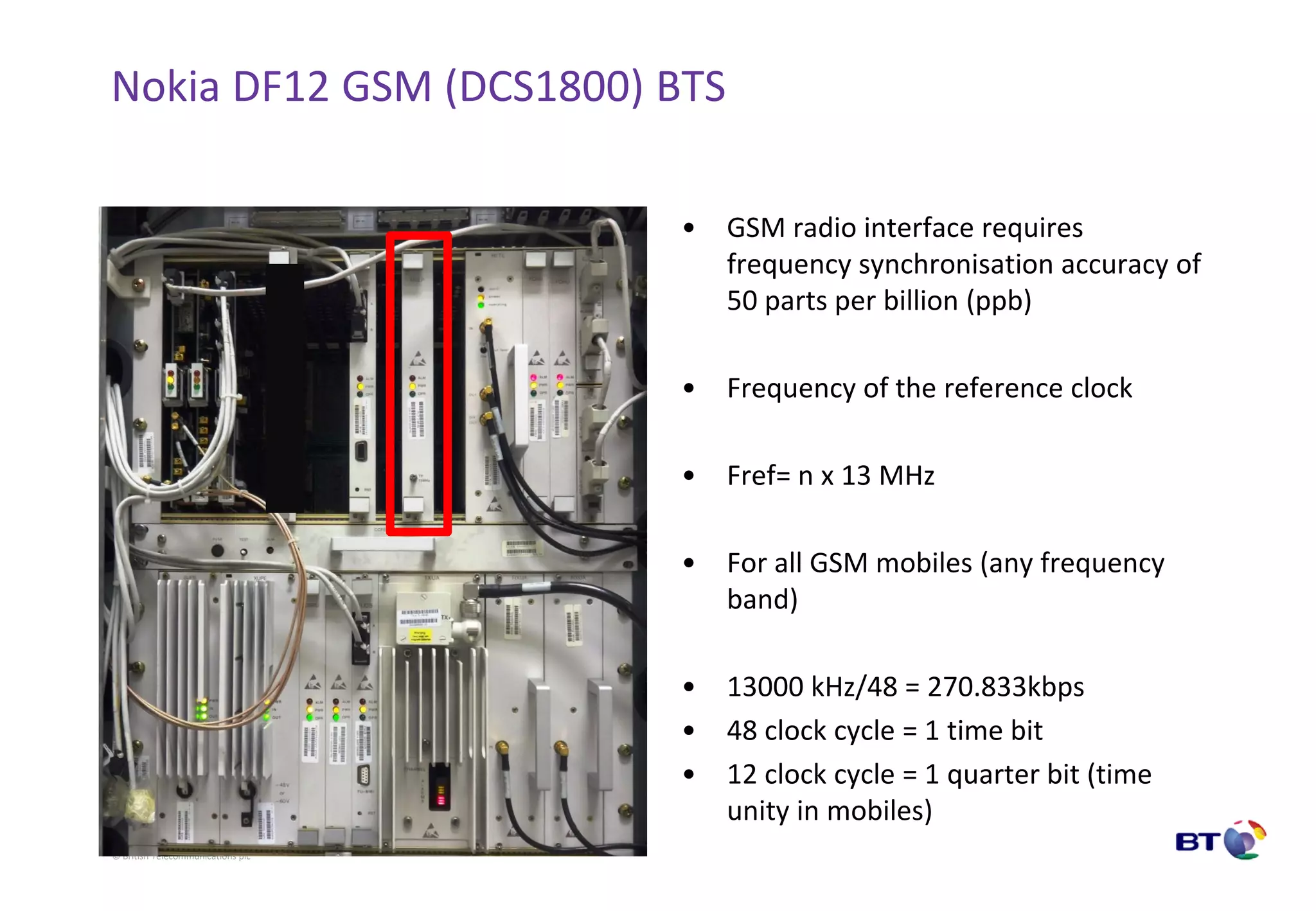
Nokia DF12 GSM (DCS1800) BTS
• GSM radio interface requires
frequency synchronisation accuracy of
50 parts per billion (ppb)
• Frequency of the reference clock
• Fref= n x 13 MHz
• For all GSM mobiles (any frequency
band)
• 13000 kHz/48 = 270.833kbps
• 48 clock cycle = 1 time bit
• 12 clock cycle = 1 quarter bit (time
unity in mobiles)
© British Telecommunications plc
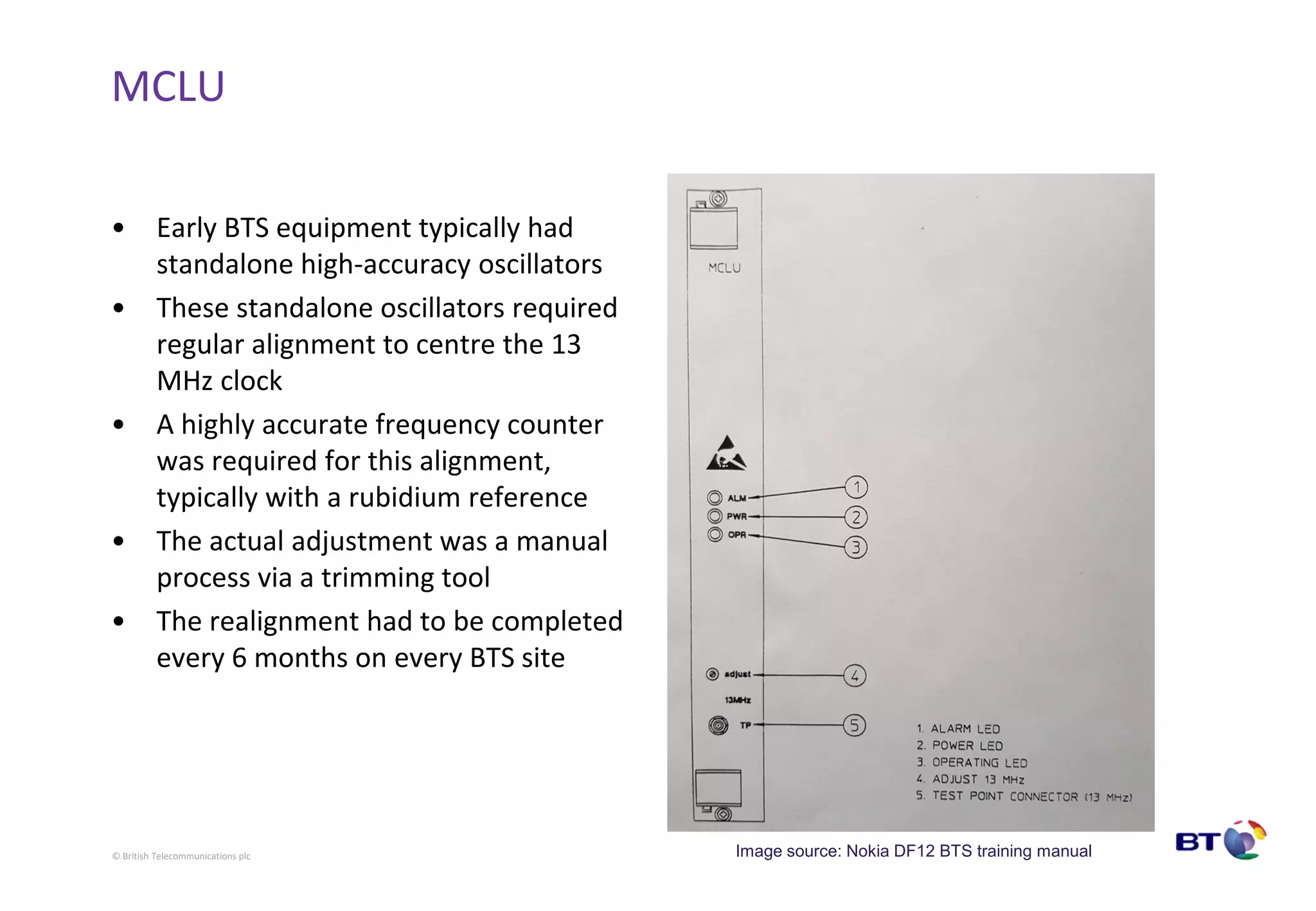
MCLU
• Early BTS equipment typically had
standalone high-accuracy oscillators
• These standalone oscillators required
regular alignment to centre the 13
MHz clock
• A highly accurate frequency counter
was required for this alignment,
typically with a rubidium reference
• The actual adjustment was a manual
process via a trimming tool
• The realignment had to be completed
every 6 months on every BTS site
Image source: Nokia DF12 BTS training manual
© British Telecommunications plc
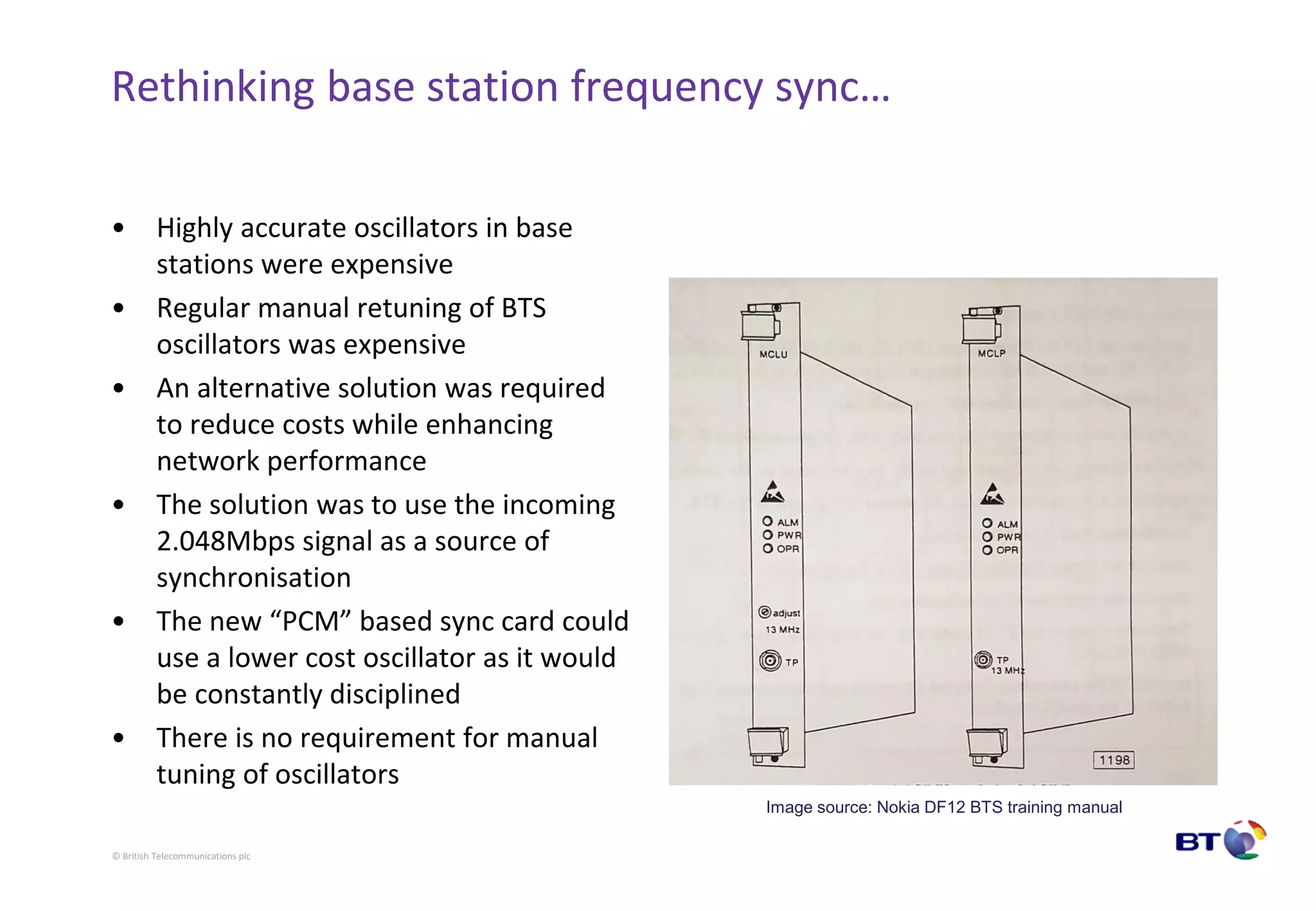
Rethinking base station frequency sync…
• Highly accurate oscillators in base
stations were expensive
• Regular manual retuning of BTS
oscillators was expensive
• An alternative solution was required
to reduce costs while enhancing
network performance
• The solution was to use the incoming
2.048Mbps signal as a source of
synchronisation
• The new “PCM” based sync card could
use a lower cost oscillator as it would
be constantly disciplined
• There is no requirement for manual
tuning of oscillators
Image source: Nokia DF12 BTS training manual
© British Telecommunications plc
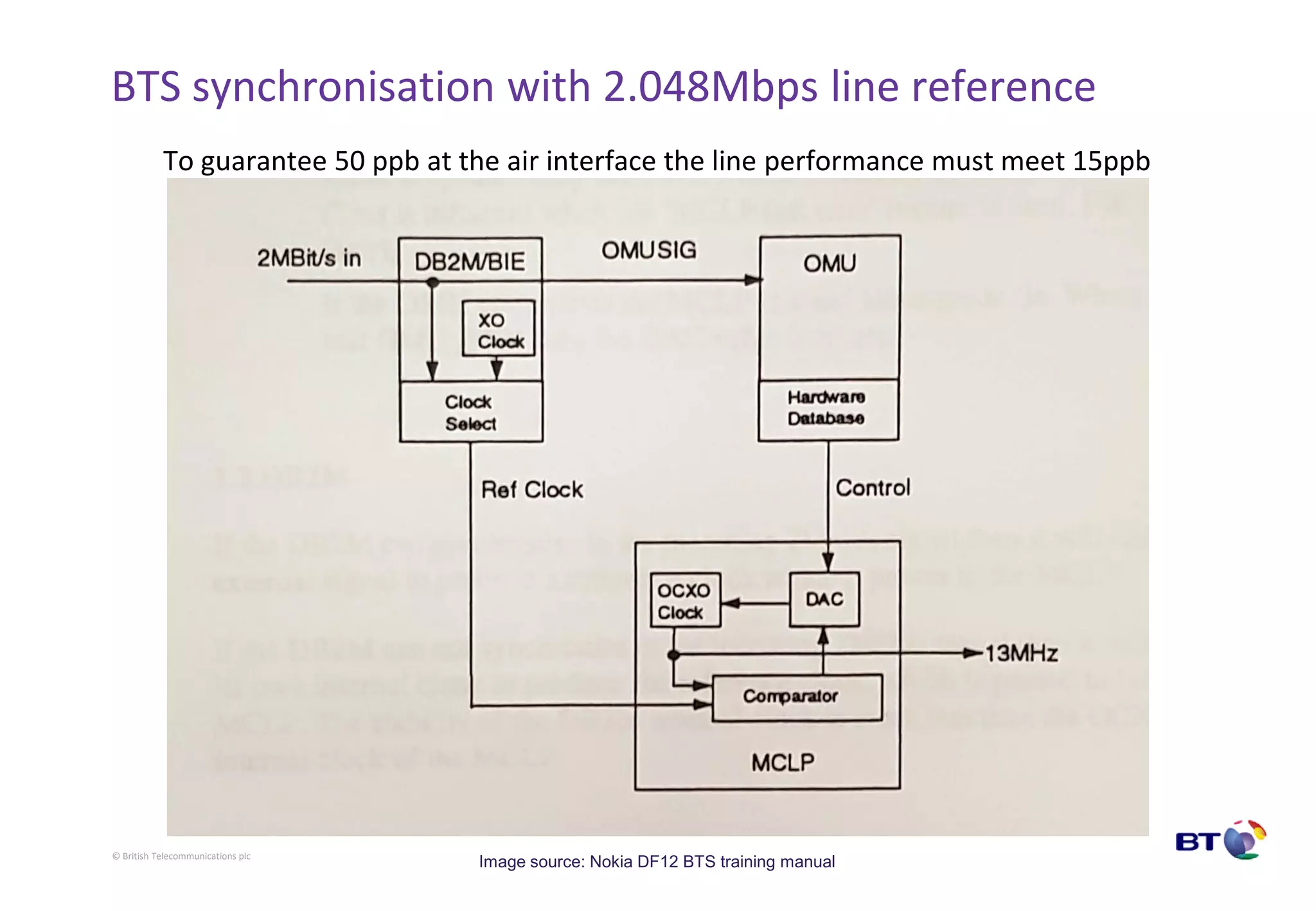
BTS synchronisation with 2.048Mbps line reference
Image source: Nokia DF12 BTS training manual
To guarantee 50 ppb at the air interface the line performance must meet 15ppb
But why is the incoming line synchronous?
© British Telecommunications plc
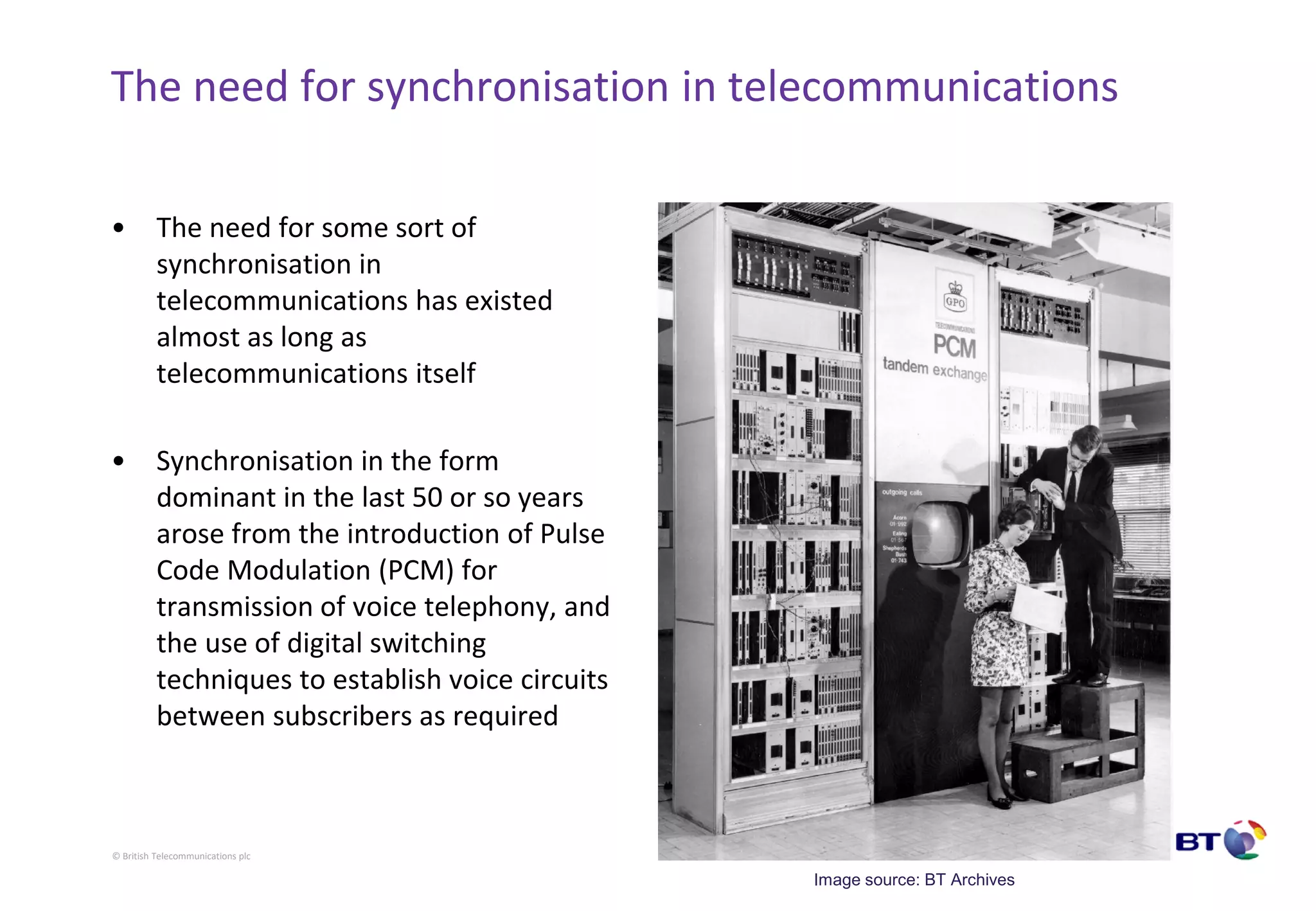
The need for synchronisation in telecommunications
• The need for some sort of
synchronisation in
telecommunications has existed
almost as long as
telecommunications itself
• Synchronisation in the form
dominant in the last 50 or so years
arose from the introduction of Pulse
Code Modulation (PCM) for
transmission of voice telephony, and
the use of digital switching
techniques to establish voice circuits
between subscribers as required
Image source: BT Archives
© British Telecommunications plc
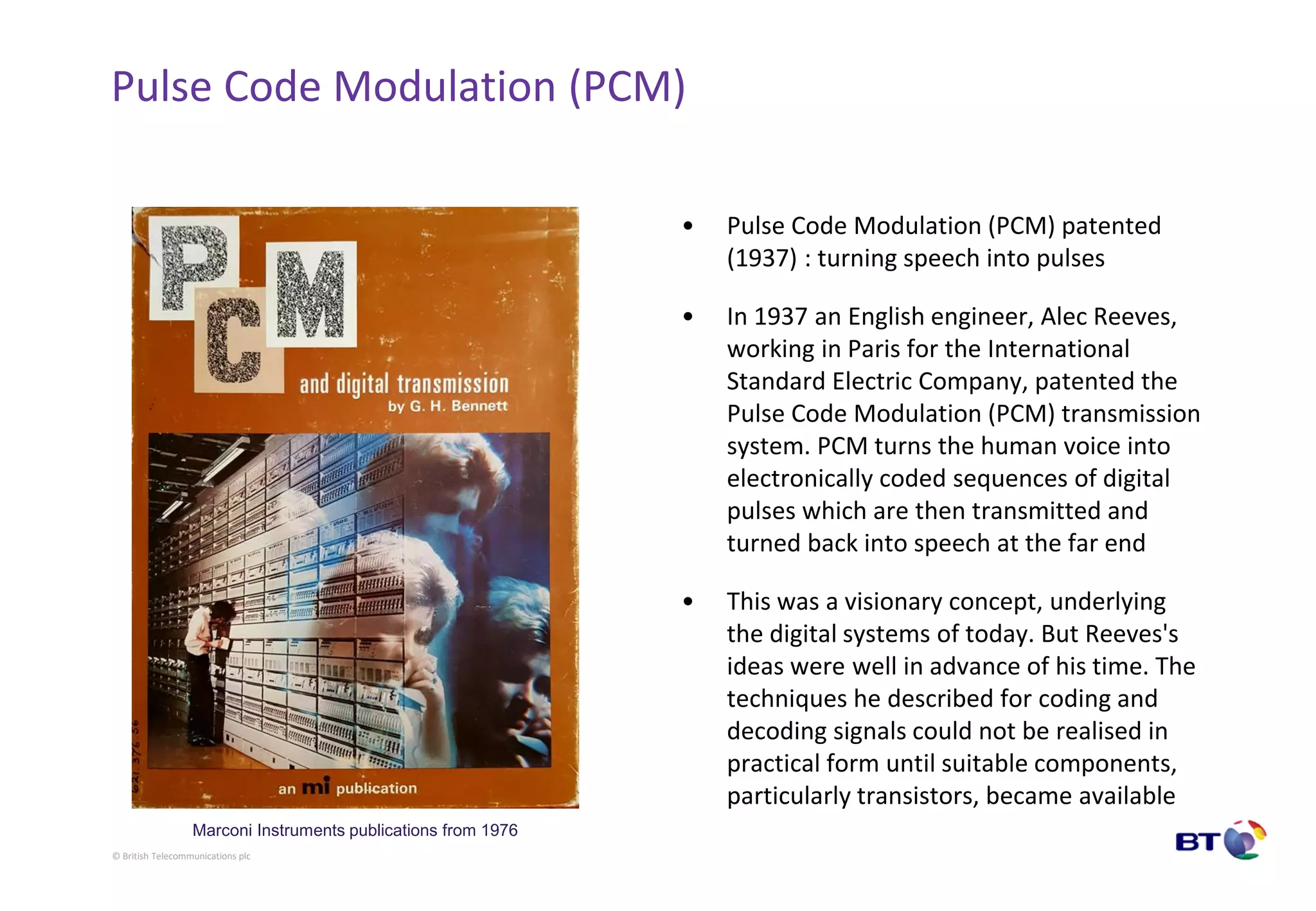
Pulse Code Modulation (PCM)
• Pulse Code Modulation (PCM) patented
(1937) : turning speech into pulses
• In 1937 an English engineer, Alec Reeves,
working in Paris for the International
Standard Electric Company, patented the
Pulse Code Modulation (PCM) transmission
system. PCM turns the human voice into
electronically coded sequences of digital
pulses which are then transmitted and
turned back into speech at the far end
• This was a visionary concept, underlying
the digital systems of today. But Reeves's
ideas were well in advance of his time. The
techniques he described for coding and
decoding signals could not be realised in
practical form until suitable components,
particularly transistors, became available
Marconi Instruments publications from 1976
© British Telecommunications plc
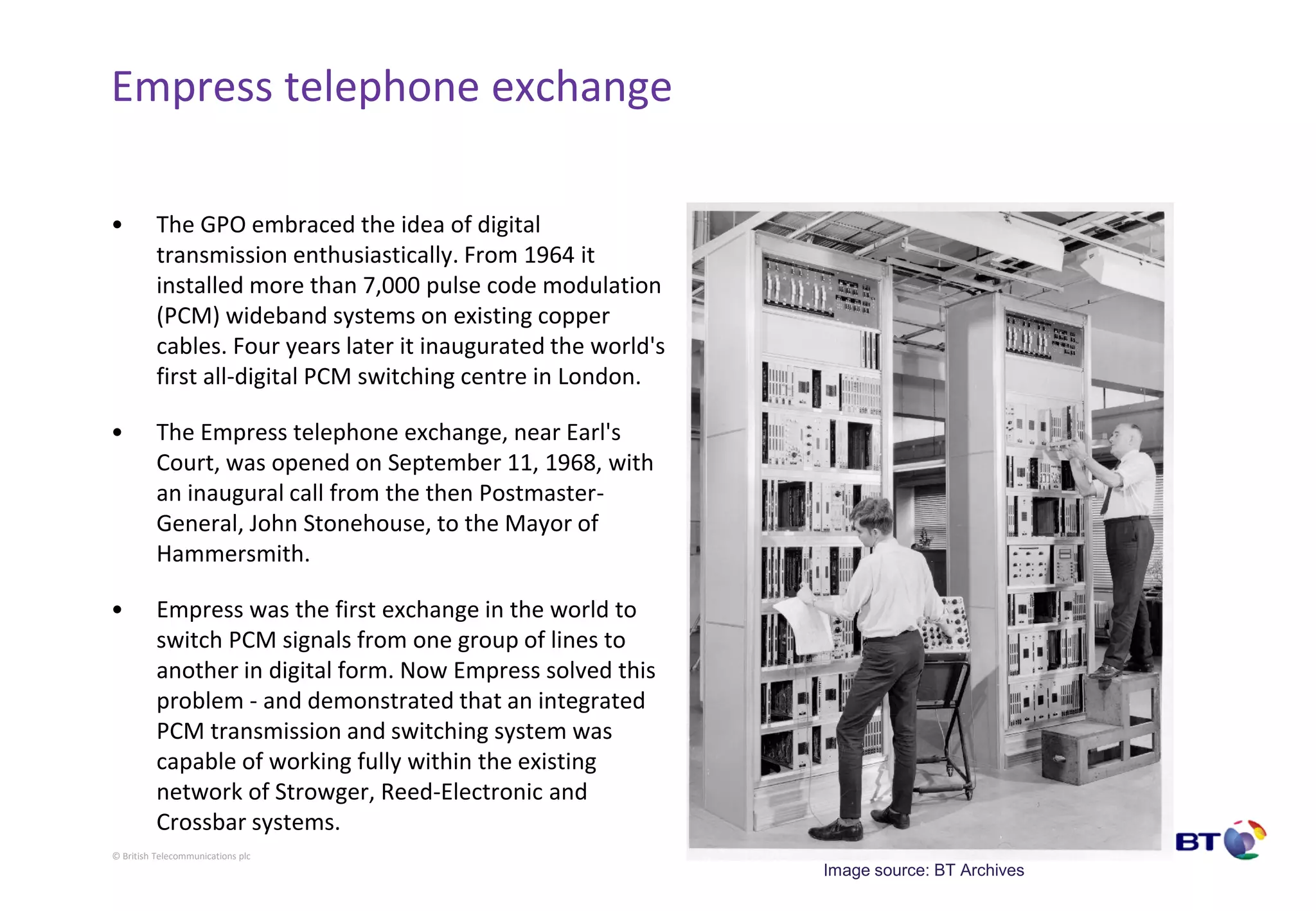
Empress telephone exchange
• The GPO embraced the idea of digital
transmission enthusiastically. From 1964 it
installed more than 7,000 pulse code modulation
(PCM) wideband systems on existing copper
cables. Four years later it inaugurated the world's
first all-digital PCM switching centre in London.
• The Empress telephone exchange, near Earl's
Court, was opened on September 11, 1968, with
an inaugural call from the then Postmaster-
General, John Stonehouse, to the Mayor of
Hammersmith.
• Empress was the first exchange in the world to
switch PCM signals from one group of lines to
another in digital form. Now Empress solved this
problem - and demonstrated that an integrated
PCM transmission and switching system was
capable of working fully within the existing
network of Strowger, Reed-Electronic and
Crossbar systems.
Image source: BT Archives
© British Telecommunications plc
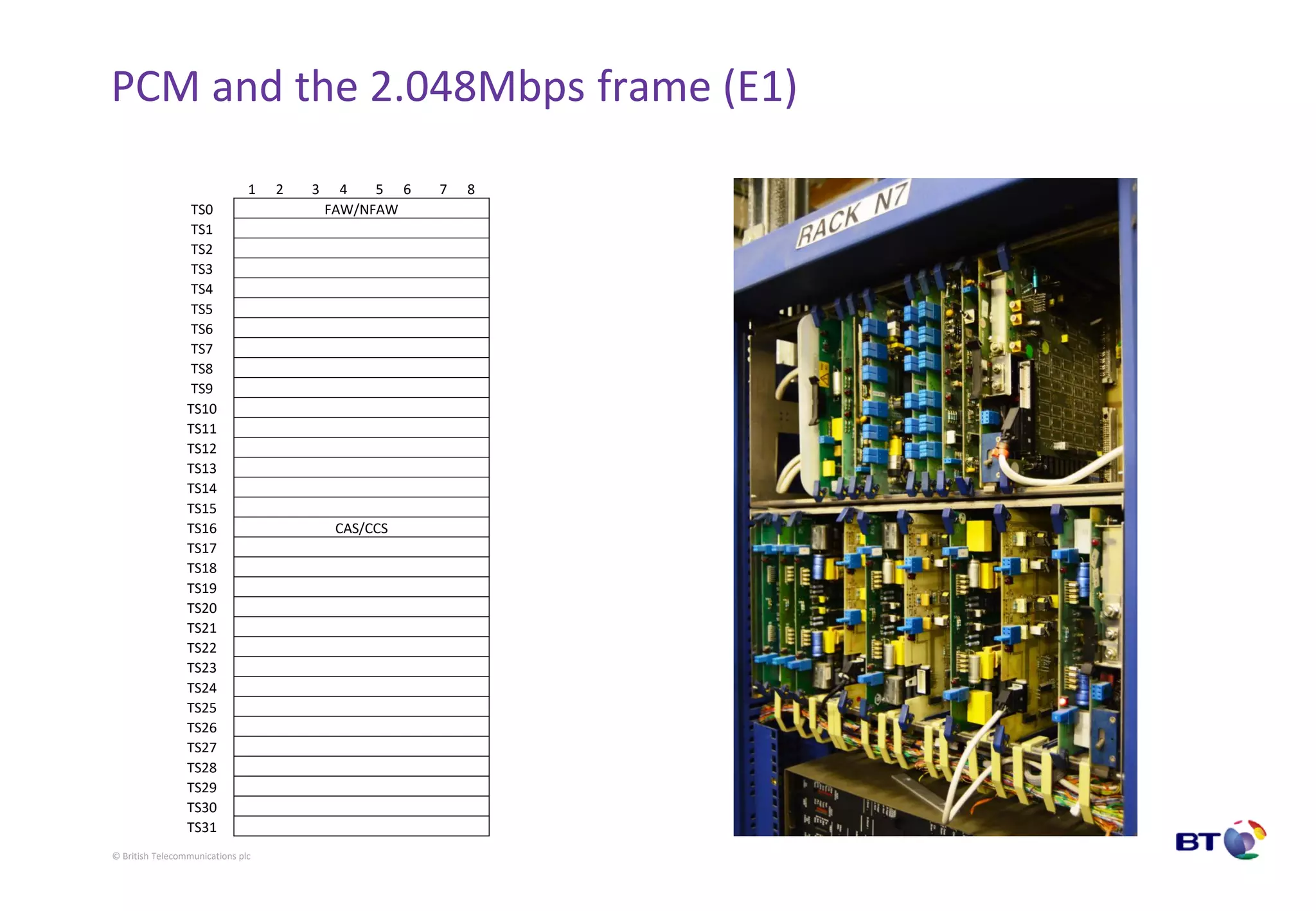
PCM and the 2.048Mbps frame (E1)
1 2 3 4 5 6 7 8
TS0 FAW/NFAW
TS1
TS2
TS3
TS4
TS5
TS6
TS7
TS8
TS9
TS10
TS11
TS12
TS13
TS14
TS15
TS16 CAS/CCS
TS17
TS18
TS19
TS20
TS21
TS22
TS23
TS24
TS25
TS26
TS27
TS28
TS29
TS30
TS31
© British Telecommunications plc
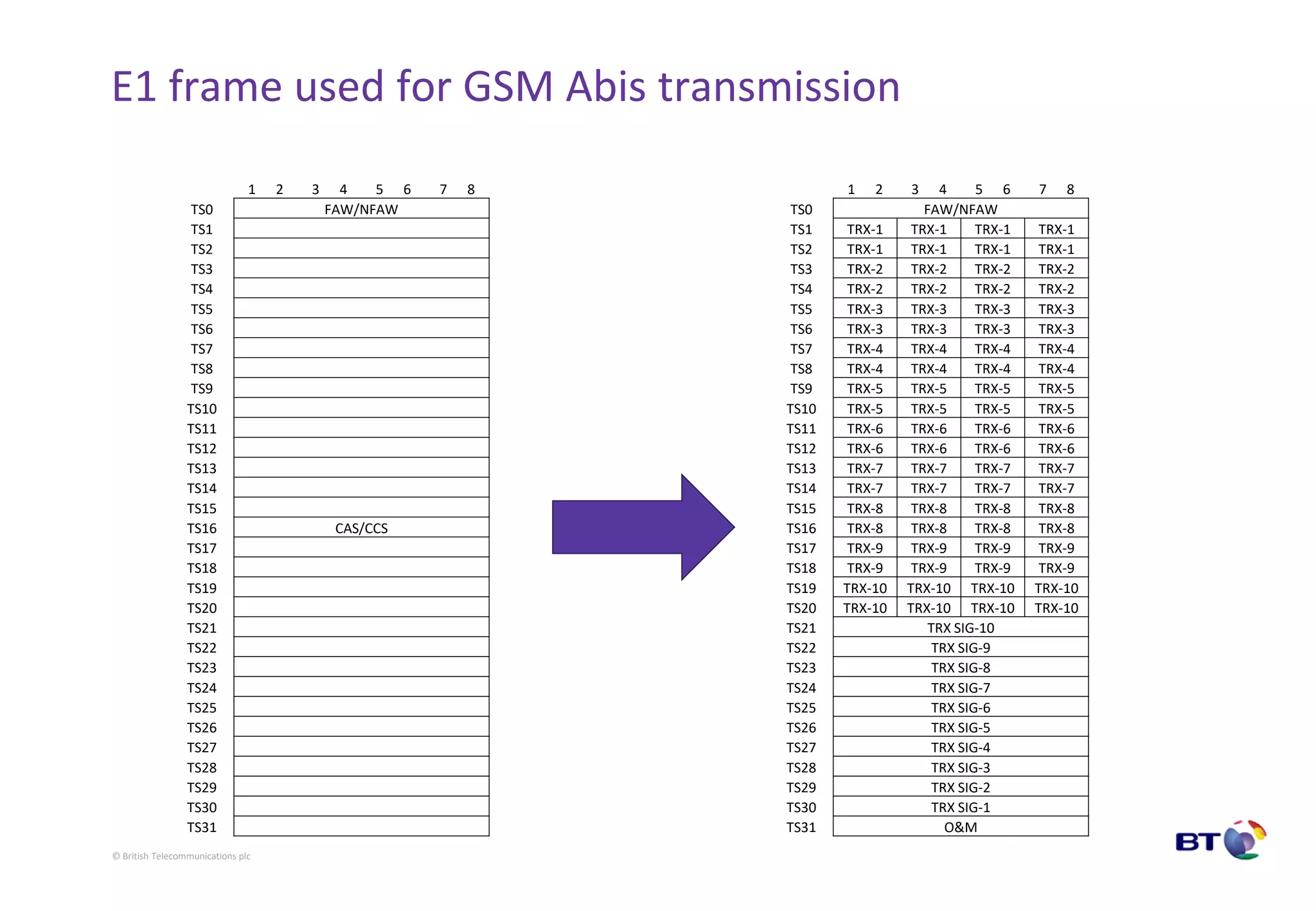
E1 frame used for GSM Abis transmission
1 2 3 4 5 6 7 8
TS0 FAW/NFAW
TS1
TS2
TS3
TS4
TS5
TS6
TS7
TS8
TS9
TS10
TS11
TS12
TS13
TS14
TS15
TS16 CAS/CCS
TS17
TS18
TS19
TS20
TS21
TS22
TS23
TS24
TS25
TS26
TS27
TS28
TS29
TS30
TS31
1 2 3 4 5 6 7 8
TS0 FAW/NFAW
TS1 TRX-1 TRX-1 TRX-1 TRX-1
TS2 TRX-1 TRX-1 TRX-1 TRX-1
TS3 TRX-2 TRX-2 TRX-2 TRX-2
TS4 TRX-2 TRX-2 TRX-2 TRX-2
TS5 TRX-3 TRX-3 TRX-3 TRX-3
TS6 TRX-3 TRX-3 TRX-3 TRX-3
TS7 TRX-4 TRX-4 TRX-4 TRX-4
TS8 TRX-4 TRX-4 TRX-4 TRX-4
TS9 TRX-5 TRX-5 TRX-5 TRX-5
TS10 TRX-5 TRX-5 TRX-5 TRX-5
TS11 TRX-6 TRX-6 TRX-6 TRX-6
TS12 TRX-6 TRX-6 TRX-6 TRX-6
TS13 TRX-7 TRX-7 TRX-7 TRX-7
TS14 TRX-7 TRX-7 TRX-7 TRX-7
TS15 TRX-8 TRX-8 TRX-8 TRX-8
TS16 TRX-8 TRX-8 TRX-8 TRX-8
TS17 TRX-9 TRX-9 TRX-9 TRX-9
TS18 TRX-9 TRX-9 TRX-9 TRX-9
TS19 TRX-10 TRX-10 TRX-10 TRX-10
TS20 TRX-10 TRX-10 TRX-10 TRX-10
TS21 TRX SIG-10
TS22 TRX SIG-9
TS23 TRX SIG-8
TS24 TRX SIG-7
TS25 TRX SIG-6
TS26 TRX SIG-5
TS27 TRX SIG-4
TS28 TRX SIG-3
TS29 TRX SIG-2
TS30 TRX SIG-1
TS31 O&M
© British Telecommunications plc
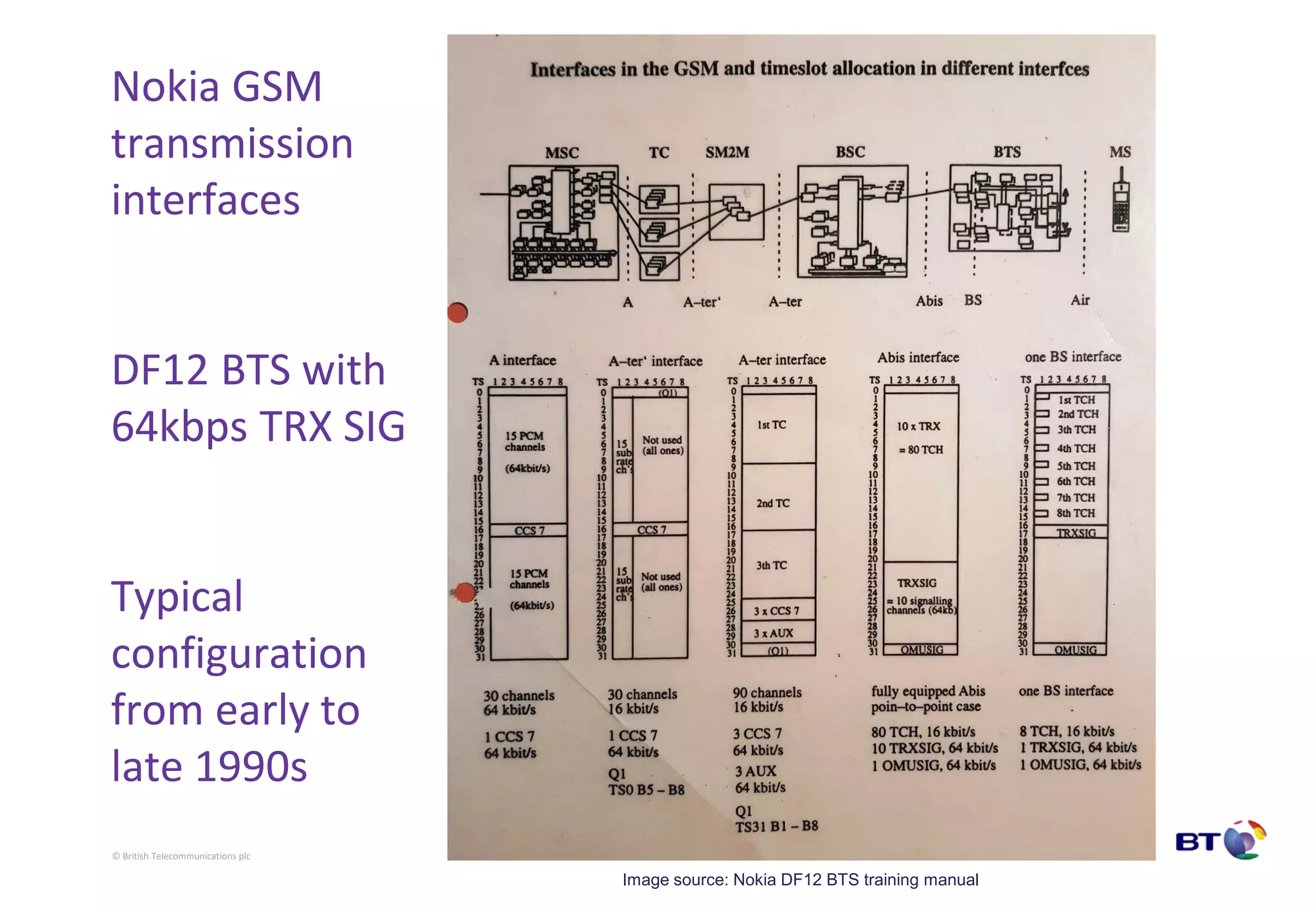
Nokia GSM
transmission
interfaces
DF12 BTS with
64kbps TRX SIG
Typical
configuration
from early to
late 1990s
Image source: Nokia DF12 BTS training manual
© British Telecommunications plc
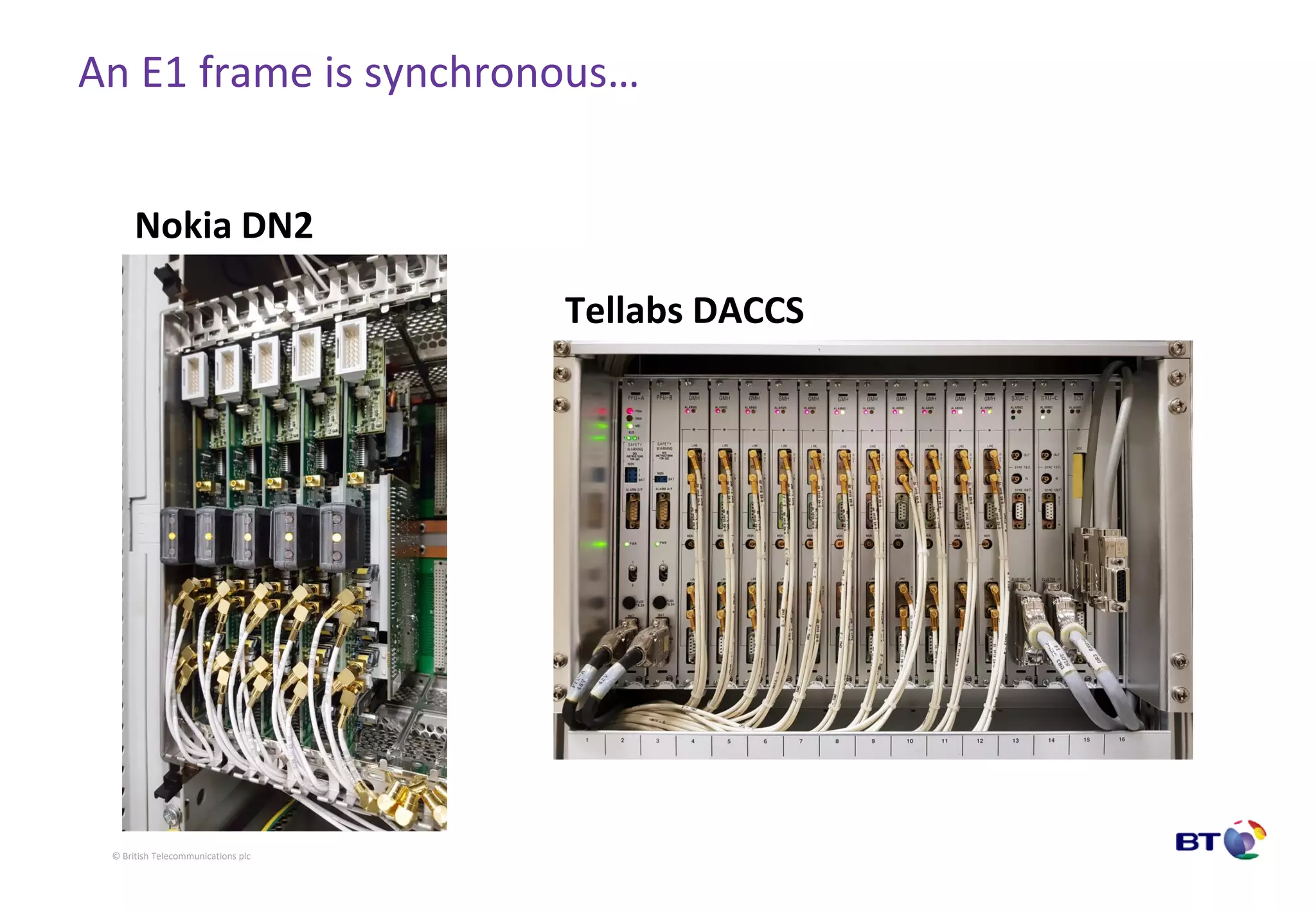
An E1 frame is synchronous…
Nokia DN2
Tellabs DACCS
© British Telecommunications plc
Synchronisation signal from PCM E1 frame
Although an 8000 sample-per-second tick is the
basis of the need for synchronisation, it
wouldn’t be found as an interface or a signal
for transmission
Rather than providing separate transmission
for synchronisation, the Primary Rate TDM bit-
stream at 2048kbps was adopted (or for local
transfer of synchronisation only, a bipolar
signal of the same rate)
Because of this, short term variations (jitter)
will occur and these will accumulate along a
chain of nodes in the hierarchy (multiplexing
into higher order bit-streams will also add
jitter).
In longer chains, this introduces a need for a
filtering stage, usually realised in the form of a
high quality oscillator and a long time constant
phase locked loop, to reduce these short term
variations to an acceptable level.
This filtering function is often needed where
one of a small number of incoming
transmission paths are to be used as the
synchronisation source for a larger number of
nodes
The requirements to select the source, to filter,
and to provide multiple feeds are often met by
one piece of equipment, a Synchronisation
Supply Unit (SSU)
Re-using the TDM bit-stream
in this way does, however,
create a challenge. Unlike a
signal intended only for
synchronisation, it will not
have a wholly repetitive and
predictable pattern of edges
from which to recover the
reference frequency.
Source: The Need for Synchronisation in Telecommunications, Martin Kingston, ITP Journal Vol 10 Part 1, 10 - 13
© British Telecommunications plc
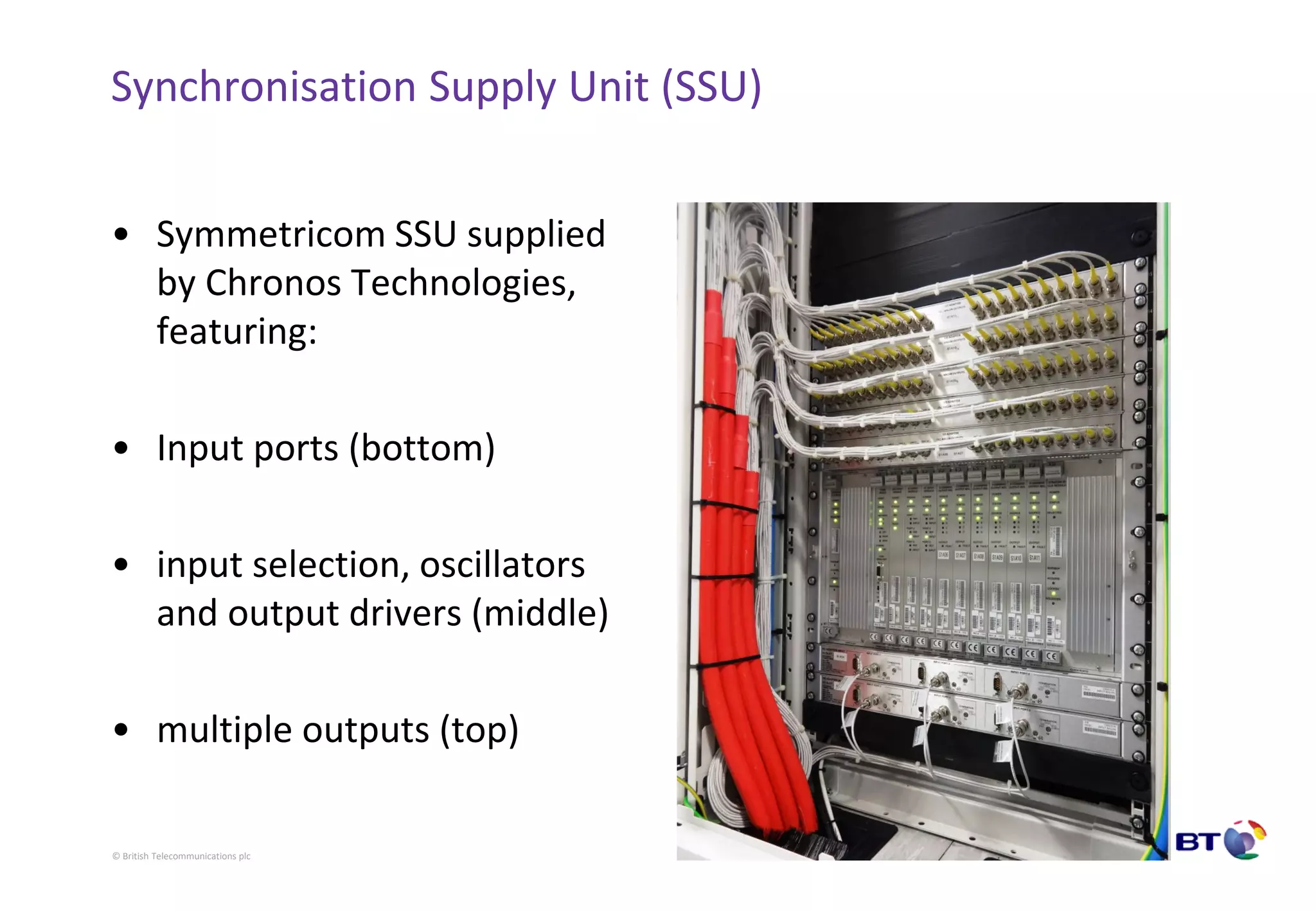
Synchronisation Supply Unit (SSU)
• Symmetricom SSU supplied
by Chronos Technologies,
featuring:
• Input ports (bottom)
• input selection, oscillators
and output drivers (middle)
• multiple outputs (top)
Let’s add some 3G UMTS…
© British Telecommunications plc
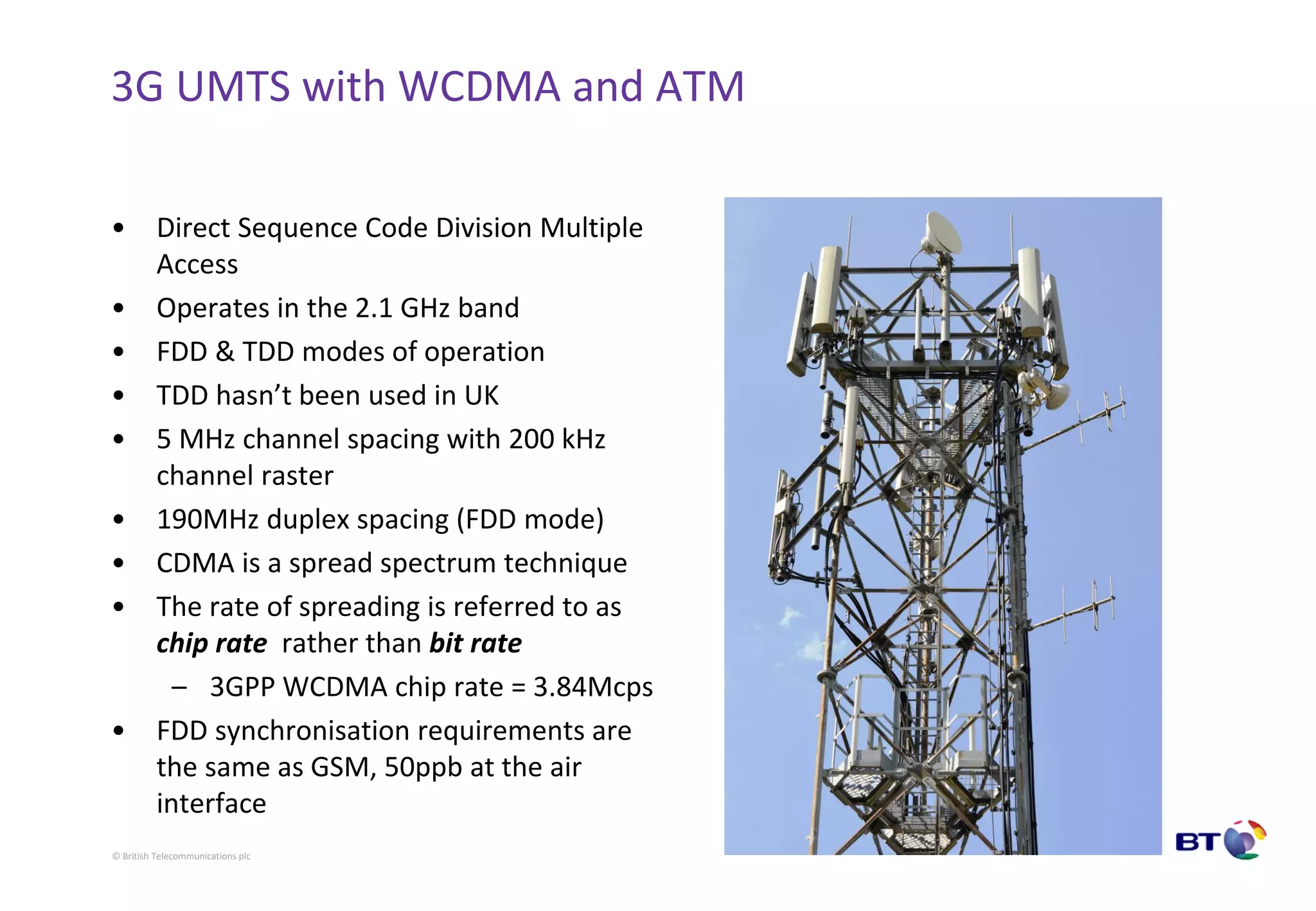
3G UMTS with WCDMA and ATM
• Direct Sequence Code Division Multiple
Access
• Operates in the 2.1 GHz band
• FDD & TDD modes of operation
• TDD hasn’t been used in UK
• 5 MHz channel spacing with 200 kHz
channel raster
• 190MHz duplex spacing (FDD mode)
• CDMA is a spread spectrum technique
• The rate of spreading is referred to as
chip rate rather than bit rate
– 3GPP WCDMA chip rate = 3.84Mcps
• FDD synchronisation requirements are
the same as GSM, 50ppb at the air
interface
© British Telecommunications plc
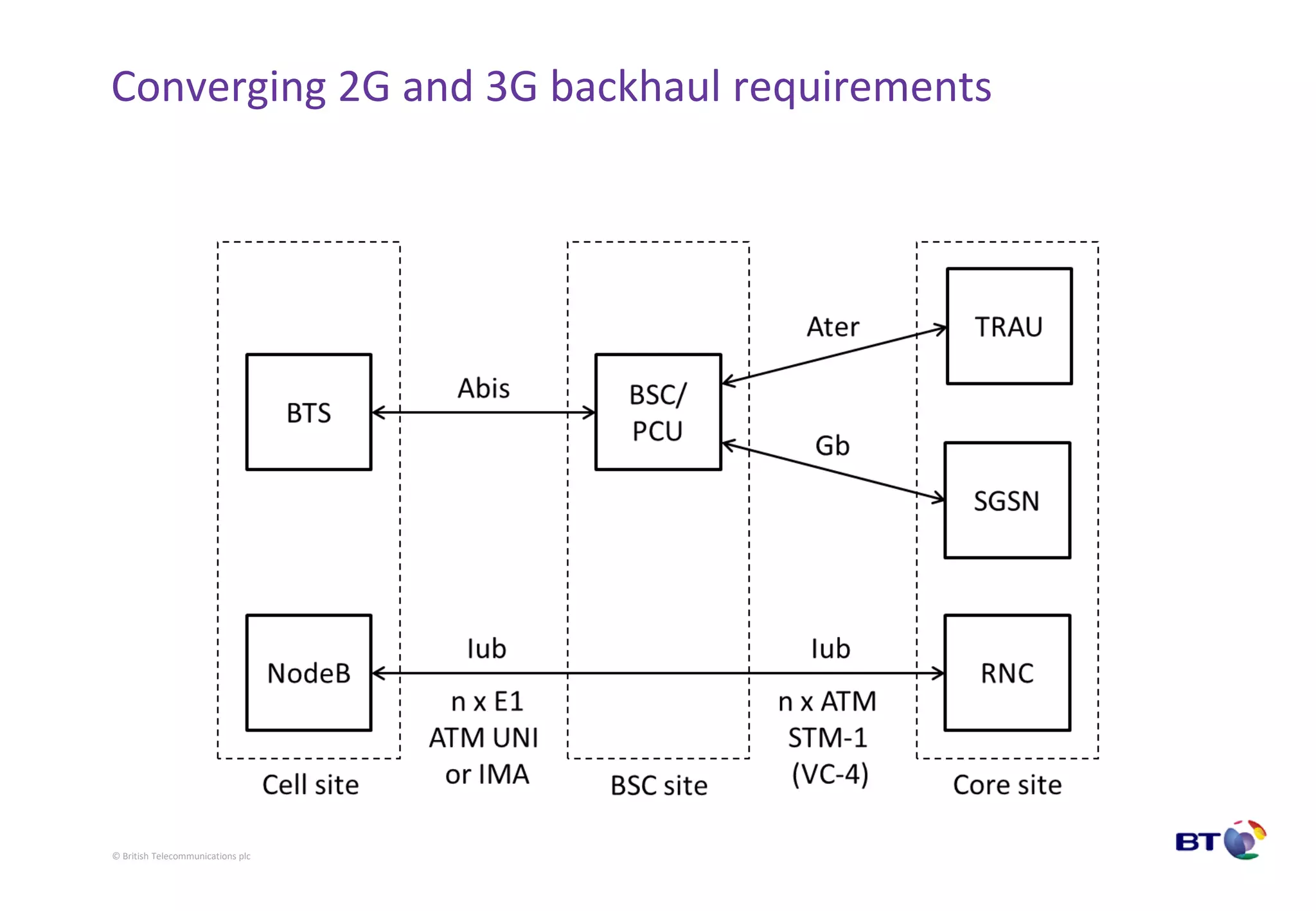
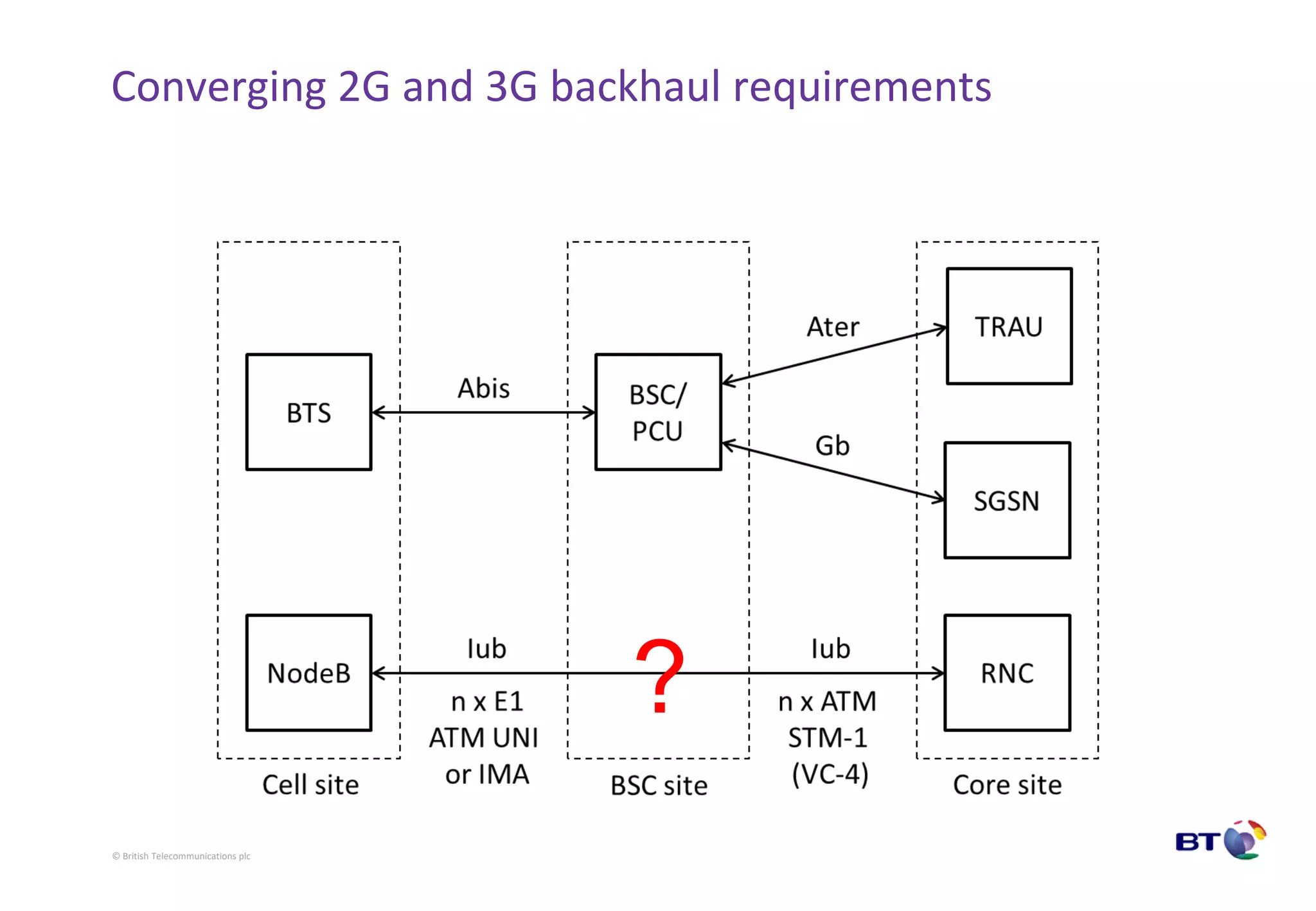
Converging 2G and 3G backhaul requirements
© British Telecommunications plc
Converging 2G and 3G backhaul requirements
?
© British Telecommunications plc
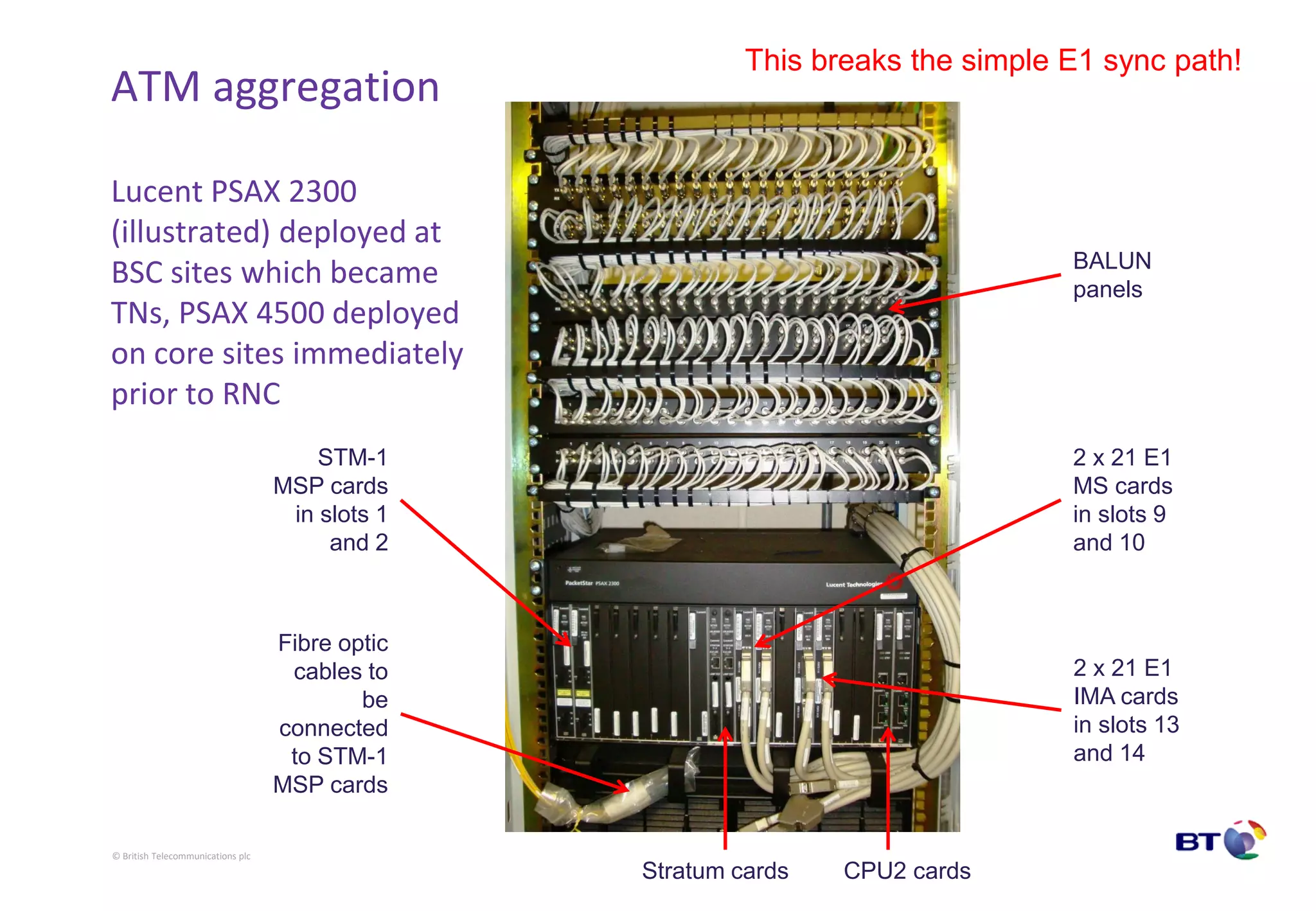
ATM aggregation
Lucent PSAX 2300
(illustrated) deployed at
BSC sites which became
TNs, PSAX 4500 deployed
on core sites immediately
prior to RNC
BALUN
panels
STM-1
MSP cards
in slots 1
and 2
Fibre optic
cables to
be
connected
to STM-1
MSP cards
Stratum cards CPU2 cards
2 x 21 E1
MS cards
in slots 9
and 10
2 x 21 E1
IMA cards
in slots 13
and 14
This breaks the simple E1 sync path!
© British Telecommunications plc
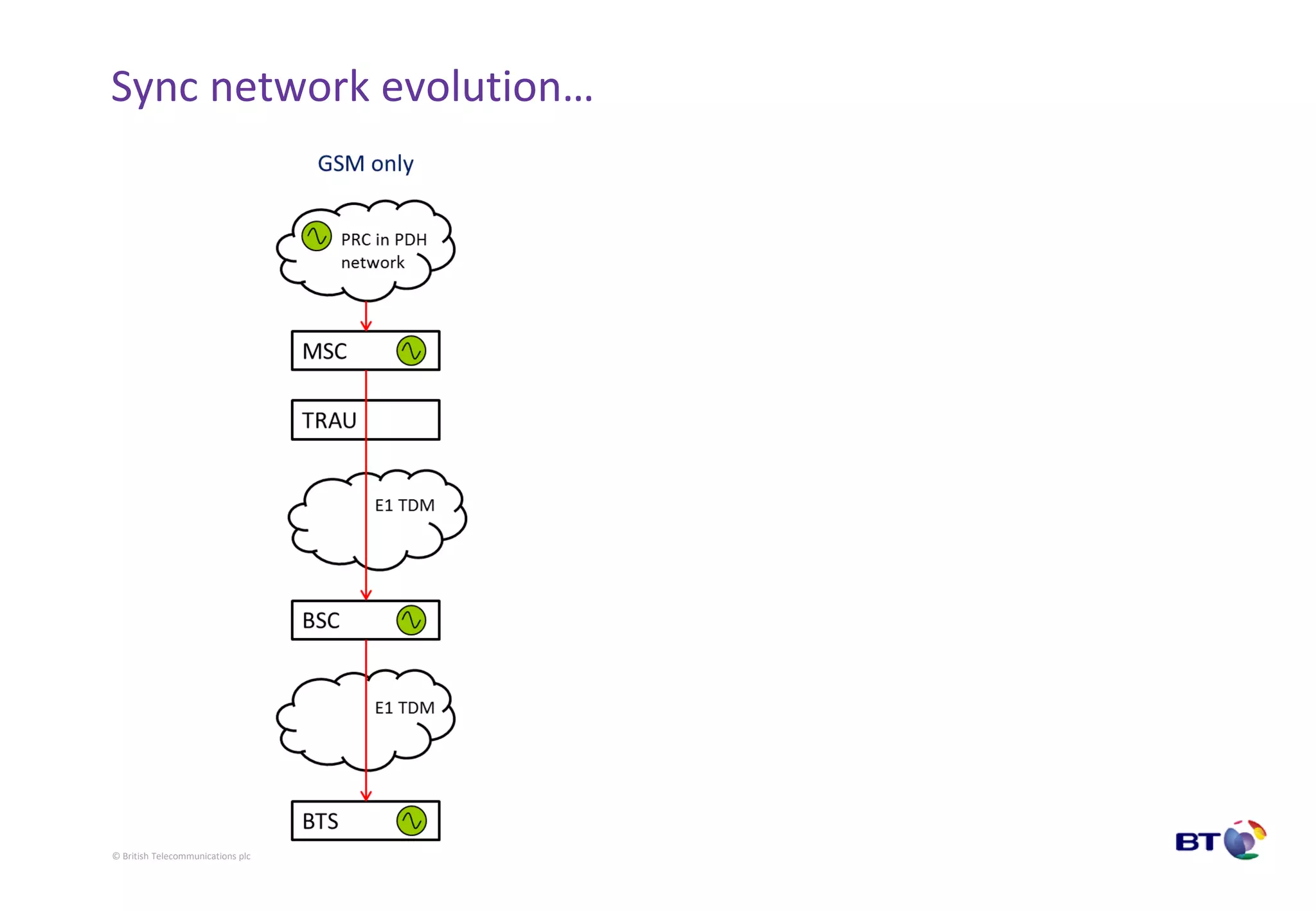
Sync network evolution…
© British Telecommunications plc
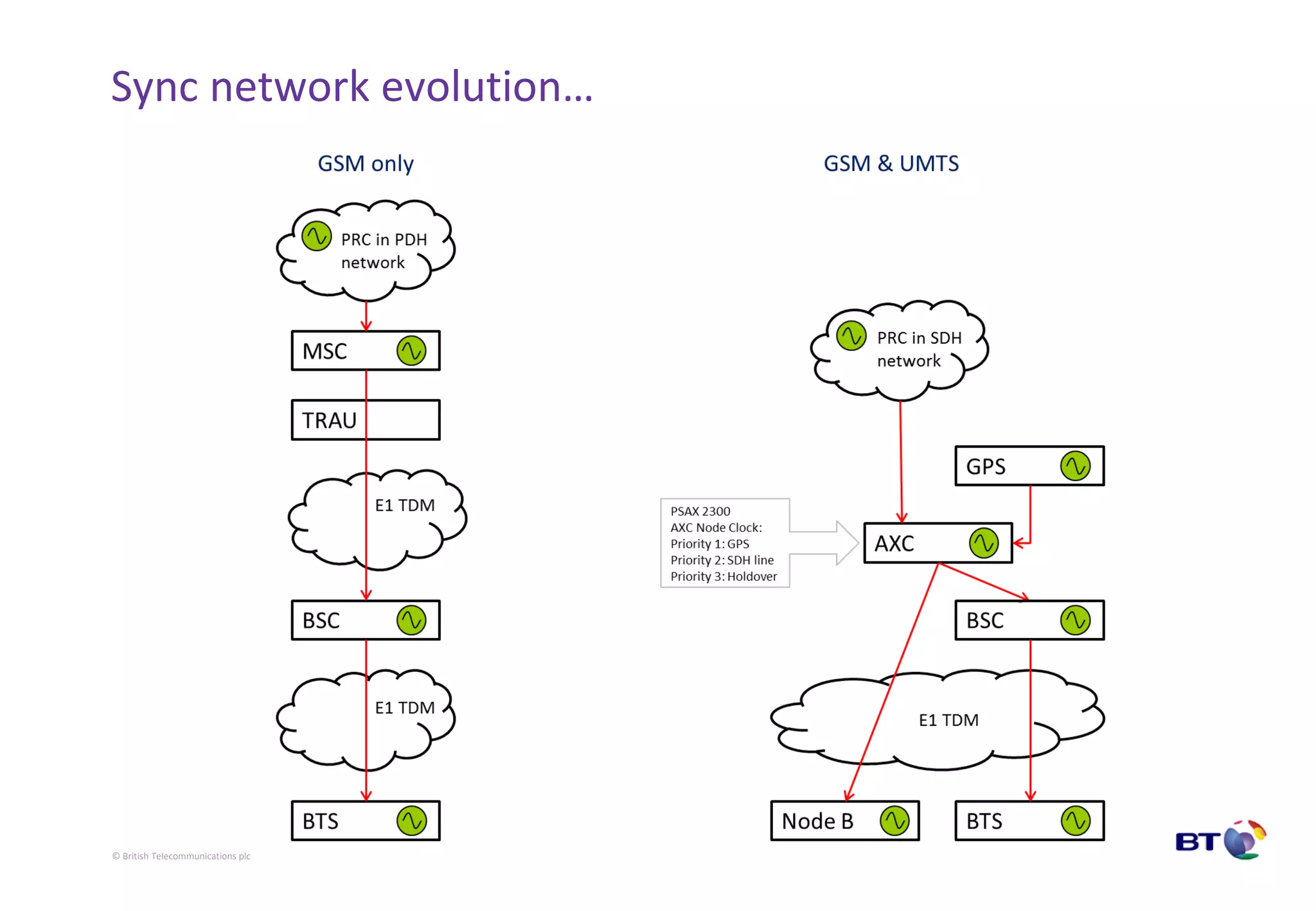
Sync network evolution…
© British Telecommunications plc
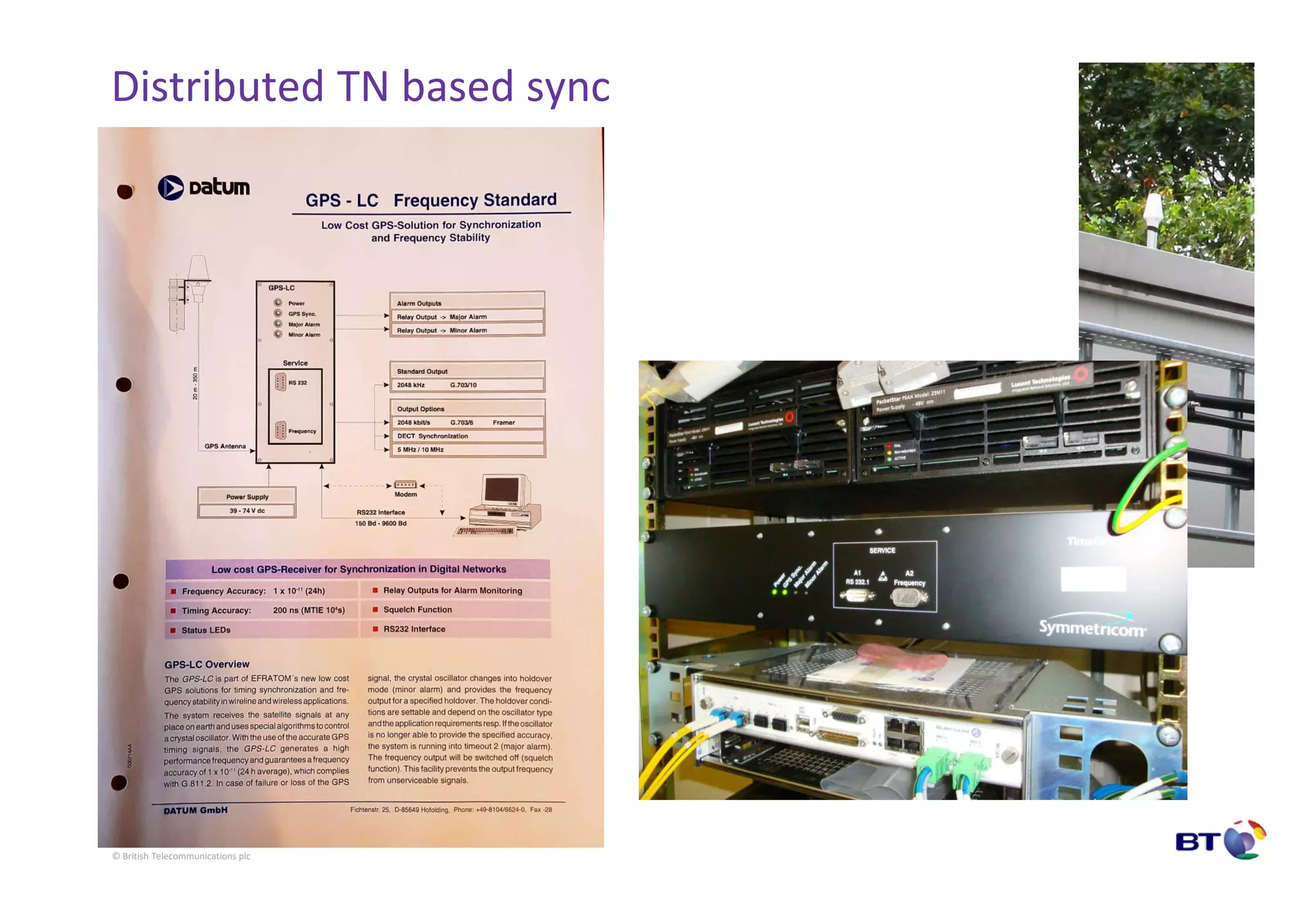
Distributed TN based sync
4G, LTE, LTE-A, LTE-A-Pro
and the road to 5G
© British Telecommunications plc
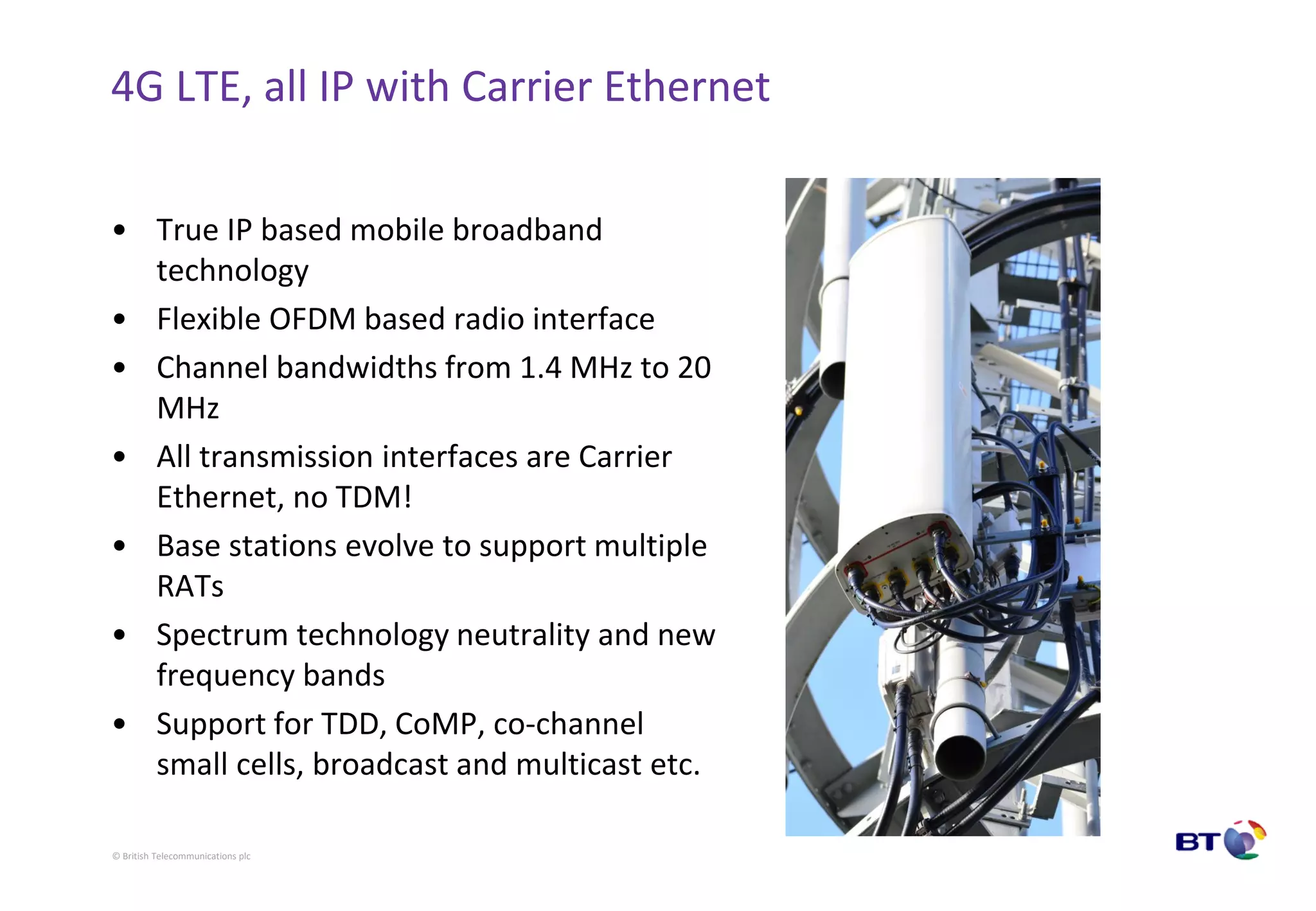
4G LTE, all IP with Carrier Ethernet
• True IP based mobile broadband
technology
• Flexible OFDM based radio interface
• Channel bandwidths from 1.4 MHz to 20
MHz
• All transmission interfaces are Carrier
Ethernet, no TDM!
• Base stations evolve to support multiple
RATs
• Spectrum technology neutrality and new
frequency bands
• Support for TDD, CoMP, co-channel
small cells, broadcast and multicast etc.
© British Telecommunications plc
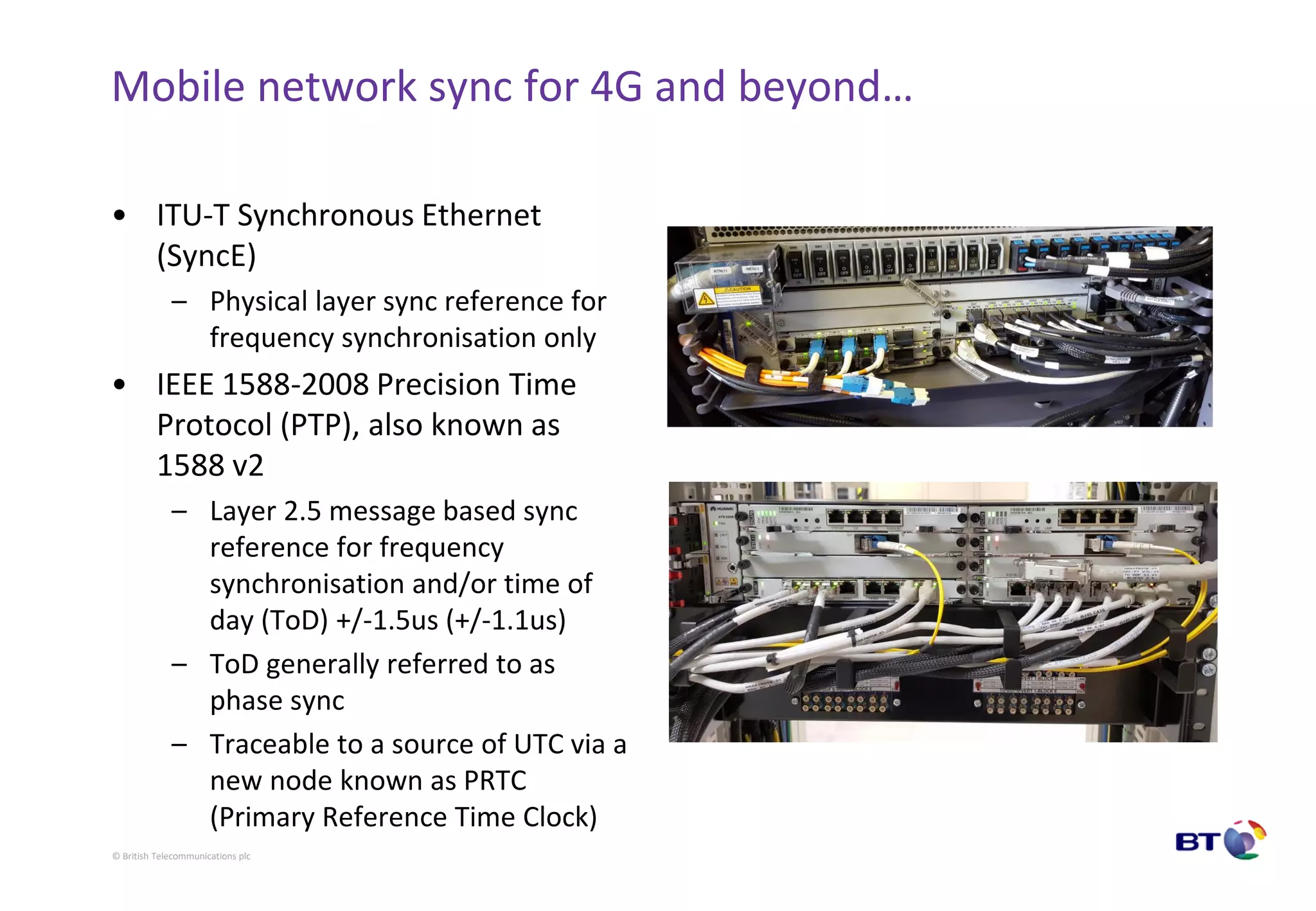
Mobile network sync for 4G and beyond…
• ITU-T Synchronous Ethernet
(SyncE)
– Physical layer sync reference for
frequency synchronisation only
• IEEE 1588-2008 Precision Time
Protocol (PTP), also known as
1588 v2
– Layer 2.5 message based sync
reference for frequency
synchronisation and/or time of
day (ToD) +/-1.5us (+/-1.1us)
– ToD generally referred to as
phase sync
– Traceable to a source of UTC via a
new node known as PRTC
(Primary Reference Time Clock)
28 British Telecommunications plc 2017
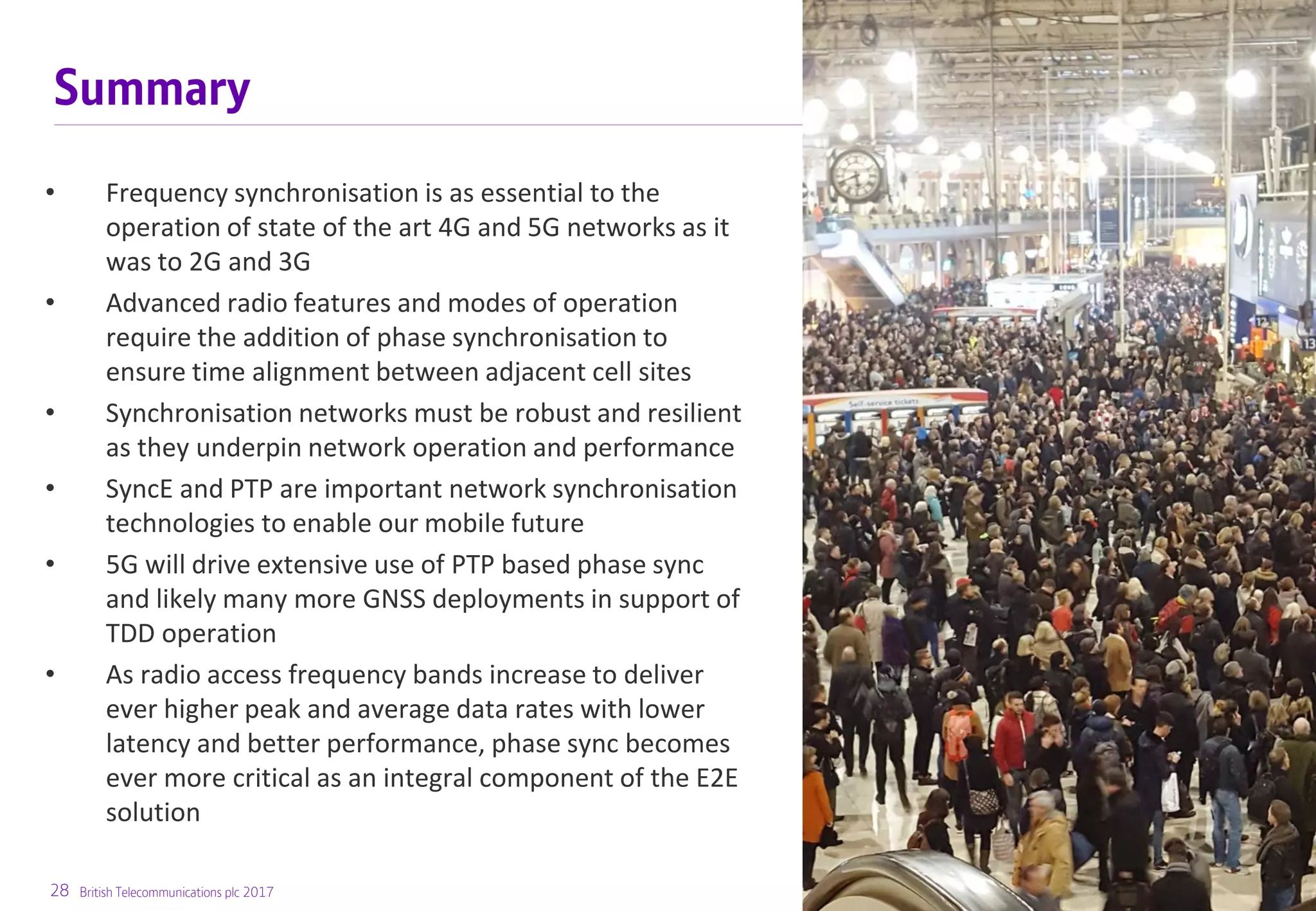
Summary
• Frequency synchronisation is as essential to the
operation of state of the art 4G and 5G networks as it
was to 2G and 3G
• Advanced radio features and modes of operation
require the addition of phase synchronisation to
ensure time alignment between adjacent cell sites
• Synchronisation networks must be robust and resilient
as they underpin network operation and performance
• SyncE and PTP are important network synchronisation
technologies to enable our mobile future
• 5G will drive extensive use of PTP based phase sync
and likely many more GNSS deployments in support of
TDD operation
• As radio access frequency bands increase to deliver
ever higher peak and average data rates with lower
latency and better performance, phase sync becomes
ever more critical as an integral component of the E2E
solution
29 British Telecommunications plc 2017
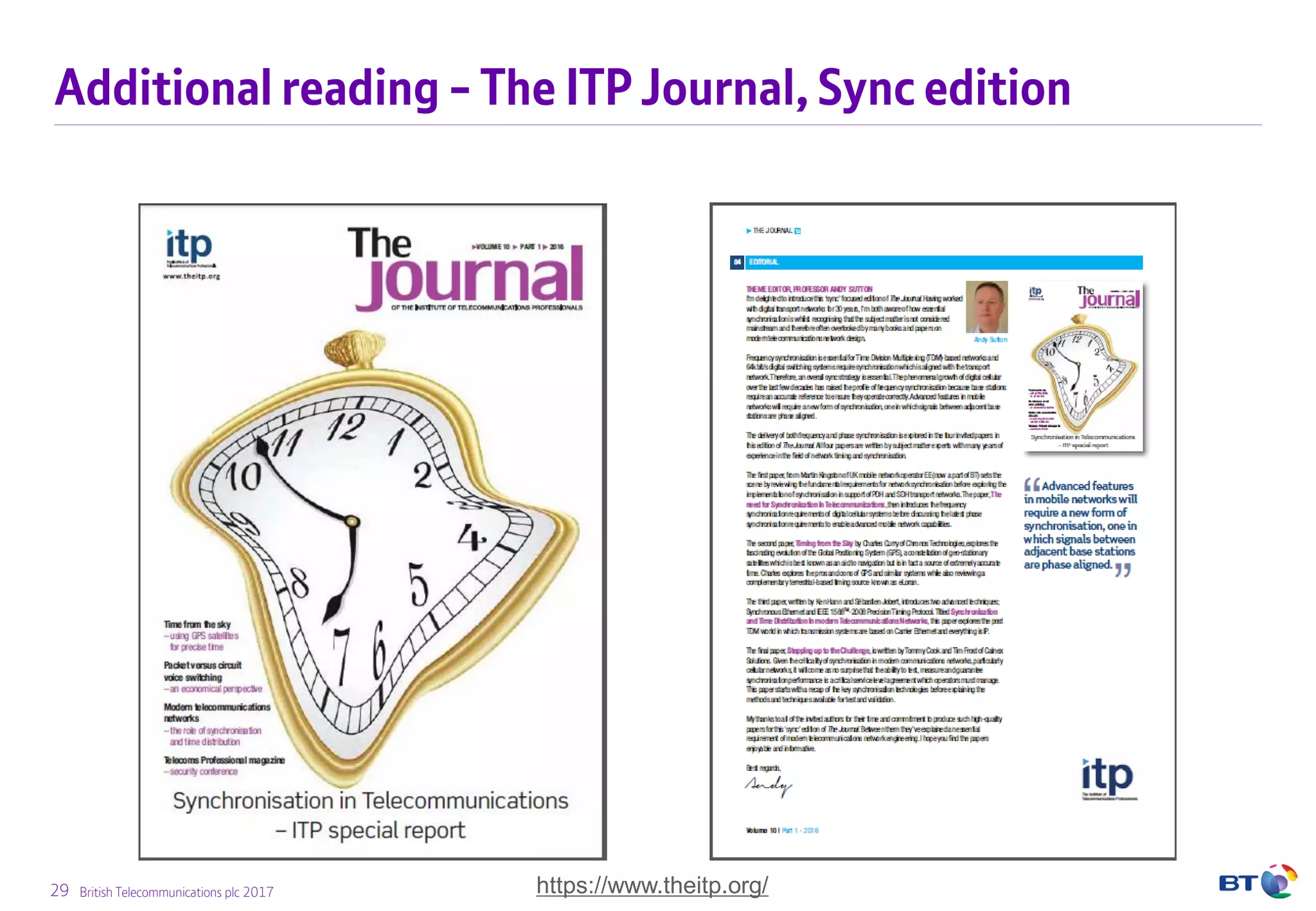
Additional reading - The ITP Journal, Sync edition
https://www.theitp.org/
30 British Telecommunications plc 2017
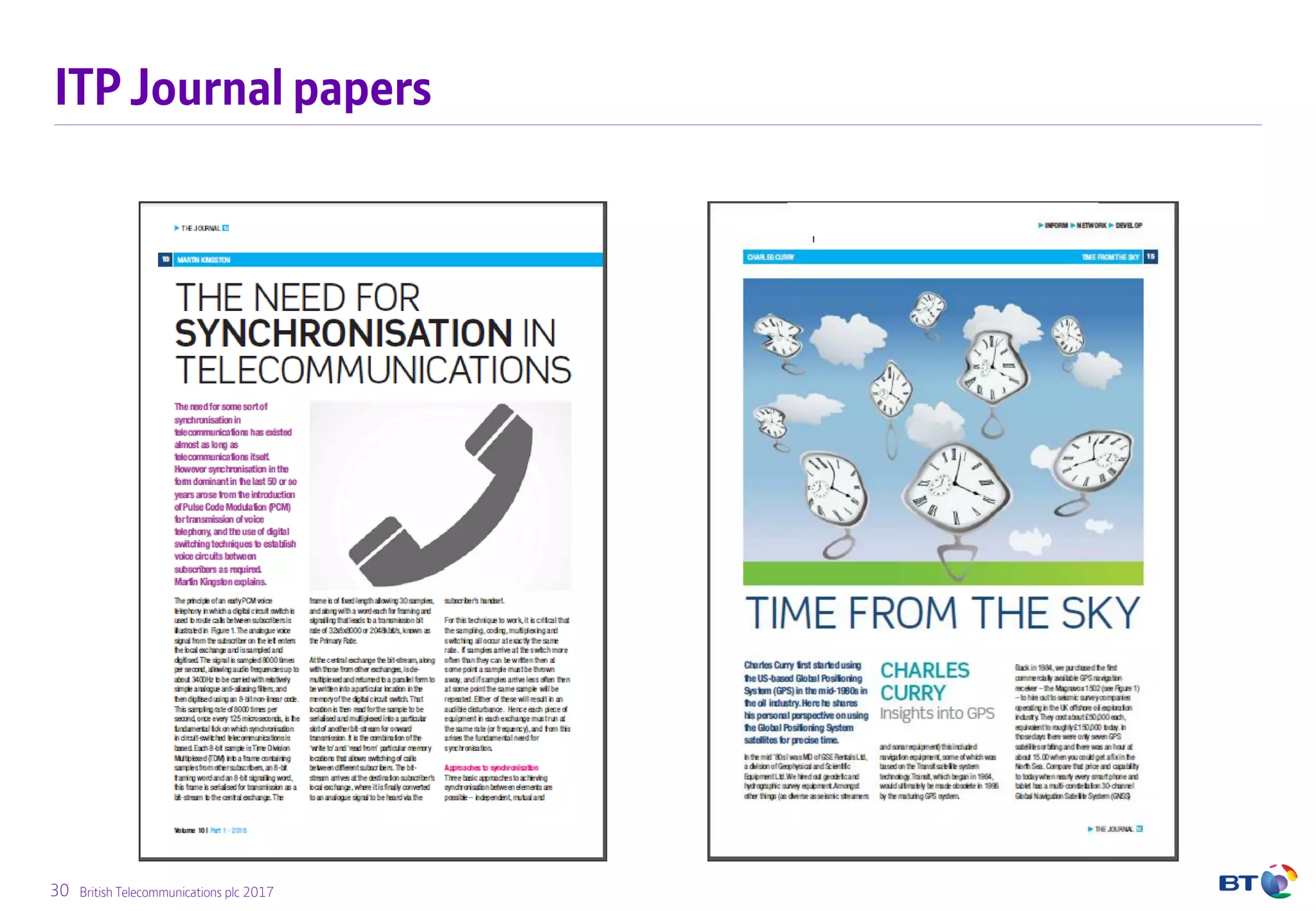
ITP Journal papers
31 British Telecommunications plc 2017
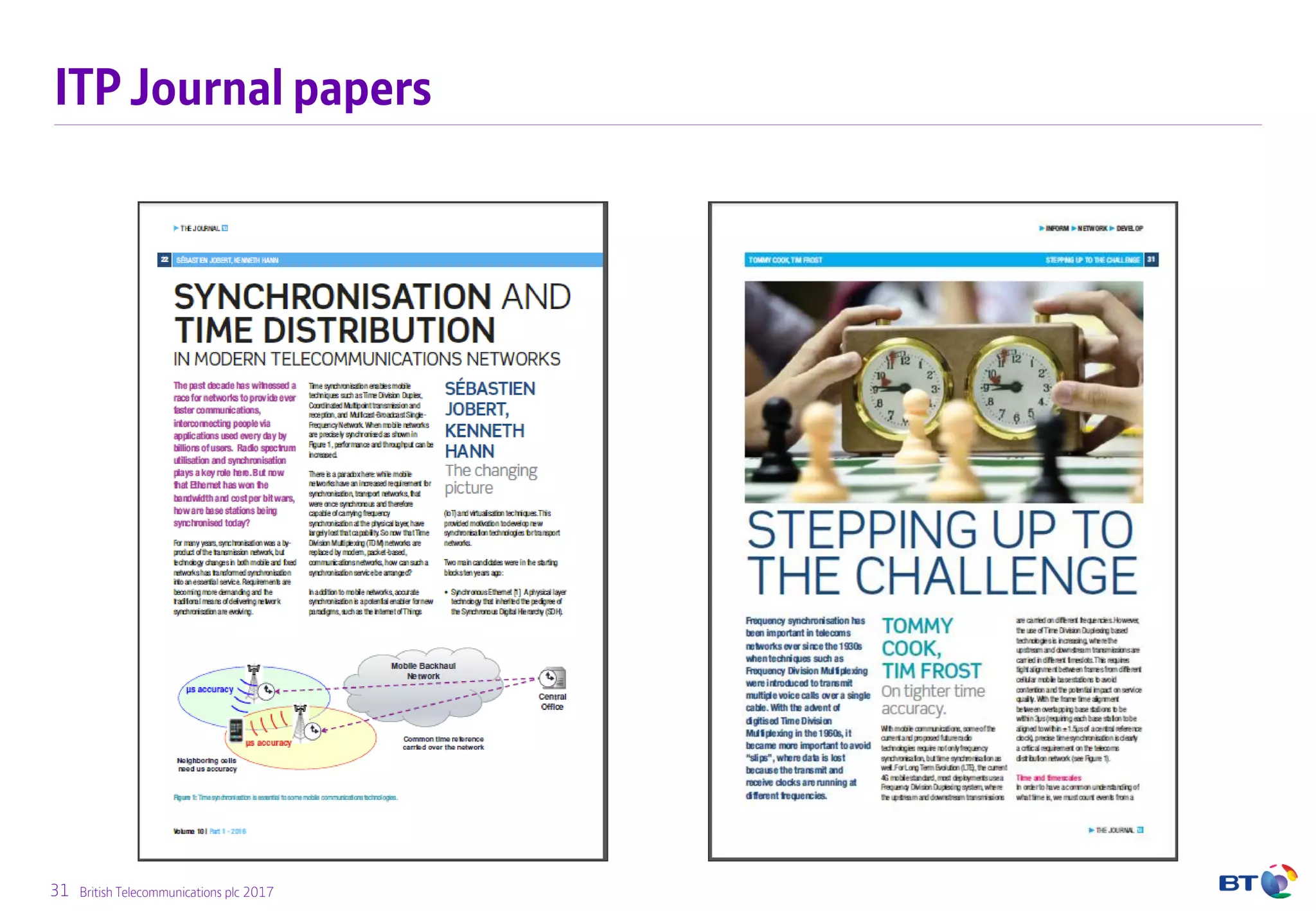
ITP Journal papers
Thank You!
Any questions?
3

The history of synchronisation in digital cellular networks

  • 1.
    British Telecommunications plc 2017 Thehistory of synchronisation in digital cellular networks Andy Sutton 16th March 2018
  • 2.
    1 British Telecommunicationsplc 2017 • GSM radio interface • Nokia DF12 BTS • Base station oscillator modules • Pulse Code Modulation • E1 frame • GSM terrestrial interfaces • Synchronisation Supply Unit • Add some 3G with UMTS and WCDMA • Implications of ATM and SDH • Converged network sync solution • 4G with LTE, LTE-A, LTE-A-Pro • Sync for 4G and beyond… • Summary Contents
  • 3.
    © British Telecommunicationsplc GSM radio (Um) interface (air interface) • TDMA TS = 577uS • TDMA frame = 4.615mS • TS numbers 0 through 7 • Burst duration = 546uS within a 577uS window • This gives a gross Um interface rate of 270.833kbps • Therefore, Each TS = 34.73kbps • Full rate TFC on the Um interface = 22.8kbps • Full rate speech occupies approx. 13.6kbps
  • 4.
    © British Telecommunicationsplc Nokia DF12 GSM (DCS1800) BTS • GSM radio interface requires frequency synchronisation accuracy of 50 parts per billion (ppb) • Frequency of the reference clock • Fref= n x 13 MHz • For all GSM mobiles (any frequency band) • 13000 kHz/48 = 270.833kbps • 48 clock cycle = 1 time bit • 12 clock cycle = 1 quarter bit (time unity in mobiles)
  • 5.
    © British Telecommunicationsplc MCLU • Early BTS equipment typically had standalone high-accuracy oscillators • These standalone oscillators required regular alignment to centre the 13 MHz clock • A highly accurate frequency counter was required for this alignment, typically with a rubidium reference • The actual adjustment was a manual process via a trimming tool • The realignment had to be completed every 6 months on every BTS site Image source: Nokia DF12 BTS training manual
  • 6.
    © British Telecommunicationsplc Rethinking base station frequency sync… • Highly accurate oscillators in base stations were expensive • Regular manual retuning of BTS oscillators was expensive • An alternative solution was required to reduce costs while enhancing network performance • The solution was to use the incoming 2.048Mbps signal as a source of synchronisation • The new “PCM” based sync card could use a lower cost oscillator as it would be constantly disciplined • There is no requirement for manual tuning of oscillators Image source: Nokia DF12 BTS training manual
  • 7.
    © British Telecommunicationsplc BTS synchronisation with 2.048Mbps line reference Image source: Nokia DF12 BTS training manual To guarantee 50 ppb at the air interface the line performance must meet 15ppb
  • 8.
    But why isthe incoming line synchronous?
  • 9.
    © British Telecommunicationsplc The need for synchronisation in telecommunications • The need for some sort of synchronisation in telecommunications has existed almost as long as telecommunications itself • Synchronisation in the form dominant in the last 50 or so years arose from the introduction of Pulse Code Modulation (PCM) for transmission of voice telephony, and the use of digital switching techniques to establish voice circuits between subscribers as required Image source: BT Archives
  • 10.
    © British Telecommunicationsplc Pulse Code Modulation (PCM) • Pulse Code Modulation (PCM) patented (1937) : turning speech into pulses • In 1937 an English engineer, Alec Reeves, working in Paris for the International Standard Electric Company, patented the Pulse Code Modulation (PCM) transmission system. PCM turns the human voice into electronically coded sequences of digital pulses which are then transmitted and turned back into speech at the far end • This was a visionary concept, underlying the digital systems of today. But Reeves's ideas were well in advance of his time. The techniques he described for coding and decoding signals could not be realised in practical form until suitable components, particularly transistors, became available Marconi Instruments publications from 1976
  • 11.
    © British Telecommunicationsplc Empress telephone exchange • The GPO embraced the idea of digital transmission enthusiastically. From 1964 it installed more than 7,000 pulse code modulation (PCM) wideband systems on existing copper cables. Four years later it inaugurated the world's first all-digital PCM switching centre in London. • The Empress telephone exchange, near Earl's Court, was opened on September 11, 1968, with an inaugural call from the then Postmaster- General, John Stonehouse, to the Mayor of Hammersmith. • Empress was the first exchange in the world to switch PCM signals from one group of lines to another in digital form. Now Empress solved this problem - and demonstrated that an integrated PCM transmission and switching system was capable of working fully within the existing network of Strowger, Reed-Electronic and Crossbar systems. Image source: BT Archives
  • 12.
    © British Telecommunicationsplc PCM and the 2.048Mbps frame (E1) 1 2 3 4 5 6 7 8 TS0 FAW/NFAW TS1 TS2 TS3 TS4 TS5 TS6 TS7 TS8 TS9 TS10 TS11 TS12 TS13 TS14 TS15 TS16 CAS/CCS TS17 TS18 TS19 TS20 TS21 TS22 TS23 TS24 TS25 TS26 TS27 TS28 TS29 TS30 TS31
  • 13.
    © British Telecommunicationsplc E1 frame used for GSM Abis transmission 1 2 3 4 5 6 7 8 TS0 FAW/NFAW TS1 TS2 TS3 TS4 TS5 TS6 TS7 TS8 TS9 TS10 TS11 TS12 TS13 TS14 TS15 TS16 CAS/CCS TS17 TS18 TS19 TS20 TS21 TS22 TS23 TS24 TS25 TS26 TS27 TS28 TS29 TS30 TS31 1 2 3 4 5 6 7 8 TS0 FAW/NFAW TS1 TRX-1 TRX-1 TRX-1 TRX-1 TS2 TRX-1 TRX-1 TRX-1 TRX-1 TS3 TRX-2 TRX-2 TRX-2 TRX-2 TS4 TRX-2 TRX-2 TRX-2 TRX-2 TS5 TRX-3 TRX-3 TRX-3 TRX-3 TS6 TRX-3 TRX-3 TRX-3 TRX-3 TS7 TRX-4 TRX-4 TRX-4 TRX-4 TS8 TRX-4 TRX-4 TRX-4 TRX-4 TS9 TRX-5 TRX-5 TRX-5 TRX-5 TS10 TRX-5 TRX-5 TRX-5 TRX-5 TS11 TRX-6 TRX-6 TRX-6 TRX-6 TS12 TRX-6 TRX-6 TRX-6 TRX-6 TS13 TRX-7 TRX-7 TRX-7 TRX-7 TS14 TRX-7 TRX-7 TRX-7 TRX-7 TS15 TRX-8 TRX-8 TRX-8 TRX-8 TS16 TRX-8 TRX-8 TRX-8 TRX-8 TS17 TRX-9 TRX-9 TRX-9 TRX-9 TS18 TRX-9 TRX-9 TRX-9 TRX-9 TS19 TRX-10 TRX-10 TRX-10 TRX-10 TS20 TRX-10 TRX-10 TRX-10 TRX-10 TS21 TRX SIG-10 TS22 TRX SIG-9 TS23 TRX SIG-8 TS24 TRX SIG-7 TS25 TRX SIG-6 TS26 TRX SIG-5 TS27 TRX SIG-4 TS28 TRX SIG-3 TS29 TRX SIG-2 TS30 TRX SIG-1 TS31 O&M
  • 14.
    © British Telecommunicationsplc Nokia GSM transmission interfaces DF12 BTS with 64kbps TRX SIG Typical configuration from early to late 1990s Image source: Nokia DF12 BTS training manual
  • 15.
    © British Telecommunicationsplc An E1 frame is synchronous… Nokia DN2 Tellabs DACCS
  • 16.
    © British Telecommunicationsplc Synchronisation signal from PCM E1 frame Although an 8000 sample-per-second tick is the basis of the need for synchronisation, it wouldn’t be found as an interface or a signal for transmission Rather than providing separate transmission for synchronisation, the Primary Rate TDM bit- stream at 2048kbps was adopted (or for local transfer of synchronisation only, a bipolar signal of the same rate) Because of this, short term variations (jitter) will occur and these will accumulate along a chain of nodes in the hierarchy (multiplexing into higher order bit-streams will also add jitter). In longer chains, this introduces a need for a filtering stage, usually realised in the form of a high quality oscillator and a long time constant phase locked loop, to reduce these short term variations to an acceptable level. This filtering function is often needed where one of a small number of incoming transmission paths are to be used as the synchronisation source for a larger number of nodes The requirements to select the source, to filter, and to provide multiple feeds are often met by one piece of equipment, a Synchronisation Supply Unit (SSU) Re-using the TDM bit-stream in this way does, however, create a challenge. Unlike a signal intended only for synchronisation, it will not have a wholly repetitive and predictable pattern of edges from which to recover the reference frequency. Source: The Need for Synchronisation in Telecommunications, Martin Kingston, ITP Journal Vol 10 Part 1, 10 - 13
  • 17.
    © British Telecommunicationsplc Synchronisation Supply Unit (SSU) • Symmetricom SSU supplied by Chronos Technologies, featuring: • Input ports (bottom) • input selection, oscillators and output drivers (middle) • multiple outputs (top)
  • 18.
    Let’s add some3G UMTS…
  • 19.
    © British Telecommunicationsplc 3G UMTS with WCDMA and ATM • Direct Sequence Code Division Multiple Access • Operates in the 2.1 GHz band • FDD & TDD modes of operation • TDD hasn’t been used in UK • 5 MHz channel spacing with 200 kHz channel raster • 190MHz duplex spacing (FDD mode) • CDMA is a spread spectrum technique • The rate of spreading is referred to as chip rate rather than bit rate – 3GPP WCDMA chip rate = 3.84Mcps • FDD synchronisation requirements are the same as GSM, 50ppb at the air interface
  • 20.
    © British Telecommunicationsplc Converging 2G and 3G backhaul requirements
  • 21.
    © British Telecommunicationsplc Converging 2G and 3G backhaul requirements ?
  • 22.
    © British Telecommunicationsplc ATM aggregation Lucent PSAX 2300 (illustrated) deployed at BSC sites which became TNs, PSAX 4500 deployed on core sites immediately prior to RNC BALUN panels STM-1 MSP cards in slots 1 and 2 Fibre optic cables to be connected to STM-1 MSP cards Stratum cards CPU2 cards 2 x 21 E1 MS cards in slots 9 and 10 2 x 21 E1 IMA cards in slots 13 and 14 This breaks the simple E1 sync path!
  • 23.
    © British Telecommunicationsplc Sync network evolution…
  • 24.
    © British Telecommunicationsplc Sync network evolution…
  • 25.
    © British Telecommunicationsplc Distributed TN based sync
  • 26.
    4G, LTE, LTE-A,LTE-A-Pro and the road to 5G
  • 27.
    © British Telecommunicationsplc 4G LTE, all IP with Carrier Ethernet • True IP based mobile broadband technology • Flexible OFDM based radio interface • Channel bandwidths from 1.4 MHz to 20 MHz • All transmission interfaces are Carrier Ethernet, no TDM! • Base stations evolve to support multiple RATs • Spectrum technology neutrality and new frequency bands • Support for TDD, CoMP, co-channel small cells, broadcast and multicast etc.
  • 28.
    © British Telecommunicationsplc Mobile network sync for 4G and beyond… • ITU-T Synchronous Ethernet (SyncE) – Physical layer sync reference for frequency synchronisation only • IEEE 1588-2008 Precision Time Protocol (PTP), also known as 1588 v2 – Layer 2.5 message based sync reference for frequency synchronisation and/or time of day (ToD) +/-1.5us (+/-1.1us) – ToD generally referred to as phase sync – Traceable to a source of UTC via a new node known as PRTC (Primary Reference Time Clock)
  • 29.
    28 British Telecommunicationsplc 2017 Summary • Frequency synchronisation is as essential to the operation of state of the art 4G and 5G networks as it was to 2G and 3G • Advanced radio features and modes of operation require the addition of phase synchronisation to ensure time alignment between adjacent cell sites • Synchronisation networks must be robust and resilient as they underpin network operation and performance • SyncE and PTP are important network synchronisation technologies to enable our mobile future • 5G will drive extensive use of PTP based phase sync and likely many more GNSS deployments in support of TDD operation • As radio access frequency bands increase to deliver ever higher peak and average data rates with lower latency and better performance, phase sync becomes ever more critical as an integral component of the E2E solution
  • 30.
    29 British Telecommunicationsplc 2017 Additional reading - The ITP Journal, Sync edition https://www.theitp.org/
  • 31.
    30 British Telecommunicationsplc 2017 ITP Journal papers
  • 32.
    31 British Telecommunicationsplc 2017 ITP Journal papers
  • 33.