Traffic Steering (TS) Concept
@3g4gUK
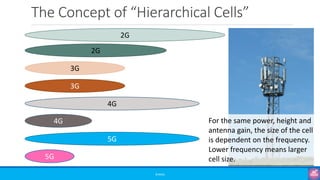
The Concept of “Hierarchical Cells”
©3G4G
For the same power, height and
antenna gain, the size of the cell
is dependent on the frequency.
Lower frequency means larger
cell size.
2G
2G
3G
3G
4G
4G
5G
5G
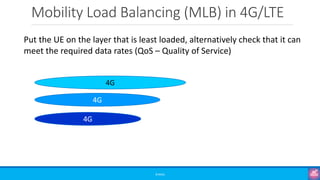
Mobility Load Balancing (MLB) in 4G/LTE
©3G4G
Put the UE on the layer that is least loaded, alternatively check that it can
meet the required data rates (QoS – Quality of Service)
4G
4G
4G
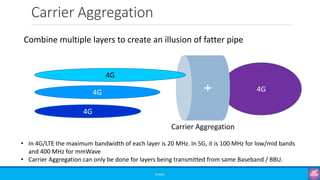
Carrier Aggregation
©3G4G
Combine multiple layers to create an illusion of fatter pipe
4G
4G
• In 4G/LTE the maximum bandwidth of each layer is 20 MHz. In 5G, it is 100 MHz for low/mid bands
and 400 MHz for mmWave
• Carrier Aggregation can only be done for layers being transmitted from same Baseband / BBU.
4G
+
Carrier Aggregation
4G
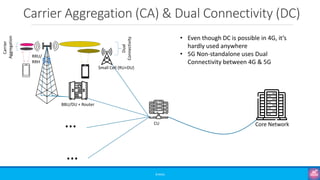
Carrier Aggregation (CA) & Dual Connectivity (DC)
©3G4G
• Even though DC is possible in 4G, it’s
hardly used anywhere
• 5G Non-standalone uses Dual
Connectivity between 4G & 5G
BBU/DU + Router
RRU/
RRH
Core Network
…
…
CU
Carrier
Aggregation
Small Cell (RU+DU)
Dual
Connectivity
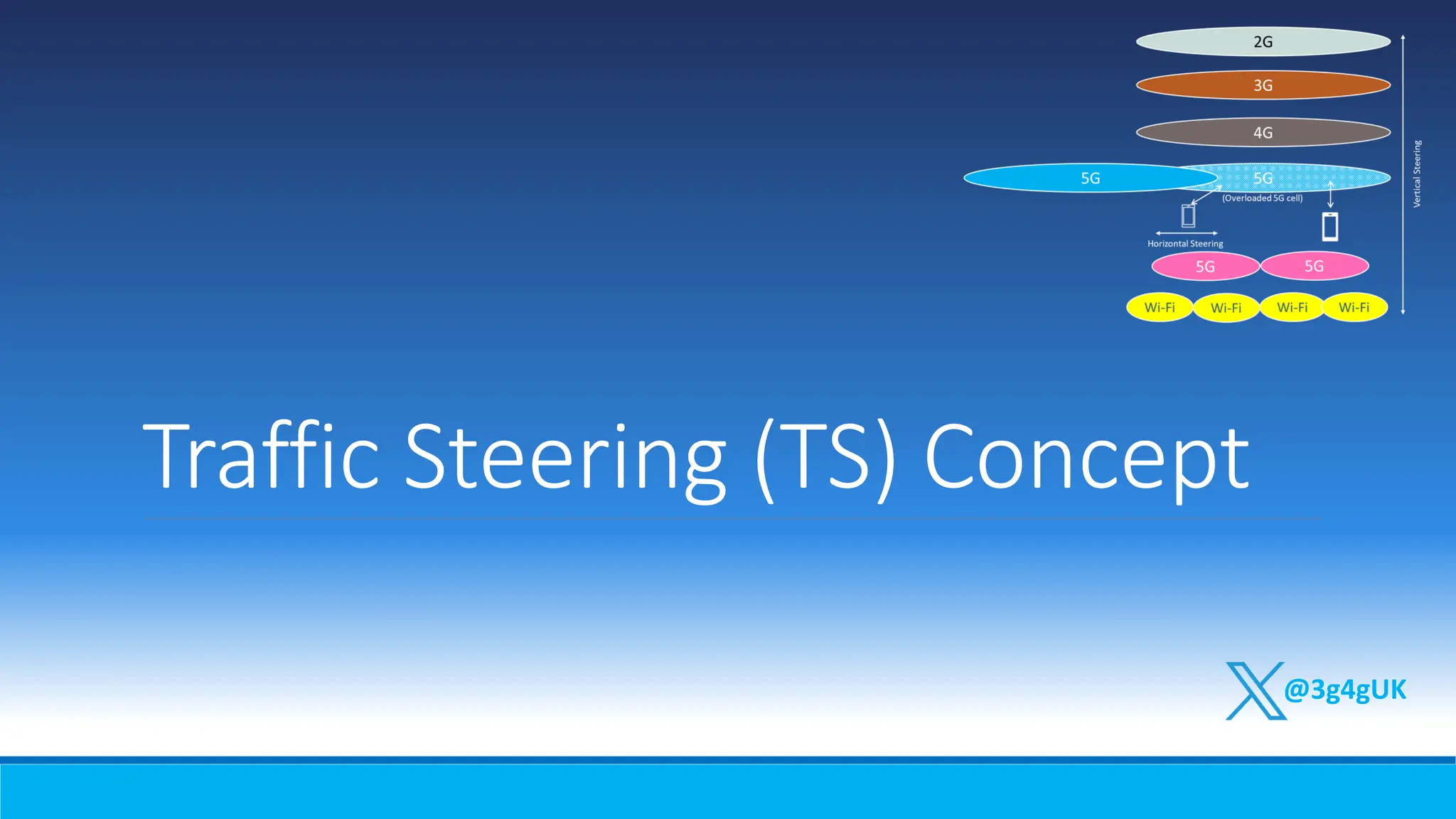
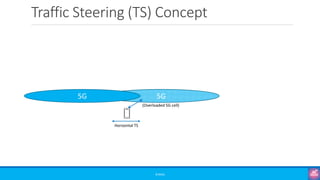
Traffic Steering (TS) Concept
©3G4G
5G
5G
(Overloaded 5G cell)
Horizontal TS
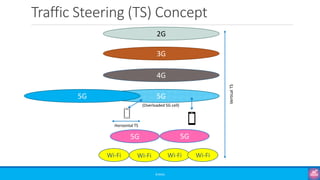
Traffic Steering (TS) Concept
©3G4G
2G
3G
4G
5G
Wi-Fi
5G 5G
Wi-Fi Wi-Fi Wi-Fi
5G
Horizontal TS
(Overloaded 5G cell)
Vertical
TS
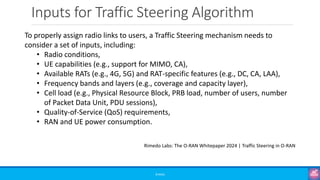
Inputs for Traffic Steering Algorithm
©3G4G
To properly assign radio links to users, a Traffic Steering mechanism needs to
consider a set of inputs, including:
• Radio conditions,
• UE capabilities (e.g., support for MIMO, CA),
• Available RATs (e.g., 4G, 5G) and RAT-specific features (e.g., DC, CA, LAA),
• Frequency bands and layers (e.g., coverage and capacity layer),
• Cell load (e.g., Physical Resource Block, PRB load, number of users, number
of Packet Data Unit, PDU sessions),
• Quality-of-Service (QoS) requirements,
• RAN and UE power consumption.
Rimedo Labs: The O-RAN Whitepaper 2024 | Traffic Steering in O-RAN
Related Presentations and Further Reading
©3G4G
• Rimedo Labs - The O-RAN Whitepaper 2024: Traffic Steering in O-RAN (link)
• telecomHall Forum: How Traffic Steering is done in Open RAN? (link)
• 3G4G: Self-Organizing Networks / Self-Optimizing Networks (SON) (link)
• 3G4G - 3GPP SON Series: Mobility Load Balancing (MLB) (link)
• 3G4G: Radio Frequency, Band and Spectrum (link)
• The 3G4G Blog: Carrier Aggregation (CA) and Dual Connectivity (DC) (link)
Thank You
To learn more, visit:
3G4G Website – https://www.3g4g.co.uk/
3G4G Blog – https://blog.3g4g.co.uk/
Telecoms Infrastructure Blog – https://www.telecomsinfrastructure.com/
Operator Watch Blog – https://www.operatorwatch.com/
Connectivity Technology Blog – https://www.connectivity.technology/
Free 5G Training – https://www.free5gtraining.com/
Free 6G Training – https://www.free6gtraining.com/
Private Networks – https://www.privatenetworks.technology/
Follow us on Twitter: https://twitter.com/3g4gUK
Follow us on Facebook: https://www.facebook.com/3g4gUK/
Follow us on LinkedIn: https://www.linkedin.com/company/3g4g
Follow us on SlideShare: https://www.slideshare.net/3G4GLtd
Follow us on YouTube: https://www.youtube.com/3G4G5G
©3G4G

Miscellaneous: Traffic Steering (TS) Concept

  • 1.
    Traffic Steering (TS)Concept @3g4gUK
  • 2.
    The Concept of“Hierarchical Cells” ©3G4G For the same power, height and antenna gain, the size of the cell is dependent on the frequency. Lower frequency means larger cell size. 2G 2G 3G 3G 4G 4G 5G 5G
  • 3.
    Mobility Load Balancing(MLB) in 4G/LTE ©3G4G Put the UE on the layer that is least loaded, alternatively check that it can meet the required data rates (QoS – Quality of Service) 4G 4G 4G
  • 4.
    Carrier Aggregation ©3G4G Combine multiplelayers to create an illusion of fatter pipe 4G 4G • In 4G/LTE the maximum bandwidth of each layer is 20 MHz. In 5G, it is 100 MHz for low/mid bands and 400 MHz for mmWave • Carrier Aggregation can only be done for layers being transmitted from same Baseband / BBU. 4G + Carrier Aggregation 4G
  • 5.
    Carrier Aggregation (CA)& Dual Connectivity (DC) ©3G4G • Even though DC is possible in 4G, it’s hardly used anywhere • 5G Non-standalone uses Dual Connectivity between 4G & 5G BBU/DU + Router RRU/ RRH Core Network … … CU Carrier Aggregation Small Cell (RU+DU) Dual Connectivity
  • 6.
    Traffic Steering (TS)Concept ©3G4G 5G 5G (Overloaded 5G cell) Horizontal TS
  • 7.
    Traffic Steering (TS)Concept ©3G4G 2G 3G 4G 5G Wi-Fi 5G 5G Wi-Fi Wi-Fi Wi-Fi 5G Horizontal TS (Overloaded 5G cell) Vertical TS
  • 8.
    Inputs for TrafficSteering Algorithm ©3G4G To properly assign radio links to users, a Traffic Steering mechanism needs to consider a set of inputs, including: • Radio conditions, • UE capabilities (e.g., support for MIMO, CA), • Available RATs (e.g., 4G, 5G) and RAT-specific features (e.g., DC, CA, LAA), • Frequency bands and layers (e.g., coverage and capacity layer), • Cell load (e.g., Physical Resource Block, PRB load, number of users, number of Packet Data Unit, PDU sessions), • Quality-of-Service (QoS) requirements, • RAN and UE power consumption. Rimedo Labs: The O-RAN Whitepaper 2024 | Traffic Steering in O-RAN
  • 9.
    Related Presentations andFurther Reading ©3G4G • Rimedo Labs - The O-RAN Whitepaper 2024: Traffic Steering in O-RAN (link) • telecomHall Forum: How Traffic Steering is done in Open RAN? (link) • 3G4G: Self-Organizing Networks / Self-Optimizing Networks (SON) (link) • 3G4G - 3GPP SON Series: Mobility Load Balancing (MLB) (link) • 3G4G: Radio Frequency, Band and Spectrum (link) • The 3G4G Blog: Carrier Aggregation (CA) and Dual Connectivity (DC) (link)
  • 10.
    Thank You To learnmore, visit: 3G4G Website – https://www.3g4g.co.uk/ 3G4G Blog – https://blog.3g4g.co.uk/ Telecoms Infrastructure Blog – https://www.telecomsinfrastructure.com/ Operator Watch Blog – https://www.operatorwatch.com/ Connectivity Technology Blog – https://www.connectivity.technology/ Free 5G Training – https://www.free5gtraining.com/ Free 6G Training – https://www.free6gtraining.com/ Private Networks – https://www.privatenetworks.technology/ Follow us on Twitter: https://twitter.com/3g4gUK Follow us on Facebook: https://www.facebook.com/3g4gUK/ Follow us on LinkedIn: https://www.linkedin.com/company/3g4g Follow us on SlideShare: https://www.slideshare.net/3G4GLtd Follow us on YouTube: https://www.youtube.com/3G4G5G ©3G4G