GPRS, EDGE & CDMA
PAUL PETER
BE. ISNE
SJUCET
2016
paulpeter460@gmail.com
HISTORY
 In 1st G AMPS(Advanced Mobile system) developed
in U.S in 1983
 In 2nd G there was introduction of CDMA,TDMA and
GSM
 In 2nd there was introduction of GPRS
 In 2.5th there was an introduction EDGE
TECHNOLOGY
 In 3rd and 3.75th there was UMTS, HSPA, H+
 4TH G is now LTE
paulpeter460@gmail.com
What is GPRS
General Packet Radio Service
• General -> not restricted to GSM use (DECT ?, 3rd
generation systems ?)
• Packet Radio -> enables packet mode communication
over air
• Service, not System -> existing BSS (partially also NSS)
infrastructure is used
Main benefits
• Resources are reserved only when needed and charged accordingly
• Connection setup times are reduced
• Enables new service opportunities
paulpeter460@gmail.com
GPRS Characteristics
GPRS uses packet switched resource allocation
• resources allocated only when data is to be sent/received
Flexible channel allocation
• one to eight time slots
• available resources shared by active users
• up and down link channels reserved separately
• GPRS and circuit switched GSM services can use same time slots alternatively
• GPRS is based on a modulation technique known as Gaussian minimum-shift
keying (GMSK)
Traffic characteristics suitable for GPRS
• Intermittent, burst data transmissions
• Frequent transmissions of small volumes of data
• Infrequent transmission of larger volumes of data
• Offered speeds up to 114 Kbps.
• 1GB downloaded in 165 hrs
• 1GB uploaded in 165 hrs
paulpeter460@gmail.com
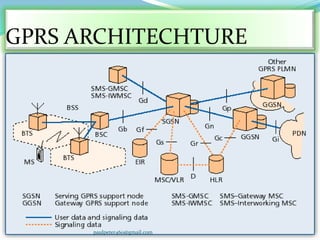
GPRS ARCHITECHTURE
paulpeter460@gmail.com
GPRS Architecture..
 Uses gsm architecture+ gsn(gprs support nodes)
Sgsn (servicing gsn)
Ggsn ( gateway gsn)
 Uses packet switching
 Faster than gsm and cdma
 Enable simultaneous transmission of packets
 SGSN and GGSN will be explain in next slide
paulpeter460@gmail.com
GPRS support nodes
 There are two network nodes use to offer packet data
service called GPRS support nodes
1) Serving GPRS Support Node (SGSN)
2) Gateway GPRS Support Node (GGSN)
paulpeter460@gmail.com
Serving GPRS Support Node(SGSN)
Serving GPRS Support Node(SGSN) is one of the GPRS
support node
 Routing the packet switched data to and from the ms
 Mobility management
 Location management
 Authentication and charging for calls
 Stores the location information of the user
 User’s profile
paulpeter460@gmail.com
Gateway GPRS Support Node(GGSN)
 Provide a gateway b/w gprs & pdn
 Convert data from sgsn to pdp format( packet data
protocol)
 Store the current sgsn address
 Stores the location of user in its location register
 Perform authentication & charging functions
paulpeter460@gmail.com
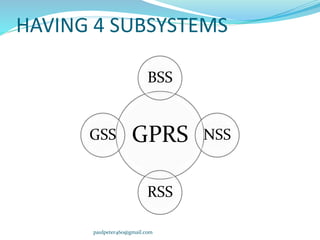
HAVING 4 SUBSYSTEMS
GPRS
BSS
NSS
RSS
GSS
paulpeter460@gmail.com
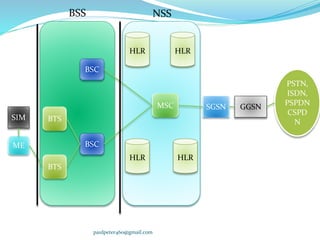
Base Station System(BSS)
 BSS system needs to enhancement to recognize and
send packet data.
 BSS includes BTS and MS.
Network Subsystem(NSS)
 It consist of a number of sgsns
 Also consist of a number of msc
 helps in – authentication, operation & maintenance of
subsystems
paulpeter460@gmail.com
SIM
ME
BTS
BTS
BSC
BSC
HLR HLR
HLR HLR
MSC SGSN GGSN
PSTN,
ISDN,
PSPDN
CSPD
N
BSS NSS
paulpeter460@gmail.com
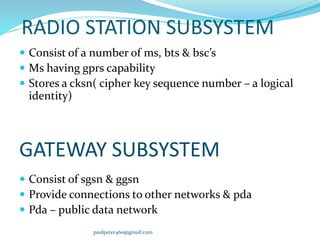
RADIO STATION SUBSYSTEM
 Consist of a number of ms, bts & bsc’s
 Ms having gprs capability
 Stores a cksn( cipher key sequence number – a logical
identity)
GATEWAY SUBSYSTEM
 Consist of sgsn & ggsn
 Provide connections to other networks & pda
 Pda – public data network
paulpeter460@gmail.com
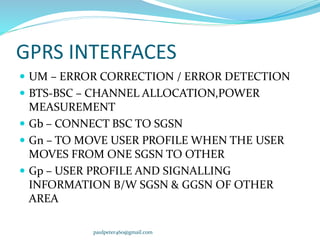
GPRS INTERFACES
 UM – ERROR CORRECTION / ERROR DETECTION
 BTS-BSC – CHANNEL ALLOCATION,POWER
MEASUREMENT
 Gb – CONNECT BSC TO SGSN
 Gn – TO MOVE USER PROFILE WHEN THE USER
MOVES FROM ONE SGSN TO OTHER
 Gp – USER PROFILE AND SIGNALLING
INFORMATION B/W SGSN & GGSN OF OTHER
AREA
paulpeter460@gmail.com
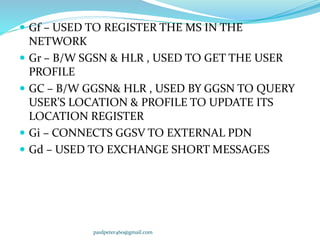
 Gf – USED TO REGISTER THE MS IN THE
NETWORK
 Gr – B/W SGSN & HLR , USED TO GET THE USER
PROFILE
 GC – B/W GGSN& HLR , USED BY GGSN TO QUERY
USER’S LOCATION & PROFILE TO UPDATE ITS
LOCATION REGISTER
 Gi – CONNECTS GGSV TO EXTERNAL PDN
 Gd – USED TO EXCHANGE SHORT MESSAGES
paulpeter460@gmail.com
GPRS other components
 Home Location Register(HLR): registers user profile
and responds to queries from GSNs .
 Mobile Station(MS): it is the mobile phone or device
 SMS Nodes: used for sms transmission via the SGSN
paulpeter460@gmail.com
Acronyms
 GPRS – GENERAL PACKET RADIO SERVICE
 MS – MOBILE STATION
 BTS – BASE TRANCEIVER STATION
 BSC – BASE STATION CONTROLLER
 MSC – MOBILE SERVICES SWITCHING CENTER
 HLR – HOME LOCATION REGISTER
 AUC – AUTHENTICATION CENTER
 EIR – EQUIPMENT IDENTITY REGISTER
 VLR – VISITOR LOCATION REGISTER
paulpeter460@gmail.com
Introduction
 Enhanced data for global evolution(EDGE) is a high
speed mobile data standard, intended to enable
second generation global system for mobile
communication (GSM) and time division multiple
access(TDMA).
 Transmits data at up to 384 kilobits per second(Kbps)
 1GB downloaded in 44 hrs
 1GB uploaded in 89 hrs
paulpeter460@gmail.com
EDGE Technology
 EDGE – Enhanced Data GSM Environment.
 Developed to increase the bandwidth of GPRS
technology.
 EDGE increased the bandwidth of GSM from 144 Kbps
to 384 Kbps.
 Migration towards 3G technology started.
 Modulation Technique is Eight Phase shift keying (8
PSK)
paulpeter460@gmail.com
EDGE benefits
 Short-term benefits –
 EDGE triples the capacity of GPRS.
 Boosts performance of existing application and
enables services such as multimedia…..
 Enables transceiver to carry more voice/data
traffic.
paulpeter460@gmail.com
EDGE benefits
 Mid-term benefits – Complementary Technology
 EDGE and WCDMA are complementary technology.
 EDGE is designed to integrate into the existing network
– base not replaced or installed from scratch making
implementation seamless.
 With EDGE, operators can offer more wireless data
applications, including wireless multimedia, e-mail, web
infotainment and positioning services, for both
consumer and business users.
paulpeter460@gmail.com
EDGE benefits
 Long term benefits – Harmonization with WCDMA
 EDGE can be seen as a foundation toward one seamless
GSM and WCDMA network with a combined core
network and different access methods that are
transparent to the end user.
 Subscribers will be able to browse the Internet on their
mobile phones, personal digital assistants or laptops at
the same speed as on stationary personal computers.
paulpeter460@gmail.com
• A digital multiple access technique specified by
the Telecommunications Industry Association
(TIA) as "IS-95.“
• One of the unique aspect of CDMA is that while
there are certainly limits to the number of phone
calls that can be handled by a carrier, this is not
a fixed number .
• Code division multiple access (CDMA) is a
digital air interface standard, claiming eight to
fifteen times the capacity of analog.
paulpeter460@gmail.com
CDMA
 Unique code to differentiate all users
 Sequence used for spreading have low cross-
correlations
 Allow many users to occupy all the
frequency/bandwidth allocations at that same time
 Processing gain is the system capacity
 How many users the system can support
paulpeter460@gmail.com
• Multiple Access in CDMA:
• Each user is assigned a unique PN code.
• Each user transmits its information by spreading with
unique code.
• Direct Sequence spread spectrum is used.
• Users are separated by code not by time slot and freq
slot.
paulpeter460@gmail.com
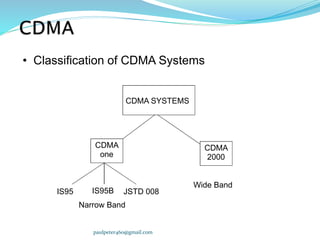
• Classification of CDMA Systems
CDMA
one
CDMA
2000
IS95 IS95B JSTD 008
Narrow Band
Wide Band
CDMA SYSTEMS
paulpeter460@gmail.com
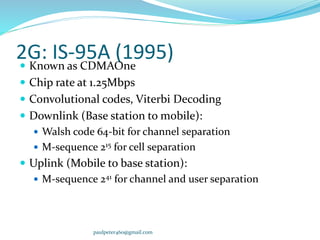
2G: IS-95A (1995) Known as CDMAOne
 Chip rate at 1.25Mbps
 Convolutional codes, Viterbi Decoding
 Downlink (Base station to mobile):
 Walsh code 64-bit for channel separation
 M-sequence 215 for cell separation
 Uplink (Mobile to base station):
 M-sequence 241 for channel and user separation
paulpeter460@gmail.com
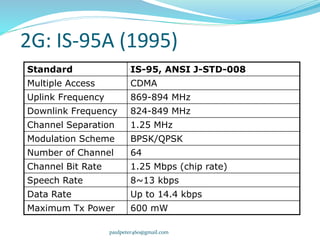
2G: IS-95A (1995)
Standard IS-95, ANSI J-STD-008
Multiple Access CDMA
Uplink Frequency 869-894 MHz
Downlink Frequency 824-849 MHz
Channel Separation 1.25 MHz
Modulation Scheme BPSK/QPSK
Number of Channel 64
Channel Bit Rate 1.25 Mbps (chip rate)
Speech Rate 8~13 kbps
Data Rate Up to 14.4 kbps
Maximum Tx Power 600 mW
paulpeter460@gmail.com
2.5G: IS-95B (1998)
 Increased data rate for internet applications
 Up to 115 kbps (8 times that of 2G)
 Support web browser format language
 Wireless Application Protocol (WAP)
paulpeter460@gmail.com
3G Technology
 Ability to receive live music, interactive web sessions,
voice and data with multimedia features
 Global Standard IMT-2000
 CDMA 2000, proposed by TIA
 W-CDMA, proposed by ARIB/ETSI
 Issued by ITU (International Telecommunication
Union)
paulpeter460@gmail.com
3G Specficiations
 Excellent voice quality
 Data rate
 144 kbps in high mobility
 384 kbps in limited mobility
 2 Mbps in door
 Frequency Band 1885-2025 MHz
 Convolutional Codes
 Turbo Codes for high data rates
paulpeter460@gmail.com
3G: CDMA2000 (2000)
 CDMA 1xEV-DO
 peak data rate 2.4 Mbps
 supports mp3 transfer and video conferencing
 CDMA 1xEV-DV
 Integrated voice and high-speed data multimedia service up
to 3.1 Mbps
 Channel Bandwidth:
 1.25, 5, 10, 15 or 20 MHz
 Chip rate at 3.6864 Mbps
 Modulation Scheme
 QPSK in downlink
 BPSK in uplink
paulpeter460@gmail.com
3G: CDMA2000 Spreading Codes
 Downlink
 Variable length orthogonal Walsh sequences for channel
separation
 M-sequences 3x215 for cell separation (different phase
shifts)
 Uplink
 Variable length orthogonal Walsh sequences for channel
separation
 M-sequences 241 for user separation (different phase
shifts)
paulpeter460@gmail.com
3G: W-CDMA (2000)
 Stands for “wideband” CDMA
 Channel Bandwidth:
 5, 10 or 20 MHz
 Chip rate at 4.096 Mbps
 Modulation Scheme
 QPSK in downlink
 BPSK in uplink
paulpeter460@gmail.com
3G: W-CDMA Spreading Codes
 Downlink
 Variable length orthogonal sequences for channel
separation
 Gold sequences 218 for cell separation
 Uplink
 Variable length orthogonal sequences for channel
separation
 Gold sequences 241 for user separation
paulpeter460@gmail.com
4G Technology (2010)
 High data rates => 100 Mbps
 Multimedia data up to ~102 Mbps
 IP-oriented network => Internet
 MIMO using Multiple Antennas
 Spreading code
 Non-binary sequences
 Multiple Access Technique
 MC-CDMA
paulpeter460@gmail.com
References
 Mobile Computing by Ashoke k Talukder
 http://www.tutorialspoint.com/gprs/gprs_architectur
e.html
 Mobile Communications by Jochen Schiller
paulpeter460@gmail.com

Cellular standars gprs edge cdma in mobile communication

  • 1.
    GPRS, EDGE &CDMA PAUL PETER BE. ISNE SJUCET 2016 paulpeter460@gmail.com
  • 2.
    HISTORY  In 1stG AMPS(Advanced Mobile system) developed in U.S in 1983  In 2nd G there was introduction of CDMA,TDMA and GSM  In 2nd there was introduction of GPRS  In 2.5th there was an introduction EDGE TECHNOLOGY  In 3rd and 3.75th there was UMTS, HSPA, H+  4TH G is now LTE paulpeter460@gmail.com
  • 3.
  • 4.
    What is GPRS GeneralPacket Radio Service • General -> not restricted to GSM use (DECT ?, 3rd generation systems ?) • Packet Radio -> enables packet mode communication over air • Service, not System -> existing BSS (partially also NSS) infrastructure is used Main benefits • Resources are reserved only when needed and charged accordingly • Connection setup times are reduced • Enables new service opportunities paulpeter460@gmail.com
  • 5.
    GPRS Characteristics GPRS usespacket switched resource allocation • resources allocated only when data is to be sent/received Flexible channel allocation • one to eight time slots • available resources shared by active users • up and down link channels reserved separately • GPRS and circuit switched GSM services can use same time slots alternatively • GPRS is based on a modulation technique known as Gaussian minimum-shift keying (GMSK) Traffic characteristics suitable for GPRS • Intermittent, burst data transmissions • Frequent transmissions of small volumes of data • Infrequent transmission of larger volumes of data • Offered speeds up to 114 Kbps. • 1GB downloaded in 165 hrs • 1GB uploaded in 165 hrs paulpeter460@gmail.com
  • 6.
  • 7.
    GPRS Architecture..  Usesgsm architecture+ gsn(gprs support nodes) Sgsn (servicing gsn) Ggsn ( gateway gsn)  Uses packet switching  Faster than gsm and cdma  Enable simultaneous transmission of packets  SGSN and GGSN will be explain in next slide paulpeter460@gmail.com
  • 8.
    GPRS support nodes There are two network nodes use to offer packet data service called GPRS support nodes 1) Serving GPRS Support Node (SGSN) 2) Gateway GPRS Support Node (GGSN) paulpeter460@gmail.com
  • 9.
    Serving GPRS SupportNode(SGSN) Serving GPRS Support Node(SGSN) is one of the GPRS support node  Routing the packet switched data to and from the ms  Mobility management  Location management  Authentication and charging for calls  Stores the location information of the user  User’s profile paulpeter460@gmail.com
  • 10.
    Gateway GPRS SupportNode(GGSN)  Provide a gateway b/w gprs & pdn  Convert data from sgsn to pdp format( packet data protocol)  Store the current sgsn address  Stores the location of user in its location register  Perform authentication & charging functions paulpeter460@gmail.com
  • 11.
  • 12.
    Base Station System(BSS) BSS system needs to enhancement to recognize and send packet data.  BSS includes BTS and MS. Network Subsystem(NSS)  It consist of a number of sgsns  Also consist of a number of msc  helps in – authentication, operation & maintenance of subsystems paulpeter460@gmail.com
  • 13.
    SIM ME BTS BTS BSC BSC HLR HLR HLR HLR MSCSGSN GGSN PSTN, ISDN, PSPDN CSPD N BSS NSS paulpeter460@gmail.com
  • 14.
    RADIO STATION SUBSYSTEM Consist of a number of ms, bts & bsc’s  Ms having gprs capability  Stores a cksn( cipher key sequence number – a logical identity) GATEWAY SUBSYSTEM  Consist of sgsn & ggsn  Provide connections to other networks & pda  Pda – public data network paulpeter460@gmail.com
  • 15.
    GPRS INTERFACES  UM– ERROR CORRECTION / ERROR DETECTION  BTS-BSC – CHANNEL ALLOCATION,POWER MEASUREMENT  Gb – CONNECT BSC TO SGSN  Gn – TO MOVE USER PROFILE WHEN THE USER MOVES FROM ONE SGSN TO OTHER  Gp – USER PROFILE AND SIGNALLING INFORMATION B/W SGSN & GGSN OF OTHER AREA paulpeter460@gmail.com
  • 16.
     Gf –USED TO REGISTER THE MS IN THE NETWORK  Gr – B/W SGSN & HLR , USED TO GET THE USER PROFILE  GC – B/W GGSN& HLR , USED BY GGSN TO QUERY USER’S LOCATION & PROFILE TO UPDATE ITS LOCATION REGISTER  Gi – CONNECTS GGSV TO EXTERNAL PDN  Gd – USED TO EXCHANGE SHORT MESSAGES paulpeter460@gmail.com
  • 17.
    GPRS other components Home Location Register(HLR): registers user profile and responds to queries from GSNs .  Mobile Station(MS): it is the mobile phone or device  SMS Nodes: used for sms transmission via the SGSN paulpeter460@gmail.com
  • 18.
    Acronyms  GPRS –GENERAL PACKET RADIO SERVICE  MS – MOBILE STATION  BTS – BASE TRANCEIVER STATION  BSC – BASE STATION CONTROLLER  MSC – MOBILE SERVICES SWITCHING CENTER  HLR – HOME LOCATION REGISTER  AUC – AUTHENTICATION CENTER  EIR – EQUIPMENT IDENTITY REGISTER  VLR – VISITOR LOCATION REGISTER paulpeter460@gmail.com
  • 19.
  • 20.
    paulpeter460@gmail.com Introduction  Enhanced datafor global evolution(EDGE) is a high speed mobile data standard, intended to enable second generation global system for mobile communication (GSM) and time division multiple access(TDMA).  Transmits data at up to 384 kilobits per second(Kbps)  1GB downloaded in 44 hrs  1GB uploaded in 89 hrs
  • 21.
    paulpeter460@gmail.com EDGE Technology  EDGE– Enhanced Data GSM Environment.  Developed to increase the bandwidth of GPRS technology.  EDGE increased the bandwidth of GSM from 144 Kbps to 384 Kbps.  Migration towards 3G technology started.  Modulation Technique is Eight Phase shift keying (8 PSK)
  • 22.
  • 23.
    EDGE benefits  Short-termbenefits –  EDGE triples the capacity of GPRS.  Boosts performance of existing application and enables services such as multimedia…..  Enables transceiver to carry more voice/data traffic. paulpeter460@gmail.com
  • 24.
    EDGE benefits  Mid-termbenefits – Complementary Technology  EDGE and WCDMA are complementary technology.  EDGE is designed to integrate into the existing network – base not replaced or installed from scratch making implementation seamless.  With EDGE, operators can offer more wireless data applications, including wireless multimedia, e-mail, web infotainment and positioning services, for both consumer and business users. paulpeter460@gmail.com
  • 25.
    EDGE benefits  Longterm benefits – Harmonization with WCDMA  EDGE can be seen as a foundation toward one seamless GSM and WCDMA network with a combined core network and different access methods that are transparent to the end user.  Subscribers will be able to browse the Internet on their mobile phones, personal digital assistants or laptops at the same speed as on stationary personal computers. paulpeter460@gmail.com
  • 26.
  • 27.
    • A digitalmultiple access technique specified by the Telecommunications Industry Association (TIA) as "IS-95.“ • One of the unique aspect of CDMA is that while there are certainly limits to the number of phone calls that can be handled by a carrier, this is not a fixed number . • Code division multiple access (CDMA) is a digital air interface standard, claiming eight to fifteen times the capacity of analog. paulpeter460@gmail.com
  • 28.
    CDMA  Unique codeto differentiate all users  Sequence used for spreading have low cross- correlations  Allow many users to occupy all the frequency/bandwidth allocations at that same time  Processing gain is the system capacity  How many users the system can support paulpeter460@gmail.com
  • 29.
    • Multiple Accessin CDMA: • Each user is assigned a unique PN code. • Each user transmits its information by spreading with unique code. • Direct Sequence spread spectrum is used. • Users are separated by code not by time slot and freq slot. paulpeter460@gmail.com
  • 30.
    • Classification ofCDMA Systems CDMA one CDMA 2000 IS95 IS95B JSTD 008 Narrow Band Wide Band CDMA SYSTEMS paulpeter460@gmail.com
  • 31.
    2G: IS-95A (1995)Known as CDMAOne  Chip rate at 1.25Mbps  Convolutional codes, Viterbi Decoding  Downlink (Base station to mobile):  Walsh code 64-bit for channel separation  M-sequence 215 for cell separation  Uplink (Mobile to base station):  M-sequence 241 for channel and user separation paulpeter460@gmail.com
  • 32.
    2G: IS-95A (1995) StandardIS-95, ANSI J-STD-008 Multiple Access CDMA Uplink Frequency 869-894 MHz Downlink Frequency 824-849 MHz Channel Separation 1.25 MHz Modulation Scheme BPSK/QPSK Number of Channel 64 Channel Bit Rate 1.25 Mbps (chip rate) Speech Rate 8~13 kbps Data Rate Up to 14.4 kbps Maximum Tx Power 600 mW paulpeter460@gmail.com
  • 33.
    2.5G: IS-95B (1998) Increased data rate for internet applications  Up to 115 kbps (8 times that of 2G)  Support web browser format language  Wireless Application Protocol (WAP) paulpeter460@gmail.com
  • 34.
    3G Technology  Abilityto receive live music, interactive web sessions, voice and data with multimedia features  Global Standard IMT-2000  CDMA 2000, proposed by TIA  W-CDMA, proposed by ARIB/ETSI  Issued by ITU (International Telecommunication Union) paulpeter460@gmail.com
  • 35.
    3G Specficiations  Excellentvoice quality  Data rate  144 kbps in high mobility  384 kbps in limited mobility  2 Mbps in door  Frequency Band 1885-2025 MHz  Convolutional Codes  Turbo Codes for high data rates paulpeter460@gmail.com
  • 36.
    3G: CDMA2000 (2000) CDMA 1xEV-DO  peak data rate 2.4 Mbps  supports mp3 transfer and video conferencing  CDMA 1xEV-DV  Integrated voice and high-speed data multimedia service up to 3.1 Mbps  Channel Bandwidth:  1.25, 5, 10, 15 or 20 MHz  Chip rate at 3.6864 Mbps  Modulation Scheme  QPSK in downlink  BPSK in uplink paulpeter460@gmail.com
  • 37.
    3G: CDMA2000 SpreadingCodes  Downlink  Variable length orthogonal Walsh sequences for channel separation  M-sequences 3x215 for cell separation (different phase shifts)  Uplink  Variable length orthogonal Walsh sequences for channel separation  M-sequences 241 for user separation (different phase shifts) paulpeter460@gmail.com
  • 38.
    3G: W-CDMA (2000) Stands for “wideband” CDMA  Channel Bandwidth:  5, 10 or 20 MHz  Chip rate at 4.096 Mbps  Modulation Scheme  QPSK in downlink  BPSK in uplink paulpeter460@gmail.com
  • 39.
    3G: W-CDMA SpreadingCodes  Downlink  Variable length orthogonal sequences for channel separation  Gold sequences 218 for cell separation  Uplink  Variable length orthogonal sequences for channel separation  Gold sequences 241 for user separation paulpeter460@gmail.com
  • 40.
    4G Technology (2010) High data rates => 100 Mbps  Multimedia data up to ~102 Mbps  IP-oriented network => Internet  MIMO using Multiple Antennas  Spreading code  Non-binary sequences  Multiple Access Technique  MC-CDMA paulpeter460@gmail.com
  • 41.
    References  Mobile Computingby Ashoke k Talukder  http://www.tutorialspoint.com/gprs/gprs_architectur e.html  Mobile Communications by Jochen Schiller paulpeter460@gmail.com