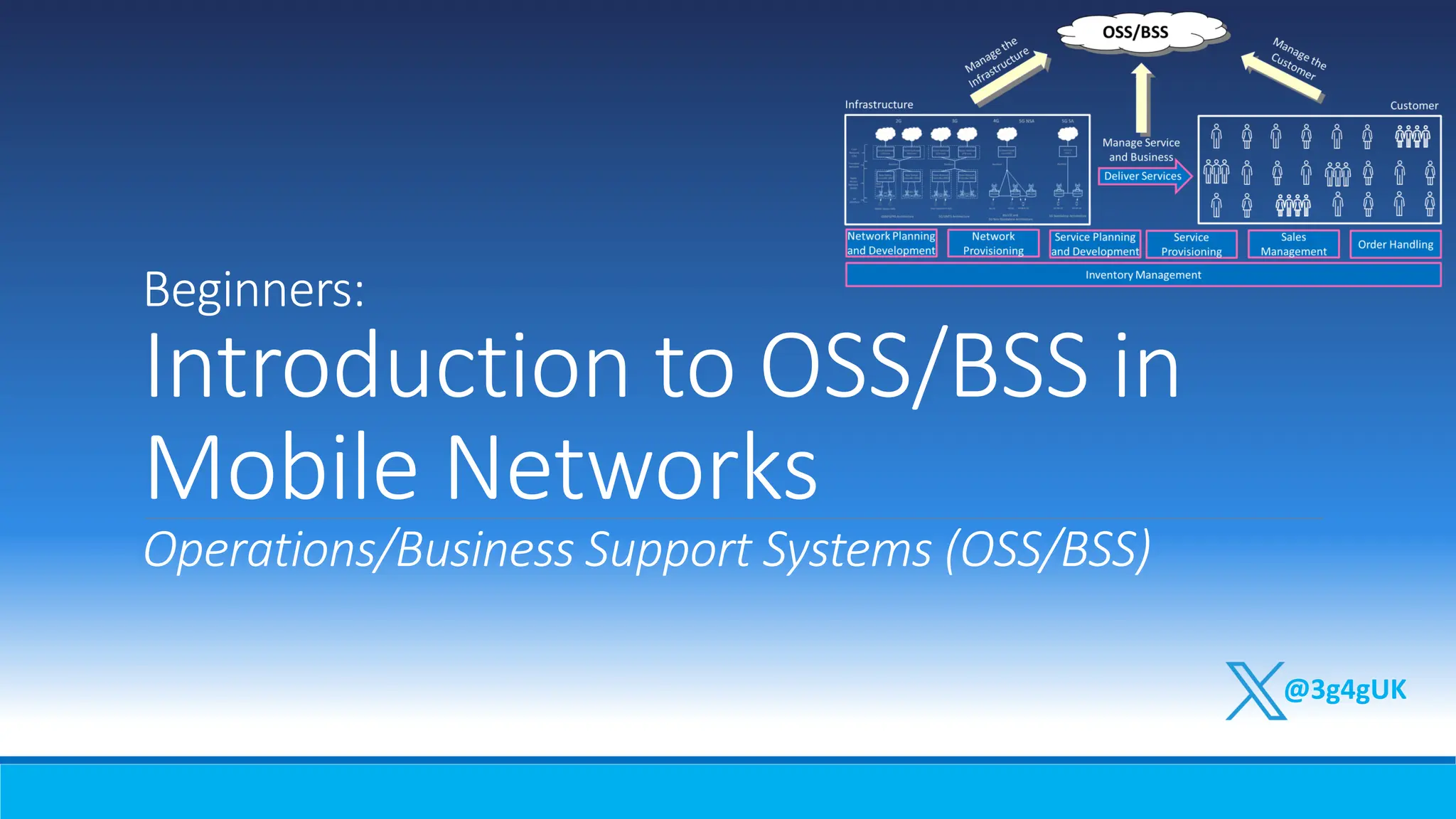
Beginners:
Introduction to OSS/BSS in
Mobile Networks
Operations/Business Support Systems (OSS/BSS)
@3g4gUK
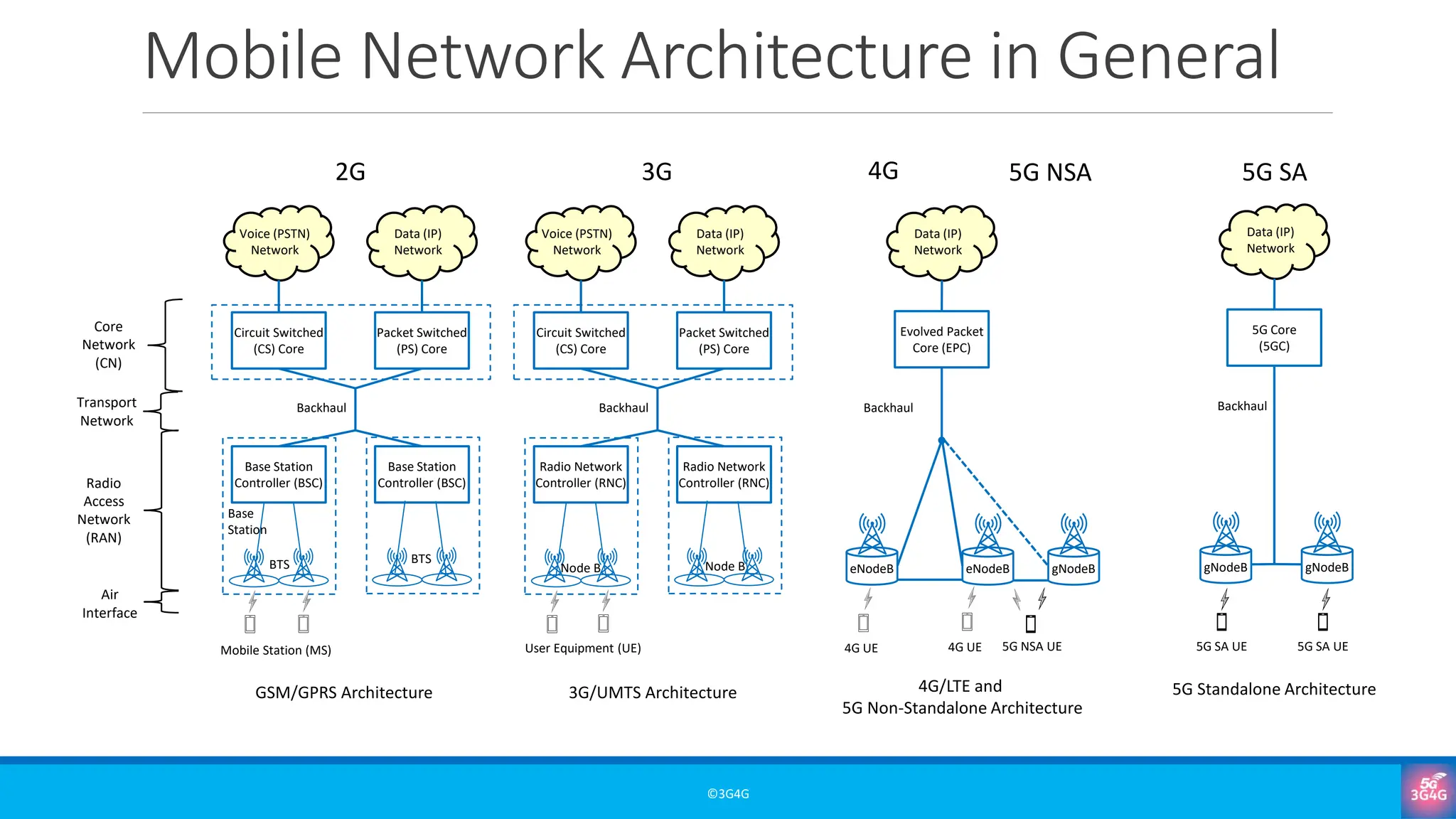
Mobile Network Architecture in General
©3G4G
Circuit Switched
(CS) Core
Packet Switched
(PS) Core
Voice (PSTN)
Network
Data (IP)
Network
Base Station
Controller (BSC)
Base Station
Controller (BSC)
BTS BTS
Air
Interface
Radio
Access
Network
(RAN)
Core
Network
(CN)
Backhaul
Transport
Network
Base
Station
Mobile Station (MS) User Equipment (UE)
Circuit Switched
(CS) Core
Packet Switched
(PS) Core
Voice (PSTN)
Network
Data (IP)
Network
Radio Network
Controller (RNC)
Radio Network
Controller (RNC)
Node B Node B
Backhaul
Data (IP)
Network
Evolved Packet
Core (EPC)
eNodeB gNodeB
eNodeB
Backhaul
Data (IP)
Network
5G Core
(5GC)
gNodeB gNodeB
Backhaul
4G UE 5G NSA UE 5G SA UE 5G SA UE
4G UE
GSM/GPRS Architecture
2G 3G 4G 5G SA
5G NSA
3G/UMTS Architecture 4G/LTE and
5G Non-Standalone Architecture
5G Standalone Architecture
Mobile Network Architecture in General
©3G4G
Circuit Switched
(CS) Core
Packet Switched
(PS) Core
Voice (PSTN)
Network
Data (IP)
Network
Base Station
Controller (BSC)
Base Station
Controller (BSC)
BTS BTS
Air
Interface
Radio
Access
Network
(RAN)
Core
Network
(CN)
Backhaul
Transport
Network
Base
Station
Mobile Station (MS) User Equipment (UE)
Circuit Switched
(CS) Core
Packet Switched
(PS) Core
Voice (PSTN)
Network
Data (IP)
Network
Radio Network
Controller (RNC)
Radio Network
Controller (RNC)
Node B Node B
Backhaul
Data (IP)
Network
Evolved Packet
Core (EPC)
eNodeB gNodeB
eNodeB
Backhaul
Data (IP)
Network
5G Core
(5GC)
gNodeB gNodeB
Backhaul
4G UE 5G NSA UE 5G SA UE 5G SA UE
4G UE
GSM/GPRS Architecture
2G 3G 4G 5G SA
5G NSA
3G/UMTS Architecture 4G/LTE and
5G Non-Standalone Architecture
5G Standalone Architecture
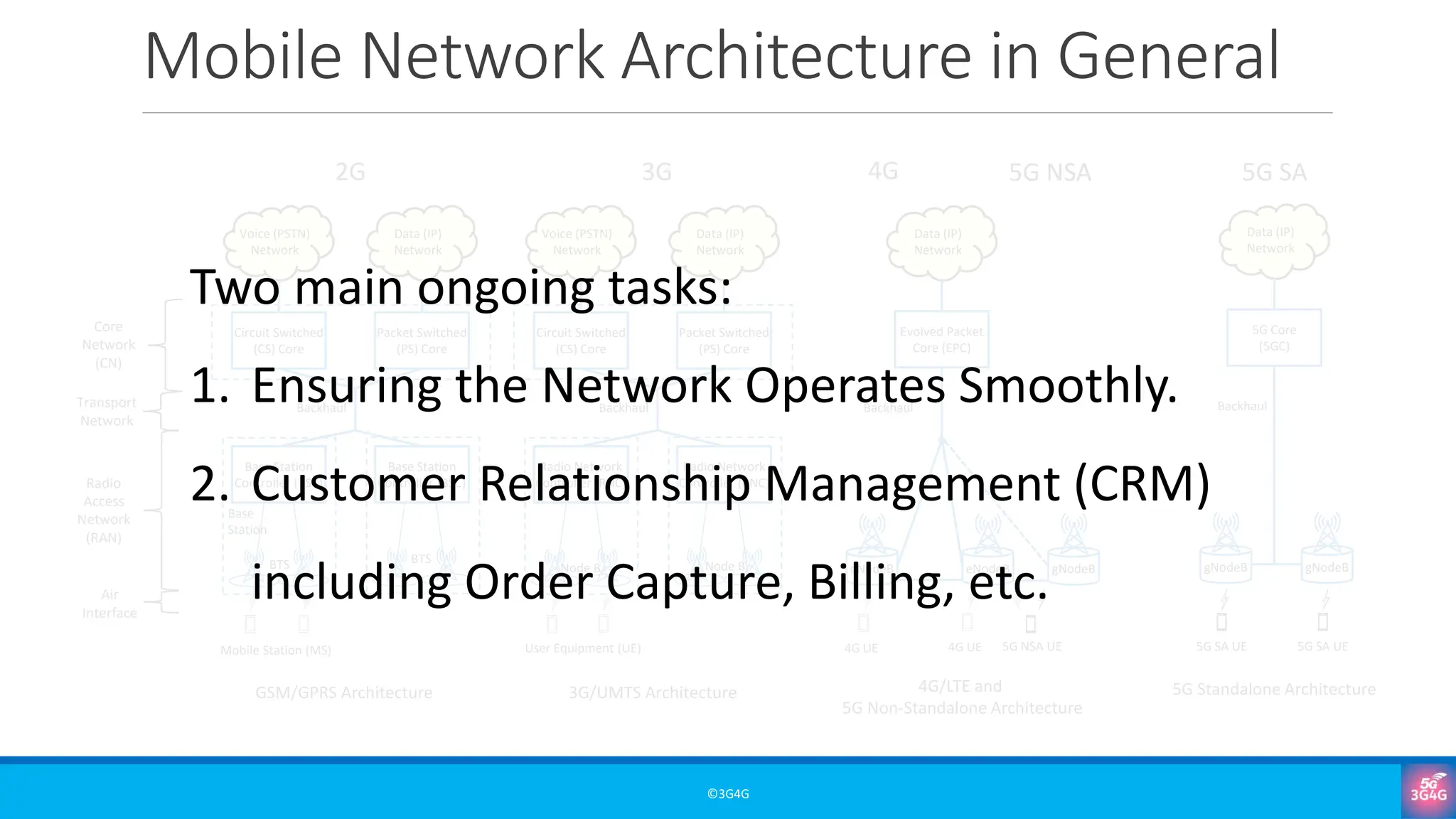
Two main ongoing tasks:
1. Ensuring the Network Operates Smoothly.
2. Customer Relationship Management (CRM)
including Order Capture, Billing, etc.
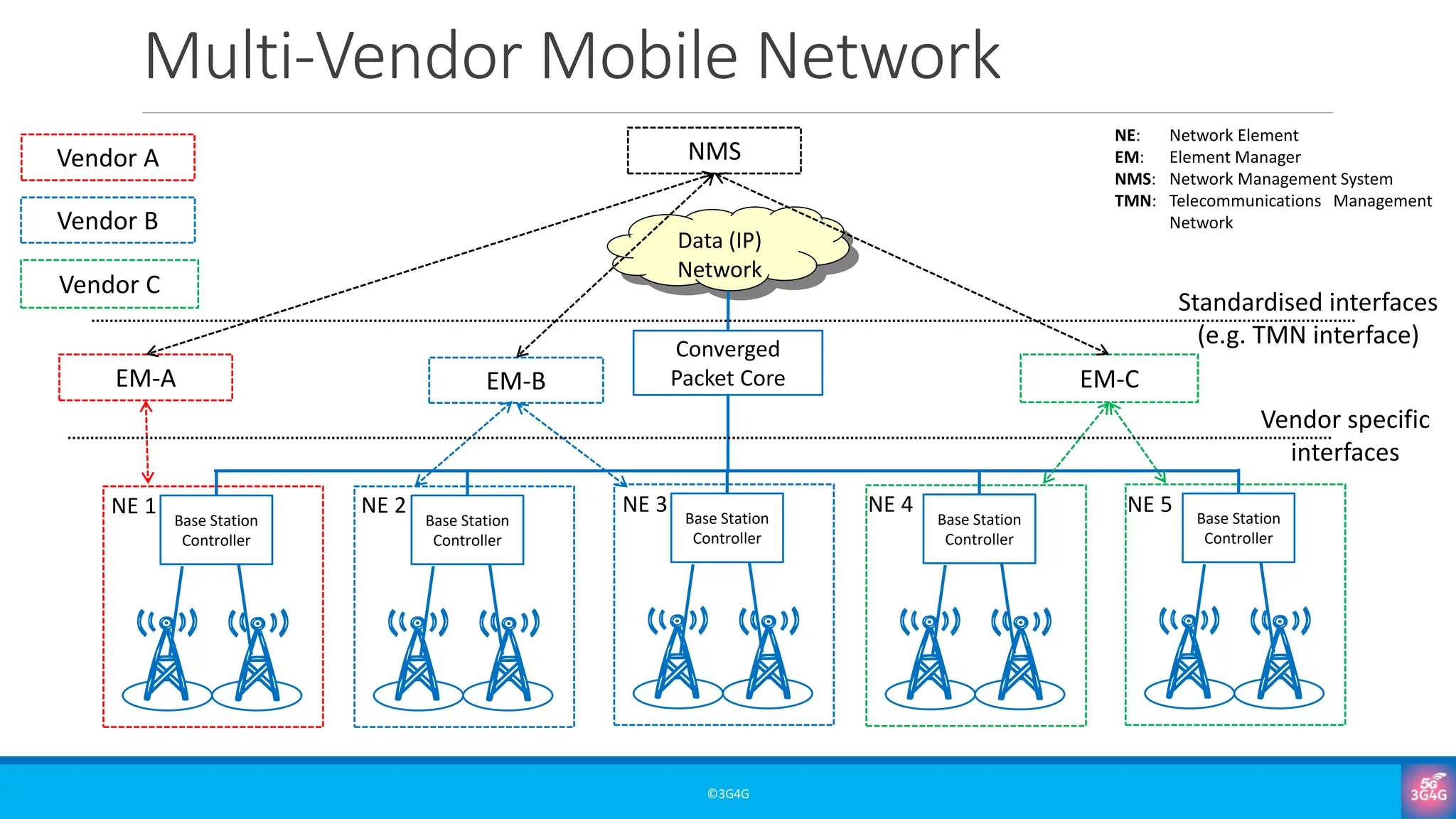
Multi-Vendor Mobile Network
©3G4G
Converged
Packet Core
Base Station
Controller
Data (IP)
Network
Base Station
Controller
Base Station
Controller
Base Station
Controller
Base Station
Controller
Vendor A
Vendor B
Vendor C
NE 1 NE 2 NE 3 NE 4 NE 5
EM-A EM-B EM-C
NMS
Vendor specific
interfaces
Standardised interfaces
(e.g. TMN interface)
NE: Network Element
EM: Element Manager
NMS: Network Management System
TMN: Telecommunications Management
Network
©3G4G
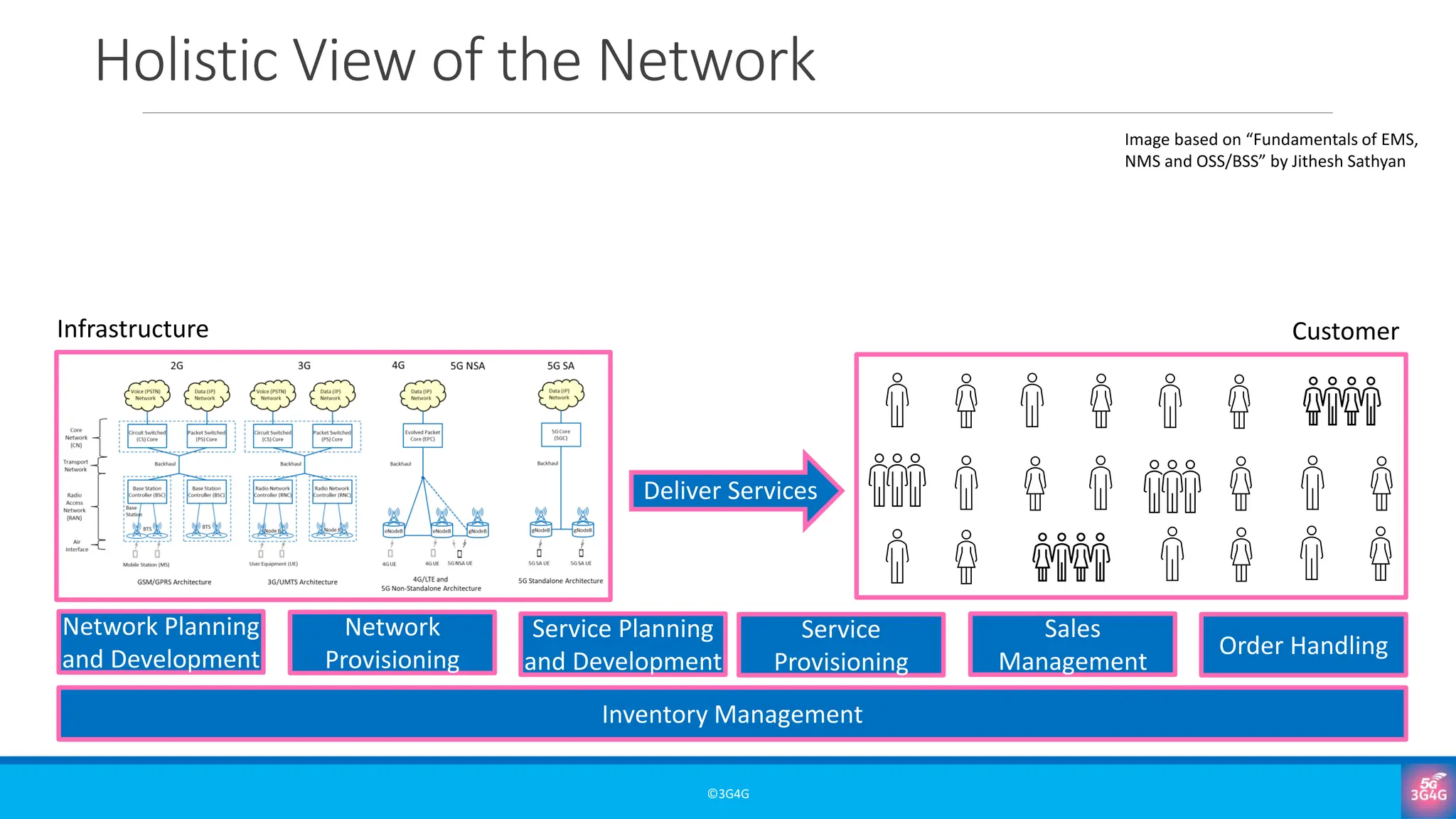
Infrastructure Customer
Deliver Services
Image based on “Fundamentals of EMS,
NMS and OSS/BSS” by Jithesh Sathyan
Sales
Management
Order Handling
Network Planning
and Development
Network
Provisioning
Service
Provisioning
Service Planning
and Development
Inventory Management
Holistic View of the Network
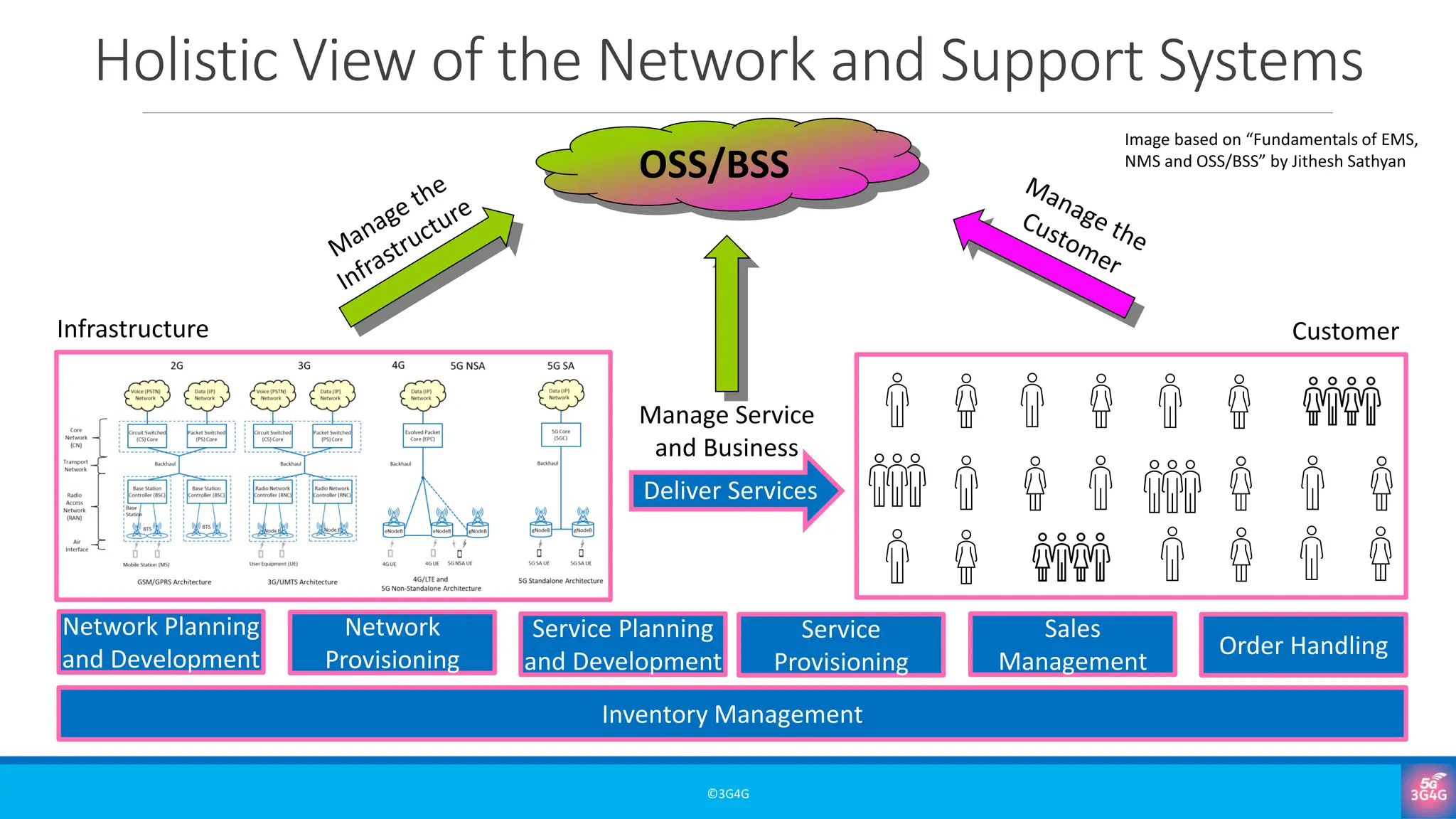
Holistic View of the Network and Support Systems
©3G4G
Infrastructure Customer
Deliver Services
OSS/BSS
Manage Service
and Business
Sales
Management
Order Handling
Network Planning
and Development
Network
Provisioning
Service
Provisioning
Service Planning
and Development
Inventory Management
Image based on “Fundamentals of EMS,
NMS and OSS/BSS” by Jithesh Sathyan
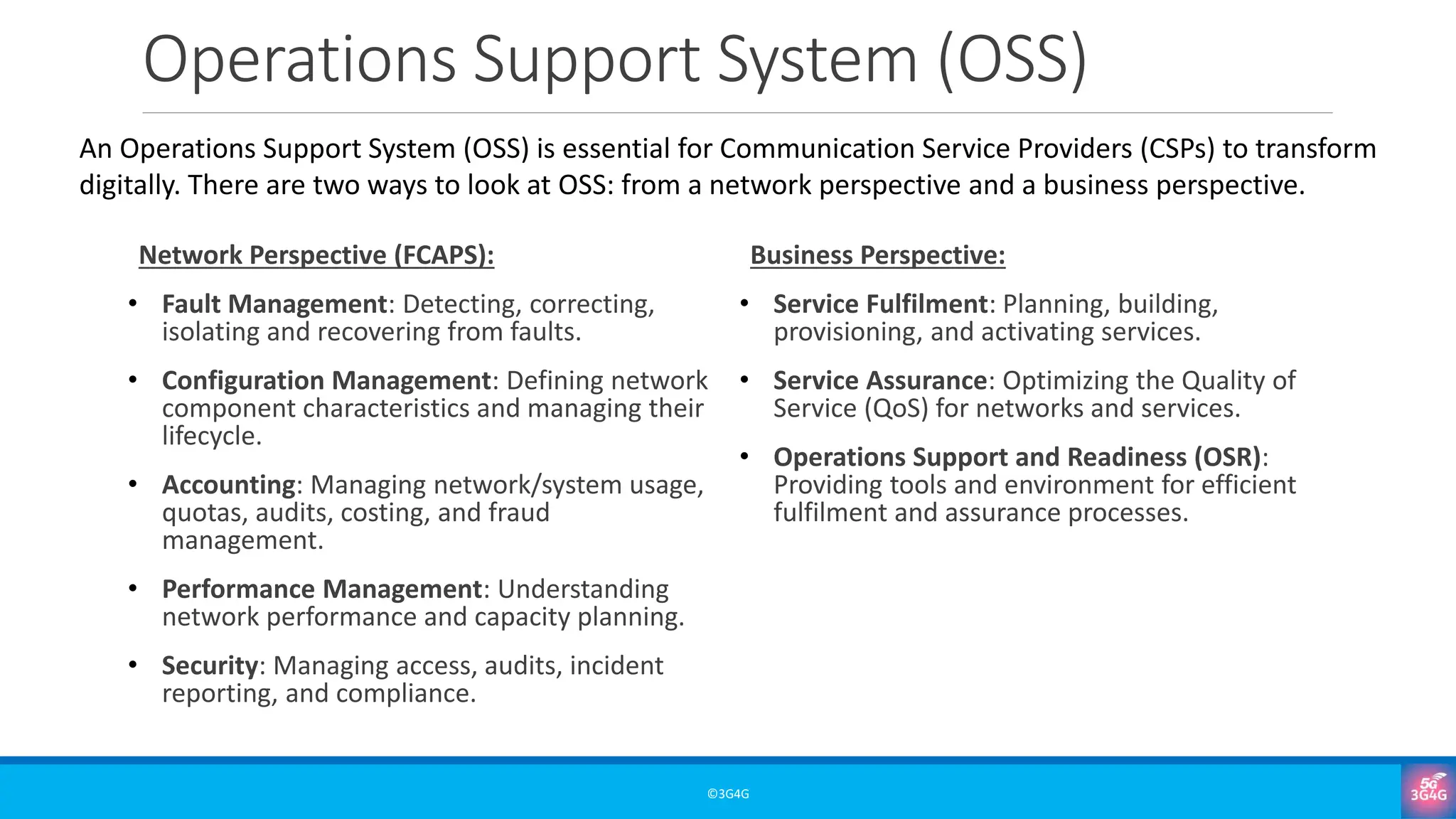
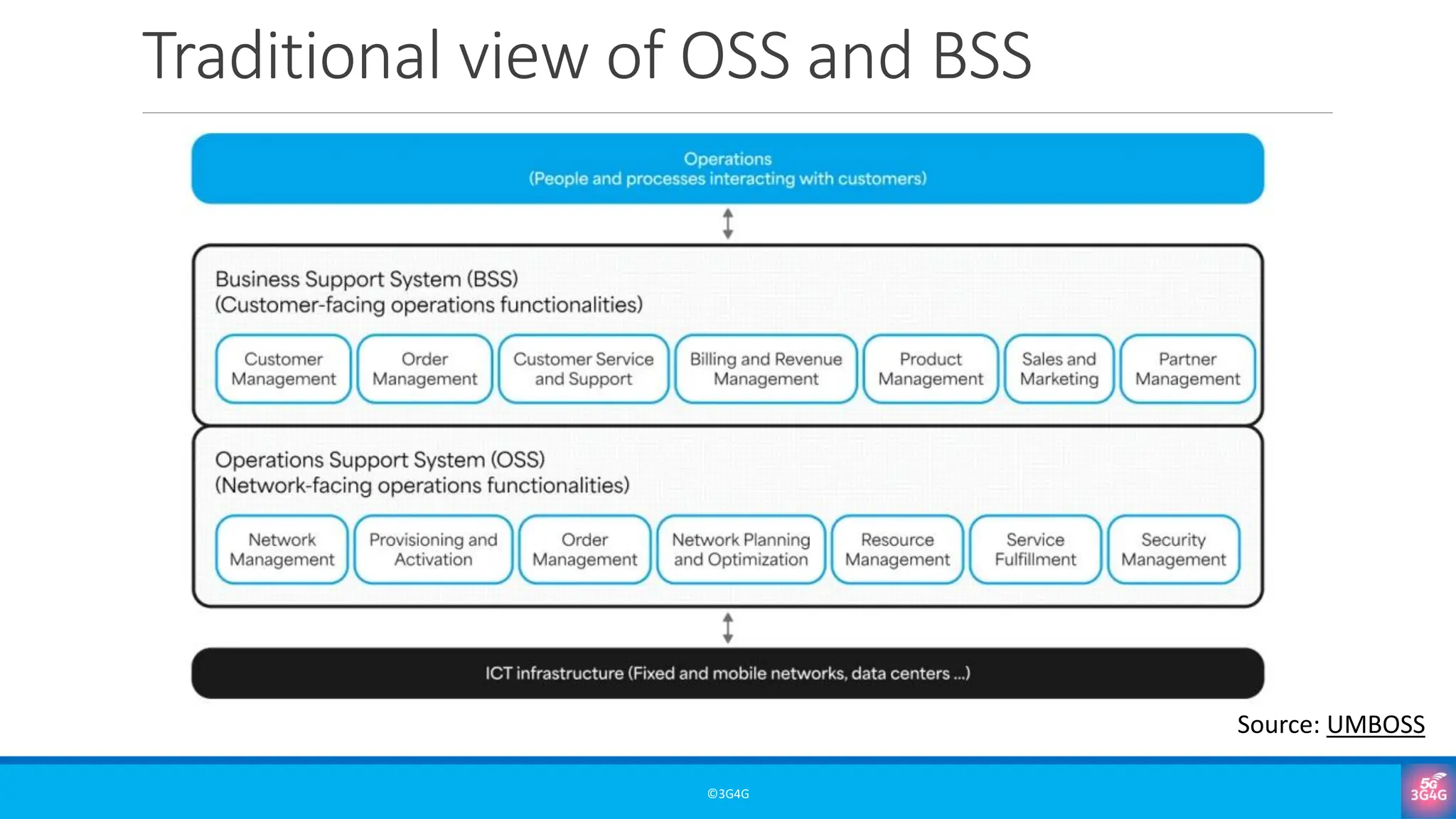
Operations Support System (OSS)
Network Perspective (FCAPS):
• Fault Management: Detecting, correcting,
isolating and recovering from faults.
• Configuration Management: Defining network
component characteristics and managing their
lifecycle.
• Accounting: Managing network/system usage,
quotas, audits, costing, and fraud
management.
• Performance Management: Understanding
network performance and capacity planning.
• Security: Managing access, audits, incident
reporting, and compliance.
Business Perspective:
• Service Fulfilment: Planning, building,
provisioning, and activating services.
• Service Assurance: Optimizing the Quality of
Service (QoS) for networks and services.
• Operations Support and Readiness (OSR):
Providing tools and environment for efficient
fulfilment and assurance processes.
©3G4G
An Operations Support System (OSS) is essential for Communication Service Providers (CSPs) to transform
digitally. There are two ways to look at OSS: from a network perspective and a business perspective.
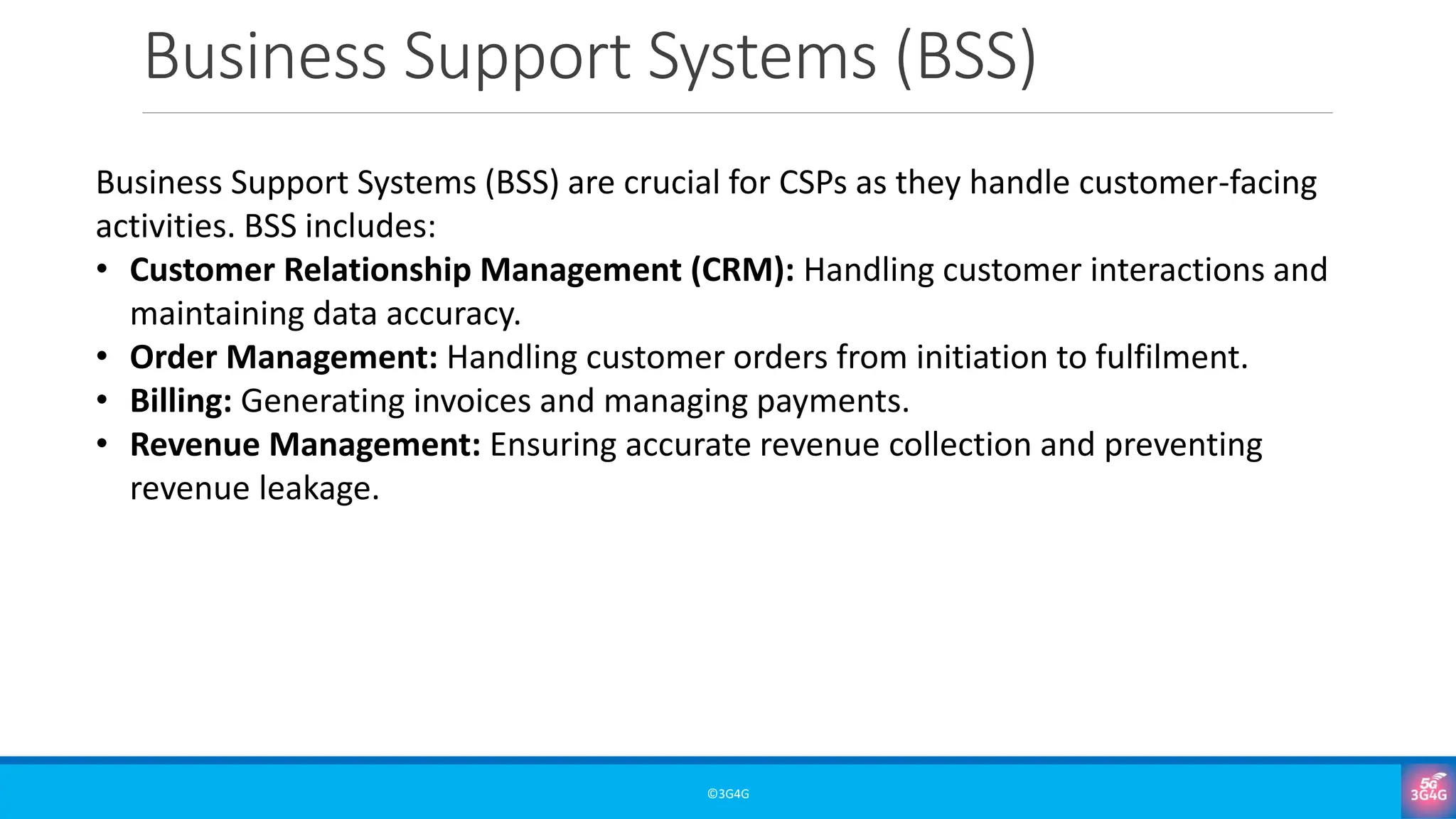
Business Support Systems (BSS)
©3G4G
Business Support Systems (BSS) are crucial for CSPs as they handle customer-facing
activities. BSS includes:
• Customer Relationship Management (CRM): Handling customer interactions and
maintaining data accuracy.
• Order Management: Handling customer orders from initiation to fulfilment.
• Billing: Generating invoices and managing payments.
• Revenue Management: Ensuring accurate revenue collection and preventing
revenue leakage.
Traditional view of OSS and BSS
©3G4G
Source: UMBOSS
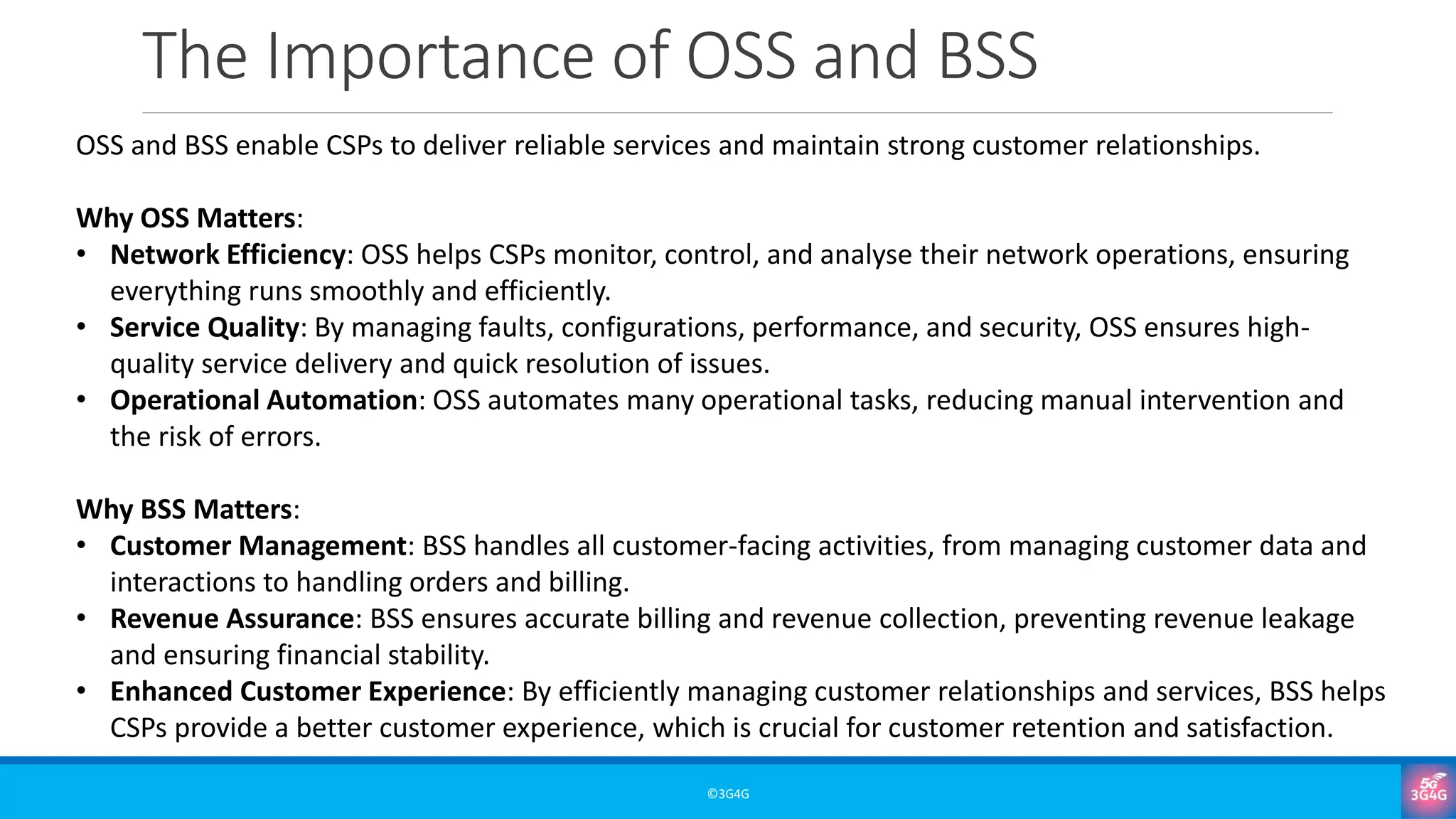
The Importance of OSS and BSS
©3G4G
OSS and BSS enable CSPs to deliver reliable services and maintain strong customer relationships.
Why OSS Matters:
• Network Efficiency: OSS helps CSPs monitor, control, and analyse their network operations, ensuring
everything runs smoothly and efficiently.
• Service Quality: By managing faults, configurations, performance, and security, OSS ensures high-
quality service delivery and quick resolution of issues.
• Operational Automation: OSS automates many operational tasks, reducing manual intervention and
the risk of errors.
Why BSS Matters:
• Customer Management: BSS handles all customer-facing activities, from managing customer data and
interactions to handling orders and billing.
• Revenue Assurance: BSS ensures accurate billing and revenue collection, preventing revenue leakage
and ensuring financial stability.
• Enhanced Customer Experience: By efficiently managing customer relationships and services, BSS helps
CSPs provide a better customer experience, which is crucial for customer retention and satisfaction.
References & Further Reading
©3G4G
• Fundamentals of EMS, NMS and OSS/BSS by Jithesh Sathyan
• ITU-T Recommendation M.3400 : TMN management functions (link)
• UMBOSS Blog: What is OSS (Operational Support System)? (link)
• Telecoms.com: The evolution of BSS and OSS in the telecoms sector (link)
Thank You
To learn more, visit:
3G4G Website – https://www.3g4g.co.uk/
3G4G Blog – https://blog.3g4g.co.uk/
Telecoms Infrastructure Blog – https://www.telecomsinfrastructure.com/
Operator Watch Blog – https://www.operatorwatch.com/
Connectivity Technology Blog – https://www.connectivity.technology/
Free 5G Training – https://www.free5gtraining.com/
Free 6G Training – https://www.free6gtraining.com/
Private Networks – https://www.privatenetworks.technology/
Follow us on Twitter: https://twitter.com/3g4gUK
Follow us on Facebook: https://www.facebook.com/3g4gUK/
Follow us on LinkedIn: https://www.linkedin.com/company/3g4g
Follow us on SlideShare: https://www.slideshare.net/3G4GLtd
Follow us on YouTube: https://www.youtube.com/3G4G5G
©3G4G

Beginners: Introduction to OSS & BSS in Mobile Networks

  • 1.
    Beginners: Introduction to OSS/BSSin Mobile Networks Operations/Business Support Systems (OSS/BSS) @3g4gUK
  • 2.
    Mobile Network Architecturein General ©3G4G Circuit Switched (CS) Core Packet Switched (PS) Core Voice (PSTN) Network Data (IP) Network Base Station Controller (BSC) Base Station Controller (BSC) BTS BTS Air Interface Radio Access Network (RAN) Core Network (CN) Backhaul Transport Network Base Station Mobile Station (MS) User Equipment (UE) Circuit Switched (CS) Core Packet Switched (PS) Core Voice (PSTN) Network Data (IP) Network Radio Network Controller (RNC) Radio Network Controller (RNC) Node B Node B Backhaul Data (IP) Network Evolved Packet Core (EPC) eNodeB gNodeB eNodeB Backhaul Data (IP) Network 5G Core (5GC) gNodeB gNodeB Backhaul 4G UE 5G NSA UE 5G SA UE 5G SA UE 4G UE GSM/GPRS Architecture 2G 3G 4G 5G SA 5G NSA 3G/UMTS Architecture 4G/LTE and 5G Non-Standalone Architecture 5G Standalone Architecture
  • 3.
    Mobile Network Architecturein General ©3G4G Circuit Switched (CS) Core Packet Switched (PS) Core Voice (PSTN) Network Data (IP) Network Base Station Controller (BSC) Base Station Controller (BSC) BTS BTS Air Interface Radio Access Network (RAN) Core Network (CN) Backhaul Transport Network Base Station Mobile Station (MS) User Equipment (UE) Circuit Switched (CS) Core Packet Switched (PS) Core Voice (PSTN) Network Data (IP) Network Radio Network Controller (RNC) Radio Network Controller (RNC) Node B Node B Backhaul Data (IP) Network Evolved Packet Core (EPC) eNodeB gNodeB eNodeB Backhaul Data (IP) Network 5G Core (5GC) gNodeB gNodeB Backhaul 4G UE 5G NSA UE 5G SA UE 5G SA UE 4G UE GSM/GPRS Architecture 2G 3G 4G 5G SA 5G NSA 3G/UMTS Architecture 4G/LTE and 5G Non-Standalone Architecture 5G Standalone Architecture Two main ongoing tasks: 1. Ensuring the Network Operates Smoothly. 2. Customer Relationship Management (CRM) including Order Capture, Billing, etc.
  • 4.
    Multi-Vendor Mobile Network ©3G4G Converged PacketCore Base Station Controller Data (IP) Network Base Station Controller Base Station Controller Base Station Controller Base Station Controller Vendor A Vendor B Vendor C NE 1 NE 2 NE 3 NE 4 NE 5 EM-A EM-B EM-C NMS Vendor specific interfaces Standardised interfaces (e.g. TMN interface) NE: Network Element EM: Element Manager NMS: Network Management System TMN: Telecommunications Management Network
  • 5.
    ©3G4G Infrastructure Customer Deliver Services Imagebased on “Fundamentals of EMS, NMS and OSS/BSS” by Jithesh Sathyan Sales Management Order Handling Network Planning and Development Network Provisioning Service Provisioning Service Planning and Development Inventory Management Holistic View of the Network
  • 6.
    Holistic View ofthe Network and Support Systems ©3G4G Infrastructure Customer Deliver Services OSS/BSS Manage Service and Business Sales Management Order Handling Network Planning and Development Network Provisioning Service Provisioning Service Planning and Development Inventory Management Image based on “Fundamentals of EMS, NMS and OSS/BSS” by Jithesh Sathyan
  • 7.
    Operations Support System(OSS) Network Perspective (FCAPS): • Fault Management: Detecting, correcting, isolating and recovering from faults. • Configuration Management: Defining network component characteristics and managing their lifecycle. • Accounting: Managing network/system usage, quotas, audits, costing, and fraud management. • Performance Management: Understanding network performance and capacity planning. • Security: Managing access, audits, incident reporting, and compliance. Business Perspective: • Service Fulfilment: Planning, building, provisioning, and activating services. • Service Assurance: Optimizing the Quality of Service (QoS) for networks and services. • Operations Support and Readiness (OSR): Providing tools and environment for efficient fulfilment and assurance processes. ©3G4G An Operations Support System (OSS) is essential for Communication Service Providers (CSPs) to transform digitally. There are two ways to look at OSS: from a network perspective and a business perspective.
  • 8.
    Business Support Systems(BSS) ©3G4G Business Support Systems (BSS) are crucial for CSPs as they handle customer-facing activities. BSS includes: • Customer Relationship Management (CRM): Handling customer interactions and maintaining data accuracy. • Order Management: Handling customer orders from initiation to fulfilment. • Billing: Generating invoices and managing payments. • Revenue Management: Ensuring accurate revenue collection and preventing revenue leakage.
  • 9.
    Traditional view ofOSS and BSS ©3G4G Source: UMBOSS
  • 10.
    The Importance ofOSS and BSS ©3G4G OSS and BSS enable CSPs to deliver reliable services and maintain strong customer relationships. Why OSS Matters: • Network Efficiency: OSS helps CSPs monitor, control, and analyse their network operations, ensuring everything runs smoothly and efficiently. • Service Quality: By managing faults, configurations, performance, and security, OSS ensures high- quality service delivery and quick resolution of issues. • Operational Automation: OSS automates many operational tasks, reducing manual intervention and the risk of errors. Why BSS Matters: • Customer Management: BSS handles all customer-facing activities, from managing customer data and interactions to handling orders and billing. • Revenue Assurance: BSS ensures accurate billing and revenue collection, preventing revenue leakage and ensuring financial stability. • Enhanced Customer Experience: By efficiently managing customer relationships and services, BSS helps CSPs provide a better customer experience, which is crucial for customer retention and satisfaction.
  • 11.
    References & FurtherReading ©3G4G • Fundamentals of EMS, NMS and OSS/BSS by Jithesh Sathyan • ITU-T Recommendation M.3400 : TMN management functions (link) • UMBOSS Blog: What is OSS (Operational Support System)? (link) • Telecoms.com: The evolution of BSS and OSS in the telecoms sector (link)
  • 12.
    Thank You To learnmore, visit: 3G4G Website – https://www.3g4g.co.uk/ 3G4G Blog – https://blog.3g4g.co.uk/ Telecoms Infrastructure Blog – https://www.telecomsinfrastructure.com/ Operator Watch Blog – https://www.operatorwatch.com/ Connectivity Technology Blog – https://www.connectivity.technology/ Free 5G Training – https://www.free5gtraining.com/ Free 6G Training – https://www.free6gtraining.com/ Private Networks – https://www.privatenetworks.technology/ Follow us on Twitter: https://twitter.com/3g4gUK Follow us on Facebook: https://www.facebook.com/3g4gUK/ Follow us on LinkedIn: https://www.linkedin.com/company/3g4g Follow us on SlideShare: https://www.slideshare.net/3G4GLtd Follow us on YouTube: https://www.youtube.com/3G4G5G ©3G4G