Plasmids


Trevor Parales
What are plasmids?


Plasmids are DNA molecules that are used for
many purposes including carrying genes from
organism to organism, making copies of genes,
and transporting genes to sites in gene therapy.
What types of plasmids are there?

                     There are 3 types
1. Conjugative plasmids: Able to perform
   conjugation, which is the process of transferring
   plasmids to another environment

2. Non-conjugative plasmids: Unable to perform
   conjugation

3. Intermediate plasmids: Able to be transferred by
   conjugative plasmids. They contain a subset of
   genes
Functions of plasmids
                            There are 5 main classes
1.   Fertility plasmids: can perform conjugation
2.   Resistance plasmids: contain genes that build a resistance against
     antibiotics or poisons
3.   Col plasmids: contain genes that code for proteins that can kill bacteria
4.   Degradative plasmids: enable digestion of unusual substances
5.   Virulence plasmids: turn the host of the plasmid into a pathogen
Shapes of plasmids
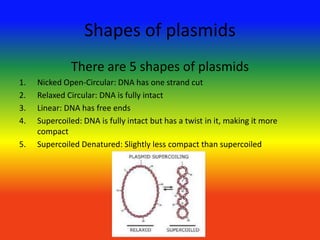
              There are 5 shapes of plasmids
1.   Nicked Open-Circular: DNA has one strand cut
2.   Relaxed Circular: DNA is fully intact
3.   Linear: DNA has free ends
4.   Supercoiled: DNA is fully intact but has a twist in it, making it more
     compact
5.   Supercoiled Denatured: Slightly less compact than supercoiled
Plasmids in genetic engineering
In genetic engineering, plasmids are used to
make copies of particular genes. This is done by
inserting the gene to be replicated into the
plasmid, then inserting the plasmids into
bacteria by a process called “Transformation”.
Next the bacteria are exposed to antibiotics that
destroy bacteria without the plasmid. These
bacteria are then grown in large amounts with
their new genes.
Plasmids in gene therapy
In gene therapy, plasmids are used to deliver the
therapeutic genes to the selected chromosomal
site.
Plasmid parts
A vector is a DNA molecule used to carry genes
from organism to organism. Plasmids have 3
key parts. They have an origin of replication, a
selectable marker gene, and a cloning site. The
origin of replication is used to indicate where
DNA replication is to begin. The selectable
marker gene is used to distinguish cells
containing the plasmid from cells that don’t
contain it. The cloning site is a site in the
plasmid where the DNA is inserted.
Conclusion
In conclusion, a plasmid is a DNA molecule that is used for a variety of
purposes, such as making copies of particular genes, delivering genes
to specific locations and many more. While they may sound like
something from science fiction, they are used by scientists around the
world and can be invaluable.

Plasmids

  • 1.
  • 2.
    What are plasmids? Plasmidsare DNA molecules that are used for many purposes including carrying genes from organism to organism, making copies of genes, and transporting genes to sites in gene therapy.
  • 3.
    What types ofplasmids are there? There are 3 types 1. Conjugative plasmids: Able to perform conjugation, which is the process of transferring plasmids to another environment 2. Non-conjugative plasmids: Unable to perform conjugation 3. Intermediate plasmids: Able to be transferred by conjugative plasmids. They contain a subset of genes
  • 4.
    Functions of plasmids There are 5 main classes 1. Fertility plasmids: can perform conjugation 2. Resistance plasmids: contain genes that build a resistance against antibiotics or poisons 3. Col plasmids: contain genes that code for proteins that can kill bacteria 4. Degradative plasmids: enable digestion of unusual substances 5. Virulence plasmids: turn the host of the plasmid into a pathogen
  • 5.
    Shapes of plasmids There are 5 shapes of plasmids 1. Nicked Open-Circular: DNA has one strand cut 2. Relaxed Circular: DNA is fully intact 3. Linear: DNA has free ends 4. Supercoiled: DNA is fully intact but has a twist in it, making it more compact 5. Supercoiled Denatured: Slightly less compact than supercoiled
  • 6.
    Plasmids in geneticengineering In genetic engineering, plasmids are used to make copies of particular genes. This is done by inserting the gene to be replicated into the plasmid, then inserting the plasmids into bacteria by a process called “Transformation”. Next the bacteria are exposed to antibiotics that destroy bacteria without the plasmid. These bacteria are then grown in large amounts with their new genes.
  • 7.
    Plasmids in genetherapy In gene therapy, plasmids are used to deliver the therapeutic genes to the selected chromosomal site.
  • 8.
    Plasmid parts A vectoris a DNA molecule used to carry genes from organism to organism. Plasmids have 3 key parts. They have an origin of replication, a selectable marker gene, and a cloning site. The origin of replication is used to indicate where DNA replication is to begin. The selectable marker gene is used to distinguish cells containing the plasmid from cells that don’t contain it. The cloning site is a site in the plasmid where the DNA is inserted.
  • 9.
    Conclusion In conclusion, aplasmid is a DNA molecule that is used for a variety of purposes, such as making copies of particular genes, delivering genes to specific locations and many more. While they may sound like something from science fiction, they are used by scientists around the world and can be invaluable.