5. More Interest Formulas
Dr. Mohsin Siddique
Assistant Professor
msiddique@sharjah.ac.ae
Ext: 29431
Date: 21/10/2014
Engineering Economics
University of Sharjah
Dept. of Civil and Env. Engg.
2
Part I
Outcome of Today’s Lecture
3
After completing this lecture…
The students should be able to:
Understand uniform series compound interest formulas
More interest Formulas
4
Uniform Series
Arithmetic Gradient
Geometric Gradient
Nominal and Effective Interest
Continuous Compounding
Uniform Series
5
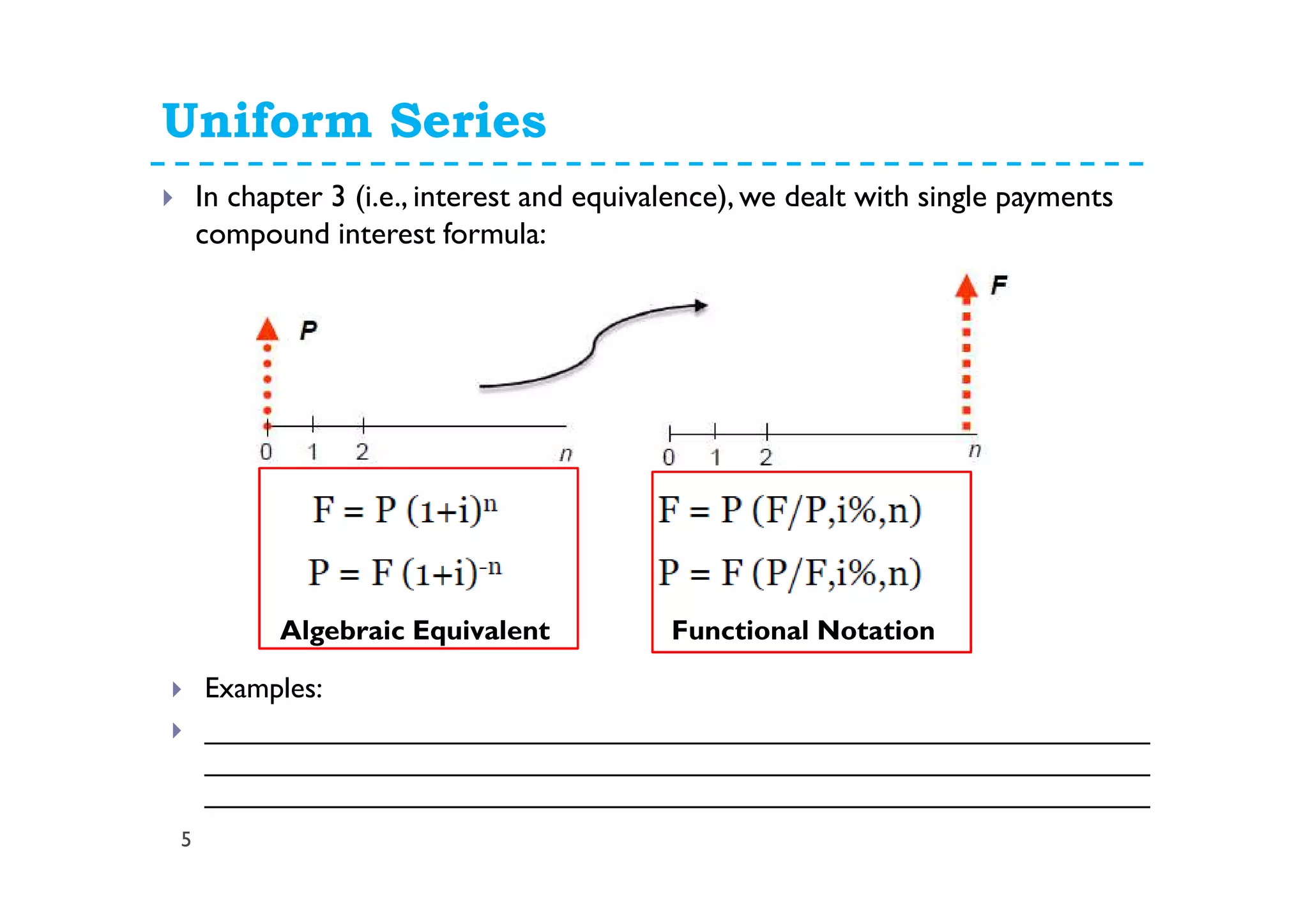
In chapter 3 (i.e., interest and equivalence), we dealt with single payments
compound interest formula:
Functional NotationAlgebraic Equivalent
Examples:
__________________________________________________________
__________________________________________________________
__________________________________________________________
Uniform Series
6
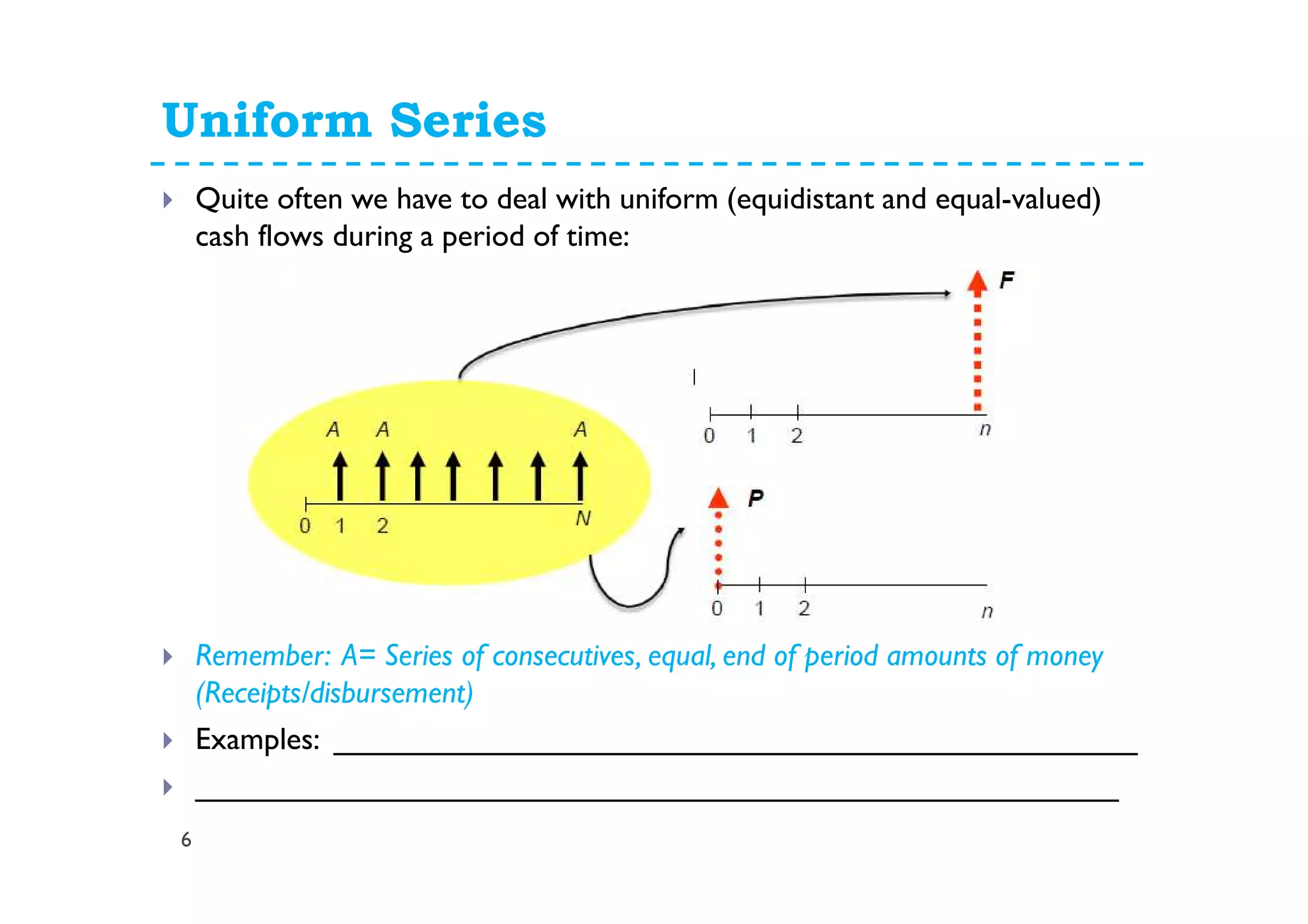
Quite often we have to deal with uniform (equidistant and equal-valued)
cash flows during a period of time:
Remember: A= Series of consecutives, equal, end of period amounts of money
(Receipts/disbursement)
Examples: _______________________________________________
______________________________________________________
Deriving Uniform Series Formula
7
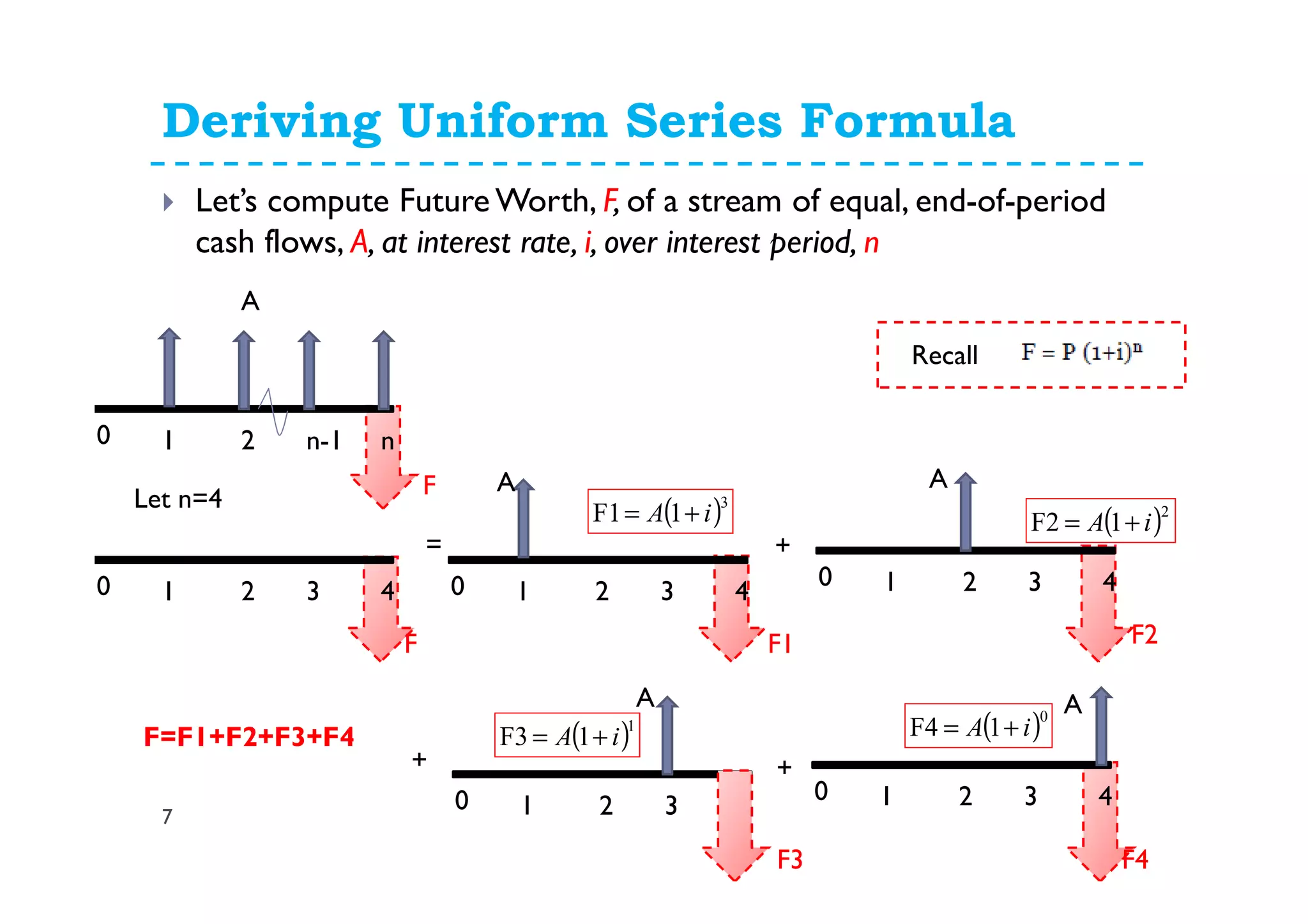
Let’s compute Future Worth, F, of a stream of equal, end-of-period
cash flows, A, at interest rate, i, over interest period, n
0 1 2 3 4
F
0 1 2 3 4
A
F1
0 1 2 3 4
A
F2
0 1 2 3 4
A
F4
0 1 2 3 4
A
F3
0 1 2 n-1 n
A
F
= +
++
F=F1+F2+F3+F4
Recall
( )3
1F1 iA += ( )2
1F2 iA +=
( )1
1F3 iA += ( )0
1F4 iA +=
Let n=4
Deriving Uniform Series Formula
0 1 2 3 4
A F
F=F1+F2+F3+F4
( )3
1F1 iA += ( )2
1F2 iA +=
( )1
1F3 iA += ( )0
1F4 iA +=
F =
+ +
+
( ) ( ) ( ) AiAiAiA ++++++=
123
111F
For general case, we can write that
Multiplying both sides with (1+i)
( ) ( ) ( ) ( ) ( )
( ) ( ) ( ) ( ) ( )[ ]iiiiAi
iAiAiAiAi
nnn
nnn
++++++++=+
++++++++=+
−−
−−
1...1111F
1...1111F
21
21
( ) ( ) ( )
( ) ( ) ( )[ ]1...111
...111
321
321
+++++++=
+++++++=
−−−
−−−
nnn
nnn
iiiAF
AiAiAiAF
Eq. (1)
Eq. (2)
Deriving Uniform Series Formula
9
Eq. (2)-Eq. (1)
( ) ( ) ( ) ( ) ( )[ ]iiiiAi
nnn
++++++++=+
−−
1...1111F
21
( ) ( ) ( )[ ]1...111
321
+++++++=
−−− nnn
iiiAF
Eq. (2)
Eq. (1)
-
( )[ ]11iF −+=
n
iA
( ) [ ]niAFA
i
i
A
n
%,,/
11
F =




 −+
=
Eq. (3)
Eq. (4)
( )





 −+
i
i
n
11
Where is called uniform series compound
amount factor and has notation [ ]niAF %,,/
Deriving Uniform Series Formula
10
Eq. (4) can also be written as
( )
[ ]niFAF
i
i
F n
%,,/
11
A =





−+
=
( ) 





−+ 11
n
i
i
Where is called uniform series sinking fund
factor and has notation [ ]niFA %,,/
Eq. (5)






ni
given
Find
%,,
Example 4-1
11
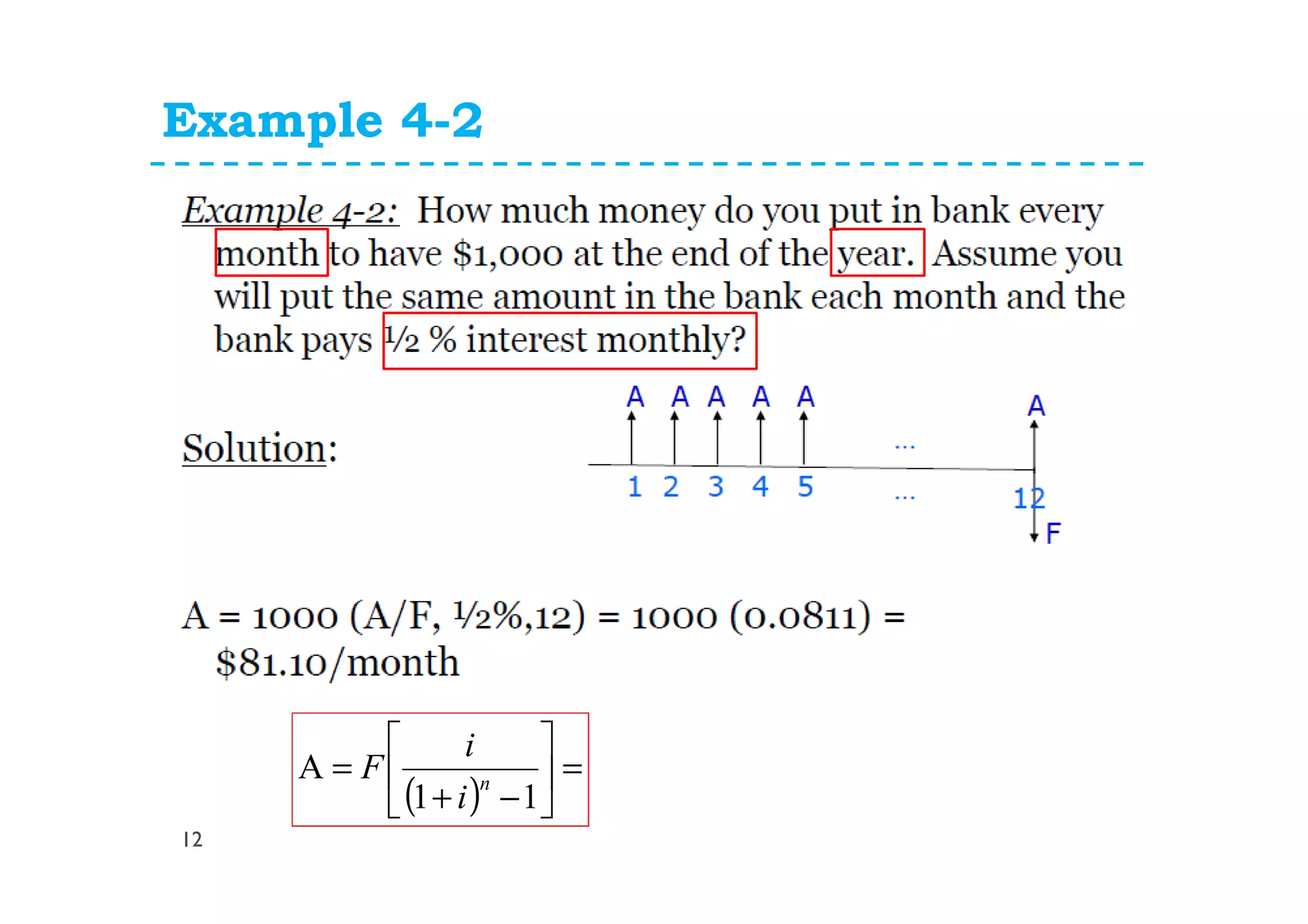
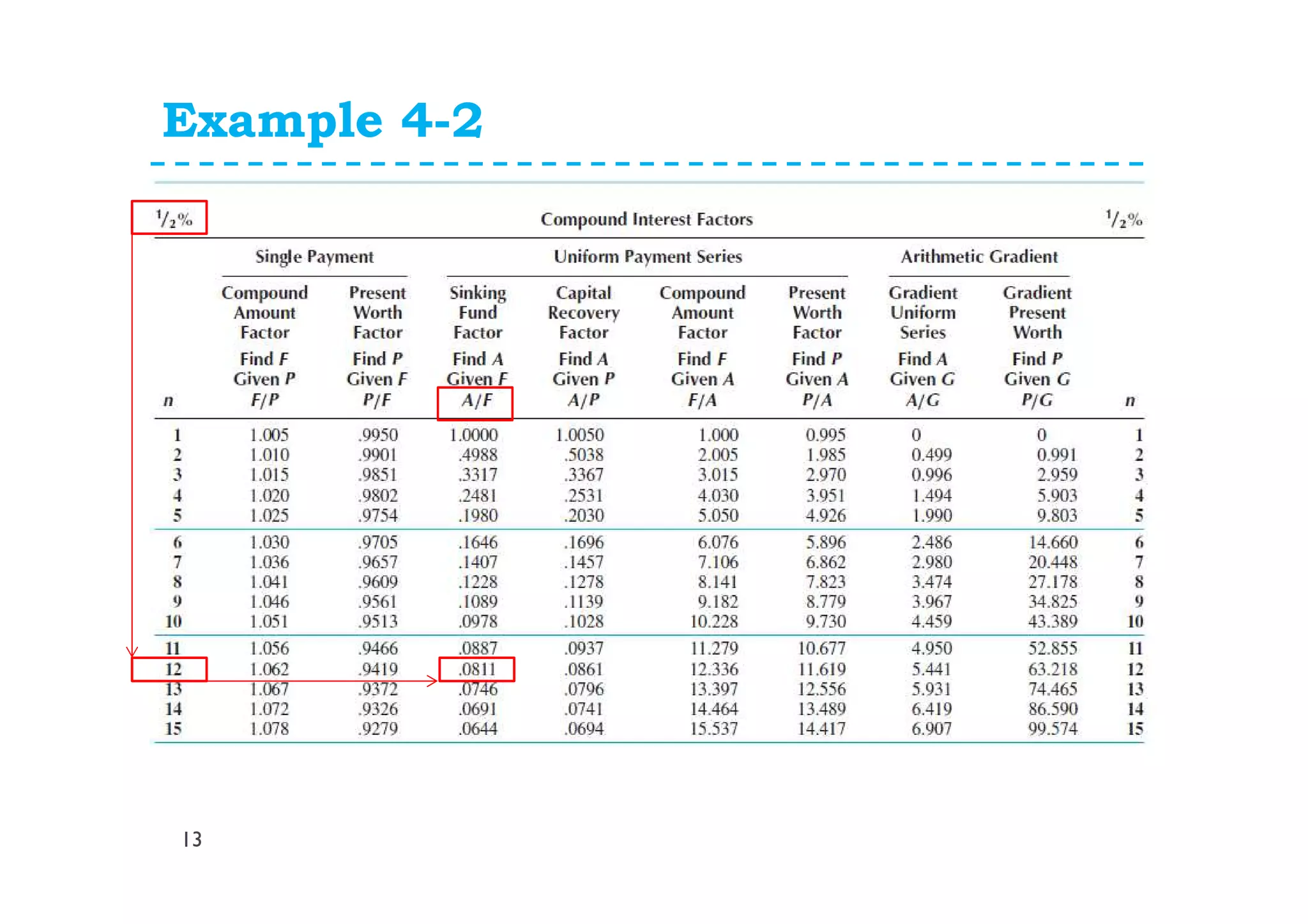
Example 4-2
12
( )
=





−+
=
11
A n
i
i
F
Example 4-2
13
Deriving Uniform Series Formula
14
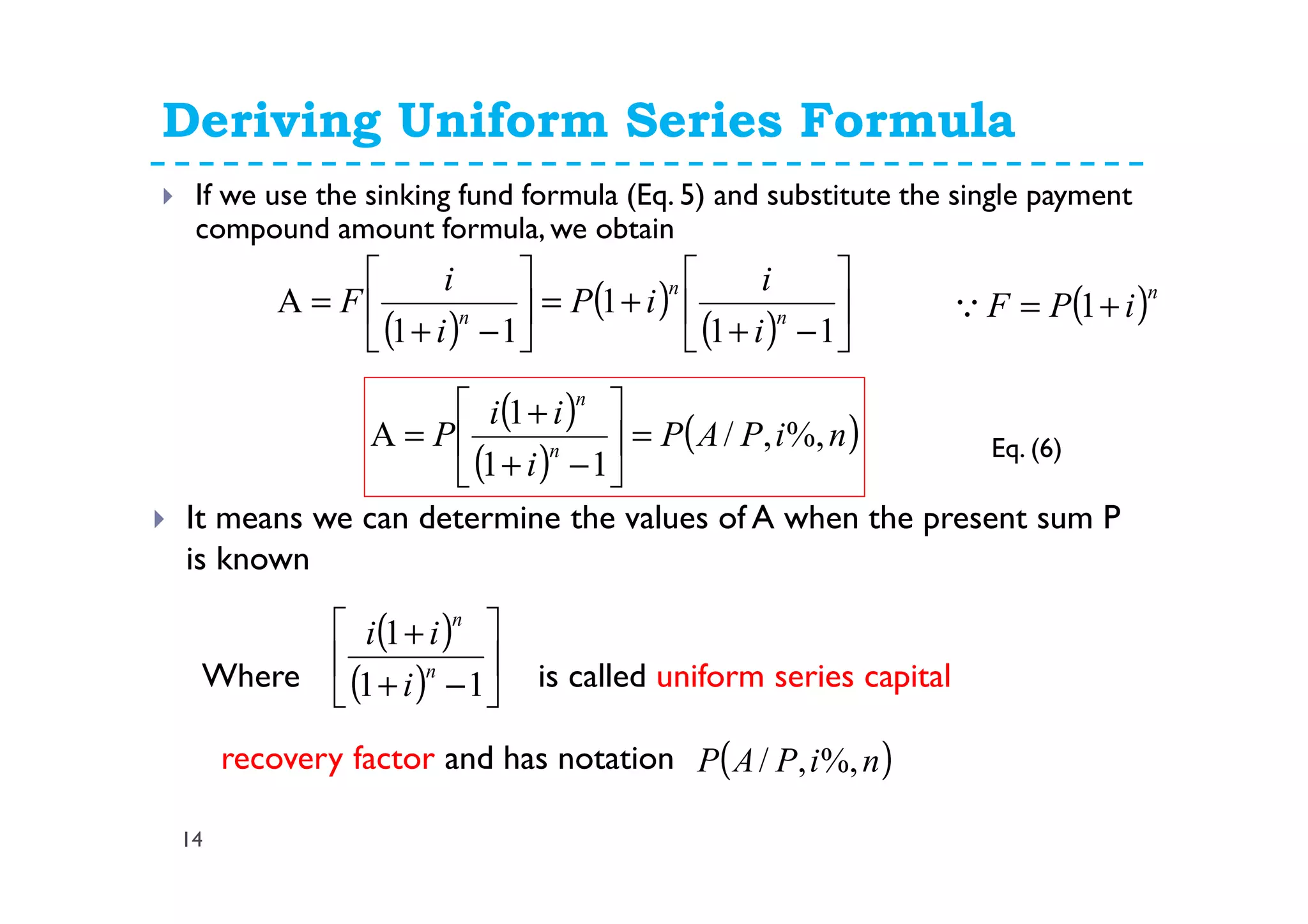
If we use the sinking fund formula (Eq. 5) and substitute the single payment
compound amount formula, we obtain
( )
( )
( ) 





−+
+=





−+
=
11
1
11
A n
n
n
i
i
iP
i
i
F ( )n
iPF += 1Q
( )
( )
( )niPAP
i
ii
P n
n
%,,/
11
1
A =





−+
+
=
It means we can determine the values of A when the present sum P
is known
Where is called uniform series capital
recovery factor and has notation
( )
( ) 





−+
+
11
1
n
n
i
ii
( )niPAP %,,/
Eq. (6)
Deriving Uniform Series Formula
15
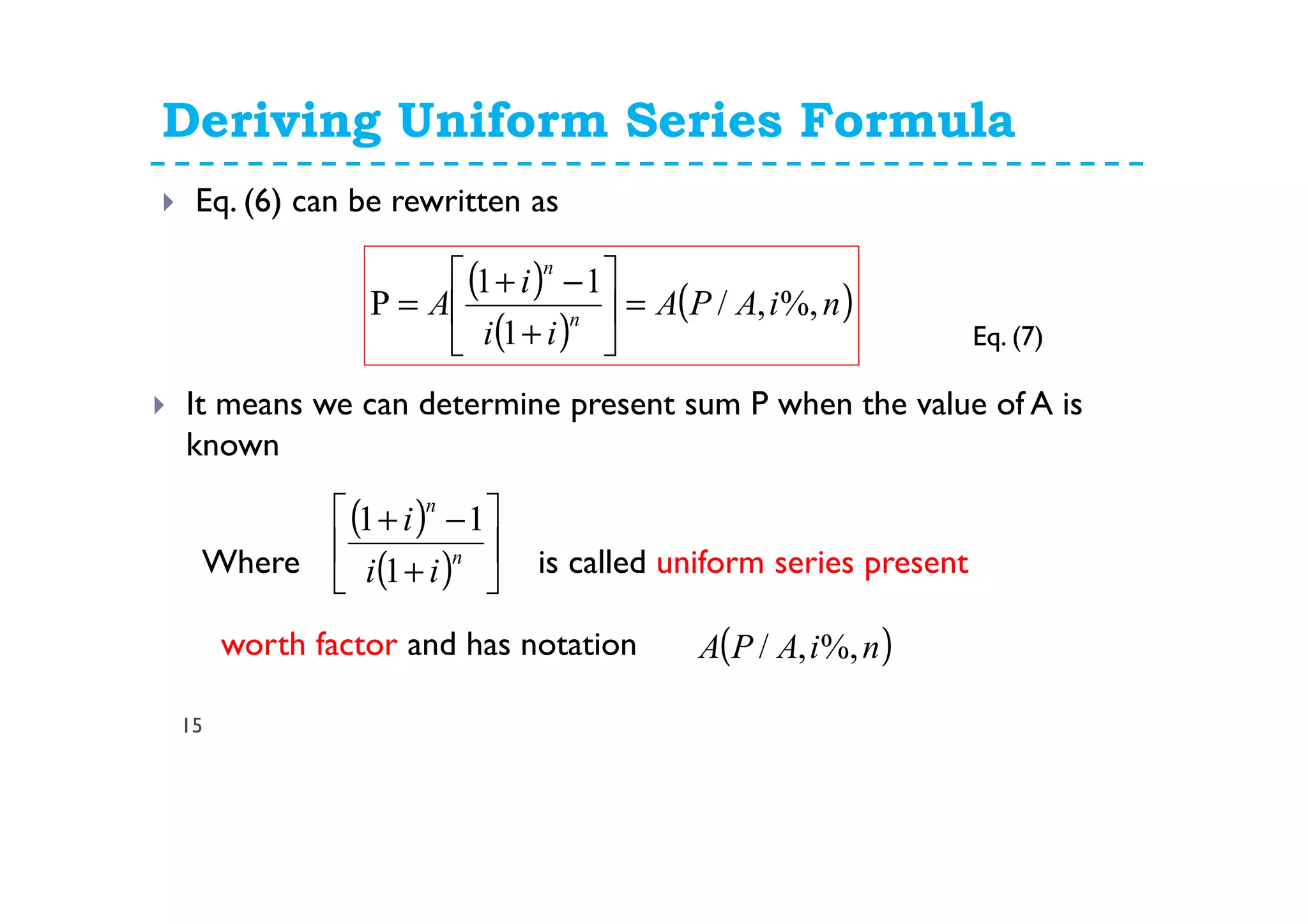
Eq. (6) can be rewritten as
( )
( )
( )niAPA
ii
i
A n
n
%,,/
1
11
P =





+
−+
=
It means we can determine present sum P when the value of A is
known
Where is called uniform series present
worth factor and has notation
( )
( ) 





+
−+
n
n
ii
i
1
11
( )niAPA %,,/
Eq. (7)
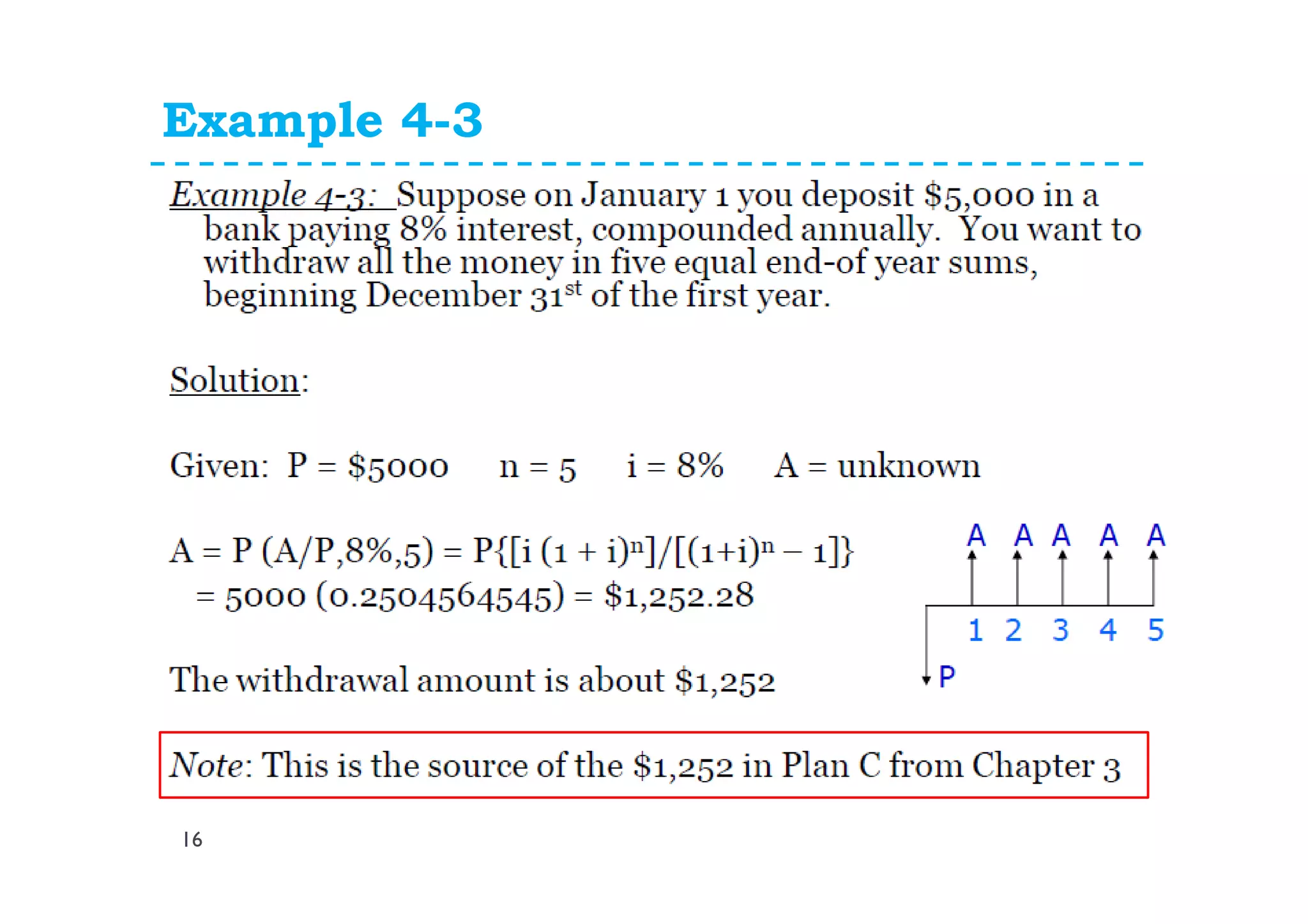
Example 4-3
16
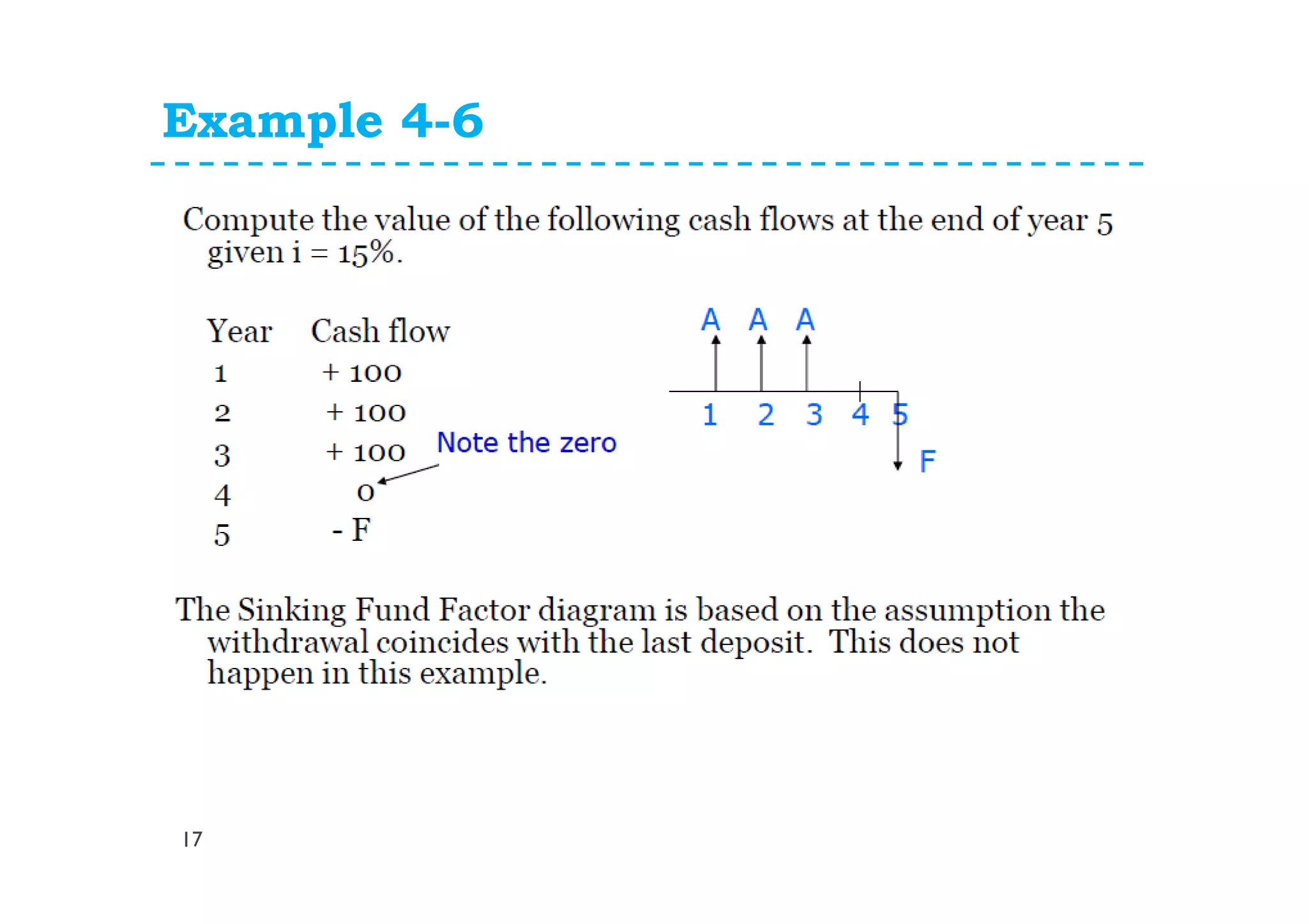
Example 4-6
17
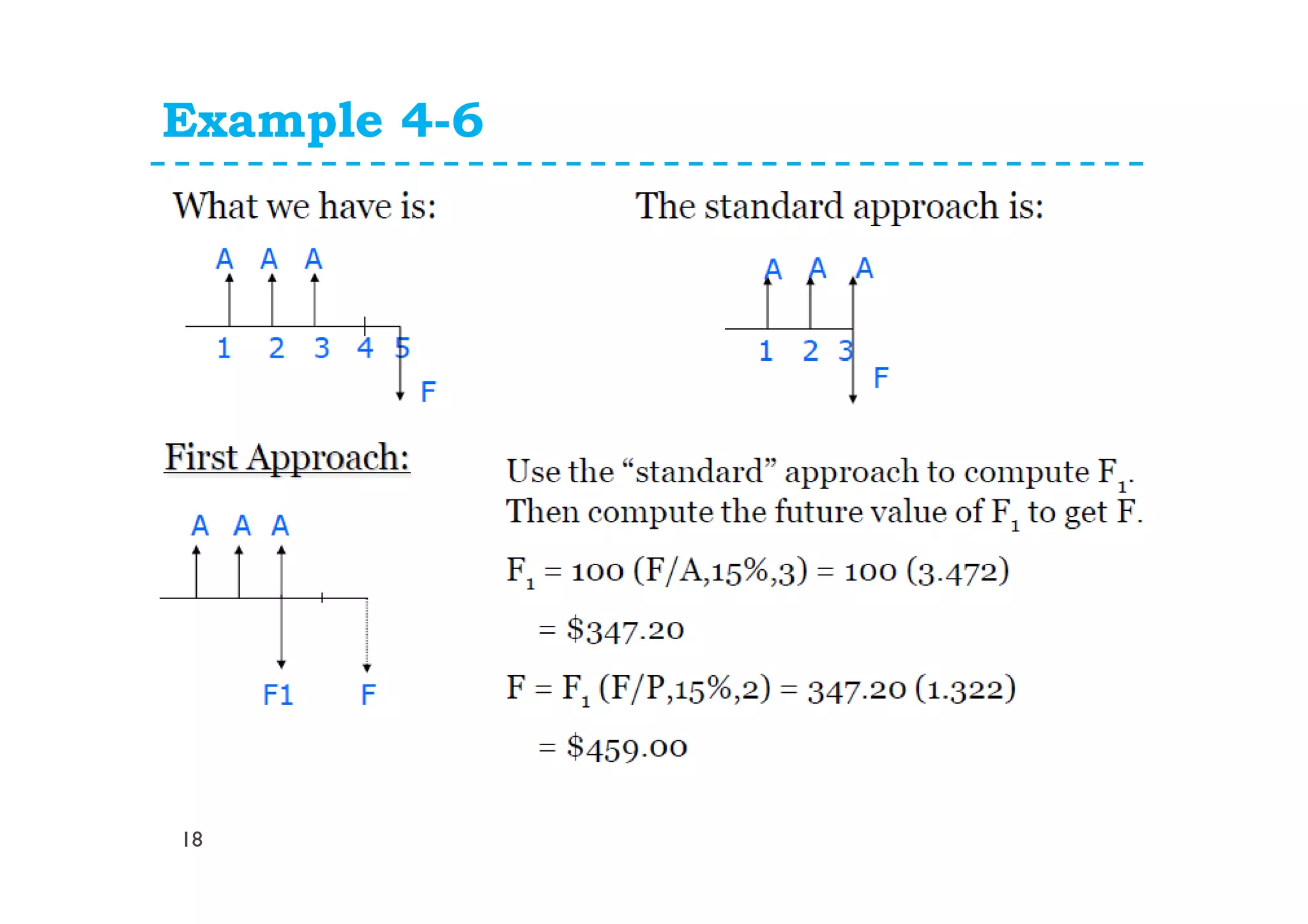
Example 4-6
18
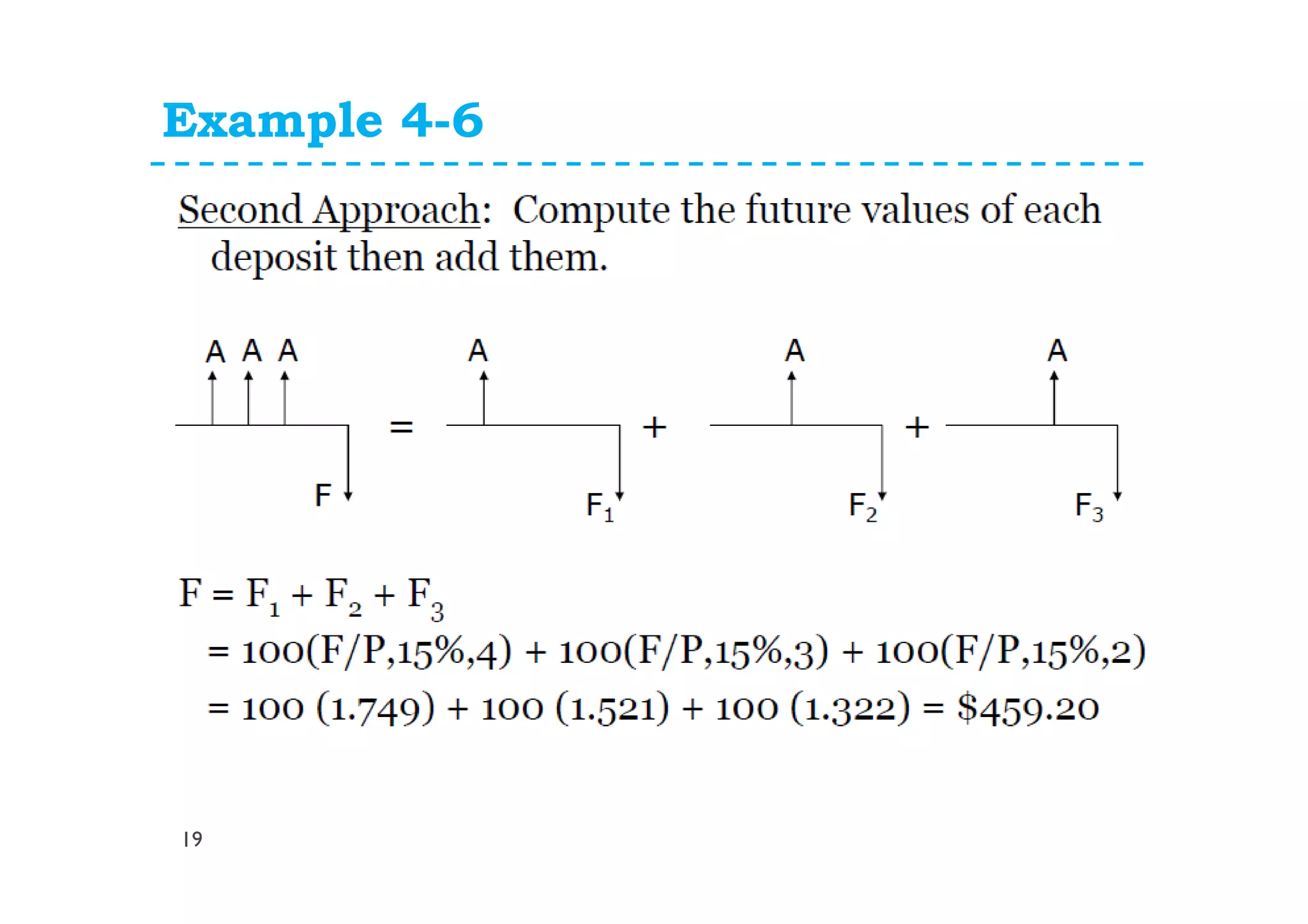
Example 4-6
19
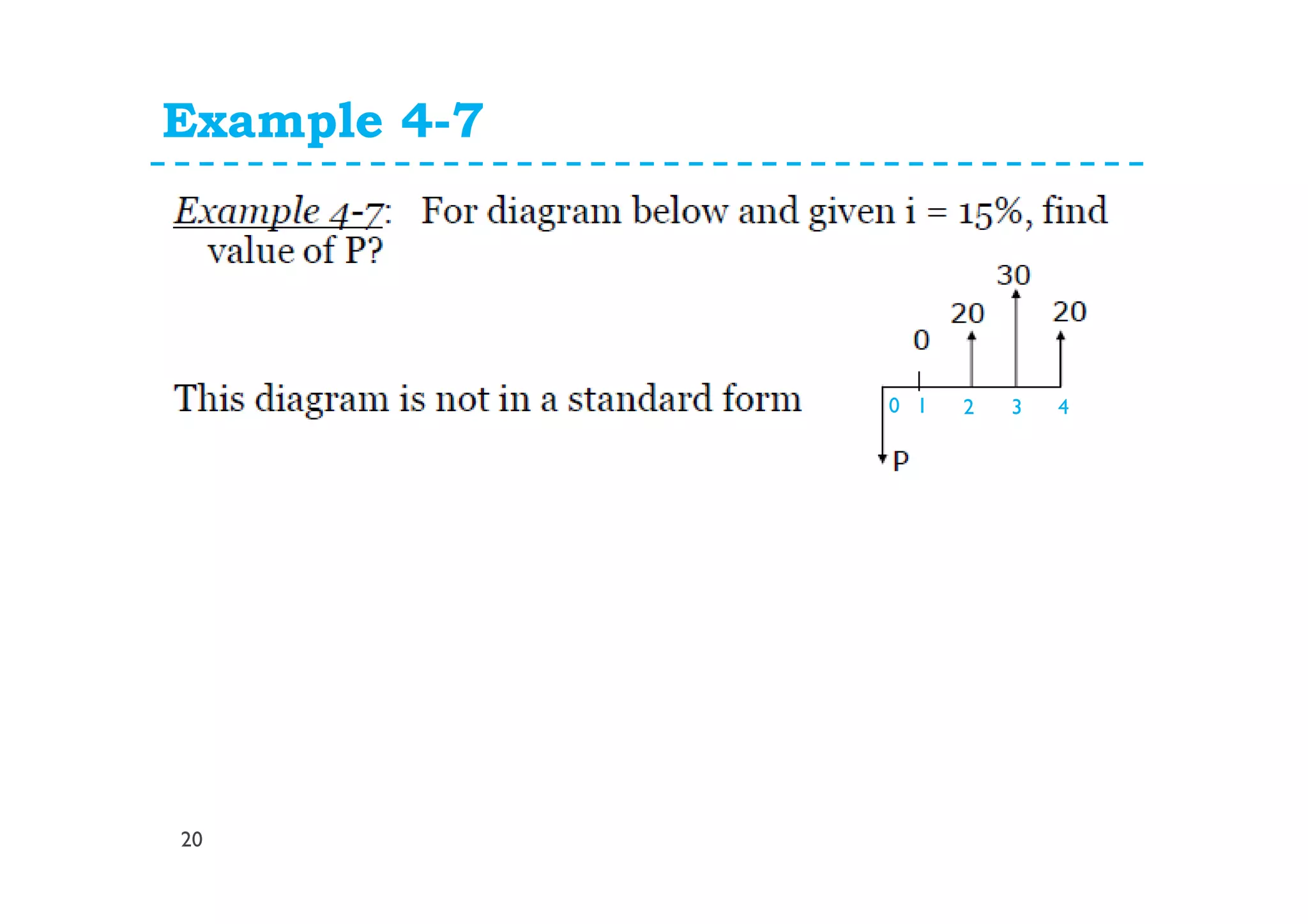
Example 4-7
20
0 1 2 3 4
21
Problem
22
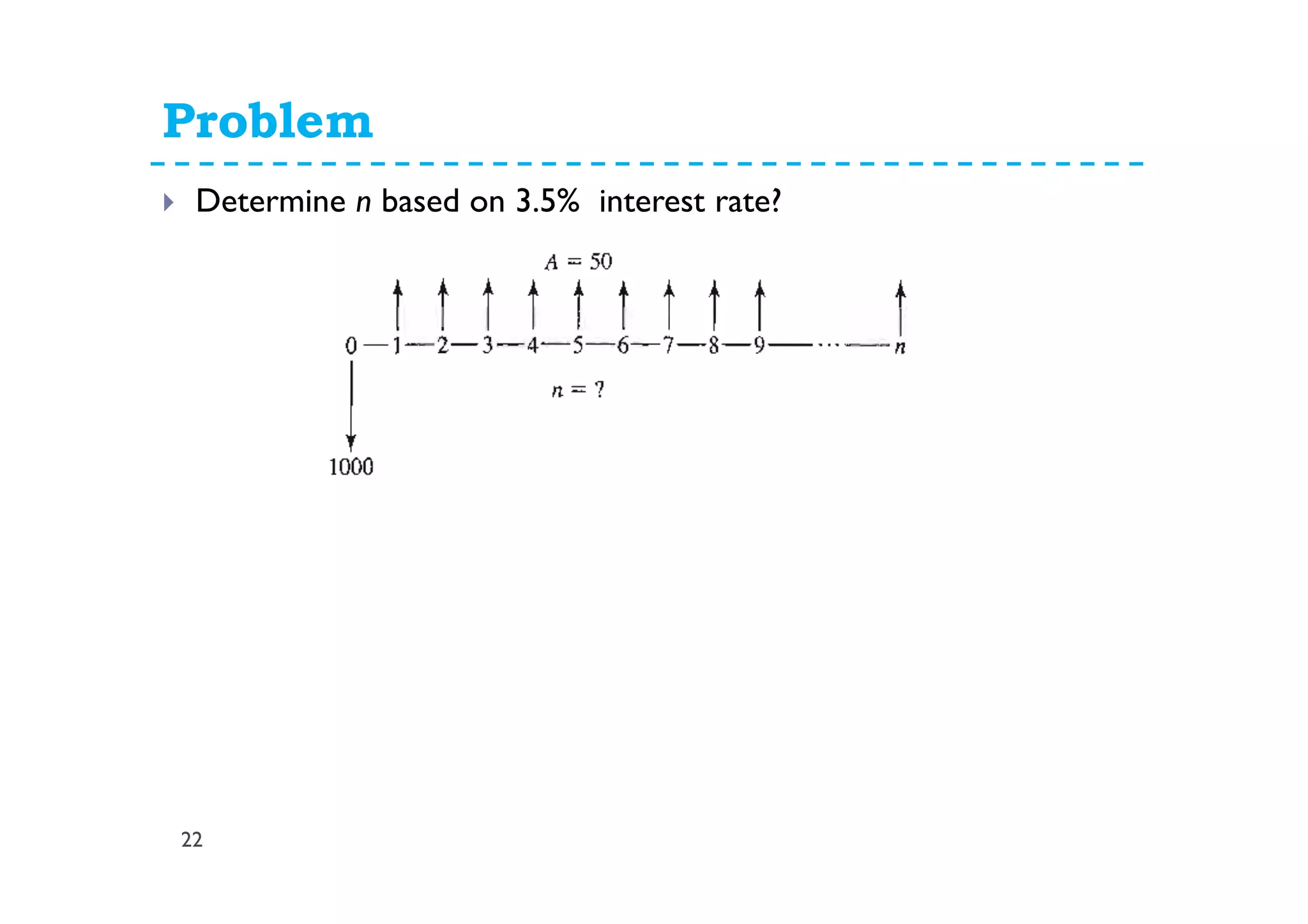
Determine n based on 3.5% interest rate?
Solution:
P = A (P/A, 3.5%, n)
$1,000 = $50 (P/A, 3.5%, n)
(P/A, 3.5%, n) = 20
From the 3.5% interest table, n = 35.
Problem
23
A sum of money is invested at 2% per 6 month period (semi-annually) will
double in amount in approximately how much years?
P = $1 n = unknown number of
semiannual periods
i = 2% F = 2
F = P (1 + i)n
2 = 1 (1.02)n
2 = 1.02n
n = log (2) / log (1.02)
= 35
Therefore, the money will double in 17.5 years.
24
Part II
(from next class bring interest tables and formula sheet)
Outcome of Today’s Lecture
25
After completing this lecture…
The students should be able to:
Understand arithmetic gradient interest formulas
More interest Formulas
26
Uniform Series
Arithmetic Gradient
Geometric Gradient
Nominal and Effective Interest
Continuous Compounding
Arithmetic Gradient Series
27
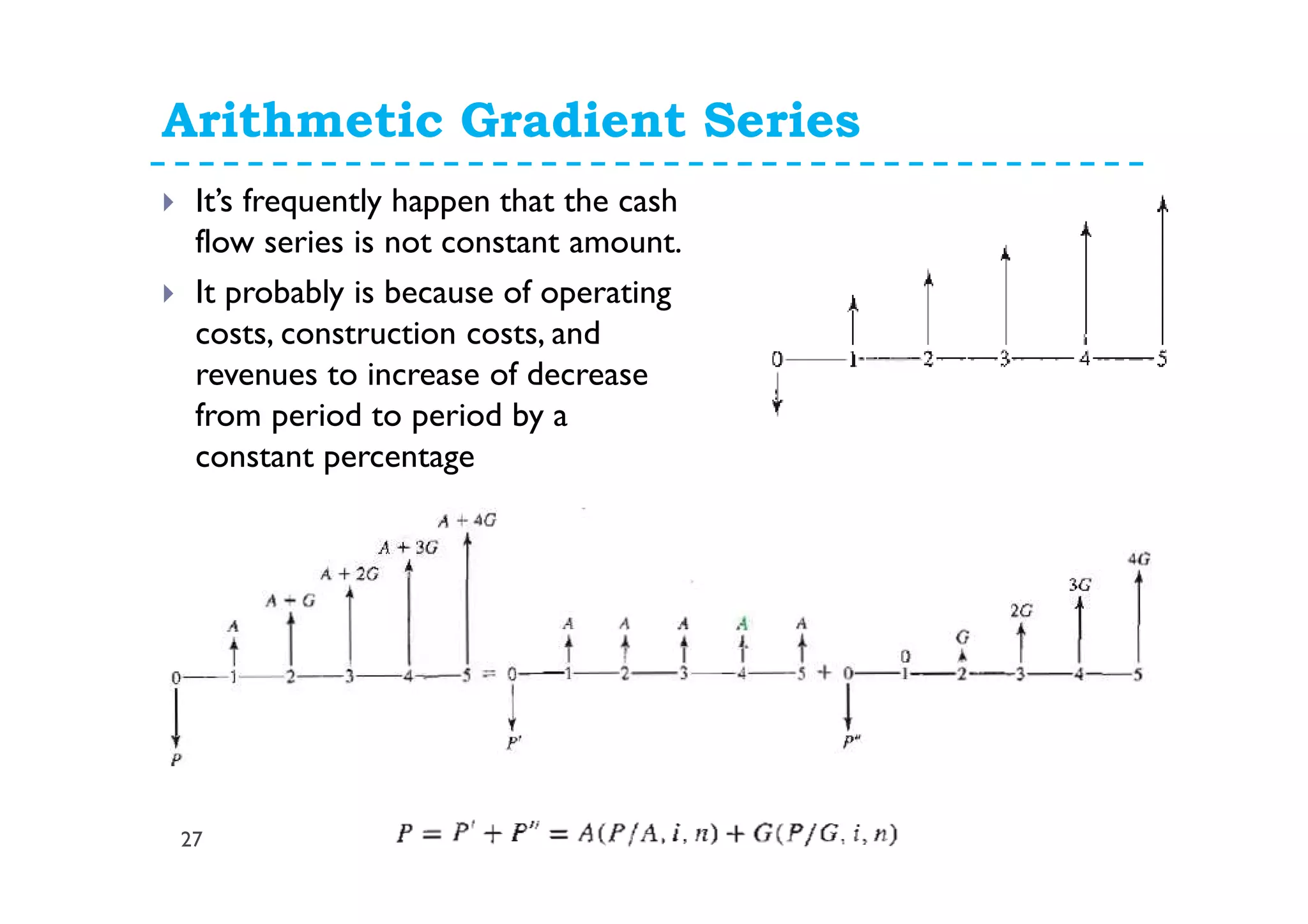
It’s frequently happen that the cash
flow series is not constant amount.
It probably is because of operating
costs, construction costs, and
revenues to increase of decrease
from period to period by a
constant percentage
Arithmetic Gradient Series
28
Let the cash flows increase/decrease by a uniform fixed amount G
every subsequent period
Eq. (1)
Recall
( ) ( ) ( )
( ) ( ) ( )[ ])1(1)2(...121F
)1()1(1)2(...121F
132
0132
−++−+++++=
+−++−+++++=
−−
−−
niniiG
iGniGniGiG
nn
nn
Arithmetic Gradient Series
29
Multiplying Eq. (1) with (1+i), we get
( ) ( ) ( ) ( )[ ]1221
)1)(1(1)2(...121Fi1 ininiiG
nn
+−++−+++++=+
−−
( ) ( ) ( ) ( )[ ]1221
)1)(1(1)2(...121Fi1 ininiiG
nn
+−++−+++++=+
−−
( ) ( ) ( )[ ])1(1)2(...121F
132
−++−+++++=
−−
niniiG
nn
( ) ( ) ( ) ( )[ ]
( ) ( ) ( ) ( )[ ] nGiiiiG
niiiiG
nn
nn
−+++++++++=
+−++++++++=
−−
−−
111...11iF
111...11iF
1221
1221
Eq. (2)-Eq. (1)
Eq. (2)
-
( )
( ) ( )





 −−+
=





−
−+
=
−




 −+
=
2
1111
11
iF
i
nii
Gn
i
i
i
G
F
nG
i
i
G
nn
n
( ) [ ]niGFG
i
ini
GF
n
%,,/
11
2
=




 −−+
=
Eq. (3)
Eq. (4)
Arithmetic
gradient future
worth factor
30
( ) ( ) ( ) ( ) ( ) ( )[ ] ( )
( ) ( ) ( ) ( )[ ]
( )[ ]
( ) nG
i
i
GiF
nGiiGiiF
nGiiiiG
inGiiiiiGi
n
n
nn
nn
−




 −+
=
−−+=
−+++++++++=
+−++++++++++=+
−−
−
11
11
111...11iF
1111...111iF
1221
231
-
Arithmetic Gradient Series
31
Substituting F from single payment compound formula, we can write
Eq.(4) as
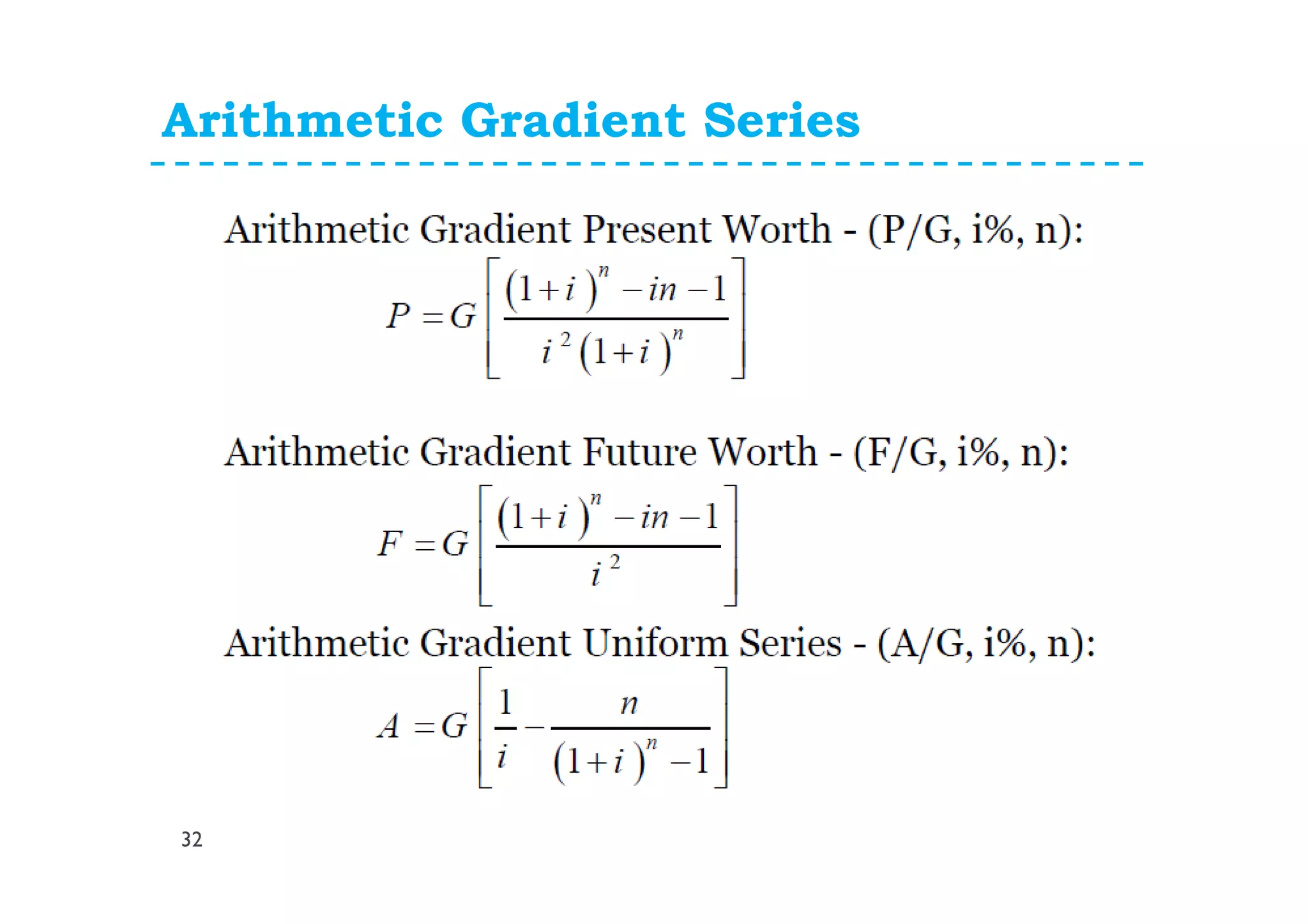
( )
( )
[ ]niGPG
ii
ini
GP n
n
%,,/
1
11
2
=





+
−−+
=
Eq. (5)
(P/G ,i%, n) is known as Arithmetic gradient present worth factor
Now substituting value of F from uniform series compound amount
factor, we can write Eq. (4) as
Recall
( ) ( )
( )( )
( )( )
( )niGAGA
ii
inii
GA
i
i
A
i
ini
GF
n
n
nn
%,,/
11
11
1111
2
2
=






−+
−−+
=





 −+
=




 −−+
=
( )





 −+
=
i
i
A
n
11
FQ
(A/G, i%, n) is known as Arithmetic gradient uniform series factor
Arithmetic Gradient Series
32
Example 4-8
33
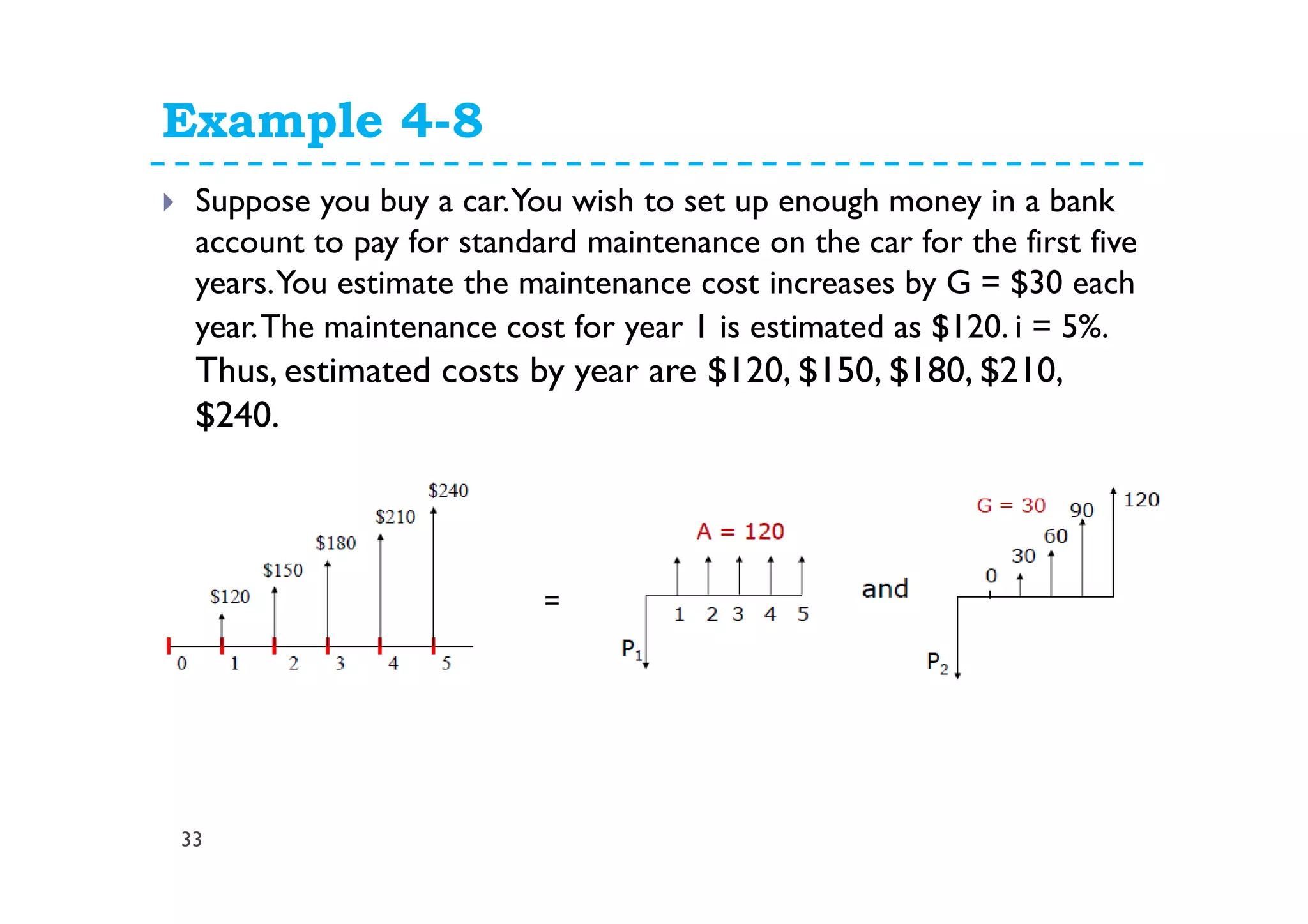
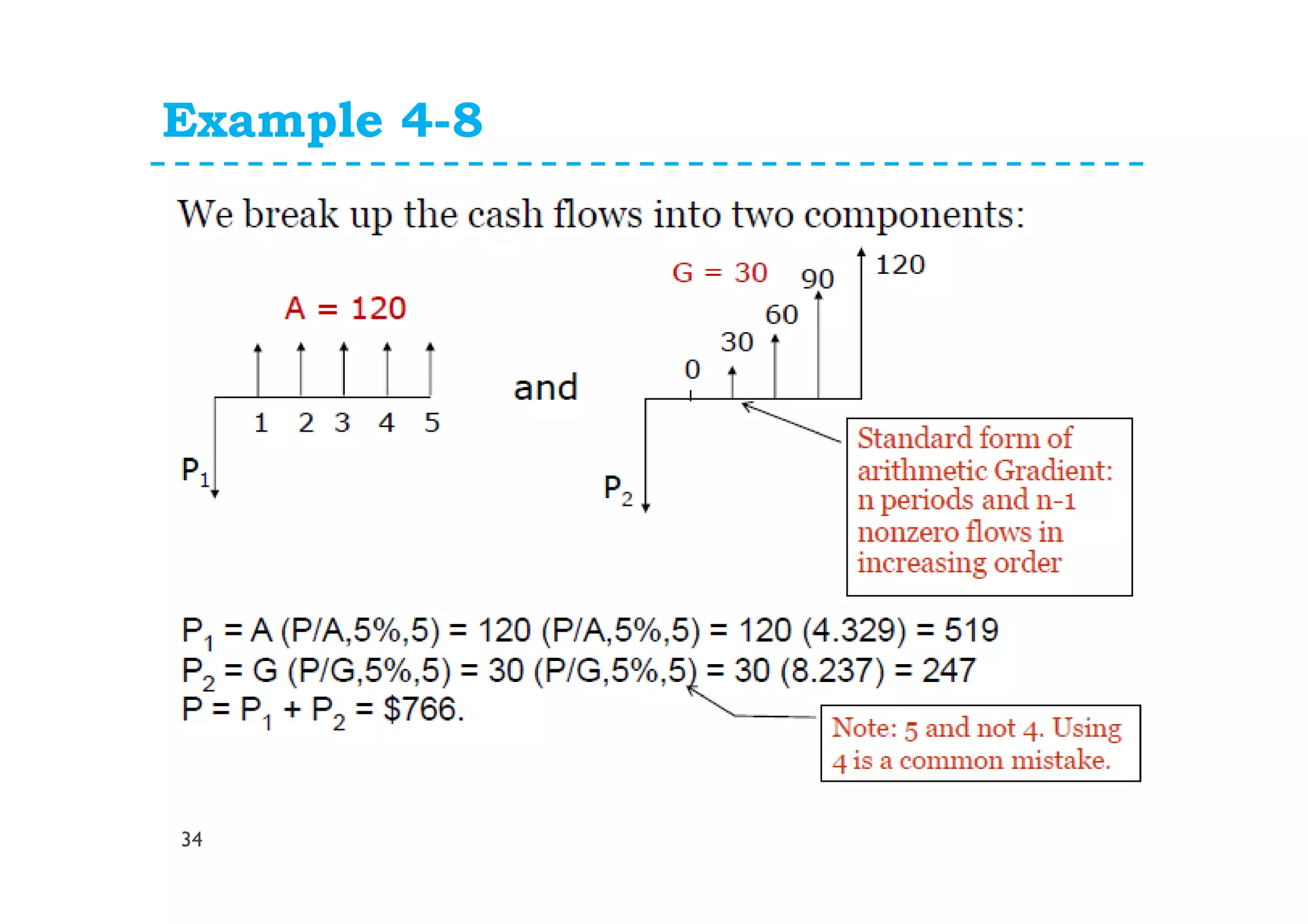
Suppose you buy a car.You wish to set up enough money in a bank
account to pay for standard maintenance on the car for the first five
years.You estimate the maintenance cost increases by G = $30 each
year.The maintenance cost for year 1 is estimated as $120. i = 5%.
Thus, estimated costs by year are $120, $150, $180, $210,
$240.
=
Example 4-8
34
Example 4-9
35
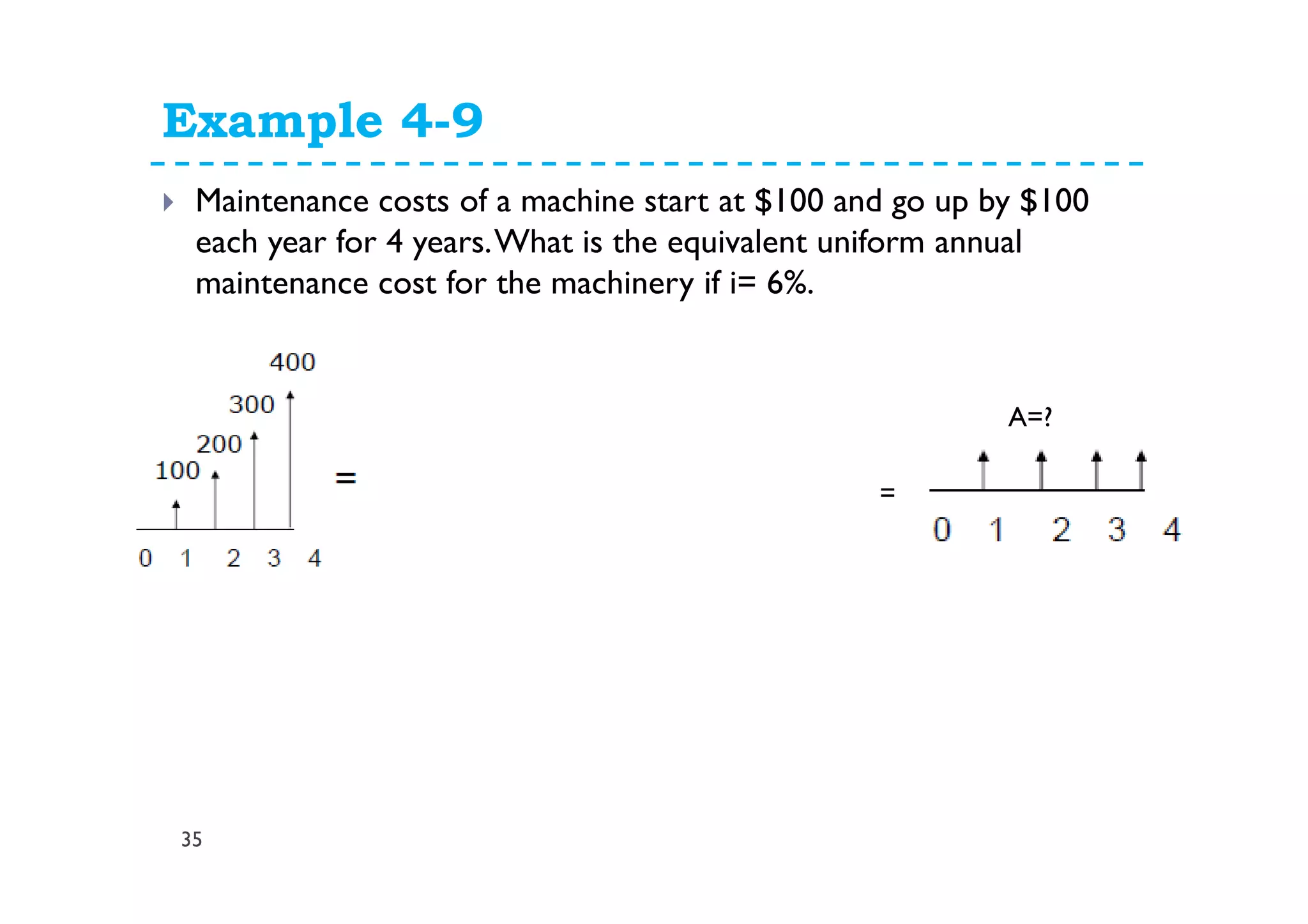
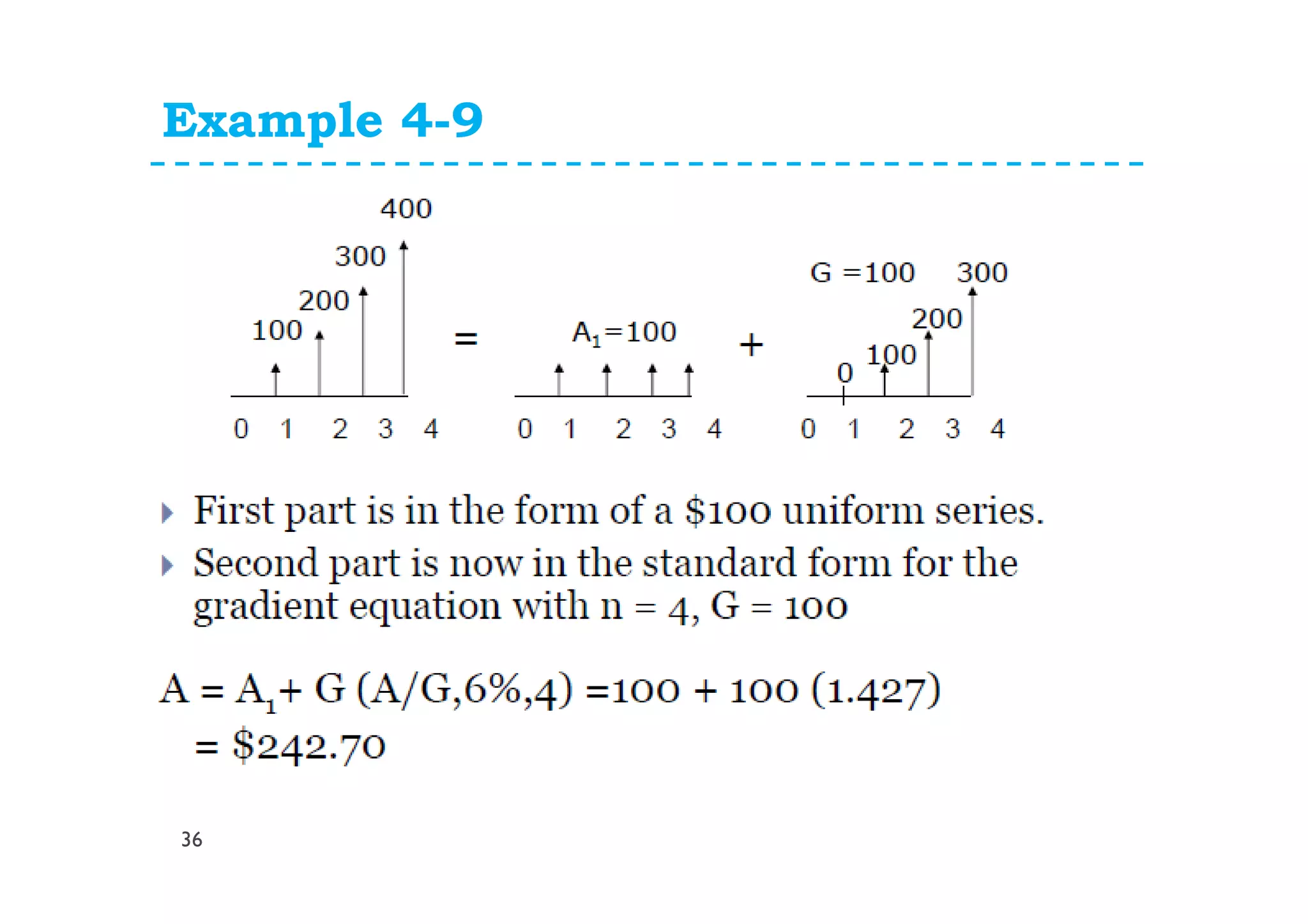
Maintenance costs of a machine start at $100 and go up by $100
each year for 4 years.What is the equivalent uniform annual
maintenance cost for the machinery if i= 6%.
=
A=?
Example 4-9
36
Example 4-10
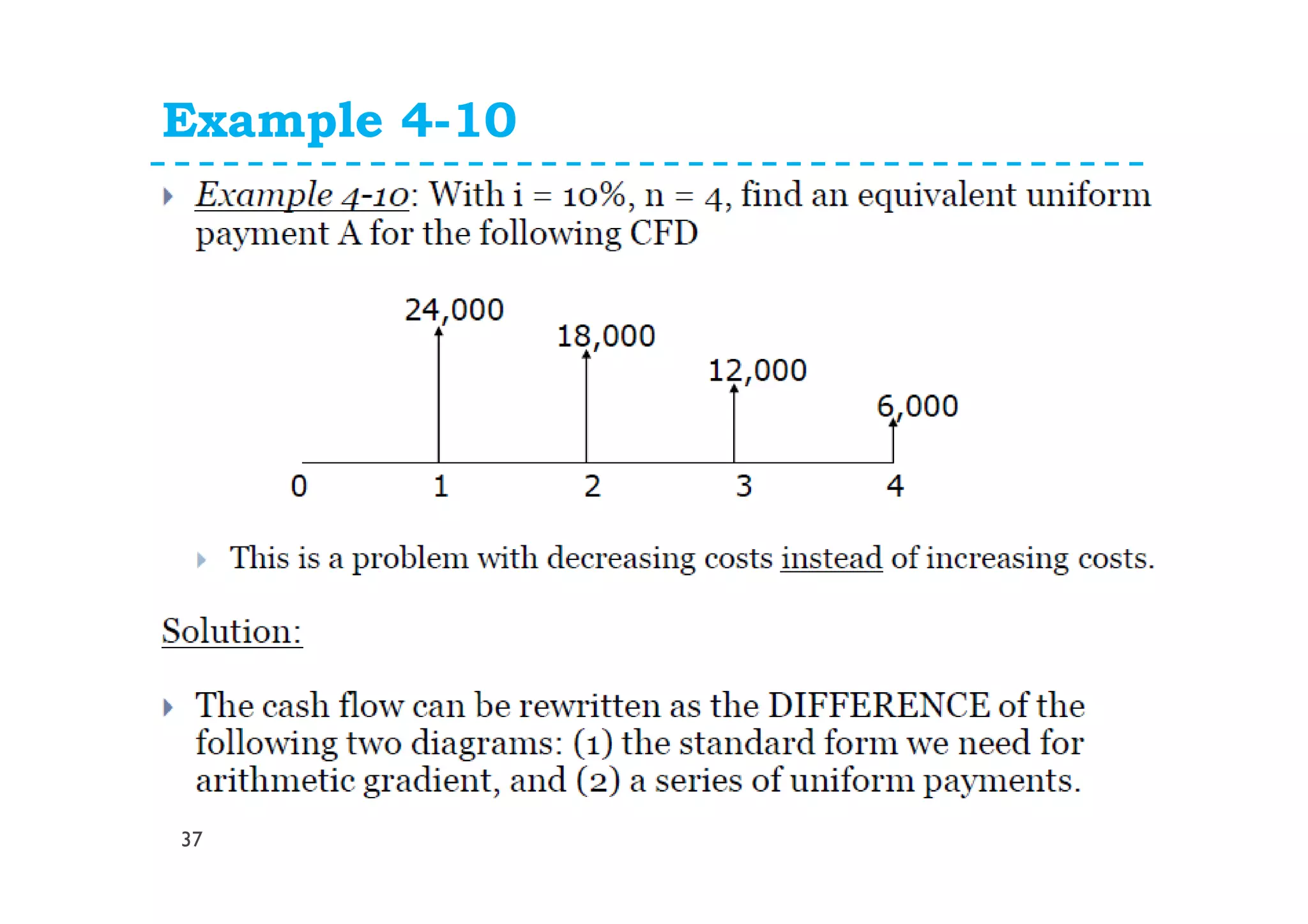
37
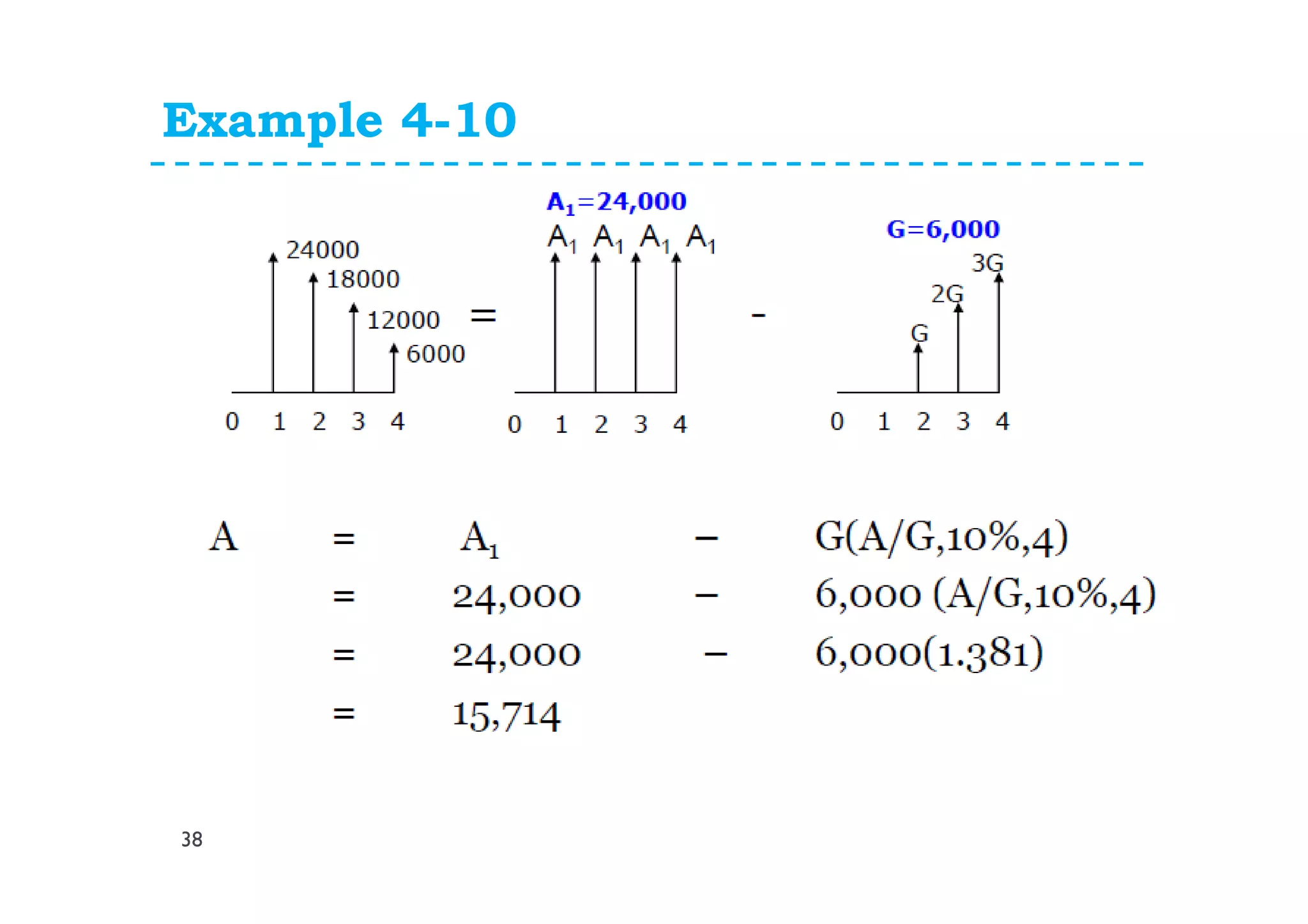
Example 4-10
38
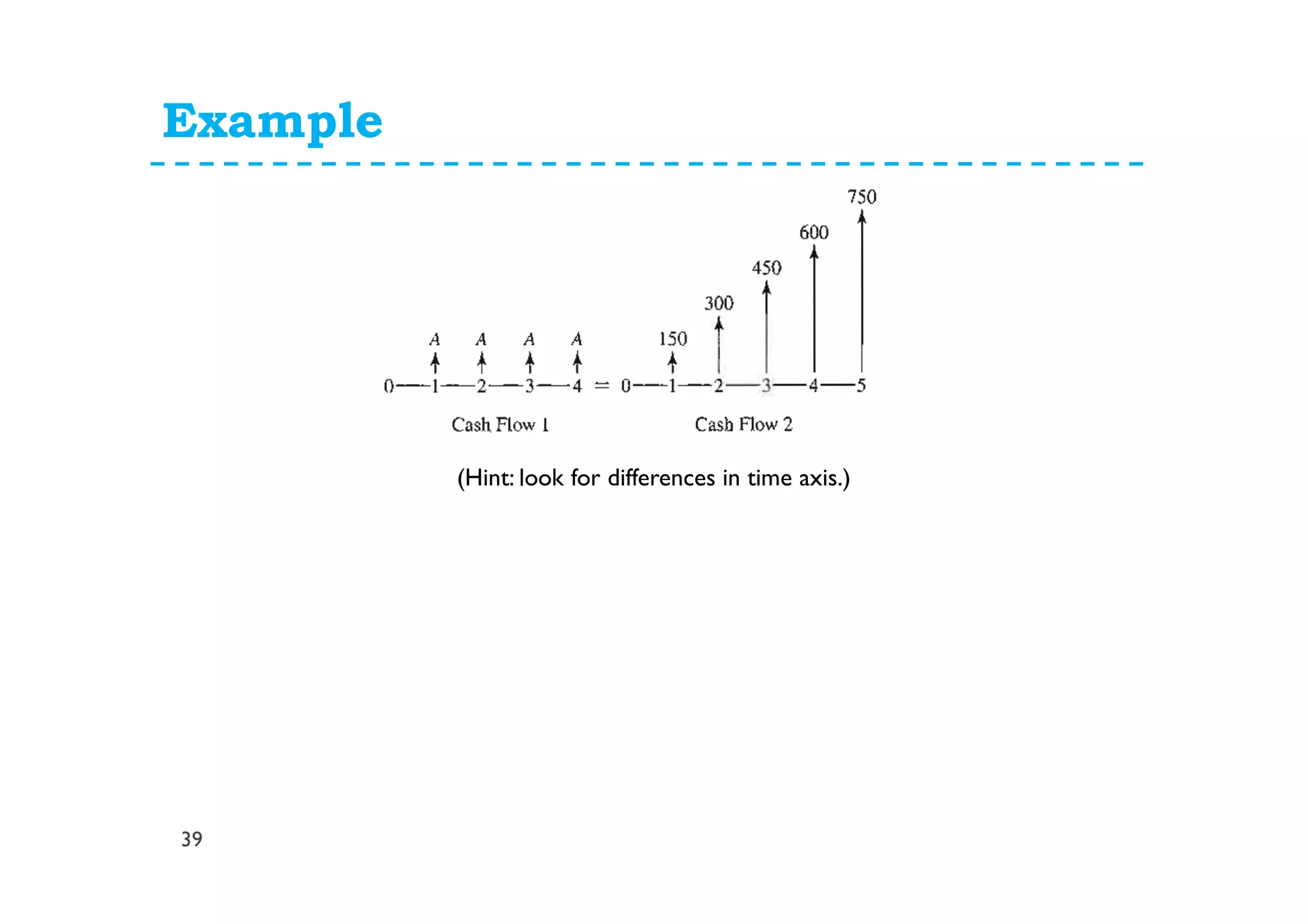
Example
39
(Hint: look for differences in time axis.)
40
ThankYou
Feel Free to Contact
msiddique@sharjah.ac.ae
Tel. +971 6 5050943 (Ext. 2943)

5 more interest formulas

  • 1.
    5. More InterestFormulas Dr. Mohsin Siddique Assistant Professor msiddique@sharjah.ac.ae Ext: 29431 Date: 21/10/2014 Engineering Economics University of Sharjah Dept. of Civil and Env. Engg.
  • 2.
  • 3.
    Outcome of Today’sLecture 3 After completing this lecture… The students should be able to: Understand uniform series compound interest formulas
  • 4.
    More interest Formulas 4 UniformSeries Arithmetic Gradient Geometric Gradient Nominal and Effective Interest Continuous Compounding
  • 5.
    Uniform Series 5 In chapter3 (i.e., interest and equivalence), we dealt with single payments compound interest formula: Functional NotationAlgebraic Equivalent Examples: __________________________________________________________ __________________________________________________________ __________________________________________________________
  • 6.
    Uniform Series 6 Quite oftenwe have to deal with uniform (equidistant and equal-valued) cash flows during a period of time: Remember: A= Series of consecutives, equal, end of period amounts of money (Receipts/disbursement) Examples: _______________________________________________ ______________________________________________________
  • 7.
    Deriving Uniform SeriesFormula 7 Let’s compute Future Worth, F, of a stream of equal, end-of-period cash flows, A, at interest rate, i, over interest period, n 0 1 2 3 4 F 0 1 2 3 4 A F1 0 1 2 3 4 A F2 0 1 2 3 4 A F4 0 1 2 3 4 A F3 0 1 2 n-1 n A F = + ++ F=F1+F2+F3+F4 Recall ( )3 1F1 iA += ( )2 1F2 iA += ( )1 1F3 iA += ( )0 1F4 iA += Let n=4
  • 8.
    Deriving Uniform SeriesFormula 0 1 2 3 4 A F F=F1+F2+F3+F4 ( )3 1F1 iA += ( )2 1F2 iA += ( )1 1F3 iA += ( )0 1F4 iA += F = + + + ( ) ( ) ( ) AiAiAiA ++++++= 123 111F For general case, we can write that Multiplying both sides with (1+i) ( ) ( ) ( ) ( ) ( ) ( ) ( ) ( ) ( ) ( )[ ]iiiiAi iAiAiAiAi nnn nnn ++++++++=+ ++++++++=+ −− −− 1...1111F 1...1111F 21 21 ( ) ( ) ( ) ( ) ( ) ( )[ ]1...111 ...111 321 321 +++++++= +++++++= −−− −−− nnn nnn iiiAF AiAiAiAF Eq. (1) Eq. (2)
  • 9.
    Deriving Uniform SeriesFormula 9 Eq. (2)-Eq. (1) ( ) ( ) ( ) ( ) ( )[ ]iiiiAi nnn ++++++++=+ −− 1...1111F 21 ( ) ( ) ( )[ ]1...111 321 +++++++= −−− nnn iiiAF Eq. (2) Eq. (1) - ( )[ ]11iF −+= n iA ( ) [ ]niAFA i i A n %,,/ 11 F =      −+ = Eq. (3) Eq. (4) ( )       −+ i i n 11 Where is called uniform series compound amount factor and has notation [ ]niAF %,,/
  • 10.
    Deriving Uniform SeriesFormula 10 Eq. (4) can also be written as ( ) [ ]niFAF i i F n %,,/ 11 A =      −+ = ( )       −+ 11 n i i Where is called uniform series sinking fund factor and has notation [ ]niFA %,,/ Eq. (5)       ni given Find %,,
  • 11.
  • 12.
  • 13.
  • 14.
    Deriving Uniform SeriesFormula 14 If we use the sinking fund formula (Eq. 5) and substitute the single payment compound amount formula, we obtain ( ) ( ) ( )       −+ +=      −+ = 11 1 11 A n n n i i iP i i F ( )n iPF += 1Q ( ) ( ) ( )niPAP i ii P n n %,,/ 11 1 A =      −+ + = It means we can determine the values of A when the present sum P is known Where is called uniform series capital recovery factor and has notation ( ) ( )       −+ + 11 1 n n i ii ( )niPAP %,,/ Eq. (6)
  • 15.
    Deriving Uniform SeriesFormula 15 Eq. (6) can be rewritten as ( ) ( ) ( )niAPA ii i A n n %,,/ 1 11 P =      + −+ = It means we can determine present sum P when the value of A is known Where is called uniform series present worth factor and has notation ( ) ( )       + −+ n n ii i 1 11 ( )niAPA %,,/ Eq. (7)
  • 16.
  • 17.
  • 18.
  • 19.
  • 20.
  • 21.
  • 22.
    Problem 22 Determine n basedon 3.5% interest rate? Solution: P = A (P/A, 3.5%, n) $1,000 = $50 (P/A, 3.5%, n) (P/A, 3.5%, n) = 20 From the 3.5% interest table, n = 35.
  • 23.
    Problem 23 A sum ofmoney is invested at 2% per 6 month period (semi-annually) will double in amount in approximately how much years? P = $1 n = unknown number of semiannual periods i = 2% F = 2 F = P (1 + i)n 2 = 1 (1.02)n 2 = 1.02n n = log (2) / log (1.02) = 35 Therefore, the money will double in 17.5 years.
  • 24.
    24 Part II (from nextclass bring interest tables and formula sheet)
  • 25.
    Outcome of Today’sLecture 25 After completing this lecture… The students should be able to: Understand arithmetic gradient interest formulas
  • 26.
    More interest Formulas 26 UniformSeries Arithmetic Gradient Geometric Gradient Nominal and Effective Interest Continuous Compounding
  • 27.
    Arithmetic Gradient Series 27 It’sfrequently happen that the cash flow series is not constant amount. It probably is because of operating costs, construction costs, and revenues to increase of decrease from period to period by a constant percentage
  • 28.
    Arithmetic Gradient Series 28 Letthe cash flows increase/decrease by a uniform fixed amount G every subsequent period Eq. (1) Recall ( ) ( ) ( ) ( ) ( ) ( )[ ])1(1)2(...121F )1()1(1)2(...121F 132 0132 −++−+++++= +−++−+++++= −− −− niniiG iGniGniGiG nn nn
  • 29.
    Arithmetic Gradient Series 29 MultiplyingEq. (1) with (1+i), we get ( ) ( ) ( ) ( )[ ]1221 )1)(1(1)2(...121Fi1 ininiiG nn +−++−+++++=+ −− ( ) ( ) ( ) ( )[ ]1221 )1)(1(1)2(...121Fi1 ininiiG nn +−++−+++++=+ −− ( ) ( ) ( )[ ])1(1)2(...121F 132 −++−+++++= −− niniiG nn ( ) ( ) ( ) ( )[ ] ( ) ( ) ( ) ( )[ ] nGiiiiG niiiiG nn nn −+++++++++= +−++++++++= −− −− 111...11iF 111...11iF 1221 1221 Eq. (2)-Eq. (1) Eq. (2) - ( ) ( ) ( )       −−+ =      − −+ = −      −+ = 2 1111 11 iF i nii Gn i i i G F nG i i G nn n ( ) [ ]niGFG i ini GF n %,,/ 11 2 =      −−+ = Eq. (3) Eq. (4) Arithmetic gradient future worth factor
  • 30.
    30 ( ) () ( ) ( ) ( ) ( )[ ] ( ) ( ) ( ) ( ) ( )[ ] ( )[ ] ( ) nG i i GiF nGiiGiiF nGiiiiG inGiiiiiGi n n nn nn −      −+ = −−+= −+++++++++= +−++++++++++=+ −− − 11 11 111...11iF 1111...111iF 1221 231 -
  • 31.
    Arithmetic Gradient Series 31 SubstitutingF from single payment compound formula, we can write Eq.(4) as ( ) ( ) [ ]niGPG ii ini GP n n %,,/ 1 11 2 =      + −−+ = Eq. (5) (P/G ,i%, n) is known as Arithmetic gradient present worth factor Now substituting value of F from uniform series compound amount factor, we can write Eq. (4) as Recall ( ) ( ) ( )( ) ( )( ) ( )niGAGA ii inii GA i i A i ini GF n n nn %,,/ 11 11 1111 2 2 =       −+ −−+ =       −+ =      −−+ = ( )       −+ = i i A n 11 FQ (A/G, i%, n) is known as Arithmetic gradient uniform series factor
  • 32.
  • 33.
    Example 4-8 33 Suppose youbuy a car.You wish to set up enough money in a bank account to pay for standard maintenance on the car for the first five years.You estimate the maintenance cost increases by G = $30 each year.The maintenance cost for year 1 is estimated as $120. i = 5%. Thus, estimated costs by year are $120, $150, $180, $210, $240. =
  • 34.
  • 35.
    Example 4-9 35 Maintenance costsof a machine start at $100 and go up by $100 each year for 4 years.What is the equivalent uniform annual maintenance cost for the machinery if i= 6%. = A=?
  • 36.
  • 37.
  • 38.
  • 39.
    Example 39 (Hint: look fordifferences in time axis.)
  • 40.
    40 ThankYou Feel Free toContact msiddique@sharjah.ac.ae Tel. +971 6 5050943 (Ext. 2943)