SSD: Single Shot MultiBox Detector
Wei Liu, Dragomir Anguelov, Dumitru Erhan, Christian Szegedy, Scott Reed,
Cheng-Yang Fu, Alexander C.Berg
[arXiv][demo][code] (Mar 2016)
Slides by Míriam Bellver
Computer Vision Reading Group, UPC
28th October, 2016
Outline
▷ Introduction
▷ Related Work
▷ The Single-Shot Detector
▷ Experimental Results
▷ Conclusions
1.
Introduction
SSD: Single Shot MultiBox Detector
Introduction
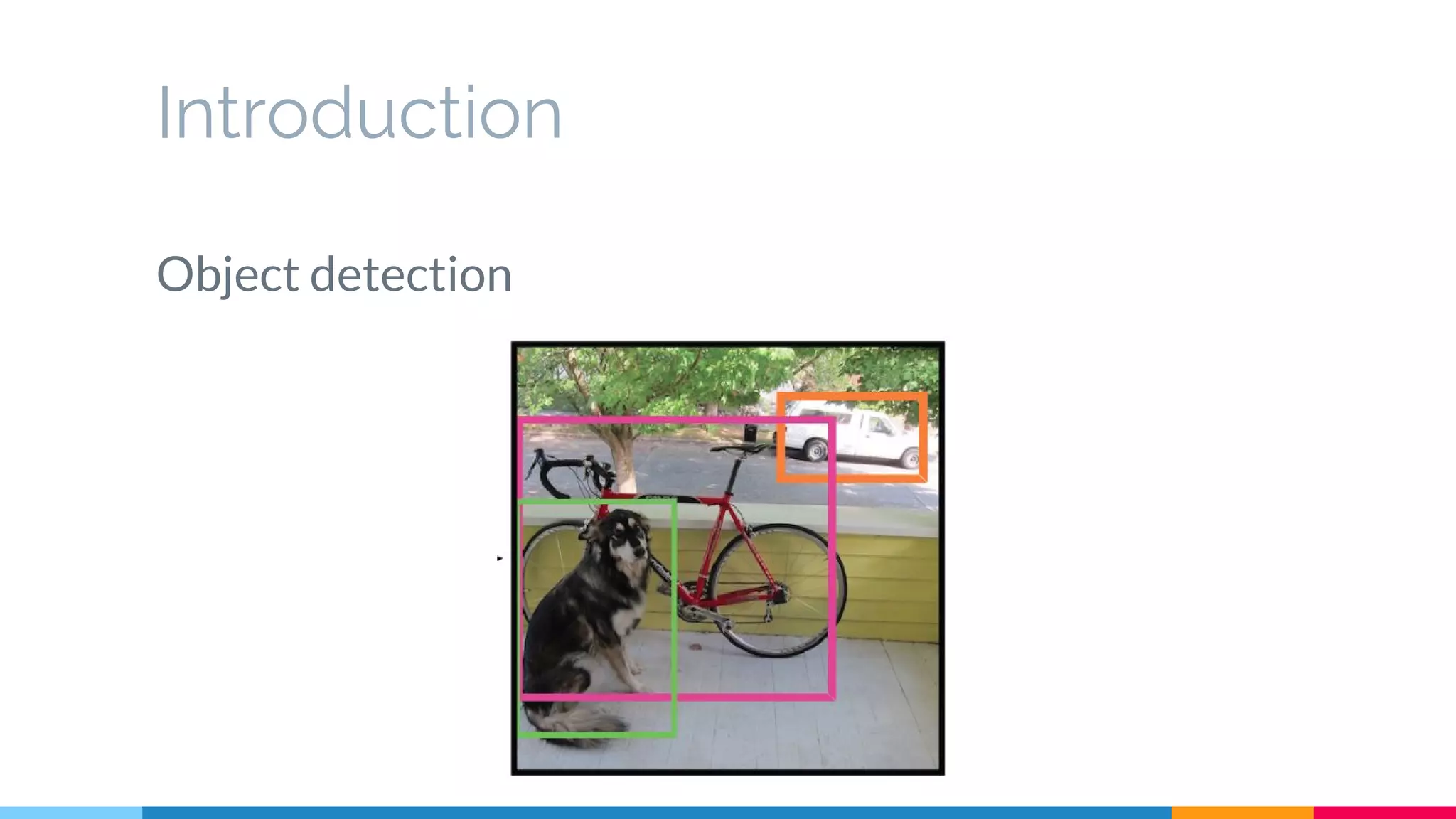
Object detection
Introduction
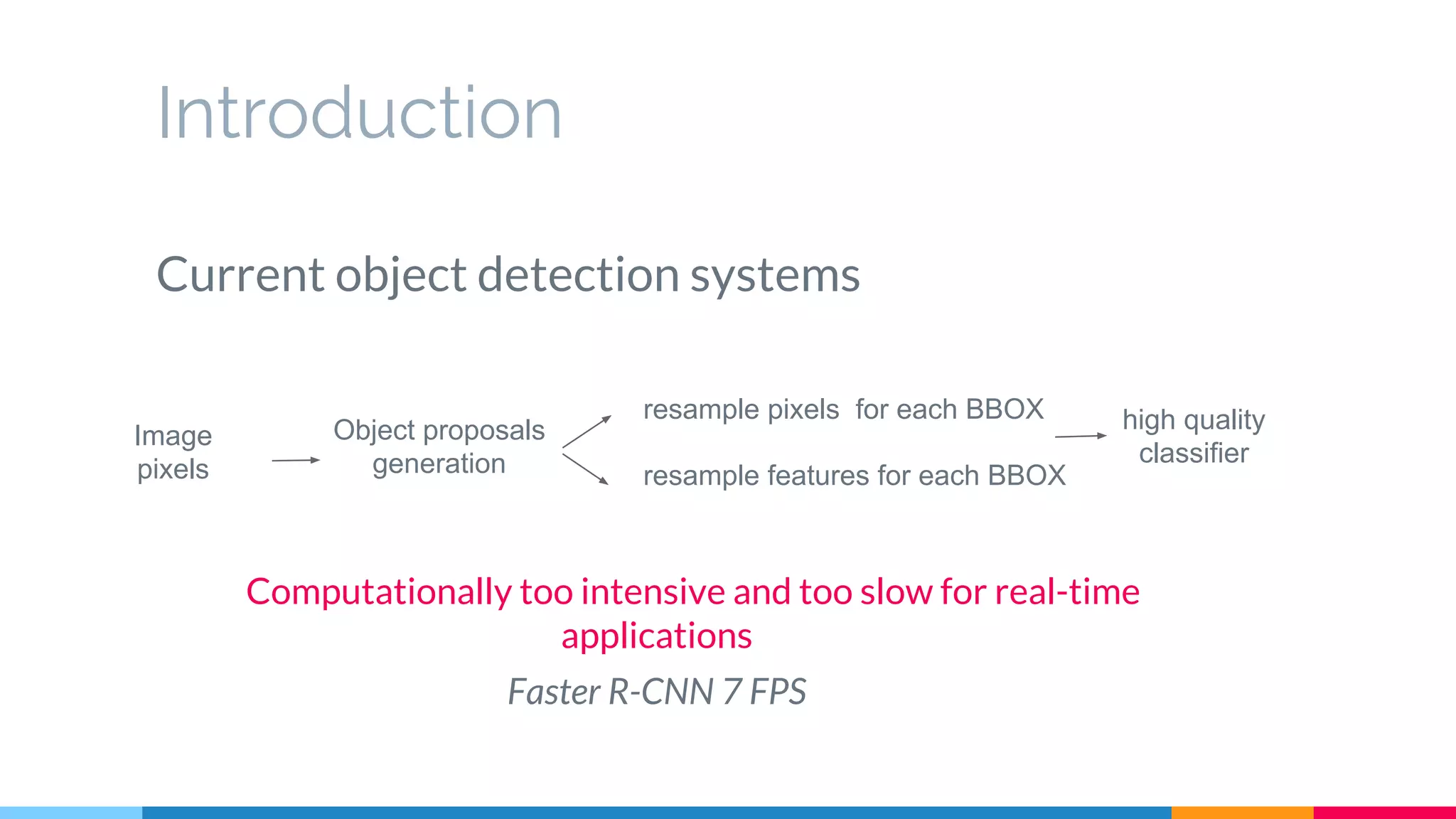
Current object detection systems
resample pixels for each BBOX
resample features for each BBOX
high quality
classifier
Object proposals
generation
Image
pixels
Introduction
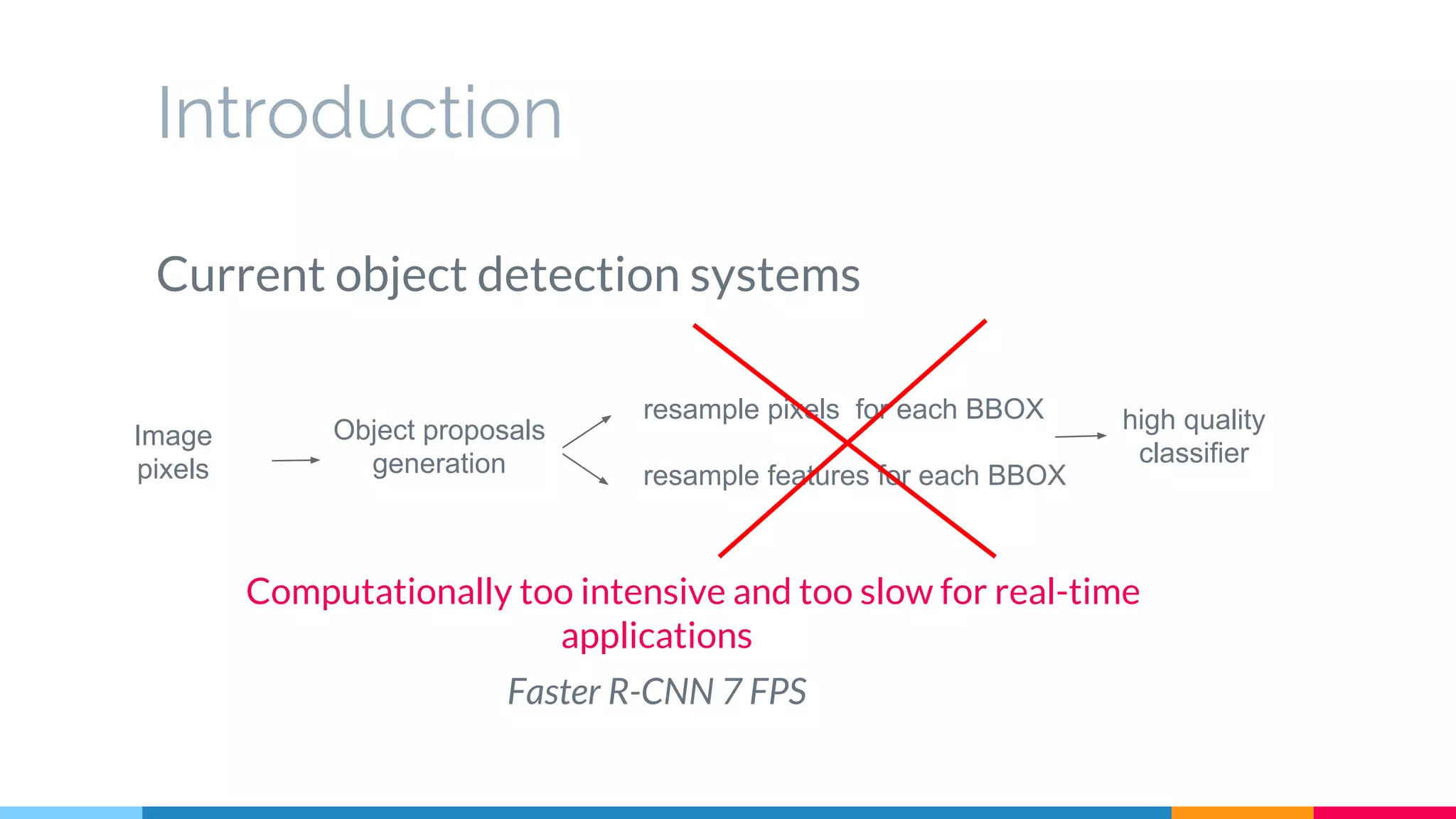
Current object detection systems
Computationally too intensive and too slow for real-time
applications
Faster R-CNN 7 FPS
resample pixels for each BBOX
resample features for each BBOX
high quality
classifier
Object proposals
generation
Image
pixels
Introduction
Current object detection systems
Computationally too intensive and too slow for real-time
applications
Faster R-CNN 7 FPS
resample pixels for each BBOX
resample features for each BBOX
high quality
classifier
Object proposals
generation
Image
pixels
Introduction
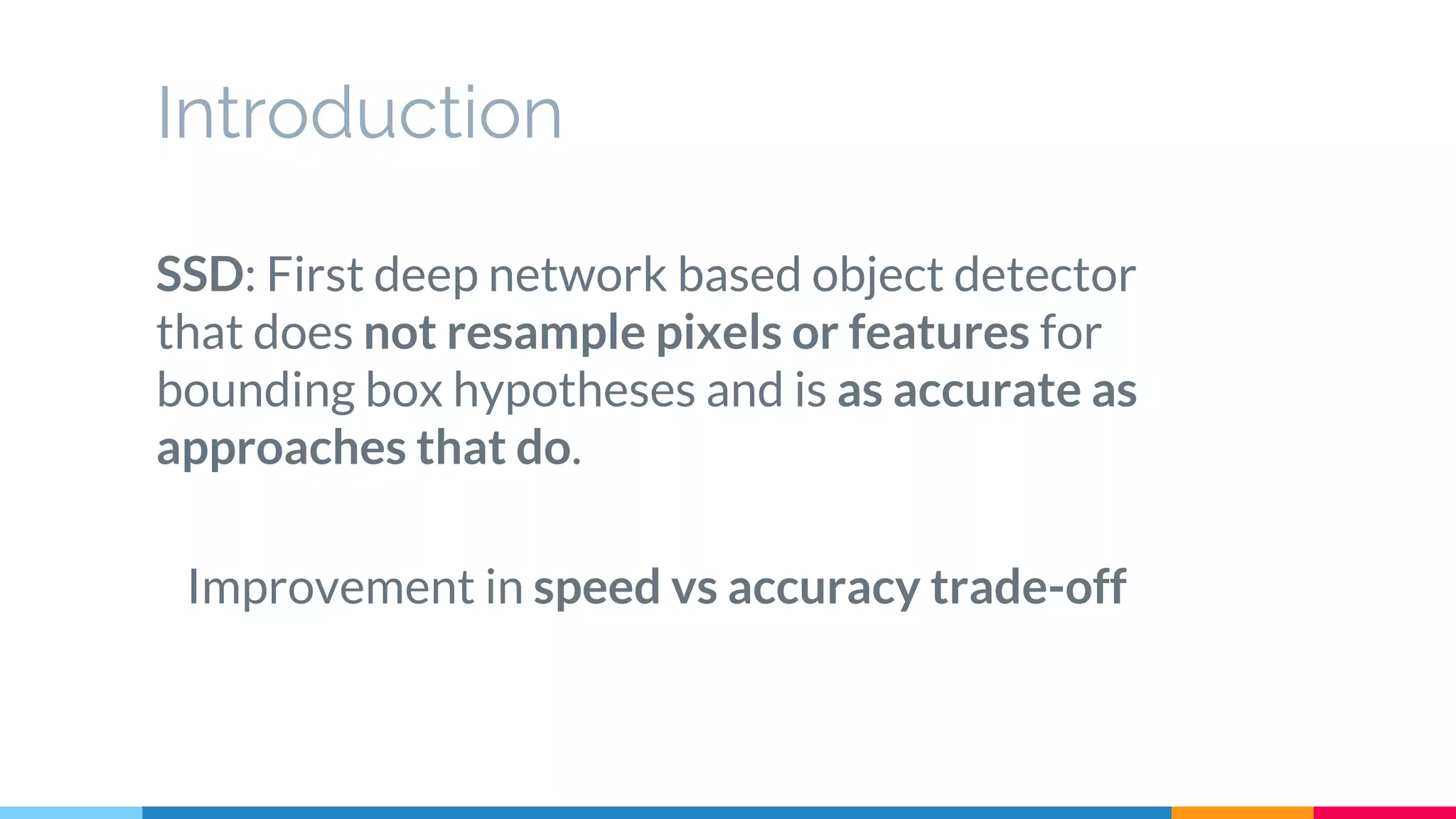
SSD: First deep network based object detector
that does not resample pixels or features for
bounding box hypotheses and is as accurate as
approaches that do.
Improvement in speed vs accuracy trade-off
Introduction
Introduction
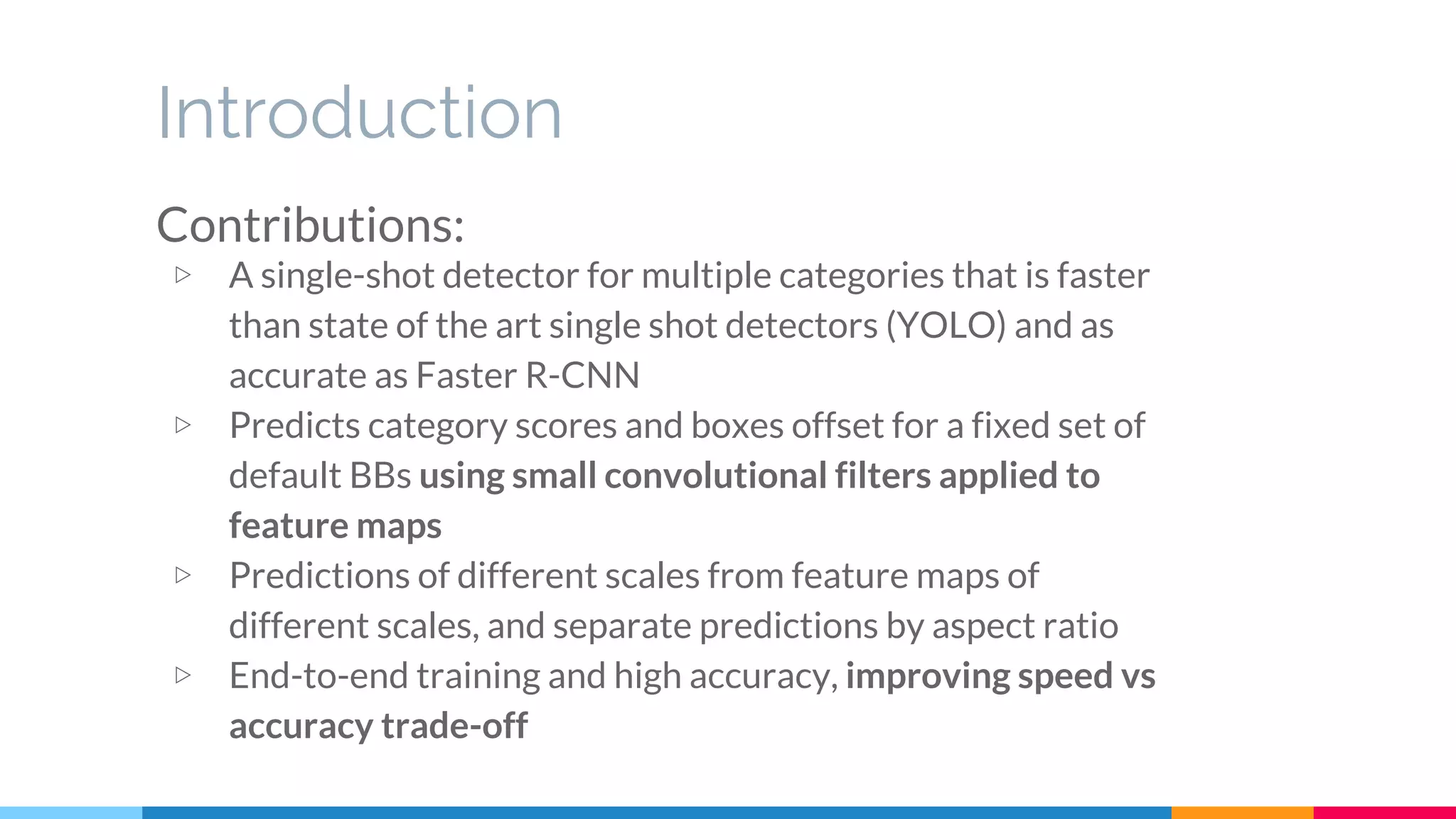
Contributions:
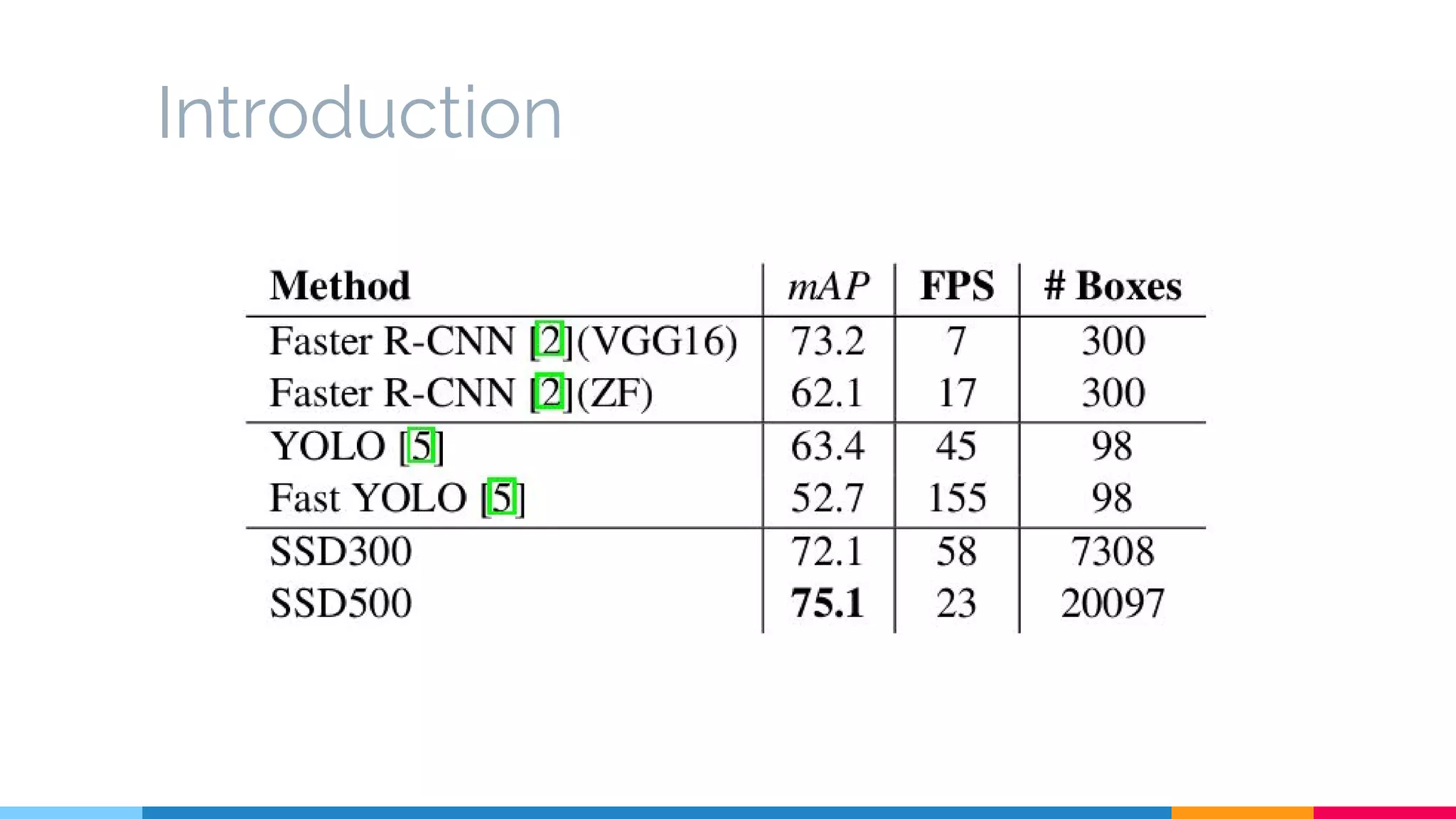
▷ A single-shot detector for multiple categories that is faster
than state of the art single shot detectors (YOLO) and as
accurate as Faster R-CNN
▷ Predicts category scores and boxes offset for a fixed set of
default BBs using small convolutional filters applied to
feature maps
▷ Predictions of different scales from feature maps of
different scales, and separate predictions by aspect ratio
▷ End-to-end training and high accuracy, improving speed vs
accuracy trade-off
2.
Related Work
SSD: Single Shot MultiBox Detector
Object Detection prior to CNNs
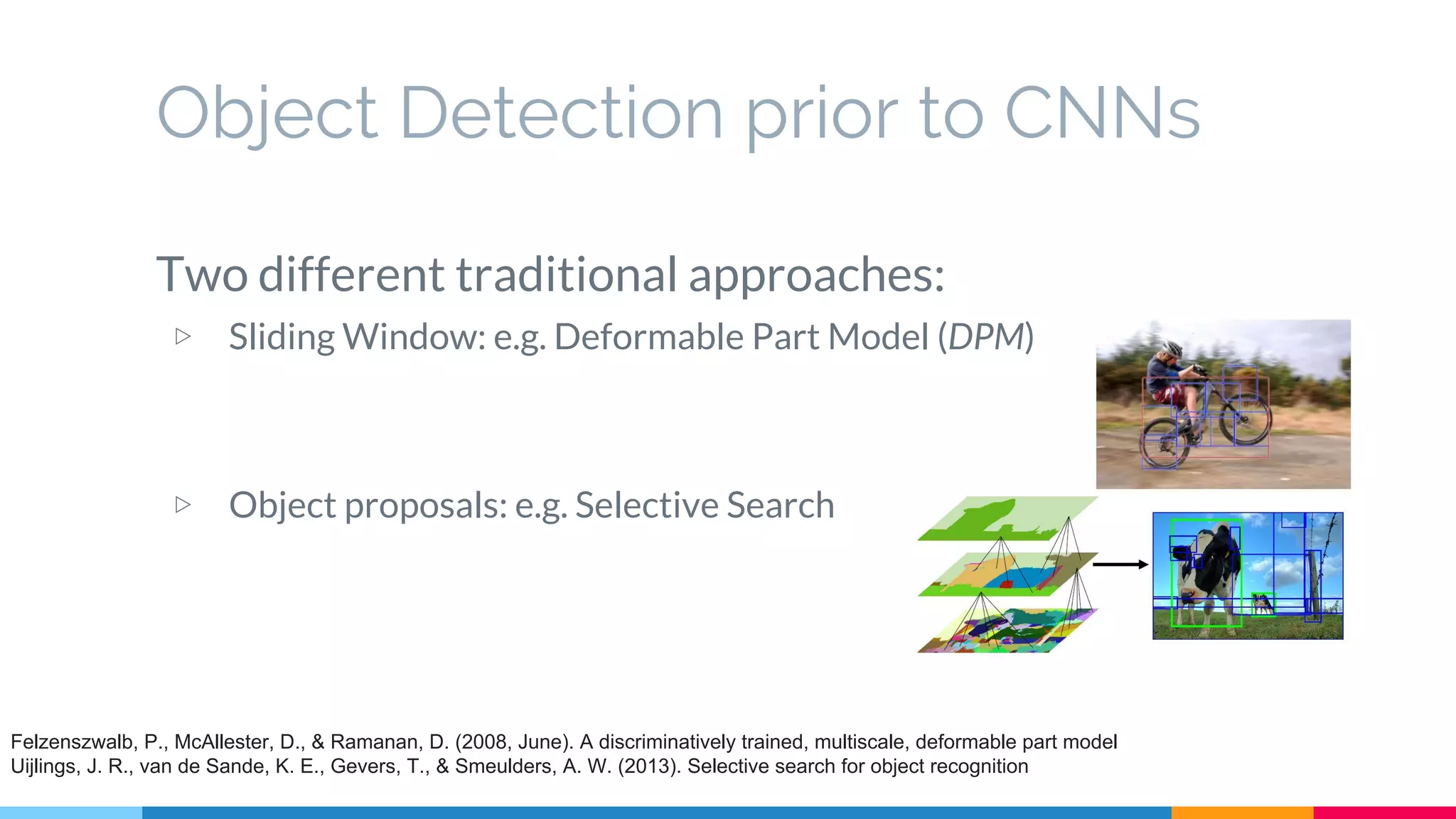
Two different traditional approaches:
▷ Sliding Window: e.g. Deformable Part Model (DPM)
▷ Object proposals: e.g. Selective Search
Felzenszwalb, P., McAllester, D., & Ramanan, D. (2008, June). A discriminatively trained, multiscale, deformable part model
Uijlings, J. R., van de Sande, K. E., Gevers, T., & Smeulders, A. W. (2013). Selective search for object recognition
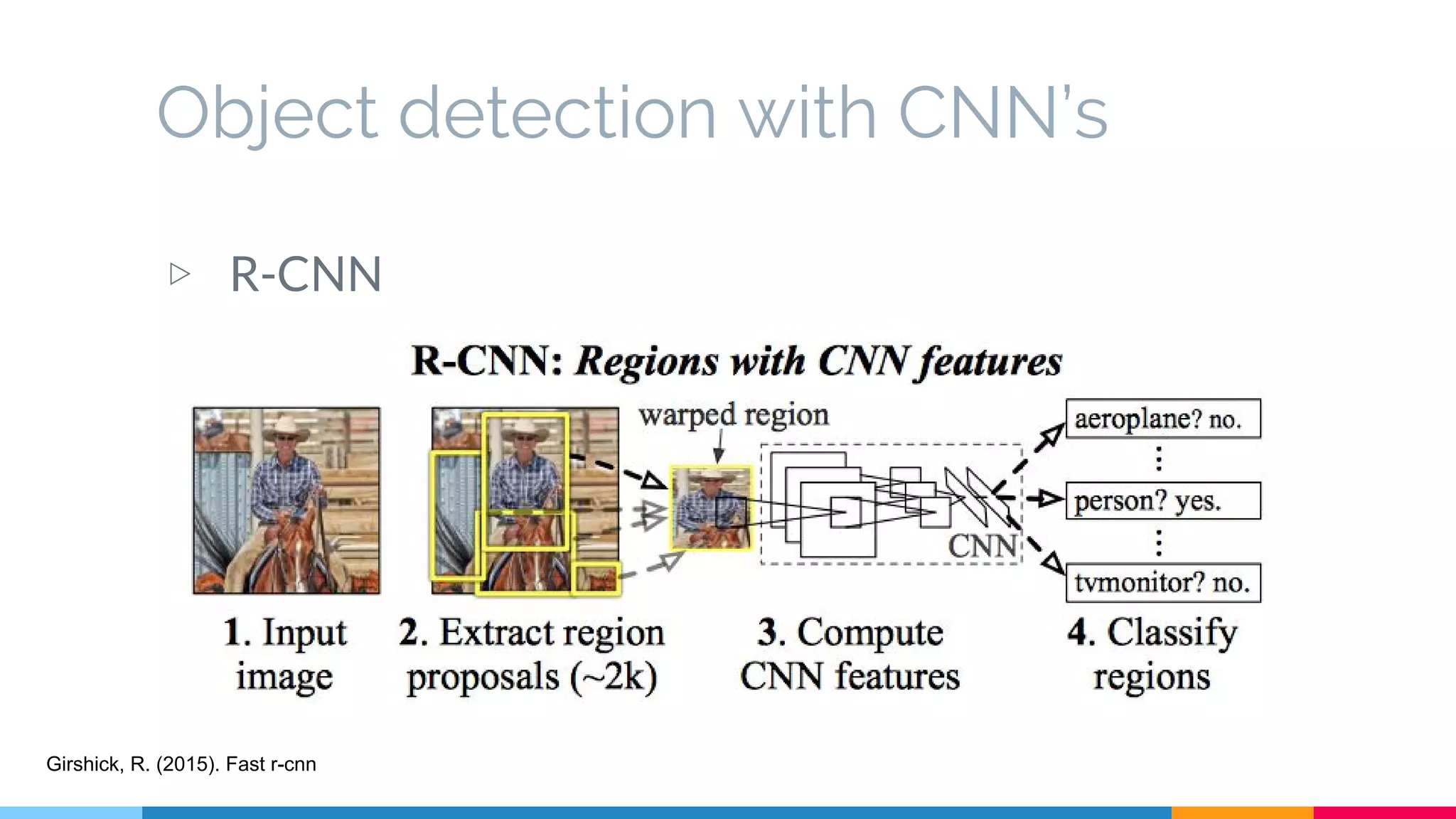
Object detection with CNN’s
▷ R-CNN
Girshick, R. (2015). Fast r-cnn
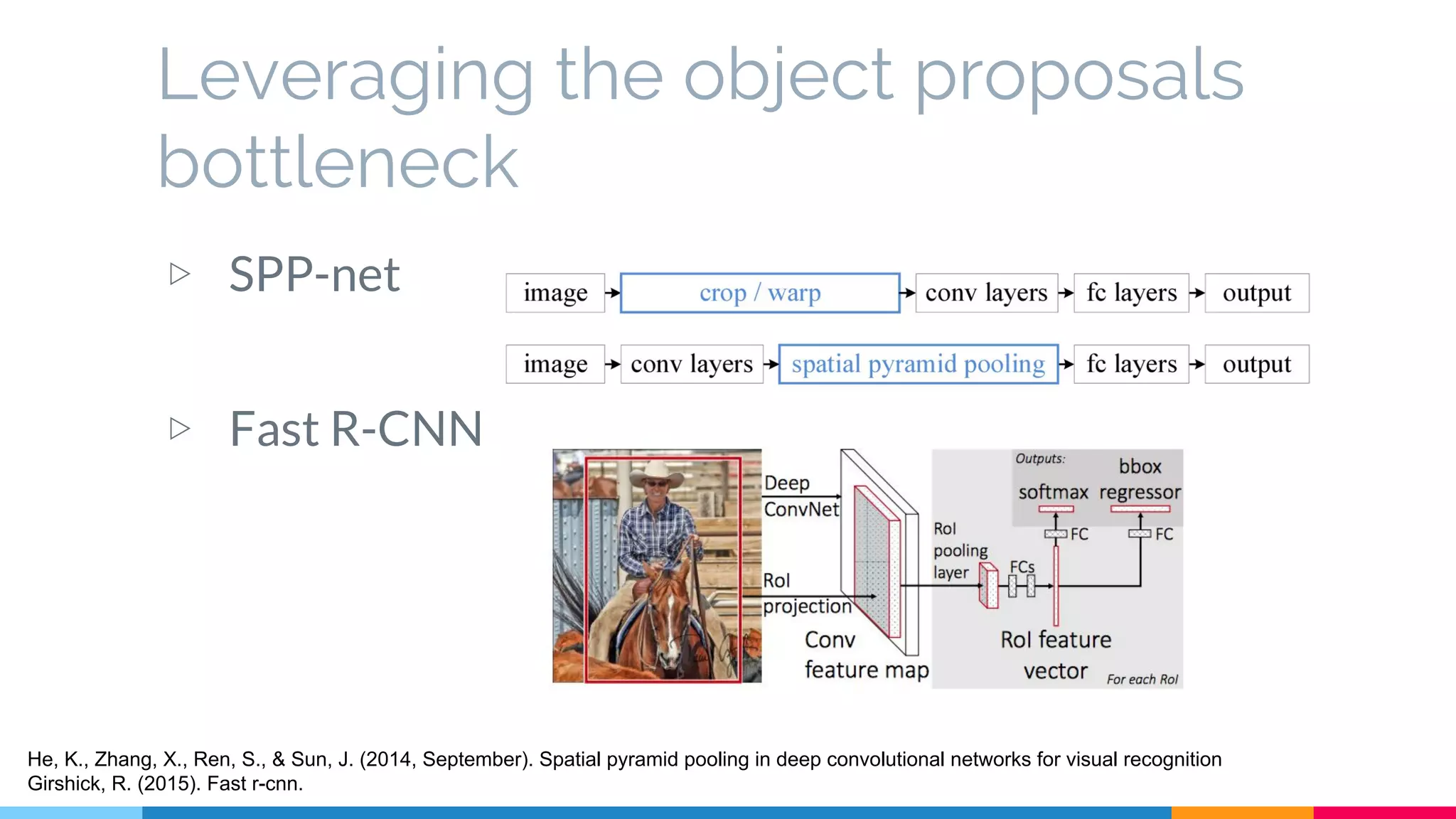
Leveraging the object proposals
bottleneck
▷ SPP-net
▷ Fast R-CNN
He, K., Zhang, X., Ren, S., & Sun, J. (2014, September). Spatial pyramid pooling in deep convolutional networks for visual recognition
Girshick, R. (2015). Fast r-cnn.
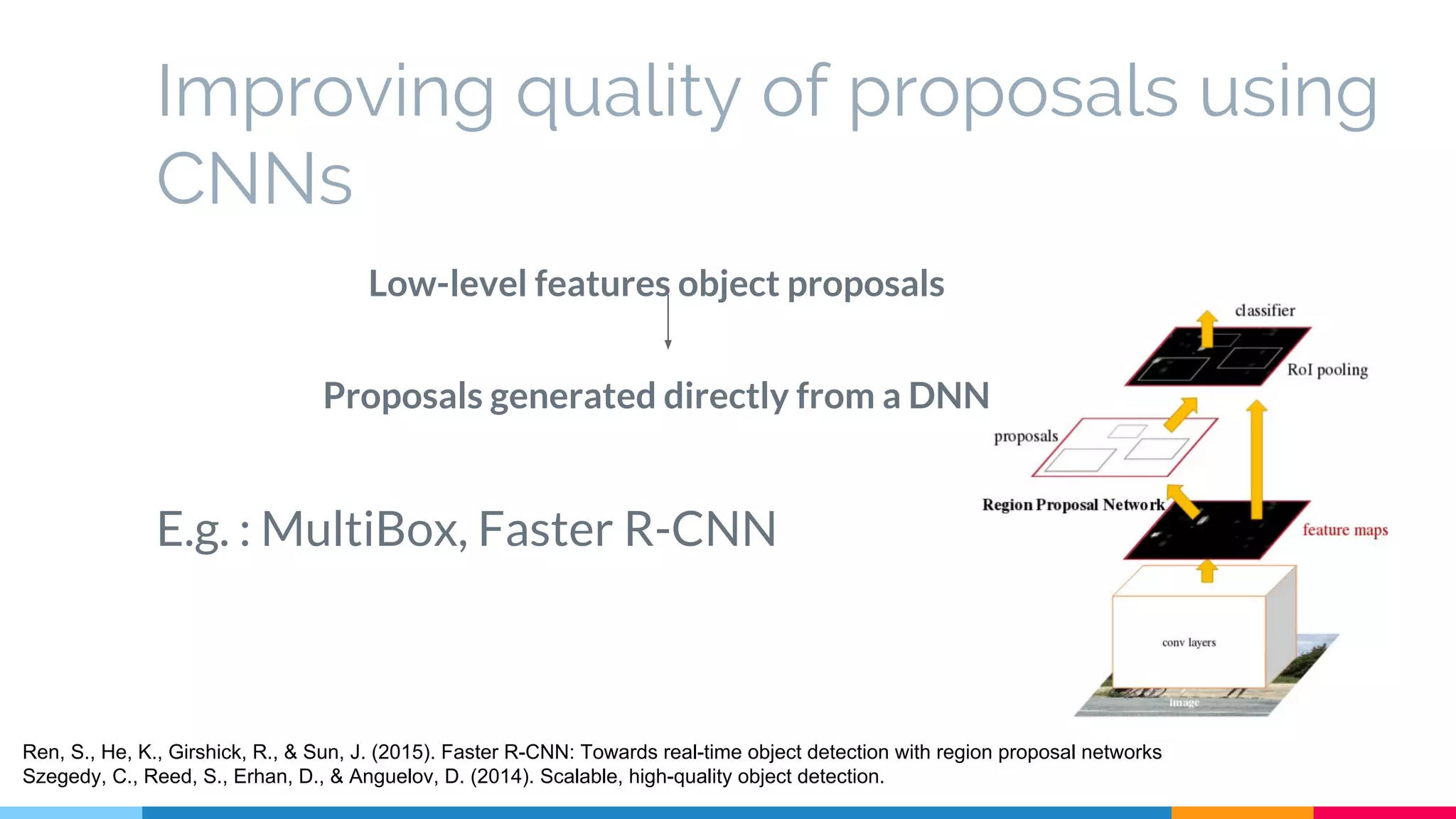
Improving quality of proposals using
CNNs
Low-level features object proposals
Proposals generated directly from a DNN
E.g. : MultiBox, Faster R-CNN
Ren, S., He, K., Girshick, R., & Sun, J. (2015). Faster R-CNN: Towards real-time object detection with region proposal networks
Szegedy, C., Reed, S., Erhan, D., & Anguelov, D. (2014). Scalable, high-quality object detection.
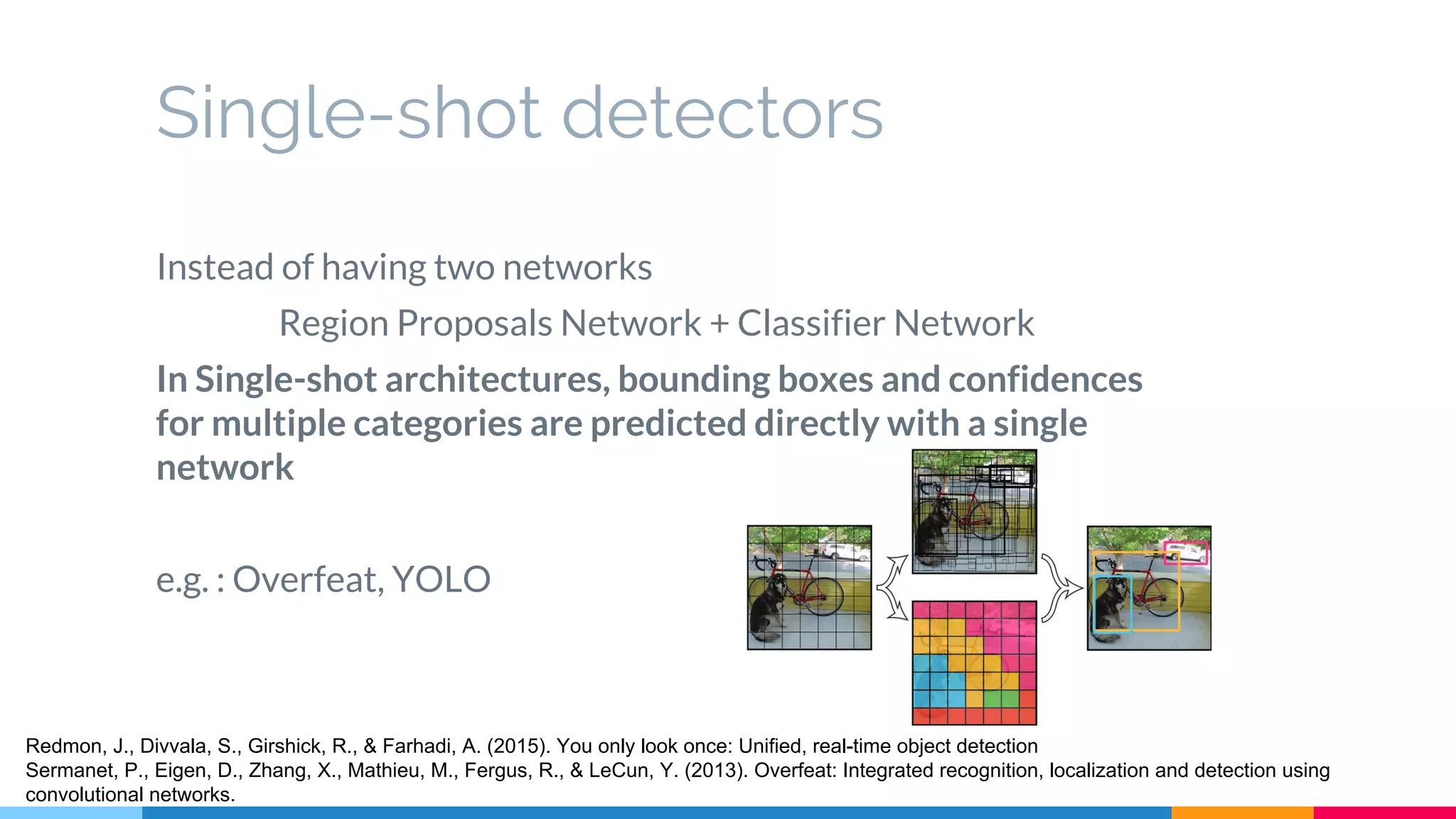
Single-shot detectors
Instead of having two networks
Region Proposals Network + Classifier Network
In Single-shot architectures, bounding boxes and confidences
for multiple categories are predicted directly with a single
network
e.g. : Overfeat, YOLO
Redmon, J., Divvala, S., Girshick, R., & Farhadi, A. (2015). You only look once: Unified, real-time object detection
Sermanet, P., Eigen, D., Zhang, X., Mathieu, M., Fergus, R., & LeCun, Y. (2013). Overfeat: Integrated recognition, localization and detection using
convolutional networks.
Single-shot detectors
Main differences of SSD over YOLO and Overfeat:
▷ Small conv. filters to predict object categories and offsets in BBs
locations, using separate predictors for different aspect ratios, and
applying them on different feature maps to perform detection on multiple
scales
3.1
The Single Shot Detector (SSD)
Model
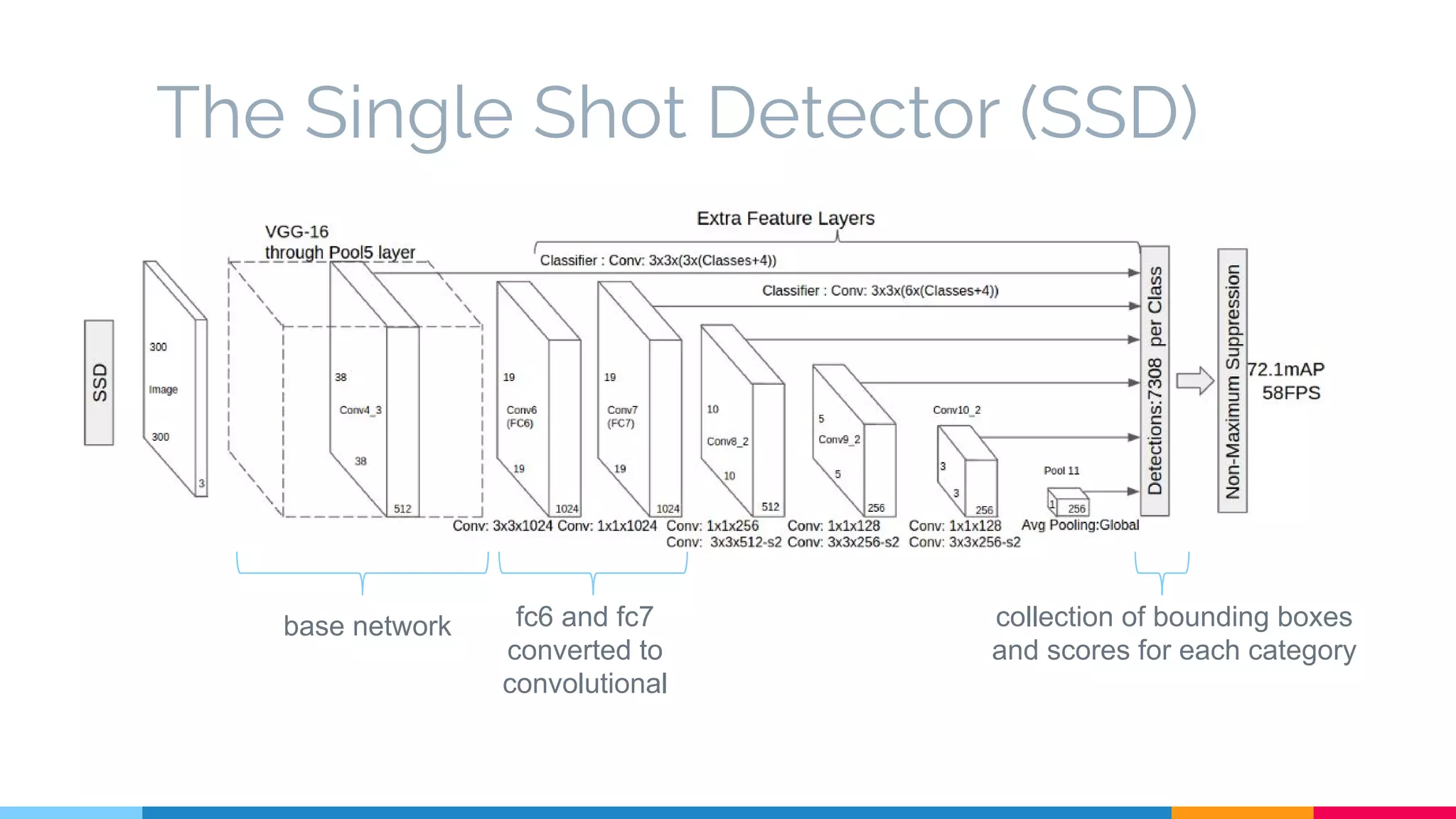
The Single Shot Detector (SSD)
base network fc6 and fc7
converted to
convolutional
collection of bounding boxes
and scores for each category
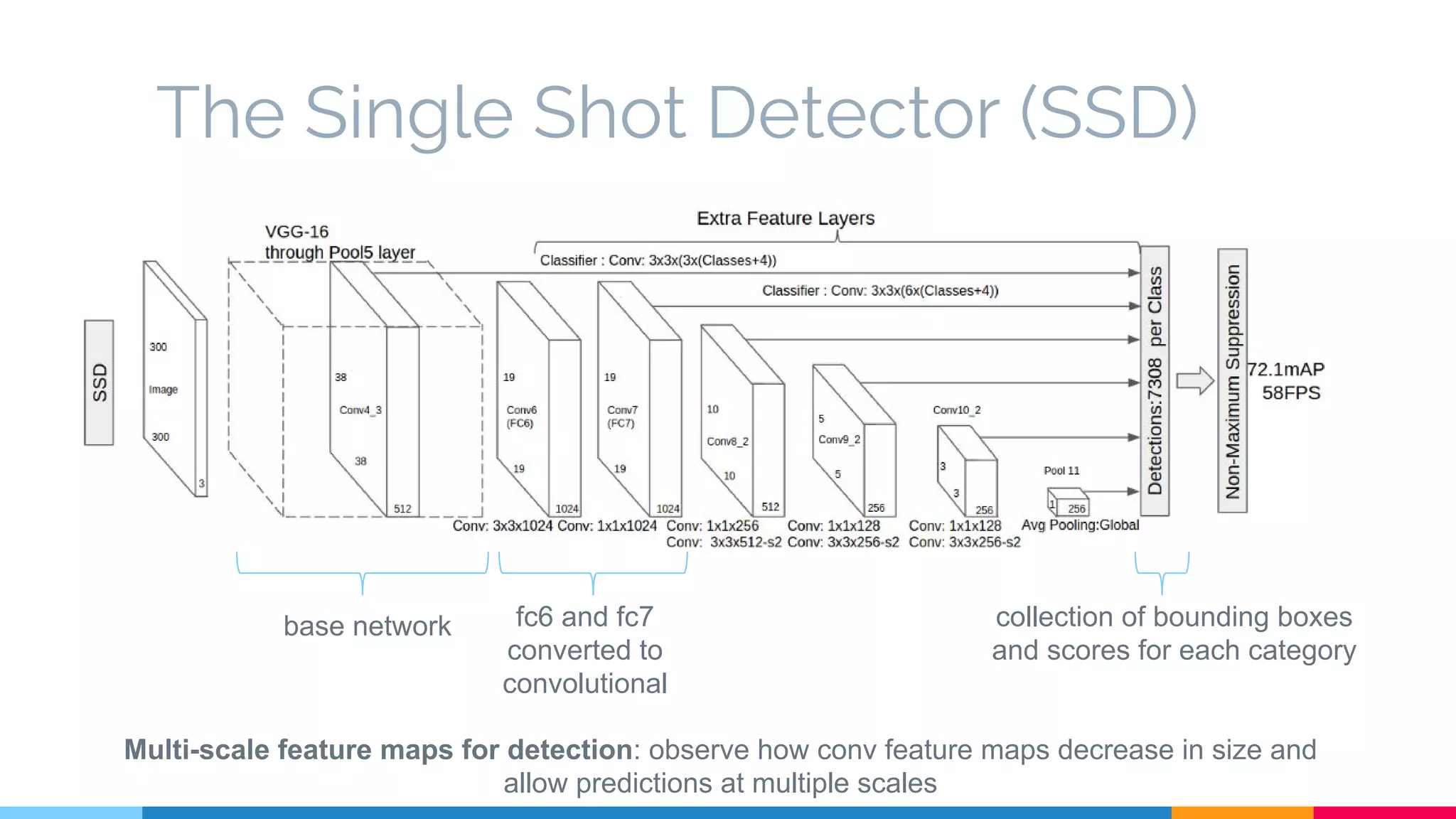
The Single Shot Detector (SSD)
base network fc6 and fc7
converted to
convolutional
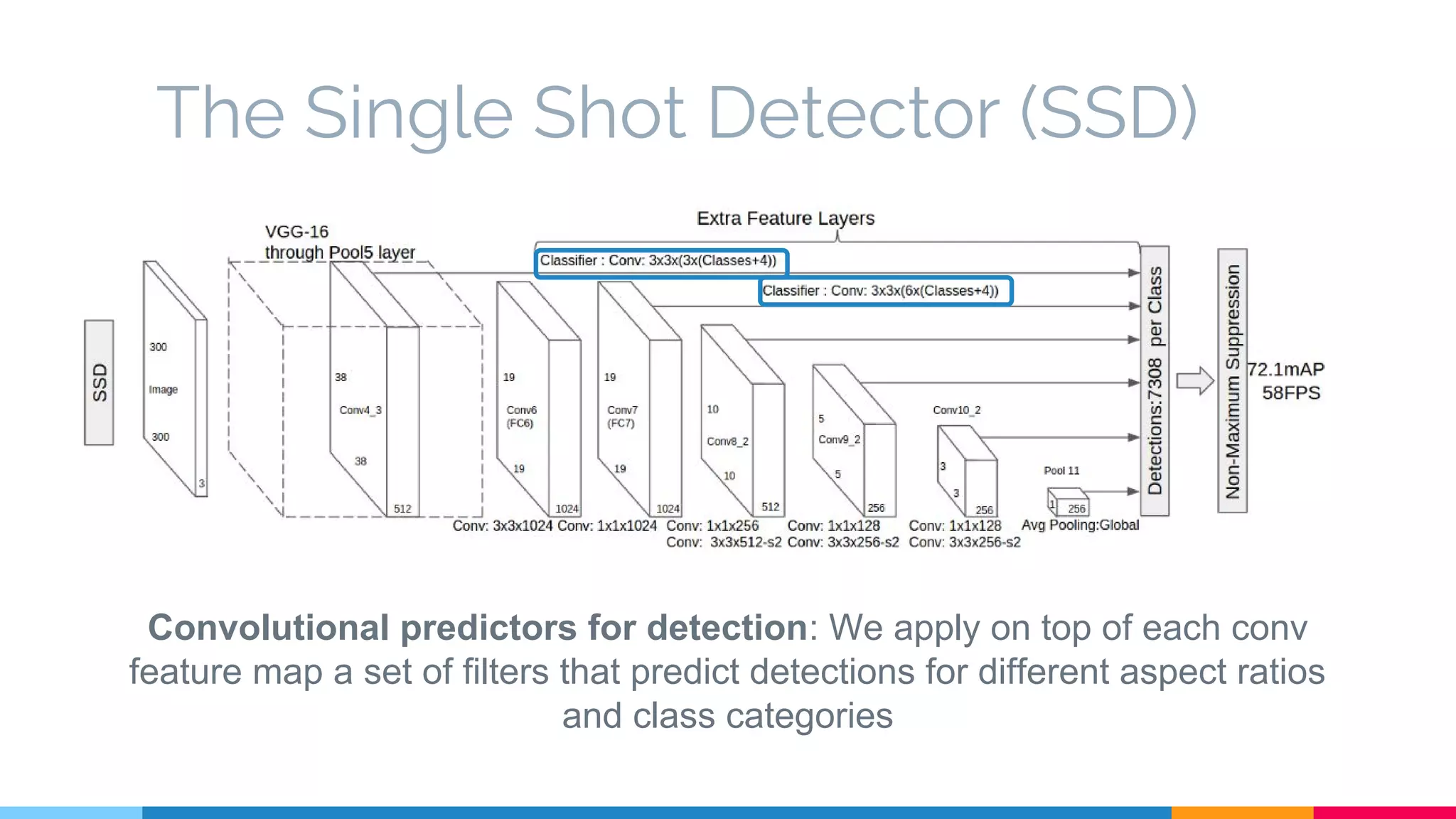
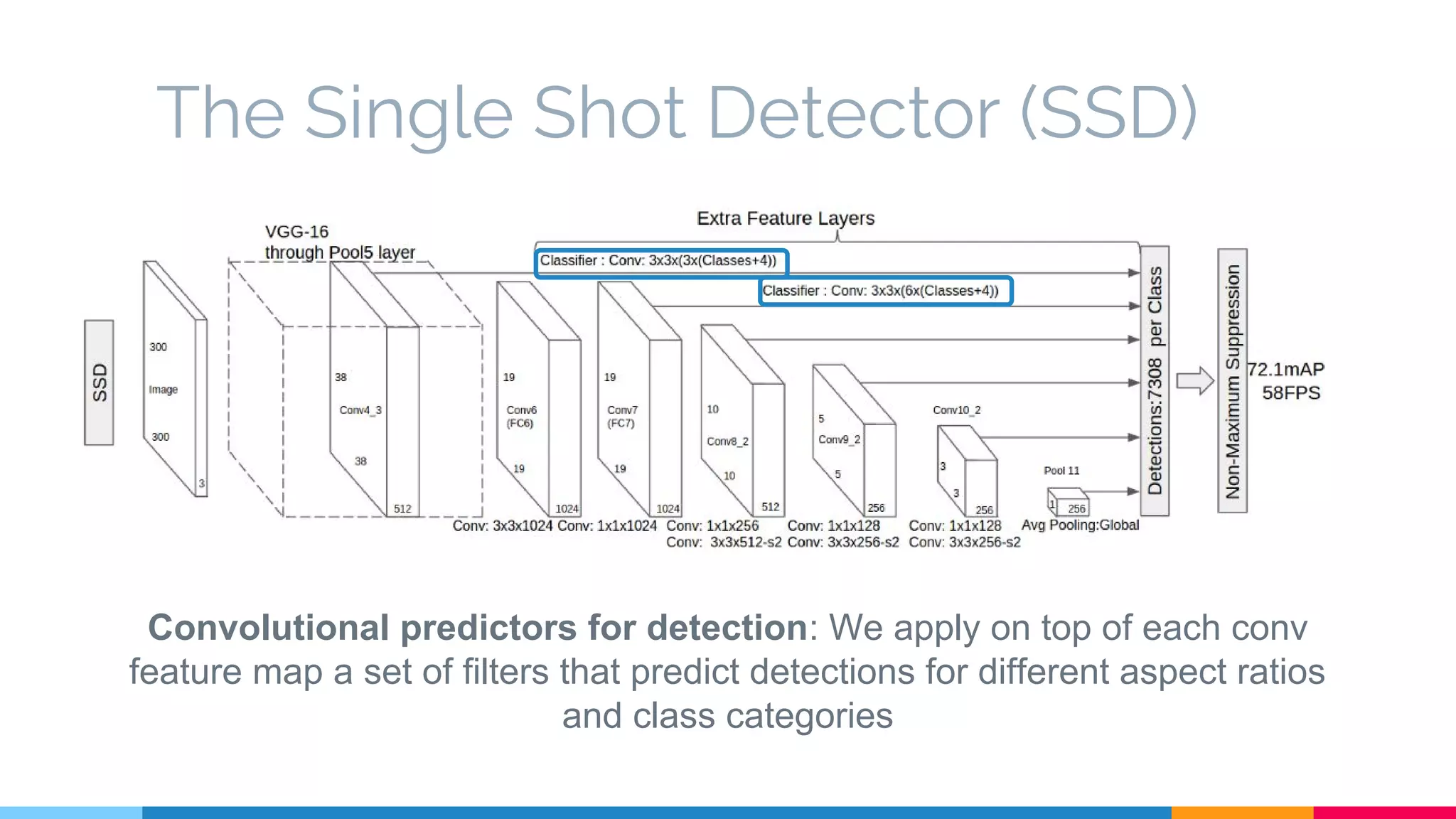
Multi-scale feature maps for detection: observe how conv feature maps decrease in size and
allow predictions at multiple scales
collection of bounding boxes
and scores for each category
The Single Shot Detector (SSD)
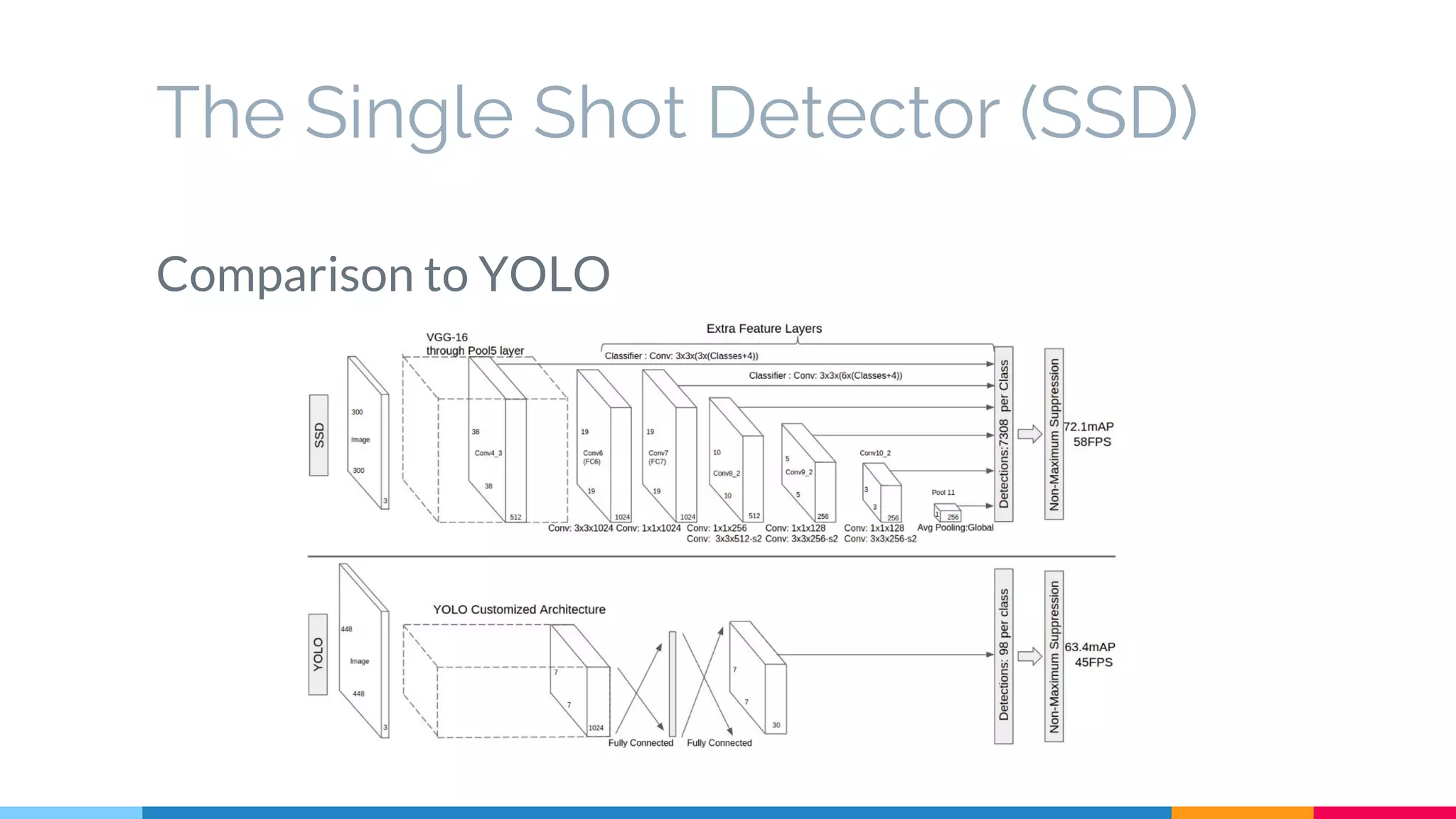
Comparison to YOLO
The Single Shot Detector (SSD)
Convolutional predictors for detection: We apply on top of each conv
feature map a set of filters that predict detections for different aspect ratios
and class categories
The Single Shot Detector (SSD)
What is a detection ?
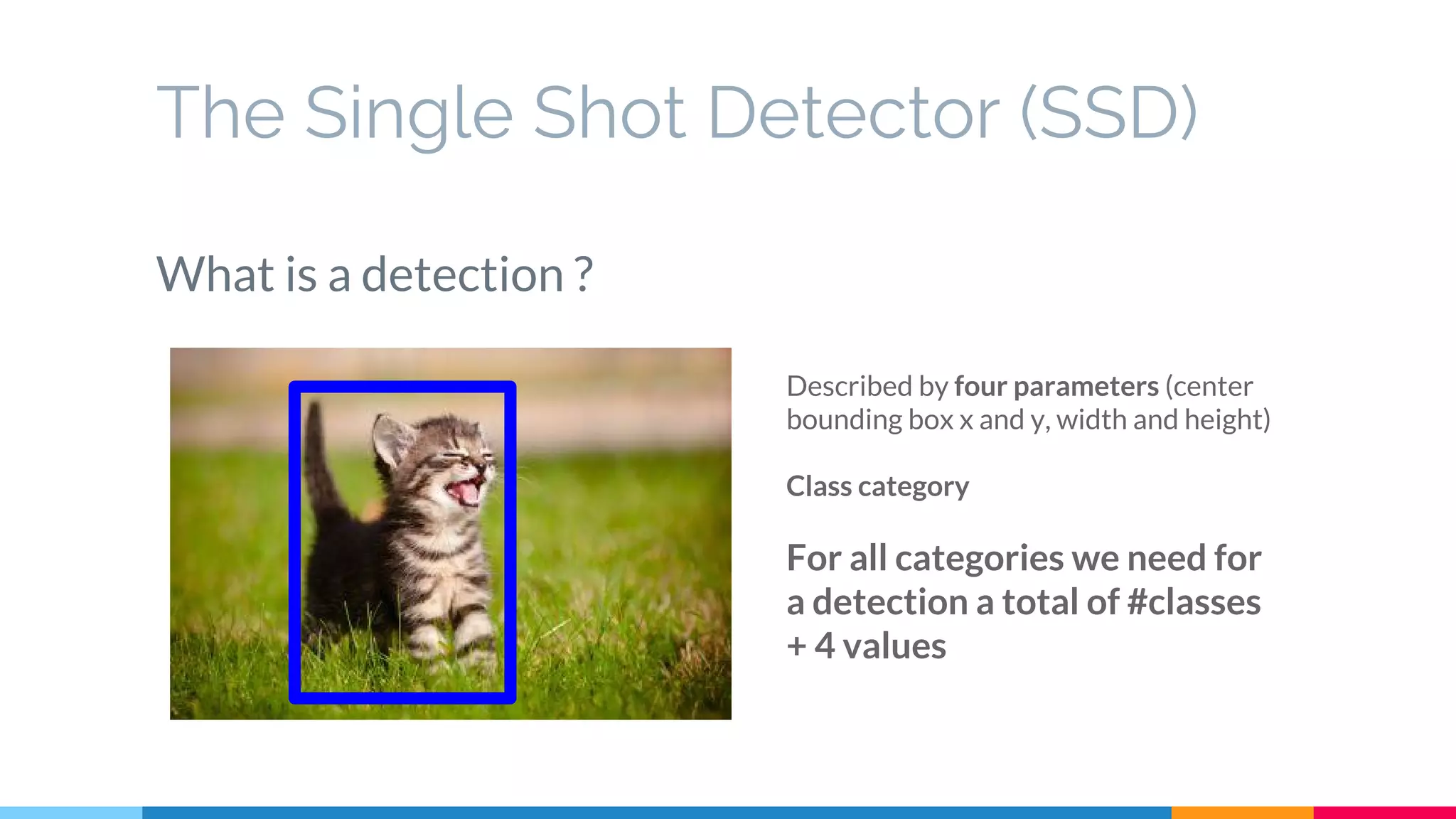
Described by four parameters (center
bounding box x and y, width and height)
Class category
For all categories we need for
a detection a total of #classes
+ 4 values
The Single Shot Detector (SSD)
Detector for SSD:
Each detector will output a single value, so we need
(classes + 4) detectors for a detection
The Single Shot Detector (SSD)
Detector for SSD:
Each detector will output a single value, so we need
(classes + 4) detectors for a detection
BUT there are different types of detections!
The Single Shot Detector (SSD)
Different “classes” of detections
aspect ratio 2:1
for cats
aspect ratio 1:2
for cats
aspect ratio 1:1
for cats
The Single Shot Detector (SSD)
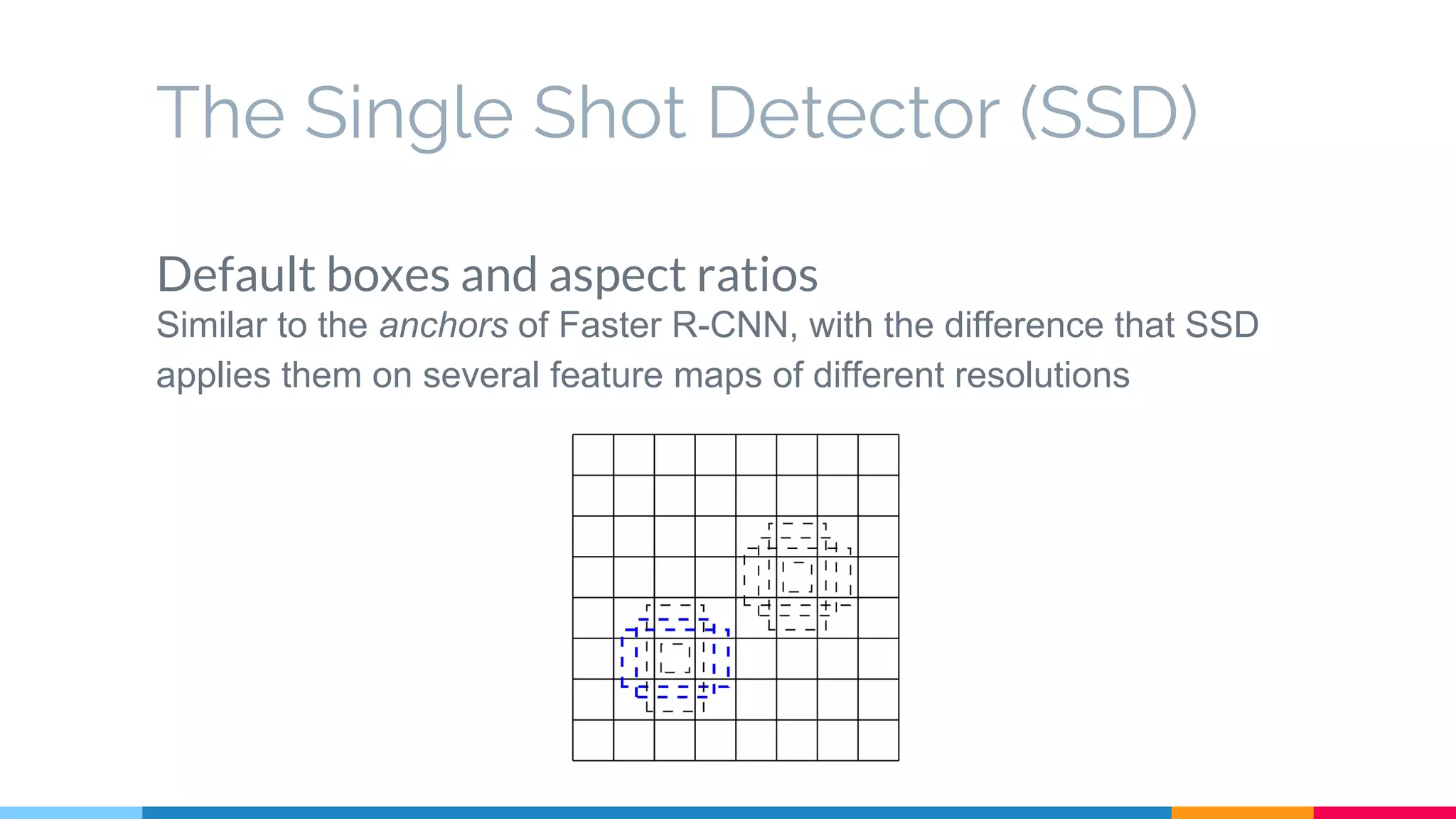
Default boxes and aspect ratios
Similar to the anchors of Faster R-CNN, with the difference that SSD
applies them on several feature maps of different resolutions
The Single Shot Detector (SSD)
Detector for SSD:
Each detector will output a single value, so we need
(classes + 4) detectors for a detection
as we have #default boxes, we need
(classes + 4) x #default boxes detectors
The Single Shot Detector (SSD)
Convolutional predictors for detection: We apply on top of each conv
feature map a set of filters that predict detections for different aspect ratios
and class categories
The Single Shot Detector (SSD)
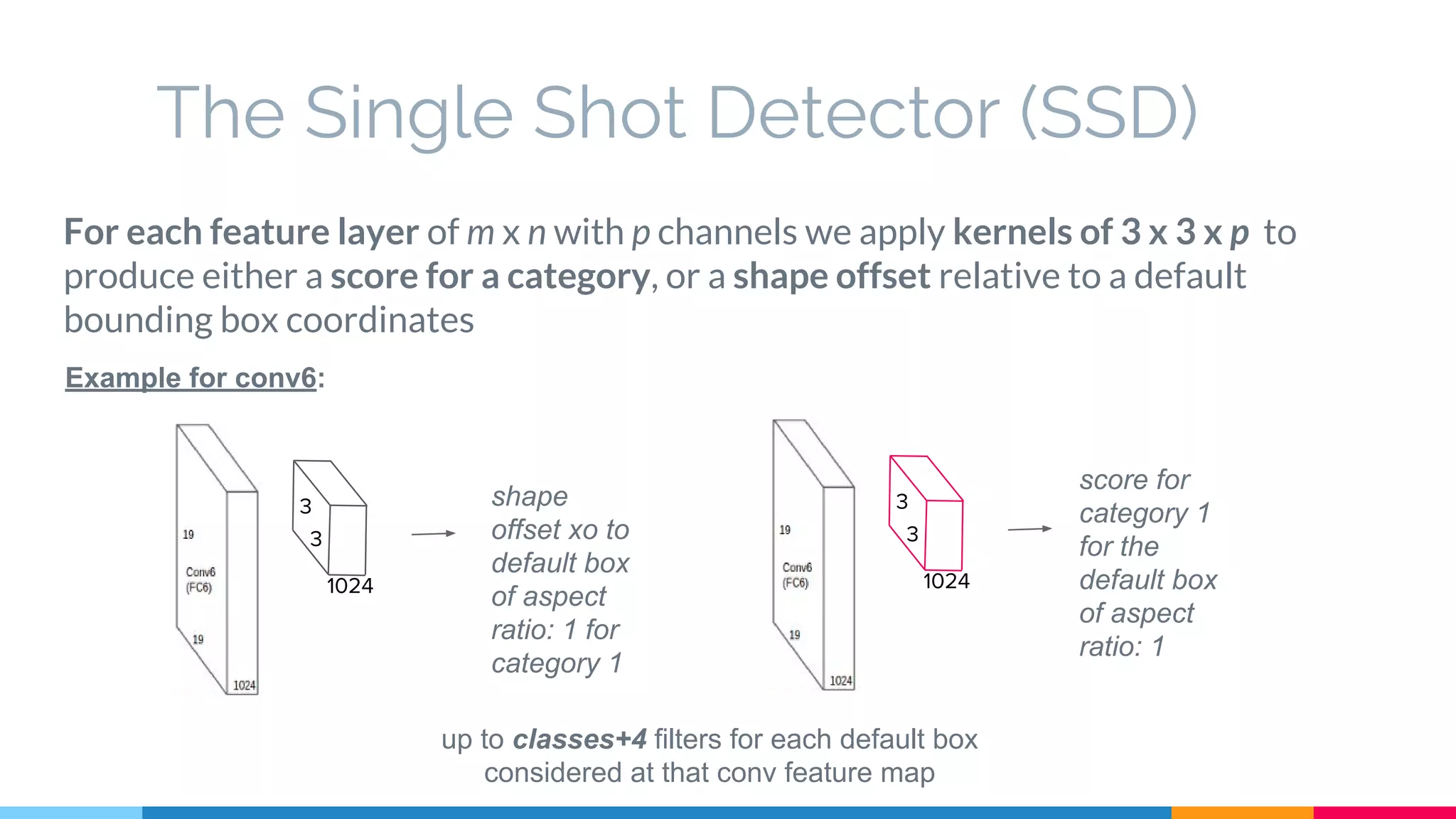
For each feature layer of m x n with p channels we apply kernels of 3 x 3 x p to
produce either a score for a category, or a shape offset relative to a default
bounding box coordinates
1024
3
3
Example for conv6:
shape
offset xo to
default box
of aspect
ratio: 1 for
category 1
1024
3
3
score for
category 1
for the
default box
of aspect
ratio: 1
up to classes+4 filters for each default box
considered at that conv feature map
The Single Shot Detector (SSD)
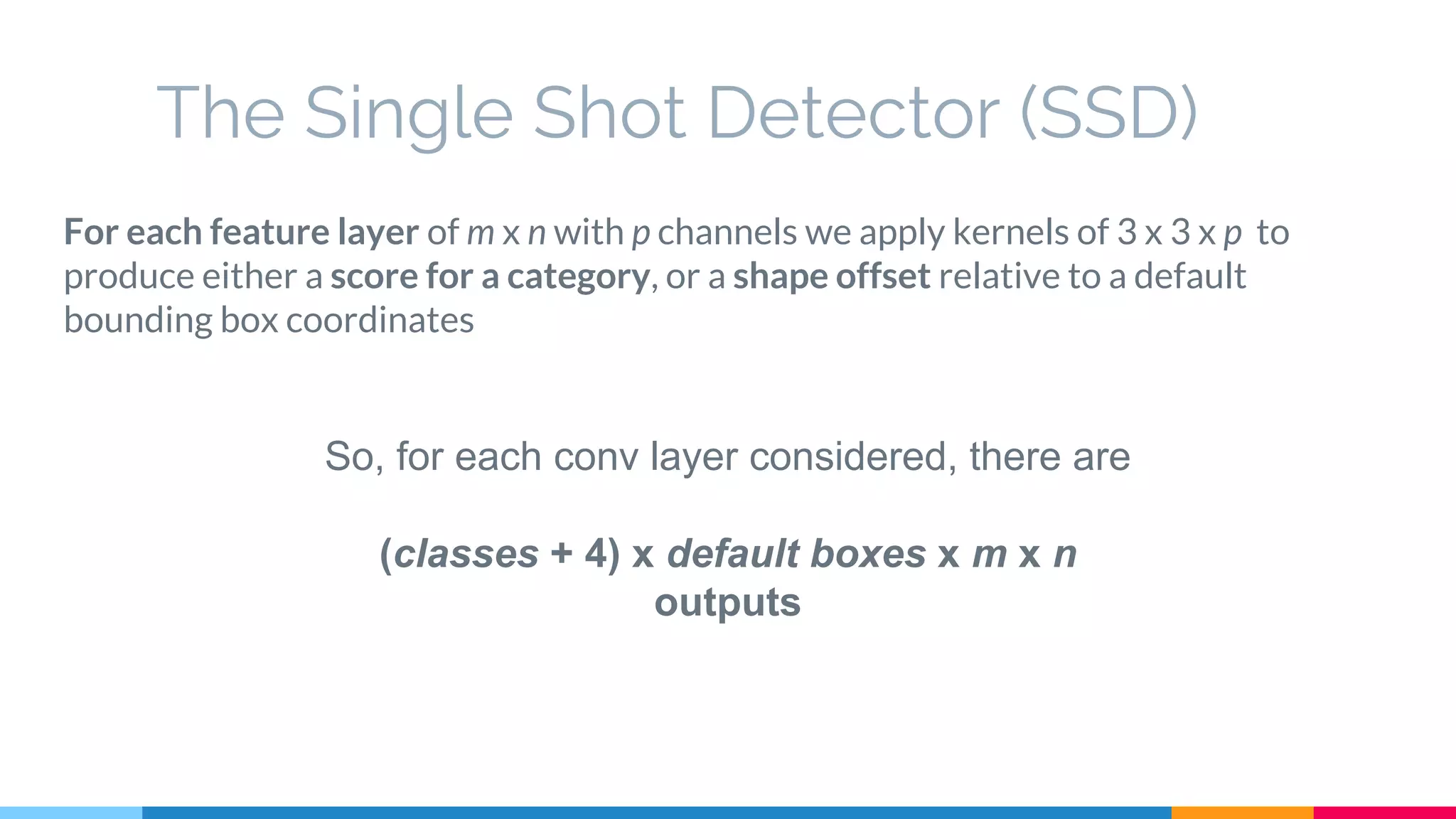
For each feature layer of m x n with p channels we apply kernels of 3 x 3 x p to
produce either a score for a category, or a shape offset relative to a default
bounding box coordinates
So, for each conv layer considered, there are
(classes + 4) x default boxes x m x n
outputs
3.2
The Single Shot Detector (SSD)
Training
The Single Shot Detector (SSD)
SSD requires that ground-truth data
is assigned to specific outputs in the
fixed set of detector outputs
The Single Shot Detector (SSD)
Matching strategy:
For each ground truth box we have to select from all the
default boxes the ones that best fit in terms of location, aspect
ratio and scale.
▷ We select the default box with best jaccard overlap. Then
every box has at least 1 correspondence.
▷ Default boxes with a jaccard overlap higher than 0.5 are
also selected
The Single Shot Detector (SSD)
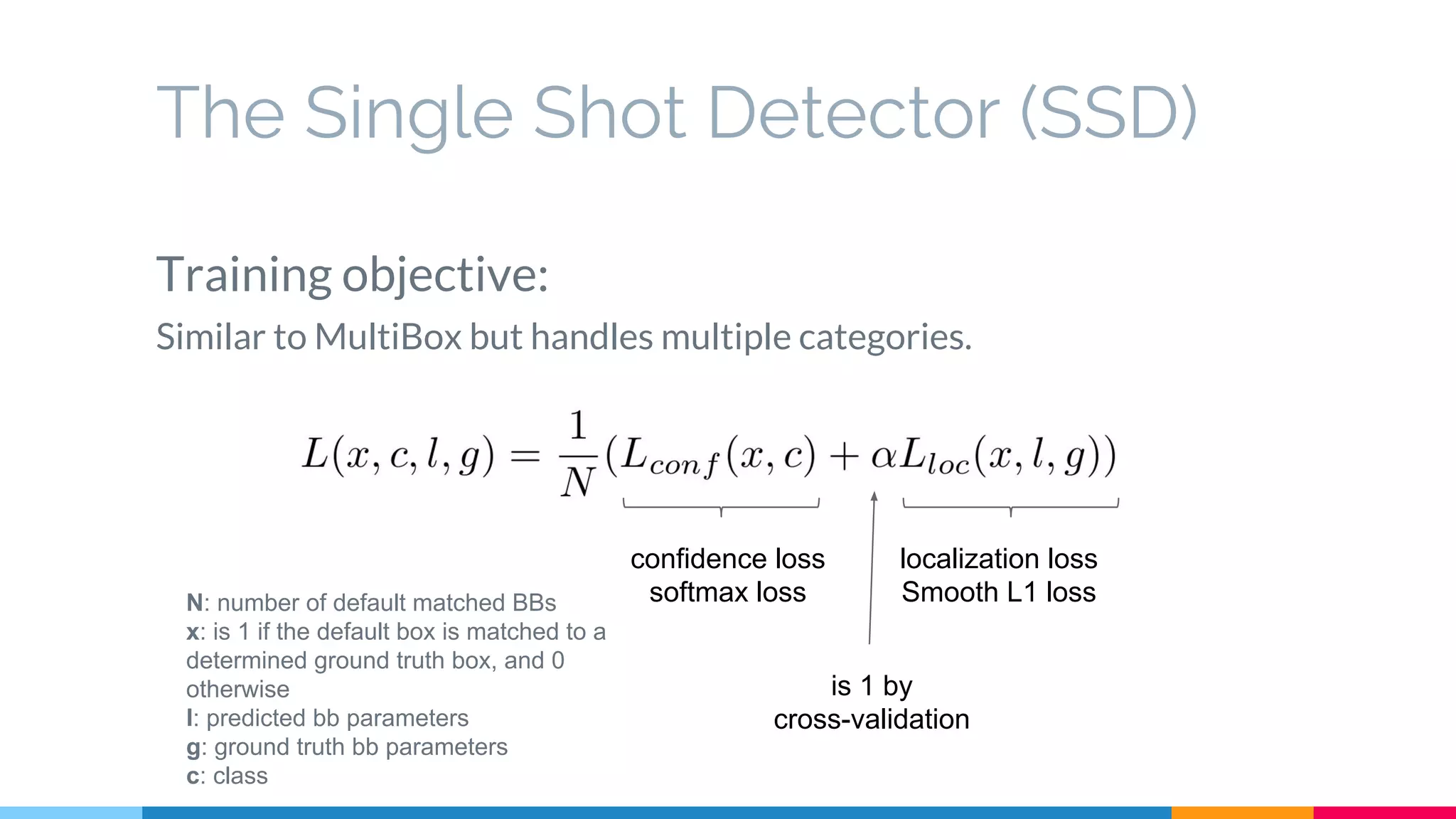
Training objective:
Similar to MultiBox but handles multiple categories.
confidence loss
softmax loss
localization loss
Smooth L1 lossN: number of default matched BBs
x: is 1 if the default box is matched to a
determined ground truth box, and 0
otherwise
l: predicted bb parameters
g: ground truth bb parameters
c: class
is 1 by
cross-validation
The Single Shot Detector (SSD)
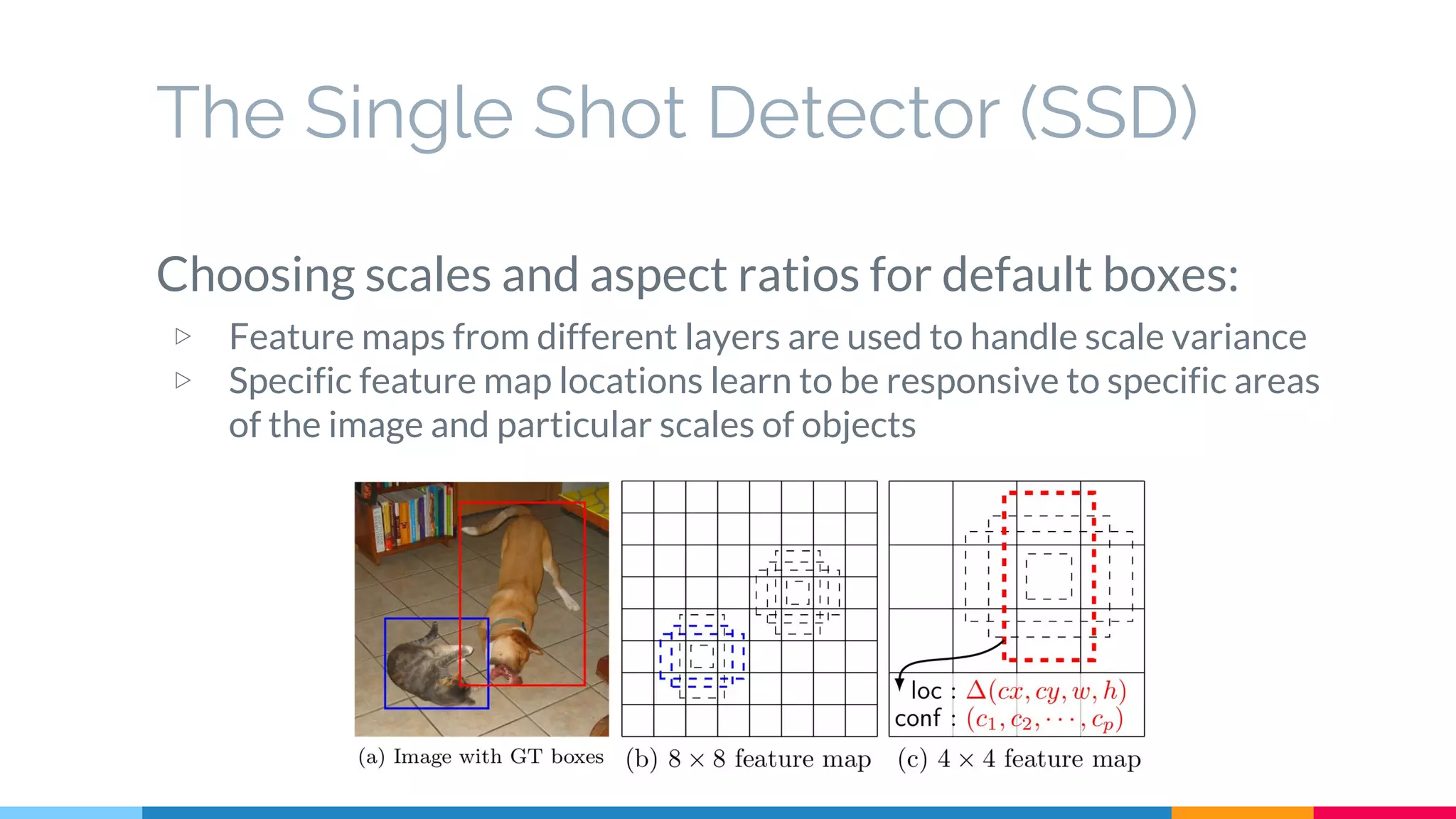
Choosing scales and aspect ratios for default boxes:
▷ Feature maps from different layers are used to handle scale variance
▷ Specific feature map locations learn to be responsive to specific areas
of the image and particular scales of objects
The Single Shot Detector (SSD)
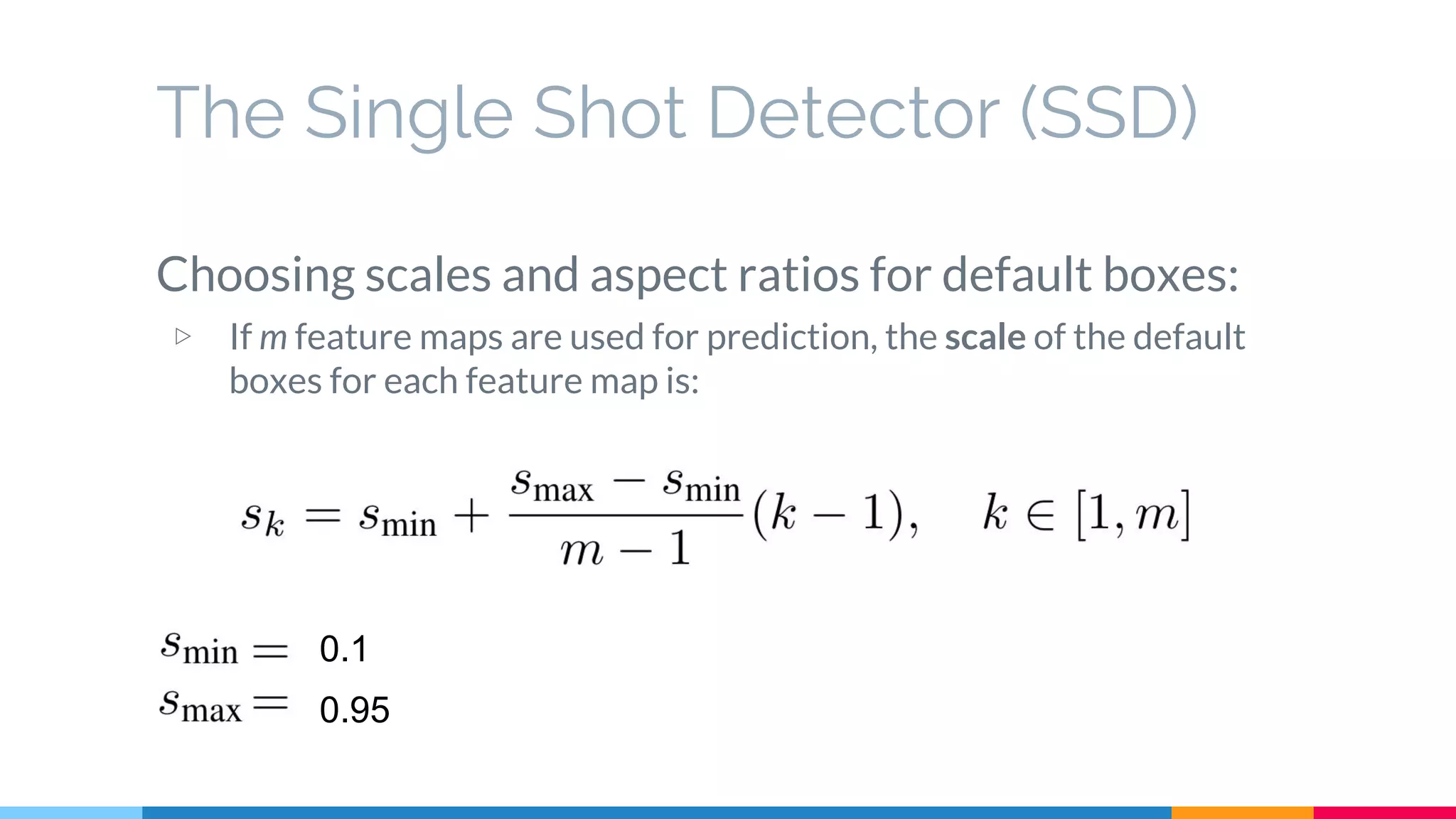
Choosing scales and aspect ratios for default boxes:
▷ If m feature maps are used for prediction, the scale of the default
boxes for each feature map is:
0.1
0.95
The Single Shot Detector (SSD)
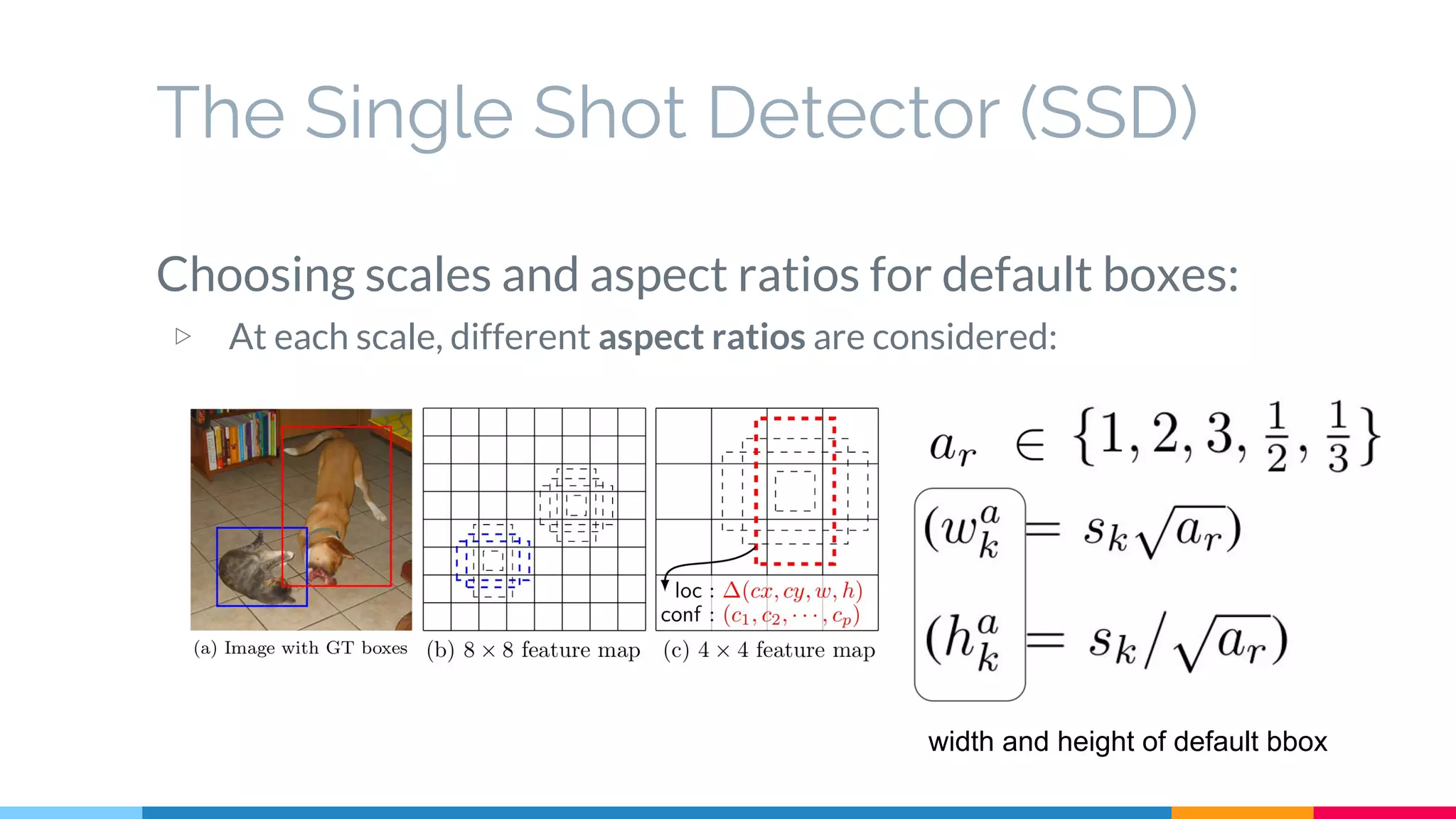
Choosing scales and aspect ratios for default boxes:
▷ At each scale, different aspect ratios are considered:
width and height of default bbox
The Single Shot Detector (SSD)
Hard negative mining:
Significant imbalance between positive and negative training examples
▷ Use negative samples with higher confidence score
▷ Then the ratio of positive-negative samples is 3:1
The Single Shot Detector (SSD)
Data augmentation:
Each training sample is randomly sampled by one of the
following options:
▷ Use the original image
▷ Sample a path with a minimum jaccard overlap with
objects
▷ Randomly sample a path
4.
Experimental Results
SSD: Single Shot MultiBox Detector
Experimental Results
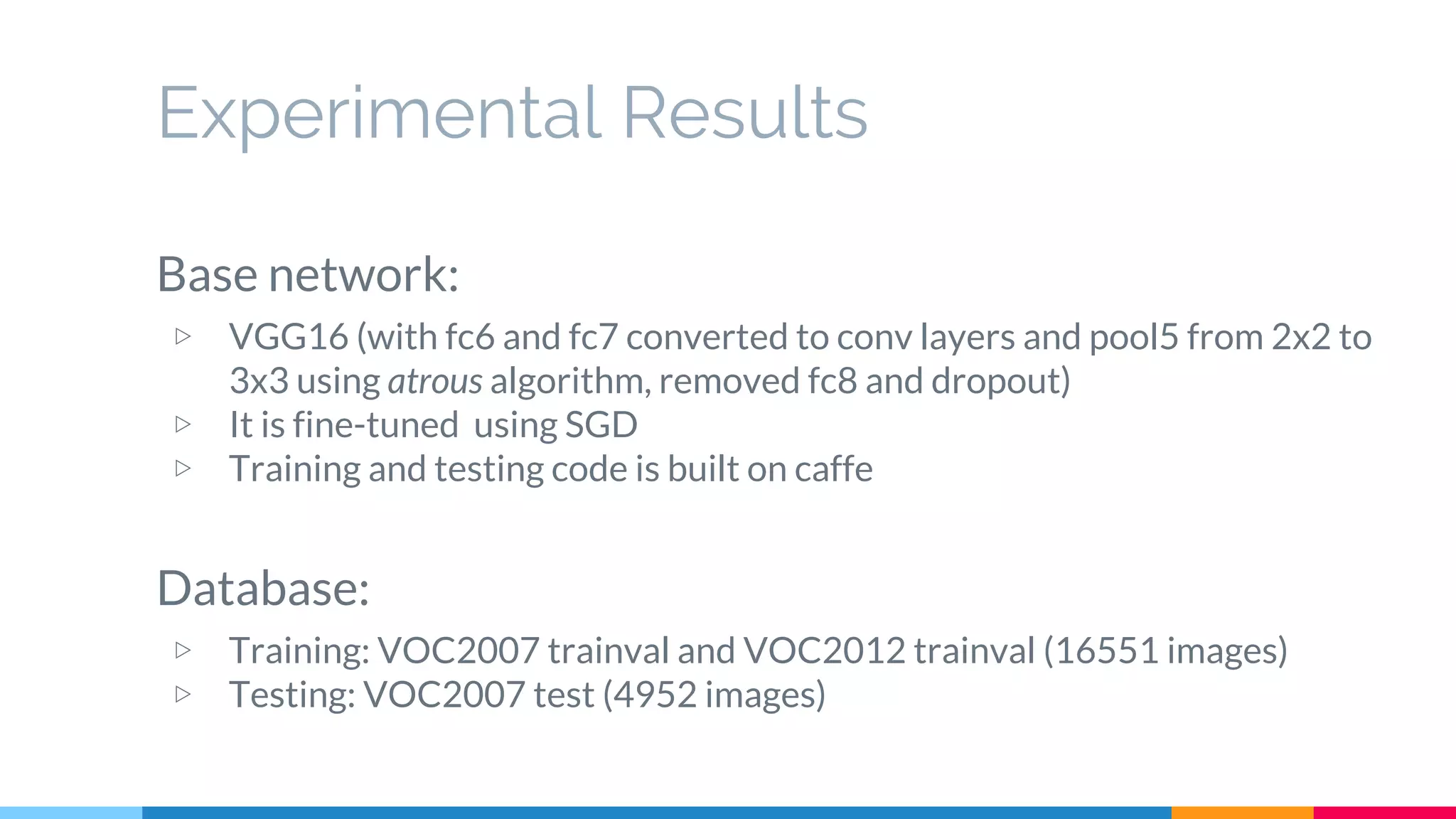
Base network:
▷ VGG16 (with fc6 and fc7 converted to conv layers and pool5 from 2x2 to
3x3 using atrous algorithm, removed fc8 and dropout)
▷ It is fine-tuned using SGD
▷ Training and testing code is built on caffe
Database:
▷ Training: VOC2007 trainval and VOC2012 trainval (16551 images)
▷ Testing: VOC2007 test (4952 images)
Experimental Results
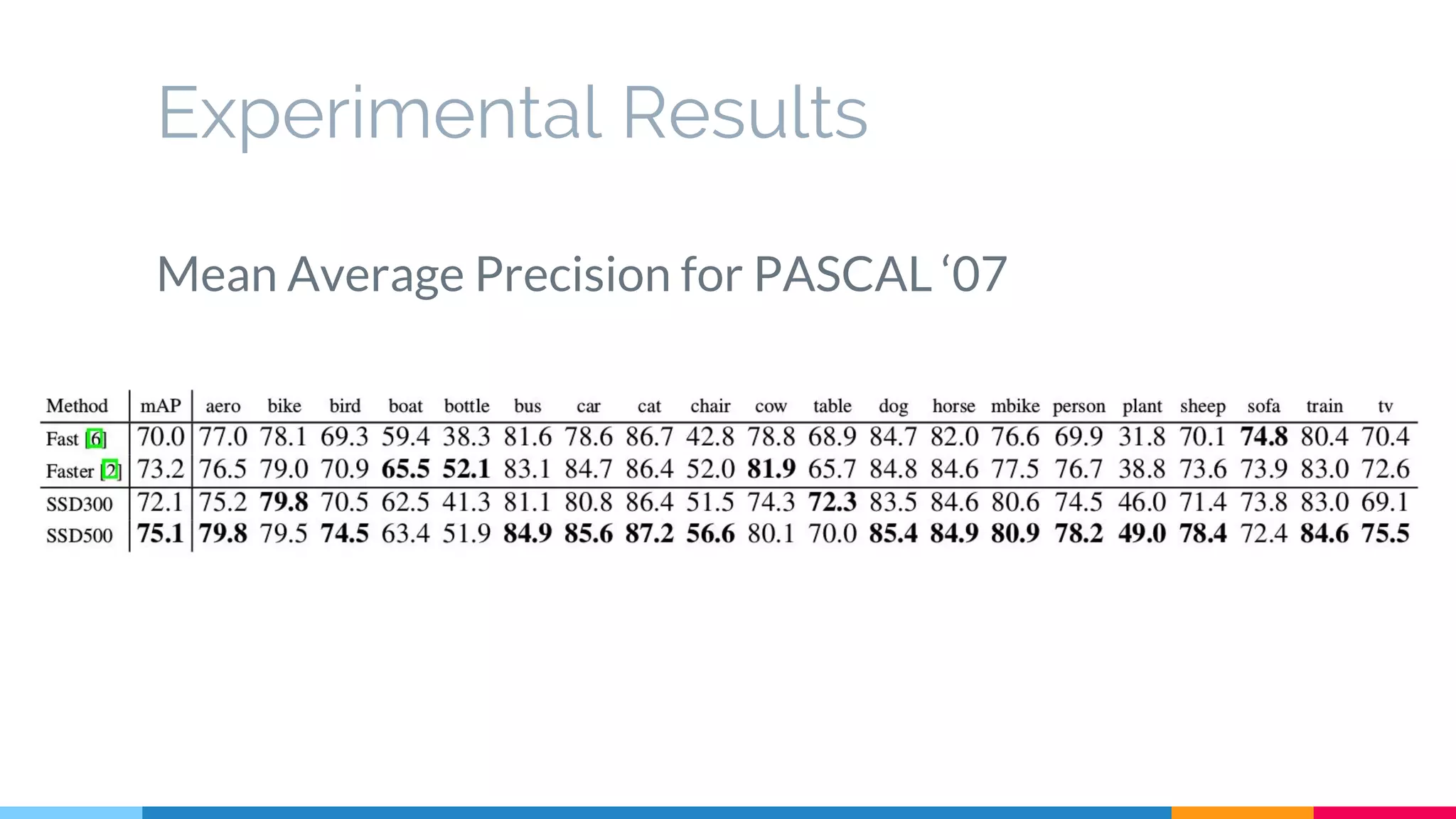
Mean Average Precision for PASCAL ‘07
Experimental Results
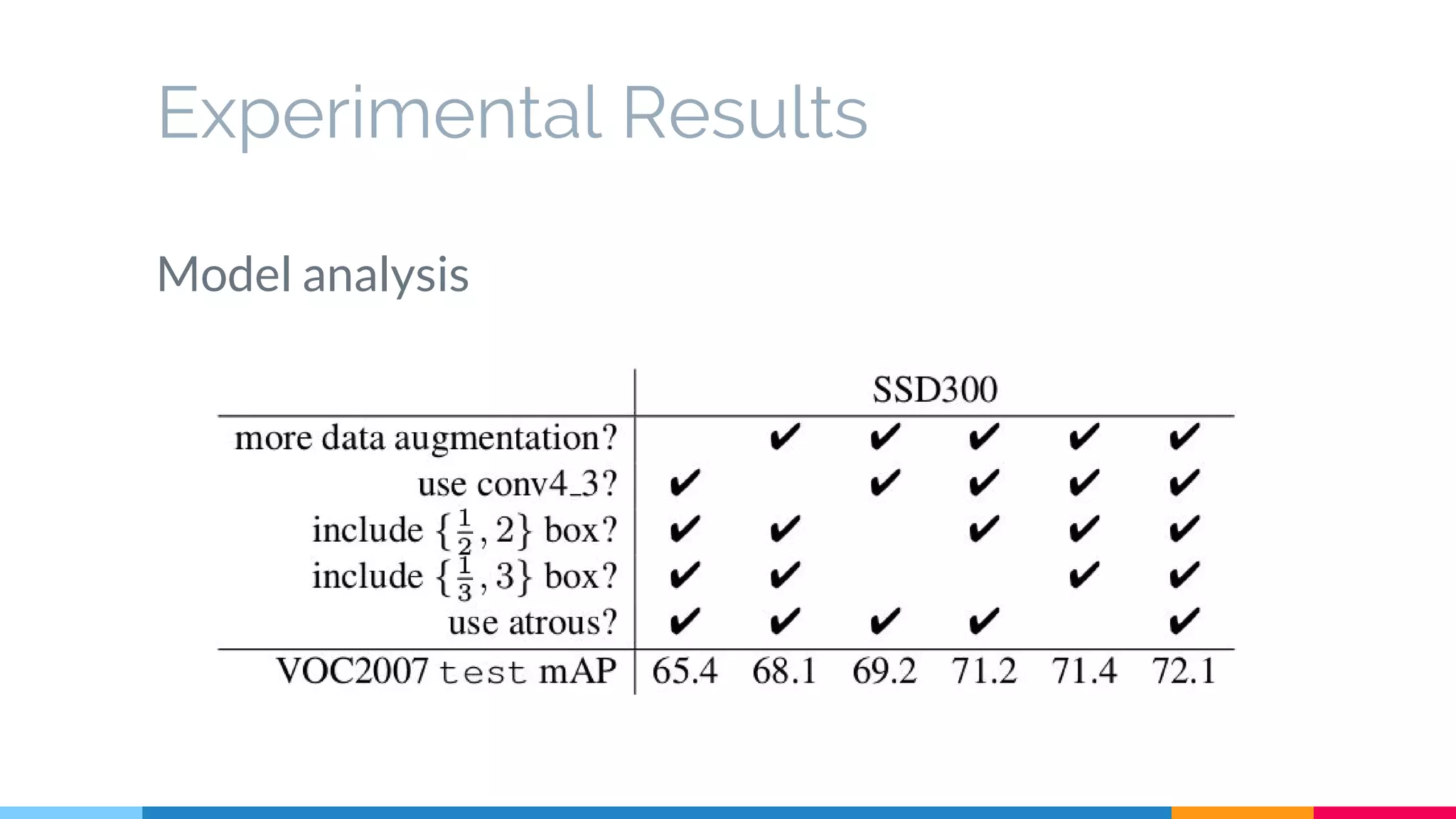
Model analysis
Experimental Results
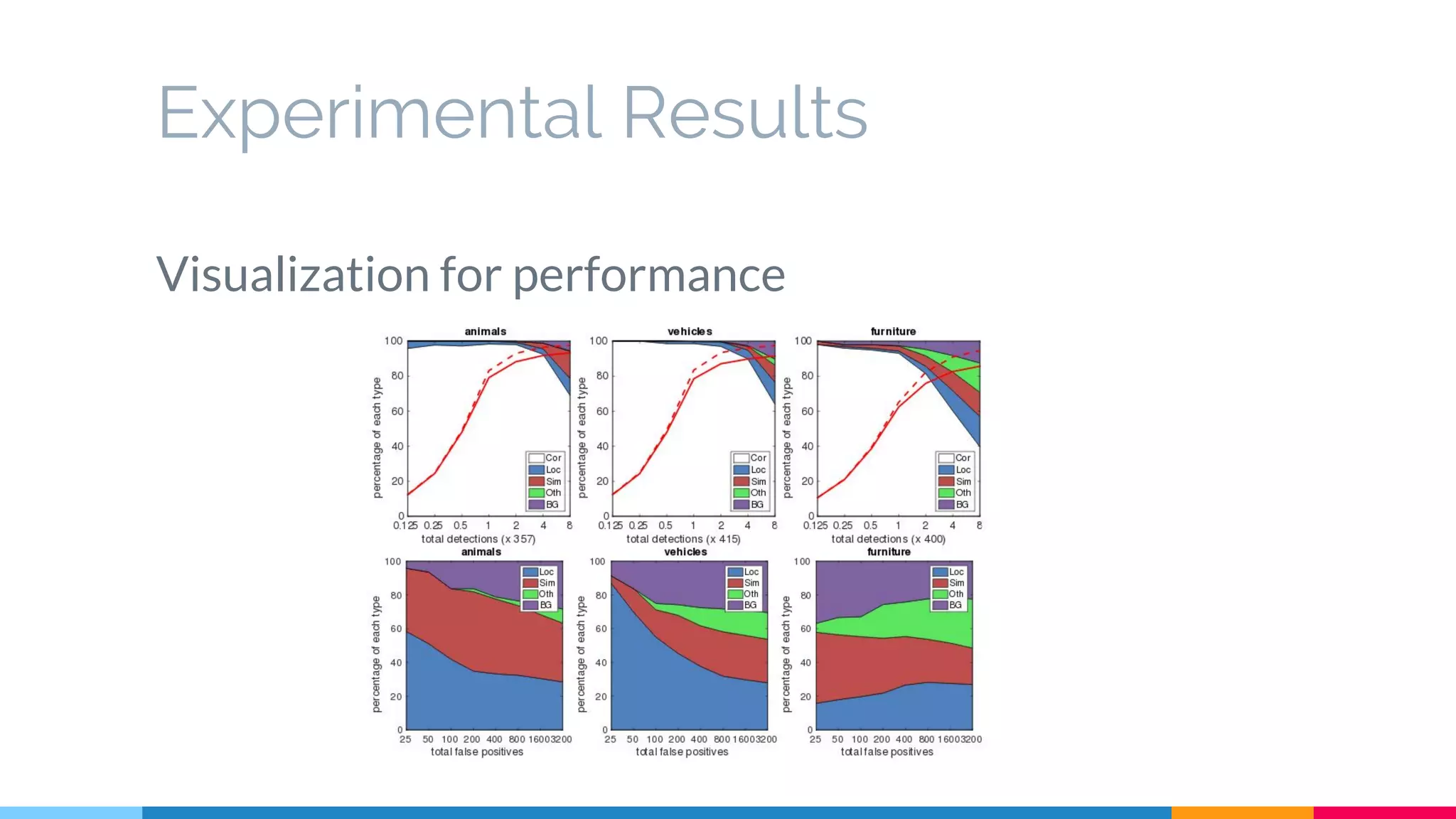
Visualization for performance
Experimental Results
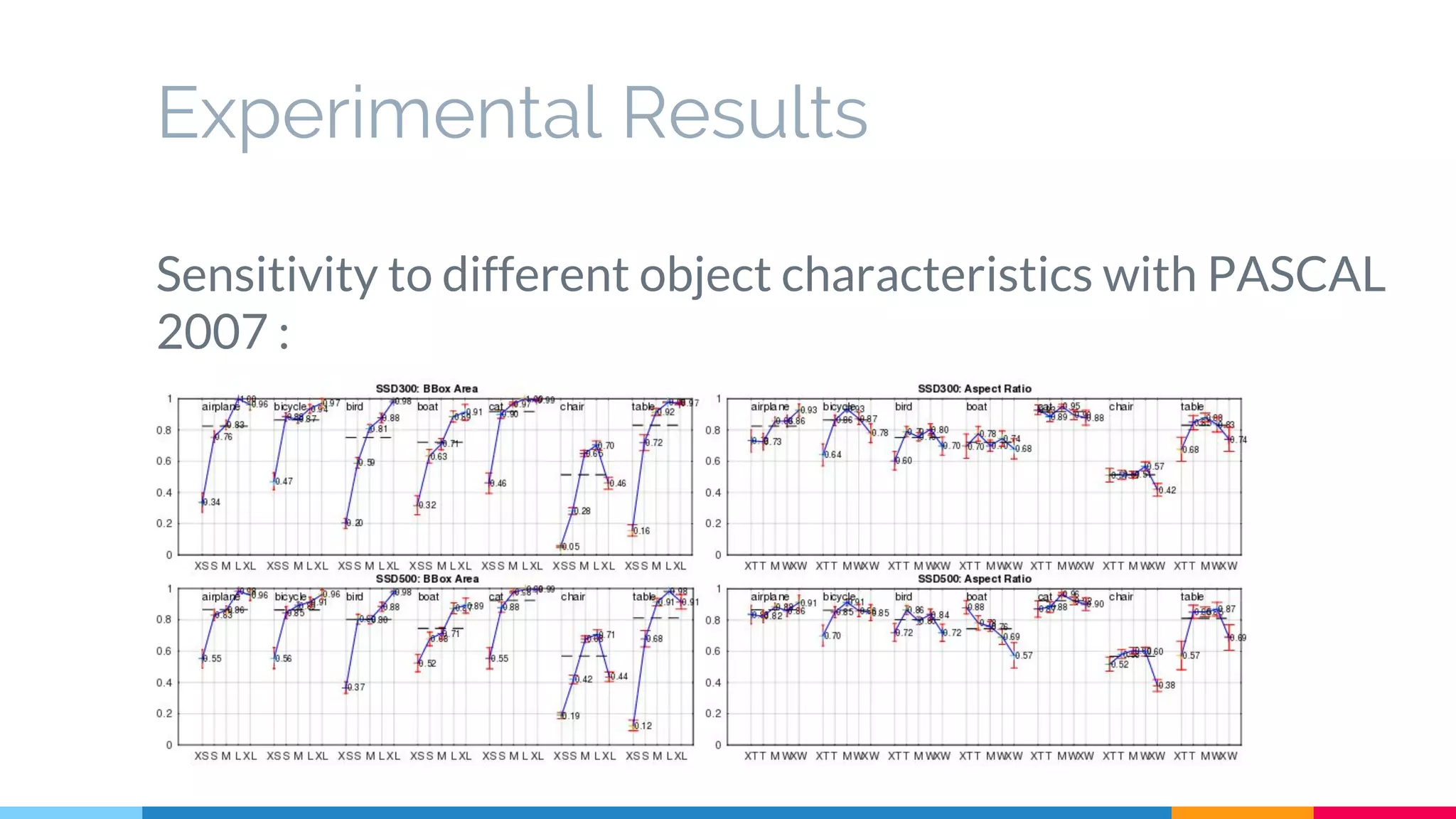
Sensitivity to different object characteristics with PASCAL
2007 :
Experimental Results
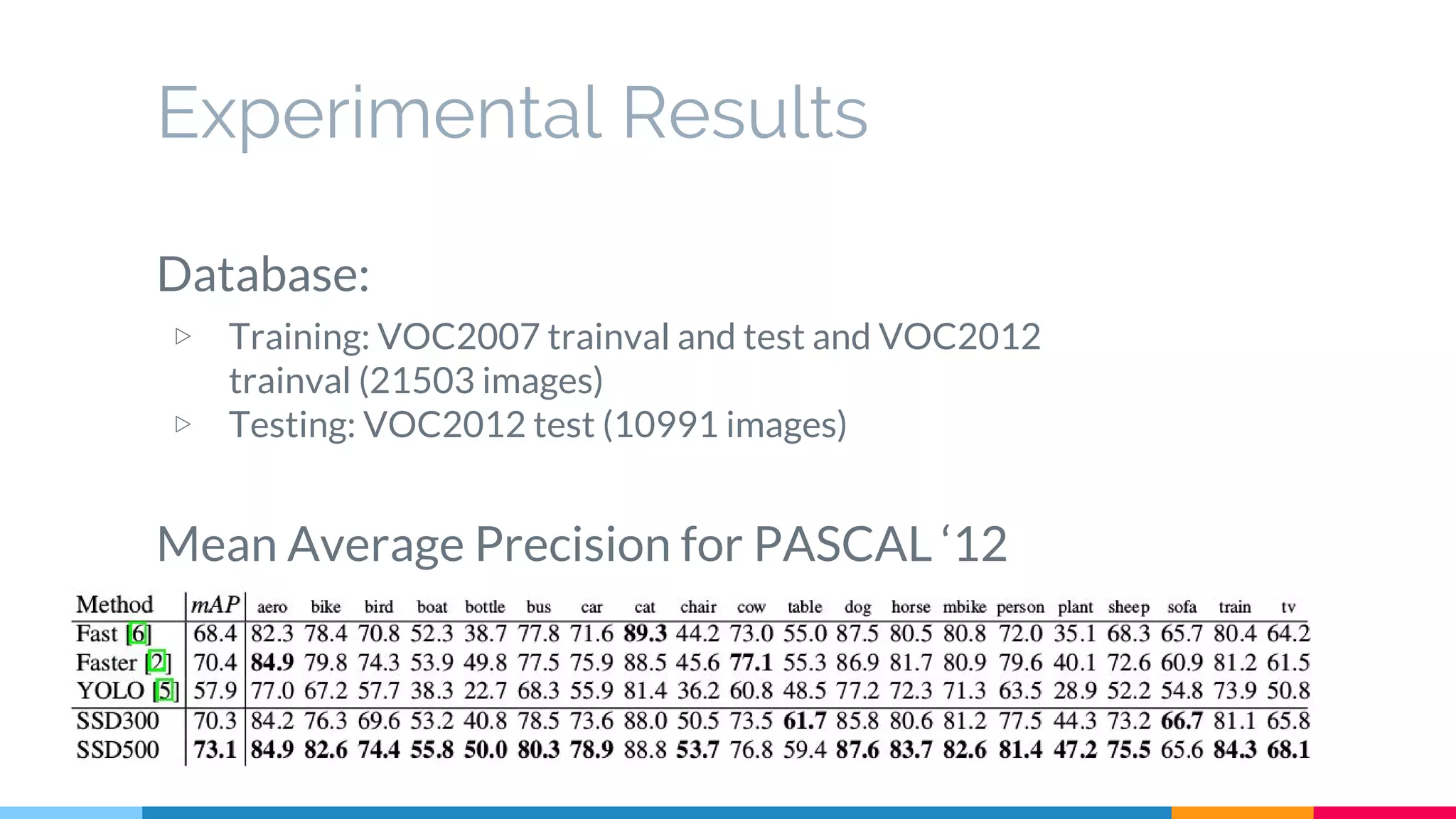
Database:
▷ Training: VOC2007 trainval and test and VOC2012
trainval (21503 images)
▷ Testing: VOC2012 test (10991 images)
Mean Average Precision for PASCAL ‘12
Experimental Results
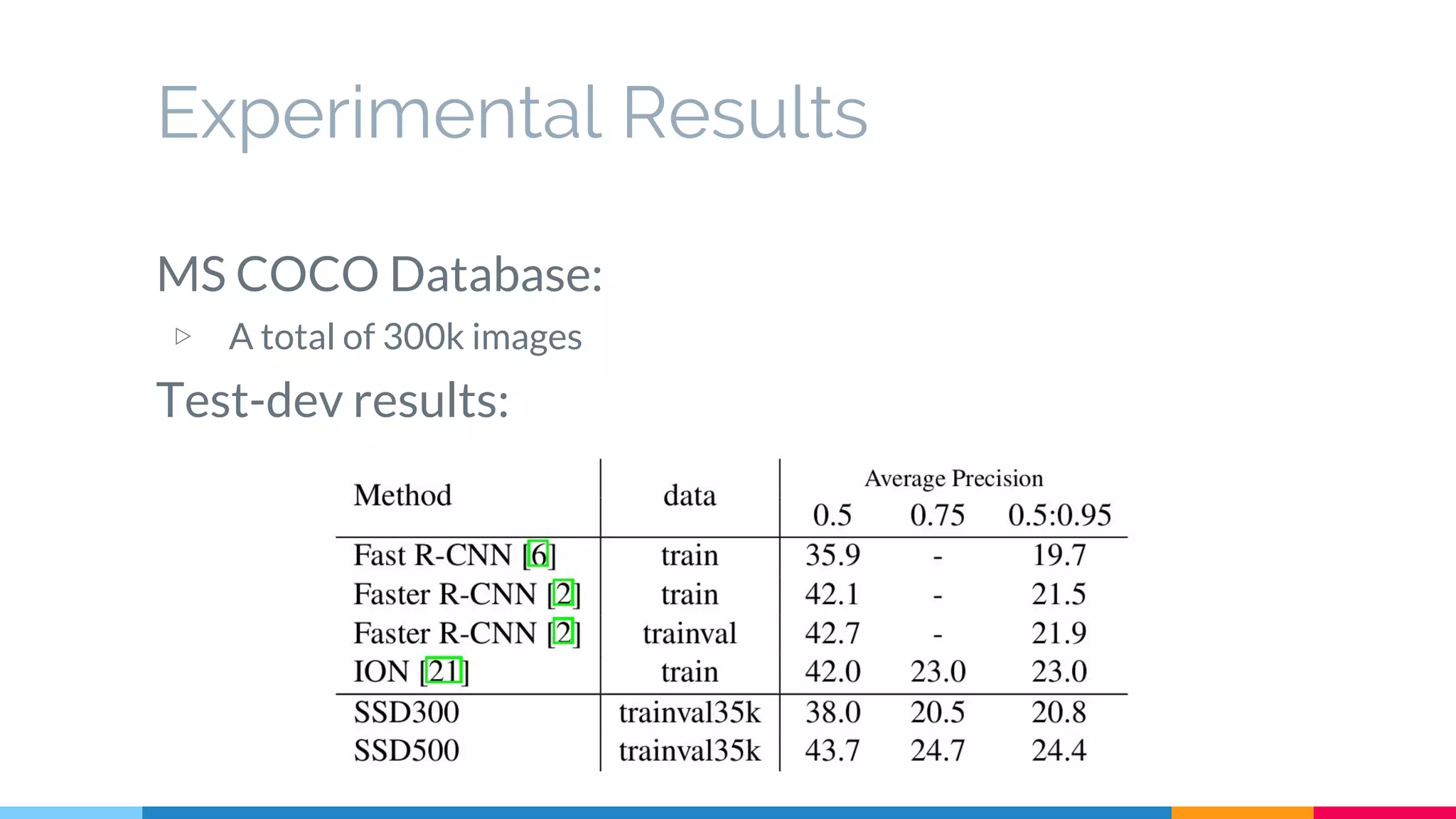
MS COCO Database:
▷ A total of 300k images
Test-dev results:
Experimental Results
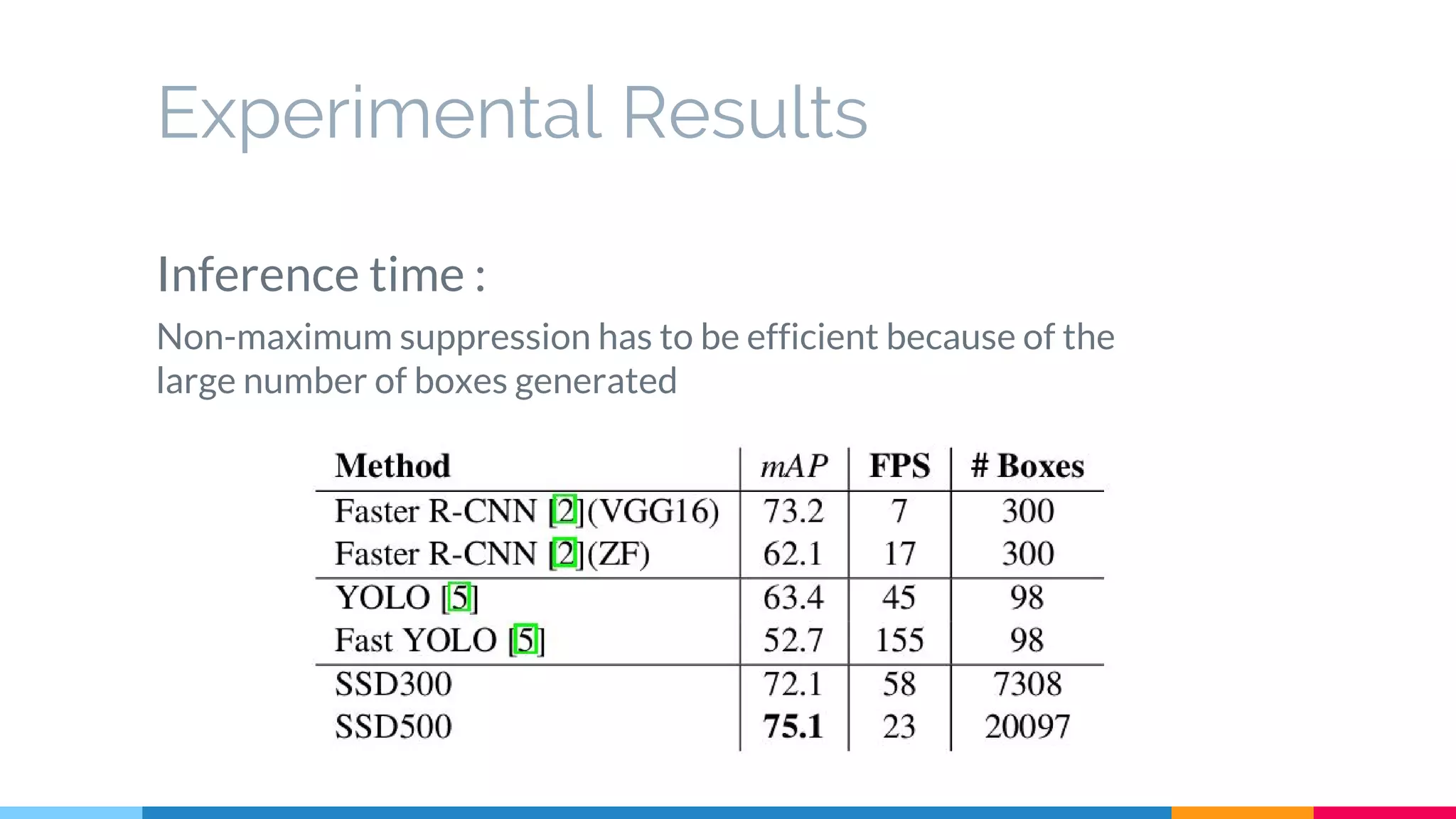
Inference time :
Non-maximum suppression has to be efficient because of the
large number of boxes generated
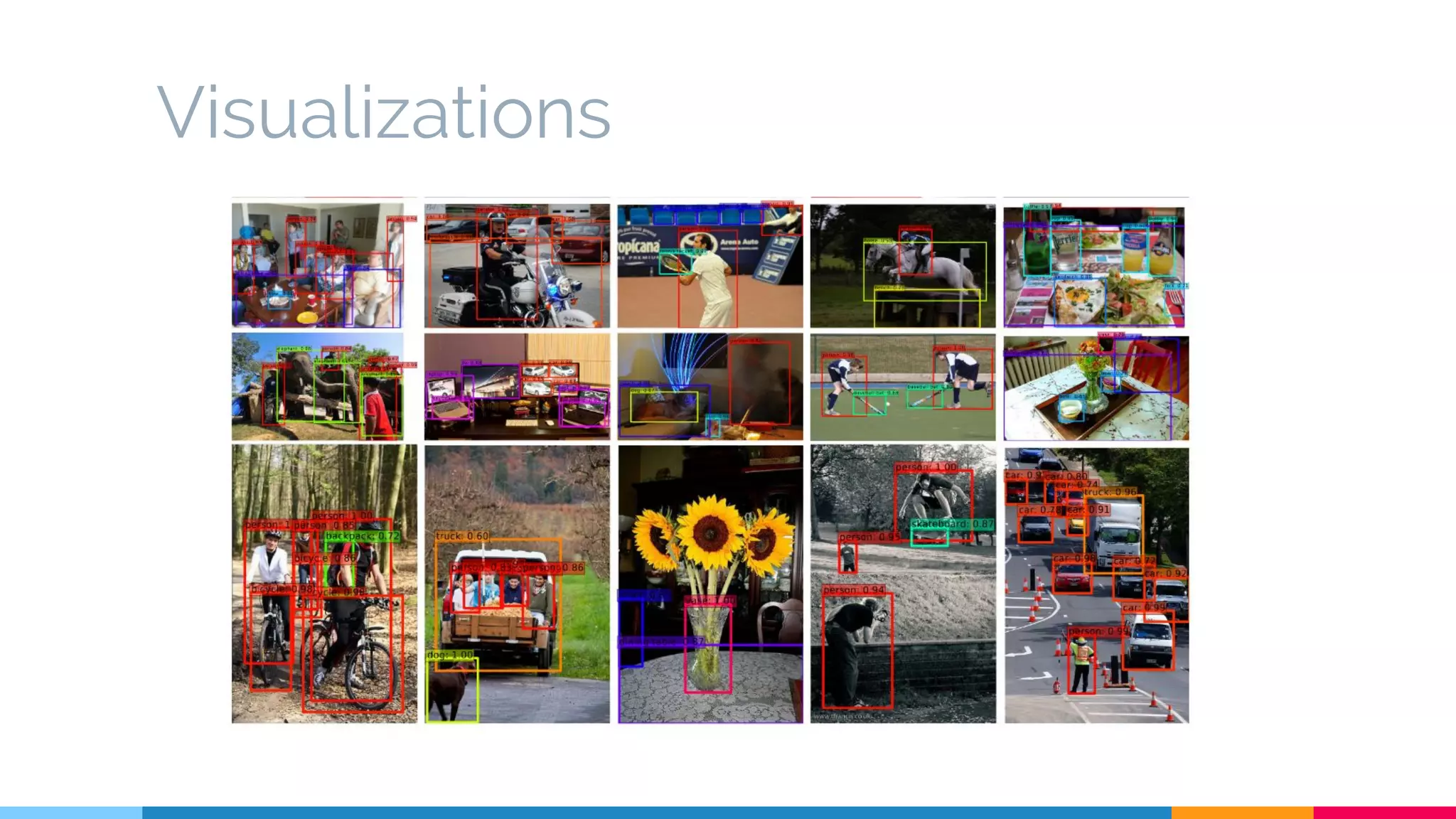
Visualizations
Visualizations
5.
Conclusions
SSD: Single Shot MultiBox Detector
Conclusions
▷ Single-shot object detector for multiple categories
▷ One key feature is to use multiple convolutional maps
to deal with different scales
▷ More default bounding boxes, the better results
obtained
▷ Comparable accuracy to state-of-the-art object
detectors, but much faster
▷ Future direction: use RNNs to detect and track objects
in video
Thank you for your
attention! Questions?

SSD: Single Shot MultiBox Detector (UPC Reading Group)

  • 1.
    SSD: Single ShotMultiBox Detector Wei Liu, Dragomir Anguelov, Dumitru Erhan, Christian Szegedy, Scott Reed, Cheng-Yang Fu, Alexander C.Berg [arXiv][demo][code] (Mar 2016) Slides by Míriam Bellver Computer Vision Reading Group, UPC 28th October, 2016
  • 2.
    Outline ▷ Introduction ▷ RelatedWork ▷ The Single-Shot Detector ▷ Experimental Results ▷ Conclusions
  • 3.
  • 4.
  • 5.
    Introduction Current object detectionsystems resample pixels for each BBOX resample features for each BBOX high quality classifier Object proposals generation Image pixels
  • 6.
    Introduction Current object detectionsystems Computationally too intensive and too slow for real-time applications Faster R-CNN 7 FPS resample pixels for each BBOX resample features for each BBOX high quality classifier Object proposals generation Image pixels
  • 7.
    Introduction Current object detectionsystems Computationally too intensive and too slow for real-time applications Faster R-CNN 7 FPS resample pixels for each BBOX resample features for each BBOX high quality classifier Object proposals generation Image pixels
  • 8.
    Introduction SSD: First deepnetwork based object detector that does not resample pixels or features for bounding box hypotheses and is as accurate as approaches that do. Improvement in speed vs accuracy trade-off
  • 9.
  • 10.
    Introduction Contributions: ▷ A single-shotdetector for multiple categories that is faster than state of the art single shot detectors (YOLO) and as accurate as Faster R-CNN ▷ Predicts category scores and boxes offset for a fixed set of default BBs using small convolutional filters applied to feature maps ▷ Predictions of different scales from feature maps of different scales, and separate predictions by aspect ratio ▷ End-to-end training and high accuracy, improving speed vs accuracy trade-off
  • 11.
    2. Related Work SSD: SingleShot MultiBox Detector
  • 12.
    Object Detection priorto CNNs Two different traditional approaches: ▷ Sliding Window: e.g. Deformable Part Model (DPM) ▷ Object proposals: e.g. Selective Search Felzenszwalb, P., McAllester, D., & Ramanan, D. (2008, June). A discriminatively trained, multiscale, deformable part model Uijlings, J. R., van de Sande, K. E., Gevers, T., & Smeulders, A. W. (2013). Selective search for object recognition
  • 13.
    Object detection withCNN’s ▷ R-CNN Girshick, R. (2015). Fast r-cnn
  • 14.
    Leveraging the objectproposals bottleneck ▷ SPP-net ▷ Fast R-CNN He, K., Zhang, X., Ren, S., & Sun, J. (2014, September). Spatial pyramid pooling in deep convolutional networks for visual recognition Girshick, R. (2015). Fast r-cnn.
  • 15.
    Improving quality ofproposals using CNNs Low-level features object proposals Proposals generated directly from a DNN E.g. : MultiBox, Faster R-CNN Ren, S., He, K., Girshick, R., & Sun, J. (2015). Faster R-CNN: Towards real-time object detection with region proposal networks Szegedy, C., Reed, S., Erhan, D., & Anguelov, D. (2014). Scalable, high-quality object detection.
  • 16.
    Single-shot detectors Instead ofhaving two networks Region Proposals Network + Classifier Network In Single-shot architectures, bounding boxes and confidences for multiple categories are predicted directly with a single network e.g. : Overfeat, YOLO Redmon, J., Divvala, S., Girshick, R., & Farhadi, A. (2015). You only look once: Unified, real-time object detection Sermanet, P., Eigen, D., Zhang, X., Mathieu, M., Fergus, R., & LeCun, Y. (2013). Overfeat: Integrated recognition, localization and detection using convolutional networks.
  • 17.
    Single-shot detectors Main differencesof SSD over YOLO and Overfeat: ▷ Small conv. filters to predict object categories and offsets in BBs locations, using separate predictors for different aspect ratios, and applying them on different feature maps to perform detection on multiple scales
  • 18.
    3.1 The Single ShotDetector (SSD) Model
  • 19.
    The Single ShotDetector (SSD) base network fc6 and fc7 converted to convolutional collection of bounding boxes and scores for each category
  • 20.
    The Single ShotDetector (SSD) base network fc6 and fc7 converted to convolutional Multi-scale feature maps for detection: observe how conv feature maps decrease in size and allow predictions at multiple scales collection of bounding boxes and scores for each category
  • 21.
    The Single ShotDetector (SSD) Comparison to YOLO
  • 22.
    The Single ShotDetector (SSD) Convolutional predictors for detection: We apply on top of each conv feature map a set of filters that predict detections for different aspect ratios and class categories
  • 23.
    The Single ShotDetector (SSD) What is a detection ? Described by four parameters (center bounding box x and y, width and height) Class category For all categories we need for a detection a total of #classes + 4 values
  • 24.
    The Single ShotDetector (SSD) Detector for SSD: Each detector will output a single value, so we need (classes + 4) detectors for a detection
  • 25.
    The Single ShotDetector (SSD) Detector for SSD: Each detector will output a single value, so we need (classes + 4) detectors for a detection BUT there are different types of detections!
  • 26.
    The Single ShotDetector (SSD) Different “classes” of detections aspect ratio 2:1 for cats aspect ratio 1:2 for cats aspect ratio 1:1 for cats
  • 27.
    The Single ShotDetector (SSD) Default boxes and aspect ratios Similar to the anchors of Faster R-CNN, with the difference that SSD applies them on several feature maps of different resolutions
  • 28.
    The Single ShotDetector (SSD) Detector for SSD: Each detector will output a single value, so we need (classes + 4) detectors for a detection as we have #default boxes, we need (classes + 4) x #default boxes detectors
  • 29.
    The Single ShotDetector (SSD) Convolutional predictors for detection: We apply on top of each conv feature map a set of filters that predict detections for different aspect ratios and class categories
  • 30.
    The Single ShotDetector (SSD) For each feature layer of m x n with p channels we apply kernels of 3 x 3 x p to produce either a score for a category, or a shape offset relative to a default bounding box coordinates 1024 3 3 Example for conv6: shape offset xo to default box of aspect ratio: 1 for category 1 1024 3 3 score for category 1 for the default box of aspect ratio: 1 up to classes+4 filters for each default box considered at that conv feature map
  • 31.
    The Single ShotDetector (SSD) For each feature layer of m x n with p channels we apply kernels of 3 x 3 x p to produce either a score for a category, or a shape offset relative to a default bounding box coordinates So, for each conv layer considered, there are (classes + 4) x default boxes x m x n outputs
  • 32.
    3.2 The Single ShotDetector (SSD) Training
  • 33.
    The Single ShotDetector (SSD) SSD requires that ground-truth data is assigned to specific outputs in the fixed set of detector outputs
  • 34.
    The Single ShotDetector (SSD) Matching strategy: For each ground truth box we have to select from all the default boxes the ones that best fit in terms of location, aspect ratio and scale. ▷ We select the default box with best jaccard overlap. Then every box has at least 1 correspondence. ▷ Default boxes with a jaccard overlap higher than 0.5 are also selected
  • 35.
    The Single ShotDetector (SSD) Training objective: Similar to MultiBox but handles multiple categories. confidence loss softmax loss localization loss Smooth L1 lossN: number of default matched BBs x: is 1 if the default box is matched to a determined ground truth box, and 0 otherwise l: predicted bb parameters g: ground truth bb parameters c: class is 1 by cross-validation
  • 36.
    The Single ShotDetector (SSD) Choosing scales and aspect ratios for default boxes: ▷ Feature maps from different layers are used to handle scale variance ▷ Specific feature map locations learn to be responsive to specific areas of the image and particular scales of objects
  • 37.
    The Single ShotDetector (SSD) Choosing scales and aspect ratios for default boxes: ▷ If m feature maps are used for prediction, the scale of the default boxes for each feature map is: 0.1 0.95
  • 38.
    The Single ShotDetector (SSD) Choosing scales and aspect ratios for default boxes: ▷ At each scale, different aspect ratios are considered: width and height of default bbox
  • 39.
    The Single ShotDetector (SSD) Hard negative mining: Significant imbalance between positive and negative training examples ▷ Use negative samples with higher confidence score ▷ Then the ratio of positive-negative samples is 3:1
  • 40.
    The Single ShotDetector (SSD) Data augmentation: Each training sample is randomly sampled by one of the following options: ▷ Use the original image ▷ Sample a path with a minimum jaccard overlap with objects ▷ Randomly sample a path
  • 41.
  • 42.
    Experimental Results Base network: ▷VGG16 (with fc6 and fc7 converted to conv layers and pool5 from 2x2 to 3x3 using atrous algorithm, removed fc8 and dropout) ▷ It is fine-tuned using SGD ▷ Training and testing code is built on caffe Database: ▷ Training: VOC2007 trainval and VOC2012 trainval (16551 images) ▷ Testing: VOC2007 test (4952 images)
  • 43.
    Experimental Results Mean AveragePrecision for PASCAL ‘07
  • 44.
  • 45.
  • 46.
    Experimental Results Sensitivity todifferent object characteristics with PASCAL 2007 :
  • 47.
    Experimental Results Database: ▷ Training:VOC2007 trainval and test and VOC2012 trainval (21503 images) ▷ Testing: VOC2012 test (10991 images) Mean Average Precision for PASCAL ‘12
  • 48.
    Experimental Results MS COCODatabase: ▷ A total of 300k images Test-dev results:
  • 49.
    Experimental Results Inference time: Non-maximum suppression has to be efficient because of the large number of boxes generated
  • 50.
  • 51.
  • 52.
  • 53.
    Conclusions ▷ Single-shot objectdetector for multiple categories ▷ One key feature is to use multiple convolutional maps to deal with different scales ▷ More default bounding boxes, the better results obtained ▷ Comparable accuracy to state-of-the-art object detectors, but much faster ▷ Future direction: use RNNs to detect and track objects in video
  • 54.
    Thank you foryour attention! Questions?