MOOCs as 
accelerator of change 
Willem van Valkenburg 
Unless otherwise indicated, this presentation is licensed CC-BY 4.0. 
Please attribute TU Delft Extension School / Willem van Valkenburg
Willem van Valkenburg 
Production & Delivery Manager 
TU Delft Extension School 
Board member 
Open Education Consortium 
twitter.com/wfvanvalkenburg slideshare.net/wfvanvalkenburg
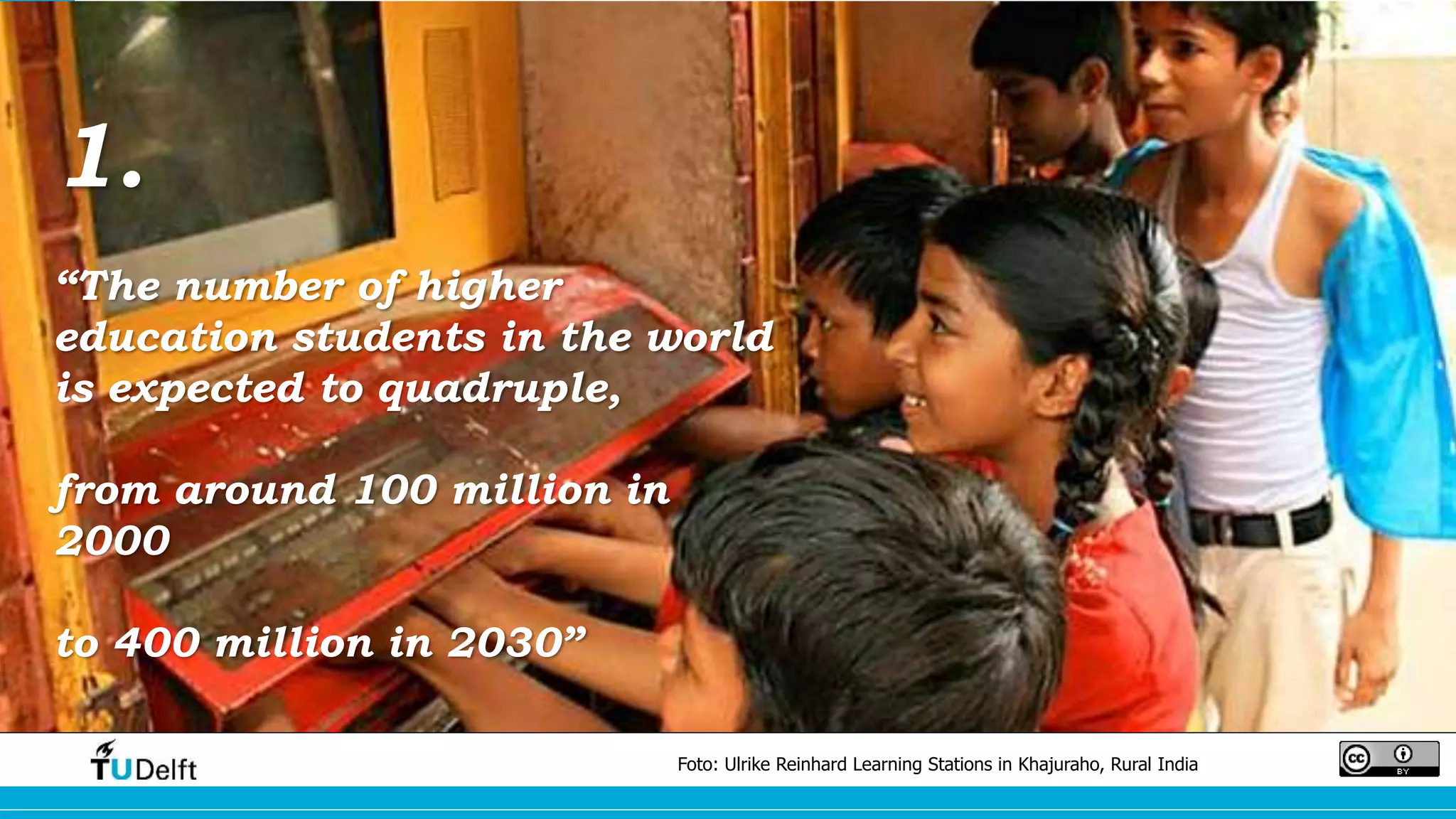
Foto: Ulrike Reinhard Learning Stations in Khajuraho, Rural India 
1. 
“The number of higher 
education students in the world 
is expected to quadruple, 
from around 100 million in 
2000 
to 400 million in 2030”
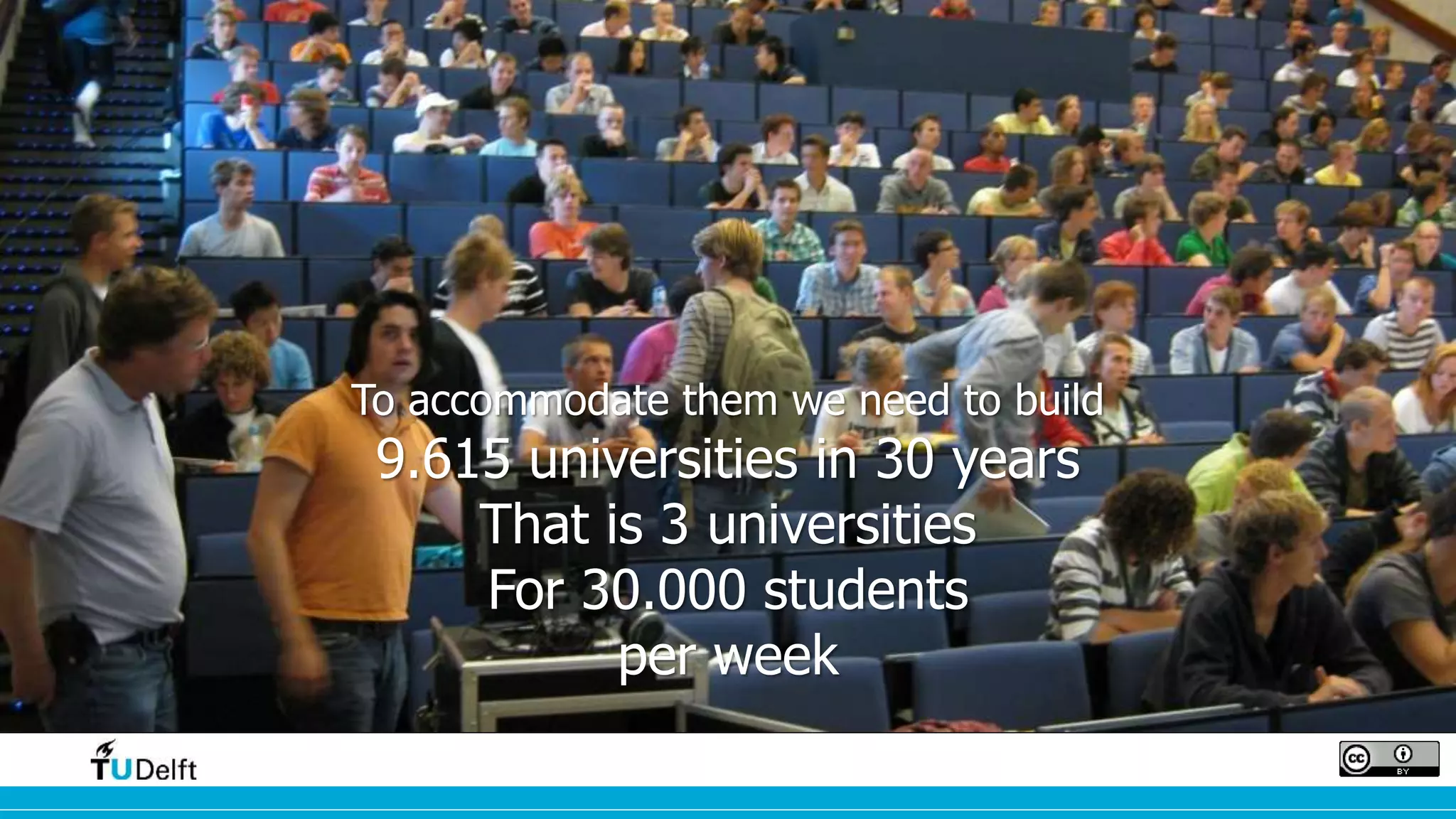
To accommodate them we need to build 
9.615 universities in 30 years 
That is 3 universities 
For 30.000 students 
per week
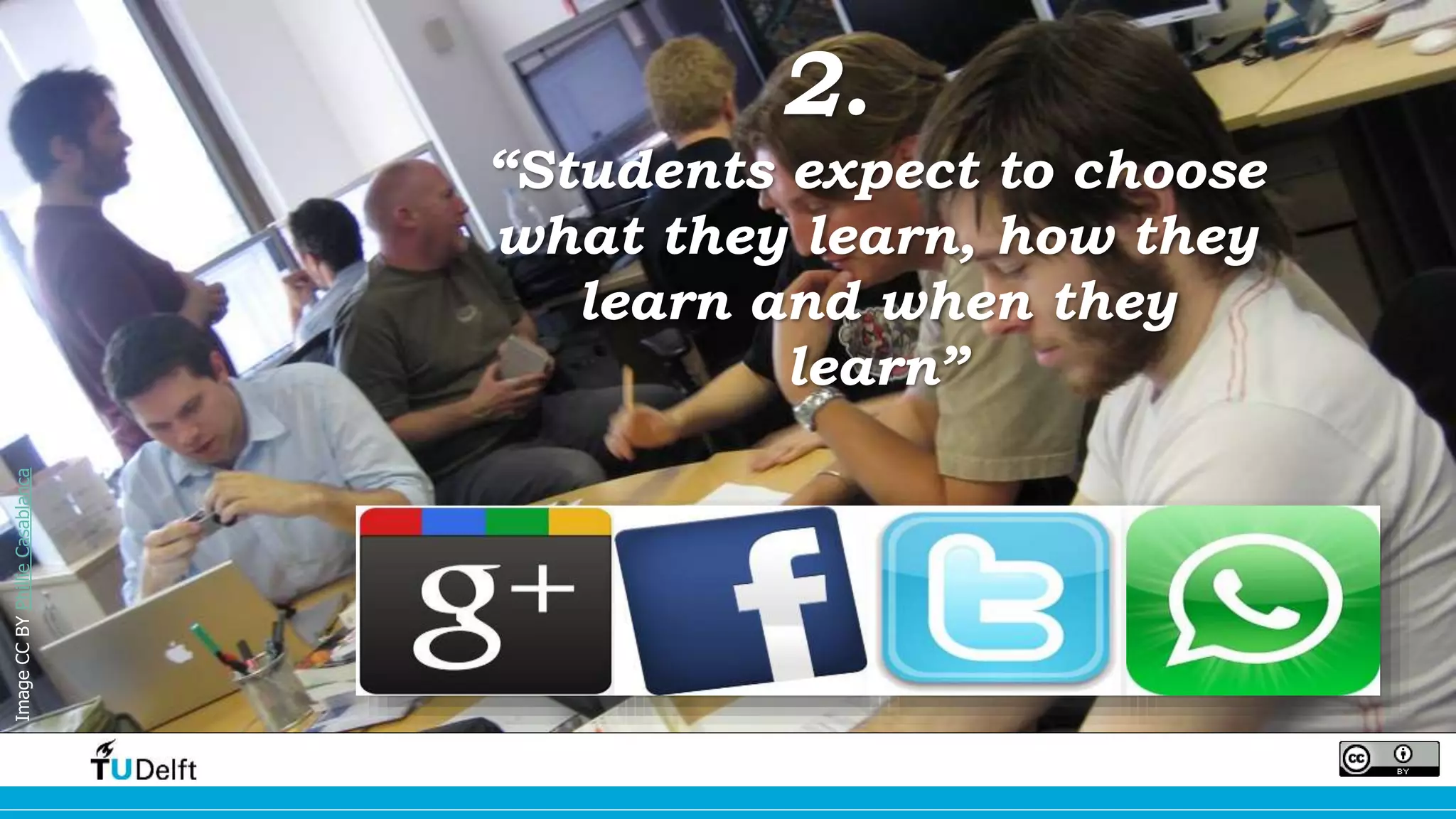
2. 
“Students expect to choose 
what they learn, how they 
learn and when they 
learn” 
Image CC BY Phillie Casablanca
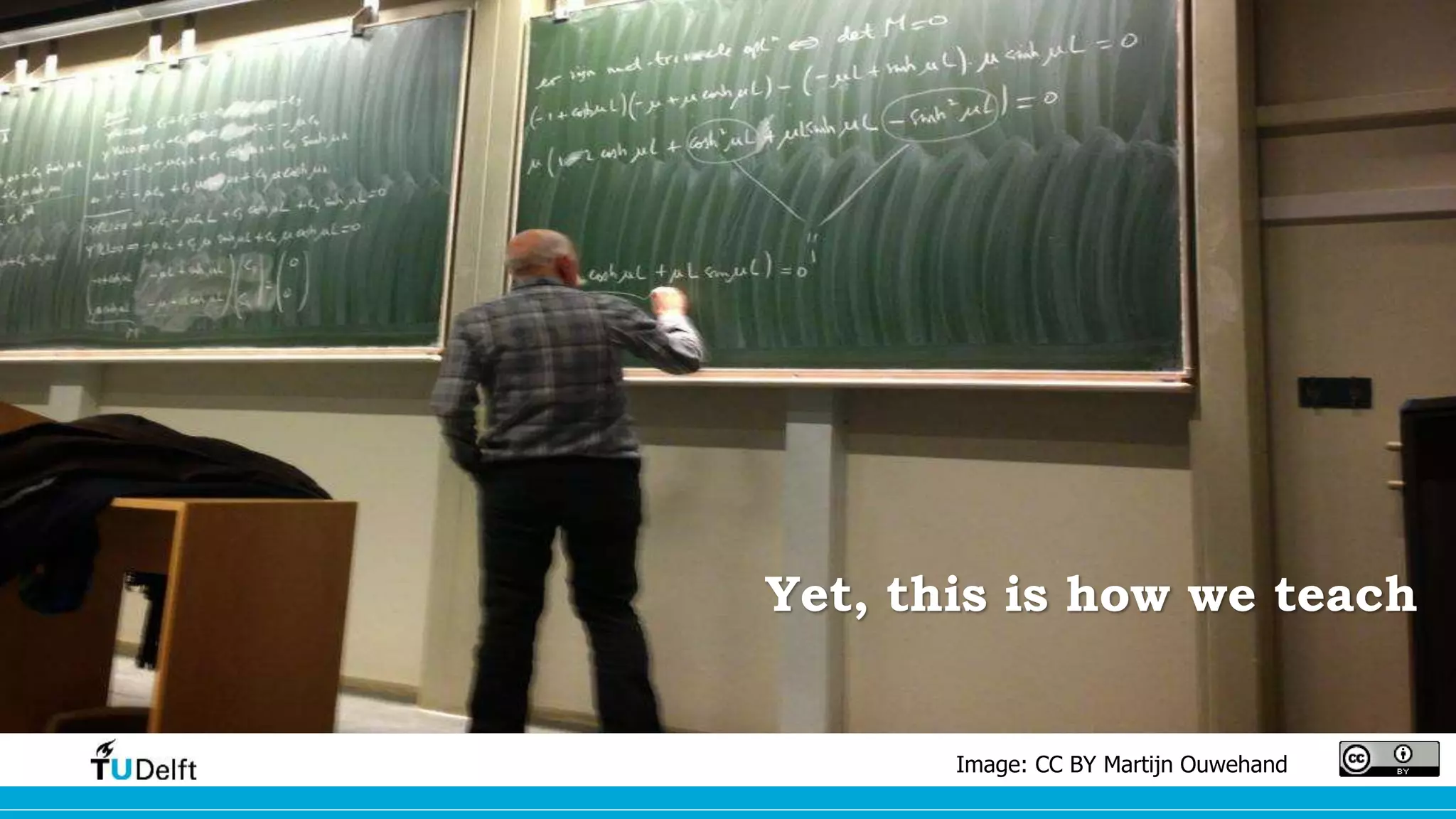
Yet, this is how we teach 
Image: CC BY Martijn Ouwehand
Content 
1. Context @ TU Delft 
2. Global Developments 
3. Vision on the future of education 
4. TU Delft Extension School 
5. Discussion
Context @ TU 
Delft
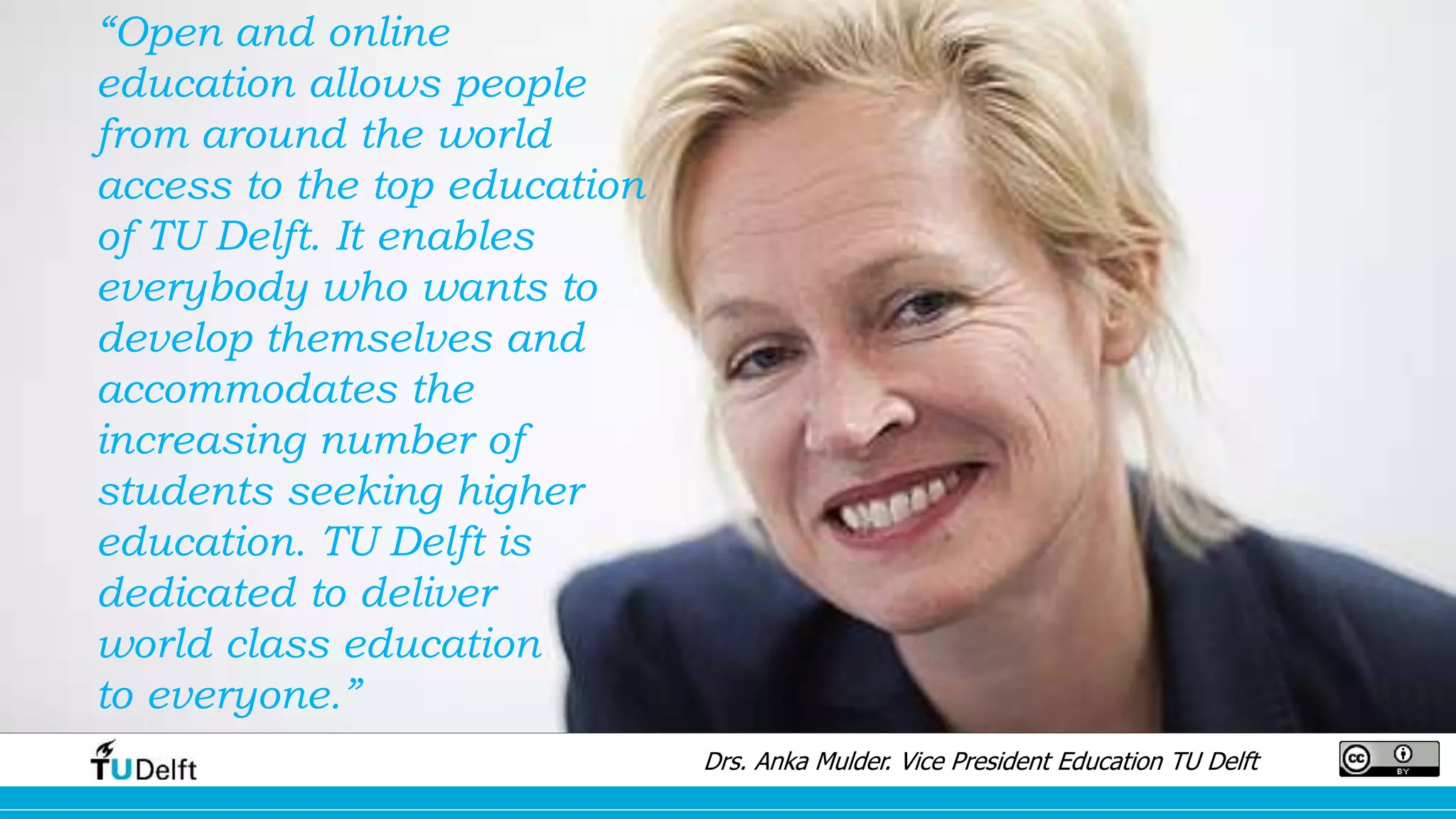
“Open and online 
education allows people 
from around the world 
access to the top education 
of TU Delft. It enables 
everybody who wants to 
develop themselves and 
accommodates the 
increasing number of 
students seeking higher 
education. TU Delft is 
dedicated to deliver 
world class education 
to everyone.” 
Drs. Anka Mulder. Vice President Education TU Delft
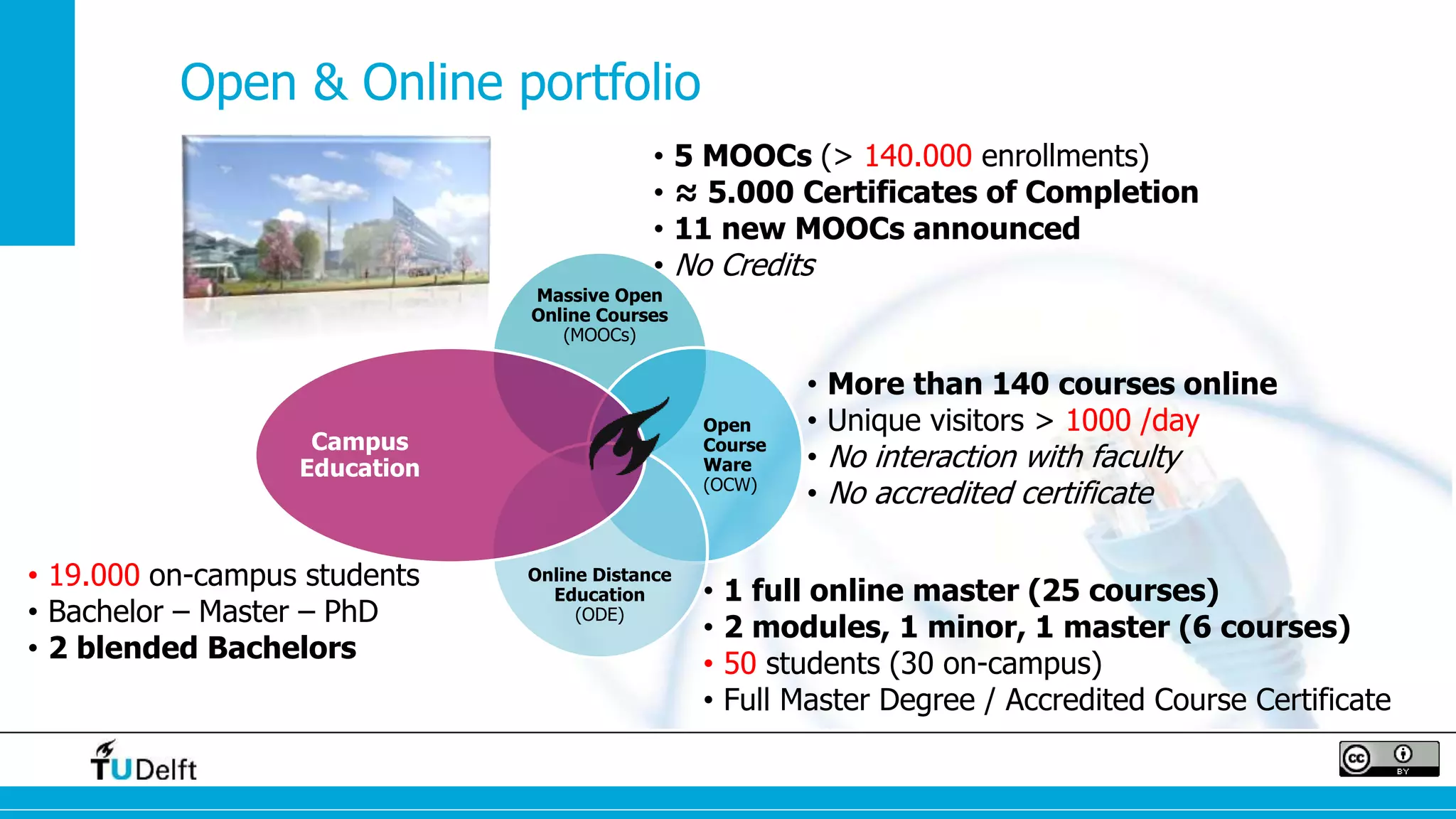
Open & Online portfolio 
Massive Open 
Online Courses 
(MOOCs) 
Open 
Course 
Ware 
(OCW) 
Online Distance 
Education 
(ODE) 
Campus 
Education 
• 5 MOOCs (> 140.000 enrollments) 
• ≈ 5.000 Certificates of Completion 
• 11 new MOOCs announced 
• No Credits 
• More than 140 courses online 
• Unique visitors > 1000 /day 
• No interaction with faculty 
• No accredited certificate 
• 1 full online master (25 courses) 
• 2 modules, 1 minor, 1 master (6 courses) 
• 50 students (30 on-campus) 
• Full Master Degree / Accredited Course Certificate 
• 19.000 on-campus students 
• Bachelor – Master – PhD 
• 2 blended Bachelors
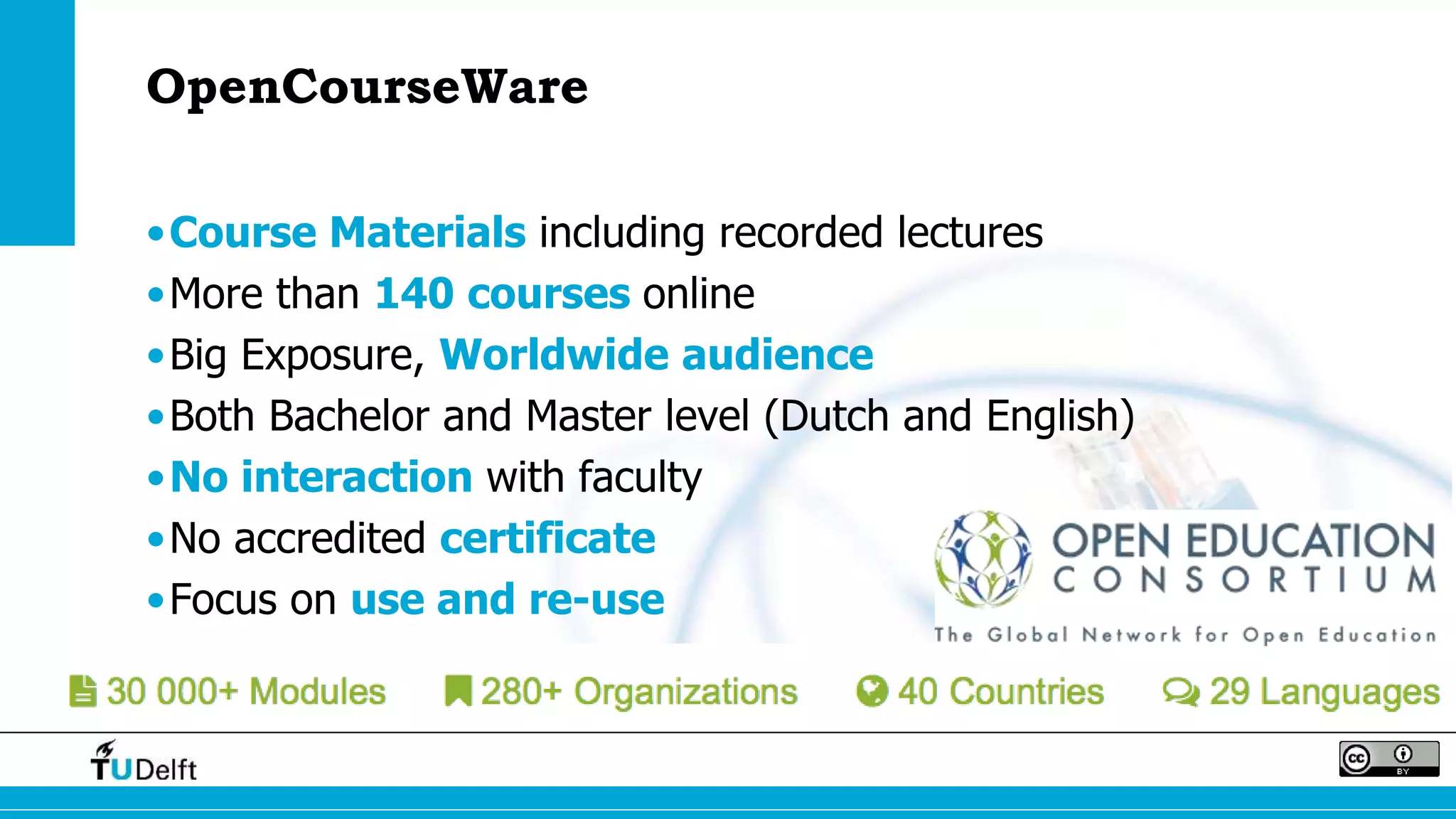
OpenCourseWare 
•Course Materials including recorded lectures 
•More than 140 courses online 
•Big Exposure, Worldwide audience 
•Both Bachelor and Master level (Dutch and English) 
•No interaction with faculty 
•No accredited certificate 
•Focus on use and re-use
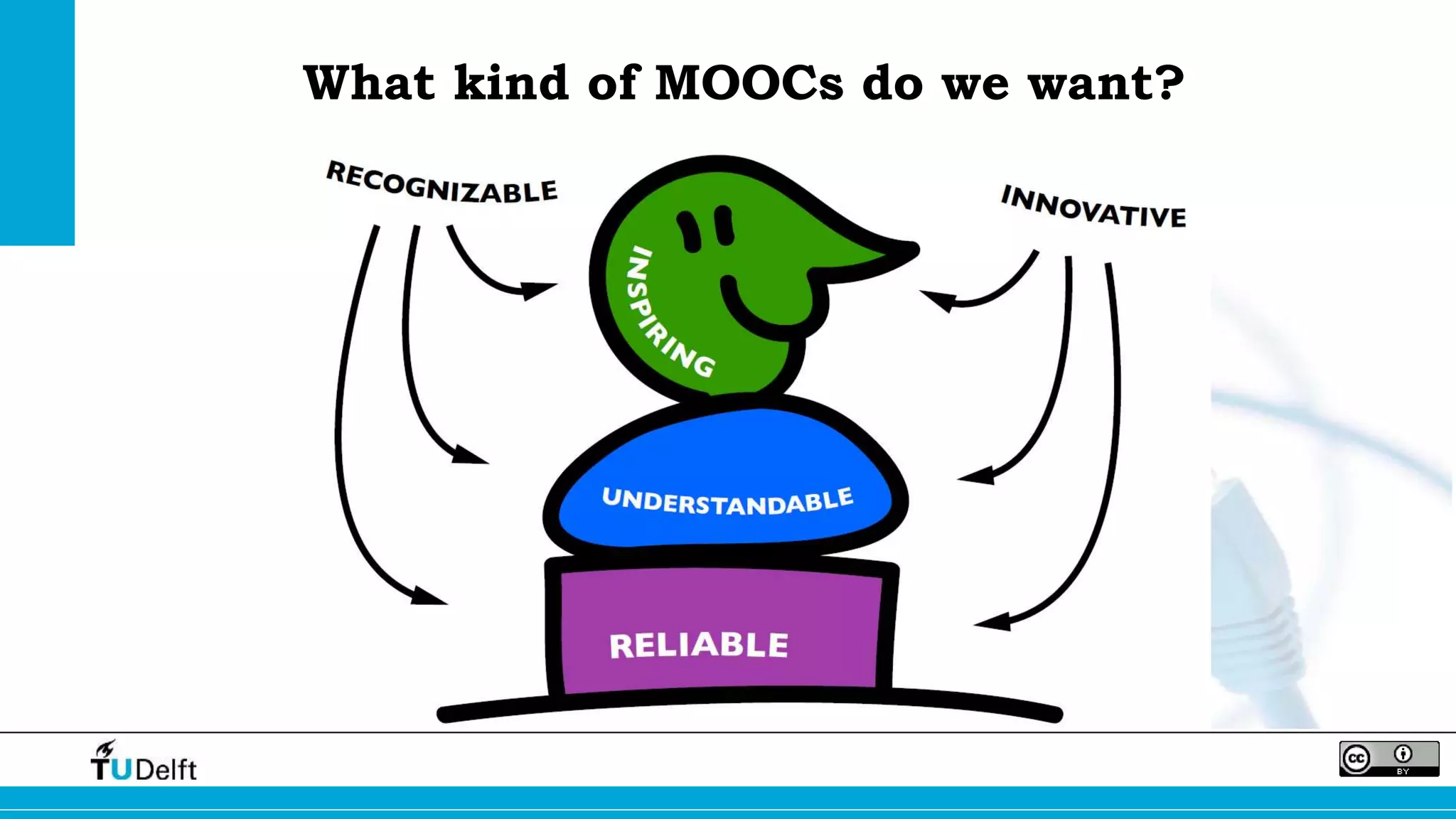
What kind of MOOCs do we want?
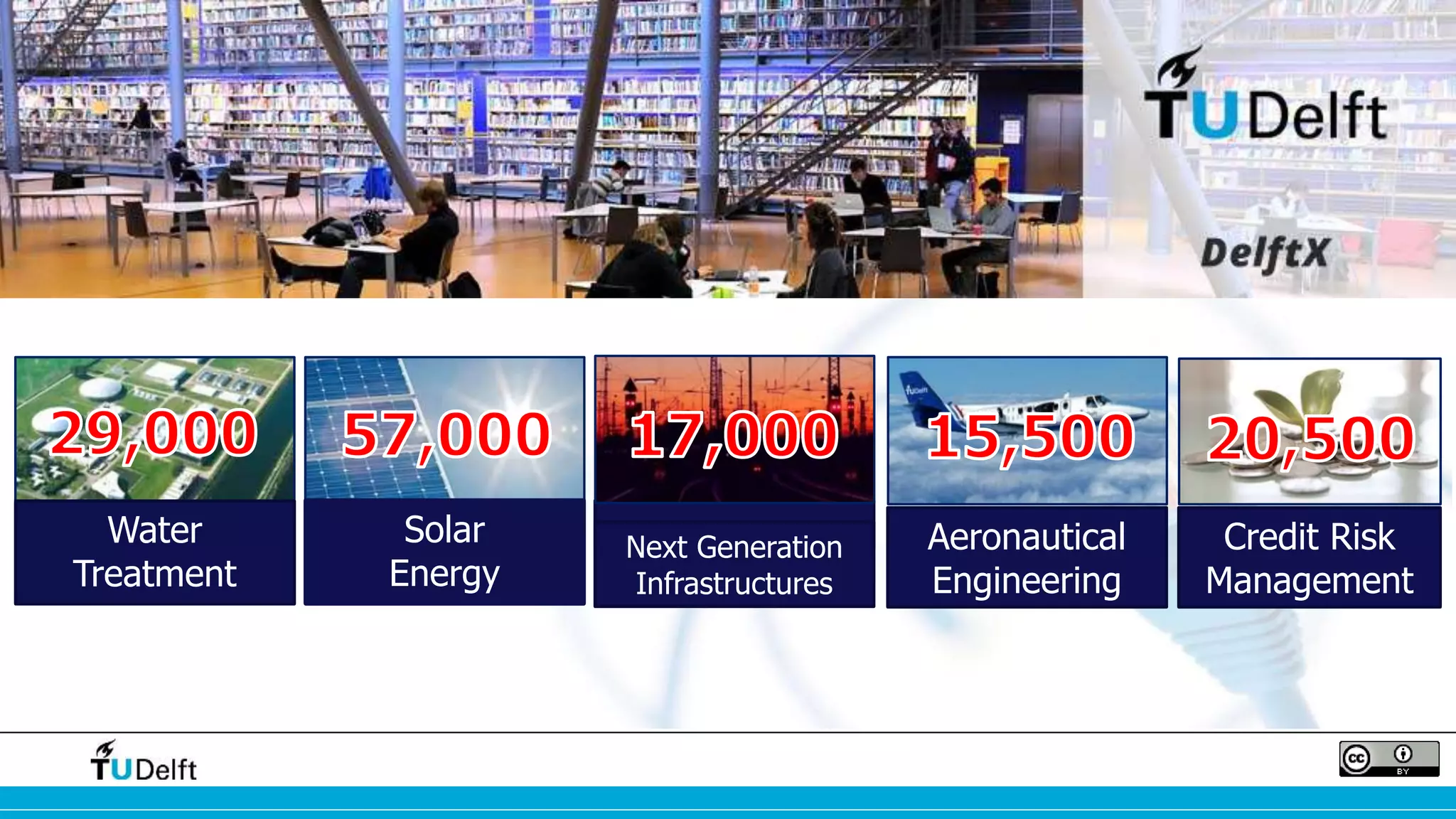
DelftX Courses 
Water 
Treatment 
Solar 
Energy 
Next Generation 
Infrastructures 
Aeronautical 
Engineering 
Credit Risk 
Management
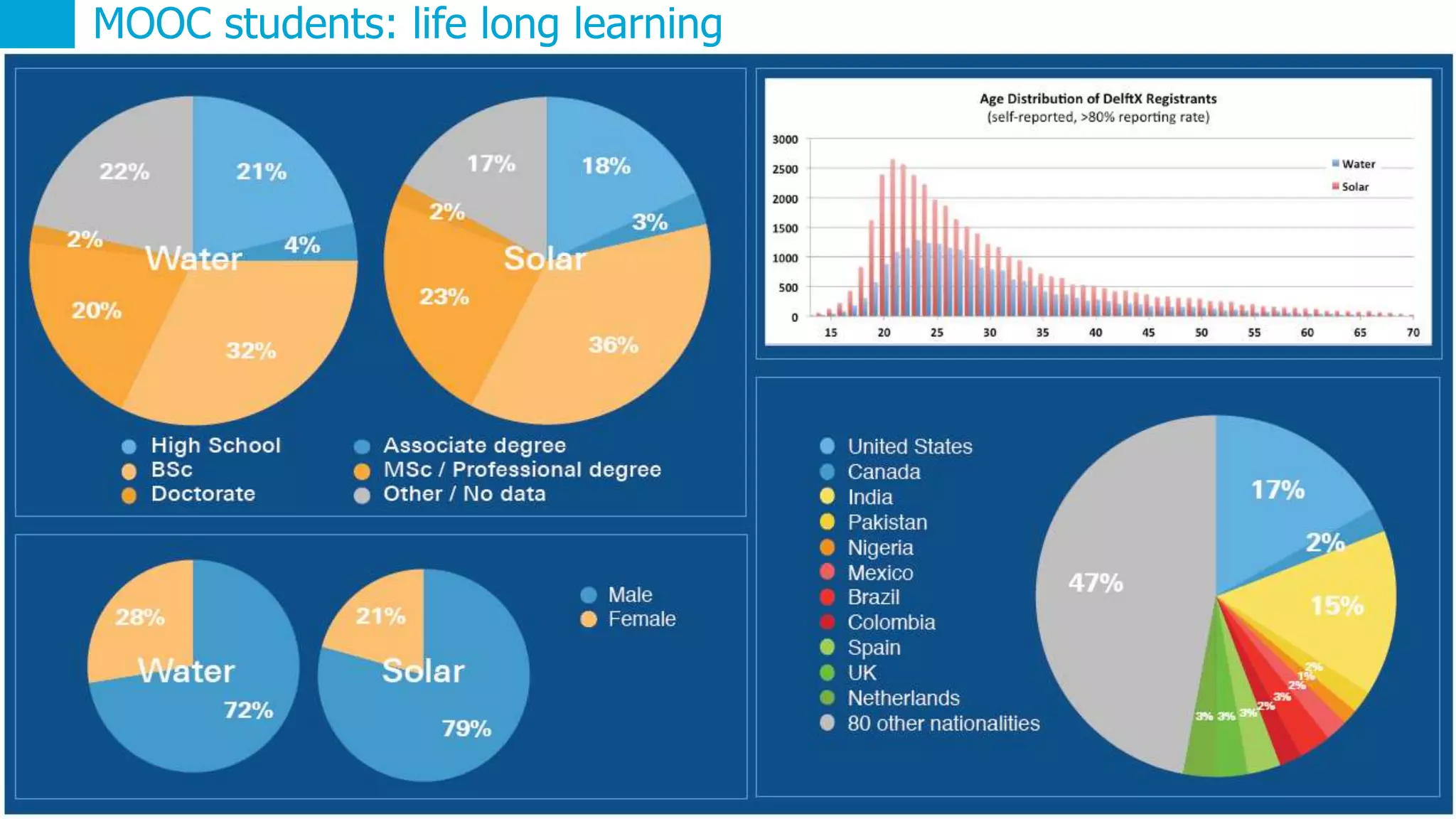
MOOC students: life long learning
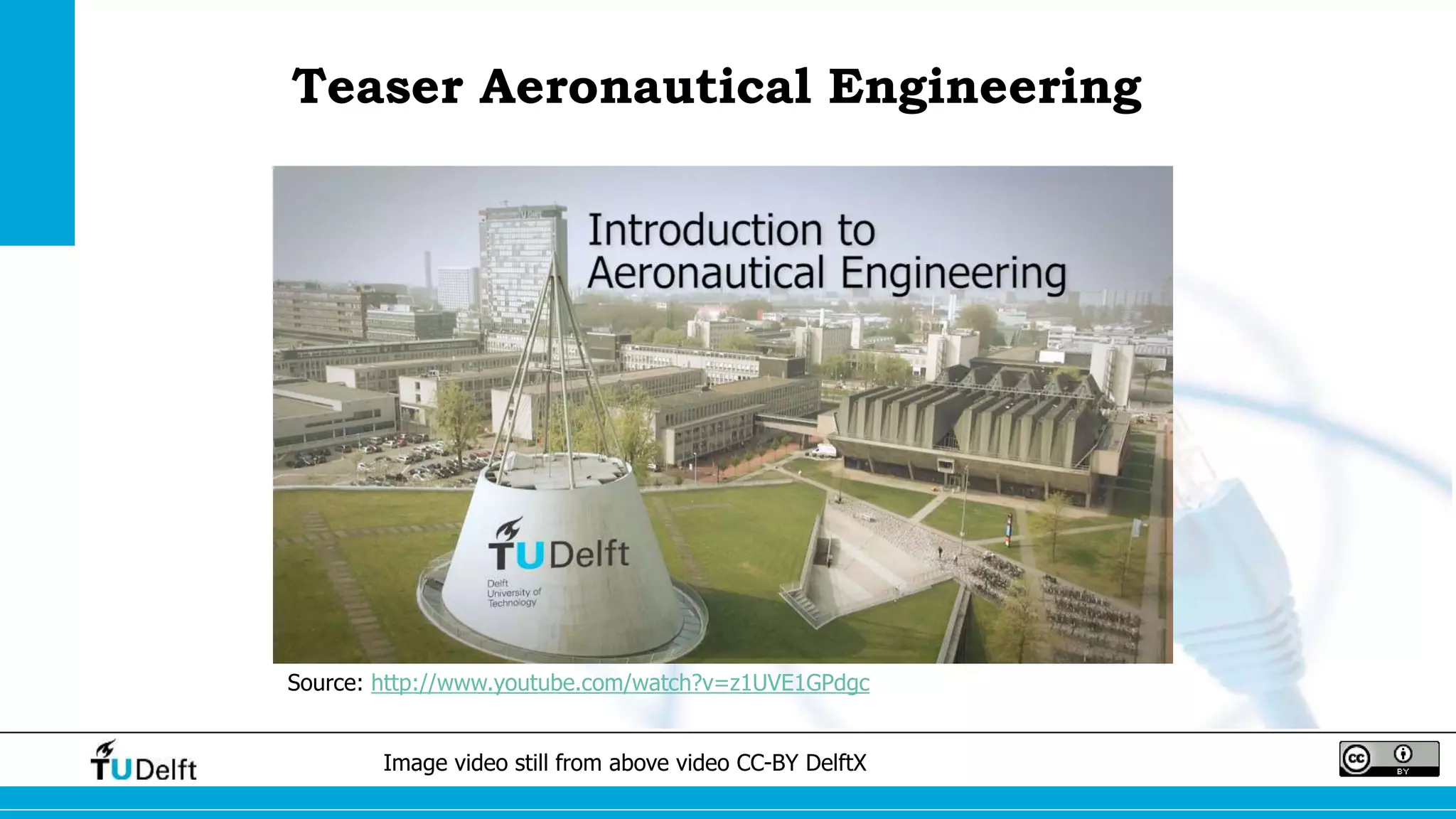
Teaser Aeronautical Engineering 
Source: http://www.youtube.com/watch?v=z1UVE1GPdgc 
Image video still from above video CC-BY DelftX
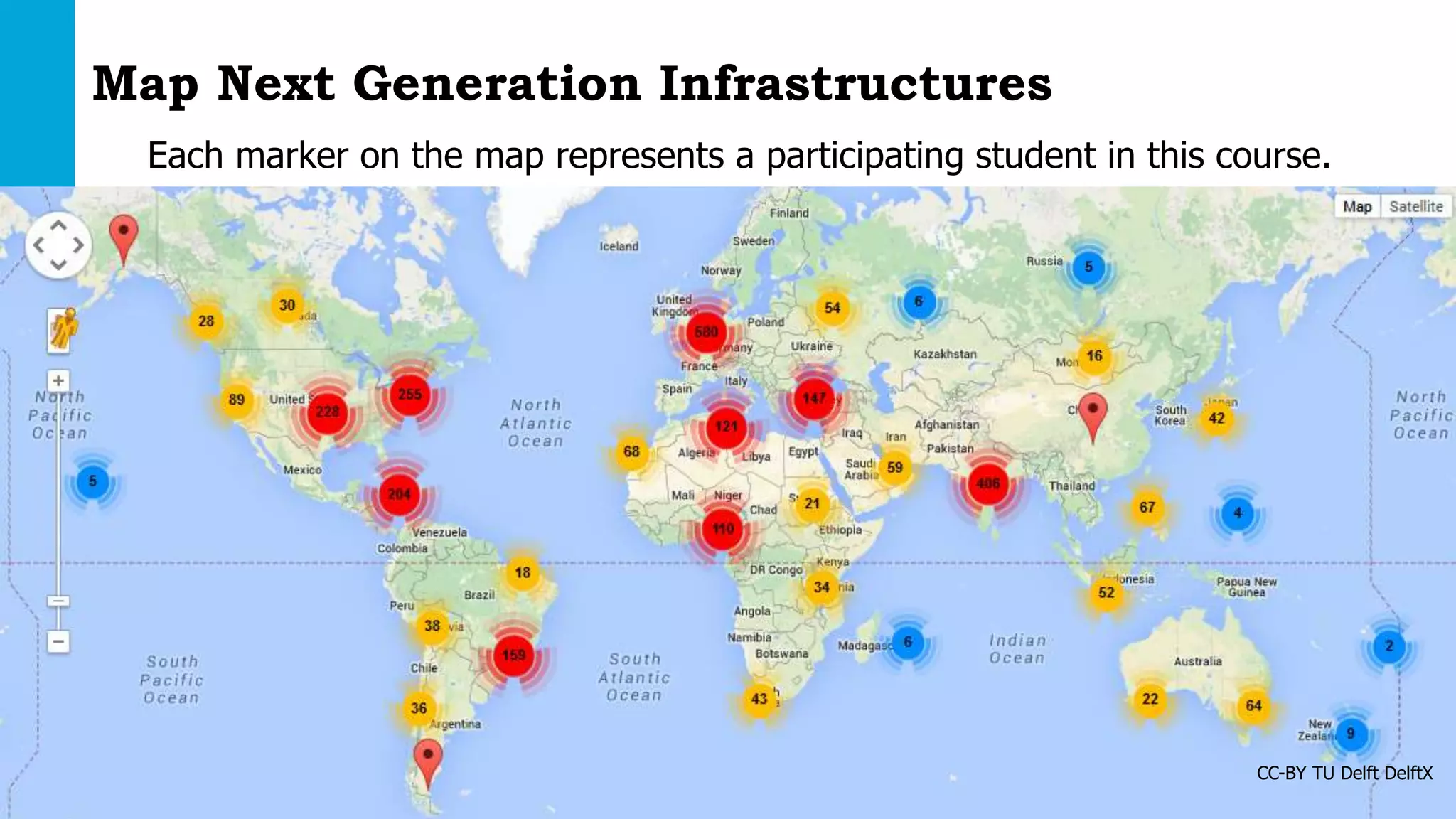
Map Next Generation Infrastructures 
Each marker on the map represents a participating student in this course. 
CC-BY TU Delft DelftX
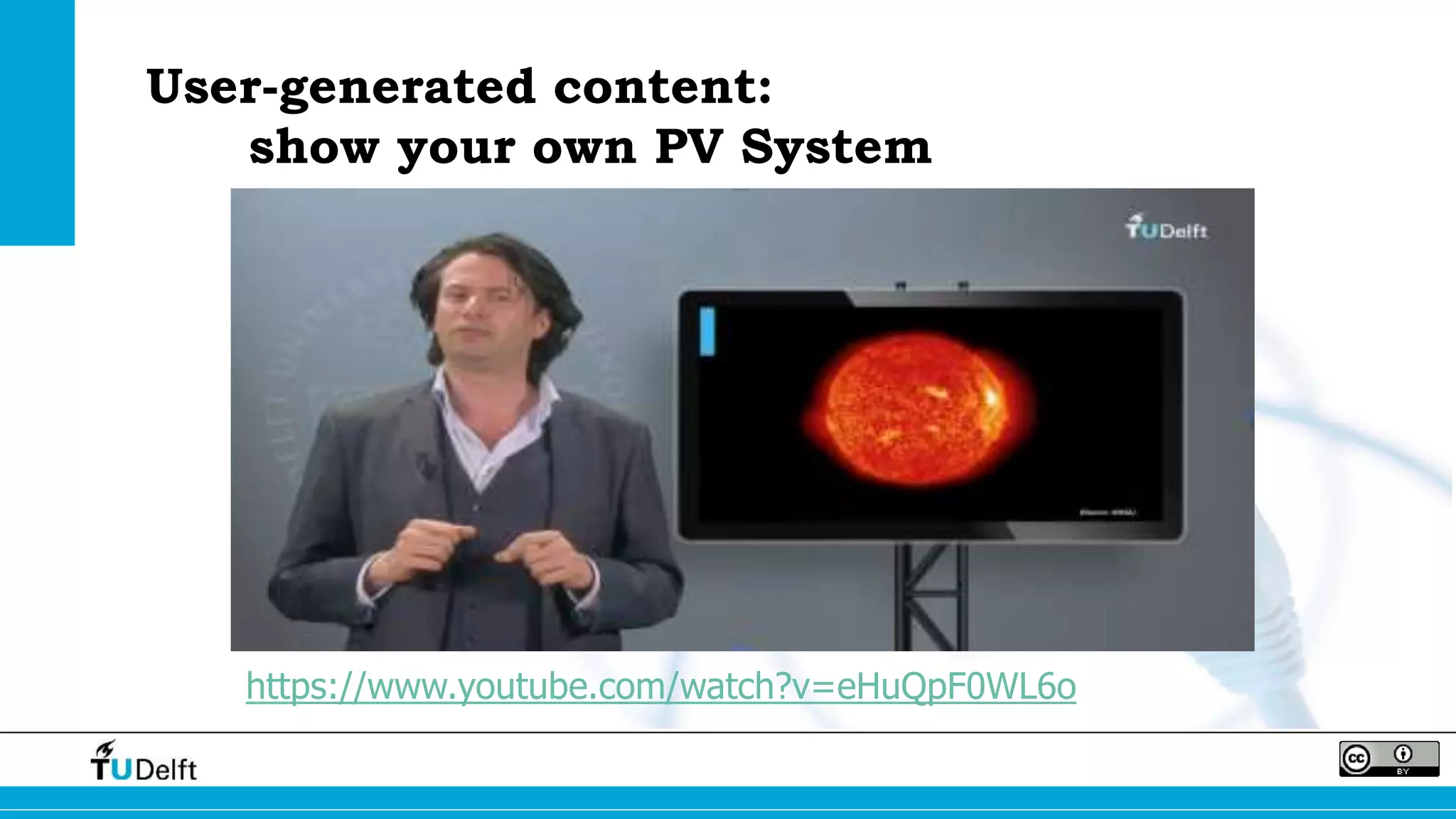
User-generated content: 
show your own PV System 
https://www.youtube.com/watch?v=eHuQpF0WL6o
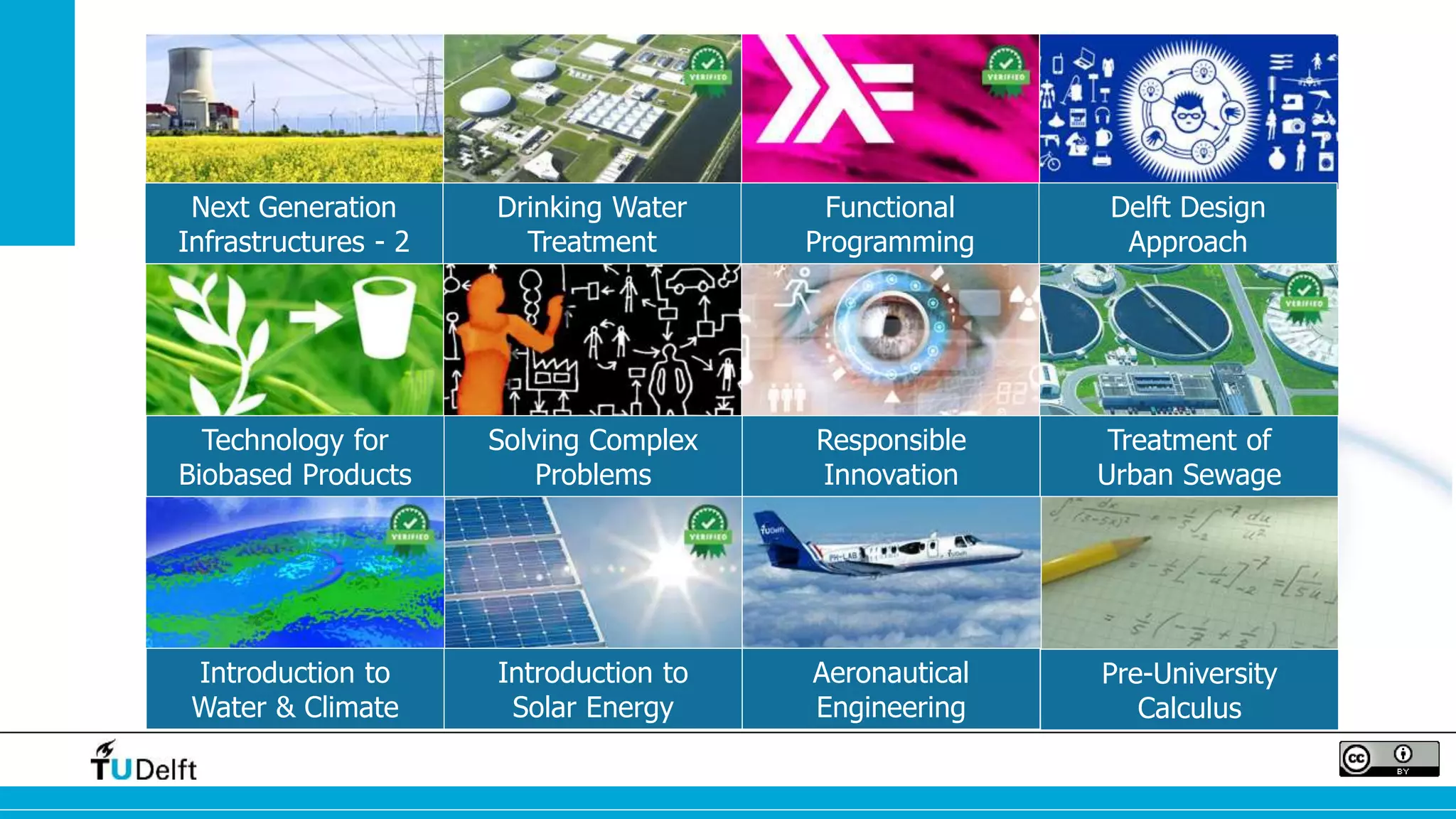
Next Generation 
Infrastructures - 2 
Drinking Water 
Treatment 
Functional 
Programming 
Delft Design 
Approach 
Technology for 
Biobased Products 
Solving Complex 
Problems 
Responsible 
Innovation 
Treatment of 
Urban Sewage 
Introduction to 
Water & Climate 
Introduction to 
Solar Energy 
Aeronautical 
Engineering 
Pre-University 
Calculus
Global 
Developments
20 
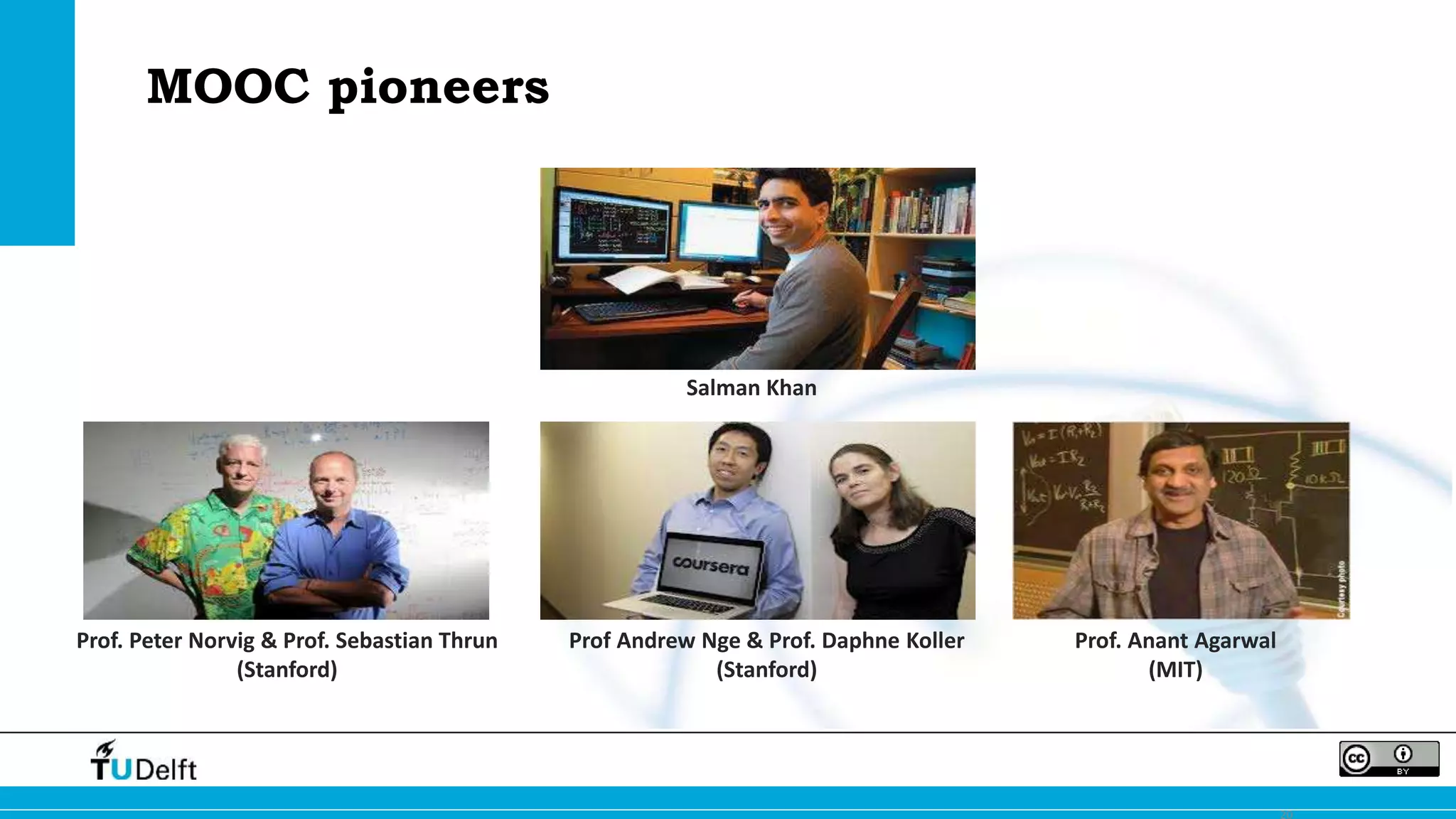
Salman Khan 
Prof. Peter Norvig & Prof. Sebastian Thrun 
(Stanford) 
Prof Andrew Nge & Prof. Daphne Koller 
(Stanford) 
Prof. Anant Agarwal 
(MIT) 
MOOC pioneers
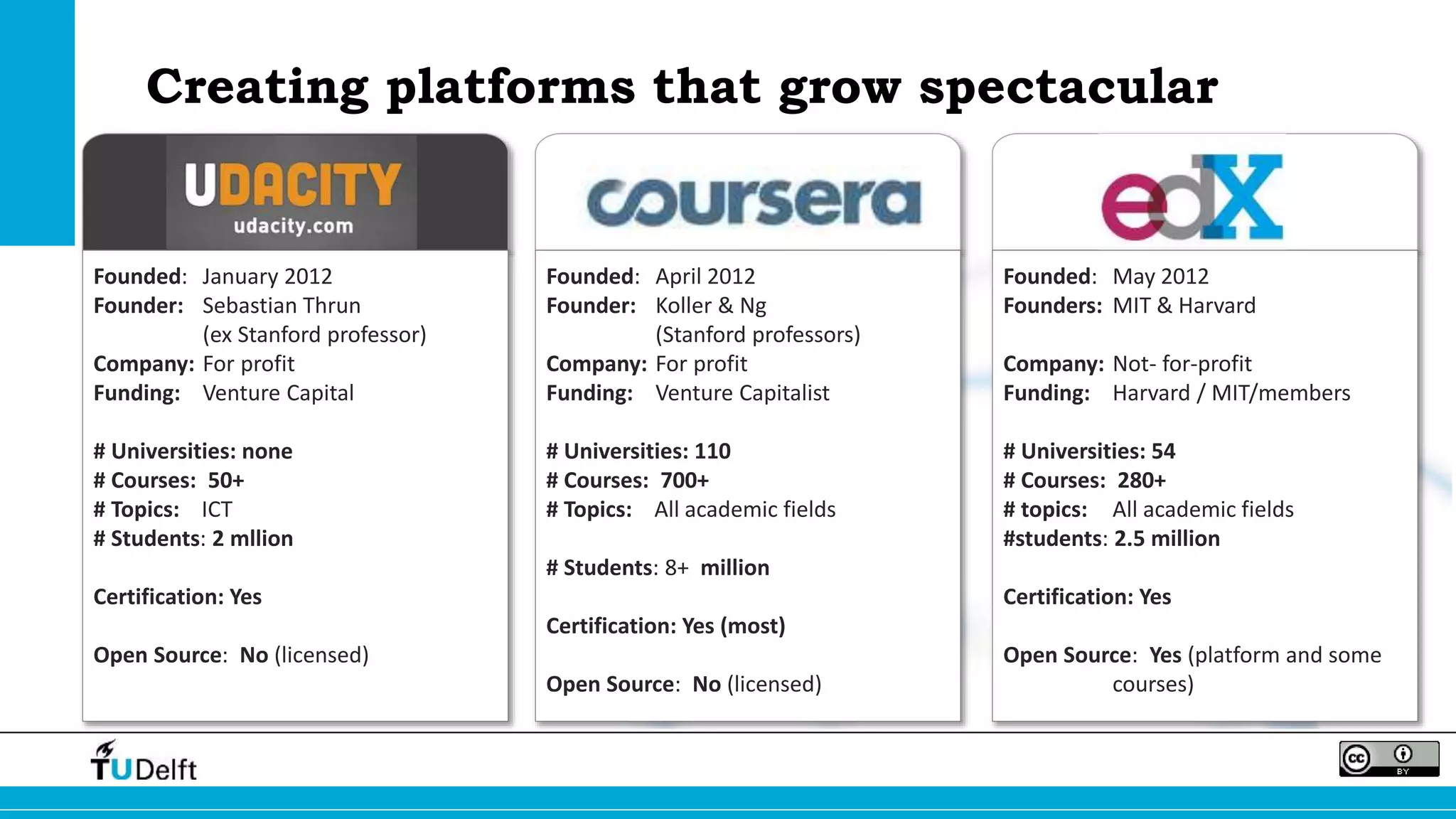
Creating platforms that grow spectacular 
Founded: April 2012 
Founder: Koller & Ng 
(Stanford professors) 
Company: For profit 
Funding: Venture Capitalist 
# Universities: 110 
# Courses: 700+ 
# Topics: All academic fields 
# Students: 8+ million 
Certification: Yes (most) 
Open Source: No (licensed) 
Founded: May 2012 
Founders: MIT & Harvard 
Company: Not- for-profit 
Funding: Harvard / MIT/members 
# Universities: 54 
# Courses: 280+ 
# topics: All academic fields 
#students: 2.5 million 
Certification: Yes 
Open Source: Yes (platform and some 
courses) 
Founded: January 2012 
Founder: Sebastian Thrun 
(ex Stanford professor) 
Company: For profit 
Funding: Venture Capital 
# Universities: none 
# Courses: 50+ 
# Topics: ICT 
# Students: 2 mllion 
Certification: Yes 
Open Source: No (licensed)
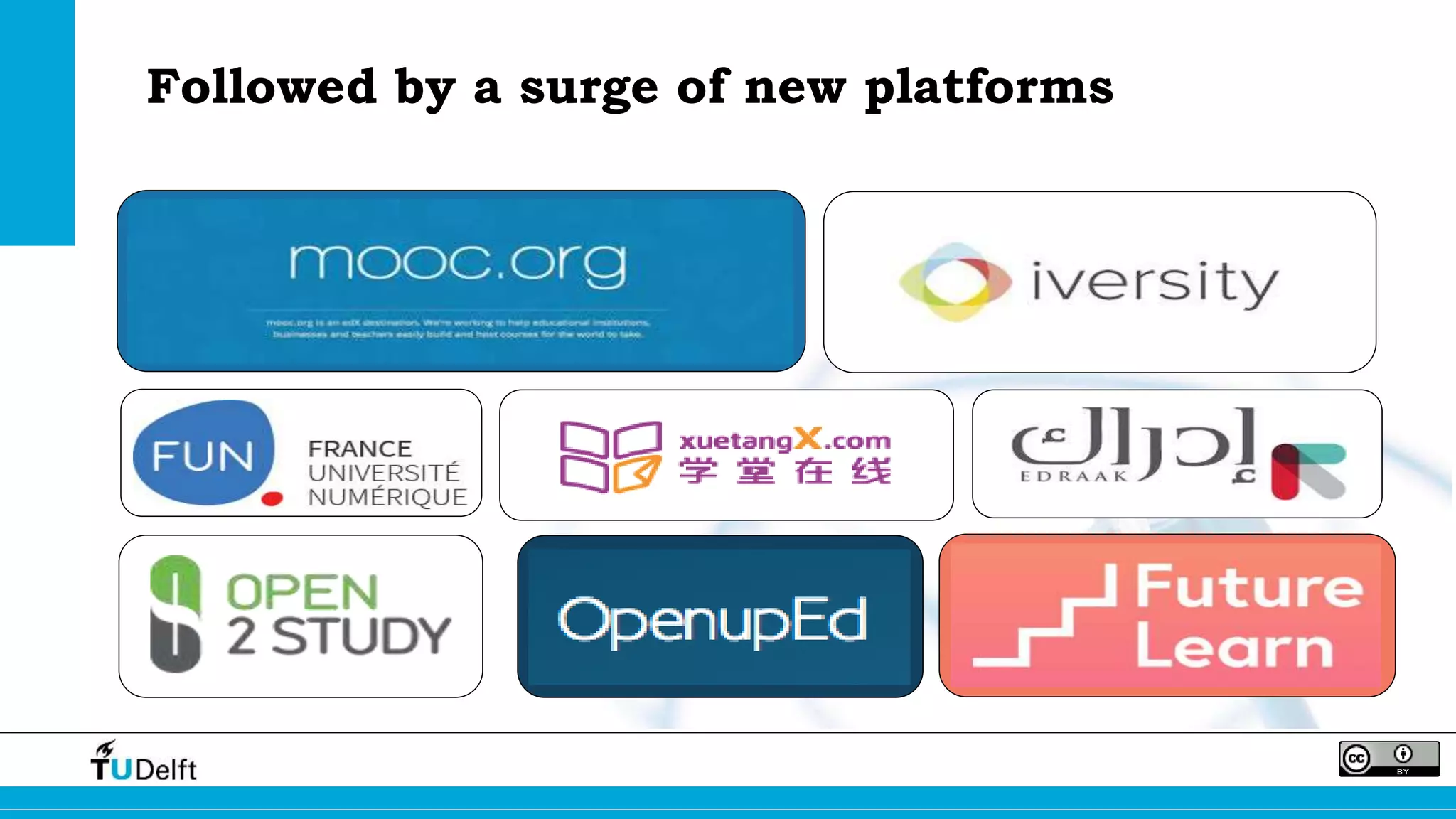
Followed by a surge of new platforms
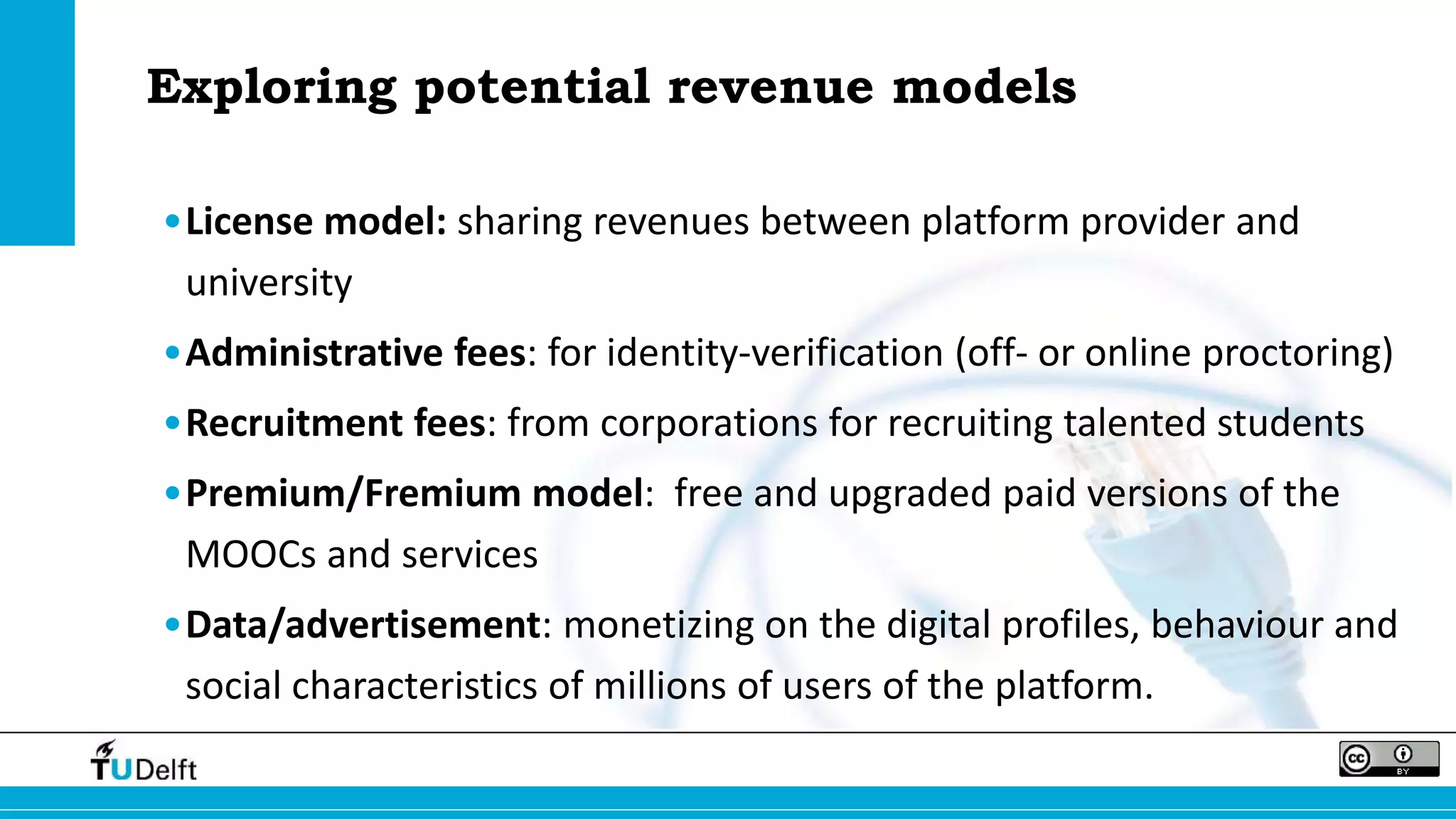
Exploring potential revenue models 
•License model: sharing revenues between platform provider and 
university 
•Administrative fees: for identity-verification (off- or online proctoring) 
•Recruitment fees: from corporations for recruiting talented students 
•Premium/Fremium model: free and upgraded paid versions of the 
MOOCs and services 
•Data/advertisement: monetizing on the digital profiles, behaviour and 
social characteristics of millions of users of the platform.
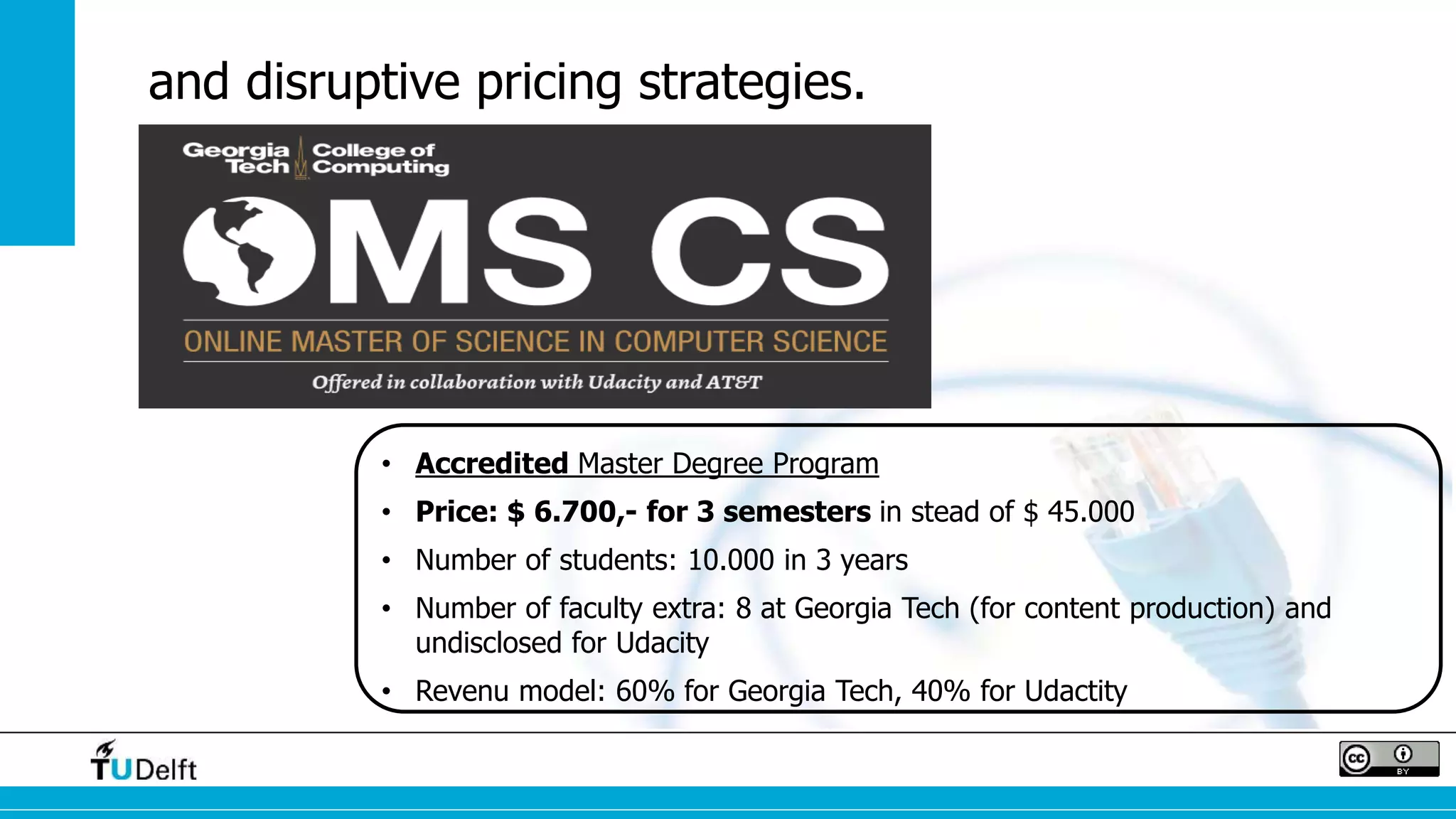
and disruptive pricing strategies. 
• Accredited Master Degree Program 
• Price: $ 6.700,- for 3 semesters in stead of $ 45.000 
• Number of students: 10.000 in 3 years 
• Number of faculty extra: 8 at Georgia Tech (for content production) and 
undisclosed for Udacity 
• Revenu model: 60% for Georgia Tech, 40% for Udactity
Swedish Universities?
Vision on the 
Future of EDU
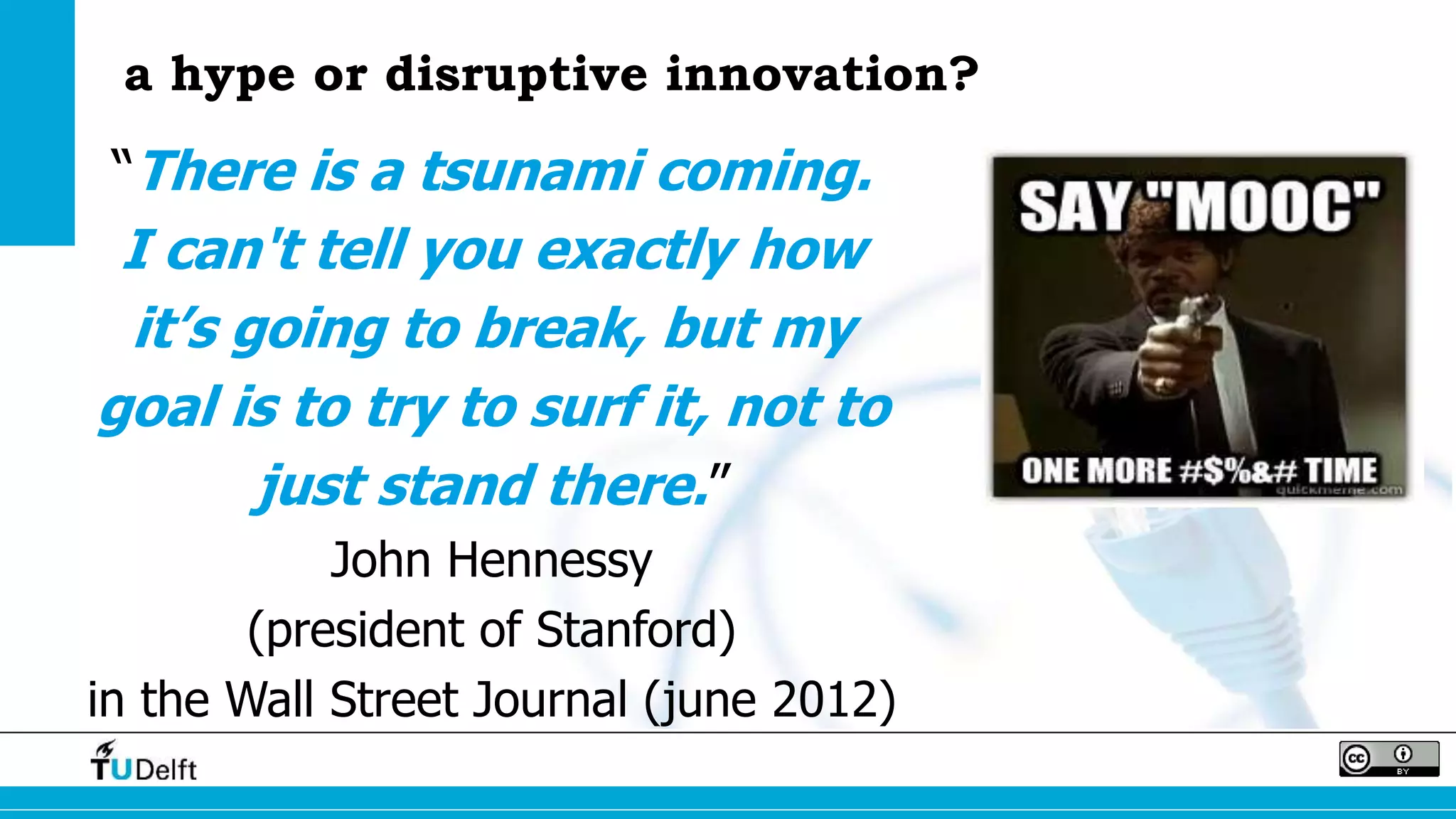
a hype or disruptive innovation? 
“There is a tsunami coming. 
I can't tell you exactly how 
it’s going to break, but my 
goal is to try to surf it, not to 
just stand there.” 
John Hennessy 
(president of Stanford) 
in the Wall Street Journal (june 2012)
Thomas Friedman: 
“The World is Flat” 
“When the outstanding becomes so 
easily accessible, average is over.” 
Source: http://www.nytimes.com/2013/03/06/opinion/friedman-the-professors-big-stage.html
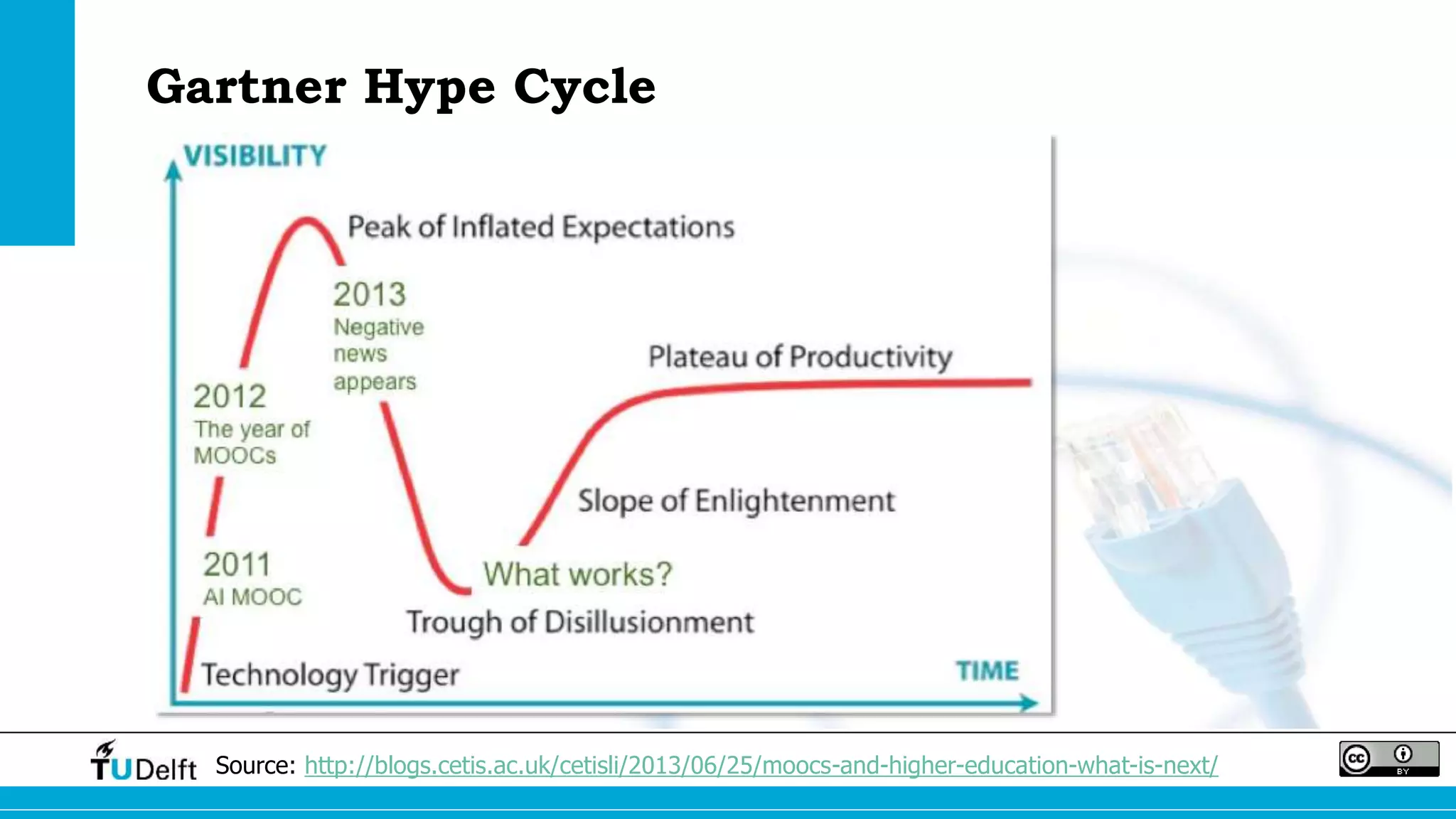
Gartner Hype Cycle 
Source: http://blogs.cetis.ac.uk/cetisli/2013/06/25/moocs-and-higher-education-what-is-next/
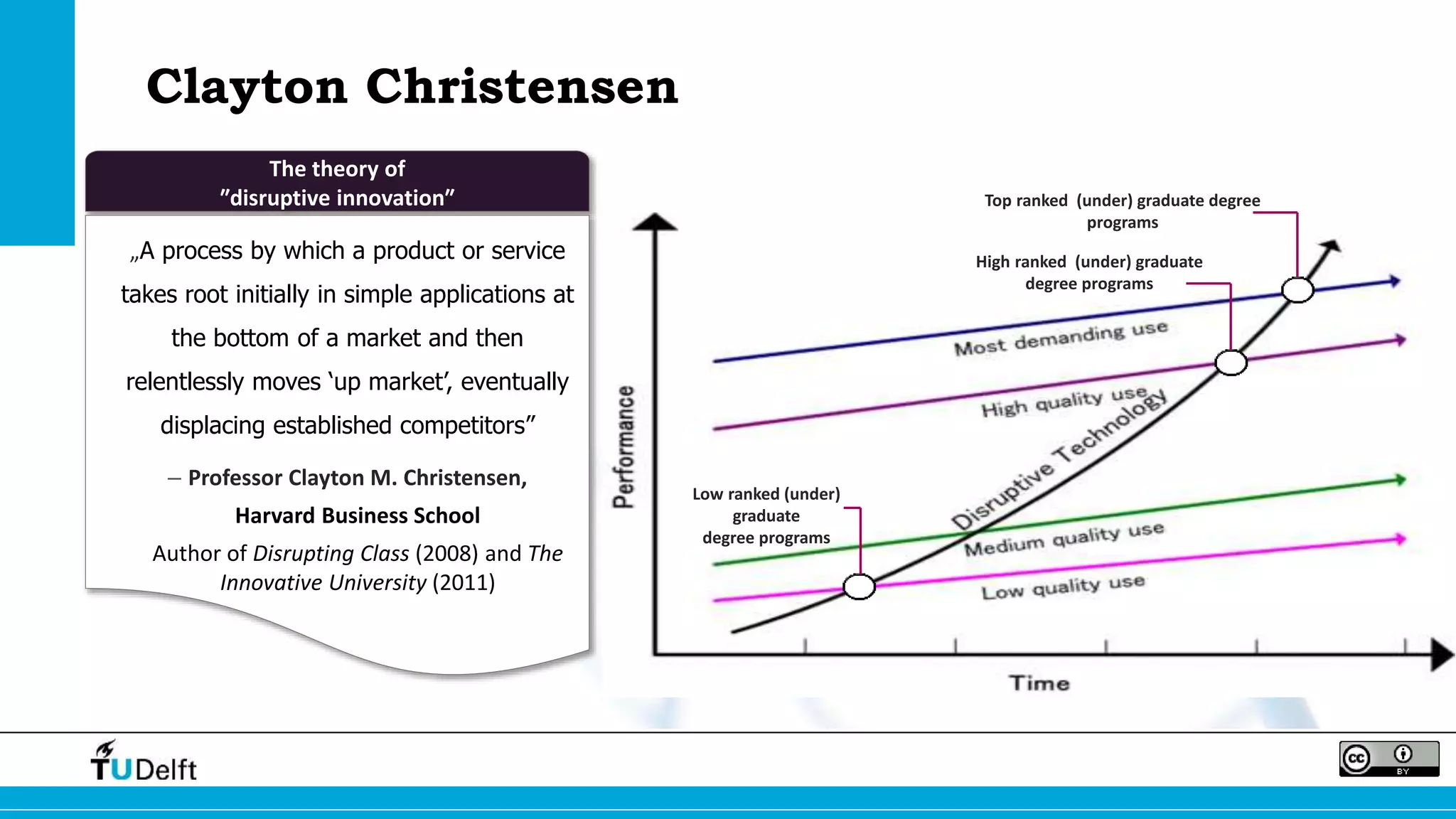
The theory of 
ʺdisruptive innovationʺ 
„A process by which a product or service 
takes root initially in simple applications at 
the bottom of a market and then 
relentlessly moves ‘up market’, eventually 
displacing established competitors” 
‒ Professor Clayton M. Christensen, 
Harvard Business School 
Author of Disrupting Class (2008) and The 
Innovative University (2011) 
Low ranked (under) 
graduate 
degree programs 
Top ranked (under) graduate degree 
programs 
High ranked (under) graduate 
degree programs 
Clayton Christensen
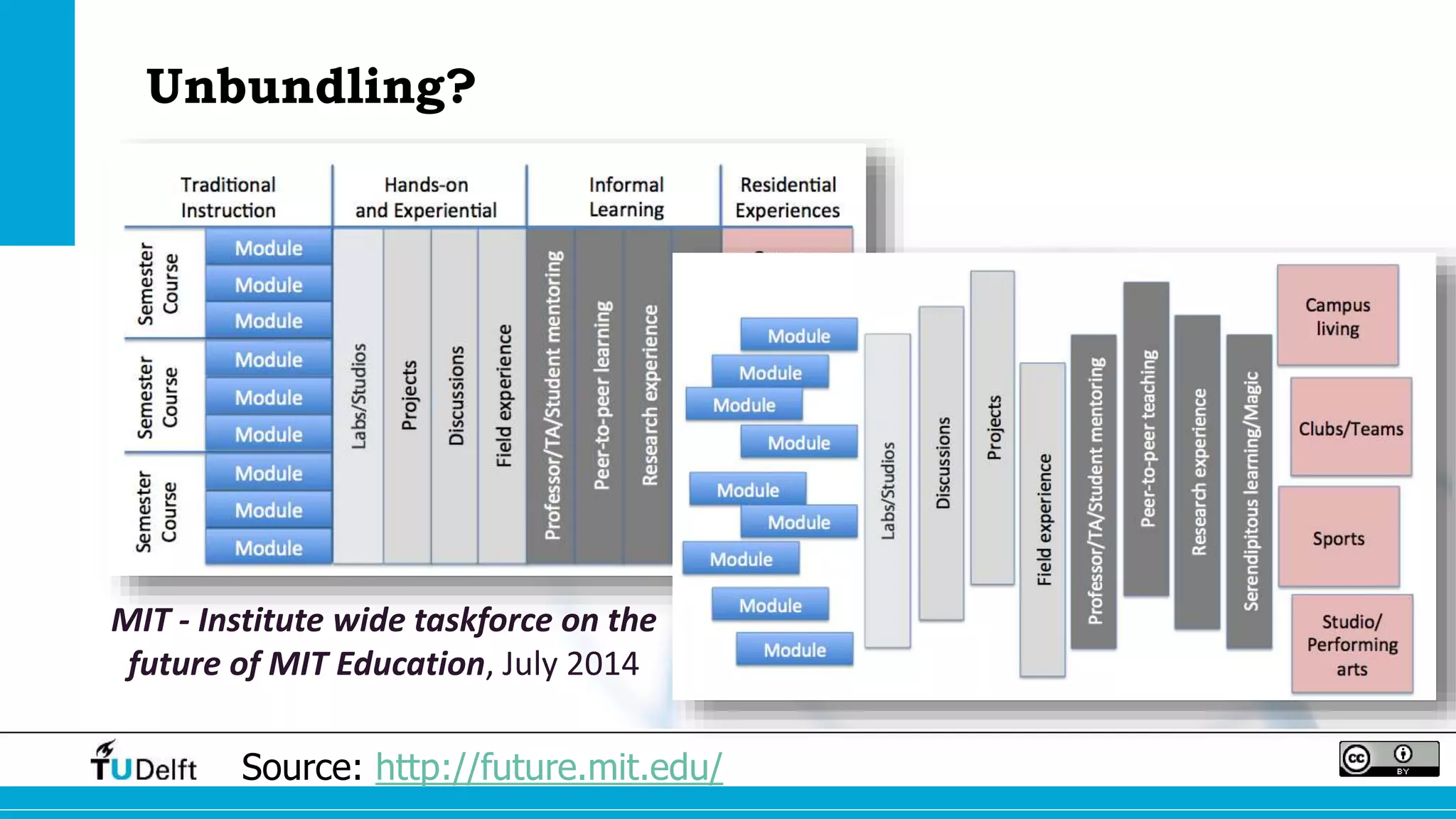
Unbundling? 
MIT - Institute wide taskforce on the 
future of MIT Education, July 2014 
Source: http://future.mit.edu/
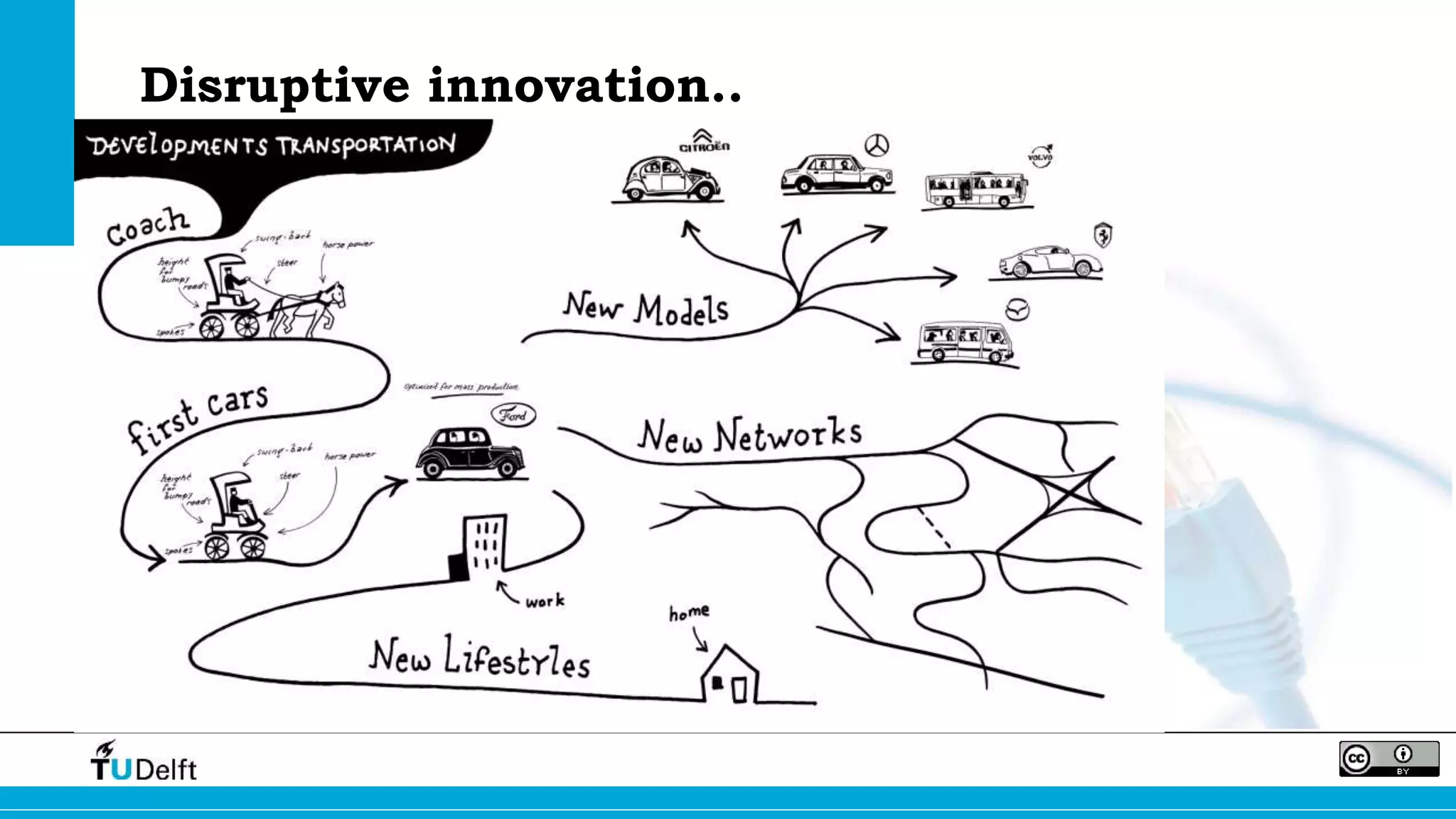
Disruptive innovation..
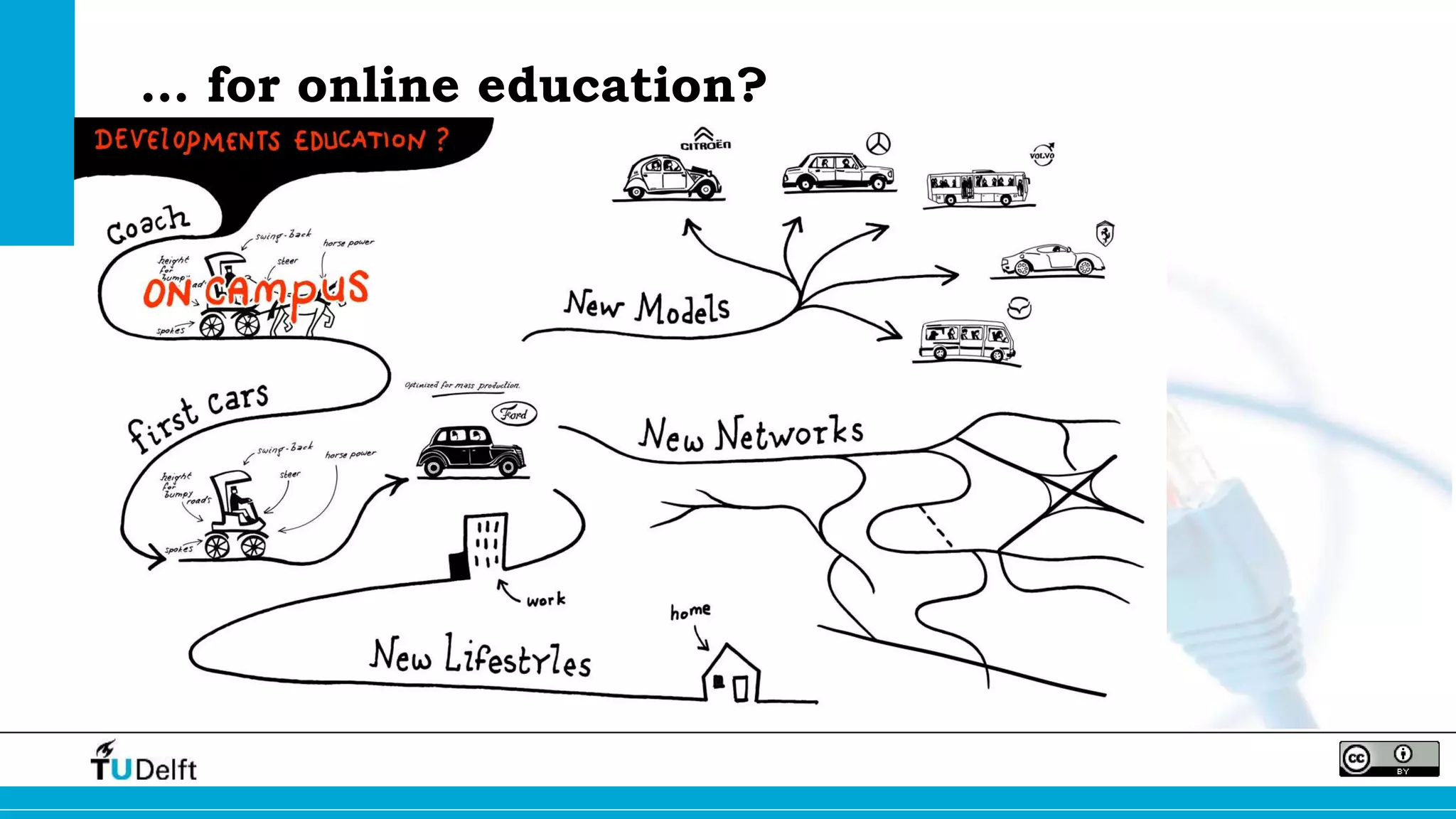
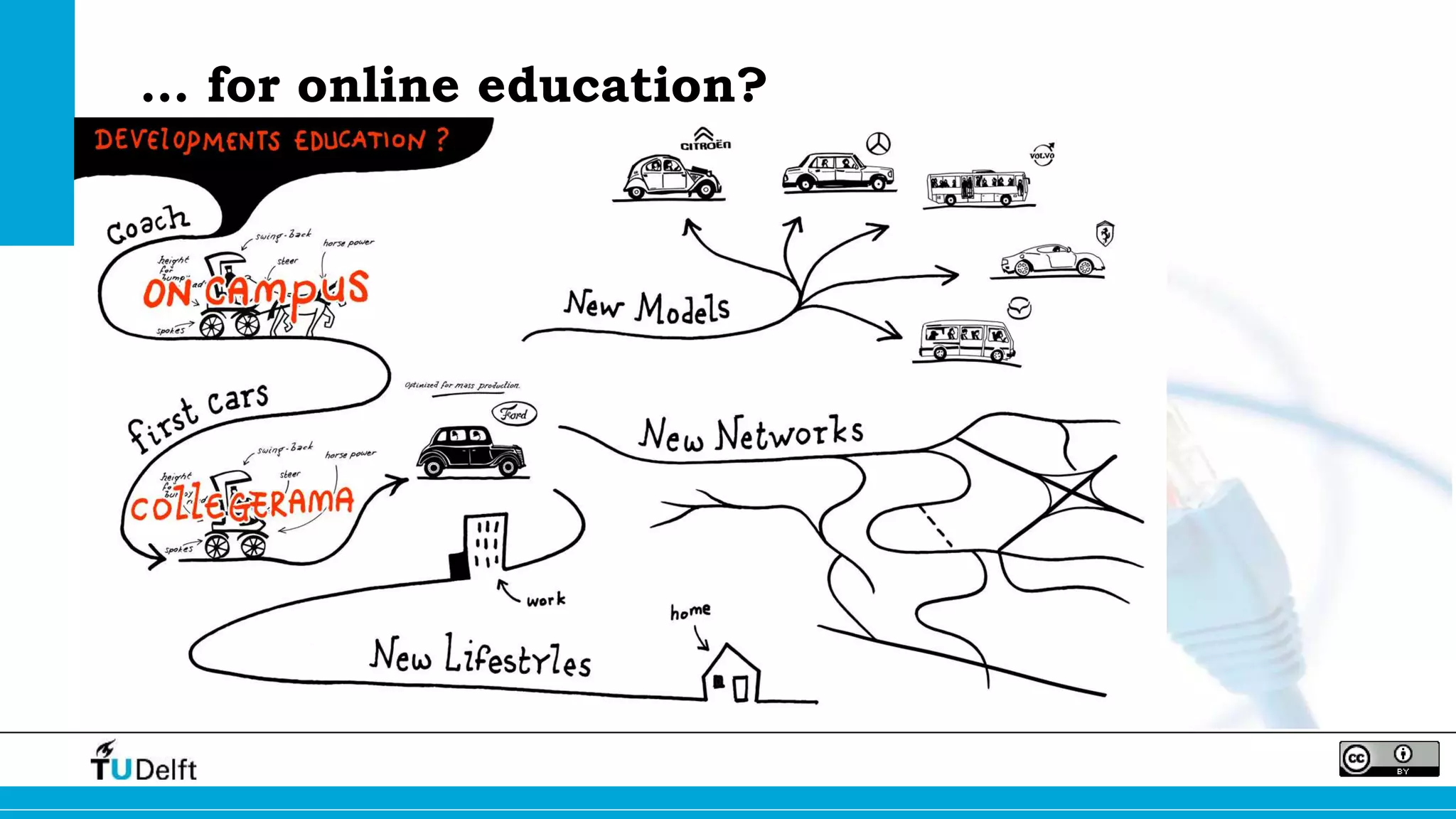
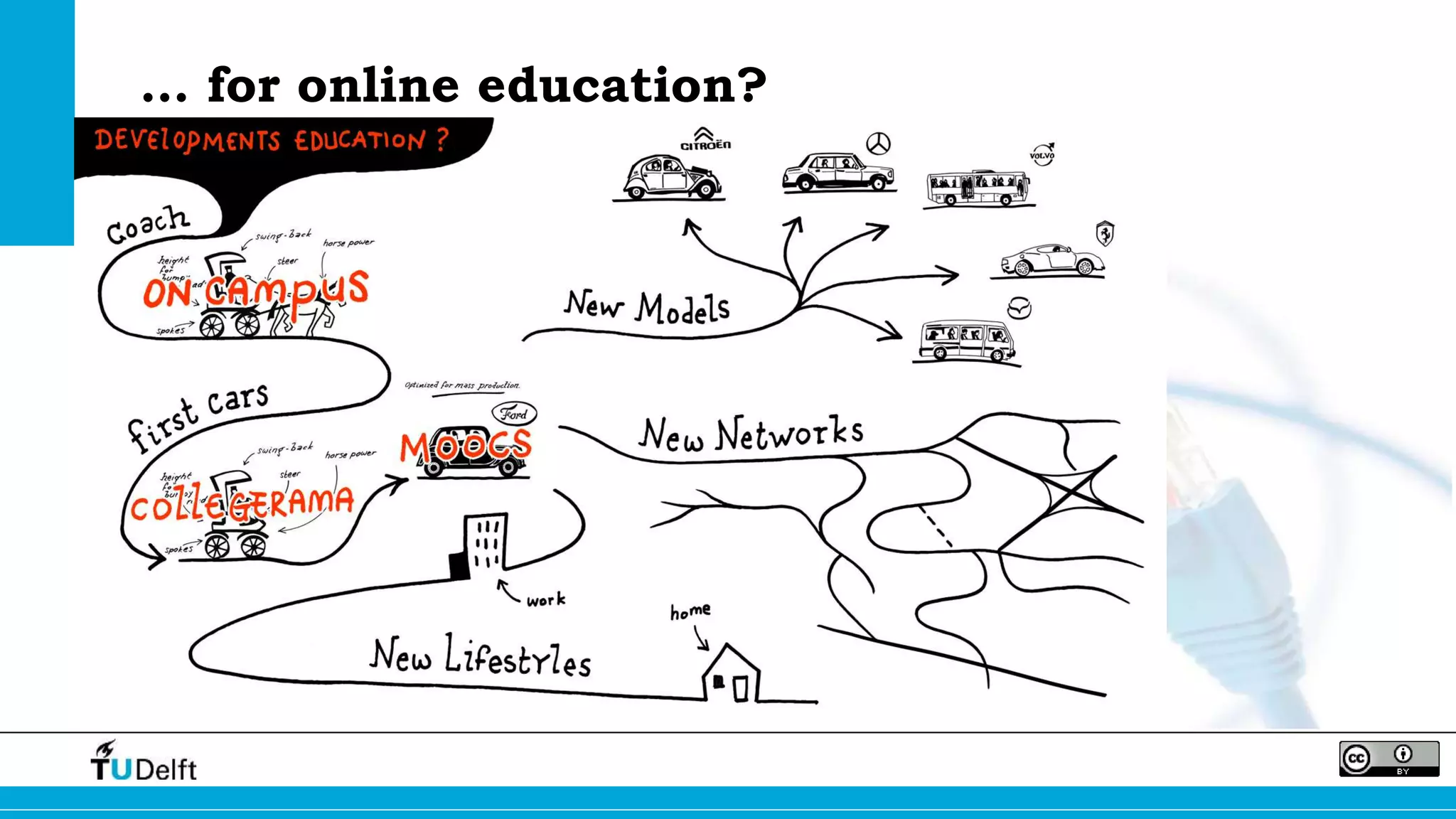
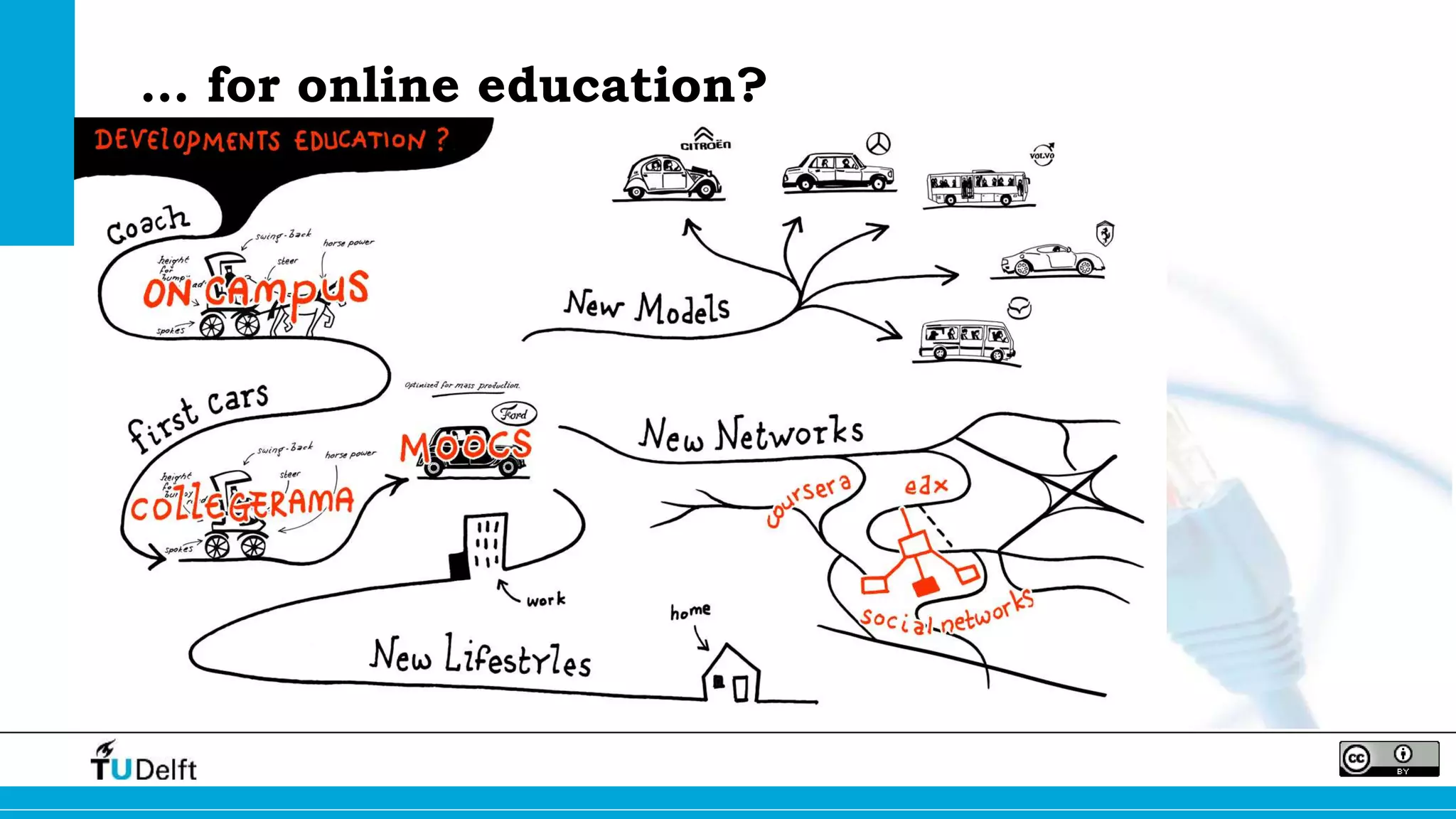
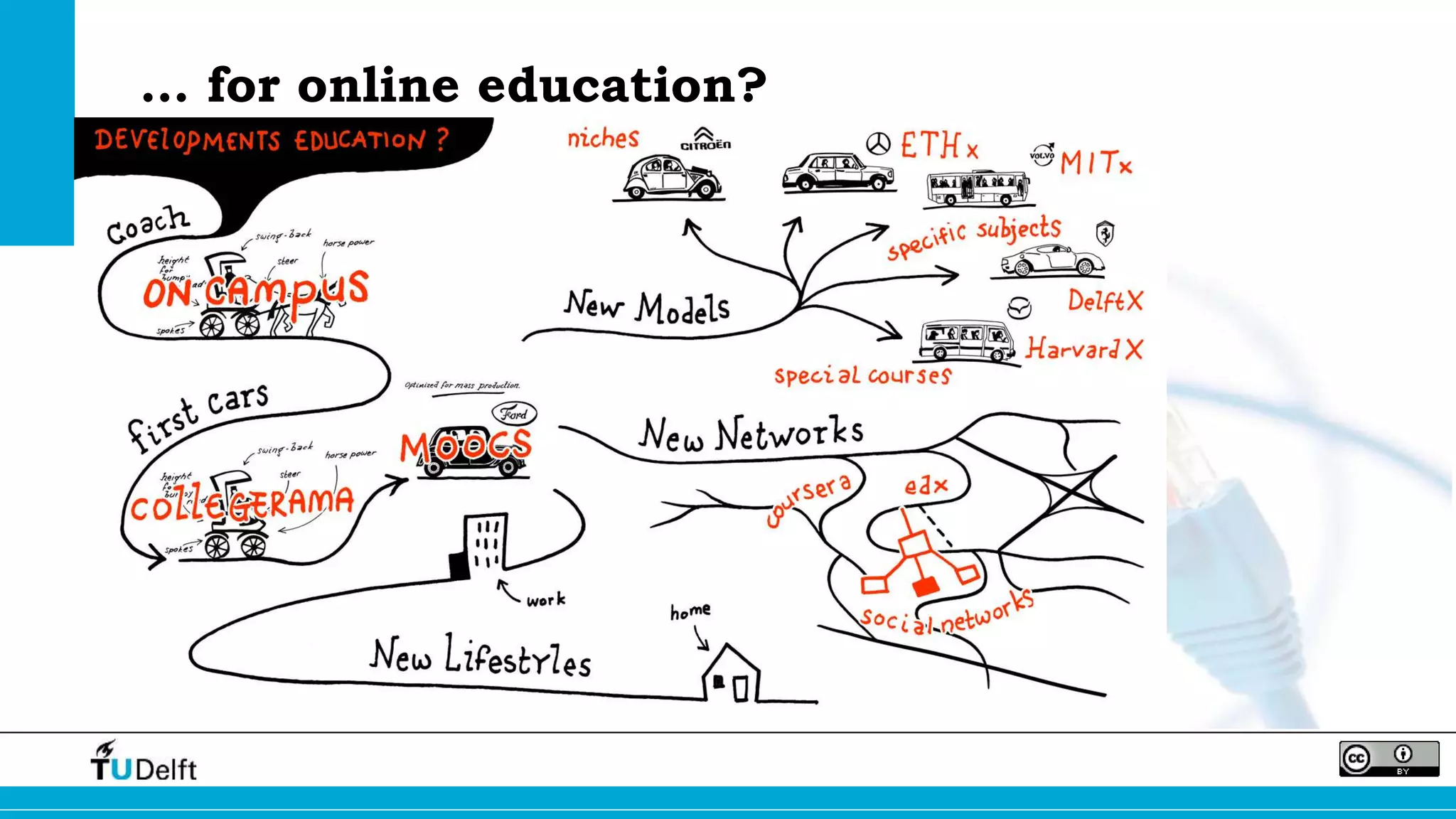
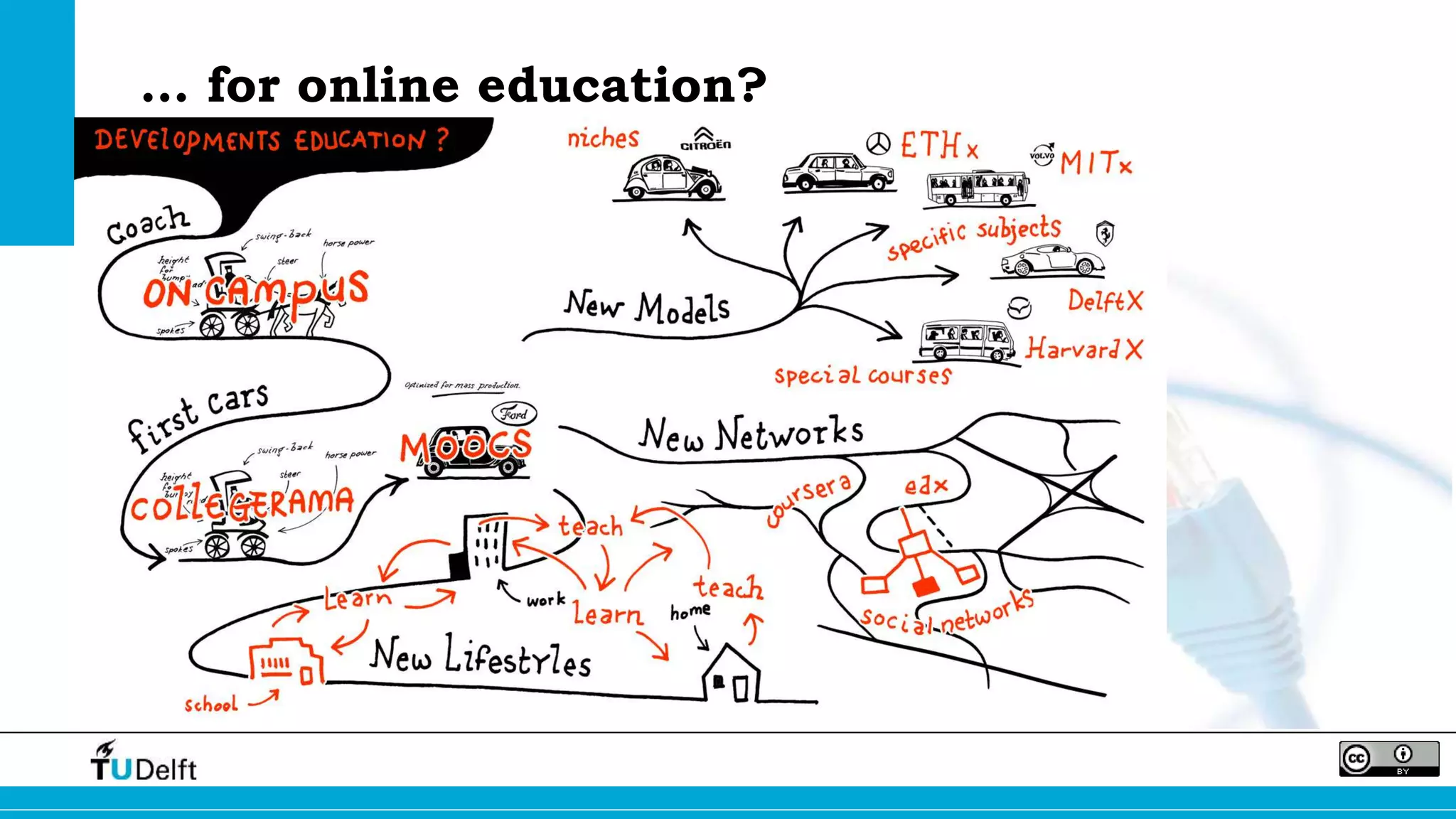
… for online education?
TU DELFT 
EXTENSION 
SCHOOL
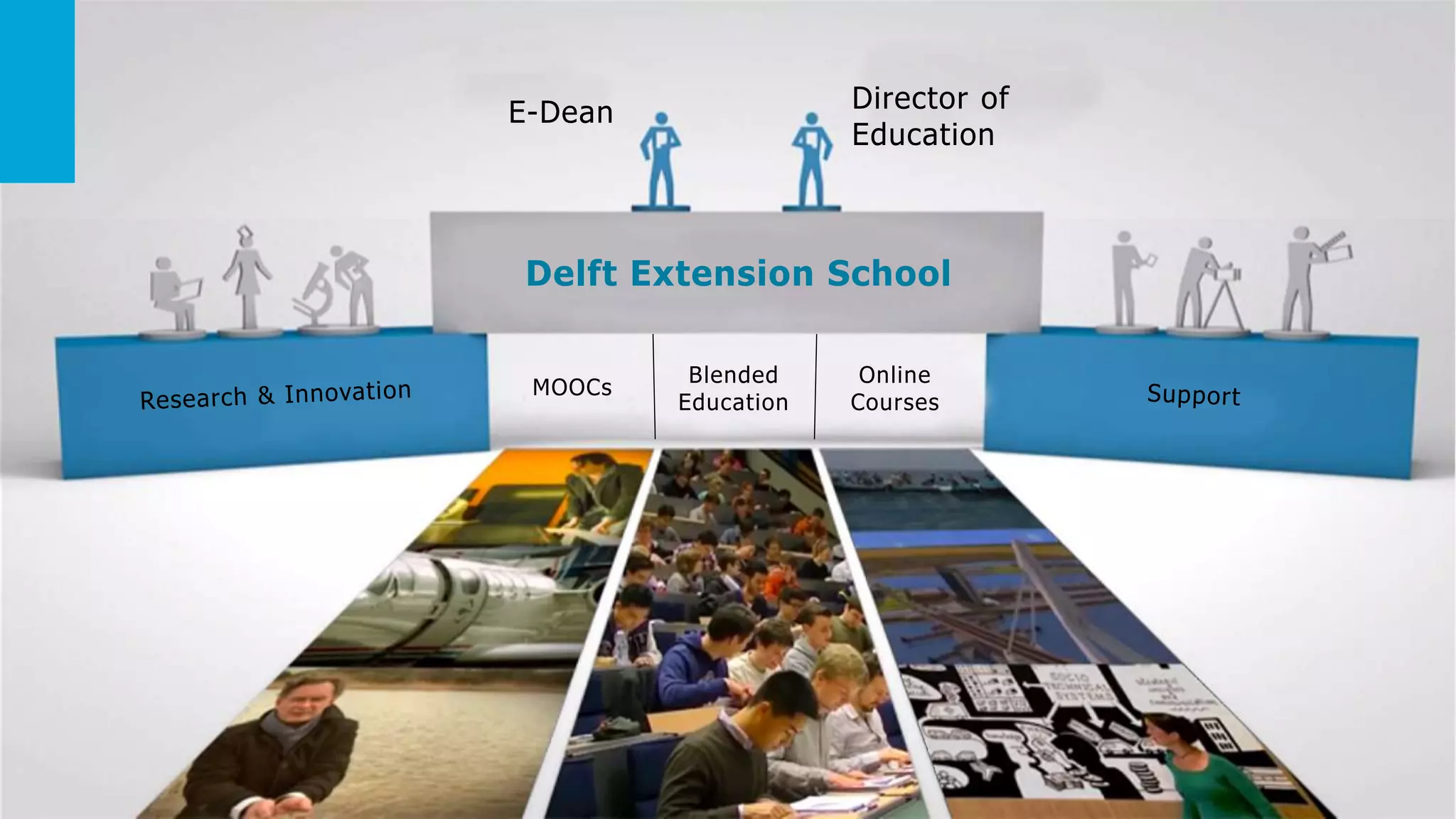
E-Dean Director of 
Education 
Delft Extension School 
MOOCs 
Blended 
Education 
Online 
Courses
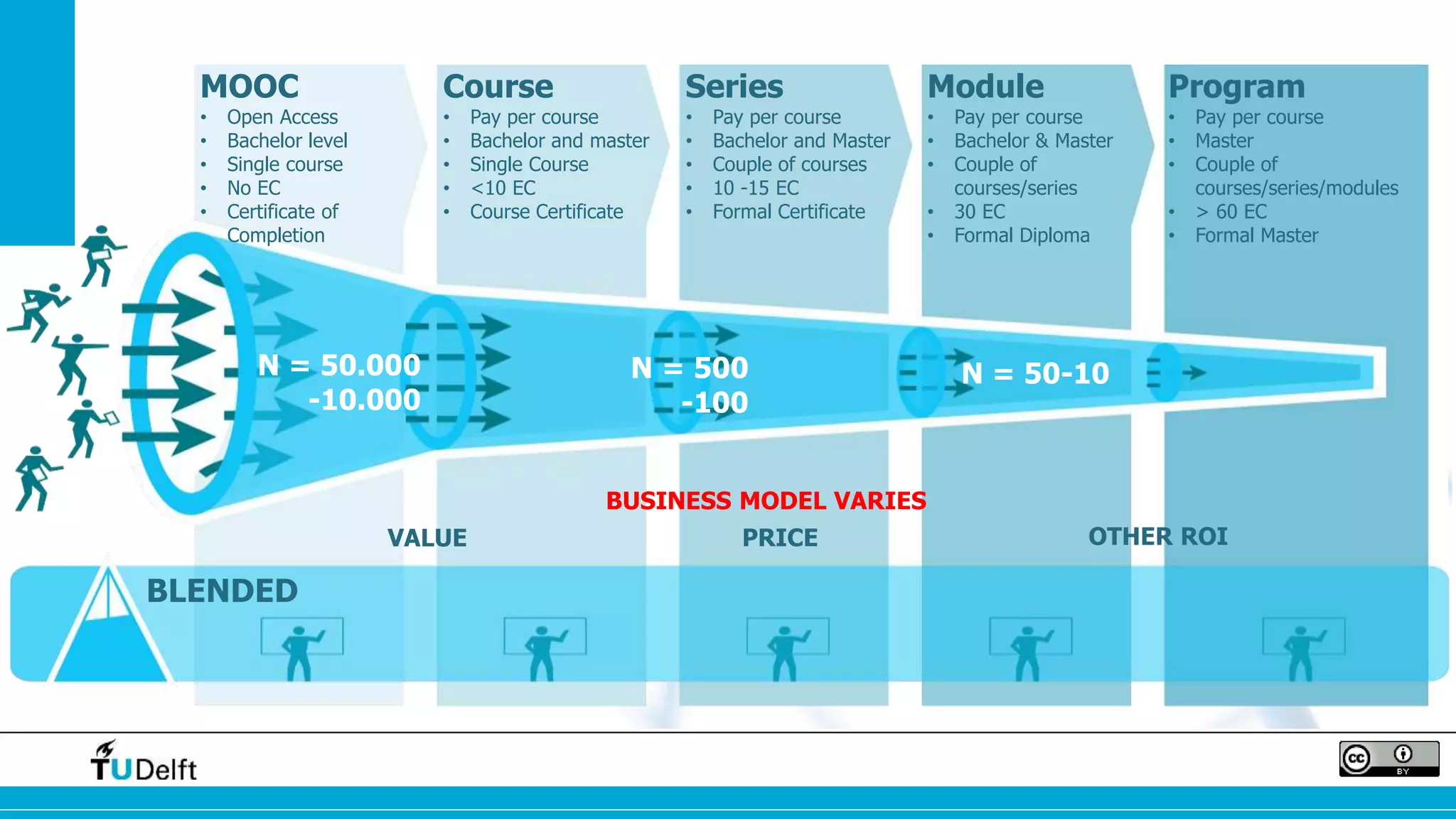
MOOC 
• Open Access 
• Bachelor level 
• Single course 
• No EC 
• Certificate of 
Completion 
Course 
• Pay per course 
• Bachelor and master 
• Single Course 
• <10 EC 
• Course Certificate 
Series 
• Pay per course 
• Bachelor and Master 
• Couple of courses 
• 10 -15 EC 
• Formal Certificate 
Module 
• Pay per course 
• Bachelor & Master 
• Couple of 
courses/series 
• 30 EC 
• Formal Diploma 
Program 
• Pay per course 
• Master 
• Couple of 
courses/series/modules 
• > 60 EC 
• Formal Master 
N = 50.000 
BLENDED 
-10.000 
N = 500 
-100 
N = 50-10 
BUSINESS MODEL VARIES 
VALUE PRICE OTHER ROI
Thank you 
CC BY: katerha: ht tp:/ /www. f l ickr .com/photos/katerha/6055323149 /
open.tudelft.nl 
slideshare.net/wfvanvalkenburg 
twitter.com/tudelftOCW 
twitter.com/DelftX 
twitter.com/wfvanvalkenburg

MOOCs as Accelerator of Change

  • 1.
    MOOCs as acceleratorof change Willem van Valkenburg Unless otherwise indicated, this presentation is licensed CC-BY 4.0. Please attribute TU Delft Extension School / Willem van Valkenburg
  • 2.
    Willem van Valkenburg Production & Delivery Manager TU Delft Extension School Board member Open Education Consortium twitter.com/wfvanvalkenburg slideshare.net/wfvanvalkenburg
  • 3.
    Foto: Ulrike ReinhardLearning Stations in Khajuraho, Rural India 1. “The number of higher education students in the world is expected to quadruple, from around 100 million in 2000 to 400 million in 2030”
  • 4.
    To accommodate themwe need to build 9.615 universities in 30 years That is 3 universities For 30.000 students per week
  • 5.
    2. “Students expectto choose what they learn, how they learn and when they learn” Image CC BY Phillie Casablanca
  • 6.
    Yet, this ishow we teach Image: CC BY Martijn Ouwehand
  • 7.
    Content 1. Context@ TU Delft 2. Global Developments 3. Vision on the future of education 4. TU Delft Extension School 5. Discussion
  • 8.
  • 9.
    “Open and online education allows people from around the world access to the top education of TU Delft. It enables everybody who wants to develop themselves and accommodates the increasing number of students seeking higher education. TU Delft is dedicated to deliver world class education to everyone.” Drs. Anka Mulder. Vice President Education TU Delft
  • 10.
    Open & Onlineportfolio Massive Open Online Courses (MOOCs) Open Course Ware (OCW) Online Distance Education (ODE) Campus Education • 5 MOOCs (> 140.000 enrollments) • ≈ 5.000 Certificates of Completion • 11 new MOOCs announced • No Credits • More than 140 courses online • Unique visitors > 1000 /day • No interaction with faculty • No accredited certificate • 1 full online master (25 courses) • 2 modules, 1 minor, 1 master (6 courses) • 50 students (30 on-campus) • Full Master Degree / Accredited Course Certificate • 19.000 on-campus students • Bachelor – Master – PhD • 2 blended Bachelors
  • 11.
    OpenCourseWare •Course Materialsincluding recorded lectures •More than 140 courses online •Big Exposure, Worldwide audience •Both Bachelor and Master level (Dutch and English) •No interaction with faculty •No accredited certificate •Focus on use and re-use
  • 12.
    What kind ofMOOCs do we want?
  • 13.
    DelftX Courses Water Treatment Solar Energy Next Generation Infrastructures Aeronautical Engineering Credit Risk Management
  • 14.
    MOOC students: lifelong learning
  • 15.
    Teaser Aeronautical Engineering Source: http://www.youtube.com/watch?v=z1UVE1GPdgc Image video still from above video CC-BY DelftX
  • 16.
    Map Next GenerationInfrastructures Each marker on the map represents a participating student in this course. CC-BY TU Delft DelftX
  • 17.
    User-generated content: showyour own PV System https://www.youtube.com/watch?v=eHuQpF0WL6o
  • 18.
    Next Generation Infrastructures- 2 Drinking Water Treatment Functional Programming Delft Design Approach Technology for Biobased Products Solving Complex Problems Responsible Innovation Treatment of Urban Sewage Introduction to Water & Climate Introduction to Solar Energy Aeronautical Engineering Pre-University Calculus
  • 19.
  • 20.
    20 Salman Khan Prof. Peter Norvig & Prof. Sebastian Thrun (Stanford) Prof Andrew Nge & Prof. Daphne Koller (Stanford) Prof. Anant Agarwal (MIT) MOOC pioneers
  • 21.
    Creating platforms thatgrow spectacular Founded: April 2012 Founder: Koller & Ng (Stanford professors) Company: For profit Funding: Venture Capitalist # Universities: 110 # Courses: 700+ # Topics: All academic fields # Students: 8+ million Certification: Yes (most) Open Source: No (licensed) Founded: May 2012 Founders: MIT & Harvard Company: Not- for-profit Funding: Harvard / MIT/members # Universities: 54 # Courses: 280+ # topics: All academic fields #students: 2.5 million Certification: Yes Open Source: Yes (platform and some courses) Founded: January 2012 Founder: Sebastian Thrun (ex Stanford professor) Company: For profit Funding: Venture Capital # Universities: none # Courses: 50+ # Topics: ICT # Students: 2 mllion Certification: Yes Open Source: No (licensed)
  • 22.
    Followed by asurge of new platforms
  • 23.
    Exploring potential revenuemodels •License model: sharing revenues between platform provider and university •Administrative fees: for identity-verification (off- or online proctoring) •Recruitment fees: from corporations for recruiting talented students •Premium/Fremium model: free and upgraded paid versions of the MOOCs and services •Data/advertisement: monetizing on the digital profiles, behaviour and social characteristics of millions of users of the platform.
  • 24.
    and disruptive pricingstrategies. • Accredited Master Degree Program • Price: $ 6.700,- for 3 semesters in stead of $ 45.000 • Number of students: 10.000 in 3 years • Number of faculty extra: 8 at Georgia Tech (for content production) and undisclosed for Udacity • Revenu model: 60% for Georgia Tech, 40% for Udactity
  • 25.
  • 26.
    Vision on the Future of EDU
  • 27.
    a hype ordisruptive innovation? “There is a tsunami coming. I can't tell you exactly how it’s going to break, but my goal is to try to surf it, not to just stand there.” John Hennessy (president of Stanford) in the Wall Street Journal (june 2012)
  • 28.
    Thomas Friedman: “TheWorld is Flat” “When the outstanding becomes so easily accessible, average is over.” Source: http://www.nytimes.com/2013/03/06/opinion/friedman-the-professors-big-stage.html
  • 29.
    Gartner Hype Cycle Source: http://blogs.cetis.ac.uk/cetisli/2013/06/25/moocs-and-higher-education-what-is-next/
  • 30.
    The theory of ʺdisruptive innovationʺ „A process by which a product or service takes root initially in simple applications at the bottom of a market and then relentlessly moves ‘up market’, eventually displacing established competitors” ‒ Professor Clayton M. Christensen, Harvard Business School Author of Disrupting Class (2008) and The Innovative University (2011) Low ranked (under) graduate degree programs Top ranked (under) graduate degree programs High ranked (under) graduate degree programs Clayton Christensen
  • 31.
    Unbundling? MIT -Institute wide taskforce on the future of MIT Education, July 2014 Source: http://future.mit.edu/
  • 32.
  • 33.
    … for onlineeducation?
  • 34.
    … for onlineeducation?
  • 35.
    … for onlineeducation?
  • 36.
    … for onlineeducation?
  • 37.
    … for onlineeducation?
  • 38.
    … for onlineeducation?
  • 39.
  • 40.
    E-Dean Director of Education Delft Extension School MOOCs Blended Education Online Courses
  • 41.
    MOOC • OpenAccess • Bachelor level • Single course • No EC • Certificate of Completion Course • Pay per course • Bachelor and master • Single Course • <10 EC • Course Certificate Series • Pay per course • Bachelor and Master • Couple of courses • 10 -15 EC • Formal Certificate Module • Pay per course • Bachelor & Master • Couple of courses/series • 30 EC • Formal Diploma Program • Pay per course • Master • Couple of courses/series/modules • > 60 EC • Formal Master N = 50.000 BLENDED -10.000 N = 500 -100 N = 50-10 BUSINESS MODEL VARIES VALUE PRICE OTHER ROI
  • 42.
    Thank you CCBY: katerha: ht tp:/ /www. f l ickr .com/photos/katerha/6055323149 /
  • 43.
    open.tudelft.nl slideshare.net/wfvanvalkenburg twitter.com/tudelftOCW twitter.com/DelftX twitter.com/wfvanvalkenburg

Editor's Notes

  • #11 OpenCourseWare: Course Materials available for use and re-use, for free, worldwide (700 visitors a day). No certificates, but pilot with Study Badges (informal certificates of Study Skills) Goal: Enlarge Access to Educational Materials, empower institution’s reputation example: publishing OCW led to Cooperation with ITB Bandung and Mozambique institutions Online Distance Education: Pilot starts september 2013, Students need to enroll but are not physically in Delft (everything happens online). Small numbers of enrolled studentsd (20?) Goal: provide a Masters degree via Online Education to those who want but are unable to come to Delft, enlarge audience MOOCs: Online, Massive Goal: strenghten reputation, enlarge access to Higher Education
  • #43 Maar is dat ook ons antwoord?