Open & Online
Education & de
toekomst van het
Nederlandse
hoger onderwijs
Impact analyse
& scenariostudie

Timo Kos
@timokos
/timokos
/timokos or /mooc-scoop
Directeur Onderwijs & Studentenzaken

slideshare.net/timokos

@KhanAcademyNL
www.khanacademy.nl
timo@khanacademy.nl
Content
0. Introduction
1. State of play

2. Impact analysis
3. Scenarios

4. Questions
Introduction
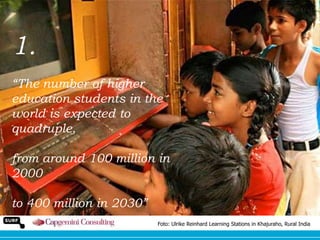
1.
“The number of higher
education students in the
world is expected to
quadruple,
from around 100 million in
2000
to 400 million in 2030”
Foto: Ulrike Reinhard Learning Stations in Khajuraho, Rural India
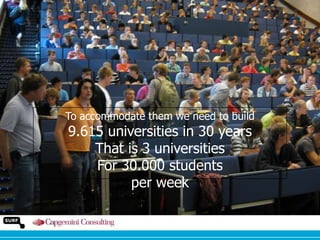
To accommodate them we need to build

9.615 universities in 30 years
That is 3 universities
For 30.000 students
per week
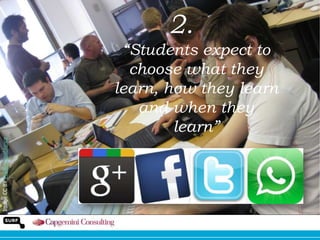
2.

Image CC BY Phillie Casablanca

“Students expect to
choose what they
learn, how they learn
and when they
learn”
•S

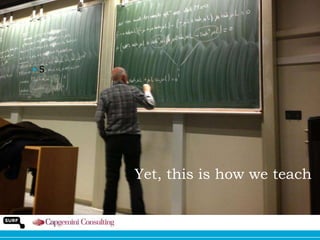
Yet, this is how we teach
O2E State of play
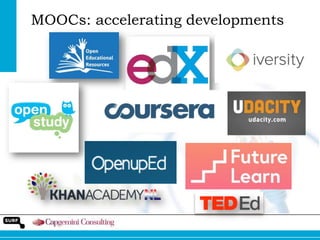
MOOCs: accelerating developments
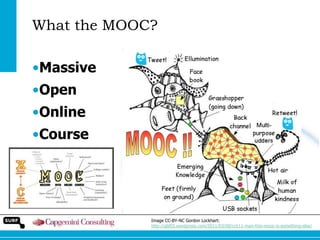
What the MOOC?
•Massive
•Open
•Online
•Course

Image CC-BY-NC Gordon Lockhart:
http://gbl55.wordpress.com/2011/03/08/cck11-man-this-mooc-is-something-else/
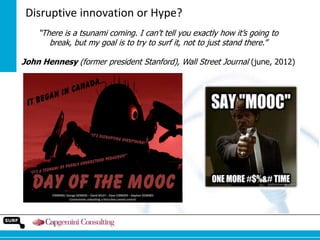
Disruptive innovation or Hype?
“There is a tsunami coming. I can't tell you exactly how it‟s going to
break, but my goal is to try to surf it, not to just stand there.”
John Hennesy (former president Stanford), Wall Street Journal (june, 2012)
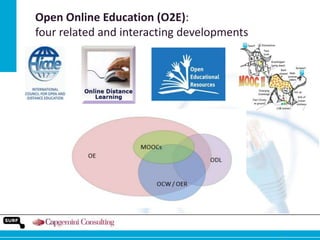
Open Online Education (O2E):
four related and interacting developments
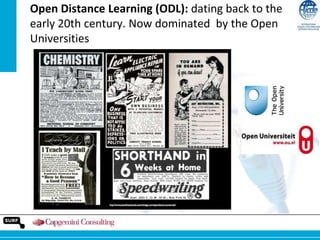
Open Distance Learning (ODL): dating back to the
early 20th century. Now dominated by the Open
Universities

14
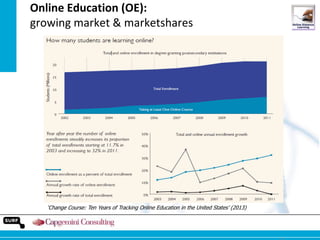
Online Education (OE):
growing market & marketshares

„Change Course: Ten Years of Tracking Online Education in the United States‟ (2013)

15
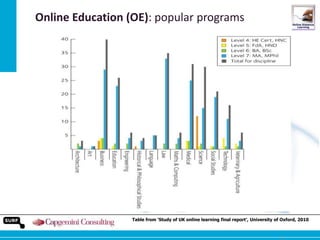
Online Education (OE): popular programs

Table from ‘Study of UK online learning final report’, University of Oxford, 2010

16
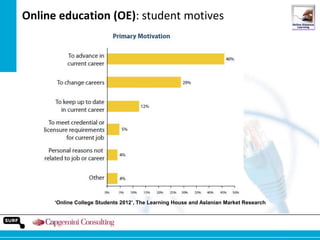
Online education (OE): student motives

‘Online College Students 2012’, The Learning House and Aslanian Market Research

17
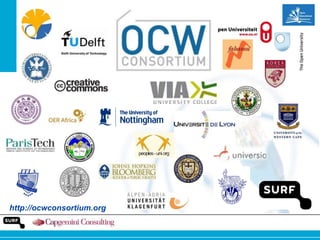
http://ocwconsortium.org
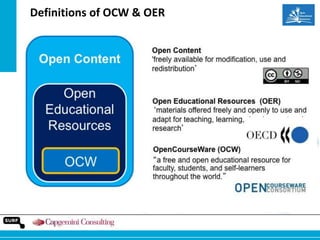
Definitions of OCW & OER
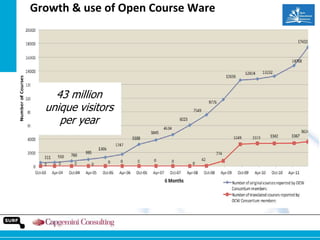
Growth & use of Open Course Ware

43 million
unique visitors
per year
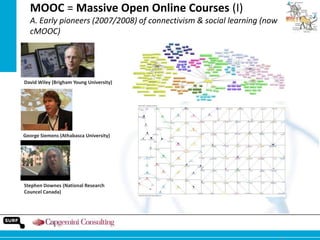
MOOC = Massive Open Online Courses (I)
A. Early pioneers (2007/2008) of connectivism & social learning (now
cMOOC)

David Wiley (Brigham Young University)

George Siemens (Athabasca University)

Stephen Downes (National Research
Councel Canada)

21
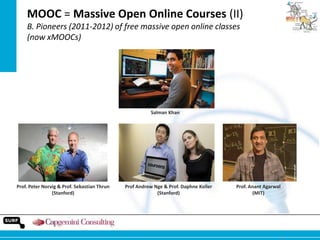
MOOC = Massive Open Online Courses (II)
B. Pioneers (2011-2012) of free massive open online classes
(now xMOOCs)

Salman Khan

Prof. Peter Norvig & Prof. Sebastian Thrun
(Stanford)

Prof Andrew Nge & Prof. Daphne Koller
(Stanford)

Prof. Anant Agarwal
(MIT)

22
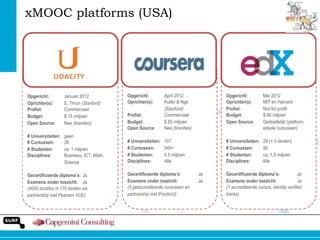
xMOOC platforms (USA)

Opgericht:
Oprichter(s):
Profiel:
Budget:
Open Source:

Januari 2012
S. Thrun (Stanford)
Commercieel
$ 15 miljoen
Nee (licenties)

# Universiteiten:
# Cursussen:
# Studenten:
Disciplines:

geen
28
ca. 1 miljoen
Business, ICT, Math,
Science

Gecertificeerde diploma’s: Ja
Examens onder toezicht: Ja
(4000 locaties in 170 landen via
partnership met Pearson VUE)

Opgericht:
Oprichter(s):
Profiel:
Budget:
Open Source:

April 2012
Koller & Nge
(Stanford)
Commercieel
$ 65 miljoen
Nee (licenties)

Opgericht:
Oprichter(s):
Profiel:
Budget:
Open Source:

Mei 2012
MIT en Harvard
Not-for-profit
$ 60 miljoen
Gedeeltelijk (platform,
enkele cursussen)

# Universiteiten:
# Cursussen:
# Studenten:
Disciplines:

107
540+
4,5 miljoen
Alle

# Universiteiten:
# Cursussen:
# Studenten:
Disciplines:

29 (+ 3 landen)
90
ca. 1,5 miljoen
Alle

Gecertificeerde diploma’s:
Examens onder toezicht:
(5 geaccrediteerde cursussen en
partnership met ProctorU)

Ja
Ja

Gecertificeerde diploma’s:
Ja
Examens onder toezicht:
Ja
(1 accrediteerde cursus, identity verified
tracks)
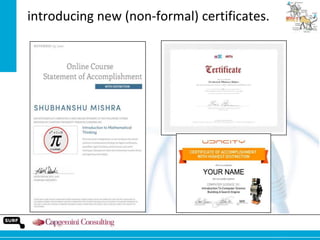
introducing new (non-formal) certificates.
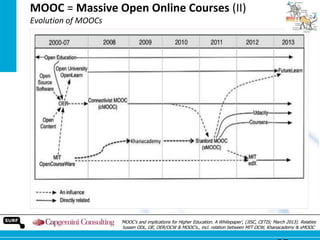
MOOC = Massive Open Online Courses (II)
Evolution of MOOCs

„MOOC‟s and implications for Higher Education. A Whitepaper‟, (JISC, CETIS; March 2013). Relaties
tussen ODL, OE, OER/OCW & MOOC‟s., incl. relation between MIT OCW, Khanacademy & xMOOC
Revenue models?
• license model: a share of gross revenue between platform provider
and universities offering courses hosted on the platform for tuition
paid degee programs or fees for additional services to students (e.g.
coaching)
• Administrative fees: for certification on proctored exam locations
• Recruitment fees: from corporations for recruiting talented students

• Premium/Fremium model: free and upgraded paid versions of the
MOOCs and services, resembling the ‘freemium’ and ‘premium’
payment models of other internet services
• Advertisement: monetizing on the scale and social characteristics of
users of the platform.
State of play - NL
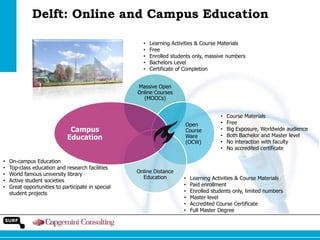
Delft: Online and Campus Education
•
•
•
•
•

Learning Activities & Course Materials
Free
Enrolled students only, massive numbers
Bachelors Level
Certificate of Completion

Massive Open
Online Courses
(MOOCs)

Open
Course
Ware
(OCW)

Campus
Education
•
•
•
•
•

On-campus Education
Top-class education and research facilities
World famous university library
Active student societies
Great opportunities to participate in special
student projects

Online Distance
Education

•
•
•
•
•
•

•
•
•
•
•
•

Course Materials
Free
Big Exposure, Worldwide audience
Both Bachelor and Master level
No interaction with faculty
No accredited certificate

Learning Activities & Course Materials
Paid enrollment
Enrolled students only, limited numbers
Master level
Accredited Course Certificate
Full Master Degree
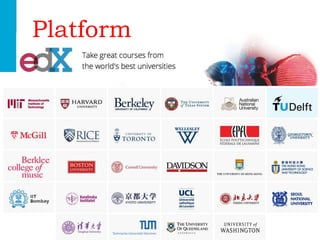
Platform
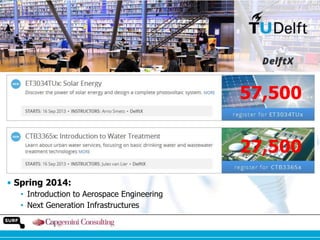
DelftX Courses

57,500
27,500
• Spring 2014:
• Introduction to Aerospace Engineering
• Next Generation Infrastructures
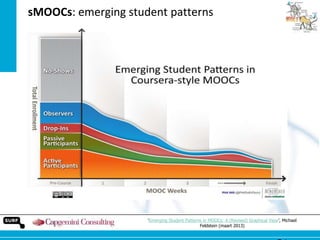
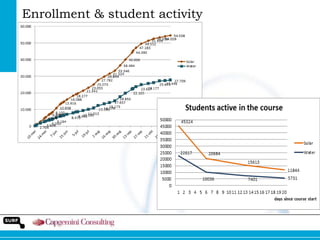
sMOOCs: emerging student patterns

„Emerging Student Patterns in MOOCs: A (Revised) Graphical View‟, Michael
Feldstein (maart 2013)
Enrollment & student activity
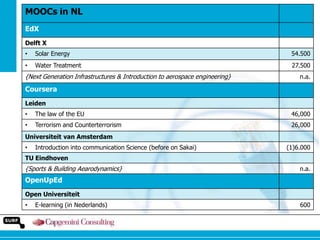
MOOCs in NL
EdX
Delft X
•

Solar Energy

54.500

•

Water Treatment

27.500

{Next Generation Infrastructures & Introduction to aerospace engineering}

n.a.

Coursera
Leiden
•

The law of the EU

46,000

•

Terrorism and Counterterrorism

26,000

Universiteit van Amsterdam
•

Introduction into communication Science (before on Sakai)

(1)6.000

TU Eindhoven

{Sports & Building Aearodynamics}

n.a.

OpenUpEd
Open Universiteit

•

E-learning (in Nederlands)

600
Impact
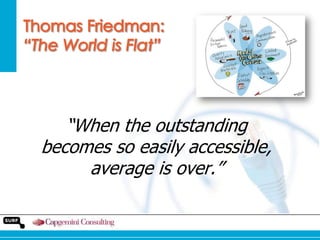
“When the outstanding
becomes so easily accessible,
average is over.”
Is it a HYPE

or a
DISRUPTIVE INNOVATION?
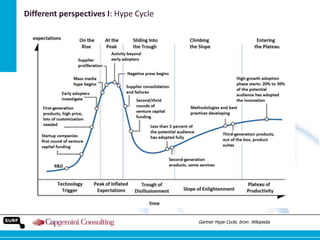
Different perspectives I: Hype Cycle

Gartner Hype Cycle, bron: Wikipedia
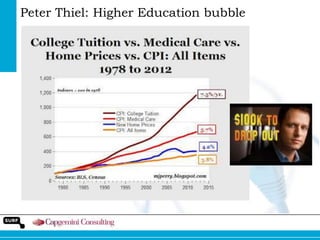
Peter Thiel: Higher Education bubble
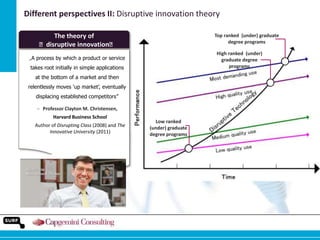
Different perspectives II: Disruptive innovation theory
The theory of
ʺdisruptive innovationʺ

Top ranked (under) graduate
degree programs
High ranked (under)
graduate degree
programs

„A process by which a product or service
takes root initially in simple applications
at the bottom of a market and then
relentlessly moves „up market‟, eventually
displacing established competitors”
‒ Professor Clayton M. Christensen,
Harvard Business School
Author of Disrupting Class (2008) and The
Innovative University (2011)

Low ranked
(under) graduate
degree programs
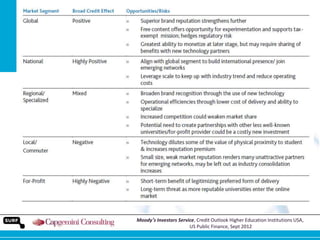
Moody’s Investors Service, Credit Outlook Higher Education Institutions USA,
US Public Finance, Sept 2012
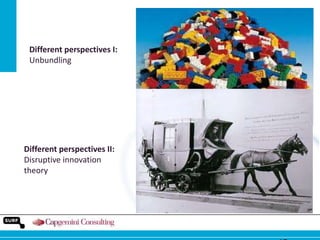
Different perspectives I:
Unbundling

Different perspectives II:
Disruptive innovation
theory
Scenario’s
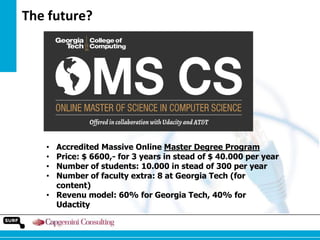
The future?

Accredited Massive Online Master Degree Program
Price: $ 6600,- for 3 years in stead of $ 40.000 per year
Number of students: 10.000 in stead of 300 per year
Number of faculty extra: 8 at Georgia Tech (for
content)
• Revenu model: 60% for Georgia Tech, 40% for
Udactity
•
•
•
•
Scenario’s
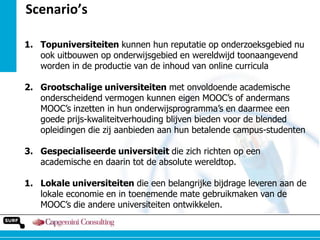
1. Topuniversiteiten kunnen hun reputatie op onderzoeksgebied nu
ook uitbouwen op onderwijsgebied en wereldwijd toonaangevend
worden in de productie van de inhoud van online curricula
2. Grootschalige universiteiten met onvoldoende academische
onderscheidend vermogen kunnen eigen MOOC‟s of andermans
MOOC‟s inzetten in hun onderwijsprogramma‟s en daarmee een
goede prijs-kwaliteitverhouding blijven bieden voor de blended
opleidingen die zij aanbieden aan hun betalende campus-studenten
3. Gespecialiseerde universiteit die zich richten op een
academische en daarin tot de absolute wereldtop.
1. Lokale universiteiten die een belangrijke bijdrage leveren aan de
lokale economie en in toenemende mate gebruikmaken van de
MOOC‟s die andere universiteiten ontwikkelen.
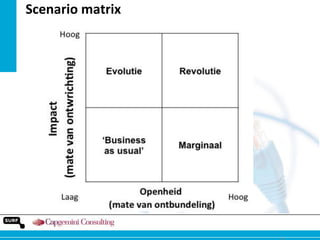
Scenario matrix

46
CC BY: katerha: http://www.flickr.com/photos/katerha/6055323149/

Thank you

Open en online onderwijs en de toekomst van het Nederlandse hoger onderwijs - Timo Kos - 2013

  • 1.
    Open & Online Education& de toekomst van het Nederlandse hoger onderwijs Impact analyse & scenariostudie Timo Kos
  • 2.
    @timokos /timokos /timokos or /mooc-scoop DirecteurOnderwijs & Studentenzaken slideshare.net/timokos @KhanAcademyNL www.khanacademy.nl timo@khanacademy.nl
  • 3.
    Content 0. Introduction 1. Stateof play 2. Impact analysis 3. Scenarios 4. Questions
  • 4.
  • 5.
    1. “The number ofhigher education students in the world is expected to quadruple, from around 100 million in 2000 to 400 million in 2030” Foto: Ulrike Reinhard Learning Stations in Khajuraho, Rural India
  • 6.
    To accommodate themwe need to build 9.615 universities in 30 years That is 3 universities For 30.000 students per week
  • 7.
    2. Image CC BYPhillie Casablanca “Students expect to choose what they learn, how they learn and when they learn”
  • 8.
    •S Yet, this ishow we teach
  • 9.
  • 10.
  • 11.
    What the MOOC? •Massive •Open •Online •Course ImageCC-BY-NC Gordon Lockhart: http://gbl55.wordpress.com/2011/03/08/cck11-man-this-mooc-is-something-else/
  • 12.
    Disruptive innovation orHype? “There is a tsunami coming. I can't tell you exactly how it‟s going to break, but my goal is to try to surf it, not to just stand there.” John Hennesy (former president Stanford), Wall Street Journal (june, 2012)
  • 13.
    Open Online Education(O2E): four related and interacting developments
  • 14.
    Open Distance Learning(ODL): dating back to the early 20th century. Now dominated by the Open Universities 14
  • 15.
    Online Education (OE): growingmarket & marketshares „Change Course: Ten Years of Tracking Online Education in the United States‟ (2013) 15
  • 16.
    Online Education (OE):popular programs Table from ‘Study of UK online learning final report’, University of Oxford, 2010 16
  • 17.
    Online education (OE):student motives ‘Online College Students 2012’, The Learning House and Aslanian Market Research 17
  • 18.
  • 19.
  • 20.
    Growth & useof Open Course Ware 43 million unique visitors per year
  • 21.
    MOOC = MassiveOpen Online Courses (I) A. Early pioneers (2007/2008) of connectivism & social learning (now cMOOC) David Wiley (Brigham Young University) George Siemens (Athabasca University) Stephen Downes (National Research Councel Canada) 21
  • 22.
    MOOC = MassiveOpen Online Courses (II) B. Pioneers (2011-2012) of free massive open online classes (now xMOOCs) Salman Khan Prof. Peter Norvig & Prof. Sebastian Thrun (Stanford) Prof Andrew Nge & Prof. Daphne Koller (Stanford) Prof. Anant Agarwal (MIT) 22
  • 23.
    xMOOC platforms (USA) Opgericht: Oprichter(s): Profiel: Budget: OpenSource: Januari 2012 S. Thrun (Stanford) Commercieel $ 15 miljoen Nee (licenties) # Universiteiten: # Cursussen: # Studenten: Disciplines: geen 28 ca. 1 miljoen Business, ICT, Math, Science Gecertificeerde diploma’s: Ja Examens onder toezicht: Ja (4000 locaties in 170 landen via partnership met Pearson VUE) Opgericht: Oprichter(s): Profiel: Budget: Open Source: April 2012 Koller & Nge (Stanford) Commercieel $ 65 miljoen Nee (licenties) Opgericht: Oprichter(s): Profiel: Budget: Open Source: Mei 2012 MIT en Harvard Not-for-profit $ 60 miljoen Gedeeltelijk (platform, enkele cursussen) # Universiteiten: # Cursussen: # Studenten: Disciplines: 107 540+ 4,5 miljoen Alle # Universiteiten: # Cursussen: # Studenten: Disciplines: 29 (+ 3 landen) 90 ca. 1,5 miljoen Alle Gecertificeerde diploma’s: Examens onder toezicht: (5 geaccrediteerde cursussen en partnership met ProctorU) Ja Ja Gecertificeerde diploma’s: Ja Examens onder toezicht: Ja (1 accrediteerde cursus, identity verified tracks)
  • 24.
  • 25.
    MOOC = MassiveOpen Online Courses (II) Evolution of MOOCs „MOOC‟s and implications for Higher Education. A Whitepaper‟, (JISC, CETIS; March 2013). Relaties tussen ODL, OE, OER/OCW & MOOC‟s., incl. relation between MIT OCW, Khanacademy & xMOOC
  • 26.
    Revenue models? • licensemodel: a share of gross revenue between platform provider and universities offering courses hosted on the platform for tuition paid degee programs or fees for additional services to students (e.g. coaching) • Administrative fees: for certification on proctored exam locations • Recruitment fees: from corporations for recruiting talented students • Premium/Fremium model: free and upgraded paid versions of the MOOCs and services, resembling the ‘freemium’ and ‘premium’ payment models of other internet services • Advertisement: monetizing on the scale and social characteristics of users of the platform.
  • 27.
  • 28.
    Delft: Online andCampus Education • • • • • Learning Activities & Course Materials Free Enrolled students only, massive numbers Bachelors Level Certificate of Completion Massive Open Online Courses (MOOCs) Open Course Ware (OCW) Campus Education • • • • • On-campus Education Top-class education and research facilities World famous university library Active student societies Great opportunities to participate in special student projects Online Distance Education • • • • • • • • • • • • Course Materials Free Big Exposure, Worldwide audience Both Bachelor and Master level No interaction with faculty No accredited certificate Learning Activities & Course Materials Paid enrollment Enrolled students only, limited numbers Master level Accredited Course Certificate Full Master Degree
  • 29.
  • 30.
    DelftX Courses 57,500 27,500 • Spring2014: • Introduction to Aerospace Engineering • Next Generation Infrastructures
  • 31.
    sMOOCs: emerging studentpatterns „Emerging Student Patterns in MOOCs: A (Revised) Graphical View‟, Michael Feldstein (maart 2013)
  • 32.
  • 34.
    MOOCs in NL EdX DelftX • Solar Energy 54.500 • Water Treatment 27.500 {Next Generation Infrastructures & Introduction to aerospace engineering} n.a. Coursera Leiden • The law of the EU 46,000 • Terrorism and Counterterrorism 26,000 Universiteit van Amsterdam • Introduction into communication Science (before on Sakai) (1)6.000 TU Eindhoven {Sports & Building Aearodynamics} n.a. OpenUpEd Open Universiteit • E-learning (in Nederlands) 600
  • 35.
  • 36.
    “When the outstanding becomesso easily accessible, average is over.”
  • 37.
    Is it aHYPE or a DISRUPTIVE INNOVATION?
  • 38.
    Different perspectives I:Hype Cycle Gartner Hype Cycle, bron: Wikipedia
  • 39.
    Peter Thiel: HigherEducation bubble
  • 40.
    Different perspectives II:Disruptive innovation theory The theory of ʺdisruptive innovationʺ Top ranked (under) graduate degree programs High ranked (under) graduate degree programs „A process by which a product or service takes root initially in simple applications at the bottom of a market and then relentlessly moves „up market‟, eventually displacing established competitors” ‒ Professor Clayton M. Christensen, Harvard Business School Author of Disrupting Class (2008) and The Innovative University (2011) Low ranked (under) graduate degree programs
  • 41.
    Moody’s Investors Service,Credit Outlook Higher Education Institutions USA, US Public Finance, Sept 2012
  • 42.
    Different perspectives I: Unbundling Differentperspectives II: Disruptive innovation theory
  • 43.
  • 44.
    The future? Accredited MassiveOnline Master Degree Program Price: $ 6600,- for 3 years in stead of $ 40.000 per year Number of students: 10.000 in stead of 300 per year Number of faculty extra: 8 at Georgia Tech (for content) • Revenu model: 60% for Georgia Tech, 40% for Udactity • • • •
  • 45.
    Scenario’s 1. Topuniversiteiten kunnenhun reputatie op onderzoeksgebied nu ook uitbouwen op onderwijsgebied en wereldwijd toonaangevend worden in de productie van de inhoud van online curricula 2. Grootschalige universiteiten met onvoldoende academische onderscheidend vermogen kunnen eigen MOOC‟s of andermans MOOC‟s inzetten in hun onderwijsprogramma‟s en daarmee een goede prijs-kwaliteitverhouding blijven bieden voor de blended opleidingen die zij aanbieden aan hun betalende campus-studenten 3. Gespecialiseerde universiteit die zich richten op een academische en daarin tot de absolute wereldtop. 1. Lokale universiteiten die een belangrijke bijdrage leveren aan de lokale economie en in toenemende mate gebruikmaken van de MOOC‟s die andere universiteiten ontwikkelen.
  • 46.
  • 47.
    CC BY: katerha:http://www.flickr.com/photos/katerha/6055323149/ Thank you

Editor's Notes

  • #5 Vroeger
  • #10 Vroeger
  • #28 Wehoevennietveelmeeruittevinden: veelelementen die bepalenwatgoedonderwijs is, zijn al opgelost online
  • #29 OpenCourseWare: Course Materials available for use and re-use, for free, worldwide (700 visitors a day). No certificates, but pilot with Study Badges (informal certificates of Study Skills)Goal: Enlarge Acces to Educational Materials, empower institution’s reputationexample: publishing OCW led to Cooperation with ITB Bandung and Mozambique institutionsOnline Distance Education: Pilot starts september 2013, Students need to enroll but are not physically in Delft (everything happens online). Small numbers of enrolled studentsd (20?)Goal: provide a Masters degree via Online Education to those who want but are unable to come to Delft, enlarge audienceMOOCs: Online, MassiveGoal: strenghten reputation, enlarge access to Higher Education
  • #30 En overigensdoenalle Am tpuniversiteitenhieraanmee
  • #48 Maar is datookonsantwoord?