TU Delft Online
Short Learning Programmes
Ir. Willem van Valkenburg
Manager Production & Delivery Extension School
w.f.vanvalkenburg@tudelft.nl
@wfvanvalkenburg
slideshare.net/wfvanvalkenburg
Agenda
1. Introduction
2. Policy and Strategy framework
3. Examples
4. Challenges
5. Solutions to the challenges
What is a Short Learning
Programme?
• Target audience
• Duration (relative to full programmes?)
• Study load per week
• Certificate / Credits / recognition
Policy and Strategy Framework
TU Delft education vision (Aug’2017):
• “We strive to offer a comprehensive portfolio of bachelor,
master, doctoral and professional courses and
programmes in the fields of science, design and
engineering that are internationally acknowledged as
world class.”
• “A variety of professional and post‐academic courses
and continuous education programmes for working
professionals, leading to professional certificates,
advanced science diplomas or advanced science
degrees.”
Open & Online Programme
• Target audience: professional learner
• First phase: focus on courses
• Second phase: focus on short programmes
“Group courses into short learning programmes to
guide the learner through a relevant learning path
to obtain a relevant certificate”
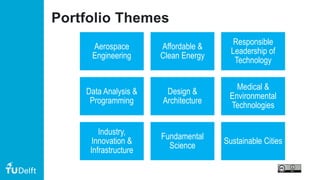
Portfolio Themes
Aerospace
Engineering
Affordable &
Clean Energy
Responsible
Leadership of
Technology
Data Analysis &
Programming
Design &
Architecture
Medical &
Environmental
Technologies
Industry,
Innovation &
Infrastructure
Fundamental
Science
Sustainable Cities
Examples of SLPs
• Professional Education Course Advanced Leadership
for Engineers
• Online Academic Course Introduction to Wind
Turbines
• Xserie on Business Model Innovation
• MicroMaster programme on Solar Energy
Engineering
• Professional Certificate Programme Data Analysis &
Visualisation with Excel
Challenges
• Focus in faculties is on initial learners, not
on the professional learners
• Diversity of business needs
• Pace of development of a new programme
Assignment
What are the challenges
you see with online SLPs
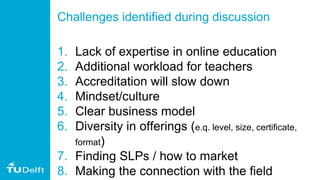
Challenges identified during discussion
1. Lack of expertise in online education
2. Additional workload for teachers
3. Accreditation will slow down
4. Mindset/culture
5. Clear business model
6. Diversity in offerings (e.q. level, size, certificate,
format)
7. Finding SLPs / how to market
8. Making the connection with the field
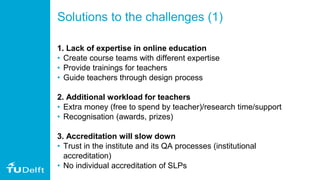
Solutions to the challenges (1)
1. Lack of expertise in online education
• Create course teams with different expertise
• Provide trainings for teachers
• Guide teachers through design process
2. Additional workload for teachers
• Extra money (free to spend by teacher)/research time/support
• Recognisation (awards, prizes)
3. Accreditation will slow down
• Trust in the institute and its QA processes (institutional
accreditation)
• No individual accreditation of SLPs
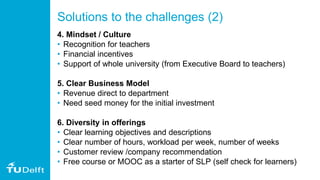
Solutions to the challenges (2)
4. Mindset / Culture
• Recognition for teachers
• Financial incentives
• Support of whole university (from Executive Board to teachers)
5. Clear Business Model
• Revenue direct to department
• Need seed money for the initial investment
6. Diversity in offerings
• Clear learning objectives and descriptions
• Clear number of hours, workload per week, number of weeks
• Customer review /company recommendation
• Free course or MOOC as a starter of SLP (self check for learners)
Solutions to the challenges (3)
7. Finding SLPs / How to market
• Use network of the course team to promote the SLPs
• European framework for SLPs
• Setup portal for SLPs
8. Making the connection with the field
• Use subject matter experts from companies
• Involve your alumni
• Connect with branch organisations
15
ONLINE-LEARNING.TUDELFT.NL
@wfvanvalkenburg
slideshare.net/wfvanvalkenburg

Online Short Learning Programmes for EADTU/ENQA seminar

  • 1.
    TU Delft Online ShortLearning Programmes Ir. Willem van Valkenburg Manager Production & Delivery Extension School w.f.vanvalkenburg@tudelft.nl @wfvanvalkenburg slideshare.net/wfvanvalkenburg
  • 2.
    Agenda 1. Introduction 2. Policyand Strategy framework 3. Examples 4. Challenges 5. Solutions to the challenges
  • 3.
    What is aShort Learning Programme? • Target audience • Duration (relative to full programmes?) • Study load per week • Certificate / Credits / recognition
  • 4.
    Policy and StrategyFramework TU Delft education vision (Aug’2017): • “We strive to offer a comprehensive portfolio of bachelor, master, doctoral and professional courses and programmes in the fields of science, design and engineering that are internationally acknowledged as world class.” • “A variety of professional and post‐academic courses and continuous education programmes for working professionals, leading to professional certificates, advanced science diplomas or advanced science degrees.”
  • 5.
    Open & OnlineProgramme • Target audience: professional learner • First phase: focus on courses • Second phase: focus on short programmes “Group courses into short learning programmes to guide the learner through a relevant learning path to obtain a relevant certificate”
  • 6.
    Portfolio Themes Aerospace Engineering Affordable & CleanEnergy Responsible Leadership of Technology Data Analysis & Programming Design & Architecture Medical & Environmental Technologies Industry, Innovation & Infrastructure Fundamental Science Sustainable Cities
  • 8.
    Examples of SLPs •Professional Education Course Advanced Leadership for Engineers • Online Academic Course Introduction to Wind Turbines • Xserie on Business Model Innovation • MicroMaster programme on Solar Energy Engineering • Professional Certificate Programme Data Analysis & Visualisation with Excel
  • 9.
    Challenges • Focus infaculties is on initial learners, not on the professional learners • Diversity of business needs • Pace of development of a new programme
  • 10.
    Assignment What are thechallenges you see with online SLPs
  • 11.
    Challenges identified duringdiscussion 1. Lack of expertise in online education 2. Additional workload for teachers 3. Accreditation will slow down 4. Mindset/culture 5. Clear business model 6. Diversity in offerings (e.q. level, size, certificate, format) 7. Finding SLPs / how to market 8. Making the connection with the field
  • 12.
    Solutions to thechallenges (1) 1. Lack of expertise in online education • Create course teams with different expertise • Provide trainings for teachers • Guide teachers through design process 2. Additional workload for teachers • Extra money (free to spend by teacher)/research time/support • Recognisation (awards, prizes) 3. Accreditation will slow down • Trust in the institute and its QA processes (institutional accreditation) • No individual accreditation of SLPs
  • 13.
    Solutions to thechallenges (2) 4. Mindset / Culture • Recognition for teachers • Financial incentives • Support of whole university (from Executive Board to teachers) 5. Clear Business Model • Revenue direct to department • Need seed money for the initial investment 6. Diversity in offerings • Clear learning objectives and descriptions • Clear number of hours, workload per week, number of weeks • Customer review /company recommendation • Free course or MOOC as a starter of SLP (self check for learners)
  • 14.
    Solutions to thechallenges (3) 7. Finding SLPs / How to market • Use network of the course team to promote the SLPs • European framework for SLPs • Setup portal for SLPs 8. Making the connection with the field • Use subject matter experts from companies • Involve your alumni • Connect with branch organisations
  • 15.