MOOCs and the European Experience
Darco Jansen
EADTU
• Europe's leading institutional association in online, open and
flexible higher education, and is at the heart of the
modernisation agenda of European universities.
• EADTU is a key-partner of the European Commission for
lifelong open and flexible learning in distance higher education
EADTU members
11 : Number of Open and
distance teaching universities
14 Associations or consortia of
conventional universities
2 Single university
membership for associations
in development
2 Associated members
European coverage: 71%
Services open to all HEIs
• EMPOWER
• E-xcellence
• OpenupEd
OpenupEd
OpenupEd is an open, non-profit partnership on MOOCs
OpenupEd aims to contribute to opening up education to the
benefit of learners and the wider society while reflecting values
such as equity, quality and diversity.
Offering over 292 MOOCs in 14 different languages.
Another 60 MOOCs will follow shortly
With > 100 with an option to do a formal exam (ECTS credits).
Darco Jansen
The OpenupEd quality label:
benchmarks for MOOCs
Published in INNOQUAL
Volume 2, No 3, 2014 and Special Issue on Quality in Massive Open Online Courses
By Jon Rosewell & Darco Jansen
Used by OpenupEd partners. For example UNED
• C. Rodrigo, T. Read, M. Santamaria and A. Sánchez-Elvira (2014) "OpenupEdLabel
for MOOCs Quality Assurance: UNED COMA Initial Self-Evaluation" Proceedings of V
Congreso Internacional sobre Calidad y Accesibilidad en la Formación Virtual (CAFVIR
2014) L. Bengoechea, R. Hernández, J.R. Hilera (Eds.) Universidad Galileo
(Guatemala), pp. 551 - 555 ISBN: 978-9929-40-497-7
• Read T. and Rodrigo C. (2014) “Toward a quality model for UNED MOOCs”
eLearningPapers 2014 ISSN: 1887-1542 Vol. 37, Pages: 43-50
MOOC movement dominated by the US
• MOOCs: predominantly US
-where it all started as of 2011 and expanded massively
-and which houses major providers Coursera, edX, Udacity
• Response in Europe …
-some universities joined US initiatives, others started themselves
-country/language-based platforms: FutureLearn (UK),
MiríadaX, UNEDcoma (Spain), Iversity (Germany), FUN (France),
OpenMOOC, EMMA-platform, MOODle as MOOC plaform
• Governmental involvement: e.g. Opening up Slovenia, FUN, …
MOOCs collaboration in Europe
• EU launch (Sept 2013): Opening up Education.
• Two major goals
• Innovate teaching and learning for all through ICT
• Reshape / modernize EU education through OER (for all
educational sectors and levels)
• EU-funded projects on MOOCs (from 2014…)
Name Learners Courses Partners Interface Languages Courses languages Country
Coursera
10,63
Millions
886 116
Arab, Chinese,
German, English,
French, Spanish,
German, Russian,
Turkish
English, Chinese, Spanish,
Portuguese, French, Russian,
Turkish, Italian, Ukranian, German,
Vietnamese, Hebrew, Japanese,
Arabic, Greek, Persian,
Macedonian, Czech, Dutch
USA
edX unknown 381 61 English English, Chinese, Spanish USA
Future
Learn
1 Million 46 45 English English UK
iversity unknown 43 7 English, Dutch English, Dutch, Russian, Italian Germany
Miríada X
1,42
Million
10 73 Spanish, Portuguese Spanish, Portuguese Spain
Udacity unknown 54 14 English English USA
OpenupEd unknown 292 13 English
English, Italian, Russian, Spanish,
French, Arab, Portuguese, Dutch,
Irish
Europe
FUN unknown 82 31 English, French French, English France
Investors Continue to Back MOOC Providers
• Funding Received: $85
Million
• In 4 Rounds from 8
Investors
• Funding Rounds (4)
• $20M Nov 24, 2013
GSV Capital, Learn Capital
• $43M Jul 10, 2013
Learn Capital, International Finance
Corporation, GSV Capital, Laureate
Education, Inc., Yuri Milner, World
Bank
• $6M Jul 17, 2012
New Enterprise Associates, Kleiner
Perkins Caufield & Byers
• $16M Apr 18, 2012
Kleiner Perkins Caufield & Byers, New
Enterprise Associates
• Funding Received: $55
Million
• In 3 Rounds from 10
Investors
• Funding Rounds (3)
• $35M Sep 24, 2014
Recruit Holdings, George Zachary,
Peter Levine, CRV, Andreessen
Horowitz, Cox Enterprises, Valor
Capital Group, Bertelsmann AG, Drive
Capital
• $15M Oct 25, 2012
Steve Blank, CRV, Andreessen
Horowitz
• $5M Jan 1, 2012
CRV
• Funding Received: $48
Million
• In 4 Rounds from 15
Investors
• Funding Rounds (4)
• $32M May 8, 2014
MHS Capital, Insight Venture Partners,
Norwest Venture Partners - NVP
• $12M Dec 7, 2012
Lightbank, Insight Venture Partners,
MHS Capital, Learn Capital
• $3M Oct 12, 2011
Lightbank, 500 Startups, MHS Capital
• $1M Aug 31, 2010
Larry Braitman, Naval Ravikant, Signia
Venture Partners, Jeremy Stoppelman,
MHS Capital, Keith Rabois, Joshua
Stylman, 500 Startups, Russ Fradin,
Paul Martino, Benjamin Ling
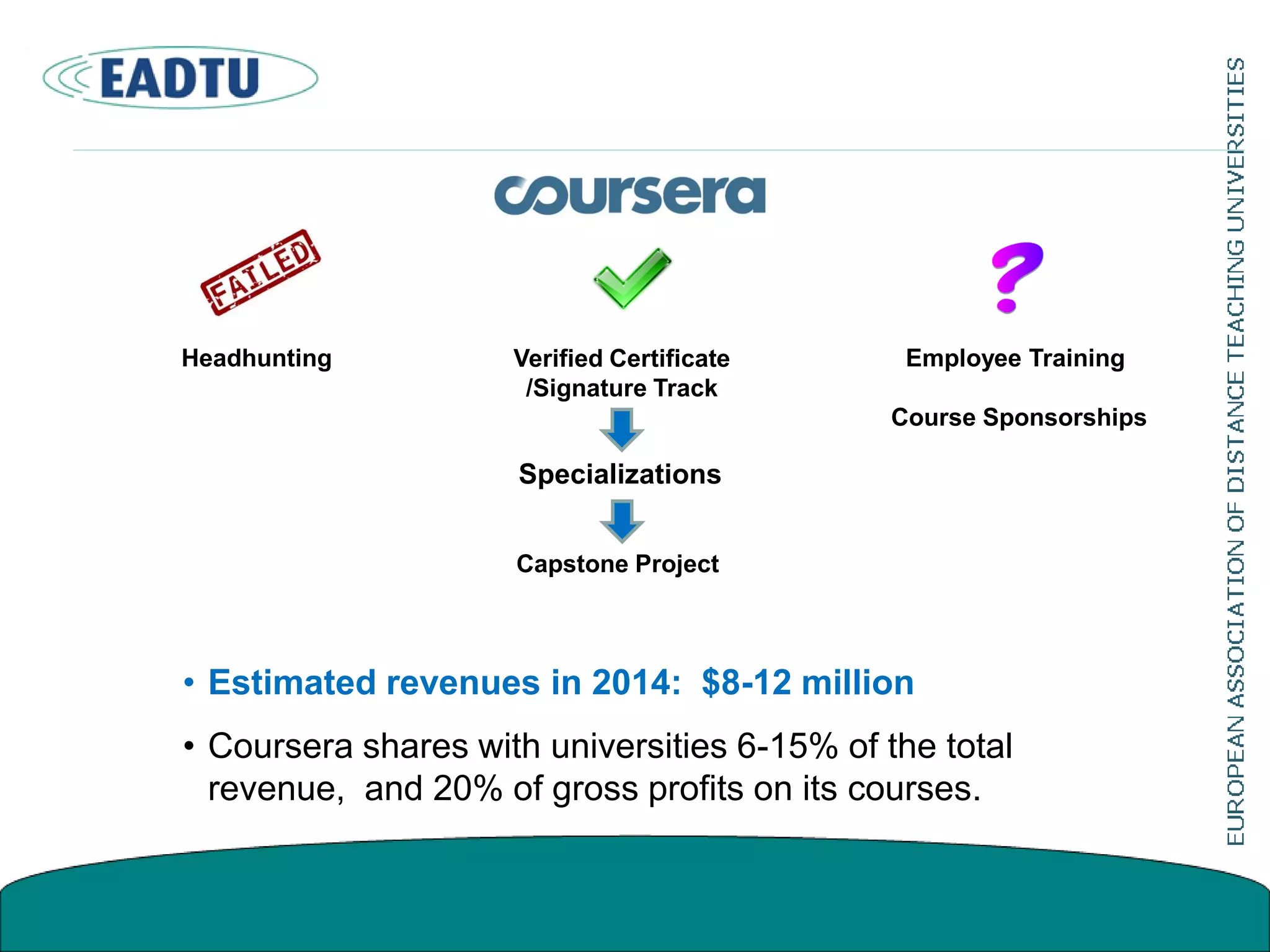
Verified Certificate
/Signature Track
• Estimated revenues in 2014: $8-12 million
• Coursera shares with universities 6-15% of the total
revenue, and 20% of gross profits on its courses.
Headhunting
Specializations
Capstone Project
Employee Training
Course Sponsorships
http://hechingerreport.org/californias-multi-million-dollar-online-
education-flop-is-another-blow-for-moocs/
Behind the surface
Is the US indeed leading the
MOOC movement?
What are the reasons to be
involved in MOOCs (or decide
not to invest in MOOCs)?
What are the difference
between US and Europe?
Can explain these differences?
Gaebel, M., Kupriyanova, V., Morais, R. & Colucci, E. (2014). E-learning in
European Higher Education Institutions: Results of a mapping survey
conducted in October-December 2013.
http://www.eua.be/Libraries/Publication/e-learning_survey.sflb.ashx
Allen, I.E. and Seaman. J. (2015). Grade Change: Tracking
Online Education in the United States. Babson Survey Research
Group and Quahog Research Group.
http://www.onlinelearningsurvey.com/reports/gradelevel.pdf
Jansen, D. & Schuwer, R.
(2015). Institutional MOOC
strategies in Europe
Status report based on a
mapping survey conducted in
October - December 2014.
EADTU – HOME project
http://www.eadtu.eu/docum
ents/Publications/OEenM/In
stitutional_MOOC_strategies
_in_Europe.pdf
MOOC offering
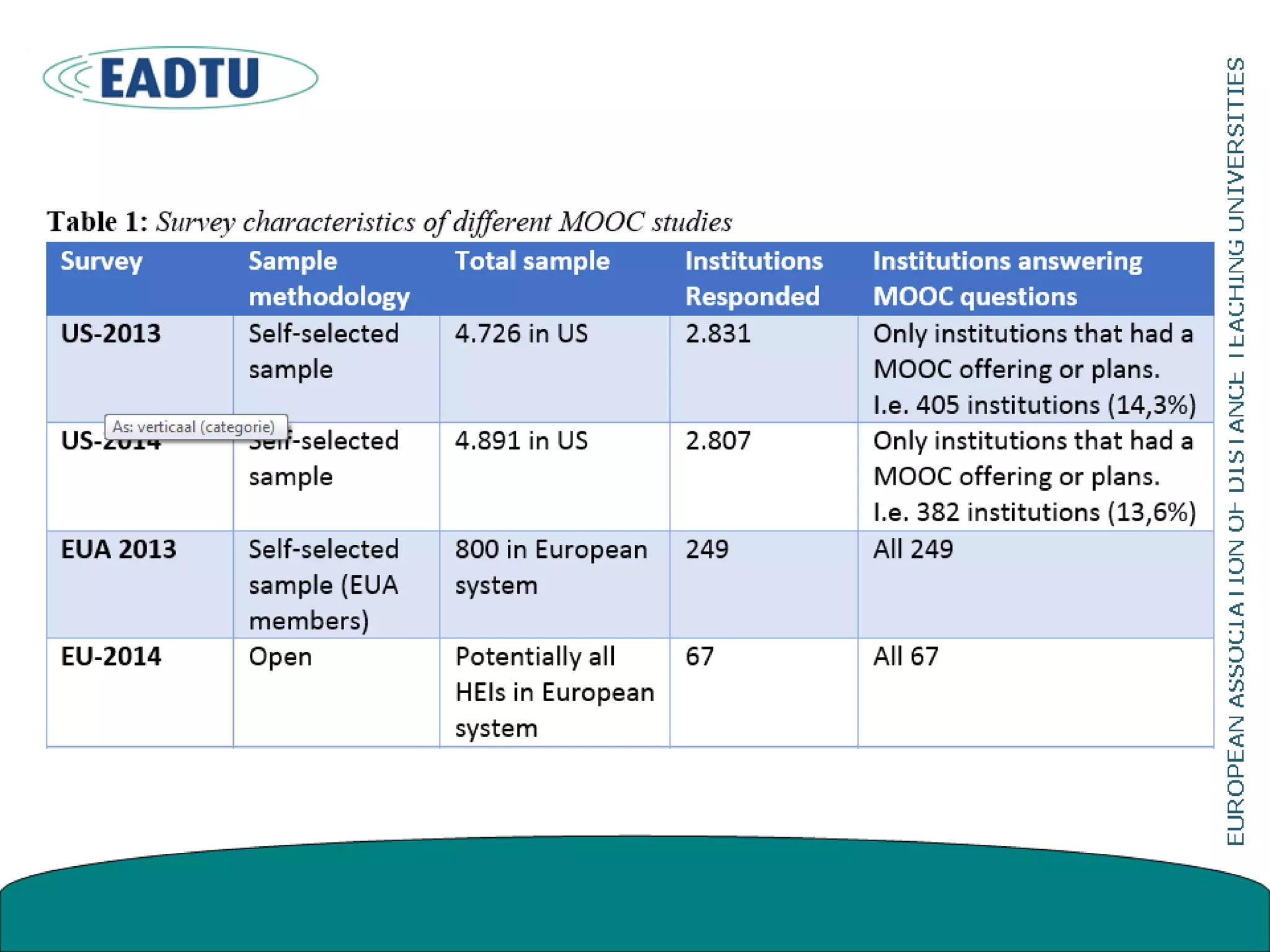
• In the US the number of
institutions having a MOOC or
planning to introduce them has
decreased from 14,3% (2013)
to 13,6% (2014)
• In Europe it has increased from
about 58% in EUA study (2013)
to 71,7% (2014) in EADTU/HOME
study.
Darco Jansen
EUA statement :
“interest in MOOCs has far
from peaked in Europe”
is simply true
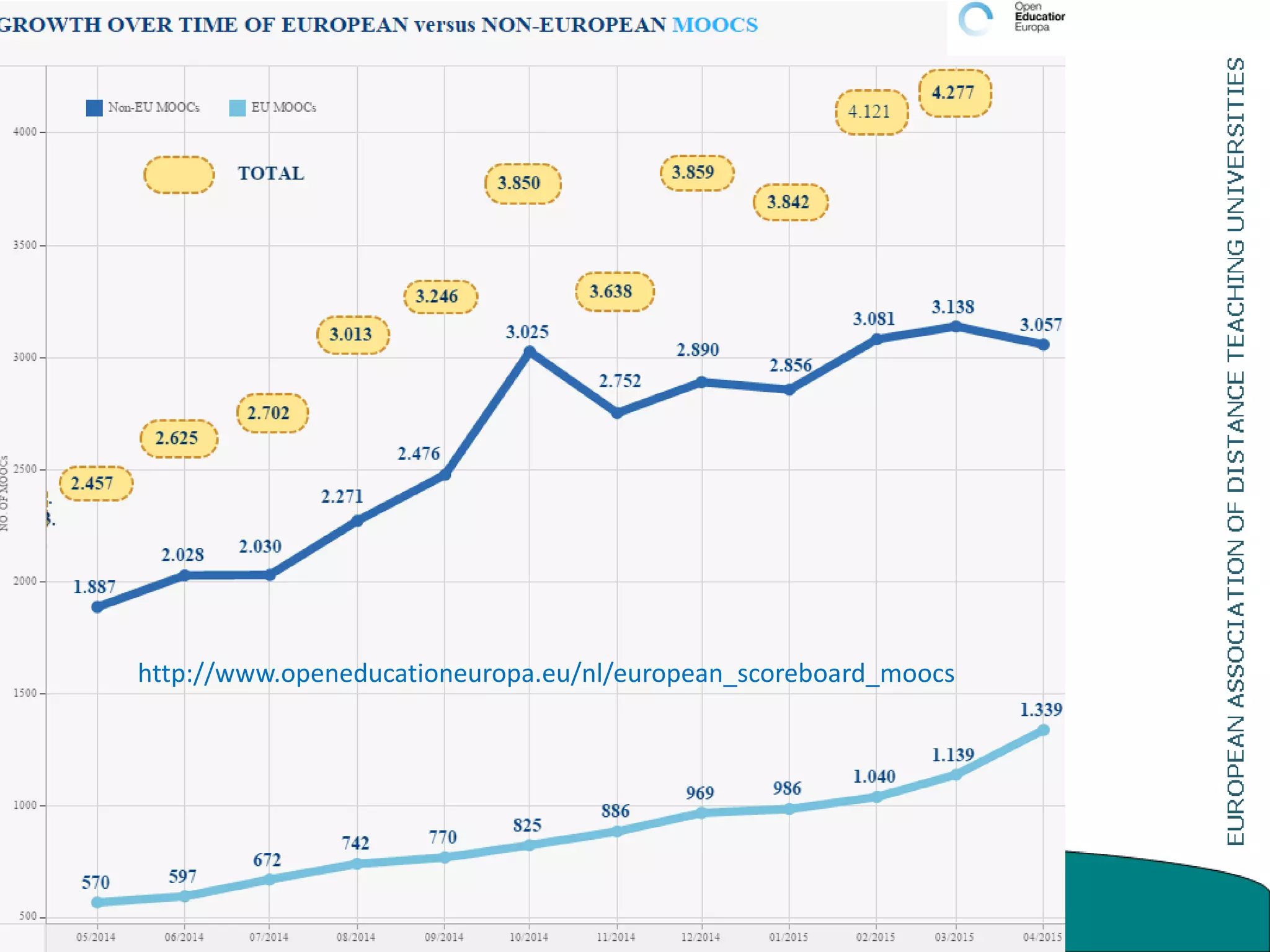
http://www.openeducationeuropa.eu/nl/european_scoreboard_moocs
Biases in the surveys
• The US surveys (US 2013 and US 2014) are biased to the large
institutions
• The EAU study is biased in favour of institutions involved in e-
learning.
• The EU-2014 study (EADTU/HOME) is biased to those institutions
interested in MOOCs.
http://openeducationeuropa.eu/sites/default/files/images/scoreboard/Scoreboard_April_2015.png
Biases in the surveys (2)
• Every institution can decide by themselves if they are providing
MOOCs
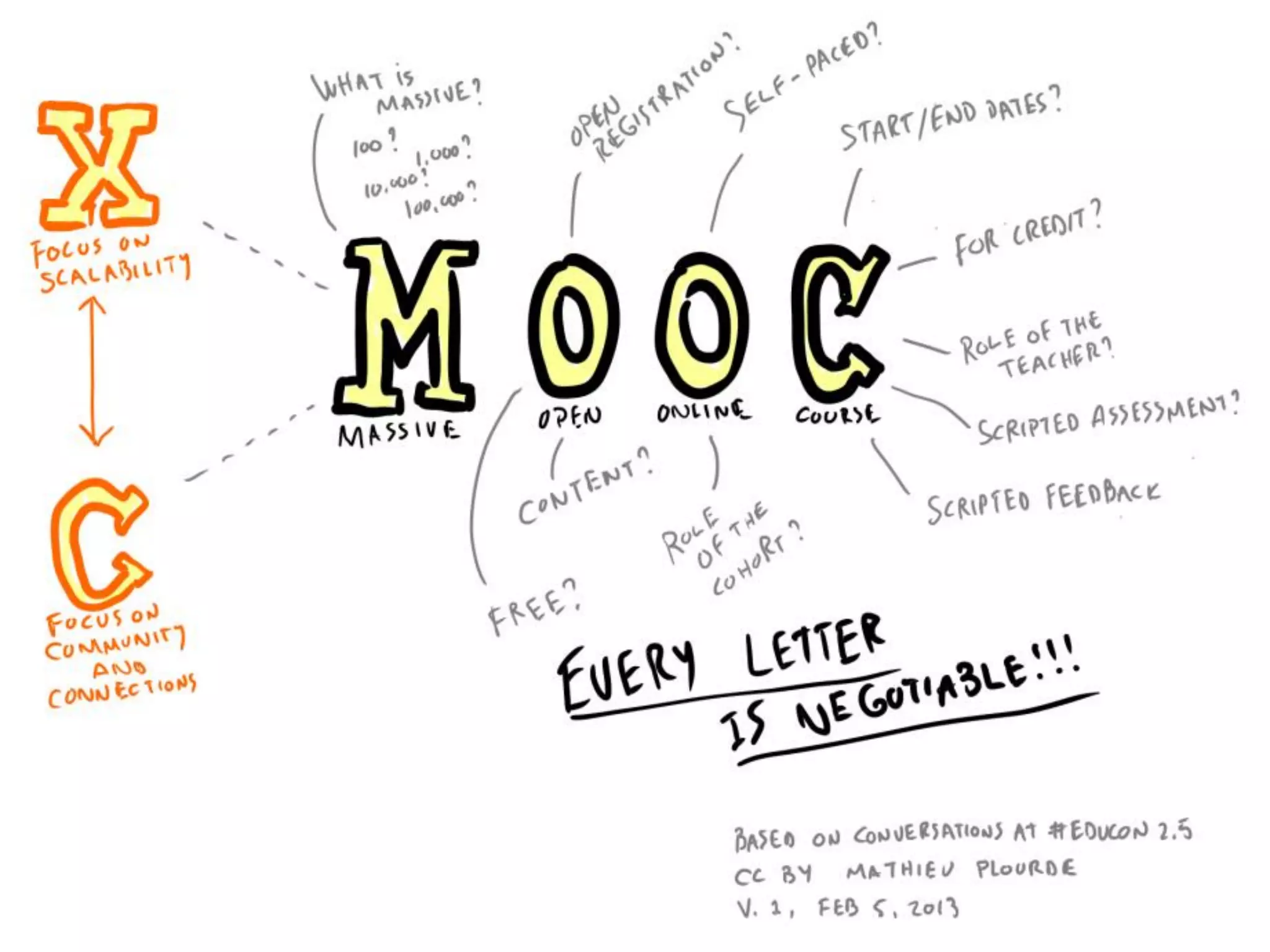
• They decide themselves what’s a MOOC !!!
Source:
SURF 2014
Open
Education
Trend
Report.
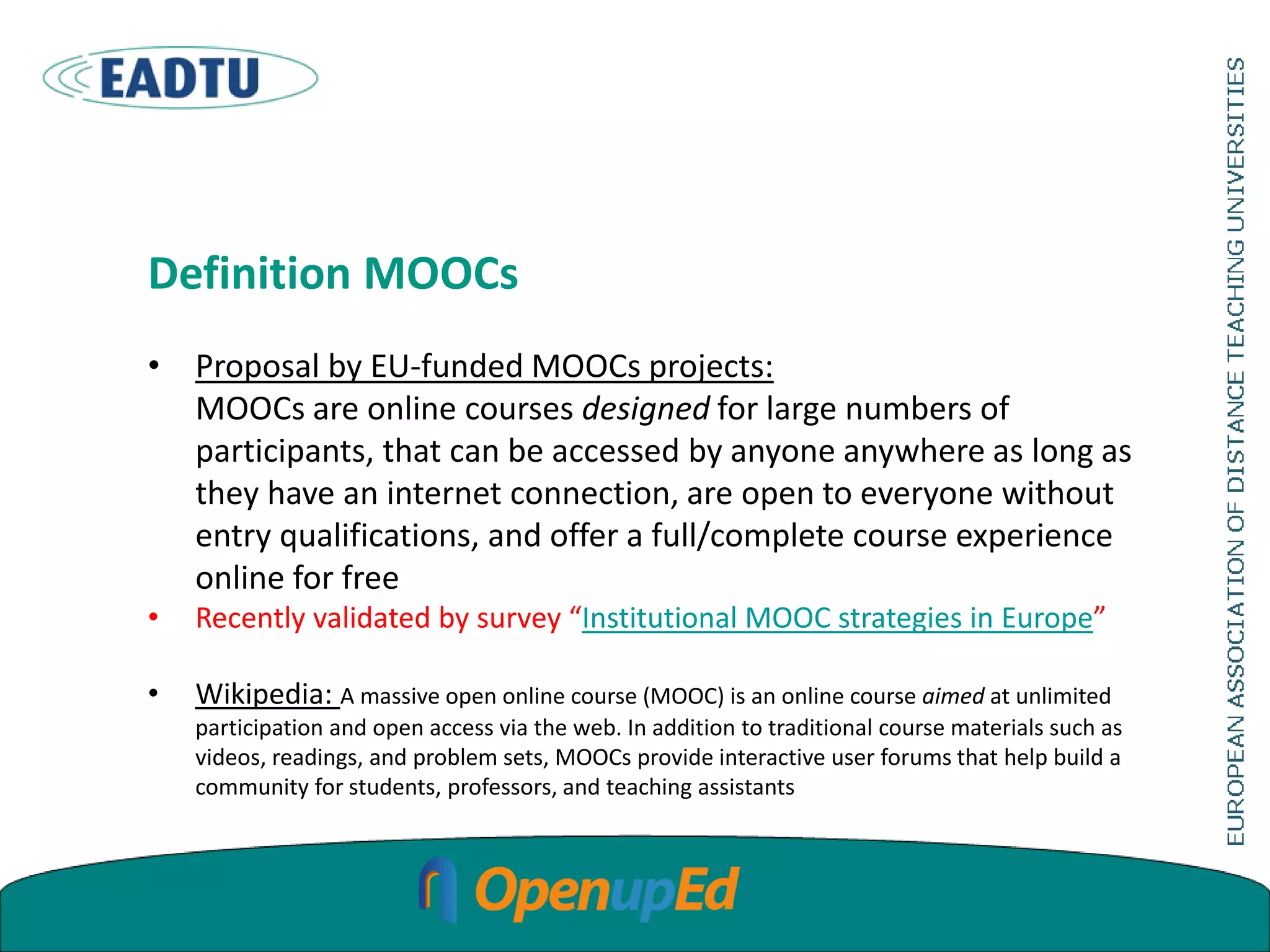
Definition MOOCs
• Proposal by EU-funded MOOCs projects:
MOOCs are online courses designed for large numbers of
participants, that can be accessed by anyone anywhere as long as
they have an internet connection, are open to everyone without
entry qualifications, and offer a full/complete course experience
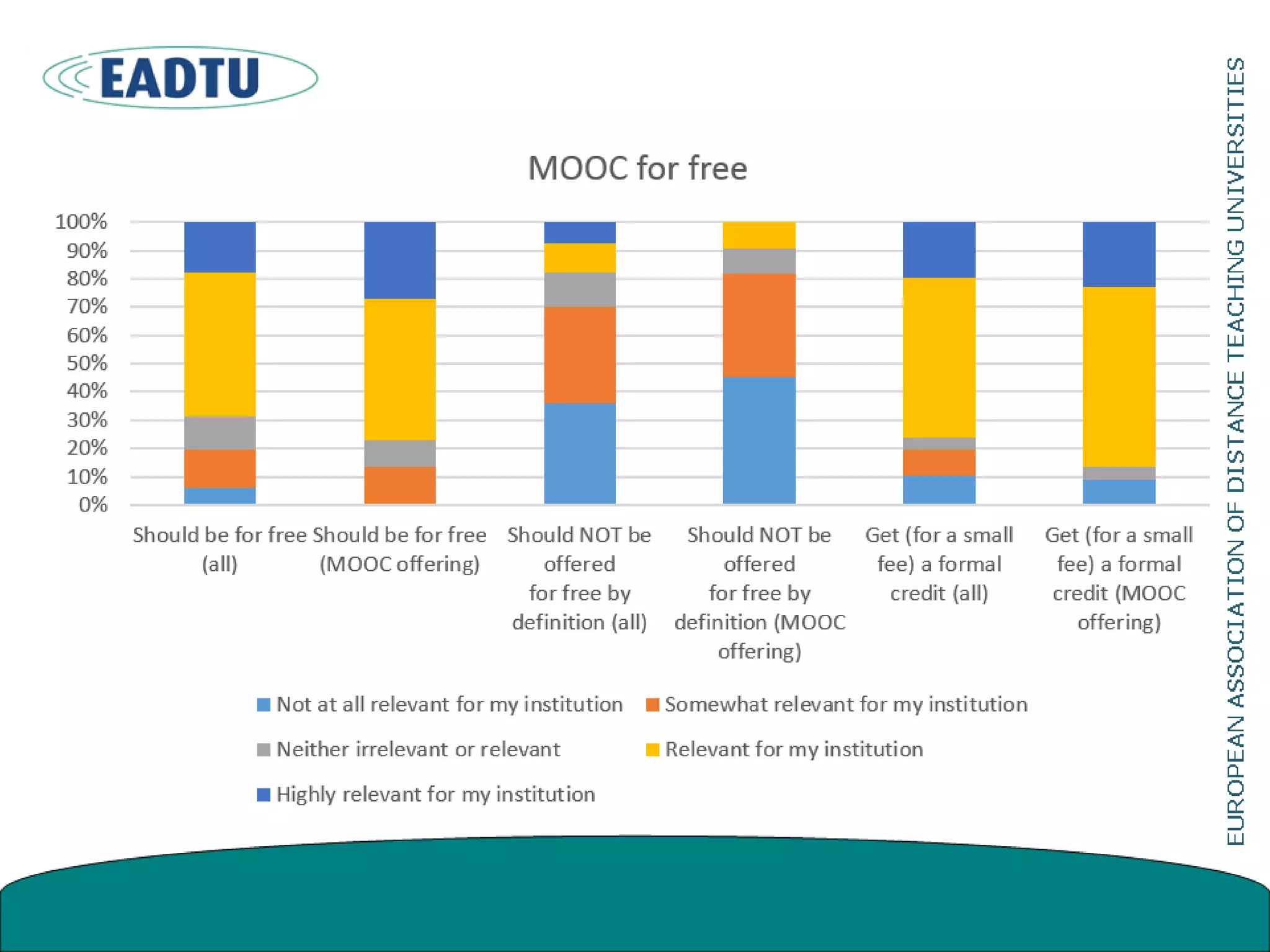
online for free
• Recently validated by survey “Institutional MOOC strategies in Europe”
• Wikipedia: A massive open online course (MOOC) is an online course aimed at unlimited
participation and open access via the web. In addition to traditional course materials such as
videos, readings, and problem sets, MOOCs provide interactive user forums that help build a
community for students, professors, and teaching assistants
http://www.openuped.eu/images/docs/Definition_Massive_Open_Online_Courses.pdf
Reflections on MOOCs
• European institution more involved in MOOCs than the US
• The number of European institutions with MOOC involvement is increasing
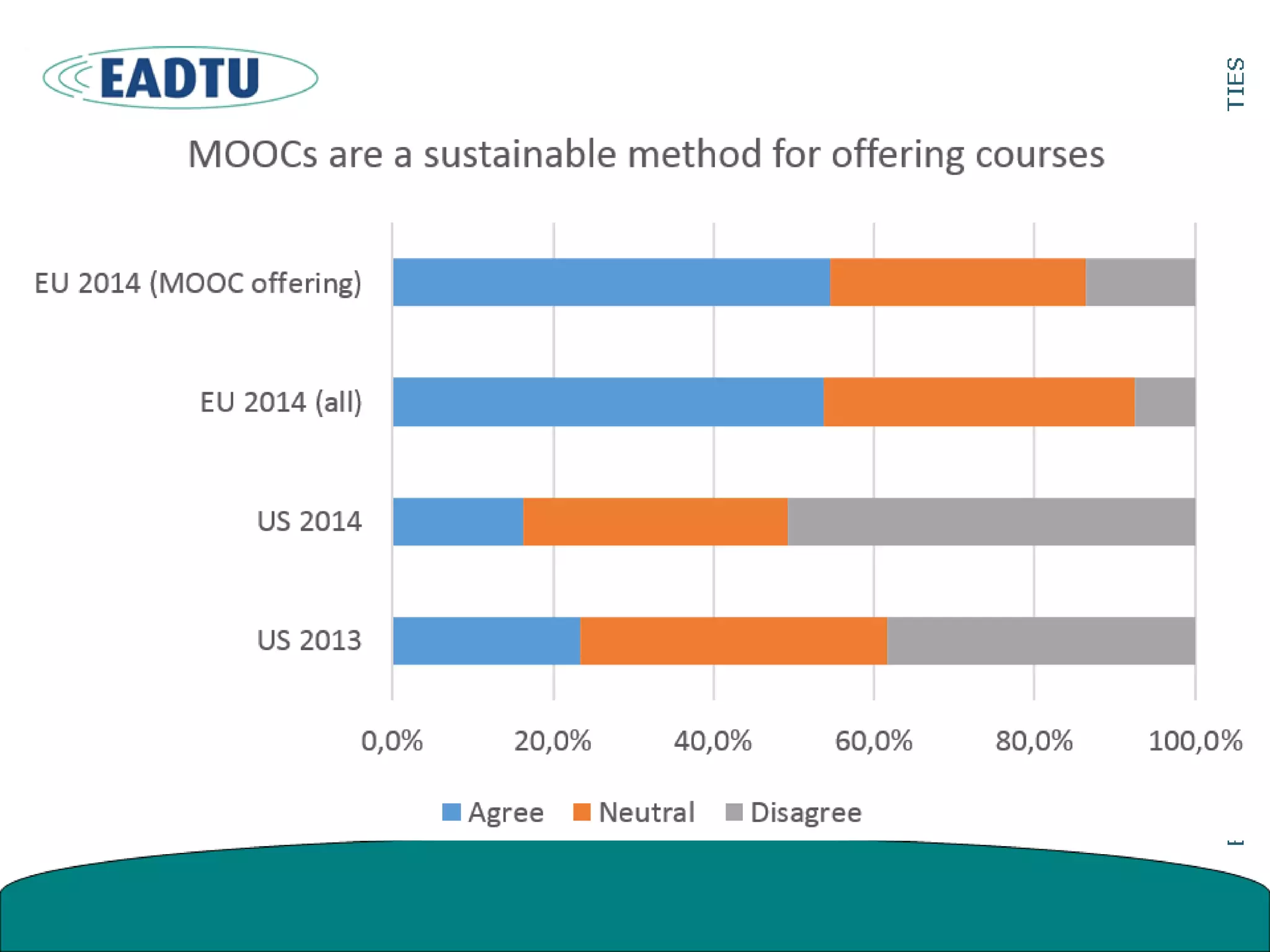
• MOOCs are perceived as a sustainable method for offering courses in
Europe.
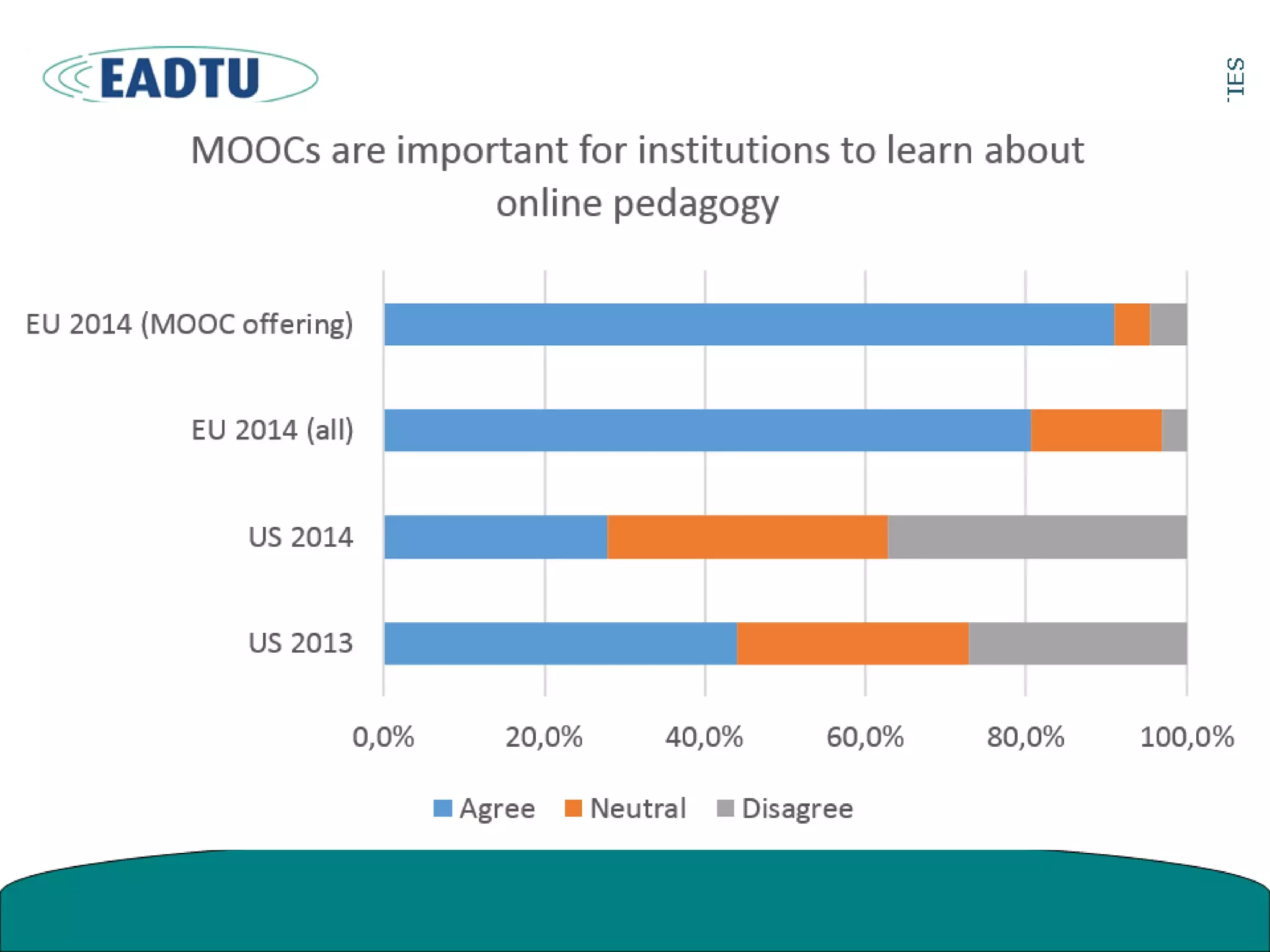
• In Europe the institutions are increasingly developing a positive attitude to
MOOCs and have positive experiences for the added values of MOOCs.
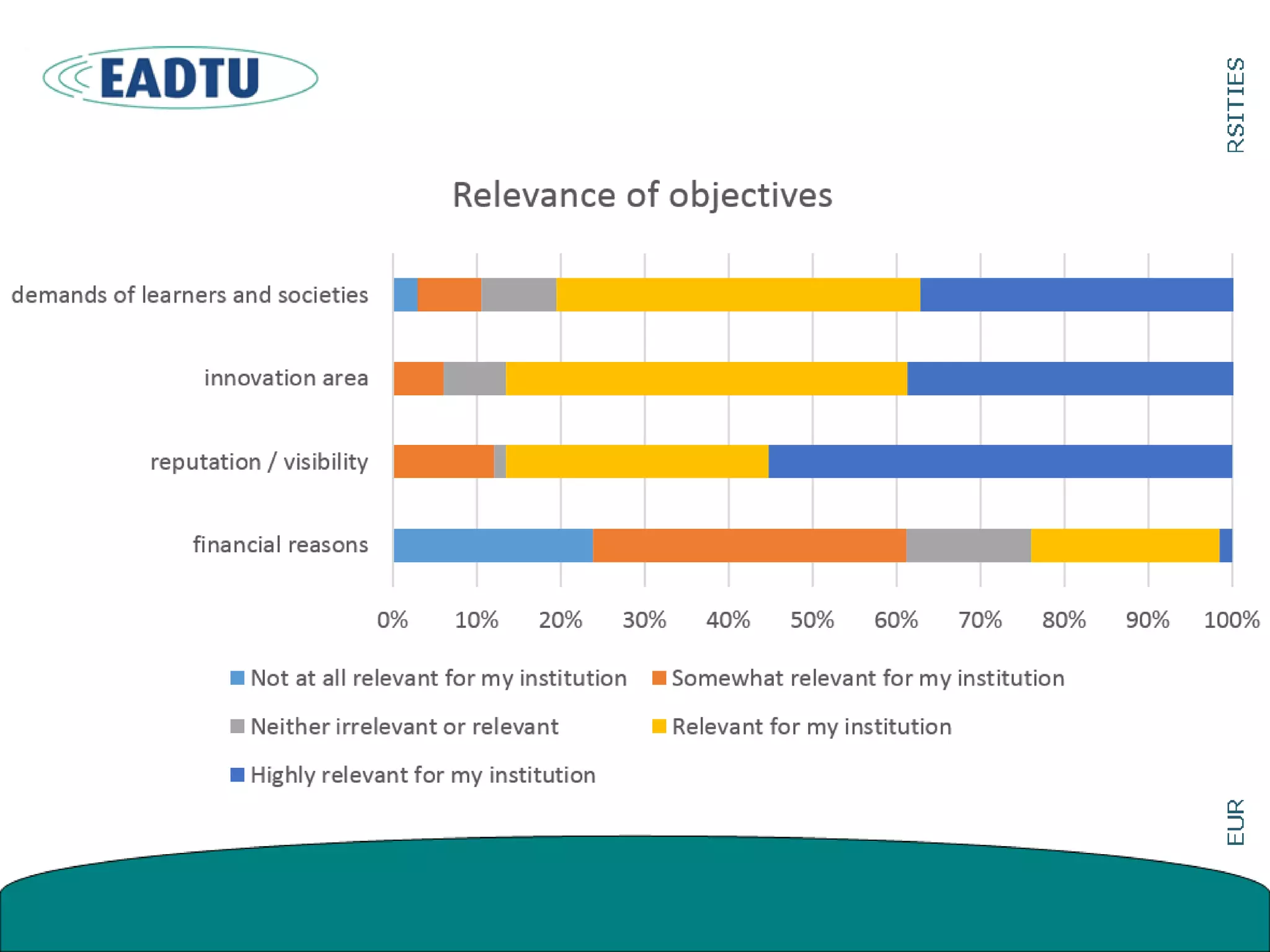
• Most dominant objective in all studies is to increase institutional visibility
and using MOOCs for reputation reasons.
• In the US using MOOCs for student recruitment is seen as the most
important primary objective of institutions, while in Europe it is rather to
reach new students and creating flexible learning opportunities
Darco Jansen
Institutions versus Governments
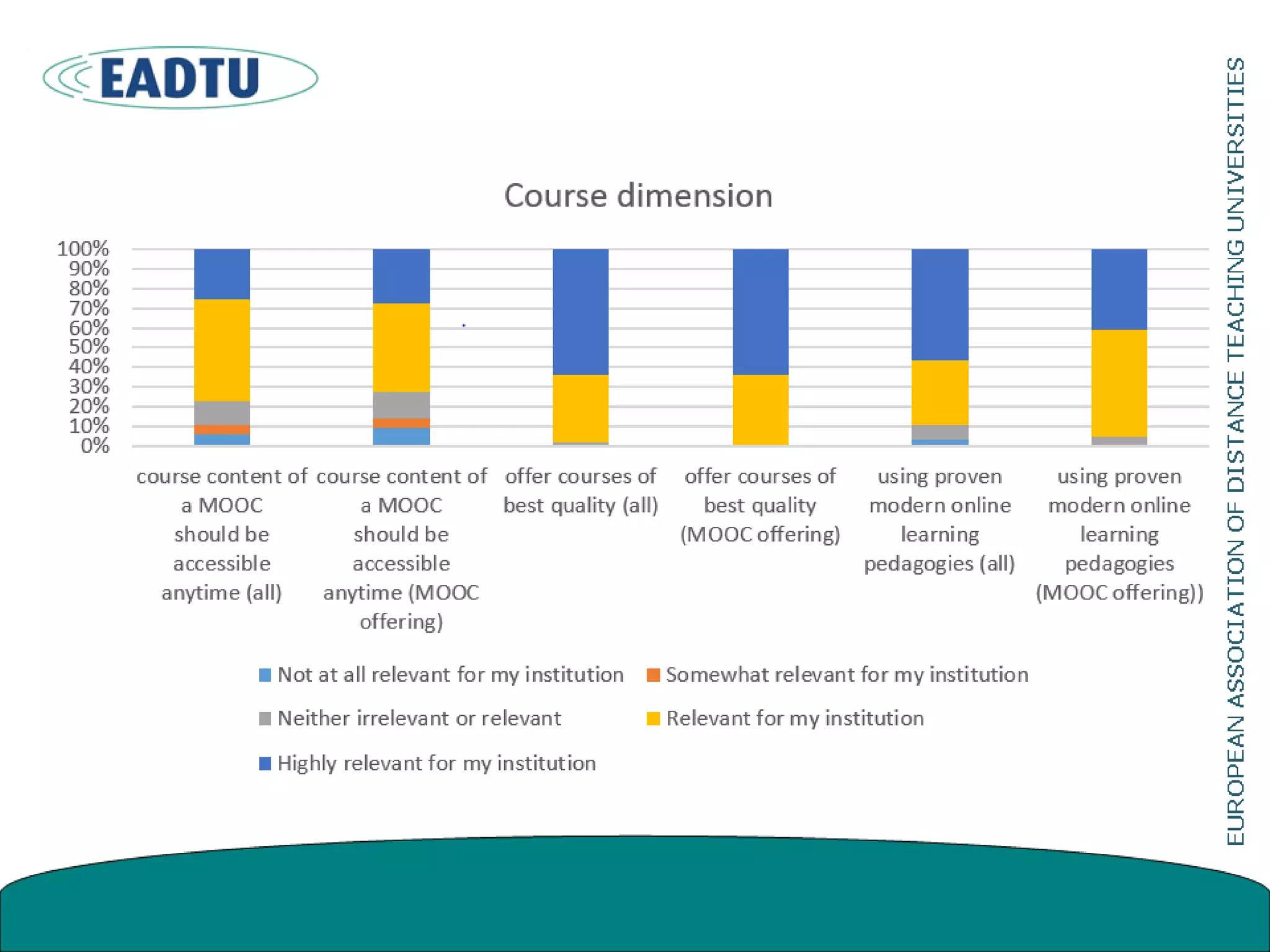
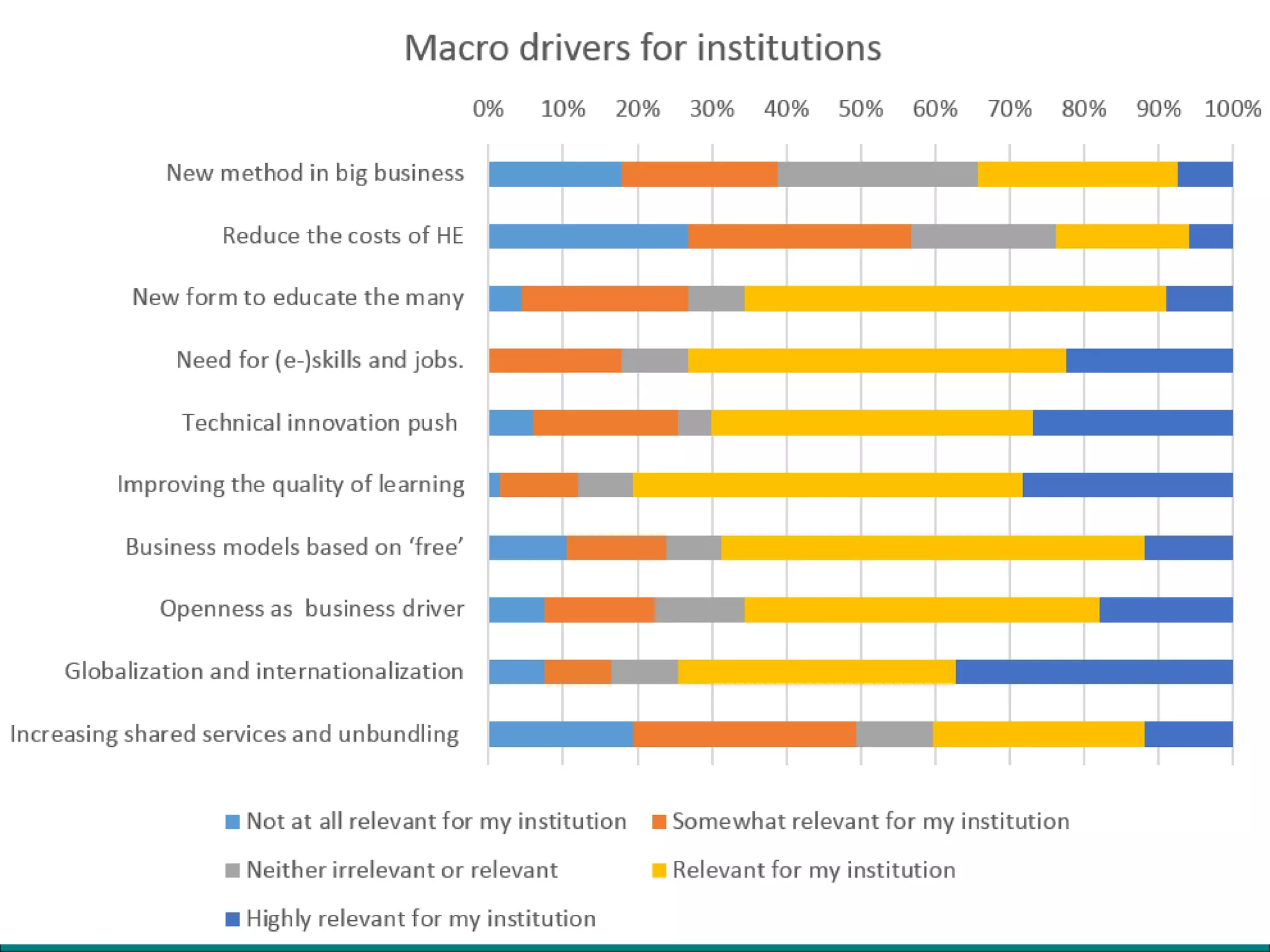
A large majority (between 65% and 80%) of institutions indicates that
many macro divers are relevant or highly relevant for their institution.
Not seen as that important are
i) new method in big business
ii) reduce the costs of HE and
iii) increasing shared services and unbundling.
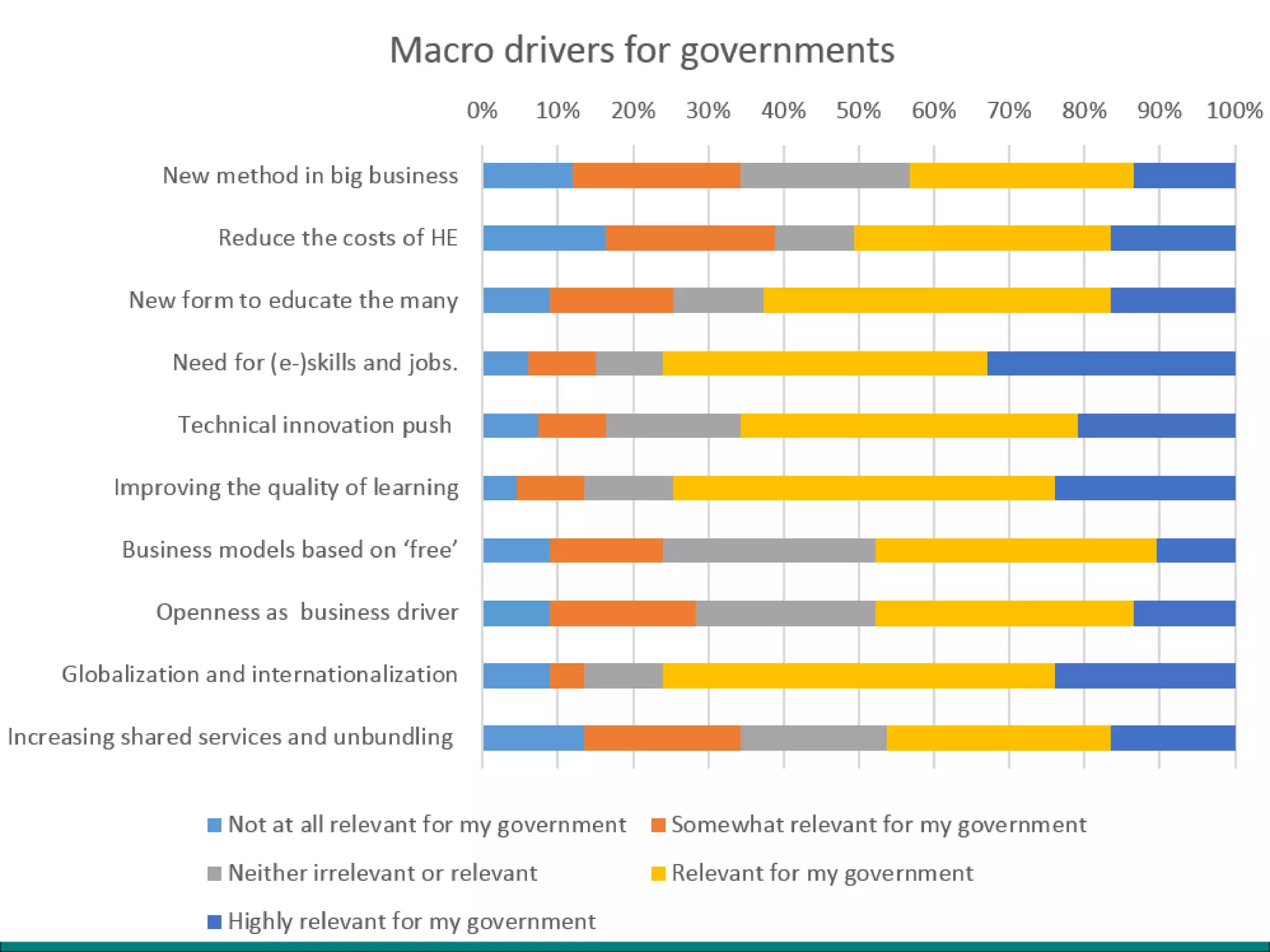
Institutions expect that their governmental involvement with MOOCs
are mainly driven by
a) need for (e-)skills and jobs,
b) improving the quality of learning and
c) globalization and internationalization.
http://econ.st/1yrDHlV
Reflection
The “Porto Declaration on European MOOCs”
- embracement of openness for all
- a collective European response
- strengthening of collaboration of universities across Europe.
It is essential that a cohesive and collaborative effort is adopted in
Europe to counteract the risks and to fully realise the opportunities of
open and online education (including equity, inclusion, etc.)
Strength of diversity versus scalability
Europe should use of the strengths of a decentralized model related to the
support of diversity. Diversity in languages, cultures, case studies and
pedagogical approaches, etc.
Diversity: the art of thinking independently together. Malcolm Forbes
It is difference of opinion that makes horse races. Mark Twain
If we cannot end now our differences, at least we can help make the world
safe for diversity. John F. Kennedy
It is the long history of humankind (and animal kind, too) those who learned
to collaborate and improvise most effectively have prevailed. Charles Darwin
Thank you!!!
Darco.Jansen@eadtu.eu
Coordinator
Coordinator

MOOCs and the european experience

  • 1.
    MOOCs and theEuropean Experience Darco Jansen
  • 2.
    EADTU • Europe's leadinginstitutional association in online, open and flexible higher education, and is at the heart of the modernisation agenda of European universities. • EADTU is a key-partner of the European Commission for lifelong open and flexible learning in distance higher education
  • 3.
    EADTU members 11 :Number of Open and distance teaching universities 14 Associations or consortia of conventional universities 2 Single university membership for associations in development 2 Associated members European coverage: 71%
  • 4.
    Services open toall HEIs • EMPOWER • E-xcellence • OpenupEd
  • 5.
    OpenupEd OpenupEd is anopen, non-profit partnership on MOOCs OpenupEd aims to contribute to opening up education to the benefit of learners and the wider society while reflecting values such as equity, quality and diversity. Offering over 292 MOOCs in 14 different languages. Another 60 MOOCs will follow shortly With > 100 with an option to do a formal exam (ECTS credits). Darco Jansen
  • 6.
    The OpenupEd qualitylabel: benchmarks for MOOCs Published in INNOQUAL Volume 2, No 3, 2014 and Special Issue on Quality in Massive Open Online Courses By Jon Rosewell & Darco Jansen Used by OpenupEd partners. For example UNED • C. Rodrigo, T. Read, M. Santamaria and A. Sánchez-Elvira (2014) "OpenupEdLabel for MOOCs Quality Assurance: UNED COMA Initial Self-Evaluation" Proceedings of V Congreso Internacional sobre Calidad y Accesibilidad en la Formación Virtual (CAFVIR 2014) L. Bengoechea, R. Hernández, J.R. Hilera (Eds.) Universidad Galileo (Guatemala), pp. 551 - 555 ISBN: 978-9929-40-497-7 • Read T. and Rodrigo C. (2014) “Toward a quality model for UNED MOOCs” eLearningPapers 2014 ISSN: 1887-1542 Vol. 37, Pages: 43-50
  • 7.
    MOOC movement dominatedby the US • MOOCs: predominantly US -where it all started as of 2011 and expanded massively -and which houses major providers Coursera, edX, Udacity • Response in Europe … -some universities joined US initiatives, others started themselves -country/language-based platforms: FutureLearn (UK), MiríadaX, UNEDcoma (Spain), Iversity (Germany), FUN (France), OpenMOOC, EMMA-platform, MOODle as MOOC plaform • Governmental involvement: e.g. Opening up Slovenia, FUN, …
  • 8.
    MOOCs collaboration inEurope • EU launch (Sept 2013): Opening up Education. • Two major goals • Innovate teaching and learning for all through ICT • Reshape / modernize EU education through OER (for all educational sectors and levels) • EU-funded projects on MOOCs (from 2014…)
  • 9.
    Name Learners CoursesPartners Interface Languages Courses languages Country Coursera 10,63 Millions 886 116 Arab, Chinese, German, English, French, Spanish, German, Russian, Turkish English, Chinese, Spanish, Portuguese, French, Russian, Turkish, Italian, Ukranian, German, Vietnamese, Hebrew, Japanese, Arabic, Greek, Persian, Macedonian, Czech, Dutch USA edX unknown 381 61 English English, Chinese, Spanish USA Future Learn 1 Million 46 45 English English UK iversity unknown 43 7 English, Dutch English, Dutch, Russian, Italian Germany Miríada X 1,42 Million 10 73 Spanish, Portuguese Spanish, Portuguese Spain Udacity unknown 54 14 English English USA OpenupEd unknown 292 13 English English, Italian, Russian, Spanish, French, Arab, Portuguese, Dutch, Irish Europe FUN unknown 82 31 English, French French, English France
  • 10.
    Investors Continue toBack MOOC Providers • Funding Received: $85 Million • In 4 Rounds from 8 Investors • Funding Rounds (4) • $20M Nov 24, 2013 GSV Capital, Learn Capital • $43M Jul 10, 2013 Learn Capital, International Finance Corporation, GSV Capital, Laureate Education, Inc., Yuri Milner, World Bank • $6M Jul 17, 2012 New Enterprise Associates, Kleiner Perkins Caufield & Byers • $16M Apr 18, 2012 Kleiner Perkins Caufield & Byers, New Enterprise Associates • Funding Received: $55 Million • In 3 Rounds from 10 Investors • Funding Rounds (3) • $35M Sep 24, 2014 Recruit Holdings, George Zachary, Peter Levine, CRV, Andreessen Horowitz, Cox Enterprises, Valor Capital Group, Bertelsmann AG, Drive Capital • $15M Oct 25, 2012 Steve Blank, CRV, Andreessen Horowitz • $5M Jan 1, 2012 CRV • Funding Received: $48 Million • In 4 Rounds from 15 Investors • Funding Rounds (4) • $32M May 8, 2014 MHS Capital, Insight Venture Partners, Norwest Venture Partners - NVP • $12M Dec 7, 2012 Lightbank, Insight Venture Partners, MHS Capital, Learn Capital • $3M Oct 12, 2011 Lightbank, 500 Startups, MHS Capital • $1M Aug 31, 2010 Larry Braitman, Naval Ravikant, Signia Venture Partners, Jeremy Stoppelman, MHS Capital, Keith Rabois, Joshua Stylman, 500 Startups, Russ Fradin, Paul Martino, Benjamin Ling
  • 11.
    Verified Certificate /Signature Track •Estimated revenues in 2014: $8-12 million • Coursera shares with universities 6-15% of the total revenue, and 20% of gross profits on its courses. Headhunting Specializations Capstone Project Employee Training Course Sponsorships
  • 12.
  • 14.
    Behind the surface Isthe US indeed leading the MOOC movement? What are the reasons to be involved in MOOCs (or decide not to invest in MOOCs)? What are the difference between US and Europe? Can explain these differences?
  • 15.
    Gaebel, M., Kupriyanova,V., Morais, R. & Colucci, E. (2014). E-learning in European Higher Education Institutions: Results of a mapping survey conducted in October-December 2013. http://www.eua.be/Libraries/Publication/e-learning_survey.sflb.ashx Allen, I.E. and Seaman. J. (2015). Grade Change: Tracking Online Education in the United States. Babson Survey Research Group and Quahog Research Group. http://www.onlinelearningsurvey.com/reports/gradelevel.pdf
  • 16.
    Jansen, D. &Schuwer, R. (2015). Institutional MOOC strategies in Europe Status report based on a mapping survey conducted in October - December 2014. EADTU – HOME project http://www.eadtu.eu/docum ents/Publications/OEenM/In stitutional_MOOC_strategies _in_Europe.pdf
  • 18.
    MOOC offering • Inthe US the number of institutions having a MOOC or planning to introduce them has decreased from 14,3% (2013) to 13,6% (2014) • In Europe it has increased from about 58% in EUA study (2013) to 71,7% (2014) in EADTU/HOME study. Darco Jansen EUA statement : “interest in MOOCs has far from peaked in Europe” is simply true
  • 19.
  • 20.
    Biases in thesurveys • The US surveys (US 2013 and US 2014) are biased to the large institutions • The EAU study is biased in favour of institutions involved in e- learning. • The EU-2014 study (EADTU/HOME) is biased to those institutions interested in MOOCs.
  • 21.
  • 24.
    Biases in thesurveys (2) • Every institution can decide by themselves if they are providing MOOCs • They decide themselves what’s a MOOC !!!
  • 26.
  • 27.
    Definition MOOCs • Proposalby EU-funded MOOCs projects: MOOCs are online courses designed for large numbers of participants, that can be accessed by anyone anywhere as long as they have an internet connection, are open to everyone without entry qualifications, and offer a full/complete course experience online for free • Recently validated by survey “Institutional MOOC strategies in Europe” • Wikipedia: A massive open online course (MOOC) is an online course aimed at unlimited participation and open access via the web. In addition to traditional course materials such as videos, readings, and problem sets, MOOCs provide interactive user forums that help build a community for students, professors, and teaching assistants
  • 34.
  • 43.
    Reflections on MOOCs •European institution more involved in MOOCs than the US • The number of European institutions with MOOC involvement is increasing • MOOCs are perceived as a sustainable method for offering courses in Europe. • In Europe the institutions are increasingly developing a positive attitude to MOOCs and have positive experiences for the added values of MOOCs. • Most dominant objective in all studies is to increase institutional visibility and using MOOCs for reputation reasons. • In the US using MOOCs for student recruitment is seen as the most important primary objective of institutions, while in Europe it is rather to reach new students and creating flexible learning opportunities Darco Jansen
  • 46.
    Institutions versus Governments Alarge majority (between 65% and 80%) of institutions indicates that many macro divers are relevant or highly relevant for their institution. Not seen as that important are i) new method in big business ii) reduce the costs of HE and iii) increasing shared services and unbundling. Institutions expect that their governmental involvement with MOOCs are mainly driven by a) need for (e-)skills and jobs, b) improving the quality of learning and c) globalization and internationalization.
  • 47.
  • 48.
    Reflection The “Porto Declarationon European MOOCs” - embracement of openness for all - a collective European response - strengthening of collaboration of universities across Europe. It is essential that a cohesive and collaborative effort is adopted in Europe to counteract the risks and to fully realise the opportunities of open and online education (including equity, inclusion, etc.)
  • 49.
    Strength of diversityversus scalability Europe should use of the strengths of a decentralized model related to the support of diversity. Diversity in languages, cultures, case studies and pedagogical approaches, etc. Diversity: the art of thinking independently together. Malcolm Forbes It is difference of opinion that makes horse races. Mark Twain If we cannot end now our differences, at least we can help make the world safe for diversity. John F. Kennedy It is the long history of humankind (and animal kind, too) those who learned to collaborate and improvise most effectively have prevailed. Charles Darwin
  • 50.