PLDs
What is programmable logic?

                     CMOS
                         Logic


Standard   uProcessors                          ASIC
                                 Programmable
 Logic     uControllers           Logic
Logic Circuits


 Standard Logic Circuits       Programmable Logic
                               Circuits
• Realize single function or   • Contains great number of
  set of functions,              standard logic circuits
  once defined                 • Possibility of realizing many
                                 various functions
  and with no possibility of
                               • Hardware can configure
  changing.                      any time user need to
                                 only by programming.


                                                                 2/13
Programmable logic devices available
            today
• Major programmable logic architecture:
                          CMOS
                          Logic


    Standard   uProcessors     Programmable
     Logic      uControllers                   ASIC
                                Logic


                    SPLD          CPLD        FPGA
Introduction
• Fixed function digital ICs are classified
  according to their complexity.
• They are listed here from the least complex to
  the most complex.
• For example :-
  SSI, MSI, LSI, VLSI and ULSI.
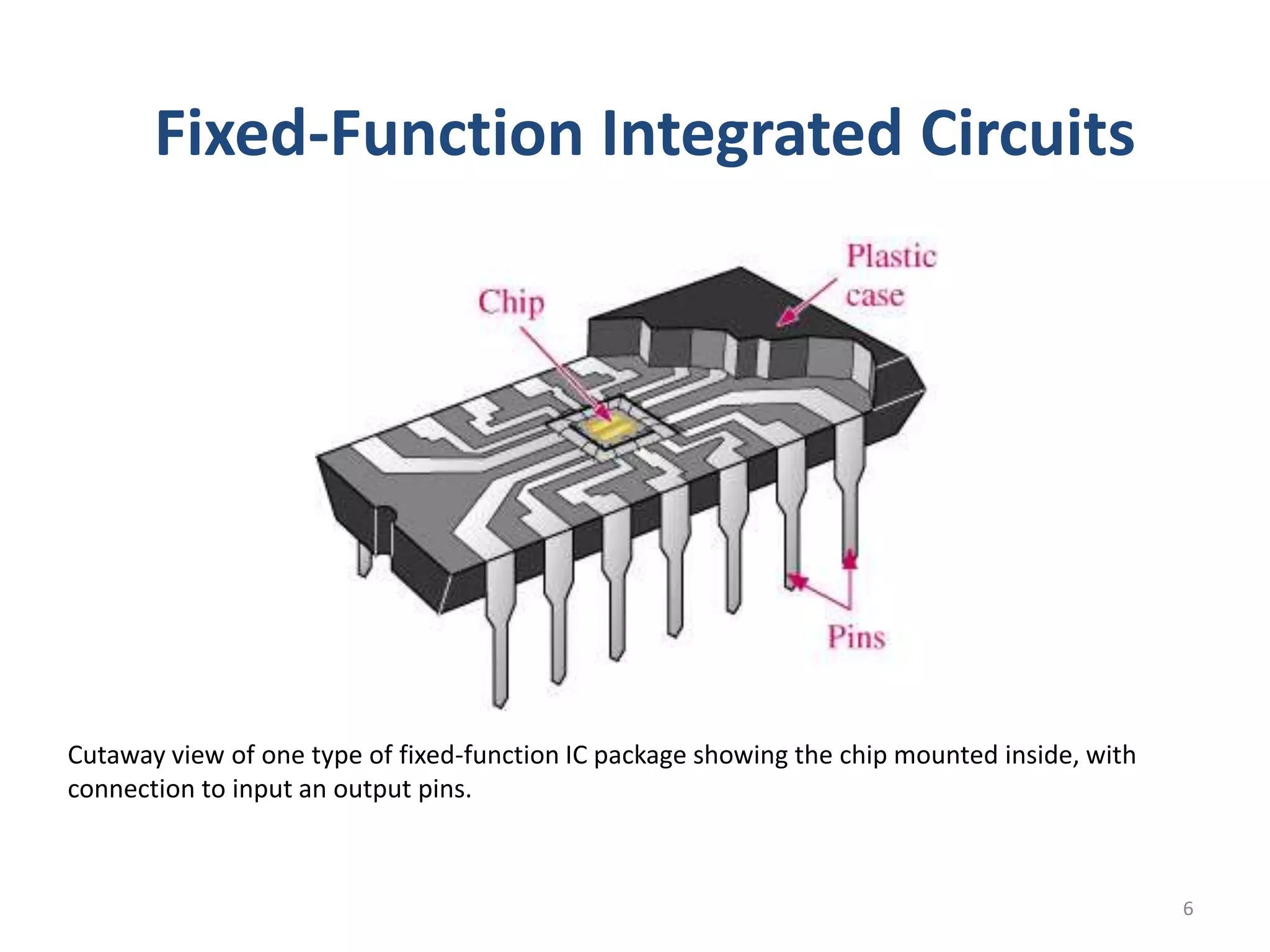
Fixed-Function Integrated Circuits


Cutaway view of one type of fixed-function IC package showing the chip mounted inside, with
connection to input an output pins.


                                                                                              6
introduction
• In fixed function devices a specific logic
  function is contained in the IC package when it
  is purchased and it can never be changed.
• Another category of logic device is one in
  which the logic function is programmed by
  user and, in some cases, can be
  reprogrammed many times.
• These devices are called programmable logic
  devices or PLDs.
Introduction
• In many applications the PLD has replaced the
  hard-wired fixed function logic device.
• However, fixed function is still important and
  will be around for a long time but in more
  limited applications.
Introduction
• Advantages: -
- Many more logic circuits can be “stuffed” into
  a much smaller area with PLDs.
- With certain PLDs, logic designs can be easily
  changed without rewiring or replacing
  components.
- A PLD design can be implemented faster than
  one using fixed function ICs once the required
  programming language is mastered.
Basic
 idea
Type of PLDs
• The three major types of programmable logic
  are :-
1) SPLD (Simple Programmable Logic devices)
2) CPLD (Complex Programmable Logic Devices)
   and
3) FPGA (Field Programmable Gate Array).
SPLDs
• The least complex form of PLDs.
• Can typically replaced several fixed function SSI
   or MSI devices and their connections.
• A typical package has 24 to 28 pins.
• A few categories of SPLD are listed below:-
 - PAL (Programmable Array Logic)
- GAL (Generic Array Logic)
- PLA (Programmable Logic Array)
- PROM (Programmable Read-Only Memory)
CPLDs
• Much higher capacity than SPLDs, permitting
  more complex logic circuits to be programmed
  into them.
• A typical CPLD is the equivalent of from 2 to
  64 SPLDs and come in 44 pins to 160 pin
  packages depending on the complexity.
• There are several forms of CPLD, which vary in
  complexity and programming capability.
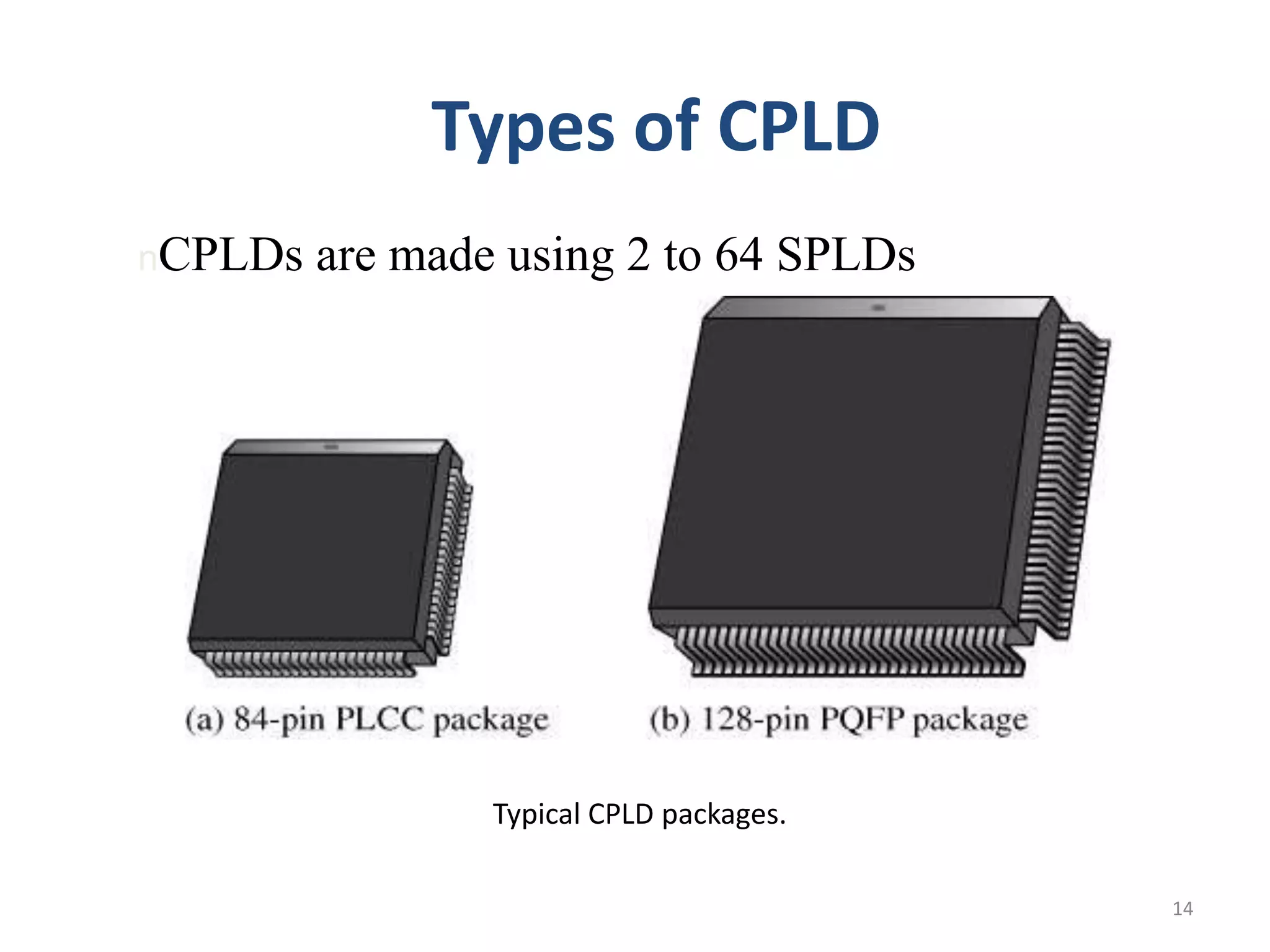
Types of CPLD
nCPLDs   are made using 2 to 64 SPLDs


                 Typical CPLD packages.

                                          14
FPGA
• Different from SPLD and CPLD.
• Have the greatest logic capacity.
• Consist of an array of anywhere from 64 to
  thousands of logic gates groups that are
  sometimes called logic blocks.
• Two basics classes of FPGA are course grained
  and fine grained.
• FPGAs come in packages ranging up to 1000
  pins or more.
PLD Programming
• A logic circuit design for a PLD is entered using
  one of two basic methods:-
- Schematic Entry
- Text based Entry.
In order to program a PLD, the following items are required:
   PLD – there are numerous manufacturers of PLD’s. They come in various sizes with
   internal structures that are equivalent to hundreds, thousands, or tens of thousands
   of equivalent gates.
   PLD programming software – this software allows the user to specify exactly how the
   circuit should perform. Functions might be specified in terms of truth table, Boolean
   expressions, state equations, and by several other methods. The PLD programming
   software would compile the information and produce a JEDEC file , which is
   essentially an industry standard binary file containing information on how to make
   connections within a given PLD. There are numerous brands of PLD programming
   software, including PLDShell, MAX PLUS II, PSPICE, ABEL, CUPL, XILINX, ORCAD, and
   many others.
   PLD programmer – this piece of hardware might contain a universal socket that could
   hold various types of PLD’s. The PLD software produces a JEDEC file which is
   downloaded into the programmer. The programmer can typically program, copy,
   erase, and verify the contents of PLD’s.            PLD inserted
                                                       into socket


                                      JEDEC file
                                      downloaded
                Computer with PLD
               programming software                                               17
                                                   PLD Programmer
Review
1. What does PLD stand for?
2. What does SPLD stand for?
3. What does CPLD stand for?
4. What does FPGA stand for?
5. Basically, how does a CPLD differ from a
   SPLD?
6. List two ways in which a logic design can be
   entered for PLD programming.
Review
7. List 4 SPLDs.
8. What is the difference between a PAL and a
  PLA?
Generalized PLD
A generic PLD for implementing SOP functions has:


     Inverter/buffer                                OR array
                              AND array
     array for inputs

                                                               20
PLD’s Compared
Type          AND array connections   OR array connections


   PROM Fixed at factory               Programmable by
                                       customer
  PLA       Programmable by             Programmable by
           customer                    customer
 PAL      Programmable by              Fixed at factory
 or GAL   customer


                                                             21
PLD Logic Capacity
• SPLD: about 200 gates
• CPLD
  – Altera FLEX (250K logic gates)
  – Xilinx XC9500
• FPGA
  – Xilinx Vertex-E ( 3 million logic gates)
  – Xilinx Spartan (10K logic gates)
  – Altera

                                               22
Programmable Logic Devices (PLDs)
           All use AND-OR structure- differ in which is programmable
                        Fixed
                                          Programmable           Programmable
Inputs                  AND array                                               Outputs
                                          connections            OR array
                        (decoder)

                             Programmable read-only memory (PROM)


         Programmable   Programmable                             Fixed
Inputs                                                                          Outputs
         connections    AND array                                OR array

                            Programmable array logic (PAL) device


         Programmable   Programmable       Programmable          Programmable
Inputs                                                                          Outputs
         connections    AND array          connections           OR array

                            Programmable logic array (PLA)
                                    Ahmad Almulhem, KFUPM 2010
Programmable Symbology


                         24
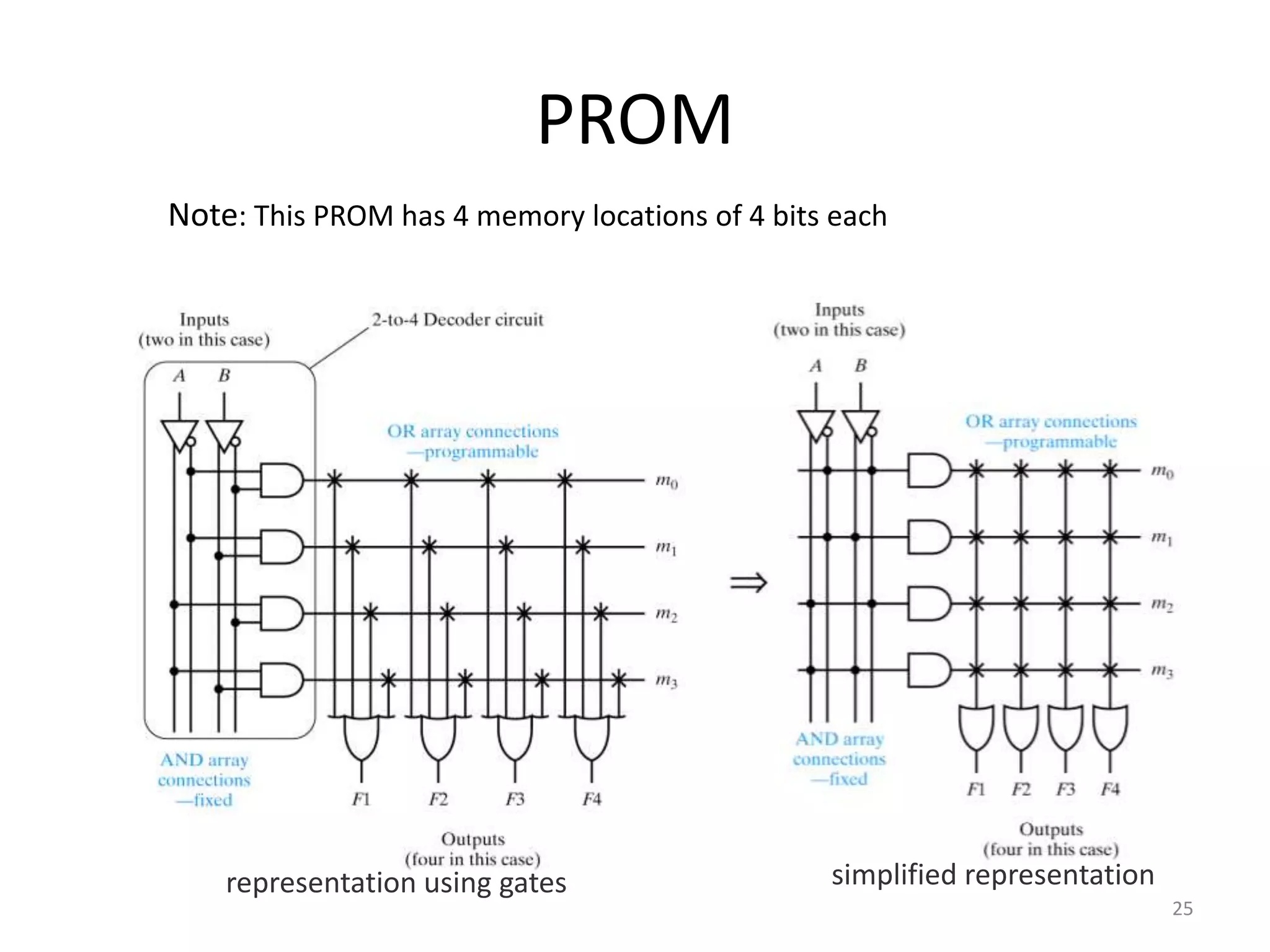
PROM
Note: This PROM has 4 memory locations of 4 bits each


    representation using gates                  simplified representation
                                                                            25
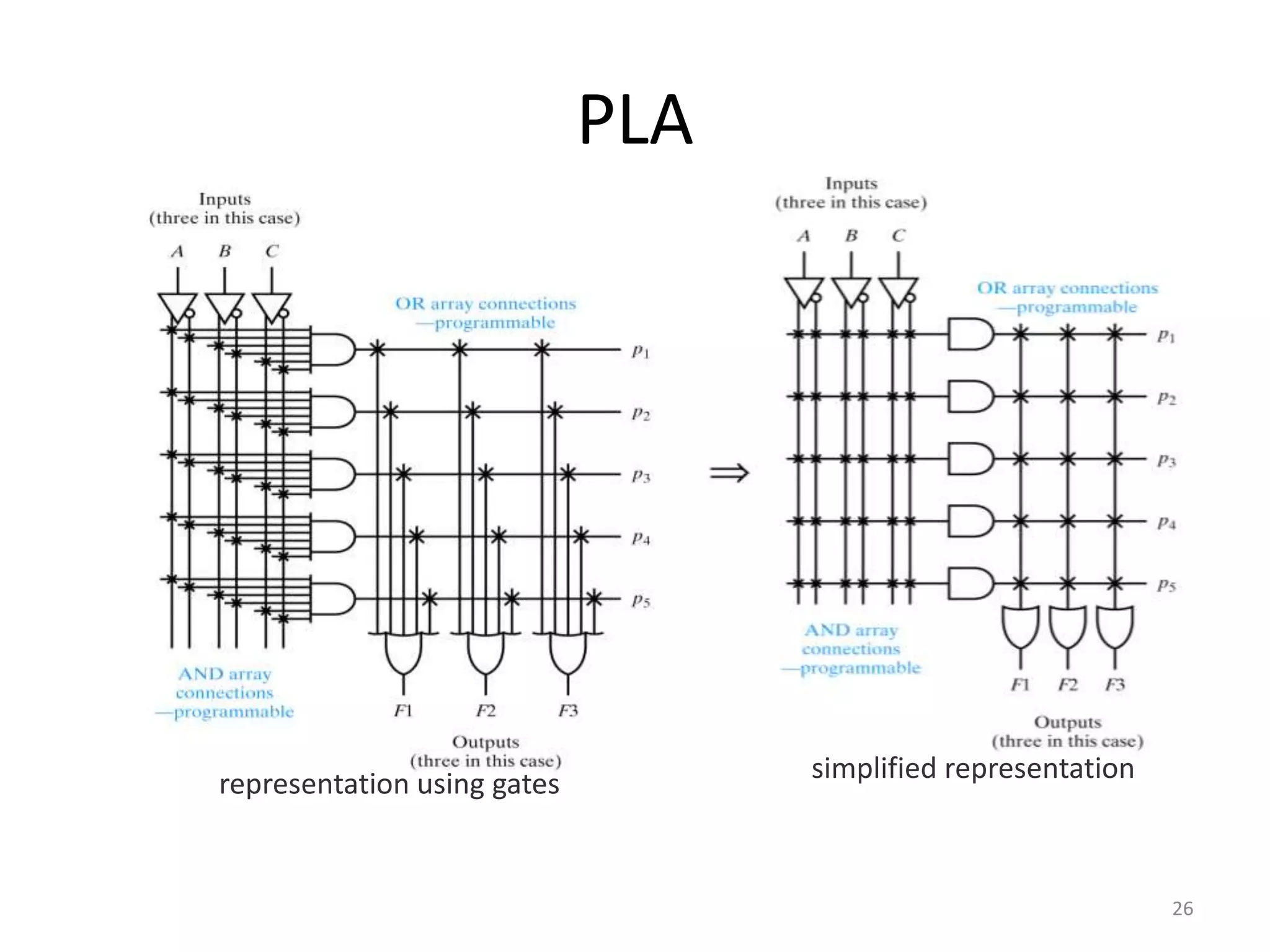
PLA


representation using gates         simplified representation


                                                               26
Programmable Logic Array (PLA)
• AND array and OR array
  are programmable
• XOR is available to
  complement an output if
  needed


• Example:
   • 3 inputs/2 outputs
   • F1 = A B’ + A C + A’ B C’
   • F2 = (AC + BC)’

                                                          Source: Mano’s textbook


                             Ahmad Almulhem, KFUPM 2010
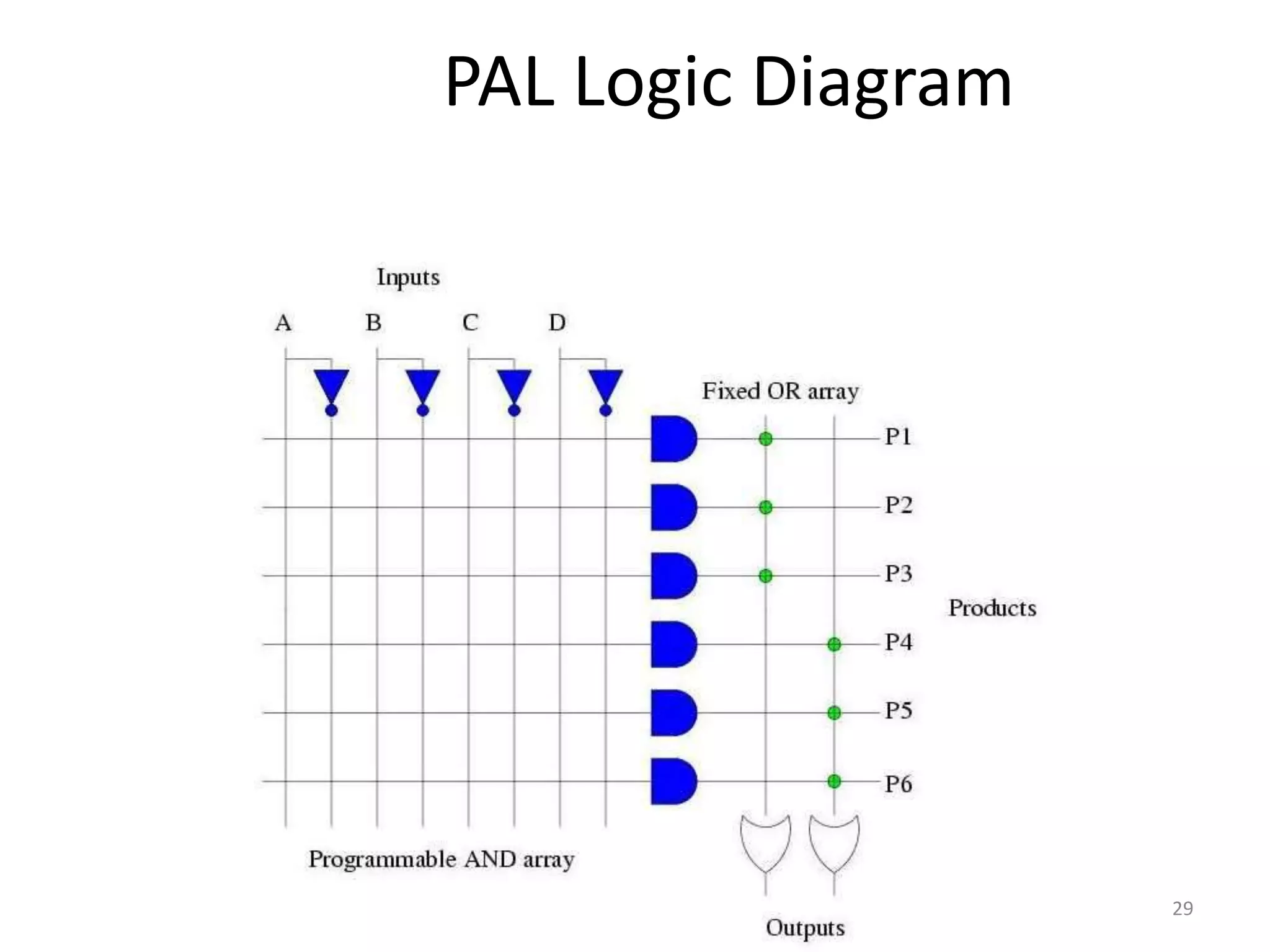
Programmable Array Logic (PAL)
• Fixed OR array and
  programmable AND array
    • Opposite of ROM
• Feed back is used to support
  more product terms
• AND output can not be shared
  here!

• Example:
• 4 inputs/4 outputs with fixed 3-
  input OR gates
• W = A B C’ + A’ B’ C D’
• X=?
• Y=?
• Z=?
                                                     Source: Mano’s textbook
                        Ahmad Almulhem, KFUPM 2010
PAL Logic Diagram


                    29
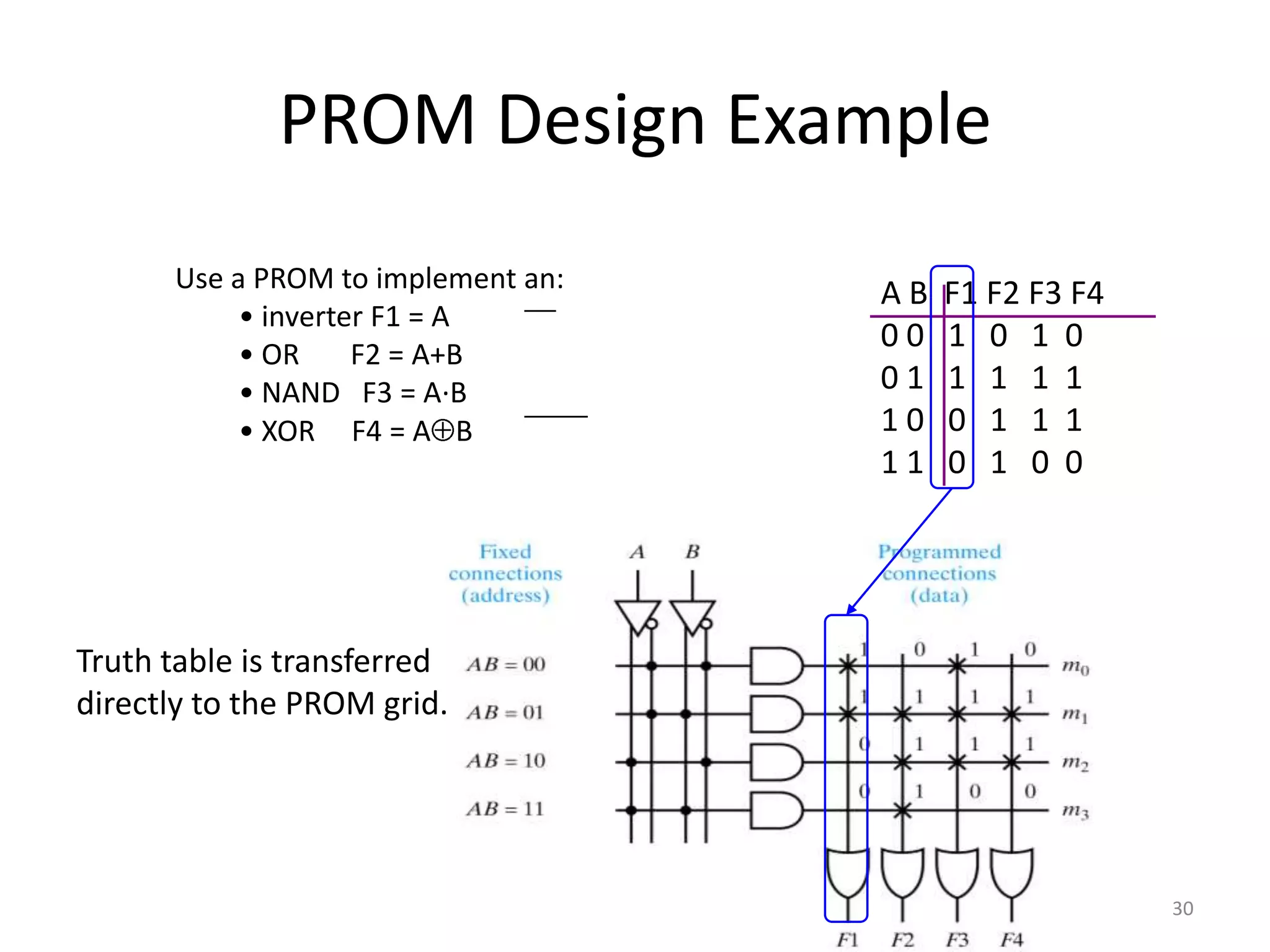
PROM Design Example
      Use a PROM to implement an:   AB   F1 F2 F3 F4
           • inverter F1 = A
                                    00   1 0 1 0
           • OR     F2 = A+B
           • NAND F3 = A·B          01   1 1 1 1
           • XOR F4 = A B           10   0 1 1 1
                                    11   0 1 0 0


Truth table is transferred
directly to the PROM grid.


                                                       30
Field Programmable Gate Array (FPGA)

 • Xilinx FPGAs
 • Configurable Logic Block
   (CLB)
    • Programmable logic
      and FFs
 • Programmable
   Interconnects
    • Switch Matrices
    • Horizontal/vertical
      lines
 • I/O Block (IOB)
    • Programmable I/O pins


                                                     Source: Mano’s textbook


                        Ahmad Almulhem, KFUPM 2010
Field programmable gate arrays

– a programmable device using more complex cells
FPGA Vendors & Device Families
• Xilinx
   – Virtex-II/Virtex-4: Feature-     • Actel
     packed high-performance
     SRAM-based FPGA                    – Anti-fuse based
   – Spartan 3: low-cost feature          FPGAs
     reduced version                       • Radiation tolerant
   – CoolRunner: CPLDs                  – Flash-based FPGAs
• Altera                              • Lattice
   – Stratix/Stratix-II
      • High-performance SRAM-based
                                        – Flash-based FPGAs
        FPGAs                           – CPLDs (EEPROM)
   – Cyclone/Cyclone-II               • QuickLogic
      • Low-cost feature reduced
        version for cost-critical       – ViaLink-based
        applications                      FPGAs
   – MAX3000/7000 CPLDs
   – MAX-II: Flash-based FPGA
                                                              33
Special FPGA functions
• Internal SRAM
• Embedded Multipliers
  and DSP blocks
• Embedded logic analyzer
• Embedded CPUs
• High speed I/O (~10GHz)
• DDR/DDRII/DDRIII SDRAM
  interfaces
• PLLs
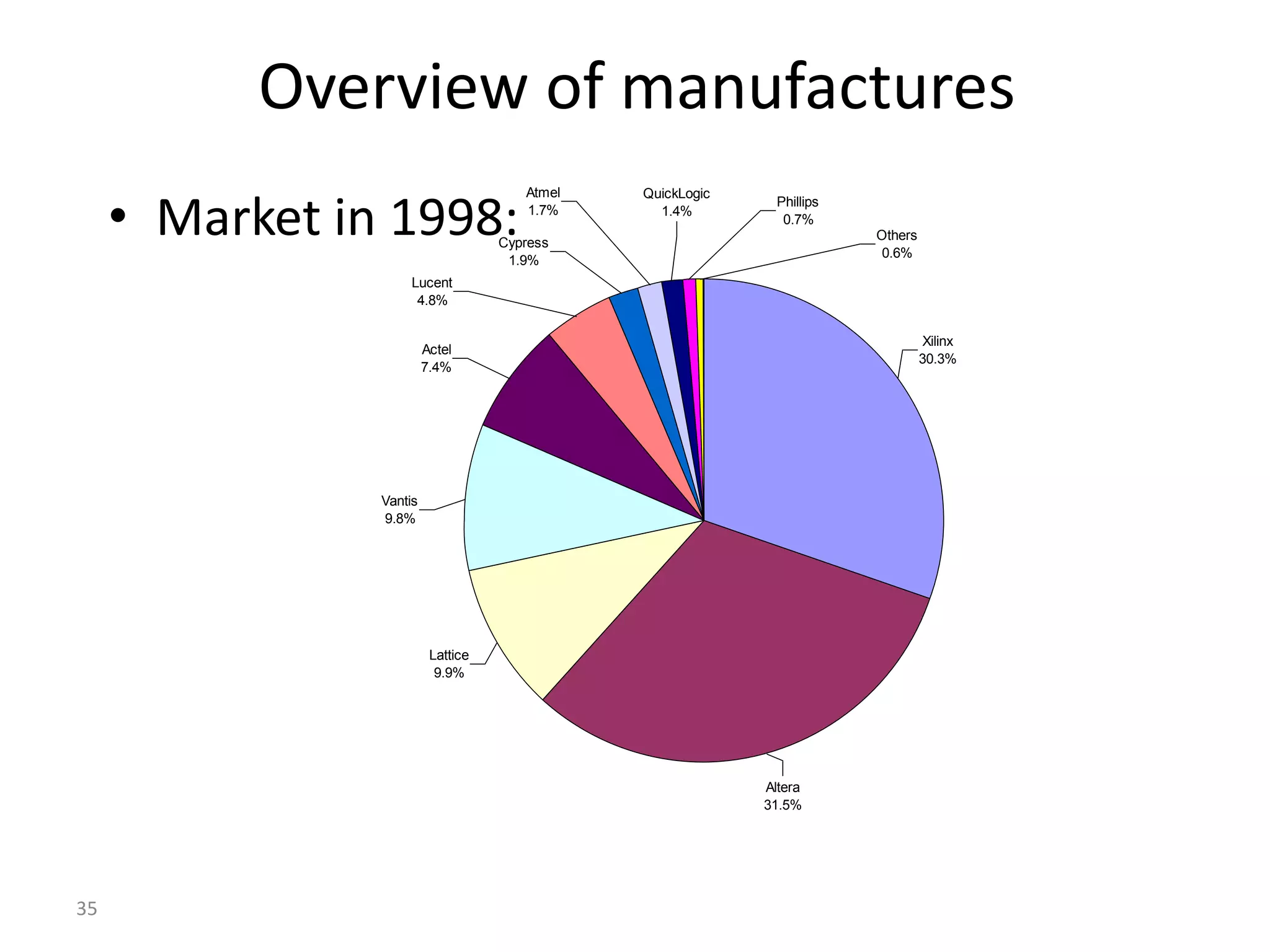
Overview of manufactures
     • Market in 1998:
                                       Atmel   QuickLogic
                                                              Phillips
                                       1.7%      1.4%
                                                               0.7%
                                                                         Others
                                    Cypress
                                                                          0.6%
                                     1.9%
                     Lucent
                      4.8%

                                                                                   Xilinx
                         Actel
                                                                                  30.3%
                         7.4%


                Vantis
                9.8%


                          Lattice
                           9.9%


                                                            Altera
                                                            31.5%


35
PLDs

PLDs

  • 1.
  • 2.
    What is programmablelogic? CMOS Logic Standard uProcessors ASIC Programmable Logic uControllers Logic
  • 3.
    Logic Circuits StandardLogic Circuits Programmable Logic Circuits • Realize single function or • Contains great number of set of functions, standard logic circuits once defined • Possibility of realizing many various functions and with no possibility of • Hardware can configure changing. any time user need to only by programming. 2/13
  • 4.
    Programmable logic devicesavailable today • Major programmable logic architecture: CMOS Logic Standard uProcessors Programmable Logic uControllers ASIC Logic SPLD CPLD FPGA
  • 5.
    Introduction • Fixed functiondigital ICs are classified according to their complexity. • They are listed here from the least complex to the most complex. • For example :- SSI, MSI, LSI, VLSI and ULSI.
  • 6.
    Fixed-Function Integrated Circuits Cutawayview of one type of fixed-function IC package showing the chip mounted inside, with connection to input an output pins. 6
  • 7.
    introduction • In fixedfunction devices a specific logic function is contained in the IC package when it is purchased and it can never be changed. • Another category of logic device is one in which the logic function is programmed by user and, in some cases, can be reprogrammed many times. • These devices are called programmable logic devices or PLDs.
  • 8.
    Introduction • In manyapplications the PLD has replaced the hard-wired fixed function logic device. • However, fixed function is still important and will be around for a long time but in more limited applications.
  • 9.
    Introduction • Advantages: - -Many more logic circuits can be “stuffed” into a much smaller area with PLDs. - With certain PLDs, logic designs can be easily changed without rewiring or replacing components. - A PLD design can be implemented faster than one using fixed function ICs once the required programming language is mastered.
  • 10.
  • 11.
    Type of PLDs •The three major types of programmable logic are :- 1) SPLD (Simple Programmable Logic devices) 2) CPLD (Complex Programmable Logic Devices) and 3) FPGA (Field Programmable Gate Array).
  • 12.
    SPLDs • The leastcomplex form of PLDs. • Can typically replaced several fixed function SSI or MSI devices and their connections. • A typical package has 24 to 28 pins. • A few categories of SPLD are listed below:- - PAL (Programmable Array Logic) - GAL (Generic Array Logic) - PLA (Programmable Logic Array) - PROM (Programmable Read-Only Memory)
  • 13.
    CPLDs • Much highercapacity than SPLDs, permitting more complex logic circuits to be programmed into them. • A typical CPLD is the equivalent of from 2 to 64 SPLDs and come in 44 pins to 160 pin packages depending on the complexity. • There are several forms of CPLD, which vary in complexity and programming capability.
  • 14.
    Types of CPLD nCPLDs are made using 2 to 64 SPLDs Typical CPLD packages. 14
  • 15.
    FPGA • Different fromSPLD and CPLD. • Have the greatest logic capacity. • Consist of an array of anywhere from 64 to thousands of logic gates groups that are sometimes called logic blocks. • Two basics classes of FPGA are course grained and fine grained. • FPGAs come in packages ranging up to 1000 pins or more.

  • 16.
    PLD Programming • Alogic circuit design for a PLD is entered using one of two basic methods:- - Schematic Entry - Text based Entry.
  • 17.
    In order toprogram a PLD, the following items are required: PLD – there are numerous manufacturers of PLD’s. They come in various sizes with internal structures that are equivalent to hundreds, thousands, or tens of thousands of equivalent gates. PLD programming software – this software allows the user to specify exactly how the circuit should perform. Functions might be specified in terms of truth table, Boolean expressions, state equations, and by several other methods. The PLD programming software would compile the information and produce a JEDEC file , which is essentially an industry standard binary file containing information on how to make connections within a given PLD. There are numerous brands of PLD programming software, including PLDShell, MAX PLUS II, PSPICE, ABEL, CUPL, XILINX, ORCAD, and many others. PLD programmer – this piece of hardware might contain a universal socket that could hold various types of PLD’s. The PLD software produces a JEDEC file which is downloaded into the programmer. The programmer can typically program, copy, erase, and verify the contents of PLD’s. PLD inserted into socket JEDEC file downloaded Computer with PLD programming software 17 PLD Programmer
  • 18.
    Review 1. What doesPLD stand for? 2. What does SPLD stand for? 3. What does CPLD stand for? 4. What does FPGA stand for? 5. Basically, how does a CPLD differ from a SPLD? 6. List two ways in which a logic design can be entered for PLD programming.
  • 19.
    Review 7. List 4SPLDs. 8. What is the difference between a PAL and a PLA?
  • 20.
    Generalized PLD A genericPLD for implementing SOP functions has: Inverter/buffer OR array AND array array for inputs 20
  • 21.
    PLD’s Compared Type AND array connections OR array connections PROM Fixed at factory Programmable by customer PLA Programmable by Programmable by customer customer PAL Programmable by Fixed at factory or GAL customer 21
  • 22.
    PLD Logic Capacity •SPLD: about 200 gates • CPLD – Altera FLEX (250K logic gates) – Xilinx XC9500 • FPGA – Xilinx Vertex-E ( 3 million logic gates) – Xilinx Spartan (10K logic gates) – Altera 22
  • 23.
    Programmable Logic Devices(PLDs) All use AND-OR structure- differ in which is programmable Fixed Programmable Programmable Inputs AND array Outputs connections OR array (decoder) Programmable read-only memory (PROM) Programmable Programmable Fixed Inputs Outputs connections AND array OR array Programmable array logic (PAL) device Programmable Programmable Programmable Programmable Inputs Outputs connections AND array connections OR array Programmable logic array (PLA) Ahmad Almulhem, KFUPM 2010
  • 24.
  • 25.
    PROM Note: This PROMhas 4 memory locations of 4 bits each representation using gates simplified representation 25
  • 26.
    PLA representation using gates simplified representation 26
  • 27.
    Programmable Logic Array(PLA) • AND array and OR array are programmable • XOR is available to complement an output if needed • Example: • 3 inputs/2 outputs • F1 = A B’ + A C + A’ B C’ • F2 = (AC + BC)’ Source: Mano’s textbook Ahmad Almulhem, KFUPM 2010
  • 28.
    Programmable Array Logic(PAL) • Fixed OR array and programmable AND array • Opposite of ROM • Feed back is used to support more product terms • AND output can not be shared here! • Example: • 4 inputs/4 outputs with fixed 3- input OR gates • W = A B C’ + A’ B’ C D’ • X=? • Y=? • Z=? Source: Mano’s textbook Ahmad Almulhem, KFUPM 2010
  • 29.
  • 30.
    PROM Design Example Use a PROM to implement an: AB F1 F2 F3 F4 • inverter F1 = A 00 1 0 1 0 • OR F2 = A+B • NAND F3 = A·B 01 1 1 1 1 • XOR F4 = A B 10 0 1 1 1 11 0 1 0 0 Truth table is transferred directly to the PROM grid. 30
  • 31.
    Field Programmable GateArray (FPGA) • Xilinx FPGAs • Configurable Logic Block (CLB) • Programmable logic and FFs • Programmable Interconnects • Switch Matrices • Horizontal/vertical lines • I/O Block (IOB) • Programmable I/O pins Source: Mano’s textbook Ahmad Almulhem, KFUPM 2010
  • 32.
    Field programmable gatearrays – a programmable device using more complex cells
  • 33.
    FPGA Vendors &Device Families • Xilinx – Virtex-II/Virtex-4: Feature- • Actel packed high-performance SRAM-based FPGA – Anti-fuse based – Spartan 3: low-cost feature FPGAs reduced version • Radiation tolerant – CoolRunner: CPLDs – Flash-based FPGAs • Altera • Lattice – Stratix/Stratix-II • High-performance SRAM-based – Flash-based FPGAs FPGAs – CPLDs (EEPROM) – Cyclone/Cyclone-II • QuickLogic • Low-cost feature reduced version for cost-critical – ViaLink-based applications FPGAs – MAX3000/7000 CPLDs – MAX-II: Flash-based FPGA 33
  • 34.
    Special FPGA functions •Internal SRAM • Embedded Multipliers and DSP blocks • Embedded logic analyzer • Embedded CPUs • High speed I/O (~10GHz) • DDR/DDRII/DDRIII SDRAM interfaces • PLLs
  • 35.
    Overview of manufactures • Market in 1998: Atmel QuickLogic Phillips 1.7% 1.4% 0.7% Others Cypress 0.6% 1.9% Lucent 4.8% Xilinx Actel 30.3% 7.4% Vantis 9.8% Lattice 9.9% Altera 31.5% 35