This document discusses various topics related to monitoring and controlling contracts and projects. It describes the monitoring and control cycle including assessing progress, collecting details, and reporting status using methods like RAG reports, Gantt charts, and earned value analysis. It also discusses change control procedures, types of contracts for acquiring software from external suppliers, and the tendering and evaluation process for selecting suppliers.
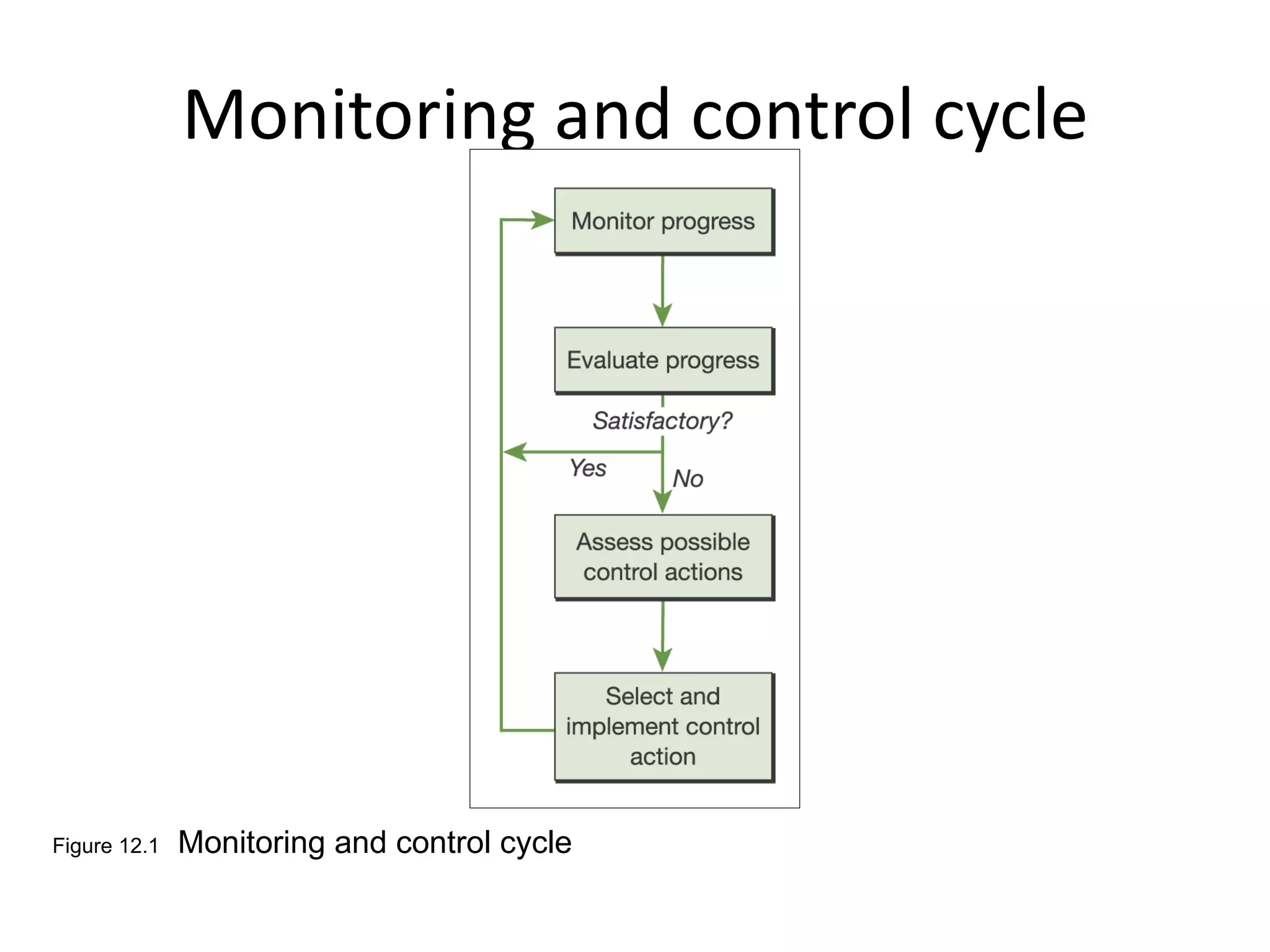
Introduction to monitoring and control processes, including cycles, responsibilities, progress checks, data collection, and cost monitoring.
Detailed explanation of earned value analysis including planned value (PV), earned value (EV), and their implications on project budgeting and scheduling.
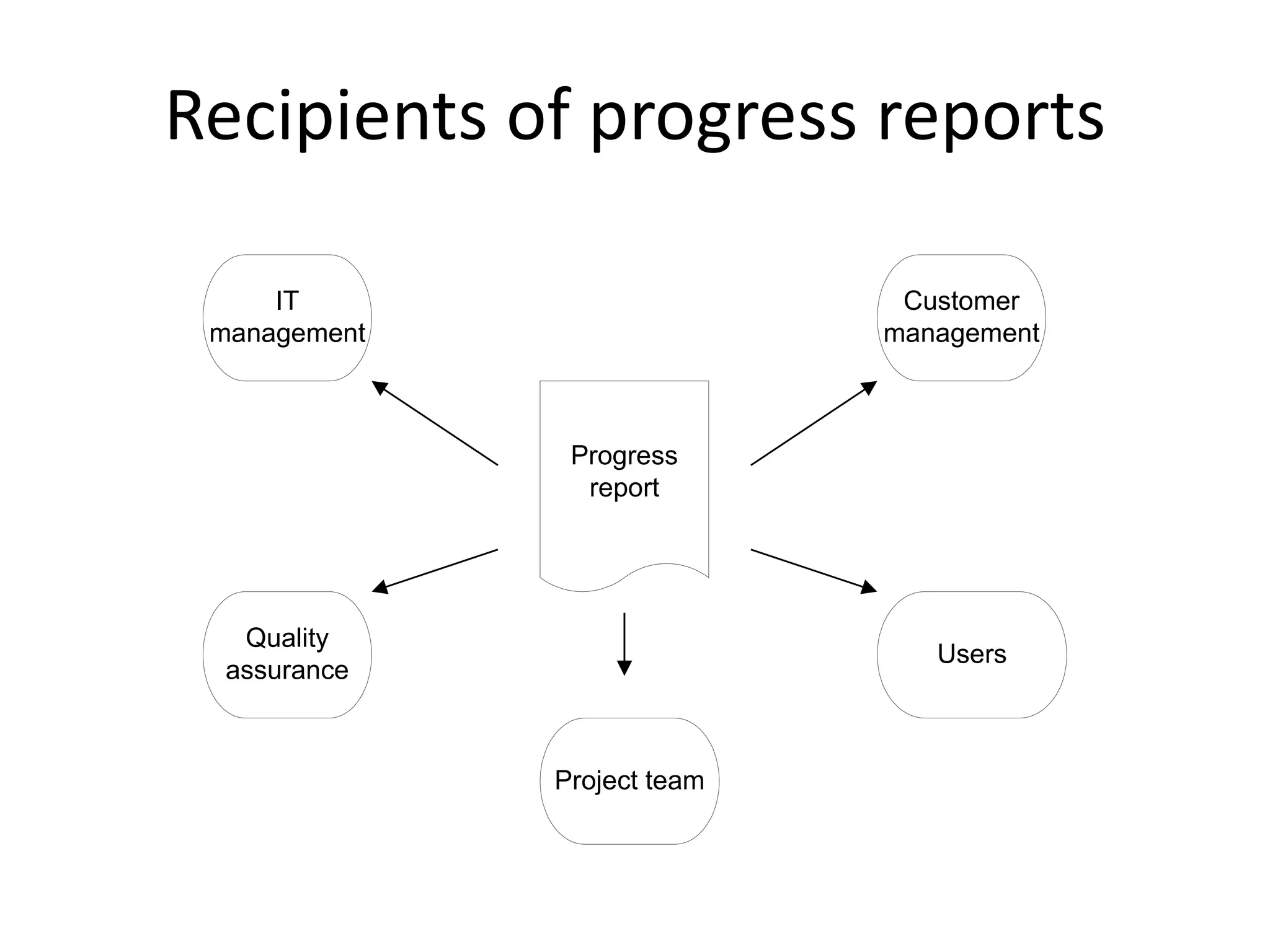
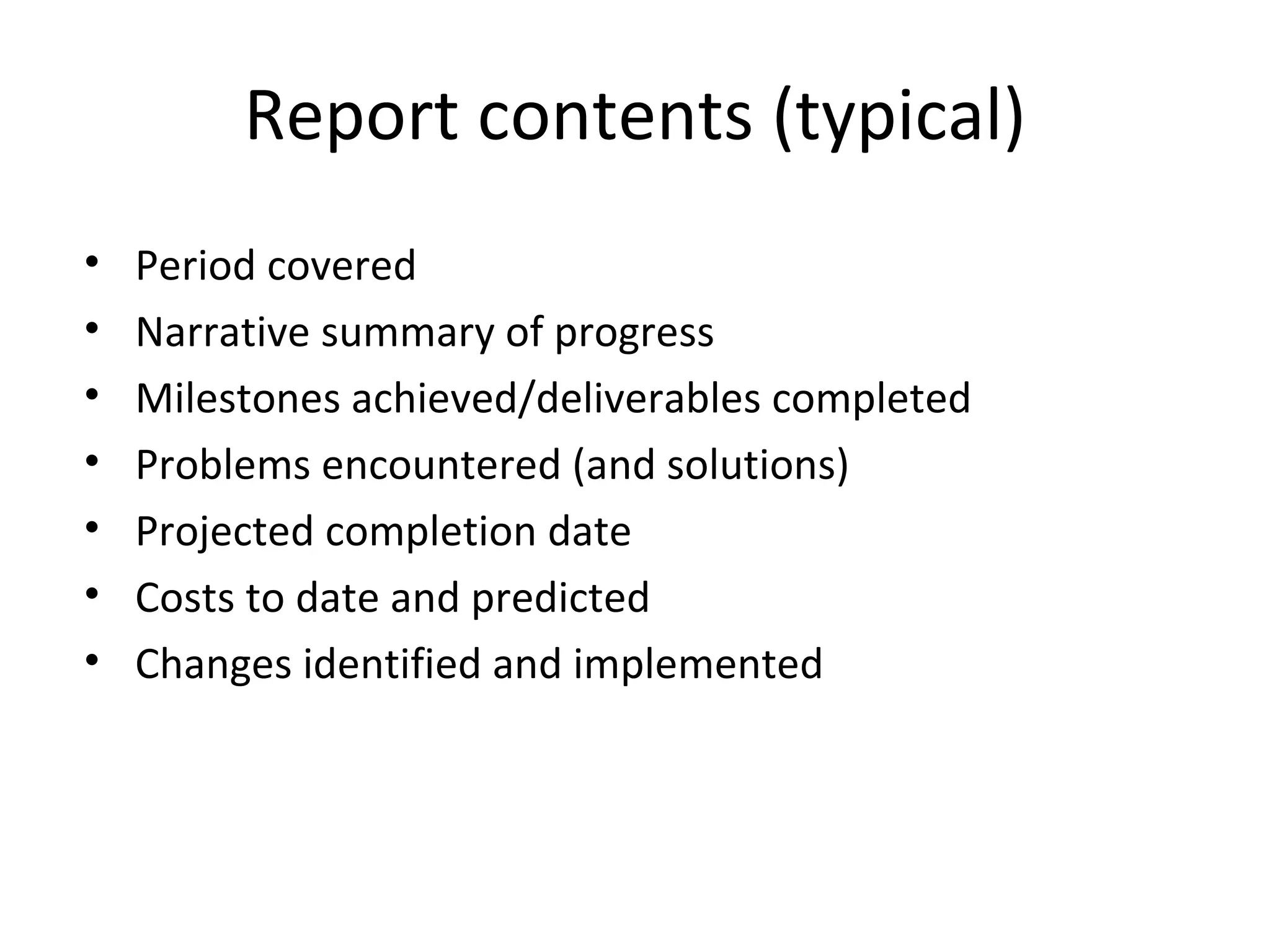
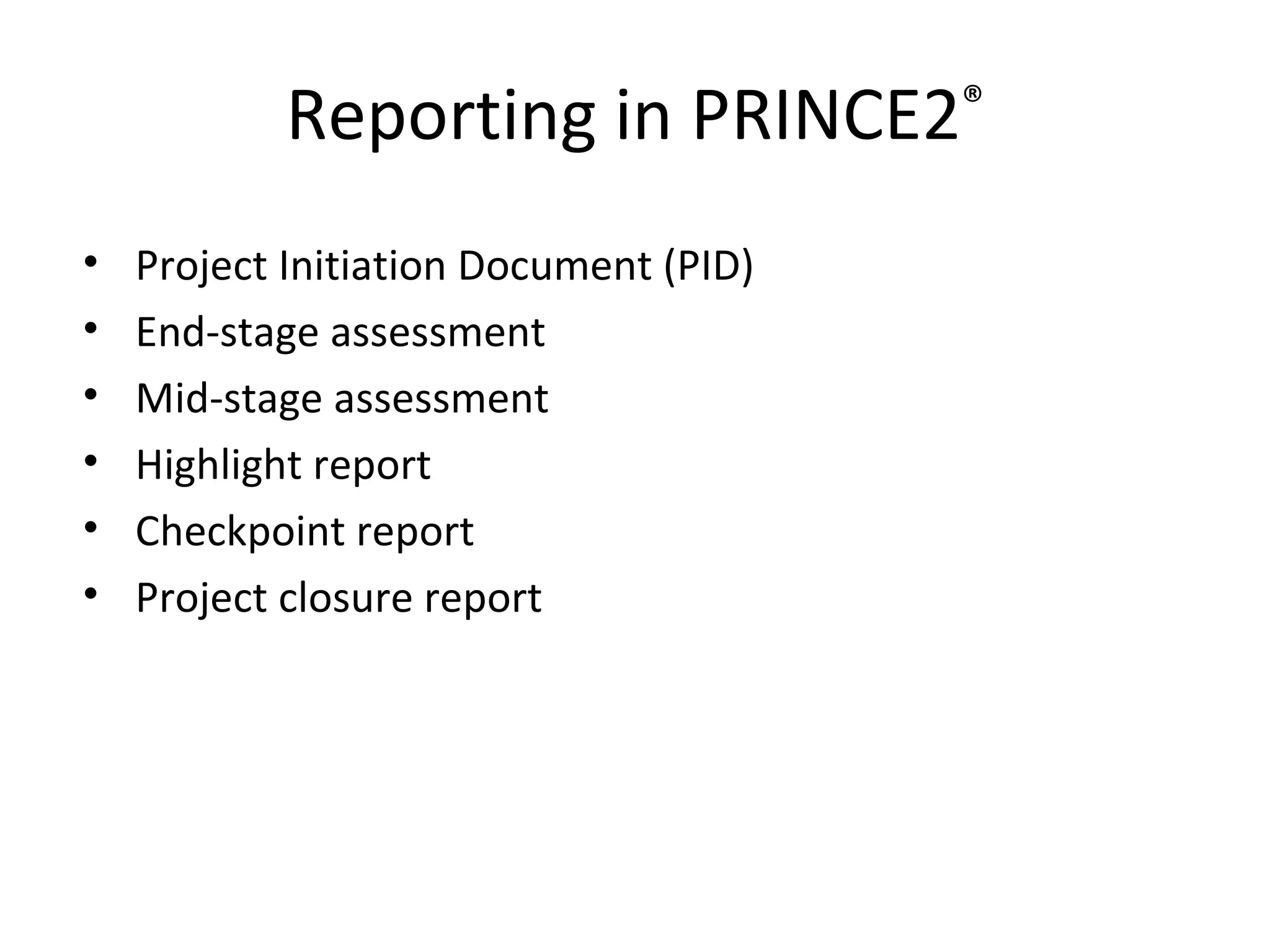
Focus on progress report contents, types of reports, and the importance of effective communication in project management.
Strategies for prioritizing monitoring activities, especially for critical tasks and managing project timelines.
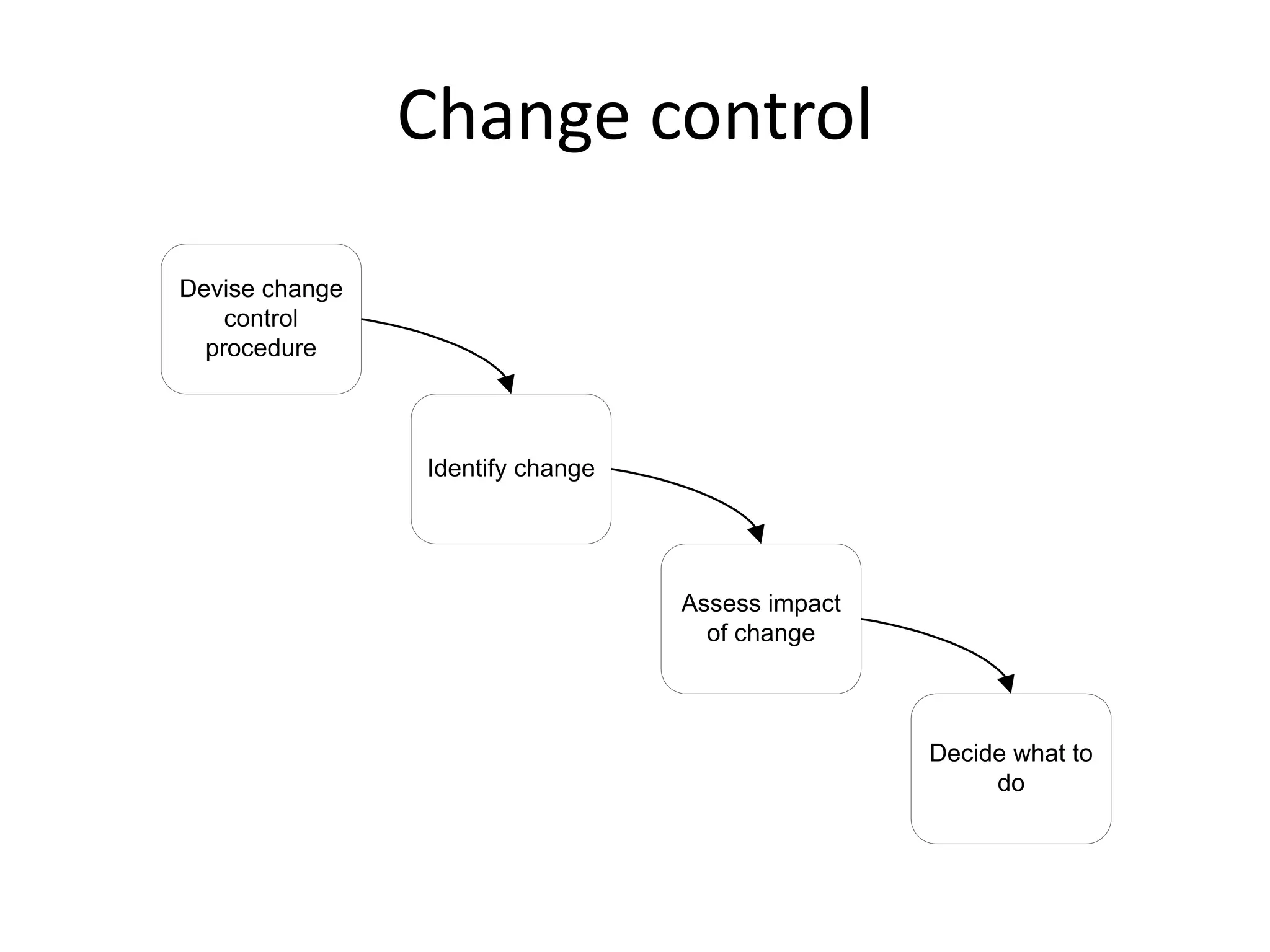
Essential procedures for managing change in project environments including roles, processes, and configuration management.
Key concepts in contract management such as types of contracts, tendering processes, evaluation plans, and acceptance testing.
Assessing progress Checkpoints– predetermined times when progress is checked Event driven: check takes place when a particular event has been achieved Time driven: date of the check is pre-determined Frequency of reporting The higher the management level, generally, the longer the gaps between checkpoints
6.
Collecting progress detailsNeed to collect data about: Achievements/ Milestones Costs How to deal with partial completions? 99% completion syndrome Possible solutions: Control of products, not activities Subdivide into lots of sub-activities
7.
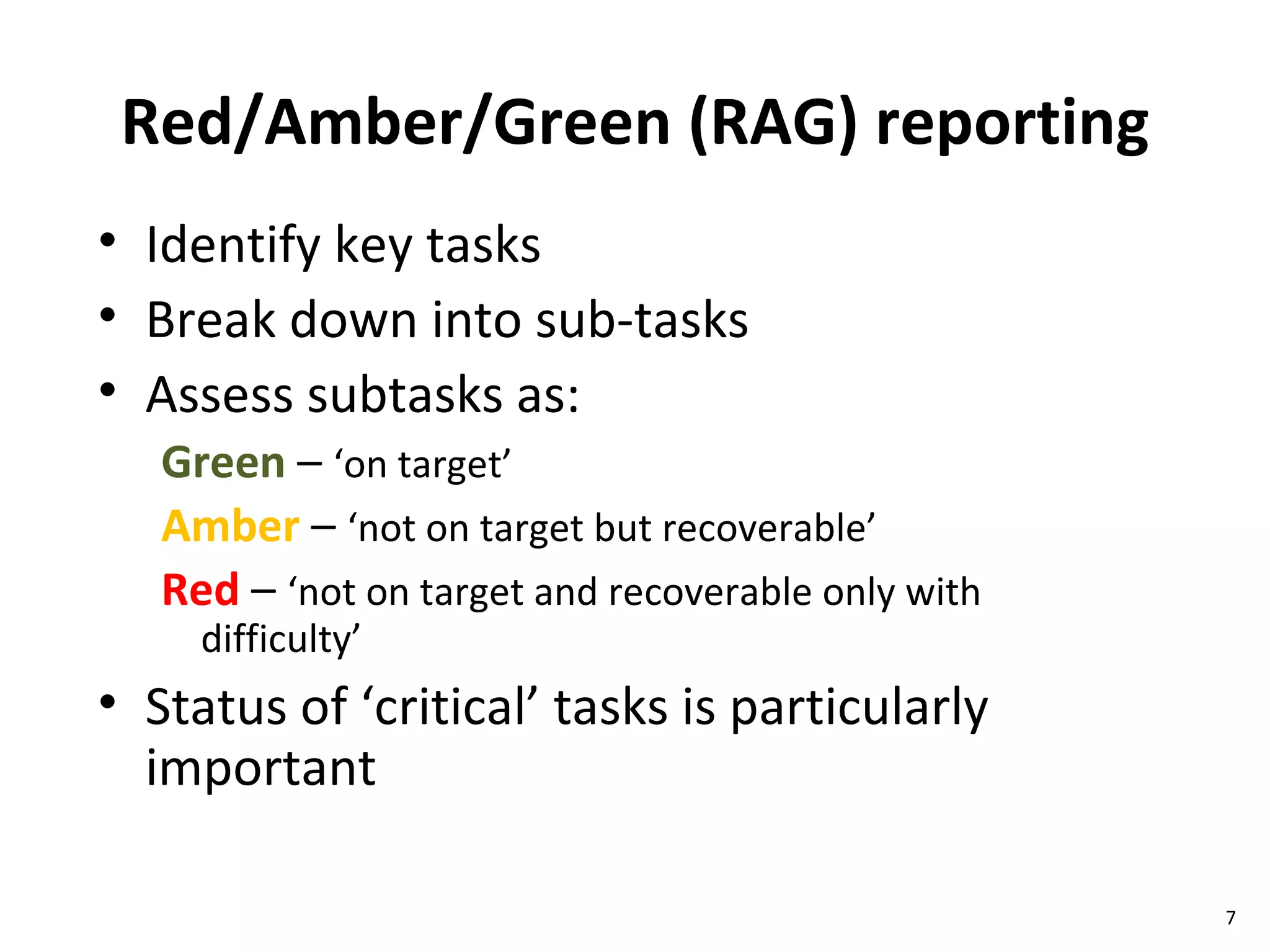
Red/Amber/Green (RAG) reportingIdentify key tasks Break down into sub-tasks Assess subtasks as: Green – ‘on target’ Amber – ‘not on target but recoverable’ Red – ‘not on target and recoverable only with difficulty’ Status of ‘critical’ tasks is particularly important
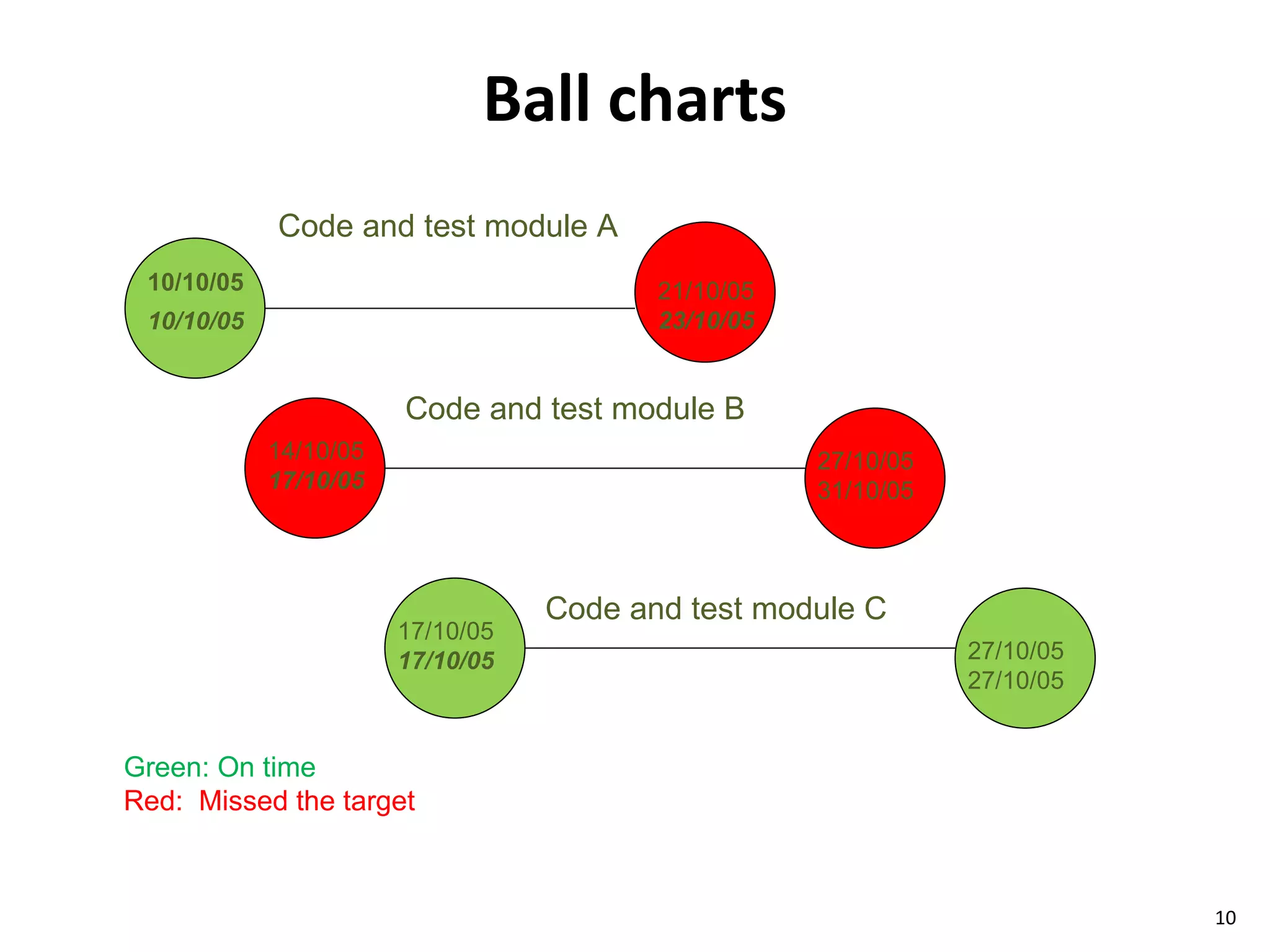
Ball charts Codeand test module A Code and test module B Code and test module C 10/10/05 10/10/05 21/10/05 23/10/05 14/10/05 17/10/05 27/10/05 31/10/05 17/10/05 17/10/05 27/10/05 27/10/05 Green: On time Red: Missed the target
Cost monitoring Aproject could be late because the staff originally committed, have not been deployed In this case the project will be behind time but under budget A project could be on time but only because additional resources have been added and so by over budget Need to monitor both achievements and costs
13.
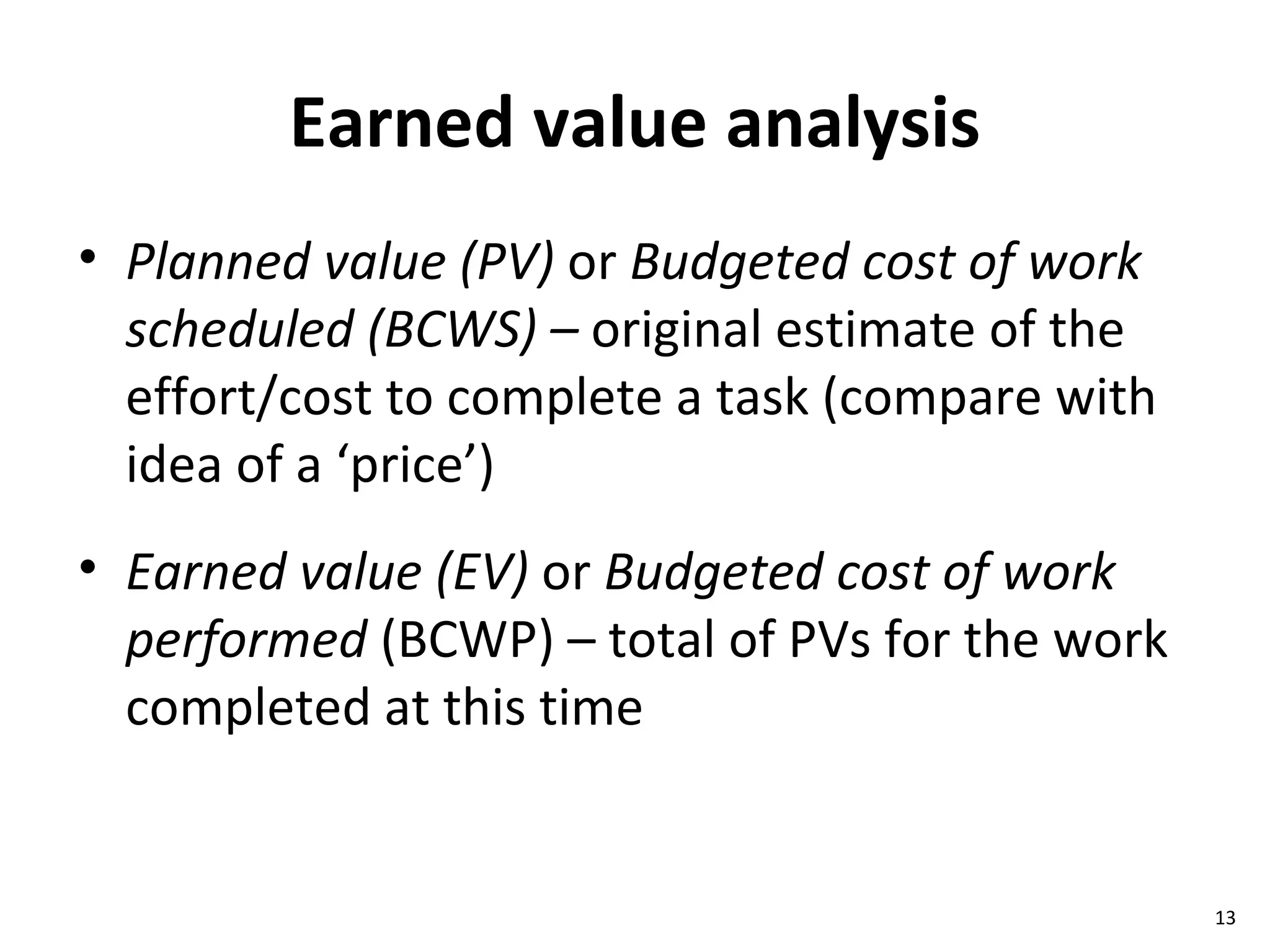
Earned value analysisPlanned value (PV) or Budgeted cost of work scheduled (BCWS) – original estimate of the effort/cost to complete a task (compare with idea of a ‘price’) Earned value (EV) or Budgeted cost of work performed (BCWP) – total of PVs for the work completed at this time
14.
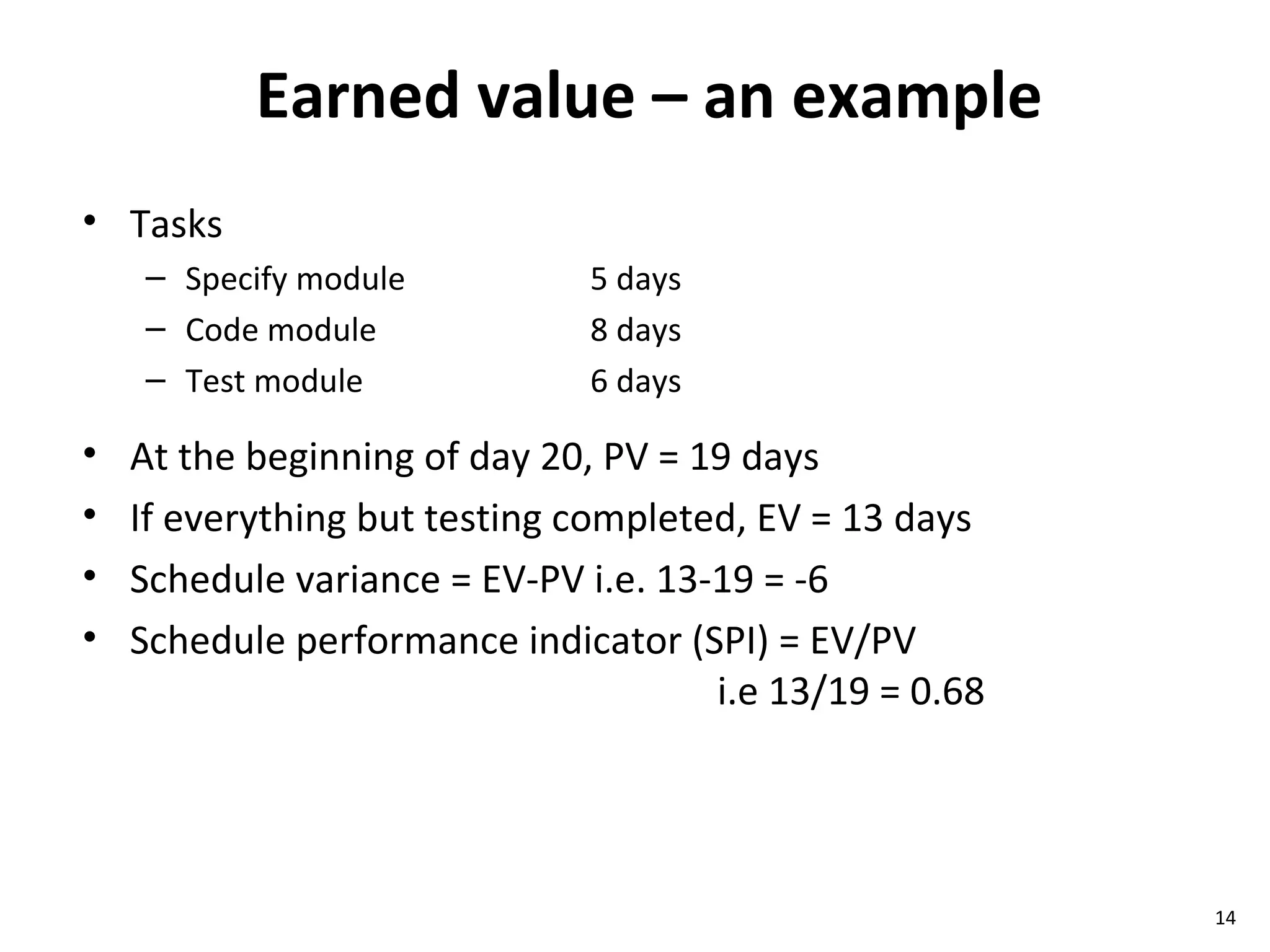
Earned value –an example Tasks Specify module 5 days Code module 8 days Test module 6 days At the beginning of day 20, PV = 19 days If everything but testing completed, EV = 13 days Schedule variance = EV-PV i.e. 13-19 = -6 Schedule performance indicator (SPI) = EV/PV i.e 13/19 = 0.68
15.
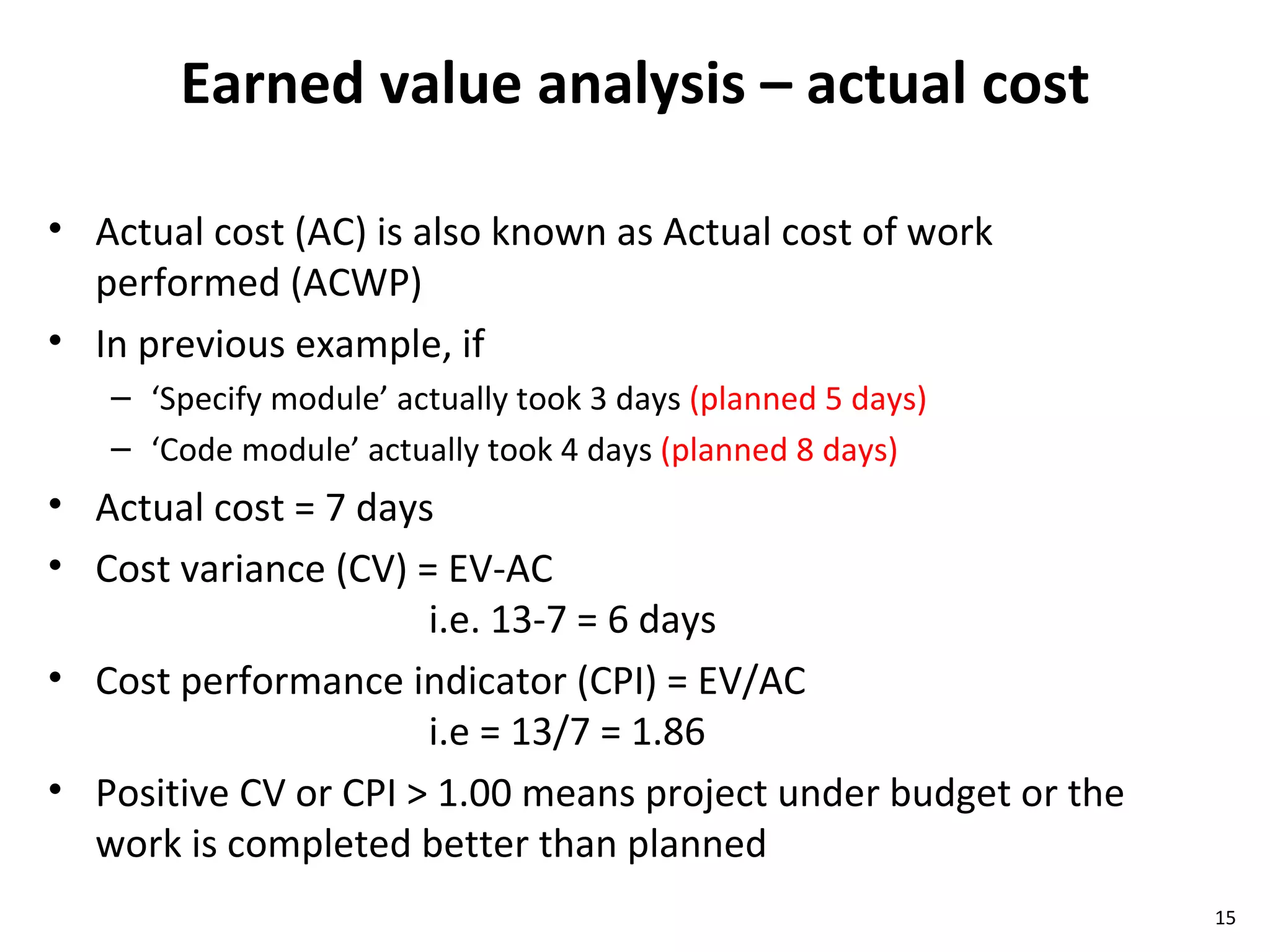
Earned value analysis– actual cost Actual cost (AC) is also known as Actual cost of work performed (ACWP) In previous example, if ‘ Specify module’ actually took 3 days (planned 5 days) ‘ Code module’ actually took 4 days (planned 8 days) Actual cost = 7 days Cost variance (CV) = EV-AC i.e. 13-7 = 6 days Cost performance indicator (CPI) = EV/AC i.e = 13/7 = 1.86 Positive CV or CPI > 1.00 means project under budget or the work is completed better than planned
Report contents (typical)Period covered Narrative summary of progress Milestones achieved/deliverables completed Problems encountered (and solutions) Projected completion date Costs to date and predicted Changes identified and implemented
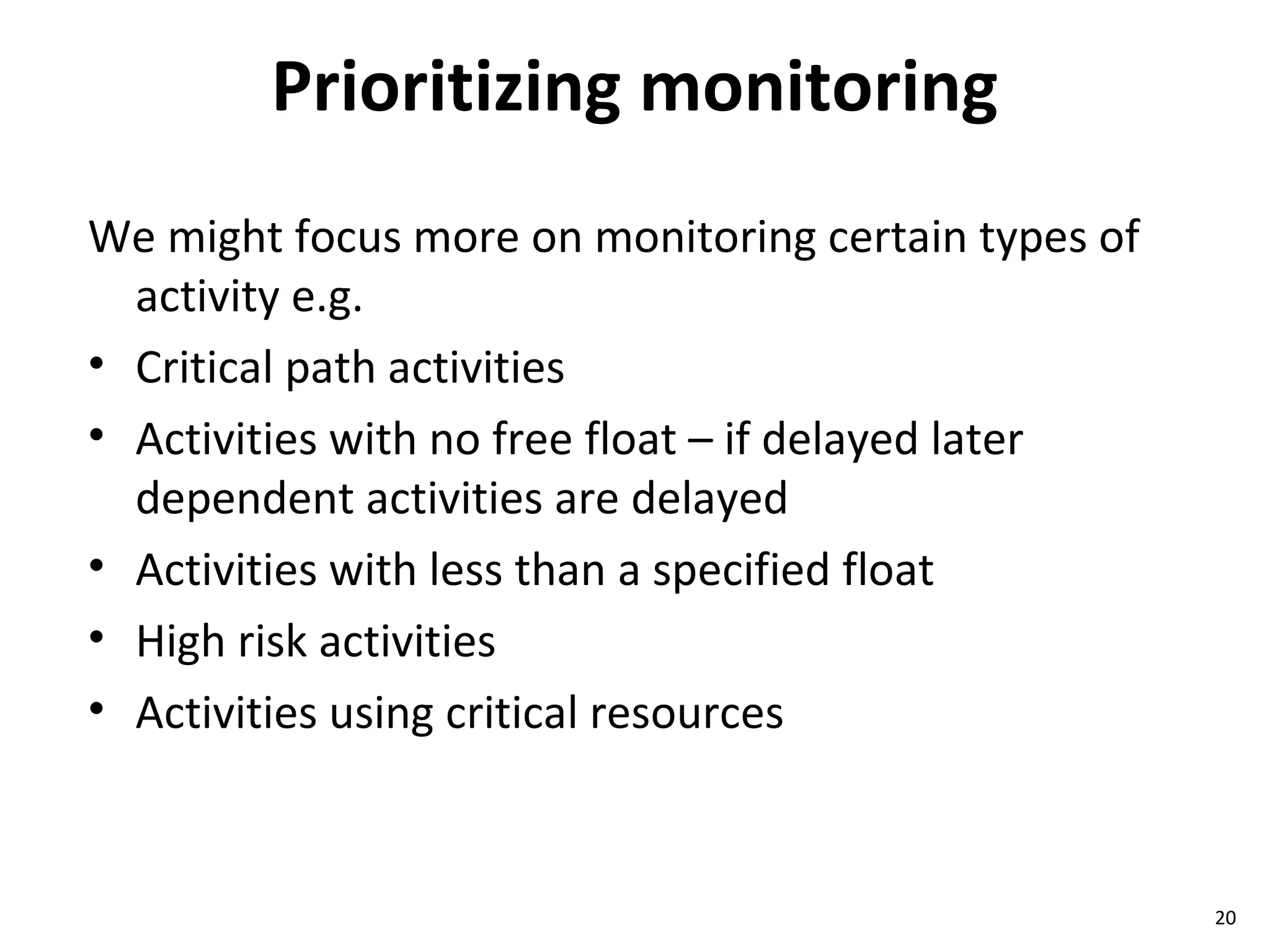
Prioritizing monitoring Wemight focus more on monitoring certain types of activity e.g. Critical path activities Activities with no free float – if delayed later dependent activities are delayed Activities with less than a specified float High risk activities Activities using critical resources
21.
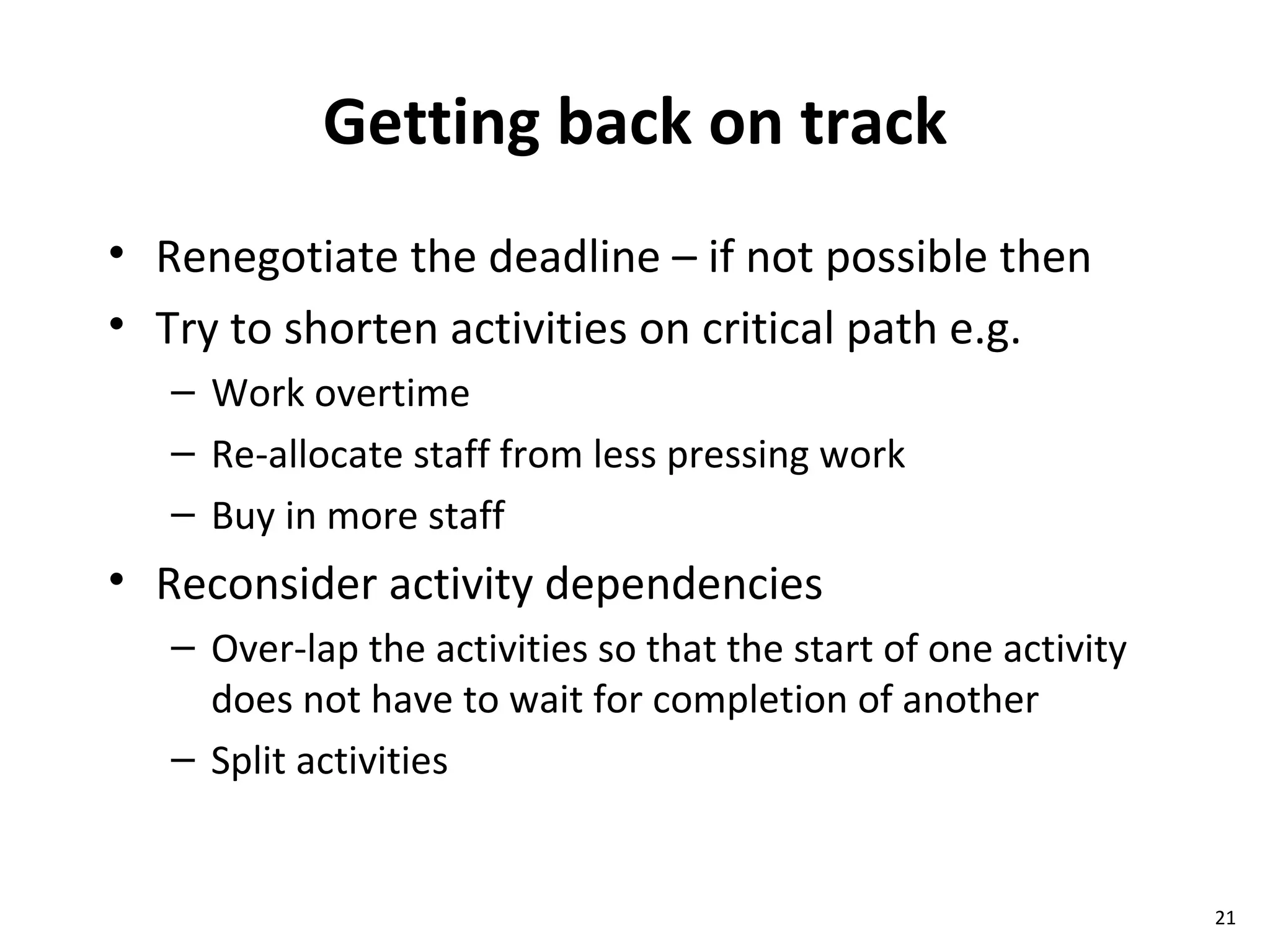
Getting back ontrack Renegotiate the deadline – if not possible then Try to shorten activities on critical path e.g. Work overtime Re-allocate staff from less pressing work Buy in more staff Reconsider activity dependencies Over-lap the activities so that the start of one activity does not have to wait for completion of another Split activities
22.
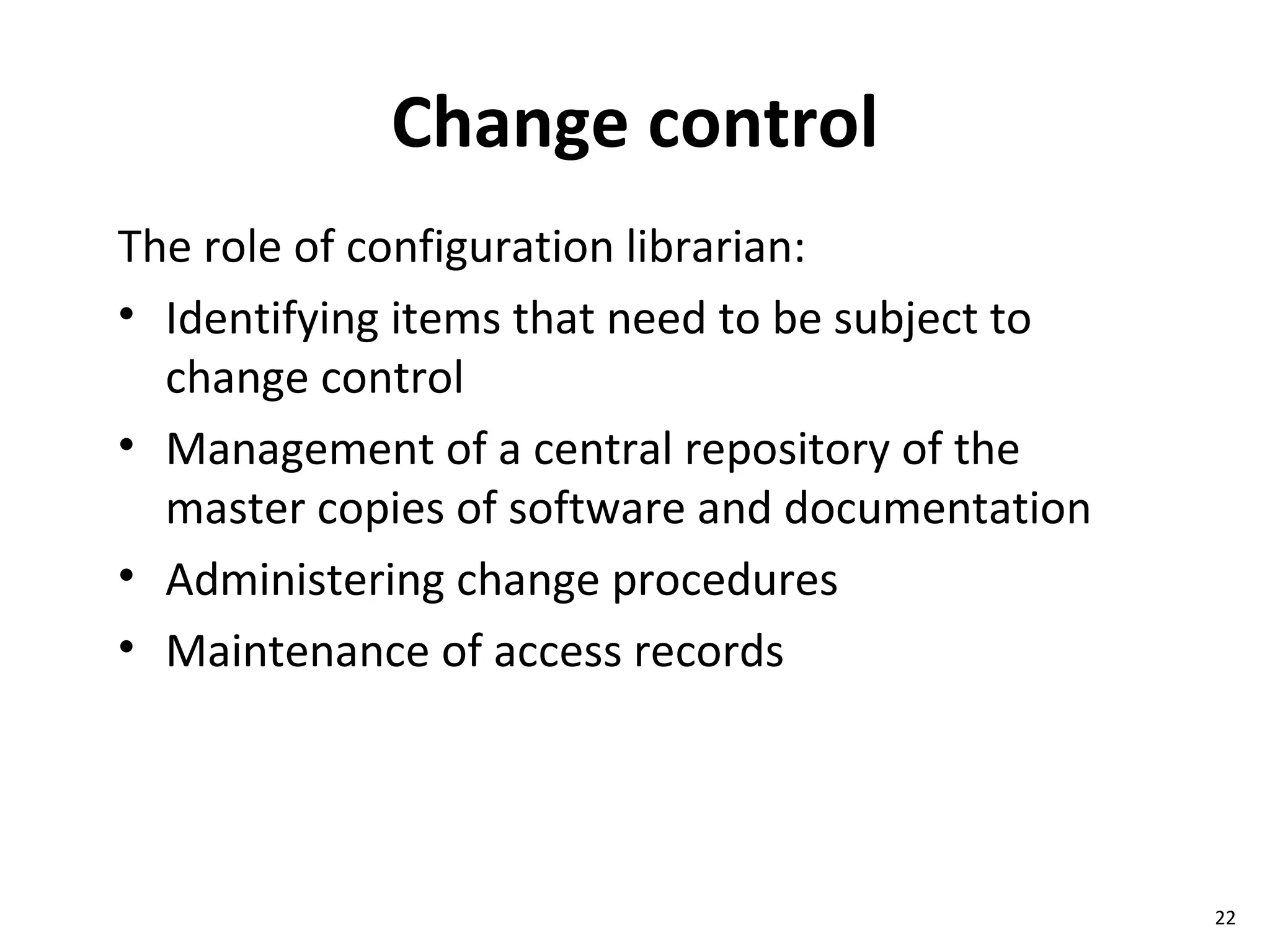
Change control Therole of configuration librarian: Identifying items that need to be subject to change control Management of a central repository of the master copies of software and documentation Administering change procedures Maintenance of access records
23.
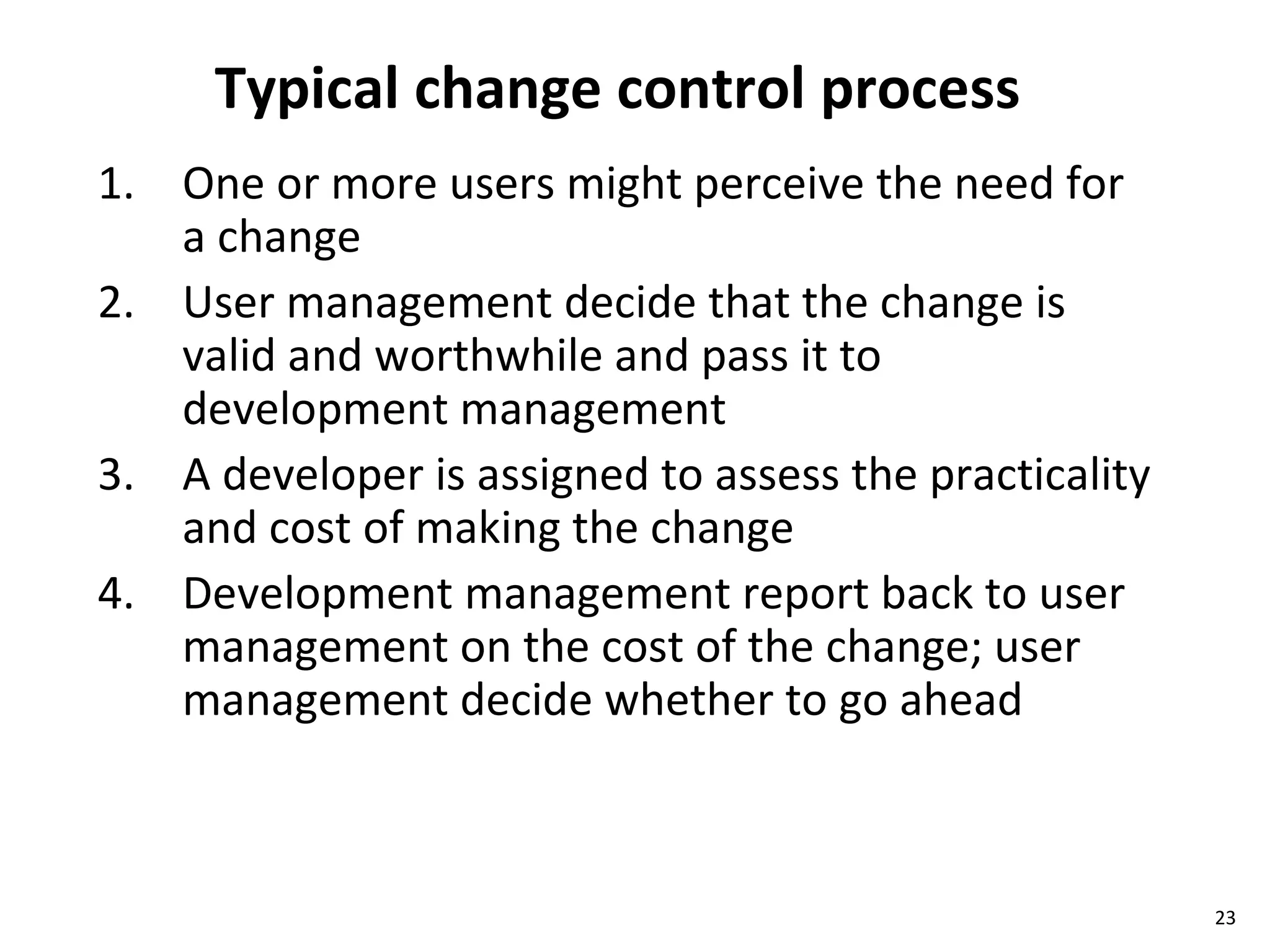
Typical change controlprocess One or more users might perceive the need for a change User management decide that the change is valid and worthwhile and pass it to development management A developer is assigned to assess the practicality and cost of making the change Development management report back to user management on the cost of the change; user management decide whether to go ahead
24.
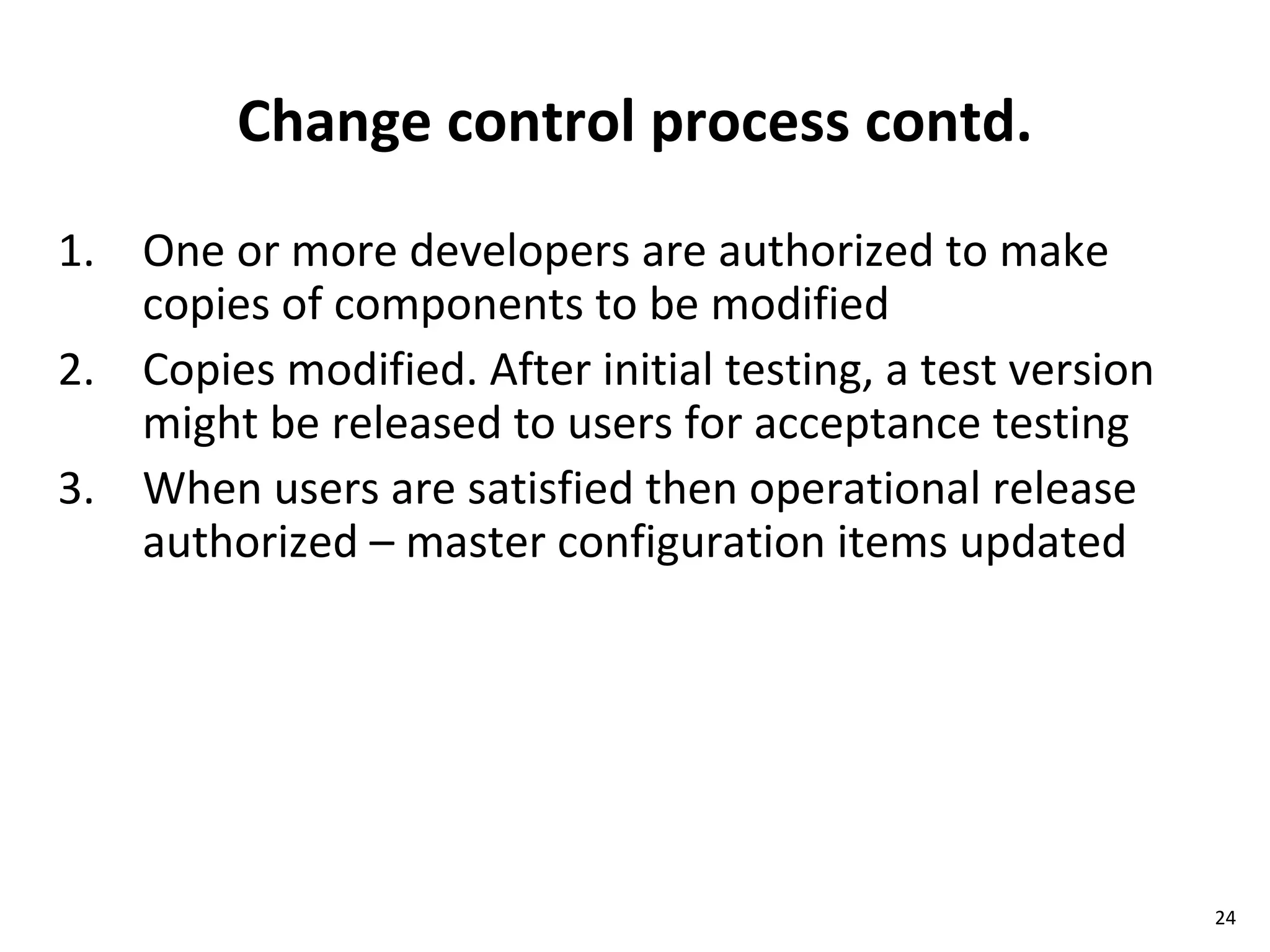
Change control processcontd. One or more developers are authorized to make copies of components to be modified Copies modified. After initial testing, a test version might be released to users for acceptance testing When users are satisfied then operational release authorized – master configuration items updated
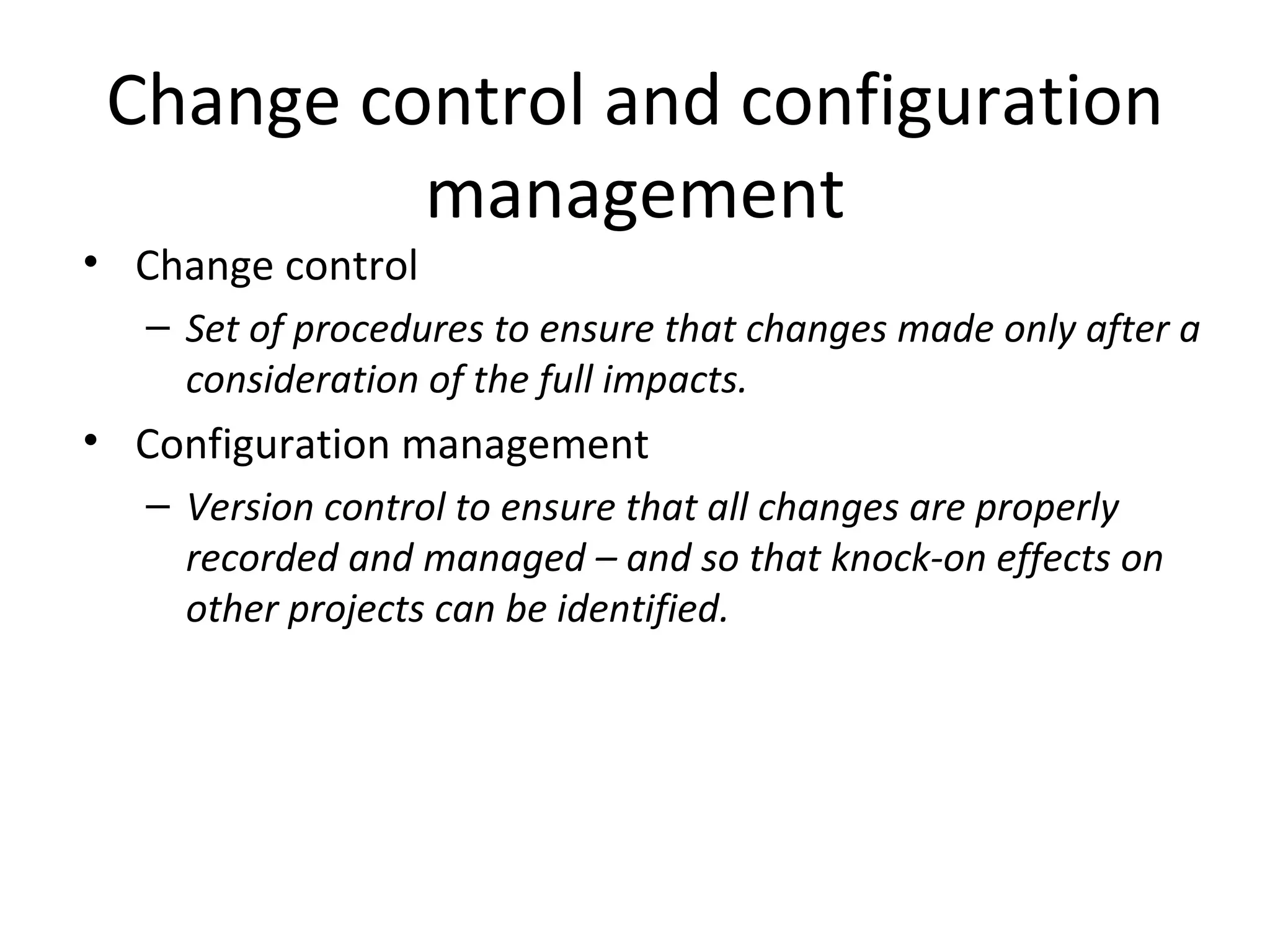
Change control andconfiguration management Change control Set of procedures to ensure that changes made only after a consideration of the full impacts. Configuration management Version control to ensure that all changes are properly recorded and managed – and so that knock-on effects on other projects can be identified.
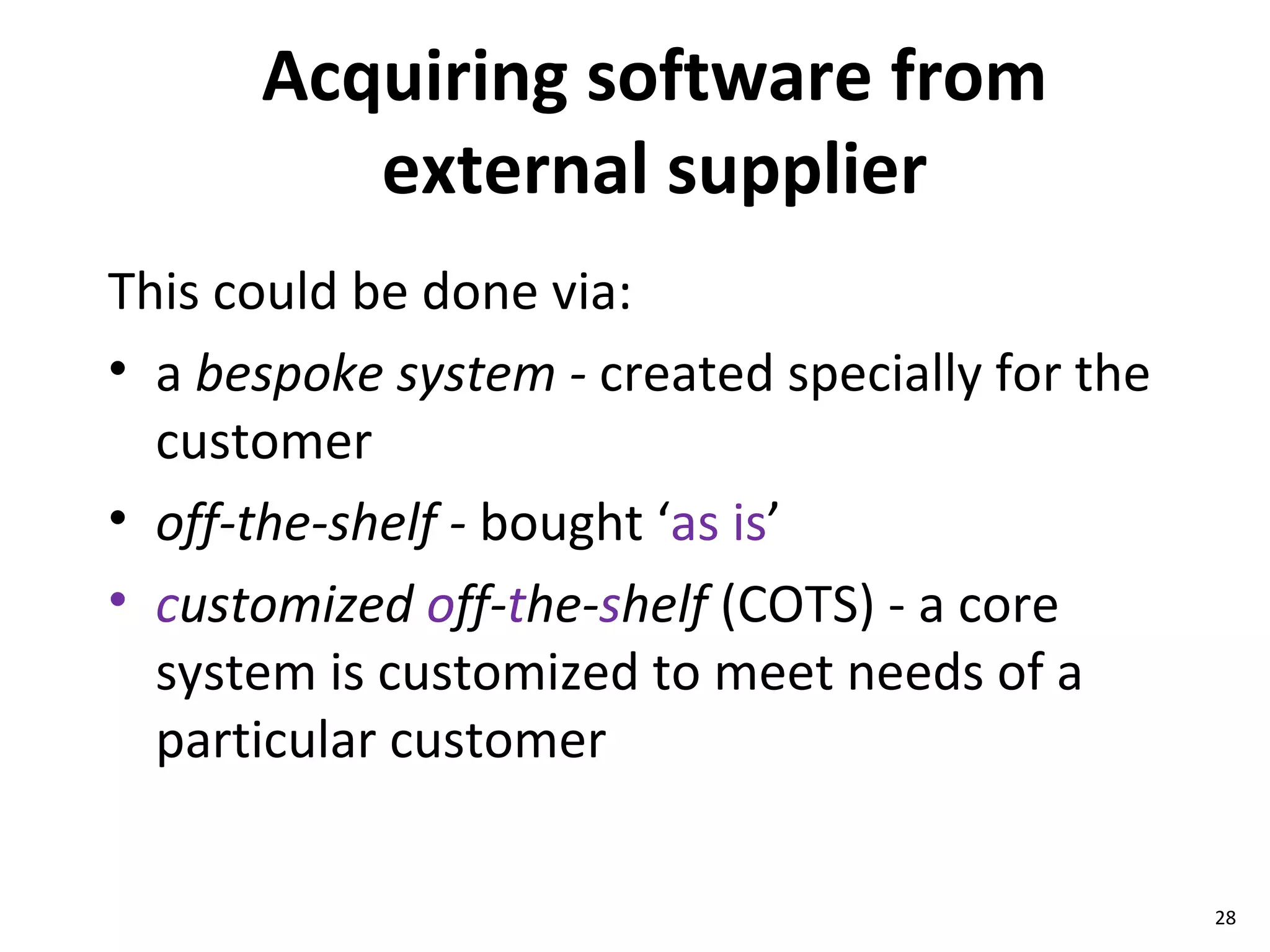
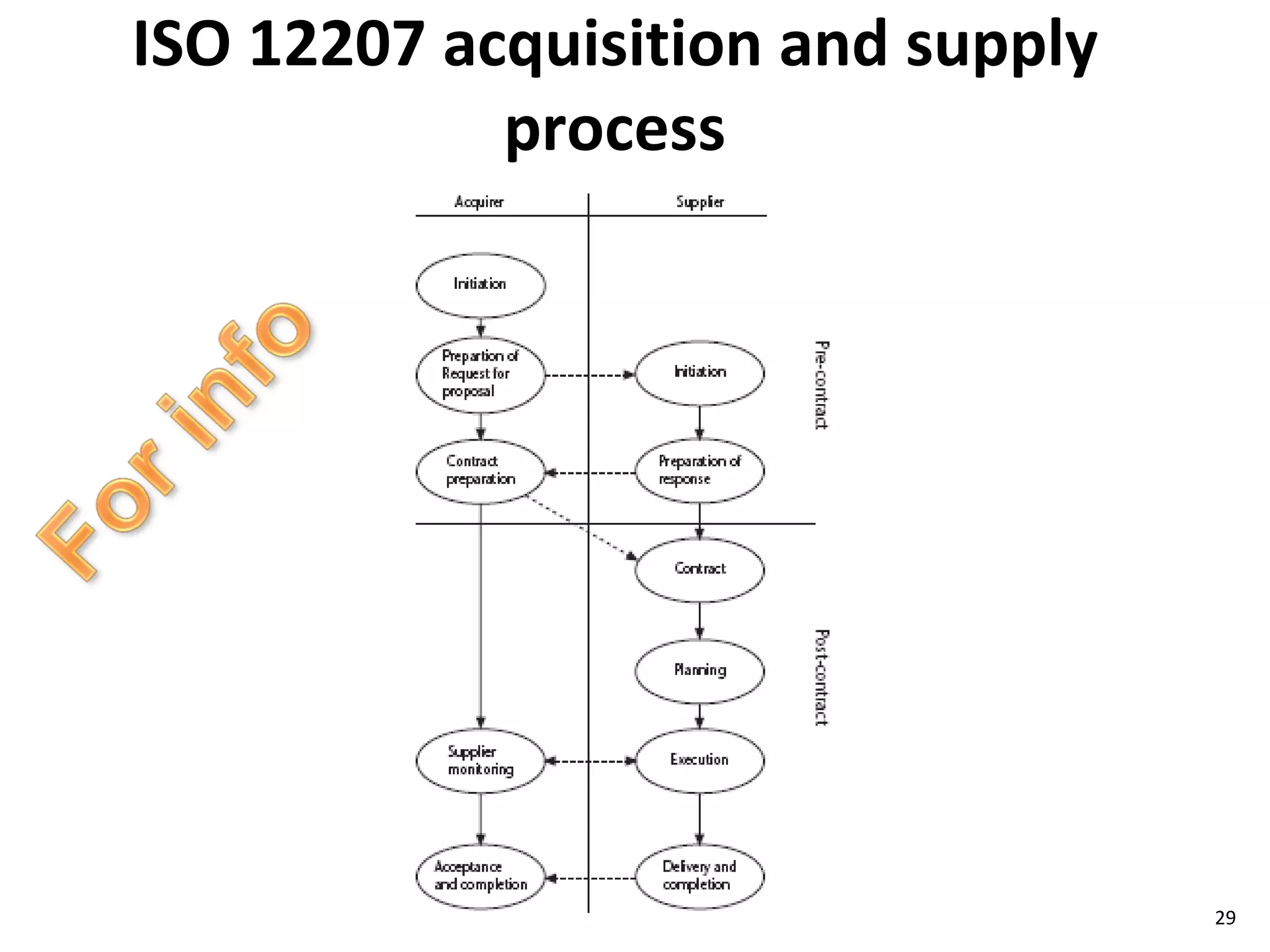
Acquiring software fromexternal supplier This could be done via: a bespoke system - created specially for the customer off-the-shelf - bought ‘ as is ’ c ustomized o ff- t he- s helf (COTS) - a core system is customized to meet needs of a particular customer
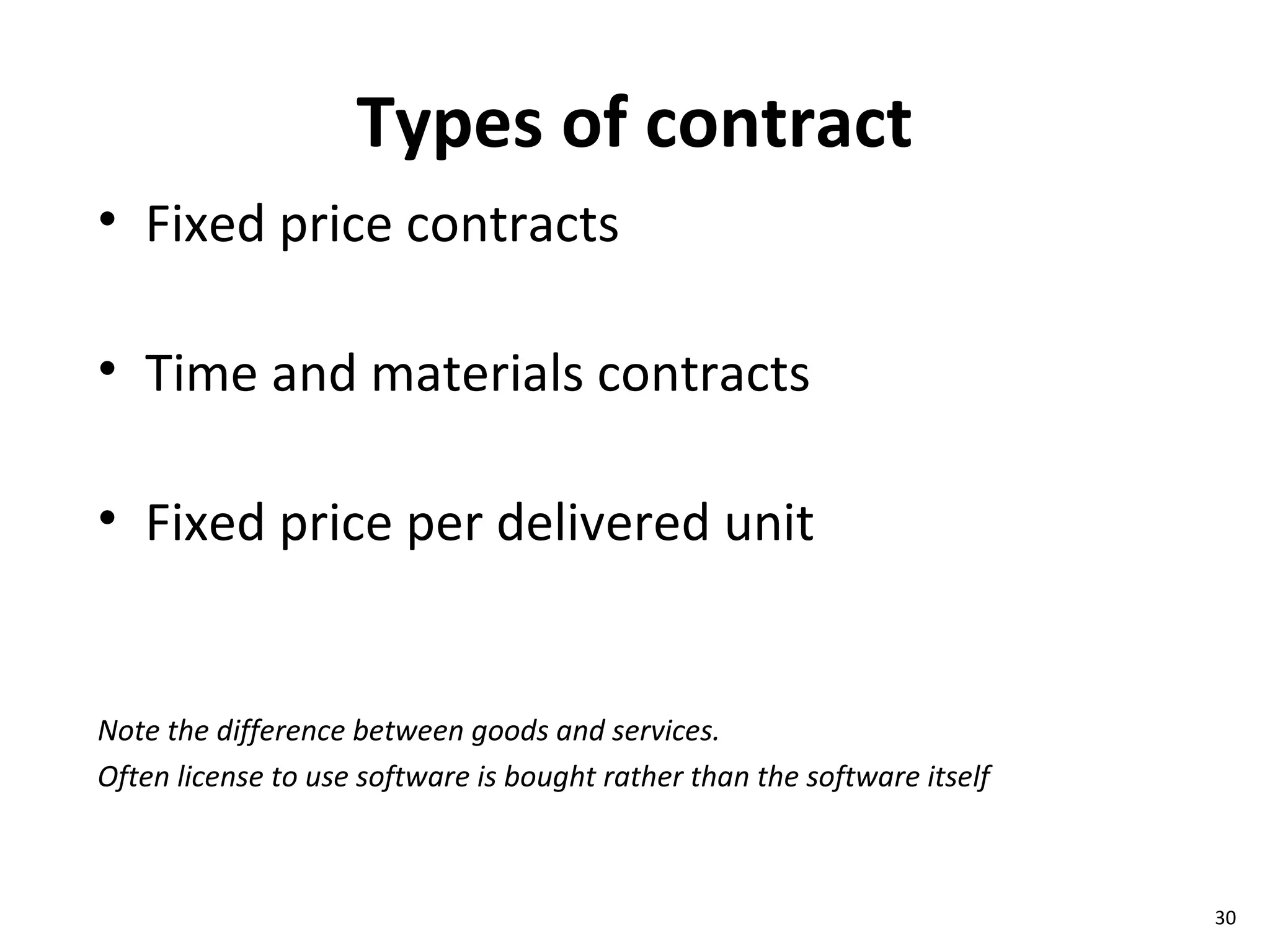
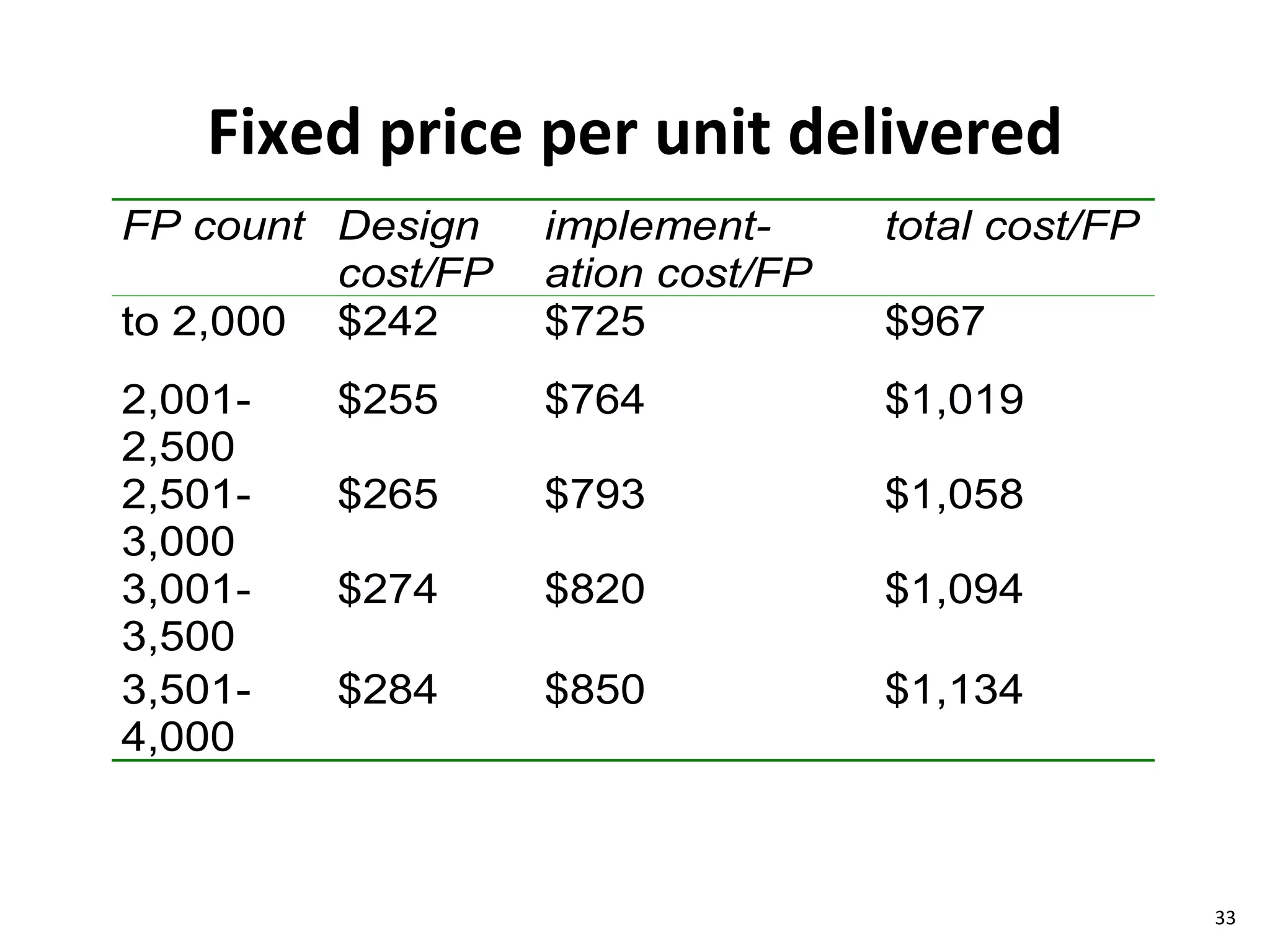
Types of contractFixed price contracts Time and materials contracts Fixed price per delivered unit Note the difference between goods and services. Often license to use software is bought rather than the software itself
31.
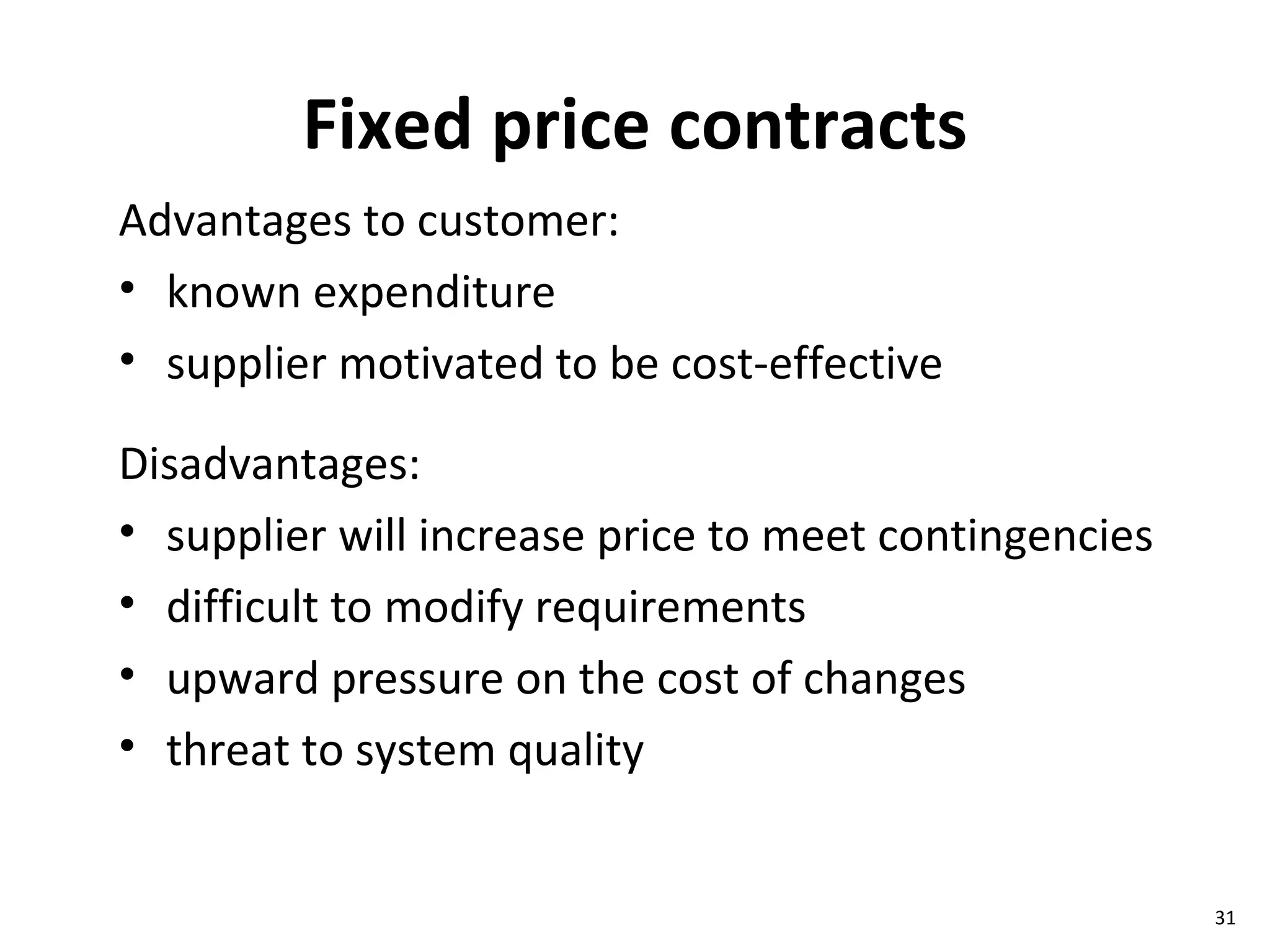
Fixed price contractsAdvantages to customer: known expenditure supplier motivated to be cost-effective Disadvantages: supplier will increase price to meet contingencies difficult to modify requirements upward pressure on the cost of changes threat to system quality
32.
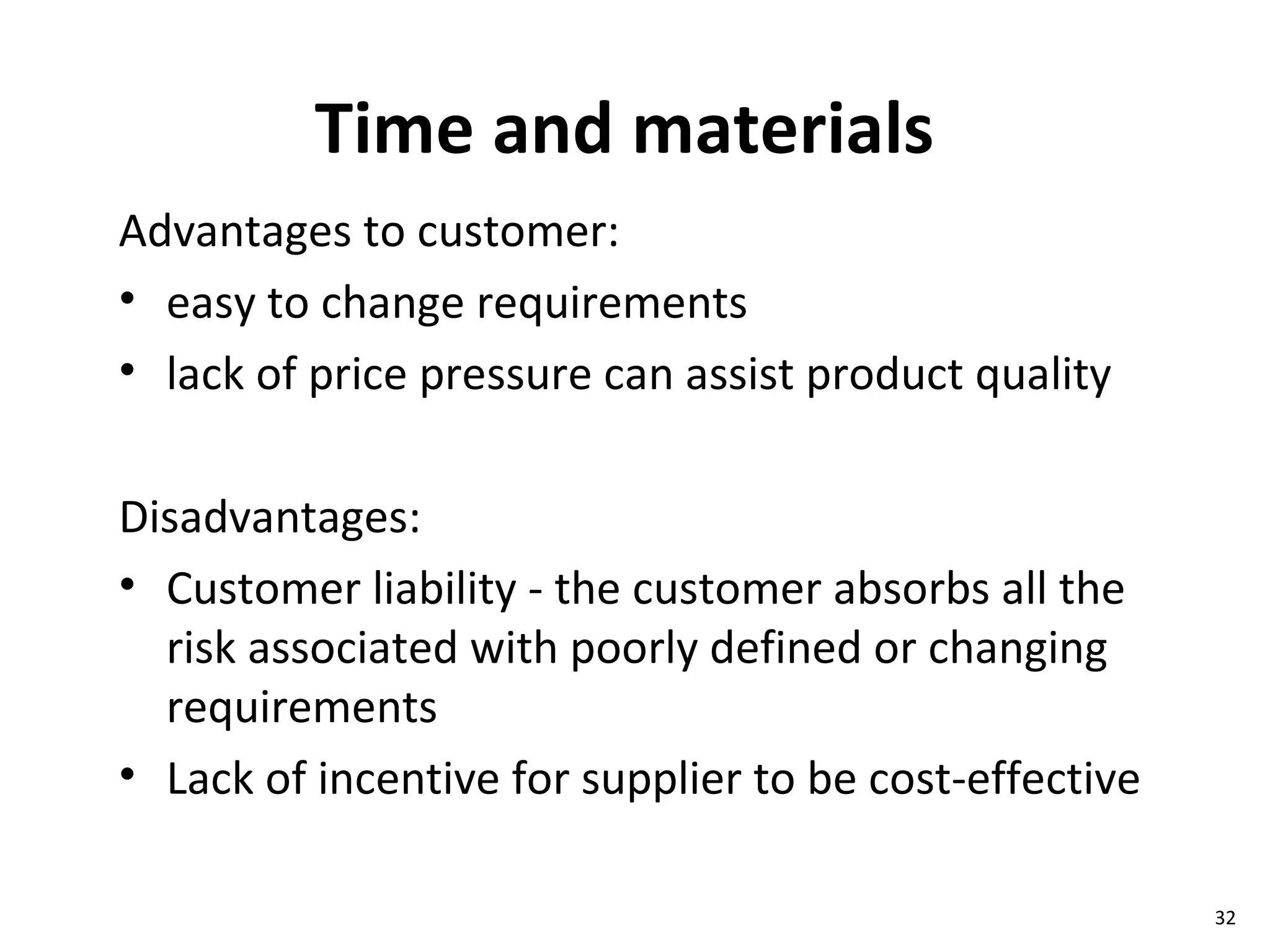
Time and materialsAdvantages to customer: easy to change requirements lack of price pressure can assist product quality Disadvantages: Customer liability - the customer absorbs all the risk associated with poorly defined or changing requirements Lack of incentive for supplier to be cost-effective
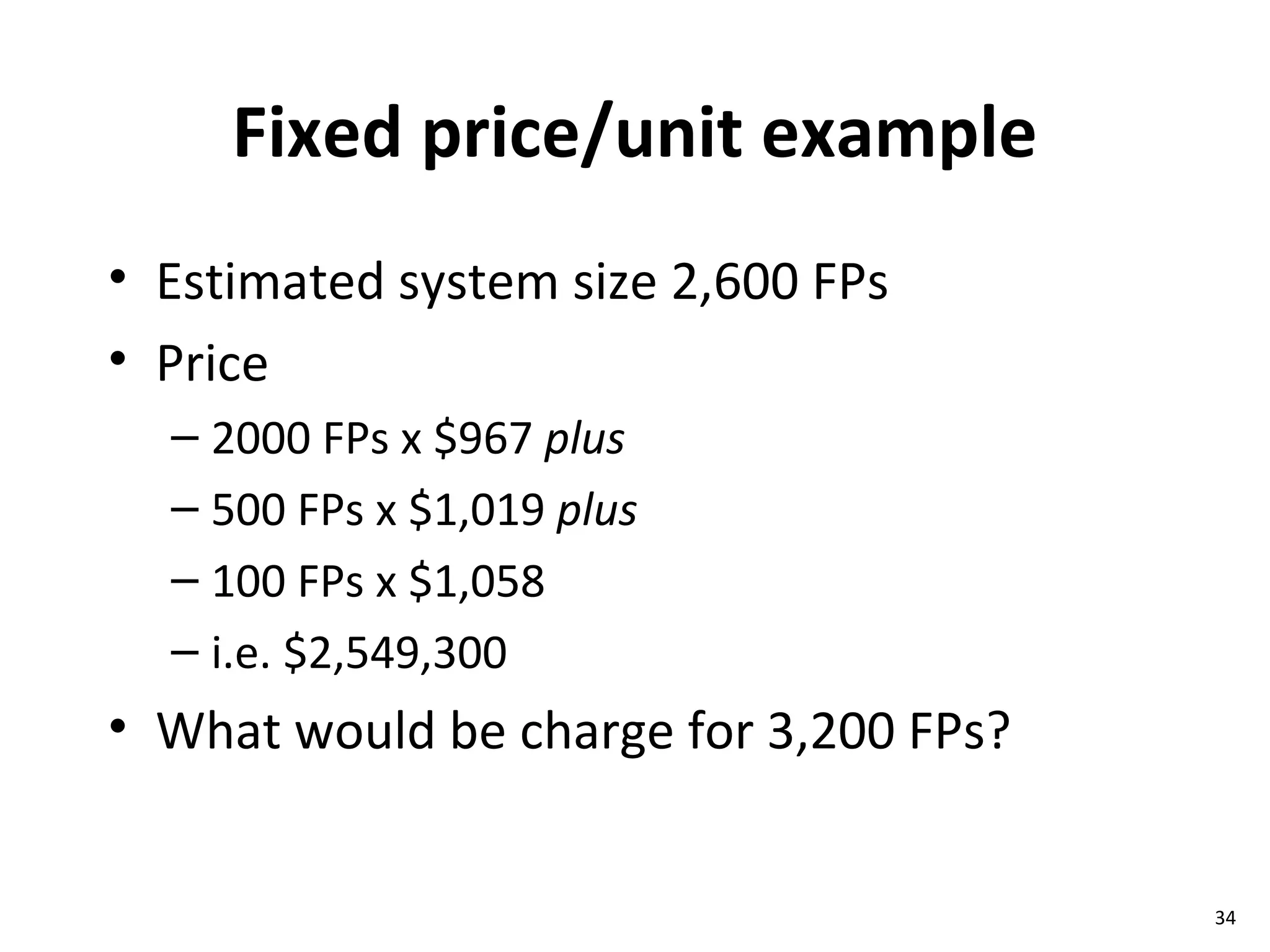
Fixed price/unit exampleEstimated system size 2,600 FPs Price 2000 FPs x $967 plus 500 FPs x $1,019 plus 100 FPs x $1,058 i.e. $2,549,300 What would be charge for 3,200 FPs?
35.
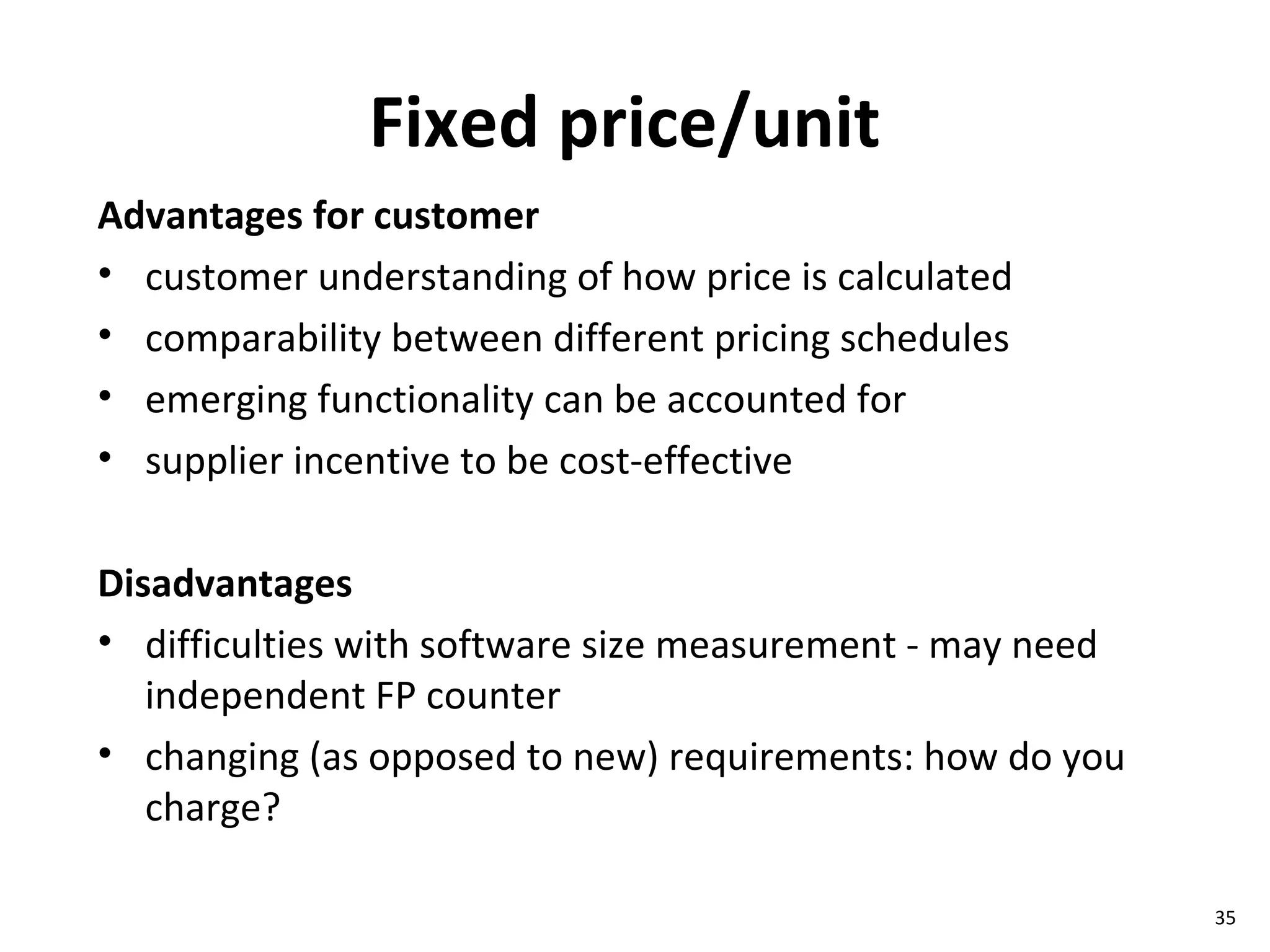
Fixed price/unit Advantagesfor customer customer understanding of how price is calculated comparability between different pricing schedules emerging functionality can be accounted for supplier incentive to be cost-effective Disadvantages difficulties with software size measurement - may need independent FP counter changing (as opposed to new) requirements: how do you charge?
36.
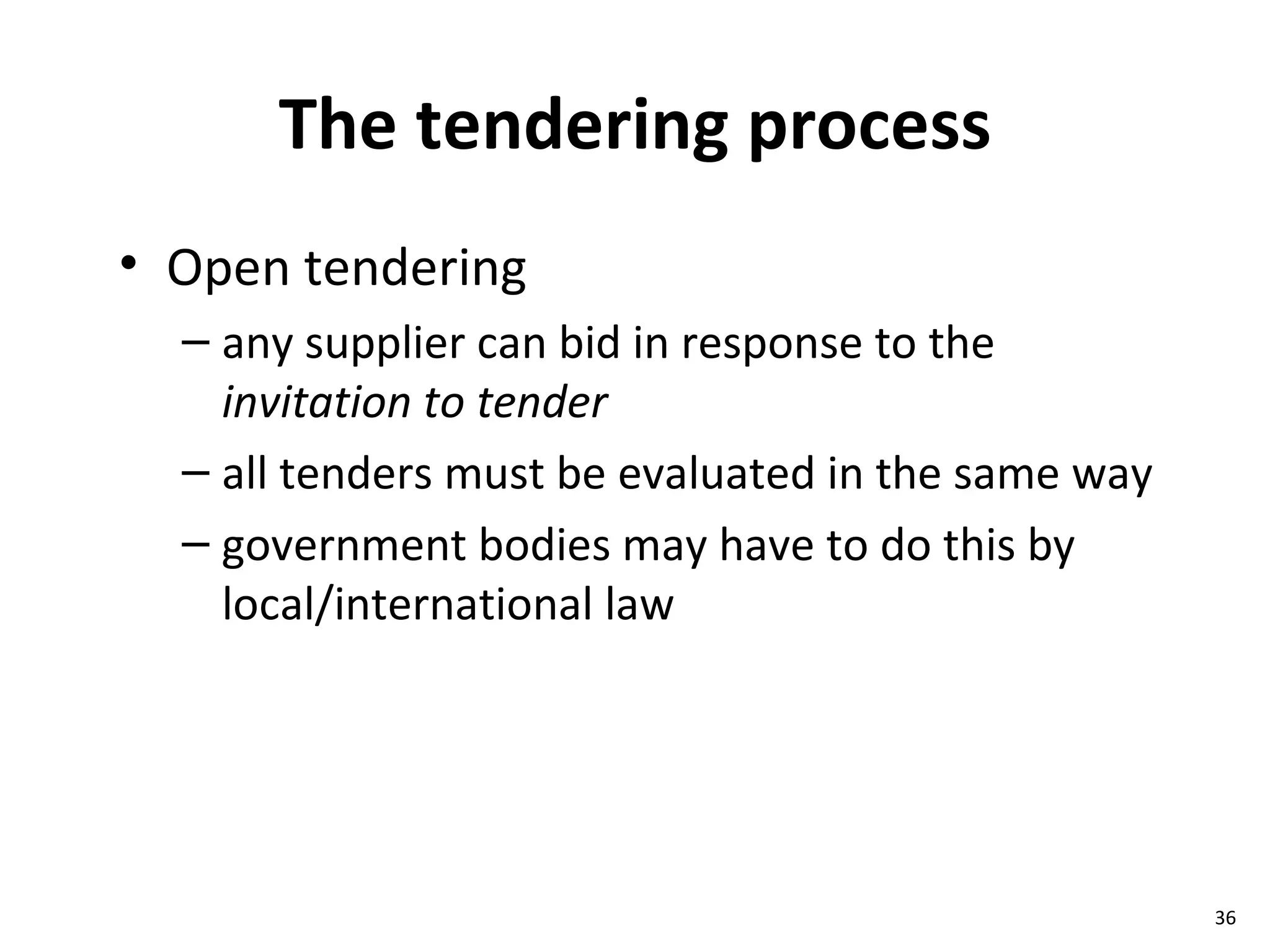
The tendering processOpen tendering any supplier can bid in response to the invitation to tender all tenders must be evaluated in the same way government bodies may have to do this by local/international law
37.
The tendering processRestricted tendering process bids only from those specifically invited can reduce suppliers being considered at any stage Negotiated procedure negotiate with one supplier e.g. for extensions to software already supplied
38.
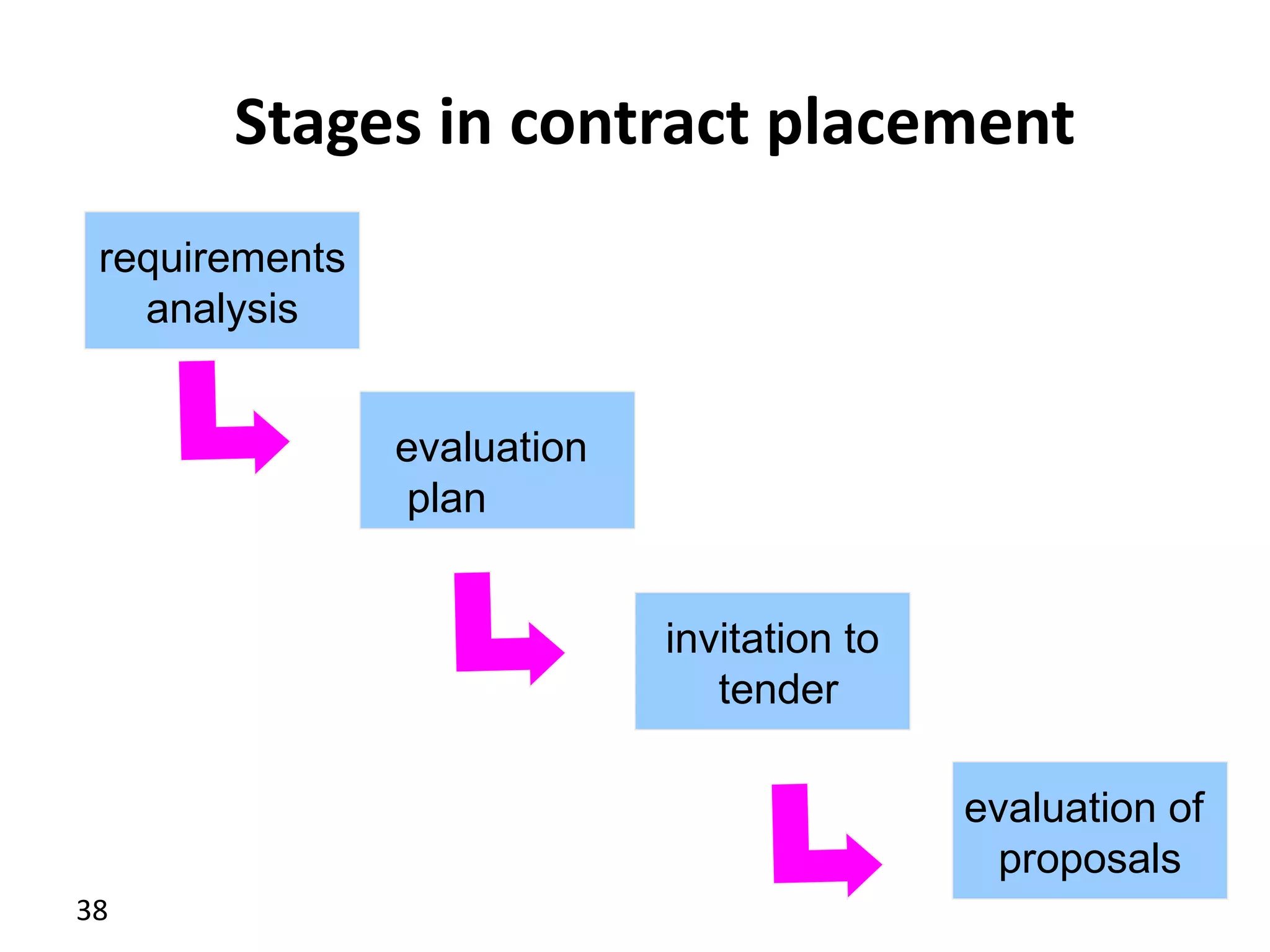
Stages in contractplacement requirements analysis invitation to tender evaluation of proposals evaluation plan
39.
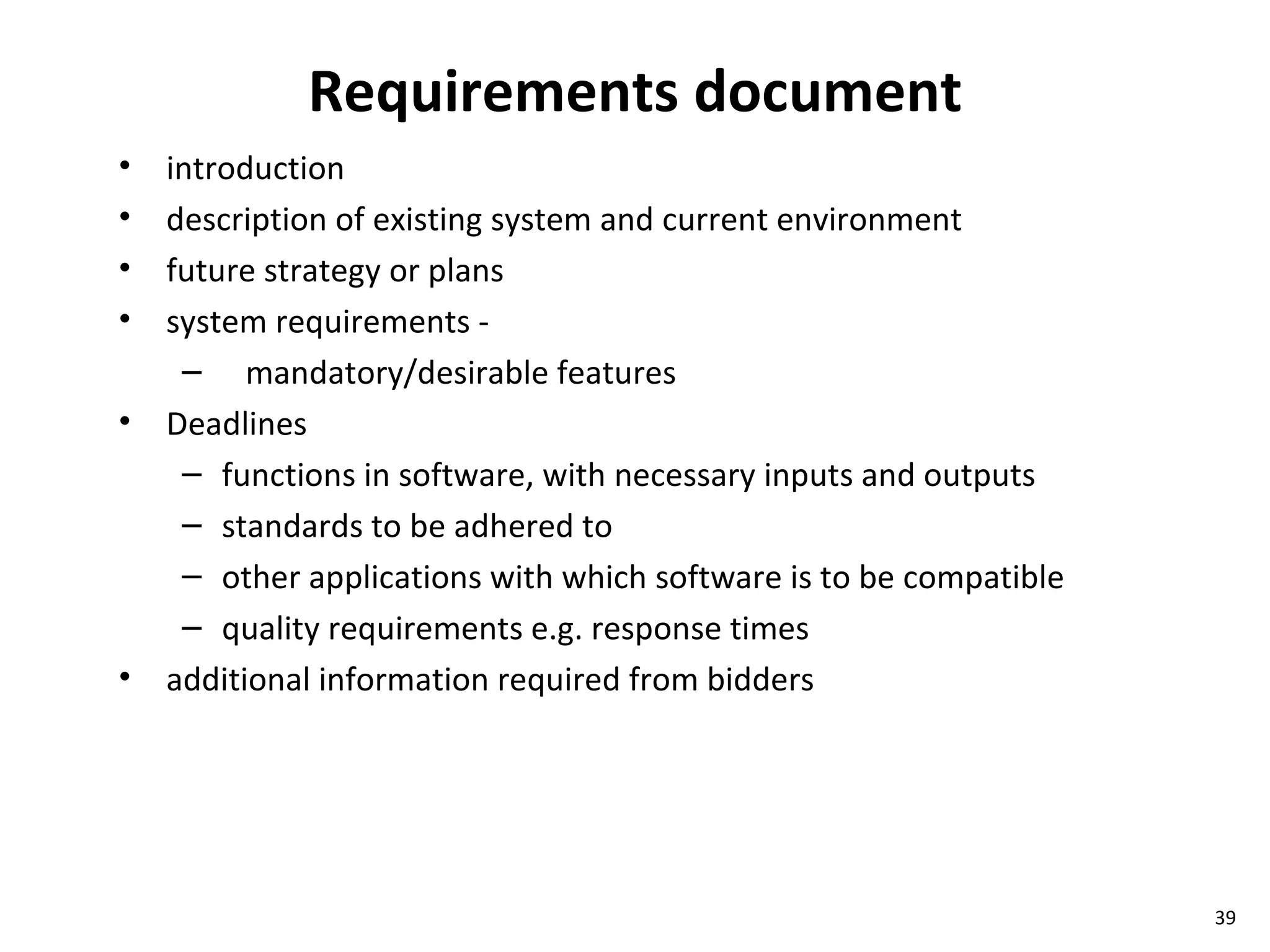
Requirements document introductiondescription of existing system and current environment future strategy or plans system requirements - mandatory/desirable features Deadlines functions in software, with necessary inputs and outputs standards to be adhered to other applications with which software is to be compatible quality requirements e.g. response times additional information required from bidders
40.
Evaluation plan Howare proposals to be evaluated? Methods could include: reading proposals interviews demonstrations site visits practical tests
41.
Evaluation plan -contd. Need to assess value for money for each desirable feature Example: feeder file saves data input 4 hours a month saved cost of data entry at RM20 an hour system to be used for 4 years if cost of feature RM1000, would it be worth it?
42.
Invitation to tender(ITT) Note that bidder is making an offer in response to ITT acceptance of offer creates a contract Customer may need further information Problem of different technical solutions to the same problem
43.
Memoranda of agreement(MoA) Customer asks for technical proposals Technical proposals are examined and discussed Agreed technical solution in MoA Tenders are then requested from suppliers based in MoA Tenders judged on price Fee could be paid for technical proposals by customer
44.
How would you evaluate the following? Usability of existing package Could try out a demo or ask existing users Usability of application to be built You would have to make stipulation about the process e.g. on the development of interface prototypes; you could also specify performance requirements Maintenance costs of hardware this could be incorporated in a maintenance agreement and you could compare the terms offered by different potential suppliers; another approach is ask to current users of the hardware about their experience of it.
45.
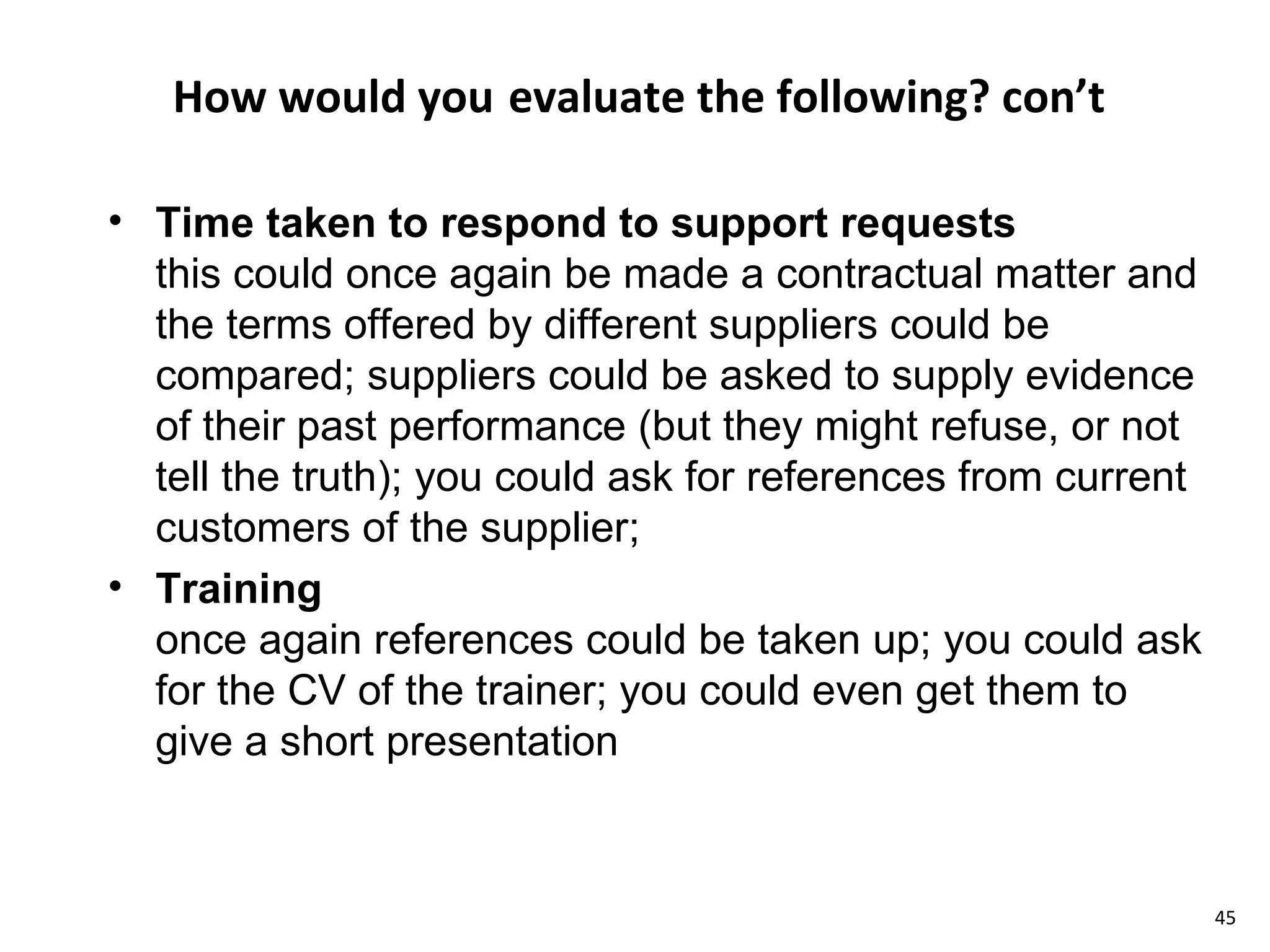
How would you evaluate the following? con’t Time taken to respond to support requests this could once again be made a contractual matter and the terms offered by different suppliers could be compared; suppliers could be asked to supply evidence of their past performance (but they might refuse, or not tell the truth); you could ask for references from current customers of the supplier; Training once again references could be taken up; you could ask for the CV of the trainer; you could even get them to give a short presentation
46.
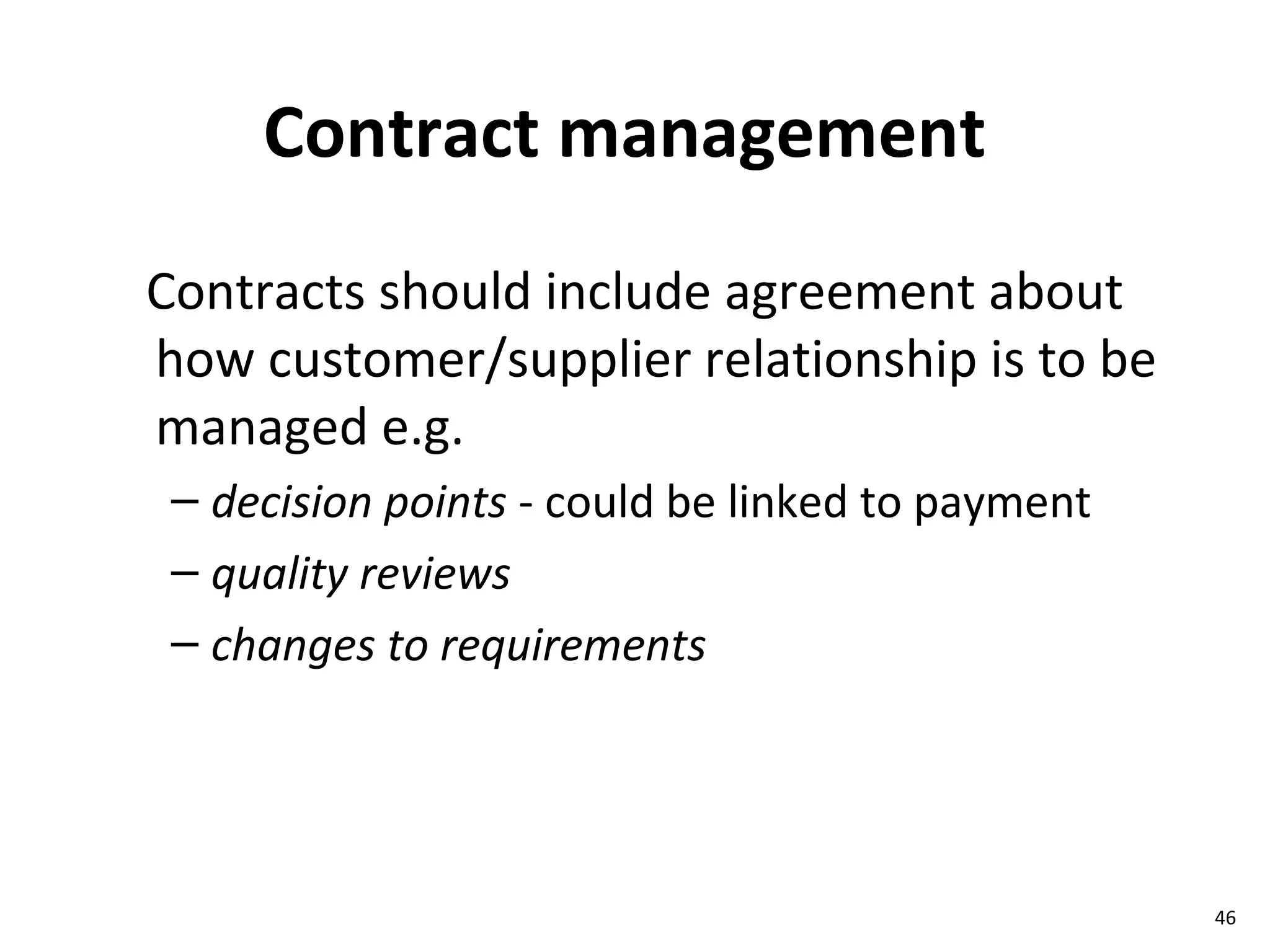
Contract management Contractsshould include agreement about how customer/supplier relationship is to be managed e.g. decision points - could be linked to payment quality reviews changes to requirements
47.
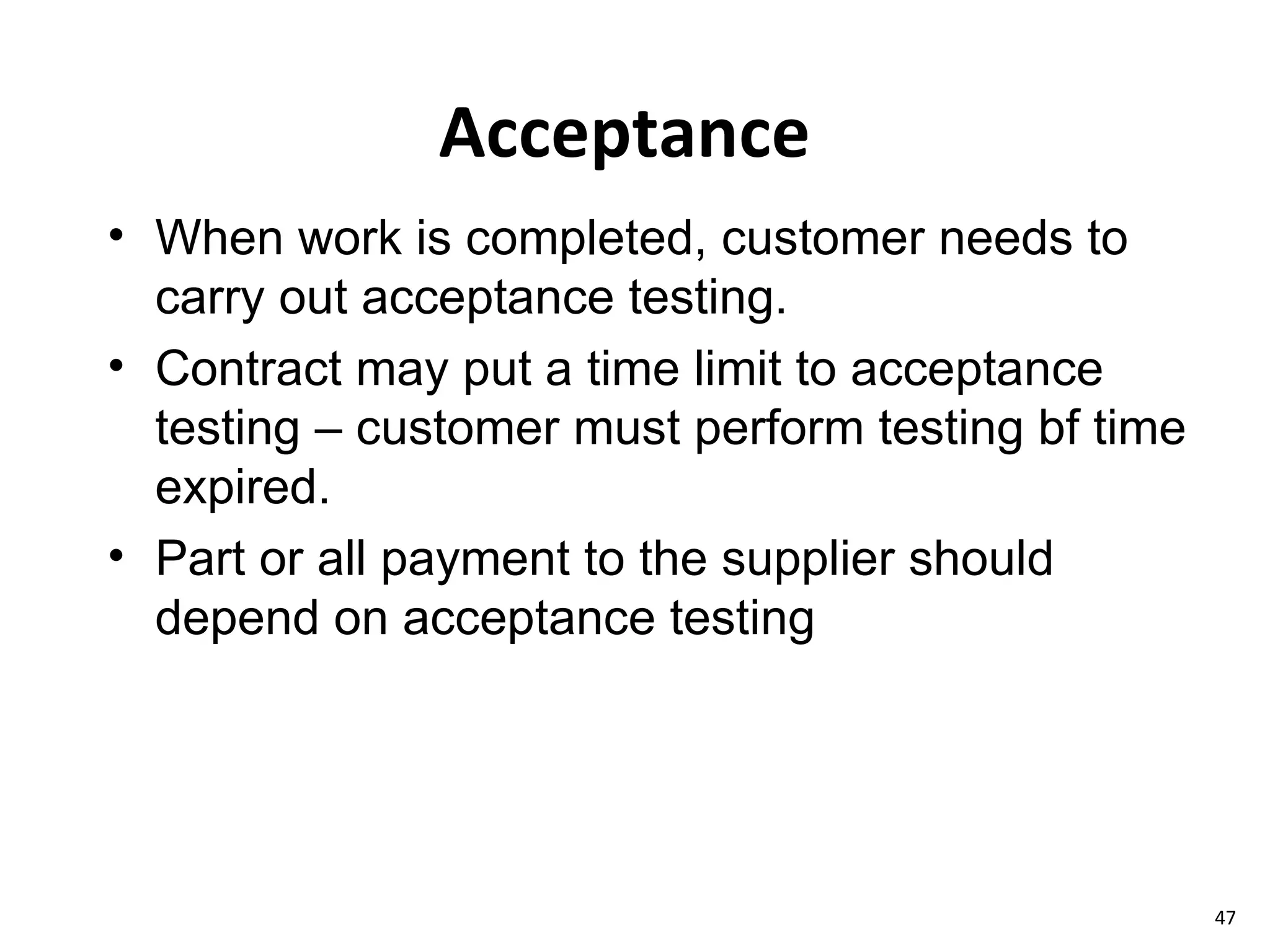
Acceptance When workis completed, customer needs to carry out acceptance testing. Contract may put a time limit to acceptance testing – customer must perform testing bf time expired. Part or all payment to the supplier should depend on acceptance testing
Editor's Notes
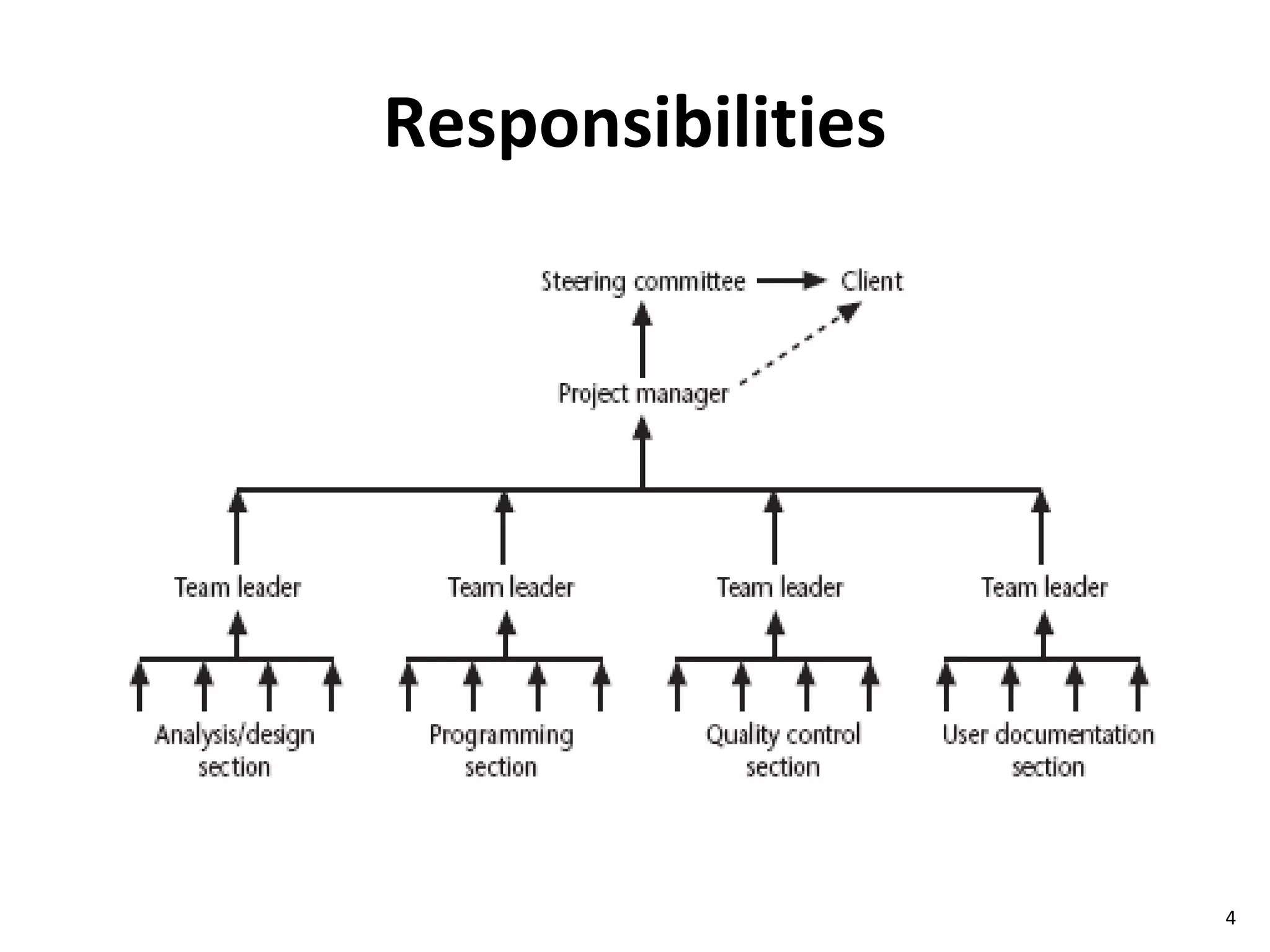
#5 Chapter 9 The concept of a reporting hierarchy was introduced in Chapter 1. The main lesson here is that the details relating to project progress have to originate with the people actually doing the work and have then to be fed up through the management structure. At each management level there is going to be some summarising and commentary before information is passed up to the next level. This means that there is always a danger of ‘information overload’ as information passes from the many to the few.
#7 Chapter 9 Projects have to be delivered on time and within budget, hence the concern with monitoring achievements and costs. Partial completion is where, for example, data is being collected at the end of Week 2 of an activity that should take four weeks. We want to know if it is about 50% completed. An example of the ’99% completion syndrome’ would be in the above case if the developer reported at the end of weeks 1,2 and 3 that the task was respectively 25%, 50% and 75% complete. However at the end of week 4 it is reported that the task is 99% complete. The same thing is reported at the end of week 5 and so on until the task is actually completed. Control on products implies that actual examination of intermediate allows us to verify independently and objectively that sub-tasks have been completed.
#8 Chapter 9 RAG reporting highlights those activities which need particular attention. The status of a troubled activity might typically move from green to amber; if corrective action is possible it might go back to green, otherwise it could switch to red. If there are lots of instances where activities switch directly from green to red, this could indicate more management control. ‘ Critical tasks’ would be those on the critical path and/or reliant on critical resources.
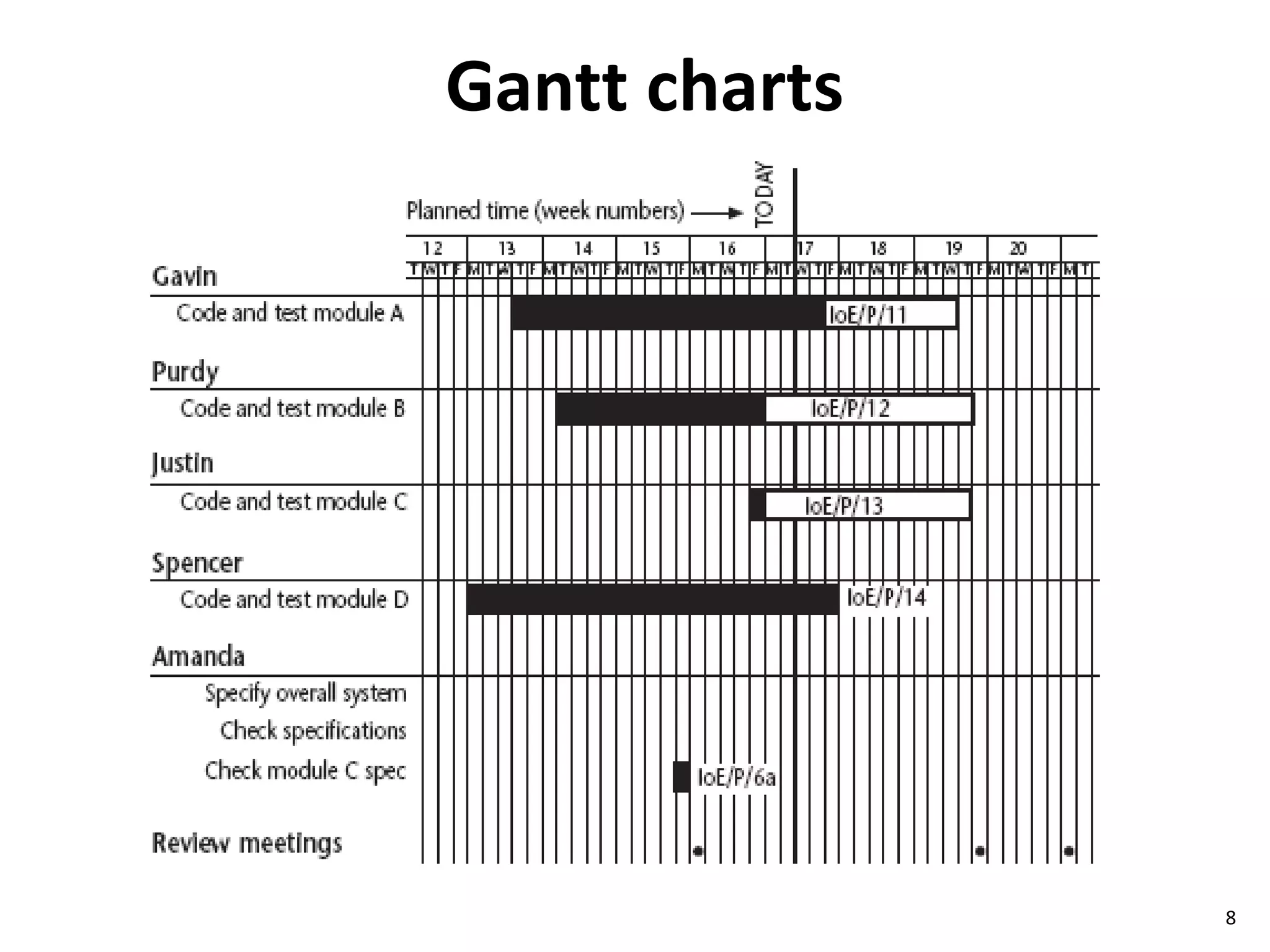
#9 Chapter 9 Note that the Gantt chart is named after Henry Gantt (1861-1919) and so should not be written in capitals! You could ask students what they think GANTT stands for before you tell them this to impress this on them. I really find Gantt written as GANTT very, very annoying and threaten students with instant failure of the module if they do this! The format of the Gantt chart here differs from the format used in Microsoft project as the activities for each team member are grouped together. You could input the details so that they came out in this format, but it would not occur automatically.
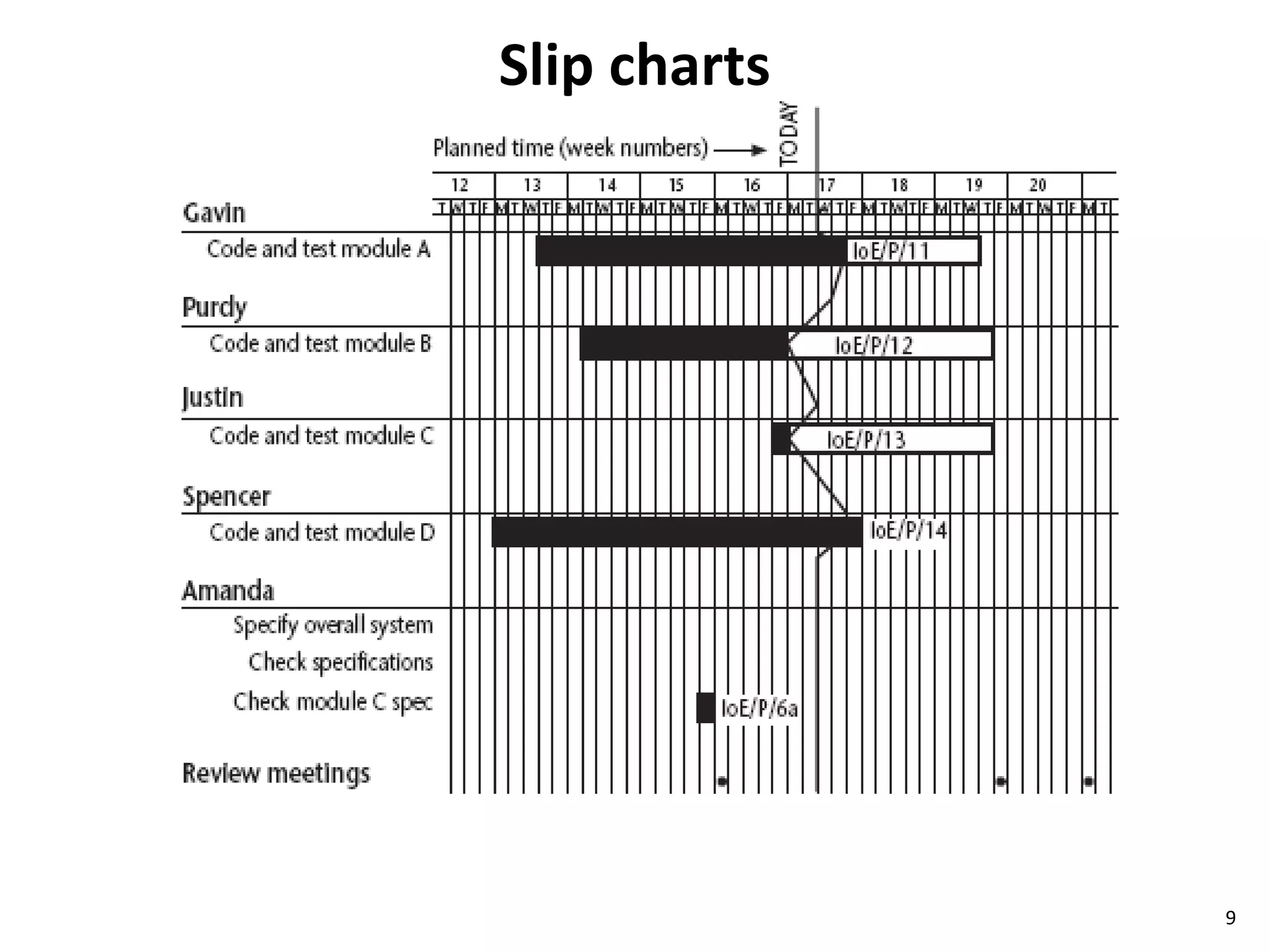
#10 Chapter 9 A slip chart is a version of the Gantt chart where a line is drawn from top to bottom. To the left of the line are all the completed activities and to the right those activities ( or parts of activities) that have not been completed. The more jagged the line, the more it means that that there are some activities that are lagging to various degrees and some that are ahead of themselves. A very jagged line means that there is scope for re-planning to move resources from those activities that are ahead to those that are behind.
#11 Chapter 9 Circles, which represent the start or finish of activities, start with the initial target dates. If these are modified then the second dates are changed. When the event actually takes place, the colour of the circle is changed to green if it is on target and to red if it has missed the target. The idea is that this chart is put on a wall in a prominent position as a constant reminder to the project team of the current situation – hence it is often referred to as ‘balls on the wall’.
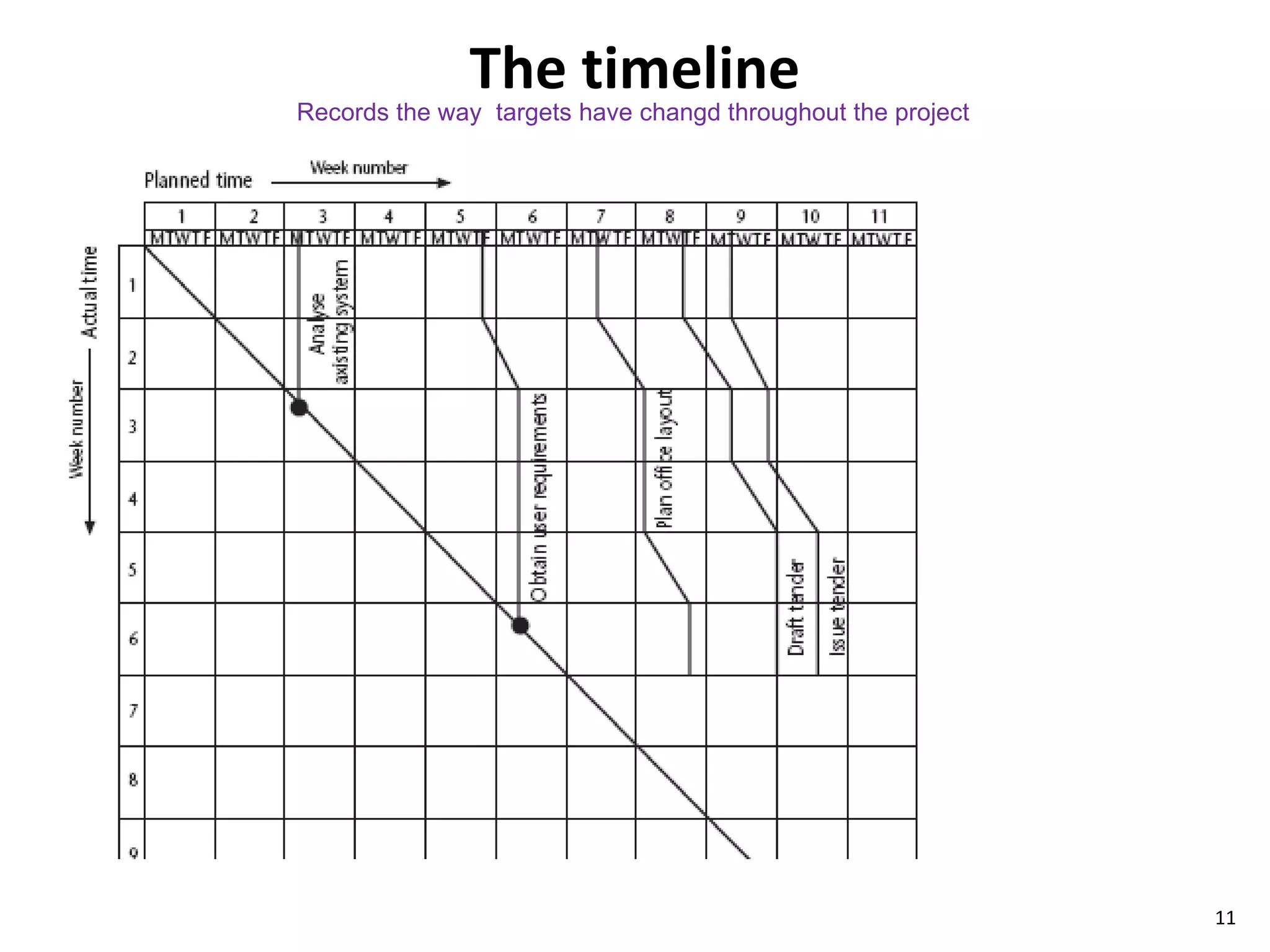
#12 Chapter 9 This records the way that targets have changed throughout the project. Planned time is plotted on the horizontal axis, and actual time on the vertical axis. The bendy lines going from top to bottom represent the scheduled completion date for each activity e.g. ‘ analyse existing system’ – at start this was due finish on the Monday of week 3 and it did finish then ‘ obtain user requirements’ was originally planned to finish on the Thursday of week 5, but at the end of the first week it was rescheduled to finish on the Tuesday of week 6.
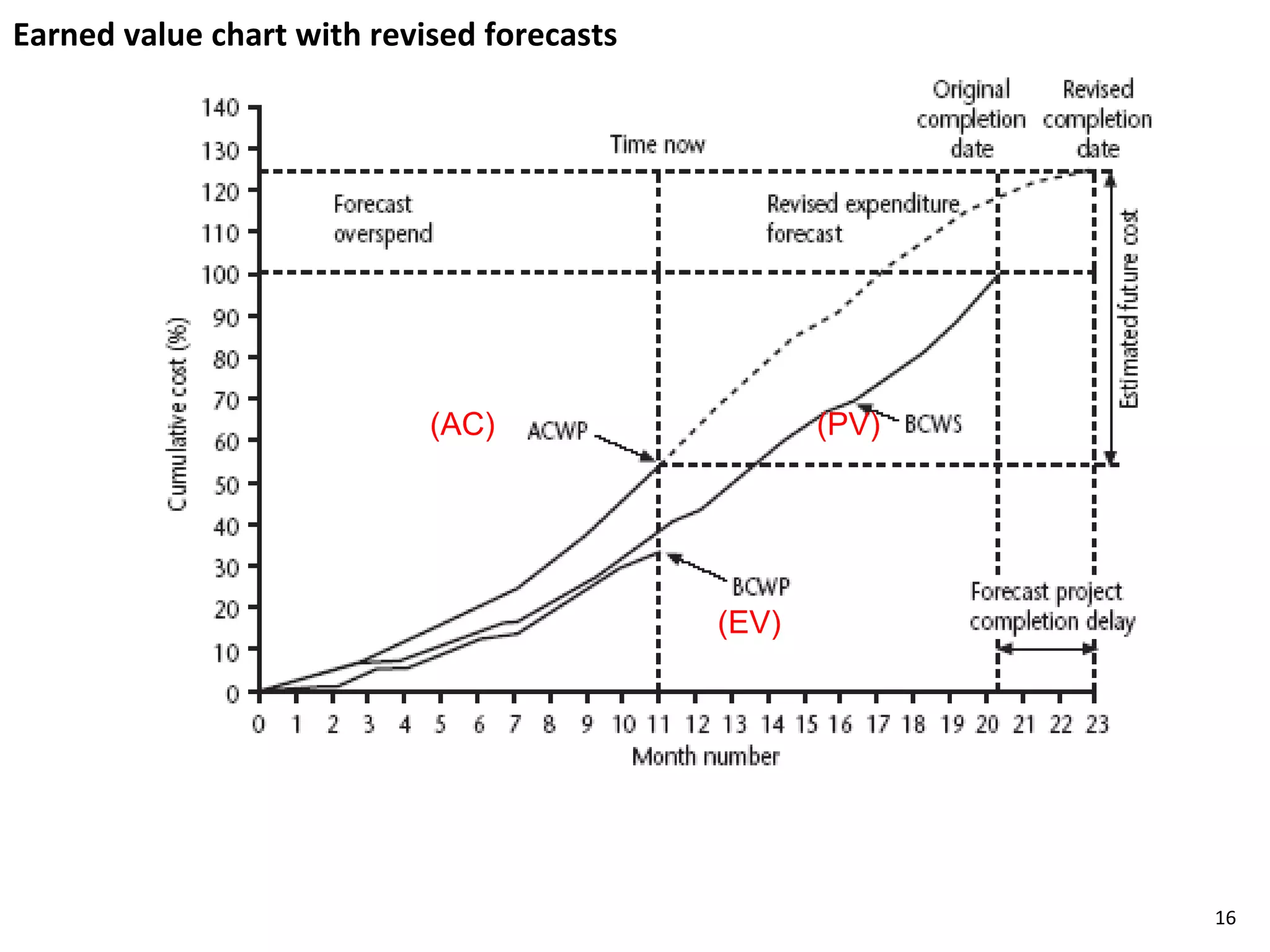
#17 Chapter 9 This shows how the planned value (PV), earned value (EV) and actual cost (AC) can be tracked over the lifetime of a project. It also shows how the graph can be used to show adjustments to the final estimated cost and duration. A revised assessment of the budget at completion (EAC estimate at completion) can be produced by dividing the original estimated budget at completion (BAC) by the current CPI. Similarly a forecast of the actual duration of the project can be derived by dividing the original estimated duration by the SPI.
#21 Chapter 9 Critical path activities – by definition if these are late then the project as a whole will be delayed Activities with no free float – free float was defined in Lecture/Chapter 6. A project with no free float will delay following dependent activities, although the project end date may not be directly threatened. Activities with less than a specified float – projects when being executed can be very dynamic: some activities will take longer than estimated others less; this could lead to the critical shifting. Activities with small floats are the most likely to find themselves turned into activities on the critical path if their floats get eroded. High risk activities – recall the calculation of activity standard deviations in Chapter 7. If the standard deviation for an activity is large, this indicates that there is a lot of uncertainty about how long it will actually take. Activities using critical resources – some resources may only be available for a limited period and if the activities that need the resource are delayed the resource could become unavailable.
#22 Chapter 9 Renegotiating the deadline – one way of doing this is to divide the deliverables into ‘tranches’ (see Lecture/Chapter 3), delivering the ones most valuable to the client on or before the deadline, but delaying less valuable ones. Shortening the critical path – the idea is to try to get things done more quickly by adding more staff. Some activities lend themselves to this more readily than others – it is often quite difficult to do this with software development. It also increases costs Reconsidering activity dependencies – allowing activities to overlap often increases the risk of quality shortfalls
#23 Chapter 9 Identifying items that need to be subject to change control – it is unlikely, for example, that a feasibility report would be subject to change control once agreement has been obtained to start the project Management of a central repository of the master copies of software and documentation Administering change procedures It is important that someone ensures that there is adherence to change control procedures. Maintenance of access records . A situation to be avoided is where two different developers are making changes to the same software component.
#24 Chapter 9 1 and 2. The user community itself must come to a consensus about whether a proposal for a change should go forward. A change deemed desirable by one part of the user community could cause opposition with other users. 2 and 3. This part of the process often involves a multipart form, initially raised by a user representative and then completed with a response by the developers. 4. There could be a change control board with user and developer representatives that oversees this decision-making process
#25 Chapter 9 5. The configuration librarian would control this release 6. Note that it is a copy that is modified; the original would still exist as the current operational version 7. The previous version of the configuration items would be archived but preserved. If there are unforeseen problems with the new version when it is made operational then a fall-back to the previous version could be considered
#30 Part of the ISO 12207 standard relates to the process by which software can be acquired from an external supplier. As can be seen from the diagram, there are two parallel and complementary processes. The acquirer (who wants the software) has a set of processes to carry out which interact with the processes for which the supplier would be responsible. Sections 10.2 and 10.3 of the textbook cover this in more detail. Chapter 10
#31 Section 10.4 of the textbook provides more detail about the types of contract. Chapter 10
#32 Even though the supplier will have to add a margin to the price to deal with contingencies, the cost could still be less than doing the work in-house as the supplier may be able to exploit economies of scale and the expertise that the have from having done similar projects in the past. Chapter 10
#33 Because suppliers appear to be given a blank cheque, this approach does not normally find favour with customers. However, the employment of contract developers may involve this type of contract. Chapter 10
#34 These figures do come from a real source (RDI Technologies in the USA). These are now several year old. The bigger the project, the higher the cost per function point. Recall that function points were covered in Lecture/Chapter 5 on software effort estimation. Chapter 10
#35 2000 FPs at $967 = $1,934,000 500 FPs at $1019 = $509,500 500 FPs at $1058 = $529,000 200 FPs at $1094 $218,800 total $3,191,300 Chapter 10
#40 The requirements document is sometimes referred to as the operational requirement or OR. If a mandatory requirement cannot be met the proposed application would have to be rejected regardless of how good it might be in other ways. A shortfall in one desirable requirement might be compensated for by other qualities or features. Chapter 10
#41 Off the shelf software clearly has an advantage here as there is actually product that can be evaluated in existence. Chapter 10
#42 RM(4 x 20 x 12 x 4) would be saved i.e. RM3,840. The payback period would be just over a year and so this feature would be worth the additional cost. Chapter 10
#43 ISO 12207 refers to an ITT as a Request for Proposal or RFP. Chapter 10
#45 Usability of existing package – you could try out a demo or ask existing users Usability of application to be built – here you would have to make stipulation about the process e.g. on the development of interface prototypes; you could also specify performance requirements Maintenance costs of hardware – this could be incorporated in a maintenance agreement and you could compare the terms offered by different potential suppliers; another approach is ask current users of the hardware about their experience of it Time taken to respond to support requests – this could once again be made a contractual matter and the terms offered by different suppliers could be compared; suppliers could be asked to supply evidence of their past performance (but they might refuse, or not tell the truth); you could ask for references from current customers of the supplier; Training – once again references could be taken up; you could ask for the CV of the trainer; you could even get them to give a short presentation Chapter 10
#46 Usability of existing package – you could try out a demo or ask existing users Usability of application to be built – here you would have to make stipulation about the process e.g. on the development of interface prototypes; you could also specify performance requirements Maintenance costs of hardware – this could be incorporated in a maintenance agreement and you could compare the terms offered by different potential suppliers; another approach is ask current users of the hardware about their experience of it Time taken to respond to support requests – this could once again be made a contractual matter and the terms offered by different suppliers could be compared; suppliers could be asked to supply evidence of their past performance (but they might refuse, or not tell the truth); you could ask for references from current customers of the supplier; Training – once again references could be taken up; you could ask for the CV of the trainer; you could even get them to give a short presentation Chapter 10